"When fascism comes to America, it will be wrapped in the flag and carrying the cross."
-- Sinclair Lewis
Sunday, October 04, 2020
Florida, Florida, Florida!
>
Florida, the ultimate swing state, has played a decisive role in too many presidential elections. Every single vote counts in any statewide election there. In 2018, Republican Ron DeSantis beat Democrat Andrew Gillum 49.6% to 49.2% in the gubernatorial race and Rick Scott beat Bill Nelson (basically a walking corpse) 50.1% to 49.9% in the Senate election. Two years earlier, Trump had beaten Hillary 49.0% to 47.8%.
This cycle there's only one statewide election: U.S. president. Republicans in Florida feel lucky that Ron DeSantis isn't on the ballot. He's more hated by his constituents than any other governor in America. Recently, his job approval rating dropped from an already horrible 40% to an astounding 29%! Perhaps that's because no other big state governor has mishandled the pandemic as badly as DeSantis. Yesterday, Florida reported 2,787 new cases, bring the state's total to 714,591-- 33,271 cases per million Floridians. That's far worse than Texas or California, the only two states with numbers of cases anywhere near Florida's.
And luckily for the GOP, neither Marco Rubio nor Rick Scott is up for reelection either. Floridians rate them both badly. Yesterday, a NY Times/Siena poll of likely Florida voters showed the bottom falling out for Trump among independent voters, a cohort where Biden leads statewide 45-33%. And the debate accelerated his decline. The Times wrote that the revulsion against Trump’s performance "extended well into his reliable base. One-third of the president’s supporters said they disapproved of his performance, including 11 percent who did so strongly. A modest but potentially significant 8 percent of people who backed him in the survey said the debate made them less likely" to vote for him... In Miami-Dade County Biden leads, 61-30 and Biden even led among Cuban-American voters who were registered as Republicans by nearly a two-to-one margin! And 60% of Floridians say they find Trump neither honest nor trustworthy. Only 36% of likely voters say he is. And 69% of independents say he's dishonest and untrustworthy.
That's the state of the race in Florida, the most likely state to try to steal the election for Trump regardless of what the voters want... and the state opening up everything with no restrictions despite a horrific and raging pandemic. In fact, Fauci just singled out Florida (DeSantis) for making huge pandemic mistakes.
One of the more dangerous aspects of the coronavirus is that a downtrend in new infections can give off the impression that life can finally revert back to normal. And so, in a scenario that we’ve seen play out numerous times over the past few months, cities that are quick to open things back up after a decline in new coronavirus cases typically see a huge surge in new infections weeks down the line.
The most recent example of this dynamic playing out can be seen in Florida. While Florida was previously a huge hotspot for coronavirus cases, the state in recent weeks saw its coronavirus numbers go way down after people started taking social distancing and mask-wearing more seriously. As a result, some schools in Miami are planning to open back up two weeks earlier than initially planned. What’s more, Florida Governor Ron DeSantis recently announced a plan to lift COVID-19 restrictions on bars and restaurants. And while bars and restaurants in most states are currently operating at 25-50% capacity, bars and restaurants in Florida will be allowed to operate at 100% capacity.
Needless to say, Dr. Anthony Fauci is beyond frustrated with the direction Florida is headed.
During an appearance on Good Morning America this week, Fauci explained:
That is very concerning to me. We have always said this is something we really need to be careful about. Because when you’re dealing with community spread, and you have the kind of congregate setting where people get together, particularly without masks, you’re really asking for trouble.
Right now we're suddenly down to the final days of this election cycle. In Florida, the state candidate fundraising deadline is 5 days prior to election day, giving state candidates there about 3 weeks to raise the money they need to run successful campaigns. I asked Fergie Reid, the principal at 90 for 90, one of the organizations that went against Florida Democratic Party wishes and recruited Democratic candidates in the districts the Democrats had decided to cede to the GOP uncontested, how the campaign is looking a month out.
He reminded me that the Florida Democratic Environmental Caucus worked with 90 for 90 to recruit 36 candidates for legislative districts the Florida Democrats were, for one reason or another (including grotesque corruption) leaving unchallenged in the state Legislature. They successfully filled each and every ballot line without a Democratic contestant. "For the first time in anyone’s living memory," he told me, "Florida Democrats are contesting Republican incumbents throughout the state. The Biden/Harris campaign has not yet fully understood the awesome value of this important fact; but, they may be catching onto that value now. These 36 candidates are running in the most Republican districts and areas of the state: the western panhandle, 'the Villages', the 'First Coast', the Everglades, the Southwestern coastline-- from Sarasota to Naples, etc. These campaigns will help Joe Biden flip Florida's 29 electoral college votes."
Reid seems confident that if the Biden/Harris campaign and their strategists finally understand this fact-- and how these down-ballot candidates, whether they win or lose-- can turn out voters, Biden will take the state of Florida. And some of these candidates, who once looked like long shots, now look like winners, particularly Kathy Lewis, whose victory will, in all likelihood, flip the state Senate.
"Bloomberg," continued Reid, "has committed to a very substantial expenditure in Florida on Biden’s behalf. A pittance of this sum could-- and should-- be allocated to utilize the 36 candidates and their campaigns to benefit Joe Biden. Blanket endorsements, social media, robo-calls, text messaging, etc., are 'low cost-high yield' measures that should be financed immediately by the Biden support structure. Not to do so is political malpractice. Many of these 36 candidates are still waiting to hear from Florida’s Biden campaign ground operatives."
Blue America has been working with the Environmental Caucus and 90 For 90 to identify progressive candidates among the recruits and there are candidates running for Congress, the state House and the state Senate. The 2020 thermometer on the right is strictly for Florida candidates who could make a pivotal difference in re-jiggling the state power structure. The state Senate is on the verge of flipping-- and Kathy Lewis, Rachel Brown and Katherine Norman could do exactly that, giving the Democrats a seat at the table when it's time next year to redraw the district maps.
In terms of the presidential race, there has been talk that the decision could be made in the House. Each state gets one vote based on a canvas among the members of the state delegation. Right now Florida has 14 Republicans and 13 Democrats. A victory by either Adam Christensen or Cindy Banyai could literally make the difference between 4 more years of Trump or a Biden/Harris administration. In fact, let me leave you with the brand new first Adam Christensen ad... while you consider contributing to this slate of candidates.
The Sheer Incompetence Of The Florida Democratic Party Could Sentence All Of Us To 4 More Years Of Trump
>
On Friday, the Tampa Bay Times published another stinging indictment of the venal and incompetent Florida Democratic Party in the form of a question from top state Senate candidate Kathy Lewis: I can lift Biden and flip state Senate. Why won’t my party help?. Kathy (who has been endorsed by Blue America) is running for an open seat to represent parts of 3 counties Hillsborough, Pasco and Polk. The Hillsborough part of the county has already turned blue and Hillary beat Trump there 50.4% to 46.0%. And Polk County is trending blue. Trump won the whole district 115,750 (52.3%) to 97,399 (44.0%). In 2018, running against incumbent Tom Lee, Kathy garnered 46.5% of the vote, significantly better than Hillary did there. But the Democrats decided to take this open swing seat off the table and allow the GOP to win it without a fight. That, in a nut shell is the Florida Democratic Party. Republicans outnumber Democrats among registered voters, but it is independents who will decide this race-- and independents are not happy with Republicans in Florida. The district is suffering under Republican mishandling of the pandemic. Hillsborough County is the 4th worst-hit on the state with 210 new cases yesterday for a total of 36,784 (more cases than either Ireland or Austria). Polk County is is the 9th worst county in the state (111 new cases yesterday, for a total of 16,803) and Pasco had 40 new cases yesterday and now has a total of 7,989 cases, 16th worst. The 3 counties have over 1,000 deaths. Many people blame Trump, his puppet governor DeSantis and DeSantis' puppet state legislature. Without the Florida Democratic Party, this would be a very good year for smart Democrats like Kathy Lewis, who has a lot of what she didn't have last time she ran: name recognition. Kathy told the reporter that she feels the state Democratic Party could be doing more to support her. "Her logic is simple: she’s a Black woman running in the Interstate-4 corridor of the country’s largest swing state. She represents a crucial Democratic constituency in a crucial part of the national electoral map. 'If we drive our race, we drive Biden,' Lewis said. 'Not helping us to the fullest extent potentially hurts Biden.' One of the state’s legislative bodies also hangs in the balance. Republicans currently hold a 23-to-17 advantage in the Senate. If Democrats flip three seats, the party could share power with Republicans in the chamber. For the first time in decades, Democrats could help set the legislative agenda in Tallahassee." After the Florida Democratic Party failed in their efforts to recruit Alex Sink, they wrote the crucial district off entirely, even though Kathy is an extremely attractive candidate. The Florida Republican Party has given Kathy's opponent $9,500. The Florida Democratic Party has give Kathy ZERO. You can contribute to Kathy's race by clicking on the 2020 Florida state thermometer on the right.
"(Burgess) has the full force of the party on his side," Lewis told the Times/Herald. "There’s clearly a complete difference on the Democrat side, for whatever their reasons are." This year, the Florida Republican Senatorial Campaign Committee has raised over $7.1 million. The Florida Democratic Legislative Campaign Committee has pulled in just a fraction of that: $1.9 million or so. ...Spending heavily in a relative long shot district may not be sound strategy. But all summer, Democrats have said their recruiting efforts across the state will help Joe Biden turn the state blue in November. "Politics is driven from the bottom up," Terrie Rizzo, the chair of the Florida Democratic Party, said in June. "Having a local candidate running talking about local issues, talking about how the issues affect local issues, helps drives turnout." Democrats are running in 140 of 141 legislative races this cycle, with a 141st candidate fighting in court to get on the ballot.
Rizzo is parroting phrases she's been beaten over the head with. She and her deputy, Juan Peñalosa, have fought the theory she's "espousing" and the recruitment of candidates by the Environmental Caucus and 90 For 90. They didn't hep in recruitment and were largely negative and now they are trying to strangle those candidates in the crib, denying them access not just to party funds but to their district voter files. Both Rizzo and Peñalosa are rumored to be close to being fired, but by then it will be too late for many of the candidates whose campaigns they are sabotaging. If the Florida GOP decided who would run the Florida Democratic Party, they could never find anyone's "good" as Rizzo and Peñalosa.
Lewis said the party should follow its own logic: If Democrats want to help Biden, they should help her. "I don’t think about winning or losing, I think about telling the story and carving the way in the forest," Lewis said. "I’m trying to over-perform so that Biden can get there." Fergie Reid, Jr. said his progressive activism organization, 90for90.org, helped recruit dozens of candidates this election cycle in Florida state House and Senate races. To Reid, Senate District 20 is an example of how the party’s recruitment efforts could go to waste if the candidates aren’t supported. And the activist said in 2020, with systemic racism at the front of many voters’ minds, it’s incumbent on Democrats to invest in Black women. "They’re not investing in Senate 20 the way they’re investing in Senate 9 and 39," Reid said. "That may or may not have something to do with the candidate being Kathy Lewis. I think it does, and I don’t think it’s a good look for the party."
Is The Anti-Trump/Anti-Red Wave Going To Help Democrats At The State Legislative Level?
>
My guess is yes-- this November we're going to see a lot of the seats that were lost while Debbie Wasserman Schultz incompetently ran the DNC picked back up by Democrats again. And, as Joan Walsh explained this week for The Nation that process is already underway. During the Wasserman Schultz years Democrats lost 942 legislative seats. "In 2009," wrote Walsh, "Democrats controlled 27 state legislative assemblies and Republicans 14, with eight divided. (Nebraska’s unicameral legislature is nonpartisan.) By 2017, Republicans controlled 32 and Democrats 14, with three divided. In 2010 Republicans were able to use this dominance to gerrymander electoral maps across the country, locking themselves into power in state after state, including in an inordinate number of congressional districts in states like Michigan, Ohio, Louisiana, North Carolina, Texas, Wisconsin, Georgia and Pennsylvania. Walsh explained that by 2017 Trump's toxicity started impacting election results "as Democrats won back 14 state seats in special elections, plus an astonishing 15 in Virginia that November." And in 2018 Democrats "turned 380 seats from red to blue... flipping chambers in six states. In Colorado, New York, and Maine, Democrats took over Senate chambers. In Minnesota they grabbed the House, and in New Hampshire they turned both. They made huge strides elsewhere in eroding GOP power, switching 16 seats in North Carolina’s House and Senate, ending GOP supermajorities (which gave the legislature power to override the Democratic governor’s vetoes); 14 in Texas; and 19 in Pennsylvania. In 2019, Virginia Democrats finished their job, taking the House and the Senate. With a Democratic governor, the state returned to full Democratic control for the first time in over two decades. Counting those Virginia victories, Democrats have won back over 450 seats and 10 state chambers in the Trump era." Anselm Weber, a progressive state House candidate for an open seat in southwest Florida told us that his race is important for a multitude of reasons. "In terms of my District," he said, "we have intense clean water issues as we are at the frontline of massive blue algae blooms caused by nitrogen and phosphorus runoff from commercial farms. My opponent Adam Botana is heavily funded by big Agricultural companies that directly contribute to our blue algae blooms. Moreover for the state of Florida we have massive poverty and healthcare uninsured rates along with immense housing insecurities. These issues have only gotten worse with COVID as thousands of Floridians have lost their job based health insurance and a whopping 51% of Florida renters are at risk for eviction. This means we need state legislators who will fight tooth and nail for a Green Jobs Program to combat climate change while providing well paying jobs across the state. along with fighting for living wages for all, universal healthcare, and an expansion of affordable and public housing."
Heidi Campbell, one of the Nashville area mayors, is running for the last state legislative seat in greater Nashville still held by a Republican. And she's going to win it. "Every now and then," she told me this morning, "I'll talk to a Democratic voter who asks me why I'm bothering to run for state Senate. Progressives have mostly given up on Republican super-majority states like Tennessee because flipping seats is a daunting prospect. There's also a tendency to focus on the shiny televised, twitter-fied federal races, and of course we've had four solid years of a President who takes up all the oxygen in the room. As a Mayor of a small city though, I can tell you that all politics really and truly IS local. Republicans are counting on states like Tennessee to seed battles to overturn Roe v. Wade and roll back environmental regulations. We need progressive candidates in these states who can win seats and fight to flip other seats. And we also need to elect people like me to run interference on the antediluvian legislation that the conservatives write, like bills to jail librarians, honor Rush Limbaugh, and the dangerous push for permitless carry. Geographically and legislatively our states ARE united, and we have to pay attention to state races before it's too late."
Drew Phelps is the progressive Democrat working towards replacing right-wing extremist Devon Mathis in a Central Valley Assembly seat. Today he told me that "The race in AD 26 is vital because the people in this district have been ignored by Sacramento for too long. One more Democrat in the California Assembly may not seem like a big deal, but for the approximately 465,000 people in AD 26 so much more is possible with a Democratic member who represents their interests. This election is a choice between a public servant who would put the needs of the district above partisan politics and special interests on one side, and someone like Devon Mathis who accomplishes nothing, harasses his own staff, and continually puts the interests of his large donors above the average working person in the district. Assembly District 26 has been ignored and left behind for too long and Sacramento needs to prioritize the needs of the people in the district so that they no longer lag behind the rest of California. Electing Drew Phelps would give the people of the district a champion who would put their needs above all else and allow them to finally get their fair share from Sacramento."
Joshua Hicks is running for a state House seat that takes in all of Nassau County and part of Duval County. "Here in Northeast Florida," he told us this morning, "we are running a campaign in District 11 to place the people back in charge in Tallahassee. This race is vitally important because it allows us the real opportunity to hold my Republican opponent accountable for his dismal failures, while also preventing him from spending his resources on his friends both locally and across the state. It's important because as Democrats, we need to ensure we have a candidate in every race because we can't win if we don't run. It's also important because we can move real numbers in my district and in districts across the country, that will help Democrats win up and down the ballot and ride the anti-Trump wave to victory. Here in District 11, we haven't had a Democratic state House campaign like mine in the past 10 years. We are putting in the resources to turn this district blue, and we are reaching out to NPAs and Republicans to convince them to reject the hate coming from Donald Trump and embrace focusing on the kitchen table issues impacting all our families. Issues like higher wages, better healthcare, acting on climate and a renewed focus on lifting up our local economy. These are the issues that matter and we are seeing real movement away from the politics of hate in Northeast Florida."
Please consider contributing to the progressive legislative candidates endorsed by Blue America-- in Florida, Tennessee, California and across the country-- by clicking on the ActBlue thermometer above.
Now those groups and some new ones are trying to change more chambers to blue, especially in states where the legislature controls redistricting. But they need to learn the lessons of why state Democrats slumped after 2008, failing to rise to the GOP challenge, and surged after 2016. Chief among them: You can’t win if you don’t play. Democrats in many states had long failed even to field challengers to many Republican incumbents. That’s changed hugely since 2016. In this cycle, the DLCC has spent $6.2 million to recruit candidates. Democrats also need a diverse slate of challengers, especially to turn out the people least likely to vote but most likely to be Democrats: so-called low-propensity voters, mainly people of color and younger people (who obviously overlap). Then Democrats need to target those voters, as well as run on issues and urgency that match the moment. ...[T]he four states that are seeing the most investment are North Carolina, where there’s a chance to shift the House and Senate; Arizona, where both chambers are likewise in play; and Texas and Michigan, whose Houses may be up for grabs. Fights are also underway to turn the Minnesota Senate, the Iowa and Ohio Houses, and both Pennsylvania chambers. Wisconsin and Georgia are getting attention, too. And with a late, unexpected surge of first-time candidates, Florida has emerged as a fascinating laboratory for building Democratic infrastructure on the ground. Republicans hold a trifecta in state power-- hapless Governor Ron DeSantis as well as both legislative houses-- and they have botched the pandemic response beyond belief. Groups like Sister District, Forward Majority, and the DLCC are starting to spend money there to at least build a working Democratic Party in red areas, if not flip a chamber. “Running up the margins” in blue districts and preventing Republicans from doing so in red districts “can help Joe Biden win the state,” says Fergie Reid Jr. of 90 for 90, a group formed to honor his father, Fergie Reid Sr., who was elected in 1967 as Virginia’s first Black state legislator since Reconstruction, on his 90th birthday. (He’s now 95 and going strong.) It is one of the groups behind Virginia’s turnaround, by registering voters and recruiting Democratic challengers. Now it has helped inspire the late surge of Florida Democratic candidates. ...[I]n Texas, where Governor Greg Abbott is increasingly reviled for his pandemic management-- which is partly why Democrats are increasingly optimistic about their chances to win the nine seats they need to turn the state House. There are nine House districts held by Republicans that were won in 2018 by Senate candidate Beto O’Rourke, whose run is widely credited with reviving the state’s withered Democratic infrastructure. He lost to Senator Ted Cruz narrowly, but Democrats picked up an astonishing 12 seats in the House that year. Run by a bumbling GOP trifecta in the age of coronavirus, ruby-red Texas is unpredictable this year. Biden even leads Trump in a few polls there. “Governor Abbott has taken all the ownership of Covid and has refused to believe science,” says second-time Texas House candidate Joanna Cattanach. “We have refrigerator trucks outside hospitals in Dallas County now.”
The net approval rating for Abbott’s response to Covid has slipped 21 points since June, when 56 percent of Texans approved and only 36 percent disapproved; he is now underwater, with 47 percent approval, 48 percent disapproval. “He’s really made himself the face of the pandemic,” Cattanach says, sounding bewildered. Not only did Abbott open businesses too soon, the public health data shows, but he also discouraged face masks and social distancing and even blocked localities from imposing stricter requirements. ...This year, some hope that a presidential election, which always gets more voters to the polls, could help boost Texas turnout-- but maybe not at the state legislative level. “We have to avoid down-ballot drop-off,” Cattanach says. That’s always a challenge in state legislative races, even in the hyperenergized Trump era. ”In 2018 our candidates underperformed Democrats in the same congressional district by about 4 points,” Forward Majority cofounder Vicky Hausman warns. “It’s a real problem.” ...Kathy Lewis, who’s running a second time for Florida’s Senate District 20, encompassing the Tampa–St. Petersburg area anchored by Hillsborough County, didn’t hear she was too liberal for the district in 2018. Mostly she didn’t hear anything, especially from Democratic Party leaders. ...“Everyone,” including many state Democratic leaders, “said we were crazy,” she recalls. “No one would vote for us. But the party had somehow miscalculated how much this district was changing.” She garnered an unexpected 46.5 percent of the vote, winning 52 percent in populous Hillsborough County. In 2020, Lee resigned, and suddenly the party had an open seat to contest. According to several reports, Democratic leaders approached at least two others to run, even though Lewis filed almost immediately after Lee’s announcement. “They said later they didn’t know I was on the ballot,” she says, sounding unconvinced. If Democrats recruited two alternative potential candidates for Lee’s seat, they neglected a whole lot of other districts. That’s where 90 for 90 came in. After the group’s Virginia successes, it moved on to other states, helping recruit candidates where party leaders seemed unable or uninterested. In Florida the Reids reached out to Janelle Christensen, the energetic head of the state Democrats’ environmental caucus. “They explained the advantages of running in every district, and I said, ‘Hey, I’m convinced,’” she says. “It’s not necessarily that they’re going to win, although they could, but they can cut the margins in red districts for Biden and educate people on our issues.” She says she could fill maybe 10 challengers’ seats with folks close to her caucus. “But when I got started talking to them, they talked to their friends, and we recruited 36.” 90 for 90 also worked to help with the unlikely candidates’ state election filing fees, which are $1,800 each. Other national groups, including the DLCC, have since jumped into Florida. “The conventional wisdom is there’s no path to winning the Florida House. We have a contrarian view,” says Hausman. As in Texas, there are districts that appear flippable, especially the 13 GOP-held seats that were won by either Clinton in 2016 or by gubernatorial candidate Andrew Gillum in 2018.
Still, many people feel the state party is undersupportive of its new insurgents. Inexplicably, challengers have had trouble getting access to VAN, a privately owned list of local voters, with names, addresses, and phone numbers, who have voted or might vote Democratic. “It felt like the party was constantly trying to reinterpret the rules for who qualifies [to get VAN],” Christensen says. “But even once you get it, most of the numbers are bad. Nobody’s even been trying in these districts, in some cases for decades. They’re useless for anyone coming in trying to organize. If all we did in these races is build a list of interested Democrats in VAN, that’s something.” Sister District cofounder Gaby Goldstein, whose group is also working in Florida, says that’s a common problem in red states, many of which it has targeted since its founding in 2016. “In some places, we have to lay the basic groundwork because VAN is garbage. Many Democratic voter lists are garbage,” she says. I have heard this a lot in red states and districts over the last four years. There have always been stalwart Democratic activists in the reddest places, but a lot of state parties have let the infrastructure “wither away,” Goldstein says. Lewis eventually got access to VAN. There are gaps in its data, but this time around, she’s more confident anyway. “You know what? With the coronavirus, we have local people who don’t have health care. They can’t access unemployment insurance. They know Florida is a mess,” she says. She adds that after hearing her story in 2018 about fighting with the state to get services for her daughter and hearing it again in 2020, people tell her, “Kathy, I didn’t understand last time, but now I see exactly what you were saying.” Unfortunately, local party leaders still don’t seem to understand. Lewis benefited from a widely seen Zoom call in July led by Hillsborough County Democratic leader Ione Townsend with local Black leaders. When one asked about the party’s lack of support for Lewis her second time around, Townsend replied, “It’s not high on our list because of where the polling was. What we do is, we prioritize based on our overall goals. White, Black, brown-- it doesn’t matter who that candidate is, it’s where they fall on our election priority list.” Angela Birdsong, a Hillsborough Democratic activist who ran for county commissioner in 2018, responded, “I just think any Black woman in the race right now stands a chance and should be given a little more money than you might think they need. I just feel that you should give them more money!” Lewis, like other women of color running for office this year, believes the widespread American revulsion over George Floyd’s murder and the movement to end police violence buoy her campaign. For one thing, it has gotten people focused on the role of state and local leaders in reforming police departments. Here’s where electing Democrats can matter-- if not always enough. Colorado, which elected a Democratic trifecta over the past few cycles, did away with qualified immunity for police officers in June; New York, which completed a trifecta in 2018, enacted other criminal justice reforms. “We now have a Black Senate leader, Andrea Stewart-Cousins, and a Black Assembly speaker, Carl Heastie,” the DLCC’s Post says of New York. “That’s truly made a difference.” ...Even in Virginia in 2019, Bachman observes, “Democrats keep underperforming,” at least partly because outreach to voters scored as less likely to vote was sometimes undervalued when it came to door knocking, media buys, and direct mail. Virginia Democrats took control of both chambers but won only two state Senate seats, fewer than expected. “Given the nature of the 2016 election, the voters who stayed home skewed to Democrats,” she adds. “It couldn’t be more clear that the path to winning more seats is getting lower-propensity voters, particularly lower-propensity voters of color, engaged with our message and turning them out.” That’s especially true, Abrams says, since 2020 is another census year, with participation threatened by the pandemic and Trump administration malfeasance. “If we do not have adequate participation by voters of color in November,” she warns, “gerrymandering will be worse than we’ve ever seen.”
Jacob Malinowski, a candidate for the Wisconsin Assembly for the red-leaning southwest corner of Milwaukee County told me today that "In Wisconsin, there are a lot of obstacles for Democratic State Assembly candidates: the map is the worst gerrymander in the country, and many national resources are focused on a select few races. Furthermore, if Republicans make just a few gains, they'll have a veto-proof supermajority with no check on their power. But in the southwest suburbs of Milwaukee, I'm running to win. My district is a 50-50 flip that nobody is paying attention to, and we're using this to our advantage to flip the seat right under the noses of the GOP. With hard work and real conversations, I'm running a new, post-partisan campaign to build lasting progressive power in my home state. If we can win here, then the path to a people-first Wisconsin is clear: run hard-working candidates everywhere who offer real ideas and speak to the lived experience in their districts, not just the same talking points."
Christine Pellegrino is running for the New York state Senate (SD-4) in Suffolk County (Babylon and Islip), a swing district currently represented by Trumpist Phil Boyle. "For candidates like me," Pellegrino told us, "2020 will allow suburban progressives to win seats at the table of power. For too long, State House Democratic majorities have used the objections of their moderate suburban colleagues as the reason to hold up the progressive legislation we need. If more suburban progressives get elected, these excuses will no longer hold water, which means that the path to enacting progressive legislation runs through the suburbs. And I've won this kind of race before, by a landslide. I was the 2nd national red to blue flip in my 2017 special election for New York State Assembly, a harbinger for the 2018 Blue Wave midterms. And once I'm in the New York State Senate, we will be able to help reverse the damage of 2010 by fully funding our schools and libraries, improving our infrastructure, and fighting for the healthcare we all deserve. Suburban down-ballot progressives are the crucible-- the testing ground-- for enacting an agenda that helps poor and working people and families first. If Albany can pass progressive legislation, other states and the federal government will be able to accrue the support to pass similar reforms. Down ballot races like mine are the cornerstone of lasting political revolution."
Missouri state Rep Deb Lavender first ran for the legislature in 2008 and told us that she "was finally successful in 2014 running four cycles in a row. I watched firsthand in 2010 how the Tea Party swept across Missouri, and the nation, and watched as good Democrats lost their seats. Republicans picked up seats in Missouri for the next two elections. Until 2014 Missouri lost so many state legislative seats we dipped into a super minority in both chambers. In 2016 we elected a Republican Governor and since then have lost all legislative issues that are important to Democrats. In 2018, I watched my own state Senator, Andrew Koenig, file and pass one of the nation's most restrictive pieces of abortion legislation, leaving no exceptions for rape or incest. Democratic senators negotiated as best as possible and yet in the end, we still passed one of the most egregious bills in the nation, because senators are also in the super-minority in Missouri. Being an elected official is about more than having power, it's about having a seat at the table to effect positive change and pass laws that improve peoples' lives. Unfortunately today in Missouri, Democrats are not welcome at the table, not in the House or in the Senate."
Deb won her race for state Representative in 2014, flipping a long held Republican seat. Over the last 6 years Democrats have picked up 4 additional seats in the state House and one in the state Senate, a good start, though not near what they need win to get out of the super-minority. She told me that "a year ago I decided to run for this Senate seat knowing we had a chance to flip the Senate seat as I had my House seat. I have worked hard for the people in my district and have used my platform on the Budget Committee, where even a Democrat can make some change. I had the opportunity to meet Jessica Post in 2015 (she started her career here in Missouri), and she looks forward to the day when Missouri is ready to flip a chamber to Democrat again. Until then, I am proud of the results she has made across the nation in picking up so many seats these last years. A significant turning point for Missouri was when we finally became the 38th state to pass Medicaid Expansion in August of this year. My experience in budget will allow me the opportunity in the Senate, to implement Medicaid expansion. The stars are aligning and there are good signs that I will win this seat. Every week, the five women running for the State House in my senate district and I get together to discuss strategy and learn from each other what we are doing to win our races. I look forward to us all flipping Republican-held seats for Democrats this year."
Helping Isn't The Same Thing As Hindering-- Take The Florida Democratic Party
>
I hope you're aware that Blue America is helping with an effort to remake the disastrous Florida Democratic Party as a real vehicle for real change. we're supporting an effort to flip the state legislature, for example, by having candidates for every seat, something the state party has opposed-- although is happy to claim some of the credit for now that it's a fait accompli. And now that it's done, they're demanding that the 36 recruits pay for access to the voter files in their districts-- an old trick the Democratic Party often does to prevent working class people from running for office. The Florida Democratic Party is demanding $750 from every House candidate and $1,500 from each of the state Senate candidates. They should be helping these men and women financially, not taxing them to use the voter files. While a grassroots effort was insuring that there would be 141 candidates in the 141 legislative seats-- the Florida Democratic Party jeering from the sidelines-- the party hired Rosy, a hack operative from Deval Patrick's failed campaign to run their legislative operations. Here she is fighting on Twitter with people trying to help, rather than hinder the candidates:
She's real piece of work-- and comes across, at least on Twitter, as either ignorant or dishonest
And the party executive director, Juan Peñalosa, jumped into the tweet spat as well-- on the side of not allowing the candidate's access to the voter file unless they pay the party:
Adam Christensen, the progressive congressional candidate for the 3rd district (Gainesville area), works closely with the legislative candidates inside his congressional district, everyone trying to lift everyone up, up and down the ballot. He tried explaining to Rosy why the Florida party should help them as well:
It didn't seem to have done any good. Like the state party she works for, she's a negative force-- and doesn't even realize it:
I asked Virginia civil rights icon Dr. Fergie Reid, Sr., the first African-American elected to the Virginia Assembly since Reconstruction and currently working on the 90For90 efforts to encourage greater voter participation. He was very clear that "making candidates pay for VAN access is essentially a current age “poll tax”; it’s not a problem for those with money; but, it can be an unnecessary and undue burden for those of lesser means. It artificially excludes the 'less well off' candidates from even the possibility of the chance of the greater success, that early VAN access can bring. It is the proverbial 'knee on the neck.' A winning sports team owner would never make his or her players pay for the 'arena custodial services, team uniforms, airplanes, buses, equipment,' etc. The owner does everything in their power to provide an environment that will make it easy for the players to perform to their greatest potential."
UPDATE: From Adam Christensen I think at the end of the day the Florida Democratic Party and everyone running at all levels can agree on a couple of things.
1. We all want to flip The Florida House 2. We want to bring more people into the Democratic Party 3. We want to be able to get out the vote for November like no one has ever seen.
In the races that we don't have the money, we have people who are passionate and dedicated. People and volunteers that will do everything they can to win in their local areas and help the Democratic Party. So let's put them on an equal playing field against republicans for their elections, let's give them a shot to make up the margins we need in November. Let's give them data because it would be a win/win for the party. When we do:
1. More people will become Democrats 2. More races will be won 3. The Florida Democratic Party will increase its fundraising and ability to scale.
This year is an incredible opportunity, and the Florida Democratic Party has a chance to do something no one thought possible FLIP Florida blue. And doing it using the power of the people, well that would be a beautiful thing. UPDATE II: From Guido Weiss
Our campaign cannot afford the Democratic party voter database so we have had to get very creative with data. The cost of the database makes it a major investment (prohibitive) for any non-incumbent unless they are coming in with a lot of money (I am not). During Democratic Club meetings, the local party organizers have been vague to me about exactly how to get a hold of the voter database in the first place, I was also berated by one county leader for the thought of running against an incumbent. The party has not assisted any congressional primary candidates with the process to my knowledge and now they are holding debates in this district only for candidates who are not running for Congress (Judge, FL House, etc). The efforts to prohibit primary candidates from having productive campaigns are ultimately going to harm the party and our democracy.
South Carolina Voters Need To Ask Themselves If Mayo Pete Respects African Americans?
>
I had dinner with civil rights icon Fergie Reid last night and we were discussing how both Elizabeth Warren and Bernie Sanders had backed the 90for90 voter registration initiative but how Mayo Pete's team had refused. I noted that Mayo's racism was hardly something new or unknown. Oddly, after having tried to get him to embrace the initiative, he finally did-- just hours after our dinner and hours before South Carolina primary day! A creation of intelligence agency spooks, did the Mayo campaign have our table bugged? I doubt it but it does seem like an act of desperation or, at least, one that lacks a certain comprehension. His outsider imagine has been carefully constructed by spin-masters to obscure his deep establishment roots, such as the fact that his foreign policy adviser is a powerful Pentagon insider , Doug Wilson, who started mentoring him right out of college, the same man who encouraged once-peacenik Buttigieg to join the military, an important factor in his political climb. Russ Baker:
In a February 25 pre–South Carolina primary debate during which Sanders took fire from all five candidates, Buttigieg called attention to himself by the intensity of his attacks on the frontrunner. At one point, an argument broke out between the two after Sanders took aim at US foreign policy for being responsible for overthrowing “governments all over the world in Chile, in Guatemala, in Iran,” and supporting pro-business dictatorships. Buttigieg responded that Sanders represents the “revolutionary politics of the 1960s”-- and hammers a recurring theme, that the Vermont senator is as divisive and dangerous as Trump. Buttigieg was able to put his military service front and center at the debate. Responding to a question framing him as the only veteran on the stage, he brought up his first trip to the state, when he attended Fort Jackson for three weeks of special training before being deployed to Afghanistan in 2015. He recalled looking down at his uniform sleeve and feeling pride that “the flag on [his] shoulder represented a country known to keep its word.” Since 400,000 vets live in South Carolina, and it has eight bases, representing Army, Navy, the Marines, and Airforce, military service carries special weight there. How was the little-known mayor of a small American city (ranked 308th largest) transformed into a candidate deemed most qualified to handle some of the most complex decisions facing this country and the world, at a time perhaps more challenging than any in history? The answer, research suggests, is that Buttigieg has benefited — like many politicians — from a career-long shaping, punctuated by repositionings and makeovers, until he had the right set of credentials and backers to make it to the top. But the particulars of the makeover are like no other. The Buttigieg we think we know today came into focus over the course of about 16 years, as he was bundled into a package of appealing but vague impressions-- energetic, reformer, articulate, thoughtful, youthful, reasonable. During his presidential campaign, his handlers have pivoted from difficult-to-prove and politically profitless assertions about his tenure in South Bend, IN, to equally vague but far more savvy branding as a healing national figure, a hardheaded realist, and seasoned man of the world: global businessman and traveler, and, not least, military veteran. Perhaps paradoxically, he turns out to be backed by a mighty retinue from the very national security elite he says he hopes to “upend.”
Henry Davis, Jr., currently serving his third term on the South Bend City Council, and Jordan Giger, a school teacher and leader of the South Bend chapter of Black Lives Matter, are clearly not on Team Buttigieg. Yesterday the two had an OpEd published by one of South Carolina's biggest newspapers, The State: If black voters in SC support Pete Buttigieg, they will only re-elect President Trump. "Before South Carolina votes in Saturday’s Democratic Party primary," they wrote, "we feel a duty-- as black leaders who know former South Bend, Indiana Mayor Pete Buttigieg very well-- to issue a political warning to anyone who cares about defeating President Donald Trump in 2020." And did they ever!
Simply put, if Buttigieg becomes the Democratic Party’s presidential nominee, his candidacy will be damaged by at least three ticking legal time bombs that are set to go off during the 2020 election-- all of which will serve to help Trump depress black voter turnout and win re-election. Voters deserve to know that there is a pending special prosecutor investigation into the June 2019 death of Eric Logan, an unarmed black man shot by a white South Bend police officer while walking to his mother’s home from a family event. Buttigieg was still mayor when the shooting occurred, and he was forced to leave the presidential campaign trail to face the anger and anguish of our community. The Indiana attorney general’s office says that the special prosecutor’s report on Logan’s death will likely be released soon.
There is also a wide-ranging federal civil rights lawsuit into systematic racism in the South Bend Police Department while Buttigieg was the city’s mayor. Civil rights law gives plaintiffs broad discovery power to unearth the racist behavior that plagued our community during Buttigieg’s two terms leading South Bend-- and our former mayor may be among those subpoenaed to give a deposition. That represents the second ticking legal time bomb hovering over Buttigieg’s campaign. And here is the third one that voters deserve to know about: the South Bend City Council brought a pending lawsuit against Buttigieg to demand the release of secret tapes revealing racist and criminal acts, including white police officers plotting against the city’s first black police chief in an attempt to get him fired. This controversy has drawn national coverage: the New York Times, for example, published an April 2019 bearing the headline “Pete Buttigieg Fired South Bend’s Black Police Chief. It Still Stings.” During the 2020 election President Trump will try to suppress the black vote, possibly with help from the Russians. Now just imagine the field day they will have as these Buttigieg-related lawsuits, depositions, subpoenas, reports and other revelations become public throughout the 2020 campaign. It could resemble the 2016 election furor over Hillary Clinton’s emails, only on steroids. And the furor over the Buttigieg material will be far more warranted, because the systemic racism Buttigieg appeared to tolerate is real. Before they vote, South Carolinians deserve to know that Buttigieg’s problems with black voters will not go away anytime soon, and that these problems exist for good reason. Thanks for listening to our voices.
Hard to understand how a completely fabricated empty suit like Mayo could be polling even 4th-- and at almost double what Elizabeth Warren is polling-- in South Carolina. The Real Clear Politics average for the state looks like this going into primary day today:
• Status Quo Joe- 39.7% • Bernie- 24.3% • Steyer- 11.7% • Mayo Pete- 11.3% • Elizabeth- 6.0% • Klobuchar- 5.7% • Tulsi- 2.3%
We'll see how accurate that turns out to be in a few hours but now consider this. Did Mayo Pete just expose South Carolina Blacks to whatever contagion prevented him from meeting Florida Whites? In South Carolina on Thursday afternoon, Buttigieg shook hands and greeted each of nine African American health care leaders. But in Florida Mayo canceled plans for two rich people-only fundraisers scheduled for Wednesday evening at private residences in Palm Beach and Wellington as well as two appearances scheduled for earlier Wednesday in Miami, citing an unspecified illness.
This week, Erik Loomis' essay at Lawyers, Guns & Money, The Big Electoral Story of 2019 reminds us that "we don’t pay nearly enough attention to how power is actually built–through local and state races and organizing. So at the very least, we need to spend a ton of attention this year supporting Democrats in Virginia to take over the state legislature this fall. It’s going to be a referendum on Trump anyway and this is how we build a bigger bench in this critical state. Virginia’s progressive lieutenant governor Justin Fairfax: "We were the beginning of the blue wave that has swept the nation. It was the first sign to people post-2016 that things could be different." Someone who very much does pay lots of attention to local races across the country is 90for90 executive director Fergie Reid, who agreed to give us a closer look at what's at stake in Virginia this year. This is his guest post: 2019-- Virginia... And Beyond by Fergie Reid
Lt. Gov. Justin Fairfax (D-VA)
Every year is an election year in the Commonwealth of Virginia. All of Virginia’s 140 General Assembly seats will be on the ballot in November 2019:
100 State House seats, and 40 State Senate seats.
In the House of Delegates, Republicans currently hold a 51 - 49 majority over Democrats; while in the State Senate, Republicans outnumber Democrats 21 - 19. Obviously, these are razor thin margins. An added wrinkle in the State Senate: 20 - 20 vote ties are broken by the Lt. Governor, who also holds the title, “President of the Senate.” The current Lt. Governor of Virginia is a Democrat, The Honorable Justin Fairfax. If Democrats flip one seat in this year’s election, they will gain effective control of the State Senate; (a 20 - 20 tie, with the Democratic Lt. Governor’s tie breaking vote). A two seat flip is necessary for Democrats to take the House Majority; should this occur, (it almost certainly will), the Virginia House could have the first female speaker in its ~ 400 year history; since the “House of Burgesses.” Eileen Filler-Corn, (HD 41 - Fairfax Co.), was recently elected minority leader by her caucus, and would likely be elected Speaker should Dems pick-up the necessary seats this year. Virginia is a “target-rich environment” for Dems this year; great “ROI” (return on investment) opportunities will be found within the Virginia Democratic slate of candidates this cycle, all the way down to County Board of Supervisors, School Board, Soil and Water Board, etc. Democrats have enjoyed great results in Virginia over the past few cycles for a variety of reasons, not the least of which is, “running candidates, in as many races as possible.” Some recent Va. results:
• All 5 Statewide Electeds are Dems-- Gov. Northam, Lt. Gov. Fairfax, Att. Gen. Herring, • U.S. Senators Warner and Kaine; • Electoral College Votes went to the Dems in 2008, 2012, 2016; • 2015: 1 State House seat flip, causing Republicans to lose a veto proof Majority; • 2016: 1 CD flip (due to court ordered district boundary change), resulting in 7 R - 4 congressional ratio, (Don McEachin took the redrawn 4th CD seat); • 2017: 15 House seat flips! Resulting in the current 51 R - 49 D split; • 2018: 3 CD flips-- Luria defeated Taylor in CD 2, Spanberger defeated Brat in CD 7, and Wexton defeated Comstock in CD 10.
All of this is fantastic! It’s Awesome and Phenomenal! And it can still get a lot better. 90for90.org started in Virginia during the early 2015 cycle, honoring the 90th birthday of one of Virginia’s “favorite son” political trailblazers; a civil rights, voting rights icon who has, for several decades, graciously and humbly helped Virginia’s elected officials and grassroots activists maximize the effectiveness of their political pursuits. Some might say he’s a mensch; now and always. The request of the 90for90.org project honoring this man, to all those who might choose to participate, is to “Register and Educate Voters-- ALL YEAR LONG.” An arbitrary goal of 90 new voters per precinct, per year, was established to honor his 90th birthday. In Virginia, with 2567 precincts, that works out to roughly 250,000 new Virginia voters per year (rounded up to set the goal higher). Since 2015, over 1.1 million new voters have been registered in Virginia; the results are evident. Clearly, the increasingly populated voter rolls help; but, the current occupant of 1600 Pennsylvania Ave. is a very significant reason for recent Virginia Democratic success. Activist groups and local committees are busting out with new members, eager to volunteer their time; many are inquiring about candidacy themselves. Most recently, HD 86 D incumbent Jennifer Boysko won a Special Election to fill the
SD 33 (Loudoun and Fairfax Co.s) seat vacated by Jennifer Wexton, who defeated Barbara Comstock to take Va.’s 10th CD seat. Don’t cry for Comstock, she’ll be welcomed on K Street. Boysko put a “beat down” on her well known, well liked Republican opponent, 70% - 30%. Most of the district is in previously Republican Loudoun County. Loudoun County is not a Republican stronghold today. Dr. Ibrahim Samirah, a Northern Virginia Dentist, won a firehouse caucus in HD 86 (Fairfax County) over the past weekend, and will likely take this HD 86 seat in the Feb. 19 Special Election. Please stay focused on Virginia as 2019 progresses. Florida will hold Special Elections soon, to replace Republican State House incumbents who will be taking leadership roles in the new Ron DeSantis administration.
HD 38 is entirely in Pasco Co., where the incumbent Danny Burgess will move on to head the Florida Veterans Affairs Department. Fortunately, Florida Democrats have recruited Kathy Lewis to run for this seat. Kathy Lewis is a strong voice within the Florida Disability Rights Advocacy Community; she is the mother of two daughters, one a Fulbright scholar, one a lifetime recipient of Florida’s Special Needs services. Kathy grew up in inner city Baltimore, MD, witnessing first hand the senseless gun violence pandemic still raging in every corner of American society; she excelled in school and graduated from Johns Hopkins University. In the 2018 cycle, Kathy ran for SD 20 in Hillsborough, Pasco, and Polk Counties, against incumbent State Senator Tom Lee, one of Florida’s most powerful, experienced GOP legislators. Mr. Lee has held leadership positions in both of Florida’s legislative chambers throughout his term-limited years in office. Accordingly, Kathy was given poor odds of success, little support, and scant attention by the know-it-alls and Grand Poobahs in the Party infrastructure, media, and “consultantocracy.”
“Nevertheless, She Persisted.” (Good one Mitch! )
On a shoestring budget, and with a team of dedicated volunteers, Kathy overperformed, taking 46.52% of the total vote. What might she have accomplished with a tiny morsel of Statewide Party support? By the way, Kathy is African-American. In fact, one of Hillsborough County’s most successful, well known Democratic Black male elected officials, Les Miller, openly endorsed and fundraised for Kathy’s Republican opponent, Senator Tom Lee. (When asked by local media, why he was supporting Mr. Lee instead of the Democrat, Kathy Lewis, Mr. Miller replied, “I didn’t realize she was running.”) Senator Tom Lee in turn, openly endorsed and fundraised for Congressman Ron (“..don’t monkey this up..”) DeSantis, the new Florida Governor. Many of Florida’s statewide Democratic candidates made the calculated decision to remain neutral in Kathy’s SD 20 race. Yes, the Democratic Statewide candidates chose not to endorse the SD 20 Democratic challenger running in this Democratic vote-rich Hillsborough County (Tampa area) District. Maybe they were worried about irritating a powerful Republican Florida Senator, from whom they might need cooperation to move their bills through the committee process? They may have been reluctant to associate themselves too closely with a candidate and campaign deemed a, “sure loser” by the omniscient punditocracy? As it turns out, all but one of the Democratic statewide Florida candidates lost in 2018; all but Nikki Fried. Nikki Fried is Florida’s new Agriculture Commissioner; a powerful job in Florida. She is also the new titular head of the Florida Democratic Party, and the front-runner in any discussion about higher Statewide elected office; Governor or U.S Senator. As for the other Democrats who lost their races; “Karma” may not be the fastest horse out of the gate, but it sure has a knack for closing in on you down the back stretch. Senator Bill Nelson lost by ~ 10,000 votes; that’s ~ 1.5 votes per precinct. Mayor Andrew Gillum lost by ~ 30,000 votes; or, ~ 4.5 votes per precinct. The Nelson and Gillum campaigns DID endorse the favored Democratic candidates in the “winnable-- flippable” districts-- of which there were ~ 7 or 8 in the state house slate; and ~ 5 to 6 in the state senate slate. For the most part, the statewide Democratic candidates, the State party, and the National Party, assiduously shunned, ignored, and were essentially non-existent to 59 state house Democratic challengers, 9 state senate Democratic challengers, and 9 Democrats challenging for Congressional seats. Some quick math: That’s • ~ HALF of Florida’s State House Districts’ voters/geography; • ~ a QUARTER of Florida’s State Senate Districts’ voters/geography; • a THIRD of Florida’s Congressional Districts’ voters/geography, who were willfully ignored and dismissed because they were deemed,
“Sure Losers” and “A Waste of Time and Resources.” “Why even try to compete in those overwhelmingly Republican districts?” “Those races are a waste of our limited and valuable resources.” “Why is she/he running ? She/He hasn’t raised enough money.” “Don’t they have sense enough to know they can’t win that race?” “It’s not a winnable district.” “We can’t support losers; our donors will stop giving to our organization.” “We don’t want to get the ‘Stink’ of ‘Loserism’ on us.”
It’s infuriating to listen to otherwise intelligent humans regurgitate the same old idiotic, tired, rote, dead, lame-ass talking points over and over. It’s pretty basic: If you cede to your opponent: HALF of the State’s geography-- represented in the ~ 59 ignored State House races, an overlapping QUARTER of the State’s geography-- represented in the 9 - 10 ignored State Senate races, and an overlapping THIRD of the State’s geography-- represented in the ignored 9 Congressional races, YOU ARE IGNORING TOO MUCH OF THE STATE, and you will lose. Conversely, if these 77 races (59 House, 9 Senate, 9 CD) are seen as “statewide ground game opportunities”; and as an, “Advancing Front into the opponent’s Strongholds”; as an insurgent effort to limit the opponent’s ability to achieve their historically slim margin of statewide victory, (60,000 votes in 2010 and 2014, 30,000 for DeSantis v Gillum; 10,000 for Scott v Nelson), then these 77 races can truly be seen as the “Answer to the Problem”;rather than “annoying curiosities” or “‘some dude’ rookies on a quixotic mission”, they are the key to the “Florida Riddle.” Instead, in 2018 Florida, these 77 races were missed opportunities; Kathy Lewis’s SD 20 race was one of them.
“Nevertheless, She Persisted.”
And she continues to persist, in the HD 38, Pasco Co. Special Election. Special Elections are Wild cards; anything can happen. Organized campaigns with motivated volunteers can deliver unexpected outcomes. If you feel so inclined, check out Kathy Lewis, FL HD 38, in Pasco Co.; the Special Election date will be announced very soon. Phone banking, postcarding, texting, emailing, hollering, small dollar donations are all very helpful to candidates. Do what you can, please. FL HD 7 GOP incumbent, Halsey Beshears, has taken the job running Florida’s Department of Business and Professional Regulation. HD 7 includes Calhoun, Franklin, Gulf, Jefferson, LaFayette, Liberty, Madison, Taylor, Wakulla Counties, and a portion of Leon County.
Ryan Terrell is the Democratic candidate; Republicans have a primary. Ryan is the National Young Democrats, Southeast Regional Director, a member of the Florida Democratic Party LGBTQA Caucus, a past Legislative Aide in the State House, and a cancer survivor. This district surrounds the southern, eastern, and western outskirts of Tallahassee, stretching though Hurricane ravaged counties of the 2nd CD, down to the “Big Bend” area of the Gulf coastline. Special Elections are wild cards; anything can happen. Ryan is ready; support him if you can. On March 12, the voters of Tennessee State Senate district 32 will elect a new Senator to replace incumbent Republican Mark Norris, who is now a Federal Judge. The Democratic candidate is Eric Coleman; Republicans have a primary. Eric Coleman is a retired U.S. Navy Senior Chief, eager to begin a new chapter of service to his neighbors in civilian leadership at the Tennessee State Capitol. TN SD 32 includes the eastern end of Shelby County, and all of Tipton County, north of Shelby. During Eric’s active-duty Navy service he suffered a severe back injury. He continues his rehabilitation while in a wheelchair. He is a strong advocate for Women’s Rights, ERA passage, sensible gun laws, voting rights, Veteran’s issues, and Disability Rights. He is endorsed by VoteVets.org, and is organizing a tremendous GOTV effort in his Shelby and Tipton precincts. The Tennessee State Senate has 33 members; 5 of these are Democrats. Let’s help Eric make it 6 Democrats. Please support Eric Coleman for TN SD 32-- March 12 Special Election, in any way you can. 90for90.org is a “Voter Promoter” Initiative, honoring the 90th birthday, and life of one of Virginia’s most historic living political figures; he’ll be 94 in just a few weeks. Commitment to year round voter registration and education is it’s goal; it should be a way of life for any politically aware citizen or activist group. We call it, “Good Voter Hygiene.” Please get involved in this project; visit the website, follow the FB and Twitter pages, tell your friends and family; especially if you live in Pennsylvania, Michigan, Wisconsin; Arizona, Maine, Florida; Georgia, North Carolina, Kansas, Texas, Ohio, Iowa... you get it.


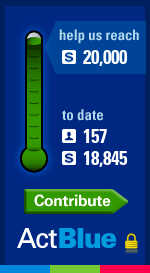 Blue America has been working with the Environmental Caucus and 90 For 90 to identify progressive candidates among the recruits and there are candidates running for Congress, the state House and the state Senate. The 2020 thermometer on the right is strictly for Florida candidates who could make a pivotal difference in re-jiggling the state power structure. The state Senate is on the verge of flipping-- and Kathy Lewis, Rachel Brown and Katherine Norman could do exactly that, giving the Democrats a seat at the table when it's time next year to redraw the district maps.


