Monday, April 06, 2020

A Quote For Trump's Tombstone: "I Don't Take Responsibility At All"

>

Die For Me by Nancy Ohanian

Unless you think it was just the racism and/or the anger at the establishment, you have probably asked yourself why over 60 million non-multimillionaires voted for Trump in 2016. Do all 60 million have IQs under 85, rendering them incapable of basic abstract thought and simple mental problem solving? Probably many of them do, but in an analysis for CNN yesterday, John Harwood pointed out that during the campaign Trump persuasively "pitched himself as a successful businessman and an executive, even though his actual record included a string of spectacular bankruptcies and lawsuits-- including an effort during the 2008 financial crisis to sidestep a $40 million debt to Deutsche Bank by invoking a "force majeure" clause likening the economic catastrophe to riots or floods. Rather than pay what he owed, he sued the bank claiming harm to his finances and reputation, eventually settling out of court. That's the executive Americans have seen in the White House during the coronavirus calamity. Instead of accepting responsibility for the administration's laggard, chaotic response, Trump has launched a full-scale attempt to shift blame onto others, including China and the media. Instead of crisp action and clear lines of command, Trump has offered indecision, changing his positions on guidance to the public and routinely undermining his own health experts. It's the opposite of the 'buck stops here' leadership that defines strong corporate executives and presidents alike. Yet while blame-casting may represent Trump's best option as a matter of raw politics, the 'not my fault' line poses a much tougher sell from the Oval Office than in 2016, when Trump was an outsider." Now we are in a recession, possibly headed for a depression and under Trump's malignant leadership nearly a third of the American economy has ground to a standstill.

Over the weekend, the Washington Post looked at the denialism and dysfunction with which the Trumpist regime approached the pandemic. They saw the enemy approach and they brought nothing but bluster and incompetence to the battle. Now hundreds of thousands of Americans are infected and the death toll is approaching 10,000.

Trump was told about the impending catastrophe early in January for U.S. intelligence agencies and even by his own Health Secretary Alex Azar. He dismissed their urgent entreaties as "alarmist" and now says Azar should have gotten his attention more forcefully. Maybe Azar could have set his hair on fire or staged a musical play or kidnapped Trump's grandchildren. Trump's response to the early warnings was to call it a hoax, tell the American people it was no worse than the common flu, that it was "totally under control," and that it would pass in a few weeks.


Tom Porter, writing for Business Insider, reported that "It was a lack or urgency from the White House, the failure to formulate a coherent chain of command and bureaucratic delays that meant that the US was unable to formulate a mass testing program in the early weeks of the outbreak to effectively track and isolate it, according to critics. It was only in March-- more than two months after being briefed by Azar-- that Trump finally realized the scale of the problem facing his administration, and that his legacy would be defined by his response."

In his report over the weekend for NBC News, Jonathan Allen quoted Eric Swalwell (D-CA):
This country is re-learning what it understood during the Cold War-- we don’t elect presidents for the good days, we elect them to handle the bad days. Donald Trump is incapable of handling a bad day, let alone a protracted pandemic.
Allen asserts that "More than two months into what President Donald Trump calls a "war" against COVID-19, his administration's efforts to combat the deadly disease, along with its disastrous effects on the U.S. economy, are often creating more problems than they solve. Bidding wars for life-saving equipment, a power struggle between Trump's son-in-law and the vice president, political gamesmanship, the centralization of authority and decentralization of accountability, and the creation of new government programs while standing bureaucracies are ignored, have all contributed to chaos within the political, economic and health care systems. Banks haven't been able to process loan applications for a new Small Business Administration relief program, companies trying to produce personal protective equipment for medical professionals can't get the Federal Emergency Management Administration's attention, and doctors and ventilators at ambulatory surgery centers idled by a soft moratorium on elective operations are on the sidelines." And it gets worse:
Those problems are minor compared to the crunch of rising coronavirus cases, the scarcity of ventilators and the possibility that trillions of dollars in aid won't be enough-- or well-directed enough-- to prevent a catastrophic economic collapse.

It all adds up to a sense that no one is really in charge in the midst of the most daunting crisis the nation has faced in generations.

...The absence of national leadership comes even at a time when Congress and the Federal Reserve are pumping cash into the system and many businesses who want to provide assistance have found they can't connect with federal agencies.

...[P]oor preparation for the pandemic has been compounded both by policies that have been implemented and by the Trump administration's inability to coordinate the distribution of health care assets-- equipment like ventilators, masks and gloves, and trained medical personnel-- and the effort to backstop an economy suddenly thrust into reverse.

More than three years into his tenure, Trump has blamed his predecessor, Barack Obama, for a barren national stockpile of needed medical equipment and at the same time said that the federal government should not be relied upon as a supplier.

"The states should have been building their stockpiles," he said at a White House press briefing this week. "We’re a backup. We’re not an ordering clerk."

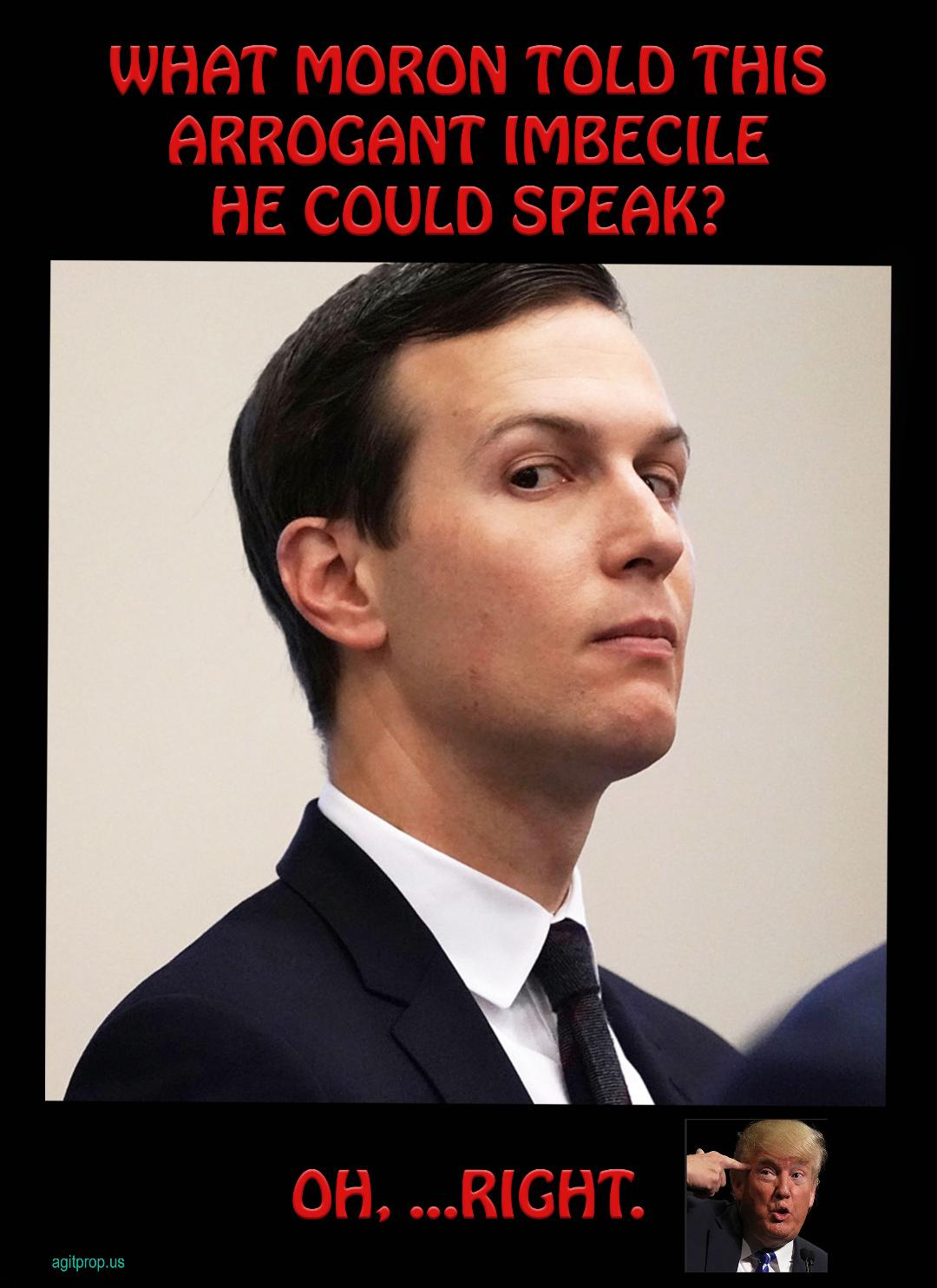
He also invited his son-in-law, Jared Kushner, to speak about the response for the first time, acknowledging the prominent behind-the-scenes role Kushner has taken in recent days on a task force that had been the domain of Vice President Mike Pence.

Moron by Chip Proser


"I've been serving really at the direction of the vice president and he's asked me to get involved in different projects," Kushner said in response to a question about reports that he is running a "shadow" task force parallel to Pence's effort.

The biggest issue on the front lines of the coronavirus fight is scarcity. On its own, that's not a problem of Trump's making, but it has been exacerbated by his insistence that states and cities compete with the federal government and private-sector buyers, including deeper-pocketed hospitals, for test kits, ventilators, masks, gowns and other items.

The truth is, there's not much equipment out there to be had. Much of the personal protective gear used in the United States is manufactured in China, where the coronavirus devastated production months ago.

On top of that, rising demand and the waiver of some federal rules for protective gear has inspired the development of a very hot "gray market" for the goods. That market means less quality control, buyers who are often unfamiliar with sellers or brokers as they are inundated with solicitations, prices that have skyrocketed, and orders that are frequently canceled at the last minute, according to several people involved in bidding for the equipment.

That can mean losses in terms of the opportunity cost of bidding teams' time, money thrown away or, even worse, the risk of outfitting emergency medical personnel with substandard equipment.

"The demand curve is far exceeding the supply curve ... which is resulting in unvetted and uncertified suppliers entering the marketplace," said Chaun Powell, vice president for strategic supplier engagement at the health care consulting firm Premier.

...More often than not, reports from around the country and across sectors of the economy show inefficiency from the federal government at best and incompetence at worst. In some cases, the administration's actions may have had unanticipated downsides.


U.S. Surgeon General Jerome Adams' admonition to limit elective surgeries was the right call but has hammered ambulatory surgery centers, just as stay-at-home guidelines have had a painful effect on health care providers who are not involved in the coronavirus fight more broadly, according to Jim Rechtin, CEO of Envision.

His company, which operates more than 250 ambulatory surgery centers and employs 27,000 clinicians, including 11,000 who work in emergency rooms, has ventilators on hand and doctors who are able to travel to work with coronavirus patients. He's looking for ways to get ventilators to hospitals-- despite his concern that they won't be replenished-- and clinicians need to be paid.

"It’s a mismatch of supply and demand-- part of that is coordination and part of it's the financial support to make it happen," he said, adding that there are "signs that there is early activity in this area but we could use more, faster."

Two people who spoke on the condition of anonymity said that FEMA isn't responding to requests from companies looking to supply goods for the coronavirus fight. The emergency management bureau's regional offices are well-schooled in disaster response, but the White House has basically thrown that organizational structure out the window in favor of centralizing power. Trump has also chosen not to use established logistics chains at other agencies, preferring a task-force model that has yet to wrangle the towering management challenge.

Outside the health system, businesses are closing up shop and laying off workers at a record pace. Ten million people have filed new unemployment claims in the last two weeks alone, and even industries that were expected to hum through the coronavirus crisis are witnessing severe slow-downs. Across the country, big trucks are parked for days on end with nothing to haul, according to multiple sources familiar with the industry.

"The food factories are reducing our shipments," said Dan Eberhart, who owns trucking and oil companies. "They’re doing this because the employees showing up at the factories are shrinking" in number.

Eberhart, who is a major fundraiser for GOP candidates, said Trump needs to get on the ball on the Small Business Administration relief program that has been overwhelmed by applications but unable to get off the ground.

"I have several industrial businesses seeking these SBA loans, and the banks won't even take the applications yet and/or haven't been able to submit them to the SBA," he said in a text message late Saturday night. "If President Trump doesn't speed this up, the U.S. is going to have an economy the size of the Cayman Islands." Right now, he appears to be having trouble proving he can manage a government bigger than that.

AP reporter Michael Biesecker, confirming Allen's report, wrote that "As the first alarms sounded in early January that an outbreak of a novel coronavirus in China might ignite a global pandemic, the Trump administration squandered nearly two months that could have been used to bolster the federal stockpile of critically needed medical supplies and equipment. A review of federal purchasing contracts by The Associated Press shows federal agencies waited until mid-March to begin placing bulk orders of N95 respirator masks, mechanical ventilators and other equipment needed by front-line health care workers. By that time, hospitals in several states were treating thousands of infected patients without adequate equipment and were pleading for shipments from the Strategic National Stockpile. Now, three months into the crisis, that stockpile is nearly drained just as the numbers of patients needing critical care is surging. Some state and local officials report receiving broken ventilators and decade-old dry-rotted masks. 'We basically wasted two months,' Kathleen Sebelius, health and human services secretary during the Obama administration, told AP."

Trump is now suggesting masks are optional but that if people can't find any they can cover their faces with bandanas and scarves. His congressional enablers, though, are still marching in lockstep behind him as he leads the country precariously towards the cliff. Mike Siegel is running for a Texas congressional seat held by a Trump stooge, Michael McCaul. McCaul is the ranking Republican on the House Foreign Affairs Committee, and had access to the earliest January-- and likely earlier-- warnings about the spread of COVID-19 in Wuhan. 

Yesterday Siegel noted that "Instead of taking action to save American lives, McCaul followed Trump’s playbook of ignore, deny, deflect. Now, after squandering critical months to activate U.S. manufacturing to provide the country with PPE, and ventilators, open shuttered hospitals, slow the spread and prepare for the surge-- McCaul’s only response is to blame China and promote xenophobia and a new 'red scare.' His inaction amounts to complicity in an ongoing crime against humanity that will result in a tremendous and substantially preventable loss of life."

Kara Eastman is in a similar situation-- in a winnable race against in Omaha for a swing district seat held by Trump enabler Donald J. Bacon. Kara told us that "Bacon has demonstrated his allegiance to this failed federal response by staging phony photo-ops in the community, putting vital nonprofit and health care workers, not to mention homeless men, women and children, at risk."

Similarly, Julie Oliver-- like Mike Siegel and Kara Eastman, is in a rematch of a 2018 race she nearly won-- is running against a knee-jerk Trump puppet, Roger Williams, who was regurgitating the Trump talking points on the pandemic through the first week of March. As recently as March 7, Williams said, "the risk still remains low for spread in our communities." Shortly before then, at the CPAC conference on February 27, Williams mistrustful comments on the ability of government to help citizens were on full display: "Big government picks winners and losers. It pushes down, you know, opportunity to create new thoughts and to create more jobs and that sort of thing. And Government needs to release regulations and let competition work. You know the best thing for small business or any business is let the customer tell you if you're doing a good job, not have the government trying to tell you what to do-- and consumers do that. So if you give good service and you have a good price and you have a good product, people will buy from you. And I'd like to see us get to where government does three things: collect my taxes, defend my borders, have good infrastructure and get the heck out of everybody's life. That should be our goal."

Goal ThermometerJulie, Mike and Kara all have distinctly different points of view about the role of government. That's why they are firm supporters of government programs like Social Security and Medicare-- and want to expand and strengthen both, while conservatives like McCaul, Bacon and Williams would like nothing better than to abolish both. Please consider helping the campaigns Julie, Mike and Kara have had to redesign because of the pandemic. Grassroots campaign techniques will have to give way to expensive mass media advertising that none of them have counted on. I implore you to click on the 2020 Blue America congressional thermometer on the right and contribute what you can to the candidates who will protect programs that conservatives hope to destroy under cover of the pandemic and the economic hard times their own disastrous response had thrust on the rest of us.

Labels: , , , , ,

Monday, November 11, 2019

Republicans Will Do Anything To Sabotage The Impeachment Against Trump

>


"Please stop using the Latin phrase 'quid pro quo' regarding the impeachment inquiry," is what 33 writers suggested in the NY Times yesterday. "Most people don’t understand what it means, and in any case it doesn’t refer only to a crime. Asking for a favor is not a criminal act; we frequently demand things from foreign countries before giving them aid, like asking them to improve their human rights record. That is not a crime; the crime is President Trump’s demand for something that will benefit him personally. But using this neutral phrase-- which means simply 'this for that'-- as synonymous with criminality is confusing to the public. It makes the case more complicated, more open to question and more difficult to plead. Please use words that refer only to criminal behavior here. Use 'bribery' or 'extortion' to describe Mr. Trump’s demand to President Volodymyr Zelensky of Ukraine, making it very clear that this is a crime. The more we hear words that carry moral imputations, the more we understand the criminal nature of the act."

Eric Swalwell, a guest on Face the Nation was good with that yesterday. He picked "extortion," as you can see if the clip up top. "We have" he told Margaret Brennan, "enough evidence from the depositions that we've done to warrant bringing this forward, evidence of an extortion scheme, using taxpayer dollars to ask a foreign government to investigate the president's opponent."

Adam Schiff by Nancy Ohanian


This is all driving Trump out of his adderall-infected mind. On Saturday he tweeted or retweeted 82 times, many of the tweets fighting against impeachment. He mentioned "impeachment," "impeach" or "impeachable" nine times, "Schiff" eleven times, the same number of time he mentioned "whistleblower."


And if he wasn't crazy enough before, what do you think this Rolling Stone title will do for him: Trump Sycophant Lindsey Graham Says 'Whistleblower' Is From the 'Deep State'. The loony and instinctually deceptive South Carolina closet queen and Senate Judiciary Committee chair has been all over the map on the transcripts. He boasted he hasn't and never will read the transcripts and the following day said he's read every word of them and has come to the conclusion there's no there there. "I’ve written the whole process off. I think this is a bunch of B.S.," he insisted. He's cracking up almost as much as Trump is.

Peter Wade wrote in his Rolling Stone piece that Trump and his regime "are too incompetent even to attempt the extortion plan, saying that the administration’s Ukraine policy was 'incoherent,' adding, 'They seem to be incapable of forming a quid pro quo.' So, the over-the-top Trump sycophant decided to go full Alex Jones and has turned to conspiracy theories to take heat off of the president. On Sunday, Graham told fellow Trump ally and Fox Business host Maria Bartiromo that the whistleblower, who initially brought the Ukrainian scandal to light, is part of the fictional entity called the deep state while also accusing Democratic House Intelligence Committee Chairman Adam Schiff of wrongdoing.

Unfake News by Nancy Ohanian


Lindsey: "When you find out who is the whistleblower is, I’m confident, you’re gonna find out it’s somebody from the deep state. You’re gonna find out find they had interactions with Schiff and this thing’s gonna stink to high heaven." Wade added that "With public hearings set to begin next week, we can expect more of the same from the president’s defenders. Trump’s actions have given them few other options."

Whites are now a minority in Kevin McCarthy's district Central Valley district and yet-- for some reason they have refused to answer satisfactorily-- the DCCC has continued never recruiting a candidate to run against him. Odd, isn't it? You can walk-- hike-- from the northern tip on Adam Schiff's district (Soledad Canyon Road) to Quartz Hill at the southern tip of McCarthy's district-- straight through CA-25. But it wasn't very neighborly for McCarthy to assert on Fox News yesterday that Schiff is single-handedly orchestrating a calculated coup against Trump and that Pelosi is the speaker in name only. Like everyone in DC, McCarthy is aware that Schiff doesn't make a move without clearing it with Pelosi first. McCarthy, as always, is just continuing to suck up to Trump. Why doesn't the DCCC go up against this pathetic clown?


Russia's on-going interference in the Brexit campaign-- and European elections-- were test cases for their on-going interference in American electoral politics. Other than Devin Nunes and Moscow Mitch there aren't many people who can deny that Russian money flooded into elections in Germany, Holland, France and the U.K... and then, the U.S. Now, in the midst of a U.K. snap election, is Russian money financing the Conservative Party again?

Yesterday, the Sunday Times reported that Britains' intelligence agencies are furious over Boris Johnson blocking publication of a report on Russian money flows into U.K. politics. Wealthy Putin cronies in London-- some of whom have become close with Johnson-- have given millions of dollars to the Conservative Party. Alexander Temerko, for example, who has worked for the Kremlin’s defence ministry and speaks about Johnson as a friend, "has gifted more than £1.2m to the Conservatives over the past seven years." The giving has increased dramatically since Jonson moved into Number 10 Downing Street. Between November 2018 and October 2019 Russians connected to the Kremlin have been around half a million pounds into the Conservative Party.

Culprits include Russian bankster Lev Mikheev, energy oligarch Alexander Temerko and Lubov Chernukhin, wife of Putin-s uber-corrupt former finance minister Vladimir Chernukhin. In 2014 Lubov donated £160,000 to the Conservative Party for a game of tennis with Johnson and former prime minister David Cameron, as well as a further £30,000 for dinner with the current Education Secretary Gavin Williamson. In total-- just last year-- Lubov gave the Conservatives £450,000.

A Labour Party official, Andrew Gwynne, responding to Johnson blocking publication of the report by pointing out that "Billionaires fund the Conservative Party, so this sordid cover up shouldn’t be surprising. The Tories blocked this report and oppose tax transparency so their billionaire backers can continue to rip us off unchallenged."

The Tories insist they're not purposely blocking the report, just that it takes a long time for things to get published.


Suddenly it matters which one is Lev and which one is Igor


And speaking of Russians... how about Ukrainians? Late yesterday, the NY Times dropped a doozy on Trump's head, Giuliani Associate Sats He Gave Demand For Biden Unquiry To Ukrainians. Lev-- of Lev and Igor-- went to Kiev before Zelensky's inauguration and announced that unless the new government publicly announced that it was investigating the Bidens, "Mike Pence would not attend the swearing-in of the new president, and the United States would freeze aid." Lev will be swearing to this when he testifies before Congress in the impeachment inquiry. This directly challenges the narrative of events from Señor Trumpanzee and his goon squad and directly links Giuliani "to threats of repercussions made to the Ukrainians, something he has strenuously denied." Igor denies there was any ultimate. And Giuliani said "Categorically, I did not tell him to say that."
The dispute represents the clearest indication yet that Mr. Parnas, who was indicted along with Mr. Fruman last month on campaign finance charges, has turned on Mr. Trump and Mr. Giuliani.

...Mr. Parnas’s account of the meeting, if corroborated, would reveal the earliest known instance of American aid being tied to demands for Ukraine to take actions that could benefit Mr. Trump’s 2020 re-election campaign. It would also represent a more extensive threat-- to pull Mr. Pence from the inaugural delegation-- than was previously known.

...Only three people were present at the meeting: Mr. Parnas, Mr. Fruman and Serhiy Shefir, a member of the inner circle of Mr. Zelensky, then the Ukrainian president-elect. The sit-down took place at an outdoor cafe in the days before Mr. Zelensky’s May 20 inauguration, according to a person familiar with the events. The men sipped coffee and spoke in Russian, which is widely spoken in Ukraine, the person said.

Mr. Parnas’s lawyer, Joseph A. Bondy, said the message to the Ukrainians was given at the direction of Mr. Giuliani, whom Mr. Parnas believed was acting under Mr. Trump’s instruction. Mr. Giuliani said he “never authorized such a conversation.”

A lawyer for Mr. Fruman, John M. Dowd, said his client told him the men were seeking only a meeting with Mr. Zelensky, the new president. “There was no mention of any terms, military aid or whatever they are talking about it-- it’s false,” said Mr. Dowd, who represents Mr. Fruman along with the lawyer Todd Blanche.

In a statement on Friday, Mr. Shefir acknowledged meeting with Mr. Parnas and Mr. Fruman. But he said they had not raised the issue of military aid. Mr. Shefir said he briefed the incoming president on the meeting. Mr. Shefir was a business partner and longtime friend whom Mr. Zelensky appointed as his chief adviser on the first day of his presidency.

“We did not treat Mr. Parnas and Mr. Fruman as official representatives, and therefore we did not consider that they could speak on behalf of the U.S. government,” Mr. Shefir said. He added Mr. Parnas and Mr. Fruman had requested that Mr. Zelensky meet with Mr. Giuliani.

Mr. Shefir said in his statement that he had told Mr. Parnas and Mr. Fruman “that we could consider meeting with Mr. Giuliani, but only publicly and officially and only after the inauguration of the newly elected president.”

The statement from Mr. Shefir, issued in response to an inquiry from the New York Times, did not directly address Mr. Parnas’s claims that he had delivered an ultimatum about American aid in general and Mr. Pence’s attendance at the inauguration. A representative for Mr. Zelensky did not respond to a request for further comment.

Mr. Bondy, Mr. Parnas’s lawyer, challenged Mr. Shefir’s characterization. “It would simply defy reason,” he said, “for Mr. Shefir to have attended a meeting with Mr. Parnas if he did not believe Mr. Parnas spoke for the president, and also for Mr. Parnas not to have conveyed the president’s message at this meeting.”

Mr. Pence did not attend the inauguration. His office said in response to questions from The Times that it had told Ukrainian officials on May 13, a week before the swearing-in, that the vice president would not be there.

Pence, Lev & Igor, Trumpanzee, Rudy-- The Gang's All Here

Labels: , , , , , ,

Tuesday, July 09, 2019

Primaries Are A Healthy Component Of Democracy But... Some Are More Crucial, In Effect, Than Others

>


Frances Motiwalla

The district right next door to mine, CA-34, includes Angelino Heights, Eagle Rock, Highland Park, El Sereno, Koreatown, Lincoln Hights, Boyle Heights, the Arts District, Chinatown, City Terrace... I'll tell you how great this district is. It's the only district in Los Angeles where Bernie beat Hillary in 2016. It's a young, vibrant, bustling district, alive with immigrants working to make a better life for themselves and their families. The district is 65% Latino and 20% Asian and the PVI is D+35. Trump won just 10.7% of the vote there.

In 2017 there was a special election to replace Xavier Becerra, who was reelected Attorney General and Blue America helped elect state Assemblyman Jimmy Gomez. He beat a more conservative Democrat, Robert Lee Ahn, in a very low turnout race-- 25,569 (59.2%) to 17,610 (40.8%). Gomez has been a bit of a disappointment in Congress. He takes dirty money and hangs back on important congressional activities. In the end, he pretty much always votes right but anyone who was looking for a leader from the most cutting edge district in Southern California (as we were) is disappointed. ProgressivePunch rates him an "A" and his lifetime crucial vote score is a hearty 95.14%-- right between Barbara Lee and Jerry Nadler. Hard to ask for anything better... except for some leadership. He always seems to hang back. He gets behind things like the Green New Deal and Medicare-For-All after everyone else has. He's not what we expected when we backed him-- no real regrets, but... Wouldn't it be great to have someone like AOC or Rashida Tlaib? The district can easily support that kind of leader.

So it was exciting this week to hear from a young activist, Frances Motiwalla, who is seriously considering primarying Gomez. I went to meet her over the weekend. Definitely AOC material, no question about it.

We'll come back to Jimmy and Frances sooner or later, but what I want to talk about now is something that Marie Newman, the progressive Democrat primarying Blue Dog Dan Lipinski in Chicagoland for the second consecutive cycle reminded me about over the weekend. She told me on Sunday, "alignment with your district is everything. If current incumbents are not in alignment, yes they should be primaried for sure. However, if an incumbent is still in strong alignment and producing proactive ideas, we should not be primarying just to do it. As a party, we need to work with focus and clarity."

Goal ThermometerI think primaries in general are healthy for democracy and I still agree with Marie and think there should be some kind of prioritization for organizations who work in the field. Yesterday I spent a lot of time on the phone with a super-progressive mayor in Milwaukie, Oregon, Mark Gamba. Mark, a full-on Berniecrat with a stellar record of accomplishment to prove it, is primarying one of the most venal Blue Dogs in the House, Kurt Schrader. How much more important is it to steer all the help we can to Gamba, while taking a back seat when it comes to races launched against incumbents who are merely... disappointing.

Yesterday a Chicago attorney, Andrew Heldut, popped up out of nowhere to say he's primarying one of the most effective progressives in the House, Jan Schakowsky. She's been a great member for her constituents (and for the country). I can't wait to see what kind of case Heldut makes. So far it was just that she's old and it's time for new leadership and that he's Polish-American. I doubt that'll fly in Schakowsky's district-- which goes from Lincoln Park through Evanston and Wilmette up to Winnetka and then west as far as Morton Grove, Des Plaines and Arlington Heights. That race hasn't moved me yet-- not the way Gamba's and Newman's have. And it isn't as intriguing as Motiwalla's either.

I noticed that Sunday USMC colonel (ret) and Iraq War veteran Sheila Bryant, an attorney launched a primary challenge against New Dem Anthony Brown, pointing out that he's detached from his job and just using it as stepping stone for a second run for governor in 2022. ProgressivePunch gives him a "D" grade-- far from acceptable in a district with a PVI of D+28 and where Hillary beat Trump 77.2% to 19.7%. So we'll look into Ms. Bryant and see if how much better a Rep. she would be. Like Brown, she's a Harvard graduate and a Bronze Star recipient. Her activism has been mostly in the field of criminal justice reform and is also running on affordable housing and healthcare. She made a good case for challenging him: "Anthony Brown doesn’t understand the tremendous urgency of now. Our president is out of control, our country is not dealing with our problems, and we need leadership that is ready to speak up, speak out and make a difference, not just show up to vote and call it a week. The country is falling apart, and Anthony Brown is treating Congress like it’s his nine-to-five, all while hoping he can use this as a stepping stone for the governorship. Congress is not a day job-- it’s a calling, and that’s why I’m running for this seat."

And then yesterday, Eric Swalwell decided to stop messing around with a pointless presidential "run" and get back home to the East Bay and see if Hayward, Dublin. Pleasanton, Union City and Livermore voters are still with him. While he wasn't minding the store, Aisha Wahab, a member of the Hayward City Council, decided to run. She has quite a following among activists and he may be in for a real fight. She's a lot more progressive than he is, with his ProgressivePunch lifetime crucial vote rating of "D."


Labels: , , , , , , , , , ,

Who's In? Who's Out? And What About Kansas?

>

Potential game-changers Kris Kobach and Tom Steyer

For context, in case you already forgot what Justin Amash told Jake Tapper Sunday: the political system is completely broken and dysfunctional. That said, Eric Swalwell decided to keep his House seat rather than keep pursuing a pointless run for the presidency. I bet Rob Bonta is glad he didn't give up his own seat in the state Assembly! Everyone thought Frackenlooper would be the first to bow out, but he probably didn't want to be the first to cut and run. Now he can be second-- not counting Richard Ojeda and Sherrod Brown, who few remember dropped out long ago. (Frackenlooper said he's ready to be a better candidate now; couldn't be a worse one.)

But Swalwell leaving the field doesn't even mean the number of contestants will go down. Billionaire Tom Steyer had an announcement he decided to make today. He's been telling staffers at his two political organizations, Need to Impeach and Next Gen that he's launching today. And, indeed he did. Or maybe he'll back out again. The NY Times reported this morning that Steyer plans to spend $100 million of his own money on his primary bid. Take a look at the announcement video he just released:


Democratic insiders, according to Chris Cadelago, are ready for The Winnowing. South Carolina strategist Mike McCauley: "if anybody is hanging on through Iowa outside the top six, we’re talking about a cabinet tryout or vanity.” By the Wednesday after Super Tuesday, it's not likely that anyone beyond Bernie, Elizabeth Warren, Kamala, and, if he hasn't self-destructed yet, Biden will be left standing.
Interviews with more than a half-dozen campaigns-- none of which would go on record-- and with dozens of other operatives, party officials and activists reveal an expectation that the upcoming debate in July will set in motion the initial culling of the 23-candidate field. Candidates who fall flat on the stage a second time, or fail to get traction, will see their finances dry up and be forced to exit. Those who fail to make the September debate-- when the criteria for entry will be even higher than the first two debates-- will be the next to go as their campaigns are denied the necessary oxygen to survive.

Others are expected to retreat and prepare for reelection to their current elected positions after failing to gain traction by summer’s end.

...The pressure on low-performing candidates to bow out is already bubbling up from the grassroots. Democratic voters have repeatedly signaled they’re tiring of the dizzyingly large field: Nearly three quarters of Democratic and independent left-leaning voters told a recent Hill-HarrisX poll that “too many” candidates are running for president.

The Iowa Poll, conducted last month for the Des Moines Register, CNN and Mediacom, found 47 percent saying they wished several candidates would drop out and another 27 percent saying they hoped that most of the candidates would relinquish their slim hopes.
OK, now let's move to a crucial Senate race-- in Kansas, where Pat Roberts (R), 83, is retiring. Kansas is a very safe red state. The PVI is an unassailable R+13. Trump beat Hillary 671,018 (56.16%) to 427,005 (35.74%). She won just two of the state's 105 counties! There are a dozen Republicans being talked about as potential successors to Roberts and two solid candidates, state Treasurer Jake LaTurner, and former Kansas City Chiefs player and current chairman of the Kansas Turnpike Authority Dave Lindstrom, are already running. But there's a problem: Trumpist neo-Nazi Kris Kobach. Once it was leaked that he would be meeting with staffers to discuss the campaign, he rushed out an announcement that he is indeed running. McConnell, though, made sure the NRSC was ready for him. A spokesperson said, on the record, that "Just last year Kris Kobach ran and lost to a Democrat. Now, he wants to do the same and simultaneously put Pressure Trump's presidency and [the GOP] Senate majority at risk." Harsh welcome!

In 2018 Kobach ran for governor and barely won the primary, edging out mainstream favorite Jeff Colyer by just 343 votes-- 128,832 (40,6%) to 128,489 (40.5%). Although Kobach completely dominated the fascist-oriented rural western part of the state, independents and mainstream Republicans just couldn't go all the way for a Nazi and he lost to Democrat Laura Kelly-- 506,509 (48%) to 453,030 (43%), getting wiped out in population-heavy Wyandotte, Johnson, Douglas and Shawnee counties and losing the biggest county of all, Sedgwick.

McConnell doesn't want Kobach to run again but yesterday Kobach was scheduled to meet with his top supporters in Leavenworth, not to begin a prison term, but to plot a strategy that may work out best for the Democrats. Like the far-right psychopath in Alabama, Roy Moore, Kobach is a better bet to win a Republican primary than a general election. Yesterday, the Kansas City Star reported that "Kobach spoke at the Leavenworth County Republican Party’s annual picnic on Saturday. It was one of his first appearances at a major political event in Kansas since his defeat. His comments focused on his role in an effort to build a border wall with private dollars. Kobach serves as general counsel and as a board member for We Build the Wall, Inc., which has raised more than $24 million for barriers at the U.S.-Mexico border."
Kobach didn’t mention a potential Senate candidacy at the event. But this weekend he and former staffers invited a small group of Kansas Republicans to a Monday afternoon gathering at the Leavenworth Riverfront Community Center.

State Rep. David French, a Lansing Republican, said Sunday he caught wind of the second event during the picnic but was unaware of what Kobach would discuss.

“I don’t think he told anybody what he was coming for. He did talk yesterday at the picnic about his building the wall project. So I don’t know if it’s some kind of a fundraiser for that or what,” French said. “People are speculating that he may be announcing tomorrow. That’s pure speculation as far as I know. I have nothing to verify that.”

Rett Rogers, chair of the Leavenworth County Republican Party, confirmed Kobach plans to have an event in the city on Monday, but he didn’t offer any other details.

“I know he’s having something here tomorrow. I just don’t know what it’s about,” Rogers said.

Two other Kansas Republican sources with direct knowledge of the event, who asked for anonymity to speak about it, confirmed that Kobach has instructed supporters to gather in Leavenworth. The northeast Kansas town has been a stronghold for Kobach in past campaigns.


Kobach did not respond to phone calls Sunday.

A former state GOP chair, he remains popular with a sizable segment of the Kansas Republican primary electorate because of his outspoken advocacy against illegal immigration and his frequent cable news appearances.

But some former Republican allies are skeptical of his ability to avoid the missteps he made as a gubernatorial candidate.

Kobach struggled to raise money and failed to reach out to moderate voters during the general election. GOP strategists have repeatedly blasted his campaign for its disorganization and poor voter turnout strategy.

“With all that Kansas Republicans are facing next cycle, the last thing we need is another Kobach debacle which distracts and divides us. If he cares about the conservative movement the right decision is not to run,” said Jared Suhn, a Republican consultant who oversaw Kobach’s early campaign for governor but quit in the spring of 2018 after disagreements with the candidate.

His entry into the Senate race could also cause national Democrats to steer money into Kansas to flip the open seat, which has been in Republican hands for eight decades but appears more competitive in light of Democratic Gov. Laura Kelly’s victory in 2018.

The Kansas Republican failed to land a position in Trump’s administration after his demands for access to a private plane and a walk-in privileges to the Oval Office were leaked to the New York Times.

A Kobach candidacy could reignite efforts to recruit Secretary of State Mike Pompeo into the race. Pompeo has repeatedly downplayed his interest in a run, but he remains the first choice for Senate Majority Leader Mitch McConnell.

Groups with ties to McConnell have indicated that they could spend money against Kobach in a primary.

“Kansas Republicans deserve a nominee who can win. Given the result in last year’s gubernatorial race, we’re watching this race closely and will make a decision on our potential involvement when the time comes,” said Jack Pandol, spokesman for the Senate Leadership Fund, a Republican super PAC with ties to McConnell.

Labels: , , , , ,

Sunday, July 07, 2019

Vanity Candidates For President-- Or Do They Want To Be The Next Ben Carson?

>


Richard Ojeda and Sherrod Brown both dropped out before they could make fools of themselves. Does anyone even remember they were once "running?" And Bloomberg and the Starbucks guy? Yesterday, Ed Kilgore, writing for New York Magazine, speculated on who would drop out first. The photo was Frackenlooper-- and he was the only guess. That's also the perfect guess since Frackenlooper continues to sink in polling, has raised a minuscule amount of money having only 13,000 donors, and has lost most of his staff (including his campaign manager, communications director, digital director and finance director). Plenty of people are wondering why the one-percenters are still in the 2020 race-- not to mention the would-be nominees struggling at or under 0.5% like these losers with their terrible, scowling Republican-lite platforms:
Steve Bullock- 0.4%
Frackenlooper- 0.2%
Tim Ryan- 0.0%
Seth Moulton- 0.0%
Eric Swalwell- 0.0%
John Delaney- 0.0%
Delaney, a crooked multimillionaire who spent a few years in Congress bashing progressive ideas, was the first candidate in and spent $17 million of his own cash on a race based from his new home in Iowa, only to be in last place-- and with support too low to measure. It would be fitting for him to also be the first to withdraw. The DNC allowed him to take part in the first debate but he's one of the 6 or 7 who aren't making it inti the one at the end of the month. The Democratic primary voters tolerant of conservative ideas are firmly lined up behind Status Quo Joe, leaving nothing at all for the likes of Delaney, Frackenlooper, Moulton, Bennet, etc. Right now, it looks like Bullock, Frackenlooper, Ryan, Swalwell, Moulton, Michael Bennet and Delaney won't meet the thresholds for the September and October debates.

On Saturday, Russell Berman, writing for The Atlantic, noted that for the little-known Representatives-- Tim Ryan, Eric Swalwell and Seth Moulton-- running for president may be only a stepping stone. A stepping stone to oblivion? They don't seem to think so. Berman claims they're running serious campaigns. Sad, considering none of them are gaining even the tiniest amount of traction.

Berman wrote that Ryan, Swalwell, and Moulton-- along with potentially a half-dozen or more of their Democratic rivals-- are also operating under an unstated reality of modern politics. The general election for the presidency may be a zero-sum game, where the winner gets to be leader of the free world and the loser is remembered forever as a runner-up. But the marathon party primary is more like that staple quote of high-school yearbooks: Shoot for the moon. Even if you miss, you’ll land among the stars. A popular, if trite, mantra for millions of American youth on the cusp of adulthood, this exhortation of ambition is also an apt (though never admitted) explanation for the long-shot campaigns of as many as a dozen Democratic presidential hopefuls. Underdog campaigns can be successful even in defeat, and the mere act of running for the pinnacle of American politics can be a stepping stone to higher office in and of itself. Just ask Energy Secretary Rick Perry and Housing and Urban Development Secretary Ben Carson, who parlayed White House bids into positions in President Donald Trump’s Cabinet. Or Joe Biden, whose failed presidential campaign in 2008 led to his selection as Barack Obama’s running mate and eight years as vice president." Berman is being overly generous towards many of the also-rans.
“If you don’t embarrass yourself-- and I don’t think so far anyone’s embarrassed themselves-- you end up in a better place than where you started,” Scott Ferson, a veteran Democratic consultant in Massachusetts, told me. Ferson worked on the 1988 presidential campaign of Representative Richard Gephardt, a future House leader who was then relatively unknown outside Washington, D.C., and his home state of Missouri.

Senators like Cory Booker of New Jersey, Kirsten Gillibrand of New York, Amy Klobuchar of Minnesota, and Michael Bennet of Colorado are currently languishing in the low single digits in 2020 polling, but they could be vice-presidential short-listers a year from now. So too, conceivably, could the governors in the race-- Jay Inslee, John Hickenlooper, and Steve Bullock-- or Julián Castro, the former secretary of housing and urban development.

All of the candidates above entered the race with resumes that checked the boxes of conventional presidential viability (at least until Trump came along): winning multiple statewide races, with years of experience either in the Senate or at the executive level managing a state government or Cabinet department.

That is not the case for Ryan, Swalwell, or Moulton, whose decisions to mount long-shot presidential bids have stumped political insiders-- even some former allies-- both in their own states and nationally, stirring suspicions that their real near-term goal is something other than the White House. The last politician to make the jump directly from the House to the presidency was James Garfield in 1881. Ryan, Swalwell, and Moulton lack the star power of Beto O’Rourke, the former Texas congressman whose near-win over Senator Ted Cruz last year made him a household name. Nor do they have the distinctive politics or personal story of Representative Tulsi Gabbard of Hawaii, whose strident anti-interventionist foreign-policy stance has set her apart from her rivals.
What do they want? To run for the Senate? Governor? To get a cabinet position? Ryan is a wishy-washy guy who can never make up his mind. It took him almost a decade after he decided to stop being anti-Choice to actually stop being anti-Choice. His trial balloons for higher office always fall flat. Berman wrote that "At 45, he’s trying to win over Democrats who are looking for a younger version of Biden with less baggage, and his supporters have suggested that he could be a potential running mate for a coastal senator like Kamala Harris of California or Elizabeth Warren of Massachusetts who might want to balance their ticket with a candidate who could appeal to white men in the Rust Belt. Yet they also acknowledge that the enhanced name recognition Ryan gets from even a losing national run could make him a stronger statewide candidate back home, where despite having served 17 years in the House, he is not well known across the entire state. Both DeWine and Republican Senator Rob Portman will be up for reelection in 2022." He's probably not going to make it onto the debate stage next time and I have a feeling his 0.0% polling isn't going to impress anyone back in Ohio.

Swalwell's not impressing anyone either. He tried for a viral moment with his pass the torch comment to Biden but... as well rehearsed as it was, it may have been too abstract for the average moron voter and it went nowhere. Is he running for Feinstein's-- or Kamala's-- Senate seat? Against Adam Schiff or Ted Lieu? Good luck with that. The filling deadline for his House seat is December so he still has time to get out of a presidential campaign that isn't going anywhere.
Ryan and Swalwell have struggled to break through, but the congressman running for president who’s in the most precarious position, both nationally and locally, is Moulton. The Massachusetts Democrat failed to make the stage for the first debates in Miami, and there’s no indication as of yet that he’s improved his standing for the second round of primary debates in July.

Moulton has less of a fallback option back home and a number of Democrats who are questioning his political judgment. The 40-year-old Marine Corps officer who served four tours of duty in Iraq burst to the forefront of Massachusetts politics when he toppled incumbent Representative John Tierney in a Democratic primary in 2014. He was seen as a likely statewide candidate, possibly even a strong primary challenger to Senator Ed Markey in 2020. But Moulton’s long-standing opposition to Speaker Nancy Pelosi, which continued even after Democrats regained the House majority last fall, angered voters, particularly women, in his district and the state party. “I think he’s got a better shot at being president than being a senator from Massachusetts,” said Ferson, who worked for Moulton’s winning congressional race in 2014 but is not involved with his presidential run. “He burned a lot of bridges in Massachusetts in the Democratic Party, and for statewide office you need party support.”

Moulton has plenty of time to run for reelection if he drops out of the 2020 race in the next several months, but several local activists and elected officials are considering a primary challenge. “He’s going to have an incredibly hard time getting reelected to his seat,” Mary Anne Marsh, a veteran Democratic consultant based in Boston, told me. “What looked like a bright future now looks like it could get derailed.”

Moulton has tried to distinguish himself by focusing on national security and foreign policy. He’s one of only a few military veterans in the large Democratic field, and he made headlines by talking openly about his struggle with post-traumatic stress disorder after returning home from Iraq. Given his cloudy future in Massachusetts, Moulton is seen as a possible contender for a Cabinet post if another Democrat defeats Trump-- potentially atop either the Veterans Administration or even the Pentagon.

...For Democratic candidates as well as the party’s voters, the great motivator remains Trump. “Donald Trump made everyone think, If he can do it, so can I. The barrier to entry has been lowered,” an aide to one long-shot candidate told me, speaking on the condition of anonymity.
Politicians, by necessity, often think very highly of themselves. Berman suggests that an underdog campaign for guys like Ryan, Swalwell, and Moulton, even if it doesn’t end in the presidency, could still open the door to opportunities that didn’t exist before. "And while they-- and the others struggling to break out of the pack-- may genuinely not have given much thought to the potential consolation prizes of a failed presidential bid, if they don’t catch that fire soon, they may have no other choice." Being the next Ben Carson or Rick Perry though... Is that a goal? And Dick Gephardt? He wound up on K Street as a detested slime-ball lobbyist.

Labels: , , , , ,

Friday, June 28, 2019

Did Democratic Primary Voters Notice Last Night That It Really IS Time For Biden To Pass The Torch?

>

Biden (senile): "Wish you were here," passing the torch to himself

I had a feeling Biden might not do well in the debate. But I never expected to see the total self-destruction. He should have been seated on a lawn chair with a hose to douse the other candidates for stepping on his lawn. Eric Swalwell summed it up before it even began! “I was six years old when a presidential candidate came to the California Democratic convention and said ‘It’s time to pass the torch to a new generation of Americans.’ That candidate was then-Senator Joe Biden. Joe Biden was right when he said it was time to pass the torch to a new generation of Americans 32 years ago. He’s still right today. If we’re going to solve the issues of automation, pass the torch. If we’re going to solve the issues of climate chaos, pass the torch. If we’re going to solve the issue of student loan debt, pass the torch. If we’re going to gun violence for families who are fearful of sending their kids to school, pass the torch.” Biden’s pathetic response: “I’m still holdin’ onto that torch.” It was the beginning of his debate-long meltdown.


He was angry and defensive and clearly the most awful would-be nominee on the stage! It got far, far worse during his argument with a very predatory and relatively skillful debater, Kamala Harris. He didn't seem prepared for the ambush that was absolutely coming his way. She had it all rehearsed and ready to go as soon as the opportunity-- in this case, Marianne Williamson's statement about slavery reparations-- came up. Watch:


She addressed him directly in a way that could not end well for him: “I do not believe you are a racist… but…” He claimed he “did not praise racists,” which he did and which she did not accuse him of doing. Watch the tape again. He was responding to his own, utterly unacknowledged, inner guilt about praising racists, not to what she said about him “talking about the reputations of two United States senators who built their… careers on the segregation of race in this country.” She also mentioned he worked with them to pass anti-busing legislation. He as much as called her a liar for saying he praised racists. But he did— over and over and over. She was only wrong about Ione thing: when she said he isn’t a racist. His long racist record in Delaware and then in the U.S. Senate is a racist record. No one ever says it out loud, but, let’s face it, he was chosen by the first black president to be his running mate to balance the ticket— a black and a racist, the ultimate Democratic Party balance. He also lied about busing. He didn’t just work for busing on a federal level. Previously to being elected to the Senate, he cynically built his reputation in Delaware as the anti-busing (pro-segregation) Democrat. And defending racism by citing “states rights” is a bad move in a post-‘50s Democratic primary. His revenge was to remind people— obliquely enough so most people probably didn’t get it— that Kamala was a very flawed prosecutor who was locking up black people for pot smoking. Still, the bullshit was seeping out of every pore in Biden’s traumatized body when he responded:

“Everything I have done in my career— I ran because of civil rights…” He first ran for office to prevent blacks from being able to exercise their constitutionally protected civil rights. Harris does no one any good by her crap about “I do not believe you are a racist.” Who cares if he is or isn;’t a racist? His RECORD is racist, regardless of what polite society decides it sees in his heart. As Biden said himself later in the debate: “My time’s up.”


People are saying Kamala had the best night. She may have, but she didn’t really drive the stake through Biden’s heart, just wounded him (perhaps mortally). As for the rest of her night… all she really does is repeat— WORD FOR WORD— Bernie’s talking points. Fine if she wants to steal the senator’s great ideas, but at least she ought to try putting them in her own words. Ans maybe Ione day we’ll find out if she has any ideas of her own (aside from setting Steve Mnuchin free for some meekly campaign contributions).

But for Biden— and his glass jaw— last night was a disaster, one he won;’t recover from. Whether it was the inevitable racism thing or his defense of the NRA or his inability to speak to a question about his judgment about leading the support for the unjustifiable invasion of Iraq— not just a bad vote— a leadership role. In fact, towards the end of the debate, one of the moderators, Chuck Todd, I think, asked each candidate to state in a couple of words, what he or she would prioritize once they were elected and in office, Biden started babbling about defeating Trump. Biden is the only Democrat who could possibly make Trump look relatively fit for office. A Biden nomination would be like a death knell for the Democratic Party. I think many Democratic primary voters saw that last night.

Will we see mass suicide at Biden campaign headquarters? No more checks? No  more chances for a White House gig in 2021?


The big take-away, besides Biden’s self-destruction, was that Bernie’s ideas dominated both nights of debate. The Democratic narrative is Bernie’s narrative, not Biden’s, not Kamala Harris’ and certainly not McKinsey Pete’s. As Elaine Godfrey put it late last night in The Atlantic, “Several of the candidates seemed to define themselves against Sanders, reflexively comparing and contrasting their agenda with his. It was a reminder of just how popular the senator from Vermont’s ideas have become since his first campaign, in 2016: His policies have dominated discussion for much of the past three years, helping pry open the Democrats’ Overton window, inch by inch. That’s especially true when it comes to health care. When asked about the pragmatism of progressives’ proposals, Senator Michael Bennet of Colorado said, ‘I agree with Bernie’ on his goal of universal health care. But ‘where I disagree is on his solution of Medicare for All.’ South Bend, Indiana, Mayor Pete Buttigieg, for his part, criticized what he sees as an impractical shift to a Medicare for All system. ‘Every person in politics who allows that phrase to escape their lips has a responsibility to explain how you are supposed to get from here to there,’ Buttigieg said.”
When the subject turned to student debt, the candidates jabbed at Sanders’s new proposal to cancel all Americans’ student debt, to the tune of $1.6 trillion, with no income or other restrictions. “I believe in free college for those whom cost could be a barrier,” Buttigieg said. “I just don’t believe it makes sense to ask working-class families to subsidize even the children of billionaires.” Biden explained that he would want to give students tuition-free community college instead.

The candidates, again and again, were playing the game on Sanders’s turf. He didn’t receive the Democratic Party’s nomination in 2016, and he might not secure it in 2020. But when the issues he’s long championed are being debated before 15 million Americans, in some ways he’s already won.


No, he will already have won, when he wins— when WE win, not the corporatists and Wall. Street banksters who have taken over both political parties, the GOP long ago and the Democrats, when Bill Clinton was getting a blow job from some ditz in the Oval Office. Bernie made it clear over and over again that it will take a political revolution to beat these forces. When that happens he/we win. Last night’s best quote wasn’t really from Kamala Harris’ useful attack on Biden. It was from Bernie: "Scientists tells us we have 12 years before irreversible damage. We have to come together against this common enemy, and transition the world off fossil fuels."


Labels: , , , ,

Wednesday, February 27, 2019

Candidate Swalwell?

>


Pete Stark was one of Congress' most liberal members. He beat another Democrat in a 1972 primary, claiming the incumbent had been in Congress "too long" and was then challenged-- and beaten-- himself on the same grounds 40 years later (2012). The victor in that tight race went to a moderate Democrat, Eric Swalwell, then a first-term member of the Dublin city council. Swalwell hadn't been born when Stark was first elected to Congress. You can't really blame him for his boss, but Swalwell's first federal job was as a staffer for one of the worst Democrats to ever serve in Congress from California, deceitful, corrupt and reactionary New Dem Ellen Tauscher. Stark was too senile to debate Swalwell or mount a viable campaign, while Swalwell's campaign was pretty brilliant. He beat Stark 120,388 (52.1%) to 110,646 (47.9%), beating him in both the Alameda County and Contra Costa parts of the district.

Until recently, Swalwell was just another relatively unaccomplished congressional backbencher-- not a Blue Dog, not a New Dem, not a member of the Congressional Progressive Caucus. ProgressivePunch gives him a "D" grade, the least progressive of the 53 California congressman other than the 16 with "F" ratings-- like Jim Costa, Scott Peters, Raul Ruiz, Ami Bera and Lou Correa from the Republican wing of the Democratic Party. Unlike any of them, though, Swalwell, turned out to be one of the moderates who signed on as an original sponsor of AOC's Green New Deal resolution.

Most Americans-- including most Californians-- only know him as a character on the MSNBC prime time flight, particularly on the Rachel Maddow Show, where he took off as a replacement for the over-used Adam Schiff character. He's made himself available to CNN and Fox a lot more than most members of Congress. He's a big-time Trump detractor, which thrills many Democrats who know little else about Swalwell. He's on two key committees that play right into Maddow's Putin-Gate theme, Intelligence and Judiciary. Straight-talking and telegenic-- and a brand new dad-- Swalwell was a TV hit. His twitter following ballooned from basically nothing to nearly half a million followers. But is that enough to base a presidential run on?


The latest New Hampshire poll I saw showed him at... well... Kirsten Gillibrand, John Delaney, Mayor Pete and Sherrod Brown are all at 1% and Tulsi and Julian are at zero and Swalwell is... below that. But he's in New Hampshire now, looking for an audience to talk to. (Aren't there important votes in the House this week?)

Anyway, Naomi Lim noted in an unfortunate Washington Examiner piece, Eric Swalwell tells New Hampshire he would offer a 'college bargain,' not free college a really bad approach. Imagine the colonists debating whether or not to declare independence. Would Swalwell have been sitting with Status Quo Joe Biden insisting that they should send King George another letter instead, asking for a reduction in the tax on tea? Or would he have been arguing that we needed to compromise on the Bill of Rights-- "why 10 amendments? how about if we do just 4?" I bet he would have suggested an anti-whipping bill instead of emancipation for the slaves. Who could oppose an anti-whipping bill? Well... this guy I guess, a perfect example of what the Republican Party has turned into-- and he sure hates Eric Swalwell! 10 points for Eric!

Lim reported that he was testing his "stump speech on Monday in New Hampshire, diverging slightly from other Democratic contenders by not promising free college tuition. He sounds like... Hillary, the only candidate in the known universe who could have lost to Trump.
"I would offer a college bargain," Swalwell said at the Politics & Eggs breakfast speaker series. "If you work through college, through work-study, and you come out [and] through part-time, volunteer service hours, lift up and help out a community in need, and still do your full-time job ... you can get a debt-free education. If you work for college, college should work for you in America. It's not free college, it's a bargain."

His three-prong proposal includes dropping the federal interest rate slapped on loans to 0 percent, allowing graduates to refinance or renegotiate for more competitive rates, and permitting employers to contribute to their employee's student debt tax-free while letting those employees receive the assistance without being taxed themselves.


“Go big, be bold, do good," Swalwell said repeatedly, signaling a potential campaign slogan.

But Swalwell on Monday remained mum about his 2020 plans when asked whether he would announce his intentions soon.

The California Democrat's comments, made in a state where graduates are burdened with some of the highest student loan debt in the country, come after fellow Democratic presidential hopeful Sen. Amy Klobuchar of Minnesota declined to support the roll-out of free four-year college for students if she won the party's nomination next year.

"If I was a magic genie and could give that to everyone and we could afford it, I would," Klobuchar said this month during a CNN town hall. "I'm just trying to find a mix of incentives and make sure kids that are in need-- that's why I talked about expanding Pell Grants-- can go to college and be able to afford it, and make sure that people that can afford it are able to pay."
The progressive proposal is to make public colleges free again-- not Harvard and Yale. We already paid for those colleges with our tax dollars and they were free or nearly free. I went to one of them in the late 1960s, before Swalwell was born. He should read more about it before he knocks it as an impossible dream. "Go big, be bold, do good" is a nice slogan-- as long as there's something behind it. The slogan matches up better with the platforms proposed by Bernie, Elizabeth Warren and Marianne Williamson.


Labels: , ,