Tuesday, July 09, 2019

Primaries Are A Healthy Component Of Democracy But... Some Are More Crucial, In Effect, Than Others

>


Frances Motiwalla

The district right next door to mine, CA-34, includes Angelino Heights, Eagle Rock, Highland Park, El Sereno, Koreatown, Lincoln Hights, Boyle Heights, the Arts District, Chinatown, City Terrace... I'll tell you how great this district is. It's the only district in Los Angeles where Bernie beat Hillary in 2016. It's a young, vibrant, bustling district, alive with immigrants working to make a better life for themselves and their families. The district is 65% Latino and 20% Asian and the PVI is D+35. Trump won just 10.7% of the vote there.

In 2017 there was a special election to replace Xavier Becerra, who was reelected Attorney General and Blue America helped elect state Assemblyman Jimmy Gomez. He beat a more conservative Democrat, Robert Lee Ahn, in a very low turnout race-- 25,569 (59.2%) to 17,610 (40.8%). Gomez has been a bit of a disappointment in Congress. He takes dirty money and hangs back on important congressional activities. In the end, he pretty much always votes right but anyone who was looking for a leader from the most cutting edge district in Southern California (as we were) is disappointed. ProgressivePunch rates him an "A" and his lifetime crucial vote score is a hearty 95.14%-- right between Barbara Lee and Jerry Nadler. Hard to ask for anything better... except for some leadership. He always seems to hang back. He gets behind things like the Green New Deal and Medicare-For-All after everyone else has. He's not what we expected when we backed him-- no real regrets, but... Wouldn't it be great to have someone like AOC or Rashida Tlaib? The district can easily support that kind of leader.

So it was exciting this week to hear from a young activist, Frances Motiwalla, who is seriously considering primarying Gomez. I went to meet her over the weekend. Definitely AOC material, no question about it.

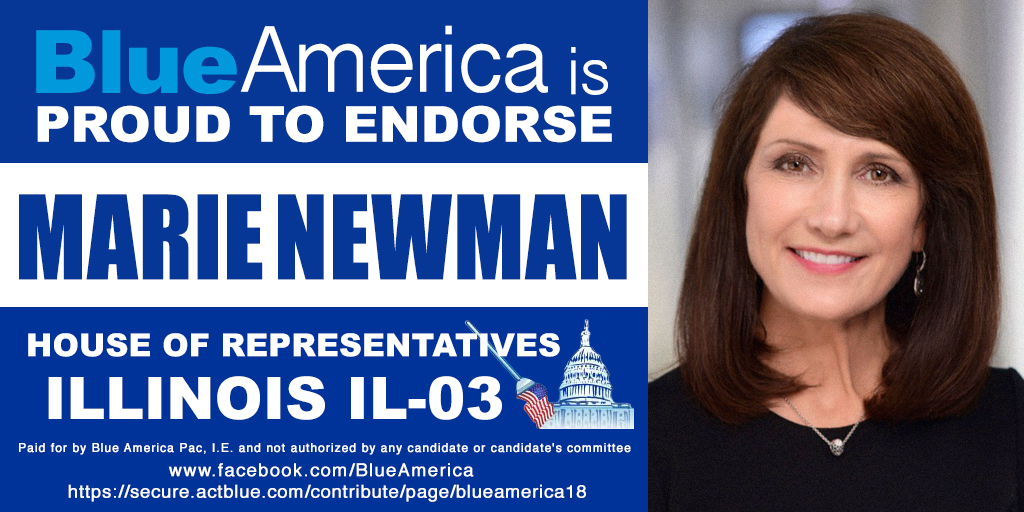
We'll come back to Jimmy and Frances sooner or later, but what I want to talk about now is something that Marie Newman, the progressive Democrat primarying Blue Dog Dan Lipinski in Chicagoland for the second consecutive cycle reminded me about over the weekend. She told me on Sunday, "alignment with your district is everything. If current incumbents are not in alignment, yes they should be primaried for sure. However, if an incumbent is still in strong alignment and producing proactive ideas, we should not be primarying just to do it. As a party, we need to work with focus and clarity."
Goal ThermometerI think primaries in general are healthy for democracy and I still agree with Marie and think there should be some kind of prioritization for organizations who work in the field. Yesterday I spent a lot of time on the phone with a super-progressive mayor in Milwaukie, Oregon, Mark Gamba. Mark, a full-on Berniecrat with a stellar record of accomplishment to prove it, is primarying one of the most venal Blue Dogs in the House, Kurt Schrader. How much more important is it to steer all the help we can to Gamba, while taking a back seat when it comes to races launched against incumbents who are merely... disappointing.

Yesterday a Chicago attorney, Andrew Heldut, popped up out of nowhere to say he's primarying one of the most effective progressives in the House, Jan Schakowsky. She's been a great member for her constituents (and for the country). I can't wait to see what kind of case Heldut makes. So far it was just that she's old and it's time for new leadership and that he's Polish-American. I doubt that'll fly in Schakowsky's district-- which goes from Lincoln Park through Evanston and Wilmette up to Winnetka and then west as far as Morton Grove, Des Plaines and Arlington Heights. That race hasn't moved me yet-- not the way Gamba's and Newman's have. And it isn't as intriguing as Motiwalla's either.

I noticed that Sunday USMC colonel (ret) and Iraq War veteran Sheila Bryant, an attorney launched a primary challenge against New Dem Anthony Brown, pointing out that he's detached from his job and just using it as stepping stone for a second run for governor in 2022. ProgressivePunch gives him a "D" grade-- far from acceptable in a district with a PVI of D+28 and where Hillary beat Trump 77.2% to 19.7%. So we'll look into Ms. Bryant and see if how much better a Rep. she would be. Like Brown, she's a Harvard graduate and a Bronze Star recipient. Her activism has been mostly in the field of criminal justice reform and is also running on affordable housing and healthcare. She made a good case for challenging him: "Anthony Brown doesn’t understand the tremendous urgency of now. Our president is out of control, our country is not dealing with our problems, and we need leadership that is ready to speak up, speak out and make a difference, not just show up to vote and call it a week. The country is falling apart, and Anthony Brown is treating Congress like it’s his nine-to-five, all while hoping he can use this as a stepping stone for the governorship. Congress is not a day job-- it’s a calling, and that’s why I’m running for this seat."

And then yesterday, Eric Swalwell decided to stop messing around with a pointless presidential "run" and get back home to the East Bay and see if Hayward, Dublin. Pleasanton, Union City and Livermore voters are still with him. While he wasn't minding the store, Aisha Wahab, a member of the Hayward City Council, decided to run. She has quite a following among activists and he may be in for a real fight. She's a lot more progressive than he is, with his ProgressivePunch lifetime crucial vote rating of "D."


Labels: , , , , , , , , , ,

Tuesday, December 18, 2018

Congress Should Not Be Self-Regulatory-- Especially Not When It Comes To Determining What Is And What Is Not A Bribe

>

The Subcommittee on Health-- the members

This morning I was on David Feldman's radio show and people were happy I had shown the connection between committee chairman and immense bribery flows from special interests the day before. OK, let me follow up on that a bit then. Let me go back to the crucially important House Energy and Commerce Committee, chaired, starting in a couple of weeks, by corrupt New Jersey machine hack Frank Pallone. Energy and Commerce has its fingers in a lot of pies-- as does the incoming chairman, Frank Pallone. This cycle his 5 biggest contributing sectors were sectors his committee writes legislation for:
Health- $724,700
Communications/Electronics- $333,451
Finance- $214,450
Labor- $187,525
Energy and Natural Resources- $178,199
His biggest industries this cycle were health professionals, Pharmaceuticals and Telecom services, industries he will be writing legislation for in the next Congress. but career-long, this is what he's gotten from the sectors that are most eagle to influence him:
Health- $6,067,900, the most of any member of the House, past or present!
Communications/Electronics- $1,536,862
Finance- $2,179,885
Labor- $2,891,945
Energy and Natural Resources- $862,516
I think I moved away from that $6,067,900 number too fast. Int deserves more attention-- and not just because of Pallone. According to its own website, "the Energy and Commerce Committee has the broadest jurisdiction of any authorizing committee in Congress. It legislates on a wide variety of issues, including:
• health care, including mental health and substance abuse
• health insurance, including Medicare and Medicaid
• biomedical research and development
• food, drug, device and cosmetic safety
• environmental protection
• clean air and climate change
• safe drinking water
• toxic chemicals and hazardous waste
• national energy policy
• renewable energy and conservation
• nuclear facilities
• electronic communications and the internet
• broadcast and cable television
• privacy, cybersecurity and data security
• consumer protection and product safety
• motor vehicle safety
• travel, tourism and sports
• interstate and foreign commerce
Since I have the PhRMA contributions broken down by member, courtesy of the Kaiser Health News-- and because pharmaceutical policy is so important for the committee and for tens of millions of Americans-- let's take a look at what kind of money from PhRMA comes flowing into the accounts of the members of the committee that write the legislation that impacts it. First the Republicans, who still run the committee for another couple of weeks. They are listed in order of seniority, starting with (outgoing) chairman Greg Walden and outgoing vice-chairman Joe Barton (followed by former chairman Fred Upton). The bolden names indicate members of the committee who are also members of the subcommittee on health. It's hard to miss this eye-popping bribes that have been showered on these ladies and gentlemen.
Greg Walden (R-OR)- $883,542
[Joe Barton (R-TX)- $408,500]
Fred Upton (R-MI)- $930,040
John Shimkus (R-IL)- $826,700
Michael Burgess (R-TX)- $683,392
[Marsha Blackburn (R-TN)- $440,917]
Steve Scalise (R-LA)- $431,000
Robert Latta (R-OH)- $159,500
Cathy McMorris Rodgers (R-WA)- $271,250
[Gregg Harper (R-MS)- $24,000]
[Leonard Lance (R-NJ)- $574,000]
Brett Guthrie (R-KY)- $480,550
Pete Olson (R-FL)- $77,000
David McKinley (R-WV)- $52,500
Adam Kinzinger (R-IL)- $225,000
Morgan Griffin (R-VA)- $80,500
Gus Bilirakis (R-FL)- $145,250
Bill Johnson (R-OH)- $66,500
Billy Long (R-MO)- $146,500
Larry Bucshon (R-IN)- $181,000
Bill Flores (R-TX)- $98,362
Susan Brooks (R-IN)- $155,500
Makwayne Mullin (R-OK)- $85,000
Richard Hudson (R-NC)- $169,500
Chris Collins (R-NY)- $115,400
[Kevin Cramer (R-ND)- $37,500]
Tim Walberg (R-MI)- $23,000
[Mimi Walters (R-CA)- $247,500]
[Ryan Costello (R-PA)- $166,500]
Buddy Carter (R-GA)- $85,000
Jeff Duncan (R-SC)- $13,000


I suspect that when Alexandria Ocasio made that statement above, she had incoming chairman Pallone in mind, perhaps because he has been working furiously to sabotage the creation of a GreenNewDeal Select Committee, or-- at the very least-- working to make sure it has no real power. It's his turf and keeping that turf brings him immense amounts of money and the power that attends money. So... here are the Democrats on the committee, again, in order of seniority. And, again, the members of the subcommittee on health are bolded. I do want to especially call 3 members to your attention who agree with Ocasio that when you're working on legislation for a particular industry, you do not take contributions from that industry: Jan Schakowsky, Kathy Castor and John Sarbanes.
Frank Pallone (D-NJ)- $840,700
Bobby Rush (D-IL)- $14,000
Anna Eshoo (D-CA)- $686,100
Eliot Engel (D-NY)- $184,500
[Gene Green (D-TX)]- $293,565]
Diana DeGette (D-CO)- $455,659
Mike Doyle (D-PA)- $65,000
Jan Schakowsky (D-IL)- $4,500
GK Butterfield (D-NC)- $346,985
Doris Matsui (D-CA)- $211,700
Kathy Castor (D-FL)- $15,000
John Sarbanes (D-MD)- 0
Jerry McNerney (D-CA)- $31,604
Peter Welch (D-VT)- $55,000
Ben Ray Lujan (D-NM)- $269,178
Paul Tonko (D-NY)- $74,098
Yvette Clarke (D-NY)- $70,000
Dave Loebsack (D-IA)- $24,500
Kurt Schrader (Blue Dog-OR)- $432,678
Joe Kennedy (D-MA)- $216,494
Tony Cárdenas (New Dem-CA)- $180,000
Raul Ruiz (D-CA)- $138,262
Scott Peters (New Dem-CA)- $311,500
Debbie Dingell (D-MI)- $31,000
A little tangent will take us to the Senate for a minute and then we'll be back to the House. On Monday, Elizabeth Warren (D-MA) sent a letter to Republican leaders of three Senate committees with jurisdiction over drug pricing issues, Health, Education, Labor, and Pensions (HELP) Committee Chairman Lamar Alexander (R-TN), Finance Committee Chairman-designate Chuck Grassley (R-IA), and Judiciary Committee Chairman-designate Lindsey Graham (R-SC), calling for them to open investigations and hold hearings on allegations of price fixing behavior by generic drug manufacturers. She was reacting to a Washington Post report about allegations of price-fixing activities by generic drug manufacturers that one expert described as "most likely the largest cartel in the history of the United States." According to these reports, "What started as an antitrust lawsuit brought by states over just two drugs in 2016 has exploded into an investigation of alleged price-fixing involving at least 16 companies and 300 drugs."
These allegations, if true, may help explain the numerous and increasingly troubling reports in recent years of rapid and unexplained price increases for generic drugs. While generic drugs have helped dramatically curbed healthcare expenditures, and are generally significantly less expensive than their branded counterparts, reported price spikes of 600%, 1000%, or more are profoundly troubling, and cause immense harm to patients in need.

The GAO in 2016 reported that over 300 generic drugs sold under the Medicare Part D program had at least one "extraordinary" price spike of over 100% in the five-year period from 2010-2015.

But evidence also suggests that generic drug markets are plagued by anti-consumer behavior and anti-competitive features that go far beyond high-profile price hikes of individual products. The industry is characterized by substantial consolidation: forty percent of generic drugs are now made by only one company, and the majority are made by one or two companies.

"If the allegations of price-fixing are true, they affect millions of Americans who purchase prescription drugs. The investigation should include the impact of such behavior on the Medicare and Medicaid programs, the Affordable Care Act, and the private health insurance market, as well as potential shortcomings in antitrust law and antitrust enforcement, and in the laws governing generic and biosimilar drug competition," wrote Senator Warren. "All of these issues are within your Committees jurisdiction, and Congress has a responsibility to investigate these concerns and legislate if necessary. 
The bicameral bill to address this was written by Warren and House Energy and Commerce Committee member (one of the clean ones), Jan Schakowsky (D-IL). Remember, we mentioned above she's on the health subcommittee and does not take contributions from the Industrial Medical Complex. Their legislation, the Affordable Drug Manufacturing Act, would:
Lower prices, increase competition, and address shortages in the market for prescription drugs through a newly established Office of Drug Manufacturing within HHS;
Authorize the Office to manufacture generic drugs under these key conditions, where competition is lacking:
◦ No company is manufacturing the drug;
◦ Only one or two companies produce the drug, and the price has spiked or the drug is in shortage;
◦ Only one or two companies produce the drug, the price is a barrier to patient access, and the drug is listed as an “essential medicine” by the World Health Organization;
Further authorize the Office to manufacture any drug that has been compulsorily licensed by the federal government;
Require the Office to begin production of generic insulin within one year of enactment;
Allow the Office to sell publicly-produced drugs at a fair price that covers manufacturing costs while taking into account the impact of price on patient access;
Improve the ability of new companies to enter the generic drug market by authorizing the public manufacturing of active pharmaceutical ingredients;
Jump-start competition by directing the Office to offer to sell its manufacturing rights to any company that commits to keeping the product on the market at a fair price;
Reserve any revenue generated from the sale of publicly-manufactured drugs for the use of the Office, making the office self-sustaining.
Looks like stuff that would be popular, right? Don't count it becoming law-- certainly not with the current Senate or the current occupant of the White House. And with this House... we're talking about a lot of money here. Let's see what Chairman Pallone does with this bill. We have already seen how he's trying to destroy the GreenNewDeal-- basically a plan that would would generate 100% of the nation’s electricity from clean, renewable sources within the next 10 years; upgrade the nation’s energy grid, buildings, and transportation infrastructure; increase energy efficiency; invest in green technology research and development; and provide training for jobs in the new green economy-- despite polling that shows 92% of Democratic voters and 64% of Republican voters want to see it move forward. That translates to 81% of registered voters saying they either support the plan.


Even a majority of self-described "conservative" Republicans back what the plan is attempting to accomplish. Yet, not a single Republican has signed on yet. So it isn't just Pallone, other turf-conscious chairmen and the Blue Dogs who oppose establishment of the select committee, but the GOP as well. The GOP doesn't get a vote. The Democrats decide this one on their own.


Back in the direction of health. Remember way back on Friday evening when a crackpot right-wing judge in Texas declared ObamaCare unconstitutional? And by morning, Señor Trumpanzee was celebrating. Republicans in Congress? Not so much... the dog had caught up with the car. So what happens next? I haven't herald many Republicans joining Trumpanzee in the celebration, despite the fact they had voted to repeal it literally dozens of times. They're very away that around 50 of their colleagues will not be back in Congress in January largely because of that opposition.

Pelosi: "Republicans are fully responsible for this cruel decision and for the fear they have struck into millions of families across America who are now in danger of losing their health coverage." Hopefully this will finally lead Democrats towards what they should have done instead of ObamaCare: Medicare-For-All. 124 Democrats in the House have signed onto H.R. 676, the Medicare-For-All bill, including almost all the members of the Energy and Commerce Committee-- but not Pallone.


Labels: , , , , , , , , ,

Friday, January 19, 2018

Major Political Explosion In Chicago!

>


Jan Schakowsky (D-IL) has a great voting record-- pretty much as good as it comes. ProgressivePunch rates her record a strong "A" and she's one of only 6 members of Congress this cycle with 100% scores (along with people like Barbara Lee, Jim McGovern and Jamie Raskin). When it comes to politics, though... she's on a different path, more often than not backing crappy DCCC/EMILY's List candidates who aren't nearly as good as she is on issues. One of the best grassroots activists in Illinois described her to me like this yesterday: "Schakowsky is a progressive on policy and establishment politically" and when I asked him why, he said "She is part of the good ol boy network... Pork for the district, her legislation moves forward, etc. All of these clowns are there for their own survival." Example: in IL-14, Randy Hultgren's Chicagoland seat primarily in McHenry, Kane and Lake counties she-- along with New Dem Bill Foster-- endorsed Matt Browley, a Republican pretending to be a Democrat. He's the establishment pick running against the grassroots progressive in the race, Jim Walz.

But how about an opposite example-- one that shows Schakowsky as the most amazing progressive fighter in Congress? This week, she and Luis Gutiérrez (who is retiring) did something no one ever does in Congress-- they endorsed a challenger and reformer against one of their own colleagues in a primary. No one does that. Pelosi and Hoyer come down on anyone who even thinks of doing that like 2 tons of bricks. But Schakowsky and Gutiérrez both announced they are backing progressive reformer Marie Newman in her tight primary race against reactionary and bigoted Chicagoland Blue Dog Dan Lipinski.


In Marie's own words: "It’s hard to overstate how big a deal this is. These two leaders know Dan Lipinski better than anyone, and they’re tired of seeing one of their fellow Democrats vote with President Trump and against the values of the Third District’s voters. They’re saying Marie Newman can do better. And they’re saying she can win.


Just look at the fight playing out on Capitol Hill right now. The vast majority of Democrats are banding together to stand with Dreamers, innocent young people who were brought to this country as children—many of whom know no other home.

This fall, President Trump announced he would end DACA, which President Obama put in place to protect Dreamers from deportation. Just this weekend, he rejected a bipartisan deal that writes these protections into the law.

We can’t count on Dan Lipinski to do what's right for Dreamers. After all, he voted against the DREAM Act and holds positions on immigration that look a lot like Trump’s.

This is why Reps. Schakowsky and Gutiérrez are eager for a new voice-- someone who will stand up for Dreamers and fight discrimination of all kinds.
Voters in IL-03 want change, not more status quo politics. In the presidential primary they backed Bernie who beat Hillary." Chicago's most credible political journalist, Lynn Sweet, wrote in Wednesday's Sun-Times that the move by Schakowsky and Gutiérrez "a rare break from the usual tradition of House incumbents either backing each other or staying neutral in a primary." Gutiérrez pointed out that "It’s not easy to endorse a challenger over a colleague in the House of Representatives, especially when that colleague is a member of your party... “Primaries are about definition of a party. I want to define myself with Marie Newman, and I hope the Democratic Party does too."


Schakowsky made it clear the move wasn't personal but about issues. Lipinski has been wrong on almost everything important to Democrats and has been especially egregious on Choice, health care, immigration and LGBT issues, where he virtually always votes with the Republicans.

Goal ThermometerThe DCCC and its corrupt conservative allies, like the Blue Dogs, New Dems, EMILY's List and the corrupt segments of the labor movement, will move with speed to counter Schakowsky and Gutiérrez and do what they can to prevent any kind of groundswell to develop for Newman. If you'd like to help Marie replace one of the absolute worst fake-Democrats in Congress, please consider clicking on the Blue America Primary A Blue Dog thermometer on the right and contributing what you can. When Blue America endorsed Marie 7 months ago, she explained in a guest post why she's running and what her priorities will be in Congress.
First, we must fight to protect and extend health care for all Americans. I believe the best way to do that is through phased-in approach to include some of the key proposals out there currently such as the Medicare for All initiative, introduced by Congressman Conyers and Senator Sanders. Until we have a President and Congress that will pass such a measure, we must fight to protect the Affordable Care Act from repeal. This includes retaining the elements of that law focused on women’s healthcare and reproductive rights, protecting Planned Parenthood and the millions of women it serves, and requiring insurance companies to cover those with pre-existing conditions.

Not only is my opponent the only Democrat from Illinois to vote against establishing the Affordable Care Act; he has voted repeatedly with the Republican majority to defund Planned Parenthood. This is an unacceptable assault on the rights and health needs of millions of women across our country.

Second, we need to put the needs and concerns of small businesses ahead of the big corporations who use their campaign money and lobbyists to turn the tax code to their advantage. It is our small businesses that create most of the new jobs in our country and that make up the majority of the businesses in the 3rd Congressional District.

In any restructuring of our tax code, we need to close the loopholes and special privileges that enable the wealthiest corporations to avoid their fair share of the tax burden and use some of those resources to help small businesses and entrepreneurs. We must also reverse the Citizens United decision, which has given a handful of right-wing billionaires a hugely disproportionate role in our elections and government. I believe every person’s voice and vote should matter the same.

My opponent takes three-quarters of his campaign money from Washington PACs and lobbyists, which is why he’s ignored the needs of small businesses without that kind of political clout. As a Member of Congress, I’ll reverse those misguided priorities and focus on promoting small business growth.

Third, too many students in our country are leaving college with huge debt but without employable skills. We should encourage the development of high school and college curriculums that actually lead to real jobs. For example, creating more cost-effective entry to community colleges and to create one and two year certifications with designated paths to well-paying jobs that will promote both job and community growth. This should apply to federally supported job retraining and career redirection programs, as well-- many of which could be administered through our community college system.
Last night, Natasha Korecki did some further reporting on this for Politico. Other than her refrying to the right-wing conservative Lipinski as "a centrist," there's some worthwhile info in her report, especially about how Lipinski is trying to defend himself.
Gutierrez framed the public shunning as a necessary response in the Donald Trump era: Democrats needed to unite against the president, and Lipinski couldn't be counted on to vote reliably with Democrats.

And yet there’s more to it than that. The act of throwing Lipinski under the bus was an exercise in bare-knuckled Chicago politics, and it was also a tale of a party that is an increasingly awkward fit for centrists like Lipinski.

"There’s an effort that is very detrimental to the Democratic Party, in that there’s the Tea Party of the Left that some people said they wanted to create. That’s bad for the party. That’s not going to be helpful in growing our numbers,” said Lipinski, who noted that the Tea Party movement was responsible for Trump’s ascendance. “I think we have to acknowledge that the way to get back into the majority into the Congress and pick up seats is to make sure we are a big-tent party and reaching out to people are moderate and not just push to the left."

Asked if he felt betrayed by his colleagues, Lipinski said he wasn’t surprised at all.

“Jan has worked against me in the past. She’s never come out formally against me. Her husband has been straight about working against me,” Lipinski told Politico. “It certainly does not surprise me. Even though I have supported her when she ran for vice chair of the caucus … I’ve been back and forth with Luis. He’s been with me, he’s not been with me. I’m not sure what his future is.”

To progressive groups angling to oust Lipinski, the seven-term Democrat is finally getting his comeuppance after years of votes against their interests. He was the only Illinois Democrat to vote against the Affordable Care Act, and the only Democrat in the House not to sign onto the Equality Act, which expands protections against discrimination on the basis of sexual orientation and gender identity. He also voted against the Dream Act, angering Chicago-area Hispanics.

Then there is Lipinski’s position on abortion, a sticking point in a party that has few remaining opponents of abortion rights.

Gutierrez and Schakowsky both cited Lipinski’s opposition to abortion as out of step with his district.

“I assure you that this district is overwhelmingly pro-choice,” said Schakowsky.

By endorsing Marie Newman, a businesswoman and former marketing consultant, Schakowsky and Gutierrez joined powerful national groups that have already coalesced behind the challenger, including NARAL, MoveOn.org, Democracy for America, Progressive Change Campaign Committee and Human Rights Campaign. Those groups expect a surge in progressive votes in the primary, providing the opportunity to oust one of the most conservative Democrats in Congress.

Still, Newman will need all the help-- and money-- she can get against Lipinski, whose family has held a seat in the district for decades.

"I am hoping it will encourage some donors to decide that they would support Marie,” Schakowsky said of her endorsement.

Privately, some Democrats question whether Gutierrez was settling a score with the powerful state party chairman Mike Madigan, a longtime ally of the Lipinski family. Gutierrez, who plans to retire at the end of this term, brought up in the news conference that during the last round of redistricting his district was redrawn to include a portion of Lipinski’s constituents.

“He jettisoned, 50-60,000 voters ... all of a sudden I have the zoo. Brookfield Zoo … Just think about it. Pilsen, Little Village, Humboldt Park, Back of the Yards,” he said, referring to Chicago neighborhoods heavily populated by Latino residents. He then added the punchline: “And I got Brookfield Zoo, thanks to [Dan] Lipinski. But he didn’t do it so I have the zoo in my congressional district. He did it because he was running away from progressive Democrats.”

Gutierrez later told Politico his remarks had "nothing to do" with Madigan or the redistricting process the state Democratic party controls. Rather, he said, they were a commentary that Lipinski had exported a part of his district, around a trademark Chicago-area zoo, that was growing more liberal.

Gutierrez said moving a portion of Lipinski's district into his own was a sign Lipinski and his clout-heavy Democratic backers knew he'd grown too conservative for his district. Lipinski insists he remains in line with his district, which includes Chicago and nearby suburbs, pointing to the endorsements of 30 mayors and village presidents just this week.

Wednesday’s move by Schakowsky and Gutierrez put them at odds with a more pragmatic [better word would be corrupt] faction of Chicago Democrats-- old guard Democrats who remain loyal to Lipinski’s father, former Congressman Bill Lipinski, and would prefer to leave his son be.

Sure, they argue, Lipinski takes some conservative votes and may even be out of step with his district, but “he has a hell of a name,” said one Democratic operative.

In other words: why is the party spending precious resources to oust an incumbent from a safe Democratic seat? Especially when Democrats are busy trying to oust a Republican governor from office and nearby GOP congressmen from their seats?
The party, unfortunately, isn't "spending precious resources to oust " Lipinski. Instead, they will spend precious resources to hold a Republican-supprting reactionary in a safe Democratic seat. Just Wednesday, for example, the Republicans passed a resolution top move forward on one of their crackpot anti-choice bills, HR 4712, and every Democrat opposed it except two, one of those two being Lipinski, of course.


Labels: , , , , ,

Saturday, December 23, 2017

Best of 2017

>


John Nichols put together The Nation's annual honor roll a couple of days ago. The video above, by Arcade Fire and Mavis Staples was the pick for Most Valuable Song, "I Give You Power." He wrote that "Protest music made a comeback in 2017. Fiona Apple wrote an anthem for the Women’s March ('We don’t want your tiny hands anywhere near our underpants…'). Bruce Springsteen and former Iron City Houserockers leader Joe Grushecky ripped the new president on 'That’s What Makes Us Great' ('I never put my faith in a con man and his crooks…'). Joey Bada$$ spoke truth to power with 'Land of the Free' ('And Donald Trump is not equipped to take this country over…'). Eminem delivered a freestyle anti-Trump rap that declared: 'Any fan of mine who’s a supporter of his / I’m drawing in the sand a line: You’re either for or against.' But there was something epic-- and refreshingly optimistic-- about the collaboration between Mavis Staples, who’s been singing freedom songs since the civil-rights era, and indie rockers Arcade Fire on 'I Give You Power.' Released on the eve of Trump’s inauguration (with proceeds directed to the American Civil Liberties Union), the song asked, 'Who gives you power? Where do you think it all comes from?' It answered: 'I give you power. I can take it all away.'"

"Resistance." he declared "was the watchword for 2017. Resistance not just to Donald Trump, but to a status quo that gave our most powerful bully pulpit to an actual bully. Progressives not only refused to go backward in 2017; they demanded a new conversation that challenged old orthodoxies." And some of his picks, the ones, basically, I'm pretty much in agreement with:
Most Valuable Senator
ELIZABETH WARREN

When Steve Bannon declared last February that the Trump administration was working toward “the deconstruction of the administrative state,” Warren recognized precisely what was at stake. The senator from Massachusetts knew that while the Trump agenda might frequently be hobbled by GOP disarray in Congress and judicial pushback, it would be advanced by the president’s appointees to cabinet posts and regulatory panels. Warren made it her mission to challenge Trump’s picks. Her diligence (along with that of the unions) helped prevent one of Trump’s worst nominees, fast-food executive Andrew Puzder, from becoming labor secretary. Her probing questions in confirmation hearings and searing speeches on the Senate floor so rattled Republicans that they tried to shut her down.

When Warren opposed Trump’s nomination of Jeff Sessions as attorney general by reading, from the Senate floor, a 1986 statement by Coretta Scott King opposing Ronald Reagan’s nomination of Sessions to serve on the federal bench, majority leader Mitch McConnell rushed to silence her. Charging that she had “impugned the motives and conduct of our colleague from Alabama,” the Republican got his colleagues to bar Warren from participating in the remainder of the debate. “She was warned,” McConnell announced. “She was given an explanation. Nevertheless, she persisted.” The majority leader had unwittingly created a meme; the “she persisted” line, which now adorns T-shirts, posters, and bumper stickers, became the preeminent rallying cry of 2017.

Warren plays defense brilliantly, as was evident when she shredded administration moves to derail the Consumer Financial Protection Bureau. But she’s best on offense: making monopolization of the economy a political issue, working with Senator Bernie Sanders to get Democrats on board for single-payer health care, and successfully amending the National Defense Authorization Act to require an annual report detailing civilian casualties resulting from US military operations.

Most Valuable House Progressive
JAN SCHAKOWSKY

The Illinois Democrat finished 2017 by ripping GOP tax policies with seasonally appropriate verse (“’Twas the Night Before Tax Scam”) that concluded by warning Paul Ryan, “There’s nowhere to hide, / There’s no ‘cover your ass,’ / When you choose to take sides / Against the middle class.” A product of the Prairie State’s rough-and-tumble politics, Schakowsky knows how to fight—but she does so with a humor and humanity that’s often missing from congressional clashes. This has made her a leading figure in both the House Democratic Caucus and the Congressional Progressive Caucus. She kept her party united on votes to preserve the Affordable Care Act and to protect Medicare, Medicaid, and Social Security. But Schakowsky didn’t stop there; she waded into every debate, leading the charge to protect the Children’s Health Insurance Program, cut prescription-drug prices, preserve net neutrality, defend immigrants, and expand protections for women in the workplace.

Most Valuable House Newcomer
RO KHANNA

Capitol Hill’s steadiest champion of congressional oversight on war-making, Representative Barbara Lee always needs allies. She got a great one when Khanna arrived in January. Lee’s fellow California Democrat jumped into a leadership post with the Congressional Progressive Caucus (as did two other outstanding newcomers, Washington’s Pramila Jayapal and Maryland’s Jamie Raskin) and emerged as a savvy champion of net neutrality. But the law-school instructor made his boldest mark as an advocate for the restoration of constitutional checks and balances. Khanna decried the use of tax dollars to “bomb and starve civilians” in Yemen and-- working with CPC co-chair Mark Pocan and libertarian-leaning Republicans-- drafted legislation to block US support for Saudi Arabia’s brutal assault on that country. In November, Khanna and his allies forced a debate on the issue, getting the chamber to vote 366–30 for a nonbinding resolution stating that US military assistance for the Saudi war was not authorized by Congress. That was a small step. But with support growing for Lee’s effort to overturn the 2001 Authorization for Use of Military Force, which has served as an excuse for military adventurism, Khanna says the Yemen vote signals that the project of “re-orienting our foreign policy away from our Saudi alliance and away from neocon/neoliberal interventionism” is finally beginning.

Most Valuable Mayor
CARMEN YULÍN CRUZ

Puerto Rico is not allowed to send voting representatives to the US Congress. But after Hurricanes Irma and Maria swept through the Caribbean, San Juan’s mayor refused to allow the federal government to neglect the people of Puerto Rico and the Virgin Islands. Her objection to claims that bumbling recovery efforts were somehow going smoothly drew the ire of President Trump, but Cruz did not back down. “The Trump administration can’t handle the truth,” she declared. Addressing the president directly, Cruz said: “Mr. Trump, do your job. Lives are at stake. This is not about politics. This is not about your ego. This is about the people of Puerto Rico and the [Virgin Islands].” Her advocacy got national attention and helped secure vital aid, as officials recognized the truth of Cruz’s assertion that “survival cannot be our new way of life.”

Most Valuable Inside/Outside Progressive
BERNIE SANDERS

Polls identify him as the nation’s most popular prominent political figure, and Sanders used that popularity to build movements in 2017. The Vermonter did plenty of work in the Senate: introducing Medicare for All legislation that drew unprecedented support, and grilling Trump cabinet picks like Education Secretary Betsy DeVos, whom he asked: “Do you think, if you were not a multibillionaire, if your family had not made hundreds of millions of dollars of contributions to the Republican Party, that you would be sitting here today?” Outside Washington, Sanders rallied red-state voters against Trump’s agenda, defending the Affordable Care Act at “Care Not Cuts” rallies in Kentucky and West Virginia; barnstormed across Pennsylvania and Ohio on a “Protect Working Families” tour sponsored by MoveOn.org and Not One Penny to oppose the GOP tax bill; and helped Indiana steelworkers expose the administration’s failure to advance fair trade. Sanders also marched in favor of union rights in Mississippi with thousands of United Auto Workers activists, civil-rights campaigners, and members of the new Good Jobs Defenders coalition.

Most Valuable Union
AMERICAN POSTAL WORKERS UNION

If you want to see solidarity in action, consider the response of the union that represents more than 200,000 US Postal Service employees and retirees to last summer’s Nazi violence in Charlottesville, Virginia. APWU president Mark Dimondstein explained to his members that rallying “for equality and against the hate-mongers” is essential union work. “What does all this have to do with the APWU? Everything!” argued Dimondstein. “Fascists are bitter enemies of workers and our unions. Their race and religious bigotry, intimidation, and violence are a direct threat to our unity and ability to stand up and fight back to save the public Postal Service, win good contracts, gain better working conditions, enjoy a better life, and live in a more just society.”
There's lots more. I want to mention I have two runners-up with Ro Khanna for most valuable House freshman: Pramila Jayapal and Jamie Raskin. Next year I'll look forward to seeing Randy Bryce on the list.

Labels: , , , , ,

Friday, July 21, 2017

Randy Bryce-- On The Environmental Challenges That Face Us All

>


Let me put the bullshit smear about Randy Bryce favoring tar sands to bed right here and now. A political operative being paid to smear Bryce in progressive circles-- something that helps no one but Ryan-- has been running around making up stories about how he was pro-tar sands pipeline and basing it on "his union was for it and he's for his union, so therefor..." The assertions didn't jibe with Randy's very vocal backing for Bernie in Wisconsin, even after his union endorsed and started working for Hillary, nor did it fit in with discussions I've had with Randy before he declared his candidacy for Paul Ryan's congressional seat. His dedication to clean energy and to an environmental agenda to fight global warming, precluded backing tar sands pipelines. Endorsements by Blue America, the Working Families Party and DFA don't go to pro-tar sands candidates.

According to a statement to DWT from Working Families Party's Wisconsin Director, Marina Dimitrijevic:
We take our candidate vetting process seriously, and especially for high office. When Randy was considering getting into the race, climate was one of many topics we covered. He's firm in his opposition to the construction of dirty energy pipelines. He also wrote in his endorsement questionnaire in support of transitioning to 100% renewable energy by 2050. Who could be a better messenger to make the case for clean energy jobs instead of dirty pipeline jobs than someone like Randy?

Randy is the real deal. We don't endorse in every race, but we do when we see someone who shares our values so whole-heartedly and can win. Randy is not just any candidate. He has been involved in the Wisconsin WFP since we launched. I don't know many federal candidates who have been actively involved in building the institutions of the progressive movement than Randy.

Beating Paul Ryan is going to be an uphill battle. He'll have all the money in the world from every polluter, banker, union buster, and every other corporate interest. Our early endorsement helps make sure we have the time to build the kind of massive organization that will it will take to rival all that money.
The first time I talked to Randy about it he told me, simply that he'd "turned down 100K working in Canada on the tar sands while I was collecting unemployment because I didn’t want to make money by contributing to the project." Last night he gave me a more formal statement:
Combatting Climate change is one of my top priorities and it will be a major focus for me as a member of Congress from southeast Wisconsin. Along with that, we must immediately reduce our reliance on fossil fuels by investing in clean, renewable energy. We can create millions good-paying jobs by transitioning to a clean energy economy in which windmill and solar panel construction, installation, and maintenance employ my brothers and sisters in the labor movement.

Transporting fossil fuel presents a critical, and immediate environmental danger, whether by pipeline, ship, rail, or road. We need to have strong federal standards and protections to ensure that our natural resources and public health are protected. I do not trust that the CEO’s and corporate boards care about these matters, and as a member of Congress I will be on the side of our communities when a potential hazard is identified.

I have specific concerns about alternative dirty energy projects which are becoming all too popular. For example, tar sands are an especially dirty form of oil that are all too often categorized as clean by the entities looking to profit at the expense of our health and safety. As an ironworker, I was once offered the opportunity to work on one of these tar sands projects and immediately turned it down. My first concern is always the ability to take care of my family, and I need work to do so. However, I was taught to have courage in my convictions and in order to do so-- and to set a good example for my son-- I turned down this opportunity.

I am extremely concerned about the environmental impact of fracking, which reports suggest are now causing earthquakes and contaminating ground water. I’m deeply concerned that this dirty process-- and similar dirty processes-- disrespect and deny protections to indigenous nations. We must protect treaty rights and the rights of indigenous nations as we work together to build a bigger table, at which we can all succeed.

Let’s be honest, folks running for political office all too often say the right thing and then go to the capitol and carry out the wishes of the fat cats. As I’ve told folks every day on this campaign, I pledge to not take campaign contributions from the fossil fuel industry-- their executives or their political action committees. I will hold true to this as candidate for Congress, and as a Congressman, after we repeal and replace Paul Ryan, who benefits from the greed and profits of big oil and the fossil fuel industry.
Jan Schakowsky's Illinois district is very close to WI-01. In fact it was Jan who proposed the Congressional Progressive Caucus endorse Randy (which it did-- unanimously). She's known to usually favor female candidates but at a meet and greet for Randy in DC this week, she was practically in tears introducing him. "The residents of Wisconsin’s 1st Congressional District deserve a representative that will show up and fight for them. As a veteran, ironworker, and cancer survivor, Randy Bryce understands the challenges Wisconsinites face daily. His sleeves are rolled up and ready to work.”

Yesterday Ruben Gallego, a progressive Democrat from Phoenix also spoke up for him: "I am excited to endorse Randy Bryce for Wisconsin's first Congressional District against Speaker Paul Ryan. Randy comes from a working class background and has served his country. As a fellow veteran, I know Randy has the training, toughness, and hard work mentality to fight for the people in Wisconsin. His leadership and values are needed in Congress more, now than ever."

Labels: , , , , , , , ,

Friday, May 19, 2017

Paul Ryan Has Been Lying About What TrumpCare Will Do To People With Pre-Existing Conditions

>


Wednesday, the Kaiser Family Foundation released a new study that goes a long way towards shedding light on what enactment of TrumpCare would actually mean to the millions of people with pre-existing conditions. Short version: over 6 million Americans will wind up unable to afford health insurance or having to pay a lot more for coverage. The study is important because Ryan and his cronies have made a systematic effort to deceive the American people as to the impact of the toxic legislation that was narrowly rammed through the House. One of the fatal flaws- literally fatal-- in TrumpCare is that it "contains a controversial provision that would allow states to waive community rating in the individual insurance market," the concoction of radical right North Carolina extremist Mark Meadows. Kaiser attempts to explain Meadows' horrific vision of health care.
Under the provision, insurers in states with community rating waivers could vary premiums by health status for enrollees who have had a gap in insurance of 63 or more consecutive days in the last year. The higher (or lower) premiums due to health status would apply for an entire plan year (or the remainder of the year in case of people signing up during a special enrollment period), at which point enrollees would be eligible for a community-rated premium unrelated to their health.

States waiving community rating would be required to set up a mechanism to subsidize the cost of high-risk enrollees, such as a high-risk pool, or participate in a reinsurance arrangement that makes payments directly to insurers. States are not required to set up an alternative source of coverage for people who face higher premiums based on their health.

The bill makes $100 billion available to all states for a variety of purposes, including high-risk pools, reinsurance programs, and cost-sharing subsidies. An additional $15 billion is made available for a federal invisible risk-sharing program, which would be similar to a reinsurance arrangement. Another $15 billion is earmarked for spending on maternal and newborn care, mental health, and substance abuse services for the year 2020.  The AHCA also allocates $8 billion over five years to states that implement community rating waivers; these resources can be used to help reduce premiums or pay out-of-pocket medical expenses for people rated based on their health status.


Premiums varied significantly based on health status in the individual market before the Affordable Care Act (ACA) prohibited that practice beginning in 2014. Insurers in nearly all states were also permitted to decline coverage to people with pre-existing conditions seeking individual market insurance. We estimate that 27% of non-elderly adults have a condition that would have led to a decline in coverage in the pre-ACA market. While insurers would have to offer insurance to everyone under the AHCA, people with declinable pre-existing conditions would likely face very large premium surcharges under an AHCA waiver, since insurers were unwilling to cover them at any price before the ACA.

The effect of a community rating waiver would depend crucially on how many people with pre-existing conditions have gaps in insurance that would leave them vulnerable to higher premiums.

Using the most recent National Health Interview Survey (NHIS), we estimate that 27.4 million non-elderly adults nationally had a gap in coverage of at least several months in 2015. This includes 6.3 million people (or 23% of everyone with at least a several-month gap) who have a pre-existing condition that would have led to a denial of insurance in the pre-ACA individual market and would lead to a substantial premium surcharge under AHCA community rating waiver.

Among the 21.1 million people who experienced a gap in coverage and did not have a declinable pre-existing condition, some also had pre-existing conditions (such as asthma, depression, or hypertension) that would not have resulted in an automatic denial by individual market health insurers pre-ACA but that nonetheless could also result in a premium surcharge.

In many cases, people uninsured for several months or more in a year have been without coverage for a long period of time. In other cases, people lose insurance and experience a gap as a result of loss of a job with health benefits or a decrease in income that makes coverage less affordable. Young people may have a gap in coverage as they turn 26 and are unable to stay on their parents’ insurance policies. Medicaid beneficiaries can also have a gap if their incomes rise and they are no longer eligible for the program.

Through expanded Medicaid eligibility and refundable tax credits that subsidized premium in insurance marketplaces, the ACA has substantially reduced coverage gaps. In 2013, before the major provisions of the ACA went into effect, 38.6 million people had a gap of several months, including 8.7 million with declinable pre-existing conditions.

Some people with a gap will ultimately regain coverage through an employer-based plan or Medicaid, and would not be subject to premium surcharges based on their health. However, anyone who has been uninsured for 63 days or more who tries to buy individual market insurance in a state with a community rating waiver would be subject to medical underwriting and potential premium surcharges based on their health.
Why are Republican extremists like Meadows insisting on this gotcha approach that potentially enables the ruination of millions of Americans' lives instead of helping to shore them up. We turned to Matt Coffay, the progressive Democrat running for the North Carolina seat Meadows currently holds, for some insight. Matt isn't wishy-washy or tentative about what the problem is or how to solve it. This morning, he told us
Goal Thermometer
The bottom line here is that Mark Meadows is out of touch with the people of his district. In addition to the loophole for pre-existing conditions, the AHCA also includes $880 billion in cuts to Medicaid. Meanwhile, two rural medical centers in the district are shutting down their labor/delivery and palliative/hospice services due to Medicaid cuts. Meadows is literally voting for legislation that hurts working families, women, children, and the elderly here in Western North Carolina. And he's hedging his bets on the fact that the whole situation with community ratings, Medicaid, insurance premiums, coverage gaps, etc., is too complicated for the average person to be able to follow. Just reading the report from the Kaiser Family Foundation shows how complicated this whole situation has become.

The people of this district are tired of all this complicated stuff. They're tired of excuses, and they're tired of dealing with insurance companies. It's time we made this situation a whole lot simpler. It's time the millionaires and billionaires in this country started paying their fair share, and that we took that money and made sure that health care is available to every single person in the United States. No more fighting with your insurance company, no more jargon. Let's get rid of the mess that insurance companies create, and replace it with a simple system: Medicare for All.
Meanwhile in a related matter, Jan Schakowsky, Chair of the Congressional Progressive Caucus’ Health Care Task Force, sent a letter to Señor Trumpanzee proposing that they work together to reduce the skyrocketing costs of prescription drugs. The letter lays out specific proposals for how the Administration and the Congressional Progressive Caucus could work together during the upcoming reauthorization of the Food and Drug Administration User Fee Agreements.
Throughout your campaign and since becoming President, you have repeatedly stated your desire to lower drug prices. In fact, as recently as March 7, 2017, you stated that you are working on a new system to enhance competition and reduce the price of prescription drugs.  We share those goals and believe that we need to take immediate action to reduce the skyrocketing cost of drugs. To that end, we believe the upcoming reauthorization of the User Fee Agreements (UFAs) provides an opportunity for your Administration and Congress to work together to reform our drug pricing system and bring relief to American families.

...The time has come for us to act. We cannot sit by and watch Americans struggle to afford the drugs they need and jeopardize critical public insurance programs like Medicare and Medicaid as their drug spending continues to rise. We urge you to work with us to improve the lives of millions of Americans by lowering drug prices.
Schakowsky's letter comes as part of the Progressive Caucus' continuing efforts to solve the prescription drug spending crisis facing working families. Kaiser found that 77% of Americans believe the price of drugs is unreasonable, and studies have found that a quarter of American families cannot fill a prescription due to the cost of the drug. Schakowsky's letter identifies specific opportunities for Congress and the Administration to work together to lower drug pricing during the reauthorization of the UFAs between prescription drug companies and the FDA. Ideas for action include requiring Medicare to negotiate for the price of drugs, requiring rebates for high-priced drugs, improving transparency around drug pricing, and ensuring generic drug manufacturers have access to the materials they need to conduct studies essential for FDA approval.

Labels: , , , ,

Saturday, June 06, 2015

Democrats Who Vote For The Toxic Republican Agenda Are About To Get A Lesson They Will Never Forget

>

How would you like to see 3 or 4 of these billboards up along the 99 between Fresno and Merced?

The conservative building trades unions have been handing out checks as usual. In the last cycle their biggest contributions went to 5 conservative Democrats:
Donald Norcross (NJ)- $171,499
Stephen Lynch (MA)- $89,300
Gary Peters (New Dem-MI)- $82,250
Nick Rahall (Blue Dog-WV)- $81,000
Steve Israel (Blue Dog-NY)- $80,500
Even worse, here's part of a letter Terry O'Sullivan, the conservative shill who runs LIUNA, sent to members in Jan Schakowsky's Illinois district last year, where she was facing a crackpot Republican who wants to abolish unions altogether.
As we head into the 2014 election season, I want to bring your attention to an issue of critical importance to our Union; your member of Congress is trying to destroy job opportunities for our LIUNA brothers and sisters. Representative Jan Schakowsky recently signed a letter to U.S. Secretary of State John Kerry urging him to reject the Keystone XL Pipeline, a vital infrastructure project that would create millions of hours of work for LIUNA members, increase U.S. energy independence, and safely transport a resource that will be developed with or without the pipeline.

To all proud, strong and united LIUNA brothers and sisters, I say, enough is enough! Our members and their families are angry, disappointed and disillusioned with out-of-touch, job-killing politicians who choose to side with environmental extremists over work for our members. There so-called "friends" of ours are destroying good-paying work opportunities with family-supporting benefits, at a time when LIUNA members are trying to put food on their tables, keep roofs over their heads, and maintain middle-class lifestyles.

For every action, there is a reaction, and our reaction to this frontal assault on our way of life needs to be loud and clear. If you do not stand with us, we sure as hell will not stand with you.

…[Your] member of Congress has chosen to side with hard-core anti-Keystone organizations rather than with hard working LIUNA members and their families. Please keep that in mind when Congresswoman Schakowsky seeks your vote this fall, and be sure to let her know how angry and disappointed you are that she is trying to keep your brothers and sisters from working.

If Congresswoman Schakowsky and other politicians continue to stand in the way of jobs for Laborers, let's make sure they "feel the power" and fury of LIUNA this November.
The AFL-CIO, on the other hand, announced a different kind of campaign contribution boycott in March. They've halted contributions to all House Democrats and the DCCC as a weapon in the fight against TPP/Fast Track. That's hardball and Democratic politicians are flipping out.
“I could understand withholding money from people who are on the fence-- sure, great,” said one House Democratic chief of staff who asked not to be identified. “But for the people who are with them who also really need the help, I just don’t know that’s a smart strategy. I think that there’s plenty of people who they trust to be with them who could really use their help in deterring an opponent by showing some strength at this point in the cycle, and they’re not helping with that.”

Other Democrats are beginning to lose trust in unions coming through with campaign contributions at all, as House Democrats look to make inroads into a historic House majority.

“We’re getting close to the end of the second quarter now … and now the answer they give us is, ‘Even if you vote no on TPA and no on TPP, you still may not get checks because we may be trying to take out people who did vote for it,’ ” said one House Democratic aide. “It’s not like they are going to reward good behavior. Now they’re saying, ‘We may have to take our money elsewhere.’"

Democrats were reluctant to speak on the record about their frustration with the finance freeze. But others said publicly that fundraising over the past few months could have been better without unions’ embargo on campaign contributions.

...There are also Democrats who say they’re being treated unfairly for taking an unpopular stance on one bill when they’ve been loyal to labor on nearly every other important issue.

On Wednesday, a group of nearly 20 House Democrats, most of whom are learning toward voting “yes” on TPA, met with House Minority Leader Nancy Pelosi for nearly an hour to discuss the matter.

During the closed-door meeting, Pelosi made it clear she has already expressed her concern about the AFL-CIO tactics directly to the people who need to hear it. But Rep. Kurt Schrader, D-Ore., chairman of the fiscally conservative Blue Dog Coalition, said later Wednesday he was still worried leadership wasn’t prepared to go far enough to shield members from AFL-CIO President Richard Trumka, who he referred to as “the bully.”

“We certainly overall represent labor’s interests,” Schrader told CQ Roll Call. “We’re solid on labor issues and to have this become a litmus test for one individual issue, I think that’s demeaning.”

“To actively campaign against you when you’re with them 80 percent of the time-- I don’t take kindly to bullying. That gets my dander up. And I hope it gets the dander up of most every single member of my party,” he said.

White House spokesman Josh Earnest said Obama will come to the aid of any Democrat who finds themselves in primary peril because of backlash for supporting the “fast-track” bill.

“Those who are concerned about it I think do take a lot of solace in knowing that they can count on the support of President Barack Obama in a Democratic primary if they need it,” Earnest said.

The AFL-CIO declined to comment on the suspension of federal contributions, and whether it will be lifted even if Congress gives Obama fast-track authority to negotiate the Trans-Pacific Partnership.

Meanwhile, Rep. Raúl M. Grijalva, D-Ariz., the co-chairman of the Congressional Progressive Caucus, suggested Democrats ought not to complain about the funding freeze-- or be surprised, at that.

“Here’s the deal,” Grijalva said on Wednesday. “Everybody goes to the well of labor when they’re running for office in terms of contributions. … Early on in this process, anybody around in the last session knew that with [trade] coming up, that was going to be a litmus test, and so to say now that labor is being mean or over the top in terms of their criticisms of Democrats who are going to vote for [TPA] is kind of like a late realization when you’ve already taken the money and the support.”

As for the decision to withhold money from all House Democrats without discrimination, Grijalva also didn’t fault the AFL-CIO.

“There are some great pro-labor people with great records that feel [the AFL-CIO] should have been more selective,” he said. “But I understand that this upcoming vote is very important, and so holding their money until that vote is done, strategically, I understand. … They see this as a critical fight for their legitimacy and their survival and the fact that they reacted the way they have, I don’t find it unusual at all.”
On top of that, both the Sacramento Central Labor Council and CREDO Action have started running ads against Wall Street-owned New Dem Ami Bera for his role in pushing Fast Track and TPP.

New polling from the NY Times and CBS News shows that most Americans oppose Fast Track Authority to push through TPP. 55% are against Fast Track and only 42% favor it.
More than half of Americans oppose giving the President the authority to negotiate trade agreements that Congress can approve or disapprove but not change-- sometimes called fast track authority. Views on this divide along partisan lines, with independents siding with Republicans.

Generally, more than six in 10 Americans think trade restrictions are necessary to protect domestic industries, while 30 percent think free trade should be allowed even if some domestic industries are hurt.

Majorities of Americans have supported trade restrictions since 1989, when CBS News and the New York Times began asking this question.

Support for restrictions on trade cuts across party lines, although Republicans are somewhat less likely to think restrictions are necessary.

Few Americans are paying attention to news about negotiations surrounding the Trans-Pacific Partnership (TPP), a trade agreement involving the U.S. and Pacific Rim countries: only 22 percent have heard or read a lot or some about it.

However, on balance, more Americans think the TPP agreement would decrease the number of jobs in the U.S. rather than increase it. Twenty-nine percent don't think it will have much effect and a third doesn't have an opinion. Americans who have heard or read a lot or some about the TPP agreement are more likely to think it will decrease jobs.
Thursday, just as the poll numbers showing Fast Track's unpopularity were being released, one of its biggest proponents, Paul Ryan, was boasting that the GOP and other Wall Street allies are "within striking distance" of being able to pass the job-killing legislation. "We had a very good week," said the Ayn Rand fanatic from southeast Wisconsin. "We’re not quite there yet but we are picking up votes every day. The undecideds are falling the right way, so we are getting within striking distance... Candidly, I have never been as confident as I am right now. Two years ago, we said we were gonna need 50 Democrats to get this done. We won’t need that many, but we’re still going to need the president to deliver votes and more than they have right now. So we’re not quite yet there and getting there is going to require some progress on their side of the aisle."

Alan Grayson has been urging voters to call the 18 right-of-center Democrats who are leaning towards voting with Ryan and the GOP on Fast Track. Most are Wall Street allies from the New Dems and Blue Dogs-- plus a few crooks the White House is bribing. Ami Bera is the most likely to lose his seat next year over his tendency to back the reactionary Republican agenda, although Blue Dog Jim Costa, who barely managed to keep from an ugly defeat last year, could also lose over this vote. Costa went to sleep on election night thinking he'd been defeated by Johnny Tacherra, 42,199 (50.4%) to 41,458 (49.6%), but he was saved by a recount. In the end Costa won by 1,319 votes, 50.7 to 49.2%. The NRCC gave Tacherra no help at all. He spent $342,204 to Costa's $1,116,677. Tacherra plans to run against Costa again next year-- with help from the NRCC. Ads from progressive groups highlighting Costa's willingness to steal money from Medicare to smooth TPP passage are likely to finish him off once and for all. If you'd like to help fund billboards along the 99 in the Central Valley-- we'd like to do them in Fresno, Merced and Madera-- please contribute here.


Labels: , , , , ,