Sunday, July 07, 2019

White Evangelicals Are Embracing Concentration Camps As Revenge For Their Petty Grievances And Resentments And Because They Feel Mocked And Scorned

>

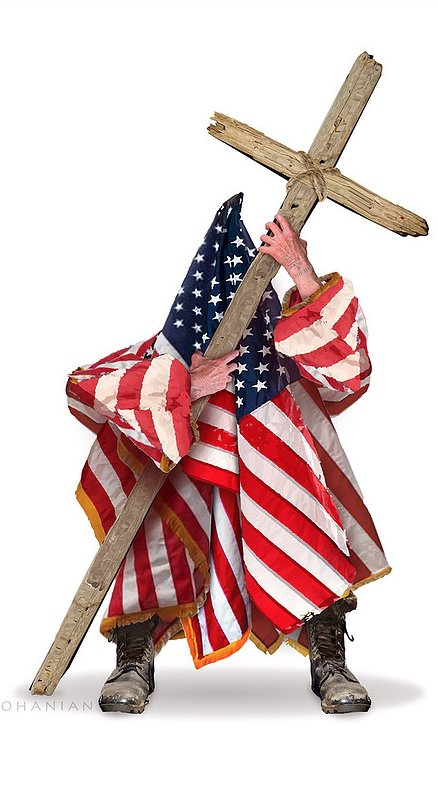
Babies in Cages by Nancy Ohanian

Death camps are different from concentration camps; they're worse. But concentration camps are bad enough. If Trump was setting up concentration camps what would you do about it? What are you doing about the concentration camps? Silence, beloved brothers and sisters, is not golden... it's complicity. Our country is complicit in his crimes against humanity, his crimes against these women and children.

What about Trump's evangelical supporters? They may bear more responsibility than other Americans. Do the concentration camps make them uncomfortable? From what I'm reading... not at all, not at all. Yesterday The Atlantic published The Deepening Crisis in Evangelical Christianity-- Support for Trump comes at a high cost for Christian witness by Peter Wehner. Their leaders are reveling in Trumpism. Wehner began with a quote from noted evangelical huckster Ralph Reed: "There has never been anyone who has defended us and who has fought for us, who we have loved more than Donald J. Trump. No one!" And evangelicals are fighting for him too. They believe the concentration camp regime "is spiritually driven" and that "God’s hand is on Trump, this moment and at the election... Donald Trump is God’s man." He's kidnapping children and putting them up for adoption. "God has chosen him and is protecting him." These people want an authoritarian asshole. They welcome fascism and the end to democracy. "Jerry Falwell Jr.: "Conservatives & Christians need to stop electing ‘nice guys.’ They might make great Christian leaders but the United States needs street fighters like @realDonaldTrump at every level of government b/c the liberal fascists Dems are playing for keeps & many Repub leaders are a bunch of wimps!"


Late last night, writing for the NY Times, Thomas Edsall pointed out how the "give-us-our-orders" evangelicals fit into Trump's plans for reelection. "Alex Gage, head of TargetPoint Consulting, a Republican firm specializing in voter mobilization, found that 'anger is a much stronger motivation' than recounting the beneficial things a politician has done. Trump has aligned himself with two overlapping, declining constituencies that are clearly motivated by a combination of anger, resentment and anxiety-- white evangelical Christians and whites without college degrees. If Trump is to win re-election next year, he must raise the stakes for these two sets of voters so that they turn out in unprecedented numbers. Demonizing immigrants and other minorities is crucial to this strategy."
Between 65 and 70% of white evangelicals approve of him-- 25 points higher than the national average. "The enthusiastic, uncritical embrace of President Trump," wrote Wehner, "by white evangelicals is among the most mind-blowing developments of the Trump era. How can a group that for decades-- and especially during the Bill Clinton presidency-- insisted that character counts and that personal integrity is an essential component of presidential leadership not only turn a blind eye to the ethical and moral transgressions of Donald Trump, but also constantly defend him? Why are those who have been on the vanguard of “family values” so eager to give a man with a sordid personal and sexual history a mulligan?"
Part of the answer is their belief that they are engaged in an existential struggle against a wicked enemy-- not Russia, not North Korea, not Iran, but rather American liberals and the left. If you listen to Trump supporters who are evangelical (and non-evangelicals, like the radio talk-show host Mark Levin), you will hear adjectives applied to those on the left that could easily be used to describe a Stalinist regime. (Ask yourself how many evangelicals have publicly criticized Trump for his lavish praise of Kim Jong Un, the leader of perhaps the most savage regime in the world and the worst persecutor of Christians in the world.)

Many white evangelical Christians, then, are deeply fearful of what a Trump loss would mean for America, American culture, and American Christianity. If a Democrat is elected president, they believe, it might all come crashing down around us. During the 2016 election, for example, the influential evangelical author and radio talk-show host Eric Metaxas said, “In all of our years, we faced all kinds of struggles. The only time we faced an existential struggle like this was in the Civil War and in the Revolution when the nation began … We are on the verge of losing it as we could have lost it in the Civil War.” A friend of mine described that outlook to me this way: “It’s the Flight 93 election. FOREVER.”

Many evangelical Christians are also filled with grievances and resentments because they feel they have been mocked, scorned, and dishonored by the elite culture over the years. (Some of those feelings are understandable and warranted.) For them, Trump is a man who will not only push their agenda on issues such as the courts and abortion; he will be ruthless against those they view as threats to all they know and love. For a growing number of evangelicals, Trump’s dehumanizing tactics and cruelty aren’t a bug; they are a feature. Trump “owns the libs,” and they love it. He’ll bring a Glock to a cultural knife fight, and they relish that.

... There's a very high cost to our politics for celebrating the Trump style, but what is most personally painful to me as a person of the Christian faith is the cost to the Christian witness. Nonchalantly jettisoning the ethic of Jesus in favor of a political leader who embraces the ethic of Thrasymachus and Nietzsche-- might makes right, the strong should rule over the weak, justice has no intrinsic worth, moral values are socially constructed and subjective-- is troubling enough.


But there is also the undeniable hypocrisy of people who once made moral character, and especially sexual fidelity, central to their political calculus and who are now embracing a man of boundless corruptions. Don’t forget: Trump was essentially named an unindicted co-conspirator (“Individual 1”) in a scheme to make hush-money payments to a porn star who alleged she’d had an affair with him while he was married to his third wife, who had just given birth to their son.

While on the Pacific Coast last week, I had lunch with Karel Coppock, whom I have known for many years and who has played an important role in my Christian pilgrimage. In speaking about the widespread, reflexive evangelical support for the president, Coppock-- who is theologically orthodox and generally sympathetic to conservatism-- lamented the effect this moral freak show is having, especially on the younger generation. With unusual passion, he told me, “We’re losing an entire generation. They’re just gone. It’s one of the worst things to happen to the Church.”

Coppock mentioned to me the powerful example of St. Ambrose, the bishop of Milan, who was willing to rebuke the Roman Emperor Theodosius for the latter’s role in massacring civilians as punishment for the murder of one of his generals. Ambrose refused to allow the Church to become a political prop, despite concerns that doing so might endanger him. Ambrose spoke truth to power. (Theodosius ended up seeking penance, and Ambrose went on to teach, convert, and baptize St. Augustine.) Proximity to power is fine for Christians, Coppock told me, but only so long as it does not corrupt their moral sense, only so long as they don’t allow their faith to become politically weaponized. Yet that is precisely what’s happening today.

Evangelical Christians need another model for cultural and political engagement, and one of the best I am aware of has been articulated by the artist Makoto Fujimura, who speaks about “culture care” instead of “culture war.


According to Fujimura, “Culture care is an act of generosity to our neighbors and culture. Culture care is to see our world not as a battle zone in which we’re all vying for limited resources, but to see the world of abundant possibilities and promise.” What Fujimura is talking about is a set of sensibilities and dispositions that are fundamentally different from what we see embodied in many white evangelical leaders who frequently speak out on culture and politics. The sensibilities and dispositions Fujimura is describing are characterized by a commitment to grace, beauty, and creativity, not antipathy, disdain, and pulsating anger. It’s the difference between an open hand and a mailed fist.

Building on this theme, Mark Labberton, a colleague of Fujimura’s and the president of Fuller Theological Seminary, the largest multidenominational seminary in the world, has spoken about a distinct way for Christians to conceive of their calling, from seeing themselves as living in a Promised Land and “demanding it back” to living a “faithful, exilic life.”

Right-wing former GOP congressman assesses Trump

Labberton speaks about what it means to live as people in exile, trying to find the capacity to love in unexpected ways; to see the enemy, the foreigner, the stranger, and the alien, and to go toward rather than away from them. He asks what a life of faithfulness looks like while one lives in a world of fear.

He adds, “The Church is in one of its deepest moments of crisis-- not because of some election result or not, but because of what has been exposed to be the poverty of the American Church in its capacity to be able to see and love and serve and engage in ways in which we simply fail to do. And that vocation is the vocation that must be recovered and must be made real in tangible action.”


There are countless examples of how such tangible action can be manifest. But as a starting point, evangelical Christians should acknowledge the profound damage that’s being done to their movement by its braided political relationship-- its love affair, to bring us back to the words of Ralph Reed-- with a president who is an ethical and moral wreck. Until that is undone-- until followers of Jesus are once again willing to speak truth to power rather than act like court pastors-- the crisis in American Christianity will only deepen, its public testimony only dim, its effort to be a healing agent in a broken world only weaken.

At this point, I can’t help but wonder whether that really matters to many of Donald Trump’s besotted evangelical supporters.
Ralph Reed, a follower of Jesus? Give me a break. Falwell, Jr.? You're joking right? What makes Wehner imply they are? Must be something I don't understand.


Also on Friday, writing for The Economist, Erasmus noted "the widening ideological and personal schism within the very group of citizens who should be a conservative president’s most natural supporters... white evangelical Christians, of whom 80% are thought to have voted for Mr Trump. Leading evangelicals are not just sparring over metaphysics, they are also trading insults. Think of the war of words that erupted after June 25th when Russell Moore, a distinguished theologian who heads the Ethics and Liberty Commission of the Southern Baptist Convention, protested over the fate of migrant children on the Mexican border." Moore wrote that the plight of the kidnapped children at the southern border stuffed into Trump's concentration camps "should 'shock all our consciences' given that all 'those created in the image of God should be treated with dignity and compassion.'" Vicious Trumpist Falwell went on the attack against the man who runs the public-policy arm of America’s largest Protestant denomination immediately: "Who are you Dr Moore? Have you ever built an organisation of any sort from scratch? You’re nothing but an employee-- a bureaucrat." [An inheritor of great wealth, it is notable that Falwell never built anything except an alliance with Satan.] The neo-Nazi evangelicals on the far right fringe joined Falwell by claiming protesting the immigration crisis amounted to an unpatriotic slur on the U.S. Border Patrol.


Labels: , , , , , , , , , , ,

Sunday, January 20, 2019

Both Sides-- But Not The Joni Mitchell Version

>


The Wall Street Journal ran an OpEd by Robert Gates Friday evening, To End the Shutdown, Try Thinking Big on Immigration. It almost doesn't matter what his "big idea" is since his presentation is so utterly flawed. "Both parties are to blame for this embarrassing impasse," he wrote. Really? Both parties. Pin a pin in that. We'll come back to it. First I want to make sure you know who Robert Gates is. Since 2012 he's been a principal in the Silicon Valley-based neocon consulting firm RiceHadleyGates LLC, with Condoleeza Rice and Stephen Hadley. ("We offer advice based on extensive experience in the international arena. We work with companies to develop and implement their international strategic plans and help them expand in major emerging markets, including in Asia, the Middle East, and the Americas. The advice they offered Trump was to hire Rex Tillerson as Secretary of State, which worked out badly for everyone concerned.) He also serves as chancellor at the college of William and Mary (his alma mater), on the board of Stabucks and as president of the Boy Scouts of America.

Before all that, Gates was a CIA intelligence analyst who worked his way up to director, despite his terrible reputation for corruption and his role in the Iran-Contra scandal. George W. Bush appointed him Secretary of Defense in 2006 and Obama made the foolish decision to keep him on.

His OpEd is a typical "both sides" concoction, part of a false national narrative. The government shut-down was not caused by "both" parties. It was caused by Trump as a way of forcing Congress to give him money for a useless vanity wall. Remember what Gates seems to have forgotten-- it was Trump who unilaterally ended DACA, took the Dreamers hostage, shut down the government, took 800,000 workers paychecks and the nation's safety hostage and is now magnanimously offering to give those back as part of a phony compromise if his blackmail is successful and the Democrats agree to fund his monument.


Congress should impeach him tomorrow instead. Gates' bullshit lies-- or maybe he's lost his mind-- is premised, in his own words, on the idea that "Few politicians in Washington-- Republican or Democrat, in Congress or the White House-- consider the best interest of the country a priority. The fight is all about politics, partisanship and power. To win the day, both sides are willing to upend the lives of 800,000 government employees and their families-- and countless others who depend on the spending of those families for their own livelihoods."

That's flat-out false. Did Gates miss this classic piece of film? Does this sound like "both sides" to you?


About a decade ago-- a little more-- I visited Myanmar. It was kind of surreal going to a fully functioning fascist state in the 21st Century. (There are more of them now, come to think of it.) In Yangon, the capital, the top tourist attraction, indisputably, is the Shwedagon Pagoda. That's me, in the picture below, walking around the complex back then. Notice one of my feet is bare. That was the result of a compromise I made with the ticket seller. He demanded I remove my shoes-- fine-- and my socks. I didn't want to take off my socks and wind up with some exotic foot disease. So I argued with him forever. We finally reached a "compromise." Both shoes, of course. But just one sock. When the Nazis put the Jews in concentration camps, were "both sides" wrong? Someone should ask Robert Gates sometime. 


Labels: , , ,

Sunday, September 09, 2018

Rohingya Crisis

>


-by Reese Erlich

I sneaked into Myanmar on a tourist visa because the military junta running the country made it almost impossible to travel as a journalist. So I thought I was the only foreign reporter in the capital of Yangon in July of 1995.

I was relaxing one morning when BBC TV ran a bulletin that famous opposition leader Daw Aung San Suu Kyi had just been released from house arrest. I scrambled into a taxi and went straight to her house in a wealthy neighborhood of Yangon. I envisioned being the first reporter to interview her. I had the scoop of the century!

When I arrived, however, her front yard was filled with dozens of diplomats and reporters. Most had flown in from Bangkok that morning when the government relaxed visa requirements.

I joined the scrum of reporters asking her questions. Suu Kyi had genuine poplar support as a democracy advocate in this country once called Burma. She stood against the country's brutal military rulers. She was also a darling of the United States and Britain because of her advocacy of free markets, anti-communism and other pro-western policies.

Most significantly neither Suu Kyi nor her supporters that I interviewed understood the complexities of Myanmar's 135 officially recognized ethnic groups. Her father had been a leftist and nationalist leader in the fight against British colonialism. That revolutionary nationalism helped free the country. But nationalism of the Buddhist majority applied against ethnic and religious minorities was to take the country in a repressive direction.


Suu Kyi was jailed and released several times until her party, the National League for Democracy (NLD), was allowed to field parliamentary candidates in 2015. The NLD won the election and Suu Kyi became Myanmar’s de facto leader. But she hardly mentioned minority rights.

The generals exercise real power in Myanmar. They claim the Rohingya, who live in the western state of Rakhine, are really Bangladeshis, despite the fact they have lived in Myanmar for centuries. The government denies Rohingyas the right to vote or hold elected office, and restricts their access to healthcare, education, and jobs.

Brutal attacks

In 2016 and then again on August 25, 2017 an armed Rohingya militia attacked police and army posts, killing dozens of security personnel. In the following days the military viciously attacked Rohingya civilians, eventually driving hundreds of thousands out of the country. In numerous documented cases, the military beat, raped and murdered civilians.

Right-wing nationalist Buddhist monks, with government cooperation, incited their followers to attack Rohingya villages, killing some civilians and driving out the rest. So much for the concept that Buddhism is somehow immune from the extremism affecting other major religions.

In August this year a UN report described the military actions as "genocide" and called for an international tribunal to put the generals on trial.

Despite these atrocities, Suu Kyi defends the military's actions. She also justifies the jailing of two Reuters reporters who exposed the massacres but were convicted on trumped up charges of violating the British colonial era Official Secrets Act. Last month they were sentenced to seven years in prison.

Alice Baillat, research fellow at the French Institute for International and Strategic Affairs now living in Bangladesh, told me Suu Kyi's political options are constrained by the powerful military. However, "she has not used her moral authority, popularity and power position, however limited, to stem or prevent the unfolding crisis and protect the civilian population."

Armed attacks

Rohingya politics are complicated as well. For two years an armed group called the Arakan Rohingya Salvation Army (ARSA) has been attacking police and military targets in Rakhine state. ARSA's leader Ata Ullah was born in Pakistan and lived in Saudi Arabia.

The International Crisis Group wrote, "The insurgent group, which refers to itself as Harakah al-Yaqin (Faith Movement), is led by a committee of Rohingya émigrés in Saudi Arabia and is commanded on the ground by Rohingya with international training and experience in modern guerrilla war tactics."

James M. Dorsey, senior fellow S. Rajaratnam School of International Studies at Singapore’s Nanyang Technological University, told me that as a Sunni Muslim group, ARSA has received political support and some relief supplies from militant groups such as Laksha Taiba in Pakistan.

He noted, however, that ARSA is not a terrorist group such as Al Qaeda or ISIS, nor does it seek to create an Islamic caliphate. But, he warned, continued government repression could push some Rohingya in that direction.

"If you're Rohingya, gravitating to militancy is 1 + 1 = 2," he said.

Other ethnic groups in Myanmar have their own armed militias, noted Simon Billenness, executive director of the International Campaign for the Rohingya based in Boston.  ARSA, he told me, attacks primarily military targets and doesn't intentionally kill civilians.

"ARSA has more in common with the ethnic armed forces than it has to any international terrorist group," he said.

U.S. Policy

Both Republican and Democratic administrations have wrestled unsuccessfully with Myanmar policy. The country has valuable gemstones and sits in a volatile area bordering China, Bangladesh and Thailand. The last few presidents have tried to break Myanmar's close economic and political ties with China, and bring it into the US sphere of influence.

The Obama administration lifted economic sanctions after the military gave up some power, even as attacks on Rohingya began. The Trump administration re-imposed sanctions on individual generals and threatened more stringent, unilateral sanctions.

In my opinion, unilateral US sanctions are wrong in principle and unhelpful in practice. Who is Trump to denounce human rights violations against Muslims while denying them entry to the United States and keeping them jailed indefinitely in Guantanamo? US unilateral sanctions, while ostensibly defending human rights, in practice aim at replacing hostile regimes with ones friendly to the U.S.

"If Donald trump comes out swinging with sanctions, he won't get a lot of Chinese and Russian support," said analyst Dorsey." If there was a multilateral effort to improve immediate living conditions with  ASEAN (Association of Southeast Asian Nations) at the core, it could create a tolerable situation."

The Trump administration should immediately help fund the UN's requested $951 million to help the Rohingya living in refugee camps. I don't expect much positive from the dotard Donald, but at least he can help fund refugee relief.


Labels: , ,

Sunday, March 12, 2017

There Are People Like Bannon And Gorka In Other Countries Too-- Myanmar

>


A decade ago I visited Myanmar for a couple of weeks and wrote about the trip on my travel blog, although the day I got back to L.A. I drafted a short post for this blog bitching about how the military junta there had censored DWT. But all Myanmar coverage always managed to get in a plus for Nobel Peace laureate Aung San Suu Kyi, who was under house arrest when I was in Yangon but is now the de factor head of government (technically State Counsellor, Foreign Affairs Minister and President's Office Minister. Her victories over the military junta have been celebrated around the world. But... lately the issue of Myanmar's oppressed Muslim minority has taken a toll on her international support.
More than a dozen fellow Nobel laureates have criticised Aung San Suu Kyi, Myanmar’s de facto leader, for a bloody military crackdown on minority Rohingya people, warning of a tragedy “amounting to ethnic cleansing and crimes against humanity.”

The open letter to the UN security council from a group of 23 activists, including Archbishop Desmond Tutu and Malala Yousafzai, warned that the army offensive had killed of hundreds of people, including children, and left women raped, houses burned and many civilians arbitrarily arrested.

It was delivered as Bangladesh announced around 50,000 Rohingya Muslims have fled the violence across its border.
That was last December. Life for the Rohingya-- a minority of about a million people who, despite living in the country for generations, are treated as illegal immigrants and denied citizenship-- has gotten worse since then.
An Amnesty International report this month, based on extensive interviews with Rohingya as well as analysis of satellite imagery, claimed that actions by Myanmar’s military may constitute crimes against humanity.

Aung San Suu Kyi, who spent much of the past two decades under house arrest and was awarded the 1991 Nobel peace prize, won elections last November, ending decades of junta rule.

But the Myanmar armed forces, or Tatmadaw, retain significant power in Myanmar. Under the army-drafted constitution, the military controls the three most powerful government ministries: home, defence and border affairs.

Aung San Suu Kyi is foreign minister and state counsellor, as the law bars her from the presidency, which is held by her close aide Htin Kyaw. However, she is widely considered the country’s de facto leader.

The open letter said that “despite repeated appeals to Daw Aung San Suu Kyi we are frustrated that she has not taken any initiative to ensure full and equal citizenship rights of the Rohingyas. Daw Suu Kyi is the leader and is the one with the primary responsibility to lead, and lead with courage, humanity and compassion.”
Last week the UN's special rapporteur for human rights in Myanmar, Yanghee Lee, blew the whistle on what she called "crimes against humanity."
She said the problem of abuse was "systemic" within the Burmese security forces, but said that Aung San Suu Kyi's elected government should bear some of the responsibility.

"At the end of the day it is the government, the civilian government, that has to answer and respond to these massive cases of horrific torture and very inhumane crimes they have committed against their own people."

...In camps in Bangladesh, the BBC heard allegations from recently arrived Rohingya refugees that the Burmese security forces had shot civilians, and abducted and raped young girls.

Many of the refugee accounts are supported by both satellite and video evidence.

...The spokesman for Ms Suu Kyi's political party, the National League of Democracy, Win Htein, told the BBC that under the current constitution, Ms Suu Kyi did not have the power to get the army to stop.
Tomorrow, Ms Lee will present her latest findings to the United Nations Human Rights Council in Geneva and will formally call for a Commission of Inquiry to be established, similar to the ones looking at abuses in places like North Korean and Syria.


Labels:

Monday, November 09, 2015

The Rise Of Fascism In India And In Myanmar Suffered Severe Blows At The Polls Sunday

>


DWT has a history of opposing Indian fascist leader Narendra Modi. We tend to oppose religious bigots and genocidal murderers like Modi anywhere in the world, but especially in places we love, like India. Writing from New Delhi in 2007, when Modi was the Chief Minister of Gujarat (not Prime Minister of India as he is today), we warned that his party, the BJP is a classic right-wing political party, representing the status quo interests of the exploitative/owner class.
In a thriving democracy like India, how does a party concerned exclusively with the welfare and prerogatives of .001 percent of the population, and espousing one prepackaged conservative nostrum after another, even hope to win votes? The BJP never needed Richard Nixon, Lee Atwater, Karl Rove or the Southern Strategy to succumb to the siren song of the Dark Side's exploitation of social tensions, racism, xenophobia, religionist hatreds and-- it being, even here, a George Bush world-- fear of "Islamofascist terrorism."

Except here in India, that kind of talk can-- and has-- turned very, very deadly. In Gujarat over a thousand Muslims-- men, women and children-- have been brutally murdered, their homes and businesses burned and looted, just five years ago as a step on the ladder to Modi-power. This is called BJP-inspired Hindutva, sometimes called Moditva, in honor of his George Wallace-like encouragement for the mayhem.

Just last week Chief Minister Modi bragged about having suspected Muslim "terrorists" dealt with extra-judicially-- by having them killed. Sobrabuddin Sheik's wife was also hunted down and murdered after Modi disposed of the husband.
Modi's fascist party came to power last year and he was named Prime Minister. Yesterday his party's divisive agenda was judged harshly by voters in Bihar, India's third most populous state (103,804,637 people), as the BJP was swamped in local elections. And Modi was the focus in a state his party won just 18 months ago.
Modi was the indisputable face of his party's campaign in Bihar. He led the campaign, addressing 26 public meetings across the length and breadth of the state.

What's more, his trusted aide Amit Shah, who is also the BJP president and chief poll strategiser, camped in the state and spoke himself at more than 70 meetings.

Mr Modi came to Bihar promising jobs and development in a reprise of the campaign which helped him to sweep to power in federal elections last year.

In fact, his party and its allies won 31 of the 49 parliamentary seats in Bihar in 2014.

But the prime minister's lustre has somewhat diminished since. In what was a protracted five-phase election, his party's campaign ramped up the rhetoric, asking voters, among other things, if they wanted "a [Bihar] government… that protects terrorists."

Amid growing countrywide concern over rising intolerance and Hindu hardliners running amok, Mr Modi and Mr Shah raised the sensitive issue of cow slaughter and consumption of beef-- the cow is regarded as sacred but polarises opinion in Hindu-majority India.

They invoked Pakistan and accused his rivals of stealing affirmative action quotas for minorities. Things became so bad that the election authorities stepped in and proscribed two provocative BJP campaign adverts.

Mr Shah told a rally that if "by any chance" his party lost Bihar, "then firecrackers would be let off in celebration in Pakistan". Mr Kumar met the BJP's high-pitched campaign with a measured response, addressing concerns over equitable growth and development. Meanwhile his ally, Mr Yadav mined the caste vote successfully, making sure that not many voters strayed to the BJP.

Mr Modi and his party, say analysts, have a lot of lessons to learn from the Bihar verdict.

First, running a campaign that uses development, caste and religion does not always work. Voters should be more respected for their wisdom.

Secondly, voters appear to be increasingly sceptical of Mr Modi's promises of growth and development. Many believe the Bihar verdict shows he hasn't convinced many people that he has the ability to deliver on his key promise.

Even some of his most ardent supporters say Mr Modi has run a lacklustre and underwhelming government in the past 18 months. The tyranny of expectations is beginning to bite. The needless provocations of some of his noisy lawmakers and ministers and the radical fringe are giving his government a bad name at home and abroad.

Thirdly, Mr Modi is seen as a less invincible and strong leader. The rout in Delhi shattered the aura of invincibility. The Bihar debacle proves that the enthusiasm has waned further. Many are wondering how a prime minister with one of the largest poll victories in India's history is unable to rein in hardliners in his own flock.

Finally, the BJP should now be ready to face a reinvigorated opposition - in tatters after last year's debacle.

Although it still remains India's strongest party, Mr Modi's binary politics-- either you are with us, or against us-- has effectively helped unite a rag-tag opposition, which now believes that it can take on the BJP by forging similar coalitions as in Bihar. Even the Congress, lacking fresh ideas and led by a reluctant leader, appears to have staged a modest recovery.
Rahul Gandhi, leader of the opposition Congress Party-- vaguely equivalent to our own pathetic Democrats-- termed the victory "a message against putting Hindus against Muslims and making them fight to win elections. Prime Minister Narendra Modi has become arrogant. He should work on toning it down as it will benefit him and the country. Modi should stop campaigning and start working."


Modi needed a victory in Bihar because the upper house of Parliament-- which is appointed by the states-- is not controlled by the BJP and has blocked some of his legislative initiatives. The NY Times' David Barstow reports that [t]he defeat also means that Mr. Modi will enter the winter session of Parliament without the political momentum he craved to force through major overhauls of taxation, labor rules and land use that he sees as critical to accelerating India’s growth and attracting more foreign investors" and that the election has "played out against a raging national debate over whether Mr. Modi’s India is becoming increasingly intolerant of secularists, Muslims and political dissent in general. According to the police, four Muslims were attacked and killed by mobs of Hindus in the past six weeks because they were suspected of stealing, smuggling or slaughtering cows."
Hundreds of writers, filmmakers, scientists and academics have protested what they see as rising intolerance by signing petitions or returning awards they had received from government-supported bodies.

“This is a victory of unity over divisiveness. Humility over arrogance,” Rahul Gandhi, a member of the grand alliance, said in a statement. Mamata Banerjee, the chief minister of West Bengal, called the election a “defeat of intolerance.”

...Given the depth and breadth of the B.J.P. rout, the results on Sunday called into question the vaunted political acumen of Mr. Modi’s version of Karl Rove: Amit Shah, the B.J.P. president.

Mr. Shah had much to prove in Bihar after a surprising electoral defeat for the B.J.P. in Delhi, and he took personal command of the Bihar election. In campaign billboards across the state, his image was nearly as prominent as Mr. Modi’s. He was also responsible for one of the most incendiary speeches in the Bihar campaign, when he predicted that firecrackers would be set off in celebration across Pakistan if Mr. Modi lost.

On Sunday, thousands of Biharis had a ready retort for Mr. Shah. Across the state, they lit firecrackers.


EVEN BETTER NEWS IN MYANMAR

I was living, briefly, in West Berlin before the Wall came down. There were already holes in the Wall and the border guards weren't generally taking it that seriously any longer, so my German friends used to go over into East Berlin whenever they felt like it. It wasn't as safe for Americans but I had to do it, right? It gave me an eerier feeling than anything I had felt in the more relaxed Communist bloc countries I had spent time in-- basically Hungary, Czechoslovakia and Bulgaria. And the next time I got that same eery feeling-- well actually it was a Stalinist feeling was when I visited Myanmar in 2007-08. I just checked and I was making the comparison between East Berlin and Yangon almost a decade ago! East Berlin, I wrote in 2007, "didn't look free and romantic; the oppression, tyranny and decrepitude were apparent and tangible... and chilling. It scared and repulsed me. I was happy to get back to West Berlin."
A few hours ago, decades later, I just returned from a place like that, a place you read about in books by George Orwell and Aldous Huxley: Myanmar.

Myanmar was Burma when I was a small boy (and avid stamp collector). I remember there were military coups when I was in elementary school. It was one of those closed off places-- exotic, mysterious, impenetrable, vaguely dangerous, like Albania, Mongolia, North Korea... places no one ever went. In the 80s the military junta took the name SLORC (an unfortunate-sounding acronym for State Law and Order Restoration Council). It sounds like something from a James Bond movie. For the people there, I just discovered, it doesn't feel like a movie. It feels like a nightmare that never ends. Paid Republican lobbyists and operatives in DC got the military dictators to ditch the SLORC moniker for SPDC (State Peace and Development Council, which sounds far less ominous-- like Bush's Clear Skies Act).

One of the first things I noticed is that the oppressive, paranoid tyranny in Myanmar exists in a parallel world next to a beautiful traditional Buddhist culture. The gentle people, predisposed to kindness, seem a little nervous-- hundreds of beloved and revered monks were brutally and ruthlessly murdered by the regime a few weeks ago after peaceful demonstrations-- but when you shoot anyone (except some of the soldiers) a mengalaba (hello) their wariness invariably breaks down and they smile. They are friendly and the reserve often vanishes quickly and, at least in Yangon, more of them spoke English than anywhere else in Southeast Asia I've ever been.

The whole city seems to be rotting and breaking down, although it may also be a work in progress of sorts. The city is immense-- but kind of slow and quiet... kind of left behind as the rest of the region rushes headlong into the 21st Century and globalization. Roland says Yangon reminds him of Havana in many ways.
I'm happy to report this evening that in their first ostensibly free elections in many years, the Burmese have chosen to go down the path of democracy. Aung San Suu Kyi's National League for Democracy seems to have won a clear majority-- perhaps as much as 80% of the vote-- and the military-backed politicians failed in an election that picked 168 of the 224 representatives in the upper house of the national parliament (the remaining quarter of seats to be appointed by the military) and 325 of the 440 seats in the lower house (with 110 appointed by the military).

Reuters reported that the dictatorship conceded defeat early Monday "as the opposition led by democracy figurehead Aung San Suu Kyi appeared on course for a landslide victory that would ensure it can form the next government."
"We lost," Union Solidarity and Development Party (USDP) acting chairman Htay Oo told Reuters in an interview a day after the Southeast Asian country's first free nationwide election in a quarter of a century.


The election commission later began announcing constituency-by-constituency results from Sunday's poll. All of the first 12 announced were won by Suu Kyi's National League of Democracy (NLD).

The NLD said its own tally of results from polling stations around the country showed it on track to win more than 70 percent of the seats being contested in parliament, more than the two-thirds it needs to form Myanmar's first democratically elected government since the early 1960s.

"They must accept the results, even though they don't want to," NLD spokesman Win Htein told Reuters, adding that in the highly populated central region the Nobel peace laureate's party looked set to win more than 90 percent of seats.

Earlier a smiling Suu Kyi appeared on the balcony of the NLD's headquarters in Yangon and in a brief address urged supporters to be patient and wait for the official results.

The election was a landmark in the country's unsteady journey to democracy from the military dictatorship that made it a pariah state for so long. It is also a moment that Suu Kyi will relish after spending years under house arrest.

Although the election appears to have dealt a decisive defeat to the USDP, a period of uncertainty still looms over the country because it is not clear how Suu Kyi will share power with the still-dominant military.

The military-drafted constitution guarantees one-quarter of parliament's seats to unelected members of the armed forces.

Even if the NLD gets the majority it needs, Suu Kyi is barred from taking the presidency herself under the constitution written by the junta to preserve its power. Suu Kyi has said she would be the power behind the new president regardless of a charter she has derided as "very silly."

The military will, however, remain a dominant force. It is guaranteed key ministerial positions, the constitution gives it the right to take over government under certain circumstances, and it also has a grip on the economy through holding companies.

Incomplete vote counts showed some of the most powerful politicians of the USDP trailing in their bids for parliamentary seats, indicating a heavy loss for the party created by the former junta and led by retired military officers.

Among the losers was USDP chief Htay Oo, who told Reuters from the rural delta heartlands that are a bastion of support for his party he was "surprised" by his own defeat.

Labels: , , , ,

Thursday, October 28, 2010

DownWithTyranny! Banned By China

>


I've written before about two of my friends living part time in China, usually for 3-4 months at a time. They read DWT regularly-- or at least they used to. As of last week, you can no longer get DWT in China. "Probably," wrote one of them, "has something to do with the title." I don't think so. The title has been there a long time. And I remember when I was in Myanmar early in 2008 I wrote this:
There is definitely a Burmese middle class in places like Yangon and Mandalay, even if every aspect of the society is held back and hampered by a severely dysfunctional and oppressive tyranny. The junta holds back development as a product of ideology and as a tactic in maintaining its own dominance through brutal authoritarianism. After the recent violent crackdown on peaceful human rights demonstrators-- a crackdown which included the military slaughtering hundreds of peaceful monks-- the regime suddenly increased the cost of satellite TV access to make it inaccessible to the middle class. I mentioned a few days ago that the junta had already banned the BBC and other western news sources, leaving people with nothing but the always inoffensive and tepid CNN-- cookie recipe shows and breathless news reports on Britney Spears latest foibles threaten no one-- on which to depend for outside news. But now, even that will be out of reach for the Burmese middle class.

And the next day, DWT was no longer accessible in Yangon. My website ceased to exist in Myanmar. It was an eerie feeling being there and feeling they might be watching me. Obviously I'm not in China, but lately I have been writing an awful lot about China, basically China's financing of the drive to make John Boehner Speaker and Miss McConnell Senate Majority Leader. My premise, which I've repeated at least a dozen times, is that China has poured money into the Chamber of Commerce (which then turns the money into attack ads against Democrats)-- through state-run industrial organizations-- because they want a weaker America and one that is dedicated to the GOP ideas regarding outsourcing jobs. When DWT attacks China-puppets like Ron Johnson (R-WI), Pat Toomey (R-PA) and, of course, Boehner and Miss McConnell (R-KY), China feels threatened.

And when authoritarians feel threatened, they respond exactly the way the Rand Paul campaign did when one of their operatives curbstomped a young woman, or the way the Joe Miller campaign did when it had thugs from a private security firm handcuff and kidnap a journalist for asking embarrassing questions about Miller's criminal record, or the way Sharron Angle thinks Americans should turn to "Second Amendment solutions" or the way Texas GOP candidate Stephen Broden talks about violence and armed rebellion being "on the table" if Republican teabaggers don't prevail next Tuesday. China understands this kind of talk; it's their kind of talk. It's the sound of authoritarianism, the hallmark of the Chinese Communist mentality as well as the hallmark of the right-wing of the Republican Party.

This week GOP thugs have tried physically intimidating Democratic candidates on behalf of rightist authoritarian like Rand Paul, Eric Cantor, and Brian Bilbray. God only knows what would happen if a liberal showed up at a neo-Nazi Rich Iott rally or, worse, an Allen West event.

Yesterday NPR connected the dots on an insidious Republican Party web of influence funded by the wealthiest families in America (not just selfish and greedy but anti-social and fascist as well) plus America's foreign competitors who want to see the GOP in charge, knowing how they will weaken the U.S. The NPR site linked about is interactive, but this is what it looks like and, remember, China, is funding the U.S. Chamber and, probably American Crossroads:


Labels: , , , ,

Friday, December 12, 2008

Howie, Mali-bound (no, not Maui, Mali, as in Timbuktu), finds DWT banned in France!

>

by Ken

You're bound to notice eventually that Howie has slipped out of his blogging chair. Those of you who've been with us before and have glanced at the calendar may realize that if it's December, that means he's off on his annual Big Trip. Two years ago Tierra del Fuego, last year South Asia (India, Thailand), this year Mali. No, not Maui, where it's possible for many a sensible person to wish to go (especially in December, if the person happens to reside in a northerly clime), but Mali, as in Timbuktu.

I just heard from him from the airport in Paris, where he arrived early only to find his connecting flight to Dakar, Senegal, delayed by what is officially described as three hours. At least until he heard about the delay, he was a relatively happy camper, heartened to find an airport lounge well-equipped not just with computers but with Macs. He was plowing earnestly through 500 accumulated e-mails (and sending back some dispatches I'll be passing on in due time), when came this:
I was so happy to find free computers -- Macs no less -- in the airport lounge. But DWT is banned -- perhaps in solidarity with Myanmar.

(Yes, if you weren't with us, last year while he was posting from Myanmar, he suddenly found DWT banned.)
#

Labels: , , , ,

Sunday, May 11, 2008

MYANMAR-- THE McCAIN CONNECTION

>

Howie visits the U.S. Embassy in Yangon

Last December when I was in Myanmar, I did some posts at my travel blog and here at DWT about how some shady GOP lobbyists and PR hacks were behind a white wash of the brutal and fascist dictatorship that rules Myanmar with an iron fist. They knew all the right buttons to push and all the right palms to grease and-- lo and behold!-- the Bush Regime and its enablers in Congress became a bit too kissy-poo with these monstrous brutes. Allow me to quote myself:
If you were a brutal fascist dictatorship and you wanted to appear less brutal and less fascist, where would you turn? DCI Group, LLC is where the junta turned. It's a very Republican, very Bush-connected public relations and lobbying firm in Washington. Their website boasts about their political connections. “We are a political firm and all of our partners have political campaign experience. We thrive in competitive circumstances, and are used to fluid situations and tight deadlines." They specialize in corporately-funded deceit, establishing bogus "grassroots" groups to make it appear that third parties favor their clients' nefarious goals (like cigarette smoke, junk food, pollution... dictatorship... you know, the whole GOP song and dance). “Corporations seldom win alone. Whatever the issue, whatever the target-- elected officials, regulators or public opinion-- you need reliable third party allies to advocate your cause. We can help you recruit credible coalition partners and engage them for maximum impact. It’s what we do best." What more could a junta ask for?

The sleazy outfit's managing partners, Tom Synhorst, Doug Goodyear and Tim Hyde, are all right out of Big Tobacco. In recent years Syndhorst, the chairman, has donated tens of thousands of dollars to every wingnut who's come asking, from Billy Tauzen, Tom DeLay, Tom Feeney, John Sununu, George Bush, Ernest Istook, to Jon Kyl, Thad Cochran, Elizabeth Dole and all the way down in to bottom of the barrel territory with Patrick McHenry and Mark Foley. Ditto for Goodyear, the ceo, who has favored such right-wing fanatics as DeLay, Kyl, Mike Enzi, John Ensign, McHenry, Santorum, Cubin, McCain, Bush, et al.

Two Three of the right wing extremists mentioned above were in the news, together again, this morning. Today's NY Times in a story called Official Chosen by McCain to Run Convention Resigns brings to light the relationship between right-wing Republicans and the brutal Burmese junta. The ill-starred Republican National Convention in Minneapolis-- first Larry Craig's romantic trysts in the airport toilets, then the GOP nomination descending on McCain by default and now the Myanmar connection-- was supposed to be run-- thanks to lobbyist-lovin' John McCain-- by Arizonan Doug Goodyear. Yesterday the McCain campaign fired him. Did he do anything illegal? Did he get caught with a second family living in northern Virginia? Something McCain didn't know about or disapprove of? Nah... it's just that the nastiness of the Regime he was working for made it to the news and McCain's role in helping the fascist dictatorship was getting a little close for comfort. After being told to fall on his sword Goodyear told the press, “I continue to strongly support John McCain for president and wish him the best of luck in this campaign."

Goodyear, like most high flying Republican lobbyists, is a longtime ally of McCain's. (McCain is surrounded by lobbyists who work for the most vicious and criminal regimes on the planet.) He has donated immense amounts of money to McCain and to other far right-wing extremists in the Republican Party, from Rick Santorum, Barbara Cubin, Patrick McHenry, John Shadegg, Jon Kyle, Mike Enzi, et al.
Goodyear is the chief executive and a founding partner of the DCI Group, which has offices in Washington and Phoenix. He offered his resignation after Newsweek reported that his firm had been paid $348,000 in 2002 to represent the junta.

The rulers of Myanmar, formerly known as Burma, have been widely condemned for stymieing relief efforts after a cyclone ravaged the country’s coastal areas on May 3, killing thousands. The United States has denounced the Burmese government as one of the world’s most repressive, and Mr. McCain, Republican of Arizona, has long been critical of the government as well. During the campaign, he has called for Myanmar’s leaders to halt human rights abuses.

An op-ed article that Mr. McCain wrote with Senator Mitch McConnell for the Wall Street Journal in 2005, which is posted on the McCain campaign’s Web site, was blunt.

“The junta routinely jails democracy activists, sometimes resorting to torture and murder,” the article said. “The Burmese military employs rape as a weapon of war, destroying the lives of innocent ethnic minority women and girls. Child soldiers are pressed into the military’s rank and file. Narcotics production remains a profitable business, with illegal drugs flowing across Burma’s borders into neighboring countries.”

Newsweek reported that Justice Department lobbying records showed that the DCI Group pushed to “begin a dialogue of political reconciliation” and led a public relations campaign to burnish the junta’s image.

The appointment of Mr. Goodyear was sensitive for Mr. McCain. It came after the senator had been criticized by some Republican primary opponents for employing several lobbyists and former lobbyists to run his campaign. And he is preparing for the possibility of a general election campaign against Senator Barack Obama, an Illinois Democrat who has made a point of his independence from lobbyists.

Interesting that neither the Times, the Washington Post nor any of the other corporate media properties reporting on this story have mentioned the thousands of dollars Goodyear has given to McCain. Maybe they ran out of space or ink.

Labels: , ,

Tuesday, May 06, 2008

THE TRAGEDY OF MYANMAR

>

Roland at the orphanage

My pal Roland is a big macho guy. He doesn't show emotions much-- at least not around me and we've been pals for about two decades. This morning he called around 6:30AM on his way to work. He was all shaken up over Myanmar. We were there a few months ago. We met a lot of people, lots of kids, on the streets of Yangon, in an orphanage we wanted to help rebuild, in the countryside south of the capital. These were the areas the typhoon hit. He was sure the orphanage was flattened. Look at that photo I took up top. He was sure the poor kids who followed us around Yangon are all dead. He was sure the small towns of thatched hut in the Irrawaddy Delta are all washed away.

The brutal, fascist dictatorship there is not only vicious but also corrupt and incompetent. There are some questions under what circumstances they will even allow aid to reach their people. We were told we had to make "donations" to military officials if we wanted to rebuild the orphanage. Something between 22,000 and 60,000 people are dead. Over a million are homeless.
Residents have described a mood of anger and a grim resignation at the junta’s power since the military shot into crowds last September to quell a huge non-violent pro-democracy uprising led by Buddhist monks.

At least 31 people, and possibly many more, were killed during that uprising, and thousands were detained, including large numbers of monks.

There were several accounts over the weekend of monks leaving their monasteries to help clear away storm wreckage, even as the military offered little help to residents.

Roland is still teaching now, so he doesn't know that George Bush just offered the send Myanmar $3 million. But apparently with strings attached. "This is a cheap shot,” said Aung Nain Oo, a Burmese political analyst who is based in Thailand. “The people are dying. This is no time for a political message to be aired. This is a time for relief. No one is asking for anything like this except the United States.”

They showed us around town on our first day in Yangon

Labels:

Monday, January 14, 2008

MYANMAR-- WILL THE RULING GENERALS COME BACK AS COACKROACHES?

>

Here I am at Swedagon. They make you take off your socks as well as your shoes. I refused to take off my socks and we negotiated and compromised. They let me keep one sock on.

It made me proud to be a Buddhist and it made me proud to be a democrat and it made me proud to be a human being to see the way the Burmese monks stood up to the fascist dictatorship that brutally runs their serene, impoverished country. I was also thrilled to watch-- on TV though-- the people of Kenya stand up to blatant election fraud in their country when the ruling regime tried stealing the election there. It makes me scared for America that we didn't stand up when Bush scored his coup d'etat in 2000.

Today's L.A. Times has a front page story about how the monks have responded to the vicious crackdown after their peaceful demonstrations in September. The story, which I read in the barbershop this morning while I was getting my head shaved (monk-style) is pretty inspiring. I had noticed when I visited the Shwedagon Pagoda, Myanmar's most revered holy site, that a couple of junta generals were walking around. It surprised me that they would have the nerve to show their mugs at a sacred Buddhist temple. It shouldn't have surprised me though-- anymore than it does that Bush aggressively professes to follow Jesus Christ while doing the daily work of Satan.
In the recent crackdown, many monks were beaten and defrocked in prison. Human rights activists say several monks were among the 31 people the United Nations says were killed by the government.

It was a traumatic wound to a mainly Buddhist society, one that forced a lot of soul searching among people who practice one of the oldest forms of the religion, which emphasizes critical thought and reasoning over blind faith.

The stern-faced Nyanissara, a 70-year-old monk in owlish glasses and a maroon robe, is able to stare down generals with chests full of medals by stepping carefully through the minefield that makes free speech lethal here.

Shielding himself with allegory, he crisscrosses the country giving lectures that draw on history and legend to remind people that rotten regimes have fallen before. As the generals try to crush the last remnants of resistance, he is cautiously keeping the fire alive.

But he knows it isn't the first time in 45 years of military rule that the government has attacked monks who challenged its absolute authority. In at least four previous crackdowns, dating back to 1965, the military rounded up thousands of monks, killing some, defrocking others, while closing monasteries and seizing property.

Each time, the brutal repression outraged many people, but in the end they felt powerless to do anything about it, the crises passed, and the generals continued to oppress with an iron fist.

It's the nature of any government's leaders to "strongly test their political power. They don't want to lose it," he said in a recent interview at the International Buddhist Academy, which he founded in this riverside town whose forested hills the faithful believe Buddha walked on his path to enlightenment.

"But in any faith, when politics and religion come into competition, religious leaders always defeat anything. Religion is the leader. Jesus Christ was killed, but which was more powerful? Religion or politics?"

...In large public gatherings such as these, when the generals' spies lurk in the audience and listen for any hint of trouble, his lectures are often built around the same lesson: Cruel rulers create bad karma. And they will suffer for what they have done.

That's a moral not easily shrugged off by a government whose leader, Senior Gen. Than Shwe, is intensely superstitious: He consults astrologers to make important decisions.

The ruling generals also churn out propaganda images portraying themselves as devoted Buddhists, receiving the blessing of sympathetic monks. If their faith is true, they know their actions will determine their next life in reincarnation's endless cycle of death and rebirth.

"They have to be afraid they'll be coming back as cockroaches," wisecracked one Western envoy.

Several of Nyanissara's lectures have been burned onto DVDs, with titles such as "Last Days of Empire." The generals have arrested people caught selling them, but they are still widely available across Myanmar, also known as Burma.

"The DVDs are very popular," the Western diplomat said. "A lot of people have mentioned watching them, or knowing of them."

To most people here, the pain of seeing monks beaten up in the streets is more than just an insult to religious faith. To many, it's as if the military had harmed their own family, and the anger does not ease quickly.

Almost any Buddhist with a son has watched with pride as his head is shaved to make him a novice monk in an initiation ceremony called shin-pyu, a moment as life-defining as a baptism, christening or bar mitzvah.

Labels: