Sunday, July 07, 2019

White Evangelicals Are Embracing Concentration Camps As Revenge For Their Petty Grievances And Resentments And Because They Feel Mocked And Scorned

>

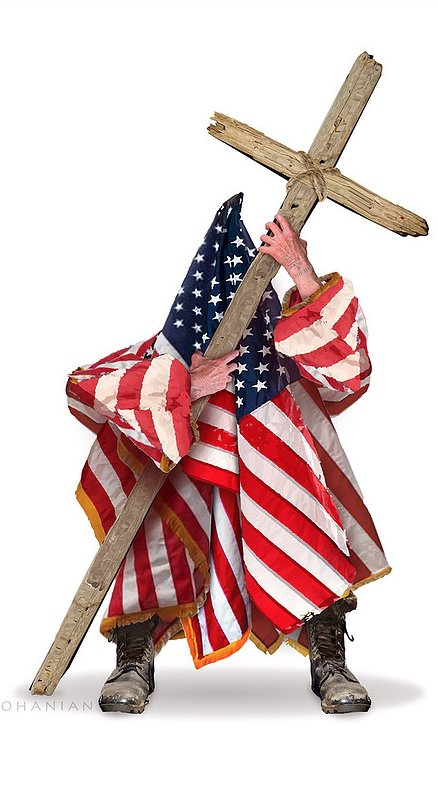
Babies in Cages by Nancy Ohanian

Death camps are different from concentration camps; they're worse. But concentration camps are bad enough. If Trump was setting up concentration camps what would you do about it? What are you doing about the concentration camps? Silence, beloved brothers and sisters, is not golden... it's complicity. Our country is complicit in his crimes against humanity, his crimes against these women and children.

What about Trump's evangelical supporters? They may bear more responsibility than other Americans. Do the concentration camps make them uncomfortable? From what I'm reading... not at all, not at all. Yesterday The Atlantic published The Deepening Crisis in Evangelical Christianity-- Support for Trump comes at a high cost for Christian witness by Peter Wehner. Their leaders are reveling in Trumpism. Wehner began with a quote from noted evangelical huckster Ralph Reed: "There has never been anyone who has defended us and who has fought for us, who we have loved more than Donald J. Trump. No one!" And evangelicals are fighting for him too. They believe the concentration camp regime "is spiritually driven" and that "God’s hand is on Trump, this moment and at the election... Donald Trump is God’s man." He's kidnapping children and putting them up for adoption. "God has chosen him and is protecting him." These people want an authoritarian asshole. They welcome fascism and the end to democracy. "Jerry Falwell Jr.: "Conservatives & Christians need to stop electing ‘nice guys.’ They might make great Christian leaders but the United States needs street fighters like @realDonaldTrump at every level of government b/c the liberal fascists Dems are playing for keeps & many Repub leaders are a bunch of wimps!"


Late last night, writing for the NY Times, Thomas Edsall pointed out how the "give-us-our-orders" evangelicals fit into Trump's plans for reelection. "Alex Gage, head of TargetPoint Consulting, a Republican firm specializing in voter mobilization, found that 'anger is a much stronger motivation' than recounting the beneficial things a politician has done. Trump has aligned himself with two overlapping, declining constituencies that are clearly motivated by a combination of anger, resentment and anxiety-- white evangelical Christians and whites without college degrees. If Trump is to win re-election next year, he must raise the stakes for these two sets of voters so that they turn out in unprecedented numbers. Demonizing immigrants and other minorities is crucial to this strategy."
Between 65 and 70% of white evangelicals approve of him-- 25 points higher than the national average. "The enthusiastic, uncritical embrace of President Trump," wrote Wehner, "by white evangelicals is among the most mind-blowing developments of the Trump era. How can a group that for decades-- and especially during the Bill Clinton presidency-- insisted that character counts and that personal integrity is an essential component of presidential leadership not only turn a blind eye to the ethical and moral transgressions of Donald Trump, but also constantly defend him? Why are those who have been on the vanguard of “family values” so eager to give a man with a sordid personal and sexual history a mulligan?"
Part of the answer is their belief that they are engaged in an existential struggle against a wicked enemy-- not Russia, not North Korea, not Iran, but rather American liberals and the left. If you listen to Trump supporters who are evangelical (and non-evangelicals, like the radio talk-show host Mark Levin), you will hear adjectives applied to those on the left that could easily be used to describe a Stalinist regime. (Ask yourself how many evangelicals have publicly criticized Trump for his lavish praise of Kim Jong Un, the leader of perhaps the most savage regime in the world and the worst persecutor of Christians in the world.)

Many white evangelical Christians, then, are deeply fearful of what a Trump loss would mean for America, American culture, and American Christianity. If a Democrat is elected president, they believe, it might all come crashing down around us. During the 2016 election, for example, the influential evangelical author and radio talk-show host Eric Metaxas said, “In all of our years, we faced all kinds of struggles. The only time we faced an existential struggle like this was in the Civil War and in the Revolution when the nation began … We are on the verge of losing it as we could have lost it in the Civil War.” A friend of mine described that outlook to me this way: “It’s the Flight 93 election. FOREVER.”

Many evangelical Christians are also filled with grievances and resentments because they feel they have been mocked, scorned, and dishonored by the elite culture over the years. (Some of those feelings are understandable and warranted.) For them, Trump is a man who will not only push their agenda on issues such as the courts and abortion; he will be ruthless against those they view as threats to all they know and love. For a growing number of evangelicals, Trump’s dehumanizing tactics and cruelty aren’t a bug; they are a feature. Trump “owns the libs,” and they love it. He’ll bring a Glock to a cultural knife fight, and they relish that.

... There's a very high cost to our politics for celebrating the Trump style, but what is most personally painful to me as a person of the Christian faith is the cost to the Christian witness. Nonchalantly jettisoning the ethic of Jesus in favor of a political leader who embraces the ethic of Thrasymachus and Nietzsche-- might makes right, the strong should rule over the weak, justice has no intrinsic worth, moral values are socially constructed and subjective-- is troubling enough.


But there is also the undeniable hypocrisy of people who once made moral character, and especially sexual fidelity, central to their political calculus and who are now embracing a man of boundless corruptions. Don’t forget: Trump was essentially named an unindicted co-conspirator (“Individual 1”) in a scheme to make hush-money payments to a porn star who alleged she’d had an affair with him while he was married to his third wife, who had just given birth to their son.

While on the Pacific Coast last week, I had lunch with Karel Coppock, whom I have known for many years and who has played an important role in my Christian pilgrimage. In speaking about the widespread, reflexive evangelical support for the president, Coppock-- who is theologically orthodox and generally sympathetic to conservatism-- lamented the effect this moral freak show is having, especially on the younger generation. With unusual passion, he told me, “We’re losing an entire generation. They’re just gone. It’s one of the worst things to happen to the Church.”

Coppock mentioned to me the powerful example of St. Ambrose, the bishop of Milan, who was willing to rebuke the Roman Emperor Theodosius for the latter’s role in massacring civilians as punishment for the murder of one of his generals. Ambrose refused to allow the Church to become a political prop, despite concerns that doing so might endanger him. Ambrose spoke truth to power. (Theodosius ended up seeking penance, and Ambrose went on to teach, convert, and baptize St. Augustine.) Proximity to power is fine for Christians, Coppock told me, but only so long as it does not corrupt their moral sense, only so long as they don’t allow their faith to become politically weaponized. Yet that is precisely what’s happening today.

Evangelical Christians need another model for cultural and political engagement, and one of the best I am aware of has been articulated by the artist Makoto Fujimura, who speaks about “culture care” instead of “culture war.


According to Fujimura, “Culture care is an act of generosity to our neighbors and culture. Culture care is to see our world not as a battle zone in which we’re all vying for limited resources, but to see the world of abundant possibilities and promise.” What Fujimura is talking about is a set of sensibilities and dispositions that are fundamentally different from what we see embodied in many white evangelical leaders who frequently speak out on culture and politics. The sensibilities and dispositions Fujimura is describing are characterized by a commitment to grace, beauty, and creativity, not antipathy, disdain, and pulsating anger. It’s the difference between an open hand and a mailed fist.

Building on this theme, Mark Labberton, a colleague of Fujimura’s and the president of Fuller Theological Seminary, the largest multidenominational seminary in the world, has spoken about a distinct way for Christians to conceive of their calling, from seeing themselves as living in a Promised Land and “demanding it back” to living a “faithful, exilic life.”

Right-wing former GOP congressman assesses Trump

Labberton speaks about what it means to live as people in exile, trying to find the capacity to love in unexpected ways; to see the enemy, the foreigner, the stranger, and the alien, and to go toward rather than away from them. He asks what a life of faithfulness looks like while one lives in a world of fear.

He adds, “The Church is in one of its deepest moments of crisis-- not because of some election result or not, but because of what has been exposed to be the poverty of the American Church in its capacity to be able to see and love and serve and engage in ways in which we simply fail to do. And that vocation is the vocation that must be recovered and must be made real in tangible action.”


There are countless examples of how such tangible action can be manifest. But as a starting point, evangelical Christians should acknowledge the profound damage that’s being done to their movement by its braided political relationship-- its love affair, to bring us back to the words of Ralph Reed-- with a president who is an ethical and moral wreck. Until that is undone-- until followers of Jesus are once again willing to speak truth to power rather than act like court pastors-- the crisis in American Christianity will only deepen, its public testimony only dim, its effort to be a healing agent in a broken world only weaken.

At this point, I can’t help but wonder whether that really matters to many of Donald Trump’s besotted evangelical supporters.
Ralph Reed, a follower of Jesus? Give me a break. Falwell, Jr.? You're joking right? What makes Wehner imply they are? Must be something I don't understand.


Also on Friday, writing for The Economist, Erasmus noted "the widening ideological and personal schism within the very group of citizens who should be a conservative president’s most natural supporters... white evangelical Christians, of whom 80% are thought to have voted for Mr Trump. Leading evangelicals are not just sparring over metaphysics, they are also trading insults. Think of the war of words that erupted after June 25th when Russell Moore, a distinguished theologian who heads the Ethics and Liberty Commission of the Southern Baptist Convention, protested over the fate of migrant children on the Mexican border." Moore wrote that the plight of the kidnapped children at the southern border stuffed into Trump's concentration camps "should 'shock all our consciences' given that all 'those created in the image of God should be treated with dignity and compassion.'" Vicious Trumpist Falwell went on the attack against the man who runs the public-policy arm of America’s largest Protestant denomination immediately: "Who are you Dr Moore? Have you ever built an organisation of any sort from scratch? You’re nothing but an employee-- a bureaucrat." [An inheritor of great wealth, it is notable that Falwell never built anything except an alliance with Satan.] The neo-Nazi evangelicals on the far right fringe joined Falwell by claiming protesting the immigration crisis amounted to an unpatriotic slur on the U.S. Border Patrol.


Labels: , , , , , , , , , , ,

Saturday, November 11, 2017

A Favor-The-Rich, Reward-The-Already-Affluent Ideology Is Embedded In The Republican Party’s DNA

>

Two embarrassing bozos from New York State

Chris Collins is a hapless backbencher from New York who represents everything in the northwestern part of New York state except the cities of Buffalo and Rochester. No one ever heard of him until he became the first member of Congress to endorse Señor Trumpanzee during the campaign. But every now and then he's responsible for some blooper that embarrasses everyone connected to him in any way, even beyond the insider stock trading that may still end up sending him to prison. This week it was his analysis of the tax bill fight in Congress that caught people's attention. He summed it up clearly: "My donors are basically saying, 'Get it done or don’t ever call me again.'" Yep... and that's exactly what this tax fight is all about-- not just for Collins, but for the whole Republican congressional contingent-- even if few of them are as stupid as Collins to publicly admit it on the record.

Gary Cohn, on the other hand, doesn't have to worry about either voters or Paul Ryan's deceitful talking points about how the tax bill helps the middle class. He readily admitted to CNBC's Nick Harwood that "The most excited group out there are big CEOs, about our tax plan."

That's because, in Thomas Edsall's words, Republicans are wondering how to make the rich richer. "As it stands now," he wrote, "the proposed House tax bill would give the undeserving rich-- legatees who will inherit multimillion dollar estates-- a $172.2 billion tax break over the next ten years. In doing so, the measure would further entrench the super rich, a class that in recent years has acquired a growing share of both income and wealth." Yep-- even worse than actual CEOs, who are-- for better or worse-- actually doing something. Remember, the rich have already been getting richer since Ronald Reagan and Bill Clinton started instituting policies to encourage just that.
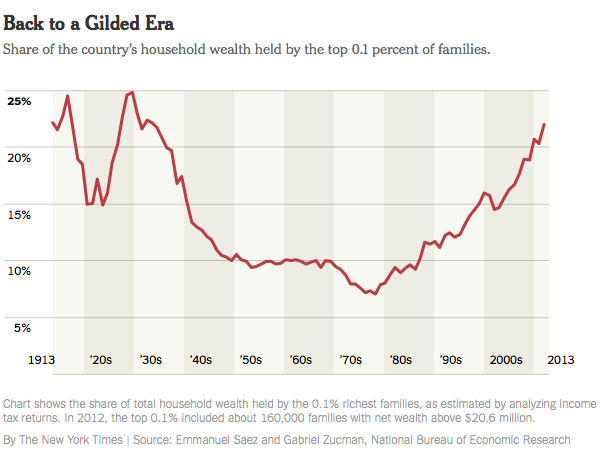
Conservative estimates published by the Brookings Institution show that from 1992 to 2013, the share of wealth held by the top 1 percent rose from 27 percent to 32 percent, and their share of income swelled from 12 to 18 percent. Looking at a century of data in “Wealth Inequality in the United States since 1913,” the economists Emmanuel Saez and Gabriel Zucman found that the share of household wealth held by the top 0.1 percent recently climbed back over 20 percent, a figure it hadn’t reached since the 1930s. (Their findings are demonstrated in the accompanying chart.)


There are a host of provisions in this year’s Tax Cuts and Jobs Act that disproportionately reward the rich, but the estate tax is one area where we can see the intentions of its sponsors most clearly.

The House legislation, backed by the Republican leadership and President Trump, would, starting in 2018, double the size of estates exempt from taxation to $10.98 million from the current level of $5.49 million. It would repeal the tax altogether at the end of 2023. According to the Joint Committee on Taxation, for the tiny percentage of the population that benefits from such immense estates, the value of the tax cut would grow steadily from $1.3 billion in 2018 to $38 billion in 2027.

Jason Furman, a professor of economics at Harvard’s Kennedy School who was chairman of the Council of Economic Advisers from 2013 to 2017, emailed his response to my inquiry about the impact of the bill on households with different incomes:
The House tax bill would lead to substantial redistribution from the middle-class to high-income households. Moreover, the particular form of the high-income tax cuts is designed to reward and perpetuate wealth in several respects. Much of the corporate rate cut would provide a windfall for the returns on capital investments that have already been made. Going forward, much of the effect of the plan would be to reduce the tax on monopoly rents-- often to negative effective rates which means taxpayers would be subsidizing corporations.
The House bill would repeal the estate tax, Furman wrote, and it “would also retain the step-up-basis loophole that even” President George W. Bush’s
estate tax repeal would have eliminated. This would mean that not only are estates not taxed but that much of capital gains could permanently escape taxation, substantially increasing dynastic wealth accumulation.
The estate tax has been under assault by Republicans in Congress for more than four decades. According to a paper published on Nov. 2 by Isabelle Sawhill and Eleanor Krause of the Brookings Institution, the estate tax currently applies to “a tiny fraction of American estates-- about 2 out of every 1000 deaths,” compared with “the 1970s, when there were over 70 taxable estates for every 1000 deaths.”

While income inequality is high in the United States-- the World Economic Forum ranked us 29th out of 30 developed countries in 2017-- wealth inequality is much greater.

...While proposing to eliminate the estate tax altogether, the House bill would retain a provision in current law-- the step-up in basis-- that effectively wipes out all tax liability for heirs on the increased value of assets at the time of death. Forbes declared, “this is a tax cut for the rich,” and described what would happen using the step-up in basis if you died with an estate that had grown in value from $10 million to $100 million:
There would be no estate tax, and your heirs could sell the stock right after your death and owe no capital gains taxes on the $90 million gain.
Many of the very richest Americans have children who stand to benefit enormously if the proposed tax bill is enacted. The list of these billionaires includes Mark Zuckerberg, Michael Bloomberg, Larry Ellison, Charles Koch, Sergey Brin, Larry Page, Phil Knight, Carl Icahn, Pierre Omidyar, David Koch, Warren Buffett, Bill Gates, Steve Ballmer, Sheldon Adelson, Michael Dell, Jeff Bezos, George Soros, and, of course, Donald Trump.

According to calculations made by Chye-Ching Huang, the deputy director of federal tax policy at the Center on Budget and Policy Priorities, a liberal think tank,
repealing the tax would give about 330 estates (which are each worth more than $50 million) each a tax cut averaging more than $20 million compared to current law.
The estate-tax provisions in the proposed bill are explicitly designed to help preserve and protect the assets of the wealthiest Americans. And despite their stated purpose, the corporate tax breaks in the legislation will not encourage new investment, according to many economists, but will instead reduce the taxes due on existing investments. Alan Krueger, a professor of economics at Princeton who was the chairman of the Council of Economic Advisers from 2011 to 2013, put the case against the Republican tax bill succinctly in an email:
Several components of the House bill favor physical and financial capital over labor and human capital-- namely, the lower rate for passive pass through income, the repeal of the estate tax, the big cut in the corporate tax rate, the failure to end the carried interest loophole, etc. At the same time, the tax on university endowments and treatment of grad student fellowships will slow human capital investment.

If enacted, these features of the proposal would also deepen and further entrench existing class divisions and reduce economic mobility.
That sure doesn't sound the way Paul Ryan describes the bill-- let alone remotely connected to anything Trumpanzee campaigned on last year, with all that talk about helping "the forgotten Americans." Edsall quoted an analysis by the Tax Policy Center concluding that:
The largest cuts, in dollars and as a percentage of after-tax income, would accrue to higher-income households. However, not all taxpayers would receive a tax cut under this proposal-- at least 7 percent of taxpayers would pay higher taxes under the proposal in 2018 and at least 25 percent of taxpayers would pay more in 2027.
"In other words," he wrote, "the Trump tax bill, contrary to the president’s populist spin, is a classic trickle-down proposal, concentrating by far the largest share of benefits on corporations and the rich."
In a blog post called “All Hail the New Plutocratic Industrial Policy,” Daniel N. Shaviro, a professor of tax law at N.Y.U., argues that the tax bill has been carefully crafted to create a new class of rich people who can evade the 39.6 percent top rate and pay at a 25 percent rate by capitalizing on complex “pass-through” and “passive-income” provisions:
So what must you do, or whom must you be, to get the 25% rate? First, you get it for 100% of your net business income from passive activities, which generally are business activities in which you personally do not materially participate. This typically applies to people who invest money in all kinds of partnerships, S corporation activities, et cetera that engage in pretty much any type of business.
Shaviro calls this obscure set of provisions in the tax bill “a weapon to enhance plutocracy-- offering the biggest rate cut to millionaires,” allowing those “who are in effect rentiers to get the low (25 percent) rate” on all their income.

A Nov. 2 analysis by the Center on Budget and Policy Priorities of the 25 percent rate for passive investors supports Shaviro’s point. A key reason the tax plan “is costly and heavily tilted to the wealthiest households is its special, much lower top rate for ‘pass-through’ business income,” Chuck Marr, Chye-Ching Huang, Brandon DeBot and Guillermo Herrera, all on the center’s staff, write. They continue:
Pass-through income would be taxed at no more than 25 percent, far below the 39.6 percent top individual income tax rate that now applies to pass-through income, or the top 35% top rate that would apply to individual income under the GOP plan. This would provide a massive windfall to the very wealthy.
This section of the bill has been nicknamed the “Trump loophole” by the center
because Donald Trump exemplifies the type of business owner whom it would most benefit.
Allan Sloan, a columnist for the Washington Post, wrote on Nov. 7 that
We don’t know how much Trump collects in such income, which has become passive for him since he put his children in charge of his enterprises rather than running them himself. But given that he seems to have stakes in at least 500 pass-through entities, it looks like reducing his rate to 25 percent from 39.6 percent would save him a ton of money.
...“[T]ax cuts for the rich” is no caricature. This year’s bill is already setting new tax avoidance schemes in motion... as it becomes clear once again that a favor-the-rich, reward-the-already-affluent ideology is embedded in the Republican Party’s DNA.

Labels: , , ,

Friday, June 02, 2017

Is The Democratic Party A Party Of Working People Or A Party Of Its Own Elites And Careerists?

>


Thomas Edsell's OpEd in the NYTimes yesterday, Has the Democratic Party Gotten Too Rich for Its Own Good?, came just as Blue America posted the above video by Mike Lux on our main 2018 congressional contribution page. Edsall began by pointing out that "During his primary campaign against Hillary Clinton, Senator Bernie Sanders, a self-proclaimed socialist, lived up to the grand Democratic tradition of favoring the underdog at the expense of the rich. He proposed hammering the affluent by raising taxes in the amount of $15.3 trillion over ten years. New revenues would finance about half the cost of a $33.3 trillion boost in social spending. The Sanders tax-and-spending plan throws into sharp relief the problem that the changing demographic makeup of the Democratic coalition creates for party leaders. Trouble brews when a deeply held commitment to the underdog comes into conflict with the self-interested pocketbook and lifestyle concerns of the upper middle class." Edsall, though, isn't celebrating.
In rhetoric reminiscent of Franklin Delano Roosevelt and Harry Truman, Sanders declared:
We must send a message to the billionaire class: “you can’t have it all.” You can’t get huge tax breaks while children in this country go hungry.
But Sanders spoke to the Democratic Party of 2016, not the Democratic Party of the Great Depression.

In days past, a proposal to slam the rich to reward the working and middle classes meant hitting Republicans to benefit Democrats.

Even as recently as 1976, according to data from American National Election Studies, the most affluent voters, the top 5 percent, were solidly in the Republican camp, 77-23. Those in the bottom third of the income distribution were solidly Democratic, 64-36.

In other words, 41 years ago, the year Jimmy Carter won the presidency, the Sanders proposal would have made political sense. But what about now?

In the 2016 election, the economic elite was essentially half Democratic, according to exit polls: Those in the top 10 percent of the income distribution voted 47 percent for Clinton and 46 percent for Trump. Half the voters Sanders would hit hardest are members of the party from which he sought the nomination.

The problem for the Democratic Party is that “them” has become “us.”

In the past, Democrats could support progressive, redistributive policies knowing that the costs would fall largely on Republicans. That is no longer the case. Now supporting these policies requires the party to depend on the altruistic idealism of millions of supporters who, despite being relatively well off, often feel financially pressed themselves.

This problem applies not only to tax policy, but even more to social policies concerning education and housing.

Richard V. Reeves, a senior fellow at the Brookings Institution, highlights the contradictions of modern Democratic liberalism in his new book, Dream Hoarders: How the Upper Middle Class is Leaving Everyone Else in the Dust.

Reeves argues that those in the top 20 percent of the income distribution have become an increasingly isolated class; if the country is to restore the American tradition of upward mobility, this elite will have to pay for it.

“The upper middle class has been having it pretty good. It is about time those of us in the favored fifth recognized our privileged position,” Reeves writes. As members of this class protect their status and economic gains for themselves and their children, Reeves contends, they have capitalized on a host of less visible forces — exclusionary zoning, the clustering of elites, legacy college admissions, disproportionate political influence — to build a protective wall, keeping those in the lower quintiles of the income distribution from breaking in.

As Reeves points out,
it is a stubborn mathematical fact that, at any given time, the top fifth of the income distribution can accommodate only 20 percent of the population. Relative intergenerational mobility is a zero sum game. For someone to move up the ladder, someone else must move down.
Or, as he put it in a 2013 essay in The Times,
Even the most liberal parents are unlikely to be comfortable with the idea that their own children should fall down the scale in the name of making room for a smarter kid from a poorer home.
His proposals calling on the upper middle class to abandon unfair “opportunity hoarding” raise a basic political question. Can the Democratic Party, as it is currently constructed, maintain its commitment to a redistributive agenda? Put another way, can a political party impose costs on its own constituents, especially those voters who make up the most influential faction of the party: the affluent and well educated?

The preliminary evidence from actual events is that demanding sacrifice poses major risks. Asking people to think of themselves as compassionate and to pay higher taxes is one thing-- many Democrats have made that leap-- but ask them to live in a mixed income neighborhood or ask them to have their kid give up her spot at Princeton, and you get a different response.

Reeves himself points to the Democratic uproar when President Obama proposed a relatively modest change in a tax-based mechanism to help pay college costs. The change in what are called 529 College Savings Plans was designed to make the program more advantageous to people with moderate incomes and less so for those with high incomes. An estimated 70 percent of the tax benefits of 529 plans currently go to families with incomes above $200,000.

The moment Obama suggested the reform, prominent Democrats from both the House and Senate were inundated with angry complaints from affluent constituents. They pressured Obama to drop the proposal. In less than a week, he did.

“The idea was sensible, simple, and progressive,” Reeves writes. “The episode was a brutal reminder that sensible policy is not always easy politics.” Reeves noted that two of the leading Democratic opponents of the 529 reform, Nancy Pelosi and Chris Van Hollen, who was elected Maryland’s junior senator in November but was a congressman when Obama proposed it, represented districts where “almost half their constituents are in households with six-figure incomes.”

Perhaps the most problematic issue for affluent Democrats are proposals calling for expanded construction of affordable housing in middle-to-upper-middle class neighborhoods.

When local officials and the courts pressed for construction of relatively small numbers of moderate income housing units in such upscale liberal bastions as San Francisco (Clinton 84.5 percent, Trump 9.2 percent) and neighboring Marin County, Calif. (Clinton 77.3 percent, Trump 15.5 percent), the groundswell of opposition was loud and clear.

...In an effort to further explore this question, I asked Jacob Hacker, a political scientist at Yale, two questions:
As the share of Democrats who are well-educated and upper middle class grows, how can the party continue to advocate redistributive policies? Can a party survive that calls on its own members to pay the costs of policies designed to help those on the bottom rungs?
Hacker replied:
The evidence is clear that even relatively affluent Democrats are more supportive of redistribution than a typical Republican-- at least in opinion surveys. This general support, however, doesn’t always translate into support for pro-opportunity policies at the local level.
Affordable housing, Hacker wrote, “is far and away the best example.” Opposition to zoning allowing denser and more affordable housing “comes not just from well-off residents but also from landlords who get monopoly rents.” The inherent zero-sum thinking underlying not-in-my-backyard approaches
prevents positive-sum solutions that could reduce the economic conflict between poorer members of the Democratic coalition and the more affluent segments.
Hacker concluded his email on an upbeat note, contending that “demography is not destiny” and that Democratic leaders
could work more aggressively to identify and create positive-sum solutions-- pro-growth policies that both lift up the least advantaged and attenuate class-based cleavages within its own coalition.
Arthur Lupia, a political scientist at the University of Michigan, less optimistically put his finger on the core problem for Democrats:
The Democratic Party is evolving in multiple ways that separate it from the living conditions of large numbers of working-class Americans.
The result, Lupia wrote, is that
many Democrats now know less, and appear to care less, about the day-to-day struggles of many working class Americans. Hillary Clinton is an example of a Democrat who struggled to be seen by many such Americans as having a sincere and credible grasp of their concerns.
Hacker and Lupia, while differing in outlook, together raise a basic concern about the contemporary Democratic Party: the casual, if not negligent, willingness of the party elite to adopt policies and positions, however worthy, without regard to the costs such policies impose on others.

The characteristics of the Democratic elite are best reflected in studies of delegates to the Democratic National Convention. For years, CBS surveyed these delegates but stopped doing so in 2008. Still, even without data from 2012 and 2016, the CBS surveys show a consistent pattern. Delegates are drawn overwhelmingly from the liberal upper middle class. In 2008, 70 percent of the delegates reported earning $75,000 or more per year, compared to 27 percent of Democratic voters at that time.

The Democratic delegates were well to the left of Democratic voters, a trend that continues. Seven out of ten delegates said that abortion should be generally available and 20 percent said abortion should be available under “stricter limits”; 43 percent of Democratic voters supported generally available abortion and 39 percent said under “stricter limits.”

More than 8 out of 10 Democratic delegates in 2008 agreed that “government should do more to solve national problems,” while 54 percent of Democratic voters shared that view, according to American National Election Studies. Hillary Clinton’s 2016 Democratic coalition clearly reflected the same priorities.

As the Democratic elite and the Democratic electorate as a whole become increasingly well educated and affluent, the party faces a crucial question. Can it maintain its crucial role as the representative of the least powerful, the marginalized, the most oppressed, many of whom belong to disadvantaged racial and ethnic minority groups-- those on the bottom rungs of the socioeconomic ladder?

This will be no easy task. In 2016, for the first time in the party’s history, a majority of voters (54.2 percent) who cast Democratic ballots for president had college degrees. Clinton won all 15 of the states with the highest percentage of college graduates [Massachusetts, Colorado, Maryland, Conneticut, New Jersey, Virginia, Vermont, New Hampshire, New York, Minnesota, Washington, Illinois, Rhode Island, California and Oregon].

The steady loss of Democratic support in the white working class, culminating in Trump’s Electoral College victory on the backs of these white voters, must inevitably send a loud and clear signal to the Democratic elite: The more the party abandons the moral imperative to represent the interests of the less well off of all races and ethnicities, the more it risks a repetition of the electoral disaster of 2016 in 2018, 2020 and beyond.
Paul Clements is the Kalamazoo progressive who ran against reactionary Republican Fred Upton in 2014 and 2016. We're hoping he runs again in 2018 and he told me he's considering doing so but hasn't made up his mind yet. He's speaking to folks on the ground and figuring out if another run is the best way to defeat Upton. After watching Mile's video up top, he told me that "As Americans see and live the results of Trump's government of billionaires and generals allied with Ryan's free market fundamentalists, Democrats need to give a vision of government for the people. Medicare for all, breaking up big banks, and clean energy, not to mention getting rid of for profit prisons, raising the minimum wage, and re-investing in public education."

Jenny Marshall, who's running for the North Carolina seat held by right-wing knee jerk crackpot Virginia Foxx, is exactly the kind of progressive Democrat who feels in her bones exactly what Lux is talking about. "We want someone who will stand up for our values, our way of life and our families," she told me after watching the clip-- although it's exactly the kind of stiff she's been talking about ever since I met her. "We want a champion that will fight for us. Democrats need to be willing to go to the mat for people and stop caving in when the GOP refuses to compromise. We can no longer negotiate away our schools, our health, our livelihoods and our future. We cannot continue to follow the Republicans as they lead us further to the right. We must stand up for what we believe in. I am standing up for the people of the 5th district. It is time we had a real leader in Washington who won't back down from a challenge."

Last year Tom Wakely ran for the Austin-San Antonio corridor seat occupied by crackpot science denier Lamar Smith. He's running again this year. He found Mike's video spot on and without knowing about Edsall's OpEd, addressed some of the questions he raised in it:
As candidates, we need to be bold. We need to tell people that having Medicare For All is a good thing. We need to tell them having the EPA around is a good thing. Unfortunately, too many in the Democratic Party still think that being a centrist is the only way to win elections. Here in Texas, we are fond of saying the only thing that is in the middle of the road is a dead armadillo and it stinks to high heavens.


When I ran against 30-yr. Republican incumbent Lamar Smith in 2016, I ran on a progressive agenda and while I lost that race, we managed to do something no one else has been able to do in over 30 years-- we managed to drop Smith's percentage vote total to 56.9%, the lowest of his career. Our campaign accomplished this not by running a centrist political campaign but by running a progressive community organizing campaign. And Lamar Smith took note of this. For the first time in nearly two decades, Smith actually started campaigning. He also dumped over $1.7 million into his campaign, spending over $8.00 a vote. We only raised $70,000, which came to a little less than .55 cents per vote. Imagine what our campaign could have done with a  little more money.

As I take a look at the Democrat Party today, I don't see the party of FDR, of Kennedy, of LBJ. I see a party wed to Wall Street, to the Big Banks. A party more interested in helping line the pockets of consultants with cash than with helping line the pockets of ordinary, working class citizens of this country. We need to make voting a hell of lot easier and that is why I support a national program to vote by mail. A lot needs to be done in the Democrat Party if it is ever to be able to proudly raise it's head once again and say, "I stand for the working people of this country." It's a marathon and not a sprint.

I am 64 years old and I don't think I have that many years left in me to take on the Democratic Party Establishment and Wall Street and win. But there are so many young, enthusiastic activists out there I have hope that one day we will see a return to the party of FDR and LBJ. But until that day comes all I can do, all I will do, is continue to tell everyone that will listen, that I am a Progressive. I  will shout from the rooftops that I stand with the working people of this country against Wall Street and the Big Banks, against those who would destroy the EPA and against those who believe that making a profit off of sick and dying people is okay.


Labels: , , , , , , , , , ,

Friday, May 19, 2017

What Will It Take For Congressional Republicans To Split From Trump?

>


According to a new poll from Morning Consult, just around a third of Americans feel Trump is trustworthy, about the same number who say he has the judgement need to be president. 77% of respondents, on the other hand, feel he's arrogant and 60% say he's reckless, unwilling to admit mistakes. Somehow they managed to find enough people who think he's knowledgeable to report that 41% of Americans are still fooled by the most ignorant man to ever be installed in the White House. Overall, his approval numbers are the lowest ever.42% approve and 50% disapprove.
Perhaps more worrying for the president-- and for Republican members of Congress ahead of the 2018 midterm elections-- is a declining strength in support among the voters who elected him. While 84 percent of Trump voters still say they approve of the president’s work, the share of those voters who strongly approve of him is down to 42 percent, another new low. In the previous poll, 49 percent of Trump voters strongly approved of him.
Monmouth University also released a poll today and it shows 53% disapproval and 39% approval for Señor Trumpanzee. Putin-Gate is taking its toll-- in a big way. And its worst in the swing counties that allowed him to slip into the White House despite losing the popular vote 65,853,516 (48.2%) to 62,984,825 (46.1%). Monmouth points to 300 counties with a narrow margin between Trump and Clinton and it is in these counties where Trump's approval ratings have plummeted. Never mind the counties where Trump did really well or the counties where Clinton did really well. This is about counties like Kenosha and Racine in Wisconsin where Trump beat Clinton, respectively, 36,025 (47.5%) to 35,770 (47.2%) and 46,620 (49.8%) to 42,506 (45.4%). Voters there are not just disappointed in Trump, they're ready to dump their local Republican congressman. And their local Republican congressman happens to be Paul Ryan, whose current reelect numbers are just 44% (with 51% looking to replace him). This is about Bucks County in Pennsylvania, where Hillary beat Trump 165,861 (48.4%) to 163,873 (47.8%) and about Erie County in the same state, where Trump beat Clinton 57,168 (48.8%) to 54,820 (46.8%) and about Broome and Dutchess counties in New York, where Trump beat Clinton 49.0-45.3% in the former and 48.4-47.3% in the latter. In Florida we're looking at Duval County, which went 49.0-47.5% for Trump and St. Lucie County, where Trump won 49.9% to 47.5%. These are the kinds of counties that are going to determine the 2018 midterms (and, ultimately, whether or not Congress impeaches Trump). And these are the counties where Trump's approval numbers are falling the fastest.

Overall, in these swingy counties, Trump's approval rating is now a dismal 34%... 5 points lower than the national average. In his NY Times column Thursday, Thomas Edsall points to the plight of Republicans-- presumably Republicans who represent these kinds of counties-- who must figure out what poses a greater risk to their careers-- supporting a potential impeachment or to close ranks behind Señor Trumpanzee? "To defy Trump or to defend him? To provoke anger among the legions of Trump loyalists back home or to run the risk of turning the 2018 midterms into a Democratic wave election?"


Members of Congress, he reminds us are "single-minded seekers of re-election." Keep that in mind along with the fact that "the most important development on the Republican side of the aisle is the rise in recent years of primary challenges from the right. Highly conservative insurgents have repeatedly demonstrated their ability to defeat Congressional incumbents who fail to toe the line."
Seth Masket, a professor of political science at the University of Denver, summarized the quandary facing members of Congress in a polarized nation:
Republicans in particular represent much more conservative districts than they used to, and they risk offending a much more active and ideologically demanding group of activists in primary elections should they be seen working with Democrats or undermining President Trump. Relatedly, the policy differences between the two parties are much greater than they used to be, so doing anything that could lead to the other party being in power is a potentially very costly exercise. Bipartisanship is just riskier and potentially costlier behavior than it used to be.
The success of right-wing challengers to centrist Republican members of the House and Senate stems from a set of mutually reinforcing trends.

These trends include growing ideological consistency in the electorate, geographic sorting, gerrymandered districts, the perception of partisan opponents as mortal enemies and the emotional intensity underpinning issues of race and sex.

For a Republican senator or representative who is considering a break with the Trump administration, these developments in the electorate pose a hazard. Defection risks inflaming primary voters in 2018.

According to American National Election Studies, 45 percent of Republican voters described themselves as conservative in 1974. By 2012, 70 percent said they were conservative.

The Pew Research Center has shown that turnout in Republican primaries tilts even farther to the right. To give one example, in 2012 Pew found that 75 percent of Republican primary voters-- whom Pew describes as “high engagement Republicans”-- described themselves as conservative, more than triple the 23 percent of self-described liberals and moderates.

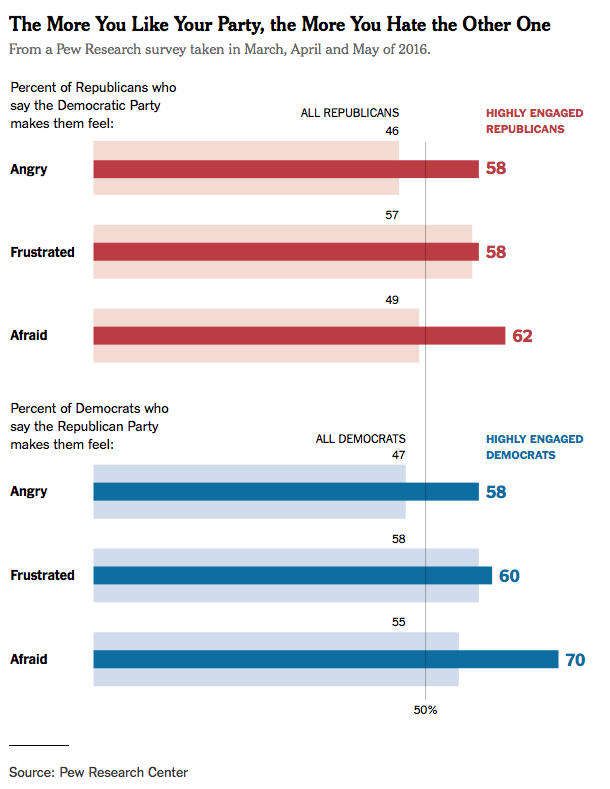
These voters view the Democratic Party not only as the opposition, but as imperiling the national welfare (a view shared in reverse by “high engagement” Democrats). Under these circumstances, bipartisan cooperation can seem positively dangerous.

The accompanying chart, which is based on data from Pew, shows that 62 percent of engaged Republicans-- those most likely to cast primary votes-- say the Democratic Party makes them feel “afraid,” 58 percent say it makes them “angry” and 58 percent say it makes them “frustrated.”


At the same time, according to Pew, the percentage of Republican voters whose view of the Democratic Party is unfavorable grew from 74 percent in 1994 to 91 percent in 2016. Equally important, the percentage with “very unfavorable” views has nearly tripled, from 21 percent in 1994 to 58 in 2016.

The increase in safe House seats from 1992 to 2012 is the driving force behind the growing significance of primary elections and the declining salience of general elections. For Republicans, safe districts-- where the potential threat to an incumbent is in the primary and not in the general election-- rose from 136 in 1992 to 191 in 2012. For Democrats, the number of safe districts grew from 111 in 1992 to 156 in 2012.

Republicans focused on self-interest-- or self-preservation-- are under pressure from all directions.

Nolan McCarty, a political scientist at Princeton, made the point in an email that, given the current level of polarization, a Republican who challenges his party by taking on President Trump and still survives the primary may not be rewarded in the general election because there is “much less opportunity for offsetting support from Democrats and Independents.”

Another factor elected Republicans must consider in calculating their positions is an upsurge in straight ticket voting since 1992.

Marc Hetherington, a political scientist at Vanderbilt, argues that voting patterns in states and districts are making it increasingly hazardous for a politician to break ranks:
Consider voting behavior in the 2016 election. For the first time in history, every state that voted Democratic voted for a Democrat for Senate. Every state that voted Republican voted for a Republican for Senate. As for congressional districts, the number of split voting districts between the presidential and House elections reached a minimum since such records have been kept, which dates to 1920.
In the current political climate, Hetherington said:
Republicans hate the Democratic Party so much and Democrats hate the Republican Party so much that they do not view the other side as a viable option.
In the past, when the electorate was less partisan,
Republicans would have to worry about what Democrats in the electorate thought because they counted on getting votes from Democrats when they had to face the voters in the fall. Now, they do not.
Along similar lines, Martin Gilens, a political scientist at Princeton, noted:
Compromise and bipartisanship are increasingly viewed as betrayal. In recent years, challenges to party leadership have come only from extremist factions like the Tea Party, not from centrists concerned with maintaining institutional norms or adopting policies with widespread appeal.
...While a great danger facing Republicans-- one with vast consequences going forward-- is that they will wait to act longer than their voters are prepared to tolerate, there are clear signs that Republican willingness to stand behind Trump has begun to fray.

On Wednesday, before Mueller’s appointment was announced, two Republican Senators, Lisa Murkowski of Alaska and Susan Collins of Maine had already suggested that it might well be time for the appointment of a special prosecutor. Other Republican senators who have publicly criticized Trump include Ben Sasse of Nebraska, John McCain of Arizona, Lindsey Graham of South Carolina and Jeff Flake of Arizona.

From Trump’s vantage point, support in Washington, and in the electorate as a whole, is falling off. He will continue to try to make a political virtue of this, arguing, as he did in his commencement speech at the Coast Guard Academy on Wednesday, that “the people understand what I’m doing and that’s the most important thing” and that “I didn’t get elected to serve the Washington media-- I got elected to serve the forgotten men and women and that’s exactly what I’m doing.”

The question now is what this reckless president with little regard for the law will do as the challenge to his legitimacy deepens.

Labels: , , , ,

Friday, August 12, 2016

When Will Commentators Start Describing Trump's Campaign As Off The Rails-- Or Even Moribund?

>


It's not likely that Señor Trumpanzee will be campaigning in WA-08 this year. The Seattle suburbs and exurbs aren't fertile ground for him and, to put it mildly, the Republican congressman in the district, Dave Reichert, doesn't want Trump getting anywhere near the any media markets where his constituents will have reason to connect the two of them. Yesterday, in fact, Reichert announced he may vote for Libertarian Gary Johnson but he's definitely not endorsing The Donald. Besides, Hillary is going to clean up in that district. Obama won it both times-- and he wasn't running against a deranged narcissistic sociopath.

Democrats have had their eyes on the district for a long time but have never been able to dislodge Reichert, although Darcy Burner came close in 2006 when Reichert scraped by 51-49%. Last time, he won with 63%. This year the DCCC screwed up again and the candidate, longtime popular KING-TV sports anchor Tony Ventrella-- who was running on a platform of getting big money out of politics-- dropped out before the primary but beat the other two Democrats in the primary and is now, reluctantly, back in the race. Reichert seems safe to me even there is an anti-Trumpanzee tsunami in Washington state.

Trump was was clear across the country August 4, campaigning in Portland, Maine. It was a disaster as he tried fomenting racial and ethnic antagonisms with between whites and Maine's peaceful Somali population. Senator Susan Collins disavowed him immediately after and yesterday a Gravis poll came out showing Hillary beating him by 10 points in the state:
Hillary- 43%
Trumpanzee- 33%
Johnson- 10%
Stein- 5%
Clinton is the choice of 74% of Maine Democrats and 15% of them prefer Trump. 68% of Republicans support Trump and 19%supporting Clinton. She leads him among independents 43-31%.

Yesterday's big news stories of the morning were how Trump is wrecking both parties and how forces within the GOP are agitating to cut him loose. Many commentators are catching up with Thomas Frank's thesis in Listen, Liberal: Or, What Ever Happened to the Party of the People? that the Democrats have given up the working class to become the party of the white collar professionals along with women and minorities (identity politics)-- the splintering of the FDR coalition. Thomas Edsall in the Times:
Trump is competitive among the less affluent and those without college degrees, among whom he is behind by 3 and 4 points respectively. But Clinton is crushing him among college graduates (57-34) and among those making $50,000 or more (55-37).

The current education and income patterns reflect a reversal of the way Bill Clinton first won the presidency in 1992. Bill Clinton beat George H.W. Bush by double-digit margins among voters making less than $50,000, but lost among voters making $100,000 or more, 54-38. In 1992, Clinton won by similarly large margins among those with high school degrees or less, while losing college graduates 41-39.

The larger conclusion from the data is that the Trump campaign-- both through the support Trump generates among working-class whites and the opposition he generates among better educated, more affluent voters-- has accelerated the ongoing transformation of the Democratic Party. Once a class-based coalition, the party has become an alliance between upscale well-educated whites and, importantly, ethnic and racial minorities, many of them low income.

...If current trends continue, not only will there be a class inversion among the white supporters of the Democratic Party, but the party will become increasingly dependent on a white upper middle class that has isolated itself from the rest of American society.

Instead of serving as the political arm of working and middle class voters seeking to move up the ladder, the Democratic Party faces the prospect of becoming the party of the winners, in collaboration with many of those in the top 20 percent who are determined to protect and secure their economic and social status.

...From this vantage point, Trump and the pro-social insurance populist right that has emerged in much of Europe are as much the result of the vacuum created by traditional liberal political parties as they are a function of the neglect of working class interests by conservatives.

You can look at the populist insurgency spearheaded by Donald Trump as either a corrective or a threat to mainstream Republican orthodoxy.

But GOP insiders are losing patience with Trump, as his narcissistic personality gets in the way of successfully navigating the realignment and his flailing, floundering campaign puts their down ballot candidates at increasingly grave risk. Alex Altman and Zeke Miller reported in Time about a tough phone call between Reince Priebus and Trumpanzee. Although Trump denies the call ever took place, they reported that "Priebus told Trump that internal GOP polling suggested he was on track to lose the election. And if Trump didn’t turn around his campaign over the coming weeks, the Republican National Committee would consider redirecting party resources and machinery to House and Senate races... Polls show that Trump has failed to grasp one of the essential truths about this extraordinary contest: in a race between the two most unpopular major-party nominees in modern history, it’s in each campaign’s interest to train the spotlight on the other. Clinton wants the race to be about Trump. Which is what the publicity-addled Republican wants too." The result is what we're seeing in the polls now, which are showing Trump not only failing to win targets like Pennsylvania, Michigan and Wisconsin but possibly losing red bastions like Georgia, the Carolinas, even Utah!
With their candidate mired in self-sabotage, Republicans could only watch and wince. “I don’t think we’ve seen anything like this since George Wallace,” said retail mogul Art Pope. Sitting at a lakeside hotel in the Colorado Rockies on July 31, the conservative megadonor wondered how his party had wound up cowering in fear of the latest tweet from a former reality star. “My concern is Donald Trump will depress the Republican vote and hurt down-ballot candidates,” said Pope, a close ally of North Carolina Governor Pat McCrory. “We’re going to lose races because of him. I just hope it’s not all lost.”

Republicans groan that the difficult task of keeping their Senate majority gets tougher with each outré remark. Which is why the RNC is considering shifting some cash and staff away from the presidential race and toward down-ballot contests. That plan is already in motion among powerful outside groups that typically spend hundreds of millions of dollars on behalf of the party nominee. “There’s going to have to be some resource reallocation,” says a senior Republican official familiar with internal party deliberations. A second senior party official routinely instructs Senate campaign managers to distance their candidates from Trump. “Don’t worry about the appearances,” the official said on a recent conference call. “Worry about winning.”

That explains why Republicans running for office this year don’t meet Trump’s plane at airports or introduce him at rallies. In some places, the avoidance strategy seems to be working. Senator Pat Toomey is in a statistical tie in his re-election bid in Pennsylvania, a state where Trump trails by about 10 points. In the key swing state of Florida, Senator Marco Rubio is running ahead in his re-election bid even as Trump narrowly trails Clinton. But in New Hampshire, Trump’s troubles may be dragging down Ayotte, who plummeted from a virtual tie to 10 points down in a recent poll.
The morning got worse when Politico published a report that "more than 70 Republicans have signed an open letter to Republican National Committee Chairman Reince Priebus urging him to stop spending any money to help Donald Trump win in November and shift those contributions to Senate and House races. "We believe that Donald Trump’s divisiveness, recklessness, incompetence, and record-breaking unpopularity risk turning this election into a Democratic landslide, and only the immediate shift of all available RNC resources to vulnerable Senate and House races will prevent the GOP from drowning with a Trump-emblazoned anchor around its neck. This should not be a difficult decision, as Donald Trump’s chances of being elected president are evaporating by the day."

And by last night, the narrative had moved along to an emergency "come to Jesus meeting" with top Trump staffers scheduled for today at the Orlando Ritz Carlton.
Trump on Thursday night challenged reports that the RNC might shift resources down ballot, warning in an interview on Fox News “if it is true, that’s okay too because all I have to do is stop funding the Republican Party.”

Trump argued that the RNC needs him more than the he needs the committee, asserting: “I’m the one raising that’s funding, I’m the one that’s raising the money and other people are getting to use the money that I raised.”

An RNC member said discontent with the Trump campaign has hit new heights in recent days, describing “major tumult in the building and staff problems and disagreements and RNC staff on the edge of mutiny.”

That’s particularly evident in must-win Florida, the nation’s biggest battleground state, where Trump’s campaign has only one field office and no visible footprint otherwise. It plans to open 25 offices by early September, but rank-and-file Republican Party members and candidates are worried that Hillary Clinton’s team is building a robust campaign across the state.

Republicans started growing more-jittery this week as a Quinnipiac University poll indicated Trump was losing his advantage in Florida over Hillary Clinton and might be dragging down Sen. Marco Rubio’s reelection efforts.

..."We're having a problem," Trump told a group of ministers in Orlando in Thursday, according to the Associated Press. Trump pointed out that the troubles and his potential loss "could cost us the Supreme Court."
And that Politico Insiders poll they take... the Republican insiders have come to the conclusion Dr. Trumpanzee can't win. These are the same men and women who, less than a month ago, were certain that a successful convention in Cleveland had put Trumpy-the-Clown on the path to victory; just a month ago! Republicans are more certain of GOP doom than Democrats, who cited the unpredictability of the 2016 campaign, along with some of Clinton’s own weaknesses. 51% of the Republicans on the panel think it's all over for Trump, who, they feel, has no understanding of electoral politics' mechanisms. Last night, for example, he told Fox News viewers that "I don’t know that we need to get out the vote. I think people that really want to vote, they’re gonna just get up and vote for Trump... We are gonna have tremendous turnout from the evangelicals, from the miners, from the people that make our steel, from people that are getting killed by trade deals, from people that have been just decimated, from the military who are with Trump 100 percent. From our vets because I’m going to take care of the vets." Republican Party communications strategist Matt Mackowiak does't seem impressed-- and let loose an epic twitter storm last night. Here's part of it:


Can the news get any worse for Mr. Trumpanzee? In 2012 Mitt Romney won North Carolina's 15 electoral votes 2,270,395 (50%) to 2,178,391 (48%) and Pat McCrory won the governor's mansion 55-43%. New polling from PPP shows Hillary pulling ahead, 43-41%. They are also showing Democrat Roy Cooper beating McCrory 43-42%. Even more shocking, much redder South Carolina is tightening so that Trump just leads 41-39%-- in a state Romney won 1,071,645 (55%) to 865,941 (44%).


Labels: , , , , ,

Saturday, December 06, 2014

The Anti-Populist Wall Street Democrats Want A Little Populist Cover-- Just A Little

>


Last week we took a quick glance at Schumer's anti-Obamacare re-positioning, not because he's Chuckie Schumer, the consummate asshole from Brooklyn, but because he's in charge of DSCC massaging. In the last couple of days, the NY Times has run columns by both Thomas Edsall and then Paul Krugman on Schumer's pronouncements, each very much worth reading through.

Edsall went first and he was more sympathetic to Schumer's divisive position, almost calling it "populist." He wrote that "According to Schumer, President Obama and his party suffered defeat last month in large part because of the strategic decision to press for enactment of the Affordable Care Act soon after Obama won the presidency." Edsall never gets into the glaring and insupportable weaknesses of the Affordable Care Act, elucidated by Tom Harkin this week but instead sticks to a Schumeresque worldview, primarily banal electoral stratagems: "Only a third of the uninsured are even registered to vote. In 2010 only about 40 percent of those registered voted. So even if the uninsured kept with the rate, which they likely did not, we would still only be talking about only 5 percent of the electorate. To aim a huge change in mandate at such a small percentage of the electorate made no political sense. So when Democrats focused on health care, the average middle-class person thought, the Democrats are not paying enough attention to 'me'."

Pelosi's direct response was a slap in the face to the repulsive careerism that has defined Chuck Schumer ever since he was an assessing high school student at James Madison in Brooklyn: "We come here to do a job, not keep a job." She never mentions Schumer's pandering to whites against people of color-- but one of her top advisors, Wendell Primus, does. Edsall writes that "Primus contended that some of the economic benefits of Obamacare do flow to the largely white middle class, that 8.3 million seniors on Medicare have benefited from expanded prescription drug coverage by an average of $1,443 per person, for total savings of $12 billion, and that Obamacare has contributed to a sharp reduction in the growth of Medicare Part B premiums. From 2000 to 2008, Primus noted, these fees rose 112 percent, from $45.50 per month to $96.40 per month, while through the subsequent eight-year period, premiums are expected to rise by only 10 percent, from $96.40 to $106.50 a month. The views of Democratic advocates of Obamacare notwithstanding, public opinion has generally sided with Schumer."
The only way for Democratic Party leaders to stop the hemorrhaging [of white voters], in Schumer’s view, is to take on the task of using the government to intervene in the private sector, pushing to raise wages and revive job opportunities for working men and women.

“Large forces-- technology, automation and globalization-- are not inherently malign forces,” Schumer said, but the burden is on Democrats “to figure out ways for the middle class to adapt to these new forces-- to be able to thrive amidst these forces.” The only counterweight “that can give you the tools to stand up to the large tectonic forces, that can mitigate the effects that technology creates on your income, is an active and committed government that is on your side.”

Standing in the way of activist intervention is the fact that “the American public is so cynical about government that a Democratic, pro-government message would not be immediately successful.” To restore credibility, Schumer argued, the “first step is to convince voters that we are on their side, and not in the grips of special interests.” He specifically suggested the prosecution of bankers for “what seems, on its face, blatant fraud” and tax reform designed to ensure that C.E.O.s paid higher rates “than their secretaries.” In effect, he said, “an element of populism, even for those of us who don’t consider ourselves populists, is necessary to open the door before we can rally people to the view that a strong government program must be implemented.” [Note: Schumer has accepted more in legalistic bribes from the Financial Sector than any other Member of Congress in history other than presidential some-- though not all-- candidates, so far, $20,721,989.]

The ability of the Democratic Party to convince middle-class voters that it is on their side is by no means guaranteed. In mid-November, 2008, just after Obama first won election, 55 percent of voters had a favorable view of the Democratic Party. In the immediate aftermath of the recent election, according to Gallup, the favorability rating of the Democratic Party had fallen to a record low of 36 percent.

...By shifting the public focus to the party’s pro-work and pro-wage policies, Schumer wants to transform the negative association of the Democratic Party with Obamacare. Even as his speech has provoked an intraparty rift, Schumer’s argument has won support from some surprising quarters.

A spokesman for Senator Elizabeth Warren told reporters that Warren “agrees with Senator Schumer that there was an urgent need in 2009 and 2010 to help middle-class families who were struggling to get by, and that more should have been done.” Sheldon Whitehouse of Rhode Island told Politico: “I agree with Chuck that the A.C.A. was essential, as our health care system was unjust and spinning out of control. I also agree that if we could have done more infrastructure first it would have connected more with working Americans, and our sales job was less than stellar.”

...Insofar as Democrats try to reduce hostility to Obamacare, they face two problems. The first is a Republican Party unwilling to support any legislation making the A.C.A. more palatable. The other is the danger that tinkering with any of the provisions that have provoked the strongest opposition could eviscerate the legislation. Among the provisions that have stirred opposition are the requirement that most Americans get coverage, the tax on medical devices and the excise tax on expensive, high-quality private health coverage. Removing existing provisions would require replacing lost funding with new revenue sources, which could provoke anger from multiple constituencies.

As if Democrats do not already have enough trouble, data released by the Centers for Medicare and Medicaid Services shows that many, if not most, of the seven million people who purchased insurance through the A.C.A. will either have to pay higher premiums or higher deductibles, or submit themselves to the complex process of switching plans.

Democrats have a lot going for them in presidential years. Nonetheless, at the moment you’d have to say that they have their work cut out for them.

Even though midterm elections favor Republicans, the 2014 results show middle- and working-class dissatisfaction with the Democratic Party rising to dangerous levels, which threatens the party’s growing demographic advantages.

Perhaps most notably, Republican House candidates in 2014 won 37 percent of the Hispanic vote, their highest percentage since Republicans rejected immigration reform in 2005, and a slight majority, 51-49, of Asian-American voters, who had been moving decisively in the Democrats’ favor. Asian-Americans and Hispanics are crucial to future Democratic presidential victories.

In combination with the growing Republican allegiance of whites, these trends raise the possibility that the Democratic plan for victory by demographics could implode, which would make the case for a full scale re-evaluation of its strategies and policies glaringly obvious.

Whatever you think of Senator Schumer, you begin to understand why he spoke out as forcefully as he did.
Krugman stared by summarizing the continuing success of Obamacare, largely ignored by Schumer, Edsall, and most everyone else.
Earlier this week, the independent Urban Institute released new estimates of the number of Americans without health insurance, and the positive results of Obamacare’s first year are striking. Remember all those claims that more people would lose coverage than would gain it? Well, the institute finds a sharp drop in the number of uninsured adults, with more than 10 million people gaining coverage since last year. This is in line with what multiple other estimates show. The primary goal of health reform, to give Americans access to the health care they need, is very much on track.

And while some of the policies offered under Obamacare don’t offer as much protection as we might like, a huge majority of the newly insured are pleased with their coverage, according to a recent Gallup poll.

What about costs? There were many predictions of soaring premiums. But health reform’s efforts to create meaningful competition among insurers are working better than almost anyone (myself included) expected. Premiums for 2014 came in well below expectations, and independent estimates show a very modest increase-- 4 percent or less-- for average premiums in 2015.

In short, if you think of Obamacare as a policy intended to improve American lives, it’s going really well. Yet it has not, of course, been a political winner for Democrats. Which brings us to Mr. Schumer.

The Schumer critique-- he certainly isn’t the first to say these things, but he is the most prominent Democrat to say them-- calls health reform a mistake because it only benefits a minority of Americans, and that’s not enough to win elections. What President Obama should have done, claims Mr. Schumer, was focus on improving the economy as a whole.

This is deeply wrongheaded in at least three ways.

First, while it’s true that most Americans have insurance through Medicare, Medicaid, and employment-based coverage, that doesn’t mean that only the current uninsured benefit from a program that guarantees affordable care. Maybe you have good coverage now, but what happens if you’re fired, or your employer goes bust, or it cancels its insurance program? What if you want to change jobs for whatever reason, but can’t find a new job that comes with insurance?

The point is that the pre-Obamacare system put many Americans at the constant risk of going without insurance, many more than the number of uninsured at any given time, and limited freedom of employment for millions more. So health reform helps a much larger share of the population than those currently uninsured-- and those beneficiaries have relatives and friends. This is not a policy targeted on a small minority.

Second, whenever someone says that Mr. Obama should have focused on the economy, my question is, what do you mean by that? Should he have tried for a bigger stimulus? I’d say yes, but that fight took place in the very first months of his administration, before the push for health reform got underway. After that, and especially after 2010, scorched-earth Republican opposition killed just about every economic policy he proposed. Do you think this would have been different without health reform? Seriously?

Look, economic management is about substance, not theater. Having the president walk around muttering “I’m focused on the economy” wouldn’t have accomplished anything. And I’ve never seen any plausible explanation of how abandoning health reform would have made any difference at all to the political possibilities for economic policy.

Finally, we need to ask, what is the purpose of winning elections? The answer, I hope, is to do good-- not simply to set yourself up to win the next election. In 2009-10, Democrats had their first chance in a generation to do what we should have done three generations ago, and ensure adequate health care for all of our citizens. It would have been incredibly cynical not to have seized that opportunity, and Democrats should be celebrating the fact that they did the right thing.

And one related observation: If more Democrats had been willing to defend the best thing they’ve done in decades, rather than run away from their own achievement and implicitly concede that the smears against health reform were right, the politics of the issue might look very different today.
I wonder if Schumer reads the Times. I mean with an open mind.

Labels: , , ,