Friday, September 11, 2020

Americans Are Largely Unaware That, As A Country, We're Doing Worse And Worse-- And There Is No Political Solution In Sight... At Least Not For The Next Few Years

>


In his NY Times column yesterday, that the U.S. is #28... and dropping. And he wasn't talking about soccer. He wrote that "The newest Social Progress Index... finds that out of 163 countries assessed worldwide, the United States, Brazil and Hungary are the only ones in which people are worse off than when the index began in 2011. And the declines in Brazil and Hungary were smaller than America’s." It's worth noting that Brazil and Hungary have also elected fascist-type leaders similar to Trump.
The index, inspired by research of Nobel-winning economists, collects 50 metrics of well-being-- nutrition, safety, freedom, the environment, health, education and more-- to measure quality of life. Norway comes out on top in the 2020 edition, followed by Denmark, Finland and New Zealand. South Sudan is at the bottom, with Chad, Central African Republic and Eritrea just behind.

The United States, despite its immense wealth, military power and cultural influence, ranks 28th-- having slipped from 19th in 2011. The index now puts the United States behind significantly poorer countries, including Estonia, Czech Republic, Cyprus and Greece.

...The United States ranks No. 1 in the world in quality of universities, but No. 91 in access to quality basic education. The U.S. leads the world in medical technology, yet we are No. 97 in access to quality health care.

Make sense of the moment.

The Social Progress Index finds that Americans have health statistics similar to those of people in Chile, Jordan and Albania, while kids in the United States get an education roughly on par with what children get in Uzbekistan and Mongolia. A majority of countries have lower homicide rates, and most other advanced countries have lower traffic fatality rates and better sanitation and internet access... and lags in sharing political power equally among all citizens. America ranks a shameful No. 100 in discrimination against minorities.

The data for the latest index predates Covid-19, which has had a disproportionate impact on the United States and seems likely to exacerbate the slide in America’s standing. One new study suggests that in the United States, symptoms of depression have risen threefold since the pandemic began-- and poor mental health is associated with other risk factors for well-being.
That's what neoliberal policies have wrought-- and what Trumpism has exacerbated. If if we get rid of Trump, we still have one of the worst examples of neoliberalism in American politics sitting in the Oval Office. Dartmouth economist David Blanchflower told Kristof that "Rising distress and despair are largely American phenomenon not observed in other advanced countries." Kristof suggests we "wake up, for we are no longer the country we think we are."

You think Trump is going to resign or even seriously consider resigning? It would be a smart move for him, since he could make a deal with Pence-- who would get to be "president" for a couple of months or weeks-- to pardon him and his churlish family. But he won't. He'll fight to the last second and then refuse to give up the White House until Biden pardons him. How's that possible? In David Remnick's words, "Trump is who he has always been, and the details that we learn with every passing day merely fill in the portrait with sharper focus and more lurid colors. The man who lied about the nature of the novel coronavirus to the American people (but confided in Bob Woodward) is the same man who, as a real-estate huckster, used to say that the best way to hype a new building was to 'just give them the old Trump bullshit.' Deception is his brand." It's worth reading Remnick's take on RAGE-- the nightmare presidency that doesn't want to let us wake up from. "As he proves almost daily, Trump is capable of saying or doing anything to win. And if he doesn’t win, the presumption that he will hand over power without some sort of duplicity is far from assured."
Trump’s Presidency has been appalling–– but not unpredictably so. That he would bring misery and division to this country should have been obvious from the start. Flagrantly corrupt and instinctually autocratic, he immediately set about threatening democratic values and the rule of law, while encouraging autocrats abroad and white nationalists at home. He has aroused hatred for the free press and slimed the patriotism of everyone from John McCain to John Lewis. It is a painful thing to say, but the evidence assaults us daily: Trump is a miserable human being. Ask his sister, a retired federal judge; in a taped conversation with the President’s niece, she refers to him as "cruel." It is the rare adviser or satrap who leaves the White House and does not hasten to write a memoir or speak to the press with the intention of sounding a common alarm, that Trump poses a threat to national security even more profound than the news-weary public can imagine. Woodward reports that the former director of National Intelligence, Dan Coats, came to believe, more and more, that the Russians had something on Trump. "How else to explain the President’s behavior?" Woodward writes. "Coats could see no other explanation."

“So you just had to deal with it,” Woodward quotes Mattis as saying, about the situation inside Trump’s White House. “It was, how do you govern this country and try to keep this experiment alive for one more year?” Mattis says he resigned only when Trump went “beyond stupid to felony stupid” and made an abrupt decision to withdraw troops fighting ISIS.

Trump’s reaction to the book has been Trumpian. He gave Woodward eighteen interviews, often calling Woodward at home at night just to deepen the hole he began to dig at more formal sessions in the Oval Office. Woodward taped the conversations with the President’s knowledge. But, as a way to cover all bases, Trump tweeted last month, “The Bob Woodward book will be a FAKE, as always, just as many of the others have been.” And, of course, he has now tried to pick at the critical thread that the reporter should have published his remarks about the dangers of covid-19 earlier. “Bob Woodward had my quotes for many months,” Trump tweeted Thursday morning. “If he thought they were so bad or dangerous, why didn’t he immediately report them in an effort to save lives? Didn’t he have an obligation to do so? No, because he knew they were good and proper answers. Calm, no panic!”

The executive in charge of saving lives was, and is, Donald Trump, not Bob Woodward. And the President’s delays and denials insured that the American response, compared with that of other nations, would be tragic. William Haseltine, the chairman and president of access Health International and a world-renowned biologist, told CNN, “How many people could have been saved out of the hundred and ninety thousand who have died? My guess is a hundred and eighty thousand of those. We have killed a hundred and eighty thousand of our fellow-Americans because we have not been honest with the truth.”

...Early in his term, there were moments when Trump would seemingly abandon his customary venom and wildness and do something ordinary, such as read a bland speech from a prepared text. The spectacle would be so striking that we’d hear commentators say such things as, “This is the night that Donald Trump became President of the United States.” Meaning that there was half a chance that he would now behave somewhere within the bounds of sanity and decency. There was never any chance of that happening. Trump is who he has always been. The rest is details. And he is not going anywhere until he’s compelled to do so.


Labels: , , , , , ,

Sunday, July 07, 2019

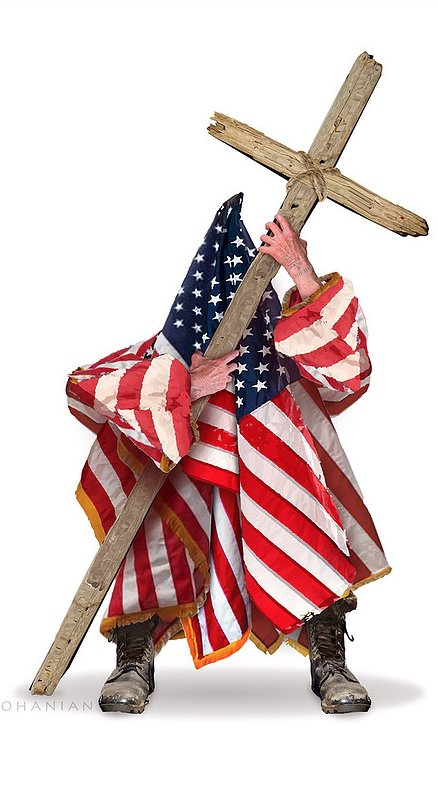
White Evangelicals Are Embracing Concentration Camps As Revenge For Their Petty Grievances And Resentments And Because They Feel Mocked And Scorned

>

Babies in Cages by Nancy Ohanian

Death camps are different from concentration camps; they're worse. But concentration camps are bad enough. If Trump was setting up concentration camps what would you do about it? What are you doing about the concentration camps? Silence, beloved brothers and sisters, is not golden... it's complicity. Our country is complicit in his crimes against humanity, his crimes against these women and children.

What about Trump's evangelical supporters? They may bear more responsibility than other Americans. Do the concentration camps make them uncomfortable? From what I'm reading... not at all, not at all. Yesterday The Atlantic published The Deepening Crisis in Evangelical Christianity-- Support for Trump comes at a high cost for Christian witness by Peter Wehner. Their leaders are reveling in Trumpism. Wehner began with a quote from noted evangelical huckster Ralph Reed: "There has never been anyone who has defended us and who has fought for us, who we have loved more than Donald J. Trump. No one!" And evangelicals are fighting for him too. They believe the concentration camp regime "is spiritually driven" and that "God’s hand is on Trump, this moment and at the election... Donald Trump is God’s man." He's kidnapping children and putting them up for adoption. "God has chosen him and is protecting him." These people want an authoritarian asshole. They welcome fascism and the end to democracy. "Jerry Falwell Jr.: "Conservatives & Christians need to stop electing ‘nice guys.’ They might make great Christian leaders but the United States needs street fighters like @realDonaldTrump at every level of government b/c the liberal fascists Dems are playing for keeps & many Repub leaders are a bunch of wimps!"


Late last night, writing for the NY Times, Thomas Edsall pointed out how the "give-us-our-orders" evangelicals fit into Trump's plans for reelection. "Alex Gage, head of TargetPoint Consulting, a Republican firm specializing in voter mobilization, found that 'anger is a much stronger motivation' than recounting the beneficial things a politician has done. Trump has aligned himself with two overlapping, declining constituencies that are clearly motivated by a combination of anger, resentment and anxiety-- white evangelical Christians and whites without college degrees. If Trump is to win re-election next year, he must raise the stakes for these two sets of voters so that they turn out in unprecedented numbers. Demonizing immigrants and other minorities is crucial to this strategy."

Between 65 and 70% of white evangelicals approve of him-- 25 points higher than the national average. "The enthusiastic, uncritical embrace of President Trump," wrote Wehner, "by white evangelicals is among the most mind-blowing developments of the Trump era. How can a group that for decades-- and especially during the Bill Clinton presidency-- insisted that character counts and that personal integrity is an essential component of presidential leadership not only turn a blind eye to the ethical and moral transgressions of Donald Trump, but also constantly defend him? Why are those who have been on the vanguard of “family values” so eager to give a man with a sordid personal and sexual history a mulligan?"
Part of the answer is their belief that they are engaged in an existential struggle against a wicked enemy-- not Russia, not North Korea, not Iran, but rather American liberals and the left. If you listen to Trump supporters who are evangelical (and non-evangelicals, like the radio talk-show host Mark Levin), you will hear adjectives applied to those on the left that could easily be used to describe a Stalinist regime. (Ask yourself how many evangelicals have publicly criticized Trump for his lavish praise of Kim Jong Un, the leader of perhaps the most savage regime in the world and the worst persecutor of Christians in the world.)

Many white evangelical Christians, then, are deeply fearful of what a Trump loss would mean for America, American culture, and American Christianity. If a Democrat is elected president, they believe, it might all come crashing down around us. During the 2016 election, for example, the influential evangelical author and radio talk-show host Eric Metaxas said, “In all of our years, we faced all kinds of struggles. The only time we faced an existential struggle like this was in the Civil War and in the Revolution when the nation began … We are on the verge of losing it as we could have lost it in the Civil War.” A friend of mine described that outlook to me this way: “It’s the Flight 93 election. FOREVER.”

Many evangelical Christians are also filled with grievances and resentments because they feel they have been mocked, scorned, and dishonored by the elite culture over the years. (Some of those feelings are understandable and warranted.) For them, Trump is a man who will not only push their agenda on issues such as the courts and abortion; he will be ruthless against those they view as threats to all they know and love. For a growing number of evangelicals, Trump’s dehumanizing tactics and cruelty aren’t a bug; they are a feature. Trump “owns the libs,” and they love it. He’ll bring a Glock to a cultural knife fight, and they relish that.

... There's a very high cost to our politics for celebrating the Trump style, but what is most personally painful to me as a person of the Christian faith is the cost to the Christian witness. Nonchalantly jettisoning the ethic of Jesus in favor of a political leader who embraces the ethic of Thrasymachus and Nietzsche-- might makes right, the strong should rule over the weak, justice has no intrinsic worth, moral values are socially constructed and subjective-- is troubling enough.


But there is also the undeniable hypocrisy of people who once made moral character, and especially sexual fidelity, central to their political calculus and who are now embracing a man of boundless corruptions. Don’t forget: Trump was essentially named an unindicted co-conspirator (“Individual 1”) in a scheme to make hush-money payments to a porn star who alleged she’d had an affair with him while he was married to his third wife, who had just given birth to their son.

While on the Pacific Coast last week, I had lunch with Karel Coppock, whom I have known for many years and who has played an important role in my Christian pilgrimage. In speaking about the widespread, reflexive evangelical support for the president, Coppock-- who is theologically orthodox and generally sympathetic to conservatism-- lamented the effect this moral freak show is having, especially on the younger generation. With unusual passion, he told me, “We’re losing an entire generation. They’re just gone. It’s one of the worst things to happen to the Church.”

Coppock mentioned to me the powerful example of St. Ambrose, the bishop of Milan, who was willing to rebuke the Roman Emperor Theodosius for the latter’s role in massacring civilians as punishment for the murder of one of his generals. Ambrose refused to allow the Church to become a political prop, despite concerns that doing so might endanger him. Ambrose spoke truth to power. (Theodosius ended up seeking penance, and Ambrose went on to teach, convert, and baptize St. Augustine.) Proximity to power is fine for Christians, Coppock told me, but only so long as it does not corrupt their moral sense, only so long as they don’t allow their faith to become politically weaponized. Yet that is precisely what’s happening today.

Evangelical Christians need another model for cultural and political engagement, and one of the best I am aware of has been articulated by the artist Makoto Fujimura, who speaks about “culture care” instead of “culture war.


According to Fujimura, “Culture care is an act of generosity to our neighbors and culture. Culture care is to see our world not as a battle zone in which we’re all vying for limited resources, but to see the world of abundant possibilities and promise.” What Fujimura is talking about is a set of sensibilities and dispositions that are fundamentally different from what we see embodied in many white evangelical leaders who frequently speak out on culture and politics. The sensibilities and dispositions Fujimura is describing are characterized by a commitment to grace, beauty, and creativity, not antipathy, disdain, and pulsating anger. It’s the difference between an open hand and a mailed fist.

Building on this theme, Mark Labberton, a colleague of Fujimura’s and the president of Fuller Theological Seminary, the largest multidenominational seminary in the world, has spoken about a distinct way for Christians to conceive of their calling, from seeing themselves as living in a Promised Land and “demanding it back” to living a “faithful, exilic life.”

Right-wing former GOP congressman assesses Trump

Labberton speaks about what it means to live as people in exile, trying to find the capacity to love in unexpected ways; to see the enemy, the foreigner, the stranger, and the alien, and to go toward rather than away from them. He asks what a life of faithfulness looks like while one lives in a world of fear.

He adds, “The Church is in one of its deepest moments of crisis-- not because of some election result or not, but because of what has been exposed to be the poverty of the American Church in its capacity to be able to see and love and serve and engage in ways in which we simply fail to do. And that vocation is the vocation that must be recovered and must be made real in tangible action.”


There are countless examples of how such tangible action can be manifest. But as a starting point, evangelical Christians should acknowledge the profound damage that’s being done to their movement by its braided political relationship-- its love affair, to bring us back to the words of Ralph Reed-- with a president who is an ethical and moral wreck. Until that is undone-- until followers of Jesus are once again willing to speak truth to power rather than act like court pastors-- the crisis in American Christianity will only deepen, its public testimony only dim, its effort to be a healing agent in a broken world only weaken.

At this point, I can’t help but wonder whether that really matters to many of Donald Trump’s besotted evangelical supporters.
Ralph Reed, a follower of Jesus? Give me a break. Falwell, Jr.? You're joking right? What makes Wehner imply they are? Must be something I don't understand.


Also on Friday, writing for The Economist, Erasmus noted "the widening ideological and personal schism within the very group of citizens who should be a conservative president’s most natural supporters... white evangelical Christians, of whom 80% are thought to have voted for Mr Trump. Leading evangelicals are not just sparring over metaphysics, they are also trading insults. Think of the war of words that erupted after June 25th when Russell Moore, a distinguished theologian who heads the Ethics and Liberty Commission of the Southern Baptist Convention, protested over the fate of migrant children on the Mexican border." Moore wrote that the plight of the kidnapped children at the southern border stuffed into Trump's concentration camps "should 'shock all our consciences' given that all 'those created in the image of God should be treated with dignity and compassion.'" Vicious Trumpist Falwell went on the attack against the man who runs the public-policy arm of America’s largest Protestant denomination immediately: "Who are you Dr Moore? Have you ever built an organisation of any sort from scratch? You’re nothing but an employee-- a bureaucrat." [An inheritor of great wealth, it is notable that Falwell never built anything except an alliance with Satan.] The neo-Nazi evangelicals on the far right fringe joined Falwell by claiming protesting the immigration crisis amounted to an unpatriotic slur on the U.S. Border Patrol.


Labels: , , , , , , , , , , ,

Monday, November 06, 2017

Not All Trump's Malfeasance And Bungling Is Reversible: Korea

>


Sunday, Nick Kristof, wrote that Korea experts estimate that the chance of a war between the U.S. and North Korea are between 20 and 50%. "Yet," he wrote, "we’re complacent: Neither the public nor the financial markets appreciate how high the risk is of a war, and how devastating one could be. The Congressional Research Service last month estimated that as many as 300,000 people could die in the first few days of war-- and that’s if it remains nonnuclear. If there is a nuclear exchange, 'there easily could be a million deaths on the first day,' says Scott Sagan, an international security expert at Stanford. Sagan says the odds of war 'are certainly greater than is widely recognized by the American public.' ... Almost no expert believes that sanctions will force Kim Jong-un to give up his nuclear weapons or halt his missile program. That puts us on a collision course, for North Korea seems determined to develop a clear capacity to target the U.S. with nuclear weapons, while the White House hints that it would rather have a war than allow the North to become a nuclear threat."
“Our president has been really clear about this,” H. R. McMaster, Trump’s national security adviser, said on Fox News. “He is not going to permit this rogue regime, Kim Jong-un, to threaten the United States with a nuclear weapon. And so he is willing to do anything necessary to prevent that from happening.”

The whispers in Washington are that “anything necessary” includes airstrikes on North Korea, such as a strike on a missile as it is being prepared for launch. When I asked North Korean officials what would happen in those circumstances, they answered unambiguously: war.

Tammy Duckworth, a former military pilot who is now a Democratic senator from Illinois, says that from what she hears, the chance is greater than 50/50 that the president will order a strike.

“I see a change in posture,” she told me. “I am extremely worried that we’ve moved beyond ‘Let’s prevent war’ to ‘It’s acceptable to do a first strike.’”

Duckworth and other Senate Democrats have introduced legislation that would prevent the president from making a pre-emptive strike on North Korea without congressional approval, barring an imminent threat to the U.S. or its allies.

Senator Lindsey Graham, a Republican, has said that Trump told him he’d choose a war with North Korea over allowing it to continue on its course.

“There is a military option: to destroy North Korea’s program and North Korea itself,” Graham told the Today show, relaying a conversation with Trump. “If thousands die, they’re going to die over there. They’re not going to die here-- and he’s told me that to my face.”

Graham said that if North Korea continues to test intercontinental ballistic missiles, a war is “inevitable.”

This may be a bluff, but, if not, war is coming, for almost every expert believes that North Korea will continue its testing.
Arizona congressional candidate Mary Matiella (AZ-02) was appointed Assistant Secretary of the Army by President Obama, the Pentagon civilian equivalent of a Brigadier General. This morning, she told me that "another war is unthinkable. A war with North Korea will result in more casualties and deaths than Viet Nam. I hope that there are enough sane thinkers in Congress and the Pentagon to keep us out of North Korea. But, the President has power, so the President can start a war even without congressional support and can tell the Department of Defense what to do."

Ted Lieu (D-CA) and Ruben Gallego (D-AZ), both military veterans, asked the Joint Chiefs of Staff to give them a picture of how a war North Korea would unfold and what the military consequences would be. Lieu told Newsweek that they were "trying to get the administration to explain to the American people what a war in North Korea would look like. People need to understand if there is military conflict in North Korea we would be going to war against a nuclear power." Defense Secretary Mattis' and the Joint Chiefs' response was chilling. "The only way to 'locate and destroy-- with complete certainty-- all components of North Korea's nuclear weapons programs' is through a ground invasion... 'North Korea may consider the use of biological weapons as an option' in the event of a conflict, adding, 'It has a long-standing chemical weapons program with the capability to produce nerve, blister, blood, and choking agents, and it likely possess a [chemical weapon] stockpile.'"
North Korea and the U.S. have been enemies for decades, but tensions have reached new heights in recent months as Pyongyang has ramped up its long-range missile tests in pursuit of a nuclear weapon capable of reaching the mainland U.S. North Korea conducted its sixth nuclear test in early September and has threatened to conduct a seventh over the Pacific Ocean. Amid all of this, Trump and Kim Jong Un have been engaged in a global rap battle, frequently trading insults and threats.

Trump's top advisers have publicly championed a diplomatic approach to North Korea, but the president has exhibited a preference for military options. Over the summer, he said North Korea would experience "fire and fury" if it didn't stop threatening the U.S. During his first address to the United Nations in late September, Trump threatened to "totally destroy" North Korea if it forced the U.S. to defend itself or its allies.

A recent Pew Research Center survey showed a strong majority of Americans (84 percent) feel Trump is "really willing" to go to war with North Korea and less than half (39 percent) were confident in his ability to handle the current heightened tensions.

Given the potential consequences of a military conflict and President Donald Trump's apparent aversion to diplomacy, Lieu is not satisfied with the response he received to his letter. He wants the Trump administration and the Pentagon to offer far more details about the potential consequences of a war with North Korea.

The California congressman and U.S. Air Force veteran is not only concerned about what might happen during such a conflict, but also once it's concluded.

"There’s no plan for the aftermath. What about refugees? What would happen with China?" Lieu said. "South Korea would basically take over after the shooting stops. I imagine we would still need ground troops there. How long would that take? We’ve been in Afghanistan for 16 years. We have not won that war. And you’ve got a brainwashed North Korean military that could continue to cause problems."
Lieu, an Air Force Reserve Colonel, has been working with other congressional military vets-- from both parties-- to urge restraint. This week he and 16 other vets currently serving in Congress-- Tammy Duckworth (D-IL), Ruben Gallego (D-AZ), Salud Carbajal (D-CA), John Conyers (D-MI), Pete DeFazio (D-OR), Anthony Brown (D-MD), Bobby Rush (D-IL), Walter Jones (R-NC), Jimmy Panetta (D-CA), Bill Pascrell (D-NJ), Mike Thompson (D-CA), Tulsi Gabbard (D-HI), Bobby Scott (D-VA), Seth Moulton (D-MA) and Del. Gregorio Sablan (D-Mariana Islands-- issued a joint statement on a potential ground invasion. The statement follows a letter from the Joint Chiefs addressing the questions raised by Lieu and Gallego about the Pentagon’s plan for military action against North Korea.

The statement warns that since the letter from the Joint Chiefs confirms that the only way to destroy North Korea’s nuclear arsenal is through a ground invasion, the result could be "hundreds of thousands, or even millions of deaths in just the first few days of fighting."
As Veterans, we have defended this nation in war and we remain committed to this country’s security. We also understand that entering into a protracted and massive ground war with North Korea would be disastrous for U.S. troops and our allies. The Joint Chiefs of Staff, it appears, agree. Their assessment underscores what we’ve known all along: There are no good military options for North Korea. Invading North Korea could result in a catastrophic loss of lives for U.S. troops and U.S. civilians in South Korea. It could kill millions of South Koreans and put troops and civilians in Guam and Japan at risk. The Joint Chiefs said they have no reason to believe North Korea would resist using their stockpiles of biological and chemical weapons. It is our intent to have a full public accounting of the potential cost of war, so the American people understand the commitment we would be making as a nation if we were to pursue military action.

A nonpartisan report by the Congressional Research Service indicates conflict on the peninsula could impact as many as 25 million people on either side of the border, including more than 100,000 U.S. citizens. We must pursue every other option before even considering a massive ground invasion. The Administration has also failed to articulate any plans to prevent the military conflict from expanding beyond the Korean Peninsula and to manage what happens after the conflict is over. We’re still engaged in the longest war in U.S. history in Afghanistan with no end in sight.

With that in mind, the thought of sending troops into harm’s way and expending resources on another potentially unwinnable war is chilling. The President needs to stop making provocative statements that hinder diplomatic options and put American troops further at risk.

The Joint Chiefs’ assessment and the CRS report clearly demonstrate that every diplomatic and economic option must be exhausted before military options are considered. If President Trump does intend to pursue a military option against North Korea, he must come to Congress as required by our Constitution. The stakes are too high and the potential outcome too grave for President Trump to violate his constitutional duty to come to Congress to authorize and oversee use of force.


Over the weekend Trump arrived in Japan and his stance-- recognized as the bluster of a babbling imbecile in Pyongyang-- was aggressive and destabilizing. A new poll published by the Washington Post on Saturday, emphasizes that Trump, with an abysmal 37-59% approval rating, does not have the confidence of the American people. 53% of Americans say that under Trump America's leadership in the world has gotten weaker; only 26% say it has gotten stronger. And 59% of Americans say he's not a strong leader. 58% say he's a bad deal maker. In terms of the North Korea situation most Americans are very wary of his abilities:


Now that Trump has failed to get China to help solve the Korea problem for him, he's trying with his pal Vlad Putin, who helped him on another matter last year, to come to his rescue. Putin is expected to grant him an audience in Da Nang on Thursday or Friday.

Doug Applegate, the progressive Democrat likely to end the disgraceful political career of Darrell Issa next year (CA-49-- norther San Diego and southern Orange counties), is a former Marine Colonel. His own perspective is that "Trump can only offer the rhetoric of a tin horn dictator who would never go In Harm's Way himself. Worse yet, he abandons diplomacy, intelligence and coordinated economic leverage with the rest of the world."

Tom Prigg, a military vet running for Congress in western Pennsylvania against corrupt Trump rubber stamp Keith Rothfus, would have been the 18th signature on Lieu's letter. "Conservative estimates of casualties," he told us, "in a ground offense are in the tens of thousands in South Korea alone, where at least 100,000, and as many as 500,000, Americans reside. If combat were to expand beyond Korea’s borders, massive casualties could push casualties into the millions." He has a far more rational approach than Trump does"
The report does maintain that there are other alternatives to a ground offensive, and highlighted seven possibilities, though this is not an exhaustive list of possible actions:
1- Maintaining the military status quo.
2- Enhanced containment and deterrence.
3- Denying DPRK acquisition of delivery systems capable of threatening the United States.
4- Eliminating ICBM facilities and launch pads.
5- Eliminating DPRK nuclear facilities.
6- DPRK regime change.
7- Withdrawing U.S. military forces.  
North Korea is not an imminent threat. We’ve faced nuclear annihilation from the Soviet Union and have exercised diplomacy down to the 11th hour during the Cuban Missile crisis. North Korea doesn’t have the nuclear arsenal that the Soviet Union once had. They don’t have the technological advancements that the United States possesses. The United States has active cyber operations against their nuclear programs that can cause their missiles to blow up on take-off. 

Despite the nuclear threats we faced against the Soviet Union, which actually did invade other countries, we never resorted to a ground offensive. The Soviet Union fell through peaceful means, and so can North Korea.

Goal ThermometerIn an all out war, the United States would not only face a nuclear threat and prolonged ground offensive, it would face possible Electromagnetic Pulse (EMP) attacks from at least two North Korean satellites. Such an attack could cause planes to crash, hospital equipment to fail, among a myriad of other catastrophes.

As a veteran, I stand behind the policy that war should always be the last option, and only used when absolutely necessary. The Trump administration has approached war with North Korea as the first.

In these difficult times, we need leaders with compassion and foresight who can think beyond the simple mentality of smashing nations we label enemies, and can recognize the virtues of diplomacy and the long-term value of avoiding wars started for the sake of bravado.

Labels: , , , , ,

Monday, October 16, 2017

What's More Flawed? The Iran Nuclear Agreement, American Korean Policy Or Señor Trumpanzee?

>


The video above from CNN's Reliable Sources is important to watch even though it isn't what this post is about. It's context, important contest, FCC commissioner Jessica Rosenworcel explaining the despite Trumpanzee's blustering and threatening media licenses are not in jeopardy and that the FCC is more interested in the First Amendment than in Trump's fascist instincts to force the media to support his authoritarian approach. "The agency," she said, "will not revoke a broadcast license simply because the president is dissatisfied with the licensee's coverage."

A new poll for CBS News from YouGov, released yesterday, shows more dissatisfaction on the part of most Americans with Trump, including with the cavalier and careless way Trump is handling foreign policy.
[W]orries about global conflict are widespread, beyond the ranks of the president's strongest backers. Many Americans-- and most of the president's opponents-- feel like the U.S. could be on the path towards another world war. Among Americans overall, 30 percent feel the nation is, and another 48 percent say maybe, so together, three in four feel it's at least a possibility. Just two in 10 say the U.S. is not headed towards another global conflict. The Nation Tracker has looked at the groups of President Trump's supporters and non-supporters since the start of his term. A majority of all groups feel the prospect of another world war rates at least a maybe, and his stronger opponents are the most likely to feel it is.


...In a stark reminder of how differently supporters and detractors see the world, those who rate things as going great or good for the Administration say that the president's policy achievements are a big part of why. Those who say things are bad say he hasn't gotten enough done, and list things the president says and how he handles himself as a big part of why they think things are going badly.

On North Korea in particular, Americans today continue to think North Korea is a threat that can be contained by the U.S. and its allies. Six in 10 think so, compared to less than one-third that thinks North Korea requires military action soon. Similarly, six in 10 think that war with North Korea is still avoidable rather than inevitable.

There are big differences in views of the president's approach, depending on levels of support for him generally. Most of his strongest supporters want him to threaten North Korea, and almost all of them say they're willing to at least tolerate his doing so. Those supporting him more conditionally are more apt to describe themselves as willing to tolerate that, though they don't really want him to threaten the North.  In contrast, Americans who do not support President Trump stand strongly against his making threats to North Korea. Americans are also mixed on what the president should do with the Iran deal. Three in ten say they want him to redo it, and almost as many describe themselves as are willing to tolerate it if he does, though they don't really want him to. Four in 10 do not want him to redo the deal.


I hope you read Nick Kristof's NY Times column yesterday about his 5-day trip to North Korea. "The only way into North Korea," he wrote, "is on daily flights from Beijing on creaky Russian planes. The in-flight entertainment is a video of a North Korean military orchestra playing classical music, interspersed with scenes of missiles being launched... North Korea is the most rigidly controlled country in the world, with no open dissent, no religion and no civil society, and there is zero chance that anyone will express dissatisfaction with the government."


Being on the ground in a country lets you see things and absorb their power: the speaker on the walls of homes to feed propaganda; the pins that every adult wears with portraits of members of the Kim family; the daily power outages, but also signs that the economy is growing despite international sanctions; the Confucian emphasis on dignity that makes officials particularly resent Trump’s personal attacks on Kim; the hardening of attitudes since my last visit, in 2005; and the bizarre confidence that North Korea can not only survive a nuclear war with the U.S. but also emerge as victor.

At one factory, we came upon workers doing their “political study.” North Koreans explained that they have political study for two hours a day, plus most of the day on Saturday, so I asked what they focused on these days. “We must fight against the Americans!” one woman answered earnestly. And then the North Koreans in the room dissolved into laughter, perhaps because of the oddness of saying this to Americans.

A visit humanizes North Koreans, who outside the country sometimes come across as robots. In person, you are reminded that they laugh, flirt, worry, love and yearn to impress.

A military officer greeted me with a bone-crushing handshake, and I asked if that was meant to intimidate and convey to the Yankee imperialists that North Koreans are muscular supermen. He laughed in embarrassment, and when we ended the interview, he was much gentler.

I left North Korea fearing that we are far too complacent about the risk of a cataclysmic war that could kill millions. And that’s why reporting from within North Korea is crucial: There simply is no substitute for being in a place. It’s a lesson we should have learned from the run-up to the Iraq war, when the reporting was too often from the Washington echo chamber rather than the field. When the stakes are millions of lives and official communications channels are nonexistent, then journalism can sometimes serve as a bridge-- and as a warning.

...I have a sinking feeling in my gut, just as I had on the eve of the Iraq war, that our president may be careening blindly toward war. In that case, the job of journalists is to go out and report, however imperfectly, and try to ring alarm bells in the night.
How about over Iran? Another sinking feeling in the gut? This one is getting really confused. Was that T-Rex on State of the Union yesterday saying he wants the nuclear treaty with Iran to stay in place? Watch:


The Washington Post analysis of Trump's Iran move points to "a widening chasm of mutual disdain between the United States and its traditional allies. Trump sees them as self-interested freeloaders who must be reminded of U.S. power. They see him as an erratic force who must be managed as he squanders American leadership."
Last spring, as Trump prepared for his first overseas trip in May, White House aides outlined his game plan to assume the mantle of global primacy.

“One thing he has the ability to do is really bring people together and galvanize people around a common set of goals,” a senior adviser said in describing objectives for the 10-day tour that took Trump to Saudi Arabia, Israel, Rome, Brussels and a G-20 meeting in Sicily.

Rather than a liability, Trump’s “unpredictability . . . is a real asset,” said the adviser, who spoke on the condition of anonymity under White House ground rules. The new president, he said, was “sending one big message, which is America is ready to lead in the world again.”

Yet instead of leading, Trump’s “my way or the highway” approach has been a detour from the multilateral road the United States has traveled since World War II. And as Trump has left behind, or threatened to, the premier international agreements of this century, from the Paris climate accord to global trade alliances and now the Iran nuclear deal, he has not had many willing followers.

Among the exceptions, governments in Saudi Arabia and the United Arab Emirates joined Israel in praising what Israeli Prime Minister Benjamin Netanyahu called Trump’s “courageous” decision on Iran.

Yet even those who have proclaimed him as a leader have sometimes not felt bound by his demands. Early in his administration, Trump gently chastised Israel for its West Bank settlements, saying that they “don’t help the process” and were not “a good thing for peace.” He has remained silent, however, as Netanyahu’s government, including as recently as last week, has approved additional settlements, leading some perplexed Israeli commentators to speculate on whether he made a “secret” deal with Netanyahu.
Worse yet, almost half (46%) the people self-identifying as Republicans actually want a preemptive war with North Korea, perhaps unable to comprehend what a nuclear bomb does. Or maybe just not caring. 77% of Democrats and 67% of independents oppose a preemptive war against North Korea. The same Quinnipiac poll shows that 40% of voters have confidence in the way Trump in handling North Korea; 57% do not, including 60% of independent voters.

Labels: , , , , ,

Monday, September 04, 2017

Climate Change: The Litmus Test

>


Imaginary candidate: he is gung-ho on Medicare-for-All and is eager to sign onto John Conyers' HR 676 as soon as he's elected. In fact, his campaign is based not just on Medicare-For-All, but on free state colleges, a higher minimum wage, getting corrupting cachet of elections. He's adamantly pro-choice and adamantly in favor of equality based on gender, race, religion, etc. He even wants to crack down on banksters and put them in prison. So why isn't he on the Blue America endorsement list? He's not quite sure about Climate Change. He has some good feelings about it but... do we really know? Don't we need more proof before we disrupt the whole economy? he asked me. Alarm bells start ringing loudly. He's too stupid-- dangerously stupid-- to be endorsed.

The conservative politicians-- particularly the conservative politicians in Texas-- whose decisions transformed Hurricane Harvey from bad weather to a national catastrophe that's going to cost taxpayers from every part of America over $100 billion, don't need more reinforcement in Congress. Climate Change is a litmus test.

Texans have decided they don't need a state income tax. Texans have decided they don't need environmental protection laws. Texans have decided not to use their $12 billion "rainy day" fund to help Harvey victims. Texas GOP congressmembers, who opposed helping victims of Hurricane Sandy in New York and New Jersey, seem to be already grossly padding the budget for Harvey cleanup. The state's crackpot, extreme right-wing governor, who called a special session of the legislature to deal with which transgender children should use in schools, has already announced he won't call a special session of the legislature to deal with the immediate consequences of Hurricane Harvey. Sunday, Nick Kristof tweeted this meme, alerting me to this column: "We Don’t Deny Harvey, So Why Deny Climate Change?"


"Imagine," wrote Kristof, "that after the 9/11 attacks, the conversation had been limited to the tragedy in Lower Manhattan, the heroism of rescuers and the high heels of the visiting first lady-- without addressing the risks of future terrorism. That’s how we have viewed Hurricane Harvey in Houston, as a gripping human drama but without adequate discussion of how climate change increases risks of such cataclysms. We can’t have an intelligent conversation about Harvey without also discussing climate change." But with Trump leading any national discussion on anything, is "an intelligent conversation" even remotely possible?
That’s awkward for a president who has tweeted climate change skepticism more than 100 times, even suggesting that climate change is a Chinese hoax, and who has announced he will pull the U.S. out of the Paris climate accord. Scott Pruitt, President Trump’s head of the Environmental Protection Agency, says it’s “misplaced” to talk about Harvey and climate change.

Really? To me, avoiding the topic is like a group of frogs sitting in a beaker, fretting about the growing warmth of the water but neglecting to jump out. Climate scientists are in agreement that there are at least two ways climate change is making hurricanes worse.

First, hurricanes arise from warm waters, and the Gulf of Mexico has warmed by two to four degrees Fahrenheit over the long-term average. The result is more intense storms.

“There is a general consensus that the frequency of high-category (3, 4 and 5) hurricanes should increase as the climate warms,” Kerry Emanuel, a hurricane expert at M.I.T., tells me. Likewise, three experts examined the data over 30 years and concluded that Atlantic tropical cyclones are getting stronger.

Second, as the air warms, it holds more water vapor, so the storms dump more rain. That’s why there’s a big increase in heavy downpours (“extreme precipitation events”). Nine of the top 10 years for heavy downpours in the U.S. have occurred since 1990.

“Climate change played a role in intensifying the winds and rainfall associated with Hurricane Harvey,” says Charles Greene, a climate scientist at Cornell. He notes that there’s also a third way, not yet proven, in which climate change may be implicated: As Arctic sea ice is lost, wind systems can meander and create blockages-- like those that locked Harvey in place over Houston. It was this stalling that led Harvey to be so destructive.

Frankly, it’s staggering that there’s still so much resistance among elected officials to the idea of human-caused climate change.

Last year was the third in a row to set a record for highest global average surface temperature, according to NASA. The 10 years of greatest loss of sea ice are all in the last decade. And poor Houston has suffered three “500-year floods” in the last three years.

Remember also that we in the rich world are the lucky ones. We lose homes to climate change, but in much of the world families lose something far more precious: their babies. Climate change increases risks of war, instability, disease and hunger in vulnerable parts of the globe, and I was seared while reporting in Madagascar about children starving apparently as a consequence of climate change.

An obvious first step is to embrace the Paris climate accord. A second step would be to put a price on carbon, perhaps through a carbon tax to pay for tax cuts or disaster relief.

We also must adapt to a new normal-- and that’s something Democratic and Republican politicians alike are afraid to do. We keep building in vulnerable coastal areas and on flood plains, pretty much daring Mother Nature to whack us.

We even subsidize such dares through the dysfunctional National Flood Insurance Program. This offers underpriced insurance, encouraging people to live in low-lying areas-- compounded by flood maps that are old and unreliable. One Mississippi home flooded 34 times in 32 years, resulting in payouts worth almost 10 times what the home was worth.

The truth is that what happened in Houston was not only predictable, it was actually predicted. Last year, ProPublica and The Texas Tribune published a devastating article about Houston as a “sitting duck for the next big hurricane” and warned that Texas was unprepared.

In other domains, we constantly manage risks that are uncertain. We address a threat from the Islamic State or North Korea even when it’s complicated and hard to assess. So why can’t our leaders be as alert to climate risks that in the long run may be far more destructive?


A brainwashed citizenry, where self-interested industries pay off media giants like Fox and buy off callow politicians to propagandize for them? I'm just asking for a friend. But these are the currently-serving members of the House who have accepted the most in bribes from the financiers of Climate Change denial-- the dirty dozen consigning our grandchildren and their grandchildren to a brutish life of misery:
Joe Barton (R-TX)- $4,560,727
Fred Upton (R-MI)- $2,837,431
Steve Pierce (R-NM)- $2,807,154
John Shimkus (R-IL)- $2,538,190
Paul Ryan (R-WI)- $2,454,153
Kevin McCarthy (R-CA)- $2,168,460
Steny Hoyer (D-MD)- $2,021,985
Kevin Brady (R-TX)- $2,011,001
Greg Walden (R-OR)- $1,680,787
Pete Sessions (R-TX)- $1,612,788
Tim Murphy (R-PA)- $1,606,382
Mike Conaway (R-TX)- $1,597,597
No progressives on that list of death's disciples! Although there are a couple of Democrats, beyond just sleaze bag Steny Hoyer, who take massive bribes from the Climate Change deniers and help the Republicans pass their agenda. Gene Green (D-TX- $1,388,688) and Jim Clyburn (D-SC- $1,067,993) are the only other House Dems who have taken over a million dollars from the culprits. Should that be reason enough toward for their retirements? Damn straight! Hector Morales is a Houston public school teacher running for seat occupied by corrupt conservative Democrat Gene Green, the congressman who keeps telling his constituents he'll do something about all the pollution in the district but just keeps taking bigger and bigger bribes from there polluters. You can help Hector repeal and replace Green here. Today he told us this:
The Arkema Plant explosion in Crosby, TX was an accident waiting to happen, just like the refineries in Pasadena, TX and the Superfund site near it. Members of Congress are known for accepting large sums of special interest money-- so far that is the only way they have been able to maintain their seats while continuously voting against the health and well being of their constituents. To see the the influence of special interests, look no further than incumbent congressional member and Blue Dog-type Democrat from TX-29, Gene Green. Green has taken in millions of dollars from the energy industry in his twenty four year tenure as a member of Congress and ranking member on the Energy and Power and Environment and Economy subcommittees. There, Green has wielded his influence to continue development of harmful refineries and one of the few lowly Democrats to vote with the GOP and President Trump for the Keystone Pipeline not just once, but every time it has come up- something he ought to bring up more during his townhalls ripping Republicans and Trump about harming the environment. Green religiously campaigns on needing the refineries, much like the Arkema Plant, to keep what he calls "good jobs" for the district. The jobs he refers to have harmed and killed countless people due to plant explosions and exposure to hazardous chemicals linked to cancer.

I grew up with those Pasadena refineries and the seemingly endless shelter in places, boil water warnings, and poor air quality. That was, and still is, the way of life in Pasadena and the 29th District. Why not advocate for renewable energy? It is here that Green's hypocrisy is blatant and on full display- adopt and campaign on the Democratic Platform of "renewable energy" while voting against incentives for the development of renewable energy. And Green gets away with it because he seems untouchable with his million dollar war chest and lack of Democratic and Republican opponents in almost every election cycle.

In twenty four years, Green is proud of having high school graduation rates that are twice as low as the State and three times as low as the nation, an average household income of under $40,000 a year for a family of five, schools that have repeatedly been rated as the top 1% of most polluted in the US-- including 26,000 students going to school within one mile of a refinery, and constituents being fifty times more likely to develop leukemia here than anywhere else in the US. "Good jobs," right?

My plan calls for addressing the issues at their core- by shifting the refineries to produce 100% clean and renewable energy and manufacturing the equipment to build the nation's renewable energy infrastructure. The future of our nation depends on renewable energy and the jobs it will create. This can be our future only if our members of Congress would be beholden to their constituents and not the corrupt money of special interests or the energy sector. And on March 6, 2017, Congressman Gene Green will see what happens when the people make their voices heard and drown out the special interests- he loses and the people win.


Labels: , , , ,

Thursday, May 18, 2017

Who's Watching Trump To Make Sure He Doesn't Do Anything Dangerous?

>


Last night Trump's Art of the Deal ghostwriter, Tony Schwartz, told CNN viewers on Anderson Coope’s 360 that Señor Trumpanzee is having a "significant meltdown. He’s in pure defensive mode. I think that he’s being run by the part of his brain that’s reactive and impulsive, not capable of reflection... The sense of siege that he feels because his sense of self-worth is so, so vulnerable that the series of things that have happened are overwhelming to him." This morning he took to twitter to whine about how unfair life is to him.


Katie Glueck, writing for McClatchy: "Pangs of fear and frustration are rippling through the Republican donor and operative classes as Donald Trump's self-inflicted wounds threaten to fully derail the GOP legislative agenda and tarnish the party's brand headed into the midterm."

Last night, the Time's Nick Kristof speculated that "the Trump presidency may now be disintegrating, tumbling toward entropy... If Trump thought he was removing a thorn by firing Comey, he now faces a grove of thistles." He seemed concerned about the dangers ahead for the country.
One is that America will be incapacitated and paralyzed by Mueller’s investigation and the suspicions-- this partly explains the stock market’s big fall on Wednesday-- and foreign powers may take advantage of this to undertake their own mischief. I would worry about Russia in both Ukraine and the Baltic countries, and we must make clear that we will work with allies to respond in kind.

Another danger is the risk of an erratic, embattled, paranoid leader at home who feels that he may be going down the tubes anyway. In domestic policy, presidents are constrained by Congress and the courts about what damage they can cause, but in foreign policy a president has a largely free hand-- and the ability to launch nuclear strikes that would pretty much destroy the world.

In 1974, as Richard Nixon’s presidency was collapsing, he was drinking heavily and aides worried that he was becoming unstable. Fearing what might go wrong, Nixon’s defense secretary, James Schlesinger, secretly instructed the military not to carry out any White House order to use nuclear weapons unless confirmed by him or Henry Kissinger.

This was unconstitutional. And wise.

Schlesinger also prepared secret plans to deploy troops in Washington in the event of problems with the presidential succession.

We don’t know how Trump will respond in the coming months, and let’s all hope for smooth sailing. But as with Schlesinger’s steps, it’s wise to be prepared.

There have been calls for Trump aides to resign rather than ruin their reputations, but I hope the grown-ups-- H. R. McMaster, Jim Mattis, Dina Powell, John Kelly, Rex Tillerson-- grit their teeth and stick it out. The White House has never needed more adult supervision.

The cabinet has the constitutional power to remove a president by majority vote under the 25th Amendment (if the president protests, this must be confirmed by two-thirds of each chamber of Congress). Such a vote is unlikely, but in the event of a crisis like the one Schlesinger envisioned, it would be essential.

I hope that cabinet members are keeping one another’s cellphone numbers handy in case an emergency meeting becomes necessary for our nation.


Labels: , , , ,

Sunday, May 14, 2017

Is Impeachment Realistic?

>


NBC News and the Wall Street Journal released a new poll this morning. If Trump really was angry at his team before, he must be ready to have them all lined up against a wall and shot now. With Trump's overall approval rating dipping further-- to 39%-- public backing for his firing of James Comey is at just 29%. And 52% of the country holds a negative view of Trump, while just 38% of the country-- his base-- has a positive view of how he's doing his job. Perhaps scariest of all for Señor Trumpanzee is that an overwhelming 78% of the country supports an independent commission or special prosecutor-- rather than Congress-- to get to the bottom of Putin-Gate. A special prosecutor, coupled with a Democratic takeover of the House in 2018, can only end in one way: impeachment.


This morning, Darren Samuelsohn, writing for Politico asked if it is time for Trump staffers to start lawyering up. Subpoenas are already being issued and there's a Grand Jury operating. "It’s an axiom of Washington scandals," he wrote, "that the cover-up tends to be worse than the crime-- and it’s lower- or mid-level people who wind up getting caught in the worst legal trouble, usually for tangential offenses like perjury or obstruction of justice. The ancillary stuff, like a forgotten meeting or a discarded document, can cause the most serious problems for staffers navigating the unfamiliar, expensive and high-stakes world of grand juries, subpoenas and congressional hearings, where the prospects of perjury or obstruction of justice charges can be filed for both unintended slip-ups or intentional attempts to cover up for a superior."
John Dean, the former Nixon White House counsel who went to prison for four months because of his role in Watergate, said he didn’t expect Trump’s staffers at this early stage of the investigative process to have already started hiring attorneys. But he said that can change quickly.

“It’s something that happens in every White House when the contagion has started spreading,” he said. He predicted the lower-level employees, including otherwise innocent secretaries and other aides who have gotten up-close interactions with the president and his senior aides, may not see the need to call for an attorney until they’ve been identified as potential witnesses. “They’re primarily driven by fear, fear of the unknown and not wanting to make a mistake,” he said.

...Outside observers say the signs are growing that Trump’s staff may want to start lining up legal advice, even if it’s only for preliminary discussions.

“If they have information that indicates contact with Russians or attempts to interfere they better damn well,” said former FBI agent Lewis Schiliro, who spent 25 years at the FBI before retiring in 2000 as head of the New York field office. “That’s a pretty serious thing.”
I suspect a lot of folks thinking about hiring lawyers read Nick Kristof's NY Times column this morning, Is Trump Obstructing Justice?, with a sense of foreboding, if not outright doom. Kristof sees Trump's firing of Comey as one more element in "a systematic campaign to undermine the rule of law and democratic norms."


The paradox is that Trump purports to be (like Richard Nixon) a law-and-order president. His administration has ordered a harsh crackdown on drug offenders, when we should be scaling up addiction treatment instead. Trump is focusing on chimerical fraud by noncitizen voters, even as he impinges on an investigation into what could be a monumental electoral fraud by Vladimir Putin. He favors tough law and order for the little guy.

Comey took the investigation into possible collusion between the Kremlin and the Trump campaign seriously enough that for his last three weeks leading the F.B.I. he was getting daily updates, according to the Wall Street Journal. The new acting director of the F.B.I. confirms that the inquiry is “highly significant.”

For months, as I’ve reported on the multiple investigations into Trump-Russia connections, I’ve heard that the F.B.I. investigation is by far the most important one, incomparably ahead of the congressional inquiries. I then usually asked: So will Trump fire Comey? And the response would be: Hard to imagine. The uproar would be staggering. Even Republicans would never stand for that.

Alas, my contacts underestimated the myopic partisanship of too many Republicans. Senator Charles Grassley, an Iowa Republican, spoke for many of his colleagues when he scoffed at the furor by saying, “Suck it up and move on.”


This goes way beyond Comey. When judges block presidential orders, Trump denounces the courts. When the opposition criticizes him, Trump savages individual Democrats. When journalists embarrass him, Trump threatens to tighten libel laws and describes the press as “the enemy of the people.”

Trump has also challenged and evaded the ethics rules that traditionally constrain administration officials. He has breached the four-decade norm that presidential candidates release their taxes. And-- how else to put this?-- he has waged war on truth. These days, any relationship between White House statements and accuracy seems coincidental.

Patterns emerge. Trump also ousted Preet Bharara, a U.S. attorney who infuriated Moscow and investigated Tom Price, Trump’s secretary of health and human services. Likewise, Trump fired Sally Yates, the acting attorney general, after she warned the White House that Michael Flynn could be blackmailed over his lies about Russian contacts.

In short, Trump challenges the legitimacy of checks on his governance, bullies critics and obfuscates everything. Trump reminds me less of past American presidents than of the “big men” rulers I covered in Asia and Africa, who saw laws simply as instruments with which to punish rivals.

It’s reported that Trump sought a pledge of loyalty from Comey. That is what kings seek; the failure to provide one got Thomas More beheaded. But in a nation of laws, we must be loyal to laws, norms and institutions, not to a passing autocrat.

Trump acknowledges that he was frustrated by the Russia investigation and that it was a factor in firing Comey. This may not meet the legal test for obstruction of justice, but step back and you see that Trump’s entire pattern of behavior is obstruction of the rule of law and democratic norms.

Earlier this year I quoted a presidential historian as saying that “there’s a smell of treason in the air,” and it’s essential that we have a thorough investigation to find out what happened. With Senate Republicans blocking an independent commission, that means that Deputy Attorney General Rod Rosenstein must choose an independent special counsel to probe Russian interference in our election.

George Washington warned that we need checks on leaders because of the “love of power and the proneness to abuse it.” This prophecy was tested during Watergate, and as a teenager then I watched Republicans like Howard Baker, Lowell Weicker, Elliot Richardson and William Ruckelshaus heroically stand up for their country rather than for a corrupt president of their own party. Partly because of them, our institutions triumphed.

The passion for truth over politics was then periodically expressed in a Latin phrase: fiat justitia, ruat caelum. Let justice be done, though the heavens fall.

Now that principle is tested again, and so are we, all of us-- politicians, journalists, judges and citizens.

In particular, this is the moment of truth for G.O.P. moderates like Senators Susan Collins, Jeff Flake and Bob Corker, who may hold decisive power. Will they align with George Washington’s vision of presidents as servants of the people or with Trump’s specter of His Sacred Majesty, the Big Man of America? Will they stand for justice, or for obstruction of it?
Goal Thermometer I look at these Republican politicians and I don't see the depth of character it would take to go up against Trump and their own corrupt political party-- not in McCain, Graham, Collins, Flake, Corker or any of them. Not the senators, not a single one. And that leaves it in the hands of midterm voters next year. Assuming the Democrats take back the House and hold onto their vulnerable Senate seats, defeating Flake (AZ), Heller (NV) and Cruz (TX) is probably the only plausible way Trump is going to be removed from office before 2020. Want to help? The Blue America Senate thermometer on the right is a place you can go to contribute to worthwhile progressives fighting to keep their seats in 2018 and to Beto O'Rourke's battle to oust Ted Cruz in the Lone Star State. Imagine Trump's fate coming down to the voters of Texas! That's pretty much the reality of it though.

Labels: , , ,