Monday, July 27, 2020

As Arizona Moves Towards The Center, The State Republican Party-- Rightly Blamed For The Pandemic-- Moves Further And Further Right

>


On Saturday, Republican Gov. Doug Ducey gave Arizona a present: 3,740 new cases of COVID-19 (and, a bonus: another 144 COVID-deaths, the highest of any state reported on Saturday). Yesterday, Governor Ducey added another 1,973 new cases and today another 1,813, bringing the state total to 163,827. That's 22,508 cases per million Arizonans. Using that metric-- cases per million residents-- Arizona is doing worse than any country in Europe. In fact the only countries in the world doing worse than Arizona are Qatar, a nation filled with slaves, and French Guiana, a sparely-populated, swampy prison colony. Of the half dozen U.S. states with numbers anything like Arizona's two, New York and New Jersey, have the pandemic under control-- at least for now. The other 4 are in deep trouble with drastically worsening numbers:
Louisiana- 23,644 cases per million Louisianans
New York- 22,642 cases per million New Yorkers
Arizona- 22,508 cases per million Arizonans
New Jersey- 20,913 cases per million Jerseyites
Florida- 20,149 cases per million Floridians
Mississippi- 17,794 cases per million Mississippians
Ducey believes in Trump, not science and he was very consistent in following his beliefs when it came tp confronting the pandemic, which explains why Arizona is worse-hit than almost anywhere else on Planet Earth. Sure, there are worse elements in the Arizona politisphere than Doug Ducey... but she isn't going to win an election to anything... except to lead the GOP. I'm talking about a mentally deranged former state Senator, Kelli Ward, who primaried John McCain and was defeated with 39% of the vote, primaried Jeff Flake/Martha McSally and lost again, this time with 28%. A fringe extremist, she then ran for the Republican Party chair and won it, in a 3-way race, with 51.7%. The state is changing drastically but Arizona Republicans still love their fringe extremists. And, yes, she is much, much crazier than Doug Ducey.

In her much-read piece for The Atlantic over the weekend, How To Lose A Swing State, Elaine Godfrey reported that pretty much everything has gone wrong for the GOP in Arizona since Ducey and Ward have risen to prominence and that "One might think that, in its moment of peril, the Arizona GOP would attempt to win over moderates. Yet the person charged with shepherding the party to victory in this most crucial moment is the state GOP chairperson Kelli Ward, a pro-Trump zealot with a soft spot for conspiracy theories... Just as polls show Arizonans-- especially those in the suburbs-- souring on Trump, the state party has veered sharply to the right." Not the state; the state party.
During her time as a state senator representing parts of the ultra-red La Paz and Mohave Counties in northwest Arizona, Ward paid a visit to Cliven Bundy’s Nevada ranch in solidarity with the rancher’s standoff against the Bureau of Land Management; suggested that the Affordable Care Act was part of a broader plot to push rural Americans into urban areas; and entertained constituent concerns about the chemtrail conspiracy theory, the idea that the government is using airplanes to poison American citizens. In 2016, during her Tea Party–style challenge to McCain, Ward defended Trump’s attacks on the senator’s experience as a prisoner of war. Later, in a primary bid against McSally, Ward made national headlines for suggesting that the McCain family had deliberately timed an announcement about the senator’s brain cancer to damage her campaign. (She lost both primary elections-- badly.)


But as Republicans nationwide began to embrace Trumpism, Ward moved from the fringes of the party to its center. She was elected the state party’s chair in 2019, and has since used her perch primarily to help wage the president’s wars. Most recently, Ward, who is a family physician with a master’s degree in public health, made headlines for encouraging protesters planning to demonstrate against local stay-at-home orders to dress like health-care workers. She and her husband, Mike, an ER doctor, appear regularly on Facebook Live to discuss “fake news” and the tyranny of mask laws, while sipping coffee out of bright-red Trump mugs. In the past month alone, Ward has tweeted warnings about the threat of “antifa,” compared the New York Times to the devil, and shared multiple videos of Black teenagers fighting and looting stores.

But now that Arizona’s political sands are shifting, Ward’s leadership is damaging the Republican cause, her critics in the party told me. As presidential candidates, Republicans McCain and Mitt Romney each won the state by nine percentage points; Trump beat Hillary Clinton in 2016 by just four points. For the past few months, Biden has been leading the president in the polls here, and unaffiliated Arizona voters, who typically swing right, are overwhelmingly supportive of Kelly in his race against Trump-endorsed McSally, according to Mike Noble, the chief of research at OH Predictive Insights, an Arizona-based nonpartisan research firm.

This is partly because of the state’s changing demographics: The Latino population, which makes up part of the Democrats’ base in Arizona, has grown, and more left-leaning young people are settling in red states. But the most important shift has been the leftward movement of suburban voters. Maricopa County, which covers the Phoenix area and accounts for 60 percent of all votes cast in the state, has been rapidly trending away from Republicans in the past few years. Barack Obama lost here by 11 points in 2012, but four years later, Trump defeated Clinton by just three points. In 2018, Sinema won Maricopa County 51 to 47 percent.
Perhaps unaware that Sinema, former chair of the Blue Dog caucus, was the single most right-wing Democrat in the House-- and is currently the Senate Dem with the most Republican-like voting record-- Godfrey referred to her win as part of a "leftward shift." There is a Demographic shift in Arizona-- more Latinos-- and there is the Trump factor, but hardly a leftward shift. Sinema has nothing to do with the left-- and neither does Biden; both are creatures of the right, although Sinema is, perhaps more so than even Ward, certifiably insane and not wedded to any ideology at all. Godfrey continued that no one wins "a statewide race in Arizona without keeping a tight grip on affluent Republicans, GOP women, and the unaffiliated voters who make up roughly one-third of the electorate, said the Arizona-based Republican strategist Chuck Coughlin-- and those are the exact voters whom the president and his ilk have alienated. 'Trump has changed everything,' Grant Woods, the former Arizona attorney general, told me. Woods was a lifelong Republican who once served as McCain’s chief of staff, but after Trump’s election, Woods reregistered as a Democrat. He’s observed a growing gap between Republican voters and their elected officials in the party and believes that gap has been stretched further by people like Ward. If Republicans 'want to double and triple down on Trumpism, then she’s perfect,' Woods said. But 'she is exactly the wrong person to be the party chairman for the Republicans if they want to have a future in the state of Arizona.' ... Jeff Flake, the former Arizona senator who retired in 2019, echoed Woods’s concerns. It’s 'tremendously damaging,' for moderates and independents to see 'virtually every Republican officeholder on stage with the president laughing at his jokes, looking at their shoes while he demeans their colleagues,' he told me. And attracting interest in the local party is difficult when the only issues discussed at precinct meetings are 'the deep state or immigration or the latest conspiracy theory.'"
The coronavirus pandemic has made a bad situation much worse for Republicans. Voters in poll after poll have been unimpressed by Trump’s handling of the crisis, and Republicans in Arizona have faced similar scrutiny: Cases of the virus surged after Governor Doug Ducey took early action to reopen the state in mid-May. In June, Arizona had the highest infection rate in the country. This spike in cases corresponded with a 13 percent increase in Arizonans reporting that the state was going in the wrong direction, according to OH Predictive Insights. Yet all the while, Ward, like Trump, has been encouraging opposition to stay-at-home orders, and dismissing mask wearing as “virtue signaling” on her daily live-stream. This has been a major turnoff to an important part of the Republican electorate, Flake said. “Suburban women and Millennials have been walking away from the party for a while. In many ways, they’re in a dead sprint now.”


Some on the right, however, dispute moderates’ diagnosis of their party’s problems. These Republicans-- best described as pro-Trump populists-- believe that the state GOP has not embraced the president enough. Steve Slaton, who runs a store in Show Low selling Trump-themed merchandise, feels that Ward, in her capacity as chairperson, has been too supportive of McSally in the primary, giving her an unfair advantage over Daniel McCarthy, her more populist opponent. Ward “got sucked into the whole McCainite-controlled party apparatus,” Slaton told me. Jennifer Esposito, a former state-committee member from Mohave County, campaigned for Ward back in 2019. “We thought as chairman she would be willing to go against the establishment,” Esposito said. “She appears now to be a sellout.”

Ward’s job, in other words, has in some ways become an impossible one. It’s unclear, at this point, whether there is anything she can do differently to change her party’s trajectory. It’s possible-- even likely-- that, come November, Arizona will turn blue. That sort of change has happened before. In 2000, Republicans controlled the Virginia state government; they held both of the state’s Senate seats, and they’d just given its electoral votes to a Republican presidential candidate. But Democrats made huge gains in the suburbs, the state GOP moved to the right instead of moderating, and by 2019, Democrats had turned the tables completely. “Unless something big changes between now and the middle of October,” this will happen in Arizona too, said Larry Sabato, the director of the University of Virginia’s Center for Politics.

If it does, Woods, the former attorney general and lifelong Republican, told me he’ll be relieved. “I want ’em all to go,” he said. “I hope the Republican party regroups and starts over.”

Labels: , , , ,

Friday, August 17, 2018

I Guess "Trump Blunders In Arizona" Isn't Much Of A Headline

>


But he did-- in the Arizona Senate race. Polling consistently shows that quasi-Democrat Kyrsten Sinema would beat any of the Republican Senate candidates. As you see from the graphic below, the only Republican who even gets close to Sinema in a head-to-head match-up is the one mainstream candidate, Martha McSally. McSally is also the choice of the NRSC and the DC and Phoenix establishments. They feel strongly nominating her is the only chance they have to hold onto the seat.


McConnell and NRSC chair, Cory Gardner (R-CO), have been begging Trump to endorse McSally. So far he hasn't. His base prefers the two extremist crackpots in the race, Kelli Ward or Joe Arpaio. All 3 candidates pretend that they have Trump's endorsement. Trump hasn't endorsed but he's said nice things about each one that each one is exploiting. Alex Isenstadt reported in Politico that Trumpanzee' refusal to explicitly endorse any of them for the August 28 primary "has led to a total muddle, prolonging the GOP slugfest in one of the most important Senate races in the country and allowing the presumed Democratic nominee, Kyrsten Sinema, to get a free pass... [E]stablishment Republicans have grown increasingly anxious that they’re squandering a critical window of time to define Sinema, who faces a nominal primary opponent. She’s spent millions of dollars running positive TV ads to boost her image and set the terms of the general election, while no Republican groups have countered."

The keys to controlling the Senate next year rests with Republican-held Arizona, Nevada, Texas, Tennessee and Democratic-held North Dakota and Florida.
People close to the president say not to expect any firm endorsement in the contest.

“President Trump has not endorsed anyone in the GOP Senate primary in Arizona and any photos or other general expressions of support shouldn’t be read as such,” said someone familiar with the operations of the Trump campaign. “He likes all of the candidates in the race very much and looks forward to supporting our nominee in the fall campaign to replace Jeff Flake in the Senate.”

Two senior Republicans in the state say they expect Trump to hold a post-primary "unity" rally, though the White House hasn’t yet announced any plans for an Arizona trip.

In a statement to Politico, Arpaio said he was not bothered by the efforts by Republican leaders to secure a Trump endorsement for McSally.

“At this time my only comment is my relationship with the President speaks for itself. It is no secret that Mitch McConnell and the Establishment do not want me in the US Senate,” he said.

Ward, in an interview in Washington last month, said much the same.

“I know that the Mitch McConnell faction and the establishment pushes [McSally] out as much as they can because that's their insider advantage that I don't have,” she said.

While Republicans continue to slug it out, Sinema’s campaign has run free on the airwaves. She’s spent more than $4 million on TV, running six different ads on health care, her work with veterans and her “record of independence.” Her first ad, launched in April, featured her brother, who is a veteran and police officer.

One-third of Arizona voters don’t identify with either party, and Sinema’s ads have been aimed squarely at those voters-- none of them mention the word “Trump” or “Democrat.” The ad campaign has been so sustained that going "negative against her is going to be extremely difficult,” said veteran Arizona Democratic strategist Andy Barr.

Travis Smith, a consultant for McSally’s campaign, brushed aside concern about Sinema owning the airwaves all summer. He said internal polling between April and July showed only a small uptick in Sinema’s favorability rating, while her negative ratings also rose by a slightly higher amount.

National Democrats haven’t had to spend to boost Sinema. Instead, a super PAC, Red and Gold, which was formed this month and hasn’t filed any information on its donors, has spent $1.6 million airing anti-McSally ads.

Defend Arizona, a pro-McSally super PAC, launched an ad Wednesday pushing back on the Democratic primary meddling. The group has also been running multiple attack ads against Ward.

“We are focused first on the primary,” said Barrett Marson, a spokesman for Defend Arizona, "and then we will focus on Kyrsten Sinema's liberal record.”
Sinema's liberal record? The chair of the Blue Dogs, Sinema has the least  liberal, most conservative voting record of any Democrat in Congress. And she's a total, corrupt Wall Street pawn. ProgressivePunch rates her record "F" which is especially heinous because she's in a strong, safe Democratic district. Her lifetime voting record is 36.17, the lowest of any Democrat in the House. This cycle, her record is even worse, with a 34.35 score, further right than the voting records of 3 Republicans-- Walter Jones (R-NC), Justin Amash (R-MI) and Brian Fitzpatrick (R-PA). It's worth noting that Trump did poorly in her district-- just 38.4%-- while winning Amash's district with 51.6% and Jones' district with 60.5%. Fitzpatrick's newly redrawn Pennsylvania district was very close: Hillary 49.1% and Trumpanzee 47.1%. But in the district as it was drawn at the time, Trump won, albeit narrowly. Sinema has one of the most pro-Trump scores of any Democrat on FiveThirtyEight's Trump Affinity Scale. Based on the district itself, Sinema would be predicted to back Trump 35.3% of the time. Instead she's backed him 60.9%. The only Democrat who votes more frequently with Trump is Henry Cuellar (68.9%), a conservative Texas Republican who, inexplicably, calls himself a Democrat.

Labels: , , , , ,

Sunday, August 12, 2018

GOP Establishment Thinks Their Own Arizona Base In Too Crazy To Be Trusted In Primaries-- Begs Trump To Calm Them Down

>


Martha McSally is widely considered a sane, mainstream Republican, especially in comparison with her two rivals for the Republican Senate nomination to replace Jeff Flake. Of course, compared to those two-- Kelli Ward and Joe Arpaio-- even Sarah Palin and Nero would be considered sane people... by some. But don't be fooled; Martha McSally is a Trump enabling rubber-stamp. Just look at her record, 97.8, on the Trump affinity tracker. FiveThirtyEight projects a score of 57.6 for someone representing AZ-02. Her 40.2 is the difference between McSally's actual and predicted Trump-support scores. She's right up there in the top dozen out of all 365 members of Congress. That's not exactly mainstream. In fact, that defines serious congressional Trump enablement.

So she's running for the Senate now and the Republican Party establishment-- both in DC and in Phoenix-- is petrified she'll lose the primary to one of the two crazies, Ward or Arpaio, either of whom would probably lose the general to GOP-lite Kyrsten Sinema, Schumer's hand-picked candidate. Actually, the latest Emerson poll shows Sinema beating any of the three, but shows McSally doing less horribly than Ward or Arpaio.


Yesterday, Alex Isenstadt, writing for Politico, reported that NRSC chairman Cory Gardner (R-CO) called Señor Trumpanzee and asked him to endorse McSally, even though the two crackpots are his natural allies and cronies and have more-- much more-- in common with him politically. Gardner and his staff (and, presumably, Miss McConnell are afraid that Arizona's right-wing voters (i.e., Republicans) will nominate one of the two unelectable candidates and cede the seat to Sinema in November. Now only Super-Trump can save the day (at least in the primary. In the general, if McSally is the nominee, he'll have to avoid Arizona like the plague). According to Isenstadt's sources Señor T "was non-committal and did not say yes or no to the request."
In an interview in May, Senate Majority Leader Mitch McConnell (R-KY) made clear that McSally would run strongest against Sinema, though he said he was unsure if the party would need to intervene on her behalf in the primary.

“It’s pretty obvious which of our candidates have a best chance of winning,” he said.

If Arpaio or Ward wins the primary, it would also put GOP senators in the difficult position of choosing whether to endorse those candidates. Sen. Susan Collins (R-ME), for example, said Arizona is one of the few places she might campaign this fall for Republicans because she won’t campaign against colleagues.

“I will go campaign in states where there are open seats, like Arizona,” she said in an interview last week. Asked about Ward and Arpaio, she replied: “Let me rephrase that. I would campaign for Martha McSally."


While Republicans are eager for Trump to intervene, the president may be disinclined to do so. He has previously lavished praise on Ward, and he pardoned Arpaio of criminal contempt, who shares his hardline immigration views. Both candidates are closely aligning themselves with the president, though Arpaio is trailing badly and the White House is uncomfortable with Ward promoting a photo of her alongside the president as an implied endorsement, according to the Arizona Republic.

McSally is the frontrunner in the primary, yet she faces obstacles. A pro-Ward super PAC, Kelli PAC, has been airing ads calling McSally “one of the most liberal Republicans in Congress.”

Ward’s super PAC has been financed by Republican mega-donor Robert Mercer, himself a Trump ally who has given the group $800,000. Sen. John McCain (R-AZ) beat Ward in the 2016 primary by 11 percentage points.

At the same time, Democrats are attempting to meddle in the Republican primary and sink McSally. Red and Gold, a newly-formed Democratic group, has begun airing commercials assailing McSally for putting “Washington over Arizona.”


Labels: , , , , , ,

Wednesday, June 20, 2018

When The Parties Undermine Their Own Candidates

>


Tony Cárdenas had no problem winning his heavily Democratic San Fernado Valley reelection bid, despite credible accusations that he he sexually assaulted a 16-year-old girl and threatened to fire her father if she squealed. Last month an L.A. Superior Court judge ruled that there is "a reasonable and meritorious basis" for the suit to go forward but Pelosi quashed it in Congress. He's definitely not getting the Al Franken treatment.

Cárdenas' district gave Trump a mere 16.8% of its vote in 2016 and the unassailable PVI is D+29. In the primary about 2 weeks ago, despite being a child molestor, Cárdenas scored 67% against Republican Benito Bernal (18%) and Democrat Joseph Shammas (8%). There wasn't a peep out of Pelosi or her DCCC. Funny, because when the decode to destroy a candidate, they certainly know how to do it. And not just Laura Moser.

In Orange County, the DCCC released all kinds of sex allegations against their own recruit, Hans Keirstead, who seems to have won the CA-48 race, leaving the DCCC in a really awkward position. And despite Archie Parnell handily winning his South Carolina primary, the DCCC is poisoning the atmosphere against him for allegations by his then-wife made in a 1973 divorce filing.

The DCCC communications director, Meredith Kelly, who also led the charge against other Democrats the DCCC has trying to destroy told the media that "What Archie Parnell did is inexcusable and deeply disturbing, and he should drop out of this race immediately." So what Parnell is accused of doing to his wife in 1973 is "inexcusable" but Cárdenas raping a 16 year old child is... crickets. The whole DCCC crowd has ganged up on Parnell and keeps demanding he drop out of the race, reaffirming that they will not spend any money in SC-05-- the Charlotte exurbs plus Lancaster, York and Cherokee counties-- where he came close to beating Ralph Norman in a special election when Mick Mulvaney resigned in 2017.
Ralph Norman (R)- 45,076 (51%)
Archie Parnell (D)- 42,341 (47.9%)
Norman outspent Parnell $1,630,143 to $1,379,838. But his case isn't the only one where the establishment is trying to destroy politically. In fact, the Republicans so the exact same thing... and as bad or worse than the Democrats. (Surprise, surprise, both parties really suck.)

Last week James Arkin blew the whistle on McConnell for this newest interference-- the Arizona Senate contest. The Democratic establishment has chosen the worst-- literally, the worst Democrat in the House, Kyrsten Sinema, as the nominee. McConnell wants to do the same thing for the GOP-- and he wants it to be the mainstream conservative, Rep. Martha McSally, rather than one of the neo-fascists, Kelli Ward or Joe Arpaio.

The McConnell-controlled Pac, One Nation, is already run ads claiming that McSally is far more right-wing and extreme than her record indicates. "The ads," wrote Arkin, "from the McConnell-aligned nonprofit One Nation, don’t explicitly reference the Senate race. But they quote McSally saying, 'We’ve got to build the wall,' just as the two-term Republican has been tacking to the right on immigration. She recently pulled her support from legislation that would have offered a pathway to citizenship for young immigrants brought to the U.S. illegally, instead backing a more conservative immigration bill, and McSally’s office also recently took down a video from last year that featured her defending DACA, the Obama-era program that protected young undocumented immigrants from deportation." Keep in mind that McConnell is the most disliked politician in America.
The TV ad marks the first move by a national group in Arizona’s Senate race, emphasizing the high stakes there as Republicans defend their 51-49 Senate majority. Democrats are confident in Rep. Kyrsten Sinema’s chances to flip the seat held by GOP Sen. Jeff Flake, who is retiring. McConnell has made clear his preference for McSally in the primary, and national Republicans fear the race will be unwinnable if former state legislator Kelli Ward or former Maricopa County Sheriff Joe Arpaio wins the nomination in late August.

Still, McConnell’s involvement comes with its own risks. The majority leader is a controversial figure among GOP primary voters, and that unpopularity was weaponized against McConnell’s chosen candidate in Alabama’s special election last year, when pro-McConnell groups spent heavily to back former Sen. Luther Strange before he lost his primary. In Arizona, Ward has already attacked the Republican establishment for interfering in the race.

"The establishment and Never Trump forces know they have to prop up Martha McSally because her support is stalling with primary voters,” Zach Henry, a spokesman for Ward, wrote in an email. “McSally's record of personal attacks on President Trump, opposing the border wall, and her dozens of votes for amnesty and reckless Washington spending doesn't appeal to Arizonans."

McSally has faced criticism from both sides for her immigration positions, with Democrats criticizing her conservative shift since announcing her Senate campaign. But the Republican primary is the first hurdle for McSally, who has been labeled “McAmnesty” by Ward’s campaign.

"Martha began working on Securing America's Future Act last September-- long before a Senate run was even a consideration," said Torunn Sinclair, a spokeswoman for McSally's campaign. "This is political posturing coming from Democrats who are grasping at straws trying to poke holes in Martha's effective record fighting for Arizonans."

Eric Beach, a strategist for Ward, told Politico in May that Ward’s campaign would not simply be a referendum on McConnell. But the majority leader has played a role in the primary: A day after that article appeared, Ward wrote in a fundraising appeal that she was “the No. 1 target” of McConnell and that he had “thrown his weight” behind McSally in the race.

In another fundraising appeal late last month, Ward labeled McConnell a “major supporter” of McSally and compared that to endorsements she had received from conservative figures Laura Ingraham, Sean Hannity, Mark Levin and Sebastian Gorka.

Steven Law, president of One Nation and its affiliated super PAC Senate Leadership Fund, said in an interview earlier this week he thought McSally is well-positioned to win the primary. He didn’t discuss his group’s plans to invest in the race, saying that was something “everyone is still evaluating.” But he praised McSally’s fundraising ability and said she’s “well-positioned to be able to win this in her own right.”

...Law wrote in a memo that in most GOP primaries, the relative strength of the candidate and their political operation are critical variables. In the interview this week, Law said he’s confident in McSally.

“The record-to-record comparison between her and her two competitors in the primary, I think, will be a deal closer for Republican primary voters,” he said.

Labels: , , , , , , , , , ,

Friday, April 20, 2018

What will The Senate Look Like In January 2019? The Map Predicts A Huge GOP Win-- But Voters Have Other Ideas

>


Schumer has chosen a handful of especially bad recruits as candidates for November. Keep in mind the DSCC did not recruit Beto O'Rourke and until very recently when they started seeing his eye-popping contributions and his even more eye-popping polling, they completely ignored him. Beto should hope Schumer keeps away; his race to replace Cruz is too close to call now. Cruz would like nothing more than to be able to equate Beto with Schumer.

Schumer's recruits-- Phil Bredensen in Tennessee, Jacky Rosen in Nevada and Kyrsten Sinema in Arizona are all very conservative. Bredensen is probably the only Democrat who could win in Tennessee (a state where he is universally known and liked-- and with an R+14 PVI). But Nevada didn't need a wretched conservative like Rosen. Hillary beat Trump there and the statewide PVI is D+1. And Arizona? The PVI is R+5. And Sinema is so far to the right that there's a danger the Democratic base could sit out the midterm rather than vote for her. She's unquestionably Schumer's worse recruit-- ever.

That said, the Republicans have their own Arizona problem. The GOP wants the race to come down to a race between mainstream conservative Martha McSally, who independent voters like, and far right Blue Dog Sinema, who many Democrats hate. But the Republicans might not get what they want. A new poll from the local ABC affiliate asked GOP voters who they prefer in the August primary and Republican strategists are ready to slit their wrists, McSally doesn't appear to be winning-- even though she's up against two far right lunatics who are splitting the far right lunatic vote:
Kelli Ward (far right lunatic)- 36%
Martha McSally (mainstream conservative)- 27%
Joe Arpaio (far right lunatic)- 22%
This is disastrous news for the GOP, since independents are likely to rejected Ward for Sinema in November.
These latest numbers show a huge swing since a January poll, conducted the same day Arpaio announced his Senate run, which had the former Maricopa County sheriff in a dead heat with then-front-runner McSally. In the January 9 results, Ward came in with the lowest percentage of the three candidates.


So how does Sinema stack up against all of the Republican candidates in a head-to-head race in November?

According to the ABC15/OHPI polling data, the Democrat is out in front to fill the seat previously held by Republican Jeff Flake, and is outpacing her GOP rivals in each of their potential races.

In an election facing Ward, Sinema holds a 10% lead, but 10% of likely voters remain undecided. A matchup against McSally is slightly closer, with Sinema ahead by 6% and another 10% of voters still undecided.

When paired up in a race against Arpaio, Sinema takes a huge lead, with 59% to Arpaio's 33%, and only 8% of voters undecided.

In a historically red-leaning state, a Democrat in the lead may seem surprising. But OHPI polling expert Mike Noble says there are a couple factors boosting Sinema's standing.

“The issue we are consistently seeing in the numbers is that Democrats are unified, Republicans are less united, and the all-important Independent voters are trending anti-Republican/Trump” said Noble, managing partner and chief pollster at OHPI.
These polling numbers would be bad enough in any year for the Republicans. But in a wave year? Wrist slitting time! McConnell is ready to dump millions of dollars into the race for McSally, but not for Ward and Arpaio. As of the March 31 FEC reporting deadline Sinema had raised $6,370,867, spent $1,945,831 and is sitting on $6,688,670. McSally had raised $4,155,612, spent $3,893,324 and is sitting on $605,712. Arpaio reported nothing and Ward had raised $1,438,804, spent $1,140,730, and has just $350,002 cash on hand. (Neo-Nazi elements have spent $576,984 on behalf of Ward.)

It's now conceivable that the Democrats will hold onto vulnerable red-state seats (West Virginia, Indiana, North Dakota, Missouri) as well as purple state seats like Florida, Ohio and Pennsylvania and win red-held Tennessee, Arizona, Nevada and even Texas. That would give the Democrats a bigger majority in the Senate than the Republicans have now. McConnell would be eating crow-- and paying for his authoritarian procedural way of running the Senate as Schumer takes over... looking for vengeance. Conceivable.

Labels: , , , , ,

Thursday, October 19, 2017

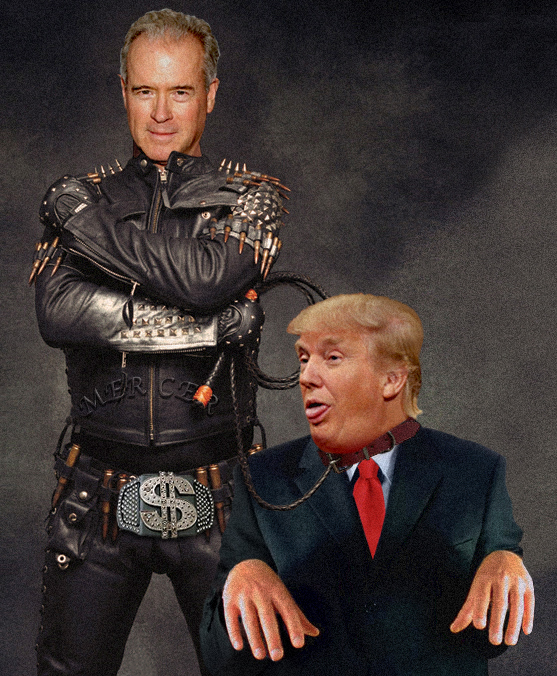
A Sweet Part Of 2018's Electoral History Will Be The Mercer Billionaires' War On The Republican Party

>

Didn't Iggy Pop have a totally awesome song for this?

The Mercers have hired Steve Bannon to run it for them, but the GOP civil war tearing the Republican Parry to shreds could never happen without the profligate spending of two of America's most odious characters, Robert Mercer, the fascist father, and Rebekah Mercer, the equally crazy crackpot daughter. Tuesday, Bannon was in Scottsdale with Kelli Ward, the neo-Nazi GOP challenger to beleaguered Republican Senator Jeff Flake, who's tops on Señor T's hate list.

Bannon was on the warpath against Mitch McConnell again-- Alabama redux-- pledging that the Republican elite are destined to "reap the whirlwind" and "that whirlwind is Kelli Ward." No one could be less deserving on this bounty than Schumer's handpicked corrupt Blue Dog, Kyrsten Sinema, who is also running and is delighted to see the Arizona GOP eviscerate itself. Bannon wasn't lying when he said the "new aristocracy," could not care less about the economic well-being of Americans. He raged that McConnell and other Republican senators disrespect and try to destroy Trump every day.
His remarks were another salvo in the "war" Bannon has declared on the GOP establishment.

“It’s an open revolt, and it should be,” Bannon said before introducing Ward at her campaign’s formal kickoff event at the Hilton Scottsdale Resort & Villas.

"These people hold you in total contempt," he said. "When they attack a Donald Trump and a Dr. Kelli Ward, it's not Donald Trump and Kelli Ward that they're trying to shut up. It's you they're trying to shut up... They think you're a group of morons."

This revolt, he said, is moving from Alabama, where the Bannon-supported Roy Moore just defeated incumbent Sen. Luther Strange in a Republican runoff, to Arizona, where the first-term Flake is up for re-election in 2018 after refusing to endorse or vote for Trump last year.

"It's going to be their money versus your money," Bannon said.

Ward, a former state senator from Lake Havasu City, last year unsuccessfully challenged incumbent Sen. John McCain, R-Ariz., in the primary.

This year, some on the right have been searching for another candidate to take on Flake, who this summer published a book, Conscience of a Conservative: A Rejection of Destructive Politics and A Return to Principle, in which he criticized the Republican Party for embracing Trumpism.

  However, early polls have shown Flake to be deeply vulnerable, and with Ward leading him.

Ward will secure the southern border and build a wall, Bannon said, will repeal and replace "Obamacare," and will negotiate Trump-style trade deals that "represent you and the American people."

"We're building a grass-roots army," Bannon said.
McConnell, who spent something like $10,000,000 against Bannon and Roy Moore in Alabama-- only to lose miserably-- isn't giving up. His team says they will fight back against the threat from the Mercer/Bannon extremists. Crooked Utah Republican Orrin Hatch, who is certainly in Bannon's sites, told the media he thinks Bannon is "going to back off on that. He certainly should. He’s a smart guy, and he’s going to realize that’s unfruitful. Where he ought to be spending his time is going after those who are screwing up the country all these years, and they don’t happen to be Republicans... I like Trump. I endorsed him. I think he’ll endorse me."

Hatch, 83, vowed when he ran in 2016 that he wouldn't run again, but he's addicted to the power and prestige of his corrupt life in the DC swamp, making him easy pickings for Bannon and Mercer. McConnell, who isn't up for reelection this cycle, is trying to portray himself as in control and not freaking out. He isn't in control and he is freaking out. Tuesday he pledged to use the power of the purse to back incumbents, the key to his own power.
“We had an experience in 2010 and 2012 nominating candidates in primaries who couldn’t win the general election,” he said, citing past conservative challengers who defeated candidates backed by the party leadership only to lose to Democrats on Election Day.

One famous instance was in 2012 when conservative candidate Richard Mourdock beat longtime GOP incumbent Sen. Richard Lugar (R-Ind.) before losing what was thought to be a safe Republican seat to Democrat Joe Donnelly.

“Our strategy going forward is to protect our incumbents and to help people get nominated who can actually win elections,” McConnell told reporters after meeting with colleagues over lunch.

It was a signal to colleagues that the National Republican Senatorial Committee (NRSC) and the Senate Leadership Fund, a super PAC linked to McConnell, would pour money into primaries next year if necessary to protect incumbents.

“The message is that [McConnell is] going to be there and we’re going to be there to back incumbents and candidates that we think are electable,” said Senate Republican Conference Chairman John Thune (S.D.), the third-ranking member of the GOP leadership.

Thune said he expects the NRSC will spend resources in primaries to defend incumbents.

...The committee’s spending on Senate GOP primaries next year will depend on state-by-state coordination limits and how much traction a conservative challenger may be gaining against an incumbent, said a GOP strategist familiar with internal discussions about the 2018 races.

Senate Republicans say they hope McConnell can persuade Trump, with whom he has had a rocky relationship this year, to pressure Bannon to back off loyal incumbents such as Senate Republican Policy Chairman John Barrasso (R-Wyo.) and Sen. Deb Fischer (R-Neb.), who are both up for reelection.

Trump acknowledged McConnell’s concerns at a joint press conference with the GOP leader Monday and hinted that he may step in.

“Some of the people that he may be looking at, I’m going to see if we talk him out of that, because frankly, they’re great people,” Trump said Monday of some of the GOP lawmakers in Bannon’s sights.

Senate GOP leaders argue it would be smart for Trump to support the incumbents he will need to vote for tax reform and other items on his agenda.

“I hope he will; I think he will,” Thune said. “They’re the kind of people he’ll need to get his agenda through.”

Barrasso and Fischer, two Republicans on Bannon’s target list, say they will focus on doing their jobs and serving their constituents. Neither said whether they would seek an endorsement from Trump.

But what happens if Miss McConnell opens his purse and there's nothing in it but moths? That's exactly what Mercer and Bannon are trying to make happen. Yesterday Bannon took his circus routine to an event for contemptible billionaires that the Mercers put together in New York. Alex Isenstadt, writing for Politico reported that Bannon and Mercer are persuading big McConnell donors that McConnell is a sinking ship they should abandon before it's too late. Last week Bannon was in Atlanta wooing vile GOP fatcat Home Depot co-founder Bernie Marcus, who's spent millions on Senate Republicans and now complains about "the lack of return on his investment." Bannon has been running around the country talking to the overly entitled GOP sugar daddies like Marcus-- under-taxed right-wing multimillionaires and billionaires, including John Childs, Foster Friess, Susan Gore, Sheldon Adelson, Ed Bosarge, Eric Crown, Dan Eberhart and Scott Bessent.
How many Republican givers will sign on with Bannon is an open question; people close to him declined to say whether he had financial commitments. Ideologically and temperamentally, the pugilistic head of Breitbart News isn't exactly a natural fit with the traditional Republican moneyed set. There is also concern in the donor world that having Bannon-aligned outsiders in the Senate Republican Conference would make it harder, not easier, to reach consensus on legislation.

But Marcus is thinking about joining Bannon. An adviser, Steve Hantler, said the billionaire intends to give his party until the end of the year to pass legislation and then would weigh his options.

“Like many donors, if the gridlock continues in Washington, Mr. Marcus will consider new approaches to breaking the gridlock, including those proposed by Steve Bannon and others,” he said.

Asked whether Marcus is open to funding primary challenges to Republican incumbents, Hantler responded: “You will have to draw your own conclusion.”

...There is serious skepticism at the highest levels of the party apparatus that Bannon's donor initiative will succeed. Some contributors who’ve met with him say the outreach is still in its nascent stage. Others have reacted coolly to the idea, reluctant to go after lawmakers just as the tax reform fight is about to begin. Adelson has told people close to him that he’s not interested in funding primary challengers, though Bannon didn't ask him for money during their meeting.

...The party establishment is racing to lock down financial support. On Thursday evening, former Secretary of State Condoleezza Rice will host a fundraising reception and dinner for Arizona Sen. Jeff Flake, just two days after Bannon attends a donor event for his primary opponent, Kelli Ward. McConnell, meanwhile, has reached out to Adelson in the past month to gauge his interest in giving to Senate Republicans.

Senior Republicans are also trying to assure givers they hear their frustrations. The NRSC, which has seen its fundraising plummet in recent months, held a retreat in Sea Island, Georgia, over the weekend that drew about 300 lobbyists and bundlers.

Tax reform was front-and-center at a breakfast panel discussion that included Georgia Sen. David Perdue, South Carolina Sen. Tim Scott and Colorado Sen. Cory Gardner. As the audience piled their plates with eggs and bacon, the senators acknowledged in blunt terms that the political consequences would be dire for Republicans if they don't pass tax legislation, according to two people present.

Bannon declared at a gathering of evangelicals last week that "money doesn't matter anymore" for Republican incumbents trying to fend off insurgent challengers. The message was this: Huge war chests can no longer save incumbents against underfunded outsider candidates with fervid grass-roots support.

But given his activity, Bannon believes his candidates will need some money to take out incumbents.

While Bannon is orchestrating much of the anti-establishment campaign on his own, he has also gotten a boost from the White House. Earlier this month, Nick Ayers, the chief of staff to Vice President Mike Pence and a veteran GOP strategist, told a group of Republican National Committee donors they should withhold their financial support to incumbents and instead give to primary challengers if Congress fails to pass President Donald Trump’s agenda.

The message was warmly received by many of the influential donors in the room, including Louis DeJoy. The North Carolina business executive, who has given over $30,000 to the NRSC this year, said he isn’t interested in bankrolling GOP challengers.

But he and other donors are fed up with the failures of the Republican Congress.

"I raise money, and I hear the frustration from everybody," DeJoy said. "Everybody knows the money is drying up."


Labels: , , , , , ,

Tuesday, October 17, 2017

The Are No Good Outcomes For Arizona In The 2018 Senate Election

>


Jeff Flake is a conservative. In fact, his career-long record in the House and Senate isn't just conservative; it's very, very conservative. He comes across as a likable enough guy for a politician; but he votes wrong on every important issue. There are Arizona Democrats-- and especially independents-- who admire him for bring one of the only Republicans with the intestinal fortitude to take on Trump and call him out on his bullshit-- he even wrote a book savaging Trump-- but just look at that voting record. No one who cares about healthcare or women's equality or economic justice or anything that makes someone a progressive can vote for the guy, no matter how anti-Trump he's being. And is being anti-Trump enough so that a great many Arizona Republicans have written him off. He's going to probably lose his primary, especially if its a head-to-head match-up with a Trumpist crackpot like Kelli Ward, who is announcing her official campaign today (with Bannon and Ingraham in tow). The co-founder of a revenge porn website, IsAnybodyDown, GOP lunatic Craig Brittain, doesn't count, but he's running too.

The latest polling in Arizona (last week) shows Ward beating him 58-42%-- and that's Flakes's best number in over a year! He's been endorsed by cronies who owe him-- like Marco Rubio, Joni Ernst, Mitt Romney and George W. Bush-- but Ward is a Mercer/Bannon candidate who's been endorsed by Señor Trumpanzee and the whole neo-fascist menagerie: Gorka, Hannity, Ingraham, Levin. Are Arizonans ready for Palin's bus chugging around their state? Flake is so cooked!

Yesterday the NY Times' Sheryl Gay Stolberg described Flake as "the most endangered Senate Republican, with an approval rating in one recent poll of just 18 percent among Arizonans" and who has been savaged by Trump "as 'toxic' and 'a flake.'" He's being pressured from the right and the only good news he's had in months is that an always dependably clueless Chuck Schumer has handpicked a Democratic opponent, the most right-wing Democrat in the House, Kyrsten Sinema, who is not just ultra-conservative but also horrifyingly corrupt and completely inauthentic-- exactly what voters don't want. It's conceivable that even Kelli Ward could beat Sinema!
[Flake's] fate is an object lesson for other Republicans who might consider voicing dire thoughts about the president’s fitness: Cross Mr. Trump, and your political career could well be over.

Mr. Flake, who is known more for his decency than his independent streak, said he had no regrets.

In an interview here, he ticked off some of his earliest criticisms of the president-- from the days when Mr. Trump peddled the false theory that President Barack Obama was born in Kenya, to the time Mr. Trump referred to Mexican immigrants as “rapists,” to his call for a complete ban on travel to the United States by Muslims-- before looking up and stopping himself.

“In which of those instances,” the senator asked, “should I not have spoken out? At what point should you not stand up and say, ‘This is not right; this is not conservative; this is not where Republicans ought to be?’”

Mr. Flake said he had known from the start that taking on Mr. Trump might do him political harm. Even before he declared the president’s brand of populism a corruption of conservative values, he anticipated a tough primary challenge, given his policy differences with Mr. Trump on issues like immigration, trade and Cuba.

“The truth is, if my only goal were to be elected, re-elected to mark time in the Senate, there are much easier paths,” he said.

Mr. Flake is not the Senate’s only vulnerable Republican; Senator Dean Heller of Nevada is also facing a tough re-election race. And Republicans will now have to field a candidate to succeed Mr. Corker, who announced late last month that he was not running next year.

Last weekend, Mr. Corker said his concerns about Mr. Trump were shared by nearly every Senate Republican, even if few have spoken out. Mr. Flake, by contrast, has put pen to paper with his criticism; his new book, Conscience of a Conservative, published in August, is a blistering indictment of the Republican Party and of a president who, despite record-low overall approval ratings, has retained the support of about 80 percent of his party.

Mr. Flake’s main primary challenger at the moment, Kelli Ward, made clear in an interview that she intended to paint Mr. Flake as “an obstructionist to the America First agenda that Donald Trump touted on the campaign trail, and that the American people want to see enacted.”

Andy Surabian, senior adviser to the Great America Alliance, a Trump-aligned group whose political action committee has been supportive of Ms. Ward, said Mr. Flake’s troubles were “entirely self-inflicted.”

“If Flake wants to know why he’s vulnerable, all he needs to do is look in the mirror,” said Mr. Surabian, who had a stint in the White House as deputy to Stephen K. Bannon, Mr. Trump’s former chief strategist. He added: “No one told him to go out and be the face of the anti-Trump resistance in the Republican Party. No one told him to go out and write a book that was basically an anti-Trump screed. The reason the race is in play is because of Jeff Flake’s actions.”

Mr. Flake said he felt compelled to write the book because Republicans had lost their way with the rise of Mr. Trump. His assessment of the president is biting.


“We pretended the emperor wasn’t naked,” Mr. Flake wrote. “Even worse: We checked our critical faculties at the door and pretended that the emperor was making sense.”

While Mr. Corker had likened the White House to an “adult day care center” and said Mr. Trump was treating his office like a reality show, Mr. Flake said in the interview that he might not have used those words. But he clearly agrees with his Tennessee colleague.

“A conservative is conservative in demeanor and comportment-- not just policy,” he said. “And the way you conduct foreign policy as a conservative is that you are steady and measured and predictable. And that’s not what we have now.”

Such comments have not gone over well at home, said Mayor Jim Lane of Scottsdale. The mayor, who calls himself a conservative Republican, said he was not currently backing Mr. Flake, whom he views as exacerbating divisions within the party and undermining the president’s agenda.

“It’s difficult, particularly when there’s a lot of people who feel very, very strongly about the president’s agenda and party’s agenda,” Mr. Lane said, adding, “Any time we sense that is not a priority, for any of our delegation, that becomes a bit of a problem.”

Mr. Flake favors immigration and free trade-- stances that put him at philosophical odds not only with the president, but also with many Arizonans. In 2013, he was part of the bipartisan “Gang of Eight” group of senators who put forth an immigration overhaul that would have offered immigrants in the country illegally a path to citizenship. It passed the Senate with 68 votes but died in the House. He also worked closely with Mr. Obama to open relations with Cuba.

...[D]espite Mr. Flake’s criticisms of Mr. Trump, he almost always votes with the president. (An analysis by FiveThirtyEight, the political blog, found that Mr. Flake had voted with Mr. Trump 91.5 percent of the time.)

“He wrote a book about the conscience of a libertarian, yet he’s voted along the lines of the things he has criticized,” Dr. Riley said. “So my only conclusion is he doesn’t have a conscience.”

...In his early years in Congress, he developed a reputation as a budget hawk who challenged party leaders to get rid of so-called earmarks, in which federal money is steered to lawmakers’ pet projects. But in the Senate, which he joined in 2013, Mr. Flake has not carved out much of a reputation, other than for being a nice guy.

“He’s going to have to define who he is, what his record is and what he’s accomplished,” said David Winston, a Republican strategist in Washington. “This is really going to be a vote about him and his incumbency.”

As to who he is, Mr. Flake puts it this way: “I’m a conservative in, I think, the traditional sense of the word: a Barry Goldwater, Ronald Reagan conservative that believes in limited government, economic freedom, free trade, pro-immigration. That’s the kind of conservative I am, and that’s my record.”

But is that the kind of conservative who is welcome in the Republican Party in the Trump era? Mr. Flake smiled wanly.

“That,” the senator said, “is the question.”


Labels: , , , , , ,

Monday, August 28, 2017

I Don't Care If The GOP Chokes On Its Racism-- But They're Wrecking Our Country

>


Yesterday, Arizona psychopath Kelli Ward told Maria Bartiromo on Fox's Sunday Morning Futures that she thinks "Trump and his leadership is what the country wanted-- that's why he's in the White House-- and I think he's got lofty goals that we should accomplish that will put America first" and that a primary challenge against him "would be a big mistake for the establishment wing of the Republican Party to attempt." Kelli Ward is a right-wing sociopath from West Virginia serving in the Arizona state Senate and running against Jeff Flake for a U.S. Senate seat with Trump's encouragement. Here's a video Mitch McConnell's Senate Leadership Fund SuperPAC just ran against her:


"She's not conservative," they assert, "she's just crazy." She's also pretty typical of the Trump Arizona fans interviewed by The Guardian at his Phoenix hate rally last week-- deranged, delusional... crazy.

Last week Jeremy McCarter took a stroll down The Atlantic's memory lane... to 1916. He told the story of Randolph Bourne. "In his time, as in ours," wrote McCarter, "America was undergoing rapid demographic change. Immigration levels in the first decades of the twentieth century neared all-time highs, thanks to the millions who arrived from Italy, Poland, and other countries in Southern and Eastern Europe. A hit play of 1908 supplied a metaphor for what was supposed to happen next: 'America is God’s Crucible, the great Melting-Pot where all the races of Europe are melting and re-forming!'"
In real life, though, this melting didn’t happen as predicted. Immigrant groups kept their languages, styles of dress, preference for certain dumplings. Many Americans feared that newly arrived aliens would import hostilities from their homelands. The year Bourne wrote his essay was the third year of the Great War. Were unmelted Germans going to fight unmelted Russians on the streets of Chicago? If President Woodrow Wilson decided to join the conflict, where would these aliens’ loyalties lie? Many American leaders called for the melting pot to get hotter, to burn away the “hyphens” that made Hungarian-Americans or Greek-Americans a group apart. The former President Theodore Roosevelt painted a dark vision of the dangers facing the country if its inhabitants failed to achieve “100 percent Americanism,” which he defined as speaking only English and feeling total and exclusive loyalty to the interests of the United States. “The one absolutely certain way of bringing this nation to ruin, of preventing all possibility of it continuing to be a nation at all, would be to permit it to become a tangle of squabbling nationalities.” A hyphenated American, he said, was no American at all.

Bourne’s essay, titled Trans-National America, is a bracing seven-thousand-word challenge to the morality, logic, and wisdom of that view, in his time and ours. The record of ethnic groups trying to live together in this country hadn’t been perfect, Bourne acknowledged, but considering the abysmal results of such attempts everywhere else it had been tried, he thought they coexisted here with “almost dramatic harmlessness.” What the ethnonationalists view with dread and suspicion, Bourne saw as grounds for pride and joy. “For the first time in history has been achieved that miracle of hope, the peaceful living side by side, with character substantially preserved, of the most heterogeneous peoples under the sun,” he wrote.

The fundamental error of those who insisted on a narrow definition of Americanism, as Bourne saw it, was believing that Americanism had any fixed definition at all. He made an impish reversal of our history, arguing that American identity consisted not of timeless truths handed down from all-knowing founders but from the accumulated prejudices of the ethnic group that managed to get here first. “English snobberies, English religion, English literary styles, English literary reverences and canons, English ethics, English superiorities, have been the cultural food that we have drunk in from our mothers’ breasts,” he wrote.

Bourne spoke of English snobberies from personal experience. He grew up in the stifling, Waspy town of Bloomfield, New Jersey, raised by a single mother who was somewhat awed by his precocious intelligence. (A botched use of forceps had left Bourne’s face deformed at birth, and a childhood illness had caused his back to hunch. He speculated that these disabilities might explain his radical outlook, the sympathy he instinctively felt for outcasts and failures. If so, he wrote, “the price has not been a heavy one to pay.”) Only his arrival at Columbia University let him escape his narrow upbringing and begin “to breathe a larger air.” In his Atlantic essay, when he suggested that friendships with people from diverse backgrounds-- Austrian, Scandinavian, Italian, Jewish-- could give young men and women a cosmopolitan view, he was describing his own experience. By coming together in a spirit of “intellectual sympathy,” by talking and arguing and dreaming, he and his college friends made their differences “creative.”

Those late-night conversations suggested to Bourne a new way of thinking about the immigrant’s place in America. Freedom for people newly arrived in this country isn’t the absence of coercion; it’s not the result of benign neglect. Freedom means active participation in self-government, “a democratic cooperation in determining the ideals and purposes and industrial and social institutions of a country.” Bourne’s travels for a book on progressive education, and his phenomenally wide reading, showed him that this participation was good for established communities as well as for new immigrants. He compared the brisk, progressive cities of the Upper Midwest, where German and Scandinavian immigrants played leadership roles, with the South, which clung more tightly than any other region to Anglo-American ways-- and, in Bourne’s view, had paid a price.

To Bourne, America wasn’t some citadel in need of defending: it was a project, one that continually enfolded new participants, dynamically renewed its character. The ethnonationalist looks backward for familiarity, security, a sense of control. Bourne, the child of a hopeful century, looked ahead with ecstatic optimism: “America is a unique sociological fabric, and it bespeaks poverty of imagination not to be thrilled at the incalculable potentialities of so novel a union of men.” Other cosmopolitans, such as the philosopher Horace Kallen, had articulated the shortcomings of the melting pot, but Bourne was rare in his ability to glimpse the shining ideal that could replace it: the “Beloved Community,” a new kind of society in which citizens are bound together by the loyalty of each to all, regardless of race or creed. Bourne was the first American to extract that concept from the work of the philosopher Josiah Royce and hold it up as the ultimate fulfillment of our national project; the second to do so, forty years later, would be Martin Luther King, Jr.

Donald Trump’s call to “Make America Great Again” would outrage Bourne: How is it, he would want to know, that, in the second decade of the twenty-first century, we are still indulging in the kind of “tight and jealous nationalism” that had sent the European powers into a suicidal war and wreaked so much havoc on America itself? How have we learned nothing from the disasters of Bourne’s own generation? Less than a year after he wrote his essay, the United States joined the war on the Allied side, unleashing a wave of “100 percent Americanism” more virulent than he had dreamed possible. Nativist attacks, vigilantism, race riots, and censorship were inflicted on a terrorized citizenry, native-born and immigrant alike. People who spoke German were menaced by mobs, and sometimes killed in the streets; the Socialist press was all but shut down, leading to a full-fledged Red Scare. As Bourne took bolder and bolder stands against the war-- even denouncing his mentor, John Dewey, who thought the war would promote democratic ideals-- he found it more difficult to get published. Old friends fell away; prewar hopes went to pieces. He died in the influenza pandemic of 1918, at the age of thirty-two.

Bourne wouldn’t be surprised that Americans still feel the tug of nationalist sentiment. He knew that people need to feel that they belong to a group. The unique challenge of America, a teeming “nation of nations,” is to define itself in terms broad enough to suit its transnational population, not to mimic other countries’ exclusive, backward-looking pride. “We must perpetrate the paradox that our American cultural tradition lies in the future,” he wrote. In other words, it’s false to our history, and disastrous for our prospects, to think that we can return to a mythic greater past. Those us who are here now have the chance to make something better than our forebears made, and the obligation to try.

Labels: , , ,