Saturday, October 24, 2020

Iowa-- A Bellwether Of The COVID Election?

>


COVID-Kim

Obama won Iowa both times he ran (53.9% to 44.4% in 2008 and 52% to 46.2% in 2012) but 4 years later Trump slaughtered Hillary by almost 10 points there-- 800,983 (51.15%) to 653,669 (41.74%). On the right is the 2016 state map by county and on the left is the 2008 map. That's some turn-around! But don't be surprised if the 2020 map looks more like 2008 map than the 2016 map.


And yet... 2 years later, Iowans were already starting to go south on Trump. Although Republican Kim Reynolds beat a weak Democratic opponent in 2018 (50.3% to 47.5%), the state's one Democratic member of Congress, Dave Loebsack won his seat 54.8% to 42.6%, while 2 of the 3 Republican members of Congress lost their seats to extremely weak candidates, Abby Finkenauer unseating Rod Blum 51% to 45.9% and Cindy Axne beating David Young 49.4% to 47.2%. Even the one Republican who was reelected, Steve King, in the reddest part of the state, had a close call, almost losing to J.D. Scholten 157,676 (50.4%) to 147,246 (47%).

This year Governor Reynolds-- luckily for her-- in not on the ballot, but Senator Joni Ernst is-- and she's down by nearly 2 points in the Real Clear Politics polling average. Their polling average shows Biden ahead of Trump 47.2% to 46.4%. And a new Monmouth poll of the congressional districts, shows Finkenauer and Axne headed for reelection, Finkenauer by 8 points and Axne by 9 points. With Loebsack retiring, the GOP is making a play for his seat-- but isn't getting anywhere. Democrat Rita Hart is beating Republican Mariannette Miller-Meeks, 49% to 43%. And in the red 4th district, Randy Feenstra knocked King out in the primary but is locked in a tight race with J.D. Scholten (48-42%, with Scholten rapidly closing the gap).

Iowa has been hit hard by the pandemic and most people understand exactly who to blame: Trump and his puppet governor, Kim Reynolds. On Friday, the state reported 1,111 new cases, bring the state's total to 112,928-- a horrendous 35,793 cases per million Iowans. That's the 7th worst in the country! Writing for the NY Times yesterday, Trip Gabriel and Astead Herndon reported that Reynolds' resistance to a mask mandate is doing in the GOP in Iowa. "As Iowa set a record for patients hospitalized with Covid-19," they wrote, "Gov. Kim Reynolds appeared at an indoor fund-raiser for the Republican Party this week, just days after joining President Trump at one of his huge rallies in Des Moines, where she tossed hats to the clamorous crowd. At neither event were social distancing or face masks high priorities. The rally last week defied guidelines by the White House’s own health experts that crowds in central Iowa be limited to 25. Iowa’s governor is not on the ballot next month. But her defiant attitude toward the advice of health experts on how to fight the coronavirus outbreak, as her state sees a grim tide of new cases and deaths, may be dragging down fellow Republicans who are running, including Mr. Trump and Senator Joni Ernst."

Older voters, in particular, have abandoned the GOP in droves because of the risk Trump and Reynolds are needlessly subjecting them to by ignoring public health professionals.
“Our older Iowans-- many have not been able to leave their homes because they do not feel safe,” said Representative Cindy Axne, a first-term Democrat who represents Des Moines and southwest Iowa. “If you go into a grocery store, the large majority of people are not wearing masks.”

Ms. Axne added that disappointment with the governor’s handling of the virus was lifting Democrats like her who are on the ballot this year. “Voters know we’re standing up to keep their families safe,” she said.

...Reynolds has called mask mandates “feel-good” actions and refused to issue a statewide directive, unlike Republican governors in such states as Texas and Ohio. At the same time, she has blocked municipalities from enforcing their own mask edicts. Iowa was one of only a few states that never imposed a full stay-at-home order, and it let restaurants, bars and hair salons reopen earlier than most places. Still, the hospitality and retail sectors are struggling because consumers have not fully returned.

Pressed in September if she would consider a mask mandate as cases began to rise again, Ms. Reynolds said, “Nope, not going to happen.” She said she trusted Iowans, armed with data about the virus, to make their own decisions.

...A survey by the Des Moines Register and Mediacom in September showed a plurality of Iowans, 47 percent, disapproved of Ms. Reynolds’s handling of the pandemic, 15 percentage points worse than the number who disapproved in June. For the first time since Ms. Reynolds, 61, became governor in 2017, more Iowans said the state was on the wrong track than headed in the right direction, according to the poll.
Daniel Deitrich is currently on tour with Vote Common Good. He isn't from Iowa; he's from South Bend, Indiana and grew up in an evangelical community and served a local evangelical church there... until they took exception to his spiritual-political outspokenness-- epitomized by this epic song, "Hymn For the 81%," a reference to the 81% of evangelicals who voted for Trump in 2016.


Labels: , , , ,

Friday, September 25, 2020

Will Women-- Including Rural Women-- In Red States Break Away From Their Menfolk On November 3rd And Save The Country From The Authoritarianism The Men Crave?

>


New polling by YouGov for The Economist suggests a bigger swing away from Trump in rural America than in the suburbs. The magazine reported that Democrats are doing less badly among rural voters We'll get to that in a second. But first let me give you a little background on Howard County, Iowa (no relation). It's in the northeast part of the state, hard up on the Minnesota border, with a dwindling population of around 9,000. It's 99% white and the median family income is around $43,000. The closest thing to a city is Cresco (less than 4,000 people). In 2016 Bernie won the Democratic caucuses with 215 votes (54%) and Trump won the Republican caucuses with 112 votes (30.5%). The county had gone for Obama in 2008 and 2012 but flipped hard against Hillary in 2016-- 2,611 (57.9%) to 1,674 (37.1%). That's a 41% swing, othe worst in Iowa and one of the worst in the country.

The county "is populated by older, white, religious, non-college-educated and often disaffected voters, including many independents. This is the sort of place where diversity means people are descended from both Norwegians and Germans."

Neil Shaffer, the county GOP chair expects another big victory "over 60%, " he told The Economist. The Democratic county chair, Laura Hubka told them she "hopes to contain her side’s loss. If Democrats limit rural pain but stir enthusiasm in cities, notably Des Moines, Mr Biden might eke out a statewide victory, as Mr Obama twice did." Iowa's Senate race is even more promising for the Democratic challenger, Theresa Greenfield. The Real Clear Politics polling average shows her up 2.6% over Trumpist incumbent Joni Ernst, and all the most recent polls show her winning. On Tuesday, Monmouth's turnout models showed Greenfield up over Ernst by 3 points on a high turnout election and winning by one point in a low turnout election.

The Economist's point, though, is that "Democrats can take heart" because polling shows "rural voters everywhere have cooled a bit" on the Orange Menace. "He still has a 14-point lead in rural places, but that is well short of his 22-point advantage four years ago. Commentators seem not to have noticed that Mr Biden has so far gained a bigger swing in rural places than he has in the suburbs. Polling by YouGov for The Economist also shows he is doing better than Hillary Clinton managed among the elderly. And among non-college-educated whites, Mr Biden has managed a ten-point gain over Mrs Clinton."

Yesterday, NY Times reporters Alexander Burns and Jonathan Martin looked at 3 states that Siena polled for them-- Georgia, Iowa and Texas and concluded that Donald is on the defensive in those three red states that he carried in 2016. Their polling shows him losing Iowa and struggling in Georgia and Texas. Why? "Trump," they wrote, "continues to face a wall of opposition from women that has also endangered his party’s control of the Senate... A yawning gender gap in all three states is working in Mr. Biden’s favor, with the former vice president making inroads into conservative territory with strong support from women. In Iowa, where Mr. Biden is ahead of Mr. Trump, 45 percent to 42 percent, he is up among women by 14 percentage points. Men favor Mr. Trump by eight points. In Georgia, where the two candidates are tied at 45 percent, Mr. Biden leads among women by 10 points. Mr. Trump is ahead with men by a similar margin of 11 percentage points. Mr. Trump’s large advantage among men in Texas is enough to give him a small advantage there, 46 percent to 43 percent. Men prefer the president to his Democratic challenger by 16 points, while women favor Mr. Biden by an eight-point margin."
The lopsided gender dynamics of the presidential contest extend to Senate races in Iowa, Georgia and Texas, with Republican incumbents facing strong challenges from Democratic candidates favored heavily by women. The gender gap is pronounced even in Iowa, where both Senate candidates are women. The Democratic challenger, Theresa Greenfield, has a two-point lead over Senator Joni Ernst and an 11-point advantage with women.

...The Senate races in the three states also highlight the same forces that are propelling Mr. Biden’s candidacy. Democrats currently appear to have a good shot of achieving a 50-50 split in the Senate, but in order to win an outright majority they would have to push deeper into Republican-leaning states.

The party may have its best chance of such a pickup in Iowa, where Ms. Greenfield, the Democrat, is capturing 42 percent of the vote to 40 percent for Ms. Ernst, a dangerously low number for an incumbent this late in the race.

In addition to leading among women, Ms. Greenfield is ahead by 10 points among voters older than 65, a group that Ms. Ernst won overwhelmingly when she captured her seat six years ago.

In Georgia, where there are two Senate races on the ballot, Republicans appear better positioned but are still facing highly competitive campaigns. David Perdue is currently winning 41 percent, while his Democratic rival, Jon Ossoff, is taking 38 percent. Sixteen percent of Georgia voters said they were undecided, including a significant number of African-Americans, who historically side overwhelmingly with Democrats.

The state’s other Senate race, to fill the unexpired term of former Senator Johnny Isakson, is even more uncertain. Senator Kelly Loeffler, the Republican appointed to replace Mr. Isakson, is in a multicandidate race with a host of other contenders. If nobody gets 50 percent, the top two vote-getters would advance to a January runoff, which could prove pivotal in a narrowly divided Senate.

Ms. Loeffler is winning 23 percent of the vote right now, while her nearest Republican rival, Representative Doug Collins, is garnering 19 percent. The top Democratic vote-getter is the Rev. Raphael Warnock, who’s also taking 19 percent of the vote. The highest vote share in the race, however, is not currently residing with any candidate: 27 percent of Georgians said they were undecided in the race.

Both Ms. Loeffler and Mr. Collins have tied themselves closely to Mr. Trump in the hope of gaining a decisive advantage with conservatives in the first round of voting. But in a runoff, either of them would be confronting a rising population of younger people and Black and Latino voters who reject the president.

...The Texas Senate race appears to be the best bet for Republicans among the three states. Senator John Cornyn, who’s seeking a fourth term, is winning 42 percent of the vote, while M.J. Hegar, the Democrat, is taking 37 percent.

Still, that a long-serving official such as Mr. Cornyn is not more firmly in control of the race illustrates the increasingly competitive nature of Texas elections and the G.O.P.’s struggles with suburban voters. Mr. Cornyn’s advantage is powered almost entirely by rural voters: he’s trailing significantly among those who live in cities and has just a two-point advantage with suburbanites, 17 percent of whom said they were still undecided.

A significant danger looming for Texas Republicans is that Mr. Trump’s hard-line immigration policies are increasingly out of step with where the state is today, and where it is heading.

Three-quarters of the state’s voters support a pathway to citizenship for illegal immigrants currently living in the country, including 98 percent of Texans under 30. Just 20 percent of Texans over all opposed such a process.

Texans were closely split on Mr. Trump’s proposal for a border wall. But opposition to such a wall is overwhelming among younger voters and significant among independents and those living in the state’s cities and suburbs.
In Texas, Heger may be a lost cause but there are at least half a dozen Republican-held congressional districts that aren't. Two of the likeliest to be flipped are partially in Austin, TX-10 (Michael McCaul's seat) and TX-25 (Roger Williams' seat). The Democrats running are both stellar progressives: Mike Siegel and Julie Oliver. Earlier Siegel told me that "Texas women turned the Texas 10th from a 'safe Republican' seat to a national battleground district during my 2018 campaign, and Texas women will help me finish the job in 2020. My core platform is based on service to the community, building on my 21 years of service as a public school teacher and civil rights lawyer. In a district with many retired teachers, especially in the rural areas, this resonates-- folks see me as someone who will protect our safety net and restore common decency. My advocacy against voter suppression and family separation policies also means a lot to Texas women, many of whom take their civic engagement and Christian values seriously."

Goal ThermometerMike continued, saying that "Most importantly, I think, is my willingness to show up and listen, and to be a healer instead of a divider, is what will carry us to victory. The Republican incumbent in the Texas 10th, Michael McCaul, is currently running ads that use racial tropes and demonize the Black Lives Matter movement. He highlights a rural law enforcement official with a demonstrated history of racist public statements. Meanwhile, I'm married to a Nigerian-American woman who is a veterinarian and business owner, and we are raising two children of mixed heritage. We represent the new Texas-- one that is a land of opportunity but also diverse and progressive-- and that image resonates with many women. While the Republicans yearn to look back to Nixonian politics of the 1960s, we are showing a path forward, a Texas where we respect and take care of each other. Through these messages we are building a broad movement. And I'm confident we will prevail."

Please consider helping Mike and Julie prevail by clicking on the Turning Texas Blue thermometer above and splitting a contribution between them.


Labels: , , , , , , ,

Wednesday, September 16, 2020

The Pandemic Turns Out To Be Bad For Drunks And School Kids-- Who Could Have Imagined?

>


Back To School With Betsy And Donald by Nancy Ohanian

Reporting from Martin County on Florida's Atlantic coast yesterday, CNN warned that since Trump and his puppet governor, Ron DeSantis, stampeded Florida schools into opening prematurely last month, "the number of children under 18 who have contracted Covid-19 statewide has jumped 26%." DeSantis then tried hiding the data from the public. Before the opening there were 42,761 school aged kids with COVID-19. A month later, the number is 53,717. The rate of infection is even worse in Martin County than in the rest of the state. DeSantis is still hiding the results from the public.

Some say Katherine Norman's state Senate race is one of the two or three most important legislative races in Florida this year. Her opponent is top Trump /DeSantis ally, Joe Gruters, chair of the state GOP. Today, Katherine told us she finds it "incredibly sad to see Governor DeSantis and others like my opponent who campaigned by lying and deceiving the public so egregiously because of their loyalties to this administration. They have had to lie for this administration so many times they either don’t even mark it is significant, can no longer discern fact from fiction, or don’t care anymore as long as it is for political gain. My opponent, Florida Republican Party chair Joe Gruters lied to CBS news reporter Jim DeFede claiming Black Lives Matter protestors were armed and threatening the McCloskeys who spoke at the Republican National Convention. Deliberately inflaming the incident and amplifying it by alleging that BLM protestors were some how responsible for or an aggressive force in this instance is a deliberate attempt to smear the movement, which is peaceful and asking for basic compassion in response to police violence and justice in excessive force cases. I am not sure why anyone would try to take opposition to confronting racial bias in our communities or law enforcement agencies, or why an elected official would ignore the pain from constituents wrongly harmed. The blind loyalty to this administration has cost these elected officials connection with actual voters in our area and the issues that matter here. Voters can no longer trust the Florida GOP."

  Kind of related in a weird way, Washington Post reporters Rachel Weiner, Chris Alcantara and Andrew Ba Tran wrote yesterday how political pressures on weak and incompetent leaders are forcing bars and restaurants open, even though rates of infection in cities, counties and states that open bars immediately rises. New York City is opening restaurants for in-door dining and Florida started re-opening bars Monday. Our trio of Post writers reports that "One decision appears to be riskier than the other... States that have reopened bars experienced a doubling in the rate of coronavirus cases three weeks after the opening of doors, on average. The Post analysis-- using data provided by SafeGraph, a company that aggregates cellphone location information-- found a statistically significant national relationship between foot traffic to bars one week after they reopened and an increase in cases three weeks later... [T]here is not as strong a relationship between the reopening of restaurants and a rise in cases."
A study by the Centers for Disease Control and Prevention of nearly 300 adults who tested positive for the coronavirus found that they were more than twice as likely to have dined at a restaurant in the two weeks before getting sick than people who were uninfected. Those who tested positive and did not have close contact with anyone sick were also more likely to report going to a bar or coffee shop. The same effect was not seen in visits to salons, gyms and houses of worship, or in the use of public transportation.

“You’re sitting there for a long time, everyone’s talking,” said Linsey Marr, an environmental engineer at Virginia Tech. “And that’s just a recipe for spread.”

Few states make their contact-tracing data available, but in two that do-- Colorado and Louisiana-- bars and restaurants are responsible for about 20 percent of cases traced to a known source. San Diego traced nearly one-third of community outbreaks to restaurants and bars, more than any other setting.

But Louisiana’s experience suggests bar patrons contribute more to the spread of the virus than restaurant diners. There have been 41 outbreaks tied to restaurants and the same number of outbreaks associated with bars, but bar outbreaks appeared to result in more infections, with 480 cases traced to those establishments compared with 180 from restaurants.


Marr said indoor dining can be reasonably safe in a restaurant operating at 25 percent capacity and with a ventilation system that fully recirculates air every 10 minutes. New York City’s policy will allow for only 25 percent capacity at first, with a scheduled increase to 50 percent in November if transmission rates remain low.

Still, Marr said, she “will not eat inside a restaurant until the pandemic is over.” As one of the first scientists to begin emphasizing that the virus was spread primarily by air, she has been concerned about indoor drinking and dining since March.

“People go to restaurants to talk,” she said, “and we know that it’s talking that produces a lot-- 10 to 100 times more-- aerosols than just sitting.”

Other countries facing outbreaks imposed stricter and longer shutdowns on bars and restaurants. Ireland has yet to open its pubs. Countries that did reopen bars and restaurants have, like American states, scaled back in the face of fresh outbreaks.

Researchers at the Massachusetts Institute of Technology say that because U.S. policies vary by state and county, waves of closures and reopenings may have perversely led to more viral spread, as people traveled to enjoy freedoms not allowed closer to home.


The National Restaurant Association argues that restaurants are safe if they follow proper mitigation guidelines and that the industry has been unfairly maligned by the actions of an irresponsible few.

“Bars become particularly risky,” said Larry Lynch, who handles food science for the restaurant trade group. “Anybody who had been in bars knows that conversations get louder, people get closer.”

But, he said, “we haven’t seen... any kind of systemic outbreaks from people going into a restaurant that’s practicing what we ask them to practice.”

Lynch questioned the methodology of the CDC study, noting it covered only 295 people and did not identify the sources of transmission.

The American Nightlife Association, which represents the bar and nightclub industry, did not respond to a request for comment.

Kristen Ehresmann, director of the Infectious Disease Epidemiology, Prevention and Control Division at the Minnesota Department of Health, agreed that when restaurants and bars abide by guidelines designed to reduce transmission, few cases of the coronavirus have been traced to those establishments.

But there are more than a few bad actors, she said: 1,592 cases of covid-19, the disease caused by the coronavirus, have been tied to 66 bars and restaurants in Minnesota. And in 58 other establishments, cases were reported among only staff members, resulting in 240 illnesses. One bar in St. Cloud, Minnesota, the Pickled Loon, was the only place visited by 73 people who got sick and was one stop among several for 44 other people.

“The bottom line is, we’re seeing a big chunk of our cases associated with these venues, and those cases go on to get other cases in other settings,” Ehresmann said. “We can’t ignore the impact.”

Iowa’s first big spike in coronavirus cases originated in the meatpacking industry. Then, says University of Iowa epidemiologist Jorge Salinas, came bars in college towns such as Iowa City, where he is based.

“It was very clear,” Salinas said. “We reviewed records for patients, and they all shared that common exposure of having been to a bar in the previous five days or so. Usually, the same bars that tend to be very crowded and very loud, rather than a place you just sit down to go and have a beer.”

He said those bars began closing not because of government intervention, but because so many staff members fell ill. By that point, the young people who got infected at bars had begun spreading the virus to an older population through family and work.

After about two months, the outbreak in Iowa City started to burn out. But then college students started returning to campus.

“It’s just a different group of young people but similar exposures-- going to bars, hanging out, going to large parties,” he said.

Remember this? Politicians don't seem to


He said an order from Gov. Kim Reynolds (R) closing bars in Iowa City and five other hard-hit counties was welcome but overdue. In the past two weeks, more than 1,000 young people in the region have become infected.

“Unfortunately, it’s late in the game,” Salinas said. “It would have been better if it had been done to prevent this rather than as a reaction to this.”

Politicians who favor an aggressive approach to containing the coronavirus have been hesitant to shut down bars and restaurants. Expanded federal unemployment benefits lapsed more than a month ago. Loans to small businesses are forgiven only if they can keep workers on the payroll, which is usually impossible while running at reduced capacity.

According to the Bureau of Labor Statistics, 2.5 million jobs in bars and restaurants have been lost since February. Although that’s an improvement from the spring, many restaurant owners say they are barely hanging on.

“Winter is coming, and I’m staring down the barrel of the gun of what’s going to happen,” said Ivy Mix, owner of a restaurant called Leyenda in New York and author of the book “Spirits of Latin America.” Even when indoor dining reopens, Mix said she is not sure she and her staff would be comfortable serving enough people inside her Brooklyn restaurant to make a profit.

“This is almost like being thrown a deflated life-jacket-- the action and the symbolism is there, but the actual aid is not,” she said.

That’s why she says the only solution is federal legislation introduced by Rep. Earl Blumenauer (D-OR) that would issue $120 billion in grants to independent bars and restaurants. A Senate version would cover some chains as well.

“Eleven million people work for these independent restaurants,” Blumenauer said. “If we don’t do something, the evidence suggests that 85 percent of them are not going to survive this year.”

His office estimates that the legislation would more than pay for itself, generating $186 billion in tax revenue and unemployment savings. He said President Trump was receptive in a meeting with supporters earlier this year, but that in recent weeks the administration “has basically shut down meaningful negotiations.”

Arizona reopened indoor restaurants and some bars at the end of August, after a hasty spring reopening and more than 5,000 deaths.

“We really kind of reaped the whirlwind,” said David Engelthaler, a former state epidemiologist now at the Translational Genomics Research Institute. “A lot of that was driven by people going into bars and nightclubs, typically the 20- to 30-year-old set, interacting, socializing like they did prepandemic. And that just supported a kind of wildfire of cases.”

He said he thinks it is probably feasible to reopen restaurants at reduced capacity, but bars are a different story.

“One thing that all bars have in common is that they create a lowering of inhibition, and I think more than anything, this will cause the spread of covid,” he said. “We get more complacent, more comfortable, covid starts spreading.”

With temperatures still regularly topping 100 degrees in Arizona, the appeal of outdoor food and drink is limited. After a rapid May reopening led to a spike in cases and deaths, the state has just begun trying a more cautious approach.

Under Arizona’s new, more deliberate reopening, businesses must apply to reopen and bars must serve food to qualify. But Saskia Popescu, an epidemiologist based in Phoenix, said it is unclear whether those requirements are sufficiently stringent.

“If you put out two items does that count?” she asked. “I just worry that we’re kind of all doing this at once.” She noted that more than 500 new cases a day continue to be reported in Arizona, about the same as during the first reopening: “We’ll see if we learn from our lessons.”
Last Friday, the Associated Press noted that the 2 maskless Dakotas are leading the country in COVID-growth. Each state has a moron governor, more concerned about Trumpist politics than keeping their citizens safe-- or even alive. "Coronavirus infections in the Dakotas are growing faster than anywhere else in the nation," reported the AP, "fueling impassioned debates over masks and personal freedom after months in which the two states avoided the worst of the pandemic... Amid the brute force of the pandemic, health experts warn that the infections must be contained before care systems are overwhelmed. North Dakota and South Dakota lead the country in new cases per capita over the last two weeks, ranking first and second respectively, according to Johns Hopkins University researchers.

COVID-Kristi

South Dakota has also posted some of the country’s highest positivity rates for COVID-19 tests in the last week-- over 17 percent-- an indication that there are more infections than tests are catching.

Infections have been spurred by schools and universities reopening and mass gatherings like the Sturgis Motorcycle Rally, which drew hundreds of thousands of people from across the country.

“It is not a surprise that South Dakota has one of the highest (COVID-19) reproduction rates in the country,” Brookings City Council member Nick Wendell said as he commented on the many people who forgo masks in public.

The Republican governors of both states have eschewed mask requirements, tapping into a spirit of independence hewn from enduring the winters and storms of the Great Plains.

The Dakotas were not always a hot spot. For months, the states appeared to avoid the worst of the pandemic, watching from afar as it raged through large cities. But spiking infection rates have fanned out across the nation, from the East Coast to the Sun Belt and now into the Midwest, where states like Iowa and Kansas are also dealing with surges.

When the case count stayed low during the spring and early summer, people grew weary of constantly taking precautions, said Dr. Benjamin Aaker, president of the South Dakota State Medical Association.

“People have a tendency to become complacent,” he said. “Then they start to relax the things that they were doing properly, and that’s when the increase in cases starts to go up.”

Health officials point out that the COVID-19 case increases have been among younger groups that are not hospitalized at high rates. But infections have not been contained to college campuses.

“College students work in places where the vulnerable live, such as nursing homes,” said Dr. Joel Walz, the Grand Forks, North Dakota, city and county health officer. “Some of them are nursing students who are doing rotations where they’re going to see people who are really at risk. I worry about that.”

Over 1,000 students at the states’ four largest universities (the University of North Dakota, North Dakota State University, South Dakota State University and University of South Dakota) left campus to quarantine after being exposed to the virus, according to data released by the schools. The Sturgis rally also spread infections across the region, with health officials in 12 states reporting over 300 cases among people who attended the event.

But requiring masks has been controversial. In Brookings, opponents said they believed the virus threat was not as serious as portrayed and that a mandate was a violation of civil liberties.

“There are a lot of things we have in life that we have to deal with that cause death,” business owner Teresa Holloman told the council. “We live in America, and we have certain inalienable rights.”
North Dakota has 52 counties and South Dakota has 66. Trump only lost two counties in North Dakota (both basically Indian reservations). And of South Dakota's 66, Trump won 61. Trump won 62.96% of the North Dakota vote and 61.53% of the South Dakota vote. Only West Virginia, Wyoming and Oklahoma were more taken in by Trump's bullshit. (Kentucky and Alabama voters fell for the hustle more than South Dakota but slightly less than North Dakota.)

Labels: , , , , , , ,

Thursday, September 03, 2020

Iowans May Not Understand The Nature Of Pandemics-- And They May Not Be The Only Americans Who Don't

>


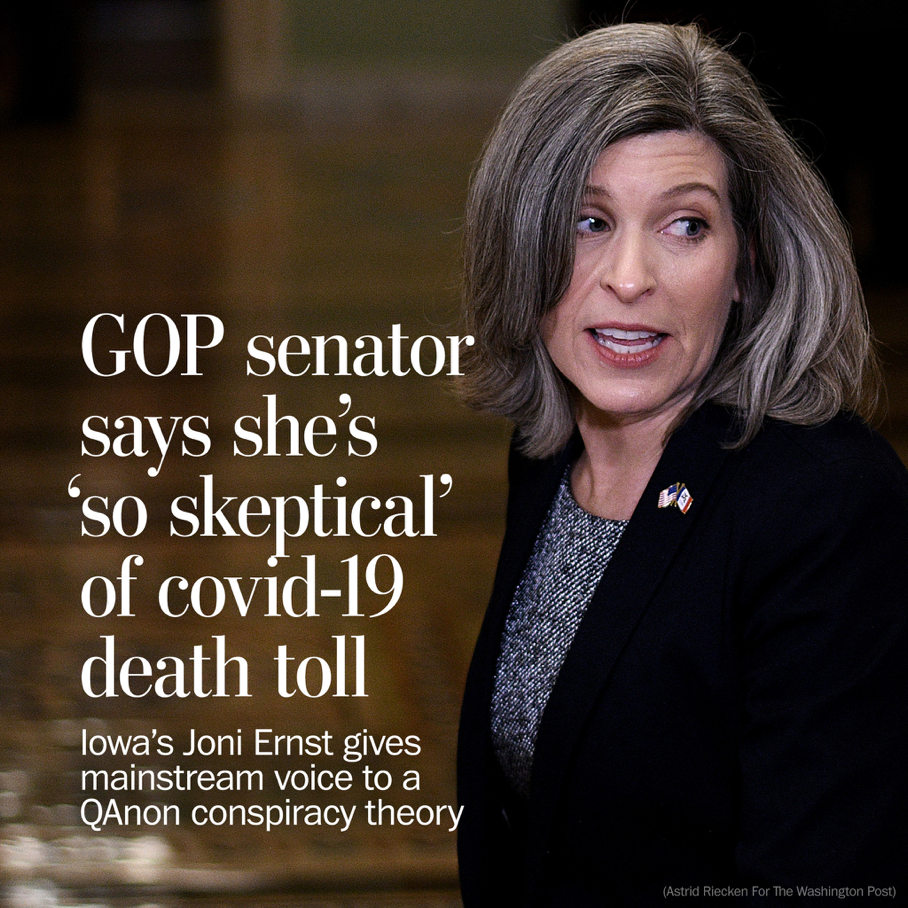
In all likelihood Americans will go to the polls in November knowing over a quarter million of our fellow citizens had died-- most needlessly-- because of Republican mishandling on the pandemic. By early next year, deaths will tick up beyond 300,000. How do Republicans defend themselves when it has been their policies and their incompetence that are behind the catastrophe? They deny it. It's a hoax; it's the media out to get them; the numbers are fake; it's just a bunch of fat old people who would have died anyway. Yesterday, Joni Ernst hadn't gotten so much national press for her clueless comments about pandemic deaths since it came out she used to be a hog castrator before being elected to the U.S. Senate in 2014. As the Washington Post put it Wednesday: "Ernst’s comments echo conspiracy theories pushed by QAnon followers that have been debunked by doctors and public health experts." She told a crowd of Republicans near Waterloo-- hopefully her Waterloo-- that "These health-care providers and others are reimbursed at a higher rate if covid is tied to it, so what do you think they’re doing?" That's a conspiracy theory straight out of Q-Anon.
Critics lashed out at Ernst over the claim, including Democrat Theresa Greenfield, who is seeking to unseat her in a November election expected to be tight.

“It’s appalling for you to say you’re ‘so skeptical’ of the toll this pandemic has on our families and communities across Iowa,” Greenfield said in a tweet directed at Ernst. “We need leaders who will take this seriously.”

...Her inaccurate figure of 10,000 or fewer covid-19 deaths is similar to a widely spread QAnon meme that misinterpreted a recent study published by the Centers for Disease Control and Prevention. That study said the coronavirus was the only contributing factor in 6 percent of reported deaths. The conspiracy theory that claims the U.S. death toll is inflated incorrectly assumes that only 6 percent of deaths should be counted in the covid-19 death tally. The study does not support that claim.

In the other 94 percent of coronavirus deaths, the victims had at least one other contributing factor. Those deaths still count toward the overall number of deaths caused by the virus. Health experts have known since the early days of the pandemic that preexisting conditions, such as asthma, diabetes and heart disease, increase a patient’s likelihood to die of a coronavirus infection.

The suggestion that the U.S. death toll has been inflated has been echoed by QAnon accounts and even retweeted by President Trump. When Trump on Sunday retweeted a QAnon follower named “Mel Q” who made the claim on Twitter, the social media site removed the tweet for spreading false information about the pandemic.

In the past week, new coronavirus cases have spiked by nearly 84 percent in Ernst’s state and the death toll increased by 25 percent. Nightclubs, concert venues and sporting arenas are still closed in Iowa, but most other businesses have been allowed to reopen and children are required to attend in-person classes at public schools throughout the state.

The senator’s unfounded claims inspired backlash from some observers, who viewed the remarks as undermining health-care workers who have been on the front lines of the pandemic.

“Senator Ernst is from Iowa, where currently is having one of the WORST #COVID19 OUTBREAKS hotspot in the entire nation as a region, and some say maybe the world,” Eric Feigl-Ding, an epidemiologist, health economist and senior fellow at the Federation of American Scientists, tweeted Tuesday in response to Ernst’s comments. “To deny that is to deny the suffering of Iowans.”
COVID-Kim (R-IA)


Iowa Governor Kim Reynolds-- backed by a GOP-controlled state legisalture-- has been responsible for one of the worst over-all responses to the pandemic of any governor in America. A 100% Trump puppet, she has consistently ignored science and public health best practices in favor of partisan and ideological gobblygook that has killed 1,125 Iowans. The state reported 646 new cases yesterday, bringing the total to 66,136-- or 20,962 cases per million Iowans-- a far worse rate than any European country, including Spain (10,073 cases per million), Sweden (8,361 cases per million) and Italy (4,470 cases per million).

In 2016, Iowa nearly ceased being a swing state. After two consecutive wins there for Obama, the state's voters overwhelmingly rejected Hillary Clinton's status quo message and Trump won Iowa's 6 electoral votes 800,983 (51.15%) to 653,669 (41.74%). Hillary won just 6 of the state's 99 counties. Two years later, the anti-red wave returned 2 of the state's 3 GOP congressional districts to Democratic hands. And current presidential polling average is firmly back in swing state territory. Trump leads Biden 46.7-45.0%. (1.7 points). The most recent poll from the Des Moines Register is a dead heat within the margin of error-- 44-43% with Trump ahead.

An even more recent Iowa poll by Monmouth shows registered voters giving a slight edge to Ernst over Democrat Theresa Greenfield, 48-45%. The poll results, though, seem to indicate that many Iowans don't understand the nature of pandemics and it is likely to require many more cases and deaths before Iowans will understand how contagious diseases work and how they can be stopped. With many Iowans opting for simplistic partisan tropes to deal with the pandemic, it will be probably some time before Iowa is part of the solution rather than part of the problem.


Labels: , , , , , ,

Friday, August 28, 2020

Trump Still Has A Narrow Pathway To Victory

>


Amy Walter did some significant research for the Cook Report that was published yesterday. It confirms what we already know: Trump's narrow pathway to victory hinges on 2 things, turning out his base of haters-- even the ones who don't normally vote-- in huge numbers, while disenfranchising and discouraging as many normal people from voting as possible.

Trump's polling is in the toilet-- nationally and in the swing states-- and Walter looked at the increasingly narrow pathway he still has. "Trump," she wrote, "is trailing, not because he's losing his 2016 base, but because he has never expanded beyond it." She compared new recent national poll from Pew(7/27-8/2) with the results of Pew's 2016 validated vote survey (basically, a post-election exit poll that uses official voting records). What she found is that "Trump is hitting his 2016 share of the vote among most demographic groups. But, he's not grown beyond those voters. Instead, it's Biden who has improved markedly on Clinton's 2016 performance."


[I]n almost every demographic category, Trump's share of the vote mirrors what he got in 2016. In other words, there's no evidence that he's slipped significantly with his base, or gained support from anyone who didn't support him in 2016.

For example, for all the talk of Trump's cratering in the suburbs, the recent Pew poll finds that the president isn't doing any worse today among white, college-educated voters than he did in 2016. In 2016, Trump took just 38 percent of the vote from this group. Today, he's still sitting at 38 percent. But, Biden has improved on Hillary Clinton's 55 percent showing by 6 points to 61 percent. Trump hasn't lost support from his core white, non-college base either. The July/August poll found him taking 64 percent with this group-- the same percentage he got in 2016. But, Biden has improved on Clinton's anemic 28 percent showing by 6 points. Most important, Trump has made no gains among independent voters, while Biden has improved on Clinton's showing by 14 points.

One bright spot for Trump is an increase in support from Latinos. He took 35 percent of the vote among Hispanics in July/August, a 7 point increase from his 2016 showing. His support among Evangelical Protestants has also improved-- from 77 percent in 2016, to 83 percent.

So, how can this work? If Trump isn't really losing support from his 2016 base, but Biden is gaining on Clinton's performance, where are those extra votes coming from?

Answer: a lot is coming from voters who supported third-party/other candidates in 2016. According to the Pew July survey, voters who didn't support either major party candidate last election are now breaking decidedly for Biden-- 55 percent to 39 percent. This group of non-Trump/non-Clinton voters doesn't get the attention of Obama-Trump voters or suburban moms, but they are a not-insignificant portion of the electorate.

In the 2016 election, the non-Clinton/Trump vote was 6 percent. The Pew validated voter survey put it at 7 percent-- so a touch higher than the popular vote...

Trump has failed to broaden his base. Instead, his ability to win this election will come down to whether he can deepen his base.

That means turning out a higher percentage of his base vote and hoping that Biden and Democrats fail to meet that same level of enthusiasm with their core constituencies.

Analysis from my colleague David Wasserman earlier this year revealed a huge number of non-voting, non-college whites in the Upper Midwest. "In 2016, non-college white voters made up 50 percent of the electorate in Michigan, 49 percent in Pennsylvania and 63 percent in Wisconsin. But among non-voters, whites without college degrees were 60 percent in Michigan, 64 percent in Pennsylvania and 64 percent in Wisconsin." In other words, there's a large pool of potential voters for Trump to mine in key swing states.

But, Trump's path to building on his 2016 showing isn't looking as clear and easy as some might expect. An analysis of the most recent Marquette University Law School survey by Craig Gilbert, the pre-eminent expert of voting trends in the state, and a reporter/columnist at the Milwaukee Journal-Sentinel, finds signs of weakening for Trump in parts of the state he dominated in 2016.

Gilbert found that Biden's strength in the Milwaukee and Madison media markets is similar to Clinton's, but that the former Vice President "is battling Trump to a draw in the combined media markets of Green Bay, Wausau, La Crosse, Duluth and the Twin Cities-- media markets that encompass the kind of small-town, rural areas where Trump beat Clinton by 15 points in 2016.

This could be due to a number of factors, writes Gilbert, including Biden's "own political strengths," an "erosion of support for Trump," and/or the fact that these are parts of the electorate where Clinton underperformed in 2016 and Biden is simply hitting 'normal' Democratic performance.

Either way, it suggests that just trying to run up the score by bringing in low-propensity voters from these parts of the state, may not be enough for Trump to win here in 2020. Of course, we don't know how the events of the last 60+ days of this election may impact this turnout. Will images of burning cities-- especially ones in their own state-- be enough to motivate more non-Trump-like voters to the polls this November? Will Trump be able to do something the campaign has thus been unable to accomplish: drive up Biden's negatives to Hillary Clinton's level? What happens if the coronavirus comes back with a vengeance this fall?

Trump's path to Electoral College victory has always been a narrow one. But, the latest Pew poll suggests that turning out infrequent base voters  is going to be more important than ever.
There hasn't been lot of publicly-available House polling. Occasionally campaigns share it with me but so far this summer there have been a few polls, mostly looking good for Democrats and bad for Republicans-- and applicable to Trump's struggle. Last week, for example, the Bangor Daily News released a poll of Maine's second congressional district which Trump won in 2016-- 51.4% to 41.1% (giving him one of Maine's 4 electoral college votes). Two years late the district flipped from red to blue based on ranked choice voting, giving dishonest conservative Democrat who campaigned as a progressive, Jared Golden a 1 point win. On election night the Republican incumbent's raw vote was 134,184 (46.33%) and Golden's was 132,013 (45.58%). Sinceno one reached 50%, ranked choice voting kicked in and Golden emerged the winner with 142,440 votes (50.62%) to Poliquin's 138,931 (49.38%) The new poll shows Golden beating his GOP opponent by 9 points this cycle.

Earlier this month Monmouth polled Iowa, and showed that the Democrats will keep the 2 seats won by Abby Finkenauer and Cindy Axne in 2018-- Finkenauer by 10 points and Axne by 6 points. The Republicans look likely to hold onto their one seat and possibly win the open blue seat from which Dave Loebsack is retiring. The latest Monmouth poll also shows Trump ahead in Iowa by 2 points.


Labels: , , ,

Thursday, July 30, 2020

JD Scholten To Cheri Bustos: "Keep Out Of My Race"

>


One of the things that always attracted Blue America to J.D. Scholten has been his independent spirit. I don't see him in Congress as just another Democrat-- not even as just another progressive Democrat. I see him as a guy standing up for working families regardless of whatever some shifting party priorities happen to be at the moment. And he was always a lot more than just a way to replace racist Republican Steve King. In fact, King lost his primary to far right state legislator Randy Feenstra who actually attacked King from the right-- someone who couldn't deliver for Trump! Scholten is someone with solid values who will make a crucial member of Congress, the way Pramila, AOC, Ted Lieu and Jamie Raskin do.

Yesterday, writing at The Intercept, Aída Chávez broke the story about how JD told Cheri Bustos, one of the most conservative Democrats in Congress, that he's running his campaign his way, not her way, regardless of her threats to go back on her word and not spend any DCCC money to help him. She had promised to make the IA-04 contest a top 5 race, which generally means at least $3 million in advertising plus a field operation, media help and a big fundraising boost with institutional Democratic Party donors and fat cats. But she insisted he allow the DCCC to take over the campaign. He told her to take a hike.

Yesterday J.D. told me that "It's clear that the DCCC has written off this district... again. But that hasn't changed the stakes. Rural Iowa families are still struggling to stay in their communities, make ends meet, and have the fullest opportunities. Our campaign is fueled by the hunger for change and won't bend to the whims and interests of those in power. We're in this for the long haul to deliver real relief to the communities of Iowa’s 4th congressional district."

Chávez wrote that "Scholten is especially frustrated by the DCCC’s approach to supporting moderate candidates who focus on traditional fundraising from big-dollar donors. 'The DCCC-type of campaign where you sit at home and fundraise all day doesn’t win respect, trust, or elections in these parts and wouldn’t be a good start to addressing the serious challenges facing rural America,' Scholten wrote... 'We have an authentic campaign that reflects who I am and my vision for this district,' Scholten said in a statement announcing the decision. 'We won’t be beholden to special interests or the DCCC; instead, we’re reaching out to folks across the political spectrum to earn votes.'"
Last week, Scholten reached out to Bustos to check in and see where the DCCC was at, and what she meant by her promise to go “all in” on his bid. During their phone call, Scholten laid out everything they had accomplished last cycle and made his case for why the race, despite King’s loss, could present a huge opportunity. “And it just got to the point where they’re trying to dangle carrots in front of us and I was like, you know what, I’m not having it,” he said. “They wanna be in all our meetings, they want us to use their consultants and stuff like that. And I don’t feel comfortable doing that at this time.”

After discussing with his team, Scholten said, he decided, “We don’t need them and what we want is to run the campaign similar to last time and that’s what’s going to win this race.” Completely refusing the DCCC’s help also means the campaign will have to provide its own field program and do its own mailing, which Red to Blue candidates are provided for free. “That’s part of it: We didn’t feel that what they do provides enough value for what we’re trying to do,” he said.

“JD Scholten is a strong candidate working to earn voters’ trust in rural Iowa,” Cole Leiter, a DCCC spokesperson, said in a statement. “We have built a big battlefield and every candidate is going to make their own decisions about how to run their race. We wish him well.”
Goal ThermometerThat's how Rahm Emanuel, Bustos' mentor taught her to tell candidates to go to hell. Blue America and other progressives groups are working to help J.D. make up for some of the help he was expecting from the DCCC. Please consider clicking on the 2020 Blue America congressional thermometer on the right and contributing what you can to J.D.'s campaign. In 2018 the DCCC helped elect 2 utterly useless conservative Democrats in Iowa, Cindy Axne and Abby Finkenauer, each of whom quickly earned F ratings from ProgressivePunch-- very, very low F-ratings. Both can always be counted on to betray working families and to betray values like peace and join a dozen or two other Democrats from the conservative wing of the Democratic Party-- the Cheri Bustos wing. It's important for Congress that we replace truly terrible conservatives with truly great progressives, not with some in-between hybrids like Axne and Finkenauer, someone who working families can always count on to have their backs, not big donors' backs.
Though King’s defeat changed the dynamics of the race, Scholten’s campaign believes that the issues, namely Medicare for All and his vow to take on the corporate interests exploiting the second largest agricultural district in the country, will help flip the district come November. Scholten’s platform stands in stark contrast to the more moderate talking points and messaging the party establishment pushes on Democratic candidates running in red districts.

In 2018, for example, the DCCC commissioned a survey and analysis to help develop its messaging on health care. The messaging handouts, The Intercept reported at the time, “made clear where the party wants its candidates to stand when it comes to health care reform: preferably nowhere, but certainly not with single-payer advocates.” Party elites also end up influencing campaign strategy, Scholten noted. In a few weeks, his campaign will launch a tour that will go through all 375 towns in the district (while adhering to health and safety guidelines.)

“They would not agree that I should go to all 375 towns even though that’s how we earn votes,” he told The Intercept. “They want me to stay at home and just fundraise, be on the phone from the minute I wake up to the minute I go to bed.”

The Scholten campaign brought in a haul of nearly $620,000 in the second quarter of the fundraising year, making it the largest ever in a second quarter for any Democrat who has run for the seat. About 96 percent of the campaign’s contributions last quarter were under $200, thanks to its online small donor base.

“The way the DCCC’s system is, candidates like me, they don’t really care much about,” he said. “If I could self fund, they’d be all over me. I mean, the organizing and just the grassroots organization, we created something that’s so authentic and so organic that I don’t think they know how to deal with something like that. We need more working-class people in D.C., and their system is not made for that.”

Labels: , , , , ,

Thursday, June 04, 2020

Iowa Republican Voters Finally Kick Neo-Fascist Congressman Steve King To The Curb

>


Tuesday evening, J.D. Scholten was the first guest on Marianne's week long down-ballot progressive summit. (Tonight, Hector Oseguera will be on with Marianne; here's the schedule.) Tuesday, while J.D. and Marianne were chatting, Iowans were voting in their primaries. J.D. wasn't challenged so, no drama there. But his opponent, GOP neo-fascist and arch-racist-- largely disowned by the DC Republican establishment-- Steve King had 4 primary opponents. And he lost-- very badly.

King is a poor fundraiser and he was badly outraised by the GOP establishment favorite, state Senator Randy Feenstra. This is what each Republican spent clobbering each other (as of May 13):
Randy Feenstra- $799,306
Steve King- $325,135
Bret Richards (self funder)- $219,655
Jeremy Taylor- $140,818
Steven Reeder- $77,595
Most Iowa Republicans-- not to mention DC Republicans-- have been embarrassed over and over again by King and are more than happy to see him go. For a long-term incumbent to get only 36% in a primary is nothing short of astounding-- if not historic. This is what you call a rejection:


Iowa is a swing state that national Democrats have largely given up on. Hillary, angry Bernie had toed her in the caucuses, pointedly and stupidly ignored the state and it went for Trump 798,923 (51.8%) to 650,790 (42.2%), after giving it's 6 electoral votes to Obama both times he ran. More recently, establishment Democrats-- mostly from the failed Clinton campaign-- have said they would not be contesting Iowa this year, a state Bernie's campaign felt very optimistic about bringing back into the Democratic fold. The state legislature is controlled by the Republicans-- 32 Republicans in the state Senate to 18 Democrats and 53 Republicans in the state House to 47 Dems. In 2018, Democrats won 5 more state House seats and two of the 3 congressional seats the GOP held. The 4th district would have been won-- by J.D.-- had the DCCC supported him, something their hatred of progressives had not allowed. J.D. came far closer to defeating King than they expected when they were telling institutional Democratic donors to not contribute to his campaign.

COVID-Kim


Iowa's governor is a clueless Trump Republican, Kim Reynolds, largely to blame for the catastrophic Iowa pandemic (6,344 confirmed cases per million, including 318 new cases yesterday and another 5 deaths, bringing the total to 561. In terms of cases per million, the worst hit counties are:
Buena Vista- 42,150 cases per million
Crawford- 30,940
Louisa- 30,830
Woodbury- 27,210
Tama- 23,630
Marshall- 22,300
Wapello- 17,270
Wright- 14,680
The 4 horribly-stricken counties in red are in King's district. Reynold's lackadaisical, ideological anti-scientific response to the coronavirus has seriously sickened thousands of Iowans needlessly. She's been on the top 10 list of the worst governors in America since the pandemic began. In way of comparison, the current cases per million in the worst hit (non-postage-stamp-sized) countries:
Spain- 6,139 cases per million
USA- 5,697
Chile- 5,689
Peru- 5,310
Iceland- 5,295
Ireland- 5,081
Belgium- 5,065
Belarus- 4,774
U.K.- 4,124
I'm predicting that Iowans' general revulsion to Trump and to COVID-Reynolds' failure will result in a clean sweep for Democrats in November, all 4 House seats and the Joni Ernst Senate seat (even with a remarkably awful Democratic nominee handpicked by Schumer). The Dems are also in position to win back control of the state House if the anti-red wave in big enough.


King didn't get much sympathy from the media after his massive rejection by IA-04 voters. Politico: "Iowa Republicans drove Steve King out of office on a primary day marked by civil unrest... The nine-term congressman with a history of racist and anti-immigrant remarks was ousted after the GOP establishment offered his opponent both material and symbolic assistance... They starved him of cash, deprived him of committee assignments, and plied his challenger with outside support. But to avoid antagonizing his legion of loyal supporters, King’s detractors largely ignored his decades-long list of remarks condoning white supremacists and demeaning immigrants. Instead, they cast him as ineffective and powerless in Washington, unable to achieve results for his constituents... Nearly every corner of the Republican Party came together to aid Feenstra when tightening polls indicated he could nab the seat. Feenstra’s backers included the U.S. Chamber of Commerce, evangelical leaders, former Iowa Gov. Terry Branstad, Karl Rove, five current Republican congressmen and longtime Iowa political operatives."

Just because he's not Steve King doesn't make Feenstra what's needed in the 4th district. The tired right-wing elixirs and bathtub remedies he's peddling have never been enough to revitalize rural communities or enough to ensure farmers get a fair price and can stay on their land or enough for families to afford healthcare and save for retirement. It wouldn't be an exaggeration to say Feenstra is lacking in vision and utterly devoid of the ability to bring people together, the way Scholten does. Feenstra takes every dime he can from corporations and special interests-- the same corporate system that's taking away power, opportunities, and wealth from Iowa communities. He already represents the D.C. swamp and everything that spells out real (not Trumpian) reform. Remember, his big complaint about King was that he was ineffective perpetrating policies like building a border wall. And in the state legislature he voted for the heartbeat bill and has always opposed all abortion exceptions beyond saving a woman’s life.

Goal ThermometerNot having King in the race, makes it tougher for J.D. in a red district like IA-04. But his 2018 campaign made him well-known in every county and he is very well-regarded by Democrats, independents and even many non-ideological Republicans. There is already talk about die-hard King supporters boycotting Feenstra, who is generally as conservative as King, but without the overt fascism and racist carryings-on. Now J.D. is going to need all the financial support he can get since there is no doubt that the GOP establishment will fight like dogs to hold onto the seat and spend immense amounts of dark money. Please help J.D. with transparent money by clicking on the Blue America 2020 congressional thermometer on the right-- and giving what you can. After the vote, J.D. acknowledged to his supporters that "This election is not going to be easy. But it wasn’t easy in 2018, and we came within 3 points of defeating Steve King. This time, we know we can win. That’s because 'not Steve King' isn’t good enough. It’s not enough to not be blatantly racist. We need someone who will fight for our farmers to get a fair price and for our families to be able to afford quality healthcare, put food on the table, and save for retirement. To do that, we can’t keep propping up the corporate system that is sucking wealth and opportunities out of our district like Randy does.We don’t need another representative who is already bought and owned by corporate interests and the 1%."

This morning he told me that "King set a low bar for a Member of Congress. We must do better than not being blatantly racist. We’re in an extraordinary moment in history: the vibrancy of rural America is declining while we’re facing a global pandemic and nationwide protests calling for justice, accountability, and long overdue changes to address white supremacy and systemic racism. Our next representative must be able to meet these challenges and have a vision for the future of rural Iowa. We can’t accept the status quo of another corporate-backed career politician and allow the rich, powerful, and well-connected to continue bleeding rural America and vulnerable Americans dry."

Labels: , , , , , , ,

Wednesday, May 13, 2020

Let’s Vote For Fair Courts In 2020

>


-by Marge Baker,
Executive Vice President,
People for the American Way


Even after two months into a national health and economic crisis, Donald Trump and his Republican cronies in the Senate have continued their assault on our federal courts. And while Americans from every walk of life are dealing with the devastating health and economic impact of this pandemic, Senate Republicans are quietly processing more of Trump’s judicial nominees.

People For the American Way has led the charge against Trump’s dangerous judicial nominees since he took office. And in the lead up to the 2020 presidential election, PFAW’s Vote the Courts 2020 campaign has focused on two goals: encouraging presidential candidates to prioritize the importance of the courts in their campaigns and holding senators who vote for Trump’s dangerous troubling judicial nominees accountable for those votes.

Vote the Courts 2020 strives to educate the public about the role that federal judges play in their daily lives-- whether they have access to affordable health care; whether their rights as workers are protected; whether they have the ability to vote and have that vote counted; whether they can be free from discrimination; whether they will have clean air to breathe and clean water to drink. The list is endless and not at all abstract.

During the primary season, we encouraged candidates to address the importance of the courts and share the kinds of judges and justices they would nominate to the bench as president.  Even amid the once-crowded field of contenders, more than a dozen Democratic candidates responded to our call.

Following the campaign launch, PFAW co-sponsored a presidential candidate forum in Iowa that focused on the importance of democracy reform and the courts, where five former candidates spoke in greater detail about their plans to restore balance to our courts.

This issue has become especially salient to progressives in the Trump era: Polling has shown that Democratic voters outrank Republican voters on whether the courts are a reason to support their party’s presidential candidate. In the coming months before Election Day, there is ample opportunity to continue to highlight the importance of fair-minded judges.

And this is relevant not just to the presidency, but also to the senators that vote on these nominees. That’s why another prominent facet of the Vote the Courts 2020 campaign is holding Senators Martha McSally, Cory Gardner, Thom Tillis, Joni Ernst, Susan Collins and David Perdue accountable for their votes to confirm Trump’s dangerous nominees. Working with partners and allies in Arizona, Colorado, Georgia, Iowa, Maine and North Carolina, we are highlighting senators’ votes to confirm extreme Trump judges who are hostile to health care, reproductive rights, a healthy environment, democracy and voting rights, and the social safety net through videos, op-eds, and activist toolkits.


In the coming months, we will continue to grow our accountability work, as the same poll cited above also indicates that Democratic voters care more about their senators’ judicial confirmation votes than do Republican voters when weighing their support for a candidate.

Our ability to create products that are integral to our Vote the Court 2020 campaign depends on the work of our stellar legal research team.  In particular, both our Confirmed Judges, Confirmed Fears blog series and web tool provide the information we are using to tie Trump judges’ rulings and dissents to the impact they have on issues critical to our daily lives.

After three and a half years, Trump and his Republican enablers have reshaped our federal judiciary by packing our courts with ultra-conservative judges who give them the green light to enact their extreme agenda. In fact, most Trump appointees are white men who are young enough to spend decades in their lifetime positions on the bench. Long after he vacates office, the damage he has done will endure.

Our rights and liberties-- our right to accessible, affordable health care; our right to make decisions about our bodies; our right to cast a ballot that counts; our right to clean air and water, and more-- are all on the line on Election Day. We need to fight for fair courts, and for judges who understand equality and justice for all of us.

Labels: , , , , ,