Tuesday, October 13, 2020

Want To Know Which Campaigns To Direct A Little Cash Where It Will Do The Most Good Right Now?

>


Let's remember on November 4 that as late as mid-October, DC prognosticators were still predicting, on average, that the GOP would lose about 7 seats in the House. Yesterday, the Politico crew called the likely thinning of GOP ranks an undertold story and wondered who would take the fall among the GOP House leaders, without mentioning Kevin McCarthy's attached at the hip relationship with Señor Trumpanzee, who's clearly dragging the GOP House conference down the drain with him. Their "election guru," Steve Shepard, moving Anne Wagner (MO-02), Jim Hagedorn (MN-01) and Steve Chabot (OH-01) into the danger zone, wrote that "signs of a possible Democratic wave abound." He also rated the House as "likely Dem." Not even "very, very" likely. What is this "election guru" waiting for, Nov. 4th?

I don't know him and he may be a lovely person, but... give me a break! "there’s a good chance they [the House Democrats] could grow the majority they won in 2018: If they split the 32 'toss-up' races evenly with the GOP, Democrats would have 236 seats, one more than they did at the start of this Congress. What a moronic thing to say. "If they split the 32 'toss-up' races evenly." Why should that be a consideration? Waves aren't about splitting toss up districts evenly. There's a better chance that the Democrats will win all of them and more than split them evenly.
Trump’s failure to broaden his base and win back suburban voters is a particular weakness for House Republicans. Two of the three districts moving from “Toss Up” to “Lean Democratic” are in once-Republican suburban strongholds currently held by Democratic freshmen: Reps. Lizzie Fletcher in the Houston suburbs and Tom Malinowski in Northern New Jersey.

Similarly, GOP Rep. Ann Wagner’s suburban St. Louis district is moving from “Lean Republican” to “Toss Up,” as is Rep. Steve Chabot’s suburban Cincinnati seat.

Those aren’t the only places where Trump is dragging down House Republicans. Freshman Democratic Rep. Jared Golden holds a rural Maine district that embraced Trump in 2016, but polls there show Golden well ahead of Republican Dale Crafts. His race moves from “Toss Up” to “Lean Democratic.” Meanwhile, freshman GOP Rep. Jim Hagedorn, who holds a Trump-friendly, rural, Southern Minnesota seat that flipped to Republicans in the 2018 midterms, sees his seat move from “Lean Republican” to “Toss Up”-- in part due to Hagedorn’s ethics woes.

Though most of the movement is in the other direction, two longtime Democratic congressmen find themselves in tougher-than-expected races, though both are still favored to win: Reps. Peter DeFazio of Oregon and Ron Kind of Wisconsin. Both were reelected easily in 2018, but Republicans recruited strong candidates for both seats-- borrowing a page from Democrats, the GOP candidates are both military veterans-- and the races move from “Likely Democratic” to “Lean Democratic.” Trump carried Kind’s seat while winning Wisconsin in 2016, and he ran essentially neck-and-neck in DeFazio’s district.
Goal ThermometerWhat the election guru doesn't want to say is that this election is a referendum on Trump and his enablers and voters are pissed off and ready to say so at the polls. It's a tragedy that the DCCC leadership doesn't seem to understand that either and is still playing their old games-- like progressives can't win in red districts. This is the cycle they can and will. Please take a look at the Blue America 2020 congressional endorsement page by clicking on the ActBlue thermometer on the right. If you're in a giving mood, please give special consideration to candidates the DCCC is still ignoring in winnable races-- like Nate McMurray in NY-27 (who was edged out in 2018 (again, no help from the DCCC) 140,146 (49.1%) to 139,059 (48.8%). It would seem like a no-brainer for the DCCC to help Nate this cycle. But... too progressive for the district. The DCCC would rather pour millions of dollars into Blue Dogs' campaigns who are too conservative for Democrats to stand voting for even if they lose half of those races.

Other races with momentum that Cheri Bustos and her Blue Dog DCCC are ignoring include Adam Christensen (FL-03), Audrey Denney (CA-01), Liam O'Mara (CA-42) and J.D. Scholten (IA-04). Let's give those races a little extra attention on the contribution page.

"I have to be honest," Audrey Denney told me this morning. "If you look at my race on paper-- it doesn’t look winnable. Which is why I haven’t gotten much national attention. But when people look closer-- they know this is a swing district. Congressman LaMalfa is a lazy fundraiser-- especially compared to the big numbers I’m putting up. We are polling within the margin of error. My district is the cheapest media market in the state. For $1million you can buy 37,000 gross rating points. If you dropped that amount in CA-25-- you’d get 1,000 points. With the turnout models we are expecting this year-- I can win this seat. People are starting to notice that. I’m seeing small dollar donations coming in from around the nation. National organizations like EMILY’s list are getting on board. But I still need more help to get over the finish line. As of right this minute I still need to raise $439,964 to fully fund my paid communications and field plan. My average contribution size is $47. Every little bit helps!"

J.D. Scholten, like Audrey, ran last cycle and nearly won-- with no DCCC help then and none now. His IA-04 campaign is pure grassroots. "In the past two months alone," he told me, "I've driven 7,786 miles in our Winnebago RV, Sioux City Sue, to all 374 towns in Iowa's 4th district. You can feel the economic pain in our small towns and see the shuttered downtowns that haven't even bounced back from the 2008 financial crisis. These folks have been left behind by the Democratic Party and by the corporations that are sucking the wealth and potential out of our communities-- that's why we turn down corporate PAC money and help from the DCCC. We're doing this our way to bring hope and change to Iowa's 4th district, revitalize our rural communities, and level the playing field for working people."

These are the seats Cook claims are up for grabs. As usual, they are too conservative, generally giving the GOP every possible benefit of the doubt, including calling utterly safe Democratic seats "likely" or "leaning" and calling seats likely to flip to the Democrats "toss-ups," "lean R" and, in the case of TX-25 (Julie Oliver vs Roger Williams) even "likely R."


Labels: , ,

Thursday, July 30, 2020

JD Scholten To Cheri Bustos: "Keep Out Of My Race"

>


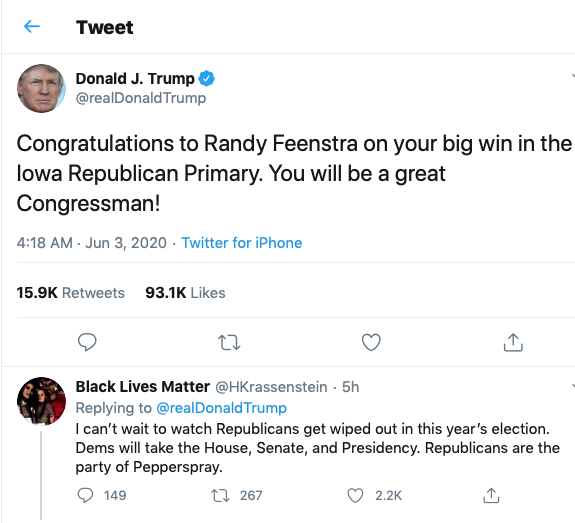
One of the things that always attracted Blue America to J.D. Scholten has been his independent spirit. I don't see him in Congress as just another Democrat-- not even as just another progressive Democrat. I see him as a guy standing up for working families regardless of whatever some shifting party priorities happen to be at the moment. And he was always a lot more than just a way to replace racist Republican Steve King. In fact, King lost his primary to far right state legislator Randy Feenstra who actually attacked King from the right-- someone who couldn't deliver for Trump! Scholten is someone with solid values who will make a crucial member of Congress, the way Pramila, AOC, Ted Lieu and Jamie Raskin do.

Yesterday, writing at The Intercept, Aída Chávez broke the story about how JD told Cheri Bustos, one of the most conservative Democrats in Congress, that he's running his campaign his way, not her way, regardless of her threats to go back on her word and not spend any DCCC money to help him. She had promised to make the IA-04 contest a top 5 race, which generally means at least $3 million in advertising plus a field operation, media help and a big fundraising boost with institutional Democratic Party donors and fat cats. But she insisted he allow the DCCC to take over the campaign. He told her to take a hike.

Yesterday J.D. told me that "It's clear that the DCCC has written off this district... again. But that hasn't changed the stakes. Rural Iowa families are still struggling to stay in their communities, make ends meet, and have the fullest opportunities. Our campaign is fueled by the hunger for change and won't bend to the whims and interests of those in power. We're in this for the long haul to deliver real relief to the communities of Iowa’s 4th congressional district."

Chávez wrote that "Scholten is especially frustrated by the DCCC’s approach to supporting moderate candidates who focus on traditional fundraising from big-dollar donors. 'The DCCC-type of campaign where you sit at home and fundraise all day doesn’t win respect, trust, or elections in these parts and wouldn’t be a good start to addressing the serious challenges facing rural America,' Scholten wrote... 'We have an authentic campaign that reflects who I am and my vision for this district,' Scholten said in a statement announcing the decision. 'We won’t be beholden to special interests or the DCCC; instead, we’re reaching out to folks across the political spectrum to earn votes.'"
Last week, Scholten reached out to Bustos to check in and see where the DCCC was at, and what she meant by her promise to go “all in” on his bid. During their phone call, Scholten laid out everything they had accomplished last cycle and made his case for why the race, despite King’s loss, could present a huge opportunity. “And it just got to the point where they’re trying to dangle carrots in front of us and I was like, you know what, I’m not having it,” he said. “They wanna be in all our meetings, they want us to use their consultants and stuff like that. And I don’t feel comfortable doing that at this time.”

After discussing with his team, Scholten said, he decided, “We don’t need them and what we want is to run the campaign similar to last time and that’s what’s going to win this race.” Completely refusing the DCCC’s help also means the campaign will have to provide its own field program and do its own mailing, which Red to Blue candidates are provided for free. “That’s part of it: We didn’t feel that what they do provides enough value for what we’re trying to do,” he said.

“JD Scholten is a strong candidate working to earn voters’ trust in rural Iowa,” Cole Leiter, a DCCC spokesperson, said in a statement. “We have built a big battlefield and every candidate is going to make their own decisions about how to run their race. We wish him well.”
Goal ThermometerThat's how Rahm Emanuel, Bustos' mentor taught her to tell candidates to go to hell. Blue America and other progressives groups are working to help J.D. make up for some of the help he was expecting from the DCCC. Please consider clicking on the 2020 Blue America congressional thermometer on the right and contributing what you can to J.D.'s campaign. In 2018 the DCCC helped elect 2 utterly useless conservative Democrats in Iowa, Cindy Axne and Abby Finkenauer, each of whom quickly earned F ratings from ProgressivePunch-- very, very low F-ratings. Both can always be counted on to betray working families and to betray values like peace and join a dozen or two other Democrats from the conservative wing of the Democratic Party-- the Cheri Bustos wing. It's important for Congress that we replace truly terrible conservatives with truly great progressives, not with some in-between hybrids like Axne and Finkenauer, someone who working families can always count on to have their backs, not big donors' backs.
Though King’s defeat changed the dynamics of the race, Scholten’s campaign believes that the issues, namely Medicare for All and his vow to take on the corporate interests exploiting the second largest agricultural district in the country, will help flip the district come November. Scholten’s platform stands in stark contrast to the more moderate talking points and messaging the party establishment pushes on Democratic candidates running in red districts.

In 2018, for example, the DCCC commissioned a survey and analysis to help develop its messaging on health care. The messaging handouts, The Intercept reported at the time, “made clear where the party wants its candidates to stand when it comes to health care reform: preferably nowhere, but certainly not with single-payer advocates.” Party elites also end up influencing campaign strategy, Scholten noted. In a few weeks, his campaign will launch a tour that will go through all 375 towns in the district (while adhering to health and safety guidelines.)

“They would not agree that I should go to all 375 towns even though that’s how we earn votes,” he told The Intercept. “They want me to stay at home and just fundraise, be on the phone from the minute I wake up to the minute I go to bed.”

The Scholten campaign brought in a haul of nearly $620,000 in the second quarter of the fundraising year, making it the largest ever in a second quarter for any Democrat who has run for the seat. About 96 percent of the campaign’s contributions last quarter were under $200, thanks to its online small donor base.

“The way the DCCC’s system is, candidates like me, they don’t really care much about,” he said. “If I could self fund, they’d be all over me. I mean, the organizing and just the grassroots organization, we created something that’s so authentic and so organic that I don’t think they know how to deal with something like that. We need more working-class people in D.C., and their system is not made for that.”

Labels: , , , , ,

Friday, July 10, 2020

Cook: Trump Is Dragging Down Republican Candidates With Him

>


Cook is usually a lagging indicator. They do not move on a dime. If they move a race from "leans Republican" to "toss up," it probably means you should expect a big loss for the GOP. Yesterday, Amy Walter, one of their top prognosticators, used the word "tsunami." It's July; I would interpret that to mean Cook foresees a mass GOP drowning in November-- an actual; threat to to basic well-being of the party's existence. This isn't just about swing states and swing districts-- you can start anticipating painful Republican losses in "solid red" states like Alaska, Texas, Arizona, Georgia and Montana. And that isn't just about electoral votes but about Republicans up for reelection-- or running for-- congressional and state and county legislative seats as well. "This election," wrote Walter, "is looking more like a Democratic tsunami than simply a Blue wave. President Trump, mired in some of the lowest job approval ratings of his presidency, is trailing Biden by significant margins in key battleground states like Pennsylvania (8 points), Michigan (9 points), and Wisconsin (9 points). He’s even running behind Biden in his firewall states of Florida and North Carolina."

She doesn't understand the difference between a Blue wave and an anti-red wave. There's no enthusiasm for Biden or the crappy party he "leads." All the enthusiasm is for stuffing Trump down a toilet and flushing. But the Beltway insiders will never understand that and will continue babbling like chimps about "a Blue wave." Fine, who cares; it ends up with the same results anyway.


Cook changed some of their electoral college predictions "to reflect this reality." All have moved towards the Democrats and all are laughably behind reality. Their best predictions are always the day after the election anyway. They move Wisconsin, Pennsylvania, and Nebraska’s 2nd district from toss up to lean Democrat. And Maine, which for whatever insane reason, was in the lean Democrat column moved to likely Democrat. Cook is so funny. They also moved Maine's 2nd district from likely Republican to just lean Republican. And she wrote that "Georgia has joined Arizona, North Carolina and Florida in the Toss Up column, although, at this point, Biden would be slightly favored to win at least Arizona and Florida."

Even Republican strategists she spoke with understand that Trump has now reached "a permanent loss of trust and faith of the majority of voters. In talking with strategists on both sides this last week, it’s also clear that Trump is dragging Republican congressional candidates with him as well. Plugged in strategists on both sides tell us that Trump is running behind in districts he easily carried in 2016. As one GOP strategist told us this week, 'I’d be surprised if any House GOP challenger is able to outperform Trump-- they are tied to him.' Meanwhile, Democratic Senate candidates-- even those in second and third-tier races-- are pulling in eye-popping second-quarter fundraising totals."


I spoke to a handful of candidates running strong in prohibitively red districts. Iowa progressive, J.D. Scholten, pointed out that his right-wing Trumpist opponent, Randy Feenstra "ran his primary campaign on the theme that he's best positioned to 'deliver' for Trump. But Trump's policies have systematically ravaged Iowa's farmers and rural communities in everything from the disastrous trade war to abuses of the Renewable Fuel Standard to corporate bailouts. Iowans don't need nor want another career politician who's beholden to corporate interests and afraid to stand up to power. We understand why folks voted for Trump-- they were looking for change and solutions, but unfortunately, that's not what we got. Our campaign is gaining traction with Trump voters, Republicans, and voters across the political spectrum because we're fighting for them: farmers, workers, and rural communities."

Goal ThermometerGeorgia progressive Lisa Ring told me that through her experiences she's concluded that the most dangerous thing we can do is assume we can predict political outcomes. "Every action," she said, "has the potential of harming or propelling a campaign but the ever-changing nature of politics renders an important development, insignificant within hours. In general, the failures of the Trump administration should be harmful to every legislator or candidate who remains loyal to it. However, it is what Democrats choose to do with the failings of the GOP that will make a difference. Or not.

"Simply pointing out that Rep. Buddy Carter is a Trump lackey who has followed his every direction in order to gain Trump’s official endorsement, is not enough," she continued. "Instead, I must remind the people of my district that Carter and Trump worked hand in hand to destroy the middle class, working class, and disadvantaged, by taking away whatever healthcare they had, letting small businesses fail, allowing our infrastructure to crumble, protections to be rolled back, and failing the millions of unemployed, as well as the millions of infected Americans who were provided no assistance and no leadership during a pandemic that is not even close to being over. 2016 and beyond, should have taught us not to rely on polls or predictors, but rather to continue to focus on the issues, and reach voters one on one. These times are unprecedented and we cannot sit back and analyze with numbers, beliefs that defy all reason. Instead let us hit the streets(virtually, if it must be) and connect truthfully to people who need answers and solutions to the very real problems they face daily."

Texan Julie Oliver shared something that has changed in a pretty big way since the 2018 campaign. "What we’ve seen over the last two election cycles is a growing number of 'independent' voters in TX-25. Some folks share that they’re former Republicans who have lost their party and will never vote for another Trumpublican, like Rep. Roger Williams, again. Sometimes we encounter these newly independent voters when we are phone-banking, or in the pre-pandemic world when we were able to canvass, but what we are seeing in this election cycle that really didn’t happen in the midterms is that many former Republicans reach out to our campaign unsolicited."

Yesterday, Astead Herndon wrote specifically about the Trumpist base in Georgia and Arizona being nonplussed about the GOP establishment Senate candidates. "Many Republican candidates face a perplexing electoral landscape this year, given that Mr. Trump’s conduct has endeared him to the party’s most conservative groups, but has soured some suburban moderates and seniors who are vital parts of any swing state coalition. These candidates are walking a tightrope, made more difficult by a voter base that doesn’t just want to elect Republicans, but rather loyal foot soldiers who take on Mr. Trump’s political and cultural enemies. It is the long-term political war over how Trumpism is best expressed-- not the short-term battle over Mr. Trump himself-- and how a party that has been driven by early-morning tweets for four years will seek to survive the next 40."
In the run-up to the 2018 midterm elections, a record number of House Republicans chose not to seek re-election rather than face conflict with the conservative base, and even a favorable Senate map saw Republicans lose in states like Arizona and Nevada.

With Mr. Trump on the ballot this year, it will be even harder for candidates to paper over the differences, and the uneasy relationship between the party’s most right-wing voters and the statewide Republicans like Ms. Loeffler and Ms. McSally who rely on their votes is bursting into the open.

Governors in both Arizona and Georgia are currently confronting this political challenge, after opening up their states’s economies at the urging of the president and those in the media who support him, only to face pressure to reverse course after coronavirus cases surged.

Polling also shows that Ms. Loeffler and Ms. McSally are underdogs in their respective races, facing an energized Democratic electorate in addition to their inner-party wrangling.

...A recent survey of Arizona voters from the New York Times and Siena College found Ms. McSally trailing her Democratic opponent, the former astronaut and U.S. Navy Captain Mark Kelly, by nine percentage points.

In a recent Fox News poll of the Arizona race, just 73 percent of Republicans supported Ms. McSally, while 88 percent of Democrats supported Mr. Kelly.

“They don’t buy her as a bona fide very conservative Republican,” said Chuck Coughlin, a longtime Republican political consultant in Arizona.

The candidates’ struggles speak to how real divisions among Republicans have been obscured by Mr. Trump’s victory in 2016, and could erupt again should he lose in November.

...Several Republicans in Arizona and Georgia said in interviews that the problem is not with Ms. Loeffler’s or Ms. McSally’s messages, but whether the base is buying the candidates as authentic.  As a sign of their shared troubles among Republicans, some of the most negative publicity for both senators in the past year has come courtesy of Fox News, the cable outlet that is often sympathetic to the president.

...“The electorate has changed a lot,” Mr. Coughlin said, adding that the current Republican Party has “moved away from that narrative that people were originally attracted to. And in my view, has become one that’s reactive to the identity politics of the left.”

Labels: , , , , , , , , , , ,

Tuesday, June 09, 2020

Trump Seems To Be In A Race To Pollute As Much Of America As He Can Before Being Tossed Out On His Ass

>


On Thursday, Trump issued an executive order-- claiming a national emergency-- to bypass environmental laws fast-tracking of major construction projects in a bid to... perhaps boost the economy before November, perhaps enrich friends and GOP campaign donors-- probably a combination. What his order does is lift environmental review of major projects, exactly what Congress prohibited over the course of decades. In practical terms it will mean rushed approval of highways pipelines, oil and gas projects and other polluting industries that have historically and disproportionately had harmful effect on minority communities.

Mustafa Santiago Ali of the National Wildlife Federation, formerly a senior adviser for environmental justice at the EPA said "It shows again that they have no respect for the lives in these communities that are already overburdened. Trump’s actions put a spotlight on black lives don’t matter."

And just as that was going on, the Senate was working in a bipartisan fashion-- very rare-- to tackle the the Climate Crisis via agriculture, "direct the Agriculture Department to help farmers, ranchers and landowners use carbon dioxide-absorbing practices to generate carbon credits."

Mike Braun (R-IN), #LadyG (R-SC), Sheldon Whitehouse (D-RI) and Debbie Stabenow (D-MI) are the principal sponsors of the Growing Climate Solutions Act, which would direct the U.S. Department of Agriculture "to create a program that would help the agriculture sector gain access to revenue from greenhouse gas offset credit markets... The bill would establish USDA-certified protocols for farmers, ranch and forest owners seeking to develop projects that can generate offset credits under existing programs. It would offer a new revenue stream for farmers, ranchers and land owners suffering from the economic impacts of global trade tensions and the coronavirus."
Landowners and farmers can generate credits and earn money for activities ranging from reforestation to sequestering carbon in soil to capturing methane from livestock.

“As a Main Street Entrepreneur and conservationist, I know firsthand that if we want to address our changing climate then we need to facilitate real solutions that our farmers, environmentalists and industry can all support,” said Braun.

Voluntary offset programs have been around since the early 2000s. In 2018, the average price of such credits was $3/tonne.

Demand for credits is expected to grow when airlines are required to purchase offsets to comply with the industry’s Carbon Offset Reduction Scheme (CORSIA), which will begin in 2021.

Republicans in Congress have largely rejected the kind of economy-wide climate measures proposed by Democrats. But some of them have recently floated legislation that promotes carbon removal through land-based measures like planting trees to investments in carbon capture and sequestration technology for power and industrial plants.

“Our nation’s farmlands, forests, and ranches hold untapped potential for removing harmful emissions from the air naturally,” said Sarah Greenberger, senior vice president at the National Audubon Society.
Kathy Ellis is running to represent a he rural district in southeast Missouri, bordering on Kentucky, Arkansas, Tennessee and the red part of Illinois. And yeah-- it was Trump country in 2016. The PVI is a daunting R+24 and Hillary only took 21.0% of the vote. Two year later Kathy Ellis challenged Trump bootlicker Jason Smith, another right-wing homophobic closet case, and did 4 points better than Hillary did. This November she plans to do much better and, hopefully, replace Smith. She told me she absolutely supports "bipartisan measures to tackle climate change and supports our farmers. When I've travelled throughout the District and spoken with farmers, I've found that they often know the best tools to tackle climate change and want to implement these measures in their agricultural work-- but, they're often too expensive or inaccessible. Our small farmers are suffering, and implementing policies that protect them and our environment is a smart plan forward... Each year, Jason Smith conducts a 'farm tour' where he travels throughout the district, visiting farmers, in his pick of plaid shirts. As one farmer responded this year, 'I just want to be left alone.' It's clear that Smith doesn't prioritize the small farmers that make up our district, and his vote against bipartisan measures such as this makes that clear."

Goal ThermometerThe video below is the very first one Audrey Denney made for her 2018 campaign. Ten seconds in, she said "I believe that climate change is the single largest facing humanity and life as we know it and I spent a huge part of my professional career working to solve this problem." Watch the whole thing. Today, Audrey told that she could talk about it for an entire semester of a college course-- which she has done. She did well last cycle and is now known throughout the large, rural-- and red-- northeastern California district and is running for the seat occupied by right-wing, do-nothing backbencher Doug LaMalfa, a Trump stooge. This morning she told me that she is "beyond thrilled to see bi-partisan support for the Growing Climate Solutions Act. I talk about carbon sequestration every day on the campaign trail-- not just because I’m a science nerd. Drawing carbon down out of the atmosphere and storing it in soil through plants-- is THE cheapest and most effective way to turn the dial back on climate change. Farmers and ranchers unlock this drawdown potential through the way that they manage their land and the practices that they implement. I believe that agriculture can and must have a net positive impact on our environment. The way we continue towards that goal is legislation like this-- that rewards farmers and ranchers for the good things they are already doing, provides support and training, and helps them increase their razor thin profit margins.


Like Audrey and Kathy, J.D. Scholten, a champion of family farms and rural communities, is running for Congress in Iowa's forth district, one of America's top agricultural districts. "One of the most underrated messages from the Iowa Caucus," he told me today, "was the consistent messages from the candidates about paying our farmers for their environmental services. We need to create 'on ramps' for farmers to enhance practices to combat climate change. We can't expect the average farmer who has struggled to make cost of production for over a half decade to go at it alone. At the heart of why I am running for Congress is my vision for Iowa's 4th Congressional District to be the epicenter for 21st century resilient agriculture."

Jennifer Christie didn't win her primary, but this is a bill she's been pushing for-- with a significant amendment: reforestation. She posted this on Twitter the other day:


Labels: , , , , , ,

Thursday, June 04, 2020

Iowa Republican Voters Finally Kick Neo-Fascist Congressman Steve King To The Curb

>


Tuesday evening, J.D. Scholten was the first guest on Marianne's week long down-ballot progressive summit. (Tonight, Hector Oseguera will be on with Marianne; here's the schedule.) Tuesday, while J.D. and Marianne were chatting, Iowans were voting in their primaries. J.D. wasn't challenged so, no drama there. But his opponent, GOP neo-fascist and arch-racist-- largely disowned by the DC Republican establishment-- Steve King had 4 primary opponents. And he lost-- very badly.

King is a poor fundraiser and he was badly outraised by the GOP establishment favorite, state Senator Randy Feenstra. This is what each Republican spent clobbering each other (as of May 13):
Randy Feenstra- $799,306
Steve King- $325,135
Bret Richards (self funder)- $219,655
Jeremy Taylor- $140,818
Steven Reeder- $77,595
Most Iowa Republicans-- not to mention DC Republicans-- have been embarrassed over and over again by King and are more than happy to see him go. For a long-term incumbent to get only 36% in a primary is nothing short of astounding-- if not historic. This is what you call a rejection:


Iowa is a swing state that national Democrats have largely given up on. Hillary, angry Bernie had toed her in the caucuses, pointedly and stupidly ignored the state and it went for Trump 798,923 (51.8%) to 650,790 (42.2%), after giving it's 6 electoral votes to Obama both times he ran. More recently, establishment Democrats-- mostly from the failed Clinton campaign-- have said they would not be contesting Iowa this year, a state Bernie's campaign felt very optimistic about bringing back into the Democratic fold. The state legislature is controlled by the Republicans-- 32 Republicans in the state Senate to 18 Democrats and 53 Republicans in the state House to 47 Dems. In 2018, Democrats won 5 more state House seats and two of the 3 congressional seats the GOP held. The 4th district would have been won-- by J.D.-- had the DCCC supported him, something their hatred of progressives had not allowed. J.D. came far closer to defeating King than they expected when they were telling institutional Democratic donors to not contribute to his campaign.

COVID-Kim


Iowa's governor is a clueless Trump Republican, Kim Reynolds, largely to blame for the catastrophic Iowa pandemic (6,344 confirmed cases per million, including 318 new cases yesterday and another 5 deaths, bringing the total to 561. In terms of cases per million, the worst hit counties are:
Buena Vista- 42,150 cases per million
Crawford- 30,940
Louisa- 30,830
Woodbury- 27,210
Tama- 23,630
Marshall- 22,300
Wapello- 17,270
Wright- 14,680
The 4 horribly-stricken counties in red are in King's district. Reynold's lackadaisical, ideological anti-scientific response to the coronavirus has seriously sickened thousands of Iowans needlessly. She's been on the top 10 list of the worst governors in America since the pandemic began. In way of comparison, the current cases per million in the worst hit (non-postage-stamp-sized) countries:
Spain- 6,139 cases per million
USA- 5,697
Chile- 5,689
Peru- 5,310
Iceland- 5,295
Ireland- 5,081
Belgium- 5,065
Belarus- 4,774
U.K.- 4,124
I'm predicting that Iowans' general revulsion to Trump and to COVID-Reynolds' failure will result in a clean sweep for Democrats in November, all 4 House seats and the Joni Ernst Senate seat (even with a remarkably awful Democratic nominee handpicked by Schumer). The Dems are also in position to win back control of the state House if the anti-red wave in big enough.


King didn't get much sympathy from the media after his massive rejection by IA-04 voters. Politico: "Iowa Republicans drove Steve King out of office on a primary day marked by civil unrest... The nine-term congressman with a history of racist and anti-immigrant remarks was ousted after the GOP establishment offered his opponent both material and symbolic assistance... They starved him of cash, deprived him of committee assignments, and plied his challenger with outside support. But to avoid antagonizing his legion of loyal supporters, King’s detractors largely ignored his decades-long list of remarks condoning white supremacists and demeaning immigrants. Instead, they cast him as ineffective and powerless in Washington, unable to achieve results for his constituents... Nearly every corner of the Republican Party came together to aid Feenstra when tightening polls indicated he could nab the seat. Feenstra’s backers included the U.S. Chamber of Commerce, evangelical leaders, former Iowa Gov. Terry Branstad, Karl Rove, five current Republican congressmen and longtime Iowa political operatives."

Just because he's not Steve King doesn't make Feenstra what's needed in the 4th district. The tired right-wing elixirs and bathtub remedies he's peddling have never been enough to revitalize rural communities or enough to ensure farmers get a fair price and can stay on their land or enough for families to afford healthcare and save for retirement. It wouldn't be an exaggeration to say Feenstra is lacking in vision and utterly devoid of the ability to bring people together, the way Scholten does. Feenstra takes every dime he can from corporations and special interests-- the same corporate system that's taking away power, opportunities, and wealth from Iowa communities. He already represents the D.C. swamp and everything that spells out real (not Trumpian) reform. Remember, his big complaint about King was that he was ineffective perpetrating policies like building a border wall. And in the state legislature he voted for the heartbeat bill and has always opposed all abortion exceptions beyond saving a woman’s life.

Goal ThermometerNot having King in the race, makes it tougher for J.D. in a red district like IA-04. But his 2018 campaign made him well-known in every county and he is very well-regarded by Democrats, independents and even many non-ideological Republicans. There is already talk about die-hard King supporters boycotting Feenstra, who is generally as conservative as King, but without the overt fascism and racist carryings-on. Now J.D. is going to need all the financial support he can get since there is no doubt that the GOP establishment will fight like dogs to hold onto the seat and spend immense amounts of dark money. Please help J.D. with transparent money by clicking on the Blue America 2020 congressional thermometer on the right-- and giving what you can. After the vote, J.D. acknowledged to his supporters that "This election is not going to be easy. But it wasn’t easy in 2018, and we came within 3 points of defeating Steve King. This time, we know we can win. That’s because 'not Steve King' isn’t good enough. It’s not enough to not be blatantly racist. We need someone who will fight for our farmers to get a fair price and for our families to be able to afford quality healthcare, put food on the table, and save for retirement. To do that, we can’t keep propping up the corporate system that is sucking wealth and opportunities out of our district like Randy does.We don’t need another representative who is already bought and owned by corporate interests and the 1%."

This morning he told me that "King set a low bar for a Member of Congress. We must do better than not being blatantly racist. We’re in an extraordinary moment in history: the vibrancy of rural America is declining while we’re facing a global pandemic and nationwide protests calling for justice, accountability, and long overdue changes to address white supremacy and systemic racism. Our next representative must be able to meet these challenges and have a vision for the future of rural Iowa. We can’t accept the status quo of another corporate-backed career politician and allow the rich, powerful, and well-connected to continue bleeding rural America and vulnerable Americans dry."

Labels: , , , , , , ,

Thursday, May 28, 2020

The Brainwashing Of America-- Will It Re-Elect Trump And His GOP Allies In November?

>

What Campaign? by Nancy Ohanian

This morning, Washington Post reporters Meg Kelly and Elyse Samuels, did a blockbuster report about how, Trump is creating an alternative reality online about coronavirus. In this alternative world-- shared by millions of Americans through Fox News, hate-talk radio and the rest of the right-wing media, Trump has successfully met the challenge of the pandemic. At a news conference on May 11th, Trump said "We have met the moment and we have prevailed. Americans do whatever it takes to find solutions, pioneer breakthroughs, and harness the energies we need to achieve a total victory."

In the real-- and well-documented-- world, Trump and his regime have lied their way through the pandemic-- from the first day until today. His Twitter and Facebook feeds tell a bizarro-world story, dishonest narratives that have attempted to illustrate and amplify a successful (but bogus) picture of the response. "The Trump administration’s mishandling of key moments in the novel coronavirus outbreak has been well documented," wrote Kelly and Samuels. Early travel restrictions from China and Europe were meant to buy time, but inaction or poor planning squandered much of the benefit. Delays in testing allowed the virus to spread across the country largely undetected. A shortage of personal protective equipment while cases surged overwhelmed hospitals and health-care workers. The president promoted unproven, and sometimes dangerous, medical approaches to fighting the disease, in some cases with potentially deadly consequences. He misrepresented how quickly a vaccine will be available.


Trump and his people are working hard to blanket the zone with his parallel universe version of what happened. "The campaign has spent $32.6 million on Facebook ads since January 2019, more than double the Facebook ad spending of presumptive Democratic nominee Joe Biden. And campaign officials spent the past four years rigorously building a digital infrastructure to connect with voters not only through on social media, but with online polls, email lists and rally registration forms. In other words, when the 2020 election went online only, the Trump team was ready. Trump and the White House often say they turn to social media because a hostile, left-leaning news media does not depict Trump’s achievements accurately. The Fact Checker video team analyzed thousands of Facebook, Twitter and YouTube posts and ads from Trump, his campaign and a long list of surrogates. The data revealed the backbone of a five-point strategy to tell their version of the coronavirus story: rewriting mistakes, highlighting achievements, deflecting blame, declaring victory and creating distraction."
The Facts

Nothing to see here


In the first phase of the outbreak, Trump and his allies consistently played down the threat of the virus. Trump held eight campaign rallies between Jan. 21 (when covid-19 was confirmed in the United States) and March 2. His speeches focused on just about everything else-- at one point referring to concerns about the coronavirus as the Democrats’ “new hoax,” akin to the Russia investigation and the Ukraine-related impeachment probe.

The Fact Checker collected data of social media posts from Brandwatch, a digital consumer intelligence company, Crowdtangle, a social media analytics tool owned by Facebook, and Nick Monaco at the Digital Intelligence Lab. The data shows that Trump’s conversation about the coronavirus online was minimal in late January and February, even though Trump in late January announced that he would impose some travel restrictions on non-U. S. citizens traveling from China. His campaign and surrogates echoed the same trend.

Instead, analysis from Brandwatch revealed that Trump’s most talked about topics online included his impeachment trial, Nancy Pelosi, the Second Amendment, and 2020 Democratic primary candidates at the time such as former New York mayor Mike Bloomberg, Sen. Bernie Sanders (I-VT) and Biden.


“When he was getting the intelligence on this back in … January, (if he) took the same level of seriousness about it that other nations were starting to do, had utilized the Defense Production Act fully, which still has not to this day been fully implemented relative to the things that we need and that the businesses in particular could do and have offered to do,” said Michael Steele, former chairman of the Republican National Committee. “If all of those early pieces had been put in place, you’d have a very different narrative today.”

We’re doing a great job

In early March, as covid-19 cases and deaths started to increase in the United States, Trump’s tone on the virus changed. He started holding regular news briefings with his coronavirus task force and took more tangible steps to fight the spread of the disease.

The refocus on coronavirus was reflected in the Trump campaign’s online rhetoric, too. However, the ways in which he and his campaign talked about covid-19 online were often not based in facts or misrepresented the reality of the situation. For instance his most talked about topics at this time included the terms “Chinese virus” and “Fake News.”


The campaign apparatus promoted videos online that tried to rewrite the narrative. For example, this video, which bashed the media’s response, skipped over February, trying to erase a period of slow intervention by the administration. (Trump in February also kept saying that the virus would soon go away and praised China for its handling of the crisis.) The campaign also shared cherry-picked video clips on social media, highlighting Trump’s comments at news conferences that were inaccurate. Other videos clipped politicians and governor’s statements or used the wrong context for their quotes. The ads inaccurately made it sound as if these people were praising Trump’s response. Lastly, video ads deflected blame to China and used this talking point to attack political rivals such as Biden, Trump’s likely opponent in this year’s presidential contest.

“One of my biggest concerns about the way that the pandemic is already shifting and will continue to shift online political campaigning is that it will drive the discourse to be even more uncivil, to be even more provocative, to be ultimately potentially hateful,” said Rebekah Tromble, professor of media, politics, digital research and ethics at George Washington University.

Give Him A Break by Chip Proser

We’ve won

In mid-April and early May, Trump and his team appeared to all but claim victory over the virus. Fearing economic downfall, they have called for the country to reopen, even while health experts warn of consequences from loosening shutdown restrictions too soon.

“If some areas, cities, states or what have you, jump over those various checkpoints and prematurely open up without having the capability of being able to respond effectively and efficiently, my concern is that we will start to see little spikes that might turn into outbreaks,” said Anthony S. Fauci, director of the National Institute of Allergy and Infectious Diseases. “I have been very clear in my message-- to try, to the best extent possible, to go by the guidelines, which have been very well thought out and very well delineated.”

Despite these concerns, Trump’s incentives to reinvigorate the economy only continue to grow. His presidency and candidacy have centered on economic growth, which will become an even greater focal point in the upcoming election.

“He’s the businessman. He’s the person there to lead the economy,” Tromble said. “We’re now in a situation where we’re looking at Great Depression levels of unemployment, and we can’t deny that the economy is in a free fall. And so that particular message is lost unless the Trump administration reshifts to trying to reopen the economy. And that’s very clearly what they’re doing now.”

In addition to the economy, Trump and his team have moved on to discussing new topics online. Their posts and ads have often focused on controversial and inflammatory topics, such as charges against former national security adviser Michael Flynn and attacks directed at the news media or House Speaker Nancy Pelosi (D-CA). The campaign has also launched ads targeting Biden that include age-related attacks and conspiracy theories about his ties to China.

The White House and Trump campaign declined to comment.


The Bottom Line

It remains to be seen whether this messaging is effective with voters and will affect the way in which Americans remember the pandemic. A Washington Post-Ipsos poll from April 27 to May 4 showed 43 percent of Americans approved of Trump’s handling of the outbreak. While Trump pushes to reopen, some Republican governors are facing pushback for moving into that phase too quickly.

“We expect our presidents to be optimistic about the future,” Steele said. “But there’s also a level of realism in that optimism. Because we know real, we see that and we still see people getting sick and dying around us. And so I think perspective is really what people are looking for."

All presidential campaigns try to portray their candidate in the best possible light, but what is notable about the Trump campaign is that its social media reach allows the campaign to rewrite even the most recent history.
The Post's Jim Hohmann followed up a couple of hours later-- for anyone who didn't grasp what Kelly and Samuels were trying to say in their long, statistic-heavy piece. He wrote that Trump "paints a picture of the alternative reality that the president’s reelection effort is trying to create for low-information voters who don’t follow traditional news organizations."

Congress is crawling with Trump rubber stamps. Georgia congressman Buddy Carter is a perfect example. His progressive opponent, Lisa Ring-- endorsed by People for the American Way this morning-- told us that Carter is "a Trump puppet and has been from the beginning. Not only has he promoted the failed policies and defended the corruption of this administration (indeed, he was one of the legislators who stormed the SCIF, cell phone in hand), he has actively pushed a false narrative about every issue as a self-service for profit and power. His latest push is to praise Trump for both the economy and his handling of COVID-19 and to demonize China and any Democrats pushing financial assistance for ordinary folks. Carter is always looking for a way to profit from any situation. If you follow the money trail, you'll see why Carter, backed by big pharma and the healthcare industry, is blaming China for the pandemic and how the U.S. responded."


Audrey Denney, the progressive candidate in the rural northeast corner of California, sees her opponent, Doug LaMalfa in much the same way Lisa sees Buddy Carter. She told us that while she "would certainly advocate that living in extremely rural counties require us to carefully examine health department data and make sure we are applying effective restrictions in a manner that makes practical sense for our part of the world, communicating a narrative that this virus is in the past is reckless and dangerous. I was dismayed to see Congressman LaMalfa spending the weekend attending anti-mask protests and then going to Memorial Day events where, without any distancing or precautions, was standing side by side some of the most vulnerable among us, our dear veterans."

Doug LaMalfa-- spreading COVID-19 in his district?

J.D. Scholten is a second-time's-the charm candidate-- just like Julie, Audrey, Lisa and Kathy. And he's taking on Steve King, who he nearly beat in 2018. This afternoon, he told us that "During a global pandemic that has cost over 100,000 American lives, Steve King continues to focus on himself. He lavishes Trump's handling of this pandemic, blames his own party's leadership for losing his committee assignments, and posts incessant memes to 'trigger' the left. This isn't leadership. Folks in Iowa's 4th district need a voice of reason, calm, and information-- not more divisiveness and self-promotion."

Goal ThermometerIt's very much the same with Roger Williams, a fully-committed Trump bootlicker in central Texas (TX-25). Julie Oliver told us that Williams has "been lying about voting by mail-- as a byproduct of this pandemic and reasonable fears of getting exposed to the virus from voting in person. Ever since Jim Crow-- and indeed, ever since Reconstruction-- the right to vote has been under attack, explicitly targeting Black and Brown communities. Roger Williams' lying and saying that vote-by-mail is unsafe or somehow more susceptible to fraud is straight out of the same playbook-- to confuse people about voting by making it harder or by delegitimizing the democratic process entirely. We need to expand voting rights in America, end gerrymandering, get big money and unaccountable dark money out of Congress and out of our politics and get our democracy back."

If Missouri Congressman Jason Smith started advertising that he's a Trump puppet, sit wouldn't surprise anyone that he was embracing what everyone already knows. His opponent, Kathy Ellis told us that "Since the start of this pandemic, Jason Smith has done nothing but lie about the state of our country. Just this past week, he tweeted-- one of his few forms of communication with his consitutients-- that 'Trump acted with swift, decisive action' and he's 'thankful for the strong leadership he's shown.' Give me a break. Since the start of this pandemic, we've seen over 100,000 Americans die, and it didn't have to be this way. With better and stronger leadership at the head of our country, we could have prevented many of these deaths. Jason Smith's attempt to negate this is an attempt to trick the voters in his District into thinking that his plan of inaction is working. Well, it isn't working, and we're seeing voters start to question that in in MO-08."

Labels: , , , , , , , ,

Sunday, May 17, 2020

Triumph In November Means Winning Primaries Now

>


It's relatively easy to point out that you don't agree with the person in power and declare your candidacy and hope more voters turn out on election day who agree with you than with the incumbent. But that is rarely the way people get into Congress. It's especially difficult winning a primary against your own party's establishment, something a reformer almost never accomplishes in one cycle. Take Ro Khanna, Donna Edwards, Alan Grayson. None of their first runs resulted in victories.

But those three had something else in common. They're all very smart and they all worked like their lives depended on winning. And when they didn't, they kept on running... and won the next time. In March we saw the same scenario play out in Illinois where progressive champion Marie Newman vanquished-- on the second effort-- DCCC-backed Blue Dog Dan Lipinski.

Lipinski spent $7,701,137 to Marie's $1,968,537.Outside groups like the right-of-Center Trump-friendly No Labels, the Blue Dog PAC (Center Forward), Republican-oriented unions like the Pipe Fitters and Plumbers and the preeminent GOP anti-choice group spent another quarter of a million dollars bolstering Lipinski and smearing Marie but Round 2 saw her take out the established-backed 7 term congressman, 49,098 (47.3%) to 46,315 (44.6%). It was a tribute to Marie's persistent hard work to build her name recognition and her ability to organize a grassroots movement around a compelling platform of progressive issues.

Last Tuesday, we saw something very similar in Omaha, Nebraska, where the progressive candidate, Kara Eastman and her grassroots army beat the DCCC-preferred "ex"-Republican, Ann Ashcroft, the wife of Blue Dog former Congressman Brad Ashcroft. This one wasn't even close. In a 3-way race Kara triumphed, 40,456 (61.8%) to 20,656 (31.6%).

After her win on Tuesday, Kara issued this statement:
"Blue America invested in my race when no one thought I had a chance. It was transformative. The grassroots support turned my race around in 2018 and I am proud to partner with them towards a win in 2020. Together, we can fight for and win on issues like Medicare for All and a Green New Deal."
That's you she's talking about. 1,182 of us contributed $21,393.74 through Blue America, an average of just under $20. And now comes the hard part, defeating serial Trump enabler Donald J. Bacon in the ultimate swing district. Last time, Bacon edged Kara by just 2 points-- 126,715 to 121,770. In 2018, Bacon and Kara each spent $2.5 million, but while the NRCC and Paul Ryan's SuperPAC spent a million and a half dollars helping Bacon, the DCCC and Pelosi only begrudgingly kicked in $90,000 for Kara. This year Kara is working hard to unify the Democratic party around her campaign. And her district-- unlike almost any other in the country, awards an electoral vote to the presidential winner, making it crucial in the battle to unseat Trump.

Goal Thermometer"When I first decided to run," Kara told us yesterday, "I committed my campaign to the cause of de-linking employment and health coverage, and became a supporter of Medicare for All. I endorse Rep. Jayapal's HR 1384 because it's the best way to ensure that every person is covered. The fact is that our current trajectory of poor outcomes and high costs is not sustainable, so we need to move in a new direction."

Please join Blue America in making sure Kara has the resources to make Round 2 the victory for her that it was for Ro, Donna and Alan. Consider clicking on the 2020 congressional thermometer on the right to contribute what you feel comfortable giving. When you're making up your mind, don't think of what we';re saying, think of what Kara Eastman said to us: "I believe that climate chaos is the most significant moral issue of our time. We can no longer kick the can of environmental unsustainability down the road. I believe the Green New Deal is an important step towards addressing this issue." So do we and. Let's bring this one home.

And in case you're feeling flush, there are 7 other candidates on that page who are fighting their second congressional battles:
J.D. Scholten vs Steve King in Iowa
Mike Siegel vs Michael McCaul and Julie Oliver vs Roger Williams in Texas
Audrey Denney vs Doug LaMalfa in California
Kathy Ellis vs Jason Smith in Missouri
Tom Guild vs Kendra Horn in Oklahoma
Lisa Ring vs Buddy Carter in Georgia
Iowa progressive J.D. Scholten noted this morning that "This unprecedented health and economic crisis shows us just how broken our country really is. Millions of Americans are unemployed and struggling to access or afford health care, food to put on the table, housing, work protections, and more. And yet, the response from Congress and the Administration has been too little, too late, and too focused on their wealthy donors, proving how disconnected they are from reality. That’s why we must fight for a government that looks like us and understands our experiences. We need to elect a government with economic, religious, identity, and gender diversity-- instead of one that caters to the corporate, wealthy class."


Labels: , , , , ,

Wednesday, April 22, 2020

Reminder: Electing J.D. Scholten Will Make Congress-- Not To Mention Iowa-- A Much More Productive Body

>


J.D. is running to represent a huge, mostly rural Iowa congressional district currently held by the most bigoted and far right Republican in the House, Steve King. But J.D.'s campaign isn't just about a referendum on King. He's far more concerned about offering voters a positive platform they can relate to. A few days ago, he wrote an OpEd for one of the local newspapers, the Carroll Times Herald.

Carroll County hasn't exactly been Democrat-friendly in recent years. Trump beat Hillary there 6,627 (63.5%) to 3,305 (31.7%). And in the 2018 Blue Wave, the county gave 62.9% of its gubernatorial vote to reactionary Republican Kim Reynolds.

Carroll County, though, was much closer for J.D. than for either Hillary or gubernatorial candidate Fred Hubbell who took just 35.3% in Carroll County. On that same day Hubbell, the gubernatorial candidate at the top of the ticket, won 3,186 votes, the county gave J.D. 4,075 votes (45.7%). It's counties like Carroll where J.D. impressed voters and came so close to winning and it's counties like Carroll he's in the process of winning over even more people. Strong, Clear Antitrust Policy Saves Lives isn't the kind of Republican-lite messaging the DCCC pushes on Democrats running in red districts. Ignoring their advice is what got J.D. so much closer than most of their red-district candidates. He held King down to 50.4% in an R+11 district. J.D. was one of the two or three top-performing Democrats in any district in the country even close to that kind of PVI. If he wins in November-- which is looking increasingly likely-- it's because he's talking to people in places like Carroll County, not to people in DC.
Right now, the failures of our healthcare system are on full display. Hospitals and their healthcare workers are overwhelmed and strapped for resources. Patients are receiving bills for COVID-19 testing and treatment that reach into the tens of thousands of dollars. The death count in America just topped 25,000-- and it could reach a quarter million.

One part of this equation is the concentration of the healthcare industry that has created fewer hospital beds, higher prices, lower quality of care and fewer resources for doctors, nurses and healthcare workers. This undoubtedly has compromised our ability to treat patients during this crisis.

Waves of consolidations and closures have plagued our nation’s hospitals with more than 680 mergers over the past decade alone.

Additionally, the reduction of about 600,000 hospital beds over the last 30 years has left our national public health infrastructure woefully unprepared for a global pandemic. This has affected urban and rural America alike: 72 percent of big metropolitan areas have highly concentrated hospital markets, and 13 percent are very highly-concentrated. And in 2019, rural America saw a record number of rural hospital closures, and another 430 rural hospitals are on the brink of closure if their financial situations do not improve. All in all, our hospital bed capacity is more than 10,000 beds short of the current projected need to respond to the coronavirus crisis.

As resources dwindle, research has proven that hospital mergers also contribute to rising health care costs and likely are a major factor in declining healthcare quality. During this coronavirus crisis, uninsured Americans could face up to $75,000 in hospital bills, an exorbitant fee and even more outrageous considering that hospitals are charging whatever they can get away with because they have the monopoly power to do so. This fact holds true with all consolidated industries: when a few players own a large percentage of the market share, there’s little incentive to reduce costs or improve the quality. It’s also easy to either buy out smaller players or simply push them out of business altogether.

During these recent years of hospital consolidation, a series of mergers and acquisitions has also increased the risk of supply shortages. In 2019 alone, hospital mergers and acquisitions were valued at $91.2 billion. These mergers pushed “just-in-time” supply chains that minimized inventories and downgraded manufacturing capacity.

We recently learned how devastating these anticompetitive mergers can be. The New York Times and ProPublica reported that public officials created a plan to address a glaring hole in our medical system’s preparedness: a ventilator shortage. The federal government signed a contract with Newport Medical Instruments, a small company in California to produce cheap, mobile ventilators that could accelerate production in the event of a pandemic. The work started and the company was on schedule to file for market approval, when Covidien, a multi-billion dollar company, bought Newport to prevent them from building a cheaper product that would undermine Covidien’s profits.

Suddenly, the ventilator program was dead. It took years for the government to line up another contract, and as you can see from this pandemic, it’s been too little, too late. Now, we have states trying to fill the gap by finding their own ventilator supply and sending supplemental ones to other states. These policies and practices are not sustainable for consumers and completely unfair to the hardworking doctors, nurses and other healthcare professionals who are working on the healthcare front lines. It’s a mess, and we must do better.

We need to reflect on these failures and have the foresight to make much-needed changes to our healthcare system. That starts with enforcing our antitrust laws in the healthcare industry and preventing the creation of these monopolies that can rake in profits at the expense of our health and well-being. Here are a couple of key steps we can take:
Give the Federal Trade Commission and the U.S. Department of Justice more funding and resources to review and monitor mergers in the healthcare industry and challenge anti-competitive conduct.
Adopt stricter scrutiny on anti-competitive conduct in horizontal mergers between hospitals as well as vertical mergers between hospitals, drug manufacturers, pharmacies, insurers and more.
Repeal state COPA statutes that protect healthcare organizations from federal antitrust scrutiny and lead to healthcare mergers.
Will enforcing our antitrust laws solve everything? Will it magically give every American affordable, quality healthcare? Of course not. But it is a strong step in the right direction to lower hospital costs, improve patient care and ensure the resources needed to fight the next pandemic.
Goal ThermometerEveryone in Carroll County and across Iowa and the country is worrying about the pandemic. J.D. is telling his neighbors that it has shined a bright and deadly light on the failures of our healthcare system, especially in rural Iowa. In particular, concentration in the healthcare industry has resulted in hospital closures and fewer hospital beds, higher costs, lower quality care, and limited resources to treat patients. The result is that Iowa has the 49th latest "peak date" in the nation of when we project the highest number of single-day deaths. Please consider chipping in to help J.D. fund his campaign by clicking on the Blue America 2020 congressional thermometer on the right.

This afternoon, he told me that "Steve King has continued to praise President Trump's response to the coronavirus and downplay the reality and seriousness of this pandemic. In Iowa, we continue to see dramatic jumps in confirmed COVID-19 cases, stressing our already-fragile and under-resourced hospitals. Our leaders need to have the foresight to anticipate problems and work to avert them before there are catastrophic consequences. Unfortunately, King's leadership style is memes, proving just how urgently we need new representation."


Labels: , , , , , ,