Sunday, April 29, 2018

Trump Tries Smearing Tester

>


Señor Trumpanzee has never been one for nuance, so when Putin's moron disguised as a president tweeted to his equality stupid supporters that Jon Tester should resign... well what more could anyone expect. He's un-nuanced and he's a more... but he has an instinct for savagery... and he senses what he perceives as blood in the water. He was bellowing on Saturday morning that the "great people of Montana will not stand for this kind of slander when talking of a great human being. Admiral Jackson is the kind of man that those in Montana would most respect and admire, and now, for no reason whatsoever, his reputation has been shattered."

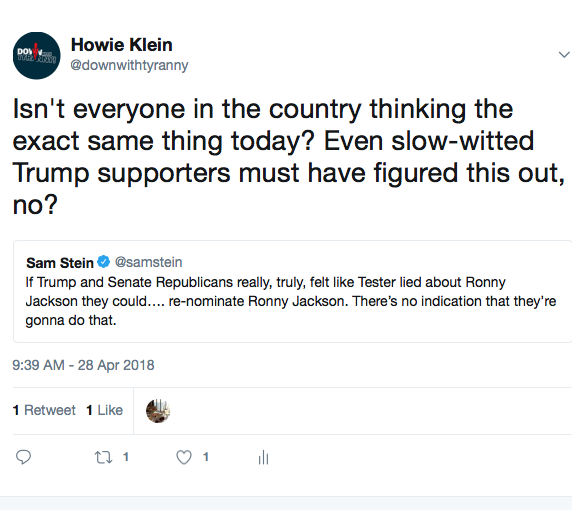
So why doesn't Trumpanzee renominate him to be head of the Veterans' Administration? Sam Stein made the same argument:


Johnny Isakson of Georgia is chairman of the veterans’ affairs committee and a pretty right wing Republican. On Saturday, while Trump was smearing Tester and demanding he resign, Isakson was voicing support for Tester. Trump won Montana 279,240 (56.2%) to 177,709% (35.7%). In 2012 Tester was barely reelected-- 236,123 (48.6%) to 218,051 (44.6%) against Republican Denny Rehberg. He originally defeated Republican incumbent Conrad Burns in 2006 even more narrowly, 198,302 votes (49%) to 195,455 (48%). Trump's goal Saturday was to fire up the Republican base in Montana so they would come out and vote against Tester in November.

In fact, right-wing groups allied with Trump have already been smearing Tester with misleading ads, like this one:


Isakson may or may not have found out that Trump was spreading his poison by tweet when his office said he didn't have a problem with how Tester had handled the Ronny Jackson affair.
“Senator Isakson has a great relationship with Senator Tester,” a spokeswoman for Isakson told CNN following Trump's tweets on Saturday. “He doesn’t have a problem with how things were handled. I don’t know for sure but highly doubt he’s seen the president’s tweets this morning.”

Tester’s staff compiled a report on the allegations against Jackson, which cited claims made by more than 20 people, including an accusation that Jackson "wrecked" a government vehicle after becoming intoxicated at a Secret Service going-away party, and a claim that he drunkenly banged on the hotel door of a female staffer during an official overseas trip during the Obama administration.
Trump, of course, is trying to imply the allegations against Jackson were made by Tester. They weren't-- and Tester made that clear at every point. They testimony against Johnson were made by men and women who worked under him and they were being investigated by the committee. "Tester, against Trump's criticism and backlash from other GOP lawmakers, has maintained that his actions are 'not political.' ...I am focused on making sure that we have the best person possible to run the VA,' he told Politico. 'It’s a very, very important agency.'"

Labels: , , , , ,

Tuesday, March 26, 2013

What's Wrong With The Confused Republican Position On Sequestration? Stockman, Bachmann, Isakson

>

Bachmann: all pearls, no meat

Monday I noticed that far right-extremist-- some would say domestic terrorist-- Steve Stockman (R-TX), who keeps changing his twitter handle as though he's trying to hide from the FBI again, tweeting away about how Obama is responsible for the Sequester's painful impact on people in his poverty stricken, backward district northeast of Houston. No one who knows squat about Stockman's virulently anti-family ideologically-driven voting record could possibly think he gives a damn about Texas special ed students or poor students-- even if he is a former vagrant who spent years sleeping under a highway underpass. And as much as he would like to spread the GOP myth that Obama owns the sequester, this is the warning the White House put out, for residents of Jasper, Vidor, Lumberton, Silsbee, Liberty and Livingston before Republican nihilists like Stockman forced it into existence:


If sequestration were to take effect, some examples of the impacts on Texas this year alone are:

• Teachers and Schools: Texas will lose approximately $67.8 million in funding for primary and secondary education, putting around 930 teacher and aide jobs at risk. In addition about 172,000 fewer students would be served and approximately280 fewer schools would receive funding.
o Education for Children with Disabilities: In addition, Texas will lose approximately $51 million in funds for about 620 teachers, aides, and staff who help children with disabilities.

• Work-Study Jobs: Around 4,720 fewer low income students in Texas would receive aid to help them finance the costs of college and around 1,450 fewer students will get work-study jobs that help them pay for college.

• Head Start: Head Start and Early Head Start services would be eliminated for approximately 4,800 children in Texas, reducing access to critical early education.

• Protections for Clean Air and Clean Water: Texas would lose about $8,467,000 in environmental funding to ensure clean water and air quality, as well as prevent pollution from pesticides and hazardous waste. In addition, Texas could lose another $2,235,000 in grants for fish and wildlife protection.

• Military Readiness: In Texas, approximately 52,000 civilian Department of Defense employees would be furloughed, reducing gross pay by around $274.8 million in total.
o Army: Base operation funding would be cut by about $233 million in Texas.
o Air Force: Funding for Air Force operations in Texas would be cut by about $27 million.
o Navy: Reduce procurement of the Joint Strike Fighter from Texas, and cancel scheduled Blue Angels shows in Corpus Christi and Fort Worth.

• Law Enforcement and Public Safety Funds for Crime Prevention and Prosecution: Texas will lose about $1,103,000 in Justice Assistance Grants that support law enforcement, prosecution and courts, crime prevention and education, corrections and community corrections, drug treatment and enforcement, and crime victim and witness initiatives.

• Job Search Assistance to Help those in Texas find Employment and Training: Texas will lose about $2,263,000 in funding for job search assistance, referral, and placement, meaning around 83,750 fewer people will get the help and skills they need to find employment.

• Child Care: Up to 2,300 disadvantaged and vulnerable children could lose access to child care, which is also essential for working parents to hold down a job.

• Vaccines for Children: In Texas around 9,730 fewer children will receive vaccines for diseases such as measles, mumps, rubella, tetanus, whooping cough, influenza, and Hepatitis B due to reduced funding for vaccinations of about $665,000.

• Public Health: Texas will lose approximately $2,402,000 in funds to help upgrade its ability to respond to public health threats including infectious diseases, natural disasters, and biological, chemical, nuclear, and radiological events. In addition, Texas will lose about $6,750,000 in grants to help prevent and treat substance abuse, resulting in around 2,800 fewer admissions to substance abuse programs. And Texas’ health departments will lose about $1,146,000 resulting in around 28,600 fewer HIV tests.

• STOP Violence Against Women Program: Texas could lose up to $543,000 in funds that provide services to victims of domestic violence, resulting in up to 2,100 fewer victims being served.

• Nutrition Assistance for Seniors: Texas would lose approximately $3,557,000 in funds that provide meals for seniors.
Not that Stockman is the only right-wing hypocrite forcing Boehner's and Cantor's sequestration down everyone's throat and trying to blame it on the Democrats.
The sequester passed on the evening of August 1, 2011. 174 Republicans and 95 Democrats voted for it. 95 Democrats also opposed it (as did 66 Republicans). Boehner, as Speaker, wasn't expected to vote. But he did. He wanted to make a point. He voted YES. So did all his top lieutenants: Majority Leader Eric Cantor, Whip Kevin McCarthy, NRCC head Pete Sessions, Party Conference Chair Jeb Hensarling, Budget chair Paul Ryan, Armed Services Committee chair Buck McKeon, Ways and Means Committee chair Dave Camp, Energy and Commerce Committee chair Fred Upton, Financial Services Committee chair Spencer Bachus, Intelligence Committee chair Mike Rogers, Foreign Affairs Committee chair Ileana Ros-Lehtinen... Boehner's entire inner circle of elite GOP leaders voted for the sequestration.

Leading the opposition were progressive Caucus leaders Raul Grijalva, Keith Ellison, Donna Edwards, Chellie Pingree, Jim McDermott, Dennis Kucinich, John Lewis, Jerry Nadler, Barney Frank, Jan Schakowsky, Xavier Becerra, Judy Chu, Ed Markey, John Yarmuth, Brad Miller, Yvette Clarke, Barbara Lee... and the Republicans who voted with them against this? Outliers like Ron Paul, Tom McClintock, Michele Bachmann, Todd Akin, Louie Gohmert, Paul Broun, Joe Walsh, Jeff Duncan, Mo Brooks, Lynn Westmoreland, Steve King, Quayle's kid, Mick Mulvaney, Justin Amash, the freaks and loons that the GOP Establishment would like to muzzle and neutralize.
Yes, Bachmann originally voted against it-- though she has since come around to a Boehner perspective. That hasn't stopped her from whining about the consequences for her own constituents. I looked again to see if she had signed the simple "end the Sequester" bill that John Conyers and Alan Grayson introduced. In fact, as I look down the list of cosponsors, the closest thing I see to a Republican on the list is California ConservaDem Juan Vargas... no actual Republicans, not even Stockman or Bachmann. Greg Sargent Monday:
Michele Bachmann has taken a fair amount of heat lately for various over the top statements about the evils of government spending, from her false claim that 70 percent of food stamp money goes to “bureaucrats” to her false claim that President Obama and his family enjoy $1.4 billion in personal “perks and excess.”

But there’s nothing like a few spending cuts in your own district to concentrate the mind. Bachmann is, understandably, upset to hear that the Federal Aviation Administration-- as part of its move to close air traffic control towers across the country due to sequestration’s spending cuts-- will be closing two towers in Bachmann’s district. And she’s suddenly making sense, putting out a statement decrying the sequester cuts and calling for a more “responsible” approach:
“I am deeply disappointed with the FAA’s decision to close the air traffic control towers at the Anoka County-Blaine Airport and St. Cloud Regional Airport. Throughout this decision-making process, I have been in touch with FAA and DOT officials urging them to focus first on eliminating waste and trimming non-essential items in the FAA’s budget before they even consider shutting down essential safety operations. Today’s decision shows a troubling lack of priorities-- closing control towers should be a last, not a first, resort.”

She added: ”While I certainly agree we need to balance our budget, it must be done in a responsible way that sets priorities, not in an arbitrary way.”
As the Star-Tribune’s headline aptly put it: “FAA tower closings bring sequester home for Bachmann.”

Now, presumably Bachmann would insist that the sequester cuts must be replaced only with other spending cuts, and no new revenues. But the point here is that, with some Republicans trying to cast the sequester as a “victory” for the GOP, not even the ardently anti-government-spending Bachmann can maintain this pretense when it comes to cuts that are hitting her district with particular force. Instead, she’s forced to distance herself from them by positioning herself as an advocate for replacing them with something more “responsible.”
Then you have ole Johnny Isakson, the right-wing Georgia senator who isn't retiring next year. He says Georgians are so happy to see Congress cutting the budget that they don't care about the impact of the Sequester. Except he's wrong. Sam Stein writes that "a survey of local news reports in Isakson's home state paints a very different picture, with Georgians in all sectors of society-- the military, education, health care and transportation-- worried about how they will grapple with the $85 billion in federal spending cuts to programs across the country."
Across the country, stories are emerging about the dramatic ripple effects of sequestration, from air traffic towers being closed to scientific research being slashed, from tuition assistance for military personnel getting suspended to Head Start programs being gutted.

The White House estimates Georgia will lose around $28.6 million in funding for primary and secondary education, meaning the jobs of 390 teachers and aides will be at risk.
This will probably come as a total surprise to Senator Isakson, the wealthiest Georgian in Congress, all of whose social acquaintances are stinking rich and unaffected by anything touched by the sequester-- unless the local airport where their private planes are kept have to shut down. No one knows exactly how much Isakson is worth-- he guards that carefully-- but his public financial statements show the reported figure somewhere between $6 million and $17.7 million-- so, in all likelihood something north of $10 million. The sequester was designed to hurt people whose net worth is considerably south of $10 million-- like in the $1,000 to $10,000 range, like many Georgians whose interests Isakson has never shown the slightest interest in.

The Republican Party of Stockman, Bachmann, Isakson and the rest have a vision for a dark dystopian future. Paul Ryan summed it up best:

Labels: , , , , ,

Wednesday, June 20, 2007

MORE ON GEORGIA... THIS TIME IT'S THE DWT PROFILE IN COWARDICE AWARD TO-- WHO ELSE?-- SAXBY CHAMBERPOT

>

Johnny Isakson helps his pal Chamberpot unloading toilet paper

Senator Chamberpot (R-GA) thought he was a big shot. He swaggered into the Georgia state Republican party convention last month and told them he was standing firmly behind Georgia Bush and his plan for immigration. The Republican activists and bigwigs booed and hissed him and scared him out of his wits. Chamberpot-- like Lindsey Graham (R-SC) who was also booed at his state's GOP convention the same week, and for the same reason-- will have to face these voters next year. In fact he has an anti-immigration quasi-Democrat, Dale Cardwell, running against him. But unlike Graham, who has been targeted for political annihilation by the extreme right of the GOP, Chamberpot (and fellow Georgia crackpot, Johnny Isakson) has told Bush he's on his own. Chamberpot and Isakson have thrown in their lot with the Know Nothing and bigoted extremist end of the Senate GOP caucus, Jeff Sessions (R-AL) and Jim DeMint (R-SC).

A close friend of Chamberpot's says he still has barely controllable loose bowels and severe headaches after facing the booing, hissing Republican conventioneers. Yesterday he and Isakson have told the anti-immigration leaders that they will vote against cloture-- the process that Reid and Bush want to use to move the debate forward. Chamberpot is trying to put lipstick on this pig but the trail of diarrhea spells out one word: "coward." Miss McConnell and Trent Lott, who are trying to round up the votes for Bush-- 22 are needed-- say they think they can do it, but DeMint, leader of the anti-immigration wing of the GOP, is laughing.

It's hard to imagine a movement on the extreme bigoted that Lott isn't part of. But, rather than a coward he's playing another of his signature public roles, that of an out and out lying sack of goat shit. And, of course a racist, a xenophobe and... just plumb out of his mind. You'll recall, of course, how loudly and aggressively Lott (R-MS) pushed for funding a hugely expensive wall to keep the undocumented workers his party tries luring to America in order to hold down labor costs, in a state of anxiety and fear. Today he belched these two little ditties out. First: "If the answer is, 'Build a fence,' I've got two goats on my place in Mississippi. There ain't no fence big enough, high enough, or strong enough you can keep those goats in that fence. Now people are at least as smart as goats, maybe not as agile."

And he soon followed that with: "One of the ways I keep those goats in the fence is I electrified it. Once they got popped a couple times, they quit trying to jump it. ...I'm not proposing an electrified goat fence, I'm just trying ... there's an analogy there." Yes, and there's a murderous fascist too.

Labels: , , ,

Friday, June 12, 2015

Patients Want Relief From Pain Without Government Interference-- Even In Red States

>

Lets all pray Sen. Isakson gets the pain relief he needs to battle Parkinson's disease

One of Georgia's two conservative Republican senators, Johnny Isakson, announced this week that he's running for reelection in 2016 and that he has been diagnosed with Parkinson's disease. Medical marijuana has proven to be a boon for people suffering from Parkinson's. I hope someone hips Isakson to the benefits. But I suspect imedical marijuana use is illegal in Georgia-- although it isn't illegal in DC, where Isakson resides.

I never thought about marijuana as a political issue-- until I went through chemotherapy recently. Marijuana helped me recover from the worst of the chemo side effects. I couldn't understand why legislators wanted to come between doctors and their patients by buying in to old and outdated propaganda nonsense about marijuana. But, generally speaking, conservatives are still opposing decriminalization of medical marijuana. Most Republicans vote NO on marijuana issues, and there are still enough backward and ignorant Democrats-- still about a dozen-- who vote with the GOP on this.

Congress has started making some headway. Recently two amendments from California congressmen-- Democrat Ted Lieu and Republican Dana Rohrabacher-- were adopted in the House. Last year, one of Rohrabacher's amendments passed both Houses and got signed into law:
None of the funds made available in this Act to the Department of Justice may be used, with respect to the States of Alabama, Alaska, Arizona, California, Colorado, Connecticut, Delaware, District of Columbia, Florida, Hawaii, Illinois, Iowa, Kentucky, Maine, Maryland, Massachusetts, Michigan, Minnesota, Mississippi, Missouri, Montana, Nevada, New Hampshire, New Jersey, New Mexico, Oregon, Rhode Island, South Carolina, Tennessee, Utah, Vermont, Washington, and Wisconsin, to prevent such States from implementing their own State laws that authorize the use, distribution, possession, or cultivation of medical marijuana.
Rohrabacher's goal is to stop government from interfering between the doctor prescribing marijuana and the patient in need of it. At the time the amendment passed Rohrabacher said, "Despite this overwhelming shift in public opinion, the federal government continues its hard line of oppression against medical marijuana." The amendment passed 219 to 189, 172 Republicans voting NO along with 17 Democrats. Among the anti-medical marijuana Democrats voting NO, 5-- all vile right-wing Blue Dogs-- were kicked out of Congress by their constituents after the vote: Barrow (GA), Gallego (TX), Matheson (UT), McIntyre (NC) and Rahall (WV). 49 Republicans joined 170 Democrats to pass the amendment.

But now the newest state talking about legalizing medical marijuana is another red one, South Dakota. It looks like a measure may be headed directly to the voters in 2016, bypassing a state legislature dominated by ignorant rightists-- 27 Republicans face 8 Democrats in the state Senate and 58 Republicans face off against 12 Dems in the state House.
The Attorney General's Office said Tuesday that an explanation for an initiated measure to legalize marijuana has been filed with the Secretary of State's Office.

Melissa Mentele, the founder of an advocacy organization that has helped two families relocate to Colorado, authored the measure. Despite past failure to legalize medical marijuana use in the state, she feels confident this latest measure will garner strong support.

"Personally I think it's a slam dunk," she said. "I think there is so much science out there that people can't dispute it."

The initiative would allow qualifying patients to get a registration card from the South Dakota Health Department that details their medical condition. Non-South Dakota residents would be allowed to use their registration cards from other states.

Patients would be allowed 3 ounces of marijuana and a minimum of six plants if cultivation is allowed. Quantities of other marijuana products would be determined by the Health Department.

Marijuana possession, use, cultivation and distribution would remain illegal under federal law.

The sponsor has 180 days to get the 13,871 signatures needed to have the measure placed on the November 2016 ballot.

...Attorney General Marty Jackley has opposed the general legalization of marijuana for safety and public health reasons. But he said marijuana can evolve into an accepted, regulated and FDA approved medical cure.

"I do hope that medicine may reach a point in which some form of marijuana or THC can safely be prescribed under a doctor's care for treatment," he said. "That would include FDA approval, prescribed by a licensed South Dakota physician, and dispensed by a licensed South Dakota Pharmacist. The FDA approval would likely give rise to a drug schedule change that would not require significant changes under South Dakota law to allow such a drug to be used legally."
A poll in the Argus Leader shows that almost 80% of those responding favor legalization.


Labels: , , ,

Saturday, November 23, 2019

Georgians Get To Vote For Two U.S. Senators Next Year

>

Trump wants to collect on his quid pro quo in Georgia

Georgia is the only state where all 2020 voters will get to pick two U.S. senators. David Perdue's term is up and there is a special election to fill the other seat because Johnny Isakson is resigning from his seat two years early. The filing deadlines are March 6 so there is still time for more candidates to get in but so far there are 8 Democrats challenging Perdue but just one who has declared for the special election, Joe Lieberman's son Matt Lieberman. We'll get to the Republicans in a moment.

4 Democrats have raised money for the Perdue race. Perdue himself has raised $8,791,345 and is spending in a big way already. The 4 Democrats raising are:
• moderate Jon Ossoff- $1,343,249
• progressive Teresa Tomlinson- $928,408
• moderate Sarah Riggs Amico- $710,770 (of which $408,400 is self-financed)
• progressive Ted Terry- $88,113
Democrats not raising money include Elaine Whigham Williams, Akhenaten Amun, Marckeith DeJesus and Harold Shouse. There are also a couple of Republicans running against Perdue but none of raised any money and the challenges are not considered serious.

The other seat has a very different dynamic since Republican Governor Brian Kemp gets to name a successor to Isakson, who then runs as an incumbent. Cameron McWhirter and Lindsay Wise, Wall Street Journal reporters, wrote that arch Trumpist, Rep. Doug Collins, is doing everything he can to get appointed to the seat-- mostly making an idiot of himself in defending Trump as ranking member on the House Judiciary Committee. Trump appreciates anyone be-clowning themselves on his behalf, so he's been pressuring Kemp to appoint Collins. Kemp doesn't want to. "In recent days," wrote McWhirter and Wise, "the president has spoken to Mr. Kemp at least twice-- once face-to-face in Atlanta and once on the phone-- urging him to pick Rep. Doug Collins (R-GA), a vocal supporter of the president in Congress… Mr. Collins, a white conservative from north Georgia, has pushed for months to get the seat that Sen. Johnny Isakson, 74 years old, is leaving at the end of the year because of health problems. But the governor is leaning toward appointing a female or minority candidate to improve the GOP’s chances in Atlanta’s burgeoning suburbs, key battlegrounds in the 2020 elections."

Georgia Republican insiders all think Kemp would prefer to appoint Kelly Loeffler, a multimillionaire financial executive who co-owns Atlanta’s WNBA franchise and has given generously to the campaigns of Georgia Republicans (and to Mitt Romney's SuperPAC, but not Trump's).


Melanie Zanon and James Arkin wrote for Politico that Trump sees Collins as "a potentially critical juror in any Senate impeachment trial soon after he helps lead the case for Trump in the House."
But even if Collins doesn’t get tapped for the Senate by Gov. Brian Kemp (R), he’s still considering launching a bid for the seat in a 2020 special election, citing his “resume supporting the president” and “being an advocate for Georgia.” And positioning himself as a top Trump defender could help bolster his campaign.

“I think people will see that I’m up here fighting for what I believe,” Collins said in an interview outside the House floor. “I’m fighting for them, and I’m fighting for an administration that I think has been treated unfairly.”

Collins, a former lawyer and pastor, has already emerged as a key Trump ally. And he’ll be the GOP’s point-man on impeachment when the Judiciary Committee takes the reins of the inquiry in the coming weeks and considers any articles of impeachment-- which could come right as Kemp announces an appointment for the Senate seat.

Trump phoned Kemp on Wednesday and pressed him to appoint Collins to the seat, according to a source familiar with the call. The conversation was first reported by the Atlanta Journal-Constitution.

TrumpWorld soon followed suit with a lobbying campaign in his favor.


Donald Trump Jr., who hosted a fundraiser for Collins in late October, tweeted that Collins is a "fighter and exactly the kind of person Republicans should want in the Senate.” Matt Schlapp, the pro-Trump chairman of the American Conservative Union, sent a letter to Kemp urging him to tap Collins.

Collins has earned plaudits in conservative circles when he led the GOP through Judiciary hearings connected to the Russia probe earlier this year.

Collins regularly slams the impeachment process as a “sham” and a “circus.” And on Thursday, he fired off a letter to Judiciary Chairman Jerry Nadler (D-NY) demanding that they obtain all evidence from the House Intelligence Committee’s underlying probe-- a preview of the fight that Collins is likely to wage, which will rely heavily on procedural weapons.

Yet Collins has also carved out a reputation on Capitol Hill as a bipartisan deal-maker, and has seemed like a reluctant warrior at times. Collins has made clear that he prefers legislating over bomb throwing, and notes he even signed his name to Nadler’s signature 9/11 health care bill a few months ago.

He says the impeachment process has been so unfair that Democrats have left him no choice but to be a fierce partisan. “I’ll play the role that I’m having to play,” Collins said. “Frankly, this committee has forced me to defend the integrity of the House, more than anything else. Because we have blatantly not followed the rules.”

“I’m willing to reach out and put my hand out, but unfortunately, many times this year, it’s gotten bit,” he added.

Collins is expected to bring a different flavor to the impeachment proceedings than Rep. Devin Nunes (R-CA), the top Republican on the House Intelligence Committee.

His colleagues describe Collins as friendly, no nonsense and high-energy-- he walks around the Capitol hallways bouncing a small rubber ball, his version of a fidget spinner. And while Collins might have a southern drawl, he speaks with the speed of an auctioneer.

“Doug was exactly the right guy to put in charge of that committee this cycle,” said Rep. Rob Woodall, a fellow Georgia Republican. “I expect [him to bring] southern gentility with a steel backbone that says, ‘I’m not gonna let us get run over.’”

If the Georgia governor does tap Collins to take over Isakson’s seat, it would hand him another key role in the impeachment saga. With the House aiming to wrap up impeachment by the end of year, Iskanson’s successor is likely to be asked to vote on whether to convict the president and remove him from office after a Senate trial.

“I don’t see how [the impeachment battle] does anything but help him… I don’t think there’s been any better defender of Trump than Doug Collins,” said Rep. Tom Cole (R-OK). “I think this strengthens his hand, if this is the direction he wants to go.”

Former Rep. Jack Kingston, who has also applied for the Senate appointment, said he had not spoken to Kemp and had been counseled not to crowd the governor on the looming decision.

Kingston said he would consider running for the seat in 2020 if he’s not appointed, but added that he would be unlikely to challenge Collins because their politics are "well aligned."

"I think Doug Collins should and definitely would consider that," he said about Collins running for the seat next year.

"I think Brian Kemp wants to make sure he has a tested, pro-Trump conservative in there,” Kingston added. “I think in terms of avoiding a primary, that's what he will need to have."

Several prominent Republicans are considered top potential picks along with Collins, including Jan Jones, the speaker pro-tempore of the Georgia state House; businesswoman Kelly Loeffler; and two members of Kemp’s administration, Robyn Crittenden and Allen Poole.

Collins’ role as an ardent Trump defender would put him in a similar position as Sen. David Perdue, the first-term Republican who is also on the ballot in 2020 and is one of Trump’s strongest backers in the chamber.

“I have the highest respect for Doug Collins. He’s a great leader in the House,” Perdue said. “He has the full right to make that decision and we’ll go forward. I know the governor is still trying to make his decision right now and so we’ll see how this plays out.”

Some Republicans have been eager for a Senate appointee with a less partisan profile to help the party regain some of their standing in the Atlanta suburbs, an area where GOP support has cratered since 2016.
Georgia Republicans love Trump but, Georgia independents, who will decide who wins the general election, are markedly less enthusiastic. In the latest Morning Consult Trump Tracker Trump's approval in Georgia is underwater-- minus 3. More ominous is that since his inauguration, Trump's approval in Georgia has ticked steadily downward and has now decreased 21 points. His influence in a Republican primary will be paramount-- but they could well backfire in the general election where his toxicity will work against any Republican but more so against a Republican he has hand-picked.


Labels: , , , ,

Tuesday, November 25, 2008

Big Changes In The Senate As The Parties Gear Up For Another GOP Drubbing In 2010

>


Yesterday we remarked how a Debbie Wasserman Schultz led cabal of conservative Democrats is already bad mouthing the prospects of the DCCC working to win more seats from Republicans in 2010. They say they want to put all their energy into the incumbent protection racket and not worry about vulnerable Republicans. Fortunately on the Senate side, there is tremendous excitement to continue retiring reactionary Republicans in order to make America a safer and more secure place. Wasserman Schultz just wants to make Florida safer and more secure for her GOP allies like Ros-Lehtinen and the notorious Diaz-Balart brothers who she protected in 2008 and plans to help to easy re-elections in 2010.

Before we get into the Senate prospects, there was a huge announcement by the DSCC today. Chuck Schumer (D-NY), the chairman for the past two cycles-- who can claim a lot of credit for helping elect quite a few Democrats ("more" if not the "better" variety)-- announced he's leaving that position. New Jersey's Robert Menendez will be taking over. Schumer was given a new #3 leadership position in the Senate, something Reid said would be impossible when it was Hillary Clinton looking for a reason to stay in the Senate.

Schumer, like his grasping and equally unscrupulous House counterpart, Rahm Emanuel, claims a lot more credit for Democratic successes than he deserves-- although he deserves a lot more than Emanuel. He made some really big mistakes-- like backing DLC hack John Morrison over populist Jon Tester in the Montana primary in 2006. Schumer, however, got behind Tester-- which is more than the pouty, petulant and pigheaded Emanuel did when grassroots candidates beat his corporate shills-- and helped him win his seat. Unfortunately, Schumer's tendency to always go for the more conservative candidate didn't always work out as well. By backing the worst and most reactionary faux Democrat from deep in the bowels of the Republican wing of Kentucky's Democratic Party, Schumer may have been pennywise and pound foolish. He saved money on the race by backing the corrupt, wealthy Lunsford-- but lost an opportunity to get rid of the hated Mitch McConnell by pitting against him a "Democrat" that many real Democrats were unable to bring themselves to vote for. Although McCain beat Obama in Kentucky 51-49%, 1,341,667 people voted for Obama. Only 846,221 of them bothered pulling the lever for the odious Lunsford (47%).

Still, most of the complaints about Schumer are from Republicans, not Democrats. They hate him and they hate the fact that since he took over the DSCC at least 13 (and as many as 15) seats have gone from red to blue. It doesn't matter to the Republican Insider establishment that many of the Democrats are conservative; they're still not Republicans, even when they vote like them.
To Republicans, Mr. Schumer has become a symbol of raw and merciless politicking and his name is often invoked when the Republicans complain of unsavory campaign tactics such as a series of television advertisements this year attacking Republican incumbents for supporting the $700 billion bailout for the financial system.

So what is Schumer leaving Menendez? Even a critic like myself, has to admit that the Lizard Man is leaving the DSCC in incredibly good shape and that Menendez has a crack team, a great balance sheet and should have every expectation of continuing to rid the country of the enemy within. Congress Daily did a first rate report yesterday on how the lay of the land is shaping up for 2010. Short version: despite what Debbie Wasserman Schultz and the nay sayers at the DCCC are preaching, it looks like another catastrophic cycle for the GOP.

It starts off with the Republicans again having to defend more seats than the Democrats, always bad news, especially when some of those seats are outside of the regions the GOP is strong in, the Old Confederacy and the backward Mormon West. Worse yet is that the NRSC will be headed by one of the least competent members of their caucus, Texas Neanderthal John Cornyn, whose good at taking graft from Big Oil and other corporate interests but not good at anything else. Listen to him give a full throated display of typical Cornynite cluelessness: "On a broad level, Republicans need to do a better job of communicating with the American people and talking about why a Republican majority would positively affect them on the issues that matter most to their families and their pocketbooks. We need to recapture the mantle of reform and offer a positive governing vision. To do that, we need to have the right resources in place, which is why fundraising and candidate recruitment are two of my top priorities in the immediate future... Senate Republicans face another uphill fight in 2010. It's going to take a lot of hard work, determination and cooperation among all Senate Republicans."

If Democrats are able to recruit top notch candidates they should be able to take out Judd Gregg (NH), Mel Martinez (FL), Jim Bunning (KY), and Arlen Specter (PA) and, if Obama and the Democrats do a good job cleaning up after Bush, Democrats will have a good shot at unseating pervert David "Diapers" Vitter (LA), George Voinovich (OH), Chuck Grassley (IA), Richard Burr (NC), Kit Bond (MO) and maybe even McCain (AZ). If Jim DeMint (SC) insists on personifying the face of extremist obstructionism there is even a chance that a decent Democrat-- if such a thing can be found for a Senate race there-- could defeat the single most right-wing member of the Senate.

Congress Daily's state by state preview

ALABAMA

If anyone in the Republican class of 2010 is considered safe, it is veteran Sen. Richard Shelby, now in his fourth term. Known for bringing money to his state as a senior member of the Appropriations Committee, Shelby seems invulnerable, but there are cracks in the solidly Republican state. While Republican presidential candidate Sen. John McCain carried the state, 61 percent to 39 percent, Democrats did pick up a GOP-held House seat this month.

Shelby, 74, has been in office since winning a state Senate seat in 1970. He moved to the House in 1978 and was elected to the Senate in 1986-- all as a conservative Democrat. He crossed the aisle in 1994 and his two wins since have been by overwhelming margins, making him a formidable opponent to any Democratic foe. No Democratic challengers have emerged; one Democrat who might make the race competitive, Rep. Artur Davis, is more likely to run for governor. One possible deterrent to other Democrats: Shelby has amassed a $13 million bankroll, according to public records. Shelby's seniority might also work in his favor. In addition to his Appropriations seat, Shelby is ranking member of the Senate Banking Committee-- a perch he has used to become an outspoken opponent of the economic bailout.

ALASKA

Sen. Lisa Murkowski might be on many endangered-incumbent lists, but she will enter the 2010 campaign with a newly elevated profile. The defeat of GOP Sen. Ted Stevens will make Murkowski the state's senior senator and her likely rise to ranking member of the Energy and Natural Resources Committee will give her a powerful seat to represent Alaska's interests. Unlike most vulnerable incumbents, Murkowski's biggest challenge might come in the GOP primary, where a challenge by Gov. Sarah Palin would make the contest the marquee race of the cycle and could either give Palin a launching pad for a 2012 presidential bid or end her political climb. Palin defeated former Sen. Frank Murkowski, the current senator's father, in a three-way 2006 primary when he ran for a second term as governor.

Other possible primary challengers for Murkowski include Lt. Gov. Sean Parnell-- who narrowly lost a primary bid to unseat GOP Rep. Don Young this year-- and state Rep. Gabrielle Ledoux. The general election might present other challenges for Murkowski, who came under intense criticism when her father was elected governor and appointed her to replace him. In a staunch GOP state, she was elected in 2004 with 49 percent of the vote against former Democratic Gov. Tony Knowles.

ARIZONA

What once might have been a Grand Canyon State free-for-all or a clash of the titans has likely devolved into that most predictable of contests, in which a veteran senator cruises to re-election. As Election Day's presidential returns rolled in with the bad news for Sen. John McCain, retirement rumors swirled around him. But McCain dispelled most of them last week when he set up a PAC as the first step toward running for a fifth term. If McCain follows through and runs, it is unlikely Republican Reps. John Shadegg or Jeff Flake, both of whom have mulled running for the Senate, would challenge the state's senior senator.

On the Democratic side, the party lost a formidable challenger when Gov. Janet Napolitano was tapped by President-elect Obama to be Homeland Security secretary. Among the state's Democratic House members, Reps. Harry Mitchell and Gabrielle Giffords are moderates who racked up impressive wins in 2006 and 2008 in swing districts. Giffords is a fundraising juggernaut who raised more than $3 million for the 2008 cycle. She is also 38 years old and can afford to wait and pick her target if she wants to run in the future.

FLORIDA

Sen. Mel Martinez is looking vulnerable in pre-election polls, even though Democrats don't have a clear-cut candidate lined up to challenge him. Although polls taken two years before an election are largely meaningless, an incumbent who polls at 36 percent -- as Martinez did in a recent Quinnipiac University survey pitting him against a generic Democrat -- is usually facing a long slog. Another factor that might work against Martinez is that President-elect Obama carried the state, 51 percent to 49 percent.

But Martinez can counter with a remarkable personal story that resonates with many Floridians. Martinez came to the United States in 1962 as a non-English-speaking 15-year-old Cuban émigré who lived in a refugee camp and with foster families until his family arrived four years later. After college and law school, Martinez was the state campaign chairman for President Bush and served as HUD secretary until narrowly winning the Senate seat in 2004, 49 percent to 48 percent over former state Education Secretary Betty Castor. Reps. Debbie Wasserman Schultz, Kendrick Meek and Allen Boyd are often mentioned as possible Democratic challengers.

GEORGIA

As a conservative Republican in a red state who won with 58 percent in 2004, Sen. Johnny Isakson is an unlikely target for Democrats. But if the Dec. 2 runoff involving GOP Sen. Saxby Chambliss and Democrat Jim Martin is an indication, Isakson could be in for an unexpectedly tough ride in two years.

Isakson remains one of the most conservative members in the Senate, with National Journal ranking him seventh in this category in 2007. While his conservative credos are similar to those of Chambliss-- ranked 15th by the magazine-- Isakson is a less caustic campaigner. Democrats will try to paint Isakson as "out of touch" with Georgians, said Martin Matheny, a spokesman for the state Democratic Party. No Democrats have emerged as serious challengers, although if Martin loses the runoff by a narrow margin he might use his better-than-expected performance and improved name recognition to try again.

IDAHO

Unseating Sen. Mike Crapo would be a tough task, regardless of the political environment in 2010. Crapo has $1.8 million in campaign cash, was unopposed in 2004, and got 70 percent in 1998 in his first Senate race. In addition, Republican presidential candidate Sen. John McCain just carried the state with 61 percent. "It will be a tough race," said Julie Fanselow, a spokeswoman for the Idaho Democratic Party, although she said she expected the party would field a challenger this time. State Democratic Party Executive Director Jim Hansen said that while no candidates have come forward, the field typically does not take shape until after the state legislative session wraps up in the spring. He said the party is optimistic because Democratic Rep.-elect Walt Minnick upset Republican Rep. Bill Sali and "overcame the stereotypes" Western Democrats get saddled with.

Hansen said the "50-state strategy" employed by Democratic National Committee Chairman Howard Dean helped identify Democratic voters and candidates for down-ballot elections, citing an increase of 53,000 votes for President-elect Obama over 2004 Democratic nominee Sen. John Kerry of Massachusetts. But the Idaho Democratic Party does not have a deep bench of state-level office holders and the state is still reliably Republican. The GOP has large majorities in the state House and Senate and controls the executive branch.

IOWA

The success of Iowa Democrats in the last two election cycles has fueled talk that the party can finally take a serious run at Sen. Charles Grassley, who will be running for a sixth term in 2010. Democrats took over both houses of the state Legislature and picked up two House seats in 2006, and President-elect Obama won the state with 54 percent of the vote this year after it narrowly went for President Bush in 2004. Democrats have held the governor's mansion since 1999, and Gov. Chet Culver will be at the top of the ticket in 2010.

A source at the Iowa Democratic Party said she would be "very surprised if there's not a high-profile challenger" to Grassley but acknowledged challenging the popular Grassley would be "daunting" to many candidates because of his high approval ratings. "Some folks do feel he's unbeatable," she said. Grassley has never faced a serious challenge for his seat, and in 2004 was re-elected with 70 percent, his highest total. Potential challengers include former two-term Gov. Tom Vilsack, Lt. Gov. Sally Pederson and Rep. Bruce Braley. The Democratic source said she expects the field to take shape next year, and said some might be waiting on Vilsack, who has been mentioned as a possible Agriculture secretary for Obama. [That rumor ended yesterday.]

KANSAS

The pending retirement of Sen. Sam Brownback raises the prospect of a bruising Republican primary fight between Reps. Jerry Moran and Todd Tiahrt. Moran has already established a committee to raise money for a Senate bid, and Tiahrt has acknowledged his interest in the seat; a spokesman called a Tiahrt candidacy "definitely a possibility." Charlotte Esau, executive director of the conservative Kansas Republican Assembly, said Moran is liked by moderates, even though he has a conservative voting record. "Tiahrt is no more conservative than Moran but for some reason isn't perceived quite the same by the moderates and is liked by conservatives," she said. Moran has a 2-1 financial advantage at this point, with $2.4 million on hand to Tiahrt's $1.2 million, according to FEC filings. Esau said the primary could hinge on how well each turns out the vote in their districts and how they fare in Kansas City's suburbs.

The Kansas GOP has had trouble uniting its conservative and moderate factions, often leading moderates to side with Democratic Gov. Kathleen Sebelius, a possible Senate candidate. But Sebelius is considered a Cabinet prospect in the Obama administration, which would take her out of a Senate race. Former Democratic Rep. Jim Slattery, who lost to GOP Sen. Pat Roberts this month, has taken himself out of the running. It has been more than 75 years since Kansas last elected a Democrat to the Senate.

KENTUCKY

Sen. Jim Bunning wasted little time after the election letting fellow Republicans know he expects their help putting together a large campaign war chest for 2010. Just four days after the 2008 election, Bunning-- who will turn 79 just prior to Election Day 2010-- told the State Central Committee he plans to soon start raising at least $10 million. His closest aides have been saying he will run with the slogan, "Do It Again in 2010." But even some of his staunchest backers say they expect Bunning to retire, given his age and the rigors of campaigning. [There have been persistent rumors that Bunning actually died 2 years ago and his senatorial duties have been handled by his staff.]

If Bunning runs, he might be reinvigorated if his long-held stance that the Federal Reserve was moving the country in the wrong direction is being shown to be prophetic, given the dismal economy. If Bunning retires, Secretary of State Trey Grayson said he is likely to run. Grayson, in his second term, is from northern Kentucky's Cincinnati suburbs-- a population center and GOP stronghold. So far, GOP Reps. Harold Rogers, Geoff Davis and Ed Whitfield have made little noise about running. Davis has an eye on a coveted seat on the House Ways and Means Committee being vacated by retiring GOP Rep. Ron Lewis. Democratic Rep. Ben Chandler might run if Bunning retires. Other Democratic prospects include Lt. Gov. Daniel Mongiardo, whom Bunning barely beat in 2004; state Attorney General Jack Conway; state Auditor Crit Luallen and businessman Bruce Lunsford, who narrowly lost this year to Senate Minority Leader McConnell.

LOUISIANA

Sen. David Vitter is expected to face a primary challenge before getting to the general election. Vitter, whose 51 percent in 2004 made him the first GOP senator in the state in 121 years, is viewed as being particularly vulnerable following revelations in 2007 that his phone number turned up in the records of a woman convicted of running a prostitution service in Washington. The allegations undercut his popularity with evangelicals who were integral to his election.

GOP sources in the state and in Washington said Louisiana Secretary of State Jay Dardenne is among the Republicans who might run in the primary. Others include state House Speaker Jim Tucker and state Sen. Mike Michot; they cannot seek re-election because of term limits. "I wouldn't put it past some of the ambitious evangelicals [to mount a challenge,]" said one senior Hill Republican with ties to the state. Former Democratic Rep. Chris John, who Vitter bested in 2004, is considered a possible general election challenger, as is Democratic Rep. Charlie Melancon. Others mentioned as potential Democratic candidates are Rep. Don Cazayoux, who lost earlier this month, and J.M. Bernhard Jr., chief executive of the Shaw Group, a Baton Rouge-based engineering and construction firm.

MISSOURI

Democrats looking for a challenger to Sen. Christopher (Kit) Bond in two years point to a statistic: 1.7 million votes, which is how many Democratic Secretary of State Robin Carnahan got while being re-elected earlier this month. That was more even than Gov.-elect Jay Nixon and prompted speculation she might take on Bond.

She is a member of one of the more prominent Democratic families in the state, as the daughter of the late Gov. Mel Carnahan and former Sen. Jean Carnahan, the sister of Rep. Russ Carnahan and the granddaughter of the late Rep. A.S.J. Carnahan. Since she will begin a new four-year term in January, Carnahan can take a free shot at Bond without losing her office. "We're all assuming it's going to be Robin Carnahan," said a state Republican Party spokeswoman. If she decides not to run, the field opens up, with state Auditor Susan Montee a possibility. Bond, who will turn 71 during the election year, is expected to shoot for a fifth term after winning election twice as governor in 1972 and 1980. He was re-elected four years ago by a decisive 56-43 percent and had $1.3 million in cash on hand at the end of September.

NEW HAMPSHIRE

Although Sen. Judd Gregg announced his intent to run in 2010 in a conference call the day after the Nov. 4 election, Democrats are not buying it. "In the end, I think he will choose to retire," said New Hampshire Democratic Chairman Raymond Buckley. He dismissed Gregg's declaration as a ploy to avoid being relegated to lame-duck status for the next two years. Buckley noted that Gregg, a former chairman of the Senate Budget Committee and a leading fiscal conservative, has not had a "real race" since 1992, when he first won election to the Senate in a close contest with Democrat John Rauh. Since then, the number of Democratic voters has grown and the party could displace the GOP as the registration leader by next year, he said.

If Gregg does run, possible Democratic challengers include Reps. Carol Shea-Porter and Paul Hodes. Also in the mix for 2010 is Katrina Swett, daughter of the late Rep. Tom Lantos, D-Calif., and the wife of former Rep. Richard Swett, D-N.H., who narrowly lost a bid to unseat former Sen. Bob Smith, R-N.H., in 1996. In a statement, Gregg said he had "nothing to add" to what he said in the conference call and said he believed it was "not constructive" to speculate about 2010 while the country was "facing extraordinary challenges."

NORTH CAROLINA

Republicans are still reeling over the loss of Sen. Elizabeth Dole, one of the nation's most recognizable politicians, and this red state going for President-elect Obama. Nevertheless, the GOP is optimistic about defending the seat of freshman Sen. Richard Burr, who as a five-term House member in 2004 defeated Erskine Bowles, former chief of staff to President Bill Clinton. Burr won his Senate seat during a triumphant Republican year in which President Bush captured 56 percent of the vote in the state. Bowles, now president of the University of North Carolina, is questionable as a repeat candidate against Burr, since he also lost to Dole in 2002.

Potential Democratic challengers include state Treasurer Richard Moore and Attorney General Roy Cooper. Moore lost a primary this year to Beverly Perdue, who went on to be elected governor this month. One or more of eight Democrats in the House might also run. Despite the Democrats' recent wins, Republican political consultant Paul Shumaker doesn't see a long-term shift. "Politics is fluid," Shumaker said, "It swings to the left. It swings to the right. It can't swing any further to the left." An adviser to Burr, Shumaker says the GOP has to connect with voters on kitchen-table issues and win over growing urban areas.

OHIO

Democrats say they have momentum going for them when Sen. George Voinovich seeks a new term in two years. That optimism is fueled by President-elect Obama's win in this swing state, the 2006 victory by Democratic Gov. Ted Strickland and a deep bench of potential candidates. The key question seems to be whether the party will choose a challenger through self-vetting or a contested primary.

"There is no question [Voinovich] will be challenged," said Hamilton County Democratic Party Chairman Tim Burke, a Cincinnati lawyer. "We will have Ted Strickland at the top of the ticket running for re-election, and he is as popular a governor as I've ever been around, so that will help the Democrat running for Senate." Burke and others have mentioned Lt. Gov. Lee Fischer as a potential Voinovich foe. State Treasurer Richard Cordray, who was elected state attorney general earlier this month, is also in the mix, though Burke believes he will instead run for re-election. Rep. Tim Ryan has been traveling the state, building his name recognition, and could emerge as a challenger. Burke said Ryan, a Roman Catholic, has been aggressively courting Catholics as the party tries to recapture their support. Other potential candidates include Reps. Dennis Kucinich, Zack Space and Betty Sutton-- and Peter Lawson Jones, a member of the board of commissioners in Cuyahoga County [Cleveland], a Democratic stronghold.

OKLAHOMA

The big question is whether Sen. Tom Coburn will run for a second term. "I'm not going to make that decision until February or March," Coburn said a week after Election Day, and he added that even the appearance of a "Coburn for Senate 2010" Web site is not conclusive. "That's something you have to do if you have any money come in," he said. Money is not something Coburn appears to be concerned about, given that he had just $69,000 in cash on hand at the end of September. But Coburn is not your average candidate. He got into the Senate race in 2004 after the field had filled out, yet won the GOP primary with 61 percent of the vote and then the general election despite being outspent by $1.1 million by former Democratic Rep. Brad Carson.

If Coburn chooses to run, Democratic Gov. Brad Henry, who will be term-limited from running again in 2010, would be the logical Democratic choice. But spokesmen for Henry ruled out a race after he won re-election in 2006. Rep. Dan Boren, the only Democrat left in the House delegation, has also ruled out a run. Oklahoma has become a solidly Republican state, with GOP presidential nominee Sen. John McCain carrying all 77 counties. Other than conservative Sen. David Boren-- Dan Boren's father-- no Democrat has won a Senate election in more than four decades.

PENNSYLVANIA

Will he or won't he? Both parties are watching closely to see if Chris Matthews, the anchor of MSNBC's "Hardball" and a former aide to the late House Speaker Thomas (Tip) O'Neill, will challenge Sen. Arlen Specter. Specter, who was first elected to the Senate in 1980, is expected to seek his sixth term despite a recurrence of cancer that required him to undergo a grueling form of treatment. Specter lost his hair, but was a constant presence in the Senate chamber and on the squash court. Matthews has long touted his Pennsylvania roots and told anyone who would listen at this year's Democratic convention that he was seriously weighing a run.

Matthews' high-visibility perch as a brash political commentator would give him instant recognition on the campaign trail, but Specter is no slouch when it comes to being known. The former Philadelphia district attorney was the lawyer for the Warren Commission who came up with the "magic bullet" theory that was used as the basis for saying that Lee Harvey Oswald, acting alone, assassinated President John Kennedy. Specter has sharp political elbows developed over a series of close races, so the race could become the cycle's marquee matchup. If Matthews doesn't run, the role of challenger could fall to Democratic Rep. Allyson Schwartz.

SOUTH CAROLINA

Outspoken conservative Sen. Jim DeMint routinely defies former President Reagan's 11th commandment: "Thou shalt not speak ill of any fellow Republican." As a freshman senator, he has not been shy about taking on fellow Republicans or party leaders. After he publicly blamed President Bush and Sen. John McCain for Republican losses, he was openly criticized by Sen. Richard Shelby, R-Ala. Still, DeMint enters the next election cycle with an edge; no Democrats have come forward yet to challenge him.

One prospective opponent is former state Democratic Party Chairman Joe Erwin. Others mentioned are state Sens. Gerald Malloy and Vince Sheehan, although party watchers say much depends on who decides to run for governor in 2010. It is not clear whether former Education Superintendent Inez Tenenbaum will run again. She lost to DeMint by 10 points in 2004. She is said to be interested in a position in the Obama administration. DeMint's views-- National Journal rated DeMint the most conservative senator for the last two years-- wears well in a state that went for McCain's presidential bid this year by 54 percent to 45 percent.

SOUTH DAKOTA

Democrats could have a tall order in knocking off Sen. John Thune, but an operative with the South Dakota Democratic Party knows how they are going to go after him in 2010. The operative acknowledged that Thune's upset of then-Minority Leader Tom Daschle in 2004 and the attacks he used to win are still "pretty fresh in people's minds." Thune attacked Daschle for being an obstructionist in the Senate who tried to stall the GOP agenda, and put his own leadership ambitions over the needs of the state. The operative said Thune's appointment as vice chairman of the Republican Conference will leave him open to attacks he used against Daschle.

The biggest name Democrats can hope to attract to the race is Rep. Stephanie Herseth Sandlin, but all indications are that she is contemplating a run for governor and the bench behind her is not very deep. "All roads lead to Pierre," for Herseth Sandlin, the operative said, noting her grandfather, Ralph Herseth, was governor, and her grandmother, Lorna Herseth, served as South Dakota's secretary of state. South Dakota's at-large seat has been a springboard for many of its senators, because the member has to run statewide every two years. Daschle, Johnson and Thune have all held the seat, and Herseth Sandlin took 68 percent of the vote in her re-election earlier this month.

UTAH

As one of the most reliably Republican states, Utah is expected to easily give GOP Sen. Robert Bennett, a fourth term. While he lacks the national profile of senior Sen. Orrin Hatch, he is popular and has had little trouble winning re-election since he won his first term with 55 percent of the vote. Few Democratic candidates are viewed as viable statewide and Republicans hold all statewide elected offices. Democratic Rep. Jim Matheson, whose father served as the state's last Democratic governor from 1976 to 1984, is seen as a possible challenger, although observers say a run for governor is more likely.

This year Republican Sen. John McCain took 63 percent of the vote in the presidential contest, while Republican Gov. Jon Huntsman won re-election with 78 percent of the vote. Matheson was first elected in 2000 and has been a Republican target. Matheson defeated his opponent by 1,641 votes in 2002, following redistricting. Since then he has increased his margin of victory, winning this year with 63 percent of the vote. Another possible Democrat is Salt Lake County Mayor Peter Corroon. Salt Lake is the state's most-populous county.

Labels: , , , ,

Friday, July 03, 2009

Health Care Reform Battle Moves To Senate Finance Committee-- Where Blanche Lincoln Needs To Make A Decision

>

UPDATE: This is the ad that got the second most votes


No doubt you've read about Blue America's Health Care Choice Campaign and later today (5pm, PT) we'll be announcing which TV ad got the most votes. It isn't too late to vote-- just click that link above and view all 3 ads and tell us which one you think will be most effective in helping persuade Conservadem Blanche Lincoln that it's time to think of the best interests of her constituents-- the working families of Arkansas-- for a change, not the CEOs at the health insurance companies that have funneled so much money into her political career. I'm in awe at the number of ads-- on everything from CNN, MSNBC, Fox and ESPN to USA, TNT, the Food Channel and Lifetime-- that will blanket the Little Rock area. I think we need more spots in Jonesboro though, so please consider adding to our little warchest.

Meanwhile, it's looking like the tiny handful of senators who actually see themselves as tribunes of the people-- Sherrod Brown, Sheldon Whitehouse, Jeff Merkley-- are allowing the sworn enemies of working families (i.e., the GOP plus the bad Democrats like Baucus, Lincoln, Lieberman, Nelson, Landrieu, all the corrupt, steaming garbage)-- are allowing themselves to be bamboozled into a weaker reform program in order to satisfy the paid off shills of the insurance companies. As Ezra Klein pointed out in the Washington Post yesterday, the new CBO score ($611 billion over the course of a decade) "is low in part because we've made some of the policy worse." We can thank corrupt shitheads like Lincoln, Baucus, Lieberman and the rest of the senators who are on the Insurance Industry payroll for that. Anyone who ever votes for any of them deserves exactly what they get from them. I mean when you have a shill like Kay Hagan now agreeing to vote for the bill, you know there's got to be something plenty wrong with it.

All 13 Democrats on the Senate Health, Education, Labor and Pensions Committee have announced they're for it. Presumably the 10 corrupt anti-family Republicans-- Mike Enzi (WY), Judd Gregg (NH), Lamar Alexander (TN), Richard Burr (Medical-Industrial Complex), Johnny Isakson (GA), John McCain (AZ), Orrin Hatch (UT), Lisa Murkowski (AK), Tom Coburn (OK) and Pat Roberts (KS)-- will all oppose it. And then there's the Insurance Industry's best friend, Max Baucus' uber-corrupt Senate Finance Committee, which has guaranteed their paymasters that they would kill whatever is beneficial in HELP's bill.

Burr, Isakson, McCain, Coburn and Murkowski all have to face the voters in 2010. Coburn's voters are as crazy and demonically-possessed as he is and there's nothing to be done with them at all. But Isakson, McCain, Burr and Murkowski should all be made to pay the price politically for sticking with the Insurance Industry CEOs and giving the collective finger to the struggling families in their states. Yesterday one of the best candidates for the Senate running anywhere, Ohio Secretary of State Jennifer Brunner, explained to Ohio voters why she is so adamant about a strong and robust public option and why she's asking all members of the Ohio congressional delegation to "fight for inclusion of a public insurance option rather than bow to pressure from the powerful insurance lobby to keep all payment for universal health care in the hands of private insurers." Brunner:  


“I strongly urge members of Congress to stand strong in favor of the more than 50 million individuals and families who now lack access to health care, because they have no health insurance of any form. Health care is a basic right, and the choice of a public or private plan ensures all have access to the type of health care they need... Consumers’ choices are dwindling as health insurance premiums soar.  Small businesses, labor unions, and companies with large numbers of retirees struggle to keep the costs of benefits level by increasing employee shares of premiums, deductibles, co-pays and decreasing covered services, especially when there are preexisting medical conditions. Millions of Americans in need of health care go without proper medical attention, even when they have health insurance.  Our current system of tying health care to a job leaves millions without health care as unemployment rises.  As these uninsured families with children apply to states for their children’s health care needs costs to taxpayers escalate.  For those who simply go without, leaving themselves completely vulnerable to catastrophic illnesses or accidents, ultimately, all others pay the price as health care costs rise."

She's running against a left-over Big Business shill from the Bush Regime, Rob Portman, someone who Cheney pointed out this week as a GOP up-and-comer. He has no position on health care whatsoever. Brunner pointed out that Cheney and Portman are exactly what has exacerbated the health care crisis in America and that the country needs to move on from their failed policies and catastrophic agenda.
Now that Dick Cheney has left office he has chosen to become vocal and to opine on issues of the day, presumably as a standard bearer for the ailing Republican Party. How can he and Rob Portman maintain their oblivion to the tragically large numbers of Americans who are suffering from their previous failure to face the deteriorating circumstances of Americans and their families because of inadequate or no health care?


In 2007, the California Nurses Association and the National Nurses Organizing Committee, which represent 80,000 members in 50 states, ran a highly publicized advertisement in support of universal health care. Its blunt message:  “If (Cheney) were anyone else he’d be dead by now.”  The advertisement pointed out that Cheney, who has survived four heart attacks and quadruple bypass surgery, benefited from government-financed health care.
 

Brunner isn't in the Senate, at least not yet. Fortunately, Jeff Merkley is-- and a member of the Senate HELP Committee. He's a big booster of the Affordable Health Care Choices Act because it includes, in his words, "a strong, nationwide public health insurance option to lower costs and greatly reduce the number of uninsured Americans." He always said that one of the reasons he took on Big Business shill Gordon Smith was to help reform the health care system. The public option, as he sees it from inside the Committee, will be offered alongside private insurance options in a “Health Insurance Gateway,” or insurance exchange.  Participation in the public option is completely voluntary, and would assure American families that they will have access to an affordable choice.  Through pooled purchasing power and lower administrative overhead than private insurers, the Community Health Insurance Option will help to lower costs and encourage insurance companies to improve their services. Merkley:
“Our health care system is broken.  Over the last nine years, costs for the average family have doubled even as insurance companies use less and less of premiums for patient care. We need to provide consumers with real choices to keep costs down and keep insurance companies honest... If you like your doctor and you like your insurance, nothing will change for you.  But if you want more options, this bill provides them, while increasing healthy competition that will reduce costs for everyone. For far too long, insurance companies have been able to set the rules, charge what they like and revoke coverage on the flimsiest of excuses. The Affordable Health Choices Act will level the playing field for consumers by providing them with more choices.”

Our campaign looks great in Little Rock, Fayetteville, Ft Smith but it can use some beefing up in Jonesboro and everything south of Pine Bluff. The good news is that counties like Little River, Drew, Hempstead, Desha, Ashley, Union, Nevada, Calhoun, Clark, Dallas and Lafayette are among the least expensive in the state to saturate. So, if you want to help us make sure we're reaching everyone... this is the place where those $5 and $10 contributions are going to do some good. And if you think this is something, we're just getting started. Believe me, Medical Industrial Complex servants like Richard Burr (R-NC), Chuck Grassley (R-IA) and Jim Bunning (R-KY), all up for re-election next year, and all violently opposed to health care reform, will not be getting off scott free.

Labels: , , , , , ,

Friday, March 20, 2009

Senate Passes Public Lands Bill-- Grand Obstructionist Party Shakes Its Fist And Spits

>

DeMint & Coburn of the Senate Pro-Pollution Caucus

For the past three days, while the rest of the country was thinking about nothing but AIG's taxpayer rip-off, the Senate has been doing almost nothing but arguing about H.R. 146, a bill that started out, innocently enough, as Rush Holt's Revolutionary War and War of 1812 Battlefield Protection Act but morphed into the Omnibus Lands bill that will protect government lands and fund water conservation.

On Monday they shut down the de facto Republican filibuster, 73-21, with only the most hard-core obstructionists joining Tom Coburn, Jim DeMint, Richard Burr and Johnny Isakson trying to make sure that we'd all die from toxic water. They've been arguing about amendments ever since but yesterday it passed 77-20, all Democrats voting yes and, again, only the worst of the reflexive obstructionists voting no, a veritable pro-pollution caucus:
Sam Brownback (R-KS)
Jim Bunning (R-KY)
Richard Burr (R-NC)
Saxby Chambliss (R-GA)
Tom Coburn (R-OK)
John Cornyn (R-TX)
Jim DeMint (R-SC)
John Ensign (R-NV)
Lindsey Graham (R-SC)
Chuck Grassley (R-IA)
Kay Bailey Hutchison (R-TX)
Jim Inhofe (R-OK)
Johnny Isakson (R-GA)
Mike Johanns (R-NE)
Jon Kyl (R-AZ)
John McCain (R-AZ)
Miss McConnell (R-KY)
Jeff Sessions (R-AL)
John Thune (R-SD)
David Diapers Vitter (R-LA)

The House has already moved on to the next step, the Water Quality Investment Act of 2009, which passed 317-101, fully 73 Republicans abandoning their anti-environmental leaders to vote with the Democrats. In case you were wondering who the some of the most anti-environmental fanatics in the House are (to go along with the list of senators above) look no further than:
Michele Bachmann (R-MN)
Spencer Bachus (R-AL)
Roy Blunt (R-MO)
Mary Bono-Mack (R-CA)
Eric Cantor (R-VA)
David Dreier (R-CA)
Elton Gallegly (R-CA)
Scott Garrett (R-NJ)
Steve King (R-IA)
Dan Lungren (R-CA)
Tom McClintock (R-CA)
Patty McHenry (R-NC)
Buck McKeon (R-CA)
Paul Ryan (R-WI)
John Shadegg (R-AZ)
Frank Wolf (R-VA)

What-- no Democrats? Nope, not even the worst of the developers' bought-and-paid-for shills with "D"s next to their names voted against this one. All the opponents were corrupt and/or sociopathic Republicans.

Labels: , ,