Tuesday, September 01, 2020

Biden Is Taking The Offensive Against A Floundering Trump

>

COVID-Kemp

Thanks to an incompetent ideologically-insane Trumpist governor, Georgia is one of the worst hit states by the pandemic. Georgia is the 8th most populous state but has the 5th most COVID cases of any state-- and the third most active cases, behind just Florida and California. Yesterday, Georgia reported 1,498 new cases, bringing the total to 270,471 cases, which comes to 25,474 cases per million residents (6th worst in the country and likely to overtake Alabama, for 5th place soon). Georgia now has had more cases than Italy, a country that was considered a disaster zone and that has around 6 times more residents than Georgia. Simple fact: Georgia has been, and still is, a text book case of how not to handle a pandemic. Republicans-- locally and nationally-- are allowing partisanship and ideology to drive decision-making, rather than science and public health concerns. Perhaps that helps explain why Trump is in trouble with independent voters in a state he won in 2016 by 5 points.

Almost all polling this summer has shown Biden and Trump within the margin of error. The most recent poll-- a PPP survey released yesterday-- shows Trump's approval underwater (52% disapproving and 46% approving) and shows Biden narrowly ahead 47-46% (within the margin of error).

Georgia has been a state where Republicans could count on winning without spending much-- and Democratic presidential candidates haven't seriously contested the state since... Jimmy Carter. This year, both Trump and Biden are spending money on advertising there. Biden has reserved ads in 9 states besides Georgia that Trump won in 2016: Arizona, Florida, Iowa, Michigan, North Carolina, Ohio, Pennsylvania, Texas and Wisconsin. Trump has ads booked in just 3 states that Hillary won in 2016-- Minnesota, Nevada and New Hampshire.

Trump is playing defense in Florida, Georgia, Arizona, Wisconsin, Iowa, Michigan, Ohio, North Carolina and Pennsylvania and is likely to start taking Texas seriously as well.

Yesterday, CNN's Chris Cillizza reported that "the number of swing states is far larger than we've seen in any recent election, a reflection of President Donald Trump's asymmetrical politics and the rapidly changing demographics in the country."
That there are 15 states that meet that bar is a remarkable testament to how wide the two sides see the potential playing field-- and how far we have come in the past two decades in terms of what can be considered a swing state. If you think back to the 2000 and 2004 elections, the group of swing states was familiar-- and small. Colorado, Florida, Iowa, New Hampshire, Ohio, Pennsylvania, and maybe one or two others. And that was pretty much it. Both sides were forced to dump tens of millions of dollars into that handful of states, not because they wanted to, but because they couldn't justify spending that money in other states in hopes of turning them.

Barack Obama broke that deadlock in 2008 with wins in Indiana, North Carolina and Virginia, states no Democrat had won at the presidential level in decades. And Trump further widened the swing-state category by notching wins in Michigan, Pennsylvania and Wisconsin, typically Democratic victories, in 2016.

What's clear from the ad reservations for this fall is that the we are now dealing with an even wider playing field. Both campaigns have reserved time in Arizona, a state long safely in the Republican column. Ditto Minnesota, a state a Republican presidential candidate hasn't won since 1972(!).

Viewed broadly, the size of the playing field -- and the states included in it-- suggest that Biden is a) playing more offense than defense and b) sees a massive Electoral College victory as a genuine possibility.

...The most fascinating part of the ad reservation is that Biden has blocked out time in Texas and Georgia, two major electoral vote treasure troves, and two states that haven't been won by a Democratic running for president since 1976 and 1992, respectively. Polling in both states shows the race close; Trump has a 3.5 point lead in the Real Clear Politics polling average in Texas and a 1.1 point average margin in Georgia.

If Biden were to win one or both of Texas and Georgia, he would have at least the possibility of a major-- 350-plus electoral votes-- Electoral College landslide. (House Speaker Nancy Pelosi has said for the better part of the last two years that Democrats must win "big" in order to avoid Trump aggressively contesting the result and refusing to concede.)

But it's more than just Electoral College calculus at work here. If Biden goes through with his plans to spend on ads in Texas and Georgia -- which is a big "if" given how expensive statewide TV buys are in both states -- he would likely force Trump's campaign to spend (and spend heavily) in those states, too. And every dollar Trump spends defending Texas or Georgia (or both) is a dollar he can't play offense with in Minnesota or Nevada or Virginia.

The widening of the electoral playing field has been happening gradually over the past three elections. But for 15 states to be in the mix this late in a presidential election cycle-- including Electoral College monsters like Texas and Georgia-- is a new chapter in modern American politics. And one that holds all sorts of possibilities-- for both parties-- in future races.
Goal ThermometerI asked how Julie Oliver how it will play out in her district. Democratic presidential candidates haven't really campaign in Texas is ages. "Texans," she told me this morning, "put our state in play, running everywhere as hard as we could in 2018-- before anyone thought it was winnable. Just everyday people, standing up, building the movement to take our state back from the corrupt ideologues who for too long have tried to keep all of us divided while they enriched themselves. And in 2020, it's time for real change.

Like Julie and all Democratic candidates in swing states, Michigan state Rep and congressional candidate Jon Hoadley is happy to see Biden taking the Democratic case to voters in his state. "It's welcome news that the Biden/Harris ticket is campaigning in Michigan," he told me this morning. "We saw what happened four years ago when people took Michigan for granted. Voters want us to not only make the case why we're better for the job than the other candidates, but why we deserve their vote at all. A strong Biden/Harris ticket in Michigan will help bolster the case we're making for change in southwest Michigan, push back against the lies being spread by secret dark money groups, and remind even more voters what's at stake in this election." Meanwhile, Hoadley is hardly waiting; yesterday he launched his own first TV ad:


Labels: , , , , , , , ,

Sunday, August 09, 2020

Which Is A Worse Trait Of Brian Kemp's-- His Authoritarian Bent Or His Incredible Stupidity? Or Is He Just A Genocidal Murderer?

>

COVID-Kemp with another idiot

On Friday, Georgia reported 4,109 new cases of COVID-19, the 4th most of any state, after much more heavily populated California, Florida and Texas. As of this afternoon, there have been 216,956 confirmed cases in the state or 20,400 cases per million residents-- worse than California or Texas and worse than any European country. There's only one reason Georgia is doing so badly: Brian Kemp and a Republican controlled legislature to back him up. Yesterday there were another 4,423 new confirmed cases reported and today another 3,169.

Kemp, one of the country's worst of the aggressively knee-jerk Trumpists, was Georgia's secretary of state when he ran for governor in 2018. He clearly lost the election and then stole it from rightful governor or Georgia, Stacey Abrams. So now he gets to kill students and teachers in a school re-opening rush that is already turning catastrophic.


Yesterday, reporting for The Atlantic, Amanda Mull penned a definitive Kemp piece, America’s Authoritarian Governor. Her point isn't just that he's a proto-fascist, but that he is also willfully stupid-- and Georgians are dying because of it. (There were 91 new deaths reported Friday, bringing the total to 4,117-- 388 deaths per million Georgians-- worse than California, Florida or Texas.) She wrote that the country has seen "as many leadership bungles in regard to the pandemic as there are states: Some failed to heed early warnings. Others refused to learn the lessons of outbreaks that came before theirs. Still others played politics instead of following science. And then there’s Georgia.
Georgia’s response to the pandemic has not been going well. It was bad from the beginning: Back in early April, weeks after other states took initial precautions, Georgia dawdled toward a shutdown while its coronavirus cases surged. Still, less than a month later, the state chose to be among the first in the nation to reopen, bringing back businesses known to accelerate the virus’s spread, such as restaurants and gyms, even though new infections had never made a significant or sustained decline. In June, the state welcomed back bars. What happened next was predictable, and was predicted: Case counts came roaring back. More people got sick and died. Many of these deaths were preventable. The state now has the sixth-highest number of coronavirus cases in the United States, behind five states with significantly larger populations.

Lots of states-- such as Florida, California, and New York-- have mishandled the pandemic since it hit in March. But when you look closely at Georgia, you see a state with a leader unique among his peers. First-term Republican Governor Brian Kemp presided over a late shutdown so short that his reopening drew a public rebuke from President Donald Trump, who has frequently opposed shutdowns altogether. Kemp’s administration has repeatedly been accused of manipulating data to downplay the severity of the outbreak. He has sparred publicly with the state’s mayors and sued to stop them from implementing safety restrictions or even speaking to the press.

To understand the course that Georgia has plotted through the pandemic, you have to understand Kemp’s failures. Those same failures, and the trajectory of the state governed by them, also represent a microcosm of America under Trump. The governor has demonstrated a willingness to defer to the president instead of his own constituents, sacrifice Georgians’ safety to snipe at his political foes, and shore up his own power at the expense of democracy. In short, Kemp is a wannabe authoritarian, and millions of Georgians have suffered as a result, with no end in sight.

Kemp has emulated strongmen since he entered state government. In 2018, as Georgia’s secretary of state, Kemp administered his own election by a thin, contested margin, despite calls to resign the office before running for governor. In his previous role, Kemp systematically purged more than 1 million voters from the state’s rolls, disproportionately disenfranchising Georgians of color. More than half a million of those voter registrations were voided in July 2017 alone, months into Kemp’s campaign for governor. Kemp’s office did not respond to a request for an interview, but in the past, he has repeatedly denied that these actions amounted to voter suppression.

In Georgia, and around the world, it has become clear that a novel virus doesn’t respond to the anti-scientific, expertise-shirking preferences of modern authoritarianism. When Kemp announced the closure of the state’s nonessential businesses on April 2, he said it was because he had learned something game-changing about the virus: that it is transmissible before an infected person develops symptoms. In reality, that had been a widely accepted belief for weeks, one that had helped encourage earlier lockdowns around the country. And unlike other states that were slow to shut down, Georgia already had a raging outbreak of nearly 5,000 identified cases. In southwest Georgia in late February, a funeral in the small, majority-Black town of Albany set off a chain of infection that sickened hundreds of people and left the local hospital system overburdened and overpaying for low-quality protective gear.

If a slow shutdown had been Kemp’s only major fumble, he’d be in broad and ideologically varied company both nationally and internationally. Instead, he has continued to double down on the state’s approach to the virus in ways that mirror not just Trump, but authoritarian leaders overseeing poorly controlled outbreaks all over the world, such as Brazil’s Jair Bolsonaro and India’s Narendra Modi. He has also taken a more hard-line stance than most of his Republican peers. GOP governors in Alabama, Mississippi, and Texas have implemented statewide mask rules in response to worsening outbreaks, and others who haven’t, such as Ron DeSantis in Florida and Doug Ducey in Arizona, have still allowed cities and counties to enforce their own local requirements. Not only has Kemp repeatedly refused to require masks in Georgia, but the state’s current pandemic emergency order was written with an explicit restriction to prevent local leaders from implementing their own mask rules.

Kemp’s administration has gone so far as to sue Atlanta Mayor Keisha Lance Bottoms over the city’s mask mandate and its plan to roll back the city’s reopening to its earliest stage, closing bars and restricting restaurants to takeout. When Bottoms fought the lawsuit, Kemp sought to stop her from speaking to the press. Other cities in the state, such as Savannah and Athens, also passed their own mandates but escaped inclusion in the lawsuit, which has pushed some to question whether the governor was trying to punish Bottoms for her support of Joe Biden. A Kemp spokesperson told the Washington Post that the lawsuit was primarily about the new restrictions on businesses in Bottoms’s order, which weren’t present in other municipalities’ mask mandates, but as the paper pointed out, masks were listed as the first issue in the complaint. “One has to ask about the political aspect of a conservative southern governor and a strong supporter of the president having a very public legal action against the Atlanta mayor, who’s been a vocal supporter of Joe Biden,” Harry Heiman, a professor at the Georgia State University School of Public Health, told me. Kemp backed down from the lawsuit last week, and Atlanta’s local mandate remains in effect.

None of Kemp’s actions has been popular among the state’s residents. According to findings released last week by the Atlanta-based market-research platform 1Q, 73 percent of Georgians surveyed believe that cities should be able to enforce their own mask mandates, and 70 percent disagree with Kemp’s refusal to institute a mandate statewide. In recent months, his overall approval rating has taken a hit. In May, Kemp was the only governor whose coronavirus response was less popular than the president’s among his own constituents. A recent poll pegged Kemp’s approval rating at 43 percent, down from more than 59 percent in January.

Kemp, like Trump, has recently started to encourage mask usage while still aggressively opposing any kind of enforceable mask rule. The problem with that approach, according to public-health experts, is that it sows confusion, making it more difficult for people to feel confident in their safety. The state’s own messaging has at times been misleading in other ways. On its Department of Public Health website, the state spent months backdating cases to a patient’s first symptoms, which meant that the most recent two weeks of the graph always looked as if the pandemic was in marked decline. The state has also released misleading graphics that it later insisted were honest errors in data rendering, such as a bar graph of case counts with the dates out of chronological order, again depicting a nonexistent downward slope.


In mid-July, two nearly identical maps of Georgia’s coronavirus outbreak began circulating on Twitter, depicting the state’s outbreaks on July 2 and July 17, over which time cases increased significantly. Both maps show only three of the state’s 159 counties shaded in red, marking the most dire spread of the disease. As case counts exploded, the state had raised the number of cases required for a county to change color. Once local media took notice, the state redesigned its map. The public health department’s website also now allows users to sort new coronavirus cases by date of diagnosis, the method used almost exclusively in other government and media visualizations of the pandemic.

Then there is the matter of reopening schools. The state’s accelerated reopening spiked cases just in time for the South’s typically early school calendar to begin, leaving educators, parents, and students to fend for themselves as Kemp urges the resumption of in-person instruction in order to protect kids from non-coronavirus threats such as malnutrition and abuse. But if Kemp’s concerns lie with the safety of the state’s children and the importance of getting them back in the classroom, why didn’t he do more to stop the spread of the virus? Why, instead, did he prioritize sending low-wage workers back to their jobs in bars, restaurants, nail salons, and gyms?

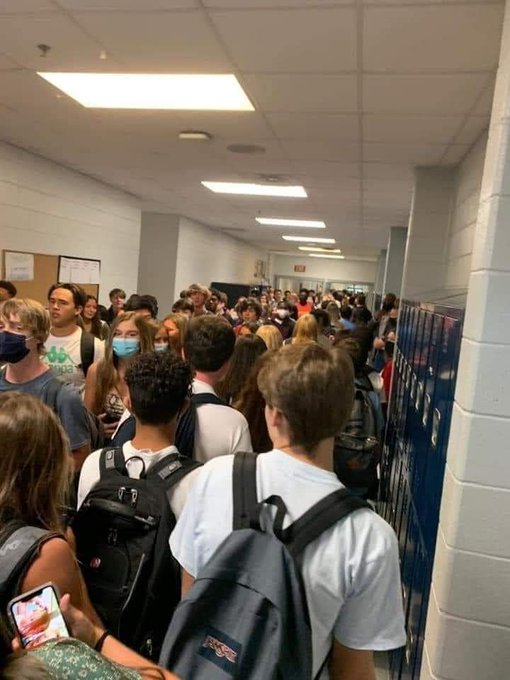
Some of Georgia’s school districts opened this week, and already the system is buckling under the weight of infection: Yesterday, we learned that the state’s outbreak had claimed its youngest victim yet, an otherwise healthy 7-year-old boy. One Cherokee County elementary-school class has already had to be quarantined after a second grader received a positive test result on the first day of school. Earlier this week, a photo from inside North Paulding High School in exurban Atlanta showed a crowded hallway with few teenagers wearing masks. An outbreak has already sickened members of the school’s football team, and students say they fear expulsion if they don’t show up. Two students were suspended for distributing photos of the school’s lax safety measures; at least one of those students has been reinstated following a public outcry over her right to free speech.

Georgia’s public universities, which are preparing for students to come back over the next couple of weeks, provide a bleak view of how the state is managing the dangers that a return to regular life presents for Georgians. For much of this summer, the University System of Georgia refused pleas from faculty and staff to require students to wear masks to class, or to allow individual colleges to make their own mask rules, before eventually relenting and requiring masks. At the University of Georgia, freshmen will still be required to live in cramped on-campus housing, much of which assigns two students to one privacy-free room, even if their classes are remote. For students who attend instruction in person, photos have begun to circulate on social media of the safety measures that await them: a small plexiglass divider loosely affixed to the front of a teacher’s classroom desk, or every other urinal in a public bathroom marked off with painter’s tape. With the majority of students yet to return, UGA already has the third-largest campus outbreak in the country, and Athens, the town where the school is located, ran out of intensive-care beds last week.

Is Paulding County ready for a Kemp-COVID outbreak?

Despite all his mistakes, it’s not too late for Kemp to wrangle the pandemic, said Heiman, the Georgia State professor. He told me that a statewide mask mandate; closing bars, gyms, and indoor dining; and clear, consistent messaging from state leadership about pandemic safety can work quickly to limit transmission of the virus, just as such measures have in New York, following that state’s catastrophic outbreak. Once transmission is low, more businesses can be safely reopened, testing supplies and personal protective equipment can be stockpiled, school buildings can be altered for better ventilation, and life can return to something closer to normalcy while Georgians wait for treatments and vaccines to come along.

In order to do that, though, Kemp would have to do something authoritarians hate: admit he was wrong, and change his mind based on evidence, the advice of experts, and the will of the people. The same is true for the country as a whole. America is a few decisions away from a much different future.

Instead, like the authoritarian he’s shown himself to be, Kemp seems intent on maintaining the disastrous course his administration has plotted so far, at the expense of the people of Georgia. “It’s truly unbelievable,” Heiman said. “It will be a case study for decades to come of what an utter collapse of political and public-health leadership looks like.”

Labels: , , , ,

Friday, July 17, 2020

I Know It Sounds Insane, But Brian Kemp Actually Wants To Kill Georgians-- And He's Getting Away With It

>


Georgia was one of the early, hard-hit states in the pandemic. But unlike other early states, Georgia is led by a right-wing ideologue, Brian Kemp, who learned nothing at all about public health and seems to care no a whit about the residents of his state. While the coronavirus is under control in New York, New Jersey, Massachusetts, Connecticut and the other early states, Georgia's pandemic is bigger than ever.

Wednesday, Georgia reported the 4th biggest one-day new cases in the country, right below Texas, Florida and California-- and worse off than Arizona! Georgia had 3,871 new cases and a ghastly 12,040 cases per million Georgians-- worse than any country in Europe. On Thursday it was 3,441 new cases, bringing the state's total to 131,275, eighth worst in the country-- and a rapidly increasing 12,364 cases per million Georgians.

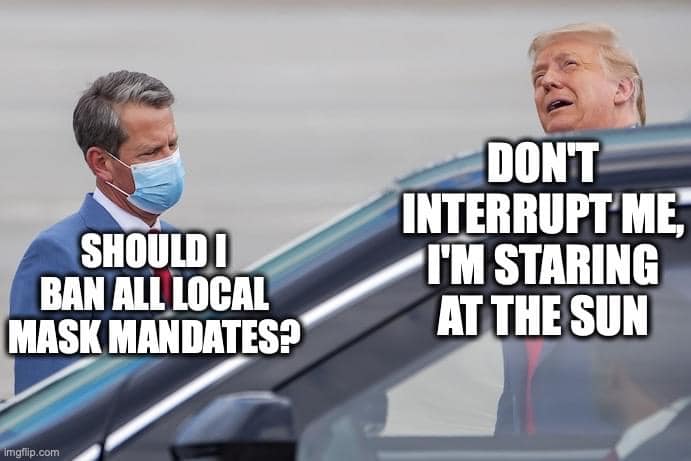
Yesterday the Atlanta Journal Constitution reported that Trump ass-licker Brian Kemp, who, as Secretary of State, stole the gubernatorial election in 2018, banned "cities and counties from adopting rules requiring masks or other face coverings, a measure that could bolster the state’s case in a possible legal battle... The governor has called such a requirement 'a bridge too far' and his office has said local mandates are unenforceable... [T]he new set of rules he signed on Wednesday specified for the first time that cities and counties can’t require the use of masks or other face coverings."

COVID-Kemp with friend

That could improve the state’s standing in a courtroom fight against a string of cities that have defied Kemp’s emergency order by requiring masks. Savannah led that charge earlier this month, and since then other cities including Atlanta, Athens and Augusta have followed suit.

...Hours before Kemp took action, his Republican counterpart in Alabama, Gov. Kay Ivey, announced a statewide mask requirement that will take effect Thursday. Meanwhile, Walmart and Sam’s Club said they would require shoppers to begin wearing masks Monday.

Also Wednesday, Gov. Andrew Cuomo announced on Twitter that New York will send 7,500 COVID-19 test kits, 30,000 pieces of personal protective equipment and 1,250 gallons of hand sanitizer to Atlanta by Friday. Atlanta Mayor Keisha Lance Bottoms, who earlier this week sought the state’s help amid a mounting feud with Kemp, said she was grateful.

...The rate of new tests that are positive for the disease is soaring, an indication that experts say suggests the spread of the disease-- and not increased testing-- is the culprit. During the week of May 24, state public health officials reported the rate of positive tests was about 6% over the course of seven days. Last week, the positivity rate was more than 13%, an Atlanta Journal-Constitution analysis of state data shows.

Even though the new wave of COVID-19 patients tends to be younger and less sick, they are filling hospital beds at a rapid clip. Hospitalizations topped Georgia's prior peak in April after the Fourth of July weekend. Shares of open critical care beds in regions surrounding Athens, Dublin, Macon, Marietta, Savannah and Tifton have dipped into the single digits. Only one was left in Dublin, according to the most recent figures available.

Disease experts at Georgia Tech and elsewhere have warned that Georgia is running out of time to prevent surges of cases that have overwhelmed hospitals in Florida, Arizona and other states that eased restrictions. This month, more than 1,400 health care workers signed an open letter calling on Kemp to shut down bars and restaurants, ban indoor gatherings of more than 25 people, mandate masks, and free local governments to institute their own rules to halt the spread of the disease.

“It’s not too late to go back to the basics: mandatory masks, more restrictions on social distancing, freeing mayors to manage their local epidemics, and vastly expanding testing and contact tracing,” Dr. Melanie Thompson, principal investigator of the AIDS Research Consortium of Atlanta, said last week. “These are basic, but we haven’t come close to mastering them yet.”

Dr. Harry J. Heiman, a clinical associate professor at Georgia State University School of Public Health, said: “In the absence of aggressive action, it’s only going to get worse.”

Seems like the worst possible time to tell local governments that they can't mandate masks


Teresa Tomlinson, former mayor of Georgia's second largest city, sees right through Kemp and his cronies "Georgia Republicans," she told me yesterday, "give a lot of lip service to local governments being the 'labortories of democracy.' They don’t believe that-- never have. Republicans want ideological enforcement at the state level. Kemp’s lawsuit against Atlanta Mayor Keisha Bottoms’ mask mandate fully demonstrates their hypocrisy. Kemp’s insistence that an individual’s freedom to wear a mask, or not, is more important than another person’s right to survive is absurd. People will die as a result of this foolishness."

Wisely, Athens and Clarke County are ignoring Kemp, the same way the Bay Area counties ignored California Gov. Gavin Newsom when the pandemic began (and are all faring much better than the counties that went along with Newsom's cowardly go-slow approach).
Athens Mayor Kelly Girtz on Thursday said that the face-covering ordinance that took effect July 9, “remains on the books.”

County commissioners unanimously approved the ordinance on July 7, and the ordinance remains in effect until Aug. 4, unless extended.

“I have been in regular communication with mayors in several other Georgia cities with mask requirements, and we wish for our local requirements to remain in place. We strongly believe this is within our authority,” Girtz said.

“On the practical matter of mask requirements, it is impossible to simultaneously want a successful economy without allowing the tools-- such as masks-- that will create the vehicle for this success. Otherwise, we risk continued shutdowns and medical crisis. Governors in Alabama, Texas and North Carolina recognize this, as do health experts from throughout the globe,” the mayor said.

According to the Girtz, the police department and county Code Enforcement Division have been told to not issue summonses during the first week of the ordinance’s roll-out, and instead “simply seek compliance” and distribute masks to people who don’t have them.

Kemp’s order that bans local governments from requiring mask wearing came as Georgia continued to see a high level of new COVID-19 infections.

Kemp was among the first governors to ease earlier restrictions, and while infections declined for weeks afterwards, they began to rise in June.

...In Athens-Clarke County there have been 1,045 confirmed cases, 74 hospitalizations and 15 deaths, according to the DPH.

According to Harvard Global Health Institute’s Covid Risk level, Athens-Clarke County is at 25.4 new daily cases per 100,000 residents, putting the county at “Covid Risk Level: RED TIPPING POINT Stay-at-home orders necessary.”

The state reports that 84 percent of available hospital critical beds are in use.

...The Athens face-covering ordinance is an attempt to slow the spread of the disease, which has shown no signs of abating. The measure requires that people cover their noses and mouths while in public.

A first and second violation or the ordinance is punishable by a $25 fine, and the third and subsequent violations are punishable by a $100 fine.


My friend Bertis Downs lives in Athens. Yesterday, he wrote that "With the reality of community spread so bad that Republican leaders in West Virginia and Alabama, not to mention Walmart and Kroger, have required masks, the one thing public health professionals say we can all do to help beat the damned virus. But not in Georgia-- nope, our governor has decided to pick that fight after all. He says local mask ordinances in 15 Georgia cities are now void. That's what he says. Maybe at some point a court will be asked to decide. If so, I wonder if Kemp will do better in his deposition that he's done before-- it has to do with working memory, or something: AJC: "By the time his deposition concluded, Kemp had answered 'I don’t recall,' 'I don’t remember,' 'I don’t know,' or some variation at least 91 times. 'To the best of my knowledge,' Kemp replied to one question, 'I don’t recall that.'" From the AP story: "The Republican governor has instead been trying to encourage voluntary mask wearing, including telling fans that reduced infections from mask-wearing would make college football season possible."

Maybe Brian Kemp needs to be impeached and removed from office before he kills even more Georgians? Oh, that's right... most members of the state legislature are as crazy, bigoted and ignorant as Kemp is.


Labels: , , , , , , ,

Thursday, May 14, 2020

Rick Bright Is Blowing The Whistle On Trumpanzee's Incompetence And Mismanagement

>


Sunday should be more than interesting at 60 Minutes, when courageous whistle-blower Rick Bright exposes what he knows about the Trump regime's mishandling on the U.S. pandemic response. There's a little CBS video teaser above that's worth watching. The pandemic numbers continue getting worse as the worst of the American governors... drumroll... meet the clownish Brian Kemp of Georgia:


... open wide. Another 579 Georgians were infected by Brian Kemp Wednesday. That brings the state's cases per million to 3,337. So what does that mean in real life? Well, the third worst pandemic-- after the U.S. (with 1,426,241 confirmed cases) and Spain (with 271,095 confirmed cases) is Russia (with 242,271 confirmed cases). But they all have different populations so it's like comparing apples with hamburgers. That's whew use the number of cases per a million people in the population. Russia has just 1,660, bad but not nearly as bad as the Open-Up states like Georgia (3,337 per million), Indiana (3,784), Tennessee (2,397), Iowa (4,212), Mississippi (3,390), Nebraska (4,691) and South Dakota 4,219. In other words, Brian Kemp (R-GA), Eric Holcolmb (R-IN), Bill Lee (R-TN), Kim Reynolds (R-IA), Tate Reeves (R-MS), Pete Ricketts (R-NE) and Kristi Noem (R-SD) are all doing a worse job that fascist murderer Vladimir Putin (R-Russia).

I hope these governors-- and their supporters-- decide to watch 60 Minutes Sunday, a must-watch for the whole nation but Bright testified before the House Energy and Commerce's health subcommittee today. Big PhRMA shill Anna Eshoo is the chair and there are no real Democratic firebrands on the subcommittee-- although people were hoping Debbie Dingell, Peter Welch, Joe Kennedy, John Sarbanes and Nanette Barragán might step up to the plate.

CNN reported, that Bright was planning on telling the committee "that the Trump administration was unprepared for the coronavirus pandemic and warn that the the US will face 'unprecedented illness and fatalities' without additional preparations. 'Our window of opportunity is closing. If we fail to develop a national coordinated response, based in science, I fear the pandemic will get far worse and be prolonged, causing unprecedented illness and fatalities... 'Without clear planning and implementation of the steps that I and other experts have outlined, 2020 will be the darkest winter in modern history.'"


Someone work up nervous this morning


Bright will reiterate that he believes he was removed from his post because he "resisted efforts to promote and enable broad access to an unproven drug, chloroquine, to the American people without transparent information on the potential health risks."

Bright is seeking to be reinstated to his position as the head of the Biomedical Advanced Research and Development Authority (BARDA) and the Office of Special Counsel, which is reviewing Bright's complaint, has determined there is reason to believe his removal was retaliatory and is recommending he be reinstated during its investigation, according to Bright's attorneys.

A Department of Health and Human Services spokesperson responded that it was "a personnel matter that is currently under review" but said it "strongly disagrees with the allegations and characterizations."

Expanding on his whistleblower complaint, Bright is expected to testify that he sought to warn his superiors about potential shortages of critical medical supplies earlier this year, but that his "urgency was dismissed" and that he "faced hostility and marginalization from HHS officials" after conveying his concerns about shortages to a senior White House official, Peter Navarro.

"As I reflect on the past few months of this outbreak, it is painfully clear that we were not as prepared as we should have been. We missed early warning signals and we forgot important pages from our pandemic playbook," Bright will testify, according to his written testimony.

In his written testimony, Bright also calls for several key steps to improve the federal government's response to the pandemic and head off a spike in cases in the fall, including increasing public education of preventative measures, ramping up production of essential medical supplies and developing a national testing strategy.

"The virus is out there, it's everywhere. We need to be able to find it, to isolate it and to stop it from infecting more people," Bright plans to say. "We need tests that are accurate, rapid, easy to use, low cost, and available to everyone who needs them."
After today's congressional testimony, Aaron Blake put together a list of 5 takeaways for Washington Post readers:
1- ‘Lives were lost’ because of ‘inaction,' unheeded warnings

Bright said that early inaction by the government-- particularly in the Department of Health and Human Services-- had, in fact, cost lives.

“That inaction has put a lot of lives at risk in our front-line health-care workers” Bright said.

Bright has said that he pushed for ramping up production of medical equipment such as masks, but that it went unheeded for months after he was informed that officials didn’t think there was a “critical shortage” of masks.

“I pushed that forward to the highest levels I could in HHS and got no response,” Bright said. “From that moment, I knew that we were going to have a crisis for our health-care workers because we were not taking action. We were already behind the ball. That was our last window of opportunity to turn on that production to save the lives of those health-care workers, and we didn’t act."

Bright added that even today, the country is dealing with the consequences of that early negligence and that health-care workers are still more at risk than they should be.

“Lives were endangered, and I believe lives were lost,” Bright said. “And not only that: We were forced to procure these supplies from other countries without the right quality standards. So even our doctors and nurses in the hospitals today are wearing N95-marked masks from other countries that are not providing the sufficient protection that a U.S.-standard N95 mask would provide them. Some of those masks are only 30 percent effective. Therefore, nurses are rushing in the hospitals thinking they’re protected, and they’re not.”

2- Administration pushed vastly expanded use of unproven drugs

One of Bright’s key claims is that he was moved to another post after raising objections to the administration pushing the use of the malaria drugs chloroquine and hydroxychloroquine to treat coronavirus.

The administration allowed for the emergency use of the drugs to treat the virus, though later studies-- which have yet to be peer-reviewed and were not randomized-- suggest that the use of the drugs don’t help and can, in fact, have negative consequences. The FDA has now warned about the dangers of using the drugs...

3- Pessimism about 12- to 18-month timeline for vaccine

President Trump has been effusively optimistic about not just treatments such as the chloroquines but about the timeline for a vaccine for the virus.

Shortly before Bright’s testimony Thursday, Trump even said, “I think we’re going to have a vaccine by the end of the year.”

That’s even more optimistic than the 12- to 18-month timeline that medical experts such as Anthony S. Fauci, head of the National Institute of Allergy and Infectious Diseases, have said is realistic for the vaccine. But Bright said that even a year to year-and-a-half timeline might also be overly optimistic.

“I still think 12 to 18 months is an aggressive schedule, and I think it’s going to take longer than that to do so,” Bright said.

4- We don’t have ‘a single point of leadership’ or ‘master plan’

As Trump increasingly criticized Fauci, Bright said the government needs to have more regard for it scientists-- and a more consistent message from the top.

He said that right now the response has been hampered by not having a “single point of leadership.”

“We need to install and empower leadership, and we need to unleash the voices of the scientists in our public health system in the United States so they can be heard and their guidances need to be listened to,” Bright said. “And we need to be able to convey that information to the American public so they have the truth about the real risk and dire consequences of this virus.

He added: "And we don’t have a single point of leadership right now for this response, and we don’t have a master plan for this response. So those two things are absolutely critical.”

Fauci has said in recent days that states that move forward with reopening their economies before meeting the guidelines from the Centers for Disease Control and Prevention are risking new outbreaks-- which could set back the entire response.

5- Azar, Republicans cast Bright as a malcontent skipping work

As Bright offered one of the most significant rebukes of the federal coronavirus response to date, Republicans on the committee and members of the Trump administration sought to undercut his testimony and character. Health and Human Services Secretary Alex Azar, in particular, had strong words for Bright.

“Everything he is complaining about was achieved,” Azar said while standing next to Trump on the White House lawn. “Everything he talked about was done. He says he talked about the need for respirators; we procured respirators under the president’s direction.”


Labels: , , , , ,

Friday, May 01, 2020

Donald J. Trump, Bringer Of Death And Destruction

>


The Dakotas are Trump country. Both states are red hellholes-- 2 right-wing Republican senators each, one at-large right-wing House member each, and each has a crackpot Trumpist governor and a sociopathic state legislature controlled by the GOP. In 2016, North Dakota gave Trump a 216,133 (64.1%) to 93,526 (27.8%) landslide over Hillary. He won 51 of North Dakota's 53 counties. The two he lost, Sioux and Rolette counties are around 80% Native American. The 2016 picture in South Dakota wasn't much different. Trump beat Hillary 227,701 (61.5%) to 117,442 (31.7%). He won all but 5 of the state's 66 counties.

The biggest county in South Dakota, Minnehaha-- the closest thing to an urban center in the state-- went to Trump by a smaller margin, 53.7% to 39.1%. Today Minnehaha County is one of the worst hit COVID-county hotspots in America. Murderess Kristi Noem, playing at being governor, seemed determined to show how ideologically pure she was by refusing to recognize the coronavirus. As of Monday, the state had 2,245 confirmed cases with 150 in the hospital. 11 had died from COVID-19. Two days later there were 6 more dead and the case load had risen to 2,449. There were 2,834 cases per million, worse than France, Britain, Sweden, Germany, Canada... More than 80% of the state's cases have been tied to a local outbreak at the Smithfield pork processing plant in Sioux Falls (Minnehaha County)-- 1,880 positive tests and six deaths.

Monday North Dakota was reporting 991 cases (79 in hospital) and 19 deaths. That's 1,373 cases per million. Gov. Doug Burgum isn't considered quite as insane as Noem, but the difference is barely detectable. Yesterday the case load had risen to 1,067-- and 1,419 cases per million.

Neither of the Dakotas will be contested in November. It doesn't matter how many Dakotans become infected or die. Those are both Trump states. Yes, his job approval has waned-- but not nearly as much in most red states. According to the Morning Consult Trump Tracker, Trump's net approval since his inauguration had decreased by 14 points in North Dakota and by 11 points in South Dakota. As of February 20th, 53% approved and 44% disapproved in North Dakota and 54% approved with 44% disapproving in South Dakota. Democrats have no viable candidates for any statewide office and a pointless state Democratic Party that has long since given up the ghost in all but name.

It's not as dire in other states Trump won in 2016. Trump is a distinct underdog in Pennsylvania, Michigan and Wisconsin. And he is fighting for survival in states he never imagined would be up for grabs in November. Here's the net approval for 10 battleground states-- listed by the number of COVID-19 cases per million:
Michigan- 4,057 per million-- Net approval- minus 10
Pennsylvania- 3,586 per million-- Net approval- minus 1
Georgia- 2,528 per million-- Net approval- +2
Iowa- 2,281 per million-- Net approval- minus 5
Florida- 1,636 per million-- Net approval- +3
Ohio- 1,486 per million-- Net approval- even
Wisconsin- 1,186 per million-- Net approval- minus 10
Arizona- 1,101 per million-- Net approval- +1
North Carolina- 1,035 per million-- Net approval- +4
Texas- 1,007 per million-- Net approval- +7
Those approval ratings, were before the pandemic struck. Local polls show Trump's approval ratings have sunk in every swing state since then-- even Texas, where the crackpot Trumpist governor has virtually removed effective social distancing rules just as the pandemic is seriously getting started. Trump's approval in Texas is now underwater-- 46% approving and 49% disapproving. A Fox News poll of Florida voters last week shows Trump's unfavorables at 49% with his favorables at 48%. The most recent Arizona poll looks absolutely catastrophic for Trump:


Yesterday, Washington Post reporter Toluse Olorunnipa seemed to indicate that the only positive strategy Trump has left is to use his signature lies to persuade voters they are not worse off but better off-- or soon will be. "Before the coronavirus pandemic ravaged the country," he wrote, "President Trump’s campaign had a simple, economy-focused reelection pitch: 'Keep America Great.' Now, with the economy in free-fall less than six months before voters cast their ballots and daily life disrupted, Trump is trying a new tact: making bold new promises about a swift economic rebound that experts and even members of his own party say are unrealistic." Are Trump's supporters that simpleminded? Is the average IQ of a Trump voter significantly below 85? Well... There were substantial reporters of Trump supporters drinking bleach and other disinfectants in the last week or two-- Trump voters in New York City, in Maryland and especially in red states like Kansas and Georgia.
The president and his allies have embraced optimism as a central part of his new reelection push, offering a rosy message about a swift return to normal life despite the rising death toll and jobless claims resulting from the outbreak.

Vice President Pence predicted the virus’s impact will be largely over by Memorial Day. Much of the country will be back to normal by June, Jared Kushner, Trump’s son-in-law and a key campaign and White House adviser, told Fox News on Wednesday.

“The hope is that by July, the country’s really rocking again,” Kushner said.

For his part, Trump has already declared that the economy has begun a “comeback,” predicting “phenomenal” growth in the fourth quarter and arguing that he will quickly reconstruct what he describes as history’s “greatest

economy.” It’s a high-risk strategy that will require Trump to evade the political ramifications of a health crisis and a steep recession with the same sense of invulnerability that has kept his presidency afloat through numerous other controversies. As economists and health experts warn that this crisis is likely to linger longer and have a more severe impact than anything in recent memory, Trump is essentially risking his reelection on proving them wrong.

“The economists said a lot of things before Trump got elected-- and he proved all of them wrong,” said Bryan Lanza, who advised Trump’s 2016 campaign and transition. “The good news is that President Trump doesn’t give a rip about what economists think.”

But economists from his own party and within his own administration are offering sober assessments that are at odds with the lofty projections from Trump and his top aides about a year-end resurgence. On Wednesday, the Commerce Department reported that the U.S. economy contracted at a 4.8 percent pace from January through March, and Federal Reserve Chair Jerome H. Powell indicated that the second quarter would see even steeper declines.

Even some Trump allies agree that more economic pain is ahead.

“I don’t see a quick recovery,” said Stephen Moore, a conservative writer and activist who advised Trump’s 2016 campaign. “I think it’s going to take longer than most people seem to think it will.”

Moore, who serves on the White House council to reopen the country, added that it was “perfectly appropriate” for the president to put forward an optimistic message, and said voters would be willing to back him if the economy has emerged from the deep recession and things are trending in the right direction by November.

Trump’s willingness to personalize the economy-- and the broader pandemic response-- has opened him up to criticism from Democrats, who are more than willing to draw a link between the president’s performance and the country’s struggles.

“As Trump downplayed the threat of the coronavirus, his White House was caught flat-footed by the economic fallout that resulted from his complete mismanagement of this crisis,” Democratic National Committee spokesman Daniel Wessel said Wednesday.

The White House has increasingly formed the backdrop for the president’s positive messaging campaign. In recent days, Trump has reconfigured his daily appearances at the White House to focus more on the economy than the ongoing health crisis that has killed more than 60,000 Americans and continues apace. He has hosted dozens of CEOs and small business owners, holding celebratory news conferences to tout the federal aid that has been distributed so far.

As Trump has shifted his focus toward reopening the economy, the health experts on the White House’s coronavirus task force have taken on a less prominent public role, even as their warnings about a lingering crisis have become more direct.

Dr. Deborah Birx, the task force’s coordinator, predicted Sunday that social distancing will continue for months, undercutting more optimistic messaging from Trump and his allies.

“Social distancing will be with us through the summer to really ensure that we protect one another,” she said Sunday on NBC’s Meet the Press.
Trump counts on them to not pay any attention to the mass media, which he has worked hard to discredit from the moment he occupied the White House. It's always what fascists and authoritarians do. Matt Kiser's report yesterday would be devastating to Trump if Trump supporters read it and understood it. Top points:
U.S. GDP contradicted 4.8% in the first quarter-- the first negative reading since the first quarter of 2014 and the worst result on record since the Great Recession of 2009. Economists say the first quarter is a precursor to a far grimmer report to come on the April-June period, with business shutdowns and layoffs striking with devastating force. The Congressional Budget Office has estimated that economic activity will plunge this quarter at a 40% annual rate.
Trump said existing coronavirus social distancing guidelines-- set to expire with the end of April-- will not be extended further. The administration said the existing social distancing recommendations will “be fading out, because now the governors are doing it.”
Millions of municipal workers could find themselves out of a job or without pay as cities and states face an urgent financial crisis, according to a new estimate from the National League of Cities. The reductions in staffing could affect education, sanitation, safety and health, and more.
Several states warned residents who are called back to work that they may be cut off from unemployment benefits if they refuse to return because they don’t feel safe. Concern about exposure to coronavirus is typically not a sufficient enough reason to stay home and continue collecting benefits, according to a recent guidance from the US Department of Labor.
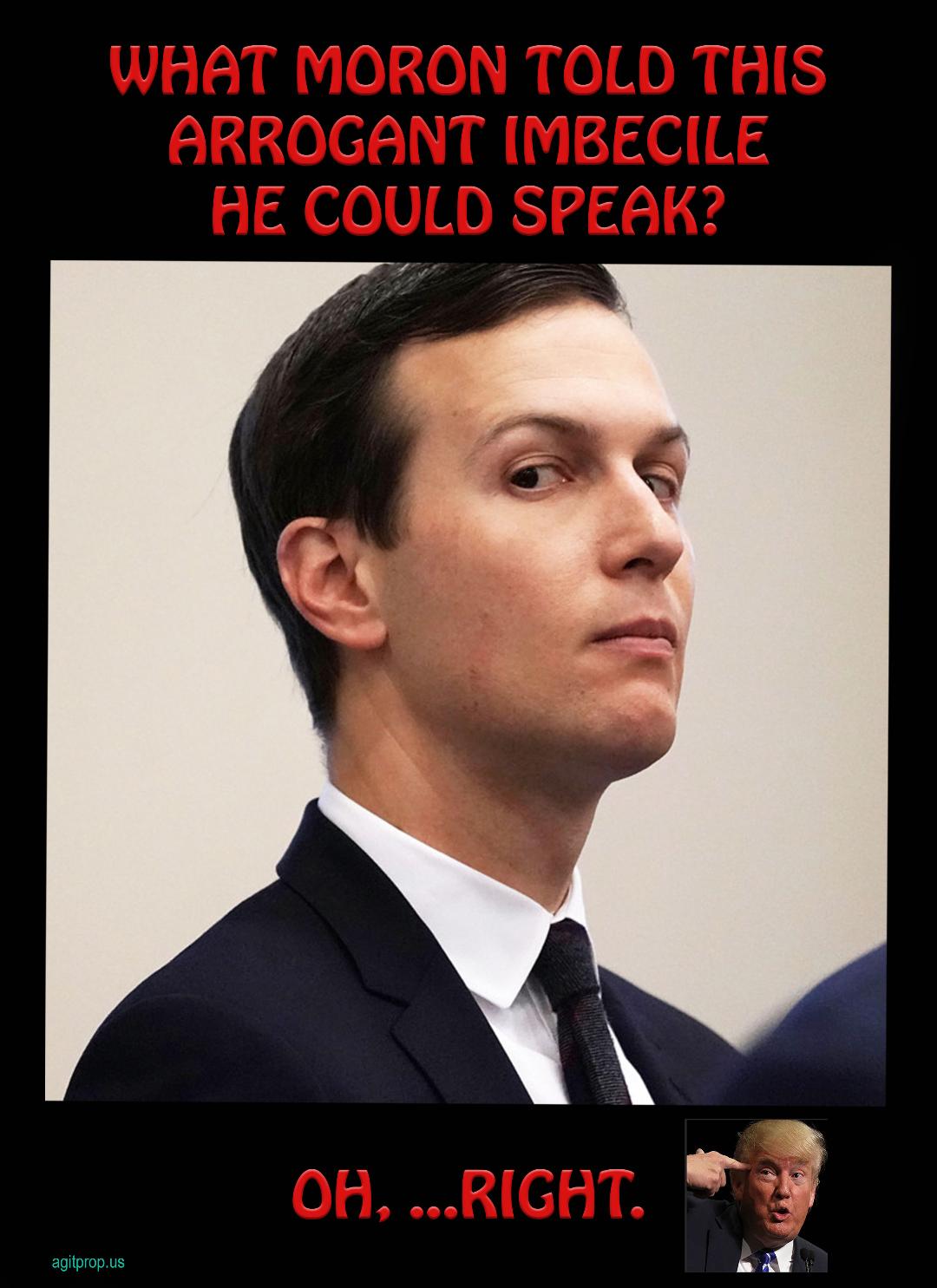
Jared Kushner called the coronavirus crisis “a great success story” as the U.S. death toll crossed 60,000, with more than one million COVID-19 cases confirmed. “We’re on the other side of the medical aspect of this,” Kushner claimed in an interview with Fox News without citing evidence. “We’ve achieved all the different milestones that are needed. The federal government rose to the challenge.” Kushner also promised that that much of the country could be “back to normal” by June and for the nation to be “really rocking again” by July. [Editor’s note: Jared Kushner is a shithead.]

Moron by Chip Proser


Dr. Anthony Fauci warned that a second round of the coronavirus is “inevitable.” He added that “we have put into place all of the countermeasures” to address the pandemic, but “If we don’t do that successfully, we could be in for a bad fall and a bad winter.” If states begin lifting restrictions too early, Fauci said the country could see a rebound of the virus that would “get us right back in the same boat that we were a few weeks ago.”
Trump-- providing no evidence-- promised that the U.S. will be able to carry out more than five million coronavirus tests per day “very soon” after a Harvard University study said the U.S. needed to be capable of carrying out at least 5 million tests a day by early June-- and 20 million per day by late July-- in order to safely reopen the economy. He later claimed that he never said that, blaming it on a “media trap.” Since the beginning of the year, however, the Trump administration has conducted 5.7 million tests in total. And, the largest number of tests conducted by the U.S. in a single day was 314,182. Trump didn’t offer how his administration was going to account for the 1,500% increase in testing, but assured those at the briefing: “If you look at the numbers, it could be that we’re getting very close,” adding “I don’t know that all of that’s even necessary.” Trump also credited expanded testing for the 1 million confirmed cases of coronavirus that the U.S. has reported, saying “It’s a number that in one way sounds bad but in another is an indication our testing is more superior.” On March 6, Trump said that anyone who wanted a coronavirus test could get one. Dr. Fauci, however, said Tuesday that “Hopefully, we should see that as we get towards the end of May, the beginning of June.”
85% of Americans said it was a bad idea to have students return to schools without adequate testing, a vaccine or medications to treat coronavirus. Americans also said it was a bad idea to have people return to work (65%), allow large groups of people to attend sporting events (91%), and reopen restaurants (80%).
MAGA by Chip Proser


Amanda Mull had a smart way of explaining the rush to reopen businesses before health concerns warrant it: an experiment in human sacrifice. Georgia's extreme right-wing Trumpist governor, Brian Kemp, seems to want to be the first to open up, despite the disaster his orders are causing. Yesterday saw 246 new cases in Georgia, bringing the total to 25,897 (2,515 per million) and over 1,100 deaths. "For weeks," wrote Mull, "Americans have watched the coronavirus sweep from city to city, overwhelming hospitals, traumatizing health-care workers, and leaving tens of thousands of bodies in makeshift morgues. Georgia has been hit particularly hard by the pandemic, and the state’s testing efforts have provided an incomplete look at how far the virus continues to spread. That testing capacity-- which public-health leaders consider necessary for safely ending lockdowns-- has lagged behind the nation’s for much of the past two months. Kemp’s move to reopen was condemned by scientists, high-ranking Republicans from his own state, and Atlanta Mayor Keisha Lance Bottoms; it even drew a public rebuke from President Donald Trump, who had reportedly approved the measures before distancing himself from the governor amid the backlash... By acting with particular haste in what he calls a crucial move to restore economic stability, Kemp has positioned Georgia at the center of a national fight over whether to stay the course with social distancing or try to return to some semblance of normalcy... Georgia’s brash reopening puts much of the state’s working class in an impossible bind: risk death at work, or risk ruining yourself financially at home. In the grips of a pandemic, the approach is a morbid experiment in just how far states can push their people. Georgians are now the largely unwilling canaries in an invisible coal mine, sent to find out just how many individuals need to lose their job or their life for a state to work through a plague."


Labels: , , , , , ,

Thursday, April 23, 2020

Trading Away Lives For Economic Well-Being... But Whose Lives?

>

MAGA by Chip Proser

Many people woke up this morning and read Peter Bakers' NY Times column, The Cold Calculations America’s Leaders Will Have to Make Before Reopening in the context of Georgia's crackpot governor's decision to start reopening mostly businesses catering to and operated by minorities. First the numbers: Georgia's confirmed case-load increased by 846 from Tuesday to Wednesday to bring the state's total to 21,512. Georgia is now over 2,000 cases per million people. That's bad and has been getting worse everyday. And that's a manifestation of a steepening curve, not a flattening curve. "How many deaths," asked Baker, "are acceptable to reopen the country before the coronavirus is completely eradicated? 'One is too many,' President Trump insists, a politically safe formulation that any leader would instinctively articulate." Kemp might add that 'one white death is too many but let's see what opening up does in black communities because, who cares.'"

The politically safe formulation made by Trump is unrelated to his reopen-soon approach. "Nor for that matter will it be the bottom line for even those governors who want to go slower. Until there is a vaccine or a cure for the coronavirus, the macabre truth is that any plan to begin restoring public life invariably means trading away some lives. The question is how far will leaders go to keep it to a minimum. Some of the more provocative voices on the political right say that with tens of millions of Americans out of work and businesses collapsing, some people must be sacrificed for the greater good of restoring the economy quickly. To many, that sounds unthinkable, but less inflammatory experts and policymakers also acknowledge that there are enormous costs to keeping so much of the work force idle, with many of the unemployed struggling to pay for food, shelter or medical care for other health challenges."

Kemp was the first to act-- and Trump both praised him on a private call to America's most racist governor while castigating him-- wink, wink-- publicly.


Baker went on that "the nation’s leaders are left with the excruciating dilemma of figuring out how to balance life and livelihood on a scale unseen in generations. 'Every governor in the nation is asking that,' Gov. Gretchen Whitmer of Michigan, where 2,700 have died and more than 1 million have lost jobs, said this week. 'There’s no such thing as zero risk in the world in which we’re living. But we know that not taking measures to control the spread means that’s going to translate into lives lost.'" Kemp-- opening barber shops, hair and nails salons first-- sees it as an opportunity for a mini-genocide... or at least some ethnic cleansing of voters who opposed him politically.
With no cure available for the coronavirus and no vaccine likely for another year or more, governors in hard-hit states are seeking ways to minimize the number of additional deaths by staging and structuring any reopening. Time and testing are key, according to public health experts. The longer a quarantine can be extended the better, they say, and the more testing made available, the easier it would be to properly calibrate a reopening and respond to any new outbreak.

Pushing to restore business sooner rather than later, Mr. Trump has dismissed waiting until comprehensive testing provides a better map of where the infection has spread. Instead, the federal government’s guidelines envision “sentinel surveillance” testing of vulnerable places like nursing homes and inner-city health centers, while gradually reopening businesses, schools and other venues in stages with precautions like masks, gloves and social distancing.

All of which could mitigate future infections but would not halt them. The reason the death toll projection may be closer to 60,000 rather than the 2 million of one estimate was because society largely shut down. One recent study said that the 60,000 deaths would have been 6,000 had quarantine measures been imposed just two weeks earlier. So easing measures means the death toll will go up even with safeguards.

But remaining closed is not without a cost either. In just four weeks, a staggering 22 million Americans have lost their jobs, the equivalent of the entire labor force of 23 states.

The question divides not only the nation but even families. Rahm Emanuel, the former mayor of Chicago and White House chief of staff, and his brother, Dr. Ezekiel J. Emanuel, a prominent medical ethicist and vice provost of global initiatives at the University of Pennsylvania, have engaged in a running quarrel about how soon society should reopen.

Rahm Emanuel considers it untenable to keep most of the country closed until the virus is completely under control, while Ezekiel Emanuel maintains that the pandemic is too much of a threat to rush back to life as usual.

...The trade-offs have stirred angry exchanges since the start of the lockdowns. Lt. Gov. Dan Patrick of Texas, who is 70, said last month that older people like himself should be ready to risk death to save the economy for their grandchildren, comments he defended on Fox News on Monday night. In a separate appearance on Fox last week, Dr. Mehmet Oz, the television host, cited a study to argue that reopening schools “may only cost us 2 to 3 percent in terms of total mortality,” calling it “a trade-off some folks would consider.” After a backlash, he said he “misspoke” and expressed regret that he “confused and upset people.”


...Government makes money-versus-lives trade-offs all the time. When a regulatory agency weighs a new safety rule, it measures the cost to industry or consumers against the gain by assigning a dollar value to each life that might be saved. If a new rule costs billions of dollars but would only prevent a few dozen deaths, it likely would not be adopted-- even though someone would die as a result.

The idea that the government translates life to dollars and cents may sound bloodless but it is not unusual. A White House report from 2017, for instance, estimated the cost of 41,000 deaths attributed to opioid overdoses in 2015 at $431.7 billion, an average of $10.5 million per person.

By that calculation, the 60,000 deaths projected from the coronavirus would be valued at $631.8 billion-- while the roughly 2 million lives theoretically saved by lockdowns would be worth about $21 trillion, or nearly eight times the $2.7 trillion in relief spending brokered by Congress and Treasury Secretary Steven Mnuchin.

But James H. Stock, a Harvard economist who served on President Barack Obama’s Council of Economic Advisers, said this crisis goes beyond such ordinary calculations because a shuttered economy represents an almost existential threat to the very idea of America.

“We really have to be talking not just about our reduction in consumption in the short run but what this is going to be doing to the economy and the republic in the long run,” he said. “It’s those big issues that we’ve been afraid to talk about. A year of this and we would just see an unrecognizable transformation of what America would look like coming out of it.”

Stephen Moore, a conservative economist who serves on Mr. Trump’s reopening committee, said those advocating restarting the economy are caricatured as putting profits over lives.

“I reject this idea that the people who are for keeping the economy shut down are the angels because they’re the ones who care about human life,” said Mr. Moore, who has coordinated with lockdown protesters. “What about the poverty? What about the suicides? What about the child abuse cases and the alcoholism and the drug overdoses and the depression and all of the negative effects to health and well-being that are associated with an economy in recession?”

Studies show that depression, drug use and suicides spike during economic hardship, including after the last recession, and the all-consuming focus of the medical system on the coronavirus in certain areas has delayed other medical care. Yet that might be offset by falling violent crime, car crashes, workplace accidents and air pollution. Vehicle collisions in California decreased by half after its stay-at-home order went into effect while murder and air pollution are each down 25 percent in New York City.

Some scholars argue that reopening too quickly would actually hurt the economy, particularly if it resulted in a second wave that destroyed public confidence. A study of the 1918 influenza pandemic found that cities that closed schools and banned public gatherings earlier and kept them shut longer not only had fewer deaths but emerged better economically.

Governor Murphy said resuming public life would not succeed if people did not feel certain that the virus had been contained. Indeed, 76 percent of Americans said social distancing should continue as long as needed to curb the virus even if it meant continued damage to the economy, according to a new poll by Politico and Morning Consult, while just 14 percent favored an end to restrictions to stimulate the economy even if it meant spreading the virus.

“If you opened every restaurant in New Jersey tomorrow, I don’t think anybody would show up,” Governor Murphy said. “It’s not like we’re holding back some pent-up demand. I don’t blame them-- there are folks out there who are frustrated, who have cabin fever, who want to break free. So do I, by the way. But I think folks also want to have confidence that they’re not going to get sick and die.”


We'll see what happens on Monday, when Georgia does open up restaurants, "even as many public health experts warn that the approach could trigger a new outbreak. Trump’s top health advisers have repeatedly criticized Kemp’s strategy. Fauci-- who didn't address the racist nature of Kemp's moves: "There is a danger of a rebound. Going ahead and leapfrogging into phases where you should not be, I would advise him, as a health official and a physician, not to do that."
Georgia Democrats, who strongly opposed Kemp’s pandemic policies, quickly highlighted the rift between the president and the governor.


“You know it’s a serious failure when Donald Trump, whose failed leadership is responsible for how badly this crisis is hitting America, distances himself from his crony Brian Kemp, who is endlessly determined to make this crisis as painful as possible for Georgians,” said Nikema Williams, chairwoman of the state Democratic Party.

...The governor has come under increasing pressure from local leaders, particularly in dense urban areas, who are upset that his statewide order barred them from enacting more severe restrictions.

“We need to, as government leaders, step up and give people an incentive to stay home,” said Atlanta Mayor Keisha Lance Bottoms. “But there’s nothing essential about going to a bowling alley in the middle of a pandemic.”

The governor also faced criticism from members of the state coronavirus task force he formed to help guide his response strategy who are upset they were left in the dark by his decision to roll back restrictions.

  Kemp defended his policy on a conference call Wednesday with U.S. Sen. Kelly Loeffler, one of his top allies, saying that efforts to contain the coronavirus were paying off.

  “I know this is a different world. But we have to continue living in it for a few more weeks, or possibly just a few more months,” he said. “There are a lot of people financially hurting, and we’ve got to do our best to help them out.”

It was a surprising turnaround for the president. A day earlier, Trump expressed confidence in Kemp’s response even as federal health officials took a different tack.

Dr. Deborah Birx, the federal coronavirus response coordinator, seemed to endorse calls by local Georgia officials who have urged residents to stay home despite Kemp’s directive.

  “I believe people in Atlanta would understand if their cases are not going down, they need to continue to do everything we said: social distancing, washing your hands, wearing a mask in public,” said Birx. 

Labels: , , , , , ,