Monday, November 05, 2018

The Trump Regime Is All About Law And Order-- Unless You're Wealthy

>

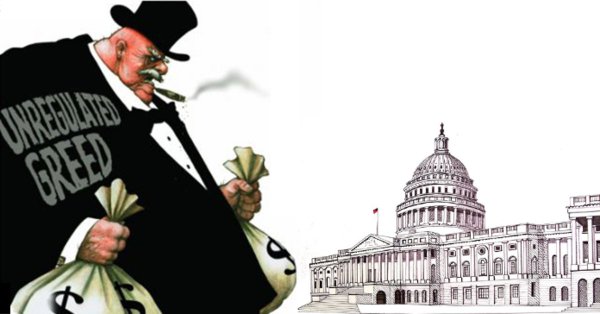
Bankster by Nancy Ohanian

It's great when is reasonable and understanding when they ensnare someone for bending the rules, especially if-- the classic example-- it's a man who steals some milk to feed his staving baby or a loaf of bread for a starving family. Leniency may well be in order. But not from a tough conservative law-and-order regime. At least not for individuals. For corporate managers on a criminal rampage, though, conservative regimes can be very... understanding. Obama's administration was lenient on Wall Street criminals... very very lenient. Even in a deep blue state the California, the former Attorney General, now Senator Kamala Harris, bent over backwards to avoid being too rough on law-breaking corporate managers. Over the weekend, Ben Protess, Robert Gebeloff and Danielle Ivory, in a blockbuster report for the New York Times, exposed something anyone could have guessed: Trump Administration Spares Wrongdoers Billions In Penalties. They let Walmart off the hook for a billion in a bribery case, Barclay's off the book for $7 billion for selling toxic mortgage investments that helped fuel the 2008 financial crisis, and Royal Bank of Scotland for a criminal investigation also involving the 2008 financial crisis. The Obama administration had all three corporations by the short hairs... and then along came Trumpy-the-Clown. The 3 criminal entities "looked to his administration for a more sympathetic ear-- and got one." Walmart remains uncharged, Barclays was let off with a $2 billion fine (a $5 billion saving) and R.B.S. paid a civil penalty, escaping criminal charges altogether, let alone any of the higher ups facing a firing squad (if I was president) or some public shaming and a stern reproach if Obama was still in office.
Across the corporate landscape, the Trump administration has presided over a sharp decline in financial penalties against banks and big companies accused of malfeasance, according to analyses of government data and interviews with more than 60 former and current federal officials. The approach mirrors the administration’s aggressive deregulatory agenda throughout the federal government.

The New York Times and outside experts tallied enforcement activity at the S.E.C. and the Justice Department, the two most powerful agencies policing the corporate and financial sectors. Comparing cases filed during the first 20 months of the Trump presidency with the final 20 months of the Obama administration, the review found:
A 62 percent drop in penalties imposed and illicit profits ordered returned by the S.E.C., to $1.9 billion under the Trump administration from $5 billion under the Obama administration.
A 72 percent decline in corporate penalties from the Justice Department’s criminal prosecutions, to $3.93 billion from $14.15 billion, and a similar percent drop in civil penalties against financial institutions, to $7.4 billion;
A lighter touch toward the banking industry, with the S.E.C. ordering banks to pay $1.7 billion during the Obama period, nearly four times as much as in the Trump era, and Mr. Trump’s Justice Department bringing 17 such cases, compared with 71.
While career officials in the federal government have continued to investigate wrongdoing at companies large and small, some of the top political appointees under Mr. Trump have led a philosophical shift in governing that favors big business and prioritizes the interests of individual investors.
I don't know her IQ, but there's no question it's substantially higher than Trump's

See, and you thought Trump has singled out Maxine Waters for such vicious treatment because he hates women and hates African Americans so much. Of course he does hate women and he does hate African Americans, but that's just part of the story for his attacks on Rep. Waters. She's the Ranking Member of the House Financial Services Committee Likely to become chair of the committee in January, Trump is already discrediting her in advance for the confrontations sure to come between a committee willing to do it's job-- instead of the disgrace Jeb Hensarling (along with crooked subcommittee chairs Bill Huizenga, Blaine Luetkemeyer, Sean Duffy, Andy Barr, Ann Wagner and Stevan Pearce-- are leading now-- and a kleptocracy Trump is leading.

It's worth mentioning the bribes the top leaders of the committee have solicited and used to build their power:
Hensarling (R-TX)- $1,536,111
Huizenga (R-MI)- $601,238
Luetkemeyer (R-MO)- $624,732
Duffy (R-WI)- $764,762
Barr (R-KY)- $907,016
Wagner (R-MO)- $867,050
Pearce (R-NM)- $161,675
Now, compare that to the $338,642 that Waters has taken from Wall Street since she ws first elected in 1990. By the way, someone might say, but there are Democrats on the committee who have taken as more or more than the Republicans-- like New Dems Jim Himes (CT), John Delaney (MD) and Kyrsten Sinema (AZ)-- and if the Republicans should be in prison so should those crooked Democrats. I couldn't agree more. In fact, it should be strictly illegal to take any money at all from any business that a committee you serve on has jurisdiction over.

Rats by Nancy Ohanian

Protess, Gebeloff and Ivory wrote that "Many Republicans in regulatory and law enforcement roles have resisted corporate penalties, suggesting that they unfairly punish a company’s shareholders for the misconduct of employees" while "Democratic appointees have more often maintained that shareholders wrongly benefit from ill-gotten gains, no matter who was responsible for them, and that tough penalties could deter future lawbreaking." OK, how about if we just throw the corporate criminals in prison instead? I mean real prison-- not Club Fed-- and for long periods of time? Then we won't have to worry nearly as much about fines-- because most of the criminal behavior will likely cease.
If the balance tilted toward a heavier hand in corporate penalties under former President Barack Obama-- even as critics argued that his administration did not do enough to punish top bankers after the crisis-- it began to swing in the opposite direction under Mr. Trump, the data show.

With the exception of the Commodity Futures Trading Commission, a small agency where a new enforcement director has presided over an uptick in penalties and a Trump-appointed chairman vowed “no pause” in enforcement, the new approach extends across the federal financial enforcement regime.

Mr. Trump’s pick to lead the Office of the Comptroller of the Currency, a federal banking regulator, is a former executive whose bank once faced an enforcement action, while Mr. Trump’s leader of the Consumer Financial Protection Bureau, created by Congress during the Obama administration, initially instituted an informal freeze on new enforcement actions.

The S.E.C., an independent agency composed of a bipartisan group of presidentially appointed commissioners, is less subject to political considerations. The leaders of the agency’s enforcement division act in a nonpartisan capacity.

Still, Robert J. Jackson Jr., a Democratic commissioner at the S.E.C. who is a former law professor and corporate lawyer, said the philosophy of Republican commissioners sent the wrong message. “We should be trying to deter management from committing fraud, not rewarding corporations when their lawyers cleverly mask bad deeds,” he said.

Former Republican officials have largely welcomed the change, though some are concerned that the Trump administration’s softer approach toward banks could open the door to the sort of reckless Wall Street behavior that spurred the financial crisis, particularly as federal regulators ease some Obama-era rules adopted after the crisis.

“The goal is really to instill in those who are regulated the illusion that the government is everywhere and looking over your shoulder,” said Harvey L. Pitt, a Republican who was chairman of the S.E.C. under President George W. Bush. “If you take away that threat, that could embolden some to keep breaking the law.”


...The decline in corporate penalties from the Justice Department may partly reflect the Trump administration’s heavier emphasis on immigration, violent crime and drugs. For two years in a row, the department has announced record-breaking prosecutions of health care fraud, much of which is related to the opioid crisis.

“Attorney General Sessions has set clear goals for this department: reducing violent crime, homicides, opioid prescriptions and drug overdose deaths,” said Steven Stafford, a department spokesman. “Under his leadership, we have begun to achieve all four of these goals by increasing violent crime and firearm prosecutions to all-time highs.”

He added, “There can be no doubt that this is a pro-law enforcement administration and Department of Justice.”

...Andrew J. Ceresney, the enforcement director [for the SEC] in the final years of Mr. Obama‘s presidency, that hit a brick wall under Mr. Trump.

In an investigation involving Morgan Stanley and Barclays, the banks had helped assemble the prospectus for a 2014 Puerto Rican bond deal. Although Puerto Rico’s dire financial health was well known to investors, the S.E.C. under Mr. Obama investigated whether the document accurately warned that the territory was on the brink of bankruptcy.

The investigation continued into the early months of the Trump presidency, when S.E.C. investigators told the bank they planned to bring charges. After higher-ranking S.E.C. enforcement officials reviewed the evidence, the agency dropped the investigation, people briefed on the matter said.

Morgan Stanley and Barclays declined to comment. Legal experts said that the agency had occasionally reversed itself and ended investigations during the Obama era as well.

Separately, an investigation into whether Carlyle, the private equity firm, misled investors about certain fees sputtered. The S.E.C. filed and settled similar cases against Carlyle’s main competitors during both administrations, but the Trump administration did not do the same against Carlyle, people briefed on the matter said. Carlyle declined to comment.

A Supreme Court ruling last year, Kokesh v. S.E.C., may have influenced the agency’s approach to the investigation. The ruling held that the S.E.C. has only five years to collect ill-gotten profits; private equity firms like Carlyle typically have investment funds with a life span of 10 years or more.

The S.E.C. has also said that a separate legal challenge to the constitutionality of its administrative court, where it typically filed many of its cases, reduced enforcement. A Supreme Court ruling this year forced the agency to reboot its administrative court process.


...The decline in criminal penalties has unfolded against a backdrop of broader regulatory rollbacks in the civil arena.

Under the Obama administration, the Justice Department’s civil rights division poured resources into lending-discrimination cases, some involving the nation’s biggest banks. In the last full year of the Obama administration, the department filed seven lawsuits alleging lending violations. The next year, the Trump administration filed one such lawsuit.

And like Walmart on the criminal side, some targets of civil prosecutions welcomed the more business-friendly approach of the Trump administration.

Barclays, under investigation by the Obama administration for selling the soured mortgage investments, had rejected the Justice Department’s demands to pay almost $7 billion, according to people with knowledge of the negotiations. The Obama administration had, in turn, filed a lawsuit against the company using the Financial Institutions Reform, Recovery and Enforcement Act, a law that Republicans in Congress had tried to curtail.

In March, Barclays settled for a much reduced penalty of $2 billion, which the bank argued was in line with what other financial institutions had paid for similar conduct.

R.B.S., similarly suspected of defrauding investors in mortgage-backed securities, was facing a criminal investigation from federal prosecutors in Boston, who had obtained records of bank employees discussing “garbage” loans and “rampant” fraud.

Toward the end of the Obama administration, Boston prosecutors declined to take a potential criminal prosecution off the table, according to people familiar with the matter. But under the Trump administration, Mr. Rosenstein decided that the case should not involve criminal charges in part because it was unfair to single out one of the many banks caught up in the mortgage investigations, two of the people said. Ultimately, R.B.S. reached a $4.9 billion civil settlement. The bank declined to comment.

The Barclays and R.B.S. outcomes reflected the broader trend in cases brought against financial firms under the Financial Institutions Reform, Recovery and Enforcement law and the False Claims Act, which targets fraud of government programs.

The Justice Department obtained $7.4 billion in such cases filed in the first 20 months of the Trump administration-- about 28 percent of the amount collected in the final 20 months of the Obama administration, according to an analysis of public disclosures by the agency compiled by Buckley Sandler, a law firm. (In October, the agency filed two large cases that would bring the Trump administration’s total to $8.6 billion.) The decline, in part, stems from a new policy Mr. Sessions issued last year requiring settlement money to go to victims or the Treasury Department, a change that effectively prevented prosecutors from forcing banks to spend billions of dollars addressing neighborhood blight and other issues tied to the mortgage crisis.

Andrew Schilling, a partner with Buckley Sandler who previously led the civil division at the United States attorney’s office in Manhattan, said there had also been a marked decline in new financial fraud investigations being opened.

“Certainly, 10 years out of the financial crisis you’re not going see quite the same activity,” he said, “but I never thought I would see financial fraud enforcement fall off as sharply as it has.”
I suppose the law school that Mr. Schilling went to didn't spend any serious time on a study of kleptocracies. Had they, perhaps Schilling might not have been in for such a shock. As the Washington Post noted Saturday evening, "Two years of political volatility will culminate Tuesday when voters for the first time since the stunning 2016 election render a nationwide judgment on whether Trumpism is a historic anomaly or a reflection of modern-day America. As the midterms roared into their final weekend-- with the biggest names in both parties exhorting their followers to vote-- uncertainty enveloped the contest amid signs that tightening races appeared headed toward dramatic finishes." [See R+11 Or Bust, Baby.

Conservative ex-Republican, Max Boot, wrote on Saturday that "Trump’s more sophisticated supporters in places such as Washington and New York claim that his presidency is a raging success because he has appointed conservative judges, cut taxes and turbocharged the economy. Trump himself evidently disagrees, because he is not running the midterm campaign based on his supposed achievements. Instead, Trump and his fellow Republicans are closing the election with the most naked appeal to racial prejudice since the dark days of Jim Crow when Democrats in the South would compete to display their fervor for segregation… It is not shocking that Trump would stoop so low. With him, there is no bottom. What is shocking, if no longer entirely surprising, is that the Republican Party would so readily follow him into the gutter. The prominent Republicans denouncing his hate-mongering are mostly those such as Sen. Jeff Flake (R-AZ), Sen. Bob Corker (R-TN) and Gov. John Kasich (R-OH) who are not seeking reelection. The rest of the GOP is complicit in this disgraceful demagoguery. Republicans who do not denounce Trump’s racist tactics-- and even imitate them-- will never escape the stench of this year’s campaign as long as they live."


Labels: , , , , , ,

Sunday, January 28, 2018

Pyramid Schemes, Congress And Deregulation

>


Even the phrase "multilevel marketing" sounds a lot better than "pyramid scheme," let alone "Ponzi scheme." Even "multilevel marketing scheme" sounds vaguely better than "pyramid scheme." But pyramid schemes are often illegal and, somehow multilevel marketing schemes are usually not. The Federal Trade Commission differentiates between legitimate multi-level marketing (MLM) companies and pyramid schemes claiming that MLM "have a real product to sell" while pyramid schemes don't. "If the money you make is based on your sales to the public, it may be a legitimate multilevel marketing plan. If the money you make is based on the number of people you recruit and your sales to them, it’s probably not. It could be a pyramid scheme. Pyramid schemes however "may purport to sell a product, but they often simply use the product to hide their pyramid structure." According the the FBI, "Pyramid schemes—also referred to as franchise fraud or chain referral schemes-- are marketing and investment frauds in which an individual is offered a distributorship or franchise to market a particular product. The real profit is earned, not by the sale of the product, but by the sale of new distributorships. Emphasis on selling franchises rather than the product eventually leads to a point where the supply of potential investors is exhausted and the pyramid collapses."

Late in 2016 John Oliver's Last Week Tonight video up top tackled the problem-- the annual 36 billion dollar problem-- and specifically called out Mary Kay, Ronan + Fields, Nu Skin, Amway, Herbalife, Vemma, Advacare, and Max International. So how do they get away with it? Congress, of course. These pyramid scams by fealty from lots of members of Congress-- and not just most the notorious crook of all (Orrin Hatch, who might as well be on the board of Herbalife) but loads of congressmembers from both parties. Conservative Democrat Raul Ruiz (Palm Springs), for example, took $12,700 in bribes from Herbalife in 2014 and another $6,400 in 2016. Just in those two cycles, every shady member of Congress was on the Herbalife gravy train for thousands of dollars, from Tony Cardenas (D-CA), Ben Ray Lujan (D-NM) and Juan Vargas (D-CA) to Marsha Blackburn (R-TN), Mimi Waters (R-CA) and Virginia Foxx (R-NC). In 2016 Mary Kay showed big cash onto Hillary Clinton and a shit-load of Texas crooked congressmembers:
Pete Sessions (R)- $11,100
Will Hurd (R)- $9,100
Michael Burgess (R)- $7,700
Marc Veasey (D)- $7,250
Kevin Brady (R)- $5,400
Randy Weber (R)- $5,000
In the 2016 cycle alone, Mary Kay gave Republicans $192,119 and gave Democrats $40,896. Amway gave even more-- in 2016 $792,653 tp Republicans and $14,893 (following $638,000 to Republicans and $1,500 to Democrats in 2014). Who got the big bucks from Amway, one of the worst of the pyramid scams? The 10 worst still in the House (just in 2016):
Tim Walberg (R-MI)- $34,400
Justin Amash (R-MI)- $22,655
Mike Bishop (R-MI)- $22,200
Bill Huizenga (R-MI)- $21,600
Paul Ryan (R-WI)- $21,400
Kevin McCarthy (R-CA)- $10,400
Fred Upton (R-MI)- $10,400
Martha McSally (R-AZ)- $10,100
Liz Cheney (R-WY)- $8,100
John Moolenaar, (R-MI)- $8,000
Amway gives mostly to Senators and Senate candidates though. Their biggest investments in 2016 were for Todd Young (R-IN-- $83,000), Marco Rubio (R-FL-- $61,400) and Joe Heck (R-NV)-- $37,100). And they gave widely to presidential candidates: Jeb Bush ($18,900), Scott Walker ($13,500), Hillary Clinton ($9,047), Carly Fiorina ($8,100), Señor Trumpanzee ($7,242) and John Kasich ($5,400).

They pay off everybody... but especially Republicans. That's the reason why strong regulations protecting consumers are so crucial and-- of course-- that's the reason why Republicans (and crooked conservative Democrats-- primarily Blue Dogs and New Dems) are so eager to abolish regulations that protect consumers and protect society. It's not that complicated. Did you send that John Oliver video to 10 friends? Go ahead.

Labels: , , , ,

Wednesday, December 06, 2017

Why Didn't The Democrats Move To Break Up The Too Big To Fail Banks? Too Many Conservative Dems Eager to Work With The GOP

>


I feel like Austin Frerick, the former Treasury Department economist running for Congress in the Des Moines-based Iowa seat (IA-03), has become a friend aside from just one of the Blue America-endorsed candidates. I feel like I learn something every time I talk with him. Looking at the corrupt-conservative push top deregulate Wall Street and give the bankster predators a green light to go back to ripping off their customers, Frerick told me that "the fundamental problem here is that we didn't address the key issue underlying the Great Recession and this 2nd Gilded Age: Economic Concentration. We should have broken up these too big too fail banks. Their economic power gives them political power to corrupt our system with things like manipulating the SIFI Threshold."

I got into the old argument today with a Democrat hoping to sell me on a candidate he really believes in. I asked if she's progressive and gathered that she's "progressive for her district" but not really progressive the way Bernie has been redefining progressive. I promised to talk with her and keep an open mind. But the argument can have no actual conclusion. My friend believes electing any Democrat is essential, no matter how conservative or corrupt or whatever, in order top put Trump in check and because they will vote for some good things. And he's right. Even Blue Dog Kyrsten Sinema (AZ)-- the single worst Democrat in the House (and, thanks soley to Upcheck Schumer, on her way to the Senate-- votes for progressive legislation... what is it now? Oh she's up to 37.56% of the time. That's better than any Republican except one endangered freshman in Pennsylvania (Brian Fitzpatrick). So he's for anyone with a "D" next to their name. And you know how I feel: I'm a strictly better Democrats kind of guy. I know not ever Democrat can be as good as Ro Khanna (100%-CA) and Jamie Raskin (100%-MD). I see even Pramila (97.06%-WA) has slipped. But its worth aspiring-- especially in primary season-- towards electing men and women like Mark Pocan (98.42%-WI), Nanette Barragán (98.51-CA), Jan Schakowsky (96.44%-IL) and Barbara Lee (95.08%-CA). There are even people with overall "A" rankings from ProgressivePunch who represent tough districts that Trump won, like Matt Cartwright, who is being heavily targeted by the GOP because of his strong progressive voting record and his stellar leadership on our issues. Anyway, my friend and I are never going to agree on this, but it doesn't mean we can't work together on candidates on whom we both do agree. And I'll keep reminding him that there are solid, solid progressive leaders running for Congress in districts as red or redder than the one his candidate is running in-- just look at Dan Canon (IN-09), Tom Guild (OK-05), Derrick Crowe (TX-21), Jenny Marshall (NC-05), Austin Frerick (IA-03), James Thompson (KS-04), Dayna Steele (TX-36)... these men and women are communicating with voters along the lines of cutting edge policy.

I should send him David Dayen's essay at The Intercept from Monday, Republicans Now Turning Their Attention To Deregulating Wall Street. Why? Because Dayen explains that, unlike the tax and Obamacare battles, the GOP "can count on Democratic help in this fight." And in 2018 that's one of the fault-lines that divides progressives from... not progressives. Dayen reminded his readers that "During the debate over whether to create the Consumer Financial Protection Bureau, Elizabeth Warren, not yet a senator, famously said at a crucial moment that her first choice was a strong agency, and her second was 'no agency at all and plenty of blood and teeth left on the floor.'" I have a feeling my friend would find that wrong-headed but Senator Warren has written "23 different amendments [primarily attacking the new regulatory exemptions for banks above $50 billion in assets] for a markup on S.2155, the “Economic Growth, Regulatory Relief, and Consumer Protection Act.” The Orwellian-named bill would actually deregulate several parts of the financial sector and unravel consumer protections in a corrupt alliance between Republicans and pro-Wall Street Democrats." These are the Wall Street Democrats working with the Republicans on this, all co-sponsors, basically, all the usual suspects:
Joe Donnelly (IN)
Heidi Heitkamp (ND)
Jon Tester (MT)
Mark Warner (VA)
Claire McCaskill (MO)
Joe Manchin (WV)
Tim Kaine (VA)
Gary Peters (MI)
Michael Bennet (CO)
Angus King (I-ME)
Donnelly, Heitkamp and Tester are all on the Banking Committee and all up for reelection in red states Trump won. Warner, a notorious corporate whore, is also on the Banking Committee, but not up for reelection this cycle.
Democratic staffers on the Banking Committee cite three major problem areas for S.2155. First, despite being pitched as relief for community banks and small lenders who played no role in the financial crisis and got caught up in the regulatory undertow, the bill extends that aid to the big boys. It eliminates automatic enhanced standards, like higher capital requirements and “living wills” that lay out how to unwind the firm in case of trouble, for banks with between $50 and $250 billion in assets. This includes large regional and national players like American Express, SunTrust, and BB&T, and foreign megabanks like Barclays and Deutsche Bank, whose holdings in the United States fall within that threshold. These international lenders have been notorious “repeat offenders,” paying tens of billions of dollars in fraud penalties for actions like repossessing the cars of servicemembers while they fought overseas.

In all, the bill removes enhanced supervision from 25 banks that control $3.5 trillion in assets and received $48 billion in taxpayer bailouts, according to an analysis from Public Citizen.

S.2155 also changes stress tests-- which check if banks can manage hazardous scenarios-- for all banks, making them “periodic” (which could mean whatever regulators want it to mean, staffers say) instead of annual. So JPMorgan Chase, Wells Fargo, and Bank of America, along with literally every big bank in the country, recipients of hundreds of billions of dollars in bailouts, get assistance in this “small bank” relief bill. The stress test itself would change-- at the discretion of Trump’s deregulatory army-- for large regional firms.

Next, the bill rolls back protections on the mortgage market, by tweaking “safe harbor” and “qualified mortgage” provisions in ways that would allow small lenders to sell high-cost adjustable-rate mortgages and avoid accountability in court for wrongful foreclosures. Just because a no-documentation or interest-only mortgage comes from a community bank doesn’t make it a safe financial product.

The bill also eliminates the need for appraisals in certain rural areas, creating incentives to cheat homebuyers; exempts sellers of manufactured homes like trailers from mortgage rules, which benefits the dominant player in that space, Warren Buffett’s conglomerate Berkshire Hathaway; and restricts data collection about mortgage lending that could help regulators spot the next crisis.

Finally, there’s no “consumer protection” worthy of the name in the bill. The tentpole consumer piece is a watered-down version of a recent bill from Warren that would offer consumers stung by data breaches at credit reporting agencies like Equifax one free credit freeze and unfreeze every year. Warren’s bill would have made all credit freezes free. Even Equifax eventually offered a lifetime credit freeze, more than the authors of S.2155. And the measure pre-empts states from giving more generous terms to its citizens.

...[Warren has created] politically tough amendments for Democrats like Heitkamp, Tester, Donnelly, and Warner to oppose, especially after spending the last week railing against Republicans for waging class warfare on low-income Americans in the tax bill. Republicans may defeat these on their own, but the goal is to name and shame Democrats who support this giveaway to big banks without bringing along anything for the public like more jobs, higher wages, labor protections, and safeguards against bank deceptions.

While pro-bank Democrats like Tester have used high-profile hearings to insist that S.2155 does not put the financial system at risk, they haven’t had to specifically defend lowering regulations on banks that took TARP bailout funds and paid enormous fines for wrongdoing, and they haven’t enumerated what ordinary people get out of the deal instead of bank executives. Warren’s amendments will force some kind of answer on that score.
When we covered this last week we spoke with Elizabeth Warren collaborator, Orange County professor and congressional candidate (CA-45), Katie Porter, who told us that "The chances that Congress repeals key protections for our economy illustrates the risks that come when candidates work for banks, rather than families. The incumbent in my race, Mimi Walters (R CA-45), voted for the House's CHOICE Act and will give Wall Street anything it wants. In fact, her only non-political job ever was working for Drexel, Burnham & Lambert, a posterchild for banking's lawlessness, as its executives faced indictments and the firm went bankrupt. In my campaign to replace Mimi Walters, I am not taking money from anyone who works for Wall Street or big banks--and I am the only candidate that I know of in the country with this strong position. I believe that the big banks have outsized influence, and that we should not let history repeat itself. Allowing banks to escape from protections puts our entire economy at risk. People can trust that I'll take my lifelong commitment to whistleblowing on bank misconduct straight to the House Financial Services Committee when I am elected to Congress."

Labels: , , , , , , , , , , ,

Thursday, October 26, 2017

Trump And Ryan-- The Destroyers Of Regulations That Protect Americans From Greed And Avarice

>


Did anyone ever really believe Trump's idiotic campaign promises to drain the swamp that he personifies or hold Wall Street-- which now runs his regime-- accountable? If so... how tragic! Late Tuesday evening Trump had Mike Pence break the 50-50 tie in the Senate that will now allow banks more leeway to prey on their customers without fear of sanctions. That it even got to a point where the GOP-controlled Senate needed a tie-breaking vote from Pence was strange. And it wasn't because McCain, Flake or Corker, who had spent the day warning about the existential threat of Trumpism to America had decided to stop rubber-stamping his agenda-- they all voted with him as usual-- or because "the moderates" like Murkowski and Collins had decided to represent their incumbents back in Alaska and Maine instead of their campaign donors on Wall Street. No it was because ex-Democrat John Neely Kennedy (R-LA) and flitty Lindsey Graham (R-SC) crossed the aisle and voted with all the Democrats against the GOP proposal.

Maddow's blogger, Steve Benen, pointed out that "it’s easy to forget that there were voters last year who helped elect Donald Trump and a Republican Congress because they were concerned that Hillary Clinton might not be tough enough on Wall Street. As regular readers may recall, Trump swore up and down for months that it was Clinton who’d do Wall Street’s bidding, while Americans could expect his administration to stand up to the finance industry and its lobbyists. Though millions of voters actually believed all of this, the claims appear quite ridiculous now." It appeared quote ridiculous then as well. A new poll from Morning Consult shows that 53% of voters say Trump is not trustworthy; only 33% of voters think he is. 51% say he's dishonest and only 35% disagree. Yesterday Ipsos released a new poll through Reuters indicating that less than a third of Americans agree with the Trump-Ryan tax proposals.
As the 2018 midterm congressional election campaigns grow nearer, the poll found that more than two-thirds of registered voters said reducing the U.S. federal budget deficit is more important than cutting taxes for the wealthy or for corporations.

Trump’s plan would balloon the deficit and add to the $20 trillion national debt, according to critics and independent analysts, but Republicans say the tax cuts proposed in the plan would be offset by economic growth that would generate new tax revenue.

Among Republicans surveyed, 63 percent said deficit reduction should take priority over tax cuts for corporations, while 75 percent said deficit reduction should take priority over tax cuts for the wealthy.
But Trump and his rubber-stamp Republican Congress is moving ahead in reshaping the financial environment anyway, part of which was the successful vote Tuesday night neutering the Consumer Financial Protection Bureau. Benen summed up the vote by writing that he had "naively thought Republicans would want to avoid being seen doing Equifax’s bidding so soon after last month’s controversy. Evidently, the party doesn’t care."

Ian Millhiser put it like this: "Tuesday night, as many Americans were preparing to go to bed, an evenly divided Senate voted to give broad lawsuit immunity to credit card companies, auto lenders, credit reporting companies like Equifax, and many other financial firms. The 50-50 tie in the Senate was broken by Vice President Mike Pence (R), and the House approved the lawsuit immunity measure. President Trump is expected to sign it. The resolution passed by the Senate overrides a rule created by the Consumer Financial Protection Bureau (CFPB), which prevents many financial firms from engaging in two abusive practices. The rule prohibited much of the financial industry from using “forced arbitration” agreements-- a common tactic where a company refuses to do business with consumers who will not sign away their right to sue the company in a real court. Consumers who sign away their right to sue must resolve any disputes with the company in a privatized arbitration system that favors corporate parties. Additionally, the CFPB rule prohibited credit card companies and many other financial firms from requiring consumers to sign away their right to bring class action lawsuits, a form of litigation that ensures that companies that charge certain illegal fees to consumers face a consequence for their actions."

The progressive Blue America-endorsed Democrat running in Indiana's flippable 9th district, Dan Canon, is an attorney who fights against this kind of regulatory capture that puts consumers at legal disadvantage and at the mercy of DC-connected corporate power. "This is yet another transparent sellout of the working class to the financial industry," he told us this morning. "There is simply no such thing as frivolous class-action litigation of consumer claims. The courts are the only place where citizens can be an even remotely equal footing with big business. Congressional Republicans and their donors know that, so they've been working to restrict meaningful access to the courts for American consumers for decades. This is just another step toward the Trump/GOP agenda of total corporate supremacy."

Goal ThermometerI was discussing the vote with the progressive Democrat running for the Maine second district seat held by Wall Street puppet Bruce Poliquin-- who takes bankster bribery bucks while sitting on the House Financial Services Committee-- and he pointed me to something he had written last month when the Republican plan was just being debated in the committee. "Earlier this month," he wrote, "the Credit reporting company Equifax announced a data breach that exposed the credit information for 143 million Americans, including Social Security numbers, birthdates and home addresses." And then he went after Poliquin and his cronies in Washington:
Equifax discovered the hack in July but waited more than a month to make news of the breach public. In response the company offered free credit monitoring services for one year, but the offer came with fine print that would have resulted in consumers who accepted the services giving away their ancient right to a trial in court by a jury of peers.

This term buried in the fine print is called an arbitration clause. Usually when we click a box to agree to terms of service, we are agreeing that any disputes will be taken to an arbitrator instead of a court on an individual basis, and we cannot band together with other victims to bring in a class action. But it can cost thousands of dollars to hire a lawyer to bring a claim to arbitration, so it never makes sense when a corporation rips us off by a few dollars here or there.

Without the threat that they will have to face a jury, corporations have every profit-making incentive to cut corners and take risks. Why invest in data security if nobody is going to hold you accountable for a breach? Only when corporations know that consumers can band together to enforce their rights, will they act as responsible stewards or our information.

We need to ban compulsory arbitration in these form contracts, but Bruce Poliquin is doing everything he can to protect the corporations. In June of this year, Bruce Poliquin voted for HR 10, which would block the Consumer Financial Protection Bureau (CFPB) from finalizing a rule to prohibit credit card, bank account, and other financial contracts from having fine print forced arbitration clauses with class action bans.

On the day that the Equifax data breach was made public, the House Financial Services Committee, on which Bruce Poliquin serves, considered a bill to cap statutory damages in lawsuits against credit-reporting companies at $500,000, and entirely prohibit punitive damages.

Bruce Poliquin’s support of the financial sector at the expense of his constituents is yet another example of how he continues to fail to represent the people of Maine’s Second Congressional District... He should be working to protect everyday people from data breaches and ensure they are fairly compensated when they fall victim. Instead, he’s working to limit the damages and fall out for the institutions that allow the breaches to happen. That’s unacceptable to me and in Congress I promise to protect people’s right to a day in court against banks and corporations like Equifax that fail to protect consumers’ sensitive information.
And he's been fighting with Poliquin about it ever since. The Sun Journal has called it a "hot campaign issue." While Poliquin puts all his energy into collecting bribes from Wall Street and smearing Jared as "a liberal," Jared was explaining to the media how Poliquin puts the desires of the country’s financial sector ahead of his constituents including the vote "to allow financial firms to force their customers into arbitration instead of allowing them to file lawsuits against firms such as Equifax... Golden, who is the assistant majority leader in the state House, said Poliquin'should be working to protect everyday people from data breaches and ensure they are fairly compensated when they fall victim. Instead, he’s working to limit the damages and fallout for the institutions that allow the breaches to happen.'"

Labels: , , , , , , , , , , ,

Friday, May 26, 2017

Political Purity Test? I Don't Think So

>


If you've been reading DWT even in the most cursory of ways any time since 2005, you know we spend a lot of time on the DCCC and on the Republican wing of the Democratic Party. It's been a theme as much as the DC culture of corruption and the bankruptcy of conservatism and the banal evil of the Republican Party. But a day never goes by when some Twitter brain surgeon doesn't pop up in my feed to whine and snivel about how "purity" enables [fill in the enemy of the moment; today's imbécile du jour was barking about Putin]. I gave up years ago responding to people that low on the political evolution scale. But there was a vote in the House yesterday-- on H.R. 953, Bob Gibbs' Reducing Regulatory Burdens Act of 2017-- pretty standard-- albeit devastating-- Republican fare to undermine environmental protections. The effect of the bill will be to allow for the dumping of tons of pesticides into the nation's streams and lakes-- without any public acknowledgement; no permits required.

Speaking on the House floor before yesterday's vote, Jim McGovern (D-MA), the ranking member of the House Agriculture Nutrition Subcommittee said "The Republicans are again bending over backward to help corporations and the wealthiest among us, while ignoring science and leaving hard-working families to suffer the consequences." True enough-- mostly.

It passed 256-165 and only one Republican opposed it. But-- and here's what McGovern's statement belies-- 25 Democrats crossed the aisle to vote with the Republicans, mostly Democrats from the Republican wing of the Democratic Party-- Blue Dogs and New Dems-- who always cross the aisle to vote for most of the corporate-backed GOP agenda we love to castigate Ryan and McConnell for. On legislation like this, these Blue Dogs and New Dems are as dangerous to our families as any Republicans are. Is pointing that out being a purist and a Putin-enabler?


These are the Blue Dogs and New Dems, all repeat offenders in their participation in the Republican war against America. Each one has an overall score of "F" from ProgressivePunch. Most of them are in public service for a career larded with corporate bribes.
Sanford Bishop (Blue Dog-GA)
Cheri Bustos (Blue Dog-IL)
Andre Carson (New Dem-IN)
Jim Costa (Blue Dog-CA)
Henry Cuellar (Blue Dog-TX)
Suzan DelBene (New Dem-WA)
Vicente Gonzales (Blue Dog-TX)
Ron Kind (New Dem-WI)
Anne Kuster (New Dem-NH)
Sean Patrick Maloney (New Dem-NY)
Tom O'Halleran (Blue Dog-AZ)
Collin Peterson (Blue Dog-MN)
Kurt Schrader (Blue Dog-OR)
David Scott (Blue Dog-GA)
Terri Sewell (New Dem-AL)
Kyrsten Sinema (Blue Dog-AZ)
Filemon Vela (Blue Dog-TX)
These people have earned primaries-- though none of them get primaries. Instead, the DCCC works exceedingly hard to recruit other shitheads just like them, while undermining and sabotaging progressives who try to run for Congress. Who to thank? Rahm is gone but his DNA is the DCCC's DNA. Today the operation is controlled by Pelosi, Hoyer, Joe Crowley, Ben Ray Lujan and recruiting chair and vice-chair Denny Heck (New Dem-WA) and Cheri Bustos (Blue Dog-IL).

Goal Thermometer This isn't about "purity." It's about making sure the Democratic Party stands for something worthwhile and offers an alternative to the horrific Republican agenda. What good is a me-too Democratic Party owned lock, stock and barrel by the corporate special interests (who also happens be the big campaign donors for both parties)? AND, somewhat ironically, recruiting these kinds of creatures is a proven failure, since after they get into Congress and start voting with the GOP, grassroots Democratic voters eventually refuse to vote for them any more-- as we showed earlier in the week here. That Blue America primary thermometer on the right is for progressives with the courage to stand up and primary bad Democrats. It's the hardest job in politics and these men and women deserve our support for taking on a pretty thankless task.

Labels: , , , ,

Thursday, March 23, 2017

Matt Taibbi On The Anatomy Of An American Kakistocracy

>


I hope everyone's already read Matt Taibbi's Rolling Stone piece this week, Trump The Destroyer, more a story on the ugliness of the Regime he's assembled around himself-- "Trump managed to stuff the top of his Cabinet with a jaw-dropping collection of perverts, tyrants and imbeciles, the likes of which Washington has never seen"-- than something on the level of Vlad the Impaler, although he did mention that the usual DC GOP gatekeepers had all "abandoned Trump during the 'grab them by the pussy' episode [and that] in a true autocracy, theirs would be the first heads gored on stakes as a warning to the others. Many D.C. bureaucrats had no idea what to expect. They were like shopkeepers awaiting the arrival of a notorious biker gang" has Trump prepared to descend from The Tower to decamp for Washington.

"The first and most notable consequence of Trump's administration," wrote Taibbi, "is that his ability to generate celebrity has massively increased, his persona now turbocharged by the vast powers of the presidency. Trump has always been a reality star without peer, but now the most powerful man on Earth is prisoner to his talents as an attention-generation machine. Worse, he is leader of a society incapable of discouraging him... On the campaign trail, ballooning celebrity equaled victory. But as the country is finding out, fame and governance have nothing to do with one another. Trump! is bigger than ever. But the Trump presidency is fast withering on the vine in a bizarre, Dorian Gray-style inverse correlation. Which would be a problem for Trump, if he cared."


But he doesn't, instead he does his thing: stokes chaos, creates hurricanes of misdirection, ignores rules and dares the system of checks and balances to stop him, "transforming not our laws but our consciousness, one shriveling brain cell at a time."

The horrific cabinet that Bannon-- on behalf of his masters in Mercerville-- oversaw Trump and Pence putting in place has one thread tying it together: "deconstruction of the administrative state... a state-smashing revolution disguised as populist political theater."
A president like Trump can have an impact even if he never manages to get a single law passed, simply by unleashing stupidity as a revolutionary force. Of course, no one can draw a direct line from Trump to incidents like the one in Kansas, where one of those "normal people" shot two immigrants from India, killing one, after accosting them about their visa status. Nor can anyone say that the Trump effect caused a Sikh man with American citizenship to be shot outside Seattle by a man yelling, "Go back to your own country!"

If Trump and his supporters don't want to take credit for this exciting new era of not knowing what a Muslim is, but shooting people for being one anyway, that's OK. But Trump's executive orders were the hallmark of his first days in office, as he signed the travel ban, pledged to overturn the Dodd-Frank financial rules and ordered the construction of the so-called "Great Wall of Trump," among other things.

But in most cases these orders only announced the start of long legal battles with highly ambiguous chances for success. Take away the impact they had as symbols of action, and most of what Trump has actually done so far, concretely, is pick a team. He soon enough stopped bothering with that, too.

...All of Trump's opponents sooner or later fall victim to the same pattern. He is so voluminously offensive that Christ himself would abandon a positive message to chase his negatives. His election so completely devastated Democratic voters that many cannot think of him except in the context of removing him as soon as possible.

A scenario under which he is impeached somehow for colluding with Vladimir Putin to disrupt last year's election seems like the needed shortcut. Unfortunately, despite a lot of lies about meetings and conversations and other curious behavior, there's no actual proof of conspiracy. The former director of national intelligence, James Clapper, said there was "no evidence" of such collusion as of his last day in office.

That has put congressional Democrats in the perilous position of having to litter their Russia speeches with caveats like, "We do not know all the facts" and "More information may well surface." They're often stuck using the conspiracy-theory technique of referring to what they don't know as a way of talking about what they hope to find out.

Trump has responded to all this in a predictable manner, leveling wild counter-accusations, saying Obama had been "tapping my phones" and was a "bad (or sick) guy." Trump's senior adviser Kellyanne Conway, who will either be ambassador to Mars or in a straitjacket by the end of this presidency, followed up by suggesting the government may have used a microwave oven to surveil Trump Tower during the election.


Maybe Trump didn't plan this, and it's just coincidence that where we are now-- dueling accusations of criminality, investig-ations instead of debates, jail promised to the loser-- is what politics would look like in a WWE future where government is a for-profit television program. And maybe it's not the Trump effect that has Democrats so completely focused on him instead of talking to their voters, a mistake they also made last election season.

Still, the Russia story is the ultimate in high-stakes politics. If proof emerges that Trump and Putin colluded, it could topple this presidency. But if no such evidence comes out, the gambit could massively backfire, validating Trump's accusations of establishment bias and media overreach.

In the short term, however, there's no question that Russia is bloodying Trump politically.

..."At some point, he just stopped appointing people," says an incredulous Hauser, the capital watchdog, at the end of February. "He's only made 30 appointments. That means he's still got over 1,000 empty posts. Nearly 200 ambassador posts are in limbo. He named Neil Gorsuch to the Supreme Court, but not a single judge beyond that-- with over 100 empty federal seats to be filled. Nobody knows what the hell is going on."

Sources theorize that Trump's appointments slowed thanks to a combination of factors. Those include a fear of more DeVos-style blowback and an inability to find people capable of passing security clearances (at least six White House staffers reportedly had to be dismissed for this reason).

A darker explanation was offered by a ProPublica story revealing that Trump sent waves of nonpolitical appointees to the agencies in so-called beachhead teams, i.e., people sent in groups under temporary appointments of four to eight months.

These appointees did not have to be confirmed by Congress. Some are freaks and fringe weirdos on a level below even the goofballs in Trump's Cabinet. A fair number carry amorphous "special assistant" titles, making it difficult to know what their duties are.

More unnerving is the presence in the Cabinet-level agencies of a seemingly new position, "senior White House adviser."

Some Hill sources believe these new officials are reporting directly to Steve Bannon, who is fast achieving mythical status as the empire's supreme villain. On the surface, Bannon is just another vicious ex-hippie of the David Horowitz/Michael Savage school, a former Grateful Dead fan who overswung the other way to embrace a Nazistic "culture first" alt-right movement. Everyone from Time magazine (which called him "the great manipulator") to the New York Times (which called him a "de facto president") is rushing to make him into a superempowered henchman of the extreme right, a new Roy Cohn-- fitting, since Cohn himself was one of Trump's first mentors. But whether he's Cohn or just a fourth-rate imitator with a fat neck is still unclear.

Rosenberg believes the anemic pace of Senate-track political nominations, coupled with this flood of unconfirmed political hires, may be at least in part a conscious strategy to try to decrease the autonomy of the agencies and increase the control of the White House, in particular the Bannon camp.

...We always assumed there was a goal behind it all: cattle cars, race war, autocracy. But those were last century's versions of tyranny. It would make perfect sense if modern America's contribution to the genre were far dumber. Trump in the White House may just be a monkey clutching history's biggest hand grenade. Yes, he's always one step ahead of us, and more dangerous than any smart person, and we can never for a minute take our eyes off him.

But while we keep looking for his hidden agenda, it's our growing addiction to the spectacle of his car-wreck presidency that is the real threat. He is already making idiots and accomplices of us all, bringing out the worst in each of us, making us dumber just by watching. Even if Trump never learns to govern, after four years of this we will forget what civilization ever looked like-- and it will be programming, not policy, that will have changed the world.
Goal Thermometer Yesterday Bernie Sanders and Elizabeth Warren riffed off Trevor Noah's little song about how Trump is screwing over "the forgotten man" in regard to-- among other things, lots and lots of other things-- internet privacy. "If," asked Bernie, "Republicans are committed to protecting privacy, why are they letting corporations sell our personal information?" Warren postulates that Senate Republicans are so obsessed with using the Congressional Review Act to kill every consumer protection rule in sight, like the FCC rules that protected consumers by adopting Broadband Privacy rules on how companies collect/use/share/sell our data. Now the GOP wants to allow internet service providers sell private info without telling customers. When we talk about slowing Trump down in the 2017 special elections and in the 2018 midterms, this is the kind of stuff we're talking about. Today the Senate passed-- 50-48 in a party-line vote-- a resolution by Jeff Flake to dismantle the internet privacy rules. Bill Nelson (D-FL), the ranking Democrat on the Senate Commerce Committee, pointed out that "passing [the resolution] will take consumers out of this driver’s seat and place the collection and use of their information behind a veil of secrecy, despite rhetoric surrounding our debate today suggesting that eliminating these common-sense rules will better protect consumers’ privacy online or will eliminate consumer confusion." If you want to help that whole slowing Trump down thing, please tap the thermometer on the right and contribute what you can.


Labels: , , , , , , ,

Thursday, February 02, 2017

What Does Big Oil Get For It's Political Bribery?

>

Where did the $1.6 billion bribe to Trump come from?

With Trump and Bannon tearing it up so raucously in the center ring, some people aren't paying close enough attention to what the Republicans are up to in the sideshow. Like "world's best negotiator," Trumpanzee himself, totally buckling to PhRMA lobbyists within minutes. And rest assured, Ryan's foul little Congress is up to no good. As the Washington Post reported yesterday, the oil industry lobbyists are collecting on a debt. Big Oil and Gas spent $29,193,276 bribing politicians in the 2016 cycle alone-- $25,361,577 to Republicans and $3,797,930 to Democrats. (Since 1990, Big Oil and Gas has poured $265,991,602 into congressional races.) The biggest Oil whores in Congress this cycle include Speaker Paul Ryan ($646,683), Ways and Means Committee Chairman Kevin Brady ($392,050), Majority Leader Kevin McCarthy ($329,750) and Majority Whip Steve Scalise ($273,900). The grateful Ryan, Brady, McCarthy and Scalise have lead the lobbyists to the feeding trough and told them gorge themselves.
One of House Republicans’ first targets for regulatory rollback is torn from the oil industry’s wish list: eliminating recent Obama administration requirements that oil, gas and mining companies divulge more information about business payments they make to foreign governments.

A House resolution this week, which aims to scrap the transparency rule imposed by the Securities and Exchange Commission, is one of the first measures that seeks to use the Congressional Review Act to undo regulations adopted during the final months of the Obama administration.

And it comes at a potentially awkward moment for former ExxonMobil chief executive Rex Tillerson, who opposed the SEC regulation and is now awaiting confirmation for the position of secretary of state.

The review act could be used to nullify regulations dating back to June last year, experts on the law say.

In this case, the SEC drafted the regulation in response to directions in the Dodd-Frank financial reform legislation. The directive was in an amendment backed by Sen. Ben Cardin (D-Md.) and then-Sen. Richard Lugar (R-Ind.). “Information is power,” Lugar said at the time. “It is power for shareholders and power for citizens living under oppressive regimes.”

The SEC says that it would “combat government corruption through greater transparency and accountability.”

But the SEC’s first version of the regulation was struck down by a federal district court in the District of Columbia after the American Petroleum Institute and U.S. Chamber of Commerce filed suit in 2012. That prompted a second attempt by the SEC. Because the final version was imposed near the end of the Obama administration, it now falls within the time frame that permits Congress and the president to use the review act to undo the regulation.

The oil industry has been particularly incensed about the regulation, complaining that the SEC rule would put them at a competitive disadvantage to foreign firms and be unduly expensive.

The SEC has argued that the rule would help fight corruption not only by companies but by governments around the world. It has also noted that global companies have begun to provide, on a voluntary basis, more comprehensive disclosures. In December 2015, then-commission member Luis A. Aguilar said that at least two large resource extraction companies were already providing payment disclosure on a project basis, and at least one other major resource extraction company was voluntarily providing other disclosures.

“Other global companies are also beginning to open their books to permit a window into their resource extraction payments to foreign governments,” he said.

...“Rolling back this law will enable the corruption President Trump told us all he would end,” said Corinna Gilfillan, head of the U.S. office of Global Witness, an advocacy group that targets environmental and human rights abuses. “The oil industry has been striking backroom deals with dictators and tyrants for decades, wrecking developing economies and the environment in the process.”

She added that “this law helps prevent it by making sure people can see how much money is changing hands for their resources, and who is really benefiting from those deals.”


Right wing extremist Ken Buck (R-CO) introduced the resolution, which passed yesterday 235-167, 5 Democrats voting with the GOP-- Gene Green (TX- $727,313), Henry Cuellar (TX- $565,180), Collin Peterson (MN- $117,275), Filemon Vela (TX- $72,800) and newcomer Vicente Gonzalez (TX- $1,000). Big Oil schmeared Buck with $72,950 this past cycle-- $402,329 since he was first elected to his High Plains Eastern Colorado seat in 2014. 

Not that Ken Buck or conservatives in Congress are the only ones Big Oil is schmearing. According to some pretty heavy duty, well-sourced rumors, Exxon gave Trump a nice fat $1.5 billion bribe. Sounds unbelievable? Maybe you haven't been paying close enough attention to what Exxon is and what Trump is. From Jonathan Schwartz:
According to documents recently uncovered in Europe, Exxon paid the Trump Organization $1.5 billion in June 2016 through a money laundering scheme involving banks in Europe, Hong Kong and New York. This payment occurred just days after ex-Exxon CEO Rex Tillerson attended the St. Petersburg Economic Conference in Russia.   It is unclear whether Trump's decision to nominate Tillerson as Secretary of State is in any way connected to the payment.

The documents were discovered by a European intelligence consulting company, headed by former European intelligence officers. The company was working with European intelligence and law enforcement agencies monitoring attempts by European companies to bypass US and EU sanction on Russia.

The documents state that on June 16, 2016, Exxon signed an agreement with MCC Holdings, a subsidiary of MCC (Metallurgical Corporation of China), a Chinese company owned by SASAC (State-owned Assets Supervision and Administration Commission of the State Council), the Chinese government agency responsible for managing government owned corporations.

Both MCC and its subsidiary, MCC Holdings have been rated by Moody's. The CEO of MCC Holdings, Mr. He Ting Shen (aka Heting Shen) is one of the signatories on the contract. According to public records as confirmed by several news sources, Shen is registered as the CEO of the company.


Кукольный! Кукольный! Нет кукол!
According to the contract agreement, Exxon and MCC holdings entered into what they defined as a "$1.6 billion joint participation agreement". The agreement, a 35-page document, is remarkably opaque, and can be described as a legalese waffle without any tangible deliverables or any other viable basis for a normal large scale business deal. The sole purpose of the agreement appears to obfuscate the payment by providing a cover that could be claimed was a plausible justification for the $1.6 billion payment Exxon made to MCC.

...On January 11, 2017, information regarding this payment was shared with the Department of Justice, the Senate Foreign Relations Committee and several Senators.

Rex Tillerson visited Russia in June 2016, and then, just days later, the Exxon payment took place. Six months after that, Trump nominated Rex Tillerson, who was still Exxon's CEO at the time the agreement was signed and the payments made, as his nominee for Secretary of State, despite his lack of pertinent experience. Clearly, it is vitally important that this matter be investigated assiduously before the Senate confirms Tillerson.

In addition to the circumstances regarding the actual payment, two other issues need looking into. One is the source of the money. If it did not come from Russia, but from Exxon sources, Exxon, as a publicly traded company is required to report a $1.5 billion to the SEC, and list it in the relevant quarterly report. If this did not happen, then either the money originated from a third party, probably Russia, or Exxon is guilty of gross violations of banking laws and regulations.

...Unlike the Russian dossier recently released in the United States, the documents in this matter are available and include the contract agreement, the wire transfer document from Paris to Hong Kong, the HSBC “Payment Advice” document, passports from signatories, and emails describing the transactions.
Yesterday 3 right-of-center Democrats-- Manchin (WV), Warner (VA) and Heitkamp (ND)-- plus 1 independent-- Angus King (ME)-- voted with the Republicans to confirm the Trump-Bannon-Putin pick for Secretary of State, Rex Tillerson. All 4 of them are up for reelection in 2018. This is how much each has received from Big Oil:
Manchin- $290,150
Heitkamp- $259,379
Warner- $161,920
King- $17,800


Labels: , , , , ,