Monday, November 05, 2018

The Trump Regime Is All About Law And Order-- Unless You're Wealthy

>

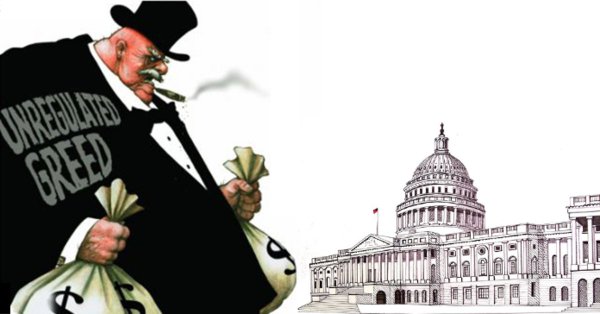
Bankster by Nancy Ohanian

It's great when is reasonable and understanding when they ensnare someone for bending the rules, especially if-- the classic example-- it's a man who steals some milk to feed his staving baby or a loaf of bread for a starving family. Leniency may well be in order. But not from a tough conservative law-and-order regime. At least not for individuals. For corporate managers on a criminal rampage, though, conservative regimes can be very... understanding. Obama's administration was lenient on Wall Street criminals... very very lenient. Even in a deep blue state the California, the former Attorney General, now Senator Kamala Harris, bent over backwards to avoid being too rough on law-breaking corporate managers. Over the weekend, Ben Protess, Robert Gebeloff and Danielle Ivory, in a blockbuster report for the New York Times, exposed something anyone could have guessed: Trump Administration Spares Wrongdoers Billions In Penalties. They let Walmart off the hook for a billion in a bribery case, Barclay's off the book for $7 billion for selling toxic mortgage investments that helped fuel the 2008 financial crisis, and Royal Bank of Scotland for a criminal investigation also involving the 2008 financial crisis. The Obama administration had all three corporations by the short hairs... and then along came Trumpy-the-Clown. The 3 criminal entities "looked to his administration for a more sympathetic ear-- and got one." Walmart remains uncharged, Barclays was let off with a $2 billion fine (a $5 billion saving) and R.B.S. paid a civil penalty, escaping criminal charges altogether, let alone any of the higher ups facing a firing squad (if I was president) or some public shaming and a stern reproach if Obama was still in office.
Across the corporate landscape, the Trump administration has presided over a sharp decline in financial penalties against banks and big companies accused of malfeasance, according to analyses of government data and interviews with more than 60 former and current federal officials. The approach mirrors the administration’s aggressive deregulatory agenda throughout the federal government.

The New York Times and outside experts tallied enforcement activity at the S.E.C. and the Justice Department, the two most powerful agencies policing the corporate and financial sectors. Comparing cases filed during the first 20 months of the Trump presidency with the final 20 months of the Obama administration, the review found:
A 62 percent drop in penalties imposed and illicit profits ordered returned by the S.E.C., to $1.9 billion under the Trump administration from $5 billion under the Obama administration.
A 72 percent decline in corporate penalties from the Justice Department’s criminal prosecutions, to $3.93 billion from $14.15 billion, and a similar percent drop in civil penalties against financial institutions, to $7.4 billion;
A lighter touch toward the banking industry, with the S.E.C. ordering banks to pay $1.7 billion during the Obama period, nearly four times as much as in the Trump era, and Mr. Trump’s Justice Department bringing 17 such cases, compared with 71.
While career officials in the federal government have continued to investigate wrongdoing at companies large and small, some of the top political appointees under Mr. Trump have led a philosophical shift in governing that favors big business and prioritizes the interests of individual investors.
I don't know her IQ, but there's no question it's substantially higher than Trump's

See, and you thought Trump has singled out Maxine Waters for such vicious treatment because he hates women and hates African Americans so much. Of course he does hate women and he does hate African Americans, but that's just part of the story for his attacks on Rep. Waters. She's the Ranking Member of the House Financial Services Committee Likely to become chair of the committee in January, Trump is already discrediting her in advance for the confrontations sure to come between a committee willing to do it's job-- instead of the disgrace Jeb Hensarling (along with crooked subcommittee chairs Bill Huizenga, Blaine Luetkemeyer, Sean Duffy, Andy Barr, Ann Wagner and Stevan Pearce-- are leading now-- and a kleptocracy Trump is leading.

It's worth mentioning the bribes the top leaders of the committee have solicited and used to build their power:
Hensarling (R-TX)- $1,536,111
Huizenga (R-MI)- $601,238
Luetkemeyer (R-MO)- $624,732
Duffy (R-WI)- $764,762
Barr (R-KY)- $907,016
Wagner (R-MO)- $867,050
Pearce (R-NM)- $161,675
Now, compare that to the $338,642 that Waters has taken from Wall Street since she ws first elected in 1990. By the way, someone might say, but there are Democrats on the committee who have taken as more or more than the Republicans-- like New Dems Jim Himes (CT), John Delaney (MD) and Kyrsten Sinema (AZ)-- and if the Republicans should be in prison so should those crooked Democrats. I couldn't agree more. In fact, it should be strictly illegal to take any money at all from any business that a committee you serve on has jurisdiction over.

Rats by Nancy Ohanian

Protess, Gebeloff and Ivory wrote that "Many Republicans in regulatory and law enforcement roles have resisted corporate penalties, suggesting that they unfairly punish a company’s shareholders for the misconduct of employees" while "Democratic appointees have more often maintained that shareholders wrongly benefit from ill-gotten gains, no matter who was responsible for them, and that tough penalties could deter future lawbreaking." OK, how about if we just throw the corporate criminals in prison instead? I mean real prison-- not Club Fed-- and for long periods of time? Then we won't have to worry nearly as much about fines-- because most of the criminal behavior will likely cease.
If the balance tilted toward a heavier hand in corporate penalties under former President Barack Obama-- even as critics argued that his administration did not do enough to punish top bankers after the crisis-- it began to swing in the opposite direction under Mr. Trump, the data show.

With the exception of the Commodity Futures Trading Commission, a small agency where a new enforcement director has presided over an uptick in penalties and a Trump-appointed chairman vowed “no pause” in enforcement, the new approach extends across the federal financial enforcement regime.

Mr. Trump’s pick to lead the Office of the Comptroller of the Currency, a federal banking regulator, is a former executive whose bank once faced an enforcement action, while Mr. Trump’s leader of the Consumer Financial Protection Bureau, created by Congress during the Obama administration, initially instituted an informal freeze on new enforcement actions.

The S.E.C., an independent agency composed of a bipartisan group of presidentially appointed commissioners, is less subject to political considerations. The leaders of the agency’s enforcement division act in a nonpartisan capacity.

Still, Robert J. Jackson Jr., a Democratic commissioner at the S.E.C. who is a former law professor and corporate lawyer, said the philosophy of Republican commissioners sent the wrong message. “We should be trying to deter management from committing fraud, not rewarding corporations when their lawyers cleverly mask bad deeds,” he said.

Former Republican officials have largely welcomed the change, though some are concerned that the Trump administration’s softer approach toward banks could open the door to the sort of reckless Wall Street behavior that spurred the financial crisis, particularly as federal regulators ease some Obama-era rules adopted after the crisis.

“The goal is really to instill in those who are regulated the illusion that the government is everywhere and looking over your shoulder,” said Harvey L. Pitt, a Republican who was chairman of the S.E.C. under President George W. Bush. “If you take away that threat, that could embolden some to keep breaking the law.”


...The decline in corporate penalties from the Justice Department may partly reflect the Trump administration’s heavier emphasis on immigration, violent crime and drugs. For two years in a row, the department has announced record-breaking prosecutions of health care fraud, much of which is related to the opioid crisis.

“Attorney General Sessions has set clear goals for this department: reducing violent crime, homicides, opioid prescriptions and drug overdose deaths,” said Steven Stafford, a department spokesman. “Under his leadership, we have begun to achieve all four of these goals by increasing violent crime and firearm prosecutions to all-time highs.”

He added, “There can be no doubt that this is a pro-law enforcement administration and Department of Justice.”

...Andrew J. Ceresney, the enforcement director [for the SEC] in the final years of Mr. Obama‘s presidency, that hit a brick wall under Mr. Trump.

In an investigation involving Morgan Stanley and Barclays, the banks had helped assemble the prospectus for a 2014 Puerto Rican bond deal. Although Puerto Rico’s dire financial health was well known to investors, the S.E.C. under Mr. Obama investigated whether the document accurately warned that the territory was on the brink of bankruptcy.

The investigation continued into the early months of the Trump presidency, when S.E.C. investigators told the bank they planned to bring charges. After higher-ranking S.E.C. enforcement officials reviewed the evidence, the agency dropped the investigation, people briefed on the matter said.

Morgan Stanley and Barclays declined to comment. Legal experts said that the agency had occasionally reversed itself and ended investigations during the Obama era as well.

Separately, an investigation into whether Carlyle, the private equity firm, misled investors about certain fees sputtered. The S.E.C. filed and settled similar cases against Carlyle’s main competitors during both administrations, but the Trump administration did not do the same against Carlyle, people briefed on the matter said. Carlyle declined to comment.

A Supreme Court ruling last year, Kokesh v. S.E.C., may have influenced the agency’s approach to the investigation. The ruling held that the S.E.C. has only five years to collect ill-gotten profits; private equity firms like Carlyle typically have investment funds with a life span of 10 years or more.

The S.E.C. has also said that a separate legal challenge to the constitutionality of its administrative court, where it typically filed many of its cases, reduced enforcement. A Supreme Court ruling this year forced the agency to reboot its administrative court process.


...The decline in criminal penalties has unfolded against a backdrop of broader regulatory rollbacks in the civil arena.

Under the Obama administration, the Justice Department’s civil rights division poured resources into lending-discrimination cases, some involving the nation’s biggest banks. In the last full year of the Obama administration, the department filed seven lawsuits alleging lending violations. The next year, the Trump administration filed one such lawsuit.

And like Walmart on the criminal side, some targets of civil prosecutions welcomed the more business-friendly approach of the Trump administration.

Barclays, under investigation by the Obama administration for selling the soured mortgage investments, had rejected the Justice Department’s demands to pay almost $7 billion, according to people with knowledge of the negotiations. The Obama administration had, in turn, filed a lawsuit against the company using the Financial Institutions Reform, Recovery and Enforcement Act, a law that Republicans in Congress had tried to curtail.

In March, Barclays settled for a much reduced penalty of $2 billion, which the bank argued was in line with what other financial institutions had paid for similar conduct.

R.B.S., similarly suspected of defrauding investors in mortgage-backed securities, was facing a criminal investigation from federal prosecutors in Boston, who had obtained records of bank employees discussing “garbage” loans and “rampant” fraud.

Toward the end of the Obama administration, Boston prosecutors declined to take a potential criminal prosecution off the table, according to people familiar with the matter. But under the Trump administration, Mr. Rosenstein decided that the case should not involve criminal charges in part because it was unfair to single out one of the many banks caught up in the mortgage investigations, two of the people said. Ultimately, R.B.S. reached a $4.9 billion civil settlement. The bank declined to comment.

The Barclays and R.B.S. outcomes reflected the broader trend in cases brought against financial firms under the Financial Institutions Reform, Recovery and Enforcement law and the False Claims Act, which targets fraud of government programs.

The Justice Department obtained $7.4 billion in such cases filed in the first 20 months of the Trump administration-- about 28 percent of the amount collected in the final 20 months of the Obama administration, according to an analysis of public disclosures by the agency compiled by Buckley Sandler, a law firm. (In October, the agency filed two large cases that would bring the Trump administration’s total to $8.6 billion.) The decline, in part, stems from a new policy Mr. Sessions issued last year requiring settlement money to go to victims or the Treasury Department, a change that effectively prevented prosecutors from forcing banks to spend billions of dollars addressing neighborhood blight and other issues tied to the mortgage crisis.

Andrew Schilling, a partner with Buckley Sandler who previously led the civil division at the United States attorney’s office in Manhattan, said there had also been a marked decline in new financial fraud investigations being opened.

“Certainly, 10 years out of the financial crisis you’re not going see quite the same activity,” he said, “but I never thought I would see financial fraud enforcement fall off as sharply as it has.”
I suppose the law school that Mr. Schilling went to didn't spend any serious time on a study of kleptocracies. Had they, perhaps Schilling might not have been in for such a shock. As the Washington Post noted Saturday evening, "Two years of political volatility will culminate Tuesday when voters for the first time since the stunning 2016 election render a nationwide judgment on whether Trumpism is a historic anomaly or a reflection of modern-day America. As the midterms roared into their final weekend-- with the biggest names in both parties exhorting their followers to vote-- uncertainty enveloped the contest amid signs that tightening races appeared headed toward dramatic finishes." [See R+11 Or Bust, Baby.

Conservative ex-Republican, Max Boot, wrote on Saturday that "Trump’s more sophisticated supporters in places such as Washington and New York claim that his presidency is a raging success because he has appointed conservative judges, cut taxes and turbocharged the economy. Trump himself evidently disagrees, because he is not running the midterm campaign based on his supposed achievements. Instead, Trump and his fellow Republicans are closing the election with the most naked appeal to racial prejudice since the dark days of Jim Crow when Democrats in the South would compete to display their fervor for segregation… It is not shocking that Trump would stoop so low. With him, there is no bottom. What is shocking, if no longer entirely surprising, is that the Republican Party would so readily follow him into the gutter. The prominent Republicans denouncing his hate-mongering are mostly those such as Sen. Jeff Flake (R-AZ), Sen. Bob Corker (R-TN) and Gov. John Kasich (R-OH) who are not seeking reelection. The rest of the GOP is complicit in this disgraceful demagoguery. Republicans who do not denounce Trump’s racist tactics-- and even imitate them-- will never escape the stench of this year’s campaign as long as they live."


Labels: , , , , , ,

Tuesday, June 05, 2018

The 2020 Dream Team

>


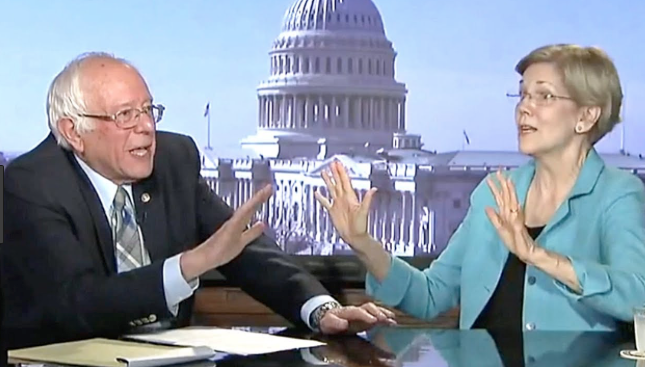
I've been assured that Bernie and Elizabeth Warren will run as a presidential ticket in 2020. That would be a dream come true for me. But I don't know if it's really true-- although my source has never been wrong on anything she's told me before. Today she gave an important speech about the efficacy and importance of government regulations, particularly in financial protects. You can watch it above.

Warren highlights one of the differences between conservatives and progressives. Progressives want to use government to protect people. Conservatives don't believe in protecting anyone; they believe in protecting business and believe the free market is sufficient. If the toaster that Warrant talks about in the video burns down enough homes, word will get out and people will stop buying them. "Back when I was a young mom in the 1970s," she explained, "I liked to make toast for breakfast. One morning I popped a few pieces of bread in our toaster oven, got busy doing six other things, and quickly forgot about the toast. When I saw smoke pouring out of the toaster oven, I grabbed the handle and pulled out the tray -four slices of bread were on fire. Always a quick thinker, I screamed and threw the tray at the kitchen sink. Three pieces of toast hit the target, but the fourth went high- setting the little yellow curtains on fire. I screamed again, then grabbed a cereal bowl and threw it at the burning curtains. The milk doused most of the fire, and I calmed down enough to realize that throwing things was probably not my best strategy. I grabbed a towel and beat on the toaster until everything seemed quiet and I could unplug it. That may have been the year I started so many kitchen fires that Daddy gave me a fire extinguisher for Christmas. Back then, our toaster oven had an on-off switch and that was it. On was On, which meant that it was possible to leave toast under the little broiler all day and all night, until the food burned, the wiring melted, and the whole thing burst into flames. At some point, someone had the bright idea of adding a timer and automatic shutoff. This simple change made it a whole lot harder for distracted mothers, or anyone else, to leave the toaster running until it set the kitchen on fire."

And the she got to her point about protecting bank customers from bankster greed.
Thirty years later, while working on an article about how the government could protect consumers from predatory financial companies, I thought about those old toaster ovens. By then, it was all but impossible to buy a toaster that had a 1-in-5 chance of bursting into flames and burning down your house. But by the 2000s, it was possible to refinance a home with a mortgage that had a 1-in-5 chance of costing a family their home and putting them out on the street. In fact, it wasn't just possible; those mortgages were being sold, then bursting into flames all over the country.

Why the difference? The United States government was the difference. Regulations were the difference. By 2007, the year I was writing my article, a government agency actually monitored toasters for basic safety, and if anyone tried to sell a toaster that had a tendency to burst into flames, the agency would put a stop to it.

In fact, government regulations ensured the basic safety of pretty much every product offered for sale. Agencies like the Consumer Product Safety Commission, the Food and Drug Administration, and the Environmental Protection Agency worked to keep us safe:
No lead paint in children's toys.
No medicines laced with rat poison.
No cars without functioning brakes.
And no exploding toasters.
But in 2007 there was no government agency that would stop the sale of exploding mortgages.

After the financial crisis we fought for a Consumer Financial Protection Bureau that would be a strong cop on the beat making financial products safer-we fought, and we won!  And just in case you think applauding for a new agency makes you a nerd, think about this:  That little agency has already put strong regulations in place on mortgages, student loans, and credit cards, and it has forced the big financial institutions to return $12 billion directly to people who were cheated.

Today the consumer agency is under attack. The Trump Administration and an army of lobbyists are determined to rig the game in their favor, to boost their own profits-- the cost to consumers be damned. But it's not just the CFPB that under attack. In agency after agency, across the federal government, powerful corporations and their Republican allies are working overtime to roll back basic rules that protect the rest of us.

Why is this happening? Why favor the profits of Wall Street banks over the economic security of American families? The answer is pretty simple-- corruption. Giant corporations and wealthy individuals are working in the shadows to make sure that government works for them, not for the people.

To hide what they are doing, big corporations and Republicans here in Washington often claim that government regulations are bad for our economy. They go on and on about how "big government" restricts freedom and makes it harder for businesses to succeed.

That's a big, greasy baloney sandwich-a greasy baloney sandwich that has been left out in the sun too long and has started to stink.

Let's talk about real freedom-- freedom from being cheated by those who care about pumping up their own profits and don't care about you. Regulations are about setting rules of the road-plain and simple. Done right, strong, clear regulations protect the freedom of every American. 
How free would you be if companies were allowed to lie to you about their businesses in order to trick you into investing your life savings in their stock?
How free would you be if no one had to wash their hands before they handled your hamburger?
How free would you be if companies could pass off little white pills as antibiotics, even if they weren't?
Don't tell me that all rules do is restrict freedom. Good rules empower people to live, work, and do business freely and safely.
Regulations serve three main functions.

First, they provide the basic framework that permits commerce to flourish-to ensure that what we're promised is what we get. That a gallon of gas is really a gallon-and not almost a gallon. That the pills labeled as antibiotics really are antibiotics-- and they aren't contaminated with mold. We get what we're promised.

Second, regulations keep thieves out of our pockets. Rules are how we make it illegal to steal your purse on Main Street or your pension on Wall Street.

Third, regulations level the playing field for everyone competing for our business. Because of regulations, good companies that do right by their customers don't have to compete against cheaters. Competition shouldn't be about who can hide the nastiest (and most profitable) trick somewhere in the fine print; it should be about who offers the choices that customers like best. That's good for customers and good for upstart competitors who think they have a better product to offer.

So let me say it outright: well-designed regulations allow for more freedom and more safety for each of us personally, more freedom and more opportunity for small businesses and startups, and more freedom and more security for workers who are building a future for their families, and more freedom for every business that is willing to compete straight up on the quality of its goods and services.

The so-called war on regulations isn't about freedom. The war on regulations is waged on behalf of giant companies that don't want to follow any rules. So let's call it what it really is - a war on public health, a war on public safety, a war on truly free and competitive markets, a war on American workers, a war on American consumers.

Republicans in Washington talk about regulation like it is some kind of uncontrollable Frankenstein's monster with an independent will of its own, a beast that will chew our bones. They use the word "regulation" like a magic incantation, a fearsome word that can be repeated three times to ward off the evils of so-called "big government."

But America's history tells a very different story about regulation.

More than a century ago, the Industrial Revolution began to stir, and factories sprouted up all over.

Industrialization radically altered the American economy, and it generated enormous wealth. But it also wreaked havoc on workers and their families. As industrialization spread across the country, families poured in from farms to cities, only to land in workplaces that were monstrously unsafe. Wages were paltry, and hours were grueling.

America's response wasn't to abandon the technological innovations and improvements of the industrial revolution. We didn't send everyone back to the farms. No. Instead, we came together as a country, and, through our government, we changed public policies to adapt to a changing economy.  In other words, we adjusted the laws-- the regulations-- to keep much of the good and get rid of much of the bad.

Over time, the list of new laws and regulations grew: A minimum wage. Workplace safety. Workers compensation. Child labor laws. The 40-hour workweek. The right to unionize.

These protections set up guardrails so giant corporations could no longer exploit workers just to boost their own profits.

In addition to protecting workers, America also took steps to protect our financial system. From colonial times until the early 1930s, America pretty much took the economic world the way it was. Booms and busts were just the way things worked and there wasn't much we could do about it-sort of like the natural cycles of the moon. And those crashes hurt.  Sure, they took down speculators, but they also took out farmers, small business owners, employees and millions of people who got swept away by massive economic forces that they couldn't control.  Then the big one hit-the Great Depression. Unemployment skyrocketed, peaking at more than 20 percent. Bread lines swelled. Across the country, frightening rumors caused Americans to rush to empty their bank accounts, triggering more crises.

In the midst of this chaos, Franklin Roosevelt stepped up with a bold idea: We can do better.  We can use regulation to end the boom-and-bust cycles. And that's exactly what he did.

In the wake of the Great Depression, America put in place strong laws and rules that stabilized our financial system:
FDIC insurance made it safe to put money in banks.
The SEC was built to be a cop on the beat-- not on Main Street, but on Wall Street.
Glass-Steagall separated boring banking-- checking accounts and savings accounts-- from Wall Street risk-taking.
For more than 50 years, those rules stayed in place-and they worked. The devastating economic crashes were gone. Regulations bought us economic stability. And the financial services industry served the American people, rather than the other way around.

Regulations to protect workers. Regulations to make financial marketplaces fairer. GDP was climbing and America's middle class was getting a huge share of all that growth. We were on a roll. In the 1970s, environmental issues moved front and center, along with the safety of America's families.vv It may be hard to believe, but back in the '50s and '60s, big American cities were smothered with thick layers of nasty, dirty smog. People sucked down toxic chemicals on the way to work; little kids breathed in dangerous substances on school playgrounds.  The factory owners that spewed their filth in the air didn't care-- they didn't pay the cost of their pollution. The auto manufacturers weren't held responsible for the tailpipe emissions from the cars they built. But the millions who suffered asthma attacks, developed lung cancer, and died from heart disease because of dirty air paid a terrible price. During one Thanksgiving week in 1966, a severe smog crisis choked New York City, killing hundreds of people.

People demanded action, but giant corporations pushed back hard. Big carmakers said that they would never be able to meet the deadlines to reduce emissions, that it would cost too much to adapt their vehicles, that they would go bankrupt. (Aside:  You'll notice that they sounded exactly like today's big corporate interests fighting rules like greenhouse gas restrictions.) But the people prevailed. The new Environmental Protection Agency was born. Congress passed the Clean Air Act, giving the EPA the authority to put in place strong new rules and clear deadlines to protect us.

The results? From 1970 to 2016, common air pollutants fell 73 percent. Today, the Clean Air Act saves more than 160,000 lives a year. 160,000 people-our neighbors, our families. 160,000 people Every. Single. Year.

What America has accomplished through strong, public-centered rules is an amazing story. So where are the cheerleaders?  Where are the defenders of the regulators who make sure most of us don't work in factories where equipment could kill us or drive cars with defective brakes? Where are the parades and special citations for the federal employees who make sure that cancer treatments really are cancer treatments and that the air is clean enough for our babies to breathe and grow and flourish? Where are the thank-you op-eds and national holidays to celebrate that infants are no longer strangled in poorly designed baby cribs and that airplanes rarely crash?  What happened? How did those regulators-and the regulations designed to help the American people-become the enemy?

The answer, once again isn't complex. The answer is corruption. By the 1980s, corporate giants who didn't want to follow the rules had a plan to fight back. They figured they could improve their profit margins by rolling back those rules, and the best way to do that was to control the rulemakers. So they made political contributions, then lobbied those same elected officials to leash up the regulators. It was called "deregulation" -but that was just a code word for "let the rich guys do whatever they want."  Let 'em lie, let 'em cheat, let 'em steal, and-if anyone asks, pretend that was a good thing.

Does that sounds a little harsh? Consider what happened in the financial industry.

Remember all those tough rules FDR put in place after the Great Depression, the ones that worked to make our economy safer? When Reagan began his systematic campaign of deregulation, those rules came under attack. And they stayed under attack, year after year, president after president-regardless of party.

For decades, the Fed and other bank regulators looked the other way as big financial institutions found new ways to trick their customers. 
The SEC was badly outgunned.
Credit rating agencies signed off on the safety of pools of mortgages that were more like boxes full of grenades with the pins already pulled out.
The wall between high-risk trading and boring banking was knocked down,as Glass-Steagall was repealed. 
The result should have surprised exactly no one. After another boom, in 2008, our economy came crashing to the ground-dragging along tens of millions of Americans who lost their homes, their jobs, their savings, the very lives they had spent years to build.

Thirty years of deregulation, a crash that nearly brought our economy to its knees, a recovery that has left most of America behind, and what is the Trump Administration's answer? More deregulation. MORE deregulation. Make this government work better and better for the richest and most powerful.

Oh, sure. Back in 2016, Candidate Trump made big promises, promises to drain the swamp, promises to fight for working people, promises to ignore lobbyists, promises to stand up to Wall Street. It's clear now that those promises were just part of the scam-a scam that has paid off handsomely for Wall Street, paid off handsomely for every corporation that can hire an army of lobbyists or drop big money at a nearby Trump Hotel, paid off handsomely for every billionaire or corporate executive who has pocketed part of the $1.5 trillion dollar tax giveaway. Paid off big time. But for American families, the big payoff still hasn't arrived.

And there's more payoff for big corporations as the Trump Administration rolls back worker protections. The agenda:
Take away overtime pay from millions of workers.
Delay rules to limit workers' exposure to chemicals that cause lung disease and cancer.
Stack the National Labor Relations Board with people who have spent their careers busting unions.
And how about the important environmental protections that protect the health of our families-- the ones we put in place to make sure we can drink the water and breathe the air?

President Trump started by appointing Scott Pruitt to head the EPA. Corruption oozes out of his office, from wasting hundreds of thousands of taxpayer dollars, to cutting deals to make himself rich, to doing the bidding of the highest paid lobbyists.

Consider clean water. The Clean Water Rule is designed to protect drinking water, but industry opposes the rule because it means they can't dump chemicals in rivers or spread toxic waste on the ground where it might run into drinking water. And since industry doesn't like the Clean Water Rule, Scott Pruitt has come up with a plan for ending it.

Think about pesticides. Three years ago, the EPA decided to ban a dangerous pesticide that puts children at risk. But right after Scott Pruitt met with the CEO of Dow Chemical, the rule was gone.

Or power. The Clean Power Plan is biggest step we have taken to fight against climate change. But once Scott Pruitt met with executives from Big Coal, the EPA announced plans to end the rule.

In just over a year, the Administration has worked to roll back more than 60 environmental rules, from revoking car emissions standards to undercutting efforts to limit methane gas. In the name of "deregulation," Pruitt has told corporations they can boost their profits by poisoning our water, fouling our air, contaminating our food and threatening the planet we call home.

All told, the Center for American Progress estimates that Pruitt's rollbacks will cost the American people about $260 billion per year. And some of those costs will be measured in hospital admissions and funeral bills.

The same attitude permeates the Trump Administration.
Betsy DeVos, Secretary of Education, has delayed the rules to keep for-profit colleges from scamming students.
Mick Mulvaney, controlling the Consumer Financial Protection Bureau, has rolled back oversight of payday lenders.
Ryan Zinke, Interior Secretary, has pushed to open up more offshore areas to risky oil and gas drilling.
President Trump has even worked to weaken the Consumer Product Safety Commission - the agency that makes sure toasters don't explode. He's nominated a new chair who has opposed safety protections for table saws, and nominated a new commissioner who defended companies that knowingly sold all-terrain vehicles that tipped over and crushed children to death.

I could keep going, but these examples make one thing clear: President Trump and his team have embarked on an aggressive effort to kill the rules that protect the American people from corporate predators.
So what's this leading to? Warren is getting ready to introduce, as she put it, "sweeping anti-corruption legislation to clean up corporate money sloshing around Washington and make it possible for our elected government to actually work for the American people again." She sees three overarching goals:

1-padlock the revolving door between government and industry;
2- eliminate the ability of government decision-makers to enrich themselves through their government service; and
3- empower federal agencies to pass strong regulations that benefit the public by ending  corporate capture of the regulatory process.

The Democrats would have to win back Congress to allow this kind of legislation to pass-- and enough progressives need to be elected to overcome the Blue Dogs and New News who will vote against it with the Republicans. Example: Warren very strongly supported a progressive reformer in Orange County, California yesterday, Katie Porter, against a corrupt Wall Street owned and operated New Dem, Dave Min.

Warren ended by reminding her audience that "Ending this war on public safety and competitive markets will also take standing up and making the case, loud and clear: strong government rules matter. We cannot-- we must not-- accept a government that works only for a privileged few. Government remains the best tool we have to create a level playing field so everyone-white, brown, black, young, old-everyone gets a turn. Government is the best tool we have to make sure everyone-male, female, rich, poor-everyone who pitches in gets a shot at success. Government matters, and we cannot be afraid to say so. Change is coming. When we send a message that corporate profits and powerful interests cannot overpower the health, safety, and economic well-being of hardworking families, we fire a warning shot. This is our time, our responsibility, our chance to rebuild a country where government works, not just for the rich and powerful, but for the people."


Labels: , ,

Saturday, December 09, 2017

Did Wells Fargo Rip You Off? Mick Mulvaney, Trump's Pick To Head The CFPB, Says "Too Bad"

>

3 crooks: Wells Fargo CEO Tim Sloan flanked by Trumpanzee & Mulvaney

There was a bit of a stir over Wells Fargo yesterday morning, Trump's exceedingly and sour joke of a CFPB director, Mick Mulvaney, started it. A little background: "In September 2016, Wells Fargo admitted that its cutthroat culture and hyperrealistic sales goals led employees to open some 2 million fake bank and credit-card accounts in customers’ names without said customers’ permission, a number the bank has now adjusted to roughly 3.5 million. In July, it admitted to charging 800,000 people for auto-insurance they didn’t need, which may have resulted in 20,000 wrongful repossessions. In August, it agreed to pay $108 million to settle allegations that it charged military veterans hidden fees to refinance their mortgages. And last month, it announced that its foreign-exchange business was under 'new management' around the same time bankers in its forex operation were revealed to have overcharged hundreds of clients. In short, Wells is the Usain Bolt of ripping off customers. As such, it has also become a prime example of the very real need for the Consumer Financial Protection Bureau. But now that the guy in charge of the agency is the same one who once co-sponsored legislation to abolish it, the bank can potentially rest much easier."
Back in October, Wells said it would issue refunds to approximately 100,000 homebuyers who were wrongly charged fees to lock in fixed-rate loans between between September 2013 and February 2017, and in November, the C.F.P.B. set settlement terms that were approved by Obama-era appointee Richard Cordray. According to Reuters, that proposal “envisions a Wells Fargo payout of tens of millions of dollars.” Though the conclusions of Mulvaney’s review are still unclear, the fact that he once called the bureau a “sick, sad joke” likely does not bode well for Wells customers hoping to receive payouts.

Mulvaney’s installation at the C.F.P.B. is part of movement by Team Trump to ease up on Wall Street and the banking industry, which they believe has been treated just so, so unfairly. On the campaign trail, Trump told voters, “I know Wall Street. I know the people on Wall Street. . . Wall Street has caused tremendous problems for us. I’m not going to let Wall Street get away with murder.” But as the New York Times recently noted, Treasury Department officials are working to help firms to avoid being hit with the dreaded “too big to fail” tag, which results in strong oversight.

...Last week, Mulvaney said that he would “try and limit as much as we can what the C.F.P.B. does to sort of interfere with capitalism and with the financial services market.” That may not be great news for those Wells Fargo has made a cottage industry of ripping off, but for the San Fransisco bank, it’s Christmas come early!
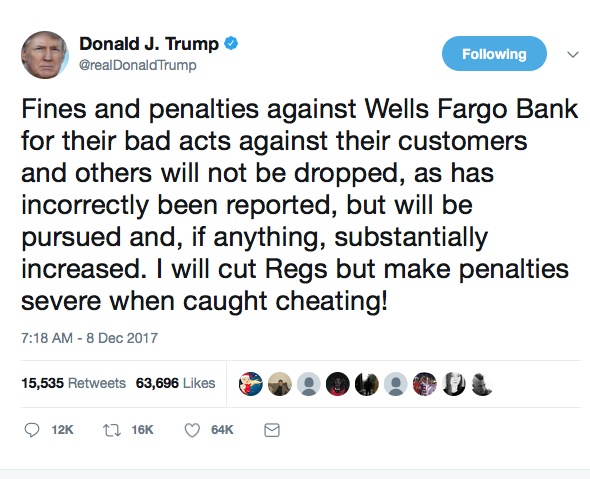
That started a stir and Trumpanzee himself jumped into the fray with this early morning tweet sure to piss off Mulvaney:


Meanwhile, the Trump Regime had a clear vision of what they had in mind in replacing Rich Cordray at the CFPB with Mulvaney. Allied Progress put out some valuable research this week showing how the Regime is already turning an organization built around protecting consumers into one that Mulvaney is leading towards harming consumers while helping banksters, predatory lenders and Wall Street special interests.
Mulvaney is Going to Pair Independent Government Regulators at the CFPB with Political Staff – A Move Experts Say Threatens the Independence of ALL Financial Regulators: Mulvaney said “he plans to start hiring political staffers, and to pair them with the career officials who currently head various CFPB divisions.” But “Congress designed the CFPB to be an independent agency in the mold of the Federal Deposit Insurance Corp., the Office of the Comptroller of the Currency and the Federal Reserve Board. Those agencies typically have far fewer political appointees than other parts of the executive branch.” As one expert put it, “Mulvaney’s plans ‘should send shivers down the spine’ of anyone who supports independent financial regulation.” [Kevin Wack, “Mulvaney’s plan to embed political staffers in CFPB sparks backlash,” American Banker, 12/5/17.]
Mulvaney Could Shelve a CFPB Investigation into a Giant Spanish Bank (Santander) for Overcharging Auto Loan Customers-- a Longtime Mulvaney Staffer Lobbies for the Bank: The CFPB has been investigating Santander “for overcharging auto loan customers. Given the tenor of recent conversations inside the bureau, agency lawyers suspect the investigation could be shelved under Mr. Mulvaney, according to four people with knowledge of the case who requested anonymity to discuss an investigation.” In 2017, longtime Mulvaney staffer Natalee Binkholder “left Mulvaney’s office to work as a top lobbyist for Santander” where she has actively worked against CFPB rules. [Jessica Silver-Greenberg and Stacy Cowley, “Consumer Bureau’s New Leader Steers a Sudden Reversal,” New York Times, 12/5/17; David Sirota, “Trump Conflict Of Interest: CFPB Pick Mulvaney Linked To Lobbyist For Bank Facing Possible CFPB Sanctions,” International Business Times, 11/26/17.]
Mulvaney is Going Easy on an Ohio-Company Which Misled More Than 100,000 Mortgage Customers and Faced an $8 Million Penalty: A federal judge agreed with the CFPB that Ohio-based Nationwide Biweekly Administration “misled more than 100,000 mortgage customers” and ordered the company to pay “$8 million in penalties.” Seeking to collect the penalty so that harmed consumers could be compensated, the CFPB sought to force the company to post a bond while proceedings in the case concluded. “Barely 48 hours later,” under Mulvaney, the CFPB reversed course. [Jessica Silver-Greenberg and Stacy Cowley, “Consumer Bureau’s New Leader Steers a Sudden Reversal,” the New York Times, 12/5/17.]
Mulvaney is Freezing CFPB Data Collection Which is Used to Protect Consumers from Discrimination and Other Industry Misconduct: Mulvaney froze the CFPB’s collection of consumer data, ostensibly “due to cybersecurity concerns.” The Government Accountability Office (GAO) had previously concluded that “the CFPB has taken steps to ‘protect and secure’ the data it collects,” including by “‘anonymizing’ the material involving identifiable individuals.” Data collection helps the CFPB “identify discrimination and other industry misconduct, and can serve as a basis for writing rules.” A CFPB official said that data is “‘essential for effective financial regulation'” and “‘allows regulators to see how markets are functioning and monitor the impact of rules.'” [Yuka Hayashi, “New CFPB Chief Curbs Data Collection, Citing Cybersecurity Worries,” the Wall Street Journal, 12/04/17; Benjamin Goad, “GAO: Nothing unusual in CFPB data collection,” The Hill, 09/22/14; Trey Garrison, “CFPB: Data collection practices within the norm for regulators,” HousingWire, 09/23/14]
Mulvaney Froze Payments to Victims of Financial Crime (But Reversed Himself Following Intense Public Outcry): When Mulvaney took charge of the CFPB, he said “he would suspend all payments from the [civil penalties] fund for at least 30 days, until he had a chance to find out ‘what that fund is all about.'” The move “drew a rebuke from two Senate Democrats, who sent a letter calling the move ‘inexplicable.'” The public outcry was so intense that Mulvaney reversed his freeze on “payments to victims of financial crime” after only eight days. [Stacy Cowley, “Consumer Bureau Lifts Freeze on Payments to Crime Victims,” the New York Times, 12/04/17]
Mulvaney is Dropping an Investigation into a Company Accused of Preying on Detained Immigrants: Under Mulvaney, the CFPB suspended “its investigation and request for a civil investigation demand (CID) of Nexus Services,” “a Virginia-based firm that handles immigration bonds.” The company was under investigation for preying on detained immigrants. [“CFPB reverses course, suspends CID investigation,” RESPA News,12/04/17; Michael E. Miller, “Company accused of preying on detained immigrants is under investigation,” Washington Post, 10/20/17.]
Mulvaney may be Freezing Enforcement Actions Against Predatory Financial Institutions: While Mulvaney has said that the bureau will continue to meet its legal and statutory deadlines,” he has said he is “reviewing the various lawsuits CFPB is party to” and has already “requested delays in two cases where immediate action was required.” [Andrew Restuccia, “Mulvaney imposes temporary hiring, regulations freeze on CFPB,” PoliticoPro, 11/27/17; Victoria Guida, “Mulvaney: No plans to fire CFPB rival Leandra English,” PoliticoPro, 12/4/17; Sylvan Lane, “Mulvaney says he won’t fire consumer bureau deputy director who sued him,” The Hill, 12/04/17.]
Mulvaney is Freezing the Hiring of Additional Personnel Who Would Help Hold Financial Bad Actors Accountable: On November 27, his first day at the CFPB, Mick Mulvaney “implemented a temporary freeze on hiring and new regulations.” He said that the freezes “will last for 30 days.” [Andrew Restuccia, “Mulvaney imposes temporary hiring, regulations freeze on CFPB,” PoliticoPro, 11/27/17.]

Labels: , , ,

Sunday, November 05, 2017

Does Monsanto WANT To Kill You? Probably Not... But They Don't Care If They Do, As Long As They Profit From It

>


Last week, Valerie Brown and Elizabeth Grossman, writing for In These Times reported on how Monsanto has captured the EPA (and twisted Science) for it's own corporate ends. Their concern is primarily health issues around glyphosate, the world’s most widely used herbicide and the primary ingredient of Monsanto's Roundup. Monsanto, they wrote, has been defending Roundup and glyphosate with research, purported to be "independent," but that was actually research funded by Monsanto itself. When EPA scientists have found Monsanto products unsafe, their finding were "reversed by EPA upper management and advisory boards, apparently under pressure from Monsanto."
Everyone is exposed to glyphosate: Residues of the herbicide are found in both fresh and processed foods, and in drinking water nationwide. More and more research suggests that glyphosate exposure can lead to numerous health issues, ranging from non-Hodgkin lymphoma and kidney damage to disruption of gut bacteria and improper hormone functioning.

The Moms Across America episode fits a pattern that has emerged since 1974, when the EPA first registered glyphosate for use: When questions have been raised about the chemical’s safety, Monsanto has ensured that the answers serve its financial interests, rather than scientific accuracy and transparency. Our two-year investigation found incontrovertible evidence that Monsanto has exerted deep influence over EPA decisions since glyphosate first came on the market-- via Roundup-- more than 40 years ago.

...[T]he EPA has overlooked a growing body of research suggesting glyphosate is dangerous. In March 2015, the International Agency for Research on Cancer (IARC) determined that glyphosate is “probably carcinogenic to humans” based on multiple peer-reviewed studies published since 2001. But the EPA has not changed its classification. Instead, the agency issued a rebuttal in September 2016 that said its scientists “did not agree with IARC”-- and cited that 1983 mouse study as evidence of non-carcinogenicity.

Controversy continues to swirl around EPA management’s cozy relationship with Monsanto. The agency’s Office of Inspector General, an independent oversight body, is currently investigating whether a former deputy director in the EPA’s Office of Pesticide Programs, Jess Rowland, colluded with Monsanto to “kill” a Department of Health and Human Services investigation into glyphosate prompted by the release of the IARC report. On April 28, 2015, Dan Jenkins, a Monsanto regulatory affairs manager, emailed his colleagues that Rowland had told him, “If I can kill this, I should get a medal.”

In the meantime, people across the country are suing Monsanto, alleging that their health problems and the deaths of their loved ones are connected to glyphosate. At least 1,100 such cases are wending their way through state courts, and an additional 240 through federal courts.
Matt Stoller's post blogger career included legislative policy jobs first for Alan Grayson in the House and then for Bernie Sanders in the Senate. More recently he's been a fellow at the Open Markets program researching the history of the relationship between concentrated financial power and the Democratic party in the 20th century. This is right up his alley and he's the first person I turned to talk about how Monsanto uses regulatory capture to further its corporate goals. "This is a problem of power," he told me this morning, "not just safety. All monopolies use political power to sustain their market position, and Monsanto is no different. The company funds a significant amount of ostensible safety research on its own products, so even if you are someone who buys the importance of GMO crops (and I do!), it's impossible to trust the regulators. What is left out of this article is Monsanto's massive merger and acquisition spree to acquire independent seed businesses, and its use of patent law and certain kinds of predatory pricing to undermine competitors and even customers. And now the company is attempting to merge with Bayer, further cementing control of the seed and chemical industry in the hands of a few. Farmers are going to feel the sting in the form of higher seed and chemical prices, and unless this moral lawlessness is stopped, we will all experience the health problems that are sure to ensue when self-policing of predatory monopolies that organize our food system is the norm."

Goal ThermometerBlue America's two most recently endorsed candidates, Iowa's Austin Frerick and Texas' Lillian Salerno, both worked in the Obama Administration and both have come to the conclusion-- "I had a front-row seat on the game being rigged," Salerno told us-- that monopolistic impulses by companies like Monsanto are a real and present danger to Americans. This morning, after he had read the piece by Brown and Grossman, Frerick told us that "Monsanto's word means nothing to me anymore. They will stop at nothing to spin the truth so long as it helps their bottom line regardless of what it does to our health or environment. It all comes back to antitrust enforcement for me. Monopolist like Monsanto have the economic and political resources to undermine and overwhelm anything that challenges it. This article is another great example of just how ruthless they are."

David Gill is running for a seat occupied by one of Monsanto's favorite puppets, Rodney Davis, who they give a $10,000 every cycle (in return for services rendered). When I asked Gill about that this morning, he said, "This is yet another example of the corporate ownership of our government, and it's no surprise to me that my Republican opponent, Rodney Davis, is one of the leading recipients of Monsanto's legalized bribery. Time after time after time, Mr. Davis takes the big bucks from the big corporations, and in exchange he shirks his duty to represent the men and women who struggle to get by here in IL-13. As a physician who has spent 29 years on the front lines, serving to protect and improve the  health of individuals and communities, I find it unconscionable that Mr. Davis sucks up the cash and then stands by quietly as Monsanto acts with reckless disregard for people's health. This is a perfect example of the swamp that voters are fed up with, and I'm eagerly looking forward to sending Mr. Davis home from D.C. in next November's election."

Last cycle, Monsanto spent $423,000 bribing members of Congress. They spent $266,000 on Republicans and $89,500 on corrupt conservative Democrats from the Republican wing of the Democratic Party, criminal congressmembers like Brad Ashford (Blue Dog-NE), Cheri Bustos (Blue Dog-IL), Jim Costa (Blue Dog-CA), Steny Hoyer (MD), Collin Peterson (Blue Dog-MN), Kurt Schrader (Blue Dog-OR) and, of course, Kyrsten Sinema (Blue Dog-AZ). Aside from the Blue Dogs the dozen House members who have made sure Monsanto could continue poisoning the U.S. food supply are:
Paul Ryan (R-WI)
Kevin McCarthy (R-CA)
John Shimkus (R-IL)
Rodney Davis (R-IL)
Frank Lucas (R-OK)
Ann Wagner (R-MO)
Adrian Smith (R-NE)
David Young (R-IA)
David Valadao (R-CA)
Devin Nunes (R-CA)
Mike Conway (R-TX)
Erik Paulsen (R-MN)
So far this cycle they have already-- once again-- made big "contributions" to some of the most notoriously corrupt members of Congress: Paul Ryan, David Young, Ann Wagner, Mike Conway, Rodney Davis, David Valadao, Kevin McCarthy and, sigh, Steny Hoyer.


Back to Brown and Grossman: "The EPA’s regulatory record on glyphosate is compromised by missing, incomplete, hidden, redacted, lost and otherwise faulty information. The EPA relies on data, most of which is unpublished, that is supplied by the manufacturer, interpreted by the industry and not publicly available. Consequently, a decisive and transparent assessment of glyphosate’s toxicity is impossible. The EPA has never wavered from its decision to dismiss and minimize the 1983 mouse study, which appears to be valid. The agency has never attempted to replicate the study in order to clarify its results-- perhaps because it feared that such evidence would demonstrate that glyphosate was indeed a carcinogen. Furthermore, it’s a pattern the agency continues to follow, discounting later studies using similar arguments and research supplied by industry that have not undergone independent analysis... Glyphosate is a clear case of 'regulatory capture' by a corporation acting in its own financial interest while serious questions about public health remain in limbo. The record suggests that in 44 years-- through eight presidential administrations-- EPA management has never attempted to correct the problem. Indeed, the pesticide industry touts its forward-looking, modern technologies as it strives to keep its own research in the closet, and relies on questionable assumptions and outdated methods in regulatory toxicology."

Labels: , , , , ,

Friday, August 18, 2017

There's Never Been A More Fetid Swamp In Washington Like The One Trump Has Set Out To Create

>


NPR's Fresh Air has a fascinating piece on Wednesday that sought to shone some light on how the Trump Regime is accomplishing quite a bit while everyone is paying attention to the clown tripping all over himself in the center ring. The guest was NY Times journalist Eric Lipton and he's been reporting on how the Trump Regime has brought in lobbyists to help destroy the regulations that have protected the public from the very industries that those lobbyists were working for-- and no doubt will again. The whole show in worth listening to and it's embedded above.

Lipton began by explaining how the Trumpists quickly changed the rules governing lobbyists in government. "[T]he Obama administration explicitly banned lobbyists from going to work in agencies that they had in the prior two years lobbied. And Trump removed that explicit restriction and has allowed quite a number of lobbyists to come into agencies to regulate the same sectors that they just a few months ago had been trying to influence... Trump eliminated the prohibition on lobbyists coming in, but he kept the two-year ban in participating in the same matter. And so then the question becomes, well, how are they enforcing this two-year ban because there are now dozens of lobbyists and lawyers who represented private industry who have been placed into the Trump administration in the same sectors that they had worked in for the private industries. But the question is, you know, how are we looking and knowing whether or not they are then working on essentially their former clients to-do lists but now with the power of the government agency that they're running?

"During the Obama administration, there was an agreement that anytime anyone was given a waiver, that waiver would be either posted on the White House website or shared with the Office of Government Ethics and made public. So we as reporters could look and see, well, this, you know, man or woman is working in the same area that they had previously been paid to represent. But we would know the conditions upon which they could do that and why they had been granted such a waiver. Then when the Trump administration started, they initially were refusing to make those waivers public despite the fact that we were asking for them. And it became the subject of a pretty intense fight. And ultimately, they made some of them public, but they don't continue to post them.


"...One of the more prominent ones is Michael Catanzaro, who was a lobbyist for Devon Energy and also for an electric utility that operates some of the largest coal-burning power plants in the United States. And so he was lobbying on things like trying to block a rule that the EPA had passed that was going to limit methane emissions from oil and gas drilling sites across the United States. Methane is many times more potent as a climate change component than CO2. And methane also-- when you release methane, you're often also releasing volatile organic chemicals, which are... you know, can be carcinogens and cause other health consequences. So the EPA was trying to regulate methane emissions. And Michael Catanzaro was working for Devon Energy to try to kill that rule. So he then goes into the White House. And he also had previously been representing the largest-- one of the largest coal-burning utilities in the United States. And he had been fighting the Clean Power Plan, which was trying to force coal-burning power plants to reduce their CO2 emissions. And so once he gets to the White House, among the things that he does is he helps write an executive order that essentially instructs the federal agencies to terminate the Clean Power Plan and the methane rule. And so he is essentially continuing the work that he'd been doing on behalf of his private-sector clients. But he's now doing it as one of the most powerful, you know, policy people in the United States. And so you wonder, how is that possible? So we were aware of Michael Catanzaro's shift. And I then went and interviewed a number of industry lobbyists who were lobbying the White House to try to get those rules repealed because they hated it. And now all of a sudden, they've got their former, you know, colleague and, you know, compatriot who is essentially helping run the show. And I said, have you talked to Michael Catanzaro since he went into the White House? And they said, yes. And I said, how is this possible? I thought there was this two-year ban on participating in a particular matter that you had represented a client on. And so we-- and then I asked the White House, well, can I see his waiver because he must have been granted a waiver. And they would not give it to me.

"After I wrote that story, the Office of Government Ethics said, you know what? This is an impossible situation. How can we have an ethics program if there - if we can't see the waivers? So the head of the Office of Government Ethics did what he called a data request, and he made a request of every federal agency. And he asked every federal agency for copies of any waivers that had been issued through April. And as a result of that request-- and there was a bit of a fight where initially the White House indicated that it may not comply with the request. But ultimately the White House complied. And there you go. On the day of the deadline, they-- the White House issues a list of waivers that had been issued, and there's Michael Catanzaro. And he was in fact-- had been granted a waiver to participate in the same matters that he had previously been paid to represent.

..."There's a guy at the Department of Transportation Security Administration. And in this case, I don't know the extent to which he has participated in the same manner. But he was working for a company that was trying to sell the Transportation Security Administration new equipment that would do security screenings. And that company had just gotten its agreement from TSA, the airport screening agency, to do kind of actual testing in its laboratory to see whether or not this equipment was worth buying and spending, you know, potentially tens, if not hundreds, of millions of dollars to install in airports in the United States. And then the same gentleman, Chad Wolf, then became the chief of staff at TSA, which would-- you know, as the chief of staff, you're involved in issues across the agency. And you know, if you're going to be making a major change in the way that you inspect carry-on baggage to look for explosives and then potentially commit to buying, you know, tens of millions or hundreds of millions of dollars in new equipment, you know, the chief of staff of the agency is going to be involved. So he is now the former lobbyist for the, you know-- explosive detection equipment is now the chief of staff overseeing, you know, various things at the Transportation Security Administration.

"There's a woman that is working in the Environmental Protection Agency who had worked for the chemical industry. And it was lobbying to try to limit the-- kind of the strength of a law intended to regulate toxic chemicals. Now she's at the EPA, helping establish the rules that will regulate the same chemicals and the same companies that she just previously had represented. And so I mean literally there are dozens of people who have made this shift from being the regulated to the regulators, and so-- at a pace that I have going back to George W. Bush and being in Washington and covering administrations that I have not seen before."

We asked two of the sharpest attorneys running for Congress this cycle, Dan Canon in Indiana and Sam Jammal in California. Dan's running for the 9th district seat held by a rubber stamp backbencher, Trey Hollingsworth. He told us that Trump's systemic dismantling of regulatory protections "is consistent not only with the unashamed corruption on display in this administration, but also the unchecked dismantling of the federal government we've seen over the last 7 months. The executive branch wants to make government into a private corporation, free from the fetters of ethical rules, public transparency, and the democratic process. And Congress isn't doing anything to hold these oligarchs accountable."

Sam Jammal, an Orange County candidate for a seat held by an entrenched top ally of Paul Ryan and the Trump Regime-- Ed Royce-- is concerned with the way the Trump Regime is perverting the role of the federal government on behalf of powerful special interests. "We need a government that works for us," he told us, "not one filled with individuals looking to turn around and make a quick buck or so biased towards one powerful interest. Regulatory capture is one of the biggest problems we face in government that no one discusses. Its an even bigger problem now with Trump and his revolving door of special interests running our government. But this has been going on for a while. The result is that we have policy decisions focused solely on the interests of the most powerful incumbents, which hurts innovation, competition and ultimately the rest of us. Everyone-- regardless of political leanings-- should be concerned. I saw this firsthand as thousands of solar jobs were lost due to regulatory capture in state public utilities commissions.

"The best way to avoid regulatory capture and the revolving door are clear rules and oversight. First, we shouldn't make it so easy for special interest representatives-- it's not just lobbyists-- being in positions to influence policy on their former employers. There must be transparency and some waiver process in order to at least require a case be made for the hire. Additionally, there should be a longer ban on returning to lobby or participate in policy roles within the regulated industry. This will remove the profit motive to write policies to open doors for the next job. Lastly, we need congressional oversight. Congress stopped holding oversight hearings years ago, which leads to powerful interests shaping policy when there are bad actors like Trump, but also leaves our government vulnerable to only favoring the loudest voices and usual suspects since no one is paying attention."

Labels: , , , , , , ,