Wednesday, July 13, 2016

Shhh! Exit (quietly) Tim Duncan

>


At a press conference yesterday, Spurs coach Gregg Popovich says, "I'm trying to wrap my head around why I'm standing here and he's not. [Pause] And we all know why."

"During interviews with Tim Duncan (a phrase roughly equivalent to 'during photo sessions with the snow leopard') the Spurs' immortal never resisted an opportunity to josh with a teammate who happened to walk by. It certainly disturbed the rhythm of the conversation—if it can be said that one rhythmically conversed with Duncan—but he wasn't sending a message to the reporter, but rather to the teammate. It said: I'm not above you. I'd rather be with you than sitting here talking about myself. So keep the shower running, and I'll be there soon.

"Duncan hid in plain sight when he was on the court, so his departure was destined to be a non-action event, coming in a press release (with no direct quotes from Duncan or anyone else) from a Spurs public relations department that over the years has figured out how to deal with his Howard Hughes ways. Maybe, just maybe, there will be a press conference down the road, during which a fidgety Duncan will likely be checking the exits after a few vanilla comments. . . ."

-- Sports Illustrated's Jack McCallum, in "Spurs'
immortal Tim Duncan retires without a whimper
"

by Ken

Of course the physical gifts were prodigious, but then, so was what he got out of them. It seems nutty to think of a player of Tim Duncan's physical presence and accomplishments as having a "quiet" career, but good heavens, think what it means to have played at that level for that long, for one team and one coach, in a system where it was the team that mattered and expectations were always high -- qualities that exude a special poignancy for those of us doomed to dwell in the service area of the NY Knicks, the Franchise That Hope Abandoned. And then to bow out so quietly, not just with no Farewell Tour, but with no farewell -- "without a whimper," as the head on Jack McCallum's nice appreciation puts it.

Here's how Jack winds up his piece:
That sturdy, I’ve-got-everybody’s-back element is now gone from the Spurs, who were often (and rightly) held up as one of the sports world’s model franchises. But it’s gone from the game, too. It’s hard to imagine that the Duncan blueprint will be duplicated—a four-year college player who comes into the league with a skill set almost fully developed, never bows to free-agent seduction, wins consistently, doesn’t change on or off the court, and then almost tiptoes out the door, no doubt flashing a sly smile at how easily he escaped.

But listen to this, Tim Duncan: Just because you won’t miss us doesn’t mean we won’t miss you.
#


Labels: ,

Thursday, March 05, 2015

Sports Watch: With leadership like this, is it any wonder that the NY Knicks are flying high?

>


Cablevision President-CEO and Madison Square
Garden Chairman James Dolan -- Whatta guy!

"There’s a little bit of North Korea to the way this team is run."
-- out-of-work lawyer Dennis Doyle, who is committed to
attend every game of the (now 12-48) NY Knicks this season

by Ken

We looked recently at the path-breaking strategy of the financial-typhoon owners of the NBA's Philadelphia 76ers, the billionaire Wall Street brains who decided to reverse the team's mediocrity by losing as many games as humanly possible. Now it seems only fair to pay tribute to the management of the 76ers' Atlantic Division rival NY Knicks, who at this moment, at 12-48, are actually a half-game worse than the 13-48 Sixers.

The Knicks are overseen by James Dolan, whose qualification is membership in a family that established dominance in cable TV on Long Island. Is it any wonder that the team has has such success since it was entrusted to him by his father?

There are many ways of measuring the Knicks' successes under Dolan's, er, leadership, but perhaps the funniest is told thusly by The New Yorker's Reeves Wiedeman in his March 9 "Talk of the Town" piece, ""
A few weeks ago, Irving Bierman, a seventy-two-year-old Brooklyn native, sent an e-mail to James Dolan, the owner of the Knicks. “As a Knicks fan for in excess of sixty years, I am utterly embarrassed,” Bierman wrote. The team had the N.B.A.’s worst record even before Carmelo Anthony, its best player, decided that knee surgery sounded more appealing than finishing a season in which ESPN had replaced a scheduled Knicks broadcast with a celebrity bowling tournament. Last week, Phil Jackson, the team’s president and resident mystic, declared that the Knicks were giving the basketball gods “heartburn.” Bierman went on, “You have done a lot of utterly STUPID business things with the franchise. Please NO MORE.” The stress of the season seemed to have got to Dolan, too. He responded to Bierman personally. “You are a sad person. . . . I’ll bet your life is a mess,” Dolan wrote in an e-mail that was reprinted by Deadspin, and went on to insinuate that Bierman had a drinking problem, while trumpeting his own sobriety of twenty-one years. “Start rooting for the Nets because the Knicks don't want you."
Wow, what class! Whatta guy!

Reeves proceeds to tell us about an authentic Knicks superfan, lawyer Dennis Doyle. Irving Bierman, he tells us, is now out of the fray, living in Myrtle Beach, where he "hasn't suffered through any games in person this season."
The same cannot be said for Dennis Doyle, a thirty-two-year-old graduate of Georgetown Law School, who, last spring, got dumped by his girlfriend, lost his job, and somehow made things worse by deciding this was all a sign that he should deplete his savings in order to attend every single one of the Knicks’ games this season. His sister, a life coach, gave her blessing; his father, a lawyer, did not. As is the modern man’s wont, Doyle started a blog documenting his journey. A recent post began, “This is starting to get difficult.

“My timing has never been great,” Doyle said, settling into his seat at the Garden before a recent game. He was referring both to his mid-recession law-school graduation -- the only job he could find was one representing co-ops in disputes with hot-dog venders operating too close to their entrances -- and to the fact that he had spent twenty-five thousand dollars on flights, hotels, and tickets. Doyle’s costs rise with each palliative arena beer, but he had come down with a bug that day, and was popping Tylenol instead. “This is my flu game,” Doyle said. He wore a down jacket with a fur-trimmed hood, which he kept on, and shielded his eyes as strobes went off during the roster introductions. “If I’m lucky, I’ll have a seizure,” he said, between sniffles.

With the season lost, Doyle had been trying to enjoy the travel. When the Knicks played in London, in the middle of a sixteen-game losing streak, he took an extra day to visit Stonehenge. (“Still a mystery why its architects engaged in such a laborious endeavor,” he said. “I can relate.”) At a casino in Cleveland, where Doyle was trying to recoup his losses, he spotted Charles Oakley, his all-time favorite Knick, at a craps table. “I got a pretty blank stare,” Doyle said, describing Oakley’s reaction upon hearing about his quest. Morris Bart, a personal-injury attorney in Louisiana, was more empathetic after reading Doyle’s blog, and offered him courtside seats for the Knicks game in New Orleans, on the condition that Doyle submit to a lecture about why he should return to the law.

Doyle hoped to avoid that fate, but he said that he was prepared to offer his services, pro bono, to a cause advocated in an op-ed in the Observer by a fellow-lawyer, who cited court decisions from three different centuries to argue that New York City could use eminent domain to take over the Knicks as a blighted property. “There’s a little bit of North Korea to the way this team is run,” Doyle said. He suspected the team of attempting to pacify the masses -- the frequency of in-game T-shirt tosses seemed to increase as the season wore on -- and hoped that a pseudoscandal like Dolan’s intemperate e-mail would foment regime change. “What I wouldn’t give for him to get caught up in some kind of Donald Sterling thing,” Doyle said. (Adam Silver, the N.B.A.’s commissioner, declined to sanction Dolan’s behavior. “Jim is a consummate New Yorker,” Silver wrote. “Jim got an unkind email and responded with an unkind email.”)

Doyle had passed the season’s halfway point, and remained committed to attending every game, despite the fact that he had yet to find a single friend who was willing to join him at the Garden. He had, however, found an agent, who sees promise in a blog-to-book deal, and has told him not to worry about the mounting losses. “At this point, it’s actually in my best interest to root against the team,” Doyle said, noting the market for books about overcoming adversity. “Hopefully, the suffering resonates.”
#

Labels: ,

Thursday, December 04, 2014

Can billionaire Wall Street brains outthink the rest of the NBA? Meet the 1-17 Philadelphia 76ers

>


At least the 76ers are easy to find down there at the bottom of the NBA Eastern Conference standings (from ESPN). If you're thinking they might look less dismal in the Western Conference, it's currently anchored by the Minnesota Timberwolves, who at 4-13 are 3½ games, er, better (for want of a better word). Then again, the 76ers are riding a one-game winning streak.


"The players are not trying to lose; rather, the owners have assembled a team with little hope of winning, thereby giving themselves a better chance of obtaining a big-time star in next year’s draft."
-- the NYT's David Gelles, in "Philadelphia 76ers
Take the Low Road to the Top
"

"I'm all for the tank program, but it's getting ugly. . . . The opponents are using us as a night off. They're cheating the fans."
-- 76ers radio pregame host Phil Allen, quoted by David Gelles

by Ken

As David Gelles notes in his piece, the Philadelphia 76ers are doing a lot of losing this season.
The 76ers are 1-17, nearly tying the league’s record for futility to start a season. The team’s first win came Wednesday night against the lowly Minnesota Timberwolves.
And he describes this as the "spectacular" result of a strategy now being pursued by the team of Wall Street financiers that three years ago took over the team that, he points out, "has been to more N.B.A. Finals than any team besides the Lakers and Celtics." What they're doing, David says, "has become a test case for what happens when the cold, hard calculations of the business world are applied to the emotionally charged landscape of professional sports."

And what they're doing, in a word, is losing.
[I]nstead of spending lavishly on star players, the owners have employed methods honed at the private equity firms where they made their fortunes. Josh Harris, the billionaire who leads the new owners group, and his front office sized up the N.B.A. marketplace and discovered something counterintuitive: the best route to the top just might be through the subbasement.

The 76ers, turning the fundamental belief system of sports on its head, don’t mind losing. A lot.
There actually is a strategy here, based on the reality that NBA teams, especially unsuccessful ones, have little hope of obtaining the kind of franchise players who can turn the team into a winner is via the draft.

The new owners discovered the hard way that free spending may not be the ticket when, as David points out, they shelled out big bucks on Andrew Bynum, who "did not play a single game for the 76ers and signed elsewhere after the team paid him $17 million." (The four co-owners, by the way, are all financial overachievers who graduated from the University of Pennsylvania's Wharton School of business, and in their years in Philadelphia became 76ers fans. At the head is Josh Harris, "a co-founder of Apollo Global Management who is worth $2.6 billion, according to Forbes." The group also includes David S. Blitzer, "a senior executive at Blackstone, the world’s largest private equity firm.")

The new ownership began stockpiling draft picks through trades of players who might have some value. But for a crack at the very top players, your team has to play badly enough to win you a choice spot in the current season's draft order, which mostly rewards futility in the previous season. (Not entirely, though: In the mid '80s the NBA decided it had to do something to discourage teams with close-to-the-worst record from striving for the worst and instituted a lottery. The system now allocates the top three picks by lottery among the 14 teams that didn't make the playoffs, though a complicated weighting system improves the odds for the, er, most deserving teams. Again, though, the lottery applies only to those first three picks in the first round of the draft. After that the order is based on losingest records.)

Last year the owners "brought in new management, including a former Madison Square Garden executive, Scott O’Neil, as chief executive and a data-driven general manager in Sam Hinkie." Their mandate is to rebuild the team through the draft.

David Gelles points to precedents for rags-to-riches stories from draft magic.
The Cleveland Cavaliers had the worst record the season before they drafted LeBron James. A few years later, the Seattle SuperSonics franchise (now the Oklahoma City Thunder) was accused of tanking but drafted Kevin Durant. James and Durant are now two of the league’s biggest stars and regularly lead their teams deep into the postseason.
Of course, thanks to the lottery, having the worst record doesn't even guarantee you the top pick. And the reality is that even the top pick doesn't often turn out to be a LeBron or a Kevin Durant. "Last year," David recalls, "the 76ers had the second-worst record in the league but wound up with the third pick. They chose Joel Embiid, a center from Cameroon who has yet to play a game in the N.B.A. because of injuries."

"I don’t understand this strategy at all," David was told by Russ Granik, a former NBA deputy commissioner, now a banker at Galatioto Sports Partners. "It seems ill-advised. You can’t assure yourself of anything in the lottery, and you can’t assure yourself when the next LeBron James or Tim Duncan is going to come along."

Of course lots of teams have achieved some success at using the draft to lift themselves out of the NBA basement. But David says that chief executive Scott O'Neil --
acknowledged that the 76ers had taken this strategy to new extremes. His is the youngest roster in the league, full of rookies and castoffs. So far this season, the team has not paid out the minimum amount required for player salaries by the league.

“We’ve gone further,” he said. “This is the youngest team in N.B.A. history. With that comes the perils of youth.”
Still, David notes, "losing is taking its toll on Philadelphia fans. "
At Monday’s game, many in the crowd cheered for the visiting San Antonio Spurs.

Attendance at 76ers games is the second lowest in the league, behind small markets like Sacramento and Memphis. Many of the concession stands remain closed during games. Stalls selling team merchandise attract few buyers.

Longtime fans say they understand the strategy but find it hard to watch. Phil Allen grew up selling sodas at 76ers games. Today, he is host of the 76ers pregame show on 97.5, The Fanatic, a sports radio station.

“I’m all for the tank program, but it’s getting ugly,” he said.

Wearing a black pinstripe suit and roaming the baseline at the Spurs game, Allen, who is also a season-ticket holder, lamented the fact that the 76ers are so bad, visiting teams don’t even bother to start their star players. On Monday, the Spurs rested Tim Duncan and Tony Parker and still won easily.

“The opponents are using us as a night off,” he said. “They’re cheating the fans.”
But team chief executive Scott O'Neil told David that "to reach great heights, his team had to take outsize risks."
If you loo at the fortunes that have been made in private equity and Wall Street, very few have been made going with the wind. The great ones are the big bets, and this is a big bet.
And David points out that, while O'Neil's Whartonbred bosses may be following private-equity habits by scrutinizing their business model and trying to outstrategize the other teams, the strategy they've evolved is longer-term than one might normally expect from private-equity hot shots.
They are investing in some long-term assets, including a new practice facility. And despite an enormous potential profit, they do not plan to sell the team.
It remains to be seen, if you're a 76ers fan, whether this is good news or bad news. My own instinct is that big-time money-makers in other fields who think their supposed genius will work just as well in sports, well, it usually doesn't.
#

Labels: , , ,

Friday, August 22, 2014

Catching up with: Openly gay NBA center Jason Collins -- since coming out, his life is "exponentially better"

>

And we catch up with the St. Louis Rams' Michael Sam


Brooklyn Nets center Jason Collins, now 35, says he doesn't know yet what's in store for next season.

"[New York] is where the Stonewall riots happened. Flash-forward to when I entered a game and got a standing ovation when I took the court for my team. As a society we're on the right path."
-- Brooklyn Nets center Jason Collins,
to the Washington Blade's Michael K. Lavers

by Ken

In April 2013, I wrote a post called "Still-active NBA center Jason Collins comes out -- is this the 'breakthrough' we've been waiting for?" Looking back at the hullabaloo that surrounded Jason's self-outing in Sports Illustrated, it seems all the more unfortunate that it was such a big deal, because it has proved to be so small a deal for basketball. Jason wound up signing with the Brooklyn Nets and playing out the 2013-14 season, including the playoffs (at least as far into the playoffs as the Nets got), and as he tells Max Blau in an interview for the website Creative Loafing Atlanta:
There was a big media reaction with cameras for my first game. But after about two weeks, it died down. I would have a game and no one would ask me a question. It was literally back to business as usual. Female athletes have been doing this for years and are still playing. Male athletes have some catching up to do being out there. But that story can only be written about in so many ways before it goes back to being about the sport.
Basketball seems amazingly unchanged, or maybe not so amazingly, because really what was supposed to happen? The lurking fear -- or perhaps hope, on the part of people who really wanted it to be a problem -- was disaster in the locker room, the end of team cohesiveness. Which was probably always foolish. Can there really be a locker room anywhere in professional sports where players aren't aware that they're dressing with gay teammates?

It's too soon to say that basketball or any of the other big-time sports have definitively gotten past this ancient taboo, but what happened this season with Jason Collins seems to me nothing but good for basketball. And there's no question that it's been good for Jason.

The Washington Blade's Michael K. Lavers begins his newly published interview with Jason (actually conducted last month) this way:
Brooklyn Nets center Jason Collins was at an event in D.C. in June when someone approached him and said his story as the first openly gay man to actively play for a major professional sports team helped him repair his relationship with his mother.

“I’ve heard other stories along those same lines,” Collins told the Washington Blade last month during an interview. “It’s just really great to see when you have an impact.”

Collins said his life is “exponentially better” since he came out in a Sports Illustrated op-ed in April 2013.
Jason recalls the enthusiastic response of Nets fans:
Collins received a standing ovation from the fans inside the Barclays Center when he took the court during his first playoff game.

“The atmosphere was incredible,” he told the Blade. “Even my first game back during the regular season when I entered the game and getting a standing ovation from the crowd in Brooklyn is something that I will never forget. This amazing moment shows the character of the fans in Brooklyn.”
I don't think it's that hard to imagine how liberating it has been for Jason to live honestly with himself, his teammates, and the public. In the Creative Loafing Atlanta interview, asked by Max Blau about a local connection, he offers a poignant recollection of life in the closet:
In your article, you discuss how the 2011 NBA lockout was a catalyst for later coming out. You played for the Atlanta Hawks during that time. What role did Atlanta play in that process?

I lived Downtown one year and Midtown for two years. Midtown has a very cool LGBT environment. I was living in one of those apartment buildings and would always look out the window and think, "It sure looks like fun down there!" [laughs] I used to go running through Piedmont Park a lot. On the way back to where I lived, I'd go past restaurants and see LGBT people enjoying things like Sunday brunch. Seeing positive examples of people living their lives. It did help knowing that life might eventually be my life.
Jason is also crystal clear about the leg up on issues of inequality a person gets by being both black and gay:
Atlanta is a city with a vibrant LGBT community. But Georgia still has a constitutional amendment banning same-sex marriage in place. Did you keep tabs on LGBT rights while you lived here? If so, how did you feel about it?

I was more than aware. I had a "Welcome to the South" moment. I was on the ninth green at the Chastain Park golf course in Buckhead and a Caucasian young man said the "n-word" to me. Not only was I aware of LGBT issues, but also racial [discrimination]. We've advanced a long way in this country from when my grandmother grew up in upstate Louisiana under Jim Crow laws. We still have a lot of work to do as far as overcoming racial issues. They're now going on in other parts of the country. It's going on in Missouri right now. That's part of the reason why I talk about being black and gay. There are constant reminders [of both] with regards to the equality in this country.
Jason has been doing a lot of traveling, and talking, and listening. He was happy to provide encouragement and advice to football defensive lineman Eric Sams, who went through his own highly publicized coming out in February before the NFL draft. The Blade's Michael Lavers writes:
Collins is among those with whom Sam spoke before coming out.

The Nets center told the Blade he was “very proud” of the acceptance speech the former University of Missouri defensive end gave when he accepted an award during ESPN’s annual ESPY Awards that took place in Los Angeles last month.

“I continue to tell him just how proud of him I am,” said Collins, noting he met Sam’s partner and his parents at the ESPY Awards. “It’s really cool to see how everything is progressing.”
As for his future in basketball, as a free agent again (the Nets don't seem to have much interest in bringing him back, but there are usually jobs in the NBA for role-playing big men, especially once the season is under way), Jason tells Max Blau:
I'm honestly stuck right now. I told myself I'd make a decision in mid-September about whether I want to keep playing or move on to other passions in my life. I'm still in shape if I decide to give basketball one more go.
In the Blade interview, Jason underscores his admiration for the female stars like Billie Jean King and Martina Navratilova who helped pave the way for "out" athletes.
“With athletes like myself and Robbie Rogers and Michael Sam, we’re showing athletes that we’re adding a few pages to that playbook,” said Collins, noting male athletes often come out after they retire. “It’s something that female athletes have been doing for years, whether it be Martina Navratilova all the way up to Brittney Griner.”
"Right now," Jason tells Max Blau,
I'm really just enjoying my summer. I went to London for the first time for Wimbledon. I'm also enjoying my time going around the country talking about civil rights issues. I'm going out there and giving people a face, not just an abstract concept, to break down prejudices, misconceptions, and stereotypes.

SPEAKING OF THE ST. LOUIS RAMS' MICHAEL SAMS


USA Today caption: "Green Bay Packers quarterback Scott Tolzien (16) gets a pass away before getting hit by St. Louis Rams defensive end Michael Sam (96) during the second half at Edward Jones Dome."

One of the story lines of the NFL preseason has been the Rams' seventh-round draft choice's battle to make the team. As USA Today's Tom Pelissero reports today:
Halfway through the preseason, rookie defensive end Michael Sam's primary hurdle for making the St. Louis Rams' roster hasn't changed.

It's a numbers game with one of the NFL's most talented defensive lines, and Sam — the seventh-round draft pick from Missouri who is trying to become the league's first openly gay player — remains a third-stringer entering Saturday's third exhibition at Cleveland.

But when the final cuts come Aug. 30, former Rams vice president of player personnel Tony Softli believes Sam will survive — if he shows some versatility over the next two games to contribute on special teams.

"Michael Sam has shown enough rushing the passer — and that's what he is, he's a DPR, he's a designated pass rusher — that he can get off and beat a tackle on the upfield shoulder. He can spin and come underneath," Softli told USA TODAY Sports on Thursday.

"He's got to prove he can do it on special teams, and I think that's going to be his (way) to make this team."
But what's interesting here is that, apart from the reference to Sam "trying to become the league's first openly gay player," the discussion is entirely about football, as of course it should be.

The Washington Post's Mark Maske makes this point nicely in "For Michael Sam, a victory even if cut from St. Louis Rams roster":
Amid all of the attention, Sam’s story is now approaching the next watershed moment, one that surfaces questions that will resonate far beyond the St. Louis locker room: What if Sam doesn’t make the Rams roster? What happens if he is cut?

Like any seventh-round draft pick, Sam is far from a lock to start the season as one of the 53 names on the Rams’ active roster. His attempt to survive cut-down day is further complicated by the Rams’ talent-rich corps of defensive linemen, led by Robert Quinn and Chris Long. But while he may fall short of securing a roster spot when rosters are trimmed for the final time Aug. 30, from a certain perspective, Sam may have already succeeded. By turning a media frenzy into business-as-usual, by fixing the preseason narrative solely on Michael Sam the football player, both Sam and the Rams have already earned an important victory for sporting social rights.
Maske talked to an assortment of observes with "inside football" credentials, who agreed that coach Jeff Fisher and the Rams front office will make their roster decisions based entirely on football considerations. Which seems further evidence that at least in this matter, as we heard Jason Collins say at the top of this post: "As a society we're on the right path."
#

Labels: , ,

Tuesday, February 25, 2014

From Arizona to K Street: Profiles in courage, 2014 right-wing-loon-style

>

"Like rats on a sinking ship"


by Ken

TO BE SERIOUS FOR A MOMENT,

because we're about to descend into the pit of American Cuckoo, maybe the most significant aspect of such recent developments as Arizona's passage of a "Right to Hate the Homos" bill and the coming of openly gay athletes to the NBA and the NFL is the response. In the case of Arizona, the spontaneous outpouring of outrage, not just from across the country but from within the state almost makes a person proud to be an American. And in the case of the latest "integration" of American professional sports, what's great to hear is how many people are asking why it should be a big deal that NBA veteran Jason Collins, having already gone public with his sexual orientation, was signed to a ten-day contract by the Brooklyn Nets, or that all-America University of Missouri defensive end Michael Sam went public ahead of the upcoming NFL draft.

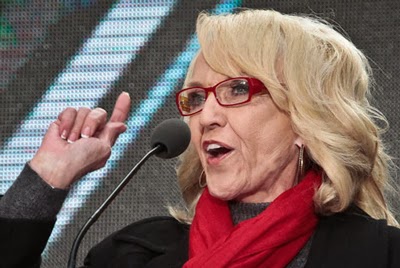
As I write, as you know, the clock is ticking on Arizona Gov. Jan Brewer to make her momentous decision, whether to sign or veto the splendid piece of legislation sponsored by her state's equally splendid legislature authorizing Christians who jes' hate us them goddam homos to refuse to have anything to do with them, including doing any kind of business with them, on the ground that the Bible tells us so.

There doesn't seem to be much doubt that left to her own devices Governor Jan would sign the bill in a heartbeat, and maybe do a little dance in celebration. She's just a hatin' kinda gal. Unfortunately, she has found herself at the center of a shitstorm of panic coming not just from the predictable bleeding-heart-socialist Left but from her very own Rock-Ribbed Right. To quote the head on Zack Ford's ThinkProgress piece: "Conservative Lawmakers And Arizona Businesses Urge Governor To Veto Anti-Gay Bill."

The "lawmakers" in question include not just both of the state's U.S. senators, those flaming liberals Young Johnny McCranky and Jeff Flake and several of its U.S. representatives but a number of Arizona mayors and even a bunch of the state legislators who voted for this splendid piece of legislation. Many of those legislators are apprarently running to succeed Governor Jan (as if so stellar a public servant could be truly replaced!). State Sen. Steve Pierce, for one, professing concern with a possible "negative picture" of the state, now says, "I screwed up. I'm trying to make it right."

Of course it's nothing new for Arizona to stand proud as the Conscience of America's Hatin' Loons. How long, after all, did the state hold out against the federal holiday honoring that goddam troublemaker Martin Luther King Jr.? In the end, of course, Arizona businessmen saw an alarming share of the nation's business that once came to them going to other, less principled states.


February 25, 2014
ARIZONA CONFRONTING AWKWARD REALIZATION THAT GAY PEOPLE HAVE MONEY, BUY STUFF
Posted by ANDY BOROWITZ


PHOENIX (The Borowitz Report) -- The state of Arizona found itself in the middle of a conundrum today as it awoke to the awkward realization that gay people have money and buy stuff.

Just days after the Arizona legislature passed a law that would enable businesses to discriminate against gays, it emerged that gays spend billions of dollars in Arizona each year -- an unexpected development that seemed to take many legislators by surprise.

Carol Foyler, a Tea Party Republican who supported the anti-gay law, said that the startling bombshell that gays play a role in the state's economy put her and her fellow lawmakers "in a tight spot."

"Quite frankly, we were blindsided by this," she said. "We had no idea that gays had money and bought things just like regular people do."

Acknowledging that her vote for the anti-gay law might have been calamitous for the state's economy, Ms. Foyler placed the blame for it squarely on the shoulders of one group: the gays themselves.

"How was I supposed to know what gay people do with their money, etc., when I don't personally know any gay people?" she asked. "I'm sorry, but it was up to the gays to tell us."
Indeed the Arizona business community has been a little quicker on the uptake this time around. ThinkProgress's Zack Ford reports:
The CEOs of the Arizona Chamber of Commerce and Industry, the Greater Phoenix Chamber of Commerce, Greater Phoenix Leadership and the Southern Arizona Leadership Council wrote to Brewer requesting a veto:
After analyzing the bill, we are very concerned about the effect it could have on Arizona's economy. As leaders in the business community, we cannot support measures that could expose our businesses to litigation, nor do we want to send a message that our state is anything but an open and attractive place for visitors and the top talent that will be the cornerstone of our continued economic growth.

If specific Arizona issues related to religious liberty are identified, we would stand ready to work with anyone to ensure that any solution addresses those problems while also ensuring that all individuals feel welcome in our state and that business is not hurt.
According to Kirstin Jarnagin, vice president of the Arizona Lodging and Tourism Assocation, people are already cancelling trips to Arizona because of the negative perception the bill has brought to the state. . . .

Oops! Why, George Takei is talking about leading a national boycott! Can the rest of Starfleet be far behind?


WHAT GOVERNOR JAN COULD DO . . .

Poor Governor Jan! All those people fussin' and hissin' at her to veto the damn bill, jes' 'cause those folks don't know their Bible, and how God and Jesus and everybody demands that the righteous hate them homos.

If she was really cagey, what Governor Jan would do is, yes, veto the damn bill -- but on the ground that it doesn't go far enough! Well-meant as this bill undoubtedly is, it leaves the state open to the charge of singling out the gays and the lesbos for hatin'. Whereas the point is that Arizona is just tryin' to preserve the rights of all good old-fashioned Bible hatin'.

So the governor sends the bill back and says she won't sign it till it's more, y'know, inclusive. Like the Jews. Doesn't the Bible to tell us to hate them damn Jews? Didn't they kill our Lord, and drink the blood of Christian children? And they've got those big-ass noses, and damn, they just smell bad. Why should righteous folk have to be, y'know, kowtowin' to the likes of them?

It seems to me like the perfect solution. All those people screechin' about gettin' the bill vetoed get what they want, and Arizona still gets to stand up proud for what it's righteous folk stand for.


MEANWHILE IN THE CUCKOO CORRIDORS OF
K STREET: STANDIN' UP AGAINST SPORTS HOMOS


Thanks to the Washington Post's Jonathan Capehart for calling attention to this nuttiness: a Washington lobbyist who not only thinks that gays should be banned from the NFL but that Congress should pass a law doing so.

You're going to think that this report comes from The Onion, but no, I swear, it comes from The Hill:
Lobbyist drafts bill to ban gays from NFL

By Rebecca Shabad

Washington lobbyist Jack Burkman on Monday said he is preparing legislation that would ban gay athletes from joining the National Football League.

Burkman in a statement said he has garnered political support for the bill, though his statement didn’t mention any specific lawmakers who are behind it.

"We are losing our decency as a nation," Burkman said in a statement. "Imagine your son being forced to shower with a gay man. That’s a horrifying prospect for every mom in the country. What in the world has this nation come to?"

Burkman said he came up with the idea after college football star Michael Sam publicly revealed he is gay a few weeks ago. If drafted, Sam would be the first openly gay player in the NFL.

Jason Collins on Sunday became the first openly gay athlete to play for a major men's professional sports team when he suited up for the NBA's Brooklyn Nets against the Los Angeles Lakers.

A number of Democratic lawmakers voiced their support of Sam after he revealed his sexual orientation in an interview with ESPN, and first lady Michelle Obama hailed him as an "inspiration."

Burkman was not available to speak with The Hill but urged Congress to act in his statement.

"If the NFL has no morals and no values, then Congress must find values for it," Burkman said.

Burkman serves as founder and president of his own lobbying firm, Burkman Associates. He has also worked as of counsel at law firm Holland & Knight. In the 1990s, he served as counsel to then-Rep. Rick Lazio (R-N.Y.).

In a statement to The Hill Tuesday, Holland & Knight said it "is proud of its support of the LGBT community and we condemn Jack Burkman's current efforts. Mr. Burkman's employment with Holland & Knight ended almost 12 years ago. He was a lawyer in our Washington office from October 1998 to May 2002."

Burkman's firm, JM Burkman & Associates, signed 70 new clients last year, the most of any K Street firm, a recent review by The Hill found. 

The four-lobbyist firm specializes in helping companies secure contracts with the federal government.
You'll note that our Jack's former associates are also running from him as fast as their legs will take them. This is also a good sign.
#

Labels: , , , ,

Sunday, November 16, 2008

Toilet Paper And Soap Are Recession-Proof... Expensive Concert Tickets? Not So Much

>

No ticket sales

Friday night I was in Glendale trying to find a book on Senegal since I'm going to Dakar for 4 or 5 days on my way to Mali. As long as I was there I figured I'd have dinner at my favorite Italian restaurant on the east side of L.A. They know me well and I can usually slide right in, although sometimes on a busy weekend night, it's not so smooth. Friday was plenty smooth. About a quarter of the tables were empty. I asked the owner how business has been. He said it's following the stock market, "one day up and three days down." He also said that there's no possibility of a profit for 2008 and he's praying he can pay his rent, taxes and employees. And his business is only off by 15%! I asked because another restaurant I love may have to close, their business off by 25%. I was there the other night and I was the only customer. They closed early.

That the entertainment business is notoriously resistant to macro-economic trends is a truism stemming from how well cheap entertainment managed to do during the Great Depression. It hasn't really be true-- or cheap-- since then. And this time around the Biz is being crushed by its own Bush-era greed and excesses. Despite boosterism from free-market admirerers, the entertainment business, especially the sectors involved in overpriced tickets, has been hemorrhaging red ink for a couple years; it's getting worse now.

Nobody in the Biz wants to talk about it-- or admit that ticket sales are in the toilet... or already flushed down it. I'm on the Board of a business 100% dependent on concert ticket prices. We spent virtually our entire last Board meeting discussing how to cut back... on everything, and to prepare for the worst case scenario.

I could be wrong about this but I think most music biz types shudder if they hear they or one of their projects has been mentioned in Bob Lefsetz's newsletters. His latest starts with a definitive attack on one of rock's last remaining heroes: "Neil Young is a jerk." I like Neil-- and his music-- a lot and I wouldn't categorize him in the same terms as Lefsetz. But Leftsetz isn't altogether wrong about one thing-- something that goes way beyond Neil. Concert tickets are way too high-- part of a bloated system as unrelated to delivering good music as HMOs are to delivering quality health.
With even the Wall Street guys unable to pay the ridiculous prices for great seats, the business is learning a big lesson. It is not recession-proof. As for the bands who've toured the same markets, year after year, with no new hit material? How many times do you need to see the Stones? They don't sell out anymore.

Some artists still do, usually one with cult audiences like Madonna. With tickets to her shows selling between $350 and $55 a pop, every single one of her recent concerts sold out including 4 nights at Madison Square Garden, 2 nights in Chicago, 2 nights in Oakland, 2 nights in Boston and a night in East Rutherford, NJ. Lucky for her all those shows were before the gays decided to put all their boundless energy into fighting for equality and against Mormons. And if you're not Madonna... ticket sales are looking dismal, even beyond dreck like Charlie Daniels, Five For Fighting or the must-see nostalgia combination of Great White, Asia, Dokken and Sweet. Last week a panic-stricken Ticketmaster started experimenting with a new concept: easing off on brutally ripping off their customers.
Ticketmaster is famous for fees that concert goers love to hate. Now the ticketing giant is experimenting with dropping those fees in an attempt to gain customers in an increasingly tough economic environment.

Tickets for the Eagles' upcoming concert will be available without any Ticketmaster convenience fees, and if you print your tickets at home, no delivery or handling fees.

The predatory monopolists have worked out a deal with The Eagles to bring down the cost of the tickets so that they band wouldn't suffer the fate of so many older artists and have to cancel their tour.

High prices are turning off concert goers, even though promoters have actually persuaded musicians to stop gouging their fans and have actually started lowering ticket prices slightly after two dismal years. As the reality of the Bush Economic Miracle and what appears to be a full-fledged economic collapse, it may be too late. And even if fans are willing to scrape up the money for overpriced tickets, there is widespread fear in the music biz that they will be spending far less on merchandise and at the concession stands, a major source of income.

The sports teams also having a tough time, having similarly priced themselves into a precarious situation in hard times. In Friday's NY Post Phil Mushnick reported an ugly scene in Memphis where the Knicks played the Grizzlies. Watching on TV he writes that "nearly every shot showed rows and rows of empty seats. The most expensive seats, from courtside and roughly 25 rows up, were almost all vacant. And expensive seats for Grizzlies games are on the NBA's low side, $100-$200 per. And this was just the Grizzlies' third home game of the season. The box score claimed that attendance was 10,129, eight more than the club's previous game in the 19,000-seat FedEx Forum. But if that were the case, most patrons were seated directly behind the TV cameras." An eyewitness claims there were 4,000 people there. And it gets worse.
In Sacramento, where the Kings would regularly sell out the 17,300-seat Arco Arena, the home opener was played to at least 5,000 empty seats - and attendance has fallen since. Indiana, Philly and Charlotte are way down, too.

By late spring, you'll likely hear and read that a couple of NBA and NHL teams are close to suspending operations, unable to make rent and payroll, that corporations that bought arena naming rights and businesses that bought big-ticket advertising are behind in payments. There will be more layoffs than layups, more undertakers and no underwriters.

There will be no new vanity-purchase buyers, no consortiums with which to consort. Even the new reliable among team investors and sponsors-- casino owners and operators-- are bleeding millions.

If you follow hockey, you probably already know what a disaster that's been. Pat Hickey reporting for the Montreal Gazette paints a bleak picture that is bound to get much, much bleaker.
In Atlanta, they have experienced the three smallest crowds of the past four seasons. Attendance has dropped 15.7 per cent to 13,384.

The Islanders are on life support as owner Charles Wang tries to get a new arena to replace the Nassau Mausoleum, which is the oldest and smallest building in the NHL. The latest rumbling is that a frustrated Wang would be willing to sell to the right bidder or, if he gets desperate, to Jim Balsillie.

The Lightning and Devils are down, and Columbus, which sold out every game in the 2001-02 season, had only 10,424 fans attend a Monday night game against Anaheim. That was the smallest crowd for the Blue Jackets in the history of Nationwide Arena.

Cheaper seats have helped Dallas turn things around, but attendance has dropped considerably in Colorado, where the Avalanche once sold out 487 consecutive games. That streak is a memory.

Attendance is down 6 per cent in Los Angeles, where the Staples Centre is filled to 83.4 per cent of capacity. But my spies there tell me that - as is the case in many other arenas - the nightly attendance figures are inflated.

Economic reality isn't going to be denied and vast empires based on unrestrained greed are crumbling before our eyes. Lucky so many of us get by so well with virtual entertainment (and Depression era cheap movie tickets) these days. Looks like NASCAR is about to lay off 1,000 employees.

Damn real estate market!

Labels: , , , , ,