Saturday, October 19, 2019

Another Side Effect Of Trumpism: Americans Are Losing Their Religion-- Rapidly

>


The latest Gallup poll concludes that Christianity is rapidly declining in the U.S.. "The religious landscape of the United States continues to change at a rapid clip. In Pew Research Center telephone surveys conducted in 2018 and 2019, 65% of American adults describe themselves as Christians when asked about their religion, down 12 percentage points over the past decade. Meanwhile, the religiously unaffiliated share of the population, consisting of people who describe their religious identity as atheist, agnostic or “nothing in particular,” now stands at 26%, up from 17% in 2009. Both Protestantism and Catholicism are experiencing losses of population share... The share of U.S. adults who are white born-again or evangelical Protestants now stands at 16%, down from 19% a decade ago."


Are Trump and his satanic bagmen, disguised as religious leaders, driving people away from Christianity? If you know anyone who's losing their religion-- or their faith-- suggest they start reading, a progressive pastor's blog: John Pavlovitz's Stuff That Needs To Be Said-- for a refreshing and reinvigorating perspective on faith.


Yesterday's post, I Resist Because I'm A Christian starts with the words evangelical leaders have moved far away from in their twisted decision to worship Trump. "As a Christian," wrote Pavlovitz, "I take the words of Jesus seriously. They matter to me. I don’t think they’re theoretical ideas meant to be uttered for an hour on Sunday or kept locked in stained glass museums or contained solely in memorized prayers or resigned to live only in Twitter bios-- I think they’re supposed to propel me out of privilege and prejudice, and into the places where grieving, hopeless, hungry, tired people are so that I can give comfort and be a help. I think they’re supposed to cause trouble for the powerful and be good news for the poor. I think they’re supposed to bring peace and justice and equity-- even if they put me in harm’s way. I don’t think I can call myself a Christian without living the words."


[I]t is because of the words of Jesus and my commitment to trying to emulate his character in the world, that I resist right now.

It is not a political affiliation that moves me, but a moral conviction, a spiritual agitation.

My faith compels me to push back.

I resist this Administration’s bigotry, because I see Jesus celebrating Samaritans and dining with prostitutes and touching the lepers and welcoming outsiders.

I resist its callousness, because I see Jesus embracing the grieving and healing the sick and defending the oppressed.


I resist the bloated arrogance and spitting malice and unrepentant cruelty of this Presidency, because I hear Jesus say that the peacemakers and the meek and the pure in heart, walk the path that good people are called to humbly walk.

I resist all of this because the Jesus I find in the gospels first resisted it. He opposed power, hatred, greed, and contempt for difference. That was the whole story: loving loudly and being willing to suffer and die on behalf of someone else.

Jesus lived a life fueled by compassion for hurting people, one fiercely devoted to bringing equity and letting more people come to the table. He dismantled the walls between people, leveled the ground that separated them, showed their inherent worth.

He wouldn’t be abiding white nationalism or gun-waving hubris or the bullying of gay couples or the defending of Confederate monuments. He wouldn’t be tolerating  religious people making their beds with dictators or a Church that cowered to hateful power.

These would be the very tables he would be turning over, so I too am upending them.

Resistance isn’t a hashtag or a catch phrase or a bumper sticker slogan and it has nothing to do with a party or a President.

It’s the most sincere prayer I can utter, the most tangible expression of belief I can offer, the clearest declaration of my faith that I can make in these moments.

Resistance to hatred is continuing the work of Jesus and so I do this work-- so help me God.


This morning the New Yorker published an essay by Eliza Griswald, Teaching Democrats To Speak Evangelical, about the role Vote Common Good is playing in make a space for evangelicals turned off by Trump's nature and by his excesses. A few weeks ago, at the invitation of Ted Lieu, Vote Common Good founder Doug Pagitt and VCG political director, Robb Ryerse, both pastors, explained the group's work to progressives in Congress. "Trying to memorize John 3:16 in the car on your way to the event and then quote that is probably not the best way to connect with faith-based voters,” said Ryerse. "He had seen a candidate try this trick on the way to a rally in Kansas and then struggle to remember the phrase onstage."
The exodus of religious voters from the Democratic Party over the past several decades is typically explained by the culture wars, most notably over abortion. As the historian of religion Randall Balmer notes in his book Thy Kingdom Come, in the sixties and seventies, the Democratic Party had a large Catholic contingent and mostly opposed abortion. By contrast, many prominent Republicans-- including Nelson Rockefeller; Ronald Reagan, during his time as the governor of California; and Harry Blackmun, the Supreme Court Justice who wrote the opinion in Roe v. Wade-- affirmed and expanded abortion rights. But, beginning in the early seventies, evangelical preachers such as Jerry Falwell and Pat Robertson worked with Republican strategists to press the Party to more vigorously oppose abortion. At the same time, the second-wave feminist movement pushed the Democratic Party to defend women’s reproductive rights. As a result, pro-life Democrats, most notably religious voters, began defecting from the Party.

Pagitt believes that this history is overly simplistic. He points out that a large percentage of Democratic voters--sixty-seven per cent, according to a Pew poll from 2018--still claim a religious affiliation. He believes that many moderate evangelicals would be happy to vote for Democrats, but that the Party often overlooks them during campaigns. In 2008, Barack Obama courted evangelicals, along with Catholics, mainstream Protestants, and Jewish voters, by asking religious leaders to appear as campaign surrogates and to take part in a regular conference call. Pagitt worked on behalf of the campaign, approaching conservative leaders and calling evangelicals who had voted for George W. Bush in 2004. “It wasn’t just me; they kept calling hundreds of leaders and asking if we could spare one more weekend,” Pagitt said. Obama succeeded in taking a large number of white evangelical and Catholic Bush voters.

But, in 2016, Hillary Clinton failed to woo these voters: between 2008 and 2016, the percentage of people who voted for the Democratic Presidential candidate declined among voters in every religious affiliation, and the dropoff was especially sharp among evangelicals. Pagitt pointed out that, though Clinton is a devout Methodist and received daily devotional readings during the campaign, she almost never spoke about her faith in public. “I don’t even know what her favorite Bible passage was,” he said. “I thought, Well, her polling numbers must tell her she doesn’t need religious voters.”

Pagitt describes himself as an evangelical, though he thinks of this as more of a sociological term than a strict theological one. “It’s like saying I’m Midwestern,” he told me. “It locates me.” He grew up near Minneapolis, in a non-religious family, and converted as a teen-ager. He spent eleven years as a pastor at Wooddale, an evangelical megachurch in Eden Prairie, Minnesota. In 1999, he planted a progressive, nondenominational church in Minneapolis called Solomon’s Porch. But, in 2018, feeling disappointed by Clinton’s loss, he founded Vote Common Good to target the voters that Clinton had overlooked. In the leadup to the midterm elections, he and fourteen other members held religious revivals in support of candidates across the country. The events featured beer on tap and thumping music from dirty-gospel acts, including Reverend Vince Anderson and Meah Pace. The family-friendly party atmosphere was modelled on revivals that the conservative evangelist Franklin Graham was holding for Donald Trump and other Republicans. “The larger goals were loving your neighbor and creating a check on power,” Diana Butler Bass, a prominent progressive theologian who joined Pagitt’s tour, told me.

Pagitt felt hopeful after the votes were cast. In 2016, eighty-one per cent of white evangelicals voted for Trump; last year, in the midterm elections, seventy-five per cent of white evangelicals voted Republican. Pagitt and the other members of Vote Common Good saw this small decline as a sign of progress: in ones and twos, evangelicals were becoming disenchanted with Trump--especially with his overt racism and misogyny, which some saw as against their values. “I don’t think it’s a silent majority,” Ryerse, Vote Common Good’s political director, told me, “but I think there’s a significant silent percentage.”

Katie Paris, a media trainer with Vote Common Good, discussed campaign tactics with the representatives. She noted that, during the midterms, Republicans had contacted religious leaders district by district to shore up their support, and often remained in close touch with them between election seasons. “You need to make it more difficult for the right to organize against you,” she said. She suggested that the representatives also reach out to religious leaders to introduce themselves. They didn’t have to fake piety, she said, but they should acknowledge that these communities were important to their constituencies. She also felt that Democrats had become afraid to mention religion at campaign events, which ceded faith to the right. She urged the representatives to discuss spirituality “wherever your values come from”--whether or not they were believers. The important thing was to make it clear that they took religion seriously and didn’t look down on the devout.

...After the meeting in Washington, Pagitt decided that the group would do more good advising candidates in the field and decided to take it back on the road. Since then, Vote Common Good has run several training seminars in New York City and around the country for Democratic congressional candidates. “In all five boroughs, there are evangelicals and other religiously motivated candidates,” he told me recently, while in New York. “We give candidates a breakdown by religious affiliation in their districts, and it’s shocking how many religious voters there are.” Last week, they launched a love-in-politics pledge, which is based on I Corinthians 13:4-7 (“Love is patient, love is kind . . .”) and calls on politicians to hold others to a standard of decency and compassion. “We’re skeptical of Mike Pence’s willingness to be swayed,” he said, of the Vice-President. “But we’re helping religiously motivated voters to have the rationale and support to change their votes.” The group is also planning a forum in Iowa, in January, where Democratic Presidential candidates could reflect on their vision of faith. Pagitt says that the major campaigns have indicated interest, though none has committed. “I think they should take religiously motivated voters seriously,” he told me. “If they don’t, it’s at their own peril.”

Labels: , , , , , ,

Sunday, September 16, 2018

Voting Your Faith-- Christians Also Know They Have To Pick The Lesser Of Two Evils

>

Carolinians, have no fear-- help is on the way

Relevant Magazine is a bimonthly Christian lifestyle magazine read primarily by people in their 20s and 30s. The mission of the magazine and website is to explore the intersection of faith and pop culture., under the umbrella of "God, life, and progressive culture." Based just outside of Orlando, their latest issue carries a piece that asks the question How Should Christians Vote?.

91% of the members of Congress, they write, professes to be Christian-- 99% of the Republicans and 80% of the Democrats. "What," they ask, does that actually mean?"And they go right to Alexandria Ocasio-Cortez to find the answer!
In a column she wrote for Jesuit magazine America, she explained that it was her Catholic faith and the teachings of Christ that led her to run, partly on a platform of criminal justice reform: “Innocence, in its mercy, partly excuses us from having to fully reckon with the spiritual gifts of forgiveness, grace and redemption at the heart of the Catechism: I believe in the forgiveness of sins.”


Alexandria Ocasio-Cortez is also a Democratic Socialist.

That word-- socialism-- has long been lobbed as an insult by conservative politicians. Politicians like former Arkansas Gov. Mike Huckabee, who is a Southern Baptist, and current Vice President Mike Pence, who is an evangelical, hold to the same faith as Ocasio-Cortez, but have a polar opposite view of politics and policies. But in terms of their religious beliefs, they agree on far more than they disagree.

The paradox raises interesting questions: How could people read the same religious teachings, devote their lives to the same faith and come to such dramatically different conclusions about how it informs their politics?

What does the Bible really say? In an increasingly polarized political landscape, how can a Christian actually vote their faith?

One of the tricky things about trying to figure out how to vote according to one’s faith and values based on the example of Jesus is that the system of government operating in Jesus’ time is dramatically different than the American democracy, says Dr. Alan Noble, a college professor and conservative writer and thinker.

He says that yes, the Bible is clear that “we are supposed to submit to governing authorities … to honor the authority … to obey the law,” but context is important.

At the time, Jesus lived under the rule of the Romans and was subjected to their policies. A democracy-- which is made up of the people it rules and whose laws are created by individuals voted on by the citizenry-- is much different. Noble says the starting point for determining how Jesus would vote is to look at a teaching that transcends politics, policy and legislation: the command of loving our neighbor.

“Part of loving our neighbor means we can’t just say, ‘Politics are such a mess, it’s just so depressing,’” he says. “That’s not an option. Being an American citizen … you don’t just get to relax and follow orders. You’ve got to pay attention to what’s going on. You have an obligation to act.”

Greg Boyd, the senior pastor of Woodland Hills Church and vocal critic of the Christian Right, agrees that engagement shouldn’t be optional for Christians.

“‘Politics’ comes from the Greek word ‘polis,’ which means ‘city-state,’ but can refer to any defined people group,” he explains. “Anything that affects society, then, is ‘political.’ Voting and protesting is one way of affecting the polis. We happen to have the good fortune of living in a society in which government invites us to share our opinion about what [it] should do, and so long as Jesus-followers are careful not to get sucked into the polarizing partisan politics that afflicts our current political atmosphere, I see no reason why we shouldn’t give it.

“Indeed, since we are called to be in solidarity with ‘the least of these,’ treating them as we would Jesus Himself, I don’t see how we can refrain from giving it whenever our government’s policies are oppressing, marginalizing or otherwise discriminating against people who are largely, if not entirely, defenseless.”

For Shane Claiborne-- who advocates for immigration reform, gun control and the abolishment of the death penalty-- what that obligation looks like starts with Jesus’ most well-known teachings: the Sermon on the Mount. That sermon opens with praise for the poor in spirit, those who mourn, the meek, those who seek righteousness, the merciful, the pure in heart, the peacemakers and the persecuted.

We don’t really have to wonder how Jesus would vote because He tells us,” Claiborne explains. “I think the Beatitudes are pretty beautiful in showing literally who God is aligned with: the poor, the merciful, the meek, the pure in heart, the peacemakers, right?”


Boyd agrees that Scripture is clear about serving less fortunate people: “While political issues are always complex, I would think this should incline Jesus followers to vote for those candidates whom they believe will do the most to alleviate the pain of the afflicted, address issues surrounding homelessness and poverty, alleviate oppression and discrimination, address the injustices of our current justice and prison systems, and eliminate discrimination against those who are the most judged and looked down upon in our society.”

However, even if you start with those two basic ideas-- that our call to love our neighbors means we are required to be involved in a democracy, and Jesus aligns with society’s “least of these”-- the challenge arises when voting comes down to essentially two parties, neither of which perfectly encapsulates both of these ideas. What happens when Jesus’ principles don’t fall cleanly down partisan lines?

Aimee Murphy is the founder of Rehumanize International, a group she says is “dedicated to bringing about a culture of peace and culture of life and working to bring an end to all forms of aggressive violence against humanity.” Though the organization itself doesn’t have a religious affiliation, Murphy is a devout Catholic.

Our central philosophy is that every human being has inherent dignity and inherent worth,” she says.

She understands the dilemma of voting when principles don’t break neatly on political lines. Though the group stands against things like the death penalty and torture (views that tend to align with Democratic Party principles), they also oppose abortion, embryonic stem cell research and euthanasia (issues that mostly align with Republican candidates).

Before choosing to vote for a candidate, she starts with the questions, “What do they have an effect over? How many lives will that affect? What sort of moral calculus do you have to do in this situation?” When it comes to voting for city council, for example, there’s a big difference in how their influence will be applied to communities than when voting for president.

Understanding not only a politician’s position-- but also their ability to actually have any effect on implementing it-- is essential, Boyd explains.

Even if a Christian finds a candidate who stands for many of the things they stand for, they still must consider whether this candidate has the kind of character and competency to actually advance these causes,” he says. “For as we all know, political candidates have been known to sometimes claim to stand for things only because they know this is what the voters they’re appealing to want to hear.

“Voting for a candidate who agrees with you but is unwilling to compromise and work with others to get things done may simply ensure that none of what you hoped would get accomplished actually gets accomplished.” Murphy gives the example of a recent election in her home state of Pennsylvania.

First, she looked at the stakes of the election based on her values of nonviolence, justice reform and peace. She noted that because it was a local election, the candidate didn’t have control over going to war, but the county home to a local immigrant detention center-- something she is passionate about reforming. And state officials could also create policies that affect the death penalty and abortion.


If I’m going to vote for the pro-life candidate-- because more lives are affected by abortion-- then the thing that I am going to do is, I am going to write a letter to his office every week about why, as a pro-life person, he should end the death penalty in the state of Pennsylvania,” she explains. “That was the moral commitment that I made to myself, because I was like, ‘OK, if I am going to make a compromise on this, I have to do something to make sure that I do not become complacent on this issue.”

In this case however, the compromises on both sides seemed too great, and she decided to vote for a third-party candidate.

The outcome is similar to the situation many Christians have faced when they enter the ballot box and are forced to decide between two flawed candidates who represent two flawed parties.

The Rev. Samuel Rodriguez is the senior pastor of New Seasons Christian Worship Center, the president of the National Hispanic Christian Leadership Conference and is one of President Trump’s evangelical advisers. He also prayed at Trump’s inauguration.

He believes that though issues like religious liberty and biblical justice should be important to Christian voters, the starting point should be the sanctity of life.

“It truly does begin with life,” he says. “Every skewed, deviated, egregious public policy or political ideology begins with negating that every life is sacred in and out of the womb.”

However, he is clear that this doesn’t mean that Christians should have a single political allegiance.

“[We must] not marry politics or one political party,” he says. “We must engage but not marry. We must engage with the understanding that Uncle Sam may be your uncle but he will never be your heavenly Father.”

It begs the question, is the current system one that represents the way of Jesus?

In the modern American political system, two main parties have emerged as the most dominant. And in the age of marketing and branding—where consumers frequently tie their identity to the companies, products and brands they like—those parties have developed large bases of supporters who have made their partisan affiliation part of their personal identities.

Instead of saying, “I voted for the Republican or Democrat candidate,” many voters say, “I am a Republican or Democrat.” That “I am” can become an extremely loaded phrase, because, as Noble points out, it ties a political party to an individual’s identity-- an identity that, if you are a Christian, should only be found in Christ.

“When we go [to] the polls, and we have to make a decision between two bad options, you need to be committed to a higher vision of what a good society looks like,” he says. “You need to be able to say, ‘Whatever this person does, I’m not going to be your cheerleader or their fan. I am holding them accountable. Whatever they do right, I will hold them accountable. And when they go astray, I’m going to look at it critically, and I will write and call and publicly critique.”

The problem comes, however, when a voter becomes so identified with a party or a candidate that they see an ideological threat to their party as a threat to their own identity.

Noble says political affiliation makes us feel “like we belong to a tribe, we have a place, we’re making a difference, we’re important, we’re significant.”

However, he explains, “The problem is, when you tie your identity to a political movement or a politician, and then as inevitably will happen, that movement, that group’s politician party fails you. You don’t have the freedom to criticize them because it’s like criticizing and betraying who you are.”

Claiborne recalls an approach that activist and public intellectual Cornel West took prior to the last presidential election. West said, “We’re gonna vote for Hillary and start protesting her in January.”

Claiborne suggests that the approach shows how loosely we should hold our “support” for candidates. “You don’t have a party that has a consistent life ethic so you always feel like you’re choosing the evil of two lessers,” he says.

Both Claiborne and Noble agree that democratic elections-- which, by design, allow the values of the majority to be placed on ideological minorities—are part of an imperfect system, but what happens in the ballot box isn’t the only way to effect change.

“I can’t tell you how many times people said things like, ‘Oh, Jesus would vote Republican because of abortion,’ or ‘Jesus would vote Democrat because war and poverty,’” Murphy says. “My gut tells me that Jesus would probably be more involved in just encountering people.”

Yes, Christians should take part in elections-- knowing that their vote isn’t an endorsement or a pledge of support. But that there are other ways we can vote our faith.

“Vote, voice and devotion all sort of share the same root,” Claiborne explains, breaking down the linguistic origins of the words. What that means is voting is more than casting a ballot. We can vote with our voice, vote with dollars, vote with our time and emotional investment.

“Another of the imbalances that folks would have, [is saying] the only chance we have to change the world is once every four years or every two years—and I think that’s also a lie,” Claiborne explains. “We change the world all the time by where we put our money or withhold our money. I think how we vote on the day after and the day before the election is just as important as what we do on election day. And we can never confine our voice to a ballot box. We have a lot of ways of being a voice for things and people that matter.”

Murphy says the strategy her organization has found the most effective to enact change isn’t necessarily through partisan politics but by engaging with the people who are actually affected by policy.

“One thing we have noticed is that stories can be very disarming,” she says. Through their site, publication and visits to political events, they engage people in the stories of families who have been affected by inequality in the justice system, by having an abortion or even assisted suicide legislation. Their goal is to tell real people’s stories.

Ultimately, effecting major change starts by making very small ones. Not by changing the government, but by being willing to change oneself.

“The only way for a Christian to ensure that their decision on who to vote for reflects the teachings of Christ and the values of the Bible is to allow these teachings and values to fundamentally shape their character and mindset over a long period of time, and in community with other disciples,” Boyd says.

“When that is in place, all of a Christian’s decisions, including their political decisions, will naturally reflect the teachings of Christ and the values of the Bible, for decisions always flow out of a person’s character.”


UPDATE: Frank Schaeffer

Can any politician speak for Jesus? Probably not but American evangelicals lock-step aversion to socialism is out of step with the teaching of Jesus. An authentic Christian democracy would be just what its label says: a form of democratic politics inspired by Christian values of inclusion, pluralism and freedom to-- among other things-- not be a Christian. Trump and his white evangelical thugs are the opposite of this concept.

I am not advocating an American form of Christian democracy as recently formed wide swaths of Europe’s politics and social welfare since the end of the Second World War. That said, with so much involvement by people claiming to represent some sort of Christian politics in the Trump era it is worth noting that authentic Christianity is incompatible with materialism. Thus as it stands now no Christian could vote for the Republican Party.

Christianity commands a duty of charity towards the poor and needy. In other words, Republicans who voted for Trump would be condemned by the entire historic church.

In case people forget, barring a few exceptions in northern Europe, it was primarily Christian democratic-- not social democratic-- parties that came to power in continental Europe and built the modern welfare state American Trump Republican evangelicals hate. As Carlo Invernizzi-Accetti and Daniel Steinmetz-Jenkins write in an article I’m borrowing from in this blog-- “Can Christian democracy save America from Trump?” (The Guardian) –
[European] Christian democracy demonstrates that religious conservatism need not be linked with nationalist populism. American evangelicals can learn from this tradition, one that has influenced American Catholic thought, instead of becoming pawns of the far right.
A former pro-choicer who is currently embroiled in a legal dispute over hush-money he paid to cover up an extra-marital affair, Trump is a model not for Christian democracy but for the white evangelical leaderships’ terminal money-grubbing hypocrite character and actual behavior.

White evangelicals should be ashamed of Trump, not because of his porn-star entanglements, but because of his anti-Christian determination to curb compassionate social policies including healthcare coverage for vulnerable groups. That is what should jar voters with Christian values most of all.

Trump’s exclusivist nationalism is in tension with Christianity’s inherent universalism too. Traditionally Christian ethics found expression in the evangelical extensive foreign aid missions. These missions went to Trump’s “S-hole” countries.

Trump is (as it were) a mistake the religious right already committed in Europe in the 1920s and 30s: hoping they could get more protection for religious values out of an alliance with authoritarianism than an alliance with liberal democracy. After Hitler, Mussolini and Franco the case was closed… until recently with the emergence of a new European white nationalist movement also using religion to justify a new wave of xenophobia in places like Hungary and Poland.

The likes of Mussolini and Hitler turned on their religious supporters in pursuit of their own pagan/brutal political projects. As Trump attacks the poor, the sick, the “other” at our borders he’s trashing everything evangelicals said they stood for. His real “gift” to the evangelicals will be to have destroyed their credibility for at least a generation.

America is a religious country. As such, religion can’t be counted out. However, America will succeed in moving beyond the present political chaos only if there is a reformed form of political conservatism capable of liberating the religious right from its Faustian pact with Trump’s disastrously anti-Christian secular authoritarianism. For Americans who love our country and also count themselves as religious believers, becoming part of that reform movement is the only option.

American Gothic Revistited by Nancy Ohanian

Labels: , , , ,

Friday, September 25, 2015

"Pope Francis Looked Happier To Be With The Homeless Than With Members Of Congress" (ThinkProgress headline yesterday)

>


ThinkProgress caption (yesterday): "Pope Francis greets supporters during a visit to Catholic Charities in Washington, D.C."

"The Son of God came into this world as a homeless person. . . . We can imagine what Joseph must have been thinking. How is it that the Son of God has no home? Why are we homeless, why don’t we have housing?"
-- Pope Francis yesterday in Washington, during his visit to a
Catholic Charities lunch for the needy, many of them homeless

by Ken

While I was rummaging around some of the online coverage of Pope Francis's visit yesterday, I stumbled across a reader comment on one of the nytimes.com posts that I meant to copy but didn't get around to as I tried to nail down assorted stuff for my post. It voiced the commenter's wish that the NYT, instead of describing the pope as left-leaning (or left-something) had described him as humanity-leaning (or humanity-whatever).

This is, of course, driving American right-wingers, Catholic and otherwise, positively batty, but the commenter is quite right, because Pope Francis really and truly isn't "left-leaning," or left-anything-else. There's nothing un-conservative about the pontiff -- it's just that his views about what needs conserving are clearly very different from those of the crack-brained fascists into which American conservatives have evolved.

What could possibly be more conservative, after all, than trying to save the planet? Or, for that matter, wanting to ensure that its resources are made fairly available to all its inhabitants? If you fancy yourself a conservative, after all, isn't this kind of Ground Zero?

The pope's big speeches -- like the one to Congress yesterday, or to the U.N. today -- have been getting most of the attention on his U.S. visit. But some other events on his crowded schedule have gotten perhaps less attention than they deserve. I was grabbed, for example, by the headline on a ThinkProgress Economy post by Jack Jenkins, reporting on his visit to the free lunch for the hungry at Washington's St. Patrick's Church provided on Wednesday afternoons by St. Maria's Meals, a Catholic Charities undertaking. The headline is the one I've put atop this post: "Pope Francis Looked Happier To Be With The Homeless Than With Members Of Congress."

It isn't just American so-called conservatives who have settled into this anti-human view of basic humanity. The pope has been taking on the vast machinery of the church over which he now presides, which has similarly settled somehow into a worldview that it's mission is the preservation and enrichment of its elites. Lip service continues to be paid to Jesus, of course, but my goodness, how little present-day Christianity -- and here I emphatically don't mean just Catholicism -- has in common with Christ. And notice how violent the reaction is when a cleric of Pope Francis's standing has the chutzpah to dust off what are supposed to be his institution's core values.

Remember the episode when the archbishop of San Francisco, Sal "The Faucet" Cordileone, actually installed a sort of overhead sprinkler system to deter homeless people from seeking shelter under the overhang of St. Mary's Cathedral? Wouldn't you think that Sal "The Faucet" might have tackled the problem of homeless people in need of shelter by asking what Jesus would have done? I don't think this is it.

Can there be any doubt that, like Pope Francis, Jesus would have been happier spending time with the homeless -- and people who dedicate themselves to providing some nourishment to them -- than with members of Congress?

Here's Jack Jenkins's report (lots of links onsite).
Pope Francis Looked Happier To Be With The Homeless Than With Members Of Congress

By Jack Jenkins | Sept. 24, 2015, 2:33pm

Shortly after finishing his historic address to Congress Thursday morning, Pope Francis declined to stay and talk with lawmakers, choosing to spend his time with a very different group of people: The homeless.

After receiving a standing ovation from Congress, Supreme Court Justices, and various other governmental officials, Francis left the U.S. Capitol to travel to nearby St. Patrick’s Catholic Church in Washington, D.C. There he spoke before roughly 250 staff and volunteers before joining another 300 people — many of them homeless — for lunch with St. Maria’s Meals, a project of the local branch of Catholic Charities.

“The Son of God came into this world as a homeless person,” Francis told the group, referencing the birth of Jesus Christ, who was born to Joseph and Mary in a stable according to the Biblical account. “[He] knew what it was to start life without a roof over his head. We can imagine what Joseph must have been thinking. How is it that the Son of God has no home? Why are we homeless, why don’t we have housing?”

“Joseph’s questions are timely even today; they accompany all those who throughout history have been, and are, homeless,” Francis said.

Francis was reportedly mobbed by gleeful supporters when he reached the site, but proceeded to work the crowd, wearing a grin noticeably broader than when he addressed Congress earlier that day. Chefs were said to prepare chicken and pasta for the event, creating dishes the local Catholic Charities CEO called “easy to serve, but very healthy, very nutritious.”

The food program began roughly three years ago, and reportedly serves dinner to anywhere from 250 to 500 poverty-stricken or homeless people each Wednesday. Catholic Charities helps run six homeless shelters throughout the city.

Washington, D.C. has been fighting a homelessness crisis for several years, only recently seeing a dip in the homeless population after launching several assistance efforts.

“We can find no social or moral justification, no justification whatsoever, for lack of housing,” Francis said. “There are many unjust situations, but we know that God is suffering with us, experiencing them at our side …[Jesus] tells us this clearly: ‘I was hungry and you gave me food, I was thirsty and you gave me something to drink; I was a stranger and you welcomed me.’”

The gesture is part of Francis’ longstanding support for the homeless since becoming pope. In addition to speaking out on behalf of the poor in Evangelii Gaudium, his first exhortation as pontiff, he has also made headlines for personal attempts to help the impoverished: Francis celebrated his birthday in 2014 by giving sleeping bags to the homeless, is rumored to sneak out of the Vatican at night to minister to those sleeping on the streets, and announced last November plans to install showers in St. Peter’s Square to serve those with no place to bathe. He also promised in January that the Vatican will soon start offering free shaves and haircuts to those who otherwise can’t afford them.
Okay, there's one more paragraph, but it falls more under the heading of Strategies for Dealing with the Homeless Which Sal "The Faucet" Cordileone would endorse:
Francis’ trip has not been a joyous occasion for all homeless people, however. New York City police dispersed about a dozen homeless people from the foot of a Harlem train station on Wednesday, attempting to clear the area ahead of the pontiff’s visit to the city later this week.

YOU MIGHT TAKE A LOOK AT IAN WELSH'S NEW
POST, "IT'S ALMOST AS IF THE POPE IS CATHOLIC"


The post focuses on the wrong-direction radicalizing of the Church, and includes tidbits like these:
So. The Pope told Congress to welcome immigrants, house the homeless, feed the poor and stop selling weapons to murderous regimes.

It is almost as if he is Catholic. . . .

Francis isn’t a radical Pope. He hasn’t said abortion is ok, or even birth control, or homosexuality.  He’s pretty doctrinaire.  What he has done is shift emphasis to the issues Jesus spent more time talking about, and extended those issues to modern concerns like climate change. . . .
#

Labels: , , , ,

Monday, June 08, 2015

Are Fox News' Constant Attacks Making You Lose Your Religion?

>


This week Bill Maher took on the GOP and their Fox allies for ramping up-- on cue: election time-- their fake war on Christianity again. Watch the video above. Maher was so good that none of his Real Time guests even mentioned that leading the Democratic Party's "war on Christianity" is the left's newest hero, Pope Francis I. Aren't Republican Catholics muttering that the Pope is off the reservation and sounding like Bernie Sanders (or, God forbid, Jesus)?

Does this story from Philadelphia sound familiar? "I went the next 20-some years only whipping out Hail Marys on bumpy flights, only calling upon the heavenly saints and angels when the occasion called for a particularly colorful curse. Save for weddings and funerals, I rarely stepped foot inside a Catholic church."

And then last year happened. In the grand scheme of years, it wasn't notable. But in my tiny world, it was the kind of year that brings you to your knees, that seems somewhere between impossible and unimaginable to get through. I was seriously considering a tattoo of Lisa Loeb lyrics when I realized, Holy Saint Joseph and Mother of Mercy help me, that I had better find something bigger than myself, and fast.

I poked around my yoga mat for awhile, and even stayed after class for meditation. I read everything Deepak Chopra had to say about enlightenment, and then listened to his audio books just in case I missed something. But here's the problem with pop culture zen: The line between cosmic consciousness and "Screw this charade we call reality, let's go eat all the drugs in Ibiza" is pretty fine, and I never had great balance.

What I wanted was a hard pew. A half-assed responsorial psalm. A good talking to from Sister Mary. And a clear-cut rubric for getting on the Promised Land’s guest list.

I wasn’t reluctant to come crawling back to Catholicism because I lack faith. Some days I know there isn’t a God, some days I suspect that there is, other days I watch a lot of Ancient Aliens and look for hidden messages in the Metro crossword. But the great thing about Catholicism-- especially the Northeast’s brand of Catholicism-- is that it’s as much of a culture as it is a religion. If you show up to the beef-and-beer and toss in for the second collection like a sport, nobody asks too many questions while you figure out your adult-onset Lisa Loeb fixation.

What did give me pause was the church’s leadership, both in Philadelphia and in Rome. How could I find comfort in an organization that abused its most vulnerable, that had so little respect for women, that arbitrarily applied the rules of a dusty old book to people whose only real mistake was loving another human?

I’m not saying Pope Francis is the answer for Catholic Church-- it’s racked up quite a few problems over the past 2,000 years, and at least for now, he talks a more progressive game than he seems willing to play. But the considerable compassion and thoughtfulness he’s shown has made me more comfortable on even St. Cecilia’s sadistic kneelers, and I’m happy and honored to welcome him to Philadelphia this fall.

Not that I’ll be in town when he stops by, of course.

Father, forgive me, but I can make $400 a night renting my place on Airbnb-- and I’m not even sure I believe in the Big Guy yet.


Labels: , ,

Sunday, March 29, 2015

Garry Wills, contemplating Pope Francis and his critics, says there are "two forms of Christianity now on offer" -- and it's up to Catholics to choose

>


A homeless man uses an umbrella to shield himself from the water from the system installed by San Francisco's Cardinal Sal "The Faucet" Cordileone to drench riffraff trying to sleep under the overhang of St. Mary's Cathedral -- in Jesus's name, of course.


"I see the church as a field hospital after battle. It is useless to ask a seriously injured person if he has high cholesterol and about the level of his blood sugars. You have to heal the wounds. Then we can talk about everything else. Heal the wounds."

by Ken

By the above standard, the pope should have a place toward the top of the list for the rampaging American so-called Christians who are waging a war of terror against, well, anyone who doesn't agree with them, to preserve their God-given right to do unto anyone they fucking well please. (Hey, man, Jesus did say something about doing unto others, didn't he?) You know, the kind of people Indiana Gov. Mike Pence says are afraid they're being picked on, and so need Right to Discriminate laws to be able to stick it to their goddamn prevert enemies.

In the depths of their delusions and just plain prevarications, and considering the threat they pose to decent folk, aren't these people among the world's most grievously wounded, mentally and morally?

In a new NYRB blogpost, "The Pope Is a Christian!," Garry Wills tells us about a man who asked him, at a recent talk he gave about the pope, "Why do more non-Catholics like the pope than Catholics do?" In fact, Wills says,
A Pew poll two months ago found that 90 percent of Catholics like what the pope is doing—and the number is even higher (95 percent) among the most observant, Mass attending Catholics. The percentage of non-Catholics who view the pope favorably does not get above the 70s.
"Yet the question was understandable," he says. Because the Catholic naysayers are really noisy, and "extremists get more press coverage than blander types."
[S]ome Catholic bloggers have suggested that the pope is not truly Catholic. They are right to be in a panic. They are not used to having a pope who is a Christian. They call Francis a radical because he deplores the sequestration of great wealth for a rich few and deprivation of the many poor. But Francis is a moderate. Jesus was the radical.

UH-OH, AMERICA'S RAMPAGING CHRISTIANS
REALLY DON'T LIKE TALK ABOUT JESUS


At least they really don't like real talk about Jesus, which is to say talk about what he actually believed, taught, and did. The Jesus they like to talk about, or maybe pay lip service to, is more of a mental and moral defective created in their own image. It's not as if they lack role models.

So are we ready for Jesus the radical?
“How hard it will be for the wealthy man to enter the kingdom of God….It is easier for a camel to pass through the eye of a needle than for the rich man to enter the kingdom of God.” (Mark 10:23,26). In the Gospel of Luke (16:19-31), when the rich man (Dives) calls for succor from hell, Abraham, holding the poor man (Lazarus) in his bosom, answers: “All the good things fell to you while you were alive, and all the bad to Lazarus; now he has his consolation here, and it is you who are in agony.”
Not only rich people, but not-so-rich people who identify with the rich people and in their own way fund the churches that demand the right to do unto others, never enjoy hearing about that camel trying to pass through the eye of a needle being a better bet than that rich man entering the kingdom of God.

Jesus must have been misquoted. Or maybe quoted out of context.

"Some right wing Catholics," Wills says, "would haul Dives up and enshrine him in the one percent of rich men who trickle wealth down on the rest of us."
They are also descendants of those Pharisees who tried to keep people away from Jesus because “This fellow welcomes sinners and eats with them” (Luke 15:1-2). The modern Pharisees try to refuse the Eucharist to politicians who do not meet their doctrinal tests. Pope Francis’s response to this patrolling of the communion line is in his major statement so far, The Joy of the Gospel (No. 47):
The Eucharist, although it is the fullness of sacramental life, is not a prize for the perfect, but a powerful medicine and nourishment for the weak.
And just to make it worse, there's that damned Jesus mouthing off for a change, saying, "It is not the healthy that need a doctor, but the sick; I did not come to invite virtuous people, but sinners."

At which point you'd think those right-wing Catholics would have the practical sense to wave their arms and shout, "Ooh, ooh, sinners! Pick us!"


TWO WAYS OF CARRYING FORTH JESUS'S MISSION

We've already seen Pope Francis's "battle" image, wherein he "see[s] the church as a field hospital after battle." "Some 'traditional' Catholics," says Wills, "also see the church as a battlefield; but they go out after battle to shoot the wounded."
Cardinal Sal "The Faucet"
They are typified by hierarchs like Cardinal Raymond Burke, who says Catholics who remarry outside the church are like murderers, living defiantly in public sin. Or like Cardinal Salvatore Cordileone, who issued a guide for teachers in the Catholic schools of San Francisco, requiring them to oppose—in the classroom and in their private lives—abortion, contraception, artificial insemination, same sex marriage, adultery, fornication, masturbation, and pornography. He also installed a water system in the overhang at Saint Mary’s Cathedral to soak homeless people who were trying to sleep there. Every hour or half hour, for 75 seconds, the pipes would gush down on those below and flush them away like human refuse.
I bet Jesus would just laugh, and laugh, and laugh some more. Pope Francis, not so much. "Contrast that," says Wills, "with the reaction of Pope Francis when he found that homeless people were sleeping at the entrance to the Vatican piazza."
Pope Francis
He sent bedrolls out to them, set up showers for them to use in the morning, and sent four hundred more bed rolls to be distributed to the homeless around Rome. The difference between flushing people away and comforting them recalls one of the pope’s favorite parables, that of the Good Samaritan (Luke 10:25-37). A man wounded almost to death lies by the road. A Temple priest and a member of the priestly (Levite) tribe pass him by so as not to be polluted by a corpse. But a Samaritan (whom Jews thought of as an outcast) rescued the man and paid for his healing. The pope also loves the story of the prodigal son, who wastes his patrimony but is welcomed back by his father, though the prodigal’s elder brother resents this treatment of a sinner.

INSTEAD OF A "CATHOLIC RIGHT" AND "CATHOLIC LEFT" --

"It may be more fitting," Wills suggests, to think of the "Catholic right" as "the defenders of Dives, or the Pharisees who do not want people to eat with Jesus, or the flushers of the homeless, or the priestly Levites, or the prodigal’s elder brother," and "their opposites" as "the lovers of Lazarus, or the sinners who eat with Jesus, or the bedroll people, or the 'outcast' Samaritan, or the prodigal's father."

"These are the two forms of Christianity now on offer," he concludes. "Let Catholics make their choice."
#

Labels: , , , , ,

Tuesday, February 25, 2014

From Arizona to K Street: Profiles in courage, 2014 right-wing-loon-style

>

"Like rats on a sinking ship"


by Ken

TO BE SERIOUS FOR A MOMENT,

because we're about to descend into the pit of American Cuckoo, maybe the most significant aspect of such recent developments as Arizona's passage of a "Right to Hate the Homos" bill and the coming of openly gay athletes to the NBA and the NFL is the response. In the case of Arizona, the spontaneous outpouring of outrage, not just from across the country but from within the state almost makes a person proud to be an American. And in the case of the latest "integration" of American professional sports, what's great to hear is how many people are asking why it should be a big deal that NBA veteran Jason Collins, having already gone public with his sexual orientation, was signed to a ten-day contract by the Brooklyn Nets, or that all-America University of Missouri defensive end Michael Sam went public ahead of the upcoming NFL draft.

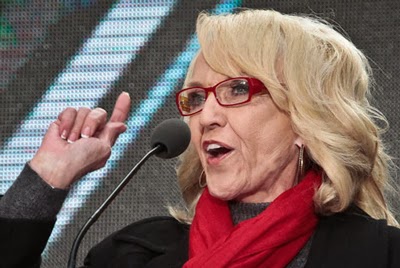
As I write, as you know, the clock is ticking on Arizona Gov. Jan Brewer to make her momentous decision, whether to sign or veto the splendid piece of legislation sponsored by her state's equally splendid legislature authorizing Christians who jes' hate us them goddam homos to refuse to have anything to do with them, including doing any kind of business with them, on the ground that the Bible tells us so.

There doesn't seem to be much doubt that left to her own devices Governor Jan would sign the bill in a heartbeat, and maybe do a little dance in celebration. She's just a hatin' kinda gal. Unfortunately, she has found herself at the center of a shitstorm of panic coming not just from the predictable bleeding-heart-socialist Left but from her very own Rock-Ribbed Right. To quote the head on Zack Ford's ThinkProgress piece: "Conservative Lawmakers And Arizona Businesses Urge Governor To Veto Anti-Gay Bill."

The "lawmakers" in question include not just both of the state's U.S. senators, those flaming liberals Young Johnny McCranky and Jeff Flake and several of its U.S. representatives but a number of Arizona mayors and even a bunch of the state legislators who voted for this splendid piece of legislation. Many of those legislators are apprarently running to succeed Governor Jan (as if so stellar a public servant could be truly replaced!). State Sen. Steve Pierce, for one, professing concern with a possible "negative picture" of the state, now says, "I screwed up. I'm trying to make it right."

Of course it's nothing new for Arizona to stand proud as the Conscience of America's Hatin' Loons. How long, after all, did the state hold out against the federal holiday honoring that goddam troublemaker Martin Luther King Jr.? In the end, of course, Arizona businessmen saw an alarming share of the nation's business that once came to them going to other, less principled states.


February 25, 2014
ARIZONA CONFRONTING AWKWARD REALIZATION THAT GAY PEOPLE HAVE MONEY, BUY STUFF
Posted by ANDY BOROWITZ


PHOENIX (The Borowitz Report) -- The state of Arizona found itself in the middle of a conundrum today as it awoke to the awkward realization that gay people have money and buy stuff.

Just days after the Arizona legislature passed a law that would enable businesses to discriminate against gays, it emerged that gays spend billions of dollars in Arizona each year -- an unexpected development that seemed to take many legislators by surprise.

Carol Foyler, a Tea Party Republican who supported the anti-gay law, said that the startling bombshell that gays play a role in the state's economy put her and her fellow lawmakers "in a tight spot."

"Quite frankly, we were blindsided by this," she said. "We had no idea that gays had money and bought things just like regular people do."

Acknowledging that her vote for the anti-gay law might have been calamitous for the state's economy, Ms. Foyler placed the blame for it squarely on the shoulders of one group: the gays themselves.

"How was I supposed to know what gay people do with their money, etc., when I don't personally know any gay people?" she asked. "I'm sorry, but it was up to the gays to tell us."
Indeed the Arizona business community has been a little quicker on the uptake this time around. ThinkProgress's Zack Ford reports:
The CEOs of the Arizona Chamber of Commerce and Industry, the Greater Phoenix Chamber of Commerce, Greater Phoenix Leadership and the Southern Arizona Leadership Council wrote to Brewer requesting a veto:
After analyzing the bill, we are very concerned about the effect it could have on Arizona's economy. As leaders in the business community, we cannot support measures that could expose our businesses to litigation, nor do we want to send a message that our state is anything but an open and attractive place for visitors and the top talent that will be the cornerstone of our continued economic growth.

If specific Arizona issues related to religious liberty are identified, we would stand ready to work with anyone to ensure that any solution addresses those problems while also ensuring that all individuals feel welcome in our state and that business is not hurt.
According to Kirstin Jarnagin, vice president of the Arizona Lodging and Tourism Assocation, people are already cancelling trips to Arizona because of the negative perception the bill has brought to the state. . . .

Oops! Why, George Takei is talking about leading a national boycott! Can the rest of Starfleet be far behind?


WHAT GOVERNOR JAN COULD DO . . .

Poor Governor Jan! All those people fussin' and hissin' at her to veto the damn bill, jes' 'cause those folks don't know their Bible, and how God and Jesus and everybody demands that the righteous hate them homos.

If she was really cagey, what Governor Jan would do is, yes, veto the damn bill -- but on the ground that it doesn't go far enough! Well-meant as this bill undoubtedly is, it leaves the state open to the charge of singling out the gays and the lesbos for hatin'. Whereas the point is that Arizona is just tryin' to preserve the rights of all good old-fashioned Bible hatin'.

So the governor sends the bill back and says she won't sign it till it's more, y'know, inclusive. Like the Jews. Doesn't the Bible to tell us to hate them damn Jews? Didn't they kill our Lord, and drink the blood of Christian children? And they've got those big-ass noses, and damn, they just smell bad. Why should righteous folk have to be, y'know, kowtowin' to the likes of them?

It seems to me like the perfect solution. All those people screechin' about gettin' the bill vetoed get what they want, and Arizona still gets to stand up proud for what it's righteous folk stand for.


MEANWHILE IN THE CUCKOO CORRIDORS OF
K STREET: STANDIN' UP AGAINST SPORTS HOMOS


Thanks to the Washington Post's Jonathan Capehart for calling attention to this nuttiness: a Washington lobbyist who not only thinks that gays should be banned from the NFL but that Congress should pass a law doing so.

You're going to think that this report comes from The Onion, but no, I swear, it comes from The Hill:
Lobbyist drafts bill to ban gays from NFL

By Rebecca Shabad

Washington lobbyist Jack Burkman on Monday said he is preparing legislation that would ban gay athletes from joining the National Football League.

Burkman in a statement said he has garnered political support for the bill, though his statement didn’t mention any specific lawmakers who are behind it.

"We are losing our decency as a nation," Burkman said in a statement. "Imagine your son being forced to shower with a gay man. That’s a horrifying prospect for every mom in the country. What in the world has this nation come to?"

Burkman said he came up with the idea after college football star Michael Sam publicly revealed he is gay a few weeks ago. If drafted, Sam would be the first openly gay player in the NFL.

Jason Collins on Sunday became the first openly gay athlete to play for a major men's professional sports team when he suited up for the NBA's Brooklyn Nets against the Los Angeles Lakers.

A number of Democratic lawmakers voiced their support of Sam after he revealed his sexual orientation in an interview with ESPN, and first lady Michelle Obama hailed him as an "inspiration."

Burkman was not available to speak with The Hill but urged Congress to act in his statement.

"If the NFL has no morals and no values, then Congress must find values for it," Burkman said.

Burkman serves as founder and president of his own lobbying firm, Burkman Associates. He has also worked as of counsel at law firm Holland & Knight. In the 1990s, he served as counsel to then-Rep. Rick Lazio (R-N.Y.).

In a statement to The Hill Tuesday, Holland & Knight said it "is proud of its support of the LGBT community and we condemn Jack Burkman's current efforts. Mr. Burkman's employment with Holland & Knight ended almost 12 years ago. He was a lawyer in our Washington office from October 1998 to May 2002."

Burkman's firm, JM Burkman & Associates, signed 70 new clients last year, the most of any K Street firm, a recent review by The Hill found. 

The four-lobbyist firm specializes in helping companies secure contracts with the federal government.
You'll note that our Jack's former associates are also running from him as fast as their legs will take them. This is also a good sign.
#

Labels: , , , ,

Sunday, November 18, 2012

Is it possible that Crap Christianity -- based on ignorance and savagery -- is finally on the defensive?

>

"Millions of American evangelicals are absolutely shocked by not just the presidential election, but by the entire avalanche of results that came in," , said in an interview. "It's not that our message -- we think abortion is wrong, we think same-sex marriage is wrong -- didn't get out. It did get out.

"It's that the entire moral landscape has changed. An increasingly secularized America understands our positions, and has rejected them."

-- R. Albert Mohler Jr., president of the Southern
Baptist Theological Seminary (in Louisville, KY)

by Ken

I've been nursing this story for more than a week now, waiting for an opportunity to explore and augment it, and speculate and counterspeculate, but it doesn't look as if any of that is going to happen anytime soon, so let's just go with this NYT report by Laurie Goodstein, "Christian Right Failed to Sway Voters on Issues," the source of the quote above from R. Albert Mohler Jr., which I for one can hardly believe I'm hearing from the mouth of the president of the Southern Baptist Theological Seminary.

The NYT piece actually goes a good deal further than the timid headline suggests, providing grounds for thinking that:

(1) The Religious Right, which for so long now has seemed impervious both to reality and to challenges to its rampaging immorality, is kind of shook up over what happened on November 5.
Christian conservatives, for more than two decades a pivotal force in American politics, are grappling with Election Day results that repudiated their influence and suggested that the cultural tide -- especially on gay issues -- has shifted against them.

They are reeling not only from the loss of the presidency, but from what many of them see as a rejection of their agenda. They lost fights against same-sex marriage in all four states where it was on the ballot, and saw anti-abortion-rights Senate candidates defeated and two states vote to legalize marijuana for recreational use.

It is not as though they did not put up a fight; they went all out as never before: The Rev. Billy Graham dropped any pretense of nonpartisanship and all but endorsed Mitt Romney for president. Roman Catholic bishops denounced President Obama's policies as a threat to life, religious liberty and the traditional nuclear family. Ralph Reed's Faith and Freedom Coalition distributed more voter guides in churches and contacted more homes by mail and phone than ever before.
And: (2) Noncrazed voices from the world of faith are finally starting to be heard pushing back above the roar of Crap Christian craziness.
Meanwhile, religious liberals are gradually becoming more visible. Liberal clergy members spoke out in support of same-sex marriage, and one group ran ads praising Mr. Obama's health care plan for insuring the poor and the sick. In a development that highlighted the diversity within the Catholic Church, the "Nuns on the Bus" drove through the Midwest warning that the budget proposed by Representative Paul D. Ryan, the Republican vice-presidential nominee, would cut the social safety net.
Oh, reporter Goodstein quotes a healthy share of eternally implacable voices of the Crap Christian Right -- dunderheads like Bob Vander Plaats and Ralph "Sure, I'm a Crook, but So What?" Reed declaring that while something-or-other seems possibly to have happened in this election, it's just a technical glitch, and nothing will deter them from the lifelong struggle to see the triumph of ignorance, hatred, and indecency.

And she quotes "Christian leaders" who "pointed to other factors that may have blunted their impact in this election." You know, stuff like the shocking outrageousness of buttholes like Todd Akin and Richard Mourdock. The problem with this "defense" is that it ignores how overwhelmingly the Crap Christian Rightists believe exactly the same things but are merely more tactful about saying so. As we know, on matters of sexual policy, there is no difference whatsoever between, say, Akin and Great White Hope Young Paul Ryan.

What happens to the pillars of Crap Christianity if American Christians figure out that there's no difference between the beliefs of acknowledged crackpots like Todd Akin (right) and closet cuckoo Young Paul Ryan (left)?

However, even those "religious leaders," says Goodstein,
acknowledge that they are losing ground. The evangelical share of the population is both declining and graying, studies show. Large churches like the Southern Baptist Convention, which has provided an organizing base for the Christian right, are losing members.

"In the long run, this means that the Republican constituency is going to be shrinking on the religious end as well as the ethnic end," said James L. Guth, a professor of political science at Furman University in Greenville, S.C.
And Goodstein takes pains to indicate that the problem extends beyond the evangelical twits to their new peas-in-a-pod allies, the bedrock of Crap Christianity, the Roman Catholic hierarchy.
The election outcome was also sobering news for Catholic bishops, who this year spoke out on politics more forcefully and more explicitly than ever before, some experts said. The bishops and Catholic conservative groups helped lead the fight against same-sex marriage in the four states where that issue was on the ballot. Nationwide, they undertook a campaign that accused Mr. Obama of undermining religious liberty, redoubling their efforts when a provision in the health care overhaul required most employers to provide coverage for contraception.

Despite this, Mr. Obama retained the Catholic vote, 50 to 48 percent, according to exit polls, although his support slipped from four years ago. Also, solid majorities of Catholics supported same-sex marriage, said Dr. [Robert P.] Jones, the pollster [chief executive of the Public Religion Research Institute].
I'm strictly an observer on Catholic issues, but I've been shocked by how far, how insanely and openly far, the U.S. bishops have lurched to the right -- clearly under heavy pressure from the recent run of devil-popes, John Paul II and his successor, Pope Cardinal Ratguts. They have given themselves over so wholeheartedly to insanity, hatefulness, and blind immorality that if I were an American Catholic, I would "just say no" to any word that comes out of their debased mouths.

Goodstein has noticed.
Bishop Jaime Soto of Sacramento, who serves on the bishops' domestic policy committee, said that the bishops spoke out on many issues, including immigration and poverty, but got news media attention only when they talked about abortion, same-sex marriage and religious liberty. Voters who identify as Catholic but do not attend Mass on Sunday may not have been listening, he said, but Catholics who attend Mass probably "weigh what the church has to say."

"I think good Catholics can be found across the political spectrum," Bishop Soto said, "but I do think they wrestle with what the church teaches."
I'd like to believe that American Catholics were as shocked and appalled as I was by the U.S. bishops' savage organized assault on American nuns, the only group inside the walls of Catholic officialdom which is demonstrating an understanding of and commitment to real Christian values -- you know, the kinds of things that Jesus preached. (See Garry Wills's remarkable April NYRB blogpost "Bullying the Nuns." My post about it seems to have disappeared, but not the May follow-up, "Bullying the nuns (cont'd).")

Like the rest of the modern-day Right, the Crap Christians have become so divorced from reality that they really appear to believe they can have their way no matter how far over the edge of sanity and decency they plunge. If they had as much as one working brain amongst the whole lot of them, they would be on their knees to the nuns, begging them to save them -- from themselves.
#

Labels: , , , ,