"When fascism comes to America, it will be wrapped in the flag and carrying the cross."
-- Sinclair Lewis
Sunday, December 14, 2014
Sunday Classics diary: I love this theme, especially when it's played like this
>
by Ken
I love this theme. It's majestic, maybe even monumental, irresistibly forward-moving, even swaggering, and at the same time tender and uplifting -- if I could put it into words, I guess I wouldn't need the music.
Now, the theme can be played kinda fast:
And it can be played kinda slow:
And it can be played the way we just heard it:
THIS LAST PERFORMANCE IS THE ONE
THAT GOT MY ATTENTION THIS WEEK
MENDELSSOHN: Notturno from A Midsummer Night's Dream (incidental music), Op. 61
Concertgebouw Orchestra (Amsterdam), George Szell, cond. Decca, recorded Dec. 2-4, 1957
Bavarian Radio Symphony Orchestra, Otto Klemperer, cond. Broadcast performance, May 23, 1969
by Ken
A much-loved little piece latched onto my brain this weeko. It was the "Nocturne" from Mendelssohn's Midsummer Night's Dream incidental music, and it really still hasn't let go. That's the sort of thing that might once have triggered a post, especially since we don't seem to have spent as much time as I remembered with the incidental music. The only traces I can find are from a November 2008 Mendelssohn post, where we heard the Szell-Concertgebouw recording of the commonly played four-movment grouping of the Overture, Scherzo, Notturno, and Wedding March. and a more expanded suite that I drew from a Klemperer-Bavarian Radio Symphony broadcast performance of a generous selection from the incidental music.
I've re-extracted just the "Notturno" from those performances, as heard above.
AS LONG AS WE'RE REHEARING THE SZELL AND
KLEMPERER "NOTTURNO" PERFORMANCES --
I thought we might as well listen again to the full selections from the MSND music we heard back in 2008.
Sunday Classics: Our Beethoven Seventh performances are connected the most obvious way -- they're by the same conductor
>
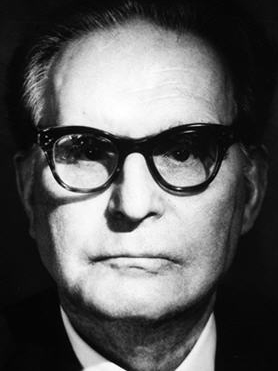
Otto Klemperer
BEETHOVEN: The Creatures of Prometheus (ballet), Op. 43: Overture
Philharmonia Orchestra, Otto Klemperer, cond. EMI, recorded Nov. 25, 1957 New Philharmonia Orchestra, Otto Klemperer, cond. EMI, recorded June 17-18, 1969
by Ken
In Friday night's preview we heard two extremely lovely performances of the haunting and powerful slow movement of Beethoven's Seventh Symphony, and I invited readers to identify the connection between them.
As our friend me noted in a comment, performance A is older and quicker than performance B. I'm not sure that the Internet-transmitted mp3 sound does full justice to B, and the sound really does matter, because the wealth of sonic color and texture our conductor is coaxing from his players becomes part of the expressive structure of the performance. It is, as it happens, a performance that's some 45 years old but that I don't think I've ever heard, for reasons I'll explain in a moment.
Let's listen again to performances A and B, with a performance X thrown in between them.
PAPAGENO: Right, then, that's still how it is!
Since there is nothing holding me back,
good night, thou false world!
-- most of our Magic Flute translations by Robert A. Jordan
Dietrich Fischer-Dieskau (b), Papageno; Berlin Philharmonic, Karl Böhm, cond. DG, recorded June 1964
Or in English: "Fare thee well, thou world of pain!"
[in English] John Brownlee (b), Papageno; Metropolitan Opera Orchestra, Bruno Walter, cond. Live performance, Dec. 26, 1942
by Ken
We were just looking at Mozart's and Beethoven's exceptional use of minor keys for opening movements of symphonies and concertos, and one point I could have made more explicit is how frequently -- among these admittedly infrequent cases -- the "thematic" material that inspires such a plan is more "motivic" than really melodic -- think of Mozart's D minor Piano Concerto (No. 20) or of Beethoven's Fifth and Ninth Symphonies.
But of course the minor mode doesn't preclude great tunes, and I think that's what planted the thought of this great moment from The Magic Flute in my head. It's the moment when Papageno the lowly bird-catcher is driven by his loneliness to the ultimate despair, and I think the Fischer-Dieskau performance in particular makes it clear that Mozart plays this moment "for real." (Not to worry, we're going to hear the complete scene, er, eventually.)
As I suggested in Friday night's "double preview," "Enter the bird-catcher; exit Sir Colin Davis," we're focusing this week on Papageno, though as we often do, we're going to start with the Overture.
OUR THREE PRINCIPAL PAPAGENOS
AND THEIR DISTINGUISHED CONDUCTORS
Sunday Classics: What comes after Mozart's and Beethoven's minor-key symphonic opening movements?
>
What comes after the monumental, mysterious opening movement of the Beethoven Ninth Symphony, which we heard last week? At the link, Christian Thielemann conducts the Vienna Philharmonic in what seems to me a grindingly prosaic rendering of the thunderingly dramatic scherzo.
by Ken
I realize I should have been saying more about this amazing music we've been hearing, dipping into the two symphonies apiece for which Mozart and Beethoven composed opening movements in the minor mode. But really, when it comes to an incandescent movement like the opening one of Mozart's great later G minor symphony, No. 40, could I really have said anything more helpful than, say, "Wouldja listen to that?" And ditto when it comes to the opening movements of Beethoven's Fifth and Ninth Symphonies. I mean, we're talking here about two of the monuments of human civilization, and I thought talking should take distant second place to listening.
My point was, if we accept that writing a minor-mode symphonic first movement is an uncommon and nervy thing to do, and is likely to happen only if a composer has been seized by some gripping musical material that requires it, where does he want to take his audience next?
We actually did a more comprehensive listen-through to chunks of this recording in the March 2011 post "Remembering Margaret Price, Part 3 -- as Mozart's Fiordiligi," and I've begun replacing the original audio clips for that post, made from my German-pressed LPs, with clips from the (pretty good) new CD issue. As I've said, it's not among my very favorite recordings of the opera, but as I indicated in writing about it for The Metropolitan Opera Guide to Recorded Opera, in this case most of Klemperer's special insights have been intuited by other conductors on records -- among whom my clear favorite remains Eugen Jochum in his near-miraculous 1962 DG recording.
We're just going to hit some high points today, with a couple of other performances tacked on, and I thought we'd kick off with a perennial favorite excerpt of mine, the Act I farewell trio, as the ladies think their fiancés are going off to war, in a scheme engineered by their cynical old friend Don Alfonso.
Act I, Trio, Fiordiligi-Dorabella-Don Alfonso, "Soave sia il vento"
Gentle be the breeze, Calm be the waves, And every element Smile in favour On their wish.
Margaret Price (s), Fiordiligi; Yvonne Minton (ms), Dorabella; Hans Sotin (bs), Don Alfonso; New Philharmonia Orchestra, Otto Klemperer, cond. EMI, recorded Jan. 25-Feb. 18, 1971
Irmgard Seefried (s), Fiordiligi; Nan Merriman (ms), Dorabella; Dietrich Fischer-Dieskau (b), Don Alfonso; Berlin Philharmonic, Eugen Jochum, cond. DG, recorded December 1962
[in English] Elizabeth Harwood (s), Fiordiligi; Janet Baker (ms), Dorabella; John Shirley-Quirk (bs-b), Don Alfonso; Scottish National Opera Orchestra, Alexander Gibson, cond. Live performance, May 1969
Sunday Classics preview: A master's view of three Mozart opera overtures
>
by Ken
One of my early records that I played over and over was a Seraphm LP of Mozart opera overtures beautifully played by the Royal Philharmonic under Colin Davis. (Yes, that's it above!) I've always really, really loved Mozart overtures -- but then, what's not to love? (I might mention that back in May 2010 we had a Mozart-overture "quiz-contest" in which we heard the overtures to The Abduction from the Seragio, The Marriage of Figaro, Don Giovanni, and Così fan tutte.)
Considering how late in life Otto Klemperer began recording operas for EMI (when the earliest of the three recordings we're going to hear from tonight, the Don Giovanni, was made, he was already 81), it's kind of amazing that eventually he would record all three of the "da Ponte operas" (i.e., the ones with those sublime librettos by Lorenzo da Ponte) as well as The Magic Flute. It pains me to think that in his last couple of years, amid his increasing incapacitations, he was working on two scores special to him which EMI would have been happy to record: the Mahler Sixth Symphony (following his uniquely fascinating recording of the Seventh) and the "other" Mozart operatic masterpiece, The Abduction from the Seraglio. EMI actually scheduled sessions for Abduction (twice, if I recall correctly), which he was unable to do.
The four Mozart operas he did record are all, er, "special" performances, which you wouldn't necessarily want as your only recording (hint: they're not exactly, um, speedy), but their specialness includes qualities you won't hear anywhere else. I thought tonight we would hear the overtures to the three da Ponte operas. (Since the Don Giovanni Overture, instead of coming to a full stop, leads directly into Leporello's opening aria, I decided to tack that on here -- though we then have an abrupt ending with the dramatic first entrance of Donna Anna.)
The Marriage of Figaro, K. 492: Overture
New Philharmonia Orchestra, Otto Klemperer, cond. EMI, recorded January 1970
Don Giovanni, K. 527: Overture; Introduzione, Leporello, "Notte e giorno faticar"
LEPORELLO: Toiling night and day, Working for someone who can't be satisfied. Putting up with rain and wind, Eating badly and sleeping badly. I want to play the gentleman, And I don't want to be a servant anymore. Ah, what a dear gallant man! He wants to be inside with a beauty And I play sentinel!
Walter Berry (bs-b), Leporello; New Philharmonia Orchestra, Otto Klemperer, cond. EMI, recorded June-July 1966
Così fan tutte, K. 588: Overture
Klemperer's Così recording isn't among my favorites, but it's got important qualities that make me happy it's finally available again.
New Philharmonia Orchestra, Otto Klemperer, cond. EMI, recorded Jan. 25-Feb. 18, 1971
FOOTNOTE: ABOUT THOSE COLIN DAVIS OVERTURES
I might explain that I'm not one of those people with great reverence for Colin Davis's Mozart opera recordings, though in general the later Bavarian Radio series of the da Ponte operas for BMG seems to me a healthy cut above the much-ballyhooed Philips versions. But that early EMI LP of overtures was awfully good. ("Early" Davis was often better than the wildly uneven "International Megastar" Davis.) Just for the heck of it, I thought I'd see if it's obtainable now, and I found this CD that not only appears to contain all the overtures from the Seraphim LP with the Royal Philharmonic but also three German Dances, the Serenata notturna, and Eine kleine Nachtmusik -- with copies available for as little as 40 cents (plus shipping)! Let me stress, though, that I haven't heard it, so I can't vouch for the transfers. Still, 40 cents . . . .
(Oh wait, I see that the Clemenza di Tito Overture is omitted. I don't have much use for the opera, but I love the Overture, and as I recall, Davis did it just fine. Grr!)
We've already heard excerpts from Klemperer's recording of Così fan tutte. Now that there's (finally) a readily available CD edition, I thought we should revisit it.
Eugen Jochum conducts the Bavarian Radio Symphony in the Scherzo (third movement) of Bruckner's Seventh Symphony.
by Ken
In writing recently about the structure of Tchaikovsky's string sextet Souvenir de Florence, I noted that it employs a particular movement format:
an opening movement and an ensuing slow movement of such emotional weight as to dominate the whole piece. Haydn was already doing it when he invented the [four-movement symphonic] form, doing it in both symphonies and string quartets. It's the format of the wonderful Symphony No. 88, with the otherworldly slow movement, which we heard in September 2010.) It's also the format of Mendelssohn's Italian Symphony, which we heard last week.
I added:
Bruckner, who supersized everything else about the symphony, also supersized this ratio in his Seventh Symphony, which has that massive opening movement and then that haunting Adagio, followed by an invigorating but comparatively brief Scherzo and Finale. The trick is to have those later movements hold up their end of the deal even while conceding emotional primacy to the first two movements. This is in marked contrast to Bruckner's differently remarkable achievement in the Fourth Symphony: producing four movements of roughly equal musical and emotional weight. (We actually took in the whole shebang in January 2010, in "Bruckner's Fourth Symphony -- four stories for four movements." ) It just goes to show that there really aren't any rules about any of this, that it's all about what you can make work.
For better or worse, I'm so highly suggestible musically that this naturally set the Bruckner Seventh running in my head. For tonight I thought it would be fun to listen just to the Scherzos of the Bruckner Fourth and Seventh. You'll notice that they're not radically different in length, but they seem to me radically different in emotional weight (we can talk about this Sunday), and of course the Scherzo of the Seventh is rendered virtually svelte by the vastly greater weight of the symphony's first two movements.
BRUCKNER: Symphony No. 4 in E-flat: iii. Scherzo: Bewegt (Lively)
Philharmonia Orchestra, Otto Klemperer, cond. EMI, recorded Sept. and Nov. 1963
Cleveland Orchestra, Christoph von Dohnányi, cond. Decca, recorded Oct. 8 and 10, 1989
BRUCKNER: Symphony No. 7 in E: iii. Scherzo: Sehr schnell (Very fast)
Philharmonia Orchestra, Otto Klemperer, cond. EMI, recorded November 1960
Cleveland Orchestra, Christoph von Dohnányi, cond. Decca, recorded August 1990
Sunday Classics preview: Otto Klemperer makes us ponder how fast Beethoven's peasants dance
>
Last night we saw and heard Zoltán Kocsis (better known to most of us as a pianist) conduct this orchestra identified as the Hungarian National Philharmonic in the second-movement "Scene by the Brook" from Beethoven's Pastoral Symphony. Here are the third and fourth movements, the "Merry Gathering of Peasants" and "Thunderstorm."
by Ken
In last night's preview we listened to the nature rambles from Beethoven's Pastoral Symphony and its hallucinatory offspring, Berlioz's Symphonie fantastique. Tonight we move on to the "Gathering of Merry Peasants" that follows Beethoven's "Scene by the Brook."
There's a wonderful story concerning Otto Klemperer's recording of this movement, as part of his EMI stereo Beethoven symphony cycle. I would have liked to find a better recollection than mine, but the ones I turned up are notably worse, so I'll have to go with mine. When it came to this third-movement scherzo, at the first run-through producer Walter Legge in the control room was taken aback by Klemperer's slow tempo, and asked the maestro -- as I recall it, into his headset -- if he didn't think it was too slow.
(For those who are just coming in at this point, Legge, who was EMI's a&r director as well as the working producer to whom EMI's a&r director assigned many of the label's most prestigious artists and projects, had a habit of second-guessing the celebrated artists he engaged --ostensibly to record "their" interpretations -- using a whole bag of tricks to enforce his will, to the point where many of the recordings he produced seem to me more his than those famous artists'. Naturally, many of these drained-of-life, cookie-cutter performances have been hailed as phonographic landmarks, by peopleI have to figure either don't listen or don't hear.)
Klemperer, unfazed, replied, "You'll get used to it." Anyway, much later in the recording process -- maybe when they were listening to playbacks? -- Klemperer asked, "Have you gotten used to it yet, Walter?" For once Legge didn't get his way, though listening now, and hearing how un-extreme the tempo is in the finished version, I have to wonder whether Klemperer hadn't at first taken an even broader tempo and then been unwillingly ground down.
Even more now than ever this speaks to me of the predictably middlebrow, drearily humdrum narrowness of the celebrated Legge vision of musical "perfection," which he imposed so ruthlessly on artists with way better musical credentials and infinitely more musical life and imagination. The tempo isn't even that slow, but it opens up the movement, and consequently the rest of the symphony, in a way that I've never heard anyone else manage. (And this is by no means a fair representation of the sound that can be gotten from this recording. I made this dub from a late German LP reissue that has jam-packed sides.) The actual sounds Klemperer could coax from his players, something that rarely comes through in even the best CD transfers, often made a significant difference in the way the music was filled in and filled out when he took unconventionally slow tempos.
"Sunday, Bloody Sunday" and the depths of Mozart's humanity
>
The trailer for John Schlesinger's Sunday, Bloody Sunday (1971)
by Ken
I tried to figure out how to work in a reference to Sunday, Bloody Sunday in writing earlier today about Mozart's Così, but couldn't figure out how to do it. I hoped maybe I'd find a clip online that shows the way director John Schlesinger used the great trio from Così to characterize his central character, a doctor (played by the great Peter Finch) who only now, in late mid-life, finds himself grappling with his sexual ambivalence. I came up empty, but it's still a great movie. I haven't seen it in ages, and probably ought to see it again.
The film was still very much on my mind when I reviewed Georg Solti's lovely first recording of Così fan tutte. Here's the trio from that lovely recording:
MOZART: Così fan tutte, K. 588: Act I, Trio, "Soave sia il vento"
Gentle be the breeze, Calm be the waves, And every element Smile in favour On their wish.
Pilar Lorengar (s), Fiordiligi; Teresa Berganza (ms), Dorabella; Gabriel Bacquier (b), Don Alfonso; London Philharmonic Orchestra, Sir Georg Solti, cond. Decca, recorded 1973-74
And as long as we're listening to this glorious trio, here it is again, from Karl Böhm's 1962 Così recording.
Elisabeth Schwarzkopf (s), Fiordiligi; Christa Ludwig (ms), Dorabella; Walter Berry (bs-b), Don Alfonso; Philharmonia Orchestra, Karl Böhm, cond. EMI, recorded September 1962
In some odd way that I can't explain, there's a dividing line in Mozart's creative life, not between the three operatic masterpieces written with librettist Lorenzo da Ponte and the later Magic Flute, but between the second and third of the da Ponte operas, Don Giovanni and Così. It's fascinating how often conductors who are in the groove with The Marriage of Figaro and Don Giovanni aren't with Così and Magic Flute, and vice versa. Somehow both Solti and Böhm seemed always to have a much stronger affinity for the later pair, Così and Magic Flute, than with Figaro and Don Giovanni.
Here is the great Act I farewell quintet -- often, and understandably, associated with the Così trio -- from Solti's later Magic Flute recording, and from Otto Klemperer's beautiful 1964 one. I've edited the quintet brutally, after the Three Ladies of the Queen of the Night have given Tamino and Papageno their marching orders for rescuing the Queen's daughter, Pamina, from the clutches of the supposedly evil Sarastro, and given Tamino a magic flute and Papageno a set of magic bells for protection, but we'll make that up some other time. (Recordings note: Böhm's glorious 1964 DG Magic Flute is one of my most beloved opera recordings, and I once had it on CD, but I can't find the CD edition. I could have dubbed it from LP, but I think Solti and Klemperer will represent this amazing music just fine, thank you.)
MOZART: The Magic Flute, K. 620: Act I, Quintet, "Lebet wohl! Wir wollen gehn!" . . . "Drei Knäbchen, jung, schön, hold und weise" . . . "So lebet wohl!"
THE THREE LADIES: Farewell, we are going. Farewell, until we see you again! [All are about to go.] TAMINO: Yet, fair ladies, tell us . . . PAPAGENO: How the castle may be found. TAMINO and PAPAGENO: How the castle may be found. THE THREE LADIES: Three boys, young, beautiful, gracious, and wise, will accompany you on your journey. They will be your guides, follow nothing but their advice. TAMINO and PAPAGENO: Three boys, young, beautiful, gracious, and wise, will accompany us on our journey. THE THREE LADIES: They will be your guides, follow nothing but their advice. ALL: So farewell, we are going; farewell, farewell, until we see you again!
Adrianne Pieczonka (s), Annette Kuettenbaum (ms), and Jard van Nes (c), Three Ladies; Uwe Heilmann (t), Tamino; Michael Kraus (b), Papageno; Vienna Philharmonic, Sir Georg Solti, cond. Decca, recorded May and Dec. 1990 Elisabeth Schwarzkopf (s), Christa Ludwig (ms), and Marga Höffgen (c), Three Ladies; Nicolai Gedda (t), Tamino; Walter Berry (bs-b), Papageno; Philharmonia Orchestra, Otto Klemperer, cond. EMI, recorded March-Apr. 1964
Sunday Classics: Dvořák's music isn't just music to love, it's music that loves you back
>
UPDATE, 9:05am ET: Crisis! The site that hosts the audio clips doesn't seem to be hosting at the moment. I don't think there's anything I can do except hope it spontaneously regains its equilibrium. (I thought it was too much to believe I'd actually gotten control of this process. Ha!) Well, you can still enjoy the "Song to the Moon."
UPDATE, 9:15am ET: Seems to be OK now. Don't ask me. (I don't plan to hold my breath though.)
Okay, I suppose the lip-synched visuals are kind of hokey, but in this undated German TV clip Lucia Popp (1939-1993) sings the daylights out of the water nymph's haunting "Song to the Moon" from Dvořák's Rusalka, in which Rusalka sings of her love for a handsome young prince -- one of those inter-life-form relationships that rarely seem to end well.
Silver moon upon the deep dark sky, Through the vast night pierce your rays. This sleeping world you wander by, Smiling on men's homes and ways. Oh moon ere past you glide, tell me, Tell me, oh where does my loved one bide? Oh moon ere past you glide, tell me Tell me, oh where does my loved one bide? Tell him, oh tell him, my silver moon, Mine are the arms that shall hold him, That between waking and sleeping he may Think of the love that enfolds him, May between waking and sleeping Think of the love that enfolds him. Light his path far away, light his path, Tell him, oh tell him who does for him stay! Human soul, should it dream of me, Let my memory wakened be. Moon, moon, oh do not wane, do not wane, Moon, oh moon, do not wane....
by Ken
So, finally, we get to the long-delayed and much-previewed Dvořák piece. In case anyone's keeping track, I can report that back on January 17 I mentioned that that week's intended subject was being put on hold -- for a week, I thought at the time! By way of easing into the still-unnamed subject, I did some speculating on who might be "the world's greatest tunesmith," focusing that day on Puccini and the next day on Schubert.
The point was that when it comes to sheer melodic inspiration, this is the company in which I would place Dvořák. It's the top rank. And in the case of Rusalka's aria, his melodic and also harmonic radiance is equally apparent in the orchestral accompaniment, and this too is characteristic of the composer.
Which is practically a cue for the second-movement Largo of Dvořák's last symphony, From the New World, written during the spring and summer of the composer's first academic year in New York, 1892-93, as director of the new National Conservatory of Music. (The New World was long known as Symphony No. 5, but by now is securely established as No. 9, thanks to numerical fixes starting with the inclusion of four earlier, previously unnumbered symphonies.) For this post, after listening to the Largo in a sizable stack of New Worlds I have on CD, I was set to go with Bruno Walter's Columbia Symphony recording(the CD that coupled it with his lovely Eighth Symphony is hard to find now, and therefore expensive, but Amazon offers an MP3 download), until it was nosed out by one last contender, Otto Klemperer's EMI recording with the Philharmonia Orchestra (not available at all now except at silly prices).
Yes, this is the entire English horn part of the New World Symphony; note that the instrument "tacet" (is silent) in movements I, III, and IV.
You'll note that the English horn part begins with six bars of rest. (That's what that "6" over the printed rests at the very start means.) In those six bars you'll hear the kind of intensity and emotional resonance Dvořák could build out of such seemingly materials as the four-bar chorale for lower woodwinds and all the brasses, which offers a textbook demonstration of the fundamental process of harmonic "resolution," where the chords go through harmonies that tease the ear as it craves for those harmonies to "resolve" into a satisfactory "root" chord. When it finally does, Dvořák brings the timpani in, tapering off then to set the stage for a segue into a gentler string chorale. (The wind chorale recurs in varied forms at strategic points through the movement.) Shockingly, you'll hear conductors simply chug through these six opening bars as if they were mere filler inserted to delay the entrance of the English horn -- amazing.
As for that entrance of the English horn (or cor anglais, the slightly larger and deeper and significantly reedier and more plaintive cousin of the oboe; the English horn, as always needs to be pointed out, is neither English nor a horn), sounding that ineffably beautiful melody, you may be thinking that surely this melody is the Negro spiritual "Going Home"? Indeed it is. But as far as I know, the scholarly position is still that the spiritual borrowed the tune from Dvořák rather than vice versa. Clearly, though, the tune is in the spirit of the spiritual. During his time in the U.S., Dvořák made no secret of his admiration for the spiritual, which he thought could help form the basis for a truly American music.
ENCORE! LET'S HEAR THE LARGO AGAIN!
I couldn't resist buying it (it was only $2.99 [note: and that includes a second CD containing the great cycle of overtures, In Nature's Realm, Carnival, and Othello, Opp. 91-93! -- Ed.]), and now I can't resist sharing it. Sometimes you can be blown away by a recording and it turns out it kind of hit you "just right." But as I was transferring it, I just listened again to the Largo in this 1999 recording of the New World Symphony by the Czech Philharmonic under pianist-turned-conductor Vladimir Ashkenazy, who was principal conductor of the orchestra from 1996 to 2003, and wow! It's a genuinely great performance, in authentically Czech orchestral colors, remarkably vivdly recorded (by a Japanese recording team, whose tape was subsequently licensed by the Finnish label Ondine,which has been recording and/or releasing Ashkenazy with several orchestras).
The case of "Going Home" isn't unique in Dvořák's output. Even now people probably tend to assume that those 16 glorious Slavonic Dances, of which we heard the second last week, are arrangements of folk melodies, as Brahms's Hungarian Dances, the obvious model for them, mostly are. In fact, the musical material is almost all original.
Like Brahms's Hungarian Dances, Dvořák's Slavonic Dances were written originally for piano duet. Brahms orchestrated some of his dances but doesn't seem to have felt any urgency about it. Almost immediately the Brahms dances began to be arranged for every imaginable combination. Dvořák, however, was systematic about orchestrating his dances, and while it's fun to hear them occasionally in the four-hand piano originals (and probably more fun to play them), I don't think there's any question that these amazing miniatures achieve their full stature in their full orchestral garb. The Hungarian Dances, by contrast, seem to me most fully imagined in their original form, at least theoretically; I can't say I can point to any performances that back me up. Still, it seems to me that Brahms was expressly trying to create an artificial -- or should I say artistic? -- miniature world conjured by these wonderful exotic tunes.
I don't doubt that Brahms himself understood what Dvořák was up to. The generous support he gave his young Bohemian colleague was no doubt a repayment, in his mind, of the patronage that had been so generously extended to him. And if you set the two composers' bodies of work side by side, it's clear how closely Dvořák absorbed Brahms's view of the musical world, working so many of the same forms in such similar ways.
I don't mean to say that there's anything unoriginal in Dvořák's working method, but rather that, like most creative artists, he learned by example, and he had the excellent taste to find and set his standards according to the best model there was. It's the good way that values are passed on. (Dvořák also seems to have absorbed Brahms's ferocious work habits and self-critical faculty.) My mental image is that at the intersection between Schubert's lyrical genius and Brahms's feeling for musical structure and discipline, you find Dvořák.
There's good reason for Americans to feel a special kinship with Dvořák: He felt the same for us, having taken his mission at the National Conservatory seriously. And while he semms to have experienced feelings of loneliness and separation from his own home, nevertheless his time here clearly provided a burst of creative stimulus, starting with the New World Symphony, written as we noted during his first academic year in New York.
The following summer, the summer of 1893, Dvořák and his family spent in the Czech-speaking community of Spillville, Iowa. And during that time he produced two more indelible masterpieces: the String Quartet in F major, Op. 96, known as the American, one of the best-loved of all chamber works, and its almost as wonderful fraternal twin, the String Quintet in E-flat major, Op. 97, also known as the American.
I don't know that we need to say anything more about the American Quartet before plunging in. We're hearing the first two movements, Allegro ma non troppo and Lento, played by the mystery quartet we heard playing Haydn Friday night and Smetana last night. Unlike in the Haydn movements we heard, in particular, all four players get a good workout here. The American is especially rich in viola opportunities. It may not come as a great surprise to learn that among Dvořák's musical accomplishments, he was a professional-caliber violist.
That's the first page of the first violin part of the American Quartet (you can click to enlarge),taking us up to about 2:36 of the movement -- note that the repeat in the bottom line at rehearsal no. 6 isn't observed.
NOTE: I'll add an update with the identity of the mystery quartet about 3pm PT (6pm ET). UPDATE: Update added below.
Just to complete the tale of Dvořák in America, between homesickness and growing discord with the conservatory management, he didn't make it through the 1894-95 academic year. But before he departed for Europe, he composed yet another towering masterpiece, the B minor Cello Concerto. But I don't think we hear any of his musical image of America in the Cello Concerto; his mind, it seems, was already back home.
UPDATE: OUR MYSTERY ENSEMBLE IS THE JANACEK QUARTET
And what a glorious run the Janáček had, though it was never accorded the prestige its remarkable musical standards warranted. These wonderful musicians were violinists Jiří Trávníček and Adolf Sýkora, violist Jiří Kratochvíl, and cellist Karel Krafka. Since the Brno-based Janáček never had the status domestically of Czechoslovakia's ranking Prague-based quartets, it generally had fewer opportunities at home for both studio recordings and radio broadcasts. Ironically, it seems to have been more appreciated abroad, and when it toured, it was hustled into recording studios by Deutsche Grammophon, Decca, and even the American Westminster company.
It happens that all of these companies have wound up under the umbrella of Universal Classics, and as a result the 2002 seven-CD DG Original Masters boxdevoted to the Janáček Quartet, billed as "The Complete Recordings on Deutsche Grammophon," is, happily, the complete DGs, Deccas, and Westminsters. While copies can still be found at reasonable prices, they should be snapped up. Amazon also offers also an MP3 download version.
The Original Masters box is the source of all our samples. The Haydn and Dvořák quartets are from gorgeous 1963 Decca stereo originals made in Vienna (Haydn) and London (Dvořák), the Smetana from a 1956 DG mono. (The Haydn LP, from which we heard a movement each of Op. 3, No. 5, and Op. 33, No. 2, and which also included Op. 76, No. 2, may be the most beautiful quartet record I've ever heard.) On at least two occasions, the Janáček joined its more celebrated (but to my hearing nowhere near asx musically disciplined or structurally sophisticated) colleagues the Smetana Quartet to record Mendelssohn's splendid Octet for strings. The version recorded by Westminster in 1959 is included in the Original Masters box. It's heaven.
Beyond that, Supraphon recordings turn up sometimes. There's a set of the three Brahms string quartets, for example.
QUICK HITS: DVORAK BASICS
SYMPHONIES: I can't imagine being without the last three symphonies, Nos. 7-9, of which there are of course lots of first-rate recordings (and of course many more less-than-first-rate ones). It has become increasingly common to package these symphonies in a CD twofer with at least some other filler material, and two that seem to me esepcially recommendable both feature the Cleveland Orchestra. Yesterday I mentioned the Sony reissue of George Szell's classic Epic recordings, also including Dvořák's Carnival Overture and Smetana's Moldau and From My Life String Quartet as orchestrated by Szell and recorded in 1949. More recently, Christoph von Dohnanyi'srecordings of the three symphonies plus the wacky and wonderful Scherzo capriccioso, which we heard last week, are highly recommendable. With Witold Rowicki's excellent Philips traversal of the complete symphonies available in three attractively priced "twofer" sets, the middle volume, containing Nos. 4-6,is an obvious next step.
CONCERTOS: The great B minor Cello Concerto, Op. 104, one of Dvořák's most gripping and powerful works, is hard to spoil, while the more fragile Violin Concerto in A minor needs really sympathetic and understanding performers to realize its true stature. For the Cello Concerto, I still love Janos Starker'sMercury recording with the London Symphony under Antal Dorati. (There's also a hybrid SACD edition.) Last week we heard the finale from my much-loved Suk-Ancerl recordingof the Violin Concerto. An excellent bargain is the Sony Essential Classics CD containing beautiful Ormandy-conducted performances of both the Cello Concerto, played by Leonard Rose, and the Violin Concerto, played by Isaac Stern; Amazon.com lists new copiesas cheap as $2.83 plus shipping and used onesas cheap as $1.62.
SLAVONIC DANCES AND OTHER ORCHESTRAL WORKS: It's deleted now, of course, but as long as you can still find it as cheaply as it's still being offered on Amazon.com, the DG Trio set of Rafael Kubelikconducting the Bavarian Radio Symphony in the Slavonic Dances (the source of the performance of Op. 46, No. 2 we heard last week) and a whole bunch of other beautiful shorter orchestral works -- these are three really well-filled (in both senses) CDs -- is a no-brainer.
CHAMBER WORKS: There are excellent series of the string quartets and quintets by the appropriately Czech-flavored Vlach Quartet Prague (Naxos) and the more robust Chilingirian Quartet (Chandos). The eminently logical coupling of the American Quartet and American QuINtet is available from the Talich Quartet.There are outstanding recordings of the four piano trios by the Suk Trio (Supraphon)and the Borodin Trio (Chandos).
VOCAL WORKS: The most immediately appealing of Dvořák's operas, Rusalka, has been a happy vehicle for Renee Fleming, who has recorded it for Deccawith tenor Ben Heppner and Charles Mackerras conducting. (There's also a video recording from Paris with tenor Sergei Larin and James Conlon conducting.) The Supraphon-DG coproduction of Dvořák's Requiem with Karel Ancerl conducting the Czech Philharmoninc is available both from Supraphonand from DG.Of the lovely Stabat Mater there are lovely recordings conducted by Rafael Kubelik and Zdenek Macal,among others.
OR IN ONE FELL SWOOP: As I've mentioned, the 40-CD Brilliant Classics Dvořák anthology,which contains all of the above (yes, including a complete recording of Rusalka) plus much more, is surprisingly solid musically as well as a great buy. (You can easily find it for not much more than $80.)
Sunday Classics: The Magic Flute -- Mozart, at 35, lived just long enough to leave us this spiritual testament
>
Soprano Dorothea Roeschmann and baritone Simon Keenlyside give a lovely account of the haunting Pamina-Papageno duet from Act I of The Magic Flute (with Colin Davis conducting, Covent Garden, 2003).
SHE: With men who feel love, a good heart can hardly be lacking. HE: To share these sweet urges is then a woman's first duty. BOTH: We want to enjoy love. We live through love alone.
SHE: Love sweetens every trial. To it every creature sacrifices. HE: It adds spice to the days of our life. It works in the circle of nature. BOTH: Its lofty purpose shows that there's nothing nobler than wife and man. Man and wife, and wife and man reach toward godliness.
[Note: It's tricky to translate something as seemingly simple as the variously repeated "Weib und Mann" and "Mann und Weib," since "Mann" really does mean both "man" and "husband" while "Weib" could refer to either "woman" or "wife." Clearly the overlapping senses are intentionally blurred here. We do this in English to an extent with the phrase "man and wife," so I tried to fall back on that. -- K]
by Ken
It doesn't take much to get me thinking about Mozart's Magic Flute. In this case I'm guessing it was a combination of:
* flipping on the Metropolitan Opera radio broadcast yesterday while I was huddled over the blogging machine, and landing in the midst of an arid performance of the Met's abridged "kiddie" version of the opera, out of which all soul had been carefully drained -- at least for the portion of the performance I stuck with. (Once upon a time my weeks were organized around the Saturday-afternoon Met broadcasts. I had to learn to fit the entire repertory onto C-60, C-90, and C-120 audio cassettes. Nowadays I may go whole seasons without tuning in to a Met broadcast.)
* having been reminded a couple of days earlier that, faced with a price I couldn't pass up, I'd bought, but never listened to, a DVD set of Glyndebourne Festival performances of six Mozart operas: Idomeneo plus the five masterpieces: The Abduction from the Seraglio, The Marriage of Figaro, Don Giovanni, Cosi fan tutte, and of course The Magic Flute. I wound up watching the Magic Flute, from 1978 and quite a nice performance, with an especially lovely Pamina and Papageno in soprano Felicity Lott and baritone Benjamin Luxon. (Later I watched the Don Giovanni and Act I of the Cosi.)
Abduction, I admit, has its awkwardnesses, at least some of which I attribute to the fact that Mozart was trying so desperately to prove himself as an operatic composer worthy of decently compensated commissions. Mozart flexing every last bit of compositional muscle puts me in mind of the inspired cartoon from the Rocky and Bullwinkle series in which Bullwinkle-as-magician tells Rocky to watch him pull a rabbit out of his hat, and Rocky says things like, "Again? That trick never works." I'm thinking of the one where Bullwinkle pulls a giant roaring head (a lion?) out of the hat, then quickly shoves it back in, saying, "Oops! Don't know my own stren'th!" Alternatively, you might imagine the future Superman as a child, before he comes to understand that, measured against earthly mortals, he has superpowers.
By the time of The Marriage of Figaro Mozart had it all in sync, but already in Abduction we have a composer with direct access to the human soul such as few other creative artists ever have had. I like to point out that in the characterization of the "villian," the ferocious Osmin, we see a depth and delicacy of characterization that I doubt would have occurred to anybody else.
Figaro, Don Giovanni, and Cosi, the three Italian-language operas Mozart wrote to splendid librettos by Lorenzo da Ponte, are of course among the supreme products of the human imagination. Still to come was one last take on the clunky old German Singspiel (or "song play") form -- musical numbers that are joined by spoken dialogue, more or less the way the typical Broadway musical is constructed, The Magic Flute.
In plot synopsis, it looks like a simple, not to say simple-minded, fairy tale. Handsome young Prince Tamino has found his way to Egypt, where -- accompanied by the jolly bird-catcher Papageno -- he is pressed into service by the "star-flaming" Queen of the Night to rescue her daughter, Pamina, from the clutches of the evil priest Sarastro. The prince has only to see a tiny portrait of Pamina to fall hopelessly in love with the princess. Only when he arrives at Sarastro's temple, everything seems turned upside-down. Here he is led to believe that the all-wise Sarastro is the font of virtue and the Queen of the Night the font of evil.
I don't think it's a coincidence that these four supreme operatic masterpieces of Mozart's all have this same basic format: The characters start out thinking they're working toward some fairly straightforward objective, but somewhere along the line, often without their quite realizing it, they find themselves in serious search of something quite different. Much the way real life has a way of working out. In The Magic Flute, Pamina and Tamino -- and even Papageno, in his more down-to-earth way -- find themselves grappling with some of the most basic of human issues: appreciating and acquiring real wisdom and maturity as well as generosity of spirit, finding purpose in life, balancing the realities and needs of our "daylight" and "nighttime" selves.
Of course, in the hands of another composer, it might have wound up as trivial and cliched as it sounds. To anyone who knows and has lived with The Magic Flute, it's nothing less than a miracle. It's Mozart at the peak of his amazing maturity, and never mind that it had its first performance some two months before the composer's death, not quite two months before what would have been his 36th birthday. There are some achievements that are beyond explaining.
I've been living with The Magic Flute for, well, a sizable bunch of years, and over those years it has -- in common with a number of other great works of art which have become part of me -- helped shape and define my understanding of the world around me, and given me a way of measuring that understanding over time.
When I was still young and impressionable, I encountered a memoir by the great conductor (and in particular great Mozart conductor) Bruno Walter, in which he wrote that as he had progressed through life the always-beloved works of Mozart, and in particular The Magic Flute, which he considered Mozart's "spiritual testament," had risen to the point of eclipsing everything else. The notoriously uncheerful Otto Klemperer said that one of the things he would most regret about dying was losing The Magic Flute.
Our clip is a really lovely performance of the great duet "Bei Maennern, welche Liebe fuehlen." In the mission to rescue Pamina, it's the sidekick Papageno rather than Prince Tamino who finds the princess, who responds with a tender outpouring of compassion to the luckless bird-catcher's revelation -- remember, a total stranger to her until just minutes before -- that he doesn't have "a girlfriend let alone a wife." A soprano-baritone duet is a tricky thing to write, since their normal vocal ranges are separated by a full octave plus an extra interval of a fifth or so, so that even if they are assigned equivalent vocal lines, they don't fall in the same part of the voice. Mozart turns this into a singular opportunity.
No composer, or creative artist, had a stronger sense of decency or empathy than Mozart, and a really fine performance of "Bei Maennern" -- a difficult feat, given the pure simplicity of the vocal lines -- is apt to send us searching for words like "sublime."
(Note: I've never seen the complete performance our clip is drawn from, but it is available on DVD. I can't help suspecting that we may be seeing/hearing the best of it right here.)
THE MAGIC FLUTE ON RECORDS
It's one of those oddities of fate that the two recordings I consider most indispensable were both made in 1964. If The Magic Flute was, as Bruno Walter suggested, Mozart's spiritual testament, then perhaps Karl Boehm's recording of it with the Berlin Philharmonic (in glorious form) -- dramatically vital and singularly songful -- may be his. The cast (Roberta Peters as the Queen of the Night, Evelyn Lear as Pamina, Fritz Wunderlich as Tamino, Dietrich Fischer-Dieskau as Papageno, Franz Crass as Sarastro) is good to great, and the spoken dialogue is especially well performed. This remains among my handful of very favorite opera recordings. The DG Originals edition is attractively priced, though it doesn't include a libretto. (You can buy one, of course, or undoubtedly track one down online.)
There's no spoken dialogue at all in Otto Klemperer's Magic Flute, at the conductor's insistence; he believed that it made no sense to include it, badly performed by opera singers, on a recording. To EMI's consternation he was insisting on doing the same thing with the recording of Abduction from the Seraglio they were trying to make in the last year or two of his life. (A cast was actually assembled and sessions scheduled, but the conductor had to cancel for health reasons.) His Magic Flute recording, with a generally strong cast (Lucia Popp, Gundula Janowitz, Nicolai Gedda, Walter Berry, Gottlob Frick) probes deeper than any other, and often has a radiant beauty like no other. Shockingly, it's currently unavailable, though copies can still be found. His recordings of the three Mozart-da Ponte operas are even harder to find. Admittedly they're for somewhat specialized tastes -- they tend to be quite gradual, placing considerable demands on the singers. But you'll hear dimensions in all these pieces that go beyond what anyone else has looked for. It would be nice to have a box of all four Klemperer Mozart operas.
Among more recent versions I would put in a good word for the Philips recording sparklingly conducted by Neville Marriner, with a strong cast (Cheryl Studer, Kiri Te Kanawa, Francisco Araiza, Olaf Baer, Samuel Ramey). Georg Solti had a lifelong special affinity for The Magic Flute, an identification with it I can only describe as a feeling of special joy,. He had served as a musical assistant to Arturo Toscanini (and played the glockenspiel part) at the Salzburg Festival in the 1930s, and both of his Decca recordings, both with the Vienna Philharmonic, have solid but somewhat uneven casts. You might want to check out the later one (with Sumi Jo, Ruth Ziesak, Uwe Heilmann, Michael Kraus, Kurt Moll).
For the budget-conscious, there's a Classics for Pleasure issue of the lovely EMI recording conducted by Wolfgang Sawallisch (with Edda Moser, Anneliese Rothenberger, Peter Schreier, Walter Berry, Kurt Moll) that can be had online for a paltry $8.50 plus shipping (without libretto, but you should be able to track one of those down online).
AND ON VIDEO
There's a genuinely outstanding Munich performance conducted by Wolfgang Sawallisch (more vivaciously than the above-noted audio recording), with Edita Gruberova, Lucia Popp, Francisco Araiza, Wolfgang Brendel, Kurt Moll.
The legendary Ingmar Bergman made a deeply personal, deeply wonderful film of The Magic Flute (in Swedish), filled with the wonder of a child's-eye view. Happily, there's a Criterion Collection DVD.
RECENT CLASSICAL MUSIC POSTS
Berlioz' always-unexpected Childhood of Christ, for Christmas Day (music: "Farewells of the Shepherds to the Holy Family" from Part I, with Charles Munch conducting the Boston Symphony)
Maureen Forrester sings Mahler: It doesn't get more eloquent (music: "Urlicht" from Symphony No. 2, Resurrection, with Glenn Gould conducting -- left-handed!)
[5/21/2011] Preview: Otto Klemperer makes us ponder how fast Beethoven's peasants dance (continued)
>
Otto Klemperer
I THOUGHT WE'D LISTEN FIRST . . .
. . . to our conductors from last night's Beethoven-Berlioz country outings, Eugene Ormandy and André Cluytens, serving up traditionally paced performances. Ormandy's peasants indeed dance at quite a lively clip. (This performance is significantly shorter than the others because Ormandy bypasses a marked repeat of essentially the whole little movement. Klemperer did the same thing in concert, or at least he did in the two live performances of his of the Pastoral I have, which both postdate the recording.)
BEETHOVEN: Symphony No. 6 in F, Op. 68 (Pastoral): iii. Merry Gathering of Peasants: Allegro
Philadelphia Orchestra, Eugene Ormandy, cond. Columbia/CBS/Sony, recorded Jan. 26, 1966 Berlin Philharmonic, André Cluytens, cond. EMI, recorded March 1960 Philharmonia Orchestra, Otto Klemperer, cond. EMI, recorded October 1957
Since repeated hearings of Beethoven's little peasants' dance doesn't add up to all that much music, even for a "preview," I thought we'd combine it with last night's "Scene by the Brook" and then carry forward into the music to which the "Merry Gathering of Peasants" leads without interruption, the "Thunderstorm," though for tonight we'll stop short of the final "Thanksgiving" into which the storm is supposed to lead without interruption.
BEETHOVEN: Symphony No. 6 in F, Op. 68 (Pastoral): ii. Scene by the Brook: Andante molto moto iii. Merry Gathering of Peasants: Allegro iv. Thunderstorm: Allegro
Berlin Philharmonic, Herbert von Karajan, cond. DG, recorded February 1962 [Note: I chose this Karajan recording, from the 1961-62 DG Beethoven symphony cycle that he seems to me to have produced with extraordinary concentration, partly because I like it a lot, and partly because just recently I saw it singled out for revulsion by a writer who was simultaneously recommending a number of recordings that struck me as nondescript at best. As I recall, he complained of the Karajan performance being bloated and sluggish. Huh?]




 (the CD that coupled it with his lovely Eighth Symphony is hard to find now, and therefore expensive, but Amazon offers

 which has been recording and/or releasing Ashkenazy with several orchestras).

 devoted to the Janáček Quartet, billed as "The Complete Recordings on Deutsche Grammophon," is, happily, the complete DGs, Deccas, and Westminsters. While copies can still be found at reasonable prices, they should be snapped up. Amazon also offers also
 recordings of the three symphonies plus the wacky and wonderful Scherzo capriccioso, which
  is an obvious next step.
 Mercury recording with the London Symphony under Antal Dorati. (There's also
  ) Last week
  of the Violin Concerto. An excellent bargain is the Sony Essential Classics CD containing beautiful Ormandy-conducted performances of both the Cello Concerto, played by Leonard Rose, and the Violin Concerto, played by Isaac Stern; Amazon.com lists
  as cheap as $2.83 plus shipping and
  as cheap as $1.62.
 conducting the Bavarian Radio Symphony in the Slavonic Dances (the source of the performance of Op. 46, No. 2
  There are outstanding recordings of the four piano trios by
  and
and 
 with tenor Ben Heppner and Charles Mackerras conducting. (There's also
  and
and  Of the lovely Stabat Mater there are lovely recordings conducted by
  and
and  among others.
 which contains all of the above (yes, including a complete recording of Rusalka) plus much more, is surprisingly solid musically as well as a great buy. (You can easily find it for not much more than $80.)


