Friday, July 17, 2020

I Know It Sounds Insane, But Brian Kemp Actually Wants To Kill Georgians-- And He's Getting Away With It

>


Georgia was one of the early, hard-hit states in the pandemic. But unlike other early states, Georgia is led by a right-wing ideologue, Brian Kemp, who learned nothing at all about public health and seems to care no a whit about the residents of his state. While the coronavirus is under control in New York, New Jersey, Massachusetts, Connecticut and the other early states, Georgia's pandemic is bigger than ever.

Wednesday, Georgia reported the 4th biggest one-day new cases in the country, right below Texas, Florida and California-- and worse off than Arizona! Georgia had 3,871 new cases and a ghastly 12,040 cases per million Georgians-- worse than any country in Europe. On Thursday it was 3,441 new cases, bringing the state's total to 131,275, eighth worst in the country-- and a rapidly increasing 12,364 cases per million Georgians.

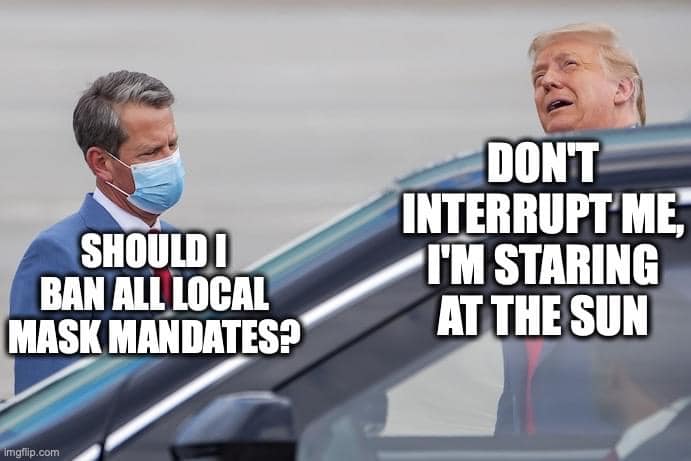
Yesterday the Atlanta Journal Constitution reported that Trump ass-licker Brian Kemp, who, as Secretary of State, stole the gubernatorial election in 2018, banned "cities and counties from adopting rules requiring masks or other face coverings, a measure that could bolster the state’s case in a possible legal battle... The governor has called such a requirement 'a bridge too far' and his office has said local mandates are unenforceable... [T]he new set of rules he signed on Wednesday specified for the first time that cities and counties can’t require the use of masks or other face coverings."

COVID-Kemp with friend

That could improve the state’s standing in a courtroom fight against a string of cities that have defied Kemp’s emergency order by requiring masks. Savannah led that charge earlier this month, and since then other cities including Atlanta, Athens and Augusta have followed suit.

...Hours before Kemp took action, his Republican counterpart in Alabama, Gov. Kay Ivey, announced a statewide mask requirement that will take effect Thursday. Meanwhile, Walmart and Sam’s Club said they would require shoppers to begin wearing masks Monday.

Also Wednesday, Gov. Andrew Cuomo announced on Twitter that New York will send 7,500 COVID-19 test kits, 30,000 pieces of personal protective equipment and 1,250 gallons of hand sanitizer to Atlanta by Friday. Atlanta Mayor Keisha Lance Bottoms, who earlier this week sought the state’s help amid a mounting feud with Kemp, said she was grateful.

...The rate of new tests that are positive for the disease is soaring, an indication that experts say suggests the spread of the disease-- and not increased testing-- is the culprit. During the week of May 24, state public health officials reported the rate of positive tests was about 6% over the course of seven days. Last week, the positivity rate was more than 13%, an Atlanta Journal-Constitution analysis of state data shows.

Even though the new wave of COVID-19 patients tends to be younger and less sick, they are filling hospital beds at a rapid clip. Hospitalizations topped Georgia's prior peak in April after the Fourth of July weekend. Shares of open critical care beds in regions surrounding Athens, Dublin, Macon, Marietta, Savannah and Tifton have dipped into the single digits. Only one was left in Dublin, according to the most recent figures available.

Disease experts at Georgia Tech and elsewhere have warned that Georgia is running out of time to prevent surges of cases that have overwhelmed hospitals in Florida, Arizona and other states that eased restrictions. This month, more than 1,400 health care workers signed an open letter calling on Kemp to shut down bars and restaurants, ban indoor gatherings of more than 25 people, mandate masks, and free local governments to institute their own rules to halt the spread of the disease.

“It’s not too late to go back to the basics: mandatory masks, more restrictions on social distancing, freeing mayors to manage their local epidemics, and vastly expanding testing and contact tracing,” Dr. Melanie Thompson, principal investigator of the AIDS Research Consortium of Atlanta, said last week. “These are basic, but we haven’t come close to mastering them yet.”

Dr. Harry J. Heiman, a clinical associate professor at Georgia State University School of Public Health, said: “In the absence of aggressive action, it’s only going to get worse.”

Seems like the worst possible time to tell local governments that they can't mandate masks


Teresa Tomlinson, former mayor of Georgia's second largest city, sees right through Kemp and his cronies "Georgia Republicans," she told me yesterday, "give a lot of lip service to local governments being the 'labortories of democracy.' They don’t believe that-- never have. Republicans want ideological enforcement at the state level. Kemp’s lawsuit against Atlanta Mayor Keisha Bottoms’ mask mandate fully demonstrates their hypocrisy. Kemp’s insistence that an individual’s freedom to wear a mask, or not, is more important than another person’s right to survive is absurd. People will die as a result of this foolishness."

Wisely, Athens and Clarke County are ignoring Kemp, the same way the Bay Area counties ignored California Gov. Gavin Newsom when the pandemic began (and are all faring much better than the counties that went along with Newsom's cowardly go-slow approach).
Athens Mayor Kelly Girtz on Thursday said that the face-covering ordinance that took effect July 9, “remains on the books.”

County commissioners unanimously approved the ordinance on July 7, and the ordinance remains in effect until Aug. 4, unless extended.

“I have been in regular communication with mayors in several other Georgia cities with mask requirements, and we wish for our local requirements to remain in place. We strongly believe this is within our authority,” Girtz said.

“On the practical matter of mask requirements, it is impossible to simultaneously want a successful economy without allowing the tools-- such as masks-- that will create the vehicle for this success. Otherwise, we risk continued shutdowns and medical crisis. Governors in Alabama, Texas and North Carolina recognize this, as do health experts from throughout the globe,” the mayor said.

According to the Girtz, the police department and county Code Enforcement Division have been told to not issue summonses during the first week of the ordinance’s roll-out, and instead “simply seek compliance” and distribute masks to people who don’t have them.

Kemp’s order that bans local governments from requiring mask wearing came as Georgia continued to see a high level of new COVID-19 infections.

Kemp was among the first governors to ease earlier restrictions, and while infections declined for weeks afterwards, they began to rise in June.

...In Athens-Clarke County there have been 1,045 confirmed cases, 74 hospitalizations and 15 deaths, according to the DPH.

According to Harvard Global Health Institute’s Covid Risk level, Athens-Clarke County is at 25.4 new daily cases per 100,000 residents, putting the county at “Covid Risk Level: RED TIPPING POINT Stay-at-home orders necessary.”

The state reports that 84 percent of available hospital critical beds are in use.

...The Athens face-covering ordinance is an attempt to slow the spread of the disease, which has shown no signs of abating. The measure requires that people cover their noses and mouths while in public.

A first and second violation or the ordinance is punishable by a $25 fine, and the third and subsequent violations are punishable by a $100 fine.

My friend Bertis Downs lives in Athens. Yesterday, he wrote that "With the reality of community spread so bad that Republican leaders in West Virginia and Alabama, not to mention Walmart and Kroger, have required masks, the one thing public health professionals say we can all do to help beat the damned virus. But not in Georgia-- nope, our governor has decided to pick that fight after all. He says local mask ordinances in 15 Georgia cities are now void. That's what he says. Maybe at some point a court will be asked to decide. If so, I wonder if Kemp will do better in his deposition that he's done before-- it has to do with working memory, or something: AJC: "By the time his deposition concluded, Kemp had answered 'I don’t recall,' 'I don’t remember,' 'I don’t know,' or some variation at least 91 times. 'To the best of my knowledge,' Kemp replied to one question, 'I don’t recall that.'" From the AP story: "The Republican governor has instead been trying to encourage voluntary mask wearing, including telling fans that reduced infections from mask-wearing would make college football season possible."

Maybe Brian Kemp needs to be impeached and removed from office before he kills even more Georgians? Oh, that's right... most members of the state legislature are as crazy, bigoted and ignorant as Kemp is.


Labels: , , , , , , ,

Monday, April 22, 2019

A Way-Too-Early Look at Bernie Sanders' VP Choices

>


by Thomas Neuburger

What is Bernie Sanders looking for in a potential vice-presidential pick? What should he be looking for? These two questions, while it may be too early to ask them, are nonetheless worth considering.

For one thing, the issue of Sanders' age, for those who are inspired by his policies, can be easily countered if he chooses a vice-president who is a) younger and b) just as progressive or nearly so. Questions about his age are appearing now. So let's take an early look at potential Sanders vice-presidential picks.

Who Is Bernie Sanders Most Likely to Choose?

As the video below points out, Sanders has already said that he was looking for someone who is "maybe not of the same gender as I am, and maybe somebody who might be a couple of years younger than me, and somebody who can take the progressive banner as vice-president and carry it all over this country to help us with our agenda and help us to rally the American people."


These criteria produce many choices, and the video lists them:
  • Kamala Harris
  • Tulsi Gabbard
  • Rashida Tlaib
  • Ilhan Omar
  • Pramilla Jayapal
  • Nina Turner
  • Stacy Abrams
  • Marianne Williamson
  • Elizabeth Warren
Of these, Harris is a strong campaigner but not very progressive. Though she's been presenting her progressive social justice side recently, she has a history in California as a tough prosecutor, including of minorities and including for minor drug crimes. She has enough negatives to make her vulnerable on social justice and prosecution of bank fraud, both important Sanders issues.

Gabbard is also a strong campaigner, but doesn't have much of a relationship with Sanders. Her background and résumé also raise questions that have yet to be answered, for example about her support for Modi in India. Her polling is also extremely low.

The young congressional women — Tlaib, Omar, Jayapal — seem unlikely choices. All are too unknown; Omar is too controversial (due in part to her own party's attacks on her); and Omar is not a natural-born U.S. citizen. Nina Turner is a possibility given her relationship with Sanders and Our Revolution, but may not pass the experience test. Marianne Williamson has no government experience at all (though she is an excellent speaker and might be a desirable choice anyway based on policies she supports).

Stacy Abrams is not polling very well, and while she's considered a progressive by the media, many of her policies are not, and she recently joined the Board of CAP, the Center for American Progress, where she said this: "Led by the extraordinary Neera Tanden, CAP has been at the forefront of progressive policy development and activism for years. Together, we will find and support bold solutions on health care access, voting rights, the economy, and other critical issues our nation faces."

CAP's positions on Medicare for All and economic issues, among many others, are decidedly neoliberal and decidedly donor-driven. For this reason, I'd be shocked and disappointed if Sanders chose Abrams.

That leaves Elizabeth Warren, who in many estimations is the most likely woman to be chosen, if Sanders chooses a woman.

Note: The video acknowledges (at 10:57) that "Bernie supporters remember her failure to back him during the 2016 primaries." I think this is one of the reasons that Warren hasn't gained traction this year among the strongest Sanders supporters on social media, and may partially account for her low polling. After all, in the early days of the 2016 primary, "Run Liz Run" was quite the rallying cry.

Warren has failed to recapture her 2015 "Run Liz Run" magic this time around, which helps explain her mid–second tier polling among 2020 Democratic candidates — she's below people like Harris and above people like Klobuchar, with the Pete's and the Beto's of the world floating up and down, above her and below, as the moment and local political winds may move them.

Yet Warren's weaker position may actually work out to Sanders' advantage, as I'll detail in a future piece. It may also work to Warren's advantage as well — given her lower polling, she's unlikely to feel she has to attack Sanders to capture his place alongside the ephemeral Joe Biden. 

Who Besides Warren Might Sanders Consider?

There are negatives, of course, to choosing Warren. Her favorability rating isn't particularly high — I know a number of Republican voters who would strongly consider Sanders over Trump but would not consider Warren — yet that may not be an issue were she second on the ticket. In addition, she doesn't add geographic diversity and she doesn't have special expertise, for example, in foreign policy, that supplements what Sanders offers.

Non-Warren alternatives suggested in the video include:

Pete Buttigieg — a direct counter to the freakishly Christian Mike Pence in the VP debate

Andrew Yang — a tech-savvy entrepreneur with many progressive policies who knows how to talk to rust-belt and disaffected workers (for example, see 15:05 in the video above)

But neither of these people, plus others like Beto O'Rourke, are choices Sanders would make. To start, Yang is too unknown (and male), Buttigieg is too neoliberal (and male). There are other reasons for Sanders to avoid them as well, and I think he will.

It looks almost certain therefore that Warren will be his VP choice. The question then becomes, when should he announce it?
  

Labels: , , , , , , , , , ,

Saturday, April 06, 2019

Is 2020 The Year The Democrats Finally Win A Statewide Race In Georgia? Or The Year A Second Georgian Becomes President?

>


2014 was a big year for elections in Georgia. Former Democrat Nathan Deal beat Jimmy Carter's grandson, Jason, 1,345,237 (53%) to 1,144,794 (45%). Not bad, huh. And on the same day, there was a Senate race that pitted two candidates with big family names: Republican David Perdue against Democrat Michelle Nunn. Perdue won 1,358,088 (53%) to 1,160,811 (45%). Wow! Same results, more or less. Last year's gubernatorial election was different. Way more people voted-- for both candidates-- and the Democrat in the race, Stacey Abrams, had a real shot. There were a lot of voting irregularities and she may have even won. The official count was 1,978,408 (50.2%) for Brian Kemp to 1,923,685 (48.8%) for Stacey Abrams. Stacey the seven biggest cities, the only ones with over 100,000 people-- Atlanta, Columbus, Augusta, Macon, Savannah, Athens and Sandy Springs-- although Roswell is almost at 100,000 and she won there too. In fact, Fulton and DeKalb counties include Atlanta, Sandy Springs and Roswell and Abrams won 72.3% in Fulton County and 83.5% in DeKalb County.

Abrams did so well in Georgia that she made a national name for herself as well. The James Arkin piece in Politico is titled Stacey Abrams torn between running for president, Senate and it's not even that outlandish. A few months ago I even asked our art director to put this together:


And so much has been made of a Biden-Abrams ticket. She even had one of those special Joe Biden moments-- before shooting down the whole scenario:


But I really think-- and I know I could be wrong about this-- that Schumer has persuaded her that her own goal (to be governor of Georgia some day) is best served by running for the Senate, not by jumping into the presidential circus. Arken, though, writes that she's "doing everything a would-be presidential candidate would do: a nationwide book tour, candidate cattle calls and stops on late-night television and morning news shows." Eh... she's not going to be on the June debate stage. And that list of everything right, is also everything right she could be doing to prepare for a Senate race that's going to include raising a lot of money nationally.
But the Georgia Democrat is also still actively considering a run for a seat in the Senate, and top Democrats continue to court her aggressively for the race. Abrams met with Senate Minority Leader Chuck Schumer Thursday in Washington, at least her third meeting with the Democratic leader this year.

Abrams told Politico in an interview on Thursday evening that Schumer has been "diligent" and "thoughtful" in wooing her to run for Senate, including enlisting allies to help her understand the contours of the job. Abrams said she spent years preparing to run for governor in 2018, a race she narrowly lost, and wanted to give the same forethought to a Senate bid.

"He has been unequivocal in his desire to have me become a candidate for this office," Abrams said of Schumer's persistence.

Meanwhile, Abrams continues to tantalize her supporters with the possibility of a presidential campaign. During an appearance on MSNBC's Morning Jo on Thursday, co-host Mika Brzezinski told her, "You should jump in" to the race for the White House. When she appeared at Rev. Al Sharpton's National Action Network convention in New York on Wednesday, speaking alongside a caravan of presidential candidates, the crowd chanted, "Run, Stacey, run."

The will-she-or-won't-she drama represents one of the last unanswered questions about the 2020 Democratic field, but it could be some time before Abrams makes a final decision. She initially intended to decide on a Senate run by the end of March, but that timeline has slipped as she has toured the country, which has allowed her to develop a national political network. She said she would decide "as soon as possible" — but called it a self-imposed deadline and declined to give a specific date for announcing whether she would challenge first-term GOP Sen. David Perdue.

"Our collective responsibility is to make sure that-- regardless of who the candidate is-- that Democrats take the Senate," said Abrams, who was in Washington for a speech at an annual gala for EMILY's List, the group that promotes Democratic women who support abortion rights. "That is my commitment, whether I'm the candidate or not."

If she were to pass on a Senate run, Abrams thinks she could wait longer before deciding whether to run for president. She told POLITICO she thought deciding on a presidential run in the fall was a viable option — even if it meant missing the first two primary debates, scheduled for this summer, and losing out on hiring early staff in the initial primary states.

...Democrats also are preparing for the possibility that Abrams passes on a Senate run. Teresa Tomlinson, the former mayor of Columbus, Georgia, has taken steps toward a campaign should Abrams pass, though she plans to back Abrams if the 2018 gubernatorial nominee does run. Tomlinson was at the headquarters of the Democratic Senatorial Campaign Committee Wednesday, where she met with Schumer and Nevada Sen. Catherine Cortez Masto, who chairs the campaign arm.

"What we intend to do is to allow Stacey the time that she needs and that she deserves to consider her options," Tomlinson told Politico Thursday. "Should she choose something other than U.S. Senate, we have to make sure we have a strong contender for the Democratic nomination here in Georgia-- and, of course, my pitch is that I'm ready to go on all that."

Abrams committed to helping Democrats in the Senate race even if she passes on running herself.

"We need a better leader, and we need a better senator-- and my mission is to make certain that whether I'm the candidate or not, someone takes on this responsibility and that we beat David Perdue in 2020," Abrams said.
Tomlinson is a pretty impressive candidate as well-- but she's not Stacey Abrams and would have considerably more of an uphill climb to gain real traction against Perdue outside of Columbus and Atlanta. This is the quickie case for her:
Teresa Tomlinson has six times been named to Georgia Trend's 100 Most Influential Georgians and she holds a National Security Secret Clearance with the Department of Defense.


During her tenure Columbus, Georgia, was named one of both 2016 and 2017 top fifty Best-Run Cities in America. Her administration reduced crime by 39.3% from its height in 2009, including a 41.2% drop in property crime and a 15% drop in violent crime. Under her leadership, the Columbus Consolidated Government balanced the budget for the first time in 16 years using no reserve funds and provided city and county services at the prudent cost of $1,300 per person. Tomlinson instituted reform in the city's pension plan, saving taxpayers some $39 million and increasing funding of the General Government plan to over 90%, while preserving the valuable Defined Benefit Plan for Employees. Reform was also instituted at the Muscogee County Prison with the Rapid Resolution Initiative, which expedited the disposition of unindicted inmates at the Muscogee County Jail. Columbus was recognized with a Harvard University, Kennedy School of Government Bright Ideas Award, for the Save-A-Pet Plan which reduced the animal euthanasia rate from 80% in 2010 to 20% in 2016 and increased adoption by triple digits. Tax Allocation Districts were adopted to encourage the revitalization of previously blighted areas, including City Village and the Liberty District. New biking/walking trails were constructed, known as the Dragonfly Trails, to create 60 miles of connected trails throughout the city, including trails and streetscapes in previously blighted areas. Over 2 miles of the Chattahoochee River were returned to its natural state, creating the world's longest Whitewater Course in an urban setting. Tomlinson has overseen the renaissance of the city's downtown creating a bustling dining/entertainment district, known as Uptown. Tomlinson has provided constituents with direct access to their mayor through quarterly forums called Let's Talk with the Mayor and social media.

Labels: , , , , ,

Wednesday, March 27, 2019

Someone Asked Me To Say Something Nice About Status Quo Joe-- I tried But...

>


Biden still hasn't announced and people-- albeit not Wall Street-- are already sick of him. According to CNN polling, Biden's favorable numbers have been declining since people started looking into his actual record. In October of 2018 he was the favorite candidate of 33% of Democrats. That dropped to 30% in December and now stands at 28%. Once he announces and people figure out that he's been a lifelong corporate whore (not to mention a disgusting racist), he should drop down into single-digit Amy Klobuchar territory, which is where candidates from the Republican wing of the Democratic Party all belong.

Saturday, in his New Yorker piece, The Challenges and Opportunities Facing Joe Biden, John Cassidy notes that "Inside the political world, there is a common presumption that entering an elongated Democratic-primary contest will prove damaging to the former Vice-President Joe Biden, who is riding high in early opinion polls, and that, as the saying goes, the first day of his campaign may well be the best." As he points out, though, "Biden is also exposing himself to hazards by standing on the edge and prevaricating."

He worries that he won't be able to raise the kind of money from the Democratic grassroots that Bernie and Beto have and that the money chase will expose him for what he, at his core, is and has always been: the Wall Street candidate. So his consultant-based campaign is sitting around floating gimmicks that might generate interest in a completely corporate campaign. (Apparently Stacey Abrams has already told him to stop tossing her name around as a lure, all too typical of the disrespect Biden has always shown women-- and especially African-American women.)
The message these stories send is that Biden is worried about various things: money, his age (he will turn seventy-seven later this year), and his ability to reach younger and more progressive voters. At least some of these worries may well be justified, but they aren’t the sort of thing that any Presidential contender wants amplified on the home pages of national newspapers, particularly a contender whose biggest assets are supposedly his likeability and electability. Assuming that Biden does intend to run, he needs to jump in and start making the case for himself, as other candidates have done. In an environment of heightened political activism, blanket media coverage, and ubiquitous social media, history doesn’t favor those who wait. And it certainly doesn’t favor he whose proto-campaign is already generating damaging stories.

If Biden does take the plunge, he will start out with at least two substantial advantages. Having faithfully served as Barack Obama’s wingman for eight years, he is widely liked among Democratic voters; his popularity extends across regions and racial groups. Moreover, Democrats desperately want to nominate someone who can beat Donald Trump, and Biden currently polls better than the other Democratic candidates in head-to-head matchups. An Emerson College survey that came out on Wednesday showed him defeating Trump by ten percentage points, fifty-five to forty-five. The matchups involving other Democrats, such as Kamala Harris and Bernie Sanders, were a lot closer.

Of course, the fact that Biden is polling well in March, 2019, doesn’t mean that he’s the best candidate to take on Trump in November, 2020. To win the nomination, he’ll need to prove his mettle on a daily basis, avoid the mistakes that plagued his two previous Presidential bids, and cast off some of the baggage he has acquired during his nearly fifty years in politics. (He entered his first electoral race, for New Castle County Council, in 1970.)


He could begin by saying sorry to Anita Hill for his role in the 1991 Clarence Thomas hearings (he has said that he wished he could have done more to prevent other members of the Senate Judiciary Committee from hounding Hill but stopped short of issuing an apology); reiterating his contrition about the Violent Crime Control and Law Enforcement Act of 1994, which led to mass incarceration of minorities; and apologizing for some of the statements he made in the mid-seventies, when, as a freshman U.S. senator, he vigorously opposed school-busing. (A recent Washington Post article dug up a number of Biden quotes, including this one, from 1975: “I do not buy the concept, popular in the ’60s, which said, ‘We have suppressed the black man for 300 years and . . . to even the score, we must now give the black man a head start, or even hold the white man back, to even the race.’”)

Judging by some comments he made last weekend, Biden’s first instinct will be to defend his record and point to progressive positions he has adopted over the years, such as his support for public housing, labor unions, and expanding voting rights. He needs to go further. Democratic-primary voters know that Biden started out in a different era, but many of them will also want him to demonstrate that he embraces an environment in which there is zero tolerance for anything that smacks of sexism or racism.

Making such a gesture is the right thing to do, and it could help defuse some of the attacks that are sure to come. It’s a smarter play than immediately floating the idea of selecting Abrams as his running mate, talented though she is. As the Washington Post columnist Karen Tumulty pointed out, the Abrams story smacked of gimmickry, and it was also “presumptuous” of Biden’s advisers to assume that Abrams would accept the role of “acting as Biden’s human shield, constantly called upon to answer for his past positions on issues that put him at odds with African American and female voters.” (On Thursday, a spokesperson for Abrams issued a statement saying that she has met with more than a half-dozen Presidential contenders, and she “continues to keep all options on the table for 2020 and beyond.”)

To be sure, if Abrams doesn’t decide to enter the Presidential race on her own account, she could eventually be a potential running mate for a number of the other candidates, Biden included. Right now, though, the former Vice-President needs to stand on his own feet. He would do well to take the advice of his Delaware friend and colleague, Senator Chris Coons, who has called on him to make clear that he has the energy and determination to serve for two terms.

Whatever he does, Biden will be attacked from the left for being too centrist, too friendly with Republicans, and too in hock to financial interests headquartered in Delaware. These are substantive criticisms. Still, if he combines his defense of the Obama legacy with a populist economic agenda focussed on advancing the middle class-- one that he has already embraced-- he could be a formidable candidate. And despite being the front-runner in the polls, he could also benefit from being underestimated by pundits, many of whom expect him to falter. In any case, though, he needs to get in there. Enough of the Hamlet act.
One more little ole thing: did you like the other Joe from the Republican wing of the Democratic Party, Joe Lieberman? If you did, you should be more than happy with Joe Biden. They're virtually the same-- and always have been. Another "Back to Normalcy" candidate with nothing at all to offer other than he's not Bush Trump.


Labels: , ,

Friday, March 22, 2019

Gimmicky

>

Ames, Iowa to Nashua, New Hampshire is an amazing 3 hours-- then back to Sioux City!

As of yesterday, Beto had campaigned in all 190 New Hampshire counties (in just 48 hours of his unique brand of superficiality). He also skateboarded through Iowa and the upper Midwest, playing a guitar and balancing a large American flag ball on his nose. Dave Siders reported for Politico that "With no day job, the Texas Democrat's breakneck pace of campaign stops is driving some of his competitors nuts... O’Rourke is rallying college students, bounding onto café countertops and pressing himself into the news cycle in different media markets by the hour."
“We’re setting the pace,” O’Rourke said in Iowa over the weekend, after running a 5K race at the start of a frenzied day of campaigning in the first-in-the-nation caucus state. He then traveled to Wisconsin, Michigan, Ohio and Pennsylvania, before driving his rented Dodge Grand Caravan more than 430 miles east to New Hampshire.

In less than a week since announcing his campaign, the Texas Democrat has singlehandedly quickened the clip of the early presidential primary, annoying some of his competitors-- and driving others nuts.

...But O’Rourke is also attempting in his go-everywhere-fast campaign to establish himself as a course-correction from Hillary Clinton’s losing effort in 2016. Many Democrats remain bitter that Clinton did not campaign at all in Wisconsin in the general election-- a critical state ultimately carried by President Donald Trump. Asked recently to assess the Democratic Party’s failure in the last presidential election, O’Rourke said, “You’ve got to show up, and you’ve got to come back.”

...For Jeff Roe, who was Cruz’s chief strategist, O’Rourke’s early run is familiar. He said that if O’Rourke remains tied to the road, it will prevent him from advancing any public storyline other than that he is a road warrior-- a narrative that will eventually grow old.

“Coming out of the gate, for the first couple weeks, it’s probably OK,” Roe said. “But this is all he has … he’s in a constant sprint to find himself.”
Meanwhile, I'm sure someone is writing a good platform for him in case he decides to run on issues.

Team Biden has its own gimmickry. Mike Allen reported yesterday that close advisors "are debating the idea of packaging his presidential campaign announcement with a pledge to choose Stacey Abrams as his vice president." Gee, what happened to the Biden-Beto team?

Allen wrote that "The popular Georgia Democrat, who at age 45 is 31 years younger than Biden, would bring diversity and excitement to the ticket-- showing voters, in the words of a close source, that Biden 'isn’t just another old white guy.'" Woulda fooled me! Allen cautions that "Advisers also know that the move would be perceived as a gimmick." Another gimmick they're considering is a pledge to serve just one term, in the words of Jonathan Martin at the NY Times, "framing Mr. Biden’s 2020 campaign as a one-time rescue mission for a beleaguered country."

Also yesterday, Jonathan Chair noted in his New York Magazine column that Abrams would be a "brilliant move" for Biden... and for Abrams too. He offers 9 reasons why:
1. Most obviously, running with Abrams would help address Biden’s cringe-inducing and sometimes ghastly history of retrograde positions on segregation and criminal justice. As my colleague Ed Kilgore correctly noted, “Serving the protector of Biden’s racial flank, on the other hand, might get a little old and a little limiting” for Abrams.

But that would be the wrong way to construct her role. The addition of Abrams would visibly signal that Biden is a bridge to a different kind of Democratic Party that has moved left on racial issues. Biden can say he’s a different kind of politician with different policies than those he advocated in the 1970s and 1980s, but having Abrams as his partner and presumptive heir demonstrates the point.

2. Abrams would also obviously add an element of mobilization and inspiration to Biden’s comfort and familiarity with the base. “Balance” is an overrated trope in vice-presidential selection, but candidates do have different qualities and the degree to which Abrams’s complements Biden’s is very striking: old/young, white/black, male/female, North/South, experience/potential.

Candidates who have the ability to mobilize voters with inspirational appeals often lack national name recognition and credibility. (That’s Beto O’Rourke’s liability.) And candidates who begin with established credentials often have a longer record of compromises and feel like old news (Biden’s problem, and also to a smaller extent a liability for Elizabeth Warren and Bernie Sanders). A pairing with Abrams gives both a chance to take on each other’s assets and cover their own liabilities.

3. The pairing would make Biden’s race feel more serious. Political reporters have approached a Biden race with the unstated assumption that his polling lead is an artifact of high name recognition. His best day will be his first, and he will slowly gaffe his way to irrelevance, as he has with every previous race. Paradoxically, he is a polling front-runner who needs to get the press corps to take him seriously.

From that standpoint, it’s odd to see “inevitability” treated as an argument against joining early with Abrams. “Naming an early running mate could help feed into an air of inevitability,” one senior Democrat who admires Biden tells CNN, which might be “problematic for his candidacy.” So the campaign would appear inevitable, like Hillary Clinton? Or Mitt Romney? Or George W. Bush? Or Al Gore? Or other candidates who were treated as prohibitive front-runners from the beginning of the race and then … won the primary? That’s bad?

4. Yes, by picking Abrams now, Biden would lock himself in very early. Matthew Yglesias argues that doing so would prevent him from having a more complete choice of running mates later in the process. And it’s true, by June of 2020, you can imagine a world where Biden would wish he could pick Warren or Kamala Harris or somebody else. But the thing is, the odds are that he’s not going to be in that position at all. Maximizing his odds of winning the nomination seems far more important, from Biden’s standpoint, than maximizing the potential for exploiting his vice-presidential selection.

5. The move would make just as much sense for Abrams. She currently finds herself in the frustrating position of having demonstrated strong political talent but lacking an obvious next step for her political ambitions. Abrams’s home state is trending purple but not quite there, and while she could run again in 2020, the political environment might not be much friendlier than it was in 2018, an anti-Trump wave election year.

Abrams has said she wants to be president. A vice-presidential spot would fast-track her for consideration-- should a Biden–Abrams ticket prevail in November, Abrams would immediately become the prohibitive front-runner whenever Biden retires. 6. Some of the logic that argues for her to join with Biden would also suggest she join Bernie Sanders, another high-polling old white guy. But even if Sanders would consider such a move, a prospect no reporting has suggested, it makes less sense for her. Abrams is not a socialist, and has a distinctly different worldview, as Rebecca Traister’s profile points out, showing Abrams tell one crowd, “I’m not going to do class warfare; I want to be wealthy.” Sanders has a different set of liabilities than Biden: chief among them, the Democratic Party elite thinks he would have trouble withstanding the attacks on his platform and his radical history that he would face in a general election (but which did not come up in the 2016 primary). Joining with Abrams wouldn’t do much to ameliorate that.

7. Joining the race early makes Abrams a much more attractive vice-presidential selection than she would be in June of next year. Like O’Rourke, her talents offset a résumé that’s well short of the traditional qualifications for president (Abrams’s highest elected office is state assembly). That’s a weakness that might prevent Abrams or O’Rourke from being nominated as a vice-president next summer-- they would face questions about their qualifications and preparedness for office. Paradoxically, for a candidate with a borderline résumé, vice-president is more of a reach than president.

But it’s also a liability that can be addressed on the campaign trail, by demonstrating a command of policy to the media. Abrams, with her advanced degrees in both public policy and law, can answer any doubts.

8. Abrams doesn’t close any options by running with Biden. “Why in the world would Stacey Abrams lock herself into Biden’s fortunes when she would be a top-tier running-mate option for several of these candidates?” asks Republican operative Brendan Buck, who perhaps might not have Abrams’s best interests at heart.

But why would running with Biden prevent her from joining a different campaign if he loses? Presidential candidates pick politicians who who ran against them for president to join their ticket all the time. Why would the fact that she ran on a different ticket as a vice-president disqualify her?

9. The biggest single argument against naming Abrams at the beginning is that it just hasn’t been done before. The closest parallel is Ted Cruz’s last-minute desperation gambit to name Carly Fiorina as his running mate in the closing stages of the 2016 primary. The fact that the combined charisma of Cruz and Fiorina was not enough to overcome Trump’s big lead hardly proves it can’t work. If anything, the lateness of the maneuver gave it a whiff of desperation. If Biden does wait, and his polling lead starts to melt, naming Abrams will have the same pitfall. The Cruz example argues for joining with Abrams on Day One.

Sometimes there’s a new idea that has not been done before for no good reason. “Political brilliance” is not a phrase I would normally associate with Joe Biden. But running with Stacey Abrams seems to qualify.

Labels: , , ,

Tuesday, January 29, 2019

What About Bernie Sanders/Stacey Abrams?

>


In a column over the weekend, Max Boot noted that Trump has as yet been unable to adjust "to the brutal reality of dealing with a Democratic-controlled House. When Republicans were in control of both chambers, he could plausibly threaten lawmakers because of his cult-like hold on 80-plus percent of Republican voters. But his base is only 35 percent or so of the entire electorate, and Democrats are not intimidated by him. His aura of invincibility has been cracked-- and, with special counsel Robert S. Mueller III scheduled to report, the worst is yet to come. Two painful, punishing years loom."

"Democrats are not intimidated by him." Well... Nancy Pelosi obviously isn't. Nor is Ted Lieu. Ro Khanna isn't. Alexandria Ocasio-Cortez and Rashida Tlaib have made it apparent that they're not afraid of him. As far as I can tell, most congressional Democrats aren't. But what about the freshman members from the red-leaning districts? Some of the New Dems and Blue Dogs, in fact, have been nearly as obsessed with Trump's supporters as Boot's cowardly Republicans are. As we've seen, some of the worst of them-- take Michigan New Dem Elissa Slotkin (the hot dog heiress)-- who was already warning that Democrats had to compromise with Trump on his vanity-wall when Pelosi shut Trump down. Others were whining that $15/hour is too high for a minimum wage, using failed Republican arguments nearly a century old.

If preserving Elissa Slotkin's seat becomes a greater priority than passing a minimum wage that real Democrats, who are not hot dog heiresses. had campaigned on, someone needs to tell Ms. Slotkin she's in the wrong party.

Over the weekend, likely Bernie running mate, Stacey Abrams (D-GA) told Britni Danielle of Essence that during her race for governor she "focused on expanding the electorate, not simply on trying to convince disaffected Republicans to join her team. Because of this, she not only turned out more Black and white voters than former President Barack Obama, but she also massively increased Latinx and Asian turnout as well. How? Throughout her campaign, Abrams focused on the issues people cared about most, including education, healthcare, and poverty, which she called 'immoral' and 'economically inefficient.'" That's the way to win in 2020, not by emulating the hot dog heiress.

"Democrats," Abrams told Danielle, "win by telling our story, by engaging communities early and authentically, and by fighting for every vote that shares our values. But too often on the Democratic side of the aisle, the ones who share our values are the ones who least likely to be asked to share their voices... what my campaign demonstrated… is that if you go into communities and treat them with respect, regardless of race, they will vote if we tell them we trust them. So I want us to have 2020 candidates who are actually doing the work of expanding the electorate, not trying to convince people who’ve already told us they don’t like us to change their mind just this once."

Disclaimer: although I once tried-- and got through almost half an episode-- I never watched The West Wing. I had this idea that it was all about what was wrong with the Democratic Party and why we were stuck with Bush, rather than a viable-- even if fictional-- alternative to Bush. So I ignored what "everyone" called the greatest TV show of all times and missed out on so many conversations it was the center of. Last week I found someone who agrees with me: Luke Savage at Jacobin and his excellent little essay Aaron Sorkin’s Road to Nowhere. "Aaron Sorkin wants to give Alexandria Ocasio-Cortez advice," wrote Savage. "Yet The West Wing creator’s worldview remains a vision of liberalism at its hollowest and most ineffective." Savage was offended that Sorkin was on CNN lecturing "the new crop of young people who were just elected to Congress" about growing up and the "need to stop acting like young people."
It says a great deal about the state of American liberalism that a screenwriter best known for crafting middlebrow dramas famous for their circuitous dialogue remains a house intellectual-- none of it good.

Perhaps better than any other cultural artifact, Sorkin’s The West Wing chronicled the moral and intellectual decline of a post–New Deal Democratic Party, reveling in its shift to a vacuous center characterized by deficit hawkishness, technocratic proceduralism, and smirking, credential-obsessive Ivy League pretension. Serving as a morale booster for Bush-era liberals, the saga of the fictional Bartlett administration ultimately reflected and informed the politics of the Obama presidency and the world views of some of its most influential partisans and operatives.

Its absurdity notwithstanding, the West Wing creator’s patronizing intervention is yet a further illustration of how deeply embedded the discredited politics of the 1990s remain in the liberal imagination, even-- especially-- amid the ongoing nightmare of the Trump presidency. In no more than thirty seconds, Sorkin’s flourish managed to evoke virtually everything wrong with DNC liberalism in the twenty-first century: from its reflexive condescension toward the young and the vulnerable (note the pejorative reference to “transgender bathrooms”) to the various ways it fetishizes personality over program, delights in punching left, and elevates intelligence over ideology.

Indeed, just like the real-world liberalism it has channeled and shaped, Sorkin’s politics have always been concerned more with aesthetics than any specific or programmatic impulse towards reform. The West Wing universe, after all, is one in which an idyllic, two-term liberal presidency warmly embraces the military-industrial complex, cuts Social Security, and puts a hard-right justice on the Supreme Court in the interests of bipartisan “balance”-- all the while making no observably transformative changes to American life. What matters most is how politics look and feel and whether the briskly striding people who staff the corridors of power possess diplomas from the right schools. Idealism, such as it is, has more to do with an abstract faith in American institutions and their inherent greatness (as in, “America is already great”) than any particular desire to make the world a better place or see a coherent set of values reflected within them. In Sorkin’s parochial fantasy, politics at its noblest and most high-minded consists mainly of wonkish sophistry and elegantly crafted speeches designed to offer vague comfort while saying nothing.

If this sounds at all familiar (putting aside the actual plot lines of the show’s seven-season run) it’s because the liberalism that defined the Clinton and Obama eras very much cleaved to a similar script, rooting itself in charismatic yet technocratically minded figures behind whom the elite brokers and corporate actors that dominate American society largely carried on business as usual-- even as millions lost their jobs and homes, saw their wages stagnate, and were crushed by the collective avarice of banks, insurance companies, and pharmaceutical giants.

Challenged by the Sanders insurgency in 2016 and rattled by Trump’s victory, the liberal intelligentsia might have taken stock and reflected-- if only out of pure self-interest-- on their own failures and the deficiencies of their worldview. With a few exceptions, this has not been the case. If anything, Sorkin’s condescension towards progressive lawmakers like Ocasio-Cortez suggests that the only thing many elite liberals still know how to do is double down, demand deference, and preach the feel-good platitudes of presidencies past.
No one is going to mistake the Sanders-Abrams White House for Josiah Bartlet's and John Hoynes'-- of that we can be certain. As Matt Taylor predicted at Vice this month, The 2020 Presidential Race Will Put Capitalism's Evils on Full Display. Even with the Warren G. Harding of the Democratic Party-- Biden, the "Back to Normalcy" candidate of an establishment that paved the way for Trump-- still popular, "it's clear," he wrote, "even a year out from the Iowa caucuses that the 2020 contest will be a once-in-a-generation battle over what democracy should look like, over how much the system can be tweaked or just destroyed, and whether Democrats can continue to function as a liberal and progressive party-- or need to become more of a distinctly anti-capitalist one."


Labels: , , , , ,

Saturday, December 15, 2018

Ready For A New And Better Ossoff Pose?

>


There's no question that even in defeat there is inspiration to be found. Lucy McBath's 50.5% to 49.5%, 3,264 vote win against Karen Handel in Georgia was a happy ending last month-- a tie in Fulton County and a bigger Democratic win in DeKalb than the GOP win in Cobb-- but people who watch politics closely were jumping out of their skin as Carolyn Bourdeaux closed in on Rob Woodall even if her massive win in Gwinnett County fell a tiny bit short of his even more massive win in Forsyth. Woodall may have won 50.1% to 49.9% (419 votes) but organizers are already working on GA-07, 2020 right now.

2018 was a great Democratic Party year but among the heroes are candidates who didn't go all the way: Randy Bryce (who did manage to chase Paul Ryan out of Congress), Beto O'Rourke (who didn't beat Ted Cruz but still managed to transform himself from a New Dem backbencher with no accomplishments into a serious contender-- reborn a "progressive"-- for president. No one may ever think about Clarence Nelson II (3 term Senator Bill) again but Tallahassee Mayor Andrew Gillum established himself as a much-admirered national political figure, despite losing narrowly to a neo-fascist Trump supporter.

And, back to Georgia, we'll definitely be eager to hear from Stacey Abrams again. Cheated out of her win-- as Gillum was-- her 1,923,685 counted votes didn't quite go all the way compared to election fraudster Brian Kemp's 1,978,408. On the other hand, I was very nonplussed yesterday to read in the Atlanta Journal Constitution that Jon Ossoff wants to run for the U.S. Senate in 2020.

Ossoff started his GA-06 congressional special election run-- the seat Lucy McBath just won-- with a roar, but then allowed the DCCC and their band of DC consultants-- who grew way fatter on the  $30,431,025 that poured into his race (and that's without even counting the millions more spent by outside groups)-- to take over and ring out every ounce of anything that was ever worthwhile about his candidacy. (Note: McBath's winning campaign spent $2,352,375, about $28,0000,000 less than Ossoff's failed race.)

Yesterday, reporter Greg Bluestein noted that Ossoff will strike a populist tone this time.


Oh, yes... American voters are just craving someone who can strike a good populist pose. Ossoff's contemplating a run against Republican Senator David Purdue in 2020, hoping another big anti-red wave will sweep him into power-- his whiter shade of pale pose trumping Abrams' profound authenticity:


Ossoff spoke at a library in Cornelia in deep red Habersham County, in rural northeast Georgia, this week. (In the 2016 presidential race, Habersham County went for Trump 13,184 (81.7%) to 2,483 (14.4%) His town hall, wrote Bluestein, "took on special significance as a chance to test his appeal to an unfamiliar crowd. And he unveiled an urgent, populist message railing against the corporate influence in politics and a national economy 'built on debt and consumption... There’s more and more cynical politics. Student debt is skyrocketing. We’re still maintaining this unfathomably large empire that costs trillions of dollars,' said Ossoff. 'We’re doing nothing for crumbling infrastructure at home. And we wonder why there’s so much anger.' He added: 'It’s because the people in charge are squandering the power and wealth entrusted in them to make our lives better.' The meeting drew about 100 people, many from a sweep of other deeply-conservative neighboring areas where Democrat Stacey Abrams struggled to crack 15 percent of the vote in November’s race for governor. Organizers said it was the most young people the county party had ever attracted."
Ossoff was dodgy about direct questions about his next step, saying he would “think really carefully” before making up his mind.

But he said he expected Democrats to sharpen their criticism of President Donald Trump, consider new anti-trust regulations and push new campaign finance rules.

He took particular aim at the U.S. Supreme Court’s Citizens United ruling, the 2010 decision that allows unlimited campaign contributions. He said Democrats must respond by banding together to reject corporate contributions.

“It takes politicians who refuse corporate money and break that dependence to bring some balance back to the system,” he said.

And he cast recent Democratic defeats in Georgia-- including his own-- as a temporary setback.

“This is a long fight. There will be triumph and heartbreak, near-misses and wipeouts, and triumphant victories,” he said. “But it’s about every single battle, and not being demoralized-- and finding community among other people who share your values.”
The 2020 Senate map isn't as bad for the Democrats as the 2018 map was. But it isn't great. Democrats will want to go after Miss McConnell and there's chatter about sportscaster Matt Jones running for the seat. Susan Collins' time may finally be up-- or maybe not. Alabama is likely to throw out Doug Jones and replace him with a generic Republican. There's a special election in purple-trending Arizona but are Arizona voters ready for two Democrats representing them in the Senate? Joni Ernst could possibly be defeated by J.D. Scholten, who nearly finished off Steve King in the reddest part of Iowa. Is Thom Tillis really at risk? I doubt it... but the Democrats will try, possibly with former Charlotte mayor Anthony Foxx, who served as Obama's Secretary of Transportation. The best target for for a red to blue flip is Colorado, where Cory Gardner is vulnerable. Georgia? Maybe. Sally Yates has already taken herself out of the running. My guess is that if Stacey Abrams runs, Ossoff will back off but that if she decides not to run, he will. Could he beat Perdue? Probably not... unless the anti-red wave is more massive than it was this year. And that's a reasonable expectation. Could Ossoff raise $30 million again? I don't think so. A lot of people will need a lot more than a pose to write him a check again.


Labels: , , , ,

Tuesday, November 13, 2018

Republican-Lite Democrats Are Only Good At One Thing: Losing

>

You think Democratic primary voters want this as their candidate against Trump?

A silly new poll from Morning Consult purports to show something about how the 2020 Democratic nomination is shaping up. The same kind of lo-info, identity politics idiots who saddled the party with Hillary Clinton in 2016, want Joe Biden in 2020. Will Democratic primary voters ever think about where a candidate might actually want to take the country rather than the color of their skin or the shape of their genitals? I think so. But it takes some kind of concentration, which isn’t easy when you’re talking about something years in the future (even just 2). Anyway, that list up top is the latest iteration of the laughable horserace tabulation, different from Monday’s. What! No groundswell for the Starbucks guy? No Mayor Buttfuck Buttigieg? No Terry McAuliffe? Where’s The Rock and Hillary, all the governors who want to form unity tickets with John Kasich and the backbencher congressmen no one ever heard of like John Delaney who’s been living in Iowa campaigning for a year and only tangentially more absurd than Seth Moulton or Tulsi Gabbard?

Note: This is stupid, so don't take it seriously


Have you read Steve Phillips’ NY Times’ OpEd about why a conservative Democrat is not going to win in 2020? He implores Democrats to learn “the right lessons from the midterms. He wrote that conventional wisdom dictated that both Andrew Gillum and Stacey Abrams “did not give Democrats their best chance; more traditional, moderate white candidates were seen as the most competitive. In this view, moderate candidates can better appeal to and win over ‘swing’ white voters. And yet, and yet… “Over the past 20 years, the best-performing Democratic candidates in statewide elections in Florida and Georgia have been Mr. Obama, Mr. Gillum and Ms. Abrams. (Hillary Clinton in 2016 was actually Florida’s highest Democratic vote-getter ever.) This year, Ms. Abrams dramatically increased Democratic turnout, garnering more votes— 1.9 million— than any other Democrat running for any office in the history of Georgia (and that includes Jimmy Carter, Mr. Obama and Mrs. Clinton).”
Midterm results laid bare the fallacy of that view. In Missouri, Claire McCaskill, the incumbent Democratic senator, lost to Josh Hawley by six percentage points, 45.5 percent to 51.5 percent. Senator McCaskill campaigned by highlighting her moderate credentials and ran a radio ad distancing herself from her party: “Claire’s not one of those crazy Democrats,” a narrator said. “She works right in the middle and finds compromise.”

In Tennessee, Phil Bredesen, the state’s former governor, lost his bid for the Senate by over 10 points despite his attempt to peel off Trump supporters by coming out in support of Brett Kavanaugh’s confirmation to the Supreme Court.
The day Bredesen came out in favor of Kavanaugh— leading in nearly a dozen consecutive polls at the time— I wrote that Democrats could kiss base enthusiasm and the Tennessee Senate seat goodbye. Bredesen, a mainstream conservative, outspent extremist Marsha Blackburn $15,246,145 ($5,516,942 from his own fortune) to $11,819,522 and Schumer’s Majority Forward SuperPac and Senate Majority PAC threw another $18.5 million into Tennessee on behalf of Bredesen. But no amount of money could save him after that stupid, pointless statement. So… will Democrats learn the right lesson? Out of the question— at least for life-long know-it-alls like Schumer (and Pelosi, Hoyer and other party leaders).

Phillips suggests looking more closely at Georgia, contrasting the 2014 election and the recent midterm. “The strategy of wooing supposedly moderate whites was put to the ultimate test when Democrats fielded nominees from two of the most prominent Democratic families in the history of Georgia-- the Carters and the Nunns. Jimmy Carter’s grandson Jason Carter ran for governor, and former Senator Sam Nunn’s daughter Michelle Nunn ran for Senate. Together their campaigns spent more than $20 million, pouring enormous sums into television advertising seeking to persuade moderate whites to back their bids.”

They both lost, with about 45% of the vote each. This cycle Stacey Abrams is governing around 49% as more voters are counted in an incredibly corrupt electoral environment. And in the 6th district, where ultimate milquetoast moderate Jon Ossoff— with every dime the Democratic establishment could raise for him-- lost last year, “riding the swell of turnout inspired and organized by Ms. Abrams, the Democrat Lucy McBath flipped that seat.”
Clearly success required a different strategy. Ms. Abrams and Mr. Gillum embraced the Obama playbook for winning elections: It starts with emphasizing mobilization over persuasion. Ms. Abrams’s campaign defied conventional wisdom by spending early and big on a vast mobilization effort that involved calling, texting and knocking on the doors of nearly 600,000 infrequent Georgia voters a full year before the election.

Mr. Gillum took a similar approach and was buoyed by the backing of organizations such as New Florida Majority, which hired community-based canvassers to knock on tens of thousands of their neighbors’ doors to identify and mobilize Gillum supporters long before the rest of the country caught on to his candidacy.

These campaigns laid the groundwork for future Democratic success, because the thousands of volunteers, operatives and new voters will pay dividends for the 2020 Democratic nominee.

Mr. Gillum and Ms. Abrams did exactly what Mr. Obama did: They inspired people across the racial spectrum to participate and vote, and they did it by being unapologetically progressive. They did not shy away from championing Medicaid expansion, pursuing criminal justice reform and promoting gun control policies.

Does this strategy require a candidate of color? No, but it does call for candidates who can inspire voters of color. Beto O’Rourke in Texas is an excellent example, and his inspiring and well-organized campaign brought him closer to winning statewide than any Democrat has come in Texas in years. And nationally, the Democrats reclaimed a majority in the House by winning in nearly a dozen districts with large populations of voters of color.

Ms. Abrams and Mr. Gillum were also not afraid to tackle the not-so-silent racist “dog whistles” emanating from their opponents and the president. Ms. Abrams refused to shirk from condemnation of racism and condemned the ways in which honoring racist imagery like the Confederate monument at Georgia’s Stone Mountain monument-- called out by name in Rev. Dr. Martin Luther King Jr.’s “I Have a Dream” speech-- undermines democracy and distances entire groups from being part of the body politic. Mr. Gillum offered one of the greatest lines in the history of American politics when he offered, about his opponent, Ron DeSantis, during a debate: “I’m not calling Mr. DeSantis a racist. I’m simply saying the racists believe he’s a racist.”

Notably, this approach of tackling racism head-on is also the best way to woo many white voters. According to the exit polls, both Ms. Abrams and Mr. Gillum received more support from whites in their states than either Mr. Obama or Mrs. Clinton did. White people-- all people-- want to believe in something. Challenging them to reject racism and embrace their highest and best ideals is the most effective way to secure their support.

Yes, the strategy of mobilizing voters of color and progressive whites is limited by the demographic composition of particular states. But what Mr. Obama showed twice is that it works in enough places to win the White House. And that is exactly the next electoral challenge.

Democrats can go the old route that has consistently failed to come close to winning and demoralized supporters down the line, or they can do the math and follow the example of Ms. Abrams and Mr. Gillum and Mr. Obama before them. Invest in the infrastructure and staffing to engage and mobilize voters. Stand as tall, strongly and proudly for the nation’s multiracial rainbow as Mr. Trump stands against it. And mobilize and call forth a new American majority in a country that gets browner by the hour and will be even more diverse by November 2020.

Labels: , , , , , , ,