"When fascism comes to America, it will be wrapped in the flag and carrying the cross."
-- Sinclair Lewis
Sunday, July 12, 2020
Midnight Meme Of The Day!
>
by Noah
Sunday Thoughts: I heard somewhere that Christians believe that God gave us free will. If that's the case, I'm surprised he hasn't taken it away in disappointment. Hmmm, or, was it all just some sadistic Old Testament kind of game?
God said to Abraham, Kill me a son. Abe said, Man, you must be puttin' me on. God said, No. Abe say, What? God say, You can do what you want, Abe, but the next time you see me comin', you better run. Well, Abe said, "Where d'you want this killin' done?*
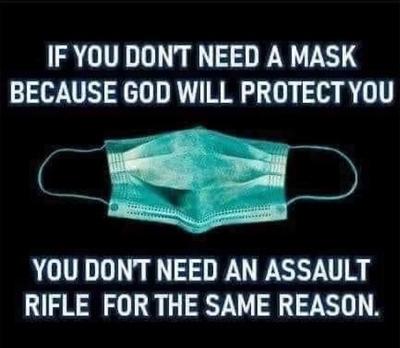
I know, after studying the last 10,000 years of human history, I might be inclined to take free will away if my name was God, but that's just me. Oh wait! I see! God sees assault rifles and COVID-19 as a choice of demise for all of us! Free will, indeed! God is
Pro-Choice! How ironic that the republican disdain for the mask while loving guns leads me to this conclusion. Now, this whole thing of Republicans saying what they do with their bodies when it comes to wearing a mask is their choice but what a woman does with her body in regards to a pregnancy isn't because that's for the government to decide. That sounds very "Deep State" to me! *Highway 61: Words & Music by Bob Dylan, BMG Rights Management
Just As Trump's Great Corona Cover-Up Kicks Into High Gear, It Appears To Be Backfiring On Him
>
On Thursday, Politico interviewed Melinda Gates, co-chair of the Bill and Melinda Gates Foundation and she set the Trump Regime on fire for their incompetent, dysfunctional and bungled response to the pandemic. Their over-all grade wasn't an "F"-- presumably because Trump hasn't fired Fauci yet-- but a D minus. One thing she cited was "a lack of a coordinated, national response," noting that governors were stepping up with '50 different homegrown state solutions,' instead of a national response coming from the top... You know, if we were doing the things that the exemplar countries are doing, like Germany, we would be testing. We would be testing, first, health care workers and then the most vulnerable, and you’d be doing contact tracing. And we would be able to start thinking about slowly, slowly reopening places in society in safe and healthy ways, but we have a lack of a coordinated effort. That’s just the truth, across the United States.'" That means things are going to get considerably worse. One of the states-- where the governor is an empty-headed and completely worthless Trumpist hack who has done everything to kill as many Iowans as she could, Kim Reynolds-- is experiencing a major pandemic surge. On Thursday, Iowa experienced 655 new cases and shot up to a horrifying 3,631 cases per million in its population, second only to Nebraska of any of the other states headed for the leadership roles in the state II summer catastrophe of those that have refused to take social distancing seriously. These were the newest numbers per million for the states begging coronavirus to come stay:
We had some insight into Iowa this morning from a Des Moines Register report by Donnelle Eller on a doubling of cases when a Tyson plant in Waterloo was prematurely forced to open. "More than 1,000 workers," wrote Eller, "at the Tyson Foods plant in Waterloo have tested positive for the coronavirus, a county public health leader said Thursday-- more than double the number Gov. Kim Reynolds had said were infected the day before." Reynolds reported 444 workers with COVID-19 on Wednesday and Black Hawk County officials reported 1,031 at the pg slaughtering facility with the disease on Thursday. Chris Schwartz, a Black Hawk County supervisor, said he was disappointed that Tyson officials, who were part of the briefing Thursday, didn't take responsibility for failing to act sooner to add more protections for employees. "It was incredibly shameful," he said. Black Hawk County Sheriff Tony Thompson expressed concern that some businesses and parks were reopening. "Malls are supposed to operate at 50%. How on Earth do you monitor that?... our numbers are not decreasing yet, have not yet hit a plateau," and that the number of deaths is increasing. On a national level, you've no doubt read by now that the U.S. jobless rate hit 14.7%, the worst since the Great Depression. Heather Long earlier today: "Over 20 million people lost their jobs in April, the Labor Department said Friday, wiping out a decade of job gains in a single month. The staggering losses are roughly double what the nation experienced during the 2007-09 crisis, which used to be described as the harshest economic situation most people ever confronted. Now that has been quickly dwarfed by the fallout from the global pandemic." The stock markets-- which reflexively hate workers, or at least hate the whole idea of companies paying workers-- moved higher on the news. Analysts are warning "it could take many years to return to the 3.5 percent unemployment rate the nation experienced in February. The sudden economic contraction has forced millions of Americans to turn to food banks and seek government aid for the first time or stop paying rent and other bills. As they go without paychecks for weeks, some have also lost health insurance and even put their homes up for sale. 'This is pretty scary,' said Lindsey Piegza, chief economist at Stifel. 'I’m fearful many of these jobs are not going to come back and we are going to have an unemployment rate well into 2021 of near 10 percent.'... As horrific as the April unemployment figure, economists say the official government rate almost certainly underestimates the extent of the job losses. The Labor Department said the unemployment rate would have been about 20 percent if workers who said they were absent from work for 'other reasons' had been classified as unemployed or furloughed." Worst hit are African-Americans, Latinos and low-wage workers in restaurants and retail. "Many of these workers," noted Long, "were already living paycheck-to-paycheck and had the least cushion before the pandemic hit... Women had a higher unemployment rate than men." Trump regime dysfunction and gross incompetence have resulted on millions of workers "still battling outdated websites and jammed phone lines to try to get unemployment aid and a relief check. Economists are urging Congress to act now to ensure aid does not end this summer when the unemployment rate is still likely to be at historic levels."
There’s a growing consensus that the economy is not going to bounce back quickly like Trump wants, even as more businesses re-open this month. Many restaurants, gyms, and other firms are only able to operate at limited capacities, and customers are proving to be slow to return as they are fearful of venturing out. Many businesses also won’t survive. All of this means the economy is going to need far fewer workers for months-- or possibly years-- to come. “We’re not going to go sharply down and sharply up. We went sharply down and we’ll go gradually up,” Thomas Barkin, president of the Federal Reserve Bank of Richmond, said Thursday.
A new Ipsos poll for ABC News found that the vast majority of Americans think-- regardless of what politicians say-- it's too soon to reopen. Imagine that: ordinary citizens are smarter than the leaders who have wormed their way into top positions!
64% of Americans say it's too soon to reopen. They includes 92% of Democrats. Only 35% of Republicans agree but what it says is that most of us believe the risk to human life of opening the country outweighs the economic toll of remaining under restrictive lockdowns. 65% of self-identified Republicans say that salvaging the economy is more important than the lives of the people who will die from a premature reopening.
Sill, when asked about the likelihood of agreeing to get a safe and effective vaccine, the new survey shows some skepticism about being inoculated. One-quarter of Americans said they were not likely to get vaccinated, even if a safe and effective vaccine was developed. About three-quarters said they would likely get the immunization.
Those Americans who are opposed to getting a vaccine, experts say, often fall into one of two categories. But, unlike most things in American politics and concerning the coronavirus outbreak, those groups are not partisan in nature, with about equal proportions of Democrats and Republicans saying they were likely to get the vaccine. "There's always been an anti-vaccine group of individuals that are going to refuse vaccines no matter what," said Dr. Carlos del Rio, an infectious disease expert, and a professor of medicine, epidemiology and global health at Emory University. "The question is, how do they impact other people." ...More states, too, began easing restrictions this week, despite the number of confirmed cases continuing to climb. As more governors began lifting orders this week that were put in place to slow the spread of the coronavirus, Trump acknowledged in an exclusive interview with ABC News World News Tonight anchor David Muir that there might be more deaths from COVID-19 during the reopening process. "It's possible there will be some because you won't be locked into an apartment or a house or whatever it is," Trump said. "But at the same time, we're going to practice social distancing, we're going to be washing hands, we're going to be doing a lot of the things that we've learned to do over the last period of time." Trump's approval for the handling of the coronavirus pandemic continues to be underwater among Americans and sharply polarizing among political tribes.
Too long for so early on a Friday morning? Tell me about it! But this post wouldn't be complete without a quick look at how Trump is trying to tightens grip on pandemic information. The Washington Post's Tolouse Olorunnipa reported Señor Trumpanzee "has sought to block or downplay information about the severity of the coronavirus pandemic as he urges a return to normalcy and the rekindling of an economy that has been devastated by public health restrictions aimed at mitigating the outbreak." The criminal regime "has sidelined or replaced officials not seen as loyal, rebuffed congressional requests for testimony, dismissed jarring statistics and models, praised states for reopening without meeting White House guidelines and, briefly, pushed to disband a task force created to combat the virus and communicate about the public health crisis. Several Republican governors are following Trump’s lead as an effort takes shape to control the narrative about a pandemic that has continued to rage throughout a quickly reopening country. With polls showing most consumers still afraid to venture out of their homes, the Trump administration has intensified its efforts to soothe some of those fears through a messaging campaign that relies on tightly controlling information about a virus that has proven stubbornly difficult to contain." So far, the Trumpist attempts to rewrite reality are failing. "If the message were to go out with complete objectivity, it would be disastrous for Trump," said Max Skidmore, a political science professor at the University of Missouri at Kansas City and the author of a book on presidential responses to pandemics. 'So he is doing his best to prevent experts from speaking out or using their expertise, and he’s simply trying to divert attention."
Trump’s information-control tactics are being replicated in states across the country, where governors are lifting stay-at-home orders against the advice of public health officials. In Arizona, where Gov. Doug Ducey (R) is pushing businesses to reopen, the state health department abruptly halted the work of a team of experts who predicted the outbreak’s peak was still about two weeks away. The department reversed the decision amid an outcry after it became public. Governors in Georgia, Texas, Iowa and elsewhere have been praised by Trump as they ignored recommendations from doctors and health officials in their states to begin phased reopenings. States such as Florida have limited or redacted public information about their coronavirus deaths. Administration officials say the moves reflect a shift, driven by Trump, away from focusing on the health challenges caused by the pandemic and toward restarting economic activity and pulling the country out of recession. The evolution is being driven in part by the political calendar, with just six months before voters decide the president’s fate. ...One senior administration official said the public-health experts are scaring people, and their dire warnings have often been at odds with the president’s call to “open up our country.” ...The administration also has not released guidelines from the Centers for Disease Control and Prevention that have been in the works for weeks and offered advice on how to reopen certain businesses and facilities. In a sharply worded statement Thursday, the White House blasted the guidelines. “Issuing overly specific instructions-- that CDC leadership never cleared-- for how various types of businesses open up would be overly prescriptive and broad for the various circumstances States are experiencing throughout the country,” the unnamed task force official said in a statement released by the White House press office following an Associated Press report that the guidelines had been shelved. “Guidance in rural Tennessee shouldn’t be the same guidance for urban New York City.” The CDC, which has seen its public role significantly downsized since the early days of the crisis, continues to play a more limited part in the coronavirus response than it has in previous viral outbreaks, according to experts and administration officials. That has unnerved some lawmakers and public health experts. “Irony around CDC not issuing it’s reopen guidance, whatever the reason, is a lot of business literally can’t reopen without it because CDC is a de facto regulator in a public health crisis,” Scott Gottlieb, former commissioner of the Food and Drug Administration, wrote Thursday on Twitter. “CDC must publish its umbrella document to publish more detailed industry specific guidance.” The limits of Trump’s ability to shape the public’s understanding of his coronavirus response could be tested next week, as major congressional hearings featuring career government health officials are set to take place. Anthony S. Fauci, the nation’s top infectious-disease expert and a member of Trump’s task force, is one of several officials scheduled to testify before a Senate committee on May 12. Fauci has regularly contradicted Trump’s sunny descriptions of the crisis and described the administration’s early testing efforts as “a failing.” While the White House blocked Fauci from testifying before the Democratic-controlled House, its blanket policy of limiting congressional testimony has not stopped the oversight process. A senior government scientist who filed a whistleblower complaint alleging that the Department of Health and Human Services made critical mistakes in the weeks before the outbreaks ramped up into a pandemic is expected to testify before a House committee next week. Rick Bright, former director of the Biomedical Advanced Research and Development Authority, said in his complaint that his early efforts to take proactive measures against the virus “encountered resistance from HHS leadership, including Secretary [Alex] Azar, who appeared intent on downplaying this catastrophic event.” Trump has tried to dismiss Bright-- who was demoted from his position after his warnings-- as a “disgruntled” employee. White House press secretary Kayleigh McEnany attacked House Democrats for trying to stage a “publicity stunt” with their requests for hearings, including with Fauci. Trump called the House “a bunch of Trump haters” as he defended his decision to block testimony before the congressional body. But the White House’s effort to tightly control which officials are allowed to testify before Congress has been criticized by Democrats and some Republicans. Rep. Tom Cole (OK), the top Republican on a House panel that requested Fauci’s appearance, said Wednesday that it would have been “useful to this country” to hear from the high-profile member of the president’s coronavirus task force. Democrats have been more forceful in their criticism. “President Trump should learn that by muzzling science and the truth, it will only prolong this health and economic crisis,” Senate Minority Leader Charles E. Schumer (D-NY) said in a statement Monday. “The president’s failure to accept the truth, and then his desire to hide it, is one of the chief reasons we are lagging behind so many other countries in beating this scourge.” Trump’s shift toward message-control comes as he has been frustrated with scientific experts, data and models that have failed to support his desire for a quick solution to the crisis. “These models have been so wrong from day one, both on the low side and the upside,” Trump said Tuesday in an interview with ABC News. “They’ve been so wrong, they’ve been so out of whack. And they keep making new models, new models and they’re wrong.” The administration released multiple statements this week disavowing a draft report that projected as many as 3,000 daily coronavirus deaths beginning on June 1. The report, which carried a CDC logo and was featured in a Federal Emergency Management Agency briefing, had not been vetted by the White House, McEnany said. On Tuesday, a day after the White House attacked the report, the United States recorded more than 2,400 coronavirus deaths. ...The steadily high number of coronavirus cases and the growing death count have stood in sharp contrast to Trump’s cheerful language about reopening the economy. The president has encouraged several states to begin relaxing stay-at-home orders even though they have failed to meet benchmarks from the White House’s own guidelines. Those guidelines encourage states to wait to see a decline in cases over a two-week period before relaxing social distancing measures. Skidmore, whose 2016 book Presidents, Pandemics and Politics describes presidential leadership during health crises as critical, said Trump’s push to turn the battle against the coronavirus into a form of information warfare will ultimately fail. “It will work for some people, but he can’t get over the fact that many, many people are dying-- and they’re dying on his watch,” Skidmore said. “Too many people are dying, and that’s the fact that he can’t cover up however much he tries.”
Like Judas, Trump Insists God Is On His Side-- How Many Evangelicals Actually Believe Him?
>
That video above is Bob Dylan and Joan Baez at the Newport Folk Festival in 1963, singing one of my favorite songs of his, “With God On Our Side” (which hadn’t been released yet). Down at the bottom is a cover by Wire Train, one of the bands on my old indie label, 415 Records. Great version— and this clip has all the lyrics shown plainly on the screen. Trump should have watched it before he went down to Miami on Friday to rally evangelical voters. All the regular fare you get at any of Trump’s standard hate rallies— but tailored specifically for evangelicals, who he fears are starting to slip away from his grasp, something that would spell the end of any chance he has for a second term. Democrats, he insisted are “radical” leftists pursuing an “extreme, anti-religious and socialist” agenda… Evangelicals, Christians of every denomination and believers of every faith, have never had a greater champion in the White House-- not even close-- than you have right now. Together, we’re not only are we defending our Constitutional rights, we’re also defending religion itself, which is under siege. Every Democrat candidate running for president is trying to punish religious believers and silence our churches and our pastors,” he hectored the most easily gaslighted sector of the population.
And then came this from his speech-writer: “I do really believe we have God on our side. Or there would have been no way we could have won.” Really? God’s on his side? The lyrics of the Dylan song are all about how we Americans believe that God will invariably side with us, leaving no need to question the morality of wars fought and atrocities committed by our country. Convenient Dylan is certainly attempting get across a sense of historical sickness which might not be comprehensible to Trump or his evangelical supporters. A little too abstract maybe?
Oh my name it is nothin'
My age it means less
The country I come from
Is called the Midwest
I's taught and brought up there
The laws to abide
And that land that I live in
Has God on its side.
Oh the history books tell it
They tell it so well
The cavalries charged
The Indians fell
The cavalries charged
The Indians died
Oh the country was young
With God on its side.
Oh the Spanish-American
War had its day
And the Civil War too
Was soon laid away
And the names of the heroes
I's made to memorize
With guns in their hands
And God on their side.
Oh the First World War, boys
It closed out its fate
The reason for fighting
I never got straight
But I learned to accept it
Accept it with pride
For you don't count the dead
When God's on your side.
When the Second World War
Came to an end
We forgave the Germans
And we were friends
Though they murdered six million
In the ovens they fried
The Germans now too
Have God on their side.
I've learned to hate Russians
All through my whole life
If another war starts
It's them we must fight
To hate them and fear them
To run and to hide
And accept it all bravely
With God on my side.
But now we got weapons
Of the chemical dust
If fire them we're forced to
Then fire them we must
One push of the button
And a shot the world wide
And you never ask questions
When God's on your side.
In a many dark hour
I've been thinkin' about this
That Jesus Christ
Was betrayed by a kiss
But I can't think for you
You'll have to decide
Whether Judas Iscariot
Had God on his side.
So now as I'm leavin'
I'm weary as Hell
The confusion I'm feelin'
Ain't no tongue can tell
The words fill my head
And fall to the floor
If God's on our side
He'll stop the next war.
Ever read ‘em? You should, carefully. Evangelical voters should too. Know any you could send them to?
This morning John Pavlovitz wrote about the kind of Christians who are still followers of Jesus-- Christians are Supposed to Care About People--and those who only claim to be. He wrote that as a result of "decades immersed in the Christian tradition both personally and vocationally, I thought I had at least the gist of Jesus. Now I think maybe I’ve been doing this wrong all these years. For my entire life I assumed something that perhaps I shouldn’t have: I thought Christians were supposed to care about people. Not necessarily agree with them or believe what they believe or even like them-- but see them each as specific and unique image-bearers of the divine, to want and to work for Shalom for them: wholeness, happiness, peace, safety, rest. I grew up believing that one of the markers of a life emulating Jesus, was a heart capable of being broken at the distress of other human beings around you: when they are hungry and hurting, when they are homeless and afraid, when they grieve and feel alone, when they believe they are unloved and forgotten, when tragedy befalls them and when injustice assails them. These things are supposed to move the needle within us if Jesus is present."
• I never once see a Jesus brandishing a “Don’t Tread On Me” bravado in the face of dire need. • I don’t see him lecturing the poor and the afflicted to “pull themselves up by their bootstraps.” • I can’t find him inviting war or celebrating bloodshed or reveling in loss of life for any reason. • I don’t encounter him trolling those who express sadness or worry or struggle. • I don’t see Jesus tossing off a defiant middle-finger contempt for those who came seeking refuge in him. • I see no arrogance that inflates his worth at the expense of someone else’s. ...If you profess to be a follower of Jesus, I’m not concerned with your politics and I don’t care about your doctrine. I’m not interested in the Scriptures you can recite or the prayers you utter out loud. Show me a working theology of empathy. Show me that you actually give a damn about people: not just Republican people or American people or Christian people or white people-- but the disparate parade of human beings in every way you encounter them, in every condition they arrive, with whatever backstory they’ve lived through. If you tell me you’re a Christian, be someone who, like Jesus-- looks at the crowds and has a compassion for them that propels them into proximity with their pain. Because if you aren’t deeply burdened to live from a place of expansive, sacrificial, selfless love toward your neighbor, not moved to alleviate anguish or reduce suffering, not compelled to leave people better than you found them-- honestly I’m not sure what the point of calling yourself a Christian is.
As Bob Dylan Could Have Said About The Status Quo Joe Campaign, "He Not Busy Being Born Is Busy Dying"
>
I left the U.S. in 1969. The idea of Nixon being the president was too much for my 20 year old sensibilities. I traveled the world and eventually wound up living in Amsterdam. While I was in Afghanistan my sensibilities were further assaulted while a northern Democrat, Louise Day Hicks-- from Boston no less-- ran on a racist platform and was elected to Congress. She only remained for two years before being defeated by a non-racist Democrat. (Ten years later I felt as mortified when a Jewish woman, Bobbi Fielder, in the San Fernando Valley-- that's part of Los Angeles-- ran on a similarly racist platform and was also elected to Congress. At least she was a Republican, but a Jew?? She served 3 terms and just died, age 81, last March.
1969-- moi
Around the same time Hicks was making a spectacle of herself in Boston, Joe Biden was dipping a toe into politics himself. He admits that back them he "thought of myself as a Republican." The Delaware GOP tried recruiting him to run for office but he was hesitant because didn't like Nixon. Because of that antipathy for Nixon, he registered as an Independent. After he went to work for a local Democrat, Sid Balick, he switched his registration to Democrat and soon after began running for office, appealing to white resentment of black people. Earlier this week, Benjamin Hart and Olivia Nuzzi asked at New York Magazine, Why Do Joe Biden’s Supporters Like Joe Biden? Good question; I've hated him since he first started serving in Congress as a racist and conservative. Hart mentioned to Nuzzi that her cover story on Biden asserts that he has "a personal and deep a connection" with his fans, "especially those who have experienced personal tragedy, which the former vice-president is, sadly, well versed in. For months, pundits have speculated Biden was on the brink of collapsing in the polls, and this has continued not to happen. His connection to President Obama is often cited as a reason for his staying power. Does that underrate his actual skills as a retail politician?" She told him she thinks "there’s a lot of denial about the reality of the Democratic electorate, which is more moderate and older than the loudest voices on Twitter. And those loud voices have extraordinary influence over our thinking in the media and over the tone of the coverage. And some of those voices are members of the media themselves. And what you don’t really have is much patience for or room for voices from people who look and sound like Biden’s voters in this space. So I think maybe it’s hard to keep things in perspective."
Ben: But do you think there’s more to the connection between Biden and his voters than “he’s moderate” and “he was Obama’s vice-president”? There’s a notion that the people who like him just do so out of a kind of default setting, not because they actually feel that fondly toward him. Olivia: It’s hard to say. When you see people share emotional stories with him or hug him or stare into his eyes-- that doesn’t seem like they’re doing it because they’re so jazzed to be in the presence of someone they think is “electable.” At the same time, I think people get excited to meet a celebrity. They also get excited to meet somebody close to Barack Obama. Ben: There’s also a fairly widespread notion that if Biden had run four years ago, he would have had a good chance to win the primary and then would have wiped the floor with Trump. He is certainly showing his age more in several ways now, but, as you write, it’s not as if his previous presidential campaigns in 1988 and 2004 were great successes. There was a reason Obama preferred him not to run in 2016, after all. Do you think his decline has been that precipitous, or is it just slightly exacerbating stuff that was already there? Olivia: The latter, I think. I’d also note that his stated public reason for not pursuing the nomination last time around was because he had just lost his son Beau to brain cancer. Ben: You write of Biden’s team: “For many of these staffers, the campaign feels like it should be a coronation. Joe Biden 2020 isn’t a labor of love or ideology. It’s about the proper order of things. It’s about who’s entitled to what.” I saw at least one Biden ally pushing back on this idea. Are there no senior advisers who genuinely think Biden’s policy vision would be the best for the country moving forward? Or is that just a kind of afterthought? Olivia: I wouldn’t say there are none. It’s not as though every single senior member of the Biden campaign anonymously spilled their guts to me (though I would love that. Call me!) But certainly, my reporting suggests that the prevailing attitude is what I wrote in the story. And of course, I don’t expect any Biden allies will be publicly confirming the negative aspects of my reporting. Ben: Indeed. Biden’s initial response to the Ukraine scandal involving his son was a bit halting, not least because he really likes to keep his family separate from politics. But if he wins the nomination, he’ll have to deal with the full fury of Trump and his allies every day. Did you get the sense from your glimpse at the campaign that it’s equipped and ready to handle that kind of thing? Olivia: So there’s this scene in the story where we’re in Cedar Rapids, Iowa, and Biden is giving a speech about climate change (under the beating sun in the middle of an 85 degree day. I’m still mad about it). And that was the day after the news of the whistle-blower leaked. So after the event ends, all the press assembles by the door to the building Biden had retreated into, as we normally do, to wait for him to come out so we can ask him questions. And we waited for, I think, an hour and a half, so long that a campaign aide brought out a tray of little cups filled with water so we wouldn’t die. And I’m standing there thinking, Surely, he’s looking forward to stepping out here and going off on Trump. I mean, why wouldn’t he?! But then he comes out, barges past the press, and steps into his waiting car. That’s not in itself an uncommon occurrence, for Biden or any other candidate to ignore the press, of course. But at that moment, I couldn’t understand the delay in reacting to what seemed like a story that ultimately broke in his favor. What I’ve learned is that Biden is terribly cautious-- as funny as that may seem given his reckless speaking style and debate style. And he waits a long time to make any decision. And he is not a very sure person; not these days, anyway, with so much hanging on by a thread. So that’s why you don’t get him calling for impeachment until like three weeks later in New Hampshire at the last second, because he’s never sure quite what to do. Ben: Sometimes, that really comes off as a strength, as when other candidates immediately line up to take a position that may not be so well-thought-out, and he doesn’t jump into the fray. Olivia: Totally. But I think it also contributes to the feeling that he’s a little out of it-- not quite sharp, not agile.
The new CNN poll that came out yesterday shows Bernie winning the first primary-- in New Hampshire-- among likely Democratic primary voters. And it shows Biden in third place with negative momentum, battling with Mayo Pete for the conservative lane in the Democratic Party:
Biden had a 9% drop since July, the biggest movement in either direction for any candidate. People are getting to know him as someone who is more (less?) than just Obama's vice-president and a guy who lost family members and experienced tragedy in his life. (Kamala Harris is also losing ground rapidly). Tulsi jumped from 1% to 5%, likely because of her very strong anti-Hillary remarks. Here are some other results from the polling:
• Favorability/Unfavorable Bernie- 66% favorable to 23% unfavorable Elizabeth- 63% to 25% Biden- 55% to 30% Mayo Pete- 55% to 15% • Asked who they would NOT consider voting for under any circumstance: Status Quo Joe- 11% Elizabeth- 11% Marianne Williamson- 9% Bernie- 7% Tulsi- 5% • Most likeable: Bernie- 27% Status Quo Joe- 20% Mayo Pete- 14% Elizabeth- 10% • Most progressive: Bernie- 47% Elizabeth- 18% Yang- 6% Status Quo Joe 5% Mayo Pete- 4% • Best able to handle healthcare: Bernie- 33% Elizabeth- 17% Status Quo Joe- 15% Mayo Pete- 7% • Best able to handle the Climate Crisis: Bernie- 30% Elizabeth- 15% Status Quo Joe- 9% Mayo Pete- 4% • Best able to handle gun policies: Bernie- 14% Elizabeth- 14% Status Quo Joe- 12% Beto- 8% Mayo Pete- 6%
Yesterday Tyler Pager reported at Bloomberg News that Biden is in danger of a humiliating loss in Iowa, coming in either 3rd or 4th, primarily because of "a poorly organized operation that has failed to engage with voters and party leaders. With fewer than 100 days until the Feb. 3 caucuses, Biden is failing to spend the time with small groups of voters and party officials that Iowans expect and his campaign’s outreach has been largely ineffective, according to 11 senior Democrats in the state. They worry that could send Biden to a crippling loss behind Elizabeth Warren and Pete Buttigieg, who have highly organized campaigns in Iowa, said the Democrats." [Bloomberg, a multibillionaire, frowns on mentioning Bernie in his company's communications.]
The Iowa caucus is not really pollable in any reliable way, but what we do know is that in the 2016 caucuses, Bernie and Hillary were essentially tied. The most recent Iowa poll-- this one by Civiqs-- of likely caucus participants, breaks down like this, very bad news for Biden:
• Elizabeth- 28% • Mayo Pete- 20% • Bernie- 18% • Status Quo Joe- 12% • Klobuchar- 4% • Kamala- 3% • Steyer- 3%
Yesterday the NY Postpublished a report that David Axelrod, Obama's former top advisor, said Biden is running his campaign "as if he were in the federal witness protection program, and also trashed his 'bewildering' defense of son Hunter’s controversial business dealings in foreign countries. They have him in the candidate protection program,” Axelrod said in a profile of Biden in New York magazine, headlined “The Zombie Campaign." Axelrod said, "I don’t know if you can do that. I don’t know if you can get through a whole campaign that way. Either he can hack it or he can’t hack it. If you’re worried the candidate can hurt himself talking to a reporter, that’s a bad sign... Perhaps he can [hang on]. But that’s generally not the way the physics of these things work. Generally, you’re either moving up or moving down. Warren is clearly moving up. There’s no sign that he is."
If the Trump Regime were running up mega-deficits by improving the country's healthcare system or educational system or by improving the infrastructure-- all promises he made during his campaign and then tossed away as soon as he got into the White House in favor of massive tax cuts for the wealthy (another campaign promise broken)-- I wouldn't mind the nearly trillion dollar deficit this year. But that's not how he ran up the gargantuan deficit. He ran it up by slashing revenues with a tax cut for the super-wealthy and by wasting money on personal projects that enriched himself and his cronies. The Associated Press reported that "The $984 billion deficit tally for 2019 came in more than $200 billion more than last year's, despite very low unemployment and continuing economic growth." Conservative economists "have long taken the position that deficits and the nation's $22 trillion national debt are unsustainable. CBO noted that deficits have been growing faster than the size of the economy for four years in a row, ending 2019 at 4.7 percent of gross domestic product."
There's no appetite in Washington to try politically painful medicine to deal with the deficit. Democrats have noted the spike in deficits since President Donald Trump's tax cut plan was passed in 2017, while Trump has promised not to touch popular retirement benefits like Social Security and Medicare.
Trump has already proposed a budget that violently slashes Social Security, Medicare and other parts of the tattered social safety net. So that was stupid reporting from AP. They should have shown examples of how Trump is misappropriating funds. Major Danny Sjursen did at Truthdig this week. He's a retired U.S. Army officer and former history instructor at West Point. He served tours with reconnaissance units in Iraq and Afghanistan and his piece for Truthdig, Secretary of Defense, Incorporated, is completely typical of how the entire Trumpist Regime functions. "Trump," Sjursen points out, "has installed faceless bureaucrats to run the most powerful national security state in human history. And the rest of us hardly notice. Trump’s appointment of Mark Esper as head of the largest and most active Cabinet department, and the new Defense Secretary’s near unanimous approval by the U.S. Senate, is no less of a scandal than Trump’s apparent efforts to seek foreign interference in the 2020 elections. Only it isn’t. Still, the nomination of Esper, a recent lobbyist for the defense contracting corporation Raytheon, ranks as one of the most egregious illustrations of the 'revolving door' between lobbyists and the Defense Department. It’s crony capitalism in fatigues, and while nothing new, a clear indication that things have only worsened under our reality-show-mogul-president." Bernie was out of town that day but he opposed Esper's confirmation, as did the other senators running for president, other than the Republican pretending to be a Democrat, Michael Bennet (CO).
Of course, seen through the rose-colored glasses of American empire, Esper is highly qualified to head the Defense Department. He’s a West Point graduate, former Army infantry officer, recipient of a master’s degree in public administration from Harvard and a doctorate in public policy from George Washington University, and has past experience working in the Pentagon. If one digs further, however, Esper is wildly problematic-- loaded with conflicts of interest, a veteran of the (should be) discredited neoconservative Bush-era DOD, and little more than a corporate “company man.” He didn’t just work for Raytheon, he lobbied on the defense contractor’s behalf only recently. Under rather sharp questioning by Sen. Elizabeth Warren during his confirmation hearings, Esper refused to recuse himself from participating in government business involving Raytheon. In typically lifeless language, Esper replied that “On the advice of my ethics folks at the Pentagon, the career professionals: No, their recommendation is not to.” How’s that for accepting responsibility? No matter, he was swiftly and quietly confirmed by a vote of 90-8 in the Senate. Expect another banner year for Raytheon. It’s already the third-largest U.S. defense contractor, and produces, among other tools of destruction, Paveway precision-guided missiles-- the very weapons that Congress recently sought to stop shipping to Saudi Arabia due to (rather tardy) concerns about the heads of Yemeni civilians upon which they’re dropped. I predict more deals and more taxpayer billions for Raytheon with Esper at the Defense helm. Not that the company has done poorly during the Trump years. In 2018, Raytheon CEO Thomas Kennedy candidly quipped that “It’s the best time that we’ve ever seen for the defense industry.” Not for indebted taxpayers, bombed-out Middle Easterners or U.S. soldiers still dying in endless wars, it’s not. But sure, it truly is the best of times for what prominent American leaders-- once upon a time-- labeled the “merchants of death.” Conflicts of interest, sliding seamlessly between defense contracting boards and the Pentagon, and securing post-government largesse on corporate boards, that’s an old story indeed. Looking back to 2001, most Defense Secretaries have troublesome private sector connections. Donald Rumsfeld entered the Pentagon after a 24-year business career; Robert Gates was on the board of directors of Fidelity Investments and the Parker Drilling Company; Chuck Hagel served on the boards of Chevron and Deutsche Bank; Ash Carter-- an exception-- was mostly an academic and a bureaucratic wonk, but still consulted for Goldman Sachs. All made millions. That covers the Bush and Obama years. What we’ve seen in the Trump administration, is, however, something far more brazen. His three Secretaries of Defense (one of whom, Patrick Shanahan, was only acting head) have been unapologetically ensconced in the world of defense contracting and corporate lobbying. “Saint” Jim Mattis had, while still a general, encouraged the military to buy the blood test products of Theranos, then dropped the service and joined its corporate board. But Theranos’ products did not work, the deal described by the Securities and Exchange Commission as an “elaborate, years-long fraud.” Mattis also served, both before and after his Pentagon stint, on the board of General Dynamics, the nation’s fifth largest defense contractor. Nonetheless, Mattis easily slid through his confirmation and was praised by all types of mainstream media as the administration’s “adult in the room.” After Mattis resigned, he being unable to countenance even Trump’s hints at modest withdrawal from the wars in Syria and Afghanistan, Patrick Shanahan stepped in as interim defense chief. Unlike his predecessor, Shanahan didn’t emerge from the military, but rather from yet another defense contractor, Boeing, for which he’s worked some 30 years. Trump thought that was dandy and nominated him to officially replace Mattis, but Shanahan decided to withdraw due to alleged personal scandals. Enter Mark Esper, Raytheon lobbyist extraordinaire. Esper’s in good company in Washington’s military-industrial swamp. Recent reports by the Project on Government Oversight (POGO)-- a vital organization that hardly any American has heard of-- identified “645 instances in the past 10 years in which a retired senior official, member of Congress or senior legislative staff member became employed as a registered lobbyist, board member or business executive at a major government contractor.” POGO also noted that “those walking through the revolving door included 25 generals, nine admirals, 43 lieutenant generals and 23 vice admirals.” All of which begs some questions and provides some disturbing answers. Perhaps we ought to ditch the myth that the Defense Secretary simply heads the Pentagon, and admit that Esper is really the emperor of a far grander military-industrial complex that includes a veritable army of K-Street lobbyists and venal arms dealers. Maybe it’s time to concede that unelected national security czars, and not a stalemated bought-and-sold Congress, run national defense and set the gigantic Pentagon budget. Perhaps we should confess to ourselves that the nation’s vaunted soldiers are little more than political pawns in a game that’s far bigger, far more Kafkaesque, than those troopers could begin to fathom. And, finally, let’s admit one last thing: Few of us care.
At Blue America we care very much and we look for candidates who we feel will never sell out to the military industrial complex and who will, in fact, push back against it in the strongest possible ways. Progressive Nebraska congressional candidate Kara Eastman told us today that "You'd expect that Rep. Don Bacon would apply his military background to maintain a patina of oversight over this brazen wholesaling of the defense budget. However, and despite his tenure on the House Armed Services Committee, Bacon has traded oversight and review for campaign cash and ignorance. Case in point are the cost overruns at Offut Airforce Base, which used to be under his purview. Costs for repairing the base from climate change-induced flooding has gone through the roof and Bacon has signed off on diverting key funds supporting the 55th Wing to the Southern Border Wall."
Eva Putzova, a progressive Democrat from Flagstaff running for an Arizona congressional seat held by Republican-turned-Blue Dog Tom O'Halleran, one of the most right-wing Democrats in Congress, told us that " The appointment of Mark Esper, the former lobbyist for Raytheon, as Secretary of Defense, demonstrates the total corruption of our military-industrial complex. Raytheon receives billions of dollars from the Pentagon and nations like Saudi Arabia to manufacture weapons used to kill civilians in Yemen and elsewhere. My opponent, the incumbent blue dog "Democrat," takes campaign contributions from Raytheon and is silent on the influence of arms dealers in the Pentagon budgeting process. Besides the enormous waste of taxpayers money which adds to our deficit in an unproductive manner the waste in human lives is even greater. When I am in Congress I will endorse legislation to outlaw the revolving door between private contractors and government service. I will also oppose all wars of choice and our role in the arms trade that fuels wars in which we are not directly involved."
Before The Voters Do, All U.S. Senators Will Have To Ask Themselves, "How Crazy Is Too Crazy?"
>
One of Trump's most ardent-- and despised-- Republican antagonists is George Conway. Yesterday he penned a piece for The Atlantic, Unfit For Office, to be read with Bob Dylan's classic "Subterranean Homesick Blues" playing in the background. In short, Kellyanne's husband's message is the same message he's been tweeting for over 2 years, namely that Señor Trumpanzee's narcissism makes it impossible for him to carry out the duties of the presidency in the way the Constitution requires. "You don’t," he quotes Dylan, "need to be a weatherman to know which way the wind blows, and you don’t need to be a mental-health professional to see that something’s very seriously off with Trump-- particularly after nearly three years of watching his erratic and abnormal behavior in the White House. Questions about Trump’s psychological stability have mounted throughout his presidency. But those questions have been coming even more frequently amid a recent escalation in Trump’s bizarre behavior, as the pressures of his upcoming reelection campaign, a possibly deteriorating economy, and now a full-blown impeachment inquiry have mounted. And the questioners have included those who have worked most closely with him." See, it's not just Democrats unhappy with the 2016 election results who are determined to impeach Trump's ass and remove him from the presidency. Thursday morning, Politico reported that that nearly half a dozen polls conducted since Pelosi got on board with impeachment have shown that women, independent voters and college-educated whites-- 3 groups that will make or break the Trumpanzee reelection bid-- are rapidly moving towards the impeachment and removal arguments. "Should impeachment gain the support of an undeniable majority," speculated Gabby Orr,"Republicans who previously declined to distance themselves from the president could quickly change their calculus — setting Trump on the same lonely course that led to President Richard Nixon’s Watergate-era resignation in August 1974." And USAToday released an Ipsos poll yesterday showing that a 45%-38% plurality of Americans now support an impeachment vote by the House and by a 44%-35% Americans think the Senate should remove him.
That's the context for Conway's assertion that "No president in recent memory-- and likely no president ever-- has prompted more discussion about his mental stability and connection with reality. Trump’s former chief of staff John Kelly is said to have described him as “unhinged,” and “off the rails,” and to have called the White House “Crazytown” because of Trump’s unbalanced state. Trump’s former deputy attorney general, Rod Rosenstein, once reportedly discussed recruiting Cabinet members to invoke the Twenty-Fifth Amendment, the Constitution’s provision addressing presidential disability, including mental disability."
The president isn’t simply volatile and erratic, however-- he’s also incapable of consistently telling the truth. Those who work closely with him, and who aren’t in denial, must deal with Trump’s lying about serious matters virtually every day. But as one former official put it, they “are used to the president saying things that aren’t true,” and have inured themselves to it. Trump’s own former communications director Anthony Scaramucci has on multiple occasions described Trump as a liar, once saying, “We … know he’s telling lies,” so “if you want me to say he’s a liar, I’m happy to say he’s a liar.” He went on to address Trump directly: “You should probably dial down the lying because you don’t need to … So dial that down, and you’ll be doing a lot better.” That was good advice, but clearly wishful thinking. Trump simply can’t dial down the lying, or turn it off-- even, his own attorneys suggest, when false statements may be punished as crimes. A lawyer who has represented him in business disputes once told me that Trump couldn’t sensibly be allowed to speak with Special Counsel Robert Mueller, because Trump would “lie his ass off”-- in effect, that Trump simply wasn’t capable of telling the truth, about anything, and that if he ever spoke to a prosecutor, he’d talk himself into jail. Trump’s lawyers in the Russia investigation clearly agreed: As Bob Woodward recounts at length in his book Fear, members of Trump’s criminal-defense team fought both Trump and Mueller tooth and nail to keep Trump from being interviewed by the Office of Special Counsel. A practice testimonial session ended with Trump spouting wild, baseless assertions in a rage. Woodward quotes Trump’s outside counsel John Dowd as saying that Trump “just made something up” in response to one question. “That’s his nature.” Woodward also recounts Dowd’s thinking when he argued to Trump that the president was “not really capable” of answering Mueller’s questions face to face. Dowd had “to dress it up as much as possible, to say, it’s not your fault … He could not say what he knew was true: ‘You’re a fucking liar.’ That was the problem.” (Dowd disputes this account.) Which raises the question: If Trump can’t tell the truth even when it counts most, with legal jeopardy on the line and lawyers there to help prepare him, is he able to apprehend the truth at all? 
Behavior like this is unusual, a point that journalists across the political spectrum have made. “This is not normal,” Megan McArdle wrote in late August. “And I don’t mean that as in, ‘Trump is violating the shibboleths of the Washington establishment.’ I mean that as in, ‘This is not normal for a functioning adult.’” James Fallows observed, also in August, that Trump is having “episodes of what would be called outright lunacy, if they occurred in any other setting,” and that if he “were in virtually any other position of responsibility, action would already be under way to remove him from that role.” ... Simply put, Trump’s ingrained and extreme behavioral characteristics make it impossible for him to carry out the duties of the presidency in the way the Constitution requires. To see why first requires a look at what the Constitution demands of a president, and then an examination of how Trump’s behavioral characteristics preclude his ability to fulfill those demands. The Framers of the Constitution expected the presidency to be occupied by special individuals, selfless people of the highest character and ability. They intended the Electoral College to be a truly deliberative body, not the largely ceremonial institution it has become today. Because the Electoral College, unlike Congress and the state legislatures, wouldn’t be a permanent body, and because it involved diffuse selections made in the various states, they hoped it would help avoid “cabal, intrigue and corruption,” as Alexander Hamilton put it in “Federalist No. 68,” and deter interference from “these most deadly adversaries of republican government,” especially “from the desire in foreign powers to gain an improper ascendant in our councils.” Though the Constitution’s drafters could hardly have foreseen how the system would evolve, they certainly knew the kind of person they wanted it to produce. “The process of election affords a moral certainty,” Hamilton wrote, “that the office of President will never fall to the lot of any man who is not in an eminent degree endowed with the requisite qualifications.” “Talents for low intrigue, and the little arts of popularity,” might suffice for someone to be elected to the governorship of a state, but not the presidency. Election would “require other talents, and a different kind of merit,” to gain “the esteem and confidence of the whole Union,” or enough of it to win the presidency. As a result, there would be “a constant probability of seeing the station filled by characters pre-eminent for ability and virtue.” This was the Framers’ goal in designing the system that would make “the choice of the person to whom so important a trust was to be confided.”
Hamilton’s use of the word trust in The Federalist Papers to describe the presidency was no accident. The Framers intended that the president “be like a fiduciary, who must pursue the public interest in good faith republican fashion rather than pursuing his self-interest, and who must diligently and steadily execute Congress’s commands,” as a recent Harvard Law Review article puts it. The concept is akin to the law of private fiduciaries, which governs trustees of trusts and directors and officers of corporations, an area that has been central to my legal practice as a corporate litigator. “Indeed,” as the Harvard Law Review article explains, “one might argue that what presents to us as private fiduciary law today had some of its genesis in the law of public officeholding.” The overarching principle is that a fiduciary-- say, the CEO of a corporation-- when acting on behalf of a corporation, has to act in the corporation’s best interests. Likewise, a trustee of a trust must use the assets for the benefit of the beneficiary, and not himself (a fundamental rule, incidentally, that Trump apparently couldn’t adhere to with his own charitable foundation). In providing for a national chief executive, the Framers incorporated the very similar law of public officeholding into his duties in two places in the Constitution-- in Article II, Section 3 (the president “shall take Care that the Laws be faithfully executed”), and in Article II, Section 1, Clause 8, which requires the president to “solemnly swear (or affirm) that I will faithfully execute the Office of President of the United States.” That language—particularly the words faithfully execute-- was in 1787 “very commonly associated with the performance of public and private offices,” the Harvard Law Review article points out, and “anyone experienced in law or government” at that time would have recognized what it meant, “because it was so basic to … the law of executive officeholding.” In a nutshell, while carrying out his official duties, a president has to put the country, not himself, first; he must faithfully follow and enforce the law; and he must act with the utmost care in doing all that. But can Trump do all that? Does his personality allow him to? Answering those questions doesn’t require mental-health expertise, nor does it really require a diagnosis. You can make the argument for Trump’s unfitness without assessing his mental health: Like James Fallows, for example, you could just ask whether Trump would have been allowed to retain any other job in light of his bizarre conduct... Trump, as president of the United States, is probably the most observable and observed person in the world. I’ve personally met and spoken with him only a few times, but anyone who knows him will tell you that Trump, in a way, has no facade: What you see of him publicly is what you get all the time, although you may get more of it in private. Any intelligent person who watches Trump closely on television, and pays careful attention to his words on Twitter and in the press, should be able to tell you as much about his behavior as a mental-health professional could. ...The “fundamental life goal” of an extreme narcissist “is to promote the greatness of the self, for all to see,” the psychologist Dan P. McAdams wrote in The Atlantic. To many mental-health professionals, Donald Trump provides a perfect example of such extreme, pathological narcissism: One clinical psychologist told Vanity Fair that he considers Trump such a “classic” pathological narcissist that he is actually “archiving video clips of him to use in workshops because there’s no better example” of the characteristics of the disorder he displays. “Otherwise,” this clinician explained, “I would have had to hire actors and write vignettes. He’s like a dream come true.” Another clinical psychologist said that Trump displays “textbook narcissistic personality disorder.” ...Even Trump’s own allies recognize the degree of his narcissism. When he launched racist attacks on four congresswomen of color, Senator Lindsey Graham explained, “That’s just the way he is. It’s more narcissism than anything else.” So, too, do skeptics of assigning a clinical diagnosis. “No one is denying,” Frances told Rolling Stone, “that he is as narcissistic an individual as one is ever likely to encounter.” The president’s exceptional narcissism is his defining characteristic-- and understanding that is crucial to evaluating his fitness for office.
The DSM-5 describes its conception of pathological narcissism this way: “The essential feature of narcissistic personality disorder is a pervasive pattern of grandiosity, need for admiration, and lack of empathy that begins by early adulthood and is present in a variety of contexts.” The manual sets out nine diagnostic criteria that are indicative of the disorder, but only five of the nine need be present for a diagnosis of NPD to be made. Here are the nine:
1. Has a grandiose sense of self-importance (e.g., exaggerates achievements and talents, expects to be recognized as superior without commensurate achievements). 2. Is preoccupied with fantasies of unlimited success, power, brilliance, beauty, or ideal love. 3. Believes that he or she is “special” and unique and can only be understood by, or should associate with, other special or high-status people (or institutions). 4. Requires excessive admiration. 5. Has a sense of entitlement (i.e., unreasonable expectations of especially favorable treatment or automatic compliance with his or her expectations). 6. Is interpersonally exploitative (i.e., takes advantage of others to achieve his or her own ends) 7. Lacks empathy: is unwilling to recognize or identify with the feelings or needs of others. 8. Is often envious of others or believes that others are envious of him or her. 9. Shows arrogant, haughty behaviors or attitudes.
These criteria are accompanied by explanatory notes that seem relevant here: “Vulnerability in self-esteem makes individuals with narcissistic personality disorder very sensitive to ‘injury’ from criticism or defeat.” And “criticism may haunt these individuals and may leave them feeling humiliated, degraded, hollow and empty. They may react with disdain, rage, or defiant counterattack.” The manual warns, moreover, that “interpersonal relations are typically impaired because of problems derived from entitlement, the need for admiration, and the relative disregard for the sensitivities of others.” And, the DSM-5 adds, “though overweening ambition and confidence may lead to high achievement, performance may be disrupted because of intolerance of criticism or defeat.” The diagnostic criteria offer a useful framework for understanding the most remarkable features of Donald Trump’s personality, and of his presidency. (1) Exaggerates achievements and talents, expects to be recognized as superior without commensurate achievements? (2) Preoccupied with fantasies of unlimited success, power, brilliance? (3) Believes that he or she is “special” and unique and should only associate with other special or high-status people? That’s Trump, to a T. As Trump himself might put it, he exaggerates accomplishments better than anyone. In July, he described himself in a tweet as “so great looking and smart, a true Stable Genius!” (Exclamation point his, of course.) That “stable genius” self-description is one that Trump has repeated over and over again-- even though he has trouble with spelling, doesn’t know the difference between a hyphen and an apostrophe, doesn’t appear to understand fractions, needs basic geography lessons, speaks at the level of a fourth grader, and engages in “serial misuse of public language” and “cannot write sentences,” and even though members of his own administration have variously considered him to be a “moron,” an “idiot,” a “dope,” “dumb as shit,” and a person with the intelligence of a “kindergartener” or a “fifth or sixth grader” or an “11-year-old child.” Trump wants everyone to know: He’s “the super genius of all time,” one of “the smartest people anywhere in the world.” Not only that, but he considers himself a hero of sorts. He avoided military service, yet claims he would have run, unarmed, into a school during a mass shooting. Speaking to a group of emergency medical workers who had lost friends and colleagues on 9/11, he claimed, falsely, to have “spent a lot of time down there with you,” while generously allowing that “I’m not considering myself a first responder.” He has spoken, perhaps jokingly, perhaps not, about awarding himself the Medal of Honor. Trump claims to be an expert-- the world’s greatest-- in anything and everything. As one video mash-up shows, Trump has at various times claimed-- in all seriousness-- that no one knows more than he does about: taxes, income, construction, campaign finance, drones, technology, infrastructure, work visas, the Islamic State, “things” generally, environmental-impact statements, Facebook, renewable energy, polls, courts, steelworkers, golf, banks, trade, nuclear weapons, tax law, lawsuits, currency devaluation, money, “the system,” debt, and politicians. Trump described his admission as a transfer student into Wharton’s undergraduate program as “super genius stuff,” even though he didn’t strike the admissions officer who approved his candidacy as a “genius,” let alone a “super genius”; Trump claimed to have “heard I was first in my class” at Wharton, despite the fact that his name didn’t appear on the dean’s list there, or in the commencement program’s list of graduates receiving honors. And Trump, through an invented spokesman, even lied his way onto the Forbes 400. ...The notorious lawyer and fixer Roy Cohn, who once counseled Trump, said that “Donald pisses ice water,” and indeed, examples of Trump’s utter lack of normal human empathy abound. Trump himself has told the story of a charity ball-- an “incredible ball”-- he once held at Mar-a-Lago for the Red Cross. “So what happens is, this guy falls off right on his face, hits his head, and I thought he died … His wife is screaming—she’s sitting right next to him, and she’s screaming.” By his own account, Trump’s concern wasn’t the poor man’s well-being or his wife’s. It was the bloody mess on his expensive floor. “You know, beautiful marble floor, didn’t look like it. It changed color. Became very red … I said, ‘Oh, my God, that’s disgusting,’ and I turned away. I couldn’t, you know, he was right in front of me and I turned away.” Trump describes himself as saying, after the injured man was hauled away on a makeshift stretcher, “‘Get that blood cleaned up! It’s disgusting!’ The next day, I forgot to call [the man] to say is he okay … It’s just not my thing.” And then there was 9/11. Trump gave an extraordinary call-in interview to a metropolitan–New York television station just hours after the Twin Towers collapsed. He was asked whether one of his downtown buildings, 40 Wall Street, had suffered any damage. Trump’s immediate response was to brag about the building’s brand-new ranking among New York skyscrapers: “40 Wall Street actually was the second-tallest building in downtown Manhattan, and it was actually, before the World Trade Center, was the tallest-- and then when they built the World Trade Center, it became known as the second-tallest. And now it’s the tallest.” (This wasn’t even true-- a building a block away from Trump’s, 70 Pine Street, was a little taller.) That human empathy isn’t Trump’s thing has been demonstrated time and again during his presidency as well. In October 2017, he reportedly told the widow of a serviceman killed in action “something to the effect that ‘he knew what he was getting into when he signed up, but I guess it hurts anyway.’” (Trump later claimed that this account was “fabricated … Sad!” and that “I have proof,” but of course he never produced any.) On a less macabre note, on Christmas Eve last year, Trump took calls on NORAD’s Santa Tracker phone line, which children call to find out where Santa Claus is as he makes his rounds. Trump asked a 7-year-old girl from South Carolina: “Are you still a believer in Santa? Because at 7, it’s marginal, right?” ...Most recently, in July of this year, in a stunning scene captured on video, Trump met in the Oval Office with the human-rights activist Nadia Murad, a Yazidi Iraqi who had been captured, raped, and tortured by the Islamic State, and had won the Nobel Peace Prize in 2018 for speaking out about the plight of the Yazidis and other victims of genocide and religious persecution. Her voice breaking, she implored the president of the United States to help her people return safely to Iraq. Trump could barely look her in the eye. She told him that ISIS had murdered her mother and six brothers. Trump, apparently not paying much attention, asked, “Where are they now?” “They killed them,” she said once again. “They are in the mass grave in Sinjar, and I’m still fighting just to live in safety.” Trump, who has publicly said that he deserves the Nobel Peace Prize, seemed interested in the conversation only at the end, when he asked Murad about why she won the prize. Another equally unforgettable video documents Trump visiting Puerto Rico shortly after Hurricane Maria, tossing rolls of paper towels into a crowd of victims. He later responded vindictively to charges that his administration hadn’t done enough to help the island, prompting the mayor of San Juan to observe that Trump had “augmented” Puerto Rico’s “devastating human crisis … because he made it about himself, not about saving our lives,” and because “when expected to show empathy he showed disdain and lack of respect.” In October 2018, a gunman burst into Shabbat morning services at a Jewish synagogue in Pittsburgh and sprayed worshipers with semiautomatic-rifle and pistol fire. Eleven people died. Three days later, the president and first lady visited the community, and the day after that, the first thing Trump tweeted about the visit was this: “Melania and I were treated very nicely yesterday in Pittsburgh. The Office of the President was shown great respect on a very sad & solemn day. We were treated so warmly. Small protest was not seen by us, staged far away. The Fake News stories were just the opposite—Disgraceful!” Similarly, after gunmen killed dozens in the span of a single August weekend in Dayton, Ohio, and El Paso, Texas, Trump went on a one-day sympathy tour that was marked by attacks on his hosts and on political enemies, and an obsessive focus on himself.
What kind of human being, let alone politician, would engage in such unempathetic, self-centered behavior while memorializing such horrible tragedies? Only the most narcissistic person imaginable-- or a person whose narcissism would be difficult to imagine if we hadn’t seen it ourselves. The evidence of Trump’s narcissism is overwhelming-- indeed, it would be a gargantuan task to try to marshal all of it, especially as it mounts each and every day. Yet Pathological Narcissism is not the only personality disorder that Trump’s behavior clearly indicates. A second disorder also frequently ascribed to Trump by professionals is sociopathy-- what the DSM-5 calls antisocial personality disorder. As described by Lance Dodes, a former assistant clinical professor of psychiatry at Harvard Medical School, “sociopathy is among the most severe mental disturbances.” Central to sociopathy is a complete lack of empathy-- along with “an absence of guilt.” Sociopaths engage in “intentional manipulation, and controlling or even sadistically harming others for personal power or gratification. People with sociopathic traits have a flaw in the basic nature of human beings … They are lacking an essential part of being human.” For its part, the DSM-5 states that the “essential feature of antisocial personality disorder is a pervasive pattern of disregard for, and violation of, the rights of others that begins in childhood or early adolescence and continues into adulthood.” The question of whether Trump can serve as a national fiduciary turns more on his narcissistic tendencies than his sociopathic ones, but Trump’s sociopathic characteristics sufficiently intertwine with his narcissistic ones that they deserve mention here. These include, to quote the DSM-5, “deceitfulness, as indicated by repeated lying, use of aliases, or conning others.” Trump’s deceitfulness-- his lying-- has become the stuff of legend; journalists track his “false and misleading claims” as president by the thousands upon thousands. Aliases? For years, Trump would call journalists while posing as imaginary PR men, “John Barron” and “John Miller,” so that he could plant false stories about being wealthy, brilliant, and sexually accomplished. Trump was, and remains, a con artist: Think of Trump University, which even Trump’s own employees described as a scam (and which sparked a lawsuit that resulted in a $25 million settlement, although with no admission of wrongdoing). There’s ACN, an alleged Ponzi scheme Trump promoted, and from which he made millions (he, his company, and his family deny the allegations of fraud); and the border wall that hasn’t been built and that Mexico’s never going to pay for. Trump is a pathological liar if ever there was one. Other criteria for antisocial personality disorder include “failure to conform to social norms with respect to lawful behaviors, as indicated by repeatedly performing acts that are grounds for arrest”; “impulsivity or failure to plan ahead”; and “lack of remorse, as indicated by being indifferent to or rationalizing having hurt, mistreated, or stolen from another.” Check, check, and check: As for social norms and lawful behaviors, there are all the accusations of sexual misconduct. Also relevant is what the Mueller report says about Trump’s efforts to derail the Justice Department’s investigation into Russian interference in the last presidential election. And given what federal prosecutors in New York said about his role in directing hush money to be paid to the porn star Stormy Daniels, a strong case can be made that Trump has committed multiple acts of obstruction of justice and criminal violations of campaign-finance laws. Were he not president, and were it not for two Justice Department opinions holding that a sitting president cannot be indicted, he might well be facing criminal charges now. ...And lack of remorse? That’s a hallmark of sociopathy, and goes hand in hand with a lack of human conscience. In a narcissistic sociopath, it’s intertwined with a lack of empathy. Trump hardly ever shows remorse, or apologizes, for anything. The one exception: With his presidential candidacy on the line in early October 2016, Trump expressed regret for the Access Hollywood video. But within weeks, almost as soon as the campaign was over, Trump began claiming, to multiple people, that the video may have been doctored-- a preposterous lie, especially since he had acknowledged that the voice was his, others had confirmed this as well, and there was no evidence of tampering. “We don’t think that was my voice,” he said to a senator. The “we,” no doubt, was a lie as well. Again, as with his narcissism, all this evidence of Trump’s sociopathy only begins to tell the tale. The bottom line is that this is a man who, over and over and over again, has indifferently mused about the possibility of killing 10 million or so people in Afghanistan to end the war there, while allowing that “I’m not looking to kill 10 million people”-- as though this were a realistic but merely less preferred option than, say, raising import tariffs on chewing gum. As a 1997 profile of Trump in the New Yorker put it, Trump has “an existence unmolested by the rumbling of a soul.” ...[W]hen you line up what the Framers expected of a president with all that we know about Donald Trump, his unfitness becomes obvious. The question is whether he can possibly act as a public fiduciary for the nation’s highest public trust. To borrow from the Harvard Law Review article, can he follow the “proscriptions against profit, bad faith, and self-dealing,” manifest “a strong concern about avoiding ultra vires action” (that is, action exceeding the president’s legal authority), and maintain “a duty of diligence and carefulness”? Given that Trump displays the extreme behavioral characteristics of a pathological narcissist, a sociopath, or a malignant narcissist-- take your pick-- it’s clear that he can’t. To act as a fiduciary requires you to put someone else’s interests above your own, and Trump’s personality makes it impossible for him to do that. No president before him, at least in recent memory, has ever displayed such obsessive self-regard. For Trump, Trump always comes first. He places his interests over everyone else’s-- including those of the nation whose laws he swore to faithfully execute. That’s not consistent with the duties of the president, whether considered from the standpoint of constitutional law or psychology. Indeed, Trump’s view of his presidential powers can only be described as profoundly narcissistic, and his narcissism has compelled him to disregard the Framers’ vision of his constitutional duties in every respect. Bad faith? Trump has repeatedly used executive powers, threatened to use executive powers, or expressed the view that executive powers should be used to advance his personal interests and punish his political opponents. Thus, for example, he has placed restrictions on disaster aid to Puerto Rico in apparent response to criticism of him and his administration; directed the Pentagon to reconsider whether to award a $10 billion contract to Amazon because its CEO owns the Washington Post, whose coverage he doesn’t like; threatened to take “regulatory and legislative” action against Facebook, Google, and Twitter, because of their supposed “terrible bias” against him; tried to get White House staff to tell the Justice Department to try to block the merger between AT&T and Time Warner in order to punish CNN for its coverage; attacked his first attorney general for allowing the indictment of two Republican congressmen who had supported him; and ordered the revocation of the security clearance of a former CIA director who had criticized him. And now, in just the past two weeks, we’ve seen the pièce de résistance of bad faith, the one that’s brought Trump to the verge of impeachment: Trump’s efforts to use his presidential authority to strong-arm a foreign nation, Ukraine, into digging up or concocting evidence in support of a preposterous conspiracy theory about one of his principal challengers for the presidency, former Vice President Joe Biden. As one political historian has put it, Trump’s use of his Article II authority to pursue vendettas is “both a sign of deep insecurity … and also just a litany of abuse of power,” and something no president has done “as consistently or as viciously as Trump has.”
Profit? Self-dealing? Look at the way Trump is using the presidency to advertise his real-estate holdings-- most notably and recently, his apparent determination to hold the next G7 summit at the Trump Doral resort in Florida. Ultra vires? Trump has made the outrageous claim that the Constitution gives him “the right to do whatever I want as president.” Consistent with that view, he has repeatedly suggested that, by executive order, he can overturn the Fourteenth Amendment’s guarantee of birthright citizenship—an utterly lawless assertion. His core constitutional obligations flow from Article II’s command that he faithfully execute the laws, yet he has told subordinates not to worry about violating the laws. According to one former senior administration official quoted in the New York Times, Trump’s “constant instinct all the time was: Just do it, and if we get sued, we get sued … Almost as if the first step is a lawsuit. I guess he thinks that because that’s how business worked for him in the private sector. But federal law is different, and there really isn’t a settling step when you break federal law.” Federal law is also different, one might add, because he’s in charge of upholding it. Facing the approach of the 2020 election with not a single new mile of his border wall having been built, Trump, as reported in the Washington Post, has urged his aides to violate all manner of laws to expedite construction-- environmental laws, contracting laws, constitutional limitations on the taking of private property-- and “has told worried subordinates that he will pardon them of any potential wrongdoing” they commit along the way. A duty of diligence and carefulness? Trump is purely impulsive, and incapable of planning or serious forethought, and his compulsion for lying has enervated any capacity for thoughtful analysis he may have ever had. He apparently won’t read anything; he himself has said, in regard to briefings, that he prefers to read “as little as possible”-- despite occupying what David A. Graham calls “one of the most demanding jobs in the world” precisely because its “holder is expected to consume, digest, and absorb prodigious amounts of information via reading.” And then there’s the question of honesty. Fiduciaries must be honest. The Framers understood, based upon the law of public officeholding in their time, that “faithful execution” of the laws requires “the absence of bad faith through honesty.” In the private realm, fiduciaries owe a duty of candor, of truth-telling; the standard of behavior was once memorably described by the renowned jurist Benjamin Cardozo as “not honesty alone, but the punctilio of an honor the most sensitive.” Today, in my own practice area of corporate litigation, corporate officers and directors, as fiduciaries, owe duties that include a duty to disclose material information truthfully and completely. Trump, whose lawyers wouldn’t dare allow him to speak to the special counsel lest he make a prosecutable false statement, couldn’t pass this standard to save his life. Trump’s incapacity affects all manner of subjects addressed by the presidency, but can be seen most acutely in foreign affairs and national security. Presidential narcissism and personal ego have frequently displaced the national interest. Today, the most obvious-- and stunning-- example is his conduct toward Ukraine: While trying to pressure the Ukrainian president to restart an investigation against Biden, Trump ordered the withholding of vital military aid to that country, thus weakening its ability to withstand Russian aggression and undermining the interests of the United States. But the list goes on: Last summer, in a narcissistic effort at self-aggrandizement, Trump told the Pakistani prime minister about a conversation he had with the Indian prime minister-- leading India to deny, indignantly, that any such conversation had ever taken place. Trump reportedly even lied about trade talks with China-- announcing that phone calls had occurred that never occurred and that the Chinese denied took place-- in an apparent attempt to pump up the stock market and take credit for it. Trump’s penchant for vendettas also doesn’t stop at the water’s edge-- American interests be damned. When confidential cables sent by the United Kingdom’s ambassador to his government were leaked, and were revealed to contain uncomplimentary (but obvious) observations about Trump’s ineptitude and emotional insecurity, and the dysfunction of his administration, Trump went on an extended Twitter tirade against the ambassador, calling him “wacky” and “a very stupid guy,” “a pompous fool,” and ultimately declared: “We will no longer deal with him.” When reports surfaced that Trump was interested in having the United States purchase Greenland from Denmark, and the Danish prime minister understandably described talk about such a purchase as “an absurd discussion” in light of Greenland’s position on the matter, Trump canceled a visit to Denmark, and then attacked the prime minister, calling her comments “nasty”; for good measure, he also attacked some of America’s NATO allies. At the same time, Trump happily succumbs to flattery from America’s enemies; he received “beautiful … great letters” from North Korea’s dictator, Kim Jong Un, and therefore “fell in love” with him, and rewards him with kind words and meetings even as North Korea continues to develop new nuclear weapons and delivery systems. Of Russia’s president, Vladimir Putin, Trump once said on television: “If he says great things about me, I’m going to say great things about him.” Putin, of course, did more than say great things about Trump, which brings up what was, until the Ukraine scandal surfaced, the most significant way in which Trump’s extraordinary narcissism influenced his presidency-- the Russia investigation. Trump made that investigation about himself, and in the course of doing so, committed what appear to be unmistakably criminal acts. At the outset, the Mueller investigation wasn’t about what Donald Trump had done during the 2016 U.S. presidential campaign. It was primarily an investigation about what the Russians had done to interfere with that election and to help the Trump campaign. At its core, it was a counterintelligence investigation-- an effort to protect the country, to defend our democracy. An effort to find out exactly what a hostile foreign power had done to attack the United States, so that our nation could fight back, and so that it could take measures to ensure that such an attack never happened again. But Trump didn’t see it that way. The Mueller report repeatedly describes Trump’s self-obsession, and his disregard for the national interest. Trump viewed “the intelligence community assessment of Russian interference as a threat to the legitimacy of his electoral victory.” He is said to have “viewed the Russia investigation as an attack on the legitimacy of his win.” He thought it would “tak[e] away from what he had accomplished.” The Washington Post has now reported, moreover, that in the Oval Office in May 2017, Trump told the Russian foreign minister and ambassador that he was unconcerned with Russia’s interference in the 2016 election. And so, contrary to his obligation to act in the nation’s interests rather than his own, and contrary to the criminal code, he repeatedly tried to obstruct the investigation-- and therefore, ironically, put himself in the crosshairs of the investigation. Thanks to Trump’s narcissism, the special counsel was forced to devote an entire volume of his report-- some 182 pages of single-spaced text-- to Trump’s repeated and persistent efforts to derail the investigation. And persistent, Trump was. He tried to get Attorney General Jeff Sessions, who had recused himself from the investigation, to violate ethics rules and unrecuse himself, so that he could get rid of the special counsel and limit the investigation to future election interference only. Trump tried to get his White House counsel to have the acting attorney general remove Mueller on a ridiculous pretext, prompting the counsel to threaten to resign. Trump tried to encourage witnesses to refuse to cooperate with the very government that Trump himself heads. As I’ve argued elsewhere, in his efforts to derail the Mueller investigation, Trump “did much more than this, but all of this is more than enough: He committed the crime of obstructing justice-- multiple times.” Trump even obstructed justice about obstructing justice when he tried to get the White House counsel to write a false account of Trump’s efforts to remove Mueller.
All in all, Trump sought to impede and end a significant counterintelligence and criminal investigation-- one of crucial importance to the nation-- and did so for his own personal reasons. He did precisely the opposite of what his duties require. Indeed, he has shown utter contempt for his duties to the nation. How else could one describe the attitude Trump expressed when, sitting next to Vladimir Putin in late June, he was asked whether he would tell Putin not to interfere in the 2020 U.S. presidential election? Trump smirked, wagged his finger playfully at Putin, and said, “Don’t meddle in the election.” Putin smirked too. The Russian president was in on the joke-- the punch line being how Trump treats America’s interests versus his own. ...[N]ow that the House of Representatives has embarked on an impeachment inquiry, one of the most important judgments it must make is whether any identified breaches of duty are likely to be repeated. And if a Senate trial comes to pass, that issue would become central as well to the decision to remove the president from office. That’s when Trump’s behavioral and psychological characteristics should-- must-- come into play. From the evidence, it appears that he simply can’t stop himself from putting his own interests above the nation’s. Any serious impeachment proceedings should consider not only the evidence and the substance of all impeachable offenses, but also the psychological factors that may be relevant to the motivations underlying those offenses. Congress should make extensive use of experts-- psychologists and psychiatrists. Is Trump so narcissistic that he can’t help but use his office for his own personal ends? Is he so sociopathic that he can’t be trusted to follow, let alone faithfully execute, the law? Congress should consider all this because that’s what the question of impeachment demands. But there’s another reason as well. The people have a right to know, and a need to see. Many people have watched all of Trump’s behavior, and they’ve drawn the obvious conclusion. They know something’s wrong, just as football fans knew that the downed quarterback had shattered his leg. Others have changed the channel, or looked away, or chosen to deny what they’ve seen. But if Congress does its job and presents the evidence, those who are in denial won’t be able to ignore the problem any longer. Not only because of the evidence itself, but because Donald Trump will respond in pathological ways-- and in doing so, he’ll prove the points against him in ways almost no one will be able to ignore.
Another high-visibility Republican critic of Trump, Rick Wilson, had bad news for Republicans in Congress yesterday: Trump Is Going to Burn Down Everything and Everyone, and Republicans, That Means You. And many of them already know it! Wilson wrote that "In private, Republicans are in the deepest despair of the Trump era. They’ve got that hang-dog, dick-in-the-dirt fatalism of men destined to die in a meaningless battle in a pointless war. They’ve abandoned all pretense of recapturing the House, their political fortunes in the states are crashing and burning, and the stock-market bubble they kept up as a shield against the downsides of Trump-- 'but muh 401(k)!'-- is popping. You want to know why so few Republicans have held town-hall meetings since early 2017? Because Trump is the cancer they deny is consuming them from the inside out. They see the political grave markers of 42 of their GOP House colleagues-- and several hundred down-ballot Republicans-- booted from office since 2017 and know that outside of the deepest red enclaves, they’re salesmen for a brand no one is buying. I have some bad news, Republicans. It never gets better. There is no daylight at the end of this tunnel. Trump is a suicide bomber, and you’ve strapped yourselves to him so tightly that when he explodes, you’re going out to meet the 72 porn stars of the Trumpian afterlife with him. (Spoiler alert: They all look like Ivanka.)"