Tuesday, September 01, 2020

No Evil Foods-- Union Busters

>


In a dimly lit room on a cold Asheville night in February, workers at vegan, plant-based, meat company No Evil Foods gathered around and listened to what would be the final mandatory anti-union speech from CEO Mike Woliansky. "I had one of our current investors say this week, I've seen hundreds of companies come across my desk, and I've never seen an investment in a unionized startup, especially not at this stage. If I was looking at this business for the first time I would run the other way."

Fears peddled by management about investors were a huge part of the reason why workers ended up voting the union down, but who exactly are these mysterious backers?

No Evil Foods has several investors, but one of their most important seems to be Blue Horizon, a firm that claims to be supporting, "game changers that are disrupting the largest market in the world: food." According to their website, Blue Horizon's goal is to help vegan companies stamp out factory farming, and overtake meat producers with plant-based products. On the surface, getting rid of the industries that routinely pollute waterways, torture animals, and subject workers to hellish conditions sounds like an honorable set of objectives. But how noble of a goal is this if the companies replacing meat packers remain more concerned about the bottom line than the workers who create all the wealth?

No Evil Foods co-founder, Sadrah Schadel, told the captive audience of workers that joining the United Food and Commercial Workers union would be joining a union that has members working in slaughterhouses, specifically Smithfield Foods, and she argued that if workers care about the company’s mission than they should should be appalled by the idea of being in such an organization.

Either Schadel was somehow impaired when taking the venture capitalists’ money or she is a hypocrite.

The backing of these investors was directly linked to increasing production to supply grocery stores nationwide, including Walmart, which is not only one of the largest meat and animal based product retails on the planet, but also a company that carries Smithfield products as well. Walmart is also known for abusing its workers in many ways, including forcing them to sign up for food stamps.

Like Blue Horizon, No Evil Foods bills itself as a "revolutionary" company, and yet their "do no harm" mentality stops where the needs of their venture capitalist investors begins.

In an interview for Capital at Play magazine, Schadel said, “Our seed round in 2018 was focused on finding a small group of like-minded, mission-oriented investors to help us fund both the new facility, as well as start building the team we needed to support our growth.”

Beyond connections with retailers such as Walmart, Blue Horizon, through its LiveKindly collective of plant-based brands, is linked to Cargill-- the largest producer of beef products in North America. Additionally, the CEO of LiveKindly, Kees Kruythoff, was previously the president of Unilever North America, a company made up of dozens of meat based brands (not to mention Axe body spray).

Makes you wonder what Schadel considers to be “like minded.”


Blue Horizon has also invested in plant-based manufacturer Hampton Creek, known best for their egg replacement and eggless mayo products. Hampton Creek has also been cited for workforce violations, many of which were the result of ramping up production following large influxes of venture capital. Employee whistleblowers at Hampton Creek, not unlike those from No Evil Foods, exposed machinery that could not safely handle the production demands and product being rushed to market.


So, unsurprisingly, when those investors shelled out their first major financing round to the tune of a modest $4.1 million in August of 2019, production floor workers at No Evil Foods felt the crunch.

Before August, "the bond between production workers on day shift was amazing," says a former No Evil Foods employee, who was employed at the time the union drive first started in the summer of 2019. This worker asked to remain anonymous fearing additional retribution. "We were hitting the highest numbers of units/cooks that we could have with the equipment we had and overall things felt so good."

But things quickly changed when the investor money started flowing: "Then we were given target goal numbers for each day, week, month. If we were lucky enough to reach those numbers, Mike [Woliansky] would greet us with a fucking cowbell at the monthly meetings as a celebration. It honestly felt embarrassing."

Schadel of course saw it differently. According to the Capital at Play article, Schadel said, “We’ve been focused on sustainable growth for a couple of years now, and that’s right in line with our mission statement. We want to build a company that not only produces food that is good for us and sustainable for the environment, but a company culture that is inherently good for our team, which includes our investors.”

Workers say they experienced something else.

"There were at least three different 'consultants' that would pop in on the floor and fuck shit up, time test certain areas, add logs for every possible thing, which really pissed off the crew that had been working there a while who felt that we didn't need outside help. There were whispers of wanting to unionize pretty early on due to lack of raises and the review structure, safety, communication breakdowns, and not having a voice to speak about these concerns."

Just a month later, the schedule switched from a four-day to a five-day workweek.

"Individuals met with Mike [Woliansky] and were told that if they missed two, maybe three Fridays, they would be terminated. That was the day I decided I was done and this wasn't the job or the company I wanted to support or represent."

In mid August, workers were also subjected to the first of what would eventually be many anti-union meetings. In fact, No Evil Foods kicked off the start of 2020 by plucking their workers off the production floor and shoving them into mandatory, anti-union meetings.

"We heard time and again pro-union workers being sworn at and talked over by management during the meetings, and then management would say those of us asking questions were the ones being hostile," another anonymous No Evil Foods worker told Industrial Worker back in March.

To this day Schadel and Woliansky continue to claim the union drive was a free and fair process, even though No Evil Foods hired a union busting law firm which directed management to use every textbook tactic for harassing workers into voting no. Even though a leaked audio compilation of mandatory anti-union meetings has made its way around the internet, neither Schadel or Woliansky have owned up to their own words.

Shortly after the union was voted down, employees responsible for creating a petition for guaranteed, immediate hazard pay were fired for bogus complaints such as dress code violations or failing to social distance. Since the union election concluded on February 13th, about one-third of the production staff eventually left either by their own recognizance or because they were culled in the witch-hunt. No Evil Foods management worked overtime to snuff out any signs of organizing efforts, all in an effort to satisfy their wealthy venture capitalist investors, not only at Blue Horizon, but also at Siddhi.

The person sitting at the top of Siddhi is Brian Finn, a man who boasts on his company profile about having "over 35 years of experience in financial service and private investments", mostly at Credit Suisse, a global wealth manager, investment bank and financial services company with a troubled history.

"They're a bunch of white people using a Sanskrit word as their name," another former worker told Industrial Worker regarding Siddhi. "That kind of appropriation is right up No Evil's alley."

In the early 1990s, Credit Suisse was targeted by divestment activists for its operations in apartheid-era South Africa. In 1998, the company agreed to pay $870,000 to settle SEC charges of having misled investors. Throughout the 2010s, Credit Suisse was slapped with even more fines for misbehavior over charges ranging from tax evasion to misleading investors.

Brian Finn himself also held a position on the board of Scotts Miracle Grow, the same company that used Monsanto's cancer-causing "Roundup" ingredient.

Siddhi also invests in a company called Somma Foods, an "ethical" producer of chicken and beef, which is interesting considering one of No Evil's arguments against unionizing with the UFCW was that it didn't want to be associated with a union that also represents workers at a meatpacking plant.

"It's greenwashing capitalism," another former worker said when asked for a comment about No Evil Food's investors. "These investors claim to have a progressive mindset but they only care about money - pumping money into businesses to make them more money. You can paint it like its a pretty picture of kind, wealthy people trying to make the world better with the money they have, but when you look deeper, a different picture is painted."

In a recent interview on the podcast Eat For The Planet, Schadel explained that the name “No Evil Foods” is aspirational, and really means that Schadel and Woliansky strive to “do better every day”. In that same interview, Schadel mentioned being fortunate to be able to offer jobs under the current economy but failed to mention it is because of the high rate of turnover.

When examining the activities and histories of No Evil's investors, the reason for branding as a "revolutionary" plant meat company becomes a little bit more clear. With a focus only on the bottom line, a penchant for union busting, and investors with questionable backgrounds, it should come as no surprise that they would want to hide behind the “world-changer” facade while effectively maintaining the status quo as much as possible.

As of the writing of this article, No Evil Foods remains without a living wage certification that they had so proudly touted throughout their union busting activities. The Industrial Worker continues to monitor for a decision from the National Labor Relations Board regarding two cases submitted by fired organizers.


Labels: , ,

Sunday, August 23, 2020

Midnight Meme Of The Day!

>


by Noah

Sunday Thoughts:


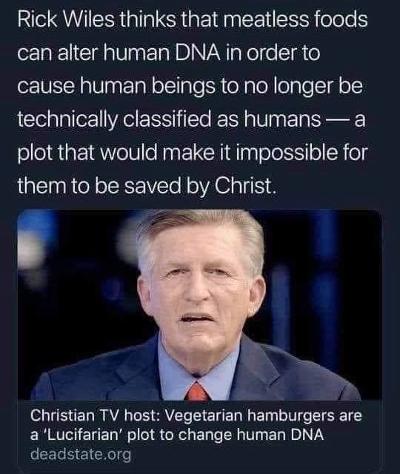
Yeah, Rick Wiles, but what's YOUR excuse? What made you so inhuman? What altered your DNA? Or, were you just born that way? Did your god play a little trick on you? Is it just a lifestyle choice that you made?

For decades, I've always noted that republicans always need someone or some group to hate or at least use for stoking fear to motivate their voters. It's the conservative M.O that they have taken in with full fervor; so Christian of them, but, that's their brand of Christianity.

When I started out, the target was people whose name ended in a vowel, "commies," or the tried and true targets of conservatives and other NAZIS, i.e. "The Jews" and "The Blacks." Nixon's tapes are full of proof of that and I heard plenty of it in my little Republicam hometown in New Jersey when I was growing up. Gradually, they added "longhairs." Then, they freaked out about gay people coming out. Then Muslims. Oh and I forgot "The Catholics." The righties used to burn their churches down. Now, they seem to just go after black churches, mosques and the old favorite, synagogues, although the later is usually reserved just for shootings and defacements with swastikas, not burnings.

The Republican Party actively looks for groups of people to hate. It hasn't been enough for them lately to focus on Chinese people because their Dear Leader tells them to. They're even now more bizarrely zeroing in on Tom Hanks now that their president has wholeheartedly embraced QAnon and their idea that Tom, Ellen DeGeneres, Oprah, Hillary Clinton and who knows who else are part of a satanic pedophile ring and vast child-eating cabal. Pizzagate wasn't enough. Republicans needed more. You know their list of supposed pedos and cannibals and pedo-cannables, or what have you, will grow and grow until practically every celebrity and sports figure you can think of will be on it. Republican voters have even recently voted for QAnon supporters to represent them in Congress. Republican leaders like Trump focus their base on such groups and causes while they fleece the very people who vote for them. It's quite a game! A big Republican Jesus vs. Satan game. To join, just send cash.

Still, I always wonder, who's next? Judging by Flor-i-Duh Pastor Rick Wiles, a man who called the impeachment a "Jew Coup," a man who called for his buddy Trump to use "the Obama bullets" on BLM protestors, a man so cherished by Republicans that he gets White House press credentials, the next republican target for their pent up hate might be vegetarians. Vegetarians! Who knew they were so profoundly unAmerican! What kind of American doesn't eat meat? How dare they! That's communism, or something! C'mon Repugs! At least give the vegetarians credit for not eating babies! Just a few days ago, Vice President Mikey Pence even got his leather panties in a twist warning that nobody better ever mess with his meat! Not to worry, Mikey. The thought had never crossed my mind, but, Mikey, you'd better watch out for that Lindsey Graham fella!

Labels: , , , ,

Thursday, April 30, 2020

Anytime Is A Good Time To Eat Less Meat-- But Now More So Than Ever

>


Chris Martenson's daily podcast has gotten me through all this coronavirus stuff since late January, when I realized his advice was golden. I was able to switch much of my retirement money out of equities and buy enough toilet paper, brown rice, chickpeas, pasta and turnips to see me through a few months of pandemic. His warnings about starting a vegetable garden have been more worrisome than anything. Problems in the food chain is something he mentions frequently. Lately I noticed that parsnips and celery root are letting harder to find and that I'm using what I have less and preparing more plentiful rutabaga and daikon root more frequently.

But the real problem with the food chain isn't really parsnips; it's meat. The processing plants are hotbeds of infection and both ocal governments and owners have been shutting them down. CNN reported that with large numbers of workers getting sick and spreading the contagion in their communities, as much as 80% of meat processing capacity was headed towards shutting down. Trump has ordered them to stay open.
Over the past several weeks, a number of major meat suppliers have announced temporary closures as workers fall ill with Covid-19. The United Food and Commercial Workers International Union estimated Tuesday that 20 meatpacking and food processing workers have died so far.

The situation has gotten so severe, company executives warned, that the US meat supply could be at risk. John Tyson, chairman of the Tyson board, warned of limited supply if plant shortages continue.

By invoking the Defense Production Act, Trump is requiring plants to remain open with some of the most dangerous conditions during the pandemic.

For years, major meat processors have been ruthlessly tamping down costs and increasing efficiencies. That has contributed to a hazardous working environment even before the coronavirus hit.

Over the years, meat processing companies have been speeding up production lines to process more meat in each facility. Faster lines require more workers who have to stand closer together.
As we've been pointing out, Texas congressional candidate Mike Siegel, has been working with labor unions and members of Congress to reforming OSHA with the intention of getting it to focus on protecting workers during the pandemic.


COVID-Mitch by Chip Proser


McConnell has signaled that he is willing to hold hostage anything and everything that helps ordinary American families unless Congress passes a corporate shield for GOP donors who open up their businesses when it isn't safe and cause deaths among their workers. This week that was the topic Judd Legum tackled at Popular Information where he explained how a corporate shield will leave workers exposed

Legum wrote that "When Congress passed legislation mandating paid sick leave during the pandemic, it exempted 80% of American workers. Notably, the requirement does not apply to any business with more than 500 employees. That means, with the lockdown still in place across much of the country, many 'essential workers' have to choose between coming to work sick and receiving a paycheck. Public scrutiny has prompted several large companies to improve their policies voluntarily, but many workers continue to expose themselves to substantial risk without basic protections. Health care workers, meat packers, grocery store clerks, and warehouse employees are getting sick and dying. Nevertheless, several states, despite warnings from public health officials, have begun loosening restrictions on businesses and bringing more people back to work. Simon Property Group, the largest mall operator in the United States, plans to reopen 49 malls in Alaska, Arkansas, Georgia, Mississippi, Oklahoma, South Carolina, Tennessee, Texas, Indiana, and Missouri between May 1 and May 4. Right now, this activity is concentrated in states with Republican governors. But all states are expected to loosen restrictions at some point before a vaccine is available, exposing workers in contact with the public to health risks."
Workers returning to the job for the foreseeable future need protective equipment, operational plans that prioritize employee health over short-term profits, and paid sick leave. These are the minimum requirements to protect workers and customers.

Is the Republican-controlled Senate doing anything to improve conditions for workers as they return to their jobs? No. Instead, the Senate is preparing legislation to shield companies from liability if its workers get sick or die.

Majority Leader Mitch McConnell (R-KY) said that giving businesses immunity from litigation is his top priority as part of the next stimulus package:
In an interview Monday on Fox News Radio, McConnell added that a liability shield for businesses and health care workers will be his "red line" in the next round of negotiations because "trial lawyers are sharpening their pencils to come after health care providers and businesses, arguing that somehow the decision they made with regard to reopening adversely affected the health of someone else." 
McConnell indicated he would oppose critical funding for state and local governments unless the package also includes a liability shield.

Trump said Congress needs to "take liability away from these companies" because he wants "the companies to open and to open strong." But this isn't about carving out narrow protections for companies that play critical roles in responding to the pandemic and need to act quickly. The administration "already has granted more limited liability exemptions for companies involved in producing and distributing key medical supplies."

McConnell and Trump are echoing the call of U.S. Chamber of Commerce president Tom Donohue, who said it was "just not fair" for businesses to be liable for exposing workers to conditions that result in illness or death.

Under normal circumstances, if your health is compromised due to "your employer’s negligence, recklessness, or willful disregard for a safe work environment," a worker could sue to "recover damages for lost wages, medical expenses, and your pain and suffering." (In some states, workers can continue to be paid and get their medical bills reimbursed without proving negligence under a streamlined "workers' compensation" process.) With a liability shield, workers will still lose wages, incur medical expenses, and experience pain and suffering, if they become sick at work. The difference is that all those costs would all be borne by workers and not employers.

Creating a liability shield, however, reduces the incentive for employers to "avoid tort liability by taking appropriate precautions." Justin Wolfers, a professor at the University of Michigan, explains this concept:
We want businesses to be scared. The claim from the Chamber of Commerce that liability will make people scared to do business is correct and that’s the point. We want businesses to take responsibility. All of tort law is about creating a strong incentive for people and companies to not act badly...What’s crystal clear is that if you let employers off the hook, they won’t take safety precautions.
This is an issue that will impact everyone, whether or not they immediately return to their workplace. "To protect public health, you have to protect worker health. And if they don't do that, it will spread into the community, and we'll have a second wave," Debbie Berkowitz, who worked at OSHA during the Obama administration, explained.

The risk of legal liability for corporations is already minimal because, even in a workers' compensation case, an employee needs to prove that they contracted the coronavirus at work. Since it's very difficult to prove where you contracted a virus, especially when there is community transmission, these lawsuits would be very difficult to win. But a liability shield means that corporations wouldn't even have to defend themselves.

...While McConnell and Trump push for a liability shield, Senators Tammy Baldwin (D-WI) and Tammy Duckworth (D-IL) are taking a different approach. Baldwin and Duckworth introduced the "Every Worker Protection Act of 2020" last week. Instead of focusing on protecting employers from legal liability after employees get sick, the legislation tries to put in place protections to keep them from getting sick in the first place.

The legislation would "require the Occupational Safety and Health Administration (OSHA) to issue an Emergency Temporary Standard (ETS) within 7 days to protect health care and other employees from exposure to the coronavirus that causes COVID-19."

Labels: , , , , ,

Monday, March 28, 2016

Not All Countries Freak Out About Healthy Eating Alternatives-- Take Holland

>


I'm thinking about going to Paris this summer. What I'd like to do is rent a house or an apartment in the city and then take a side-trip to Bordeaux, Périgueux, Limoges and the Dordogne Valley to see the caves in the region. It's the only part of France I've never visited and friends tell me it's not-to-be-missed. But Roland wants to visit Amsterdam. He loves Amsterdam-- and especially our friends there-- but I lived there for 4 years and visiting someplace you know in such a workaday way isn't really a vacation. And, after all, no place is as good as it used to be, right?

I lived in Amsterdam when I returned from Europe after a couple of years traveling around Turkey, Iran, Afghanistan, Pakistan, India, Sri Lanka and Nepal. That was pretty exotic. Amsterdam wasn't. I rented an apartment, got a job, some friends and lived my life. Hum-drum in a way. The city of Amsterdam employed me in a youth center, het Kosmos, dedicated to non-sectarian meditation. I was a chef, waiter, dishwasher, cashier, manager in the center's macrobiotic restaurant. I had never so much as cooked an egg before I stumbled into the restaurant, looking for a place I could eat healthy food for a dollar or two per meal.

Amsterdam was very welcoming in those days, especially to Americans who didn't want to be living in the country bombing Vietnam, like myself. Someone even made a documentary about my life there-- a war resister in Holland. Believe it or not, Holland is such a conservative society-- but so entirely progressive at the same time. I could never understand the politics there, not for the 4 years I lived there and not since. And not now, as an actual fascist, Geert Wilder-- who has endorsed Trump-- inches closer and closer to the premiership. So on the one hand you have Wilders and on the other... a government advocating vegetarianism as a preferred option and healthy eating that is good for you and, at the same time, environmentally sustainable. Last week, National Geographic pointed out a report from the Dutch government about the relationship between a healthy diet, a healthy planet and the unsuitability of meat in that context-- meat and fish as a matter of fact.
The Netherlands Nutrition Centre says  it is recommending people eat just two servings of meat a week, setting an explicit limit on meat consumption for the first time. The recommendations come five years after a government panel weighed the ecological impact of the average Dutch person’s diet, concluding last year that eating less meat is better for human and environmental health.

The Nutrition Centre, a government-funded program responsible for making food-based dietary guidelines, took those conclusions and presented them on Tuesday in its “Wheel of Five”-- a graphic distributed to the public, along the lines of the U.S. government’s “MyPlate.”

“The new dietary guidelines are implemented in our new education model … in a way that the total environmental impact of the diet is lower than the current consumption,” explains Corné van Dooren, a sustainable food expert at the center. “We focus on eating a less animal-based and more plant-based diet by the unique advice to consume not more than 500 grams of meat a week.”

Of that 500 grams, or about one pound, only 300 grams should be red, or “high-carbon” meat, van Dooren noted, explaining that the guidelines suggest getting protein from other sources, like one 25-gram portion of unsalted nuts a day and one 135-gram portion of pulses a week. Seafood recommendations also get an update.

“The advice for fish is changed from two portions to one portion a week, due to sustainability issues,” van Dooren adds. “One portion is enough to reach the benefits for coronary heart diseases.”

Over the past decade, a handful of countries have started to more seriously consider environmental factors in their official nutrition advice, including the U.S. That’s out of the more than 60 countries that maintain and update nutrition advice, according to the FAO.

“There are just a very few countries that have taken this issue on,” says Kathleen Merrigan, former deputy secretary at the U.S. Department of Agriculture, now the executive director of sustainability at George Washington University. “It’s a moving target.”

In 2014, Merrigan helped convene a conference on food sustainability, inviting government nutrition advisers from the Netherlands and Brazil, two of the countries that have worked most intensively on the issue. (In 2012, Brazil set new recommendations that factored in “environmental integrity,” fair trade principles and the eating patterns of indigenous food cultures.)

Other countries that have included sustainability into their nutrition advice, or have seriously contemplated doing so, include Germany, Australia, Sweden, and the U.K.

Many in the U.S., too, embraced the conversation around sustainability when the 15-member Dietary Guidelines Advisory Committee announced in its 2015 report that sustainable diets, lower in meat intake, are also more healthful (see New U.S. Dietary Recommendations First to Consider Environmental Impact.)

But not everyone went for it. The idea that environmental considerations should make their way into nutrition advice has been especially controversial with the livestock industry, which fought against their inclusion. The American livestock industry, for one, successfully argued that sustainability—or specific recommendations to limit meat consumption because of the environmental toll of meat production-- get knocked out of the final Dietary Guidelines. The final guidelines were issued in January (see What’s In America’s New Dietary Guidelines-- and What’s Not).

Just last week, the U.K. issued its latest nutrition advice, recommending a diet lower in red and processed meat.  The move was hailed by nutrition groups,  even as they sought more explicit reductions.

...The new advice, though, was immediately blasted by the livestock industry.

“Blanket messages to reduce red meat consumption could be very detrimental to the diets of consumers who already eat low to moderate amounts of red meat, for example women and young people,” says Emma Derbyshire, a member of the Meat Advisory Panel, in British media reports last week. “Lean red meat is rich in protein, iron, zinc, B vitamins and selenium and makes an important contribution to daily vitamin and mineral intakes.”

The industry pushback will likely get stronger as more governments turn their attentions to the issue of sustainability in the diet.
I remember a couple of years ago when Jared Polis (D-CO) wrote and introduced H.R. 4870, the Healthy School Meals Act. Polis hoped to offer the option of school kids eating some plant-based food at school meals. Polis told me he isn't a vegan or even a vegetarian. He just wants to make sure that children have a choice, noting that in the past 30 years "the prevalence of overweight in children ages 6 to 19 has tripled and 1 in 5 is struggling with obesity and related conditions like type 2 diabetes, hypertension, and heart disease, which were previously considered adult diseases."

His legislation is based on the fact that children consume too much fat, saturated fat and sodium and don’t get enough fiber, whole grains, fruits or vegetables and that research shows that children who eat school-purchased lunches are more likely to be overweight and obese, and less likely to eat enough fruits and vegetables. So what does the bill do?
Improves children’s eating patterns by encouraging the inclusion of healthful plant-based options in the National School Lunch and Breakfast Programs.

Introduces plant-based foods to schools, increases their availability and affordability, and provides incentives for schools to provide healthful entree options in the lunch line.

Removes restrictions on providing nondairy milk alternatives with school lunches, thus ensuring that all children receive vital nutrients.

I asked Jared if there were any bad guys in this story-- some crackpot Republicans or evil food processing corporations. He told me there weren't. He just hadn't been clobbered by him yet. That came after our chat. Some time ago I was the general manager of Sire Records and one of our artists, k.d. lang, recorded the TV ad below. The cattle and meat processing industries came down on us like a ton of bricks. I've read that they do the same thing to schools that start vegetarian-oriented programs, even if it's just to offer a vegetarian option once a week. Jared's bill didn't pass; he never even got out of committee.

Labels: , , , ,

Thursday, March 08, 2012

What Do Doctors Know About Health?

>


Tuesday night we looked at some of the issues around organic food and healthy eating. It sparked quite a few responses but this one from a woman in Missouri was the most galvanizing and I want to share it with you.
Vegetarianism has been a huge part of my life for the past several years  and I plan on raising my daughter based on the principles involved. Today I was shocked at the government, and special interest groups involvement in trying to prevent informed eaters from keeping this restricted diet. My daughter is about to start preschool (daycare), and I informed them she was vegetarian, and did not drink cow's milk. They insisted upon a doctors note stipulating that I was depriving her of these "essential resources." My physician wrote a note, and that should have been the end of it (which was ridiculous to begin with) but I was told it had to be worded a certain way due to USDA regulations on children in schools' food! I put 2 and 2 together quickly, and asked them if that was because they had a vested interest in keeping my child on dairy products to make money. I was given a noncommittal nod from the instructor. So despite the fact that we have moral reasons for maintaining this diet, there are also numerous health concerns with the hormones/steroids found in most dairy products, & meat. Choosing not to give my child these should be an educated choice I make, however the USDA has said I do not have that right. Fortunately, I convinced the doctor she would be getting adequate protein, and iron. Even if you do not agree with my stance on being vegetarian, or refraining from cow's milk, you should realize how absurd government interference (backed by the funds of private companies) in choosing what my child eats truly is! This is outrageous!

She included a note from her cousin, a kindergarten teacher in the same district who voiced the same concerns about collusion from the USDA and the dairy industry. "We get in trouble if we don't have a doctor's note as then we are taking away their nutrition and the school district gets money for every kid that gets milk. So, yes your school will loose money if her daughter doesn't get the milk. The USDA gives the school money for each child and we have to give it to them."

Last week I had dinner with one of the country's best known raw vegan chefs and one of the most prominent young surgeons in the country. We were all grooving on the food and I asked the surgeon how many courses doctors are required to take on nutrition during medical school. He laughed. "There was a three hour lecture," he said. "That's it."

Ezra Klein at the Washington Post knows a lot about health-- or at least health costs. It's his beat. Last week he looked at a question that perplexes U.S. policy makers and consumers alike, Why an MRI costs $1,080 in America and $280 in France. In fact, health care costs more in America-- and doesn't get better results than in other industrialized countries.
In 2009, Americans spent $7,960 per person on health care. Our neighbors in Canada spent $4,808. The Germans spent $4,218. The French, $3,978. If we had the per-person costs of any of those countries, America’s deficits would vanish. Workers would have much more money in their pockets. Our economy would grow more quickly, as our exports would be more competitive.

There are many possible explanations for why Americans pay so much more. It could be that we’re sicker. Or that we go to the doctor more frequently. But health researchers have largely discarded these theories. As Gerard Anderson, Uwe Reinhardt, Peter Hussey and Varduhi Petrosyan put it in the title of their influential 2003 study on international health-care costs, “it’s the prices, stupid.”

...“The United States spends more on health care than any of the other OECD countries spend, without providing more services than the other countries do,” they concluded. “This suggests that the difference in spending is mostly attributable to higher prices of goods and services.”

On Friday, the International Federation of Health Plans-- a global insurance trade association that includes more than 100 insurers in 25 countries-- released more direct evidence. It surveyed its members on the prices paid for 23 medical services and products in different countries, asking after everything from a routine doctor’s visit to a dose of Lipitor to coronary bypass surgery. And in 22 of 23 cases, Americans are paying higher prices than residents of other developed countries. Usually, we’re paying quite a bit more. The exception is cataract surgery, which appears to be costlier in Switzerland, though cheaper everywhere else.

...“Other countries negotiate very aggressively with the providers and set rates that are much lower than we do,” Anderson says. They do this in one of two ways. In countries such as Canada and Britain, prices are set by the government. In others, such as Germany and Japan, they’re set by providers and insurers sitting in a room and coming to an agreement, with the government stepping in to set prices if they fail.

In America, Medicare and Medicaid negotiate prices on behalf of their tens of millions of members and, not coincidentally, purchase care at a substantial markdown from the commercial average. But outside that, it’s a free-for-all. Providers largely charge what they can get away with, often offering different prices to different insurers, and an even higher price to the uninsured.

Health care is an unusual product in that it is difficult, and sometimes impossible, for the customer to say “no.” In certain cases, the customer is passed out, or otherwise incapable of making decisions about her care, and the decisions are made by providers whose mandate is, correctly, to save lives rather than money.

In other cases, there is more time for loved ones to consider costs, but little emotional space to do so-- no one wants to think there was something more they could have done to save their parent or child. It is not like buying a television, where you can easily comparison shop and walk out of the store, and even forgo the purchase if it’s too expensive. And imagine what you would pay for a television if the salesmen at Best Buy knew that you couldn’t leave without making a purchase.

“In my view, health is a business in the United States in quite a different way than it is elsewhere,” says Tom Sackville, who served in Margaret Thatcher’s government and now directs the IFHP. “It’s very much something people make money out of. There isn’t too much embarrassment about that compared to Europe and elsewhere.”

The result is that, unlike in other countries, sellers of health-care services in America have considerable power to set prices, and so they set them quite high. Two of the five most profitable industries in the United States-- the pharmaceuticals industry and the medical device industry-- sell health care. With margins of almost 20 percent, they beat out even the financial sector for sheer profitability.

...But as simple an explanation as “the prices are higher” is, it is a devilishly difficult problem to fix. Those prices, for one thing, mean profits for a large number of powerful-- and popular-- industries. For another, centralized bargaining cuts across the grain of America’s skepticism of government solutions. In the Medicare Prescription Drug Benefit, for instance, Congress expressly barred Medicare from negotiating the prices of drugs that it was paying for.

The 2010 health-reform law does little to directly address prices. It includes provisions forcing hospitals to publish their prices, which would bring more transparency to this issue, and it gives lawmakers more tools and more information they could use to address prices at some future date. The hope is that by gathering more data to find out which treatments truly work, the federal government will eventually be able to set prices based on the value of treatments, which would be easier than simply setting lower prices across-the-board. But this is, for the most part, a fight the bill ducked, which is part of the reason that even its most committed defenders don’t think we’ll be paying anything like what they’re paying in other countries anytime soon.

“There is so much inefficiency in our system, that there’s a lot of low-hanging fruit we can deal with before we get into regulating people’s prices.” says Len Nichols, director of the Center for Health Policy Research and Ethics at George Mason University. “Maybe, after we’ve cut waste for 10 years, we’ll be ready to have a discussion over prices.”

I wonder if they'll have that discussion over donuts and coffee with lots of sugar and cream.

Labels: , , ,

Thursday, January 12, 2012

Food Sovereignty-- Getting Around Agribusiness Whore Collin Peterson

>


When discussing loathsome Democrats, it's often repeated that "at least he's not as bad as a Republican." That doesn't really work with Minnesota Blue Dog Collin Peterson. He's more corrupt than most Republicans in terms of taking legalistic bribes from the corporate entities he oversees and whose toxic agendas he puts into law. And last year he voted less frequently with the Democrats on crucial rollcalls than a handful of Republicans. His ProgressivePunch score was a breathtaking 23.31, which means he voted with Cantor and Boehner more than 76% of the time. What an asshole! Over the course of his entire miserable career he's been with the GOP about 60% and with the Democrats just about 40%.

Before half the Blue Dogs, though alas not Peterson, were defeated last year, flipping the House to the GOP, Peterson chaired the House Agriculture Committee-- so packed with corrupt right-wing Democrats that committee meetings were like Blue Dog caucus sessions. K Street lobbyists claim that there was no committee on Capitol Hill more blatantly up for sale than Peterson's Agriculture Committee. Peterson himself has taken more in bribes from agribusiness than any other Member of the House ($2,251,813, approximately the same as Senator McConnell).

His iron grip on the country's agricultural and food policies has been devastating-- a national disgrace, which has made him wealthy and made the country sick. Looking at the situation last May, I wrote: "Congress, particularly the graft-oriented House Agriculture Committee, has steered U.S. food policies in the interests of fat-cat donors from agribusiness and in ways diametrically against the well-being of consumers. For decades both parties have been working furiously against their own constituents. This might be expected of Republicans-- it's part of their religion-- but conservative Blue Dogs have been ceded food policies within the Democratic Party and they're not better than Republicans." It hasn't gotten any better. And that, at least in part, is a political problem.

Peterson has no primary opponent, and the Republican who filed to run against him this year, Lee Byberg, only managed to garner 38% in 2010, the best GOP year in decades. McCain won the district 50-47% in 2008, at the same time that Peterson took 72%.

Recently Blue America was approached by a well-financed food policy group that has its heart set on ending Peterson's career. I wish we could help-- I really, really do. America would be a far better, and far healthier, place if his career ended. But these civic-minded souls had no idea how to defeat him. They asked if we could put a campaign together like the one we did to defeat Alabama Blue Dog Bobby Bright last year. The two races are as unrelated as are the two districts. Peterson is actually popular with his clueless constituents; Bright wasn't. And Bright made the fatal flaw of pretty formally breaking with the Democratic Party by announcing he wouldn't vote for Pelosi as Speaker. While the GOP idiotically ran ads claiming he was a Pelosi pawn, we blanketed Democratic precincts with the truth-- which is what did him in. He lost to a moron teabagger, Martha Roby, 111,645 (51%) to 106,865 (49%), with Democratic turnout significantly lower in every county we ran ads in. I wish we could do the same thing against Peterson, but wishing won't make it come true.

As for an end run around his toxic food agenda... well, better news on that front. It's coming from small-town Maine. Ever hear of the "food sovereignty movement"? Sounds like part of a Ron Paul campaign, but it's even better.
On Friday evening, they became perhaps the first locale in the country to pass a “Food Sovereignty” law. It’s the proposed ordinance I first described last fall, when I introduced the “Five Musketeers”, a group of farmers and consumers intent on pushing back against overly aggressive agriculture regulators. The regulators were interfering with farmers who, for example, took chickens to a neighbor for slaughtering, or who sold raw milk directly to consumers.

The proposed ordinance was one of 78 being considered at the Sedgwick town meeting, that New England institution that has stood the test of time, allowing all of a town’s citizens to vote yea or nay on proposals to spend their tax money and, in this case, enact potentially far-reaching laws with national implications. They’ve been holding these meetings in the Sedgwick town hall since 1794. At Friday’s meeting, about 120 citizens raised their hands in unanimous approval of the ordinance.

Citing America’s Declaration of Independence and the Maine Constitution, the ordinance proposed that “Sedgwick citizens possess the right to produce, process, sell, purchase, and consume local foods of their choosing.” These would include raw milk and other dairy products and locally slaughtered meats, among other items.

This isn’t just a declaration of preference. The proposed warrant added, “It shall be unlawful for any law or regulation adopted by the state or federal government to interfere with the rights recognized by this Ordinance.” In other words, no state licensing requirements prohibiting certain farms from selling dairy products or producing their own chickens for sale to other citizens in the town.

What about potential legal liability and state or federal inspections? It’s all up to the seller and buyer to negotiate. “Patrons purchasing food for home consumption may enter into private agreements with those producers or processors of local foods to waive any liability for the consumption of that food. Producers or processors of local foods shall be exempt from licensure and inspection requirements for that food as long as those agreements are in effect.” Imagine that -- buyer and seller can agree to cut out the lawyers. That’s almost un-American, isn’t it?

This from a press release put out after the vote by supporters:

“Local farmer Bob St. Peter noted the importance of this ordinance for beginning farmers and cottage producers. ‘This ordinance creates favorable conditions for beginning farmers and cottage-scale food processors to try out new products, and to make the most of each season’s bounty,’ said St. Peter. ‘My family is already working on some ideas we can do from home to help pay the bills and get our farm going.’

“Mia Strong, Sedgwick resident and local farm patron, was overwhelmed by the support of her town. ‘Tears of joy welled in my eyes as my town voted to adopt this ordinance,’ said Strong. ‘I am so proud of my community. They made a stand for local food and our fundamental rights as citizens to choose that food.’”

The ordinance comes up for a vote in three other Maine towns upcoming–Penobscott, Brooksville, and Blue Hill.

Occupy Blue Hill! And some good news from Ezra Klein yesterday: Americans are eating less and less meat-- 12.2% less meat in 2012 than they did 2007. “Beef consumption has been in decline for about 20 years; the drop in chicken is even more dramatic, over the last five years or so; pork also has been steadily slipping for about five years.”

Why is this happening? The Daily Livestock Report blames rising meat prices in the United States. As countries like China and India get richer, they’re eating more meat, which is helping to drive up U.S. exports and making beef, pork, and chicken more expensive here at home. Ethanol also plays a role: Nowadays, American farmers divert bushels and bushels of corn to make fuel, which drives up feed prices and, again, makes meat pricier.

Perhaps just as significantly, though, it does seem that attitudes toward meat are changing. More and more people appear to be cutting back on beef and pork consumption for environmental or ethical reasons. (Although before vegetarians get too excited, one factor that often gets overlooked here is the aging of the population-- as the baby boomers get older, they’ve been eating less meat.)

And Hostess Brands, one of the most toxic purveyors of faux-food in America-- Twinkies, Ho Hos, Sno Balls, and Wonder Bread-- just filed for bankruptcy protection again. The shady Texas company seems to have been stealing hundreds of millions of dollars from it's employees pension plans but that isn't the only reason they're in trouble.
[P]art of the problem is that sales of Twinkies are down.

"Nearly 36 million packages of Twinkies were sold in the year ended Dec. 25, down almost 2 percent from a year earlier, according to data from SymphonyIRI Group, a Chicago-based market-research firm," reports the Wall Street Journal.

The company, which has roots reaching back to 1930, has also suffered as consumers move away from white bread and toward more whole-grain breads.

And sales of Twinkies have suffered despite its prime product placement in the 2009 film Zombieland.

Labels: , , , ,

Sunday, May 23, 2010

Bacon: You Think Eating Yourself To Death Is A Nice Way To Go?

>


The other day I was at my favorite restaurant in L.A. and the chef was telling me that starting on Monday she's revamping the menu entirely. Maybe she saw how nervous I became but she reassured me by going over all the new dishes she had worked up. One caught my attention; it was something with "bacon." It's a raw, organic vegan place. No room at the inn for bacon. (In fact, as ex-cattle rancher Howard Lyman, told the East Bay Express last week, carnivores can't be environmentalists.


He wasn't just a cattle rancher. He was a diehard fourth-generation Montana cattle rancher with a thousand animals on the range and thousands more in feedlots. On more than 10,000 acres of cropland, he grew grain to feed his livestock, which also included pigs, chickens, and turkeys.

Thirty years later and 130 pounds lighter, Howard Lyman is a changed man. First and foremost, he's a staunch vegetarian. "I would love to see feedlots close and factory farming end," Lyman wrote in his book The Mad Cowboy: Plain Truth From the Cattle Rancher That Won't Eat Meat. "I would love to see more families return to the land, grow crops for our own species, and raise them organically. I would love to see farm communities revive. I would love to know that I've wandered into my nation's heartland by the sweet smell of grain and not the forbidding smell of excrement."

Now the "bacon" my chef friend Lisa was talking about was faux bacon made entirely from raw baby coconut meat. Not this kind of bacon-- you know, the kind that will kill you. Research from the Harvard School of Public Health concludes that "eating two rashers of bacon or a sausage every day can increase your risk of heart disease by nearly half, scientists claim. Their study found meat that has been cured, salted or processed in another way can also push up the likelihood of developing diabetes. It linked the salts and chemical preservatives used on processed meat to ill health if the products are eaten regularly." Add various cancers to the bowels and breasts-- and then there's the little obesity problem we were talking about with Rep. Jared Polis a couple weeks ago. Turns out Michelle Obama has made tackling that thorny subject-- solving the childhood obesity problem in a generation-- one of her top priorities in the White House.
But the goal is so ambitious only because the crisis of childhood obesity is so grave -- with the current generation of Americans is "on track to have a shorter lifespan than their parents." Obesity "is estimated to cause 112,000 deaths per year in the United States, and one third of all children born in the year 2000 are expected to develop diabetes during their lifetime." Each year, obese adults incur "an estimated $1,429 more in medical expenses than their normal-weight peers," and overall, the nation spent up to $147 billion on obesity-related costs in 2008.

...[T]he newly enacted comprehensive health reform law "contains a number of provisions to address childhood obesity in the context of health care and public health." Several studies have indicated that, when presented with calorie information and recommendations, people on average consumed meals with almost 100 fewer calories. The law improves nutrition labeling in fast food restaurants by requiring all chain restaurants "to provide clear labeling of the calorie counts by March 2011." By that date, restaurants must "display a succinct statement on the recommended number of calories individuals should consume each day as well as provide written nutrition information when requested." Vending machines will soon have to meet a similar requirement. The law also promotes breastfeeding by mandating that "employers with more than 50 employees must provide break time and place for breastfeeding mothers to express milk," gives grants to community based obesity intervention programs, invests in broader population-level obesity intervention efforts, and promotes primary care and coordination efforts that emphasize prevention. Still, none of this alone can significantly lower obesity rates. For that, policymakers must do much more to enact the Task Force's recommendations and look beyond health care into the nutrition of food in school cafeterias, the physical education programs, America's agricultural policies, and the food options in lower-income neighborhoods.

Unfortunately, some in the conservative media are using the Task Force to further the meme that the administration is undermining personal freedoms and liberties. Last week, for instance, Matt Drudge ran a headline saying, "White House seeks controls on food marketing." On the May 11 edition of his Fox News show, Sean Hannity said: "An Obama government obesity task force." "Does every American family need a dietitian appointed by the government to tell them that this food is going to make you fat and this food is not?" he asked. Conservative blogger Michelle Malkin also turned the Task Force into a hit, saying that her "problem with the Obama administration is that it's more concerned with policing grocery aisles and our refrigerators than it is with our borders." "And we'd be heck a lot better off if they got their priorities in order." Only former Governor Mike Huckabee, who himself has struggled with obesity, warned conservatives against mischaracterizing the report. During a discussion in February about Obama's campaign to fight childhood obesity, Huckabee explained that the initiative is not a "nanny-state solution" or a "leftist position" and warned that conservatives would engage in reactionary attacks against the program. Speaking of Obama, he concluded, "She does not believe that it is a government solution and that government should dictate what size cheeseburger you eat."

How about a cheeseburger with no cheese, no burger and no bun, just stuff that's delicious and nutritious? and don't get me started on the California Department of Pesticide Regulation deciding to permit the systematic poisoning of the state's strawberry crop with methyl iodide, a potent carcinogenic gas which is certainly a neurotoxin and disruptor of thyroid function, particularly for fetuses.

Ever go to a Hollywood premiere? We've written about Bold Native in the past, while it was being filmed. Now it's completed and this spectacular film about about animal liberation, the nature of terrorism, and those who believe it is sometimes necessary to break the law in the pursuit of a higher good will have it's world premiere on Wednesday evening, June 16. I'm goin'. And the folks from Open Road Films gave me a pair of tickets to give away to a Blue America donor. Everyone who contributes in the next 24 hours-- to any Blue America candidate on this ActBlue page will be entered into a drawing for the pair of tickets. Now if you live in Maine, you'll have to figure out how to get to Hollywood yourself. Same if you like in Santa Monica. But there are 3 or 4 vegan restaurants real close by the theater.


UPDATE: Could Be Worse... Take The Fare At The Beijing Zoo For Example

The Chinese love eating rare game... the rarer and more exotic the animal, the more the Chinese seem to want it in their moo goo gai pan. And if the species is endangered and on the verge of extinction... yum, yum, yum.
Some zoos are not just for looking at animals. If you're going to Beijing, you can eat them as well.

Crocodile and kangaroo tail, as well as the webbed toes of a hippopotamus are all on the menu at the Beijing zoo's restaurant.

And if that doesn't sound exotic enough, there's always scorpion and deer's penis, with ant soup as a starter.

Labels: , , ,

Thursday, March 25, 2010

Republican Flesh-Eaters... Just Kidding

>


A few weeks ago we looked into the idea of how someone can be-- or, perhaps, can't be-- both a meat-eater and an environmentalist. I pointed to a movie that's coming out soon called Bold Native, a spectacularly insightful film that covers a great deal of ground, from activism, social protest and totalitarianism to compassion, ecology and... well, the survival of mankind. This is how the film's website describes it:
Bold Native is a fiction feature film. Charlie Cranehill, an animal liberator wanted by the United States government for domestic terrorism, emerges from the underground to coordinate a nationwide action as his estranged CEO father tries to find him before the FBI does. The film simultaneously follows a young woman who works for an animal welfare organization fighting within the system to establish more humane treatment of farmed animals. From abolitionists to welfarists, Bold Native takes on the issue of modern animal use and exploitation from several angles within the context of a road movie adventure story.

The filmmakers’ background in documentary informed the creative approach to Bold Native. Self-financed and shot with a four person team in real-world locations, sometimes using real activists, lawyers, and formerly imprisoned animal liberators, the film weaves an intricate tale of one of the most important issues facing America and the world morally and ecologically-- the impact and consequences of industrialized animal use. And with a character who faces prosecution and potential lifetime imprisonment under the recently passed Animal Enterprise Terrorism Act (AETA) for property crimes currently considered terrorism, the film also illuminates the danger of corporate interests influencing the law in a post-9/11 world.

When I first brought it up, there was no real trailer for the film. I just stumbled across one and thought I'd share it:

Labels: , ,

Wednesday, March 10, 2010

Do You Eat Meat?

>


I grew up in Brooklyn and Long Island, eating meat three meals a day, bacon and eggs for breakfast, ham and cheese sandwich for lunch and, say, pot roast or meatloaf for dinner. It never occurred to me that there was an alternative until I went to college and settled down with a hippie chick from Manhattan who was a vegetarian and a GREAT cook. She never told me I was a vegetarian and I never gave it much thought beyond how delicious the meals she prepared were. But when I was traveling through Asia-- and especially Afghanistan-- I noticed all the meat eaters getting deathly sick and me becoming like the caregiver for half the hippie trail kids in Kabul. A lengthy stay in Goa, where I learned about how human-hog recycling worked-- i.e., the sewage "system" (humans eat them and they eat the sewage and we eat them some more)-- made me a vegan for decades.

As I mentioned a few times lately, I'm reading Thom Hartmann's newest book, Threshold. I want to quote a couple of short paragraphs that stuck with me the other day:
[W]hile there are more than six billion humans, there are more than twenty billion livestock mammals (pigs, cows, goats, sheep) and about sixteen billion chickens in the world, over 99 percent of them grown by humans as food for humans. The Food and Agriculture Organization of the United Nations (FAO) in a 2007 report noted that 37 percent of the world's total methane production (and 9 percent of all CO2 and 65 percent of all nitrous oxide emissions) comes from our livestock. Because nitrous oxide is 296 times stronger than CO2, the combined greenhouse effect of our livestock worldwide is greater than the sum total of all our cars, trains, buses, trucks, ships, airplanes and jets.

A sudden and worldwide shift to vegetarianism (or even close to vegetarianism-- most indigenous societies historically have used meat as a flavoring rather than a staple, eating less than a fifth of the meat and dairy products Americans do) would have more impact on global warming than if every jet plane and car in the world were to fall silent forever.

University of Chicago research found that simply going vegetarian would reduce the average American's carbon footprint by over 1.5 tons of carbon per year: That's half again more than doubling the gas mileage of your car by moving from a big sedan to a small hybrid (which typically saves about a ton of carbon per year).

Hartmann then goes on to explain how methane concentrations in the atmosphere will eventually-- actually, fairly soon-- probably end most life, certainly human life-- on earth. And then there's all the solid polution. I was speaking with North Carolina Secretary of State Elaine Marshall about the problem the other day. She reminded me that in 2007 her state, the #2 hog producer (over 10 million annually) after Iowa, became the first in the nation to ban the construction or expansion of lagoons and sprayfields on hog farms-- the Swine Farm Environmental Performance Standards Act. Marshall, who is running against reactionary Republican Richard Burr for the U.S. Senate has a long career working for environmentally sound hog farming operations. "Locally," she told me on the phone, "I've been helping a North Carolina inventor who has patients and EPA approval for a hog-farm operation that produces no waste, but in this economy it's been difficult for him to get funding for a demonstration project." She also mentioned that she's been eating a lot more environmentally herself. In fact, more and more candidates have mentioned that to me than I've ever heard before. And you know what? It's the one thing each and every one of us can do on a personal, nonpolitical level to help save our planet.

Last week and old friend of mine, Cheri Shankar, wrote a very provocative piece for HuffPo, Can You Be A Meat-Eating Environmentalist?. She has the most environmentally advanced, green-friendly home I've ever been in. She's very sweet and doesn't like hectoring people but she's come to the conclusion that it's difficult to talk the talk without walking the walk.
Probably the best thing we can do for the planet is abstain from meat, fish, and dairy. Our food choices have the most profound impact of all. More than driving a hybrid, recycling, solar panel installation or LEED architecture. So for all of our efforts, our carbon footprint is huge, thanks to our diet full of hamburgers, steaks, bacon and chicken salads. The energy it takes to produce a pound of meat versus a pound of vegetables is mind boggling. Meat eating is a biggie! It matters ... a lot.

Last year my friend Phil took me to the screening on a groundbreaking movie that is mostly filmed, Bold Native; they're still working on it. I still haven't gotten it out of my mind. There's an incongruous, almost random 14 second clip from the movie at the top of this post. Here's the blurb from the Bold Native website:
Bold Native is a fiction feature film. Charlie Cranehill, an animal liberator wanted by the United States government for domestic terrorism, emerges from the underground to coordinate a nationwide action as his estranged CEO father tries to find him before the FBI does. The film simultaneously follows a young woman who works for an animal welfare organization fighting within the system to establish more humane treatment of farmed animals. From abolitionists to welfarists, Bold Native takes on the issue of modern animal use and exploitation from several angles within the context of a road movie adventure story.

The filmmakers’ background in documentary informed the creative approach to Bold Native. Self-financed and shot with a four person team in real-world locations, sometimes using real activists, lawyers, and formerly imprisoned animal liberators, the film weaves an intricate tale of one of the most important issues facing America and the world morally and ecologically-- the impact and consequences of industrialized animal use. And with a character who faces prosecution and potential lifetime imprisonment under the recently passed Animal Enterprise Terrorism Act (AETA) for property crimes currently considered terrorism, the film also illuminates the danger of corporate interests influencing the law in a post-9/11 world.

Meet Casanova and Sonny:

Labels: , , , , ,

Friday, October 10, 2008

We Are What We Eat-- And So Is Our Society, Of Course

>

yum yum?

My friend Phil asked me to join him and Go Vegan radio host Bob Linden for dinner last night. I never get out so, of course, I jumped at the chance. We decided on a suitable vegan-ish restaurant in the area, Cafe Alf on Sunset Blvd in Echo Park. As I was leaving my home, a blogger buddy, Hekebolos, called and told me another blogger friend, OrangeClouds, was visiting L.A. and why don't we go for dinner. I explained that I was walking out the door to meet some other friends and why not join us. So we all got together and it turns out OrangeClouds is the foremost food policy blogger I know and Bob Linden can take any problem-- the mortgage crisis, a passing fire engine, the high cost of energy, the problems with the Bible-- and explain it in terms of the propensity of society's toleration of meat and dairy consumption. It was a lovely evening.

My friend Phil promised to write a post for DWT and he even finished a few fabulous sentences: "Medieval Christians killed off the entire wolf population in Europe. The same mentality exists here in a remote 15th century part of America today. Why? Because of a brain defect passed down through generations of witchburners, animal slaughterers and ... because the bible has a scary story about wolves."

Meanwhile I did get a thought provoking e-mail from OrangeClouds-- let's call her Jill-- that included a link to her blog, La Vida Locavore, on which I found a question far more important, in every way, than what the margin of victory Obama is likely to have in North Carolina: Can Organics Save Us From Global Warming. She asked me what I knew about the members of the House Agriculture Committee and sent me their names. I was appalled when I went through it.

My first thought was, no wonder we have mucked up the food industry even worse than the banking industry. Then I thought that no one could even find a committee this bad unless they actually set out to do so. There are 25 Democrats and 21 Republicans, most of whom are unspeakably in the pocket of the big-- and destructive-- corporate farming industry. Most of the Democrats on the Committee are in that pocket too. In fact, you couldn't find a worse bunch of Democrats. There is exactly one who I would trust, Wisconsin freshman Steve Kagen. The rest are a bunch of reactionaries, mostly Blue Dogs and worse. I know most people don't know one of these monstrosities from another, but people who pay close attention at DWT are sure to recognize some names of tried and true villains:

- Chairman Collin Peterson (D-MN)
- Tim Holden (D-PA)
- Joe Baca (D-CA)
- John Barrow (D-GA)
- Leonard Boswell (D-IA)
- Nancy Boyda (D-KS)
- Dennis Cardoza (D-CA)
- Travis Childers (D-MS)
- Jim Costa (D-CA)
- Henry Cuellar (D-TX)
- Joe Donnelly (D-IN)
- Brad Ellsworth (D-IN)
- Bob Etheridge (D-NC)
- Kirsten Gillibrand (D-NY)
- Steve Kagen (D-WI)
- Nick Lampson (D-TX)
- Tim Mahoney (D-FL)
- Jim Marshall (D-GA)
- Mike McIntyre (D-NC)
- Earl Pomeroy (D-ND)
- John Salazar (D-CO)
- Stephanie Herseth Sandlin (D-SD)
- David Scott (D-GA)
- Zachary Space (D-OH)
- Timothy Walz (D-MN)
- Bob Goodlatte (R-VA)
- Charles Boustany, Jr. (R-LA)
- K. Michael Conaway (R-TX)
- Terry Everett (R-AL)
- Jeff Fortenberry (R-NE)
- Virginia Foxx (R-NC)
- Sam Graves (R-MO)
- Robin Hayes (R-NC)
- Timothy Johnson (R-IL)
- Steve King (R-IA)
- Randy Kuhl (R-NY)
- Robert Latta (R-OH)
- Frank Lucas (R-OK)
- Jerry Moran (R-KS)
- Marilyn Musgrave (R-CO)
- Randy Neugebauer (R-TX)
- Mike Rogers (R-AL)
- Jean Schmidt (R-OH)
- Adrian Smith (R-NE)
- Tim Walberg (R-MI)

I guess the best thing a wag might say about this list is that at least it keeps these people and their atrocious instincts and corporatist attitudes off committees where they could do the nation grievous harm. But that wag would be dead wrong. They are on a committee where their atrocious instincts and corporatist attitudes are doing this nation-- all of us-- grievous harm. A feature in today's NY Times (linked above) by Michael Pollan, author of In Defense of Food: An Eater’s Manifesto gets right to the point of linking the health care crisis, energy independence, climate change and... how we grow, process and eat our food-- is this a coincidence or what?
After cars, the food system uses more fossil fuel than any other sector of the economy-- 19 percent. And while the experts disagree about the exact amount, the way we feed ourselves contributes more greenhouse gases to the atmosphere than anything else we do-- as much as 37 percent, according to one study. Whenever farmers clear land for crops and till the soil, large quantities of carbon are released into the air. But the 20th-century industrialization of agriculture has increased the amount of greenhouse gases emitted by the food system by an order of magnitude; chemical fertilizers (made from natural gas), pesticides (made from petroleum), farm machinery, modern food processing and packaging and transportation have together transformed a system that in 1940 produced 2.3 calories of food energy for every calorie of fossil-fuel energy it used into one that now takes 10 calories of fossil-fuel energy to produce a single calorie of modern supermarket food. Put another way, when we eat from the industrial-food system, we are eating oil and spewing greenhouse gases. This state of affairs appears all the more absurd when you recall that every calorie we eat is ultimately the product of photosynthesis-- a process based on making food energy from sunshine. There is hope and possibility in that simple fact.

In addition to the problems of climate change and America’s oil addiction, you have spoken at length on the campaign trail of the health care crisis. Spending on health care has risen from 5 percent of national income in 1960 to 16 percent today, putting a significant drag on the economy. The goal of ensuring the health of all Americans depends on getting those costs under control. There are several reasons health care has gotten so expensive, but one of the biggest, and perhaps most tractable, is the cost to the system of preventable chronic diseases. Four of the top 10 killers in America today are chronic diseases linked to diet: heart disease, stroke, Type 2 diabetes and cancer. It is no coincidence that in the years national spending on health care went from 5 percent to 16 percent of national income, spending on food has fallen by a comparable amount-- from 18 percent of household income to less than 10 percent. While the surfeit of cheap calories that the U.S. food system has produced since the late 1970s may have taken food prices off the political agenda, this has come at a steep cost to public health. You cannot expect to reform the health care system, much less expand coverage, without confronting the public-health catastrophe that is the modern American diet.

It's worth reading Pollan's whole feature, which is in the form of an open letter to Barack Obama. After all he wants change, right? And there is no more fundamental change than re-examining our eating habits. And like our financial system and economy, our food policies aren't fundamentally sound, or even sustainable, either.

Labels: , , , ,