Thursday, September 27, 2018

Yesterday's Polls Today

>

Not sure what it refers to, but it looks good

The NY Times/Siena poll showed good news for one of the Blue America candidates. They had Katie Porter with a substantial lead over Trump rubber stamp Mimi Walters, 48% to 43%. Unfortunately, the Times/Siena poll is the least credible polling operation I've seen since Rasumussen and their data is virtually worthless. Still... the good news is that Porter is gaining ground on Walters. In fact, the FiveThirtyEight forecaster shows her with a 69.7% chance to win as opposed to Walters' 30.3% chance. You can support Katie Porter's grassroots efforts here-- as Ryan's toxic SuperPAC continues to smear her with tons of Adelson money.


PPP polled a couple of Texas congressional districts (TX-07, where Trump's net approval is minus 3, and TX-32, where Trump's net approval is down a stupendous minus 10) and found Colin Allred (D) leading Rep. Peter Sessions in the North Dallas area 47-42%, and Lizzie Fletcher (D) leading Rep. John Culberson in the west Houston area 47-45%.

Yesterday's most important and biggest polling dump came from Ipsos via Reuters. Michigan, for example, looks so good at the top of the ticket (governor and Senate) that the Democrats are talking about seriously putting more congressional seats into play. Democratic incumbent Senato Debbie Stabenow is leading Republican challenger John James by 20 points (which is not unexpected), while the open gubernatorial chair was expected to be closer than how its turning out. Gretchen Whitmer (D) is rolling over Trumpist state Attorney General Bill Schuette by 13 points.


Pennsylvania and Wisconsin have similar situations, while Ohio, which is more Republican-oriented, still shows Sherrod Brown way ahead (11 points) of self-funding multimillionaire Jim Renacci and the gubernatorial race a dead heat between Richard Cordray (D) and Mike DeWine (R). Brown has raised $23,165,903 while Renacci has struggled raising anything. He wrote himself a check for $4,000,000 to bring his total to just $6,190,352. The Republican Party has pretty much given up on him and there is no outside IE money coming in on his behalf. McConnell's SuperPAC, for example, spent $14,400 and the NRSC spent zero.

In Pennsylvania, incumbent Governor Tom Wolf (D) has a 17 point lead over Republican Scott Wagner and incumbent Democratic Senator Bob Casey is leading GOP Rep. Lou Barletta (another Trumpist) by a hefty 16 points. Again, the finances are very bad for the GOP. Casey has raised $18,280,829 to Barletta's $4,044,469 and there is no significant outside money in the race, indicating, again, that the GOP has given up on Barletta. The NRSC and McConnell's SuperPAC combined have spent a grand total of ZERO in Pennsylvania. This is going to be very good down-ticket of course and, in fact, another poll released yesterday (just NYTimes/Siena, unfortunately) shows Democrat Susan Wild leading Marty Nothstein (R) 50-42% in the open 7th district.

Wisconsin looks good too. Governor Scott Walker trails Democratic state schools superintendent Tony Evers by 7 points and Senate incumbent Tammy Baldwin (D) leads Republican Leah Vukmir by a healthy 52% to 39%. Baldwin has raised $22,616,357 to Vukmir's $2,002,657. So far Republican PACs have ignored Vukmir's plight and are not spending in the state. The other day Baldwin was down in WI-01 campaigning with Randy Bryce in Paul Ryan's old congressional district, where the Republicans have already poured in $1.8 million-- in a vicious personal smear campaign against Bryce, totally unanswered by the DCCC, which has never liked his independence or the fact that he's a working class guy who doesn't wear suits and had the temerity to show up at the DCCC building in work boots, frightening Dan Sena and Ben Ray Lujan, and has a grassroots following suspicious of the DCCC. (Please consider helping Randy keep up here.)


Among other Ipsos findings, polling in Indiana shows Senator Joe Donnelly (D) slightly ahead of Trumpist Mike Braun, 48% to 43% in a very red state. Donnelly has raised $11,495,629 to Braun's $8,258,437, most of which was used up in a vicious, expensive primary. As of the June 30 FEC reporting deadline, Donnelly had $6,391,931 on hand to Braun's $1,071,454. It's worth noting that Braun wrote himself several checks amounting to $6,241,377, but it is unclear if he will continue spending his own money, on a campaign that has not caught fire, at that rate now. Outside spending is intense. The DSCC has already spent $1,508,227, Schumer's PAC kicked in $9,057,627 and two other Democratic Party PACs have spent $1,937,089 and $1,913,433. McConnell's PAC has thrown in $3,937,662 but the NRSC has only put in $801,863 so far.

Ipsos also polled Arizona, where Blue Dog congresswoman Kyrsten Sinema leads Republican congresswoman Martha McSally 47-44% in a pure lesser-of-two-evils race. As of the August 8th FEC reporting deadline, Sinema had $2,468,252 on hand to McSally's $1,906,974. Outside spending dwarfs candidate spending. The Republicans have already spent $5,090,954 attacking Sinema (calling her a liberal, despite a voting record that shows she's nearly as conservative as McSally) and the DSCC has spent $418,499 while 3 other Democratic PACs have come after McSally with $2,397,413, $1,727,286 and $1,090,947 (Planned Parenthood).


The Ipsos polling shows Beto O'Rourke (D) leading Ted Cruz (R) in Texas within the margin of error-- 47% to 45% and Nevada's Republican Senate incumbent Dean Heller holding on against mulltimillionaire conservative Democrat Jack Rosen with 46% to her 43% (also within the margin of error. Rosen has refused to put any of her own substantial fortune into the race and Heller has outraised her $10,677,374 to $9,238,490. He has $5,874,814 left and she still has $3,828,593. Outside spending is gargantuan-- $10,093,116 attacking Heller and $5,423,033 attacking Rosen. The open seat Nevada gubernatorial race is also within the margin of error, Laxalt 43% and Sisolak 40%.

Other polls from yesterday includes one the L.A. Times released by USC that shows Democrats leading Republicans in a generic ballot test, 55% to 41%-- with likely voters disapproving of Trump’s overall performance in office by 57% to 39%. And then there was a late afternoon Quinnipiac poll of Florida, with really good news: as neo-fascist Ron DeSantis continues to fall apart, Andrew Gillum now leads him 54% to 45% among likely voters. How's that for some good tidings from the Sunshine State? Gillum continues to blanket the TV airwaves with ads but the more people see them, the more they dislike him.

And just for the fun of it, let me end today with a brief look at VA-07, the district where Tea Party extremist Dave Brat beat Eric Cantor. It looks like a former spy and current Blue Dog, Abigail Spanberger, could beat him. It's a district with a PVI of R+6, where Obama lost both times and where Trump beat Hillary 50.5% to 44.0%. Monmouth's poll shows Spanberger beating Brat 47-42% among registered voters who have voted at least once since 2010. Deep dive:
Spanberger holds a sizable advantage in the Richmond suburbs of Henrico County (58% to 30% for Brat) and Chesterfield County (50% to 35%)-- areas that supported Hillary Clinton for president in 2016 after voting for Mitt Romney in 2012. Brat holds a 57% to 35% lead over Spanberger in the remaining part of the district. This area, which runs from Culpeper to Nottoway County, actually gave Donald Trump a bigger margin of support in 2016 than it did for Romney four years earlier. Overall, voters in Virginia’s 7th district supported Romney for president by 11 points in 2012 and Trump by just over 6 points in 2016. Brat won re-election to his House seat by 15 points two years ago.

“This is a tale of two districts. The Richmond suburbs that backed Clinton in 2016 support Spanberger while the Trump strongholds are firmly behind Brat. The reason this race is so close right now is because there are more voters in the suburban areas,” said Murray.

Brat holds a very large lead over Spanberger among white voters without a college degree (61% to 31%). This is offset by Spanberger’s advantage among college educated white voters (52% to 42%) and non-white voters regardless of education (68% to 9%). Just over half of all voters (56%) have a lot of interest in the election, which includes 63% of Spanberger supporters and 62% of Brat supporters.

The district is currently divided on which party they want in charge of Congress, with 39% of VA-07 voters saying they prefer to see GOP control and 37% saying they want the Democrats to take over. Another 20% say that party control of Congress does not matter to them. Spanberger does better than Brat in winning over partisan converts.  The poll finds that 83% of self-identified Republicans support Brat, but 13% say they will cross party lines to vote for Spanberger. The Democratic candidate, on the other hand, holds onto 91% of her fellow partisans while losing none to Brat.  Independent voters are divided at 45% for Spanberger and 36% for Brat.

“Some Republican voters who are lukewarm on Brat feel comfortable enough with Spanberger to give her their support, at least for now,” said Murray.

Spanberger, a former CIA officer, gets a positive rating of 43% favorable and 19% unfavorable from VA-07 voters, with 39% having no opinion. Views of Brat are more mixed at 35% favorable and 27% unfavorable, with 37% having no opinion. The incumbent entered Congress after upsetting former House Majority Leader Eric Cantor in the 2014 Republican primary.

Overall, 47% of VA-07 voters approve of the job Trump is doing as president while a similar 46% disapprove, although those who strongly disapprove (40%) slightly outnumber those who strongly approve (33%). The poll finds that 61% of potential voters say it is very important for them to cast a vote for Congress that shows how they feel about the president-- with Trump opponents (70%) being somewhat more likely than Trump supporters (64%) to feel this way.

Currently, 27% of voters say Brat has been too supportive of the president, while 39% say he has offered the right amount of support and 8% say he has not been supportive enough. Another 26% have no opinion. As a point of comparison, a similar number of voters (25%) worry that Spanberger will be too supportive of House Minority Leader Nancy Pelosi if she is elected to Congress, while 40% say she will offer the right amount of support and 9% say she will offer too little support. Another 26% have no opinion.

When asked to choose the top issue in their vote for Congress from a list of six policy areas, 30% of VA-07 voters pick health care. This is followed by immigration (17%), gun control (13%), tax policy (13%), job creation (12%), and abortion (7%).  Voters are divided on whether they approve (42%) or disapprove (39%) of the tax reform plan passed by Congress last year.

Spanberger has a slight advantage on handling voters’ top concern of health care, with 37% saying they trust the Democrat more to keep health care affordable compared to 32% who say they trust Brat more on this issue. Another 18% say they trust both candidates equally. On handling the issue of illegal immigration, 36% say they trust Brat more, 34% say they trust Spanberger more, and 18% say they trust both candidates equally.

Going Down by Nancy Ohanian

Labels: , , , , , , , , , , , , , ,

Friday, July 22, 2016

Up on the High Wire

>

Clinton and Trump, on the high wire,
Once side's ice and one is fire,
Putting on a show for you and me.

by Gaius Publius

I'm preparing for a month-long haitus (vacation, finally), and while I'll be reading the news I won't be commenting on it. Ahead of that, I'd like to offer these thoughts.

1. Our "Look Ahead" series will continue as the fall campaign kicks off. The outcome of the election, though, is very hard to predict. Each campaign seems determined to drive its own car into the ditch. Last car with wheels on the road will win this one. Plus there's those ever-present black swans, like this one.

As to what happens after the election, it gets more predictable. Whoever ultimately wins, we'll know enough in the fall to know nearly every player's fate for the next few years — Trump, Clinton, the progressive-hating Democratic leadership, the Koch-bossed Republican Party, Sanders-supporting progressives themselves; all of their Tarot cards will be laid out for reading, up to the moment when the climate throws its own card into the mix. We just have to be willing to look at what those cards say.

If you're interested, the parts so far of the Look Ahead series are these:


2. Clinton is looking more and more vulnerable, according to the latest Economist / YouGov poll (pdf). Whatever you think of the outcome of the Trump-Clinton contest, so far no one has a real lead, and both are playing a high-risk game of High Wire, a tightrope act without a net.

Surprising Poll Results

The following look at some of the poll results comes from poster Vraye_Foi at the Reddit site r/Kossacks_for_Sanders. The poll itself is long and worth a further look, if you're so inclined. My thanks for this summary of just a a few of its findings (my emphasis except where noted):
Pages 12 and 13 of the report [the "enthusiasm" pages] are full of interesting data, some of which I'll highlight -
  • 25% of Democrats are either Dissatisfied or Upset [Clinton] is the Democrat candidate for President
  • 62% of Independents are either Dissatisfied or Upset that she is the Democrat candidate for President
  • 43% of those polled across the board (includes all demographics and party affiliations) are "Upset" that she is the Democrat candidate for President
When it comes to Independents' view of Donald Trump, only 44% are Dissatisfied or Upset that he is the Republican nominee.

Enthusiastic Support for Trump within his party is at 51%. Hillary's Enthusiastic support within her party: 34%. 
The choices for this question are: Enthusiastic, Satisfied, Dissatisfied, Upset, Not Sure. The wording of the most extreme categories is Enthusiastic and Upset. So Trump starts the pre-convention head-to-head campaigning with more enthusiasm within his party and also with independents than Clinton does, by a lot if the poll is right.

When looking at support among women:
And continuing on the theme of "Enthusiastic Support", how about this surprise:
  • 18% of female respondents are Enthusiastic for Trump
  • 19% of female respondents are Enthusiastic for Clinton
So just an aside and speaking as a woman here, can the HRC campaign cut the shit bout how it's sexist if you don't support or vote for Hillary? Please? Because this poll shows that women are about as enthusiastic and thrilled about Hillary as they are about Trump. ...

On the negative side, when it comes to Hillary being the Democrats' candidate, 12% of the women polled feel "Dissatisfied but not Upset" and 42% are UPSET.

It must be troubling news for the HRC campaign to see Enthusiastic/Satisfied combined numbers (45%) linger behind the Dissatisfied/Upset numbers (54%). A lot of women are not happy that Clinton is the nominee.
We're not saying that situation is right or wrong, just that it is. Now about enthusiasm by age (emphasis in original):
The other shocker is that 49% of respondents age 45 - 64 are "Upset" she is the Dem's candidate. But wait - it gets even more shocking: 53% of respondents over the age of 65 responded "Upset" as well.

Hasn't the narrative been that HRC has solid support from the over 45s and women? This poll raises some questions about that. Just as with the women respondents, the 45 and older crowd's negative sentiments towards HRC's candidacy are HIGHER than the positive ones.
That "over 65" polling number is across all genders and party identifications, but so is the general election.

Gary Johnson and Jill Stein

There's Johnson and Stein polling in the report as well. The reddit poster quoted above notes this (regarding data on pages 21 and 23):
General Election | Johnson Preference

Would you say you are mostly voting FOR Gary Johnson, AGAINST Hillary Clinton or AGAINST Donald Trump? Asked of those who would vote for Gary Johnson
  • I’m mostly voting FOR Gary Johnson 38%
  • I’m mostly voting AGAINST Hillary Clinton 37%
  • I’m mostly voting AGAINST Donald Trump 23%
  • Not sure 2%
General Election | Stein Preference

Would you say you are mostly voting FOR Jill Stein, AGAINST Hillary Clinton or AGAINST Donald Trump? Asked of those who would vote for Jill Stein
  • I’m mostly voting FOR Jill Stein 36%
  • I’m mostly voting AGAINST Hillary Clinton 42%
  • I’m mostly voting AGAINST Donald Trump 8%
  • Not sure 13%
Page 25 of the poll gives data in general on whether people are voting For a given candidate or Against a given candidate. Those general results are mainly a wash. The split in voting for vs. against Clinton is 28%–23%. The same split for Trump is 23%–20%, with 2% each saying they're voting FOR Johnson or Stein.

But it's the Against Clinton number in the Johnson and Stein polling that should cause worry in the Democratic camp. The Johnson+Stein combined Against Clinton total, as shown above, is 79%. The Johnson+Stein combined Against Trump total is just 31%. In other words, prospective Libertarian+Green voters, as a group, are much more strongly against Clinton than against Donald Trump, at least prior to the start of the fall campaign.

Pages 27–30 are also interesting. The question is, "Would you consider voting for [Clinton/Trump/Johnson/Stein]?" Possible responses are Might, Would Never, Not Sure, with overall totals and cross-tabulated breakdowns by gender, age, and so on. The Might vs. Would Never breakdown for Clinton among Democratic primary voters who prefer Sanders is 59%–38%. The same breakdown  for this group (Democratic primary voters who prefer Sanders) for Johnson is 45%–28%, and for Stein is 44%–20%.

To put that more simply, 38% of Sanders supporters would never vote for Clinton. Where would they go? An even split — 45% would vote for Johnson and 44% would vote for Stein.

Independents Still Control this Election

It looks like it's still true, that this year's "radical independents," people who were attracted to Trump and/or Sanders as a way to raise a "pronounced middle finger" to the powers that be (Norman Solomon's phrase in a slightly different context), are likely to decide this election. They may not know who they're for, but they're pretty sure who, or what, they're against. For far too many voters, there is no good outcome.

 "Le Pendu," the one left hanging, suspended in time and awaiting the outcome (source).

Enjoy the rest of the summer. I'll be back with more in a month.

GP
 

Labels: , , , , , , ,

Monday, April 25, 2016

A Look Ahead: Coming to the Philadelphia Crossroad

>


Senator Sanders telling Andrea Mitchell he will campaign until the last primary vote is counted; also, that's it's on Clinton to convince his supporters she's offering policies they can vote for.

by Gaius Publius

Earlier I said I wanted to take a "look ahead" at what's likely to occur in the next few months and also in the next few years, since we're clearly at a major crossroads in the nation's (and the world's) future. In particular:
I want to start taking a look ahead, not in a long essay but in chunks. "Ahead" means what happens at the Democratic convention, what those outcomes may be, what happens in the general election, and furthest out of all, what happens in 2017 and beyond. So this will be a series of sorts.
The first piece looked at this core point and its corollary:

1. If Clinton is the nominee, she must win Sanders supporters or risk losing to the Republican, whoever that is.

1a. "Independents" aren't "moderate Republicans." Independents are pretty radical these days.

In my view and the view of many, Clinton's success in the general election depends on appealing to the voters she's currently disrespecting — Sanders supporters, first-time younger voters (those who only want "free this and free that" and don't do their own research), and non-party-affiliated independents (the ones who can't vote for Sanders because they are locked out of closed primaries like New York's).

The corollary (point 1a) describes today's independent voter, not as some imagined between-the-parties "Reagan Democrat," but as modern radical independents, people in both parties who (1) reject the bipartisan money-washed system, and (2) are suffering personally because of it. Modern independents now comprise 42% of the country.

Frankly, the future of the country, at least until the climate overtakes us, hinges on the two points above. It seems clear that the national rebellion against big-money rule by both parties, which is well underway, will either find an electoral expression (Sanders or initially, Trump) or will fail in its attempt to find an electoral solution. (Trump will eventually fail to satisfy this revolt, as discussed briefly here and in this Michael Parenti comment: "Fascism is a false revolution. It makes a revolutionary appeal without making an actual revolution. It propagates the widely proclaimed New Order while serving the same old moneyed interests." But that discussion is for later.)

As I see it, in all cases but a Sanders nomination, the next phase of the revolt will occur outside the electoral process and outside the rules of Establishment authority. This doesn't necessarily mean pitchforks and torches. It can range from something as mild (but effective) as Occupy and Nuit Debout ("up all night" protests) in France, to angry, active Ferguson-style street events.

One of the Nuit Debout protests at Place de la République in Paris (source; click to enlarge)

Consider, for example, a national student debt strike as a non-violent, anti-Establishment rebellion. At some point, people who see themselves as having "no economic future" and "zero hope of working in my profession" (as one early-30s woman, in tears, described herself to me at Netroots Nation) will rise up and just refuse to pay. This is a direct assault on the bankers who hold her debt and who have paid Congress to make sure her debt is not dischargeable in a bankruptcy.

Refusing to pay is an act of rebellion. Refusing to pay en masse is rebellion with teeth, just like the Bernie rebellion, except outside the electoral process. It will force a response, likely an angry state-sponsored one.

As I've been writing almost from the start of doing this work, the whole game since the 1980s was to deprive the nation's workers of good jobs; load the country with debt — so people could chase the "lifestyles of the rich and famous" with credit cards and mortgage-backed loans instead of real income — then make the government make sure no debt is forgiven.

That's the whole game in a nutshell. A debt strike is an assault on that game, just as the Sanders candidacy is an assault on it. Neither assault can be allowed by the money-serving Establishment, but one form of assault is infinitely preferable to the other. Most sensible people do and will prefer electoral solutions.

My point again — if Sanders is not nominated, there will be no electoral solution (unless Clinton reverses a lifetime of pro-money policies), and the conflict will move into the next, non-electoral arena.

Three Visible, Simultaneous Contests, Not Just One, in the Democratic Primary

Let's look at the time period between now, roughly midway through the primary season, and the July Democratic convention in Philadelphia. To continue our enumerated points:

2. There are three simultaneous races in the 2016 Democratic primary: the race for money; the race for popular support (and the appearance of popular support); and the race for pledged delegates.

Sanders is winning the first race by a large margin, is tied or leading in the second, and is rising from behind in the third. The Democratic contest isn't just about pledged delegates. It's also about the optics of the Democratic nomination as seen by national voters, a nomination that will culminate in the convention in Philadelphia. The nominee coming out of that convention will be judged by voters of the nation, all of them, in terms of those optics.

Here's what that means. Assume the leaders of the Democratic Party want to win in November — not a safe assumption, but let's assume it anyway, since the country is both making that assumption and being led to make it by the press. (I personally think most Party leaders want Clinton nominated anyway, regardless of how they get her there. But I'm not the usual, casual, semi-paying-attention contest-watcher.)

Now consider the three races going on in the Democratic primary contest:
  • The race for money, both overall campaign dollars and small-donor funding, which indicates popularity
  • The race for popular support as expressed by national polls and crowd size
  • The race for "pledged delegates"
How are those races going?

Sanders Winning the Race for Funding

Bernie Sanders is winning the first race hands down, and it's being noticed. The following compares Sanders' and Clinton's fundraising through the end of March (my yellow highlight) as released by the campaigns in early April (current March numbers from FEC filings are very slightly different). This does not include super PAC money, just contributions to the campaigns themselves.


Sanders has actually outraised Clinton in total "hard money" at this point, $182 million to $180 million, as this All In with Chris Hayes segment explains (h/t GottaLaff for the clip):


Notice Nick Confessore's comment about Clinton having to find new donors since so many of her current donors are maxed out, i.e., have contributed all the "hard money" to her allowed by law.

It's not just important that Sanders is winning the money race. It's important that this is being noticed by the press and the public.

Sanders Tied and Rising in the Race for Popular Support

The race for popular support — and the appearance of popular support — is taking place on two main fronts, the national polls and the constant mention of crowd sizes. Let's stick to national polls, both now and in the future. First, current polling.

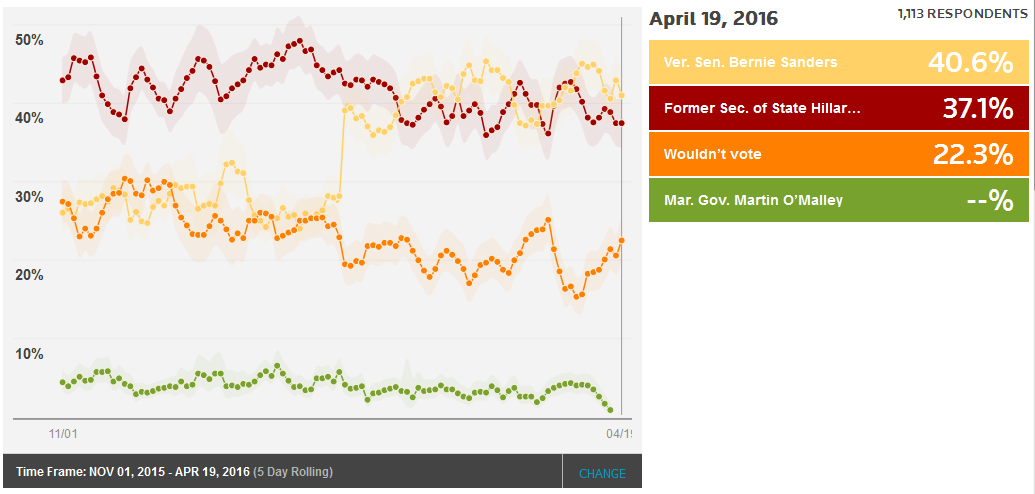
If you look at the national Clinton vs. Sanders national polling at an aggregator site like Huff Post or Real Clear Politics, you see a dramatic narrowing to a statistical tie, with Sanders starting to lead in a few. And this is only April in a race that ends in June — the start of the third quarter, in other words. For example, the following shows Sanders slightly ahead of Clinton in the Reuters five-day tracking poll through the third week of April and just after the New York primary:


Note the change in momentum above. Imagine that momentum continuing until Sanders is solidly in the lead in all polls and still rising. Now imagine that change in momentum occurring while he's also behind in the delegate count, but rising...

Sanders Behind But Rising in the Race for Pledged Delegates

As predicted, Sanders lost badly in the Deep South (front-loaded races in which he had little name recognition, in states which no Democrat will carry in November). Then he reversed the Clinton lead and has been steadily climbing back, visible evidence of momentum.

Here's a chart of the pledged delegate differential prior to the mid-Atlantic series of primaries:


I haven't included contests later than April 9 because of the lawsuits and investigations that challenge the New York election results. Initial New York results shows Sanders giving back 31 delegates of the 100 delegates he had regained since the Deep South voted. But if the New York city election challenges prevail (and they are serious), that result will change the rest of the graph, perhaps dramatically. His initial post-New York delegate loss could easily be revised in his favor, changing the rest of the chart. (Click here for a county-by-county map of the Democratic primary results in New York.)

Democrats at the Philadelphia Crossroads

Regardless of the result, however they may be revised, of the troubled mid-Atlantic elections, each of the following statements is true:
  • As predicted, March 15 will remain the date of Sanders' lowest differential.
  • Sanders has a path to adding as many as 100 delegates to his differential total prior to June 7, when California (475 delegates) and five other states vote.
  • He has a clear, though narrow, path to surpassing Clinton in the final delegate count...
  • ... or to coming less than 50 delegates short after the last primary vote is cast.
Can you see what that means coming into the convention? Imagine that Sanders continues to win the money race, lead in the national polls by, say, 10 points or more, and has another big delegate surge in the fourth quarter of the delegate race, the post-East Coast phase. Now add in that Sanders beats all Republicans by more than Clinton, and that Clinton even loses to some of them. (A recent poll, in fact, has her in a statistical tie with Trump, up only 3 points and within the margin of error, while Sanders trounces Trump by 10 points.)

This isn't about what Sanders will do coming into the convention. Sanders doesn't have to do anything but show up and let the process play out. The pressure, if there is any, will come from the voters. The whole nation will be watching, will see all of this. What will the Democrats do with all eyes on them? And how will the nation respond if they stick with an underwater but pre-ordained "inevitable" pick anyway?

This leads to our third principle:

3. Democrats may not be able to win in November if they appear to force the least desirable candidate on the public.

Remember the first two principles above. Clinton can't win the general election without independents, the "radical independents" who support Sanders and Trump. She can certainly wrap up the nomination (or not), but if she does, she will have done it with a jiggered, Debbie Wasserman Schultzed process; by winning states no Democrat will win in November; by winning mainly in contests in which only Democrats could vote.

Note the word "appear" in the bolded statement above. This is not about the rightness or wrongness of what the Democrats do on arrival in Philadelphia. It's about how what they do will look to people who will vote in November.

This could all be a problem — for Democrats, not for Sanders. What's a "hardwired for Clinton" political party to do? Stay tuned. Philadelphia may be the site of the most important crossroad in post-FDR American history.

(Blue America has endorsed Bernie Sanders for president. If he's also your candidate, he needs your support now as the contest leaves the third quarter and enters its final phase. Consider contributing now; and thanks.)

GP
 

Labels: , , , , , ,

Friday, March 25, 2016

Why Is Clinton Polling Worse Than Her Delegate Count? Early Voting.

>

Another instance of Clinton polling far below her delegate count. In this poll, she's losing.

by Gaius Publius

Yes, the answer, unique to this contest, is early voting. Let me explain.

Anyone who's breathlessly watched as voting returns come in knows at least two things: early voting totals (from votes by mail, for example) are reported first; and on the Democratic side early voting heavily favors Clinton.

Most of the analysis of this phenomenon ignores the way this "primes the pump," as it were, by creating the initial impression that Clinton will win a given contest, and instead focuses on other factors.

(About pump-priming: In Arizona reporting early voting first did more than that. It may have helped determine the outcome. News organizations reported early voting totals — a large percentage of the total vote — and not much else, then after their pre-selected precincts reported, they called the race for Clinton while voting was still going on. Why was voting still going on? Because voting lines were often so long, and so many voter registrations were erroneous, that polls had to he held open past pre-determined closing times. In other words, people waiting in line were told by news outlets that the race was over in Arizona. How many voters abandoned waiting in lines that in some cases were five hours long? We'll never know. But keep reading. This piece may hold the answer to why the Arizona vote was more one-sided than it could have been.)

Analysis of Clinton's early-voting advantage generally focuses on which age and gender groups tend to vote early, versus which ones vote on election day. What's missing is analysis of the "information gap." If I vote three weeks early in a state where one candidate is little-known, I likely know little about that candidate. If that candidate then "introduces himself or herself" via media appearances, campaign events and advertising, an election day voter is likely to be making a more informed choice than an early voter — depending of course on the value of the information presented prior to election day.

The contests between Bernie Sanders and Hillary Clinton are near-textbook examples of that disparity in information. Clinton is one of the most recognized figures in modern politics. Sanders is one of the least recognized. Without candidate "introduction" in the lead-up to voting, Clinton is simply the default because for a great many voters, she's the only one they've heard anything at all about.

Hillary Clinton and Early Voting

Which leads to a rather stunning discovery — if you subtract out the early voting totals in the Democratic contests and look at election day totals only, Sanders ties or beats Clinton, even in some of the "Clinton states" like North Carolina.

Seth Abramson, writing at the Huffington Post, tells the tale (my emphasis):
[L]et’s make an important observation: Bernie Sanders has tied or beaten Hillary Clinton in a majority of the actively contested votes this election season.

You doubt it? Okay, let me explain.

Bernie Sanders has terrible name recognition in states where he hasn’t advertised or campaigned yet; meanwhile, Hillary Clinton has universal name recognition everywhere. Realizing this, the Clinton camp pushed hard to rack up the early vote in every state where early voting was an option. They did this not primarily for the reason we’ve been told — because Clinton performs well among older voters, and older voters are more likely to vote early than other age demographics — but rather because they knew that early votes are almost always cast before the election season actually begins in a given state.

That’s right — in each state, most of the early primary voting occurs before the candidates have aired any commercials or held any campaign events. For Bernie Sanders, this means that early voting happens, pretty much everywhere, before anyone knows who he is. Certainly, early voting occurs in each state before voters have developed a sufficient level of familiarity and comfort with Sanders to vote for him.

But on Election Day — among voters who’ve been present and attentive for each candidate’s commercials, local news coverage, and live events — Sanders tends to tie or beat Clinton.

In fact, that’s the real reason Sanders does well in caucuses.
That's an important observation about caucuses, by the way. A caucus is, by definition, an election day event.

Abramson looks at voting patterns in North Carolina as an example of a "Clinton state":
Consider: in North Carolina, Hillary Clinton only won Election Day voting 52% to 48%. Given the shenanigans in evidence during the live voting there — thousands of college students were turned away from the polls due to insufficient identification under a new voter-suppression statute in the state — it wouldn’t be unfair to call that 4-point race more like a 2-point one (51% to 49% for Clinton).
If you consider, as Abramson does, that without (Republican-created) voter suppression, Clinton and Sanders ran basically even, it casts new light on the race as a whole, and goes a long way to explaining those narrowing national polls, like the one featured above, from Bloomberg.

Bernie Sanders is introducing himself to the nation. There's no "early voting" in these polls, and the results are steadily narrowing, as a trip to a site like RealClearPolitics shows. And remember, this is just the halfway mark. The contest started on February 1. It will end on June 14. We're not even through the second month of a 4½ month-long contest.

I keep saying this is far from over, because it's far from over.

Early Voting and Arizona

The author makes an interesting point about Arizona. Keep in mind, the piece was written before all of the election-day votes were counted, but he points to some interesting trends (emphasis in original):
[I]n Arizona yesterday, the election was called almost immediately by the media, with Clinton appearing to “win” the state by a margin of 61.5% to 36.1%. Of course, this was all early voting. CNN even wrongly reported that these early votes constituted the live vote in 41% of all Arizona precincts — rather than merely mail-in votes constituting a percentage of the total projected vote in the state — which allowed most Americans to go to bed believing both that Clinton had won Arizona by more than 25 points and that that margin was the result of nearly half of Arizona’s precincts reporting their live-voting results. Neither was true.

In fact, as of the time of that 61.5% to 36.1% “win,” not a single precinct in Arizona had reported its Election Day results.

Indeed, more than two and a half hours after polls closed in Arizona, officials there had counted only 54,000 of the estimated 431,000 Election Day ballots.

That’s about 12%.

So how did Bernie Sanders do on Election Day in Arizona?

As of the writing of this essay (2:45 AM ET), Sanders was leading Clinton in Election Day voting in Arizona 50.2% to 49.8%, with just under 75,000 votes (about 17.3% of all Election Day votes) counted.
Without the combination of Republican voter suppression (the Maricopa County official who strangled the vote by eliminating most of the polling stations is a Republican), the media calling the race over with a great many voters still in line, and Clinton's natural lead in early voting, the race in Arizona may have had a very different outcome. How different? Again, we'll never know.

What If Early Voting Is Always Reported Last?

Finally, Abramson asks us to consider a thought experiment, one I consider rather fascinating (my emphasis below):
So imagine, for a moment, that early votes were reported to the media last rather than first. Which, of course, they quite easily could be, given that they’re less — rather than more — reflective of the actual state of opinion on Election Day. Were early votes reported last rather than first, Arizona as of 2:45 AM ET would have been considered not only too close to call but a genuine nail-biter. In fact, only 400 or so Election Day votes were separating the two Democratic candidates at that point — though the momentum with each new vote counted was quite clearly in Sanders’ favor.
Reporting that election day momentum may have kept more Sanders voters in those five-hour lines — or more Clinton voters. I fear we'll never know which, though every candidate, Democratic and Republican, should ask for a revote.

Election Day Voting Patterns Explains a Lot

Abramson makes other points as well (the whole piece is worth reading through). He uses this information to help determine why Clinton is close to tied in the national race, why Clinton is "'beating' Sanders among American voters despite having a -13 favorability rating nationally, as compared to Sanders’ +11 rating," and why Sanders consistently outperforms Clinton in head-to-head races against all Republicans.

Including this, about super-delegates:
But what about the argument, implicitly being made to super-delegates now, and likely to be made to them explicitly in Philadelphia this summer, that Bernie Sanders has, broadly speaking, out-performed Hillary Clinton in Election Day voting? Given that Election Day voting in the spring is the very same sort of high-information voting that will occur in November, you’d think super-delegates would be quite interested to know that, in live voting, Bernie Sanders beats Hillary Clinton more often than not.
At the same time she underperforms Sanders in all general election polling. Do the super-delegates want to know that? That answer we will know. At some point — at the convention, in fact — super-delegates will cast a vote as well.

Blue America has endorsed Bernie Sanders for president.
Seems so to me. And thanks!

GP
 

Labels: , , , , , ,

Tuesday, March 22, 2016

One of Several Sanders Paths to a Win

>

Robert W. McChesney, Prof. of Media and Communications, University of Illinois, comments on the Sanders-Clinton race going forward (source: DKos diarist Get The Word Out)

by Gaius Publius

Recently we took yet another look at the Clinton-Trump side of the race and found, shall we say, some risk for the Democratic Party, should they choose that path.

Here I'd like to take the first of several looks at the Sanders side of the race, in particular, one of several paths he has to a victory. We've looked at work by DKos diarist and master data-stitian MattTX (here); I've seen analyses that take social media indicators into account (image source), and several others, including some indication of a much more promising path by Nate Silver's site that adjusts for their "mistake" in Michigan.

But let's take a look at this, a thoughtful projection by a former DKos-diarist and now redditor (yep, another escapee) that looks at five factors — [1] racial diversity, [2] internet penetration, [3] the intersection of both race and internet penetration, [4] youth voting, and [5] income average — to see which were present in which of Sanders' wins, and then projects a result for post-March 15 contests. (For a fuller explanation of the factors and how they played out in the pre-March 15 contests, I refer you to the piece.)

For reference, I personally have Bernie Sanders winning at least seven of the eight contests between March 15 and April 9, just prior to the New York primary on April 19, with nearly 375 delegates to be decided in that period. Sanders should also win 12 of the next 15, those following New York. (Sanders delegate deficit, with all March 15 delegates finally allocated, along with the Democrats Overseas primary, in which he beat Clinton by more than two-to-one, is a manageable minus-321.) My personal projection is that between March 15 and the New York primary in mid-April, Sanders will have reduced that lead by 100 delegates or more, assuming his momentum continues.

Here are the projections (made prior to the remaining March contests) by the diarist mentioned above. As you read or reread this, some of these contests may have been decided, but I present it anyway as one template for a Sanders win, to encourage you going forward and so you can keep score at home.

I've grouped his predictions by contest date and added (slightly rounded) delegate counts per date:
[March 22 — more than 130 delegates]
Arizona: Bernie will either win or lose by 5% margin. [Factor 1, 4]
Idaho: Bernie will win by 15%+ [Factor 1, 4]
Utah: Bernie will win by 15%+ [Factor 3, 4, 5]

[March 26 — more than 140 delegates]
Alaska: Bernie will win by 15%+ [Factor 3, 4, 5]
Hawaii: Bernie will win by 15%+ [Factor 3, 5]
Washington: Bernie will win by 15%+ [Factor 3, 4, 5]

[April 5 and 9 — 100 delegates]
Wisconsin: Bernie will win by 15%+ [Factor 3, 5]
Wyoming: Bernie will win by 15%+ [Factor 3, 4, 5]

[April 19 — more than 380 delegates]
New York: Bernie will either win or lose between 5% (him) or 10% (Clinton). [Factor 2]

[April 26 — 20 delegates]
Connecticut: Bernie will win or lose within 5% [Factor 2, 5]
Delaware: Bernie will lose by around 15%+ [Factor 5]
Maryland: Bernie will win or lose by around a 5% [Factor 2, 5]
Pennsylvania: Bernie will win or lose within a 5% [Factor 2, 5]
Rhode Island: Bernie will win by 15%+ [Factor 3, 5]

[May 3 through June 5 — more than 300 delegates]
Indiana: Bernie will lose by around 10-15% [Factor 4]
Guam: Bernie will win by around 15%+ [Factor 3]
West Virginia: Bernie will win or tie within +-5%. [Factor 1]
Kentucky: Bernie will win or lose within a factor of +-5%. [Factor 1]
Oregon: Bernie will win by 15%+ [Factor 3, 5]
Virgin Islands: Bernie will lose by 10%+ margin. [A major lack of internet connectivity cancels out Factor 1]
Puerto Rico: Bernie will win or lose within +-5% [Factor 1]

[June 7 — almost 700 delegates]
California: Bernie will win by 20%+ [Factor 3, 4, 5]
Montana: Bernie will win by 10%+ [Factor 1]
New Jersey: Bernie will win or lose by +-5%. [Factor 2, 5]
New Mexico: Bernie will win or lose by +-5%. [1, 4]
North Dakota: Bernie will win by 15%+ [Factor 3, 4, 5]
South Dakota: Bernie will win by 15%+ [Factor 1, 5]

[June 14 — 20 delegates]
District of Columbia: Bernie will lose by around 10%+ [Factor 5]
In total, between March 15 and the last contest on June 14, more than 2000 delegates (2020 to be exact) will have been allocated.

By the way, most of those wins by ">15%" will be by much greater than 15%. Some will be blowouts. The average of the Sanders' wins prior to March 15 is 65%, a 30-point differential over Clinton in those contests. Note that the projections in New York, Pennsylvania and New Jersey look especially promising. Close losses in those states are as good as close wins, especially in light of likely large winning margins elsewhere.

This is an exciting contest, as well as, unfortunately, a seriously consequential one for the Party and the nation. Stay tuned. I'll offer my own projections in due course.

(Blue America has endorsed Bernie Sanders for president. If you'd like to help out, go here. If you'd like to "phone-bank for Bernie," go here. You can volunteer in other ways by going here. And thanks!)

GP
 

Labels: , , , ,

Thursday, March 03, 2016

The Democratic Party, Donald Trump & the 2016 Turnout Problem

>

Primary voter turnout in doubly-contested years (source; click to enlarge). Notice the large Democratic advantage in 2008 (lower graph) and the relatively lower Democratic turnout so far in 2016 (upper graph).

by Gaius Publius

One of the noticeable features, if feature is the word, of the 2016 presidential contest so far is the marked difference in voter turnout. On the Democratic side, turnout overall is significantly down. On the other hand, Republican turnout is way up. (See chart at the top.)

There are at least three factors at play here, and one very large problem. Those factors — turnout driven by the Clinton candidacy; turnout driven by the Sanders candidacy; and turnout, both Democratic and Republican, driven by Trump's presence in the race. The first is quite low; the second is not yet well understood; and the third, on the Republican side, is quite high. We know the Republican turnout is Trump-driven because he's the exciting candidate on the Republican side, he's winning, and turnout is well above Republican norms.

On the Democratic side, attributing the low voter turnout to candidates is difficult for a number of reasons. One is that two viable candidates are on the ballot; another is that we don't know to what degree Republican contests are stealing independent voters from Democratic contests (i.e., Trump driving Democratic turnout down). What we do know, however, is that in areas that are more or less exclusively Clinton's domain — where she competes neither with Trump nor, for the most part, with Sanders — her numbers are nowhere near Barack Obama's numbers in 2008.

Nick Confessore, the author of the article linked below, quotes a pollster who puts it this way:
“Barack Obama without that surge [in new voters] is John Kerry [who lost to George Bush].”
Thus the very large problem. If the Democratic candidate is Hillary Clinton, she may be facing a wave of turnout for the other side, a problem similar to the one John McCain faced in 2008 and Mitt Romney, to a lesser degree, faced in 2012.

Because Confessore's piece focuses on Clinton's turnout problems, I'll cover just that part here. (If the Democratic nominee is Bernie Sanders, the analysis is more complicated. Some preliminary thoughts at the bottom on that, but the data is not in.)

Confessore writes (my emphasis):
Beneath Hillary Clinton’s Super Tuesday Wins, Signs of Turnout Trouble

Hillary Rodham Clinton set out 10 months ago to inspire and energize the Democratic Party, hoping to bring together the rising American electorate of black, brown, young and female voters into a durable presidential coalition. But buried beneath Mrs. Clinton’s wide-ranging and commanding victories on Tuesday night were troubling signs of a party that has not yet rallied to her call.

Democratic turnout has fallen drastically since 2008, the last time the party had a contested primary, with roughly three million fewer Democrats voting in the 15 states that held caucuses or primaries through Tuesday, according to unofficial election results. It declined in virtually every state, dropping by roughly 50 percent in states like Minnesota and Texas. In Arkansas, Alabama, and Georgia, the number of Democrats voting decreased by roughly a third.

The fall-off in Democratic primary turnout — which often reveals whether a candidate is exciting voters and attracting them to the polls — reached deeply into some of the core groups of voters Mrs. Clinton must not only win in November, but turn out in large numbers. It stands in sharp contrast to the flood of energized new voters showing up at the polls to vote for Donald J. Trump in the Republican contest.

Some Democrats now worry that Mrs. Clinton will have difficulty matching the surge in new black, Hispanic, and young voters who came to the polls for President Obama in 2008 and 2012.

“Barack Obama without that surge is John Kerry,” said Cornell Belcher, a Democratic pollster who worked on Mr. Obama’s re-election campaign, referring to the losing Democratic nominee in 2004. “Just turning out the traditional minority base is not a 51 percent pathway going into November.”
Confessore cites a number of Clinton-specific districts, those where Clinton was significantly more successful than Bernie Sanders, and also looks at the general case of Massachusetts. For example (my emphasis):
  • "In three precincts of Virginia’s Third Congressional District, the heart of the state’s African-American community, where overwhelming black turnout in 2008 helped Mr. Obama win the state, turnout was down by an average of almost 30 percent on Tuesday night."
  • "Mrs. Clinton’s strong victory in South Carolina, which was celebrated for her dominance among African-American voters, obscured a big decline in black turnout of about 40 percent."
  • "On Super Tuesday, Republicans smashed turnout records in Massachusetts, a traditionally Democratic-leaning state, and saw huge turnout in both Virginia and Tennessee."
This is not to disparage Clinton's candidacy, but to fear for it. The article is detailed beyond what I've quoted and contains a number of speculations on what the causes might be. Answers range from GOP voter suppression laws to Debbie Wasserman Schultz's decision to hide the Democratic debates under a bushel. The piece is well worth reading completely.

But the answer may also be simply the candidates, or the fact that the leading candidate is not Barack Obama. Nevertheless, there is some early reason to be concerned.

What About Sanders and Turnout?

Confessore doesn't dig into that, so we have to speculate. The data may well show that Sanders voters are turning out in greater numbers than Clinton voters, though in a state like South Carolina, so dominated by the institutional Democratic Party, the numbers could be skewed enough to make that not readily visible.

But the answer — and this needs to be checked — may also come from another aspect of the race, alluded to above. The media has managed to paint this election as already a contest between Trump and Clinton, and low-information (i.e., busy) voters may be buying that. In states where voters can choose which primary or caucus to participate in, potential Sanders voters may choose to vote for the more exciting Trump, rejecting the presumed Democratic nominee and not casting a vote on the Democratic side.

Put more simply, Trump may be cannibalizing Democratic turnout in a primary that Clinton is presumed to have "already won" nationally. 

For example, look at that Super Tuesday comment again:
"On Super Tuesday, Republicans smashed turnout records in Massachusetts, a traditionally Democratic-leaning state, and saw huge turnout in both Virginia and Tennessee."
Did Trump's greater turnout (he "smashed records") account for Clinton's narrow win over Sanders in Massachusetts, by taking Sanders-leaning independent votes from the Democratic primary? That's at least possible if you look at Sanders' well documented greater appeal to independents relative to Ms. Clinton's. Trump may have become the default choice of potential "Sanders voters" in Massachusetts, if those voters thought the national Democratic race was already over.

Which leads to these thoughts, also speculative. It's possible that in a Clinton–Trump contest, turnout alone would be against her, even before adding in any other turnout effects, such as the effect of negative advertising. In other words, assuming the Republican vote in a Clinton–Trump contest would be high anyway (the "Trump effect"), Clinton would have to overperform (according to Confessore and those he interviewed) among non-white voters in order to offset the working class and non-ethic vote that Trump might easily draw (again, my emphasis):
[D]espite the seemingly inexorable demographic rise of Hispanic voters, the American electorate is still overwhelmingly white. Some analysts said they believed Mr. Trump could even exceed Mitt Romney’s 59 percent share of the white vote — winning over disaffected Republicans and even working-class Democratic men, and putting Democratic-leaning swing states like Michigan, and potentially Pennsylvania, in play. That could offset losses Republicans might suffer among Latino voters, forcing the Democratic nominee to overperform significantly among the smaller proportion of nonwhite voters.
Now let's consider a Sanders–Trump contest. Would Sanders offset some of Trump's appeal to working class and non-ethnic voters? Available polling, though early, says yes. In other words, Sanders, who is already (and falsely, in my view) being accused by both the media and Clinton campaign of running a "too white" campaign, could well outperform Clinton in that demographic, and in fact, steal those voters back from the Trump campaign.

How will we know? It will, I think, come down to this — Who is more believable on trade? Who is more credible as an anti-NAFTA, anti-TPP candidate among non-racist independents of any ethnicity? Given Sanders' consistent opposition, even hatred, of these job-killing trade deals, and his proven ability to stay on-topic despite distractions, he could easily outperform Clinton with working class voters, ethnic and non-ethnic alike. (Especially in debates. We've touched briefly on the debate problem Clinton may have with Trump. On trade I think Trump would be entirely credible with working class voters, those who don't listen past the words, and Clinton uniquely vulnerable. More on that separately.)

On the other hand, could Sanders attract and keep Clinton-preferring ethnic voters in a contest against Trump, since we know he would keep his own not-small portion of this population? That's a hypothetical and good data isn't in on his success in contests outside of the South — in states, in other words, a Democrat could actually win in the general election. But it's very hard to imagine any ethnic voter staying home in a contest featuring Donald Trump as a potential president.

Which leaves us with this thought. If a Trump candidacy could lower Democratic turnout for either Democratic candidate, what would be the effect on persuadable — and economically struggling — independents of a Clinton candidacy vs. a Sanders candidacy? In other words, for whom would a lower turnout be more damaging?

We clearly need more data; stories like this, about party-switching in Massachusetts, are only anecdotal. Still, if I had to bet, I think I see a favorite for my money. Will the Party see it this way as well? Will they try to find out?

(Blue America has endorsed Bernie Sanders for president. If you'd like to help out, go here. If you'd like to "phone-bank for Bernie," go here. You can volunteer in other ways by going here. And thanks!)

GP
 

Labels: , , , , , , ,

Tuesday, March 01, 2016

Clinton Will Build Her Biggest Lead on March 15. Sanders Will Erode It After That.

>

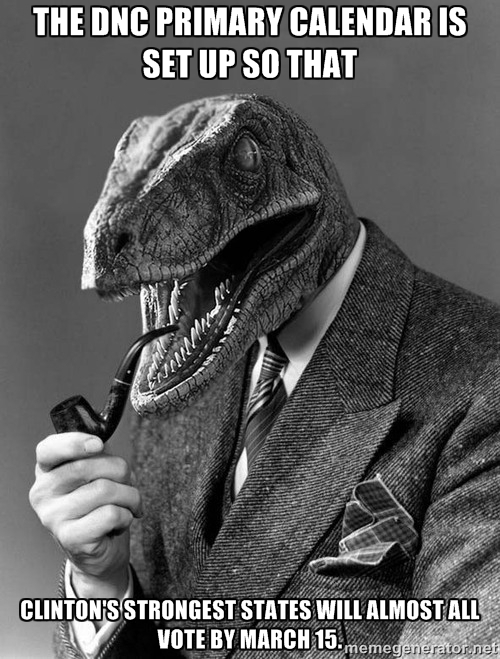
Don't question the lizard. The lizard knows.

by Gaius Publius

I'm keeping this short to put a very simple idea into your head. Because of the way the Democratic Party voting calendar is structured this year, Clinton's largest lead will occur on March 15. After that, most of Sanders' strongest states will vote.

What this means is simple:
  • Hillary Clinton will grow her lead until the March 15 states have voted.
  • Bernie Sanders will erase that lead — partly or completely — after March 15.
  • How much of Clinton's lead he will erase depends on your not buying what the media is selling — that the contest is over.
  • In most scenarios where Sanders wins, he doesn't retake the lead until June 7, when five states including California cast their ballots.
March 15 is the Ides of March; a good way to remember the date. The message — gear up for a battle after the Ides of March, and don't let the establishment media tell you what to think. They won't be right until the last state has voted.

If you want to stop reading here, this is all you need to know.

The Data

Now the data. One of the best data-stitians I've come across is a diarist at Daily Kos named MattTX. Matt is very good, professionally good, at this stuff. In a long, carefully-reasoned diary, "How Bernie Sanders can win the Democratic nomination," he lays out six scenarios for the race, in five of which Bernie Sanders wins the nomination (the other is a current baseline with no momentum). He presents them in a parallel fashion, and each presentation differs only in changing a small set of assumptions. Once you understand how to read the first one, you can read the others easily.

The first three scenarios are "static" — they assume that the national polling remains fixed throughout the race. He then runs the numbers on each state race for the following assumptions:
  • The polling stays fixed at Clinton 49%–Sanders 42%, a 7-point Clinton lead.
  • The polling stays fixed at Clinton 45%–Sanders 45%, a dead heat.
  • The polling stays fixed at Sanders 47%–Clinton 44%, a 3-point Sanders lead.
Then he looks at what "momentum" looks like in a number of recent presidential contests (it actually can take a number of shapes) and chooses a momentum pattern associated with Obama's win over Clinton in 2008. (Click here to see that chart.)

His final three scenarios are "dynamic" variations of his static ones, with shifting momentum off the current baseline. In each of these, Sanders wins, each time overcoming the bulge in the Clinton lead that comes on March 15. In the narrowest of these winning scenarios, the March 15 bulge is quite large, +184 delegates for Clinton.

Note that the data in Matt's piece was run prior to South Carolina's results, so Sanders has some additional ground to make up. Still, Sanders is right to "take it to the convention." Most of his strength comes after most of Clinton's, and Sanders could easily surprise in his states, just as Clinton will surprise in some of hers. Again, we won't know who has the lead for good until after California and four additional states vote in early June.

Bottom line — What looks bad for Sanders supporters on March 1 will look worse a few weeks later. But stay heartened. Whatever the result through March, this isn't over until June, after Sanders' best states have voted as well.

(Blue America has endorsed Bernie Sanders for president. If you'd like to help out, go here; you can adjust the split any way you like at the link. If you'd like to "phone-bank for Bernie," go here. You can volunteer in other ways by going here. And thanks!)


GP
 

Labels: , , , , , ,

Monday, February 08, 2016

Are the Wheels Coming Off in the Democratic Primary? A Roundup.

>

Carl Bernstein explains why the White House is "horrified" at the state of the Clinton campaign, which they (and Bernstein) favor.

by Gaius Publius

This is a roundup of recent pieces with a common theme — the wheels may be coming off the effort to keep the insider game alive on the Democratic side. Note, for example, in the Bernstein portion, the great concern by the White House that Hillary may not be able to take the crown.

I didn't expect to see this explosion of concern. Putting all this in one place makes interesting reading. I do encourage clicking through. The sections I touch on are listed below, if you want to skip around, please do. The assembly of all this worry is interesting. Our sections are:

◾ Reuters: Sanders / Clinton race in "dead heat"
◾ Carl Bernstein: White House "horrified" ... Clinton "blowing up" her campaign
◾ Bill Curry: "It’s almost over for Hillary ... a mass insurrection against a rigged system"

For the latter sections, click the links above to go there directly.

Reuters: Sanders, Clinton in "dead heat"

Let's start with this, the data, hot off the Reuters presses:
Exclusive: Presidential hopefuls Sanders, Clinton in dead heat - Reuters/Ipsos poll

Vermont Senator Bernie Sanders has erased Secretary of State Hillary Clinton's wide lead for the Democratic presidential nomination since the start of year, putting the two in a dead heat nationally, according to a Reuters/Ipsos poll.

Clinton leads Sanders 48 percent to 45 percent among Democratic voters, according to the poll of 512 Americans, conducted Feb. 2-5 following the Iowa caucus. The poll has a credibility interval of 5 percentage points.
The data sets the stage. Now for the gnashing of teeth, which strongly indicates these polls aren't very far off.

Carl Bernstein: White House "horrified" that "Hillary Clinton is blowing up her campaign."

For reaction, let's begin with Carl Bernstein, speaking recently on CNN. This is enormously interesting. Note that Bernstein, though clear-eyed about her vulnerabilities, is coming to this as a Hillary Clinton supporter — not a criticism, just something to note. He's open about that in the interview.

I hope you have time to read or listen to this through. Bernstein is well connected, and he has a lot to pass on (italicized emphasis and ellipses mine):
Bernstein: There is a huge story going on. I've spent part of this weekend talking to people in the White House. They are horrified at how Hillary Clinton is blowing up her own campaign.

And they're worried that the Democrats could blow -- they are horrified that the whole business of the transcripts, accepting the money -- that she could blow the Democrats' chance for White House. They want her to win. Obama wants her to win.

But Sanders has shown how vulnerable she is. These ethical lapses have tied the White House up in knots. They don't know what to do. They're beside themselves. And now, you've got a situation with these transcripts a little like Richard Nixon and his tapes that he stonewalled on and didn't release.
At this point CNN put up a graphic — "Total Hillary Clinton speech income from "big banks" 2013-2014: At least $1.8 million for at least 8 speeches" (highlight theirs).

Then the host asks, "You're saying this is akin to the [Watergate] tapes?" (a significant question given Bernstein's role in Watergate). Bernstein replies:
Bernstein: No, what I'm saying that if she stonewalls on it and does not release them and enables the Republicans to paint her again into a corner. This is not just a vast right-wing conspiracy that is causing her problems. She has caused herself these problems. The server is not the vast right-wing conspiracy. It's Hillary Clinton deciding that she could put a server in her closet, the same with these transcripts, the same with accepting this money in a presidential year when she knew that she was going to probably be running for president.

To the people in the White House I talked to, it is unfathomable that she did this and has endangered President Obama's legacy. As I say, they are terrified at this point and they want Bernie Sanders to not do well [in New Hampshire] on Tuesday and Hillary to do well. Because if this keeps going like that, they see real problems ahead.
The host asks about Clinton's shrugging defense of having been paid $600,000 by Goldman Sachs, "I don't know; that's what they offered."
Host: "So what should she have said?"

Bernstein: "I can't advise her. Maureen Dowd in her column tomorrow calls that answer obscene. ... Some of this is unanswerable because it represents such terrible judgment, which is what people in the White House are saying. They're just dumbfounded by this and want her to get back on track."
The host then offers that maybe Clinton didn't know she was going to run when she made those speeches. The reply:
Bernstein: "It's disingenuous. She knew she might [run for president]. And this has been a problem I say in the last pages of "A Woman in Charge," my book on Hillary written before she ran the last time, she has had a difficult problem with the truth going back to the Arkansas years. It's not about outright lying. It's about obfuscation. It's about not being transparent.

[Note this heavy praise] "She is so qualified to be President of the United States. She is so much in the right lane on Democratic issues, she has the experience, and yet she keeps tripping herself up. That's what she did in the last campaign, and that's what she's been doing in this campaign.

"She's got to get herself righted, meaning up-straight and moving forward. She might have to show some humility and start explaining that she has exercised some terrible judgment here. I don't know what the answer is for her to do, except to keep going forward, but she's got a big problem here.
And then comes this exchange on Sanders' "socialism," which Bernstein — conventionally — sees as a problem. The host pushes back on that.
Host: "Where does this go?"

Bernstein: "I don't know where it goes. I think the good news for Hillary Clinton in some ways, that Bernie Sanders, a self-described "socialist," is out of touch with mainstream America..."

Host: "But that wasn't reflected in Iowa..."

Bernstein: "Exactly, and particularly with young people he is tuning in and touching a nerve in mainstream America and with young women, which is Hillary Clinton's worst nightmare.

"In fact, I think you have to go back to the candidacy of Bobby Kennedy in 1968 -- and I don't want to care Sanders and Kennedy in some regards, but this is a movement. He's right, Sanders. He has started a movement. And that, too, has got the White House very upset."
Keep that "touching a nerve with young women" in mind, especially as you read about the "BernieBro problem" in the Clinton-supporting press. Bernie has far less of a BernieBro problem than Clinton has a "Feminists for Bernie" problem, based on the available data so far.

The host then raises the question that the Clinton campaign keeps raising as their differentiator — (paraphrased) "Pragmatism vs. passion. Doesn't she have that passion?"
Bernstein: "The last pages of my book are about her passion, her passion for America, her passion for doing good things for the people of this country ... and she has that fire, she has that passion, but so does Bernie Sanders. ...It's possible she is not in tune with her time and her country and her party. And somehow she has to get herself aligned with whatever this new strain of economic populism.

"She's got a problem. If she's cozy with Goldman Sachs, and she's got transcripts that she can't release that show her cozying up to Goldman Sachs, it's a problem. It would help her if she could get these transcripts out there. She's said, judge me by her record. Part of her record is what she has said to these investment bankers in these meetings, and we ought to be able to know what she has said."
I like Carl Bernstein and don't begrudge him his insider perspective, especially since he's doing a good honest job as a reporter. His bottom line — "It's possible she is not in tune with her time" — is fairly astute. Especially when coupled with "If she's cozy with Goldman Sachs, and she's got transcripts that she can't release that show her cozying up to Goldman Sachs, it's a problem."

And note, he wants those transcripts released as well, and for the right reason. Voters really do have a right to read them.

Bill Curry: "It's almost over for Hillary. This is a mass insurrection"

Now Bill Curry writing in Salon. He talks first about the establishment-rigged process (my emphasis):
It’s almost over for Hillary: This election is a mass insurrection against a rigged system 

It would be hard to overstate what Bernie Sanders has already achieved in his campaign for president, or the obstacles he’s had to surmount in order to achieve it. Not only has he turned a planned Hillary Clinton coronation into an exercise in grass-roots democracy, he’s reset the terms of the debate. We are edging closer to the national conversation we so desperately need to have. If we get there, all credit goes to Bernie.

Many of those obstacles were put in place by Democratic national party chair and Clinton apparatchik Deborah Wasserman Schultz. Without pretense of due process, Schultz slashed the number of 2016 debates to six, down from 26 in 2008, and scheduled as many as she could on weekends when she figured no one would be watching. ...

Sanders got bagged again in Iowa, this time by a state party chair, one Andrea McGuire. Like Schultz, McGuire’s specialty is high-dollar fund raising, and like Schultz she was deeply involved in Clinton’s 2008 campaign. Under the esoteric rules of the Iowa Democratic caucuses, and after a string of lucky coin tosses, Clinton eked out a 700.52 to 696.86 margin, not in votes cast but in a mysterious commodity known as “delegate equivalents.” ...

All evidence indicates Sanders won the popular vote [in Iowa]. It isn’t a minor point. If the public knew he won the only vote anybody understands or cares about, Clinton wouldn’t be “breathing a sigh of relief,” she’d be hyperventilating. McGuire refuses to release vote totals. She says keeping them a secret is an Iowa tradition. So what if it is?
And about the rigged press coverage:
Throughout the campaign the press has been nearly as big an obstacle for Sanders as the party. Even jaded political junkies were startled when the Tyndall Report exposed the media blackout of Sanders. In 2015, ABC News devoted 261 minutes to the 2016 campaign. Donald Trump got 81 minutes. Bernie Sanders got 20 seconds. Nearly as harmful is the dismissive tone of the cable commentariat, and I don’t mean just Fox News.

CNN has larded up ‘the best political team on television’ with partisans, including Bush acolyte Ana Navarro and Trump minion Jeffrey Lord. On the Democratic side, Paul Begala advises a Clinton Super PAC; David Axelrod was Obama’s guru; Donna Brazile a DNC chair; Van Jones an Obama staffer; David Gergen a Clinton advisor. All are bright, honorable people, but it’s hard to report on a peasant revolt from inside the castle. (The network just added Sanders sympathizer Bill Press to the mix, but it’s far too little and too late.)

Things aren’t all that different over at MSNBC though to its credit it lets reporters do more of its analysis. ... The whole press corps still treats politics as theater or sport. No one ever explains policy on a post-debate show.
And:
What makes the media blackout of Sanders an even greater travesty is that it was imposed over a period of many months in which he led all 21 other candidates in both parties in nearly every general election poll. When a self-described socialist leads every poll, something historic is happening. ... Even horse-race reporters should have seen that a story so big ...
Something historic is indeed happening, or about to happen. There's much more on that subject in the piece. Curry dismisses Clintons's three main arguments (as he sees them) — her electability, her greater ability to govern, and her greater "loyalty to the [Democratic] establishment."

And yet, with all that rigging and all that obfuscation of the core economic issues:
My guess is the middle class sees what [Sanders] sees and wants what he wants: a revolution. If he can continue to drive the debate, they may get one.
At which point, you should refer back to Curry's headline. "It's almost over for Hillary." I'm not so sure yet, but Curry — and maybe Bernstein — appear much more certain.

Where We Stand Now

Nationally, Democratic voters had been supporting Clinton by a more than 2-to-1 margin at the beginning of the year. Sanders has narrowed that lead considerably over the past several weeks, to a "dead heat" in the most recent polls.

I'm not ready to wring my Sanders hands the way the White House is wring their Clinton hands, but I do want to see what's happening in the South. I'm optimistic that the tide is turning, but we're still in the second quarter (sorry for the sports metaphor) with the momentum just beginning to turn our way. We'll see.

This is the most interesting election of your life, I'm willing to bet. Also the most consequential.

(Blue America has endorsed Bernie Sanders for president. If you'd like to help out, go here; you can adjust the split any way you like at the link. If you'd like to "phone-bank for Bernie," go here. You can volunteer in other ways by going here. And thanks!)

GP
 

Labels: , , , , , ,