Wednesday, February 19, 2020

How Dangerous Do You Think Facebook Is To Democracies?

>


On Monday, the Financial Times published a letter from George Soros calling for Mark Zuckerberg and Sheryl Sanderberg to be removed from controlling Facebook:
Mark Zuckerberg should stop obfuscating the facts by piously arguing for government regulation ("We need more regulation of Big Tech," February 17).

Mr Zuckerberg appears to be engaged in some kind of mutual assistance arrangement with Donald Trump that will help him to get re-elected. Facebook does not need to wait for government regulations to stop accepting any political advertising in 2020 until after the elections on November 4. If there is any doubt whether an ad is political, it should err on the side of caution and refuse to publish. It is unlikely that Facebook will follow this course.

Therefore, I repeat my proposal, Mark Zuckerberg and Sheryl Sandberg should be removed from control of Facebook. (It goes without saying that I support government regulation of social media platforms.)
I hope that works-- before the election. Watch this video interview with a former Trump campaign executive that was posted by the BBC in 2017 that explains how the Trump campaign used Facebook to worm his way into the White House.


Q: What were Facebook and Google and YouTube people actually doing here; why were they here? (at Trump's digital campaign headquarters)

A: They were helping us... They were basically our hands-on partners as far as being able to utilize the platform as effectively as possible... When you're pumping in millions and millions of dollars to these social platforms, you're going to get white glove treatment. So, they would send people to the Project Alamo to ensure that all of our needs were being met. Without Facebook, we wouldn't;'t have won. Facebook really and truly put us over the edge. Facebook was the medium that proved most successful for this campaign.


Last month, a Facebook executive, Andrew Bosworth, made a similar claim, namely that Facebook out Trump in the White House.
Bosworth, a close friend of the firm's chief Mark Zuckerberg, made the remark in an internal memo last week.

Mr Bosworth said Mr Trump was not elected because of "misinformation," but "because he ran the single best digital ad campaign I've ever seen from any advertiser. Period."

...Bosworth's note discussed many of Facebook's high-profile scandals, including alleged Russian interference in the 2016 presidential election.

Mr Bosworth told staff that it was not foreign interference that helped Mr Trump get elected, but his well-planned campaign.

"So was Facebook responsible for Donald Trump getting elected?" questioned the long-time employee. "I think the answer is yes, but not for the reasons anyone thinks."
Political manipulation through Facebook is probably here to stay and by "here," I mean the planet earth. ZDNet Tuesday: "Facebook has called out the Singapore government for its use of the country's Protection from Online Falsehoods and Manipulation Act to block access to a page on the social networking platform. The move goes against an earlier pledge that the legislation will not be used to censor voices, says the US internet giant. Singapore's Ministry of Communications and Information on Monday instructed Facebook to block access to the States Times Review page, after the latter repeatedly refused to comply with previous directives issued under POFMA. The 'disabling' order, outlined under Section 34 of the Act, requires Facebook to disable access for local users. The order came two days after the ministry served a directive for the STR page on Facebook to be tagged a 'Declared Online Location.' This required the author of the page, Alex Tan, to publish a notice on the page stating it had 'a history of communicating falsehoods.' The order, which was to take effect from February 16, was not complied with, prompting the directive for Facebook to block access to the page. The page is no longer accessible in Singapore... In defending the decision to issue the disabling order against the STR page, Minister for Communications and Information S. Iswaran said the government needed to 'act swiftly' against falsehoods amidst the coronavirus outbreak. 'Because if we don't, then these falsehoods can cause anxiety, fear, and even panic,' the minister said Tuesday during a media doorstop."


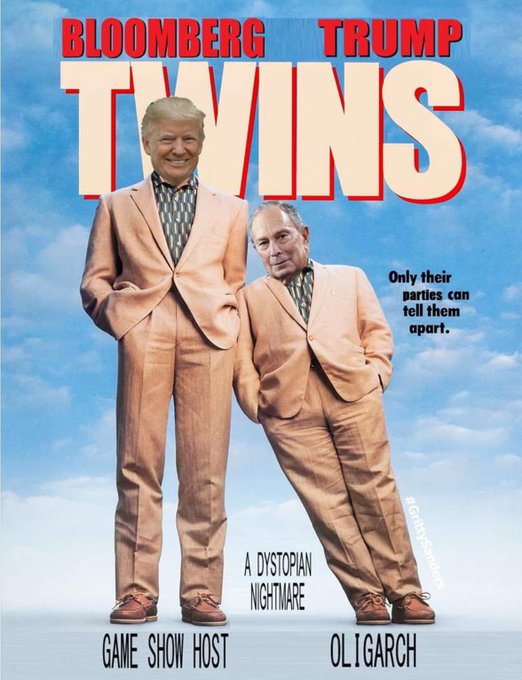
Republican oligarch Michael Bloomberg has been spending a million dollars per day on manipulative Facebook ads that seem to be working very well for him.


Labels: , , ,

Saturday, February 15, 2020

Timeline: How DNC Manipulated 2016 Presidential Race

>

You wonder why independent voters and millions of Democrats don't trust the establishment?

-by Michael Brennan

December 16, 2014: President Obama signs into law omnibus spending bill that increases maximum possible individual political contributions from $129,600 annually to $777,600, substantially increasing the amount of money flowing through party committees. (Congressional Research Services)

April 7, 2015: A Clinton campaign memo to the DNC articulates “Pied Piper” strategy to elevate the most extreme Republican candidates: “Our hope is that the goal of a potential HRC campaign and the DNC would be one-in-the-same: to make whomever the Republicans nominate unpalatable to a majority of the electorate. We have outlined three strategies to obtain our goal: 1) Force all Republican candidates to lock themselves into extreme conservative positions that will hurt them in a general election; 2) Undermine any credibility/trust Republican presidential candidates have to make inroads to our coalition or independents; 3) Muddy the waters on any potential attack lodged against HRC.” (Salon)

May 26, 2015: An updated confidential Clinton campaign memo to the DNC is circulated, including new language (as disclosed by “Guccifer 2.0” on 6/15/16): “3) Use specific hits to muddy the waters around ethics, transparency and campaign finance attacks on HRC… Working through the DNC and others, we should use background briefings, prep with reporters for interviews with GOP candidates, off-the-record conversations and oppo pitches to help pitch stories with no fingerprints and utilize reporters to drive a message.”

August 27, 2015: DNC announces “Hillary Victory Fund” joint fundraising agreement with Hillary Clinton’s campaign with a maximum possible individual contribution of $356,100 ($2,700 to Hillary for America, $33,400 to the DNC, and $10,000 to 32 of the state parties).

November 13, 2015: Associated Press releases a widely-cited survey of superdelegates’ public support: 359 for Clinton, 8 for Bernie Sanders, 2 for Martin O’Malley, and 210 uncommitted.

February 21, 2016: New York Times publishes front-page story proclaiming Sanders faces “steep climb” in delegates, despite trailing Clinton by only one pledged delegate following the Nevada caucus. Clinton’s “inevitability” narrative was largely based on the implicit assumption that her institutional support-- including public commitments by superdelegates-- would be too powerful for Sanders’ insurgency to overcome.

March 5, 2016: DNC vice-chair Donna Brazile provides Clinton with a debate question on the Flint water crisis the day prior (as disclosed by Wikileaks on 10/11/16).

March 12, 2016: Brazile shares question with Clinton on the death penalty the day before a CNN town hall (as disclosed by Wikileaks on 10/11/16). (Washington Post)

April 19, 2016: More than 117,000 Brooklyn voters are unable to cast their New York primary vote due to illegal “voter purges” by the New York City Board of Elections. (New York Times)

April 26, 2016: DNC staffer shares messaging preparing for when Sanders ends his campaign (as disclosed by Wikileaks on 7/22/16). (The Intercept)

May 2, 2016: Politico reports bombshell on how the Hillary Victory Fund was being utilized to circumvent campaign contribution limits by the Clinton campaign and DNC.

May 5, 2016: DNC officials conspire “atheist” smear against Sanders: “It might may no difference, but for KY and WVA can we get someone to ask his belief. Does he believe in a God. He had skated on saying he has a Jewish heritage. I think I read he is an atheist. This could make several points difference with my peeps. My Southern Baptist peeps would draw a big difference between a Jew and an atheist,” said DNC CFO Brad Marshall (as disclosed by Wikileaks on 7/22/16). (Washington Post)

May 14, 2016: The Nevada Democratic convention unfolds chaotically: Chairwoman Roberta Lange passes a motion to arbitrate unverified voice votes. 56 Sanders delegates were denied voting status for administrative reasons, swinging the at-large and party leaders pool to Clinton. Lange rejected a voice vote to reconsider the delegates’ rejection and abruptly adjourned the convention to the dismay of Sanders’ supporters. Despite no evidence suggesting violence, major outlets uncritically repeat the myth of “pro-Sanders violence and chair throwing.“

May 17, 2016: DNC Chair Debbie Wasserman-Schultz calls Sanders’ campaign manager Jeff Weaver a “damn liar” in DNC internal emails (as disclosed by Wikileaks on 7/22/16).

May 18, 2016: Wasserman-Schultz promotes “pro-Sanders violence at Nevada convention” myth on MSNBC.


May 21, 2016: DNC national press secretary pitches an anti-Sanders story to DNC comms director: “Wondering if there’s a good Bernie narrative for a story, which is that Bernie never ever had his act together, that his campaign was a mess,” (as disclosed by Wikileaks on 7/22/16). (The Intercept)

June 6, 2016: On eve of the second biggest primary day (California, New Jersey, New Mexico, Montana, and South Dakota), Associated Press publishes major story calling the primary for Clinton: “Clinton has delegates to win Democratic nomination.” This count includes public superdelegate commitments who will not vote until July 25.

June 15, 2016: “Guccifer 2.0” releases documents stolen from the DNC server including opposition research on Donald Trump, Clinton donor information, and the 5/26/15 strategy memo.

June 28, 2016: Donors to Sanders file a class action lawsuit against the DNC and Wasserman Schultz alleging fraud, specifically that they violated Article 5, Section 4 of the Charter of the Democratic Party: “…the Chairperson shall exercise impartiality and evenhandedness as between the Presidential candidates and campaigns. The Chairperson shall be responsible for ensuring that the national officers and staff of the Democratic National Committee maintain impartiality and evenhandedness during the Democratic Party Presidential nominating process.”

July 22, 2016: Wikileaks releases first batch of DNC emails three days before the Democratic National Convention, demonstrating anti-Sanders bias from senior DNC officials.

July 24, 2016: DNC chairwoman Debbie Wasserman-Schultz resigns on the eve of the Democratic National Convention. (Reuters)

July 26, 2016: Sen. Nina Turner, a prominent Sanders surrogate, is prohibited from joining Rep. Tulsi Gabbard for Sanders’ nominating speech. Following the roll call vote nominating Clinton as the Democratic presidential candidate, hundreds of Sanders delegates stage a “No Voice No Unity” walkout protest off the convention floor.


October 11, 2016: Wikileaks releases “The Podesta Emails Part 3,” revealing collusion between Donna Brazile and Clinton.

April 25, 2017: In class action lawsuit alleging DNC fraud, DNC attorney argues the party has the right to ignore primary voters: “The party has the freedom of association to decide how it’s gonna select its representatives to the convention and to the state party. Even to define what constitutes evenhandedness and impartiality really would already drag the court well into a political question and a question of how the party runs its own affairs. The party could have favored a candidate. I’ll put it that way… We could have voluntarily decided that, ‘Look, we’re gonna go into back rooms like they used to and smoke cigars and pick the candidate that way.’” (See Newsweek: Was the Election Rigged Against Bernie Sanders? DNC Lawsuit Demands Repayment for Campaign Donors.)

She's gone; is Perez worse?


August 25, 2017: Judge dismisses DNC lawsuit on lack of standing: “Not one of them alleges that they ever read the DNC’s charter or heard the statements they now claim are false before making their donations. And not one of them alleges that they took action in reliance on the DNC’s charter or the statements identified in the First Amended Complaint. Absent such allegations, these Plaintiffs lack standing.” (Washington Post)

November 2, 2017: Brazile reveals Hillary Victory Fund agreement “specified that in exchange for raising money and investing in the DNC, Hillary would control the party’s finances, strategy, and all the money raised… [Clinton’s] campaign had the right of refusal of who would be the party communications director, and it would make final decisions on all the other staff. The DNC also was required to consult with the campaign about all other staffing, budgeting, data, analytics, and mailings.” (Vox)

They'll trying it again this year

Labels: , ,

Tuesday, January 28, 2020

Can Bernie Win A State Like Utah? He's Got A Better Chance Than Status Quo Joe Does

>


In 2016 Trump did poorly in Utah, a state where his amorality-- and worse-- is not appreciated. He came in third in the Republican caucuses:
Ted Cruz- 122,587 (69.2%)
John Kasich- 29,773 (16.8%)
Trumpanzee- 24,864 (14.0)
Utah isn't exactly a blue state-- the PVI is R+20, same as Oklahoma and redder than every Southern state, West Virginia and Idaho-- but more people voted for Bernie on caucus day than for Trump. This is how the Utah Democratic caucuses went:
Bernie- 61,333 (79.3%)
Hillary- 15,666 (20.3%)
Yeah, more than twice as many people voted for Bernie than Trumpy the Clown. And Bernie killed Hillary. I'm not 100% sure what Utah Democratic voters were looking for but what Bernie was offering that Hillary wasn't... well, change, reform, character, likability... In the general election, Trump only took 45.9% of the vote, while Hillary, independent-Republican Evan McMullin and Libertarian Gary Johnson split the rest. Hillary got 27.8% and McMullin took 21.0%. Hillary won one county (Grand) by 2 votes and took Salt Lake and Summit counties. So 3 out of Utah's 29 counties. In 7 counties she came in with less than 10% and in 15 counties she came in third behind McMullin.

So why are people so surprised that Bernie is kicking ass in Utah now? He won every single county against Hillary. Even in the three she won the general, Bernie beat her:
Salt Lake-- Bernie 78.8%, Hillary 20.9%
Summit-- Bernie 68.3%, Hillary 31.2%
Grand-- Bernie 79.6%, Hillary 20.2%


The same repulsive Democratic establishment that shoved Hillary down our throats and is determined to do the same with Biden, keeps whining that Bernie is a Socialist!!!! and can't win in red states. Earlier today, Wall Street bankster and DNC fat cat Steve Ratner, a Biden advisor, openly talked about how he and other fat cats are working on a stop-Bernie-jihad. Watch him on Comcast TV earlier today on the clip above. Yesterday, writing for the Salt Lake Tribune, Lee Davidson reported that a new poll for The Tribune by Suffolk finds Bernie crushing the rest of the field:


"Sanders," wrote Davidson, "generates most of his Utah support-- now and in 2016-- from younger voters. In the new poll, Sanders won 49% of the support from likely Democratic voters ages 18-34 and 40% of those ages 35-44-- double to tripling what other candidates received from those age groups. Older age groups are far more evenly split. Warren led with those ages 45-54, Bloomberg led among those 55-64 and Biden led among those 65 and older.
For his academic research, [political science professor at Brigham Young University David] Magleby interviewed some of Sanders’ 2016 managers for media and fundraising about why the senior citizen is so popular with younger voters.

“Their answer is: He’s seen by young people as authentic,” Magleby said. “Sure, he’s older. Sure his hair is a little frizzy…. But what those young people like in Sanders is that he’s the real Bernie. He’s authentic.”

Mike Oberbrockling, 35, of Layton, is one of the people polled who plans to vote for Sanders.

“After Bernie wins, he is going to do the things he says he is going to do,” Oberbrockling said. “He seems to be pretty upfront with everything. You watch a lot of interviews with most politicians, and they give long, drawn-out answers that aren’t clear. Bernie doesn’t beat around the bush.”

Magleby said many younger voters also seem to see Sanders as a father figure, or a grandfather figure, and Oberbrockling agrees.

“Some people call him America’s dad,” Oberbrockling said. “And just like any dad, he wants what’s best for everybody. And the cool thing about Bernie Sanders is it doesn’t matter if you support him or not — he still wants those better things in place for you,” such as Medicare for all.

Magleby said younger voters are also part of an enthusiastic liberal wave that often appears in Democratic presidential campaigns. In contrast, he said, older voters tend to be more centrist and more interested in experience. That is shown by Gaye Anthony, 66, of Taylorsville, one of the Biden supporters among poll respondents.

“At this point in our democracy with what’s going on [with President Donald Trump],” she said, “we need [Biden’s] experience and temperament to help bring our country back to an order that is more stable and more friendly, and more in keeping with our traditions and our expectations.”

Magleby said the poll also shows the strength of the liberal wing in the Utah Democratic Party-- in a state controlled by Republicans. He notes that progressives Sanders and Warren are capturing 40% of the vote, while centrist moderates trail well behind.

“This is not uncommon in one-party states,” he said, “where the out party is more interested in making a statement than winning an election.”

Magleby added it reinforces a perception that the Utah Democratic Party is well left of the Utah mainstream, and “that isn’t going to help Democrats win any office in the state of Utah, where party labels are on the ballot.”

Former political reporter Rod Decker in his recent book on Utah politics, The Elephant in the Room, noted that if it weren’t for Latter-day Saints, who overwhelmingly vote Republican, the Beehive State would have delivered Hillary Clinton one of her largest victories in the past election.

Magleby did note that moderate Bloomberg seems to be surging amid big spending out of his own pocket here on advertising. The Hill website reported that Bloomberg has spent $147 million on ads, mostly in states with primaries on Super Tuesday, including more than seven figures in Utah.

In a recent visit to Utah, Bloomberg said he can attract unaffiliated voters and many Republicans upset with Trump to become the first Democrat to carry the Beehive State since Lyndon Johnson in 1964. One event for him was hosted by a fellow Democratic moderate, Rep. Ben McAdams, who won his seat by fewer than 700 votes and has been careful also to appeal to independents and moderate Republicans.


McAdams is a right-of-center Blue Dog with one of the 5 worst voting records of any Democrat in Congress. There is nowhere else in America-- except Oklahoma and some Southern states-- where people would think of McAdams as a Democrat. But to someone like McAdams, candidates from the Republican wing of the Democratic Party-- like Status Quo Joe, Bloomberg and Mayo Pete-- are just what the doctor ordered... despite what Utah Democrats want.


Don't even try to guess-- only Mormons know what this is & what it means

Labels: , , ,

Friday, December 27, 2019

Even Many Of His Own Delusional Supporters, Know Trump Is A Disgusting Excuse For A Human Being— And That Putin Helped Put Him Into The White House

>


A couple of new YouGov polls were just released that tell us something about what to expect moving forward. These were the results of a survey of German voters when they were asked to name the most dangerous world leader:
Señor Trumpanzee (The Confederacy)- 41%
Kim Jong Un (North Korea)- 17%
Vladimir Putin (Russian)- 8%
Ayatollah Ali Khamenei (Iran)- 8%
Xi Jinping (China)- 7%
That goes to show the degree to which trust in U.S. leadership has eroded under Trump, and I suspect it would be even worse among other traditional U.S. allies. Which is exactly what Putin wanted when he backed Trump!

The second poll was even worse news— for Trump, not necessarily for Americans. There were some non-horse race questions about Trump. When asked about how much Trump has accomplished, most Americans have not been taking in my the constant bragging and gas lighting:
More than I expected- 33%
About what I expected- 27%
Less than I expected- 26%
Not sure- 14%
And then the big one: As a president, how do you think Trump will go down in history?
Outstanding- 28%
Above Average- 12%
Average- 9%
Below Average- 40%
Poor- 10%
Maybe this helps explain it:


A few more questions we should look at, All about foreign interference in the 2016 election and what’s about to hit us again:
1- How much does it matter to you if a foreign country interferes in U.S. elections?
A lot- 63%
Some- 24%
Doesn’t matter at all- 13%
2- Do you believe that Russian interfered with the 2016 U.S. presidential election?
Yes- 51%
No- 30%
Not sure- 19%
3- Do you believe that Ukraine interfered with the 2016 U.S. presidential election?
Yes- 19%
No- 51%
Not sure- 29%
4- Do you think Donald Trump purposefully withheld military aid to Ukraine in order to get the President of Ukraine to investigate allegations of corruption against the Biden family?
Yes- 46%
No- 35%
Not sure- 18%
Before we get back to Putin’s role in stealing the 2016 election for Trump, let me mention that the survey found that 49% of Americans approved of Congress impeaching Trump and that 41% no do approve; and that 44% say he should be removed from office and 41% say he should not be removed. And how Americans see Trump the person:


I doubt we’ll ever know for sure how seriously the Russians actually hacked the U.S. elections on behalf of Trump. My gut has always told me that they hacked the election far beyond the Facebook bullshit and that they did go right into voting machines-- and will again. Yesterday, Kim Zetter took a closer look for Politico at the Russian hacking monkey-business, primarily in Florida. Better, though, began in Durham, North Carolina, where votes were tampered with electronically. North Carolina was a swing state that Obama had won once and lost once. Trump beat Hillary in 2016, but the targeting of Durham County makes that win very suspect. Hillary won Durham County 118,783 to 27,879. Turnout should have been much higher. That’s where the hacking came in. They were able to hack into the machines to electronically suppress the vote in black precincts by, among other things causing “extensive delays at some precincts, leading an unknown number of frustrated voters to leave without casting ballots.” It’s worth noting that the Russians may actually control VR Systems through the British expats who own it and run it. The Russians have been far more audacious in their use of British spies in the past.

Zetter: “To this day, no one knows definitively what happened with Durham’s poll books. And one important fact about the incident still worries election integrity activists three years later: VR Systems had been targeted by Russian hackers in a phishing campaign three months before the election. The hackers had sent malicious emails both to VR Systems and to some of its election customers, attempting to trick the recipients into revealing usernames and passwords for their email accounts. The Russians had also visited VR Systems’ website, presumably looking for vulnerabilities they could use to get into the company’s network, as the hackers had done with Illinois’ state voter registration system months earlier.


[S]ignificant questions remain about what happened in Durham and just how close the Russians actually came to hacking the 2016 election. North Carolina state election officials say Durham County’s investigation was incomplete and inconclusive, and they cannot say with certainty that the problems were due to human error. Indeed, there’s no indication the investigators looked for malware or even contemplated the possibility of foul play. And VR Systems bases its assertion that it was not hacked on a forensic investigation of its computers that was done by a third-party security firm nearly a year after the Russian phishing campaign-- plenty of time for any Russian hackers to have erased their tracks in the meantime. There are also questions about the thoroughness of that investigation. VR Systems spoke to Politico about the investigation but wouldn’t answer detailed questions about it or provide a copy of the forensic report that it says proves it wasn’t hacked.

Public confidence in the integrity of the 2016 election outcome rests largely on the belief that the Russian hackers-- who did, in fact, attempt to meddle in the election, according to the U.S. intelligence community-- were blocked before they could alter votes or have a direct effect on the results by manipulating voter records. It has been publicly reported, for example, that those hackers superficially probed election-related websites in 21 states and breached a few voter-registration databases, but did not alter or delete voter records. And accounts of the Russian interference laid out in a recent Senate Intelligence Committee report and in Robert Mueller’s lengthy investigative summary released earlier this year assert that there’s no evidence the Russian actors altered vote tallies or even attempted to do so.

But the government has also suggested in one report and asserted outright in others--among them a 2017 National Security Agency document leaked to the press, a 2018 indictment of Russian intelligence officers, and the Senate Intelligence Committee report and Mueller report-- that the hackers successfully breached (or very likely breached) at least one company that makes software for managing voter rolls, and installed malware on that company’s network. Furthermore, an October 2016 email obtained recently by Politico, sent by the head of the National Association of Secretaries of State to its members around the country two weeks before the election, states that the Department of Homeland Security “confirmed” to NASS at the time that a “third-party vendor” in Florida that worked with local jurisdictions on their voter registration systems “experienced a breach.”

None of the public versions of the government reports, nor the NASS email, identify the hacked company by name. But based on details describing the affected firm in some of the documents, they appear to be referencing VR Systems. VR Systems itself has acknowledged that it appears to be the company mentioned in the government reports but says the FBI has never told it that it was breached by the Russians, which the bureau would be expected to do as part of the victim notification process if VR Systems had been hacked. (The FBI won’t discuss VR Systems, saying any interactions between it and the bureau are part of an ongoing investigation into the Russian election interference efforts.)

But lack of notification isn’t proof that VR Systems wasn’t hacked. The government has been lax in sharing information in a timely way with other targets of the Russian operation, and sometimes has been wrong or misleading about what occurred. Georgia, for example, learned that two county websites in that state had been visited by the Russians only when the 2018 indictment was published-- two years after the fact. And in August 2018, when then-Senator Bill Nelson told a Florida newspaper that the Russians had successfully penetrated systems in some Florida counties in 2016, the FBI and DHS publicly denied his claim, though he later was proved correct.

Why does what happened to a small Florida company and a few electronic poll books in a single North Carolina county matter to the integrity of the national election? The story of Election Day in Durham-- and what we still don’t know about it-- is a window into the complex, and often fragile, infrastructure that governs American voting. In some respects, elections are tightly regulated. A web of federal and state laws prescribes how they are conducted. But these laws often say very little about how elections should be secured. The infrastructures around voting itself-- from the voter registration databases and electronic poll books that serve as gatekeepers for determining who gets to cast a ballot to the back-end county systems that tally and communicate election results-- are provided by a patchwork of firms selling proprietary systems, many of them small private companies like VR Systems. But there are no federal laws, and in most cases no state laws either, requiring these companies to be transparent or publicly accountable about their security measures or to report when they've been breached. They’re not even required to conduct a forensic investigation when they've experienced anomalies that suggest they might have been breached or targeted in an attack.

And yet a successful hack of any of these companies-- even a small firm-- could have far-flung implications. In the case of VR Systems, more than 14,000 of the company’s electronic poll books were used in the 2016 elections-- in Florida, Illinois, Indiana, North Carolina, Virginia and West Virginia and other states. The company’s poll book software-- known as EViD, short for Electronic Voter Identification-- was used in 23 of North Carolina’s 100 counties and in 64 of Florida’s 67 counties. The latter include Miami-Dade, the state’s most populous county.

But VR Systems doesn’t just make poll book software. It also makes voter-registration software, which, in addition to processing and managing new and existing voter records, helps direct voters to their proper precinct and do other tasks. And it hosts websites for counties to post their election results. VR Systems software is so instrumental to elections in some counties that a former Florida election official said that 90 percent of what his staff did on a daily basis to manage voters and voter data was done through VR Systems software.

“You’re using VR Systems from the moment you get to work until the moment you get home,” Ion Sancho, former supervisor of elections in Florida’s Leon County, told me. “New voter registrations, voter moves and address transfers, name updates … everything that you’re doing to that voter or could do, you’re doing through VR Systems.”

The company’s expansive reach into so many aspects of election administration and into so many states-- and its use of remote access to gain entry into customer computers for troubleshooting-- raises a number of troubling questions about the potential for damage if the Russians (or any other hackers) got into VR Systems’ network-- either in 2016, or at any other time. Could they, for example, alter the company’s poll book software to cause the devices to malfunction and create long delays at the polls? Or tamper with the voter records downloaded to poll books to make it difficult for voters to cast ballots-- by erroneously indicating, for example, that a voter had already cast a ballot, as voters in Durham experienced? Could they change results posted to county websites to cause the media to miscall election outcomes and create confusion? Cybersecurity experts say yes. In the case of the latter scenario, Russian hackers proved their ability to do precisely this in Ukraine’s results system in 2014.

An incident in Florida in 2016 shows what this kind of Election Day confusion might look like in the U.S. During the Florida state primary in August 2016-- just six days after the Russians targeted VR Systems in their phishing operation-- the results webpage VR Systems hosted for Broward County, a Democratic stronghold, began displaying election results a half hour before the polls closed, in violation of state law. This triggered a cascade of problems that prevented several other Florida counties from displaying their results in a timely manner once the election ended. VR Systems cited employee error for the problem, but election security experts see a potential vulnerability in a reporting system that is centrally managed by a small, third-party company for multiple election districts. Mark Earley, the current elections supervisor for Leon County in Florida, acknowledged that if hackers were to obtain log-in credentials for the VR Systems administrators, or for county election officials, they could “potentially do some damage” and change results. No one is suggesting this is what occurred in Broward, but the risk existed.

“I think it's a travesty that the citizens of Florida don’t have the information necessary to know if our election systems are safe,” said Sancho. “We don’t have any data to know what occurred in 2016, so we don’t know what will occur in 2020.”

No one has attempted to pull together, in public view, all the available information about what happened with VR Systems during the 2016 election cycle until now. Based on interviews with the company and with county and state election officials; analysis of government reports and documents obtained through public records requests; and a timeline of known events, the following represents as complete a narrative as currently possible about the events around VR Systems and the 2016 elections-- and raises many questions not only about America’s ability to secure the national elections less than a year away but the country’s ability to have trust in their integrity.

…At the time VR Systems remotely accessed Durham’s computer in the run-up to the November 2016 elections, the company already knew that it and its customers were in the sights of Russian hackers bent on influencing the presidential election.

Months earlier, on August 24, 2016, in the wake of already successful hacks of the Democratic National Committee and Illinois’ voter registration database, a set of emails hit seven VR Systems employee addresses. The phishing emails came from noreplyautomaticservice@gmail.com-- a detail that suggests the attackers knew VR Systems used Google for its company email. Two of the targeted addresses were nonworking accounts.

The emails informed recipients that their Google email account storage was full and provided a link to obtain additional storage. The link, however, went to a fake Google webpage, where the users would be prompted to enter their email account username and password. The attackers likely wanted to take over the accounts to send malicious emails to VR Systems’ election customers and make it look as if they were coming from legitimate VR Systems employees.

At the time the phishing campaign occurred, officials with the Department of Homeland Security and the FBI were scrambling to determine the extent of Moscow’s hacking operations against state boards of election and voter registration databases across the country, but were still unaware that the Russian hackers had also turned their attention to the private company in Florida.

The company’s account of the order of events after it received the phishing emails has varied over time, making it difficult to establish a clear timeline of events. Earlier this spring, for example, VR Systems assured North Carolina State Board of Elections officials, in a letter the company provided to me, that the emails were caught by its automated email filters and quarantined as suspicious before any employees could open them. It implied that the company discovered these rogue emails immediately when they arrived in August and reported them to the FBI.

…On October 31, the Russians created a fake VR Systems gmail account-- vrelections@gmail.com--and used it to send malicious emails to more than 100 customers of VR Systems in Florida. The emails came with a Microsoft Word attachment purporting to be a new user guide for VR Systems’ electronic poll book software, according to the NSA document leaked to the media in 2017. VR Systems had in fact sent a legitimate email to its North Carolina customers a month earlier announcing a new user guide available as a PDF or a Word document, according to a document I obtained. It’s not clear if the company sent the same email to its Florida customers. But it suggests the hackers had a good understanding of how to craft their malicious email to match the nature and timing of legitimate correspondence from the company. If a user clicked on the email sent by the Russian hackers to the Florida election officials, the attachment would load code onto the victim’s system that opened a back door to the hackers. Two Florida counties apparently clicked on the deceptive emails, according to recent news reports indicating that Washington County and another, unknown county were breached in this way.

VR Systems learned about the campaign against its Florida customers on November 1, just seven days before the election, when one recipient notified the company about the suspicious email. VR Systems sent an alert to all of its other customers to warn them about the email and also notified the FBI about this second phishing campaign. VR Systems did not tell customers in its alert to them that it too had been targeted by the Russians back in August.

Although VR Systems believed the August phishing campaign against its own employees had been unsuccessful, the FBI had warned participants on the September 30 conference call that Russian hackers were targeting election infrastructure. And VR Systems had already discovered suspicious traffic to its website from the IP addresses the FBI had shared on the September 30 call, according to the company’s letter to Wyden. Despite these heightened risks, the company remotely accessed Durham’s system the night before the critical November election.

Durham County election officials did not immediately connect the Russian hacking activity to the problems that occurred in Durham on Election Day, presumably because they weren't aware of that activity. It would be nearly a year before the public-- and VR Systems customers-- would learn that the company had been targeted in 2016.

On November 18, Durham County certified its election results. But the county still had questions about the way the VR Systems poll books had performed in the election, so it hired a cybersecurity company called Protus3 to investigate the poll book problems. After examining the activity logs on the poll books as well as the software, Protus3 determined that the devices and software had worked properly. But, according to a redacted report written by the company that December, Protus3 concluded that 17 of the county’s 227 laptops had not been properly cleaned of previous data before the November election-- meaning they had either an old version of the EViD software on them or old voter data from a previous election. Old software could have caused the problem in which the systems improperly indicated that voters needed to show ID. And old voter data from a previous election could have been the reason the machines indicated some voters had already cast ballots in the 2016 election, if the voters had cast ballots in that previous election. The Protus3 report also indicated that on several occasions in the 2016 election poll workers mistakenly tried to sign in the same voter more than once into a poll book, which also could have accounted for the system indicating that the voters had already cast a ballot.

But ultimately Protus3 couldn’t definitively account for the issues with all of the poll books. The report listed additional steps Protus3 needed to take to complete its investigation, but according to a document viewed by Politico, the company never completed those steps. There’s also no indication that anyone ever looked for malware on the poll books or on the county workstation that VR Systems remotely accessed, and no indication that Protus3 even considered the possibility of foul play.

In an email to me, the North Carolina State Board of Elections has acknowledged that the Protus3 report was incomplete and inconclusive; the elections board planned in 2017 to conduct its own separate forensic investigation after the public learned about the Russian targeting of VR Systems, but never followed through because it said it didn’t have the technical expertise. Instead, the board asked the Department of Homeland Security for assistance several times, according to someone familiar with the situation. DHS agreed to help the state only a few months ago, after the Mueller report was released and public pressure to resolve the outstanding questions around VR Systems grew. But given the amount of time that has passed since the incidents and the incomplete evidence preserved from the election, it’s not clear how comprehensive the DHS investigation could be at this point.

The public learned about the targeting of the VR Systems in June 2017, when The Intercept published the leaked NSA document. The document revealed that a company that makes voter registration software had been targeted in a Russian phishing campaign that was “likely” successful against at least one of the company’s employees. The document identified the target only as “U.S. COMPANY 1,” but the details describing it match VR Systems-- so closely that even VR Systems believed it was the company to which the document referred, causing it to reach out to the FBI to ask why the NSA document said it had been hacked.

The NSA document said that after the Russian attackers targeted U.S. Company 1, they launched a second phishing campaign against 122 election officials (all of them in Florida, a fact later revealed in the 2018 indictment of Russian intelligence officers), using an email address designed to look as though it came from the company. That email address-- vrelections@gmail.com-- wasn’t redacted in the document. VR Elections is another name VR Systems uses, leading many to believe that VR Systems was “U.S. COMPANY 1.”

The Justice Department’s 2018 indictment of 12 Russian military officers leaves little doubt that an election technology company fitting the description of VR Systems was compromised. The indictment says the co-conspirators “hacked into the computers of a U.S. vendor that supplied software used to verify voter registration information for the 2016 U.S. elections.” The co-conspirators also “used an email account designed to look like [the same vendor’s] email address” to send more than 100 phishing emails to “organizations and personnel” involved in administering elections in Florida counties. The phishing emails contained malware embedded in Word documents that bore the vendor’s logo. VR Systems isn’t mentioned in the indictment, just as the targeted company in the leaked NSA document wasn’t identified by name, but the details of the vendor incident match the details in the NSA document and what is known about the 2016 Russian targeting of VR Systems and its customers.

The Mueller report goes a step further. It says that not only did Russian hackers send phishing emails in August 2016 to employees of “a voting technology company that developed software used by numerous U.S. counties to manage voter rolls,” but the hackers succeeded in installing malware on the unidentified company’s network. The Mueller investigators write: “We understand the FBI believes that this operation enabled the GRU [Russia’s military intelligence service] to gain access to the network of at least one Florida county government.” They include a caveat, however: “The Office [of the special counsel] did not independently verify that belief and, as explained above, did not undertake the investigative steps that would have been necessary to do so.” Since the Mueller report was published earlier this year, it has been confirmed that two Florida counties were hacked by the Russians after receiving phishing emails.

The release of the NSA document in 2017 was the first time VR Systems heard that it might have been hacked and not just phished. That report led VR Systems to hire the security firm FireEye to conduct a forensic investigation to determine whether the report was true. But a year had already passed since the Russian activity. Until then, VR Systems appears to have relied only on its own internal assessment in 2016 to determine if it had been breached. The company told Wyden that in addition to the 2017 FireEye investigation, DHS also conducted an assessment of VR Systems’ computers and network in 2018, two years after the phishing campaign. VR Systems told Sen. Wyden that the FireEye investigation determined that the company had not been hacked, and the DHS assessment found no malware on the company’s systems and network.

"[W]e engaged FireEye, a global cyber security firm, to consult, test and monitor VR’s systems and servers,” the company wrote Politico Magazine in an email. “Based on analysis by FireEye, there was never an intrusion in our EViD servers or network.”

Aside from the issue that so much time had passed before the FireEye investigation and DHS assessment occurred, there’s a question about the scope of these investigations. Companies that hire private security firms to conduct hacking investigations, or that bring in DHS to do an assessment, control what systems investigators examine. And the VR Systems statement about the FireEye investigation mentions only the company’s “EViD servers or network,” which pertain to its electronic poll books. Did the company limit FireEye to looking just at its EViD servers and the computers of employees who were targeted in the phishing campaign? Or did it open all of its systems to FireEye to search for intrusions that might have come through its website, or through remote connections the company made to customer systems, or through its web-hosting and election-night results servers? FireEye wouldn’t discuss the investigation with Politico, citing customer confidentiality.

The only information available about what might have happened to the company is contained in the government reports and the newly uncovered NASS email-- all of which suggest or assert that VR Systems or some other Florida elections company was indeed hacked.

It’s interesting to note that a pair of news accounts published in the weeks before the 2016 election do appear to support the government assertion that a Florida elections company was indeed hacked. An ABC News report in October 2016, for example, mentioned the hack of such a company; like the NSA document, the story didn’t identify the company but did mention the September 30 conference call that the FBI’s local office in Jacksonville had convened with Florida election officials-- the same call VR Systems was on-- and described the hacked company as a contractor hired to handle voter information. It noted that, although the hackers had obtained access to voter data through the company, they did not change the data.

A CNN story published around the same time also mentioned the September 30 call and described the same incident-- but this one suggested the contractor was a company based in California that had a system with Florida voter data on it. A Miami Herald story, on the other hand, seemed to contradict the notion that a successful hack occurred at all: It reported that the FBI told participants on the September 30 call that no one had been hacked. Instead, a source told the news outlet, during the call the bureau mentioned only “a malicious act found” in a Florida jurisdiction and cautioned election officials to be wary. (It’s not clear what “malicious act” in Florida the FBI was referring to, but the call occurred after the August 26 phishing campaign against VR Systems and before the October phishing campaign against the 122 Florida election officials.)

It is possible that the reports from Mueller and the NSA are wrong, and that their authors-- with no firsthand knowledge of events and with limited details about what occurred-- mistakenly concluded that the phishing campaign against VR Systems was successful.

Neil Jenkins, who was a director in the Office of Cybersecurity and Communications at the Department of Homeland Security in 2016, says he was the DHS official who told NASS that a Florida vendor had been breached. But he says that information came from the FBI, and when his staff tried to get more information from the bureau, such as the victim’s name, they were rebuffed.

“[W]e understood there was an actual breach, and we understood that while there was a breach FBI didn’t feel that it was big enough or important enough to let us in on what they had learned from it and they were handling it through their law enforcement channels,” he told me. He acknowledges the possibility that the FBI was wrong and that this incorrect information then got passed to reporters and other agencies and subsequently made it into the Mueller report, the DOJ indictment and the NSA document.

“There’s all sorts of opportunities for miscommunication. And that miscommunication could have been perpetuated over time,” he said.

It is also possible the reports confused an unsuccessful phishing campaign against VR Systems with a successful hack of a different Florida company involved in the elections business; there are at least two other companies that have contracts with Florida counties to handle voter registration data and therefore fit descriptions of the hacked company.

The description of the company in the ABC News story-- a contractor hired to handle voter data-- matches VR Systems. But the description also matches two other Florida companies, though no one has suggested either is the hacked company referenced in the Mueller report and NSA document. Tenex Software Solutions, based in Tampa, which supplies electronic poll books and voter registration management software in at least eight states and one Florida county, and LogicWorks Systems, a one-person consultancy based in West Palm Beach, have participated in regular election vendor calls with Florida’s Department of State and VR Systems in the past, according to documents Politico Magazine obtained. Tenex President Ravi Kallem wouldn’t answer questions from Politico about whether his firm participated in the September 30 call with the FBI and VR Systems, or whether Tenex had been targeted in a phishing campaign in 2016 or was otherwise hacked. Jon Winchester, who is president of LogicWorks, says he didn’t receive any phishing emails in 2016 and says he and his systems have never been hacked. “I don’t get viruses. I don’t click on stuff. I’m very careful about that. … I don’t think I have anything to be hacked,” Winchester told me.

VR Systems spokesman Ben Martin thinks there’s a different explanation for the assertions made in the Mueller report and NSA document. He believes that “U.S. COMPANY 1” in the NSA document does refer to his company, but he thinks the assertion that the company was hacked is based on a faulty assumption the FBI made that has never been corrected-- and that subsequently tainted the Mueller report and other government documents. He believes the FBI falsely assumed that the Russians were successful in hacking VR Systems based only on the subsequent phishing campaign in October 2016 that targeted the company’s clients in Florida. The government “supposed that since [the hackers] used the email addresses of our customers, they must have used our network to get that information,” he wrote in an email. “In fact, the email addresses of the Florida officials are easily available with a simple google search.”

Notably, VR Systems told North Carolina officials in their May phone call with those officials that the FBI never shared with the company the list of email addresses targeted in the October phishing campaign. But the company learned some of the addresses from customers who were targeted in the campaign, and the company told North Carolina officials that some of the addresses were not ones it had even possessed, suggesting the Russian hackers had obtained them elsewhere, possibly through a Florida state website that lists contact information for election officials across the state.

VR Systems also told the North Carolina officials that after the NSA document was leaked in 2017 and it contacted the FBI to complain that the document implied that the August 2016 phishing campaign against it was successful, it asked the FBI for a public correction to clear up suspicions that it had been hacked, according to a source with knowledge of the call between those officials and VR Systems. But the company described the FBI as unsympathetic to its request. Because the NSA document said only that it was “likely” the campaign had been successful and not that it actually was, there was nothing to clear up, the FBI told the company.

The fact that so many significant questions about VR Systems remain unanswered three years after the 2016 election undermines the government's assertions that it’s committed to providing election officials with all of the timely information they need to secure their systems in 2020. It also raises concerns that the public may never really know what occurred in 2016.

The Department of Homeland Security’s own investigation into the Durham County poll books began last spring. Nearly two dozen poll books were sent to DHS in June, along with mirror images of their hard drives taken some time after the 2016 election. The DHS review was expected to be completed in November, but neither DHS nor North Carolina officials would answer questions about it to Politico. In any case, it’s not clear how thorough the assessment could be at this point or whether it can answer all outstanding questions about what happened in 2016.

If DHS looked only at the Durham laptops and did not also have mirror images preserved in 2016 of VR Systems’ own computers and the Durham County workstation that experienced problems the days before that election, its investigation might resolve the questions about what occurred with Durham's laptops in 2016-- but not the question of whether VR Systems was hacked. Those questions could be resolved if the FBI and the intelligence community were to provide more transparency around the assertions made in the Mueller report, the Justice Department indictment and the NSA document. But three years after the fact, no one in government seems prepared or willing to provide that clarity.

“The FBI and DHS keep reassuring the public that they've ‘got this,’ but the lack of transparency and visibility into the investigations [of what occurred in 2016] doesn’t inspire confidence or provide assurance to the public that we can trust the process,” said Susan Greenhalgh, vice president of policy and programs for National Election Defense Coalition. “Elections demand transparency. Concealing the investigations and findings from the public directly undermines trust and confidence.”
Yesterday the Washington Post noted that "Military cyber officials are developing information warfare tactics that could be deployed against senior Russian officials and oligarchs if Moscow tries to interfere in the 2020 U.S. elections through hacking election systems or sowing widespread discord. One option being explored by U.S. Cyber Command would target senior leadership and Russian elites, though probably not President Vladimir Putin, which would be considered too provocative, said the current and former officials who spoke on the condition of anonymity because of the issue’s sensitivity. The idea would be to show that the target’s sensitive personal data could be hit if the interference did not stop, though officials declined to be more specific."

Conclusion: not only is Trump the worst occupant of the White House in history, he's also an illegitimate "president" installed by the Russians-- with the after-the-fact connivance of Moscow Mitch and Paul Ryan-- for their own purposes. And they all got away with it. And-- one more thing-- Trump and the Republicans plan to do it again.


Labels: , ,

Monday, November 04, 2019

Michigan 2020-- Will Democrats Make The Same Mistake They Made In 2016?

>


Michigan used to be a reliably Republican state. Michiganders picked native son Jerry Ford over Carter in 1976, Reagan both times he ran and the George H.W. Bush over Dukakis in 1988 but in 1992 the state started turning-- and voting-- blue. Bill Clinton beat George H.W. Bush and then Dole; Bush II lost there both times he ran and then Obama won both times he ran. And then along came Hillary-- the worst possible candidate for a state like Michigan. She lost to Trump because she stood for the status quo and he stood for change-- and Michiganders wanted change. It was close but Michigan's crucial 16 electoral votes went to Trump, 2,279,543 (47.50%) to 2,268,839 (47.27%). During the primaries Bernie beat her-- statewide-- and in every single swing district in the state. She won in deep blue counties with big African-American populations. Take Allegan County for example. Bernie beat Hillary 5,545 (60.3%) to 3,489 (38.0%). And by the way, Trump only got 5,327 votes that day. Same in Eaton County-- Bernie 7,007 (55.6%) to Hillary's 5,560 (44.1%), with Trump at 5,386 votes. In Muskegon County it was Bernie 10,062 (53.7%), Hillary 8,220 (43.9%) and Trump with 5,757 votes. How about some of the big counties? Ingham County went for Bernie 22,909 (54.7%) to 18,287 (43.7%), with Trump at 8,056 votes. Same story in Kalamazoo County-- Bernie 20,146 (60.6%) to Hillary at 12,593 (37.9%) and Trump with 8,655 votes. Again, Kent County-- Bernie 43,375 (62.5%), Hillary 25,899 (37.3%) and Trump with just 22,742 votes. In Washtenaw Bernie won 38,063 votes (55.4%) to Hillary's 20,022 (43.7%), with Trump at just 10,206 votes. In the primary Hillary won the big blue counties Bernie would have easily won in the general. He won in places that Hillary lost in the general. It would be crazy to think that Bernie wouldn't have taken Michigan in the 2016 general election.

The only Michiganders who don't want this are hard-core Republicans


So what about 2020? Yesterday Emerson released a new poll showing Biden's support (basically Hillary supporters) shrinking and Bernie's growing. Biden slipped from 40% to 34% (down 6 points), while Bernie climbed from 23% to 28% (up 5 points). Elizabeth Warren climbed from 11% in March to 19% (up 8 points). Kamala collapsed entirely-- from 12% in Match to just 3% now. Mayo Pete, Midwestern Man is a non-factor at 8%, as is Amy Klobuchar, Midwestren Woman, at 0%.
With voters in the 18-29 age range, Sanders holds a very strong lead with 73% of the vote, and competes with Warren for the 30-49 year olds, with both Senators tied at 28%. Among those over 50, Sanders struggles to take 10%. Voters over 50 are heavily breaking for Biden, who gets 53%.

Spencer Kimball, Director of Emerson Polling, noted that “in 2016, Sanders was able to shock the political establishment by winning Michigan, and it looks like his base of youthful support positions him do it again on March 10th.”

When asked if Secretary Hillary Clinton should run for president again in 2020, 70% of Michigan Democrats said she should not run, 18% said she should, and 12% were unsure.

The majority (50%) of Michigan voters disapprove of the President, compared to 43% who approve. 47% support impeaching Trump, and 43% are in opposition. In the Republican primary, President Trump has a strong lead over other candidates, with 92% of the vote.

...In general election matchups against the President, leading Democratic candidates Biden, Sanders, and Warren all lead Trump by a magnitude that is outside the margin of error.


In the upcoming Senate election, the incumbent Democratic Senator Gary Peters holds a lead above Republican candidate John James, 46% to 40%.

The plurality of voters (27%) say the economy is the most important issue in deciding their vote for president, followed by health care (21%), and social issues (19%).

When voters were asked which health care policy they support-- Medicare for All was the most popular option at 36%, followed by a public option at 21%. 18% of voters want to keep things as they are, 14% want something else, and 11% are unsure. Medicare for All is the leading option for Democrats with 58%. Independents are split between a public option (26%), something else (25%), and Medicare for All (21%). A plurality (27%) of Republicans want to keep things as they are, followed by 24% who want a public option, and 22% who want Medicare for All.

Labels: , , ,