Monday, November 05, 2018

The Trump Regime Is All About Law And Order-- Unless You're Wealthy

>

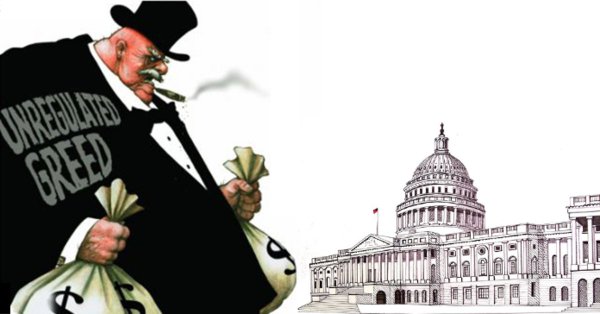
Bankster by Nancy Ohanian

It's great when is reasonable and understanding when they ensnare someone for bending the rules, especially if-- the classic example-- it's a man who steals some milk to feed his staving baby or a loaf of bread for a starving family. Leniency may well be in order. But not from a tough conservative law-and-order regime. At least not for individuals. For corporate managers on a criminal rampage, though, conservative regimes can be very... understanding. Obama's administration was lenient on Wall Street criminals... very very lenient. Even in a deep blue state the California, the former Attorney General, now Senator Kamala Harris, bent over backwards to avoid being too rough on law-breaking corporate managers. Over the weekend, Ben Protess, Robert Gebeloff and Danielle Ivory, in a blockbuster report for the New York Times, exposed something anyone could have guessed: Trump Administration Spares Wrongdoers Billions In Penalties. They let Walmart off the hook for a billion in a bribery case, Barclay's off the book for $7 billion for selling toxic mortgage investments that helped fuel the 2008 financial crisis, and Royal Bank of Scotland for a criminal investigation also involving the 2008 financial crisis. The Obama administration had all three corporations by the short hairs... and then along came Trumpy-the-Clown. The 3 criminal entities "looked to his administration for a more sympathetic ear-- and got one." Walmart remains uncharged, Barclays was let off with a $2 billion fine (a $5 billion saving) and R.B.S. paid a civil penalty, escaping criminal charges altogether, let alone any of the higher ups facing a firing squad (if I was president) or some public shaming and a stern reproach if Obama was still in office.
Across the corporate landscape, the Trump administration has presided over a sharp decline in financial penalties against banks and big companies accused of malfeasance, according to analyses of government data and interviews with more than 60 former and current federal officials. The approach mirrors the administration’s aggressive deregulatory agenda throughout the federal government.

The New York Times and outside experts tallied enforcement activity at the S.E.C. and the Justice Department, the two most powerful agencies policing the corporate and financial sectors. Comparing cases filed during the first 20 months of the Trump presidency with the final 20 months of the Obama administration, the review found:
A 62 percent drop in penalties imposed and illicit profits ordered returned by the S.E.C., to $1.9 billion under the Trump administration from $5 billion under the Obama administration.
A 72 percent decline in corporate penalties from the Justice Department’s criminal prosecutions, to $3.93 billion from $14.15 billion, and a similar percent drop in civil penalties against financial institutions, to $7.4 billion;
A lighter touch toward the banking industry, with the S.E.C. ordering banks to pay $1.7 billion during the Obama period, nearly four times as much as in the Trump era, and Mr. Trump’s Justice Department bringing 17 such cases, compared with 71.
While career officials in the federal government have continued to investigate wrongdoing at companies large and small, some of the top political appointees under Mr. Trump have led a philosophical shift in governing that favors big business and prioritizes the interests of individual investors.
I don't know her IQ, but there's no question it's substantially higher than Trump's

See, and you thought Trump has singled out Maxine Waters for such vicious treatment because he hates women and hates African Americans so much. Of course he does hate women and he does hate African Americans, but that's just part of the story for his attacks on Rep. Waters. She's the Ranking Member of the House Financial Services Committee Likely to become chair of the committee in January, Trump is already discrediting her in advance for the confrontations sure to come between a committee willing to do it's job-- instead of the disgrace Jeb Hensarling (along with crooked subcommittee chairs Bill Huizenga, Blaine Luetkemeyer, Sean Duffy, Andy Barr, Ann Wagner and Stevan Pearce-- are leading now-- and a kleptocracy Trump is leading.

It's worth mentioning the bribes the top leaders of the committee have solicited and used to build their power:
Hensarling (R-TX)- $1,536,111
Huizenga (R-MI)- $601,238
Luetkemeyer (R-MO)- $624,732
Duffy (R-WI)- $764,762
Barr (R-KY)- $907,016
Wagner (R-MO)- $867,050
Pearce (R-NM)- $161,675
Now, compare that to the $338,642 that Waters has taken from Wall Street since she ws first elected in 1990. By the way, someone might say, but there are Democrats on the committee who have taken as more or more than the Republicans-- like New Dems Jim Himes (CT), John Delaney (MD) and Kyrsten Sinema (AZ)-- and if the Republicans should be in prison so should those crooked Democrats. I couldn't agree more. In fact, it should be strictly illegal to take any money at all from any business that a committee you serve on has jurisdiction over.

Rats by Nancy Ohanian

Protess, Gebeloff and Ivory wrote that "Many Republicans in regulatory and law enforcement roles have resisted corporate penalties, suggesting that they unfairly punish a company’s shareholders for the misconduct of employees" while "Democratic appointees have more often maintained that shareholders wrongly benefit from ill-gotten gains, no matter who was responsible for them, and that tough penalties could deter future lawbreaking." OK, how about if we just throw the corporate criminals in prison instead? I mean real prison-- not Club Fed-- and for long periods of time? Then we won't have to worry nearly as much about fines-- because most of the criminal behavior will likely cease.
If the balance tilted toward a heavier hand in corporate penalties under former President Barack Obama-- even as critics argued that his administration did not do enough to punish top bankers after the crisis-- it began to swing in the opposite direction under Mr. Trump, the data show.

With the exception of the Commodity Futures Trading Commission, a small agency where a new enforcement director has presided over an uptick in penalties and a Trump-appointed chairman vowed “no pause” in enforcement, the new approach extends across the federal financial enforcement regime.

Mr. Trump’s pick to lead the Office of the Comptroller of the Currency, a federal banking regulator, is a former executive whose bank once faced an enforcement action, while Mr. Trump’s leader of the Consumer Financial Protection Bureau, created by Congress during the Obama administration, initially instituted an informal freeze on new enforcement actions.

The S.E.C., an independent agency composed of a bipartisan group of presidentially appointed commissioners, is less subject to political considerations. The leaders of the agency’s enforcement division act in a nonpartisan capacity.

Still, Robert J. Jackson Jr., a Democratic commissioner at the S.E.C. who is a former law professor and corporate lawyer, said the philosophy of Republican commissioners sent the wrong message. “We should be trying to deter management from committing fraud, not rewarding corporations when their lawyers cleverly mask bad deeds,” he said.

Former Republican officials have largely welcomed the change, though some are concerned that the Trump administration’s softer approach toward banks could open the door to the sort of reckless Wall Street behavior that spurred the financial crisis, particularly as federal regulators ease some Obama-era rules adopted after the crisis.

“The goal is really to instill in those who are regulated the illusion that the government is everywhere and looking over your shoulder,” said Harvey L. Pitt, a Republican who was chairman of the S.E.C. under President George W. Bush. “If you take away that threat, that could embolden some to keep breaking the law.”


...The decline in corporate penalties from the Justice Department may partly reflect the Trump administration’s heavier emphasis on immigration, violent crime and drugs. For two years in a row, the department has announced record-breaking prosecutions of health care fraud, much of which is related to the opioid crisis.

“Attorney General Sessions has set clear goals for this department: reducing violent crime, homicides, opioid prescriptions and drug overdose deaths,” said Steven Stafford, a department spokesman. “Under his leadership, we have begun to achieve all four of these goals by increasing violent crime and firearm prosecutions to all-time highs.”

He added, “There can be no doubt that this is a pro-law enforcement administration and Department of Justice.”

...Andrew J. Ceresney, the enforcement director [for the SEC] in the final years of Mr. Obama‘s presidency, that hit a brick wall under Mr. Trump.

In an investigation involving Morgan Stanley and Barclays, the banks had helped assemble the prospectus for a 2014 Puerto Rican bond deal. Although Puerto Rico’s dire financial health was well known to investors, the S.E.C. under Mr. Obama investigated whether the document accurately warned that the territory was on the brink of bankruptcy.

The investigation continued into the early months of the Trump presidency, when S.E.C. investigators told the bank they planned to bring charges. After higher-ranking S.E.C. enforcement officials reviewed the evidence, the agency dropped the investigation, people briefed on the matter said.

Morgan Stanley and Barclays declined to comment. Legal experts said that the agency had occasionally reversed itself and ended investigations during the Obama era as well.

Separately, an investigation into whether Carlyle, the private equity firm, misled investors about certain fees sputtered. The S.E.C. filed and settled similar cases against Carlyle’s main competitors during both administrations, but the Trump administration did not do the same against Carlyle, people briefed on the matter said. Carlyle declined to comment.

A Supreme Court ruling last year, Kokesh v. S.E.C., may have influenced the agency’s approach to the investigation. The ruling held that the S.E.C. has only five years to collect ill-gotten profits; private equity firms like Carlyle typically have investment funds with a life span of 10 years or more.

The S.E.C. has also said that a separate legal challenge to the constitutionality of its administrative court, where it typically filed many of its cases, reduced enforcement. A Supreme Court ruling this year forced the agency to reboot its administrative court process.


...The decline in criminal penalties has unfolded against a backdrop of broader regulatory rollbacks in the civil arena.

Under the Obama administration, the Justice Department’s civil rights division poured resources into lending-discrimination cases, some involving the nation’s biggest banks. In the last full year of the Obama administration, the department filed seven lawsuits alleging lending violations. The next year, the Trump administration filed one such lawsuit.

And like Walmart on the criminal side, some targets of civil prosecutions welcomed the more business-friendly approach of the Trump administration.

Barclays, under investigation by the Obama administration for selling the soured mortgage investments, had rejected the Justice Department’s demands to pay almost $7 billion, according to people with knowledge of the negotiations. The Obama administration had, in turn, filed a lawsuit against the company using the Financial Institutions Reform, Recovery and Enforcement Act, a law that Republicans in Congress had tried to curtail.

In March, Barclays settled for a much reduced penalty of $2 billion, which the bank argued was in line with what other financial institutions had paid for similar conduct.

R.B.S., similarly suspected of defrauding investors in mortgage-backed securities, was facing a criminal investigation from federal prosecutors in Boston, who had obtained records of bank employees discussing “garbage” loans and “rampant” fraud.

Toward the end of the Obama administration, Boston prosecutors declined to take a potential criminal prosecution off the table, according to people familiar with the matter. But under the Trump administration, Mr. Rosenstein decided that the case should not involve criminal charges in part because it was unfair to single out one of the many banks caught up in the mortgage investigations, two of the people said. Ultimately, R.B.S. reached a $4.9 billion civil settlement. The bank declined to comment.

The Barclays and R.B.S. outcomes reflected the broader trend in cases brought against financial firms under the Financial Institutions Reform, Recovery and Enforcement law and the False Claims Act, which targets fraud of government programs.

The Justice Department obtained $7.4 billion in such cases filed in the first 20 months of the Trump administration-- about 28 percent of the amount collected in the final 20 months of the Obama administration, according to an analysis of public disclosures by the agency compiled by Buckley Sandler, a law firm. (In October, the agency filed two large cases that would bring the Trump administration’s total to $8.6 billion.) The decline, in part, stems from a new policy Mr. Sessions issued last year requiring settlement money to go to victims or the Treasury Department, a change that effectively prevented prosecutors from forcing banks to spend billions of dollars addressing neighborhood blight and other issues tied to the mortgage crisis.

Andrew Schilling, a partner with Buckley Sandler who previously led the civil division at the United States attorney’s office in Manhattan, said there had also been a marked decline in new financial fraud investigations being opened.

“Certainly, 10 years out of the financial crisis you’re not going see quite the same activity,” he said, “but I never thought I would see financial fraud enforcement fall off as sharply as it has.”
I suppose the law school that Mr. Schilling went to didn't spend any serious time on a study of kleptocracies. Had they, perhaps Schilling might not have been in for such a shock. As the Washington Post noted Saturday evening, "Two years of political volatility will culminate Tuesday when voters for the first time since the stunning 2016 election render a nationwide judgment on whether Trumpism is a historic anomaly or a reflection of modern-day America. As the midterms roared into their final weekend-- with the biggest names in both parties exhorting their followers to vote-- uncertainty enveloped the contest amid signs that tightening races appeared headed toward dramatic finishes." [See R+11 Or Bust, Baby.

Conservative ex-Republican, Max Boot, wrote on Saturday that "Trump’s more sophisticated supporters in places such as Washington and New York claim that his presidency is a raging success because he has appointed conservative judges, cut taxes and turbocharged the economy. Trump himself evidently disagrees, because he is not running the midterm campaign based on his supposed achievements. Instead, Trump and his fellow Republicans are closing the election with the most naked appeal to racial prejudice since the dark days of Jim Crow when Democrats in the South would compete to display their fervor for segregation… It is not shocking that Trump would stoop so low. With him, there is no bottom. What is shocking, if no longer entirely surprising, is that the Republican Party would so readily follow him into the gutter. The prominent Republicans denouncing his hate-mongering are mostly those such as Sen. Jeff Flake (R-AZ), Sen. Bob Corker (R-TN) and Gov. John Kasich (R-OH) who are not seeking reelection. The rest of the GOP is complicit in this disgraceful demagoguery. Republicans who do not denounce Trump’s racist tactics-- and even imitate them-- will never escape the stench of this year’s campaign as long as they live."


Labels: , , , , , ,

Monday, August 06, 2018

Paul Manafort-- The Embodiment Of Globalized American Kleptocracy

>


As you've probably read by now, the fake "president" is freaking out that Idiot, Jr. and Kushner-in-law are going to be indicted in Putin-Gate. There's plenty more than that they should both be indicted for. Last week's Franklin Foer essay for The Atlantic, This Is So Much Bigger Than Paul Manafort, gets to the heart of it far better than any simpleminded Trump tweet for his moron base ever will. Topic, as you may have guessed from the title: kleptocracy. In case you're unaware of the term, like kakistocracy, it comes from the Greek. Kleptocracy references kléptēs, "thief," kléptō, "I steal," and krátos, "power, rule." Where kakistocracy is a government run by the worst, least qualified, or most unscrupulous citizens, Kleptocracy, according to Wikipedia, "is a government with corrupt leaders (kleptocrats) that use their power to exploit the people and natural resources of their own territory in order to extend their personal wealth and political powers. Typically, this system involves embezzlement of funds at the expense of the wider population." It would be difficult to accurately determine which is a better description of the Trump regime.
Kleptocracies are generally associated with dictatorships, oligarchies, military juntas, or other forms of autocratic and nepotist governments in which external oversight is impossible or does not exist. This lack of oversight can be caused or exacerbated by the ability of the kleptocratic officials to control both the supply of public funds and the means of disbursal for those funds. Kleptocratic rulers often treat their country's treasury as a source of personal wealth, spending funds on luxury goods and extravagances as they see fit. Many kleptocratic rulers secretly transfer public funds into hidden personal numbered bank accounts in foreign countries to provide for themselves if removed from power.
Sound familiar? Let's get to what Foer had to say. He asserts that Manafort is one of the architects of this new world order, in which "America has become the sanctuary of choice for laundered money, a bastion of shell companies and anonymously purchased real estate [and in which] American elites have learned to plant money offshore with acumen that comes close to matching their crooked counterparts’ abroad."


During the 1980s and ’90s, he provided strategic advice to the thuggish dictators who served as proxies for the Reagan administration’s anticommunist foreign policy. With his mastery of American media, he helped sanitize crooks like former Philippine President Ferdinand Marcos and his wife, Imelda-- the symbol of their rule, the 3,000 pairs of shoes she owned, was still fewer than the number of people by killed by the regime. These dictators (also Angola’s Jonas Savimbi, the Congo’s Mobutu Sese Seko, and Kenya’s Daniel arap Moi) should never have been respectable figures in Washington. But Manafort reinvented them as latter-day Thomas Jeffersons, allies in the cause of democracy, and successfully lobbied for them to receive arms and aid from the U.S. government.

As communism fell, the former Soviet Union became the scene of one of the biggest heists in history, and the opportunity of a lifetime for Paul Manafort. In Russia, the KGB steered billions of dollars into offshore accounts during the dying days of the regime, the beginning of a pattern of plunder best described by the late Karen Dawisha in her instant classic, Putin’s Kleptocracy. These funds became the basis for some of the fortunes of those who now appear as characters in the Russiagate scandal. Vladimir Putin himself amassed wealth that totaled more than $40 billion when Dawisha calculated his haul several years ago. Russians who invested in Trump real estate over the years had many motives. But everything we know about kleptocracy suggests that they were likely attempting to relocate their money to a place where it would both disappear from public view and have the protections that come with the American rule of law.

An important part of this story is Ukraine. Paul Manafort went to work there in 2004-- and the country’s ruling party remained his primary client until 2014. During those years, the country hemorrhaged more than $118 billion in illicit financial flows, according to the Kleptocracy Initiative, a think tank that has published invaluable reports about the scourge of corruption. (To set that number in relief, the country’s entire GDP in 2013 was $181 billion.) Stealing this money wasn’t a victimless crime: It came at the expense of Ukraine’s development as a market economy; it sucked funds away from public investment; it eroded faith in democracy and Western institutions. The West hypocritically lectured Ukraine about good government while it profited from Ukrainian oligarchs parking cash in Vienna, London, and New York.

Russian and Ukrainian oligarchs stole these vast fortunes, but they couldn’t accomplish the feat on their own. They needed enablers, and in the course of Mueller’s prosecution of Manafort, we’ve come to see how pillars of the American establishment filled this role.

Barack Obama’s White House counsel Greg Craig and his top-drawer law firm, Skadden Arps, abetted former Ukrainian President Viktor Yanukovych’s efforts to smash the political opponents who might get in the way of his thievery. Manafort arranged for the firm to publish a report justifying the arrest of a former Ukrainian prime minister, who had been denied counsel at crucial moments of her trial. (Last April, Craig retired under a cloud of scandal. Another Skadden associate who worked with Manafort has pleaded guilty to misleading Special Counsel Robert Mueller’s investigators.) Tony Podesta, a leading Democratic lobbyist of his generation, has watched his own power firm collapse after Mueller revealed his complicity in Manafort’s efforts. These are not stray villains, but representative figures: American law firms play an essential role in protecting global kleptocracy and helping it relocate money to the United States.

Manafort was, of course, the most important enabler of them all. During the decade he spent in Ukraine, he helped a clique of former gangsters seize control of the country’s governmental machinery, a feat he achieved by bringing state-of-the-art campaign strategy to a barely developed democracy. He hired a network of former European politicians to apologize for the regime, to whitewash its history of corruption and illiberalism. Back in Washington, Manafort would escort oligarchs around town, taking them to think tanks and meetings with politicians, helping them achieve the legitimacy that they hoped would protect their ill-gotten fortunes.

It doesn’t require any imagination to see how money stolen from Ukrainian coffers, money won in rigged privatizations and crony contracts, money obtained after the brutal murder of rivals, ended up with Paul Manafort. Clean money doesn’t need to travel through shell companies in Cyprus, unlike the millions that Manafort poured into accounts there. And Manafort allegedly used the same techniques of his dodgy clients to repatriate the money in the United States, taking advantage of gaps in the enforcement of anti-money-laundering laws to sneak cash into the country through real estate, expensive rugs, and tailored suits.

What’s increasingly clear is that Manafort also attempted to exploit the Trump campaign with similarly kleptocratic aims. Take the story of Stephen Calk, which has emerged in the course of Mueller’s pretrial filings. Calk owns a small Chicago bank. In the summer of 2016, Manafort applied for a loan from the bank-- and the claims in Manafort’s loan applications were obviously shaky. According to Mueller, bank officials were quite adamant in expressing their reservations about Manafort’s application. But there was apparently a backstory that these officials didn’t know. Calk had won a place on Trump’s board of economic advisers, one of 13. Mueller’s lawyers have said that they plan to prove that Calk landed this official title only after promising Manafort loans. So even as Manafort departed the campaign amid widespread allegations of misdeeds, Calk extended him loan after loan—$16 million in total. (The loans represented 22 percent of the bank’s total equity capital.)

This small tale is just one instance of a larger genre repeated across this administration-- the hints that foreign countries are financing deals that profit the president’s own family; the long list of officials (see also: Scott Pruitt, Tom Price) abusing the perquisites of their office. And those stories are just a subset of an even larger narrative still, of an American elite increasingly at home in the ranks of international kleptocracy. Thanks to Robert Mueller, that racket is now on trial.


Labels: , ,

Sunday, July 15, 2018

Trump’s Dishonesty Has Been A Central Story Of His Presidency

>

Moscow's Mule by Chip Proser

On Saturday morning, Axios put together a quickie post, "3 lies heard 'round the world," and I'm sure you know exactly who told the 3 whoppers. He claimed he bent NATO members to his will, which never happened. He tried walking back his trazodone-fueled interview with The Sun, calling it "fake news," even though they released a tape. Trump countered that he has his own tape and told reporters to "get it from Sarah." Huckabee's daughter has no tapes. Her drug-addled boss also claimed that the indictments of a dozen GRU officers for helping Putin steal the election for him is a "rigged witch hunt," after being briefed by his own Justice Department "on the most extensive foreign invasion into our elections since we won independence... The disregard for honesty in the Trump era... is eliciting new research and polemics from philosophers, literary critics, political analysts and social scientists."

Saturday's Toronto Star led with a piece by DC Bureau Chief Daniel Dale on Saturday, Trump has said 1,340,330 words as president. They’re getting more dishonest, a Star study shows. The words of the vile and disgusting Russian cut-out masquerading as an illegitimate "president," are, he wrote, "getting more dishonest over time, the Star has found in the first detailed statistical analysis of his inaccurate statements in office. The analysis relies on some subjective judgments, which we’ll explain in detail below. But it provides the most comprehensive picture yet available of what historians say is an unprecedented avalanche of serial lying." And they deliver.
Trump’s dishonesty has been a central story of his presidency, a daily problem that has confounded members of Congress and foreign leaders, confused policy debates and made it difficult for many members of the American public to trust the commander-in-chief.

We’ve tried to quantify the issue. Since Trump’s inauguration speech on Jan. 20, 2017, we’ve fact-checked every word Trump has spoken or tweeted since his inauguration speech on Jan. 20, 2017. Up until July 1, 2018, the end date for the analysis, we had counted 1,929 false claims.

Readers wanted more than just this raw number. They asked us, for example, to explain why the number of false claims per week has increased since early 2017. The key question: is Trump just talking more, or are his words denser with dishonesty than they used to be?

Thanks to never-before-released data, we can now offer an answer: it’s a bit of both, but there’s no doubt he’s getting worse per word spoken.

Our conclusions:

There’s a lot of dishonesty: Of all the words Trump said and tweeted as president as of July 1, 5.1 per cent were part of a false claim. Expressed differently: Trump uttered a false word every 19.4 words.

Trump’s dishonesty density is increasing: The issue isn’t just that he’s talking more these days. It’s that what he’s saying is less truthful.

In weeks that started in 2017, 3.8 per cent of Trump’s words were part of a false claim. In 2018, it’s 7.3 per cent. Expressed differently: in 2017, Trump said about 26 words for every one false word. In 2018, it’s down to about 14 words per one false word.

Word count aside, his raw number of false claims has spiked: Trump made 2.9 false claims per day in 2017. He’s made 5.1 false claims per day in 2018.

He is talking 20 per cent more than he used to: Though it’s not the whole issue, some of the 2018 increase in false claims is indeed happening because Trump is speaking more.

The number of words Trump utters in a week varies widely depending on what happens to be on his schedule-- it often jumps in weeks when he holds one of his hour-long campaign rallies, for example-- but it is generally increasing over time. Trump has averaged 484 more public words per day in 2018 than he did in 2017-- 2,856 vs. 2,372, a 20 per cent increase.

There is a strong statistical correlation-- .73, on a scale that goes up to 1-- between the number of words Trump speaks in a week and the number of false claims he makes in a week. The correlation is getting stronger with time: it was .55 in 2017, .89 in 2018.

So: when Trump spoke more in 2017, his number of false claims increased measurably but moderately; when he spoke more in 2018, his number of false claims increased more dramatically.

We have a theory about why there is now a stronger correlation between how much Trump talks and how many false claims he makes: he appears to have started ad-libbing more frequently in recent months than he did at the beginning of his term, when he was less comfortable. We know from experience that Trump makes more false claims when he is improvising rather than reading from a staff-written speech.

He’s quite dishonest in interviews: Unsurprisingly, Trump has uttered more false claims in his many speeches, 648 of the 1,925, than anywhere else.


What’s more notable about the data: Trump makes the second-most-false claims, 380, in interviews. This is interesting because of how few interviews he gives-- it depends on how you count, but it’s under 60-- and how friendly most of the interviewers are. According to presidential tracker Mark Knoller, a CBS reporter, Trump had given 26 interviews to Fox News since taking office as of mid-June; he’d given no more than six to any other outlet. So Trump is usually not being pressured into false claims because of tough questioning, he’s just making them.
The bulk of his daily lies isn't meant to convince normal people of anything. Normal people know he's a congenital liar who can't be trusted. Polling shows the overwhelming majority of Americans recognize he's a liar. Some care and some don't. His barrage of lies is meant to give his supporters some kind of plausible deniability that they made a huge, historic mistake based on their own stupidity and gullibility and that they should probably lose the right to vote either permanently or until they've passed a civics course. But then there are the self-serving lies-- the swamp lies that move forward his kleptocratic agenda. Adam Davidson covered a perfect example in the July 13th New Yorke, Where Did Donald Trump Get Two Hundred Million Dollars To Buy His Money-Losing Scottish Golf Club? Short version: the Russian Mafya's money laundering operation. Turnberry is a loser, shedding tens of millions of dollars that has cost the Trump Organization hundreds of millions of dollars-- and it isn't just because Trump is one of the worst businessmen in history.
Trump has proclaimed himself the “king of debt,” a proud master of “doing things with other people’s money.” So it was quite surprising when Jonathan O’Connell, David A. Fahrenthold, and Jack Gillum revealed in a Washington Post story in May that Trump had abruptly shifted strategies and begun spending hundreds of millions of dollars in cash to fund projects. In the nine years before he ran for President, the Post reported, the Trump Organization spent more than four hundred million dollars in cash on new properties-- including fourteen transactions paid in full. In fifteen years, he bought twelve golf courses (ten in the U.S., one in Ireland, and a smaller one in Scotland), several homes, and a winery and estate in Virginia, and he paid for his forty-million-dollar share of the cost of building the Trump Hotel in Washington, D.C.-- a property leased to Trump by the U.S. government. But his largest cash purchase was the Turnberry, followed by tens of millions of dollars in additional cash outlays for rehabbing the property.

Using what appears to be more than half of the company’s available cash to purchase Trump Turnberry makes no obvious sense for any business person, but especially for Donald Trump. It is a bizarre, confounding move that raises questions about the central nature of his business during the years in which he prepared for and then executed his Presidential campaign.

While Trump has portrayed himself as uniquely aggressive in his use of debt, borrowing money is central to any real-estate business. By borrowing money, developers increase their profits when successful, reduce their losses when they fail, and are able to diversify their holdings to increase the likelihood of success. By 2014, Trump was seen by lenders as a high-risk bet because he had so many bankruptcies and so few successful projects. But, if he had used the three hundred million dollars he spent on Turnberry as a pledge, he could have surely received several hundred million in loans at a competitive rate. With, say, a billion dollars total, he could have invested in projects around the world. Instead, he chose to put nearly all of his available cash in an old, underperforming course in a remote corner of Scotland.

...Even before the financial crisis of 2008, Trump found it increasingly difficult to borrow money from big Wall Street banks and was shut out of the rapidly growing pool of institutional investment. Faced with a cash-flow problem, he could have followed other storied New York real-estate families and invested in the ever more rigorous financial-due-diligence capabilities required by pension funds and other sources of real-estate capital. This would have given him access to a pool of trillions of dollars from investors.

Instead, Trump turned to a new source of other people’s money. He did a series of deals in Toronto, Panama, the Dominican Republic, Azerbaijan, and Georgia with businesspeople from the former Soviet Union who were unlikely to pass any sort of rigorous due-diligence review by pension funds and other institutional investors... He also made deals in India, Indonesia, and Vancouver, Canada, with figures who have been convicted or investigated for criminal wrongdoing and abuse of political power.


We know very little about how money flowed into and out of these projects. All of these projects involved specially designated limited-liability companies that are opaque to outside review. We do know that, in the past decade, wealthy oligarchs in the former Soviet Union and elsewhere have seen real-estate investment as a primary vehicle through which to launder money. The problem is especially egregious in the United Kingdom, where some have called the U.K. luxury real-estate industry “a money laundering machine.” Golf has been a particular focus of money laundering. Although the U.K. has strict transparency rules for financial activity within the country, its regulators have been remarkably incurious about the sources of funds coming from firms based abroad. All we know is that the money that went into Turnberry, for example, came from the Trump Organization in the U.S. We-- and the British authorities-- have no way of knowing where the Trump Organization got that money.

The goal of laundering money is to take the proceeds of a criminal activity-- government corruption, tax fraud, drug trade, or many others-- and to disguise its origin. Many oligarchs in the former Soviet Union who made their money by expropriating the state’s wealth want to move their money into a more stable nation with greater rule of law. This presents a challenge: How can one insert illegally obtained funds into a system that requires due diligence? The answer, quite often, is to use shell companies to disguise the flow of funds. Although we cannot say that Trump himself knowingly engaged in money laundering, we do know with certainty that much of his business in the past decade was in the industries most known for money laundering, in the locations most conducive to money laundering, and with people who bear the key hallmarks of money launderers.

Labels: , , ,

Wednesday, June 20, 2018

How Dangerous Are Trump's Severe Mental Illnesses To America? Why Not Give Him The $25 Billion Hew Wants To Steal If He Promises To Resign?

>

They also have a problem with him overseas

Yeah, yeah, we all know Trump is a lying sack of shit. The idea that this man is president is more disgusting and unpalatable by the day. The idea that the latest job approval poll shows that 39% of Americans actually approve of the way he's doing his job-- and only a mere 54% disapprove-- makes me worry if my country can actually survive as a beacon of hope and a decent place to live. The Washington Post ran another Trump's the Biggest Liar in History piece yesterday. The compulsive liar-in-chief and the I-was-just-doing-what-I-was- told-Nazis who populate his ghastly regime "say U.S. laws or court rulings are forcing them to separate families that are caught trying to cross the southern border. These claims are false... It’s strange to behold Trump distancing himself from the zero-tolerance policy ('the Democrats gave us that law') while Nielsen claims it doesn’t exist ('it’s not a policy') and Sessions defends it in speech after speech."


For Trump, the family-separation policy is leverage as he seeks congressional funding for his promised border wall and other immigration priorities, according to reporting by the Washington Post. Top DHS officials have said that threatening adults with criminal charges and prison time would be the “most effective” way to reverse the rising number of illegal crossings.

The doublespeak coming from Trump and top administration officials on this issue is breathtaking, not only because of the sheer audacity of these claims but also because they keep being repeated without evidence. Immigrant families are being separated at the border not because of Democrats and not because some law forces this result, as Trump insists. They’re being separated because the Trump administration, under its zero-tolerance policy, is choosing to prosecute border-crossing adults for any offenses.
Meanwhile Eliana Johnson and Annie Karni have written a shocking report for Politico on how frustrating Trump's family separation agenda has become inside his own Regime. Towards the end of a long piece on how hapless Homeland Security Secretary Kirstjen Nielsen is caught up in Trump's horrifying actions towards children, they mention that her sponsor, Chief of Staff John Kelly-- himself the former Homeland Security Secretary-- is flipping out entirely.

"Kelly’s status in the White House," they wrote, "has changed in recent months, and he and the president are now seen as barely tolerating one another. According to four people close to Kelly, the former Marine general has largely yielded his role as the enforcer in the West Wing as his relationship with Trump has soured. While Kelly himself once believed he stood between Trump and chaos, he has told at least one person close to him that he may as well let the president do what he wants, even if it leads to impeachment-- at least this chapter of American history would come to a close." (Trump's deputy chief of staff, Joe Hagin bailed yesterday afternoon. He had wanted to quit long ago but Kelly had persuaded him to stay on.)

Standing between Trump and chaos is not something Trump approves of or finds supportive of his ultimate ambitions. Trump is certifiably insane on several levels-- from Narcissistic Personality Disorder to traits that are far more dangerous to the country. On Tuesday he exploded during a private meeting with Senate Republicans over the one thing he's trying to accomplish that will outlast his miserable time in office: the Great Wall of Trump. He threatened to shut down the government in September-- so right before the midterms-- if they don't give him the $25 billion he wants to build the wall, much of which, no doubt, will line the pockets of his friends and family. This defines a kleptocracy. The senators fear that shutting down the government will shut down their careers.
In a private meeting regarding the wall Monday, Trump fumed to senators and his own staff about the $1.6 billion the Senate is planning to send him this fall, according to two people familiar with the meeting. Trump wants the full $25 billion upfront and doesn’t understand why Congress is going to supply him funds in a piecemeal fashion-- even though that’s how the spending process typically works.

...GOP lawmakers are loath to see a government shutdown on their watch just weeks before the midterm elections.

“It’s probably an overwhelming belief in the House and the Senate, especially the Senate, that government shutdowns aren’t good for anybody,"[Alabama Senator Richard] Shelby said.

The Appropriations Committee, which is led by Shelby, began working to pass its Homeland Security bill on Tuesday. Democrats seem unlikely to change course and agree to add more border security money for the president.

"We've got the bill and we're moving forward and I think we're going to get good bipartisan support for it. I think it's a good bill that will keep our borders safe," said Sen. Jon Tester (D-MT), the ranking member of the Homeland Security appropriations committee.

On Monday, GOP Sens. Shelley Moore Capito of West Virginia and Shelby both tried to explain to Trump that the Senate is merely meeting Mulvaney’s request and has to cut a bipartisan deal with Democrats. The Senate needs 60 votes to pass a spending bill, so Republicans would have to find at least nine Democratic votes.

"We're going to do make a down payment on that working together," said Capito, chairwoman of Homeland Security spending panel.

But Trump has not been mollified. He raised his voice several times in Monday's meeting with Mulvaney, White House staffers and the senators, insisting he needs the full $25 billion-- an unlikely outcome in the narrowly divided Senate.

Shelby said he views $1.6 billion as a floor in negotiations, which could increase if Democrats want to do some horse-trading.
Horse-trading-- like in rescuing the children Trump has put in concentration camps?


This is a letter the American Psychological Association sent to Trump last week:
On behalf of the American Psychological Association (APA), we are writing to express our deep concern and strong opposition to the Administration’s new policy of separating immigrant parents and children who are detained while crossing the border. We previously wrote to then Secretary of Homeland Security John Kelly on April 5, 2017, about this matter. Based on empirical evidence of the psychological harm that children and parents experience when separated, we implore you to reconsider this policy and commit to the more humane practice of housing families together pending immigration proceedings to protect them from further trauma.

APA is the leading scientific and professional organization representing psychology in the United States. Our membership includes researchers, educators, clinicians, consultants, and students. APA works to advance the creation, communication, and application of psychological knowledge to benefit society and improve people’s lives. We have 115,700 members and affiliates across the United States and in many other countries, many of whom serve immigrant youth and adults in a wide range of settings, including schools, community centers, hospitals and refugee resettlement centers.

The current policy calls for children to be removed from their parents and placed for an often indeterminate period of time in the custody of the Office of Refugee Resettlement. Decades of psychological research have determined that it is in the best interest of the child and the family to keep families together. Families fleeing their homes to seek sanctuary in the United States are already under a tremendous amount of stress. Sudden and unexpected family separation, such as separating families at the border, can add to that stress, leading to emotional trauma in children. Research also suggests that the longer that parents and children are separated, the greater the reported symptoms of anxiety and depression are for children. Adverse childhood experiences, such as parent-child separation, are important social determinants of mental disorders. For children, traumatic events can lead to the development of post-traumatic stress disorder and other mental health disorders that can cause long lasting effects. Furthermore, immigration policies, such as separating families at the border, can also adversely impact those immigrants who are already in the United States. They can suffer from feelings of stigmatization, social exclusion, anger, and hopelessness, as well as fear for the future.

As a tragic example of the current policy’s serious potential for harm, a Honduran man who was separated from his wife and 3-year-old son after he crossed the border into Texas recently took his own life while detained in a holding cell, according to the Customs and Border Protection officials, public records, and media reports. There are also reports of detained immigrants foregoing legitimate claims for asylum by pleading guilty to expedite the return of their separated children and reports of parents being deported while their children, including infants, remain in custody. These incidents serve to highlight the mental health crisis for many families caused by the Administration’s policy.

Given these considerations, a change in immigration policy regarding the detention of immigrant families at the border is desperately needed-- from separating parents and children to housing them together and providing needed physical and mental health services. As psychologists, we have documented multiple harmful effects of parent-child separation on children’s emotional and psychological development and well-being and urge that the current policy of family separation be reversed. Should you have any questions regarding these comments, please contact Serena Dávila, J.D., with our Public Interest Directorate.

Labels: , , , , ,

Tuesday, June 19, 2018

Is Every Single Thing Just A Distraction For The Unprecedented Kleptocracy?

>


Today, Lloyd Blankfein, CEO of Goldman Sachs, told a Bloomberg editor at the Economic Club of New York that he thinks Señor Trumpanzee is just bluffing about starting a trade war. "That’s what you’d do if it was a negotiating position and you wanted to remind your negotiating counterparty of how much firepower you have. I don’t think we’re in a suicide pact on this, so I suspect we’re not going to cause the economies to collapse... I do think-- as some people have commented-- that this is part of a negotiating pattern, that would be my best take." And no one knows what a gaslighting bullshit artist Trump is?

Jeremy Zipple is a film maker and Jesuit priest in San Antonio at Our Lady of Guadalupe Shrine. He had a couple of powerful tweets over the weekend, aimed right at Señor Trumpanzee: "2600 years ago, one prophet named Isaiah said, 'Woe unto those who legislate evil'-- that’s actually scripture--'and rob the poor of their rights and make women and children their prey'" and "US Catholic bishops seem to be gearing up for a full on fight on this issue during an election year.

But suppose Trump feels enough pressure to finally give in on this, which I suspect will happen, maybe even fire far right racist neo-Nazi and crackpot Stephen Miller and make him the scapegoat. Although... Bannon doesn't agree that Trump is going to fold on this and that its core to his campaign promises and absolutely fabulous. Yesterday he told Jonathan Karl on This Week that listening to his inner voice Señor Trumpanzee "is going to lead-- write this down-- that’s going to lead to an astounding victory in November, where he’s going to run the tables in the House and he’s going to pick up a couple seats in the Senate... Trump is accomplishing everything he committed to the American people on the campaign that I stepped in as CEO. I couldn’t be prouder of the guy. All he has to do is continue to hit those marks on that whiteboard and he’s going to run the tables."

Yes, write this down. Or don't; write this down, an article by Francis Wilson for Bloomberg instead: New York’s Case Against Trump May Be Prophetic. But not prophetic in the same way Zipple talks about prophetic-- prophetic for the courts and for the members of Congress who have to vote on impeachment in 2019. It starts with Trump being an absolutely slimy crooked businessman, worst I've ever seen... and I've seen some bad ones.
The report released by the inspector general of the Federal Bureau of Investigation on Thursday painted a vivid picture of the past. It shows that in 2016, James Comey, then the FBI director, inexcusably broke the rules in advertising his department’s investigation into Hillary Clinton while simultaneously following the rules in keeping its investigation of Donald Trump under wraps.

Trump has already mischaracterized the report, in the way Trump routinely does. But it’s unclear, ultimately, how much all this history matters politically.

For a more prophetic vision of the future, you should read the complaint against Trump, his children and his foundation by New York State Attorney General Barbara Underwood.

Why prophetic? Because it’s likely a preface to the report or complaint that special counsel Robert Mueller will bring. The alleged crimes described by Underwood are not similar to those being investigated by Mueller. But the behavior is.

One stumbling block to public understanding of the Mueller probe, in addition to a steady stream of propaganda and lies designed to undermine it, is that it’s hard for even a cynic to accept the premises of what is being investigated.

U.S. history simply doesn’t offer a lot of reference points for a major-party political candidate who so casually subverts the law and sells out the nation’s highest values. How many Richard Nixons are there?

Someone seems obsessed


To believe the accusations that Trump colluded with Russia, laundered vast amounts of money and/or put American foreign policy on the auction block in return for the enrichment of his family requires an awkward leap of faith. You have to believe this leader is both profoundly corrupt-- far more so than Nixon-- and staggeringly sloppy-- again more so than Nixon.

This is essentially the portrait that Underwood paints in the detailed accusations against the head of the Trump Foundation: that of a shady huckster who engages in “persistently illegal conduct” and is buffoonishly sloppy along the way.

To give credit where it’s due, the New York attorney general is building on the case built in 2016 by Washington Post reporter David Fahrenthold, whose search for legitimate charitable activity by Trump’s foundation consistently left the reporter comically empty-handed.

What Fahrenthold detailed was Trump’s utter disregard for the law in taking in tax-deductible contributions to his foundation and proceeding to spend the money on his personal and business needs. 
New findings, for instance, show that the Trump Foundation’s largest-ever gift-- $264,631-- was used to renovate a fountain outside the windows of Trump’s Plaza Hotel.

Its smallest-ever gift, for $7, was paid to the Boy Scouts in 1989, at a time when it cost $7 to register a new Scout. Trump’s oldest son was 11 at the time. Trump did not respond to a question about whether the money was paid to register him.
Take a moment to savor that last detail. A man claiming to be worth billions of dollars-- and who certainly flaunted the lifestyle-- appears to have illegally diverted $7 from a charitable foundation to pay his son’s Boy Scouts registration fee.

Trump’s foundation is organized “exclusively for charitable, religious, scientific, literary or educational purposes either directly or by contributions to organizations that qualify as exempt organizations under section 501(c)(3) of the Internal Revenue Code."

Instead, as Underwood’s complaint shows clearly, he used it to pay settlements incurred in business lawsuits and to advance his 2016 political campaign. The foundation took in millions in donations for veterans. His campaign then directed the foundation to issue checks to Iowa veterans groups in advance of the Iowa caucuses as he sought to curry political favor.

How does Underwood know campaign personnel were involved in spending decisions? Because the Trumpsters are so recklessly contemptuous of rules that they left a trail of this blatant violation of campaign-finance law on their emails. At least one email thread included Trump campaign manager Corey Lewandowski weighing in on where he wanted the foundation’s tax-deductible funds directed.

The foundation also made a $25,000 contribution to Florida Attorney General Pam Bondi, who subsequently determined that fraud charges against Trump’s university were not a proper matter for her office. The foundation listed the contribution as going to a Kansas nonprofit with the same name as Bondi’s political committee.

“The Foundation has no credible explanation for the false reporting of grant recipients to the IRS and the State of New York,” Underwood concluded.

Trump will likely claim he was uninvolved and unaware. But Underwood’s complaint has that covered, too.
Mr. Trump, who was the sole signatory on the Foundation's bank accounts, approved all grants and other disbursements from the Foundation. Accounting staff for the Trump Organization had responsibility for issuing checks from the Foundation, and issued the checks based solely on Mr. Trump's approval before presenting the checks to Mr. Trump for signature.
Indeed, the foundation’s board didn’t provide much of a check on Trump’s personal whims, owing to the fact that, in violation of the law, it “has not met since 1999 and does not oversee the activities of the Foundation in any way.”

It took the attorney general’s office months to investigate this narrow corner of the Trump universe-- even though the evidence was lying around in plain sight. Mueller’s investigation is far broader and more consequential. His complaint may yet take a while. But it should be a doozy.

Trump's rotten regime seems to have lost close to 6,000 children, after telling Congress last month that they "only" lost 1,500. "To the extent that there are problems for protection of unaccompanied children, this will only become worse as they put more kids in the unaccompanied category by ripping them away from their families," said Clara Long, U.S. researcher at Human Rights Watch. This isn't just on Trump and the people that work in his fetid swamp. Every Republican enabler in Congress who hasn't spoken up with rot in Hell with them.
The reality is the Trump administration-— and the Obama administration beforehand-- has lost track and continues to lose track of thousands of unaccompanied minors while ORR does not appear to be trying to keep track of the children once they’re placed with sponsors.

...A 2008 law signed by President George W. Bush placed all children who arrive at U.S. borders and ports of entry without a parent or guardian under the care and custody of the Department of Health and Human Services.

Under President Barack Obama this issue grabbed national attention when, in 2015, it was discovered that HHS did not require any meaningful proof that the people who presented themselves as family friends really were who they said they were.

In one high-profile case, HHS allowed six migrant children from Guatemala to be turned over to traffickers who forced them to work in grueling conditions on an Ohio egg farm.
Frank Sharry, executive director of America’s Voice: "What’s happened is that ICE has a new policy of going after sponsors. The bigger story if not that they are losing people-- it's that ICE is terrorizing people."

Think of the basement of the Ipatiev House in Yekaterinburg on July 16, 1918

Labels: , , , , , , ,

Wednesday, June 13, 2018

Look At It From A Real Estate Perspective-- Understanding Trump’s Foreign Policy

>


by Doroth Reik

Trump’s foreign policy is easy to understand. He likes places where he can make money and he doesn’t like places where he cannot. Europe, Japan, Canada, Australia, places that used to be our allies, which fought alongside us in our tragically misbegotten wars-- he can’t make money there so the hell with them! His only investment in Europe is that loser golf course in Scotland.

North Korea is another story-- it’s a goose that can lay golden eggs for everyone. Trump even spelled it out at yesterday’s press conference-- "Look at it from a real estate perspective," he exclaimed. Casinos for Sheldon Adelson? No problem-- and the South Koreans have plenty of money to gamble with. He can put those casinos right on the DMZ so those South Koreans can stop by on the way to visit their northern brethren. Trump Tower and a golf course-- for sure! And while they are at it-- a McDonalds!


Where else would our kleptocrats and corporate big wigs stay and play while they plan their sweat shops and factories as well as the infrastructure projects we are all waiting for here at home-- projects which the Asian Development Bank and the World Bank are waiting to fund and Trump’s supporters are waiting to build. North Korea already has a well-disciplined (to say the least) work force accustomed to toiling for starvation wages. Bangladesh-- watch out! And then there is agriculture. Monsanto is probably gearing up to flood North Korea with its poison seeds and the glyphosate to kill off everything else.

Yes-- this "peace treaty" will happen-- it should be called the "piece of the action" treaty! But North Korea is only one piece of the foreign policy the puzzle. There are fortunes to be made in kleptocracies and dictatorships all over the world-- Russia, for example, where Trump has already made his first deal-- and not for a Trump Tower-- yet. This was an oil deal. "The Trump Russia Dossier describes a massive privatization deal to deliver a chunk of the state-owned Rosneft Oil company to Qatar and also a secret buyer in the Cayman Islands."

In China daughter Ivanka leads the pack-- you gotta take care of your kids! WAPO was outraged at the number of trademarks she acquired. And the Donald got some money too-- for his project in Indonesia-- a cool $500 billion!

And then there is Saudi Arabia. The $270,000 the Saudi princes have spent at the Trump Hotel is just the beginning. It seems that during the campaign Trump registered 8 businesses in Saudi Arabia and the UAE. No wonder he was dancing around and fondling a crystal ball!


Wherever there was or is a bad guy in charge Trump has a tower and a friend-- the Philippines, Indonesia, Azerbaijan, even Panama. Just follow the dots as TIME did.

But Robert Mueller seems poised to put an end to it all, including the money laundering, when he finishes his investigation: "One foreign deal, a stalled 2011 plan to build a Trump Tower in Batumi, a city on the Black Sea in the Republic of Georgia, has not received much journalistic attention. But the deal, for which Trump was reportedly paid a million dollars, involved unorthodox financial practices that several experts described to me as "red flags" for bank fraud and money laundering; moreover, it intertwined his company with a Kazakh oligarch who has direct links to Russia’s President, Vladimir Putin. As a result, Putin and his security services have access to information that could put them in a position to blackmail Trump. (Sekulow said that "the Georgia real-estate deal is something we would consider out of scope," adding, “Georgia is not Russia”)."


While we wait we can just keep following the money, dirty or otherwise, from kleptocracy to oligarchy to dictatorship because these are, or will be, our new allies. At least for now Kim Jong Un seems to be substituting shiny glass towers for nukes as his phallic symbol of choice.

Labels: , ,