"When fascism comes to America, it will be wrapped in the flag and carrying the cross."
-- Sinclair Lewis
Friday, November 09, 2018
Midnight Meme Of The Day!
>
by Noah Maxine Waters! Maxine Waters! Say that name to any republican and they will clench their fists and tense up with rage. Show them a picture of Maxine Waters and they will enter a state of apoplexy and start screaming about a world gone wrong. May I suggest that we send every republican we know a picture of Maxine Waters? Flood the White House with them? Hell, I'd even rent a truck with loudspeakers playing Maxine's greatest moments and park it outside the White House gates with the amplifiers set to 11. Get another one and go to Mitch McConnell's house. And another to follow idiots like Kellyanne Conway, Don Jr., and Sarah Huckabee Sanders as they head out to dinner, every damn night! Every night! And, wake them up with it every damn morning! When I see Maxine Waters on my TV, I tell my wife "That's my President!" Oh, I know there are better possibilities but none would upset republicans more! Can you imagine if Ms. Waters ran against Herr Trump and actually beat him? Oh to have film of Trump screaming and babbling with misogynistic racist frustrated rage, slowly melting into a fetid, whimpering orange puddle while Stephen Miller takes off his sheet and hood to desperately sop up the mess in an effort to save his dear leader. Well, OK. Until that glorious time, we will have to settle for knowing that Maxine Waters will now, as a result of Tuesday's election results, be the Chairperson of the House Financial Services Committee, and that's pretty damn good. I imagine her standing at some huge archaic-looking subpoena machine, turning the big crank with determination. It's a start.
The Trump Regime Is All About Law And Order-- Unless You're Wealthy
>
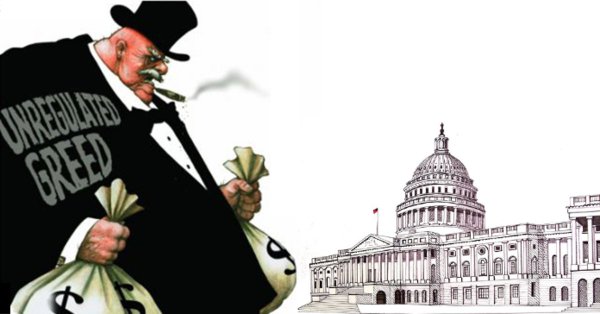
Bankster by Nancy Ohanian
It's great when is reasonable and understanding when they ensnare someone for bending the rules, especially if-- the classic example-- it's a man who steals some milk to feed his staving baby or a loaf of bread for a starving family. Leniency may well be in order. But not from a tough conservative law-and-order regime. At least not for individuals. For corporate managers on a criminal rampage, though, conservative regimes can be very... understanding. Obama's administration was lenient on Wall Street criminals... very very lenient. Even in a deep blue state the California, the former Attorney General, now Senator Kamala Harris, bent over backwards to avoid being too rough on law-breaking corporate managers. Over the weekend, Ben Protess, Robert Gebeloff and Danielle Ivory, in a blockbuster report for the New York Times, exposed something anyone could have guessed: Trump Administration Spares Wrongdoers Billions In Penalties. They let Walmart off the hook for a billion in a bribery case, Barclay's off the book for $7 billion for selling toxic mortgage investments that helped fuel the 2008 financial crisis, and Royal Bank of Scotland for a criminal investigation also involving the 2008 financial crisis. The Obama administration had all three corporations by the short hairs... and then along came Trumpy-the-Clown. The 3 criminal entities "looked to his administration for a more sympathetic ear-- and got one." Walmart remains uncharged, Barclays was let off with a $2 billion fine (a $5 billion saving) and R.B.S. paid a civil penalty, escaping criminal charges altogether, let alone any of the higher ups facing a firing squad (if I was president) or some public shaming and a stern reproach if Obama was still in office.
Across the corporate landscape, the Trump administration has presided over a sharp decline in financial penalties against banks and big companies accused of malfeasance, according to analyses of government data and interviews with more than 60 former and current federal officials. The approach mirrors the administration’s aggressive deregulatory agenda throughout the federal government. The New York Times and outside experts tallied enforcement activity at the S.E.C. and the Justice Department, the two most powerful agencies policing the corporate and financial sectors. Comparing cases filed during the first 20 months of the Trump presidency with the final 20 months of the Obama administration, the review found:
• A 62 percent drop in penalties imposed and illicit profits ordered returned by the S.E.C., to $1.9 billion under the Trump administration from $5 billion under the Obama administration. • A 72 percent decline in corporate penalties from the Justice Department’s criminal prosecutions, to $3.93 billion from $14.15 billion, and a similar percent drop in civil penalties against financial institutions, to $7.4 billion; • A lighter touch toward the banking industry, with the S.E.C. ordering banks to pay $1.7 billion during the Obama period, nearly four times as much as in the Trump era, and Mr. Trump’s Justice Department bringing 17 such cases, compared with 71.
While career officials in the federal government have continued to investigate wrongdoing at companies large and small, some of the top political appointees under Mr. Trump have led a philosophical shift in governing that favors big business and prioritizes the interests of individual investors.
I don't know her IQ, but there's no question it's substantially higher than Trump's
See, and you thought Trump has singled out Maxine Waters for such vicious treatment because he hates women and hates African Americans so much. Of course he does hate women and he does hate African Americans, but that's just part of the story for his attacks on Rep. Waters. She's the Ranking Member of the House Financial Services Committee Likely to become chair of the committee in January, Trump is already discrediting her in advance for the confrontations sure to come between a committee willing to do it's job-- instead of the disgrace Jeb Hensarling (along with crooked subcommittee chairs Bill Huizenga, Blaine Luetkemeyer, Sean Duffy, Andy Barr, Ann Wagner and Stevan Pearce-- are leading now-- and a kleptocracy Trump is leading. It's worth mentioning the bribes the top leaders of the committee have solicited and used to build their power:
Now, compare that to the $338,642 that Waters has taken from Wall Street since she ws first elected in 1990. By the way, someone might say, but there are Democrats on the committee who have taken as more or more than the Republicans-- like New Dems Jim Himes (CT), John Delaney (MD) and Kyrsten Sinema (AZ)-- and if the Republicans should be in prison so should those crooked Democrats. I couldn't agree more. In fact, it should be strictly illegal to take any money at all from any business that a committee you serve on has jurisdiction over.
Rats by Nancy Ohanian
Protess, Gebeloff and Ivory wrote that "Many Republicans in regulatory and law enforcement roles have resisted corporate penalties, suggesting that they unfairly punish a company’s shareholders for the misconduct of employees" while "Democratic appointees have more often maintained that shareholders wrongly benefit from ill-gotten gains, no matter who was responsible for them, and that tough penalties could deter future lawbreaking." OK, how about if we just throw the corporate criminals in prison instead? I mean real prison-- not Club Fed-- and for long periods of time? Then we won't have to worry nearly as much about fines-- because most of the criminal behavior will likely cease.
If the balance tilted toward a heavier hand in corporate penalties under former President Barack Obama-- even as critics argued that his administration did not do enough to punish top bankers after the crisis-- it began to swing in the opposite direction under Mr. Trump, the data show. With the exception of the Commodity Futures Trading Commission, a small agency where a new enforcement director has presided over an uptick in penalties and a Trump-appointed chairman vowed “no pause” in enforcement, the new approach extends across the federal financial enforcement regime. Mr. Trump’s pick to lead the Office of the Comptroller of the Currency, a federal banking regulator, is a former executive whose bank once faced an enforcement action, while Mr. Trump’s leader of the Consumer Financial Protection Bureau, created by Congress during the Obama administration, initially instituted an informal freeze on new enforcement actions. The S.E.C., an independent agency composed of a bipartisan group of presidentially appointed commissioners, is less subject to political considerations. The leaders of the agency’s enforcement division act in a nonpartisan capacity. Still, Robert J. Jackson Jr., a Democratic commissioner at the S.E.C. who is a former law professor and corporate lawyer, said the philosophy of Republican commissioners sent the wrong message. “We should be trying to deter management from committing fraud, not rewarding corporations when their lawyers cleverly mask bad deeds,” he said. Former Republican officials have largely welcomed the change, though some are concerned that the Trump administration’s softer approach toward banks could open the door to the sort of reckless Wall Street behavior that spurred the financial crisis, particularly as federal regulators ease some Obama-era rules adopted after the crisis. “The goal is really to instill in those who are regulated the illusion that the government is everywhere and looking over your shoulder,” said Harvey L. Pitt, a Republican who was chairman of the S.E.C. under President George W. Bush. “If you take away that threat, that could embolden some to keep breaking the law.”
...The decline in corporate penalties from the Justice Department may partly reflect the Trump administration’s heavier emphasis on immigration, violent crime and drugs. For two years in a row, the department has announced record-breaking prosecutions of health care fraud, much of which is related to the opioid crisis. “Attorney General Sessions has set clear goals for this department: reducing violent crime, homicides, opioid prescriptions and drug overdose deaths,” said Steven Stafford, a department spokesman. “Under his leadership, we have begun to achieve all four of these goals by increasing violent crime and firearm prosecutions to all-time highs.” He added, “There can be no doubt that this is a pro-law enforcement administration and Department of Justice.” ...Andrew J. Ceresney, the enforcement director [for the SEC] in the final years of Mr. Obama‘s presidency, that hit a brick wall under Mr. Trump. In an investigation involving Morgan Stanley and Barclays, the banks had helped assemble the prospectus for a 2014 Puerto Rican bond deal. Although Puerto Rico’s dire financial health was well known to investors, the S.E.C. under Mr. Obama investigated whether the document accurately warned that the territory was on the brink of bankruptcy. The investigation continued into the early months of the Trump presidency, when S.E.C. investigators told the bank they planned to bring charges. After higher-ranking S.E.C. enforcement officials reviewed the evidence, the agency dropped the investigation, people briefed on the matter said. Morgan Stanley and Barclays declined to comment. Legal experts said that the agency had occasionally reversed itself and ended investigations during the Obama era as well. Separately, an investigation into whether Carlyle, the private equity firm, misled investors about certain fees sputtered. The S.E.C. filed and settled similar cases against Carlyle’s main competitors during both administrations, but the Trump administration did not do the same against Carlyle, people briefed on the matter said. Carlyle declined to comment. A Supreme Court ruling last year, Kokesh v. S.E.C., may have influenced the agency’s approach to the investigation. The ruling held that the S.E.C. has only five years to collect ill-gotten profits; private equity firms like Carlyle typically have investment funds with a life span of 10 years or more. The S.E.C. has also said that a separate legal challenge to the constitutionality of its administrative court, where it typically filed many of its cases, reduced enforcement. A Supreme Court ruling this year forced the agency to reboot its administrative court process.
...The decline in criminal penalties has unfolded against a backdrop of broader regulatory rollbacks in the civil arena. Under the Obama administration, the Justice Department’s civil rights division poured resources into lending-discrimination cases, some involving the nation’s biggest banks. In the last full year of the Obama administration, the department filed seven lawsuits alleging lending violations. The next year, the Trump administration filed one such lawsuit. And like Walmart on the criminal side, some targets of civil prosecutions welcomed the more business-friendly approach of the Trump administration. Barclays, under investigation by the Obama administration for selling the soured mortgage investments, had rejected the Justice Department’s demands to pay almost $7 billion, according to people with knowledge of the negotiations. The Obama administration had, in turn, filed a lawsuit against the company using the Financial Institutions Reform, Recovery and Enforcement Act, a law that Republicans in Congress had tried to curtail. In March, Barclays settled for a much reduced penalty of $2 billion, which the bank argued was in line with what other financial institutions had paid for similar conduct. R.B.S., similarly suspected of defrauding investors in mortgage-backed securities, was facing a criminal investigation from federal prosecutors in Boston, who had obtained records of bank employees discussing “garbage” loans and “rampant” fraud. Toward the end of the Obama administration, Boston prosecutors declined to take a potential criminal prosecution off the table, according to people familiar with the matter. But under the Trump administration, Mr. Rosenstein decided that the case should not involve criminal charges in part because it was unfair to single out one of the many banks caught up in the mortgage investigations, two of the people said. Ultimately, R.B.S. reached a $4.9 billion civil settlement. The bank declined to comment. The Barclays and R.B.S. outcomes reflected the broader trend in cases brought against financial firms under the Financial Institutions Reform, Recovery and Enforcement law and the False Claims Act, which targets fraud of government programs. The Justice Department obtained $7.4 billion in such cases filed in the first 20 months of the Trump administration-- about 28 percent of the amount collected in the final 20 months of the Obama administration, according to an analysis of public disclosures by the agency compiled by Buckley Sandler, a law firm. (In October, the agency filed two large cases that would bring the Trump administration’s total to $8.6 billion.) The decline, in part, stems from a new policy Mr. Sessions issued last year requiring settlement money to go to victims or the Treasury Department, a change that effectively prevented prosecutors from forcing banks to spend billions of dollars addressing neighborhood blight and other issues tied to the mortgage crisis. Andrew Schilling, a partner with Buckley Sandler who previously led the civil division at the United States attorney’s office in Manhattan, said there had also been a marked decline in new financial fraud investigations being opened. “Certainly, 10 years out of the financial crisis you’re not going see quite the same activity,” he said, “but I never thought I would see financial fraud enforcement fall off as sharply as it has.”
I suppose the law school that Mr. Schilling went to didn't spend any serious time on a study of kleptocracies. Had they, perhaps Schilling might not have been in for such a shock. As the Washington Post noted Saturday evening, "Two years of political volatility will culminate Tuesday when voters for the first time since the stunning 2016 election render a nationwide judgment on whether Trumpism is a historic anomaly or a reflection of modern-day America. As the midterms roared into their final weekend-- with the biggest names in both parties exhorting their followers to vote-- uncertainty enveloped the contest amid signs that tightening races appeared headed toward dramatic finishes." [See R+11 Or Bust, Baby. Conservative ex-Republican, Max Boot, wrote on Saturday that "Trump’s more sophisticated supporters in places such as Washington and New York claim that his presidency is a raging success because he has appointed conservative judges, cut taxes and turbocharged the economy. Trump himself evidently disagrees, because he is not running the midterm campaign based on his supposed achievements. Instead, Trump and his fellow Republicans are closing the election with the most naked appeal to racial prejudice since the dark days of Jim Crow when Democrats in the South would compete to display their fervor for segregation… It is not shocking that Trump would stoop so low. With him, there is no bottom. What is shocking, if no longer entirely surprising, is that the Republican Party would so readily follow him into the gutter. The prominent Republicans denouncing his hate-mongering are mostly those such as Sen. Jeff Flake (R-AZ), Sen. Bob Corker (R-TN) and Gov. John Kasich (R-OH) who are not seeking reelection. The rest of the GOP is complicit in this disgraceful demagoguery. Republicans who do not denounce Trump’s racist tactics-- and even imitate them-- will never escape the stench of this year’s campaign as long as they live."
Does It Surprise You To Know That Eating At An Over-Priced Trump Restaurant Is Like Eating Off The Floor Of A Public Toilet?
>
You'll have to click on the image before you figure out how to react if you see any of them in a restaurant
The ugly imbecile and illegitimate "president" of the U.S.-- who had millions of votes less than Hillary Clinton, the people's choice and who was helped by a foreign power (Russia) who wanted to cripple America by installing an incompetent moron-- is, in case you forgot, a gaslighting racist. In true Goebbels fashion, he repeated his ridiculous projection that Maxine Waters is "an extraordinarily low IQ person," which she isn't... but he is. After the heroic ostracism of Huckabee's vile daughter at the Red Hen in Virginia-- which followed public humiliations of White House Nazi Stephen Miller and of child kidnapper Kirstjen Nielsen at other restaurants-- Congresswoman Waters told her supporters at a rally in Los Angeles, "if you see anybody from that Cabinet in a restaurant, in a department store, at a gasoline station, you get out and you create a crowd and you push back on them, and you tell them they’re not welcome anymore, anywhere." Trump immediately tried to twist that from a call to disturb his Cabinet enablers to an attack against all Trump supporters, another in a long list of lies. Meanwhile, Trump, who owns filthy restaurants and hotels that are always being fined for health-code violations, decided to project his sickening and unsafe establishments onto the Red Hen. "The Red Hen Restaurant," he lied like a spoiled 6-year old, "should focus more on cleaning its filthy canopies, doors and windows (badly needs a paint job) rather than refusing to serve a fine person like Sarah Huckabee Sanders. I always had a rule, if a restaurant is dirty on the outside, it is dirty on the inside." His own restaurants may look good-- if faux glitzy-- on the outside by are virtually sewers on the inside. In contrast to Trump's pigstyes, Virginia authorities found no violations when they visited the Red Hen in Lexington in February and gave the Red Hen their top possible health-risk rating. All of Trump's restaurants fail health inspections regularly and you actually take your health into your hands by eating anything served by his filthy kitchens. The most recent inspection at his DC hotel found 10 health-code violations, including raw meat stored above ready-to-eat foods and containers of flour stored next to a hand sink that lacked a splash guard. Inspectors also found that the hotel was operating a number of on-site kitchens without city permits. When inspectors dropped by for a follow-up inspection 3 months later, they found that Trumpanzee's hotel had failed to correct the violations and alerted the public that eating there was risky. Even with an inspector in the kitchen one Trump employee, the report states, "dropped an empty pan on the floor and then put it inside a refrigerator" without washing it or even wiping it. Mar-a-Lago is even worse-- getting 51 health code violations in the last 5 years, not counting the 30 violations at the beach club. The notoriously filthy Doral golf club in Florida was really disgusting and unsafe, with 524 violations in the last 5 years-- some extremely serious-- for which Trump was fined. There were dozens of cockroaches all over the kitchen-- some dead and some alive-- as well as "slimy/mold-like build-up” everywhere in the kitchen.
Would you patronize a restaurant that served people like these?
Monday night, Maxine Waters was Chris Hayes' guest on All In to explain how Señor Trumpanzee had misinterpreted-- purposefully-- her call for Americans to confront Trumpist Cabinet members into a call for violence against GOP Voters. What she had said had zero to do with violence and zero to do with GOP voters... it was simply about legitimate, constitutionally-protected protest about usually cloistered and unavailable government officials... very healthy. She then read a list of times Señor T had publicly called for violence against Americans. A few we should all easily remember:
• "Maybe he should be roughed up" • "I’d like to knock the crap out of them" • "Try not to hurt him but if you do, I’ll defend you in court. Don’t worry about it." • "I’d like to punch him in the face."
Real civil, right? Speaking of which... Early Tuesday morning Mark Sumner posted an important essay at Daily Kos about the media's "civility debate." "The media demands for “civility”over the last three days," he wrote, "are not just being unfairly applied in a wholly one-sided manner-- dirty hippies aren’t allowed to comment on their betters-- they are themselves a dangerous and unreasonable demand that is threatening the nation."
It’s not just that major media sources have settled into a routine where when Donald Trump insults someone, their first instinct is to repeat that insult. Or that they are constantly in search for a comment from the left which, no matter how it is phrased, can be turned into the focus of some serious nose-lifted high dudgeon. It’s not simply that while the right punches, the press plays stenographer, and when the left fights back, they declare fighting out of bounds. It’s not even about the incredible spectacle of journalists who have personally been on the receiving end of both spit and thrown bottles while Trump rants about ending “political correctness,” suddenly chiding the left for refusing to be good little frogs while the water boils. It’s that the demand being made for “civility” isn’t about language at all. It’s about throwing a ring of protection around the powerful. It’s about pretending that people whose actions wreck millions of lives on a whim, are cocooned from the consequences of their actions, not just because they have money, and connections, and resources, but because their power puts them on a different plane. The idea that “politics” represents some kind of insulating blanket, that someone should be able to take any action in the service of a political office, then stroll out into the street and be treated with cheery “civility,” giving no consequence to what they’ve done in their day job, is not just foolish. It’s dangerous. That’s not civility. That’s royalty. This isn’t some theoretical thing. The arguments here are not about angels on pins or the health of unseen cats. There are children being taken away at the border who may never see their parents again. And there are parents out there who will absolutely never again see their child again because he was gunned down for simply being black. And there are people out there whose lives are purposely being made worse, simply because those people-- those people who feel like they deserve to rule from inside Washington, and still go out to demand a good meal from the peasantry-- find them handy objects of ridicule. The idea that political statements take place in some privileged space, and that pushing back outside the beltway is wrong isn’t just sickening, it’s surrender. For many of the journalists engaged in this latest round of finger-waving, A large part of the argument is about who they value. They value those people they see, they meet, they talk with every day. Those people that they interview and quote are real people, worthy of nice things, even when they don’t say nice things. And the people who don’t have power, the people whose only appearance on television is as a literal face in the crowd, … are not. Not valued. Not worthy. Not real. It’s why Sarah Sanders can lie directly to their faces every day, and threat them like a class of unruly third graders, and they’ll still moan in sympathy when Sanders is featured in a punch line. Because jokes hurt … not like the policies that Sanders is promoting that only take food and medicine from those who need it, and pump pollution into the air and water to the tune of 80,000 American lives lost. That tendency to place more import on those around you is only human. But the media’s tendency to demand it, is part of protecting the power structure. When senators and congressmen wax lyrical over the magic age of civility past, even that is just another way of saying “when we once went to our country clubs together, free of our lessers, and the press coddled us even more.” The press would be happier if Americans storming the castle would limit their efforts to the occasional neatly proscribed march. With colorful signs! And a permit! The press is going to continue to be disappointed in us. If we’re lucky.
Democracy is messy-- and establishment media has always been worried about "civility"
A biproduct of reactionary Trumpism: A new poll released this morning found that half of us think the country is in "real danger of becoming a nondemocratic, authoritarian country." But maybe still civil? 55% see democracy as "weak" and 68% believe it is "getting weaker." About eight in 10 Americans say they are either very or somewhat concerned about the condition of democracy here. What an historical mistake we made... as a people! I hope it's not too late. We'll all counting on November!
Now, please, go back up top and watch that lovely video of New Oder's "Age of Consent"-- and don't worry about all that civility in the beginning... it ends well. And you can sing to it, dance to it, dream to it.
Won't you please let me go
These words lie inside they hurt me so
And I'm not the kind that likes to tell you
Just what I want to do
I'm not the kind that needs to tell you
Just what you, want me to
Who Or What Puts Trump In Greater Jeopardy Than Michael Cohen? Oh Yes... That's For Real
>
Every now and then, we look in on Pam and Russ Martens at their very worthwhile blog, Wall Street on Parade. This title caught my attention yesterday; Deutsche Bank, not Michael Cohen, May Be Donald Trump’s Biggest Problem. With all the crap seeping out about Cohen-- and those tapes-- how can anything be more detrimental to Señor Trumpanzee? Thursday the Wall Street Journal and the Financial Times exploded a major bombshell. The Federal Reserve had noted-- officially-- that Deutsche Bank's U.S. business is in a "troubled condition." The FDIC, which provides Federal deposit insurance to U.S. banks, saw it the same way as the Fed, except their designation is "rpoblem bank." This is big trouble for Deutsche Bank. "Until yesterday," the Martens reported, "both of these actions by Federal regulators were secret and unknown to Deutsche Bank’s shareholders, to the markets and to the New York Stock Exchange where Deutsche Bank’s stock trades in the U.S. Over the past year, Deutsche Bank’s stock has lost more than 40 percent of its value as a result of a lack of positive earnings for three years and serial regulatory lapses and settlements." Friday Standard and Poor's slashed their credit rating to BBB+ from A-, essentially closing in on junk (BBB-)... so, "margin calls to Deutsche Bank along with demands for more collateral on their sprawling derivative exposure."
Deutsche Bank is the largest lender to Trump and his businesses. Late last year, Special Counsel Robert Mueller, who is investigating the Trump campaign’s ties to Russia, subpoenaed records from Deutsche Bank. As Cohen’s lawyers were making their first court appearance in the FBI raid case, Cohen was having a cigar party outside his hotel. One of his entourage was Jerry Rotonda, a former Deutsche Bank executive. Deutsche Bank has had a troubled history with shady Russian dealings. The draft report released by Democrats on the House Permanent Select Committee on Intelligence on March 13 contained this paragraph:
“Donald Trump’s finances historically have been opaque, but there have long been credible allegations as to the use of Trump properties to launder money by Russian oligarchs, criminals, and regime cronies. There also remain critical unanswered questions about the source of President Trump’s personal and corporate financing. For example, Deutsche Bank, which was fined $630 million in 2017 over its involvement in a $10 billion Russian money-laundering scheme, consistently has been the source of financing for President Trump, his businesses, and his family. We have only begun to explore the relationship between President Trump and Deutsche Bank, and between the bank and Russia.”
Deutsche Bank’s “$10 billion Russian money-laundering scheme” which became known as “mirror trades,” was the subject of a May 23, 2017 letter sent by Maxine Waters, the ranking member of the House Financial Services Committee and other House Democrats to John Cryan, then the CEO of Deutsche Bank. The letter began:
“We write seeking information relating to two internal reviews reportedly conducted by Deutsche Bank (“Bank”): one regarding its 2011 Russian mirror trading scandal and the other regarding its review of the personal accounts of President Donald Trump and his family members held at the Bank. What is troubling is that the Bank to our knowledge has thus far refused to disclose or publicly comment on the results of either of its internal reviews. As a result, there is no transparency regarding who participated in, or benefited from, the Russian mirror trading scheme that allowed $10 billion to flow out of Russia. Likewise, Congress remains in the dark on whether loans Deutsche Bank made to President Trump were guaranteed by the Russian Government or were in any way connected to Russia. It is critical that you provide this Committee with the information necessary to assess the scope, findings and conclusions of your internal reviews. “Deutsche Bank’s failure to put adequate anti-money laundering controls in place to prevent a group of traders from improperly and secretly transferring more than $10 billion out of Russia is concerning. According to press reports, this scheme was carried out by traders in Russia who converted rubles into dollars through security trades that lacked any legitimate economic rationale. The settlement agreements reached between the Bank and the New York Department of Financial Services as well as the U.K. Financial Conduct Authority raise questions about the particular Russian individuals involved in the scheme, where their money went, and who may have benefited from the vast sums transferred out of Russia. Moreover, around the same time, Deutsche Bank was involved in an elaborate scheme known as ‘The Russian Laundromat,’ ‘The Global Laundromat,’ or ‘The Moldovan Scheme,’ in which $20 billion in funds of criminal origin from Russia were processed through dozens of financial institutions.”
There's A Serious Culture Of Corruption At The Intersection of Wall Street And The House Financial Services Committee
>
Republicans and "Democrats" from the Republican wing of the Democratic Party are drawn to the House Financiall Services Committee like flies to shit. It's the congressional honeypot through which millions and millions of dollars in bribes moves from Wall Street into the political system every year. The banksters and their lobbyists pay big money to the members of the committee for their... cooperation. Most of it goes to the corrupt Republicans but some of it goes to the corrupt Democrats who beg to be on the committee as well. Jeb Hensarling (R-TX) is the chair and the only member of the House who has taken more in direct bribes from Wall Street than ole Jeb-- $7,851,498-- is Speaker and former Banking Committee Chair Paul Ryan ($12,130,498). The other biggest criminals on Financial Services are Ed Royce (R-CA-$7,335,907), Carolyn Maloney (D-NY- $5,802,677), Jim Himes (New Dem-CT- $5,798,121), Steve Stivers (R-OH- $4,596,677), Patrick McHenry (R-NC- $4,476,742), Ed Perlmutter (New Dem- CO- $3,591,708), Brad Sherman (D-CA- $3,544,653) and Gregory Meeks (New Dem-NY- $3,233,288). That's since 1990. Last cycle the biggest bribes to committee members went to this dozen gaggle of arch-criminals:
• Ed Royce (R-CA)- $1,407,949 • Patrick McHenry (R-NC)- $1,381,400 • Jeb Hensarling (R-TX)- $1,285,895 • Steve Stivers (R-OH)- $1,166,020 • Blaine Luetkemeyer (R-MO)- $1,059,132 • Kyrsten Sinema (Blue Dog-AZ)- $1,003,940 • Jim Himes (New Dem-CT)- $980,035 • Josh Gottheimer (Blue Dog-NJ)- $935,569 • Bruce Poliquin (R-ME)- $929,124 • Lee Zeldin (R-NY)- $919,241 • Sean Duffy (R-WI)- $878,176 • French Hill (R-AR)- $862,962
And which committee members have put their asses up for rent the most so far this cycle? The half dozen worst on the committee, at least so far (they're just getting started):
• Ann Wagner (R-MO)- $694,400 • Patrick McHenry (R-NC)- $555,056 • Jeb Hensarling (R-TX)- $475,358 • Kyrsten Sinema (Blue Dog-AZ)- $471,096 • Blaine Luetkemeyer (R-MO)- $457,850 • Josh Gottheimer (Blue Dog-NJ)- $442,558
Should every single one of them be thrown in prison? Yes. Key thrown away? I'll hold the keys. Are there any honest members of the Financial Services Committee, people drawn to it to actually do good? Yes, like 3. The most recent Dems to grease there way on are as crooked as the Republicans, starting with "ex"-Republican (now Blue Dog) Charlie Crist as well as Blue Dog Vicente Gonzalez (TX). When the Democrats win back Congress in 2018, Maxine Waters, the banksters worst nightmare, will take over as chair. How will she be as chair of the committee? Well... she just introduced a new bill to break up big banks that abuse their customers. Think of Wells Fargo as a perfect example. There's no way Señor Drain the Swamp would ever sign it if it-- the Megabank Accountability and Consequences Act-- ever got out of committee and onto the floor and through the House and Senate, but, in never-never-land, her bill would give federal banking regulators the power to break up big banks that have records of customer abuse. Waters has her eyes on Wells Fargo, JPMorgan Chase, Citibank and Bank of America as the potential targets. "Rampant violations of consumer protections by megabanks," she said, "are just as consequential to a megabank’s safety and soundness as capital levels or other indicators of bank health. My bill ... will require federal prudential banking regulators to fully exercise their authorities and shut down megabanks that repeatedly show indifference toward consumer protection. It’s time to hold these financial institutions accountable and put people over profits."
The only Dems on the committee to co-sponsor were Keith Ellison (MN), Al Green (TX) and Mike Capuano (MA). No Kyrsten Sinema? No Jim Himes? No Charlie Crist? No Josh Gottheimer? Well, you can knock me over with a feather! Other co-sponsors (not on the greed and selfishness committee) include Marcy Kaptur (D-OH), John Sarbanes (D-MD), Pramila Jayapal (D-WA), Jamie Raskin (D-MD) and Jan Schakowsky (D-IL). I reached out to Pramila to get her always -valuable perspective:
We need to protect American consumers from predatory megabanks. By selling working families bad deals, these banks have been preying on innocent families for far too long. Operating a bank and serving the public is a privilege, not a right. When banks like Wells Fargo consistently flout the law, inflicting serious pain on the American people, there must be consequences. The Megabank Accountability and Consequences Act will allow us to bring accountability to megabanks that repeatedly ignore consumer protection. Supporting this bill is about standing with the people whose credit scores have been ruined, whose cars have been repossessed and whose homes have been foreclosed on because of predatory behavior from megabanks.
Since one of the megacrooks for the megabanks is Ed Royce of Orange County, I asked the progressive Democrat running against him, Sam Jammal, how he would differ from Royce when it comes to bank regulation. "I would start by actually doing the job on behalf of families in the 39th district,"he told us today, "not Wall Street. Ed has a long career of being a yes man for whatever the big banks want. He was an advocate for bailing out Wall Street and opposes any new regulations aimed to stop another financial crises. In many ways, he has made a career in the aftermath of Dodd-Frank to undercut enforcement and rules meant to prevent another crisis. That doesn't work for families who lost their homes in the Great Recession, seniors who lost their 401(k)s or small businesses who don't otherwise have a voice in DC when pitted against the big banks. Ed has a long career of sounding reasonable, but consistently voting to consolidate the power of the largest interests. This doesn't work for our families. We need to vote him out and have someone focus on helping families, not the big banks."
South of Royce's district, but still in Orange County, Mimi Walters represents, but doesn't live in, CA-45. Kia Hamadanchy, who worked on banking issues in the Senate at one time, is running for the seat Walters is occupying. He's aware she functions as a rubber-stamp for Trump and Ryan. "Mimi Walters has shown time and time again," he told us, "that she doesn't care about the interests of consumers and if she had it her way they would be deprived their day in court when they are ripped off by institutions like Wells Fargo. She's also for removing every rule we have in place to protect from the unchecked greed and worst impulses of Wall Street. That would take us right back to the Wild West environment with out banking system that was the cause of the financial. I believe that it is critical that not only do we need to keep these rules in place, but that we need to take additional steps to protect the safety and soundness of financial system and further protect consumers."
Wilbur Ross And The Russian Roots Of Trump's New Kleptocracy/Kakistocracy
>
You may have come to expect cowardly conservative careerists in the Senate like Joe Manchin (D-WV), Joe Donnelly (D-IN), Heidi Heitkamp (D-ND) and Claire McCaskill (D-MO) to cross the aisle and rubber-stamp virtually all of Trump's horrendous nominees for high public office. But the vote Monday on billionaire Trump crony and murderer Wilbur Ross didn't follow the regular pattern. Ross was confirmed as Secretary of Commerce-- no one really questioning him on the Sago Mining disaster or on his financial connections to Putin's kleptocracy-- 72-27. Every Republican, of course, voted yes. But so did 21 Democrats (not including Manchin, who, presumably out of deference to the families of the dead miners Ross killed, broke with the Trump Regime on this one). These are the Democrats who voted to confirm Ross:
• Michael Bennet (CO) •Sherrod Brown (OH) •Tom Carper (DE) • Bob Casey (PA) • Chris Coons (DE) • Catherine Cortez Masto (NV) •Joe Donnelly (IN) • Tammy Duckworth (IL) •Dianne Feinstein (CA) • Maggie Hassan (NH) •Heidi Heitkamp (ND) •Tim Kaine (VA) •Angus King (I-ME) •Amy Klobuchar (MN) •Claire McCaskill (MO) •Bill Nelson (FL) • Gary Peters (MI) • Brian Schatz (HI) • Jeanne Shaheen (NH) •Jon Tester (MT) • Mark Warner (VA)
I just watched Señor Trumpanzee signing a couple of executive orders on TV while I was putting on my shoes and socks. He thanked a gaggle of right-wing hacks in the room to witness it-- Joni Ernst (R-IA), John Barrasso (R-WY), Lamar Smith (R-TX), Nan Fischer (R-NE) and Heidi Heitkamp (D-ND). These are all members from states and districts that went for Trump in November and all of them see themselves-- for whatever reason-- as rubber stamps for his horrific agenda, You may have noticed that one is a Democrat, Heitkamp. She has the single worst voting record in the Senate of any Democrat-- a 57.87 lifetime crucial vote score (obviously, an "F"). Few people realize she's actually been a worse voter than Joe Manchin, albeit not by much. She has to face North Dakota voters in 2018. I don't know who she expects to support her. Democrats are sickened by her acquiescence to all things Trump and Republicans will have their own even worse right-wing nut to vote for. Trump beat Hillary in North Dakota 216,784 (63.0%)-93,758 (27.2%), one of Clinton's worst performances. She only won 2 tiny counties in the state, Rolette and Sioux (both of which had been won by Obama in 2012, although he won 6 counties and 124,827 votes (39%). On that same day in 2012 that Obama was taking 124,827 votes, Heitkamp was winning her first Senate term with 161,163 votes, less than 3,000 more votes than Congressman Rick Berg. Many North Dakotans were prepared to split their tickets.
Just over half the Democrats who voted for confirm Ross are up for reelection in 2018. Like Heitkamp, their names are bolded above. Why do these senators always appear to be frightened of Trump and his voters instead of being frightened by Democratic voters who may be angry that they are rubber-stamps for Trump? For example, Feinstein-- if she decides to run again; she'd be nearly 86 wen her next term begins-- might want to consider that a mainstream California Democrat could primary her. Trump lost California 8,753,788 to 4,483,810 and she doesn't have to worry about his 31.5% of the voters and kiss his ass for political reasons. Trump lost the 13 biggest counties in the state-- including GOP-leaning areas like Orange, Riverside and Fresno counties. Who's going to be held responsible when Wilbur Ross, a top Russian money laundering asset, swings into action? Are people going to wonder why Ross wasn't properly vetted by Democrats like Feinstein-- not to mention Sherrod Brown, Brian Schatz, Bill Nelson, Amy Klobuchar and Tim Kaine? Isn't that their job? Recall when the Mafia congressman from Staten Island (since arrested and imprisoned and released), Michael "Mikey Suits" Grimm, disappeared while on a trip too Israel with a bunch of GOP skinny-dippers? He wasn't skinny-dipping with Kevin Yoder in the Sea of Galilee because he was working on a deal for the Russian Mafia in Nicosia. (And yes, he was dating Bannon crony Tulsi Gabbard at the time.) And who's on the board of that money laundering bank, Trumpy-the-Clown's new Commerce Secretary, Wilbur the murderer (along with some Russian mobsters) one of whom helped arrange a $60 million payoff to Trump (watch the video at the top of the page). James Henry wrote the story up for DCReport.org Tuesday morning. Even though over 24 hours have passed, it's a must-read if you want to understand Trump's carefully constructed kakistocracy. "Wilbur J. Ross, Jr., the billionaire investor who is one of Donald Trump’s closest advisors on trade and economics," he wrote, "has extensive Russian financial ties that the Senate should thoroughly explore before voting on his nomination as Commerce Secretary." Oops... too late; wrong tense. Thanks Sherrod, Ranking Dem on the Senate Banking Committee.
Central to this inquiry is the question of Ross’s role as Vice Chair and a leading investor in the Bank of Cyprus, the largest bank in Cyprus, one of the key offshore havens for illicit Russian finance. Ross has been Vice Chairman of this bank and a major investor in it since 2014. His fellow bank co-chair evidently was appointed by none other than Vladimir Putin. The Bank of Cyprus is just one of more than 100 direct and indirect investments that Ross listed on his U.S. Office of Government Ethics financial disclosure form last month. He recently promised to resign as Vice Chairman of the Bank and disinvest from it within the next 90 days if his nomination is approved. Mere divestiture will not suffice here, even if it was immediate. Exiting a brothel in a hurry doesn’t explain what you were doing there in the first place. Ross’ involvement in the Bank of Cyprus raises many questions about his judgment, but also about the Trump Administration’s seemingly endless direct and indirect connections with friends and associates of Vladimir Putin, who all 17 U.S. intelligence agencies say conspired to interfere in the November 2016 U.S. election on behalf of Donald Trump. Whether or not these connections involve any criminality, these are the kind of relationships that most American business people would not tolerate for 30 seconds. After all, as discussed below, since the 1990s Cyprus has served as one the top three offshore destinations for Russian and former Soviet Union flight capital, most of it motivated by tax dodging, kleptocracy, and money laundering. As of 2013, just before the banking crisis, Russian deposits accounted for at least a third of all bank deposits in Cyprus. As one leading newspaper put it, “Russian money is in fact at the heart of the island’s economy.” Nor is Ross’ Bank of Cyprus in particular-- now probably at least half owned by Russians, as we‘ll see-- any stranger to money laundering, tax dodging, or odious finance. With a market share of 30 percent, Bank of Cyprus has long been the market leader in Cypriot financial chicanery:
• As of 2013, for example, more than 81 percent of the bank’s deposits were accounted for by 21,000 mainly foreign depositors, up to half of them Russians, who each had at least €100,000 on deposit. • By 2013, after a decade of rampant inflows of offshore capital and irresponsible lending, Bank of Cyprus alone had €11.5 billion of delinquent loans on its books-- 60 percent of the country’s entire gross domestic product. At that point, it required €11.3 billion of Emergency Liquidity Finance from the Central Bank of Cyprus to survive. • The top 20 Bank of Cyprus borrowers reportedly accounted for €3 billion of these non-performing loans. This is consistent with the patterns found in other recent credit booms-- dodgy real estate projects, bust-out loans to insiders, and rampant control fraud. • In March 2015, it was discovered that 19 of the Cyprus Parliament’s 56 Members of Parliament, owed BOC €51.2mm, including 13 MPs whose non-performing loans totalled €35.3m. The following month, the Parliament adopted a new pro-bank law to accelerate foreclosures. Evidently the revelations increased the pressures to act. • In a series of recent criminal trials in Nicosia, five former CEOs, Board Chairmen, and managers of Bank of Cyprus have been charged with a wide variety of financial misconduct pertaining to the pre-2013 period. The charges include conspiracy to defraud investors, forgery, and market manipulation. • No one has yet been convicted.
There are also disturbing reports of several recent high-profile money laundering cases in Cyprus.[There are also reports that attempts to clean up money laundering and improve financial transparency stalled, and that as of 2016 Geldwasching may be back, not only in Cyrus as a whole, but also at the Bank of Cyprus.] So this is the fundamental question: How did a prospective U.S. Commerce Secretary come to play a lead role in what turns out to be one of the world’s leading haven banks for laundering Russian money, precisely at a time when the U.S. Government and the EU have been trying so hard to enforce economic sanctions against Russia and Putin’s wealthy allies? Before the U.S. Senate approves Ross’s nomination, it is essential to get to the bottom of these curious relationships. Unfortunately, no one bothered to ask Ross even a single question about them, the Bank of Cyprus, or dirty Russian money at his January 18 confirmation hearing before the Senate Commerce Committee, where he received unanimous approval along with a ringing endorsement from his Florida Senator. In “TrumpLand,” however, as we have recently come to appreciate, that was eons ago. And there are now signs that the U.S. Senate may finally be waking up. In July 2014, Ross became Vice Chairman of the Bank of Cyprus. At that point the bank was in deep financial trouble, having nearly failed in 2013. Ross, who specializes in buying troubled firms cheap and then reselling them, organized a group of U.S. and European-based investors to spend €1 billion (U.S. $1.3 billion then) to acquire 17 percent of the common stock of this deeply troubled bank, including Ross’ own 1.6 percent stake. Since then, Ross has played an active role in recruiting and nominating its senior management team, especially its board chairman, Josef Ackermann, the long-time former Chairman of Deutsche Bank-- one of the few banks in the world that would make loans to Donald Trump. As we have recently explored elsewhere, from the mid-1990s on, this massive reconcentration of wealth gave way to an extraordinary outflow of flight capital, and the proliferation of tax dodging and criminal enterprises. Among the key beneficiaries of this economic crisis was Vladimir Putin, who rode it to power. But the tsunami of illicit Russian money also greatly benefited Donald Trump, who, as discussed in more detail in a previous article, simply could not have financed his bankrupt business empire in the early 2000s without it. Of course, Trump has reiterated time and again—most recently at his White House press conference on Feb. 17-- that he has no business deals with Russia. Significantly, Trump said nothing about Russians, investors from other former Soviet Union states like the Ukraine or Kazakhstan, or ventures with Russians outside of Russia and the former Soviet Union. In the past, even Trump has boasted repeatedly about raking in many millions from Russian oligarchs who bought luxury Trump apartments and joined his golf clubs. Nor has he denied that he was paid $13 million to hold the 2013 Miss Universe pageant in Moscow. His three oldest children also made 13 trips to Moscow over 18 months, in what the Trump Organization described at the time as business trips intended to recruit Russian investors. Furthermore, as noted below, one Russian oligarch shelled out at least $95 million to Trump in one Florida real estate deal. This allowed Trump to more than double his $41 million investment in that property in four years. This profit were earned at a time, when by Trump’s own account, the U.S. real estate market was a “disaster”-- so dead that he actually sued Deutsche Bank, his one remaining global creditor, in a failed effort to avoid repaying a $40 million real estate loan. ...According to money laundering experts, the Bank of Cyprus also has a long history of being up to its ears in Russian flight capital. Indeed, Like Trump and Putin, Cyprus in general-- and the Bank of Cyprus in particular-- have been huge beneficiaries of Russia’s 1990s economic crisis and the extraordinary deluge of dirty money that it produced. Especially since Cyprus was admitted to the EU in 2004 and the Eurozone in 2008, the island has captured the bronze medal, just behind more venerable havens like the Switzerland and the UK. And, as noted, the Bank of Cyprus was the market leader, as the island’s largest single financial institution, which for a time also had branches in Moscow, the Ukraine, Greece, and Rumania. ...For Wilbur Ross and his fellow private vulture capitalists, this Russian-flight induced crisis presented an irresistible investment opportunity. (Exactly who introduced Wilbur’s group to the island is an interesting question that the Senate should explore.) The bank’s management and board spent the first year after the March 2013 crisis staving off bankruptcy with the help of €10 billion in ECB and IMF emergency assistance-- including €6.5 billion for the Bank of Cyprus alone. In 2014 it decided to raise new capital. In July 2014, in exchange for €1 billion, Ross and his group were able to acquire 17 percent of the bank’s stock, the largest single ownership block, plus the Vice Chairmanship and significant management influence. The only trouble was that Ross and his group could not afford to be too discriminating about who their co-investors were. To this day, as noted, not only is Bank of Cyprus at least half owned by Russian investors, but several of the largest ones are “super-garchs” who have business and personal histories that are, to be polite, colorful. Nor could Wilbur’s investment group afford to be too particular about the uses these co-investors made of the bank, or the fact that Bank of Cyprus’s new business model-- apart from financial chicanery and more MP loans-- requires an awful lot of hard work trying to collect money they don’t have from thousands of recalcitrant borrowers. Under the terms of Cyprus’ 2013 agreement with the ECB and the IMF, to qualify for for their €10 billion bailout-- fully €7.3 billion of which went to bail out the Bank of Cyprus and other private banks-- the country was compelled to agree to “bail-in” “large depositors”-- those with over €100,000 on deposit. In return for seizing 47.5 percent of their deposits, 21,000 of depositors-- and especially a core group of about 560-- initially received 81.5 percent percent of the bank’s stock. When the Ross group arrived this was slashed. The Bank’s financial disclosures don’t permit us to say precisely how this ownership is distributed. But at least a third to fifty percent accrued to wealthy Russians who received stock in proportion their confiscated deposits. In addition, our three leading identified Russian ‘garchs also ended up owning at least 14.3 percent of the bank. The Russian Connections
Vladimir Strzhalkovsky: Vice Chair, Bank of Cyprus, October 2013- June 2015 For a year after Wilbur Ross arrived on the scene at the Bank of Cyprus in July 2014, until June 2015, his fellow Co-Chair and leading co-investor was none other than Vladimir Strzhalkovsky, described by the New York Times and the FT as “a former KGB agent” and as a “long-time associate of Putin’s.” Strzhalkovsky reportedly owned 2.5 percent of the Bank of Cyprus from October 2013 until June 2015. He told an interviewer that his family would retain at least 1.8 percent of the Bank-- more than Ross owns. How did Strzhalkovsky become the Bank of Cyprus’ Vice Chair in October 2013?[52] It is most likely that he was appointed by Putin, his “long time associate” and fellow former KGB agent, to represent the estimated 33-50 percent of the bank’s 2013 “large depositors” who were Russian, and who had had nearly half of their deposits confiscated and converted into stock. Strzhalkovsky continued to serve as Bank of Cyprus’s Vice Chair until he sold part of his stake-- 0.7 percentBank of Cyrpus-- to Viktor Vekelsberg. (See below.) Before joining Bank of Cyprus, from 2008 to 2012, Strzhalkovsky had served as Chairman/ CEO of the Russian mining giant Norilsk Nickel. In 2010, the Polish business community reportedly lobbied him to appeal directly to Putin to adopt a softer line toward Poland-- more evidence that he have a direct line to the Russian President. In 2012 Strzhalkovsky gained the distinction of receiving the largest management buyout in Russian corporate history-- a $100 million payment for leaving his post at Norilsk. It was described by the New York Times as follows:
“…(A)nother data point in the shift of corporate wealth and influence away from the first generation of former Soviet businessmen-- known as the oligarchs-- and toward a coterie of well-connected former security service agents who made their mark under President Vladimir V. Putin…”
Before that, from 2004 to 2008 Vladimir Strzhalkovsky had run Rostourism, the Russian equivalent of the FSU’s Intourist tourism agency—long a source of invaluable “kompromat” for the Russian secret service. He had also served on the boards of several leading Russian companies, including Aeroflot and the giant energy company Inter RAO UES. Interestingly, even while Vice Chair of the Bank of Cyprus from 2013 to 2015, Strzhalkovsky had also served on the board of Olympstroy, a corruption-ridden state company that in 2014 grew to be notorious for mismanaging the construction of sports facilities at the 2014 Winter Olympics in Sochi, Russia. The Sochi Olympics cost a record $51 billion-- four times the cost of the 2010 Vancouver Winter Olympics... Here are a few questions that Senators should ask Ross, under oath, in public hearings about Strzhalkovsky:
• Have you ever visited Cyprus? Have you ever met with Vladimir Strzhalkovsky? When, where, how many times and for what purposes? What records of those meetings do you or the bank have, and will you produce them? Did you or your associates have email, messaging, mail or phone contacts with Strzhalkovsky and his associates? Can you provide records of those communications? • During the year that you and Strzhalkovsky were co-chairs and co-investors in the Bank of Cyprus, were you aware of Strzhalkovsky’s KGB background? Of his extensive connections with Putin? If not. how do you explain this lack of diligence? • As a “turn-around king” with a special focus on banking, how would you assess Vladimir’s Strzhalkovsky special bank management expertise? What other special skills does he have? • To you knowledge, did any of the Russian intelligence services ever make use of the Bank of Cyprus? Which ones? What efforts did you make to learn of Russian intelligence services regarding Bank of Cyprus activities? • What conversations, if any, did you have directly or through associates with Putin or his associates? Did you keep records of such contacts and, if so, will you provide them? • What inquiries did you make about the money flowing into Bank of Cyprus? Did you ask for reports about criminal proceeds? Tax evasion? Russian interference in the affairs of other countries, including especially Cyprus and the United States? • It is true that Vladimir Putin selected Strzhalkovsky to be Vice Chair of the Bank? If so, given the fact that Putin appointed Strzhalkovsky, did you see any indications that Putin, his family of entities he controls did business with the Bank of Cyprus? Did it occur to you to make such inquiries? • What reports, if any, did you make to U.S. banking, money laundering, terrorist finance and intelligence agencies about Bank of Cyprus and its customers? Please describe the Bank’s activities with respect to controlling flight capital, money laundering, and tax dodging during your tenure. • Are you aware that Strzhalkovsky’s family is still an investor in The Bank of Cyprus? • Did you discuss the Sochi project and its huge costs with Strzhalkovsky? Were you aware of published reports that the Sochi Olympics contracts were riddled with fraud? That Strzhalkovsky was one of Olympstroy‘s directors? • What, if any, conversations did you have with Russians, including Strzhalkovsky, Putin and their associates concerning Donald Trump, the Trump Organization or the Trump family? To your knowledge, has Strzhalkovsky ever met Donald Trump or any members of his family?
Viktor Vekselberg: Bank of Cyprus board member and largest single shareholder (9.3 percent stake); Russian aluminum tsar, reportedly worth $11-$17 billion; long-time business partner of Ukrainian-born billionaire Len Blavatnik, the UK’s wealthiest citizen; reportedly enjoys good relations with Vladimir Putin. As of now, Ross maintains a joint Co-Chairmanship in Bank of Cyprus with Maksim Goldman, who represents Lamesa Holding S.A., a part of the Renova Group, an aluminum and oil conglomerate that is majority-owned by Vekselberg. As of 2014, Lamesa’s stake in the Bank was 5.5 percent; in 2015 it was increased to 6.2 percent with the purchase of the 0.7 percent stake from Strzhalkovsky. In January 2017, it increased again to 9.3 percent, making Renova Group the bank’s largest single shareholder.
Together with his long-time business partner Leo Blavatnik, Vekselberg is a major aluminum and oil industries investor through Renova Group, their corporate umbrella group. He also reportedly owns the world’s largest collection of Faberge eggs, and a yacht, the Odessa II, that is valued at $150 million. Vekselberg is the 7th wealthiest Russian, according to the Russian edition of Forbes magazine. He is reportedly also on reasonably good terms with President Putin. In fact, he reportedly delighted the “new Tsar” by spending millions to buy up the Faberge eggs and return them to a special museum he has created for them in Moscow. Vekselberg has denied reports of some tension between him and Putin. There have been some recent reports of tensions in the relationship, but VV has denied it. Here are a few questions that Senators should ask Ross in public hearings about Viktor Vekelsberg:
• When, where and under what circumstances have you ever met or communicated with Viktor Vekelsberg or his business partners? How frequently do you communicate directly or through Maksim Goldman or anyone else associated with Renova Group? • What business dealings, if any, have you had directly or indirectly with Vekelsberg and his various business enterprises? With his partner Len Blavatnik, directly or indirectly? What role has he and his family played in the bank? Do other members of his family do business with the Bank? Do other members of his affiliated companies do business with the Bank or with other investors in the Bank? To your knowledge, has he or his business partners done any business with the Trump Organization? • What has been Renova’s role at the Bank of Cyprus? How does Vekelsberg use the bank, as a depositor, investor or borrower? What loans or advances were extended to him or at his direction to others? Has Vekelsberg brought any new clients to the bank? If so, who? • What can you tell us about business dealings between Vekelsberg and others associated with the Bank of Cyprus and Renova Group and Donald Trump, his organization and his family? • Were you aware that Vekselberg’s long time business partner is Len Blavatnik? Were you aware that on October 25 2016, AI ALTEP Holdings Inc., a company reportedly based in New York City and owned directly or indirectly by Vekselberg’s business partner Len Blavatnik, made a $1 million contribution to Senator Mitch McConnell’s “Senate Leadership Fund?”
Dmitry Rybolovlev: Reportedly owned the largest stake in the Bank of Cyprus as of 2010 (9.7%); bought Donald Trump’s Palm Beach house in 2008 for $95 million, at the time the most expensive property in the U.S., more than doubling what Trump paid four years earlier; his personal jet’s flight pattern shows an odd coincidence of airports with Trump’s appearances on the fall campaign trail. (See the discussion below.) Wilbur Ross also has a direct link through the Bank of Cyprus to a third leading Russian oligarch who, as of 2010, was the bank’s largest single investor and appears to still own a significant position in the Bank. This is Dmitry Rybolovlev, a 50-year old Russian once known as the country’s “potash king.” During the “Wild West” days of Russian privatization back in the mid-1990s, “Rybo” had acquired a two-thirds stake in a critical fertilizer company, Uralkali, which eventually supplied up to 30 percent of global potash sales. Beginning in June 2010, however, shortly before Rybolovlev invested €233 million in the Bank of Cyprus, he rather wisely started to dispose of his 66% stake in UralKali, completing the divestiture in 2011. Since then potash prices have slumped, so in hindsight, this was an adroit move.
Even after an expensive divorce, in recent years Rybolovlev’s net worth has variously estimated at $5 to $13.8 billion, depending on the year and source, with $7.8 billion being the most popular guesstimate. According to published reports, he has a very impressive €500 million art collection, although some of it was recently the subject of nasty litigation concerning provenance. He has also reportedly acquired xCitbank CEO Sandy Weill’s $88 million penthouse in New York, a $20 million mansion in Hawaii that used to belong to the actor Will Smith, a waterfront property in Palm Beach that he purchased from Donald Trump,(see below), two luxury villas in Gstaad, two personal jets that are reportedly worth over $100 million, including a private Airbus A319 (see below), a mansion on the Rue de l’Elysée in Paris that overlooks the Presidential Palace, the entire island of Scorpios, a $68 million 67-meter yacht, and the football club in Monaco. If this fellow had invented fertilizer, it is hard to believe that this collection of toys and lucre or his collection of invoices from divorce attorneys would be any more elaborate. In addition to just being yet another fabulously rich Russian natural resources billionaire-- for our purposes Rybolovlev is interesting for at least three other reasons. First, as noted, in 2010 Rybolovlev bought 9.7% of the Bank of Cyprus, becoming at that point by far its largest single investor. By 2013, just before the crash, he had reportedly increased that to 9.9 percent. Even after the 2013 crash and refinancing that produced a “haircut” for existing Bank of Cyprus investors, he appears to have retained at least a 3.3% stake. Although this stake is larger than Ross’s 1.6 percent, Rybolovlev does not have a seat on the board of directors. Second, like many other hypertense members of the Russian elite, since the early 2000s Rybolovlev has been on of a crusade to diversify his wealth internationally. The potash mines were hard to relocate physically, so he sold off some his stake in it, and has focused since 2007 on purchasing foreign properties, joining the Russian émigré flood abroad. In particular, in addition to all the other foreign properties described earlier, in June 2008 he purchased a Palm Beach waterfront property from Donald Trump for $95 million plus a sales commission, one that Trump had reportedly purchased himself in July 2004 for just $41 million. The unusual nature of this transaction is only underscored by the fact that the property had been valued at just $59.8 million on Palm Beach County’s tax rolls as of 2013. Eight years later, in 2016, Rybolovlev had the 60,000 square foot mansion that Trump built torn down, subdivided the property in three, and sold off a 2.74-acre plot for $34 million-- nearly $3 million per acre less than he had paid for it. This price gain is also especially interesting because in mid-2008, Trump was complaining loudly the American real estate market was “dead” and that many of his projects were cratering. Indeed, as we noted earlier, that same year he fought tooth and nail to avoid repaying a $40 million real estate loan to Deutsche Bank. Now precisely at that crucial point in mid-2008, just as the Great Recession was unfolding, this extraordinary $50 million Russian cash injection into Donald Trump’s balance sheet may well have saved him from personal bankruptcy. On top of his six other corporate bankruptcies, that one, in turn, might well have been the beginning of the end for Donald Trump’s political ambitions. Third, according to flight logs from FlightRadar24 and PlaneFinder, as well as photos of planes on the ground taken from Jetphotos.co and amateur photos taken at airports by amateur Twitter journalists, an Airbus A319-133X(CJ) with the registration M-KATE that very much appears to belong to Dmitry Rybolovlev appears to have followed some very unusual flight patterns during the fall 2016 American presidential campaign. When Rybolovlev still owned his potash company, he reportedly maintained an Airbus A319 that was outfitted for personal use. This plane, with the registration M-KATE, is registered to Sophar Property Limited, a British Virgin Islands company. While this company was originally registered to UralKali, the potash company that he disposed of by 2011, apparently Rybo, as he is known, enjoyed this plane and another, a Falcon, so much that he retained ownership or at least use rights to the two planes, this Airbus and, a Falcon jet. The Airbus A319’s registration is reportedly named after one of his two daughters, Ekaterina. For our purposes, the intriguing thing is that this plane, normally based in Moscow and Switzerland, can be tracked. According the flight logs available from FlightRadar24, it made numerous flights all over the U.S. from August 2016 through November 2016, the peak season for the U.S. 2016 Presidential campaign-- of course right at the moment when Moscow was supposedly trying to jack the election on Trump’s behalf. Moreover, in at least three cases, Airbus A319M-KATE showed up at very same airports, where candidate Trump was-- in the North Carolina cities of Charlotte and Concord and in Las Vegas, for example. Indeed, in the case of Charlotte, local photographers took pictures of M-KATE and the Trump campaign jet at the very same airport on November 3, 2016. During a presidential campaign close aides often arrive before and after the candidate, times that overlap with the Rybolovlev jet in several cities. Local photographers took pictures of M-KATE and Trump’s Boeing 757 the Trump campaign jet at the same airport on November 3, 2016. Indeed, earlier this month-- on Friday, Feb. 10 2017-- Rybolovlev‘s Airbus A319 M-KATE flew all the way from Switzerland to Miami. That airport is near where the White House said that the president was partying with hedge fund mogul Steven Schwartzman in Palm Beach on Saturday night. Rybolovlev’s jet returned to Switzerland on February 12, flight records show. There were also M-KATE flights to Westhampton, New York and Los Angeles in early August 2016 and October-November, 2016, but the intersections with Trump’s travels are less clear. Why would Rybolovlev’s plane scurry back and forth from Moscow to odd destinations like Charlotte and Concord, as well as to Las Vegas, New York, Burbank, and Miami, to arrive there precisely when Trump was there? The obvious question: was Rybolovlev a Putin emissary? These flight patterns that were first noted by observant ‘Twitter journalists” like @Observer14 and @AceInCharlotte back on Nov. 3, 2016, just as they were occurring. But what could Rybolovlev possibly have been carrying that couldn’t have been ported more efficiently and discretely by other methods? Furthermore, are we sure that relations between Putin and Rybolovev are all that good? After all, in 2008, Igor Sechin, Putin’s Deputy Prime Minister at the time-- and now the Executive Chairman of the fabled Rosneft, the world’s largest publicly-traded oil producer-- reportedly threatened to prosecute Dmitry Rybolovlev’s potash company over a mine disaster, exposing it to huge fines. Soon after this threat, Rybolovlev’s potash company, UralKali, reportedly paid $250 million of “voluntary” compensation to the government. After that Rybolovlevalso accelerated his efforts to diversify abroad. The Financial Times does say that relations between Putin and Rybolovlev are now fine. But this pattern also fits the standard Putin stratagem whereby oligarchs are pressured into becoming semi-feudal servants of the de facto modern Tsar. In any case, these flights remain a genuine enigma. We do yet not have any eyewitness reports or photos that show that Rybolovlev was actually on the planes or actually met with Trump or any of his staff. But these coincidences, combined with everything else we know about Rybolovlev’s connections to Trump and Ross, certainly deserves further scrutiny. This prompts still more questions for Wilbur Ross, this time regarding Dmitry Rybolovlev:
• How long have you known Dmitry Rybolovlev? How much of the Bank of Cyprus does he currently own? What role has he and his family played in the bank? Do other members of his family do business with the Bank? Do other members of his affiliated companies do business with the Bank or with other investors in the Bank? What contacts have you or associates had with Dmitry Rybolovlev? • What attention did you and your team pay to Rybolovlev because of his 3.3 % (and at one time nearly 10%) stake in the Bank of Cyprus? What due diligence did you or your associates perform regarding Rybolovlev and Trump? What did you find? • When and how did you learn of the lucrative deal Trump made with Rybolovlev in 2008 to sell his Florida property at a huge profit? As a long-time Trump friend and associate, were you involved in that deal? Did you meet Rybolovlev at the time? To your knowledge, has Donald Trump had any other business dealings with Rybolovlev or his associates? • Have you or your businesses done any business with Rybolovlev or entities associated with him? • When and when if ever, have you or your team met or communicated by telephone mail, email or through intermediaries with Rybolovlev? Are you aware of any occasions where Dmitry Rybolovlev may have met with Donald Trump or other members of his staff? Were you present at any occasions in the last year in the U.S. or elsewhere where Dmitry was present? How do you account for the unusual flight patterns listed above? Do you know who recently bought one-third of Rybolovlev’s Palm Beach property? Did you attend the Schwartzman party in Palm Beach on February 11? Was Dmitry there? Did you meet Donald Trump or other members of his staff that weekend? If so, what was discussed?
Josef Ackermann: Chairman of the Board, The Bank of Cyprus since 2014; former Chairman of Deutsche Bank (2002-12) during period when it engaged in a wide range of corporate misbehavior, including laundering $10 billion of Russian money, incurred fines that nearly bankrupted the bank, which is the largest single lender to the Trump Organization; “Friend of Vlad” who reportedly knows Putin well. When Wilbur Ross became Vice Chairman of The Bank of Cyprus in July 2014, one of his first acts was to nominate Josef Ackermann, who had headed Deutsche Bank from 2002 to 2012, to become Bank of Cyprus’s new board chairman. He assumed that role in November 2014 and still holds it. Even back in July 2014, it was difficult to make Ackermann’s decade running Deutsche Bank look like an achievement, to say the least. Since then, it has become even clearer that he presided over a period of spectacular chicanery at Germany’s largest bank. Given this, his nomination by Ross to head the Bank of Cyprus in 2014 seems peculiar, to say the least.
Wilbur und Josef
One possible explanation is that Wilbur Ross is a long-time financial ally of Donald Trump, dating back to an effort to restructure his casinos in 1990. From 2002 to 2012, under Ackerman, Deutsche Bank had become Trump’s largest bank creditor by far, with more than $650 million of loans to the Trump Organization and even more to other Trump partnerships, as of 2008. Trump’s 2016 financial disclosures show that out of $650 million owed by him and his organization, $364 million was owed to Deutsche Bank. Meanwhile, ever since Trump failed to repay more than $900 million of bank loans in the early 1990s, other major U.S. and European banks had largely rejected him. He did not help his own cause by bragging in print that he had borrowed from the banks knowing full well that he would never repay. To this day, why Deutsche Bank has continued lending to Trump and his organization remains a mystery. Indeed, according to recent press reports, Deutsche Bank has recently been looking into allegations that the Russian Government may have guaranteed some of the bank’s more generous loans to Trump during the Ackerman period, either directly, or through offshore banks and companies. This would resemble a similar approach that was used by Putin in France. In 2014 he helped secure €11 million for Marine Le Pen’s cash-starved National Front from the “First Czech-Russian Bank,” a Moscow-based bank, as a reward for her support for Russia’s March 2014 invasion of Crimea and other Putin policies. In any case, as noted, during Ackermann’s tenure at Deutsche Bank, Deutsche Bank had indulged in an incredible range of financial misconduct, from sanctions-busting, interest rate rigging, and mortgage fraud to facilitating tax dodging, illicit trading, illegal foreclosures, rigging energy markets, and money laundering. By no means were any of these full-blooded “white collar crimes” that were prosecuted to conviction and sentence; in most cases, they were disposed of by settlements and, at worst, deferred prosecution agreements. But in many ways that is the point-- leniency may explain why they kept recurring. Since 2010 all this misconduct has finally caught up with the bank, if not its former senior executive. Although no one has gone to jail, Deutsche Bank has already had to pay nearly $20 billion in fines and settlement costs. Those already booked include a recent $7.2 billion U.S. Justice Department settlement for issuing fraudulent mortgage-backed securities in the 2008 financial crisis-- the largest penalty of its kind to date. This was also coupled with a $5.3 billion fine against Ackermann’s previous employer, Credit Suisse, for the same exact kind of toxic RMBSs. Another case led to a $650 million fine for laundering $10 billion of Russian money, by way of Deutsche Bank’s offices in Moscow, New York, and Cyprus. All these penalties were announced in January 2017. They all pertain to behavior that took root on Ackermann’s watch. As a New York State financial regulator remarked when he announced the Russian money-laundering fine for Deutsche Bank in January, “This Russian mirror-trading scheme occurred while the bank was on clear notice of serious and widespread compliance issues dating back a decade.” Since 2016, all this misbehavior has finally caught up with Deutsche Bank’s stock price. DB’s stock price has sharply underperformed other bank stocks because of the billions of litigation expense and penalties, to a large extent for offenses that originated during the Ackerman years. This, in turn, has led to huge job cuts, and even some serious concerns about whether Germany’s largest bank may soon require a bailout of its own. Meanwhile, Ackermann has moved on, bonuses and all, despite recent demands from shareholders to claw them back. As the saying goes, however, “A shoemaker does not just make one shoe.” There are some reports from investigative journalists that Cyprus is still up to its old tricks, albeit on a smaller scale. As a German ZDF TV investigative program concluded last year after succeeding in laundering €15 million through the Bank of Cyprus and other Cyprus banks, “Money laundering in Cyprus is still possible.” If so, the mere force of competitive pressures mean that Bank of Cyprus cannot stay far behind. This is especially irritating to money laundering experts. After all, one of the key conditions for the €7.3 billion bailout that Cyprus received from the ECB and IMF in 2013-2016 was that Cyprus banks would commit to much tougher programs for monitoring compliance with “anti-money laundering” rules and statutes. As Ackermann acknowledged in a June 2016 interview, however, “There may still be individual cases… Money laundering had been the business model of Cyprus, and it is a difficult struggle.” Evidently, it is not a struggle for everyone. In addition to becoming Chairman of the Board of the Bank of Cyprus, Ackerman has also joined the board of directors of Viktor Vekselberg’s Renova Group. This is consistent with the fact that Ackermann also reportedly enjoys a long-standing, warm relationship with Vladimir Putin. While at Deutsche Bank, he met with Putin and other senior Russian officials frequently, served on Russia’s Foreign Investment Advisory Council and its “consultative committee” to form an “International Financial Center” in Moscow, and strongly endorsed Putin’s peculiar idea of a “free trade zone” between Russia and the EU. In Putin’s own words, “It would take ages to describe everything that Deutsche Bank is doing in Russia.” Indeed I fear that it may. So we also have a few more questions that Senators should ask Ross, under oath, in public hearings, with respect to Josef Ackermann:
• How long have you known Josef Ackerman? What loans or other business dealings have you had with Credit Suisse or Deutsche Bank? Do you have a private banking relationship with Deutsche Bank? With Credit Suisse? • Are you aware of Deutsche Bank’s history with respect to Donald Trump? To your knowledge, does Josef Ackerman know Donald Trump? To your knowledge, was he involved in the lending relationship between Deutsche Bank and the Trump Organization or between the private banking side of Deutsche Bank and Donald Trump or is family? Was this a factor in your decision to hire him? • What due diligence did you do with respect to Josef Ackermann? What questions did you ask Ackermann about his connections to Trump, Putin and Russian oligarchs? Are you aware that Josef Ackerman has a very cordial relationship with Vladimir Putin? Was that a factor in your decision to nominate him? Does Vladimir Putin ever any banking relationships with The Bank of Cyprus? • Given Ackerman’s track record, and in light of your own reputation for bank turn-around management, why did you hire Josef Ackerman to be Chairman of the Board of The Bank of Cyprus? How confident should its shareholders be in his leadership?
WILBUR ROSS-- SUMMARY At 79, Wilbur Ross’s energy level and sheer capacity to take on new challenges are impressive. If approved, he would be by far the oldest U.S. Commerce Secretary ever. But his nomination is actually not that surprising. To begin with, Ross’ relationship with Trump goes back at least to the early 1990s, when he helped to finance one of Trump’s first Atlantic City casino deals. Ross has also been one of the most generous donors to Trump’s 2016 campaign. And he is widely reported to be one Trump’s most trusted advisors-- in so far as Trump listens to anything other than the voices in his head. Ross fits right in with the ruling financier elite, way more easily than the President. Of course, Trump campaigned against all these folks when he was courting the lumpen proletariat back in the fall, but when he realized for the first time on Election Eve that he might actually have to govern, he immediately began to invite the hard-working Ivy elite in to do a reverse takeover. Most important, while Ross’ investment funds have had trouble raising money lately, reportedly out of concern about his age, he does provide Trump with a certain degree of respectability in the investment community. While Trump falsely claims a degree from the Wharton School (he actually attended Penn’s undergraduate real estate economics program), Ross has a degree from Yale and earned a Harvard MBA. While Trump has no record of public or community service of any kind, Ross serves on the boards of a dozen prominent non-profits, including the Japan Society (Chair), Brookings, and the Dean’s Advisory Board at the Harvard Business School. He also holds seats on the boards of 70 for-profit firms, including 7 banks and 19 offshore haven companies. The January 15 “Ethics Agreement” Ross signed with federal Office of Government Ethics promises that he will divest up to 80 of these investments within 90 to 180 days and that he will resign from most of his board seats as well. Unfortunately, however, this does not put an end to potential conflicts of interest, especially in the Ross case. First, from the standpoint of potential conflicts, as the Wall Street Journal recently reported, Ross still insists on retaining tens of millions of dollars in investments in non-transparent offshore entities. These include a major co-investment with the Chinese government, a stake in a shipping company that will probably be subject to Commerce Department regulations, and a Cayman Islands “fund of funds” whose underlying assets and co-investors are completely invisible-- for all we know they include “friends of Putin.” Ross hasn’t been asked. Second, the proposed terms of disinvestment are pretty slack. Three months is an eternity on Wall Street-- plenty of time to alter their value if Ross were so inclined. Third, there are no limits on Ross’ partners’ investments in the Bank of Cyprus or any other enterprises. They might decide to reward him in Heaven for favors done now. Fourth, Ross is not required to unwind his extensive loan portfolio, including the very large sums that he and his group owe to big banks like JP Morgan. These banks may well be within the range of various federal government regulations that official actions by Ross could impact. Fifth, If Mr. Ross were so inclined, an endless variety of murky dis-invest and buy-back deals might be constructed to offset his formal disinvestments. This is the essence of the problem with trying to enforce conflict of interest rules against extremely rich business people who have built up global networks of other rich business people over decades. Favors are discretely provided and reciprocated. Just ask Vladimir Putin. Just for the sake of argument, however, let’s assume for the moment that Wilbur is too long in the tooth to take advantage of such loopholes or be motivated by selfish considerations. Let’s also stipulate that he really does believe that what he is serving the public good, as he sees it. Even then, there is still another valid concern-- the most important. From this angle, classic “conflicts of interest” analysis and Ross’s pledges to discontinue his investments and board seats both miss the point. For just as with the President, the stench of dodgy associations lingers on. In other words, even if Ross divested everything down to his garters, there would still be this annoying puzzle: Why, at the ripe old age of 77, way back in 2014, did Wilbur Ross step in with a lot of his and his associates’ money to save this feral bank in Cyprus? Why did he pursue all these associations with dodgy Russian “investors,” including “close associates of Putin?” Before it confirms Mr. Wilbur Ross, the U.S. Senate needs to conduct a full investigation and demand public testimony to help us understand this glaring puzzle.
So... if you run into Sherrod Brown or Amy Klobuchar or Brian Schatz, ask them why they voted to confirm Wilbur.