Friday, July 03, 2020

If Your Cup Of Tea Is A Nice Democrat With No Spine, I Have A Perfect List For You

>

Yes, Republicans check their spines at the front door-- but many Dems do too

Late Wednesday afternoon there was an interesting vote in the House. It was a GOP procedural move to prevent the Democrats from passing Pete DeFazio's infrastructure bill. The bill itself
funds federal-aid highway, transit, and safety programs;
reauthorizes surface transportation programs, including the federal-aid highway program, transit programs, highway safety, motor carrier safety, and rail programs;
addresses climate change, including strategies to reduce the climate change impacts of the surface transportation system and conduct a vulnerability assessment to identify opportunities to enhance the resilience of the surface transportation system and ensure the efficient use of federal resources;
revises Buy America procurement requirements for highways, mass transit, and rail;
establishes a rebuild rural grant program to improve the safety, state of good repair, and connectivity of transportation infrastructure in rural communities;
implements new safety requirements across all transportation modes; and
directs the Department of Transportation to establish a pilot program to demonstrate a national motor vehicle per-mile user fee to restore and maintain the long-term solvency of the Highway Trust Fund and achieve and maintain a state of good repair in the surface transportation system.
Primarily because it deals with the Climate Crisis, the Republican Party opposes it. But they tricked the most weak and cowardly Democrats in the House into showing them colors by introducing an utterly anti-China amendment. They could have said, please raise your hands if you area gutless wonder who deserves to be defeated in November. There are only two Democrats who oppose the underlying bill itself, Blue Dog garbage Collin Peterson (MN) and Ben McAdams (UT). But 39 Democraps fell right into the Republican trap and voted for their recommit motion. You want to see a list of cowards and gutless wonders. Here they are, most of them the hideous DCCC recruits from 2018:
Cindy Axne (New Dem-IA)
Anthony Brindisi (Blue Dog-NY)
Gil Cisneros (New Dem-CA)
TJ Cox (New Dem-CA)
Angie Craig (New Dem-MN)
Charlie Crist (Blue Dog-FL)
Jason Crow (New Dem-CO), who passed himself off as a courageous military hero in 2018
Joe Cunningham (Blue Dog-SC)
Antonio Delagado (NY)
Abby Finkenauer (IA)
Jared Golden (ME), who passed himself off as a courageous military hero in 2018
Josh Gottheimer (Blue Dog-NJ)
Josh Harder (New Dem-CA)
Kendra Horn (Blue Dog-OK)
Crissy Houlahan (New Dem-PA), who passed herself off as a courageous military hero in 2018
Andy Kim (NJ)
Conor Lamb (PA), who passed himself off as a courageous military hero in 2018
Susie Lee (New Dem-NV)
Dave Loebsack (IA)
Dan Lipinski (Blue Dog-IL)
Elaine Luria (New Dem-VA)
Tom Malinowski (New Dem-NJ)
Sean Patrick Maloney (New Dem-NY)
Ben McAdams (Blue Dog-UT)
Lucy McBath (New Dem-GA)
Debbie Mucarsel-Powell (New Dem-FL)
Stephanie Murphy (Blue Dog-FL)
Chris Pappas (New Dem-NH)
Collin Peterson (Blue Dog-MN)
Dean Phillips (New Dem-MN)
Max Rose (Blue Dog-NY), who passed himself off as a courageous military hero in 2018
Harley Rouda (New Dem-CA)
Kim Schrier (New Dem-WA)
Elissa Slotkin (New Dem-MI)
Abigail Spanberger (Blue Dog-VA), who passed herself off as a courageous military hero in 2018
Xochitl Torres Small (Blue Dog-NM)
Lauren Underwood (IL)
Jennifer Wexton (New Dem-VA)
Susan Wild (New Dem-PA)
Am I telling anyone to work against these people in November? No... although, if you do, I wouldn't blame you. What I am saying is that if you vote for spineless garbage, you get a Congress filled with spineless garbage. So don't contribute to them and please think carefully and think twice about voting for any of them. They are self-obsessed careerists who don't deserve any kind of support from progressives, even if they are the lesser of evils.

Labels: , ,

Thursday, February 13, 2020

Andy Levin And AOC Are Working To Tear Down A Barrier For Consumers Interested In Buying An Electric Vehicle

>


When Trump first got to the White House, he saw infrastructure spending as a perfect way to transfer taxpayer dollars into his own pocket and the pockets of his campaign donors-- until Pelosi and Schumer told him that isn't the way it works. So he colored on his campaign promises of rebuilding American infrastructure. He now sees infrastructure as building his useless wall on the southern border.


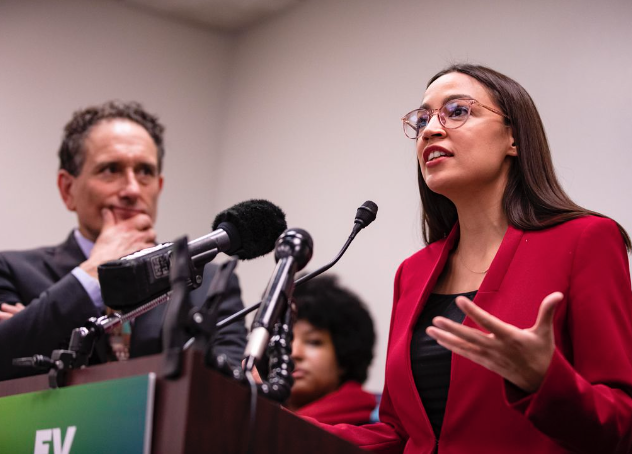
Last week, two of Congress' best members, freshmen Andy Levin (D-MI) and AOC (D-NY) introduced the Electric Vehicles (EV) Freedom Act, H.R. 5770. The purpose is to create a comprehensive nationwide network of high-speed electric vehicle chargers along America’s highways within five years. Yesterday, Levin told his constituents that "When it comes to purchasing an electric vehicle, many consumers are worried about the lack of public charging stations, especially along the highway. But the EV Freedom Act will ensure that drivers along the National Highway System will have ready access to charging stations that can power up their EV in the shortest time technology allows. It’s time to bring our highway system into the 21st century."

He wrote that the bill offers the opportunity to eliminate barriers to consumers who ate interesting these cars and paving the way for rapid mass adoption of electric vehicles. "This transformational legislation will not only help reduce carbon emissions and combat climate change, but it will also create thousands of good-paying automotive and infrastructure jobs. Jobs that are created through the EV Freedom Act will adhere to Buy American and prevailing wage requirements to protect the hardworking people behind America’s new EV future. And, it will make sure our poor communities and communities of color are included in both the new green infrastructure and job opportunities."

On introducing the bill, AOC said that "Cars, above all else, have historically represented America's problem with dirty oil. Establishing a nation-wide network of electric vehicles charging stations helps us reduce emissions, creates good paying jobs, and will help transition the U.S. economy to a cleaner future."
Specifically, the EV Freedom Act:
Establishes a comprehensive, nationwide network of high-speed EV chargers within 5 years;
Helps secure the automotive and infrastructure jobs of the future and create thousands of good-paying jobs with robust Buy America and prevailing wage requirements to protect the hardworking Americans who will build an EV future;
Ensures the chargers built along the National Highway System keep up with new technology to achieve a simple goal-- fully power up EVs in the time it takes to fill up gas and diesel tanks;
Promotes interoperability so drivers don’t have to fear that chargers won’t be compatible with their cars; and
Prioritizes accessibility by guaranteeing that payment methods are secure, convenient, and equal access, and that all charging stations are ADA compliant.
The EV Freedom Act directs the Secretary of Transportation and the Secretary of Energy to devise a plan to create the network of EV chargers, submit the plan to Congress and create the network of EV chargers within five years.

The EV Freedom Act has the support of a diverse group of labor, environment and climate groups, including:

Blue Green Alliance, League of Conservation Voters, Union of Concerned Scientists, Sierra Club, Earthjustice, Ecology Center, Environmental Defense Fund (EDF), Environmental Law & Policy Center (ELPC), Utility Workers Union of America (UWUA), United Steelworkers (USW), United Automobile Workers (UAW) and the Center for Transportation and the Environment (CTE).
The immediate co-sponsors were Rashida Tlaib (D-MI), Mark Pocan (D-WI) and Pramila Jayapal (D-WA). Yesterday I spoke with several members who I know are big boosters of electric vehicles, like Jamie Raskin (D-MD), who had written a similar bill when he was in the Maryland state legislature, Tom Suozzi (D-NY), Ted Lieu (D-CA) and Ro Khanna (D-CA), who all told me they are either going to sign on or are studying it and are likely to sign on. In fact, Tom Suozzi, many of whose Long Island constituents, are commuters, was the first to co-sponsor the bill yesterday... followed by Ro Khanna just moments later.

I also asked some of the top progressive candidates who are likely to be in Congress next year and will be the ones to get this passed, since McConnell is likely to block it from being debated in the Senate in 2020. I recall telephoning Mike Siegel once when he was on a picket line at a car factory supporting local strikers. So I asked him. "This is what the fight against climate change looks like: we must rebuild the American economy, piece by piece, to allow for a sustainable future. Representatives Levin and Ocasio-Cortez speak for all of us, by fighting for the infrastructure we need for electric vehicles. We know America can do this. 100 years ago we provided electricity to rural America. Under FDR we rebuilt our electric grid through the New Deal. Eisenhower built the interstate highway system. And now, as we face climate change and massive wealth inequality, we need a new generation of federal programs that will create good new jobs and protect our planet. I look forward to pushing these types of efforts forward when I join the House in 2021."

Goal ThermometerJon Hoadley represents Kalamazoo in the Michigan state legislature and he's likely to be the next member of Congress from the southwest corner of the state. He's very enthusiastic about Levin's and AOC's bill. "The Electric Vehicles Freedom Act is a common sense step in the right direction toward transitioning the U.S. away from fossil fuels and toward a cleaner future. Frankly, it should have been done years ago. By establishing a nation-wide network of electric vehicles charging stations, the EV Freedom Act will help us reduce emissions, create good paying jobs, and provide the much needed infrastructure to reduce our dependence on fossil fuels."

This legislation, if passed and signed, will be amazing news for Indiana's economy. We have two candidates running there, Jim Harper, the newest candidate endorsed by Blue America, is very excited about it. His district in northwest Indiana would benefit immensely. "The EV Freedom Act," he told me yesterday, "would be a boon to the working families of Northwest Indiana. The proposal will not only help us kick our addiction to dirty petroleum, but it will also help create good-paying, union jobs. Green infrastructure and technology are the future for our region, particularly in light of a history of industrial pollution that has fallen disproportionately hard on communities of color."

And Jennifer Christie, who is running in a more swingy district north of Indianapolis, is just as excited as Jim. "I love it!," she said when she read about the bill.  "In October, our campaign released a Climate Agenda calling exactly for this and other measures to decarbonize to zero emissions. Comprehensive Electric Vehicle (EV) infrastructure is essential to solving the transportation component of the climate crisis. What’s more, this will create jobs while we upgrade our highway infrastructure. We also have the opportunity to invest in rural communities and Tribal Nations as we install EV charging networks; There are opportunities to invest in solar projects around charging stations as well as local commerce that will surely develop along the EV grid. In addition to the boost EV infrastructure will give to electric car usage, it will also protect water quality. Gasoline is typically stored in underground storage tanks (USTs). Leaks, spills, and overfills from gasoline service stations are one of the most common sources of ground water pollution according to the EPA. Approximately half of the American population relies on ground water as their drinking source. With an eventual goal of replacing gasoline stations with EV charging stations, imagine the good that we can do for the environment and the economy. I am glad to see this bill introduced. We need more legislative action on climate that directly helps to reduce carbon pollution. Let’s support this bill by calling our current representatives. If I have the opportunity to vote on it, count me as a YES!"

Morgan Harper, the progressive running for the Columbus, Ohio congressional seat, realizes how important this bill will be for central Ohio. She told me this morning that she strongly supports the legislation. "Not only is it critical in our fight against climate change to invest in Electric Vehicle infrastructure, but it provides auto manufacturers, many of whom have a strong presence in Ohio, the clear incentive to invest more, sooner, in their Electric Vehicle programs."

Labels: , , , , , , , , , ,

Thursday, January 30, 2020

Do Politicians Work For Us Or Themselves? Bernie Is One Of The Few Outliers-- Which Is Why He's So Popular

>


Electability: Trump is unlikely to lose Texas in November but a new Texas Lyceum poll shows that if anyone can beat him there, it's Bernie. Trump is leading Bernie 50-47% in Texas, a 3 point lead. Trump has a5 point lead over Status Quo Joe, an 8 point lead over Elizabeth Warren and an 8 point lead over Mayo Pete. Electability is about party unity and, as you probably saw earlier in the week, Biden is hanging with the anti-Bernie fanatics and still refusing to say if he would back Bernie if Democratic voters stand up to party bosses and nominate Bernie to face Trump. Biden's fat-cat advisors and cronies are leading an all-out corporate cash smear campaign against Bernie now.

AP's Bill Barrow wrote that Biden stopped short Tuesday of saying he’d support Bernie Sanders if the progressive Vermont senator wins the Democratic presidential nomination. 'I’m not going to make judgments now,' Biden told reporters in Muscatine, six days before the Iowa caucuses. 'I just think that it depends upon how we treat one another between now and the time we have a nominee.' Biden had previously promised to support the Democratic nominee, 'regardless' of who it is. At some stops along the campaign trail, Biden has even pledged to 'work like hell'” to help any of his rivals defeat President Donald Trump.

In a letter to her own supporters, AOC said that in DC there are "too many leaders who are afraid of change. People who know what working-class folks need, but are too scared to fight and pass those policies. Those are the people we need to replace." She was talking about the Democrats from the Republican wing of the Democratic Party-- like Biden.


Afraid that Bernie is unstoppable now, the scumbag DNC leadership cobbled together quick golden parachutes for themselves... just in case Bernie decides to put people in charge who care about the country more than sating their own repulsive greed. When the scheme was leaked to journalists, Tom Perez and his two top deputies, Seema Nanda and Sam Cornale claimed they knew nothing about it. One of their flacks told the media that "100% of our resources are going towards beating Donald Trump. DNC leadership will not accept any extra compensation recommended by the budget committee, which didn’t operate at the direction of DNC leadership. The resolution was crafted by the budget committee and did not involve the Chair, CEO, or Deputy CEO." A great deal of house-cleaning and swamp draining will be needed when Bernie is elected-- and it's not all about Republican corruption either.

You wonder why so little gets done for the people while so much money is spent? A lot of people with pieces of power-- from Trump right down to graspers like Perez-- are working tp feather their own nests, not work for America. Did you read Emily Cochrane's NY Times piece yesterday about a doomed infrastructure bill congressional Democrats are pushing? It's a five-year, $760 billion framework for rebuilding the nation’s highways, airports and other infrastructure." Trump isn't interested.

The framework "is the product of a collaboration led by Representative Peter A. DeFazio of Oregon, the chairman of the House Transportation and Infrastructure Committee; Frank Pallone Jr. of New Jersey, the chairman of the Energy and Commerce Committee; and Richard E. Neal of Massachusetts, the chairman of the House Ways and Means Committee." Pallone and Neal are both untrustworthy crooks who should no more be allowed near anything involving expenditures than Trump should be. The 3 of them announced that "This is not just about fixing our roads and bridges. It is about seizing the opportunity to make transformational changes in communities of all sizes, in every corner of our country."

Trump says he won't work with Democrats on infrastructure or anything else unless they stop investigating him. I'm surprised that didn't turn up as another impeachment count.
The renewed push for agreement on an infrastructure plan comes as Democrats, eager to shift the focus from the divisive impeachment proceedings against Mr. Trump, are mapping out an election-year agenda that showcases their policy priorities.


It is highly unlikely that the plan will prompt a genuine round of negotiations with the Republican-led Senate and the White House that would yield legislation that could be signed into law before the election. But the rollout suggests that Democrats intend to spend the coming months passing a slate of popular infrastructure bills to show voters, then seek to blame Republicans and the White House if they fail to succeed.

The 19-page plan to be proposed by Democrats includes $329 billion for investment in transportation systems, including improving safety measures for bicyclists and pedestrians, and $105 billion for transit agencies and maintenance needs. The framework also includes $55 billion in railway investments for both the expansion of the country’s passenger rail network and improvement of Amtrak stations and services, $19.7 billion for the upkeep of harbors and ports, $86 billion for the expansion of broadband access and additional funds to address greenhouse gas pollution and increase climate resiliency.

There will also be $21.4 billion for the preservation of clean drinking water and communities dealing with toxic chemicals that can contaminate drinking water, known as PFAS. Democrats struggled to include stronger regulations for PFAS in must-pass defense policy legislation late last year, and passed a stand-alone measure in early January.

And while the framework also includes transportation and infrastructure legislation routinely addressed by Congress, Democrats made a point of emphasizing efforts to counter climate change and its effects.

An infrastructure plan has been an elusive goal for both the Trump administration and Congress over the last three years. The phrase “Infrastructure Week” has become something of a joke that encapsulates the dysfunction of Washington in the Trump era, after the White House repeatedly scheduled one during Mr. Trump’s first two years in office, only to have it overshadowed by a jarring comment by the president or a damaging revelation about him.

Nine months before Election Day, a $1 trillion infrastructure plan is still one of Mr. Trump’s unfulfilled promises from his inaugural campaign.

Labels: , ,

Tuesday, May 28, 2019

When Trump Campaigned On Fixing U.S. Infrastructure, It Was Just Hot Air

>


I've got some bad pot holes on the way from my house to the main road. I take a detour every time I drive to or from home to anywhere. It's annoying, not horrible, just annoying. But no one can brag to me how they fixed it unless it's fixed. It's not about statistics or bombast; it's about being able to take the direct route from my house to the test of the world. And as Toluse Olorunnipa and Mike DeBonis wrote for the Washington Post yesterday, Trump has fallen short on infrastructure after promising to build roads, bridges and consensus. People notice it and are pissed off-- and are noticing that "the bitter partisan impasse in Washington is paralyzing efforts to revamp the nation’s deteriorating and outdated infrastructure." Who will they blame?

Bridges are aging, roads crumbling and tunnels, scary and in need of repair. U.S. infrastructure has earned a D+ grade in the most recent report from the American Society of Civil Engineers. That's not as bad as Afghanistan but it's lot worse than any other country any Americans not enlisted in the military are likely to ever go to. What does a D+ mean? Well a "D" means "the infrastructure is in poor to fair condition and mostly below standard, with many elements approaching the end of their service life. A large portion of the system exhibits significant deterioration. Condition and capacity are of serious concern with strong risk of failure." Meanwhile a "C" means "the infrastructure in the system or network is in fair to good condition; it shows general signs of deterioration and requires attention. Some elements exhibit significant deficiencies in conditions and functionality, with increasing vulnerability to risk." So a D+ is in between, a little better than a strong risk of failure but worse than "significant deficiencies."

There's just one bright spot-- rail, which is graded a "B," up from a C+ in 2013, when the Obama administration put some effort into improving it. Under Trump, those improvements are likely to go into reverse. These are the categories examined with the 2013 and 2017 grades, basically from Obama to Trump:
Aviation- D (no change)
Bridges- C+ (no change)
Dams- D (no change)
Drinking Water- D (no change)
Energy- D+ (no change)
Hazardous Waste- D+ (improved from D during Obama administration)
Inland Waterways- D (improved from D- during Obama administration)
Levees- D (improved from D- during Obama administration)
Ports- C+ (improved from C during Obama administration)
Public Parks- D+ (deteriorated from C- during Trump's first term)
Roads- D (no change)
Schools- D+ (Improved slightly from D during Obama administration)
Solid Waste- C+ (deteriorated from B- during Trump's first term)
Transit- D- (deteriorated dangerously from D during Trump's first term)
Wastewater- D+ (Improved slightly from D during Obama administration)


That's what amounted to an overall D+ and what Trump campaigned on improving, touting his skills as both a builder and a dealmaker during the 2016 campaign. What's bothering voters is that he "has been unable to reach a grand bargain with Congress, further dimming hopes that upgrading the nation’s roads, bridges and tunnels will bypass the capital’s infamous gridlock anytime soon." Trump's own rating as a leader in this field is an F: "unacceptable with widespread advanced signs of deterioration... signs of imminent failure."
Trump, who has repeatedly said he wants to improve the nation’s infrastructure, abruptly walked out of a meeting with leading Democrats on Wednesday and declared there would be no “investment” until congressional investigations into his personal finances and administration cease. Democrats accused Trump of being unable to rise to the occasion and match the political savvy of previous presidents whose names are associated with the country’s most ambitious infrastructure projects.

The partisan stalemate-- now immortalized as a running joke about the White House’s never-ending “Infrastructure Week”-- belies the growing and costly problem. The American Society of Civil Engineers, in its 2017 report, estimated that funding would need to be increased by $2 trillion over 10 years to make up the infrastructure gap.

“We can no longer afford to wait,” said ASCE Executive Director Tom Smith. “Our infrastructure problem is not going to go away, and it’s certainly not going to get better with time.”

Local leaders have grown frustrated with the political stalemate.

“It’s exhausting,” said MarySue Barrett, president of the Chicago-based Metropolitan Planning Council, a nonprofit that advocates sustainable regional development. “We’re desperate in Illinois and in Chicago for infrastructure investment to jump-start our economy and are beyond frustrated that the federal government is not our partner.”

Before things blew up, both Trump and congressional Democrats were speaking optimistically about the prospects for a deal, not only to restore infrastructure but also to bring broadband to rural America.

Last month, a cheerful group of Democrats that included House Speaker Nancy Pelosi (D-CA) and Senate Minority Leader Charles E. Schumer (D-NY) emerged from the White House to announce that they had agreed with Trump to push for a $2 trillion infrastructure package. The number-- twice what Trump had proposed just a year earlier-- quickly became a flash point as Republicans distanced themselves from it and Democrats called on the White House to provide ideas for how to fund such a massive spending project.

Some Republicans saw a setup.

Americans for Tax Reform President Grover Norquist said earlier this month that Democrats’ approach to their initial meeting with the president-- especially their decision to put the onus on Trump to develop a financing mechanism-- betrayed their political motives. Any Trump-proposed tax increase to fund a $2 trillion infrastructure deal would amount to “fingerprints on the murder weapon” that would be used to convict Republicans in the next election, Norquist said.

They think they could trick the president into agreeing to a stimulus package that they would call infrastructure, and then the president would, in their view, be stupid enough to stand by them while he signed their bill,” he said. “The president would have simultaneously turned himself into George Herbert Walker Bush-- he would have raised taxes on the middle class, he would have raised taxes on the American people, and he would have been crushed in the next election.”

Trump appeared to echo those views in an interview with Fox News host Steve Hilton, when he accused the Democrats of turning the infrastructure negotiations into “a little bit of a game.”

“What they want me to do is say, ‘Well, what we’ll do is raise taxes, and we’ll do this and this and this,’ and then they’ll have a news conference, ‘See, Trump wants to raise taxes,’” Trump said in the interview, which aired May 19.

A White House spokesman did not respond to a request for comment.

Trump’s standoff with Democrats highlights the president’s difficulty navigating Washington’s political waters and inability to deliver on a key campaign promise with bipartisan appeal, said presidential historian Douglas Brinkley.

“It’s easy to say you’re going to work to fix bridges and highway and dams, but that’s just talk,” he said. “In order to move the ball forward, you have to get out there and cheerlead for public works projects-- and this president doesn’t know how to bring people together.

Using the metaphor of a two-lane road, Trump told reporters Wednesday that the Democrats he had just walked out on had to choose whether to pursue investigations of his administration or legislative dealmaking. Doing both, he said, was not an option.

You can go down the investigation track, and you can go down the investment track or the track of ‘Let’s get things done for the American people,’” he said during a hastily scheduled news conference in the Rose Garden.

For now, Democrats are pushing ahead with their oversight efforts, and prospects for an infrastructure deal seem all but dead this year. Pelosi accused Trump of a “temper tantrum” and publicly questioned his ability to “match the greatness of the challenge” before him.

“I can only think that he wasn’t up to the task of figuring out the difficult choices of how to cover the cost of the important infrastructure legislation that we had talked about three weeks before,” she told reporters Thursday.

Trump has shown himself more comfortable battling Democrats than advocating on behalf of any plans that could win bipartisan support, Brinkley said. Beyond outlining the broad themes of an infrastructure policy, the Trump administration has not yet mounted the kind of sustained policy effort necessary to turn the president’s campaign promise into legislation.

Democrats who thought Trump’s ambivalence toward fiscal conservatism and penchant for putting his name on buildings might make him more willing to back a major financial investment in new federal projects have been disappointed.

“We’re two-and-a-half years into this with no real movement on infrastructure, no real new dollars being brought to bear,” said Austin Mayor Steve Adler (D). “I don’t know if it was just something that the president was saying in order to get elected, but there’s never been an indication that there was something there there.”

Congress has also not shown an ability to break through decades-old fights over how to fund transportation upgrades. The federal tax on gas and diesel fuel, a main source of revenue for infrastructure spending, has held steady since 1993.

House Transportation and Infrastructure Committee Chairman Peter A. DeFazio (D-OR) has become fond of telling a story when pressed on why major infrastructure legislation has been so elusive: Imagine a flock of hungry penguins at the South Pole, standing on a cliff staring at a pool full of fish below, hesitating for hours as they watch leopard seals, dangerous predators, circle the water, he says.

“They push one guy over, he doesn’t get eaten, and then they all jump,” he said, comparing the lawmakers to the penguins and Washington interest groups to the predators. “That’s where we’re at: No one wants to go first.”

“We have to talk about real revenues, which means some form of taxation in some way,” he added. “You can’t do it with fairy dust.”

While Trump’s administration has explored the idea of raising the gas tax, the president’s Republican allies have pushed back on the prospect of raising new revenue. House Minority Whip Steve Scalise (R-LA) has said lawmakers “ought to go and look and see how we can move existing dollars around and put them into higher areas of priority.”

Democrats have also been divided about where to get the money, with some arguing that raising the gas tax disproportionately impacts lower-income drivers.

The U.S. Chamber of Commerce has become a prominent voice on the center right advocating for a gas-tax increase-- seeking to combat Norquist and tax-cut absolutists.

“People believe there are reasonable, bipartisan ways to pay for this, beginning with increasing the gas tax for the first time in 26 years,” said Neil Bradley, chief policy officer for the Chamber and a former senior GOP congressional aide. “That would allow a really robust infrastructure bill to get done in this year.”

The lack of progress on infrastructure could have an impact on the 2020 presidential race, which Trump plans to pursue using the “Promises Kept” motto. Earlier this month, Trump promised a new interstate highway bridge in Louisiana that would be operable the day after his reelection in November.

By failing to reach a bipartisan deal, Trump has undercut his ability to cast himself as a political outsider who could break the logjam in Washington, Brinkley said.

“The one thing that he had going for him during the election was when he’d say that ‘the airports and highway and bridges are broken and I’m going to fix it,’ ” Brinkley said. “The great irony is the president who promoted himself as a builder is unable to build anything.”
Goal ThermometerInfrastructure is an important issue for all of the Blue America candidates but different for each one because of their very diverse districts. Audrey Denney, for example, is running in a largely rural, small town district in northeast California "The crumbling infrastructure in my vast district," she told me, "puts us at an economic disadvantage and threatens lives. It is one of our most pressing issues. Much of CA-01 is made unnecessarily remote by poorly maintained roads and a lack of highways, which discourage investment, raise costs for businesses, and increase road accidents. Lack of broadband internet and cell service in large areas of the north state inhibit access to public safety resources, education, services, and economic opportunities. Additionally, the Oroville Dam spillway disaster that happened in our district in 2017 showed us all just how critical is the need for maintenance, repair, and improvement to California’s aging water infrastructure system.

Kara Eastman's district is mostly urban (Omaha) and suburban. She concerned about somewhat different issues. "Nebraska’s bridges and roads are in disrepair," she said, "We have been recently devastated by floods (and pot holes!). In Omaha we have 84,000 homes built before 1978 and over 17,000 lead service lines. Voters in the district tell me their utility bills are extreme because of our extreme weather. We are desperate for an infrastructure plan to address these issues and create well paying jobs.

Blue Dog Dan Lipinski is on the House Transportation and Infrastructure Committee but he seems to have forgotten about his own Chicagoland constituents. Marie Newman, the progressive Democrat running for the seat he occupies told us that "Infrastructure is a huge issue in my district. In IL-03, we have 3 of the worst-rated bridges and many other sites with critical issues. The irony? Our current congressperson has sat on the Transportation and Infrastructure Committee for his entire 15 year tenure and has done very little to address critical issues. Further, he has not built any transportation and infrastructure bills and continues to use the 2004 CREATE project fund ( passed and developed prior to his tenure) as if he developed it and he is doing everybody a favor. Additionally, we have serious environmental crises throughout the district. We must bring green workforce training that lead to green infrastructure repairs and other green projects. We cannot wait any longer."

Labels: , , ,

Tuesday, April 30, 2019

Nancy, Chuck And Trumpanzee vs McConnell, McCarthy And The GOP Deep State

>

Trump Jumps Ship by Nancy Ohanian

Today Pelosi and Schumer are heading over to the White House-- this time at their own request-- to talk with Trumpanzee about infrastructure. This has McConnell and McCarthy fuming, primarily because Trump's own views on this are far more in synch with the Democrats than with the Republicans. Like the Democrats, he's looking to spend-- and spend big-- and wants signs everywhere that will say "this project is being built for you by Señor Donald J. Trumpanzee," or something along those lines.

Jonathan Swan broke the story at Axios that Trump told Richard Neal, chair of the House Ways and Means Committee, that he wants to spend close to $2 trillion on infrastructure. It isn't just McConnell and McCarthy who oppose him. Many in his own Regime are against it and it's unclear if he has the juice to get it through. Pelosi and Schumer want to get him to take a stand for what he-- and they-- want, even if it means McConnell, McCarthy and Trump's own skin-flint chief of staff, Mick Mulvaney, have fits. The White House plan-- which Trump disparagingly calls "Gary's Plan" was put together by Gary Cohen before Trump canned him.

The "Gary Plan" was meant to authorize building out infrastructure through "public-private partnerships"-- leveraging a modest amount of government spending to stimulate private investment in projects around the country, which is a non-starter among Democrats and isn't something Trump is at all enthusiastic about either, having used the method to rip off the government and well aware of how it would be used to rip off tax dollars again.

Behind the scenes: Trump came into office imagining a presidency in which new projects-- "built by the Trump administration"-- would be erected all over the country, sources close to him tell me.
There was a genuine naivety about the prospect of Democrats and Republicans coming together to do something on a grand scale with infrastructure," a former White House official told me. "It was one of those things where Trump said it was gonna be easy. He really thought so."
In an early 2017 infrastructure meeting at the White House with his friend, New York real estate billionaire Richard LeFrak, Trump laid out his grand Trumpian vision. "They say Eisenhower was the greatest infrastructure president. They named the highway system after him," Trump said, per a source who was in the room. "But we're going to do double, triple, quadruple, what Eisenhower did."
Kudlow, who's leading the White House team on this, isn't any more enthusiastic about it than the rest of the Republicans, who would rather give their wealthy donors more tax cuts than spend money on infrastructure, especially if the money spent has to include a revenue plan (i.e., taxes).

Pelosi and Schumer aren't prepared to move unless Trump agrees to spend real federal dollars on this and raise the money needed with taxes that don't penalize working families. They are also insisting that all materials used in all the projects be American-made, something Trump will agree to instantly but that the Republican Party leaders never will. Today should be fun.

Trump Jump Ship II by Nancy Ohanian

Labels:

Thursday, January 03, 2019

Even Stonewall McConnell Thinks There Can Be Bipartisan Headway On Infrastructure-- But Can There Be... With Trump Thowing Bombs On Twitter?

>


As I mentioned earlier, Oregon Congressman Pete DeFazio will be the next chair of the House Transportation and Infrastructure Committee. He's about to have a lot on his plate, since infrastructure may be one of the few places Trump will be able to work together with congressional Democrats to accomplish something... anything. Trump's own plan is just an enrichment scam for his Wall Street amigos, so Democrats are going to have to come up with something that will look good for Trump's populist peanut gallery. It's doable, as Leo Hindrey, Jr.-- a highly successful businessman and author of It Takes a CEO: It’s Time to Lead with Integrity and he Biggest Game of All-- wrote in a piece for the Washington Monthly: How Democrats Can Affordably Fix America’s Infrastructure. DeFazio has said that Trump "gets it" because his "is a builder." God only knows what DeFazio was smoking.
Since Inauguration Day, the Trump administration’s infrastructure plan has been a one trillion dollar “public private partnership,” funded with $200 billion from Congress and with $800 billion in loans from Wall Street institutions like Goldman Sachs and Blackstone. The $200 billion paid by Congress would be quickly spent. But Wall Street says it would demand an annual interest rate of 10 to 12 percent on their loans. Getting a return on these large, Wall Street-funded infrastructure projects would be very expensive. It would be so expensive, in fact, that the women and men intended to use these new rail lines, benefit from new broadband networks, cross repaired bridges, or fly out of upgraded airports won’t be able to afford to do so.

Trump’s plan is a slap in the face to the mayors and governors who have been waiting decades for help funding infrastructure projects that their constituents need. Even if it weren’t prohibitively costly for communities, Trump’s plan doesn’t provide the full $1.5 trillion which the American Society of Civil Engineers (ASCE) believes is outside the current capabilities of the states and municipalities. Trump has proposed a half-baked half-measure which won’t affordably solve our current problems, let alone address our future needs.

But while the nation’s infrastructure needs are great, they are not an emergency. Our infrastructure must be fixed in a timely matter, but not necessarily tomorrow. Democrats don’t have to settle with Trump on a bad plan, and they shouldn’t. They can instead push for a lasting solution. And thankfully, the party already has one in mind: an infrastructure bank.

As a term, “infrastructure bank” might sound boring. But the idea can be elegant and ingenious. The federal government first establishes a bank and seeds it with billions of dollars–a lot of money, but still only a small fraction of what Trump is proposing. Next, the bank invites outside investors to add more money–orders of magnitude more than what the government provided. The bank would then finance infrastructure projects across the country, so long as they pay for themselves over time through user fees or associated taxes. States or cities could apply to fund projects ranging from passenger trains and toll roads to electricity grids and sewage pipes. And unlike Trump’s proposal, an infrastructure bank would not be a one-off funding initiative. Rather, once seeded, it would be self-sustaining, as loan repayments from earlier projects allow the bank to lend money for future ones.

Every administration since Ronald Reagan’s has at least talked about a national infrastructure bank, and both Bill Clinton and Barack Obama initially pushed to create one. So why hasn’t it happened? For starters, it’s difficult to establish a bank structure that fully respects Congress’ right to appropriate but doesn’t unduly politicize project selection and project oversight.

Some people believe that Congress would be able to fairly and efficiently manage these decisions, but I’m not one of them. Members of Congress are very able to decide what they want funded. But they would be less focused on selecting good projects and more likely to select ones which favor their own region or political views on infrastructure.

I believe that a proper national infrastructure bank must instead be a wholly owned government corporation with non-partisan directors appointed by the president and confirmed by the Senate. These directors should be experts when it comes to infrastructure and macroeconomics. They should include women and men with proven expertise in heavy construction, business, labor and government policy. And in order to make the bank as informed as possible about America’s diverse infrastructure needs, the bankshould, like the Federal Reserve, be regionalized into operating districts.

A second challenge for the bank will be melding project selection with current and future national needs. Not every road project should be approved, not every urban project should be favored, and certainly no project should irreparably damage the environment. The bank’s board will need to be Solomon-likein its stewardship. But by having experienced directors and devolving power across the country, the bank I’m proposing will more likely make the right calls than would either Congress or a Washington-centric band of technocrats.

Finally, the bank has to avoid leaving cities and states drowning in high-cost debt. To make sure this doesn’t happen, my proposed bank avoids Wall Street entirely. Instead, complemented by support from the U.S. Treasury, the bank would be primarily capitalized with and find its liquidity from $1.5 trillion in long-term loans from America’s large state and municipal pension plans, as well as by some of the world’s largeoverseas sovereign wealth funds (like Norway’s massive oil-rich permanent fund). The interest rate on these loans would be in the range of 3 to 4 percent. This may appear low, but it is actually consistent with the interest rate these plans and fundsearned over the last decade on their fixed-income assets.

It would, in other words, be a good investment. And to meet these returns, cities and states won’t have to make tolls, tickets, and fees astronomically high. Unlike Trump’s plan, this bank would lead to infrastructure that is affordable for Americans.

...For six consecutive administrations, presidents have had three overriding objectives for funding moneymaking infrastructure. First, finance all of the infrastructure projects that are beyond the capabilities of states and cities–not just some of them. Second, prioritize projects in a fair and efficient manner. Third, minimize the federal government’s contribution. The National Infrastructure Bank I’m proposing, with its specific characteristics, is designed to achieve these objectives. It will fund infrastructure that’s affordable, accessible, and dearly needed. It won’t drain federal coffers. Democrats in Congress should now show their leadership and reach out across the aisle and to President Trump to pass legislation that creates this institution.

At the same time, however, Democrats in Congress need to strongly resist pressure to cut a less than perfect deal. They should oppose infrastructure packages that leave some projects behind or that overburden user communities with exorbitant fees. While our nation’s infrastructure needs are great, they are not dire. We can afford to wait. And if President Trump and Senate Republicans refuse, or if they insist on the President’s unacceptably costly and unfair pro-Wall Street plan, then Democrats should wait until they control both chambers of Congress and until we have a new President. American infrastructure has had too many patchwork fixes. It’s time we get this right.

The 115th Congress' Transportation and Infrastructure Committee consisted of 33 Republicans and 27 Democrats. That number will be at least reversed in the 116th. Several Democrats will therefor be added, not to mention that 3 Democrats from the committee-- Elizabeth Esty (New Dem-CT), Richard Nolan (D-MN) and Mike Capuano (D-MA)-- are leaving Congress, making more room. aside from losing a number of positions on the committee, 10 Republicans were defeated or are retiring, including ex-chairman Bill Shuster. The new ranking member is Sam Graves of Missouri since two of the guys slated to take over after Shuster-- Johnny Duncan (TN) and Frank LoBiondo (NJ) both retired.

When you see those ads from the California tourist bureau touting the state as a vacation getaway, it's all about the beaches and L.A., San Francisco and San Diego, not about the beautiful, if remote northeast part of the state where congressional candidate Audrey Denney grew up on her families farm. Her part of California is a mostly small town and rural, a world apart from Hollywood or Silicon Valley. And infrastructure is one of the issues Denney has been hammering on-- perhaps more so because the GOP incumbent she's running to replace, Doug LaMalfa, is a do-nothing member of the House Transportation and Infrastructure Committee. This morning, Denney told me that "The crumbling infrastructure in my vast district puts us at an economic disadvantage and threatens lives. It is one of our most pressing issues. Much of CA-01 is made unnecessarily remote by poorly maintained roads and a lack of highways, which discourage investment, raise costs for businesses, and increase road accidents. Lack of broadband internet and cell service in large areas of the north state inhibit access to public safety resources, education, services, and economic opportunities. Additionally, the Oroville Dam spillway disaster that happened in our district in 2017 showed us all just how critical is the need for maintenance, repair, and improvement to California’s aging water infrastructure system."


Labels: , , , , ,

Friday, May 11, 2018

How The GOP Hopes To Save Their House Majority-- Trumpanzee Jr, Adelson's Gambling Money And... Not Much Else

>


When people wanted to think Trump could turn into a normal president after the election-- fools-- there was speculation that he would put together an awesome, historic, bipartisan infrastructure plan that would unite the country. Instead, Trump, Ryan and McConnell decided to go for the tax scam for GOP donors, something that certainly killed any chance for a significant infrastructure effort. The tax scam also turned out to be a blow to the GOIP's slender hopes to holds onto power in Congress, something an infrastructure bill might have helped them accomplish. Señor Trumpanzee's campaign promise to "build the next generation of roads, bridges, railways, tunnels, sea ports and airports that our country deserves" was just more hot air and bullshit from the ultimate con-man.

So how are they going to persuade themselves they're going to hold onto Congress? Yesterday, the Washington Post reported that Miss McConnell suggested everyone get booked on Fox as often as possible. Sure, that's gonna do it. And Jonathan Swan reported something even more absurd: Jr. to the rescue. No really. Trumpanzee Jr. "is preparing to dive into the 2018 midterm elections."

Swan (with a straight face): "He wants to use his influence within the Republican base to 'expand our majority in the Senate and protect our majority in the House,' said a source close to the president's son. Expect Don Jr. to be raising money for Republican candidates and staging rallies. DTJ "offered to come down [to West Virginia] and campaign with Morrisey to defeat Democratic Sen. Joe Manchin." He also plans to dazzle the voters in Missouri, Montana and Indiana. "Jr. said he believes his brand of 'MAGA conservatism'-- pro-gun, anti-media, anti-establishment-- could make a difference in turning out the base in these states." He's even staffing up for his new hobby.


Meanwhile right-wing, mob-connected casino mogul, Sheldon Adelson, will funnel some of his Chinese profits into an effort to save the House. Jake Sherman and Alex Isenstadt reported yesterday that the GOP-sugar daddy wrote Paul Ryan a $30 million check for his Congressional Leadership Fund. Just like the founding fathers foresaw, right? Ryan and his team flew to Vegas to lick Adelson's assat his gaudy Venetian Hotel to get the dough.
As a federally elected official, Ryan is not permitted to solicit seven-figure political donations. When Ryan (R-WI) left the room, Coleman made the ask and secured the $30 million contribution.

CLF did not respond to requests for comment. The contribution will become public later this month in the organization's campaign finance filing.

Coleman said he would not discuss his dealings with Adelson.

...The $30 million contribution is three times as much as Adelson gave to CLF in 2016. And the cash comes much earlier in the cycle: In 2016, Adelson gave CLF $10 million in August, as the campaign headed into the homestretch.

Party officials have been paying Adelson their respects. In February, a number of House Republicans made their annual sojourn to Las Vegas to attend the annual retreat hosted by the Republican Jewish Coalition, an organization that Adelson helps to fund. Majority Leader Kevin McCarthy (R-CA) addressed the conference, and Ryan spoke by teleconference to a meeting of the group’s board.

CLF is one part of a two-pronged political organization designed to protect and bolster House Republicans. CLF is a super PAC, and the American Action Network is a nonprofit that boosts center-right policies. Ryan, and John Boehner before him, have backed the groups.

Labels: , , ,

Sunday, March 04, 2018

Ellen Lipton For Congress (MI-09)

>


Last month we met Ellen Lipton a candidate for the open congressional seat in the Oakland and Macomb county suburbs north of Detroit. She founded and was named President of the Michigan Promise Zone Association, which supports free community college tuition, technical training and certification to Michigan students in selected communities across Michigan, a blueprint for free college tuition across America. Before that she was in the Michigan legislature, where she was the bane of Betsy DeVos' existence. If education policy is one of her fields of expertise, infrastructure was one of the motivations that made her jump into the race. She wrote a guest post for us about the issue:
“POTHELL!” was the big, bold headline splashed across a newspaper recently here in metro Detroit, and no word sums up Michigan’s infrastructure crisis more clearly. Under the headline was a picture of three drivers who’d been stranded on their way to work when they crossed an enormous pothole that had immediately destroyed their tires and rims upon impact. Welcome to pothole season in Michigan, when a daily commute often involves dangerous dodging and swerving to avoid potholes, then dodging and swerving to avoid accidents with other vehicles. It’s a public safety nightmare.

Trump recently unveiled his infrastructure proposal, and it falls far, far short of what’s needed in Michigan to even begin to solve our infrastructure crisis. Under his plan, states and localities would have to find their own, new sources of revenue to spend on infrastructure to even qualify for federal help. After decades of state disinvestment in infrastructure in MI, Trump’s plan would have little to no impact here, since our local units of government have already been revenue-starved for years and are highly unlikely to be able to come up with new state spending sources.

Michigan can’t wait for President Trump to get his act together and propose a plan that would actually work for our state. Here are just a few examples of how our infrastructure crisis is negatively impacting our communities every single day:
Flint water crisis-- Old service lines leached lead into Flint’s drinking water, poisoning an entire community. These service lines and lead connectors have still not been replaced, four years after the crisis first began to unfold.
• Fraser sinkhole-- A little over a year ago, an underground sewer line in Fraser collapsed, causing the ground to shift and open up and forcing people from their homes, closing down roads and putting a community in harms way.
Falling concrete on I-696-- Just recently, drivers along I-696, a major thoroughfare that links Oakland and Macomb counties in the 9th Congressional District, were being bombarded by large chunks of concrete falling from highway overpasses.
Heavy rains and E. coli outbreaks-- Every time there’s a heavy rain, levels of E. coli rise along the Clinton River and Lake St. Clair. This shoreline issue can be traced to much of the region still operating on old combined sewer systems in which a single pipe carries sewage from homes and businesses as well as storm runoff coming from street drains. Such outdated systems mean that during a heavy rainfall, a mix of storm water and sewage spills over from the retention basins to rivers and drains that carry it to Lake St. Clair.
The problems I’ve just described above barely scratch the surface of what our state’s infrastructure crisis entails. Cleary, President Trump’s so-called plan won’t even begin to get the job done when it comes to rebuilding my home state and making it a safe and healthy place for our communities.

What’s needed now more than ever is a bold vision for rebuilding our infrastructure, centered on the human side of the issue, and focused on putting people back to work and enhancing peoples’ quality of life where they work and where they live. Such a bold vision would invest our resources in people to produce millions of family-sustaining jobs, raise living standards, reduce inequality, strengthen education, reduce poverty and create a clean, healthy environment.

It would also mandate a direct public investment in roads, bridges and other public works, as opposed to providing “corporate giveaways” to spur private-sector investment. This direct investment should come in the form of a federal jobs program, through which our country would invest in human capital by putting people back to work rebuilding our roads and bridges, water and sewer systems, schools, airports and veterans’ hospitals, and linking our communities with high-speed internet access.

This kind of federal infrastructure program could create millions of jobs immediately, as well as introduce real-world job training for so many young people who are looking to begin careers in the skilled trades. An initiative like this one place great emphasis on jobs that pay a living wage, ensure workplace safety and guarantee racial and gender equality in the workplace. These goals could be achieved by raising benchmarks for prevailing wages in every corner of the country, requiring local hiring to accurately reflect and represent the diversity of the community’s workforce, include robust “Buy American” requirements and prioritize the hiring of veterans.

The path to American greatness lies in significant investment in our greatest resource: our people. A federal jobs program based on rebuilding our country would be proof that America’s complex infrastructure challenges can be met by following the simple principle that public money should go toward the public good.
Goal ThermometerMI-09 is a reliable Democratic district, which Sandy Levin, who has represented it for three-and-a-half decades, is leaving. His son Andy would like to take over. There are 2 other men running as well... and Ellen, the progressive game changer in the race. Hillary was seen as the status quo candidate and he did much worse than Obama had done and much worse than Sandy Levin did on the same day. She was just the wrong candidate with the wrong message and the wrong strategy for a district like that. Michigan voters want someone with bold fresh ideas, not more of the same. It's why Bernie beat Clinton in the Michigan primary and it's why Trump beat Clinton in the general. Ellen is part of this energy and she's the kind of leader who won't be satisfied sitting in the backbenches taking orders from the party's sclerotic, calcified leadership. Pelosi's, Hoyer's and their team's days are numbered. The congressional Democrats desperately need seasoned, bold leaders like Ellen Lipton to help the party snap out of it before it's too late.

Labels: , , , ,

Thursday, February 15, 2018

Midnight Meme Of The Day!

>


by Noah

Back on Monday, Señor Trumpanzee revealed the latest of his money-grubbing scams; i.e. his plan for repairing the nation's infrastructure. It's a scam sure to be loved by fellow grifters Mitch McConnell and Paul Ryan. After all, it's a plan designed to maximize the potential for kickbacks through privatization of all things dealing with the nation's infrastructure. Every privatization deal will have a squadron of middlemen with their hands out. Pockets will be stuffed and that is the aim of this latest Trump scam. Successful conclusions will have nothing to do with it. Remember when Whitefish Energy that tiny 2 person Montana "power company" with hometown ties Trumpanzee Interior Secretary Ryan Zinke got the $300,000,000 contract to restore power in Puerto Rico? No? Oh, that's right, Whitefish Energy has 3, not 2 employees, if one counts the fact that Zinke's son is an intern for the company. To be fair, Whitefish assembled teams of linemen and sent them to the ravaged island. Their starting pay? $300 per hour. Whitefish's big backer? The Dallas-based HBC Investments, a major campaign contributor to the likes of Rick Perry, March Rubio, and John McCain. One hand washing the other. After 5 months of this privatization, 400,000 Puerto Ricans are still without electrical power and Whitefish fled home 2 months ago. Well done! Heck of a job!

For perspective, Whitefish is a just one "incident." Think of restoring power to Puerto Rico as equivalent to restoring power to Connecticut or Oklahoma, states with a similar population. Now, multiply the corruption and inefficiency of Whitefish Energy getting a privatization deal times every city and every state in the United States Of America. That's every power grid, every highway, every dam, every bridge, every airport, every sewer on the list. Hey, it's a gold rush of graft and more! Loot the treasury! Stuff your pockets! Bring your own armored truck and drive it up to the gates of the White House and the Capitol!

With that in mind, the creator of tonight's meme did some editing and rewriting of part of the outline of the infrastructure scam presented by Señor Trumpanzeey. Some might say that the editing and rewrite job is cynical, but, is it really cynical when it's the truth? Even Trump's calling his plan a $1.5 Trillion plan is a scam. What his plan actually outlines comes to $200 Billion. He talks about things like 20% of project cost grants to individual states. Problem is the states don't have the remaining 80% so there's no way to actually do the work, but, that's not the goal. The goal is just to hand out tax credits and cash, our cash, to friends and family for "start ups" that can never be; more of those huuuge 1, 2, and 3 people companies that just suddenly appear, only to disappear almost just as quickly. That handout money? It'll come from cuts to social programs that we fund with out tax dollars. We might as well all go to the bank, make a withdraw and hand it to Trump's cabinet members and other Washington dirtbags and their "associates."

Labels: , , ,