Friday, February 01, 2019

No One Gets To The Left Of Bernie

>


If the Trump-hating/AOC-hating/Elizabeth Warren-hating/Bernie-hating, clueless Starbucks Guy is running on reducing a deficit his class built up and on cutting what he calls "entitlements," and on opposing Medicare-for-All, the Green New Deal and fair taxes on the wealthy, why doesn't he just run as the Republican his top aides and advisors all are?

Earlier in the week Miss McConnell and John Thune proposed repealing the weak estate tax, which is expected to be paid by fewer than 2,000 Americans a year. As Erik Sherman pointed out for Forbes readers, "The PR game that was waged to promote and forcibly sell the massive tax cut of 2017-- a move that has only begun to put the country into trouble-- is over. Corporations, the rich, and the politicians that serve them had their way. Now that particular façade has been dropped by those who erected it and the likely truth is out. The $1.5 trillion giveaway was supposed to create new jobs and significant investment by companies in facilities and equipment, all of which would drive economic growth." It turns out that 84% had not changed investment or hiring plans because of the drastically diminished corporate tax cuts and only 4% of corporations hired more people because of the tax cuts. The vast majority did nothing more than they would otherwise have. Trickle down/voodoo economics still doesn't work-- except for the already very wealthy. McConnell, Thune and the rest of the GOP are waging class war against the rest of us-- we most of us don't even know it. "GOP senators are now arguing to end the estate or inheritance tax because it's such a burden-- on fewer than 2,000 families a year," Sherman continued. "Mitch McConnell, Chuck Grassley, and John Thune on the Senate Finance Committee are all saying that there has to be a big cut." How about a guillotine?


Yesterday, there was something strange about Sydney Ember's NY Times headline-- in 2019, rather than say 1980-- saying Sanders Unveils Estate Tax Plan, Joining Democrats Who Want to Tax the Rich. Bernie, she wrote, "introduced legislation on Thursday that would increase the number of wealthy Americans subject to the estate tax. With the bill, Mr. Sanders joins a growing chorus of left-wing politicians calling for new ways to tax the rich. Welcome to the party begun by Cory Booker, Kamala Harris and Elizabeth Warren? Ummm.... maybe Sydney's headline writer is a 5 year old child prodigy who missed what Bernie had been talking about since 1970?

If passed and signed into law-- it may take a few years-- Bernie's new bill, the For the 99.8% Act, would establish a progressive estate tax on the fortunes of the top 0.2 percent of Americans and significantly increase rates on billionaires, raising $2.2 trillion from the nation's 588 billionaires. Bernie: "At a time of massive wealth and income inequality, when the three richest Americans own more wealth than 160 million Americans, it is literally beyond belief that the Republican leadership wants to provide hundreds of billions of dollars in tax breaks to the top 0.2 percent. Our bill does what the American people want by substantially increasing the estate tax on the wealthiest families in this country and dramatically reducing wealth inequality. From a moral, economic, and political perspective our nation will not thrive when so few have so much and so many have so little."

His bill only applies to the wealthiest 0.2% of Americans. It would establish a 45% tax on the value of an estate between $3.5 million and $10 million; a 50% tax on the value of an estate between $10 million and $50 million; a 55% tax on the value of an estate in excess of $50 million; and a 77% tax on the value of an estate above $1 billion-- a return to the top rate from 1941 through 1976, while also closing tax loopholes that have allowed billionaire families to pass fortunes from one generation to the next without paying their fair share of taxes. BONUS: "The Kochs, a family worth over $97 billion, would owe an estate tax of up to $74 billion. And the family of Jeff Bezos, the founder of Amazon, who has a net worth of more than $130 billion, would pay an estate tax of up to $100 billion."


The For the 99.8% Act was endorsed by a number of leading economists including Thomas Piketty, Emmanuel Saez, Gabriel Zucman, Robert Reich and Darrick Hamilton.

"The estate tax was a key pillar of the progressive tax revolution that the United States ushered one century ago. It prevented self-made wealth from turning into inherited wealth and helped make America more equal. However, the estate tax is dying of neglect, as tax avoidance schemes are multiplying and left unchallenged. As wealth concentration is surging in the United States, it is high time to revive the estate tax, plug the loopholes, and make it more progressive. Sen. Sanders' bill is a bold and welcome leap forward in this direction," said Emmanuel Saez, professor of economics at the University of California, Berkeley.

“One century ago, the US invented steeply progressive estate and income taxes in order to maintain the egalitarian and democratic legacy of the country. Today's US is becoming even more unequal than Pre-World War I Europe. The way out is stronger investment in skills, higher paying jobs and a more progressive tax system. Sen. Sanders' estate tax bill, including a 77 percent tax rate on estate values above $1 billion, is an important step in this direction,” said Thomas Piketty, Paris School of Economics professor.
One of the country's best political-economics reporters, Zach Carter took this on from another perspective yesterday. Carter wrote that "Socialism is having a big moment in America. After a surge in popularity during the financial crisis of 2008, the long-verboten political label at last lost its toxicity after Sen. Bernie Sanders’ 2016 presidential run and the election of democratic socialist Rep. Alexandria Ocasio-Cortez (D-NY) in 2018. Among self-identified Democrats, socialism is now more popular than capitalism, reflecting a trend that has been evident among young voters for years. Bankers and billionaires are, of course, desperate to reverse this political tide. Eyeing the 2020 Democratic presidential primary, the CEO of one giant bank recently told Politico that the party’s nominee “can’t be Warren and it can’t be Sanders.” To plutocrat Michael Bloomberg, Sanders is a “demagogue” preaching “unreason,” while Sen. Elizabeth Warren (D-MA) will transform the United States into a “non-capitalistic” system where “people are starving to death,” like “Venezuela.” The rhetoric from the 0.01 percent is more than a little overheated. But for most people, Warren and Sanders hail from the same left flank of the Democratic Party-- both are supporters of enacting Medicare for all, breaking up the banks and dramatically increasing taxes on the very wealthy... Whatever Warren and Sanders say to establish their political brands, the two senators do in fact represent a very similar way of thinking about politics. That’s why billionaires hate them both.


All of these proposals transfer money and power from the super-rich to the not-rich. Take postal banking. About 32.6 million households rely on a check-cashing service, payday lender or other expensive, small-dollar financial bottom-feeder at least once a year, according to the FDIC. On average, these households earn about $25,500 a year and spend nearly 10 percent of their income-- $2,412-- on these sketchy financial products. That’s over $82 billion going from hard-up homes to predators every year. You can deal with payday lenders a lot of different ways: ban them, regulate them or, the preferred tack of Warren and Sanders, have the government make them obsolete. If every household can get a low-fee bank account with the Post Office, they won’t have to turn to legalized loan sharking to get by. That’s bad news for payday loan executives, like ACE Cash Express CEO Jay Shipowitz, who made almost $4.5 million in 2004 alone. Is postal banking socialism or reformed capitalism? Yes.

In America today, the super-rich not only control an outrageous share of the national wealth, they also exercise a degree of political power incompatible with basic democratic principles. The choice for Democrats in 2020 is not really about policy minutia-- it’s about power-- who has it, and who doesn’t. And both Sanders and Warren have proved they are willing to confront the powerful and attack their sources of power. We can call this socialism, New Deal liberalism or Jeffersonian democracy-- whatever the label, it’s a critical ideological test for anyone who wants to be the next president of the United States.

Running for re-election in 1936, FDR noted that the “economic royalists” of “business and financial monopoly, speculation” and “reckless banking” all counted themselves among his political “enemies.”

“Never before in all our history have these forces been so united against one candidate as they stand today,” Roosevelt said. “They are unanimous in their hate for me-- and I welcome their hatred.”

For today’s Democrats, that’s the ticket.
Yeah, that populist approach that Bernie, Elizabeth Warren, Marianne Williamson and Jeff Merkley are taking... not this:


Labels: , , , ,

Monday, December 04, 2017

Elimination Of The Estate Tax Is All About Greedy Predators Like The Trumps, Nothing About Iowa Family Farms

>


The earliest inheritance tax I could find was a 5% levy on inheritances of estates that went to people other than the deceased's grandparents, parents, children, grandchildren, and siblings towards the end of Augustus' reign. Receipts went to a fund to pay military retirement benefits. In the U.S. the first inheritance tax was passed in 1898-- but only 75 cents on each hundred dollars of an estate worth over $10,000. On very big estates, there were higher taxes and very wealthy people went crazy and a law suit went all the way to the Supreme Court, which found it constitutional. That hasn't stopped very wealthy people from keeping up the pressure to abolish it. Several states have done so-- including New Hampshire (2005), Utah (2005), Louisiana (2008), Indiana (2012), and several others. In Kentucky, New Jersey and Iowa they go back to the Roman idea and inheritances to spouses, parents, children, grandchildren and siblings are exempt. And... speaking of Iowa, over the weekend Des Moines Register reporter Jason Noble took a look at how the estate tax abolition being pushed so hard by Trump and the Republicans has virtually no impact on farms in Iowa. As he wrote, "If the tax reform packages that have now passed the U.S. House and Senate become law, at least one thing appears likely: The federal estate tax will be slashed and perhaps eliminated altogether. That will represent a victory for Republicans in Iowa’s congressional delegation, who have consistently opposed the tax and argued it unfairly lumps in the state’s farmers with some of the country’s richest families. But a review of federal tax data and nonpartisan research on the subject shows that family farmers and small business owners represent a tiny share of estate tax payers, and that the taxes they owe rarely force them to sell land or quit farming. The number of Iowans paying the estate tax actually numbers in the dozens each year, out of roughly 1.4 million who file federal tax returns each year. IRS data from the last five years shows the number of Iowa taxpayers owing estate taxes ranged from 32 in 2012 to 61 in 2015, and that the vast majority of those probably were not farmers or small business owners."

Austin Frerick is the progressive Democrat running for the Iowa seat that includes Des Moines-- and a lot of farm country all the way to Council Bluffs, the Omaha suburbs and the Nebraska border. "Rep. Young repealed the estate tax for his robber baron donors," he told us flatly today. "Plain and simple. He'll tell you its to save family farms but that just aint true. After searching for 35 years for 1 example of a family farm that was lost due to the estate tax, Iowa State Professor Neil Harl stated simply, “It’s a myth."  Only 44 Iowans paid the estate tax in 2016. I'm running to end this 2nd Gilded Age and reinstate the estate tax."
Despite that evidence, U.S. Sen. Chuck Grassley, a member of the tax-writing Finance Committee in the Senate, has long presented the estate tax as a potentially ruinous burden on farmers and small business owners.


“The federal estate tax may force family members to liquidate to pay the death tax,” Grassley said in a statement released earlier this year. “It’s harder than ever for families to pass down the family-run farm or business from one generation to the next. The death tax creates financial hardship for family businesses to survive and thrive.”

The estate tax is a 40 percent tax on wealth assessed when a person dies, and currently is applied to assets above $5.5 million for individuals and $11 million for couples. The House and Senate bills double those exemptions to $11 million and $22 million, and the House version abolishes the tax completely in 2024.

  In a statement after the House bill passed, U.S. Rep. Steve King, a Republican from Iowa’s ag-heavy 4th District, cheered the changes, arguing the estate tax “often falls hardest on family-owned farms and small businesses.”

Likewise, U.S. Rep. David Young, a Republican whose district includes the Des Moines metro, has highlighted changes to what Republicans often call the “death tax.”

In a newsletter sent on Friday, Young called it a "myth" that "repealing the estate tax is a massive giveaway to the wealthiest Americans."

Rather, he wrote, "The estate tax (sometimes called the death tax) negatively impacts farms and businesses all over the 3rd District... Death should not be a taxable event and families should not have to fear the Internal Revenue Service and more taxes making it more difficult and costly to pass on the farm or family business to the next generation."


That view, in fact, has been a GOP talking point for a generation or more. President George W. Bush made the exact argument in 2001 when pushing tax cuts that raised the estate tax exemption and lowered rates.

“To keep farms in the family, we are going to get rid of the death tax,” Bush declared back then.

The arguments from Grassley, Young, King and others, however, don’t match the reality found in federal tax data-- particularly for Iowa.

The estate tax applies to around 5,000 taxpayers across the entire country each year, and very few of them come from Iowa. Of the Iowans subject to the tax, only a fraction are actually farmers, and a vanishingly small number of them face a tax bill requiring them to sell off farmland or other assets.

No data is available breaking down the occupations or asset types held by the Iowans subject to the estate tax. But national data shows farmers and owners of farm assets make up a tiny share of estate tax payers.

According to IRS data from 2016, just 682 tax filers in the entire country who owed estate taxes owned any farm assets. That represents about 13 percent of the 5,219 estate tax returns in which taxes were owed.

And even that figure likely overstates the number of primarily farm operations subject to the tax. A 2015 report from the Congressional Research Service projects that just 65 farm estates annually across the U.S. face an estate tax liability. Less than a quarter of these, the congressional report finds, have insufficient cash to pay their tax bills.

A U.S. Department of Agriculture analysis published earlier this year found a somewhat higher number of farm estates owed the tax in 2016: 0.4 percent, or about 160 nationwide.

Kristine Tidgren, the assistant director of the Center for Agricultural Law and Taxation at Iowa State University, said she’s not aware of any Iowa estates forced to sell land since the estate tax exemption was raised to its current level in 2012.

“I haven’t come across any examples of an Iowa family that had to sell the farm to pay the estate tax,” Tidgren said. “I don’t think the current estate tax system threatens family farmers.”

The USDA report puts hard numbers to the tax liability faced by the few farms subject to the estate tax.

Operations the USDA classifies as small family farms (those with annual income under $350,000) face an average tax bill of about $620,000, or 11 percent of their total value of the estate. For mid-size farms (with annual income between $350,000 and $1 million), the average bill is $3.7 million, or about 24 percent of the estate’s value.

Tidgren said the farmers facing such a bill are typically diversified-- perhaps with an off-farm job or business and liquid assets like stocks and bonds in addition to real estate and equipment.

“With the price of land, there are some farms in Iowa that definitely have to worry about the estate tax, and they might end up having to pay some,” she said. “But generally those are larger operations and oftentimes they have other assets outside of the farm property.”

The number of small businesses impacted by the estate tax is similarly small. That same Congressional Research Service report finds about 94 estates annually that hold half or more of their assets in a small business that heirs will continue to operate after the owners die. And fewer than half of these don’t have the cash on hand to pay the tax.

All this means, in essence, is that lawmakers’ argument for abolishing a tax that generates tens of billions of dollars annually is based on the challenges faced by perhaps a few dozen farm estates and a few dozen more small businesses across the entire country.

When asked for data supporting Grassley’s view, his Senate office offered a report from the American Farm Bureau Federation, which showed that rising land values in recent years have increased the number of farms potentially subject to the estate tax.

That report found Iowa farms with as few as 625 acres-- encompassing as much as 30 percent of farms in the state-- could be subject to the tax in 2016.

This analysis overlooks key factors, however. For one, it applies an exemption level of $5 million, which is roughly the exemption for an individual. For married couples, the first $11 million in assets are exempt from the tax. Using the Farm Bureau’s analysis but applying an $11 million exemption suggests only farms with more than about 1,400 acres might face the estate tax. Ten percent or less of Iowa farms are that size.

The Farm Bureau analysis also does not account for various deductions available that can drive an estate’s taxable value below the $5 million threshold. Of the 120 Iowa taxpayers who filed an estate tax return in 2016, 118 claimed deductions and 44 actually owed taxes.

Young, King and 1st District U.S. Rep. Rod Blum voted for the House version of tax reform containing the estate tax repeal. Grassley and Iowa Sen. Joni Ernst likewise voted for the Senate version, and Grassley this year co-sponsored standalone legislation to permanently abolish the estate tax.

And like he said, Austin Frerick has included reinstating the estate tax as part of his platform. If you'd like to support his campaign, you can contribute here. It isn't a statement the DCCC encourages it's corporate shill candidates to make-- and I doubt any would. In the Washington Post article Frerick cited above, Wonewoc, Wisconsin organic dairy farmer Jim Goodman wrote that the Republican myth being perpetrated by Grassley, Young and the rest of them "is a sales pitch, nothing more, again capitalizing on that mystique of the family farm that people hold so dear. Getting rid of the estate tax is a gift to the very rich, not to farmers. As the old saying goes, ask a farmer what they would do if they won a million dollars: Keep farming till it ran out. While estate taxes are not a threat to the family farm, we face plenty of other challenges. But you’ll never see politicians tackle the greatest threat to the family farmer: unfairly low prices for our products... The U.S. agricultural economy has and always will be designed to ensure corporate agribusiness profits at the expense of farmers and consumers. We, the farmers, will of course, be expected to remain silent, work harder and avoid dissent in a nation ruled by an administration that will not tolerate dissent. The nostalgia and fascination with the family farm is gratifying for those of us who still run a family farm, but sadly that doesn’t help pay the bills. In time, the family farm will exist only in nostalgic illustrations on milk cartons at the supermarket, and in the false promises of politicians."


Trump & Paris Hilton-- this is who the estate tax is for

Labels: , , , ,

Saturday, November 11, 2017

A Favor-The-Rich, Reward-The-Already-Affluent Ideology Is Embedded In The Republican Party’s DNA

>

Two embarrassing bozos from New York State

Chris Collins is a hapless backbencher from New York who represents everything in the northwestern part of New York state except the cities of Buffalo and Rochester. No one ever heard of him until he became the first member of Congress to endorse Señor Trumpanzee during the campaign. But every now and then he's responsible for some blooper that embarrasses everyone connected to him in any way, even beyond the insider stock trading that may still end up sending him to prison. This week it was his analysis of the tax bill fight in Congress that caught people's attention. He summed it up clearly: "My donors are basically saying, 'Get it done or don’t ever call me again.'" Yep... and that's exactly what this tax fight is all about-- not just for Collins, but for the whole Republican congressional contingent-- even if few of them are as stupid as Collins to publicly admit it on the record.

Gary Cohn, on the other hand, doesn't have to worry about either voters or Paul Ryan's deceitful talking points about how the tax bill helps the middle class. He readily admitted to CNBC's Nick Harwood that "The most excited group out there are big CEOs, about our tax plan."

That's because, in Thomas Edsall's words, Republicans are wondering how to make the rich richer. "As it stands now," he wrote, "the proposed House tax bill would give the undeserving rich-- legatees who will inherit multimillion dollar estates-- a $172.2 billion tax break over the next ten years. In doing so, the measure would further entrench the super rich, a class that in recent years has acquired a growing share of both income and wealth." Yep-- even worse than actual CEOs, who are-- for better or worse-- actually doing something. Remember, the rich have already been getting richer since Ronald Reagan and Bill Clinton started instituting policies to encourage just that.
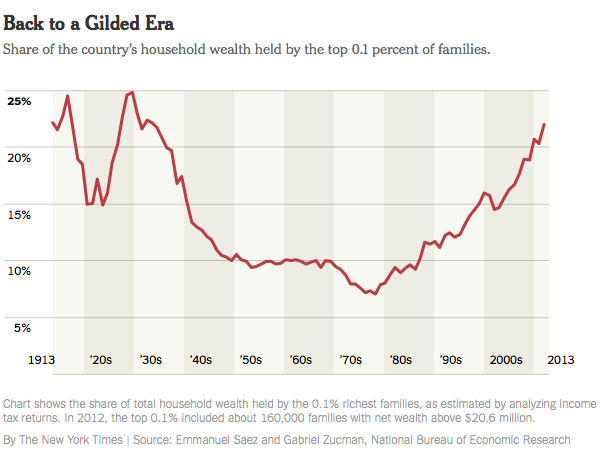
Conservative estimates published by the Brookings Institution show that from 1992 to 2013, the share of wealth held by the top 1 percent rose from 27 percent to 32 percent, and their share of income swelled from 12 to 18 percent. Looking at a century of data in “Wealth Inequality in the United States since 1913,” the economists Emmanuel Saez and Gabriel Zucman found that the share of household wealth held by the top 0.1 percent recently climbed back over 20 percent, a figure it hadn’t reached since the 1930s. (Their findings are demonstrated in the accompanying chart.)


There are a host of provisions in this year’s Tax Cuts and Jobs Act that disproportionately reward the rich, but the estate tax is one area where we can see the intentions of its sponsors most clearly.

The House legislation, backed by the Republican leadership and President Trump, would, starting in 2018, double the size of estates exempt from taxation to $10.98 million from the current level of $5.49 million. It would repeal the tax altogether at the end of 2023. According to the Joint Committee on Taxation, for the tiny percentage of the population that benefits from such immense estates, the value of the tax cut would grow steadily from $1.3 billion in 2018 to $38 billion in 2027.

Jason Furman, a professor of economics at Harvard’s Kennedy School who was chairman of the Council of Economic Advisers from 2013 to 2017, emailed his response to my inquiry about the impact of the bill on households with different incomes:
The House tax bill would lead to substantial redistribution from the middle-class to high-income households. Moreover, the particular form of the high-income tax cuts is designed to reward and perpetuate wealth in several respects. Much of the corporate rate cut would provide a windfall for the returns on capital investments that have already been made. Going forward, much of the effect of the plan would be to reduce the tax on monopoly rents-- often to negative effective rates which means taxpayers would be subsidizing corporations.
The House bill would repeal the estate tax, Furman wrote, and it “would also retain the step-up-basis loophole that even” President George W. Bush’s
estate tax repeal would have eliminated. This would mean that not only are estates not taxed but that much of capital gains could permanently escape taxation, substantially increasing dynastic wealth accumulation.
The estate tax has been under assault by Republicans in Congress for more than four decades. According to a paper published on Nov. 2 by Isabelle Sawhill and Eleanor Krause of the Brookings Institution, the estate tax currently applies to “a tiny fraction of American estates-- about 2 out of every 1000 deaths,” compared with “the 1970s, when there were over 70 taxable estates for every 1000 deaths.”

While income inequality is high in the United States-- the World Economic Forum ranked us 29th out of 30 developed countries in 2017-- wealth inequality is much greater.

...While proposing to eliminate the estate tax altogether, the House bill would retain a provision in current law-- the step-up in basis-- that effectively wipes out all tax liability for heirs on the increased value of assets at the time of death. Forbes declared, “this is a tax cut for the rich,” and described what would happen using the step-up in basis if you died with an estate that had grown in value from $10 million to $100 million:
There would be no estate tax, and your heirs could sell the stock right after your death and owe no capital gains taxes on the $90 million gain.
Many of the very richest Americans have children who stand to benefit enormously if the proposed tax bill is enacted. The list of these billionaires includes Mark Zuckerberg, Michael Bloomberg, Larry Ellison, Charles Koch, Sergey Brin, Larry Page, Phil Knight, Carl Icahn, Pierre Omidyar, David Koch, Warren Buffett, Bill Gates, Steve Ballmer, Sheldon Adelson, Michael Dell, Jeff Bezos, George Soros, and, of course, Donald Trump.

According to calculations made by Chye-Ching Huang, the deputy director of federal tax policy at the Center on Budget and Policy Priorities, a liberal think tank,
repealing the tax would give about 330 estates (which are each worth more than $50 million) each a tax cut averaging more than $20 million compared to current law.
The estate-tax provisions in the proposed bill are explicitly designed to help preserve and protect the assets of the wealthiest Americans. And despite their stated purpose, the corporate tax breaks in the legislation will not encourage new investment, according to many economists, but will instead reduce the taxes due on existing investments. Alan Krueger, a professor of economics at Princeton who was the chairman of the Council of Economic Advisers from 2011 to 2013, put the case against the Republican tax bill succinctly in an email:
Several components of the House bill favor physical and financial capital over labor and human capital-- namely, the lower rate for passive pass through income, the repeal of the estate tax, the big cut in the corporate tax rate, the failure to end the carried interest loophole, etc. At the same time, the tax on university endowments and treatment of grad student fellowships will slow human capital investment.

If enacted, these features of the proposal would also deepen and further entrench existing class divisions and reduce economic mobility.
That sure doesn't sound the way Paul Ryan describes the bill-- let alone remotely connected to anything Trumpanzee campaigned on last year, with all that talk about helping "the forgotten Americans." Edsall quoted an analysis by the Tax Policy Center concluding that:
The largest cuts, in dollars and as a percentage of after-tax income, would accrue to higher-income households. However, not all taxpayers would receive a tax cut under this proposal-- at least 7 percent of taxpayers would pay higher taxes under the proposal in 2018 and at least 25 percent of taxpayers would pay more in 2027.
"In other words," he wrote, "the Trump tax bill, contrary to the president’s populist spin, is a classic trickle-down proposal, concentrating by far the largest share of benefits on corporations and the rich."
In a blog post called “All Hail the New Plutocratic Industrial Policy,” Daniel N. Shaviro, a professor of tax law at N.Y.U., argues that the tax bill has been carefully crafted to create a new class of rich people who can evade the 39.6 percent top rate and pay at a 25 percent rate by capitalizing on complex “pass-through” and “passive-income” provisions:
So what must you do, or whom must you be, to get the 25% rate? First, you get it for 100% of your net business income from passive activities, which generally are business activities in which you personally do not materially participate. This typically applies to people who invest money in all kinds of partnerships, S corporation activities, et cetera that engage in pretty much any type of business.
Shaviro calls this obscure set of provisions in the tax bill “a weapon to enhance plutocracy-- offering the biggest rate cut to millionaires,” allowing those “who are in effect rentiers to get the low (25 percent) rate” on all their income.

A Nov. 2 analysis by the Center on Budget and Policy Priorities of the 25 percent rate for passive investors supports Shaviro’s point. A key reason the tax plan “is costly and heavily tilted to the wealthiest households is its special, much lower top rate for ‘pass-through’ business income,” Chuck Marr, Chye-Ching Huang, Brandon DeBot and Guillermo Herrera, all on the center’s staff, write. They continue:
Pass-through income would be taxed at no more than 25 percent, far below the 39.6 percent top individual income tax rate that now applies to pass-through income, or the top 35% top rate that would apply to individual income under the GOP plan. This would provide a massive windfall to the very wealthy.
This section of the bill has been nicknamed the “Trump loophole” by the center
because Donald Trump exemplifies the type of business owner whom it would most benefit.
Allan Sloan, a columnist for the Washington Post, wrote on Nov. 7 that
We don’t know how much Trump collects in such income, which has become passive for him since he put his children in charge of his enterprises rather than running them himself. But given that he seems to have stakes in at least 500 pass-through entities, it looks like reducing his rate to 25 percent from 39.6 percent would save him a ton of money.
...“[T]ax cuts for the rich” is no caricature. This year’s bill is already setting new tax avoidance schemes in motion... as it becomes clear once again that a favor-the-rich, reward-the-already-affluent ideology is embedded in the Republican Party’s DNA.

Labels: , , ,

Friday, September 15, 2017

The Truth About The Trumpanzee Tax Plans

>


Former CNN Chief Business Correspondent Ali Velshi, now an MSNBC anchor, is not an idiot... but... On his morning show yesterday the Hairless Prophet of Doom introduced a question to Jared Bernstein, once a professor at Columbia and then Vice President Biden's Chief Economic Adviser, by claiming that Trump's plan to eliminate the estate tax would help the middle class. Before Bernstein got to whatever Velshi's question was, he addressed the GOP talking point Velshi had just slipped onto the air so matter-of-factly. The estate tax only impacts .02% of the richest Americans. ZERO is paid, he said, by any estate worth under $11 million. Velshi pushed back with another Republican Party myth: "but the family farms..." Bernstein cited the NY Times exhaustive search for a family farm, GOP congressmen are always whining about, that has been impacted by the estate tax. That found exactly none-- not one.

Trump's largely nonexistent tax proposal is entirely based on a tissue of outright lies. At a meeting with lawmakers from both parties in the Cabinet Room this week, Señor Trumpanzee insisted that the so-called Tax reform plan his Regime is still trying to draft "will not lower the amount of taxes paid by the wealthiest Americans." Fox News pushed his lies:


Trumpanzee claims the amount of taxes-- even his own-- could even go up. "The rich," he bullshitted, "will not be gaining at all with this plan. We are looking for the middle class and we are looking for jobs-- jobs being the economy. So we're looking at middle class and we're looking at jobs. I think the wealthy will be pretty much where they are, pretty much where they are... If they have to go higher, they'll go higher." Tucson-based GOP mental midget Martha McSally (video up top) bought right into it. She's so fucking stupid-- a Republican version of Blue Dog Josh Gottheimer of New Jersey. Americans For Tax Fairness are not as gullible as McSally. They pointed out that Trump's nonsense might be music to the ears of Congress' most foolish members (the so-called "Problem Solvers Caucus") but that doesn't make any of it real or true.

Frank Clemente, Executive Director, Americans for Tax Fairness, replied without mincing words: "That's a lie. Trump's current tax plan will overwhelmingly benefit millionaires, billionaires, and large corporations, at the expense of everyone else. The top 1% will get half of his proposed tax cuts-- $175,000 each on average. Trump plans to pay for his massive tax giveaway with budget cuts to Social Security, Medicaid, public education and other priorities for the middle class. He even plans to cut $667 million from FEMA next year. Unbelievable."
Here are the facts about Trump's tax plan as outlined in April 2017:
Half of the tax cuts in Trump's plan will go to the top 1% (those making more than $732,900).
The average tax cut for the top 1% will be $175,000.
The average tax cut for a family making between $25,000 and $48,600 will be $210.
A quarter of all families making between $48,600 to $86,100 will actually see their taxes INCREASE.
On top of that, these tax cuts for millionaires will be paid for by Trump's budget cuts to Social Security, Medicaid, public education, and many other priorities for working families and the middle class-- including FEMA and other disaster recovery agencies.

A few other things to note:
Trump's tax cuts will not create jobs.
Trump's tax cuts will not trickle down to workers.
Trump's tax cuts will not benefit small businesses.
Ro Khanna (D-CA) and Sherrod Brown (D-OH) have offered a viable alternative to the Trump Regime's bullshit plan to make the rich richer. On Wednesday they introduced a bill that would give low-income and working-class taxpayers a big tax credit, dramatically expanding the Earned Income Tax Credit, which Republicans would like to abolish altogether. The EITC helps people at the bottom end of the salary range. Low-income taxpayers without dependent children would see their credit rise from a maximum of $510 to $3,000, and families would see their maximum rise from $6,318 to $12,131, depending on their income and number of children. Economists say the increased credit would help compensate for the fact that working class salaries have stagnated in recent decades even as the U.S. economy has continued to grow.

Khanna knows Paul Ryan will never allow his plan to even get a vote in Congress while he's Speaker, but he's hoping Democrats will incorporate it into their own vision of ameliorating massive and increasing wealth inequality in this country. He said he's hopeful that his plan "is going to be our party’s answer to Donald Trump on taxes. While he’s proposing tax cuts for the investor class, we’re proposing support for the working and middle class. He is counting on a separate financial transaction tax and taxes on the highest-earning incomes to pay for it. The San Jose Mercury News reported that "Experts say the Trump plan would give the largest benefits to corporations and individuals with high incomes. The Brown-Khanna plan, on the other hand, would increase credits for families making up to about $75,000 and individuals without children making up to about $37,500."
Expanding the Earned Income Tax Credit would do more to help working-class Trump voters than tax cuts for the wealthy, argued Chuck Marr, an economist at the liberal Center on Budget and Policy Priorities. “If you were to take seriously the people he was talking about in the campaign-- rust belt workers, truck drivers, cooks in restaurants, people who clean offices-- this is what you would do,” Marr said.

The credit was first introduced in 1975 as a way to incentivize low-income people to get work and stay off of welfare. It has been expanded over the years, and most economists, both liberal and conservative, see the credit as a successful policy to boost low wages.

...Khanna said his proposal is already getting support from prominent Democrats. He said he’s heard from potential Democratic presidential candidates interested in backing the bill, including senators Kirsten Gillibrand (D-NY) and Cory Booker (D-NJ). Rep. John Delaney (New Dem-MD), who is the first declared 2020 presidential candidate from the party, will be a co-sponsor.

The Brown-Khanna plan would boost wages for full-time and part-time workers alike, which Khanna said made sense for an economy of more Uber drivers and other workers with uncertain incomes. It would also let taxpayers request a credit in the middle of the year instead of waiting to receive their refund check, in order to help them pay for large, unexpected expenses.

The plan could fit in with the Democratic party’s larger economic message, which has focused on increasing wages. “The question is how are you going to do that. Democrats need to have an answer, and this is an answer,” Khanna said. “People say, ‘don’t just be against Donald Trump, tell us what’re you for.’ This is what we can be for.”

Even a few extra hundred dollars in the tax credit would go a long way for low-income people in the Bay Area, said Marie Bernard, the executive director of Sunnyvale Community Services, a financial aid organization that helps residents of Santa Clara County. Some of Bernard’s clients count the days until their EITC check arrives in April, and find their tax credit to be the difference between paying rent and being evicted.

“There are so few resources for smaller families and single people,” she said. “This will go straight to keeping them housed and fed.”

Labels: , , , , ,

Thursday, August 31, 2017

Trump Tax Cuts For Multi-millionaires Will Be Paid For By Painful Cuts To Social Security, Medicare, Medicaid, Education

>


On Tuesday we asked half a dozen of the Blue America candidates how eager they are to go on the offensive over the GOP tax agenda. All of them are very eager to do just that. For example, James Thompson, the candidate for the Kansas congressional district centered around Wichita, thinks if the 2018 election iOS decided on tax policies, he'll be the next congressman from KS-04. "If you want to know what will happen to the rest of the United States as a result of Trump's tax reform," Thompson told us Tuesday morning, "just look at Kansas. The so called 'tax reform' being pushed by President Trump and Ron Estes is the nationalization of the same failed trickle down tax experiments of Sam Brownback in Kansas. Our schools and hospitals are underfunded and closing. Our infrastructure, especially in rural areas, is collapsing. Our businesses are leaving our state. Our guards in the prison system are underpaid and overworked in overcrowded prisons. Our police departments don't have the money for proper training and are short staffed. Our mental health care facilities, formerly number one in the country, are now ranked at the bottom. More and more people are falling below the poverty line. These are just a few of the examples of what 'tax reform' did to Kansas. The filthy rich got the tax break goldmine, and the working people of Kansas got the shaft. Supply side economics do not work. Businesses do not hire new employees because of tax breaks. Demand drives business. Rather than trying to get a bigger piece of the pie, how about increasing the size of the pie? Paying a living wage will circulate more money into the economy and create a larger tax base. Finally expanding Medicaid will allow 100,000 additional Kansans to get medical care, again pumping more money into our local economy. We have lost more than 2 billion dollars in the last couple of years as a result of failing to expand Medicaid. Using targeted trade agreements to allow farmers to sell their products internationally while also protecting the wages of our working class people at home will bring more money into our state. Republicans don't want to do this though, they want the pie all for themselves. In Kansas, we say 'pigs get fat, and hogs get slaughtered.' The Republicans are all greedy hogs lined up at the 2018 trough gorging themselves on the slop Trump is feeding them."

The next day, Tumpanzee was in Springfield, Missouri promoting his tax plan-- with one lie after another-- at a closed-to-the-public event behind the closed doors of one of his rich campaign donors. Just before Trump spoke, Frank Clemente, executive director of Americans for Tax Fairness, warned the media to “Make no mistake; what Trump and Republican leaders in Congress are proposing is not tax reform. They simply want massive tax cuts for millionaires, billionaires, and big corporations, at the expense of everyone else. And those tax giveaways will be paid for by cuts to Social Security, healthcare, education and other programs that maintain living standards for working families. It’s Trumpcare all over again, and it must be blocked.”

When Señor Trumpanzee says he will enact historic tax reform, as he always brags he will, all he's talking about is a fairly standard conservative $5 trillion tax giveaway benefitting the wealthy and big corporations. What there is of a Trump budget shows tax cuts being paid for by $4.3 trillion in cuts to Social Security, Medicare, Medicaid, education, and other services that help working families get by in the GOP law of the jungle society they envision. He claims his plan will help the middle class but his revisions to the tax code primarily benefit the top 1% of income earners, no one's definition of the middle class. Everyone in the top 1% gets, on average, a nice $175,000 tax cut. Something like 25% of middle-class families would actually pay higher taxes under the Trumpanzee/Paul Ryan plan. Even worse, Trump would pay for his tax cuts for the wealthy and corporations by cutting public services working families rely on, such as Social Security, Medicaid, education, infrastructure, nutrition programs and other vital services.

Likewise, his bullshit claims that his plan helps small businesses are nothing but a hoax-- another boon for the wealthy. Trump says he's going to lower small business' taxes to 15% but most small businesses already pay taxes at a 15% rate or lower, so less than 7% of business owners would get any tax cut. More than three-quarters of the tax cuts would go to the richest 1% of business owners, who would get an average tax cut of $75,000 each year. These are not Main Street shopkeepers, but hedge fund managers, Wall Street lawyers and real estate developers like Trump, who would lower his own tax rate from roughly 40% to 15%.


And Trump was braying in Springfield, as Republicans always do, that corporate and individual tax rates need to be reduced because we have the highest taxes in the world-- a flat out lie Republicans love to recite endlessly. As Americans for Tax Fairness has shown, Americans are not taxed higher than other countries and, as a percentage of the overall economy, Americans pay less in taxes than 30 of 35 other similarly developed countries. And although the official corporate tax rate is 35%, most corporations pay much less because of loopholes. In fact, the Government Accountability Office found that profitable U.S. corporations paid an effective tax rate of only 14% from 2008 to 2012.

And when Trump boasted that his plan making deep cuts to the tax rate on accumulated offshore corporate profits will “bring that cash home” to be “reinvested” in the American economy, it's a complete conservative fantasy. The GOP's proposal to tax those offshore earnings at just 10%, instead of the 35% they currently owe, amounts to a $600 billion tax cut for tax-dodging corporations-- a huge loss of revenue that could be used for economy-boosting public investments. When Congress provided a similar tax giveaway in 2004, corporations that brought home their profits cut tens of thousands of jobs and gave 90%-- so 90 cents of every dollar-- in earnings brought home to rich shareholders through stock buybacks and dividends.

Americans For Tax Fairness: "Recent experience and academic research both show that tax cuts for the wealthy and corporations are a poor way to stimulate the economy and create jobs. And Trump’s proposed deep budget cuts to infrastructure, healthcare, medical research and education won’t help create jobs, either... Only the richest one of every 500 estates currently pays the estate tax-- the estate must be worth $5.5 million or more to be affected. The only effect abolishing the estate tax will have on American workers is to deprive them of over $20 billion in annual revenue, which pays for public services used by those who haven’t inherited a fortune... Big corporations don’t need a tax cut-- what they need is to start paying their fair share of taxes again.

As Sam Jammal, the progressive opponent challenging Wall Street shill Ed Royce-- Royce has taken an astronomical $7,303,507 in bribes from the Financial Sector since coming to Congress in 1993-- told us earlier in the week, he finds "this whole tax reform conversation to represent everything wrong with Washington. Right now, thousands of lobbyists are lining up with their own 'fixes' to our tax system. Everything is centered on how the most wealthy will benefit. None of the conversation is about how we help working families... Tax reform should be about making sure the middle class is still a reality for our community. We should scrap corporate tax reform and focus on reforms that help regular people. This includes increasing the Earned Income Tax Credit, expanding deductions on child care, student loans and home ownership, and promoting job creation by entrepreneurs and small business-- not paybacks to the uber wealthy. We can't continue to have an economy where so few can get ahead and so many are falling behind. Everything we are hearing on Trump's tax reform looks like a bad deal for our families. We need to stop this 'reform.'"

Goal ThermometerMatt Cartwright is one of a small handful of progressive Democrats reelected last year in district that Trump won (click on the thermometer on the right for the list). Trump beat Hillary in Matt's largely blue collar Pennsylvania district 53.4% (10 points better than Romney had done) to 43.3% (12 points worse than President Obama had done in 2012). Meanwhile, Cartwright, an assertive and skillfiul champion for working families, was reelected 53.8% to 46.2%, a margin of over 20,000 votes. But the Republican Party is targeting Matt in a big way this cycle. They've recruited a self-funding Wall Street hack, John Chrin, a former managing director at JP Morgan Chase who lives on millionaires' row in swanky Short Hills, New Jersey-- a Wall Street company town. He claims he can run in PA-17 because his paternal grandfather owns a company that owns a landfill in Northampton County. Chrin's mansion is about a two hour drive--more if there's traffic on the I-80-- from Scranton and Wilkes-Barre in the district. He lives in Leonard Lance's district although I suppose he can move into his grandfather's company's landfill if the commute to PA-17 gets too arduous for him. Trump's tax plan is tailor-made for people exactly like John Chrin. Above is the new ActBlue "Trump District Progressives" thermometer. It's important; please take a look.

Yesterday, Matt, a member of the House Appropriations Committee, told us that his "own impression is that in all likelihood, the GOP tax plan will follow the 2017 playbook for major Republican legislation:  it will be introduced with much fanfare and loudly ballyhooed by the president. Then, people will read it. These people will include the diligent accountants and analysis at the nonpartisan Congressional Budget Office. The CBO will score it and reveal it to be an unabashed giveaway to the wealthiest people in America, an actual tax increase to many middle-income earners, and a drain on Social Security, Medicare and Medicaid. The ensuing public outcry will stun even the most insensate GOP members of Congress, and result in the president blaming GOP congressional leaders and claiming he never had anything to do with it. Then the president will send out an astonishing tweet, on a different subject, so outrageous as to be incapable of being ignored, attempting to get everyone to forget about his festival of legislative failures and broken promises. How long Americans continue to fall for this nonsense is anybody’s guess."

Ro Khanna represents a big chunk of white collar Silicon Valley. He also represents the solidly middle and working class blue collar areas in the South and East Bay like Newark and Fremont. He's no more a fan of Trump's tax plan than Matt Cartwright is. He told us that "Trump's $5 trillion giveaway to the speculator class is not just morally wrong but also hurts our economic growth. If we really want to grow the economy at 3 percent, we should use that money instead to give tax credits to working families, to have Medicare for all, to invest in research and development, to provide debt free college and to support apprenticeships, tech courses, and vocational education. The democrats need to make the case that our policies are pro growth and pro American competitiveness.  We also shouldn't be afraid to provide a bold $5 trillion plan for investing in our economy as a counter to Trump."

Meanwhile, in the alternative universe on the fringes of American society, this is not a parody of the Bannon-Mercer neo-Nazi website, Bretbart. This is an actual Breitbart page from yesterday. This is what the neo-Nazis across America are reading today. And remember, we're talking about people with 2-digit IQs incapable of intellectual discernment beyond that of a slow-witted 8 or 9 year old. And they're armed.


Labels: , , , , , , , , , ,

Tuesday, August 29, 2017

Trump Thinks His Tax Strategy To Give Paris Hilton's Dogs A More Luxurious Lifestyle Will Energize GOP Voters

>

Gunster, Trumpster and a batch of U.K. neo-Nazis

While congressional leadership incompetence and Señor Trumpanzee's tweet rages against fellow Republicans will drive down turnout for the 2018 midterms among his supporters and others on the far right, well-funded GOP superPACs are preparing to lure voters to the polls with packages of ballot initiatives that appeal to racists, homophobes, Nazis, xenophobes and other key contingents of the Republican Party base. Yesterday, Alex Isenstadt reported that the West Wing is coordinating the efforts and that the White House thinks "tax reform" is the issue to motivate and invigorate conservatives.

I guess the theory is that Republican dog lovers all want to end the estate tax so Paris Hilton can inherit even more money and so that her dogs' can live even more glamorous lives than they already do in their lovely "doggie mansion." Thanks for the tweet, Paris.


The shots, reported People Magazine, "show the outside and inside of the luxe doggie digs. Hilton isn’t lying. There is an easy-to-spot chandelier, and several pieces of fancy-looking furniture placed against the house’s pink (of course) walls. The outside photo shows one of Hilton’s small pups enjoying the second-story balcony, while another frolics on the grass below. So while you struggle with the choice of paying a massive energy bill or living as a human sweat blob for the next month, take comfort in the fact that at least Hilton’s dogs are living comfortably." That should help turn out the Trumpanzee base, right?

The White House goal is to defeat Jon Tester (D-MT), Heidi Heitkamp (D-ND) and Claire McCaskill (D-MO). Someone, I suppose, figures that right-wing voters (and independents) in Montana, North Dakota and Missouri think billionaires and multimillionaires are being treated unfairly by the tax code. Who could be that stupid?
Spearheading the discussions is Republican strategist Gerry Gunster, a referendum expert who helped to lead the successful 2016, populist-infused campaign for Britain's exit from the European Union. Gunster-- who visited then-president-elect Trump in New York City along with Brexit leader Nigel Farage after the November election-- has spoken about the ballot initiative concept with top administration aides, including political director Bill Stepien and Nick Ayers, the chief of staff to Vice President Mike Pence and a veteran GOP operative.

Still, it's an open question whether a White House-backed ballot initiative effort will materialize. Those involved caution that the plans are in a preliminary stage and that the White House, while intrigued, has yet to give final signoff.

Complicating matters has been the departure of chief strategist Steve Bannon, who was a leading internal proponent of the idea and thought it should be an administration priority heading into 2018.

Yet several people involved raised the prospect that Bannon, now free from the constraints of government, could orchestrate a campaign from the outside. He would have the financial resources: Bannon has a patron in Robert Mercer, the reclusive New York hedge fund billionaire who has long funded his political projects.

Neither White House officials nor Bannon would comment on the record. Gunster declined to discuss his talks with administration officials, but noted that his firm “has a well-documented history of managing initiatives and referenda that focus on tax reform and job growth. We do frequently work on state ballot measures that remove barriers to doing business."

An administration-led campaign would give conservatives a counterweight to liberals, who have already begun circulating possible initiatives in states aimed at mobilizing supporters in 2018-- some of them centered on marijuana legalization. Several midterm battlegrounds, including Missouri, Florida and Arizona, may see cannabis-related items on the ballot.

Some Republicans contend that putting tax cut-related measures on the 2018 ballot could give the party a boost.

"Probably it has some effect. It never hurts to have Republicans push on issues that are core to the party and that get people motivated," said Steve Linder, a GOP strategist in Michigan who has worked on nearly a dozen ballot measures, including the state’s 2004 anti-gay marriage amendment. "It's a way to reinforce the base, and can it help around the edges? Yes it can."

The deliberations come at a sensitive time for senior Republicans. They're increasingly worried that the party’s meager legislative accomplishments so far, the ongoing special counsel investigation of Trump campaign ties to Russia and the president’s intensifying war with GOP leaders will depress the base in 2018.

...The extent to which the anti-gay marriage amendments boosted Bush in 2004 is the subject of debate. In the immediate aftermath of his reelection, there was general agreement that the 11 amendments, all of which were approved by comfortable margins, jolted turnout in Bush’s favor.

But in the following years, some political observers began to question the influence it had on the election results. A 2006 report by the Pew Research Center concluded that while an amendment may have been decisive in the critical state of Ohio, their effect in other states was less clear.

...Some Republicans are skeptical that running an initiative campaign will do much to help their 2018 prospects. Jeff Flint, a Republican strategist in California who specializes in ballot initiatives, said the party would need to find an issue that tapped into a deep vein of frustration in order to drive turnout. He argued that a tax cut-focused effort wouldn’t do the trick.

Absent such a driving issue, voters are bound to be influenced by their opinion of Trump and his performance, Flint said.

"Nine times out of 10," he said, "turnout is driven by the top of the ticket, or the" president.
This morning Trumpanzee's chief economic advisor, Gary Cohn, the multimillionaire who Trumpanzee drafted from Goldman Sachs, was reported to have told a gaggle of Democratic senators that "only morons" pay the estate tax. Another way of putting it is that only criminals don't pay estate taxes. What the real morons-- Republican base voters who can be manipulated by these GOP SuperPAC appeals-- don't understand is that the estate tax is a 40% levy applied to the portion of an estate valued at over $5.49 million for individuals or $10.98 million for couples and that because it's a tax that applies only to the very wealthy, it only affects one out of every 500 taxpayers. The number of people actually paying the tax, and the money it raises have both plunged drastically in recent years. In 2008, the estate tax raised $25 billion; in 2015 that was down to $17 billion. Criminally-minded tax attorneys are the primary culprits. Democratic candidates we asked about the Trumpist plans to run on their version of "tax reform" were unanimous: BRING IT ON!

Lamar Smith's progressive opponent for next year (TX-21), Derrick Crowe, is looking forward to debating him on taxes and using the issue to help him win the election and flip the seat red to blue. "Donald Trump's 'enrich the rich' tax plan," he told us confidently, "is as likely to prompt his target voters to pick up pitchforks and torches as it is to help win an election. Inequality is tearing apart the social fabric of this country. If you look at where GOP rhetoric has been translated to tax policy--like, say, Texas-- you find voters on the edge of revolt due to skyrocketing, regressive property taxes and underfunded state services. The rigged economy is already tilted heavily toward the ultra-wealthy, and people know it. Trump is just revealing whose side he's really on-- and it's not the side of the working class. There's no way that translates to electoral victory in 2018 or 2020."

James Thompson should only be so lucky to have his election determined by a debate over taxes! "Red state" Kansas has come to know what GOP tax plans mean for ordinary people. "If you want to know what will happen to the rest of the United States as a result of Trump's tax reform," warned Thompson, "just look at Kansas. The so called 'tax reform' being pushed by President Trump and Ron Estes is the nationalization of the same failed trickle down tax experiments of Sam Brownback in Kansas. Our schools and hospitals are underfunded and closing. Our infrastructure, especially in rural areas, is collapsing. Our businesses are leaving our state. Our guards in the prison system are underpaid and overworked in overcrowded prisons. Our police departments don't have the money for proper training and are short staffed. Our mental health care facilities, formerly number one in the country, are now ranked at the bottom. More and more people are falling below the poverty line. These are just a few of the examples of what 'tax reform' did to Kansas. The filthy rich got the tax break goldmine, and the working people of Kansas got the shaft. Supply side economics do not work. Businesses do not hire new employees because of tax breaks. Demand drives business. Rather than trying to get a bigger piece of the pie, how about increasing the size of the pie? Paying a living wage will circulate more money into the economy and create a larger tax base. Finally expanding Medicaid will allow 100,000 additional Kansans to get medical care, again pumping more money into our local economy. We have lost more than 2 billion dollars in the last couple of years as a result of failing to expand Medicaid. Using targeted trade agreements to allow farmers to sell their products internationally while also protecting the wages of our working class people at home will bring more money into our state. Republicans don't want to do this though, they want the pie all for themselves. In Kansas, we say 'pigs get fat, and hogs get slaughtered.' The Republicans are all greedy hogs lined up at the 2018 trough gorging themselves on the slop Trump is feeding them."

Goal ThermometerTom Guild, another example of a "red state" Democrat not afraid of Trump's hollow threats, is running for a seat in Oklahoma that Trump won 53.2% to 39.8%. And he's not shying away from a very progressive approach to taxes that emphasizes fairness for working families and the middle class. "The Oklahoma GOP," he told us today, "has all the political marbles in Oklahoma. They control the state House of Representatives by a 3 to 1 margin and the state Senate by a 5 to 1 margin. They have the governor’s office and all statewide state offices to boot. If you look at their supply side tax policy, you would likely conclude that they didn’t have all their marbles when they adopted their trickle down tax plans. Because of the failure of trickledown economics in Oklahoma, our state is a fiscal basket case. We have had a revenue failure a number of years in a row and the gap widens as time goes on. This is due to their string of state income tax cuts for the wealthy, and their lowering of the oil and gas gross production tax from 7% (the lowest in the nation at the time) to 2% (by a country mile the lowest in the nation). They sold both types of regressive tax cuts as a way to produce more revenue for the state.  Well, their theory is an accountant’s nightmare. Teachers, who are at the bottom of the barrel nationally in salaries are fleeing the state in droves. This leads to emergency certification of replacements who aren’t quite qualified to teach. The number of emergency certifications has increased exponentially over the past few years. We can’t fund public health, including Medicaid and mental health programs. We are slashing senior nutrition programs and cutting child welfare workers in the face of a court order that demands we go in the other direction and increase state employees checking in on our vulnerable children. Our gaping potholes and chasms in our state and local roadways cost the average Oklahoman a pretty penny every year in damage to their vehicles. The GOP legislature outlawed raising the minimum wage at the local level as we were petitioning to raise the wage in Oklahoma City. Many Okies are working multiple jobs and still not able to keep their households above water. College students graduate with a bachelor’s degree and more than $30,000 in student loan debt and the shortfall increases every year because of cuts to the higher education budget. Lax regulation of the fossil fuels industry in Oklahoma has led to an unimaginable increase in human induced earthquakes, that are shaking many Oklahoma families to their core and causing many huge increases in out of pocket expenses. If Trump and his Billionaire’s Club Cabinet do for the U.S. what supply side trickledown economics has done for Oklahoma, the whole nation will be economically on its knees. Enough is Enough! We must elect progressives who put working people and the middle class first and attend to the basic necessities of the least among us."

North Carolina's Jenny Marshall has a similar perspective. She's running for the seat held;d by Virginia Foxx, who strictly represents the interests of the rich, rather than the middle and working class residents of NC-05. Foxx is a complete rubber stamp for Trump and Ryan. "North Carolina's GOP also gave away millions in tax breaks for the rich while saddling the average person with more taxes on labor costs such as auto and appliance repairs," said Jenny. "This is a typical GOP move. Reduce taxes for the rich with no regard to the fallout. My campaign's main issue is the economy. With 50% of my district living in low income or poverty households, Trump's tax reform falls on deaf ears. My community does not need a tax break. They need good paying, dependable jobs they can raise a family on. Minimum wage just doesn't pay the bills, yet rather than focus on raising wages and creating sustainable jobs, Trump wants to give the ultra wealthy a tax break. It just goes to show that the GOP leadership in Washington is out of touch with the everyday people of our country. I am committed to raising the minimum wage and the creation of jobs that will help the United States rebuild its infrastructure and increase our green energy sector."

The DCCC is trying to derail the campaign of young progressive Sam Jammal to help recruit their pathetic and unelectable silly recruit, a lottery winner who literally lies as much as Donald Trump! Sam is eager to debate Ed Royce on how the tax system should be reformed. "I find this whole tax reform conversation to represent everything wrong with Washington," he told us. "Right now, thousands of lobbyists are lining up with their own 'fixes' to our tax system. Everything is centered on how the most wealthy will benefit. None of the conversation is about how we help working families. My Congressman, Ed Royce, is too busy overseas to worry about what families in our community need. I would be shocked if we hear anything from him, other than a solid 'yes' vote for whatever scheme Trump and Ryan come up with. Tax reform should be about making sure the middle class is still a reality for our community. We should scrap corporate tax reform and focus on reforms that help regular people. This includes increasing the Earned Income Tax Credit, expanding deductions on child care, student loans and home ownership, and promoting job creation by entrepreneurs and small business-- not paybacks to the uber wealthy. We can't continue to have an economy where so few can get ahead and so many are falling behind. Everything we are hearing on Trump's tax reform looks like a bad deal for our families. We need to stop this 'reform.'"

And Randy Bryce, the ironworker and union and veterans' activist, challenging Paul Ryan for the southeast Wisconsin congressional seat, reminded us that "At the recent CNN media event that Paul Ryan had, he let it slip that tax reform really meant 'tax cuts' for the rich. The Banana Republicans aren’t fooling anyone when it comes to who they stand with. People across the country are admitting to having buyer’s remorse due to the 2016 election, and I personally can not wait for November 6, 2018 when we end one chapter that had them trying to bury working people only to find out that we were seeds."


Labels: , , , , , , , , , , , ,