Friday, August 02, 2019

Trump Doesn't Know The First Thing About Making A Deal-- Let Alone With China... His Expanding Trade War Is Hurting Us More Than Them

>


Yesterday, the Dow was flying-- celebrating the interest rate reduction-- and reached 27,188 before Trump announced another round of tariffs against China. Markets immediately plummeted, the Dow crashing nearly 300 points to 26,700.  World markets continued trending downwards today, the Dow off 90 points as we prepared to publish and the NASDAQ down 110. Yesterday the orange-hued monkey in the White House said he'll target $300 billion in Chinese products with a 10% tariff in exactly one month if they don't bend to his will by then. He then told reporters that if he wants to he might increase the tariffs to 25% or more. (Bloomberg News reported this morning that Trump ignored Mnuchin's advice to warn China in advance of what he was about to do.) One frustrated member of Congress told me this morning that he's a "disgusting, dangerous pig" and, at the same time, "a bull in a china shop... Remember, this is a sales tax Trump is making American consumers pay; the only person who doesn't seem to understand that is the self-proclaimed Wharton graduate in the White House."
The new tariffs could hit US consumers harder than the earlier rounds. It would tax goods like iPhones and other consumer electronics, sneakers and toys. Last year, Trump imposed tariffs on about $250 billion in Chinese-made goods, targeting industrial materials and components.

As he has many times before, Trump claimed-- falsely-- that the tariffs have cost China rather than American consumers.

"We're taking in many billions of dollars. There's been absolutely no inflation and frankly it hasn't cost our consumer anything. It cost China," Trump said in his remarks, adding that companies are now moving out of China to avoid the tariffs.

In fact, economic studies show that US consumers, not China or other foreign importers, are bearing the weight of the duties. The White House's most recent Economic Report of the President, released in March, acknowledged that any benefit from the tariffs is offset by "costs paid by consumers in the form of higher prices and reduced consumption."

Trump issued his new threat of tariffs on China following a mid-morning meeting in the Oval Office with his trade team meant to update him on talks that wrapped this week in Shanghai, according to an administration official familiar with the matter.

The team includes Treasury Secretary Steven Mnuchin and US Trade Representative Robert Lighthizer.

Trump wasn't pleased that China had not offered concrete promises to purchase American agricultural products during the talks, something he believed was agreed to when he met with Chinese President Xi Jinping in June at the Group of 20 summit in Japan, according to the official.

At the time, Trump said he'd put off imposing new tariffs indefinitely."We won't be adding an additional tremendous amount of-- we have, I guess, $350 billion left, which could be taxed or it could be tariffed. And we're not doing that," Trump said at the time.

While trade officials told Trump Thursday they believed there is still the potential for a deal to be struck with China, they said they were still far off from coming to any kind of agreement.

Trump issued the four-tweet message announcing new tariffs starting in September with input from Mnuchin and Lighthizer, according to the official.

In his tweets, the President called the talks "constructive," but said the Chinese have not restarted buying American agricultural products as they had promised. He also claimed that China had failed to live up to its commitment in stemming sales of fentanyl, a powerful opioid, into the United States.

American farmers have been hit hard by China's retaliatory tariffs. Once the biggest market for US soybean farmers, the Chinese stopped buying the American product last summer in retaliation to Trump's tariffs. By the end of 2018, the amount of American soybeans sitting in storage hit record levels.

The move to apply new tariffs is sure to increase anxiety among businesses and Wall Street that the trade war is nowhere near its end.

Equity and oil markets took a downward turn after Trump's tweets.

"The business community was surprised by the President's announcement of new tariffs," said Doug Barry, communications director for the US-China Business Council.

"We are concerned that today's actions will drive the Chinese away from the negotiating table," he added.

About 85% of the toys sold in the United States come from China and would be hit by the new tariff. In June, Hasbro president John Frascotti told US trade officials at a hearing that the duty would cause "significant and disproportionate harm" to the company and the broader US toy industry.

Tariffs that go into effect on September 1 could hit some of the toys that companies have already ordered for the holiday season, said Steve Pasierb, president and CEO of The Toy Association.

"We're worried about how much of the 10% tariff will get passed on to consumers across all categories. A lot of things are going to get more expensive, and toys aren't essential goods," he said.


A spokesperson for the Chinese foreign ministry told the media that China isn't looking for a fight but that Trump's move is a "serious violation" of the agreement Trump made with Xi Jinping in June and that China will take "countermeasures" if he follows through with his threats. "We don't want to fight, but we are not afraid to figh. China will not accept any extreme pressure, intimidation and blackmail." She said Trump should "abandon [his] illusions, correct mistakes, and return to consultations based on equality and mutual respect." 

Even before Trump made his announcement, his former Chief Economic Advisor, Gary Cohn, happened to do an interview with the BBC, where he asserted that Trump's trade war with China has had a "dramatic impact" on US manufacturing and capital investment and that the trade war was "a very convenient excuse" for China to slow down its overheated economy. Cohn warned that warned that "everyone loses in a trade war. We are an 80% service economy. The service side of the economy is doing very well, because, guess what, it's not being tariffed."
Cohn said the tariffs had made it expensive to import vital products from China, counteracting the effects of Mr Trump's tax cuts, which were designed to stimulate the US economy.

He said: "When you build plant equipment, you're buying steel, you're buying aluminium, you're buying imported products and then we put tariffs on those, so literally the tax incentive we gave you with one hand was taken away with the other hand.

"So we are not seeing the manufacturing job creation. And I think if we get through this tariff situation, there's a real opportunity to see it here in the United States."

...He thinks the trade wars have created geopolitical uncertainty, which is stopping businesses from investing. Strikingly he also thinks that, for all the rhetoric, the trade war with China is hurting the US more than it is the Chinese.

Mr Trump won't like reading that. Mr Cohn though delivered for the President on tax cuts and deregulation, one of the things that has given boosters to the US economy-- unemployment at record lows, wages rising, consumer confidence increasing.

Yes, the tax cuts have disproportionately helped the rich, and handed massive tax windfalls to corporate America-- but with a growing economy, and interest rates falling-- that doesn't seem to be a big concern.

Labels: , ,

Friday, March 02, 2018

Leaving The Trump Regime And Heading To Prison Are Two Different Balls Of Wax

>


Nancy Ohanian sees Kushner-in-law

It's like a Kinks song from the '60s, but who will the next be to leave the crumbling Trumpanzee Regime? Everyone was saying it was going to be McMaster-- and before April Fools Day. Then this morning Ben White reported for Politico that Gary Cohn-- still fuming he didn't get the Fed Chair-- would quit over the tariffs. Cohn, he wrote, "has been rumored to be on the brink of leaving the White House for months but stayed for one main reason: to stop the president from imposing steep tariffs. By Thursday afternoon, Cohn had lost the fight. In a meeting with steel industry executives, Trump announced plans for a 25 percent tariff on steel imports and a 10 percent tariff on aluminum imports. The decision came after a frantic 24 hours in which Cohn and others tried to talk Trump off the ledge. At one point, aides were sure Trump would make the announcement. Then they said he wouldn’t. Finally, sitting alongside steel executives, he did. The Dow promptly tanked over 500 points, and Cohn’s allies began wondering if this would be the final insult sending the director of the National Economic Council to the exit. One person close to Cohn, a former Goldman Sachs executive, said he wouldn’t be surprised if he eventually left the chaotic and deeply exhausting administration as a result of the decision. A second person close to Cohn described it as a brutal blow that violated one of the NEC director’s core beliefs—that protectionism is economically backward and won’t lead to increased prosperity."

But the tariffs and a peeved Gary Cohn aren't going to end Trump's Regime and McMaster will just be reshuffled into another slot. It's Hope Hicks, basically a sexy secretary, and her diary + Ivanka and Kushner-in-law who could do Trump in... Putin-Gate!! Earlier today the news came fast and furious but no one could forget the NY Times story about how Señor Trumpanzee is so frustrated with Kushner-in-law that even he finally recognizes him as "a liability because of his legal entanglements, the investigations of the Kushner family’s real estate company and the publicity over having his security clearance downgraded, according to two people familiar with his views. In private conversations, the president vacillates between sounding regretful that Mr. Kushner is taking arrows and annoyed that he is another problem to deal with." And this seems newsworthy: "Privately, some aides have expressed frustration that Mr. Kushner and his wife, the president’s daughter Ivanka Trump, have remained at the White House, despite Mr. Trump at times saying they never should have come to the White House and should leave. Yet aides also noted that Mr. Trump has told the couple that they should keep serving in their roles, even as he has privately asked Mr. Kelly for his help in moving them out." And here I though Kelly was moving against Kushner as a way of committing political suicide!

The Washington Post:
They were the ascendant young couples of the Trump White House: Jared Kushner and Ivanka Trump, and Rob Porter and Hope Hicks. They enjoyed rarefied access to the president and special privileges in the West Wing. Glamorous and well-connected, they had an air of power and invincibility. They even double-dated once.

But an unlikely cascade of events-- set in motion by paparazzi photos of Porter and Hicks published Feb. 1 in a British tabloid-- crashed down on Kushner this week. The shortest month of the year delivered 28 days of tumult that many inside and outside the White House say could mark the fall of the House of Kushner.

Once the prince of Trump’s Washington, Kushner is now stripped of his access to the nation’s deepest secrets, isolated and badly weakened inside the administration, under scrutiny for his mixing of business and government work and facing the possibility of grave legal peril in the Russia probe.
Ryan Grim painted an even grimmer picture-- for Kushner-- at The Intercept early, early this morning. Kushner's family firm "made a direct pitch to Qatar’s minister of finance in April 2017 in an attempt to secure investment in a critically distressed asset in the company’s portfolio, according to two sources. At the previously unreported meeting, Jared Kushner’s father Charles, who runs Kushner Companies, and Qatari Finance Minister Ali Sharif Al Emadi discussed financing for the Kushners’ signature 666 Fifth Avenue property in New York City." Charles! Wouldn't it be funny if he wound up back in his old prison cell? With his son down the cell block? I wonder who leaked this to the press:
The failure to broker the deal would be followed only a month later by a Middle Eastern diplomatic row in which Jared Kushner provided critical support to Qatar’s neighbors. Led by Saudi Arabia and the United Arab Emirates, a group of Middle Eastern countries, with Kushner’s backing, led a diplomatic assault that culminated in a blockade of Qatar. Kushner, according to reports at the time, subsequently undermined efforts by Secretary of State Rex Tillerson to bring an end to the standoff.

The Gulf crisis involving Qatar and its neighbors will likely be Kushner’s defining foreign policy legacy. The crisis followed a May visit to Riyadh, Saudi Arabia, by Kushner and President Donald Trump, who subsequently took credit for Saudi Arabia and its allies’ efforts against Qatar. The fallout has reshaped geopolitical alliances in the region, splitting the Gulf Cooperation Council and pushing Qatar, home to the Middle East’s largest U.S. military base, closer to Turkey and Iran.

...The news of Kushner Companies’ direct pitch to the Qatari government puts a Wednesday report from the Washington Post into broader context. U.S. intelligence services, the paper reported, had determined that officials in four countries-- the United Arab Emirates, China, Israel, and Mexico-- had been privately discussing how to use Jared Kushner’s real-estate investments as a way to gain leverage over him in order to influence official U.S. policy.

Kushner has divested from a small portion of Kushner Companies, but has retained substantial ownership. A balloon payment due in 2018 on the badly underwater property at 666 Fifth Avenue has been a ticking clock on the fortunes of the Kushner family, precipitating the global hunt for capital. The Washington Post reported earlier this year that the father-son pair, Jared and Charles Kushner, speak on a daily basis.

The New York Times reported last month that just prior to Jared Kushner’s visit to Israel and Saudi Arabia in May 2017, his family real estate company “received a roughly $30 million investment from Menora Mivtachim,” described as one of Israel’s largest financial institutions.
You don't think the Kush is in over his head-- and possibly headed for a very bad ending? Pay more attention. Watch a lovable, self-described "middle-aged, pot-bellied lesbian" who may have a new career as a crossword puzzle designer. And... read Axios on your cell while crossing the street. Jim VandeHei: Destroying Jared Kushner: a five-part play. "It’s no secret a lot of people inside and outside the White House want Jared Kushner gone. They think he’s too inexperienced, too compromised by conflicts of interest and the Russia probe, and too ineffective. Their revenge against him this week has been brutal, sustained, at times brilliant, and potentially lethal. What has unfolded is not the work of coincidence: it is the slit-by-slit slow bleed of a top adviser and son-in-law to the president." Is this Shakespeare? Or just more reality TV, playing for tawdry ratings?
Act I: The knee-capping

The public humiliation of losing his top security clearance was telegraphed and then executed by Chief of Staff John Kelly. It was promptly leaked. Kushner, who fancied himself a de facto Secretary of State and peacemaker, lost access to the power of information.
White House staff instantly turned unafraid to leak against Jared to reporters. He’s no longer seen as untouchable. Actually now seen as almost frail. They say he’s naive and has dim political insights.
At the same time, he lost his top image-shaper Josh Raffel, just when he needs him most. (Kushner has known for a while Raffel is leaving, but that doesn’t make the blow any easier.)
Act II: The humiliation

Nothing’s worse for ego and perception than to be seen as easy prey.  Cue the leak to the Washington Post: Foreign governments reportedly discussed ways to manipulate Kushner, "current and former U.S. officials familiar with intelligence reports on the matter" told the paper. They said his business dealings left him vulnerable.

Act III: The Godfather turns

Rupert Murdoch, the master of Fox and the Wall Street Journal, has advised Kushner for years. They are allies, friends, mentor and mentee. There was nothing friendly about the lead editorial in Murdoch's paper politely suggesting the “knives are out” and it’s time for Jared to skip town. “Giving up their White House positions would be a bitter remedy, but Mr. Kushner and first daughter Ivanka could still offer advice as outsiders.”

Act IV: The plot

You can’t execute family without cause. The whispers, which turned into constant conversation, which turned into screaming headlines, is that Kushner mixed too much personal business with official governmental work.
Kushner, the New York Times revealed on its front page, took White House meetings with private equity billionaires and his family business benefited from their loans afterward. There is "little precedent for a top White House official meeting with executives of companies as they contemplate sizable loans to his business."
Act V: Tortured Trump

One thing Jared and Trump have in common: they read Maggie Haberman and the New York Times. Nothing says family love and I’ve-got-your-back like this: 
“Mr. Trump is also frustrated with Mr. Kushner, whom he now views as a liability because of his legal entanglements, the investigations of the Kushner family’s real estate company and the publicity over having his security clearance downgraded, according to two people familiar with his views. In private conversations, the president vacillates between sounding regretful that Mr. Kushner is taking arrows and annoyed that he is another problem to deal with.”
The End?
Well, let's hope so... but maybe a long drawn-out and very tortured ending? How about that? Gloria Borgia Friday morning: "Not since Richard Nixon started talking to the portraits on the walls of the West Wing has a president seemed so alone against the world. One source-- who is a presidential ally-- is worried, really worried. The source says this past week is 'different,' that advisers are scared the President is spiraling, lashing out, just out of control. For example: Demanding to hold a public session where he made promises on trade tariffs before his staff was ready, not to mention willing. 'This has real economic impact,' says the source, as the Dow dropped 420 points after the President's news Thursday. 'Something is very wrong.' Even by Trumpian standards, the chaos and the unraveling at 1600 Pennsylvania Avenue are a stunning-- and recurring-- problem. But there's an up-against-the-wall quality to the past couple of weeks that is striking, and the crescendo is loud, clear, unhealthy, even dangerous." Uh oh... batten down the hatches. We all like the entertainment part... but the danger? Not so much. And it's coming; you knew it would.


Labels: , , , , , ,

Monday, September 18, 2017

No One In History Has Ever Presided Over A Swamp Like Trump's Swamp-- The Swampiest Swamp That Will Forever Define Swamps

>


Yesterday, during the tweet storm that is her life, Ann Coulter reminded the lunatics who follow her online that "The 1 fact (before DACA betrayal) that made die-hard Trump voters hate him: White House full of Goldman Sachs bankers," pointing to the must read essay by Gary Rivlin and Michael Hudson, Government By Goldman. She must really hate Trump by throwing this piece of red meat out to the fan boys she and Trump share. "Gary Cohn is giving Golman Sachs everything it ever wanted for the Trump Administration" is the best description of how Trump has dealt with his draining the swamp campaign promise.


It was Kushner-in-law who introduced Trumpanzee to Cohn, then still president of Goldman Sachs, at the end of November, an imperious, insecure man, like Trump, who is "at heart a salesman." They wrote how "Goldman Sachs had been a favorite cudgel for candidate Trump-- the symbol of a government that favors Wall Street over its citizenry. Trump proclaimed that Hillary Clinton was in the firm’s pockets, as was Ted Cruz. It was Goldman Sachs that Trump singled out when he railed against a system rigged in favor of the global elite-- one that 'robbed our working class, stripped our country of wealth, and put money into the pockets of a handful of large corporations and political entities.' Cohn, as president and chief operating officer of Goldman Sachs, had been at the heart of it all. Aggressive and relentless, a former aluminum siding salesman and commodities broker with a nose for making money, Cohn had turned Goldman’s sleepy home loan unit into what a Senate staffer called 'one of the largest mortgage trading desks in the world.' There, he aggressively pushed his sales team to sell mortgage-backed securities to unaware investors even as he watched over 'the big short,' Goldman’s decision to bet billions of dollars that the market would collapse."
On the campaign trail, Trump had spoken often about the importance of investing in infrastructure. Yet the president-elect had apparently failed to appreciate that the government would need to come up with hundreds of billions of dollars to fund his plans. Cohn, brash and bold, wired to attack any moneymaking opportunity, pitched a fix that would put Wall Street firms at the center: Private-industry partners could help infrastructure get fixed, saving the federal government from going deeper into debt. The way the moment was captured by the New York Times, among other publications, Trump was dumbfounded. “Is this true?” he asked. Was a trillion-dollar infrastructure plan likely to increase the deficit by a trillion dollars? Confronted by nodding heads, an unhappy president-elect said, “Why did I have to wait to have this guy tell me?”

Within two weeks, the transition team announced that Cohn would take over as director of the president’s National Economic Council.

...The conflicts between the two men were striking. Cohn ran a giant investment bank with offices in financial capitals around the globe, one deeply committed to a world with few economic borders. Trump’s nationalist campaign contradicted everything Goldman Sachs and its top executives represented on the global stage.

Trump raged against “offshoring” by American companies during the 2016 campaign. He even threatened “retribution,”­ a 35 percent tariff on any goods imported into the United States by a company that had moved jobs overseas. But Cohn laid out Goldman’s very different view of offshoring at an investor conference in Naples, Florida, in November. There, Cohn explained unapologetically that Goldman had offshored its back-office staff, including payroll and IT, to Bangalore, India, now home to the firm’s largest office outside New York City: “We hire people there because they work for cents on the dollar versus what people work for in the United States.”

Candidate Trump promised to create millions of new jobs, vowing to be “the greatest jobs president that God ever created.” Cohn, as Goldman Sachs’s president and COO, oversaw the firm’s mergers and acquisitions business that had, over the previous three years, led to the loss of at least 22,000 U.S. jobs, according to a study by two advocacy groups. Early in his candidacy, Trump described as “disgusting” Pfizer’s decision to buy a smaller Irish competitor in order to execute a “corporate inversion,” a maneuver in which a U.S. company moves its headquarters overseas to reduce its tax burden. The Pfizer deal ultimately fell through. But in 2016, in the heat of the campaign, Goldman advised on a megadeal that saw Johnson Controls, a Fortune 500 company based in Milwaukee, buy the Ireland-based Tyco International with the same goal. A few months later, with Goldman’s help, Johnson Controls had executed its inversion.

With Cohn’s appointment, Trump now had three Goldman Sachs alums in top positions inside his administration: Steve Bannon, who was a vice president at Goldman when he left the firm in 1990, as chief strategist, and Steve Mnuchin, who had spent 17 years at Goldman, as Treasury secretary. And there were more to come. A few weeks later, another Goldman partner, Dina Powell, joined the White House as a senior counselor for economic initiatives. Goldman was a longtime client of Jay Clayton, Trump’s choice to chair the Securities and Exchange Commission; Clayton had represented Goldman after the 2008 financial crisis, and his wife Gretchen worked there as a wealth management adviser. And there was the brief, colorful tenure of Anthony Scaramucci as White House communications director: Scaramucci had been a vice president at Goldman Sachs before leaving to co-found his own investment company.

Even before Scaramucci, Sen. Elizabeth Warren (D-MA) had joked that enough Goldman alum were working for the Trump administration to open a branch office in the White House.

“There was a devastating financial crisis just over eight years ago,” Warren said. “Goldman Sachs was at the heart of that crisis. The idea that the president is now going to turn over the country’s economic policy to a senior Goldman executive turns my stomach.” Prior administrations often had one or two people from Goldman serving in top positions. George W. Bush at one point had three. At its peak, the Trump administration effectively had six.

...Cohn shared the podium with fellow Goldman alum Mnuchin (the two made partner there the same year) when the administration unveiled its new tax plan, one that, if the past is prelude, had the potential to save Goldman more than $1 billion a year in corporate taxes. The president had promised to “do a number” on financial reforms implemented after the 2008 subprime crisis, including one that threatened to cost Goldman several billion dollars a year in revenues. Under Cohn, the administration has introduced new rules easing initial public offerings — a Goldman Sachs specialty dating back to the start of the last century, when the firm handled the IPOs of Sears, Roebuck; F. W. Woolworth; and Studebaker. As Trump’s top economic policy adviser, Cohn can exert influence over regulatory agencies that have shaken billions in penalties and settlements out of Goldman Sachs in recent years. And his former colleagues inside Goldman’s Public Sector and Infrastructure group likely appreciate the Trump administration’s infrastructure plan, which is more or less exactly as Cohn first pitched it inside Trump Tower in November.

“It’s hard to see how Gary Cohn recusing himself would solve a lot of these conflicts because nearly every major decision of his job would have a significant impact, likely billions of dollars, on Goldman Sachs and its executives,” said Tyler Gellasch, an attorney and former Senate staffer who helped draft Dodd-Frank, the landmark financial reform law passed in the wake of the financial meltdown. “Goldman touches nearly every aspect of the economy, from selling U.S. treasuries to helping companies go public, and the National Economic Council advises on all of that.”

In the wake of last month’s white supremacist rally in Charlottesville, Virginia, Cohn confessed to the Financial Times that he has “come under enormous pressure both to resign and to remain.” But the man who the Washington Post has dubbed Trump’s “moderate voice” declared that neo-Nazis would not force “this Jew” to leave his job. “As a patriotic American, I am reluctant to leave my post as director of the National Economic Council,” Cohn told FT. “I feel a duty to fulfill my commitment to work on behalf of the American people.”

Or at least a few of them. The Trump economic agenda, it turns out, is largely the Goldman agenda, one with the potential to deliver any number of gifts to the firm that made Cohn colossally rich. If Cohn stays, it will be to pursue an agenda of aggressive financial deregulation and massive corporate tax cuts-- he seeks to slash rates by 57 percent-- that would dramatically increase profits for large financial players like Goldman. It is an agenda as radical in its scope and impact as Bannon’s was.

...While Trump’s father was a wealthy real estate developer, Cohn’s father was an electrician. When Trump sought to get into the casino business, his father loaned him $14 million. When Cohn couldn’t find a job after graduating from college, all his father could do was find him one selling aluminum siding. While Trump has the instincts of a reality show producer and an eye for spectacle, Cohn prefers to operate in the shadows.

But they likely recognize much of themselves in the other. Both Cohn and Trump are alpha males-- men of action unlikely to be found holed up in an office reading through stacks of policy reports. In fact, neither seems to be much of a reader. Cohn told Gladwell it would take him roughly six hours to read just 22 pages; he ended his time with the author by wishing him luck on “your book I’m not going to read.” Both have a transactional view of politics. Trump switched his voter registration between Democratic, Republican, and independent seven times between 1999 and 2012. In the 2000s, his foundation gave $100,000 to the Clinton Foundation, and he contributed $4,700 to Hillary Clinton’s senatorial campaigns. He even bought and refurbished a golf course in Westchester County a few miles from the Clinton home, in part, Trump once admitted, to ingratiate himself with the Clintons. Cohn is a registered Democrat who has given at least $275,000 to Democrats over the years, including to the campaigns of Hillary Clinton and Barack Obama, but also around $250,000 to Republicans, including Senate Majority Leader Mitch McConnell and Florida Sen. Marco Rubio.

There are also striking similarities in their business histories. Both have a knack for weathering scandals and setbacks and coming out on top. Trump has filed for bankruptcy four times, started a long list of failed businesses (casinos, an airline, a football team, a steak company), but managed, through his best-selling books and highly rated reality TV show, to recast himself as the world’s greatest businessman. During Cohn’s tenure as president, Goldman Sachs faced lawsuits and federal investigations that resulted in $9 billion in fines for misconduct in the run-up to the subprime meltdown. Goldman not only survived but thrived, posting record profits-- and Cohn was rewarded with handsome bonuses and a position at the top of the new administration.

...The emergence of “Bad Goldman”-- and Cohn’s central role in that drama-- is really the story of the rise of the traders inside the firm. “As trading came to be a bigger part of Wall Street, I noticed that the vision changed,” said Robert Kaplan, a former Goldman Sachs vice chairman, who left in 2006 after working at the firm for 23 years. “The leaders were saying the same words, but they started to change incentives away from the value-added vision and tilt more to making money first. If making money is your vision, what lengths will you not go?”

At the height of the dot-com years, a debate raged within the firm. The firm underwrote dozens of technology IPOs, including Microsoft and Yahoo, in the 1980s and 1990s, minting an untold number of multimillionaires and the occasional billionaire. Some of the companies they were bringing public generated no profits at all, while Goldman was generating up to $3 billion in profits a year. It seemed inevitable that some within Goldman Sachs began to dream of jettisoning the Goldman’s century-old partnership structure and taking their firm public, too. Jon Corzine was running the firm then-- he would later go into politics in the Goldman tradition, first as a U.S. senator and then as New Jersey governor-- and was four-square in favor of going public. Corzine’s second in command, Henry Paulson-- who would go on to serve as Treasury secretary-- was against the idea. But Corzine ordered up a study that supported his view that remaining private stifled Goldman’s competitive opportunities and promoted Paulson to co-senior partner. Paulson soon got on board. In May 1999, Goldman sold $3.7 billion worth of shares in the company. At the end of the first day of trading, Corzine’s and Paulson’s stakes in the firm were each worth $205 million. Cohn’s and Mnuchin’s shares were each worth $112 million. And Blankfein ended up with $168 million in company stock.

Like any publicly traded company, there would now be pressure on Goldman Sachs to make its quarterly numbers and “maximize shareholder value.” Discarding the partner model also meant the loss of a valuable restraint on risk-taking and bad behavior. Under the old system, any losses or fines came out of the partners’ pockets. In the early 1990s, for example, the firm was involved in transactions with Robert Maxwell, a London-based media mogul who was accused of stealing hundreds of millions of pounds from his companies’ pension funds. The $253 million that Goldman Sachs paid to settle lawsuits brought by pension funds over its involvement was split among the firm’s 84 limited partners. Now any losses are paid by a publicly traded entity owned by shareholders, with no direct financial liability for the decision-makers themselves. In theory, Goldman could claw back bonuses in response to executives’ bad behavior. But in 2016, when Goldman paid over $5 billion to settle charges brought by the Justice Department that the firm misled customers in the sale of a subprime mortgage product during Cohn’s time overseeing that unit, the Goldman board declined to dock Cohn’s pay. Instead, the company awarded him a $5.5 million cash bonus and another $12.6 million in company stock.

As Blankfein moved up the corporate hierarchy, Cohn rose along with him. When Blankfein was made vice chairman in charge of the firm’s multibillion-dollar global commodities business and its equities division, Cohn took over as co-head of FICC, Blankfein’s previous position. That meant Cohn was overseeing not just J. Aron and the firm’s commodities business, but also its currency trades and bond sales. By the start of 2004, Blankfein was promoted to president and COO, and Cohn was named co-head of global securities. At that point, Cohn had authority over the mortgage-trading desk. Under Cohn, the firm aggressively moved into the subprime mortgage market, using Goldman’s own money and that of its customers to help stoke the housing bubble.


Goldman was already enabling subprime predators, such as Ameriquest and New Century Financial, by providing them with the cash infusions they needed to scale up their lending to individual home buyers. Cohn would steer the firm deeper into the subprime frenzy by setting up Goldman as a patron of some of these same mortgage originators. During his tenure, Goldman snapped up loans from New Century, Countrywide, and other notorious mortgage originators and bundled them into deals with opaque names, such as ABACUS and GSAMP. Under Cohn’s watchful eye, Goldman’s brokers then funneled slices to customers they sold on the wisdom of holding mortgage-backed securities in their portfolios.

One such creation, GSAA Home Equity Trust 2006-2, illustrates Goldman’s disregard for the quality of loans it was buying and packaging into security deals. Created in early 2006, the investment vehicle was made up of more than $1 billion in home loans Goldman had bought from Ameriquest, one of the nation’s largest and most aggressive subprime lenders. By that point, the lender already had set aside $325 million to settle a probe by attorneys general and banking regulators in 49 states, who accused Ameriquest of misleading thousands of borrowers about the costs of their loans and falsifying home appraisals and other key documents. Yet GSAA Home Equity Trust 2006-2 was filled with Ameriquest loans made to more than 3,000 homeowners in Arizona, Illinois, Florida, and elsewhere. By the end of 2008, 65 percent of the roughly 1,400 borrowers whose loans remained in the deal were in default, had filed for bankruptcy, or had been targeted for foreclosure.

In just three years, Goldman Sachs had increased its trading volume by a factor of 50, which the Wall Street Journal attributed to “Cohn’s successful push to rev up risk-taking and use of Goldman’s own capital to make a profit”-- what the industry calls proprietary trading, or prop trading. The 2010 Journal article quoted Justin Gmelich, then the firm’s mortgage chief, who said of Cohn, “He reshaped the culture of the mortgage department into more of a trading environment.” In 2005, with Cohn overseeing the firm’s home loan desk, Goldman underwrote $103 billion in mortgage-backed securities and other more esoteric products, such as collateralized debt obligations, which often were priced based on giant pools of home loans. The following year, the firm underwrote deals worth $131 billion.

In 2006, CEO Henry Paulson left the firm to join George W. Bush’s cabinet as Treasury secretary. Blankfein, Cohn’s mentor and friend, took Paulson’s place. By tradition, Blankfein, a trader, should have elevated someone from the investment banking side to serve as his No. 2, so both sides of the firm would be represented in the top leadership. Instead he named Cohn, his long-time loyalist, and Jon Winkelried, who also had history on the trading side, as co-presidents and co-COOs. Winkelried, who had started at Goldman eight years before Cohn, had probably earned the right to hold those titles by himself. But Cohn had the advantage of his relationship with the CEO. Blankfein and Cohn vacationed together in the Caribbean and Mexico, owned homes near each other in the Hamptons, and their children attended the same school. Winkelreid was out in two years. The bromance between his fellow No. 2 and the top boss may have proved too much.

With Blankfein and Cohn at the top, the transformation of Goldman Sachs was complete. By 2009, investment banking had shrunk to barely 10 percent of the firm’s revenues. Richard Marin, a former executive at Bear Stearns, a Goldman competitor that wouldn’t survive the mortgage meltdown, saw Cohn as “the root of the problem.” Explained Marin, “When you become arrogant in a trading sense, you begin to think that everybody’s a counterparty, not a customer, not a client. And as a counterparty, you’re allowed to rip their face off.”

...Goldman would not have suffered the reputational damage that it did-- or paid multiple billions in federal fines-- if the firm, anticipating the impending crisis, had merely shorted the housing market in the hopes of making billions. That is what investment banks do: spot ways to make money that others don’t see. The money managers and traders featured in the film The Big Short did the same-- and they were cast as brave contrarians. Yet unlike the investors featured in the film, Goldman had itself helped inflate the housing bubble-- buying tens of billions of dollars in subprime mortgages over the previous several years for bundling into bonds they sold to investors. And unlike these investors, Goldman’s people were not warning anyone who would listen about the disaster about to hit. As federal investigations found, the firm, which still claims “our clients’ interests always come first” as a core principle, failed to disclose that its top people saw disaster in the very products its salespeople were continuing to hawk.


Goldman still held billions of mortgages on its books in December 2006-- mortgages that Cohn and other Goldman executives suspected would soon be worth much less than the firm had paid for them. So, while Cohn was overseeing one team inside Goldman Sachs preoccupied with implementing the big short, he was in regular contact with others scrambling to offload its subprime inventory. One Goldman trader described the mortgage-backed securities they were selling as “shitty.” Another complained in an email that they were being asked to “distribute junk that nobody was dumb enough to take first time around.” A December 28 email from Fabrice “Fabulous Fab” Tourre, a Goldman vice president later convicted of fraud, instructed traders to focus on less astute, “buy and hold” investors rather than “sophisticated hedge funds” that “will be on the same side of the trade as we will.”

...Rolling Stone’s Matt Taibbi described [Goldman Sachs] as “a great vampire squid wrapped around the face of humanity, relentlessly jamming its blood funnel into anything that smells like money,” a devastating moniker that followed Goldman into the business pages. After news leaked that the firm might pay its people a record $16.7 billion in bonuses in 2009, even President Barack Obama, for whom the firm had been a top campaign donor, began to turn against Goldman, telling 60 Minutes. “I did not run for office to be helping out a bunch of fat-cat bankers on Wall Street.”

“They’re still puzzled why is it that people are mad at the banks,” Obama said. “Well, let’s see. You guys are drawing down $10, $20 million bonuses after America went through the worst economic year that it’s gone through in decades, and you guys caused the problem.”

Goldman was also facing an onslaught of investigations and lawsuits over behavior that had helped precipitate the financial crisis. Class actions and other lawsuits filed by pension funds and other investors accused Goldman of abusing their trust, making “false and misleading statements,” and failing to conduct basic due diligence on the loans underlying the products it peddled. At least 25 of these suits named Cohn as a defendant.

...In the final report produced by the Senate’s Permanent Subcommittee on Investigations, Goldman Sachs was mentioned an extraordinary 2,495 times, and Gary Cohn 89 times. A Goldman Sachs representative declined to respond to queries on the record.

The investigations and fines were a blow to Goldman’s reputation and its bottom line, but the regulatory reforms being debated had the potential to threaten Goldman’s entire business model. Even before the 2008 crash, the firm’s lobbying spending had grown under Lloyd Blankfein and Cohn. By 2010, the year financial reforms were being drafted, Goldman spent $4.6 million for the services of 49 lobbyists. Their ranks included some of the most well-connected figures in Washington, including Democrat Richard Gephardt, a former House majority leader, and Republican Trent Lott, a former Senate majority leader, who had stepped down from the Senate two years earlier.

Despite all those lobbyists on the payroll, Goldman made its case primarily through proxies during the debate over financial reform. “The name Goldman Sachs was so radioactive it worked to their disadvantage to be tied to an issue,” said Marcus Stanley, then a staffer for Democratic Sen. Barbara Boxer and now policy director of Americans for Financial Reform. Instead, Goldman lobbied through industry groups.

Goldman’s people likely knew that all of Wall Street’s lobbying might could not stop the passage of the sprawling 2010 legislative package dubbed the Dodd-Frank Wall Street Reform and Consumer Protection Act. Obama was putting his muscle behind reform-- “We simply cannot accept a system in which hedge funds or private equity firms inside banks can place huge, risky bets that are subsidized by taxpayers,” he said in one speech-- and the Democrats enjoyed majorities in both houses of Congress. “For Goldman Sachs, the battle was over the final language,” said Dennis Kelleher of Better Markets, a Washington, D.C., lobby group that pushes for tighter financial reforms. “That way they at least had a fighting chance in the next round, when everyone turned their attention to the regulators.”

There was a lot for Goldman Sachs to dislike about Dodd-Frank. There were small annoyances, such as “say on pay,” which ordered companies to give shareholders input on executive compensation, a source of potential embarrassment to a company that gave out $73 million in compensation for a single year’s work-- as Goldman paid Cohn in 2007. There were large annoyances, such as the requirement that financial institutions deemed too big to fail, like Goldman, create a wind-down plan in case of disaster. There were the measures that would interfere with Goldman’s core businesses, such as a provision instructing the Commodity Futures Trading Commission to regulate the trading of derivatives. And yet nothing mattered to Goldman quite like the Volcker Rule, which would protect banks’ solvency by limiting their freedom to make speculative trades with their own money. Unless Goldman could initiate what Stanley called the “complexity two-step”-- win a carve-out so a new rule wouldn’t interfere with legitimate business and then use that carve-out to render a rule toothless-- Volcker would slam the door shut on the entire direction in which Blankfein and Cohn had taken Goldman.

It was 5:30 a.m. on Friday, June 25, 2010, when a joint House-Senate conference committee approved the final language of Dodd-Frank. By Sunday, an industry attorney named Annette Nazareth-- a former top SEC official whose firm counts Goldman Sachs among its clients-- had already sent off a heavily annotated copy of the 848-page bill to colleagues at her old agency. It was just the first salvo in a lobbying juggernaut.

Within a few months, Cohn himself was in Washington to meet with a governor of the Federal Reserve, one of the key agencies charged with implementing Volcker. The visitors log at the CFTC, the agency Dodd-Frank put in charge of derivatives reform, shows that Cohn traveled to D.C. to personally meet with CFTC staffers at least six times between 2010 and 2016. Cohn also came to the capital for meetings at the SEC, another agency responsible for the Volcker Rule. There, he met with SEC chair Mary Jo White and other commissioners. “I seem to be in Washington every week trying to explain to them the unintended consequences of overregulation,” Cohn said in a talk he gave to business students at Sacred Heart University in 2015.

“Gary was the tip of the spear for Goldman to beat back regulatory reform,” said Kelleher, the financial reform lobbyist. “I used to pass him going into different agencies. They brought him in when they wanted the big gun to finish off, to kill the wounded.”

Democrats lost their majority in the House that November, and Goldman threw its weight behind the spate of Republican bills that followed, aimed at taking apart Dodd-Frank piece by piece. Goldman spent more than $4 million for the services of 45 lobbyists in 2011 and $3.5 million a year in 2012 and 2013. Its lobbying spending was nearly as high in the years after passage of Dodd-Frank as it was the year the bill was introduced.
Let's take a break for a second and look at a list. These are the 20 most corrupt Members of Congress still serving in the House, in order of how much they've taken from the banksters like Cohn and his firm, Bipartisan:
Paul Ryan (R-WI)- $10,955,550
Jeb Hensarling (R-TX)- $7,809,348
Ed Royce (R-CA)- $7,303,507
Pat Tiberi (R-OH)- $6,719,095
Kevin McCarthy (R-CA)- $6,609,567
Joe Crowley (New Dem-NY)- $6,491,559
Steny Hoyer (D-MD)- $6,094,848
Carolyn Maloney (D-NY)- $5,774,077
Jim Himes (New Dem-CT)- $5,773,452
Pete Sessions (R-TX)- $5,597,470
Nita Lowey (D-NY)- $4,953,475
Richard Neal (D-MA)- $4,895,121
Pete Roskam (R-IL)- $4,598,243
Steve Stivers (R-OH)- $4,560,427
Patrick McHenry (R-NC)- $4,443,742
Nancy Pelosi (D-CA)- $3,650,387
Erik Paulsen (R-MN)- $3,620,003
Ed Perlmutter (New Dem-CO)- $3,592,708
John Larson (New Dem-CT)- $3,570,930
Brad Sherman (New Dem-CA)- $3,529,853
Want to really drain the swamp? Take that list and throw those 20 crooks in prison and that will be the end of the swamp for at least a generation.
Goldman lobbyists dug in on a range of issues that would become top priorities for Republicans in the wake of Donald Trump’s electoral victory. Records from the Center for Responsive Politics show that Goldman lobbyists worked to promote corporate tax cuts, such as on the Tax Increase Prevention Act of 2014 and Senate legislation aimed at extending some $200 billion in tax cuts for individuals and businesses. Goldman lobbied for a bill to fund economically critical infrastructure projects, presumably on behalf of its Public Sector and Infrastructure group. Goldman had seven lobbyists working on the JOBS Act, which would make it easier for companies to go public, another bottom-line issue to a company that underwrote $27 billion in IPOs last year. In 2016, Goldman had eight lobbyists dedicated to the Financial CHOICE Act, which would have undone most of Dodd-Frank in one fell swoop-- a bill the House revived in April.

Yet defanging the Volcker Rule remained the firm’s top priority. Promoted by former Fed Chair Paul Volcker, the rule would prohibit banks from committing more than 3 percent of their core assets to in-house private equity and hedge funds in the business of buying up properties and businesses with the goal of selling them at a profit. One harbinger of the financial crisis had been the collapse in the summer of 2007 of a pair of Bear Stearns hedge funds that had invested heavily in subprime loans. That 3 percent cap would have had a big impact on Goldman, which maintained a separate private equity group and operated its own internal hedge funds. But it was the restrictions Volcker placed on proprietary trading that most threatened Goldman.

Prop trading was a profit center inside many large banks, but nowhere was it as critical as at Goldman. A 2011 report by one Wall Street analyst revealed that prop trading accounted for an 8 percent share of JPMorgan Chase’s annual revenues, 9 percent of Bank of America’s, and 27 percent of Morgan Stanley’s. But prop trading made up 48 percent of Goldman’s. By one estimate, the Volcker Rule could cost Goldman Sachs $3.7 billion in revenue a year.

When regulators finalized a new Volcker Rule in 2013, Better Markets declared it a “major defeat for Wall Street.” Yet the victory for reformers was precarious. “Just changing a few words could dramatically change the scope of the rule-- to the tune of billions of dollars for some firms,” said former Senate staffer Tyler Gellasch, who helped write the rule. Volcker gave banks until July 2015-- the five-year anniversary of Dodd-Frank-- to bring themselves into compliance. Yet apparently the Volcker Rule had been written for other financial institutions, not elite firms like Goldman Sachs. “Goldman Sachs has been on a shopping spree with its own money,” began a New York Times article in January 2015. The bank used its own funds to buy a mall in Utah, apartments in Spain, and a European ink company. Paul Volcker expressed disappointment that banks were still making big proprietary bets, as did the two senators most responsible for writing the rule into law. That June, Cohn appeared to reassure investors that Goldman would find a workaround. Speaking at an investor conference, he said Goldman was “transforming our equity investing activities to continue to meet client needs while complying with Volcker.”

Goldman had five years to prepare for some version of a Volcker Rule. Yet a loophole granted banks sufficient time to dispose of “illiquid assets” without causing undue harm-- a loophole that might even cover the assets Goldman had only recently purchased, despite the impending compliance deadline. The Fed nonetheless granted the firm additional time to sell illiquid investments worth billions of dollars. “Goldman is brilliant at exercising access and influence without fingerprints,” Kelleher said.

By mid-2016, Goldman, along with Morgan Stanley and JPMorgan Chase, was petitioning the Fed for an additional five years to comply with Volcker-- which would take the banks well into a new administration. All Blankfein and Cohn had to do was wait for a new Congress and a new president who might back their efforts to flush all of Dodd-Frank. Then Goldman could continue the risky and lucrative habits it had adopted since traders like Cohn had taken over the firm-- the financial crisis be damned-- and continue raking in billions in profits each year.

Goldman’s political giving changed in the wake of Dodd-Frank. Dating back to at least 1990, according to the Center for Responsive Politics, people associated with the firm and its political action committees contributed more to Democrats than Republicans. Yet in the years since financial reform, Goldman, once Obama’s second-largest political donor, shifted its campaign contributions to Republicans. During the 2008 election cycle, for instance, Goldman’s people and PACs contributed $4.8 million to Democrats and $1.7 million to Republicans. By the 2012 cycle, the opposite happened, with Goldman giving $5.6 million to Republicans and $1.8 million to Democrats. Cohn’s personal giving followed the same path. Cohn gave $26,700 to the Democratic Senatorial Campaign Committee in 2006 and $55,500 during the 2008 election cycle, and none to its GOP equivalent. But Cohn donated $30,800 to the National Republican Senatorial Committee in 2012 and another $33,400 to the National Republican Congressional Committee in 2015, without contributing a dime to the DSCC. Cohn gave $5,000 to Massachusetts Republican Scott Brown weeks after news broke that Elizabeth Warren-- an outspoken critic of Goldman and other Wall Street players-- might try to capture his U.S. Senate seat, which she did in 2012.
And here are the dozen current members of the Senate who have taken the most in bribes from the banksters (since 1990); also bipartisan:
John McCain (R-AZ)- $39,398,887
Chuck Schumer (D-NY)- $26,628,675
Marco Rubio (R-FL)- $12,632,535
Mitch McConnell (R-KY)- $12,149,201
Rob Portman (R-OH)- $10,627,074
Pat Toomey (R-PA)- $9,027,950
Ted Cruz (R-TX)- $8,660,047
John Cornyn (R-TX)- $8,649,666
Richard Shelby (R-AL)- $8,455,008
Kirsten Gillibrand (D-NY)- $8,416,631
Bob Menendez (D-NJ)- $7,867,355
Mark Warner (D-VA)- $7,793,321
Nancy Ohanian's White House Kakocracy


Goldman Sachs, under Cohn and Blankfein, was hardly chastened, continuing to play fast and loose with existing rules even as it plunged millions of dollars into fending off new ones. In 2010, the SEC ran a sting operation looking for banks willing to trade favorable assessments by its stock analysts for a piece of a Toys R Us IPO if the company went public. Goldman took the bait, for which they would pay a $5 million fine. An employee working out of Goldman’s Boston office drafted speeches, vetted a running mate, and negotiated campaign contracts for the state treasurer during his run for Massachusetts governor in 2010, despite a rule forbidding municipal bond dealers from making significant political contributions to officials who can award them business. According to the SEC, Goldman had underwritten $9 billion in bonds for Massachusetts in the previous two years, generating $7.5 million in fees. Goldman paid $12 million to settle the matter in 2012.

Just two years later, Goldman officials were again summoned by the Senate Permanent Subcommittee on Investigations to address charges that the bank under Cohn and Blankfein had boosted its profits by building a “virtual monopoly” in order to inflate aluminum prices by as much as $3 billion.

The last few years have brought more unwanted attention. In 2015, the U.S. Justice Department launched an investigation into Goldman’s role in the alleged theft of billions of dollars from a development fund the firm had helped create for the government of Malaysia. Federal regulators in New York state fined Goldman $50 million because its leaders failed to effectively supervise a banker who leaked stolen confidential government information from the Fed, which hit the firm with another $36.3 million in penalties. In December, the CFTC fined Goldman $120 million for trying to rig interest rates to profit the firm.

Politically, 2016 would prove a strange year for Goldman. Bernie Sanders clobbered Hillary Clinton for pocketing hundreds of thousands of dollars in speaking fees from Goldman, while Trump attacked Ted Cruz for being “in bed with” Goldman Sachs. (Cruz’s wife Heidi was a managing director in Goldman’s Houston office until she took leave to work on her husband’s presidential campaign.) Goldman would have “total control” over Clinton, Trump said at a February 2016 rally, a point his campaign reinforced in a two-minute ad that ran the weekend before Election Day. An image of Blankfein flashed across the screen as Trump warned about the global forces that “robbed our working class.”

Goldman’s giving in the presidential race appears to reflect polls predicting a Clinton win and the firm’s desire for a political restart on deregulation. People who identified themselves as Goldman Sachs employees gave less than $5,000 to the Trump campaign compared to the $341,000 that the firm’s people and PACs contributed to Clinton. Goldman Sachs is relatively small compared to retail banking giants.

Yet, according to the Center for Responsive Politics, no bank outspent Goldman Sachs during the 2016 political cycle. Its PACs and people associated with the firm made $5.6 million in political contributions in 2015 and 2016. Even including all donations to Clinton, 62 percent of Goldman’s giving ended up in the coffers of Republican candidates, parties, or conservative outside groups.

There's ultimately no great mystery why Donald Trump selected Gary Cohn for a top post in his administration, despite his angry rhetoric about Goldman Sachs. There’s the high regard the president holds for anyone who is rich-- and the instant legitimacy Cohn conferred upon the administration within business circles. Cohn’s appointment reassured bond markets about the unpredictable new president and lent his administration credibility it lacked among Fortune 100 CEOs, none of whom had donated to his campaign. Ego may also have played a role. Goldman Sachs would never do business with Trump, the developer who resorted to foreign banks and second-tier lenders to bankroll his projects. Now Goldman’s president would be among those serving in his royal court.

...In early February, Trump signed an executive order giving his Treasury secretary 120 days to give him a hit list of regulations the administration could eliminate. But with Mnuchin yet to be confirmed, the task appeared to land in Cohn’s eager hands. He was standing at the president’s shoulder when Trump said, “We expect to be cutting a lot out of Dodd-Frank.” Shares in Goldman Sachs, which had jumped by 28 percent after the election, rose another $6 a share that day. Soon Cohn was coordinating Trump’s plans not only for rolling back regulations, but also for creating jobs and slashing taxes. He met with a health care specialist, along with House Speaker Paul Ryan and other Republican leaders, to discuss alternatives to the Affordable Care Act.

...These days, it can be hard to tell whether Cohn is speaking as a high-ranking White House official or a former Goldman Sachs executive.

In the wake of Trump’s February call for a rollback in financial regulations, Cohn vowed in an interview with Bloomberg TV, “We’re going to attack all aspects of Dodd-Frank.” The first example he gave: the Volcker Rule, which he cast as harmful to the country’s competitive advantage. In an interview that same day with Fox Business, he homed in on another Goldman obsession: Dodd-Frank’s capital requirements. “Banks are forced to hoard money because they are forced to hoard capital, and they can’t take any risks,” he said. Mortgage, auto, credit card lending, and commercial lending are all up since 2010. Yet Cohn told Fox viewers, “We need to get banks back in the lending business, that’s our No. 1 objective.”

Roy Smith, a former Goldman partner now teaching at the NYU Stern School of Business, argues that Cohn should avoid the administration’s effort to unwind Dodd-Frank altogether, but “at a very minimum he has to excuse himself whenever the discussion turns to Volcker.” But Smith said he has trouble imagining Cohn leaving the room when Volcker comes up. “The hard part for someone like Cohn is that he knows where all the pain points are with Volcker and other parts of Dodd-Frank,” Smith said. “His every instinct would be to get involved.”

Beyond deregulation, two other pillars of Trump’s economic plan-- cutting taxes and investing in infrastructure-- would have dramatic impacts on Goldman’s bottom line.

Thanks to loopholes, many Fortune 500 corporations pay little or no corporate income tax at all. By contrast, Goldman Sachs typically pays taxes near the official 35 percent federal tax rate. In 2014, for instance, Goldman paid $3.9 billion in taxes on profits of $12.4 billion, or 31 percent. Last year, the firm’s tax bill was $2.7 billion on profits of $10.3 billion, or 28 percent. In that same Fox Business interview, Cohn said that “lower corporate taxes” was the White House’s “starting point” on tax reform; cuts to personal income taxes were a secondary concern.

Under the plan Cohn and Mnuchin announced last spring, what Cohn called “one of the biggest tax cuts in the American history,” corporate taxes would be capped at 15 percent. If Cohn succeeds, Goldman will save massive sums: At that rate, Goldman would have paid $2 billion less in taxes in 2014, $1.4 billion less in 2015, and $1.4 billion less in 2016. The Koch brothers’ network of political groups has already spent millions of dollars to promote the proposal. Even Blankfein, who the Trump campaign singled out in the commercial it ran in the final days of the campaign, acknowledged in a voicemail to employees that Trump’s commitment to tax cuts, deregulation, and infrastructure “will be good for our clients and our firm.”

The details of the president’s “$1 trillion” infrastructure plan are similarly favorable to Goldman. As laid out in the administration’s 2018 budget, the government would spend only $200 billion on infrastructure over the coming decade. By structuring “that funding to incentivize additional non-Federal funding”-- tax breaks and deals that privatize roads, bridges, and airports-- the government could take credit for “at least $1 trillion in total infrastructure spending,” the budget reads.

It was as if Cohn were still channeling his role as a leader of Goldman Sachs when, at the White House in May, he offered this advice to executives: “We say, ‘Hey, take a project you have right now, sell it off, privatize it, we know it will get maintained, and we’ll reward you for privatizing it.’” “The bigger the thing you privatize, the more money we’ll give you,” continued Cohn. By “we,” he clearly meant the federal government; by “you,” he appeared to be speaking, at least in part, about Goldman Sachs, whose Public Sector and Infrastructure group arranges the financing on large-scale public sector deals. “Goldman Sachs is one of the largest infrastructure fund managers globally,” according to infrastructure advisory firm InfraPPP Partners, “having raised more than $10 billion of capital since the inception of the business in 2006.” Lost in the infamous press conference the president gave in the lobby of Trump Tower a few days after Charlottesville, with Cohn and Mnuchin visibly uncomfortable at his right flank, were Trump’s remarks on infrastructure, the ostensible purpose of the event. The thrust was that the president would grease the wheels for project approvals by signing an executive order rolling back environmental impact requirements and other elements of an “overregulated permitting process.”

In countless other ways, Cohn is positioned to help the firm that has been so good to him over the years. The country’s National Economic Council adviser might caution a president against running too large a deficit, especially amid a healthy economy. But Goldman Sachs is in the business of finding investors to underwrite government debt. An economic adviser might caution a populist president that corporate inversions often cost jobs and tax revenue. Instead, Trump has ordered a review of policies Obama put in place to discourage them-- good news for Cohn’s former colleagues. Transparency has been a watchword of initial public offerings dating back at least to the Securities and Exchange Act of 1934, but easing those rules, a step Goldman has sought, could potentially generate hundreds of millions of dollars in fees for investment banks such as Goldman. The SEC announced in June that it would allow any company going public to withhold details of its finances and strategies, an exemption previously available only to firms with under $1 billion in revenue-- more good tidings for Goldman. Just loosening the rules for IPOs, said Tyler Gellasch, the former Senate staffer, “could mean hundreds of millions of dollars more to Goldman.”

In June, the Treasury Department released a statement of principles about the administration’s approach to financial regulation focused on promoting “liquid and vibrant markets.” Not surprisingly, the report included a call to ease capital requirements and substantially amend the Volcker Rule.

It’s Cohn’s influence over the country’s regulators that worries Dennis Kelleher, the financial reform lobbyist. “To him, what’s good for Wall Street is good for the economy,” Kelleher said of Cohn. “Maybe that makes sense when a guy has spent 26 years at Goldman, a company who has repaid his loyalties and sweat with a net worth in the hundreds of millions.” Kelleher recalls those who lost a home or a chunk of their retirement savings during a financial crisis that Cohn helped precipitate. “They’re still suffering,” he said. “Yet now Cohn’s in charge of the economy and talking about eliminating financial reform and basically putting the country back to where it was in 2005, as if 2008 didn’t happen. I’ve started the countdown clock to the next financial crash, which will make the last one look mild.”

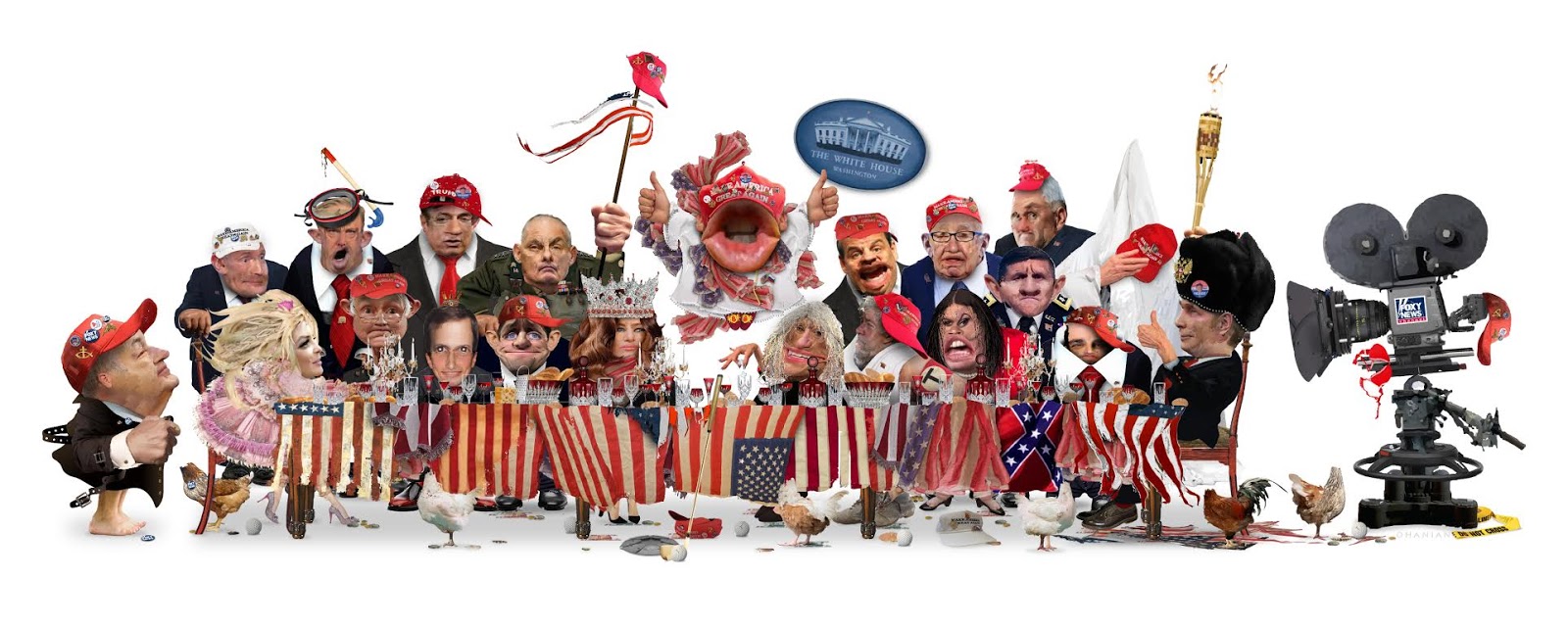
Ohanian's Last Supper

Labels: , , , ,

Tuesday, August 29, 2017

Trump Thinks His Tax Strategy To Give Paris Hilton's Dogs A More Luxurious Lifestyle Will Energize GOP Voters

>

Gunster, Trumpster and a batch of U.K. neo-Nazis

While congressional leadership incompetence and Señor Trumpanzee's tweet rages against fellow Republicans will drive down turnout for the 2018 midterms among his supporters and others on the far right, well-funded GOP superPACs are preparing to lure voters to the polls with packages of ballot initiatives that appeal to racists, homophobes, Nazis, xenophobes and other key contingents of the Republican Party base. Yesterday, Alex Isenstadt reported that the West Wing is coordinating the efforts and that the White House thinks "tax reform" is the issue to motivate and invigorate conservatives.

I guess the theory is that Republican dog lovers all want to end the estate tax so Paris Hilton can inherit even more money and so that her dogs' can live even more glamorous lives than they already do in their lovely "doggie mansion." Thanks for the tweet, Paris.


The shots, reported People Magazine, "show the outside and inside of the luxe doggie digs. Hilton isn’t lying. There is an easy-to-spot chandelier, and several pieces of fancy-looking furniture placed against the house’s pink (of course) walls. The outside photo shows one of Hilton’s small pups enjoying the second-story balcony, while another frolics on the grass below. So while you struggle with the choice of paying a massive energy bill or living as a human sweat blob for the next month, take comfort in the fact that at least Hilton’s dogs are living comfortably." That should help turn out the Trumpanzee base, right?

The White House goal is to defeat Jon Tester (D-MT), Heidi Heitkamp (D-ND) and Claire McCaskill (D-MO). Someone, I suppose, figures that right-wing voters (and independents) in Montana, North Dakota and Missouri think billionaires and multimillionaires are being treated unfairly by the tax code. Who could be that stupid?
Spearheading the discussions is Republican strategist Gerry Gunster, a referendum expert who helped to lead the successful 2016, populist-infused campaign for Britain's exit from the European Union. Gunster-- who visited then-president-elect Trump in New York City along with Brexit leader Nigel Farage after the November election-- has spoken about the ballot initiative concept with top administration aides, including political director Bill Stepien and Nick Ayers, the chief of staff to Vice President Mike Pence and a veteran GOP operative.

Still, it's an open question whether a White House-backed ballot initiative effort will materialize. Those involved caution that the plans are in a preliminary stage and that the White House, while intrigued, has yet to give final signoff.

Complicating matters has been the departure of chief strategist Steve Bannon, who was a leading internal proponent of the idea and thought it should be an administration priority heading into 2018.

Yet several people involved raised the prospect that Bannon, now free from the constraints of government, could orchestrate a campaign from the outside. He would have the financial resources: Bannon has a patron in Robert Mercer, the reclusive New York hedge fund billionaire who has long funded his political projects.

Neither White House officials nor Bannon would comment on the record. Gunster declined to discuss his talks with administration officials, but noted that his firm “has a well-documented history of managing initiatives and referenda that focus on tax reform and job growth. We do frequently work on state ballot measures that remove barriers to doing business."

An administration-led campaign would give conservatives a counterweight to liberals, who have already begun circulating possible initiatives in states aimed at mobilizing supporters in 2018-- some of them centered on marijuana legalization. Several midterm battlegrounds, including Missouri, Florida and Arizona, may see cannabis-related items on the ballot.

Some Republicans contend that putting tax cut-related measures on the 2018 ballot could give the party a boost.

"Probably it has some effect. It never hurts to have Republicans push on issues that are core to the party and that get people motivated," said Steve Linder, a GOP strategist in Michigan who has worked on nearly a dozen ballot measures, including the state’s 2004 anti-gay marriage amendment. "It's a way to reinforce the base, and can it help around the edges? Yes it can."

The deliberations come at a sensitive time for senior Republicans. They're increasingly worried that the party’s meager legislative accomplishments so far, the ongoing special counsel investigation of Trump campaign ties to Russia and the president’s intensifying war with GOP leaders will depress the base in 2018.

...The extent to which the anti-gay marriage amendments boosted Bush in 2004 is the subject of debate. In the immediate aftermath of his reelection, there was general agreement that the 11 amendments, all of which were approved by comfortable margins, jolted turnout in Bush’s favor.

But in the following years, some political observers began to question the influence it had on the election results. A 2006 report by the Pew Research Center concluded that while an amendment may have been decisive in the critical state of Ohio, their effect in other states was less clear.

...Some Republicans are skeptical that running an initiative campaign will do much to help their 2018 prospects. Jeff Flint, a Republican strategist in California who specializes in ballot initiatives, said the party would need to find an issue that tapped into a deep vein of frustration in order to drive turnout. He argued that a tax cut-focused effort wouldn’t do the trick.

Absent such a driving issue, voters are bound to be influenced by their opinion of Trump and his performance, Flint said.

"Nine times out of 10," he said, "turnout is driven by the top of the ticket, or the" president.
This morning Trumpanzee's chief economic advisor, Gary Cohn, the multimillionaire who Trumpanzee drafted from Goldman Sachs, was reported to have told a gaggle of Democratic senators that "only morons" pay the estate tax. Another way of putting it is that only criminals don't pay estate taxes. What the real morons-- Republican base voters who can be manipulated by these GOP SuperPAC appeals-- don't understand is that the estate tax is a 40% levy applied to the portion of an estate valued at over $5.49 million for individuals or $10.98 million for couples and that because it's a tax that applies only to the very wealthy, it only affects one out of every 500 taxpayers. The number of people actually paying the tax, and the money it raises have both plunged drastically in recent years. In 2008, the estate tax raised $25 billion; in 2015 that was down to $17 billion. Criminally-minded tax attorneys are the primary culprits. Democratic candidates we asked about the Trumpist plans to run on their version of "tax reform" were unanimous: BRING IT ON!

Lamar Smith's progressive opponent for next year (TX-21), Derrick Crowe, is looking forward to debating him on taxes and using the issue to help him win the election and flip the seat red to blue. "Donald Trump's 'enrich the rich' tax plan," he told us confidently, "is as likely to prompt his target voters to pick up pitchforks and torches as it is to help win an election. Inequality is tearing apart the social fabric of this country. If you look at where GOP rhetoric has been translated to tax policy--like, say, Texas-- you find voters on the edge of revolt due to skyrocketing, regressive property taxes and underfunded state services. The rigged economy is already tilted heavily toward the ultra-wealthy, and people know it. Trump is just revealing whose side he's really on-- and it's not the side of the working class. There's no way that translates to electoral victory in 2018 or 2020."

James Thompson should only be so lucky to have his election determined by a debate over taxes! "Red state" Kansas has come to know what GOP tax plans mean for ordinary people. "If you want to know what will happen to the rest of the United States as a result of Trump's tax reform," warned Thompson, "just look at Kansas. The so called 'tax reform' being pushed by President Trump and Ron Estes is the nationalization of the same failed trickle down tax experiments of Sam Brownback in Kansas. Our schools and hospitals are underfunded and closing. Our infrastructure, especially in rural areas, is collapsing. Our businesses are leaving our state. Our guards in the prison system are underpaid and overworked in overcrowded prisons. Our police departments don't have the money for proper training and are short staffed. Our mental health care facilities, formerly number one in the country, are now ranked at the bottom. More and more people are falling below the poverty line. These are just a few of the examples of what 'tax reform' did to Kansas. The filthy rich got the tax break goldmine, and the working people of Kansas got the shaft. Supply side economics do not work. Businesses do not hire new employees because of tax breaks. Demand drives business. Rather than trying to get a bigger piece of the pie, how about increasing the size of the pie? Paying a living wage will circulate more money into the economy and create a larger tax base. Finally expanding Medicaid will allow 100,000 additional Kansans to get medical care, again pumping more money into our local economy. We have lost more than 2 billion dollars in the last couple of years as a result of failing to expand Medicaid. Using targeted trade agreements to allow farmers to sell their products internationally while also protecting the wages of our working class people at home will bring more money into our state. Republicans don't want to do this though, they want the pie all for themselves. In Kansas, we say 'pigs get fat, and hogs get slaughtered.' The Republicans are all greedy hogs lined up at the 2018 trough gorging themselves on the slop Trump is feeding them."

Goal ThermometerTom Guild, another example of a "red state" Democrat not afraid of Trump's hollow threats, is running for a seat in Oklahoma that Trump won 53.2% to 39.8%. And he's not shying away from a very progressive approach to taxes that emphasizes fairness for working families and the middle class. "The Oklahoma GOP," he told us today, "has all the political marbles in Oklahoma. They control the state House of Representatives by a 3 to 1 margin and the state Senate by a 5 to 1 margin. They have the governor’s office and all statewide state offices to boot. If you look at their supply side tax policy, you would likely conclude that they didn’t have all their marbles when they adopted their trickle down tax plans. Because of the failure of trickledown economics in Oklahoma, our state is a fiscal basket case. We have had a revenue failure a number of years in a row and the gap widens as time goes on. This is due to their string of state income tax cuts for the wealthy, and their lowering of the oil and gas gross production tax from 7% (the lowest in the nation at the time) to 2% (by a country mile the lowest in the nation). They sold both types of regressive tax cuts as a way to produce more revenue for the state.  Well, their theory is an accountant’s nightmare. Teachers, who are at the bottom of the barrel nationally in salaries are fleeing the state in droves. This leads to emergency certification of replacements who aren’t quite qualified to teach. The number of emergency certifications has increased exponentially over the past few years. We can’t fund public health, including Medicaid and mental health programs. We are slashing senior nutrition programs and cutting child welfare workers in the face of a court order that demands we go in the other direction and increase state employees checking in on our vulnerable children. Our gaping potholes and chasms in our state and local roadways cost the average Oklahoman a pretty penny every year in damage to their vehicles. The GOP legislature outlawed raising the minimum wage at the local level as we were petitioning to raise the wage in Oklahoma City. Many Okies are working multiple jobs and still not able to keep their households above water. College students graduate with a bachelor’s degree and more than $30,000 in student loan debt and the shortfall increases every year because of cuts to the higher education budget. Lax regulation of the fossil fuels industry in Oklahoma has led to an unimaginable increase in human induced earthquakes, that are shaking many Oklahoma families to their core and causing many huge increases in out of pocket expenses. If Trump and his Billionaire’s Club Cabinet do for the U.S. what supply side trickledown economics has done for Oklahoma, the whole nation will be economically on its knees. Enough is Enough! We must elect progressives who put working people and the middle class first and attend to the basic necessities of the least among us."

North Carolina's Jenny Marshall has a similar perspective. She's running for the seat held;d by Virginia Foxx, who strictly represents the interests of the rich, rather than the middle and working class residents of NC-05. Foxx is a complete rubber stamp for Trump and Ryan. "North Carolina's GOP also gave away millions in tax breaks for the rich while saddling the average person with more taxes on labor costs such as auto and appliance repairs," said Jenny. "This is a typical GOP move. Reduce taxes for the rich with no regard to the fallout. My campaign's main issue is the economy. With 50% of my district living in low income or poverty households, Trump's tax reform falls on deaf ears. My community does not need a tax break. They need good paying, dependable jobs they can raise a family on. Minimum wage just doesn't pay the bills, yet rather than focus on raising wages and creating sustainable jobs, Trump wants to give the ultra wealthy a tax break. It just goes to show that the GOP leadership in Washington is out of touch with the everyday people of our country. I am committed to raising the minimum wage and the creation of jobs that will help the United States rebuild its infrastructure and increase our green energy sector."

The DCCC is trying to derail the campaign of young progressive Sam Jammal to help recruit their pathetic and unelectable silly recruit, a lottery winner who literally lies as much as Donald Trump! Sam is eager to debate Ed Royce on how the tax system should be reformed. "I find this whole tax reform conversation to represent everything wrong with Washington," he told us. "Right now, thousands of lobbyists are lining up with their own 'fixes' to our tax system. Everything is centered on how the most wealthy will benefit. None of the conversation is about how we help working families. My Congressman, Ed Royce, is too busy overseas to worry about what families in our community need. I would be shocked if we hear anything from him, other than a solid 'yes' vote for whatever scheme Trump and Ryan come up with. Tax reform should be about making sure the middle class is still a reality for our community. We should scrap corporate tax reform and focus on reforms that help regular people. This includes increasing the Earned Income Tax Credit, expanding deductions on child care, student loans and home ownership, and promoting job creation by entrepreneurs and small business-- not paybacks to the uber wealthy. We can't continue to have an economy where so few can get ahead and so many are falling behind. Everything we are hearing on Trump's tax reform looks like a bad deal for our families. We need to stop this 'reform.'"

And Randy Bryce, the ironworker and union and veterans' activist, challenging Paul Ryan for the southeast Wisconsin congressional seat, reminded us that "At the recent CNN media event that Paul Ryan had, he let it slip that tax reform really meant 'tax cuts' for the rich. The Banana Republicans aren’t fooling anyone when it comes to who they stand with. People across the country are admitting to having buyer’s remorse due to the 2016 election, and I personally can not wait for November 6, 2018 when we end one chapter that had them trying to bury working people only to find out that we were seeds."


Labels: , , , , , , , , , , , ,