Saturday, February 16, 2019

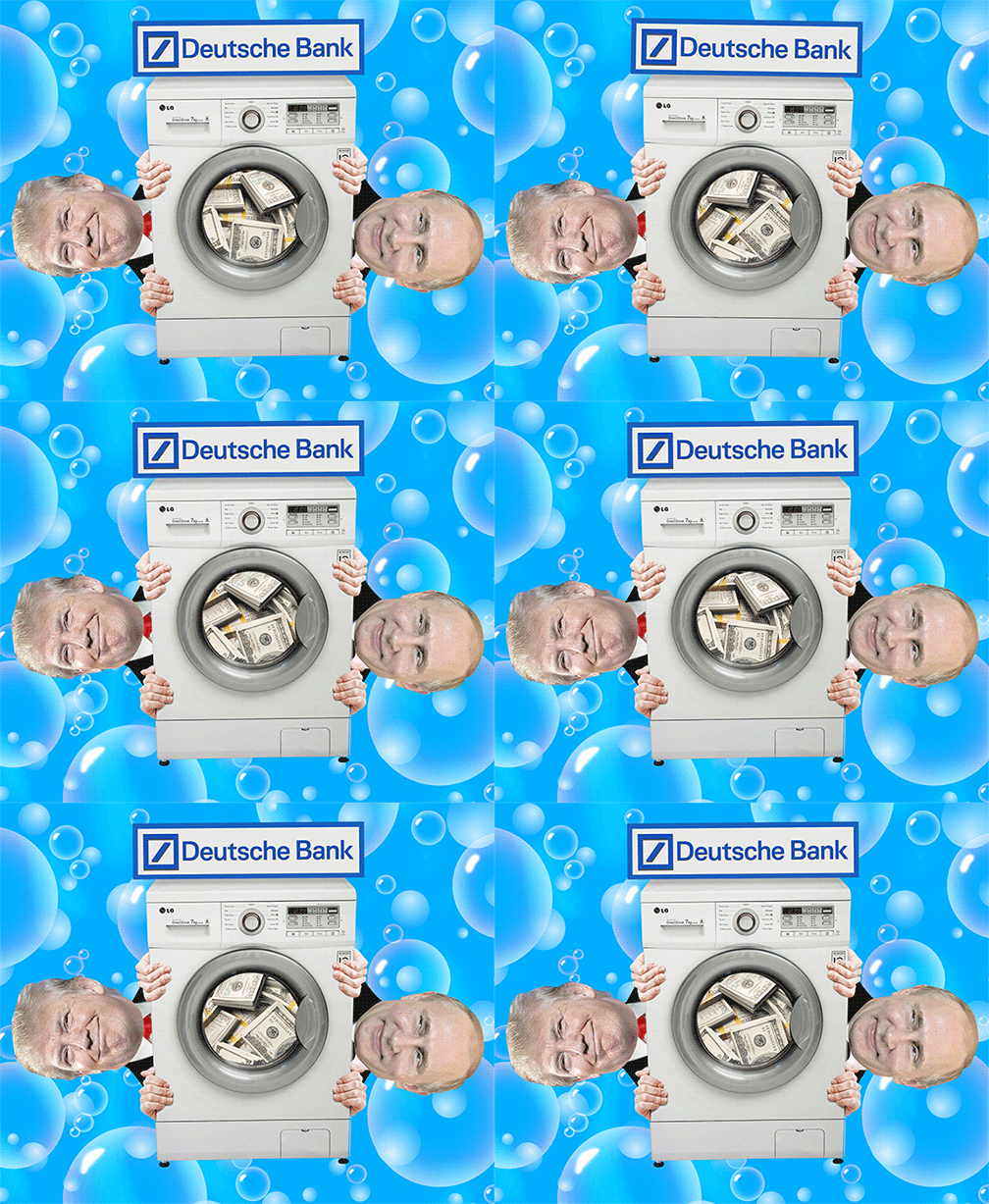
Trump's Brand Continues To Deteriorate In The Hotel Business

>

Trump's idea to go into welfare residential hotels fails

After visiting the never officially opened Trump Tower hotel in Baku, Azerbaijan-- before criminals Trump had partnered with tried burning it down for insurance money-- I fancied myself an expert in Trump's shady hotel business. "Expert" in the sense that I try keeping up on further news about how the business has continued-- like his brand in general-- to fall apart. Yesterday, Steve Eder, Ben Protess and Eric Lipton brought New York Times readers up to date on the continuing collapse. The Trumps blame the "political climate" for their failures.

Remember when they realized that they were dead in the water in normal places for hotels? They decided they would build hotels in backward, rural places where Trump in popular... like in shopping malls in Mississippi... albeit even there with brands that didn't include the now toxic Trump name-- like Scion. That whole idea has now been abandoned. Scion-- and another brand, "American Idea," have been "shelved indefinitely." The Times reported that "As a practical matter, that means calling off just one agreement, in Mississippi, though two years ago the Trump Organization said it had as many as 30 potential deals in the pipeline."

Why, if it was such a good idea as a way of exploiting the "fame" of the president-- albeit illegitimate president-- two years ago, has it been shit-canned today? "The retrenchment comes," writes Eder, Protess and Lipton, "as the company faces growing scrutiny from federal prosecutors and congressional investigators, and as a former employee, Michael Cohen, heads to prison for multiple crimes. With Democrats now in control of the House of Representatives, any new hotel deals could have provided investigative fodder for critics of the president."
The decision to walk away from the hotel plans is the latest and clearest sign of the perils of running a family business whose owner occupies the White House. As Eric Trump and his brother Donald Jr. downsize the Trump Organization’s hotel ambitions, the president has lamented the toll that elected office has taken on the company. “I lost massive amounts of money doing this job,” he told the New York Times in a recent interview. “This is one of the great losers of all time.”

Some of those losses stem from an ethics code that Mr. Trump was encouraged to adopt: It has prevented the company from doing new business abroad during his presidency, halting the global growth that for years brought in millions of dollars in fees. But other wounds have been more directly self-inflicted. In the United States, where the company intended to open the Scion and American Idea hotels, Mr. Trump’s divisive rhetoric and polarizing politics have turned his brand into a target for opponents.

The Trump Organization, which the president continues to own, faced local opposition to potential Scion deals in cities like Dallas and St. Louis. Some potential development partners were also scared away by the prospect of intense media coverage and legal and financial vetting from the company’s outside ethics adviser, people briefed on the matter said.

The people said that as of Thursday the Trump Organization was walking away from more than a dozen potential deals in Washington, D.C., and at least five states.

...[S]ome senior executives at the Trump Organization expressed concern that expanding the hotel operation could backfire and reflect poorly on the president, according to the people briefed on the matter, who spoke on the condition of anonymity because they were not authorized to discuss it. The executives worried that any potential new deals could lead to accusations that the company-- and its owner-- were profiting from the presidency.

In late 2017, Eric Trump foreshadowed a shift in strategy, indicating in an interview that the company would concentrate on its existing golf, real estate and hotel properties.

“If we have to take a break for an eight-year period of time or a four-year period, then it is what it is,” he said, referring to new business opportunities.

At the outset of the presidency, Mr. Trump’s sons inherited a company that was coming off a decade of growth, having opened a slate of golf courses and luxury hotels from Chicago to Las Vegas. Marketing deals put the Trump name on properties around the world, as well as on suits, mattresses and a host of other products.

The presidency proved to be a game changer.

The Trump name became so toxic in some places that the company was paid to remove it from hotels in Toronto and New York. The majority owner of the Trump hotel in Panama took a more drastic step, ordering the T-R-U-M-P letters pried off the property with a crowbar.

In the last two years, the company has also been under scrutiny from federal investigators and Democrats in Congress, particularly after Mr. Cohen pleaded guilty to arranging hush money payments during the presidential campaign to two women who said they had had affairs with Mr. Trump. The Trump Organization reimbursed Mr. Cohen for one of those payments, and is itself a focus of the ongoing investigation.

The company has also faced a torrent of negative media coverage, most recently over revelations, first reported in The Times about its employment of undocumented workers. The reports, which prompted a review of its properties’ staffs and the firing of more than two dozen workers, came at a time when Mr. Trump was denouncing illegal immigration as a threat to national security.

Still, the presidency has not put a damper on all aspects of Mr. Trump’s business. Some international deals that were in the works before the election have moved forward, including a Trump-branded hotel in Vancouver and a golf course in Dubai that opened in early 2017, and other plans that are still underway in India, Uruguay and the Philippines.

The Trump International Hotel in Washington, which opened in 2016, has surpassed expectations, with its lobby regularly packed with Republican officials and operatives. It has also caused headaches for the company, having prompted lawsuits claiming that Mr. Trump is illegally profiting from the presidency. Two cases now working their way through the courts focus on whether patrons of his hotels hail from overseas or state governments, a potential violation of the emoluments clauses of the Constitution.

Mr. Trump brushed off those concerns in the recent interview with The Times, suggesting that any new business dealings were more than offset by lost opportunities. During the presidential campaign, about six months before his surprising victory, Mr. Trump told The Times that he had about 120 deals in the pipeline. His executives had been working on hotel projects across the globe, including in Israel, Saudi Arabia and China.

After the election, the self-imposed prohibition on new development in foreign countries caused the Trump Organization to cancel some proposed deals and its pipeline to rapidly shrink, the company has said. Just before taking office, Mr. Trump said his company had turned down a potentially lucrative deal in Dubai.

Closer to home, where fewer restrictions applied, the company focused on the prospect of new hotel lines in cities such as Cincinnati, Nashville and Valley Forge, Pa.

The hotels were intended to target an audience different from the patrons of the existing five-star Trump properties. The Scion, a four-star line, would be a hipper boutique option. American Idea, a chain of budget-friendly hotels, would feature hints of Americana. Scion was announced before Mr. Trump’s election, and the concept for American Idea materialized after the Trumps spotted an opportunity during the campaign to expand into farther-flung markets with fewer hotel options.

Potential partners, though, were put under a microscope.

The company aborted a Scion deal that was under discussion in Dallas, after The Times reported that the prospective partner had ties to Russia and Kazakhstan and the Trumps’ outside ethics adviser raised questions about the potential deal. The Times also reported that the Chawlas, the partners in Mississippi, had turned to the state government for millions of dollars in support through a tax rebate program.

New business activity slowed even further last year, and the company announced no new hotel deals. The Trump Organization briefly managed a Livingston, N.J., hotel owned by the family of Jared Kushner, Mr. Trump’s son-in-law, and were in talks to open a Scion on the Jersey Shore that the Kushners would have owned.
Still... absolutely sounds like a great SNL cold-opening skit. Perhaps the Trumps, the Chawlas and other partners from parts of the world where gangsters dominate the economy can try their hand at by-the-hour motels. Sounds right up Trump's alley.


Labels: ,

Monday, August 28, 2017

What Secrets Is Mueller Finding As He Investigates Trump's Shady Foreign Deals?-- Part III

>


[Last night Valley Girl outlined, in Parts I (here) and II (here), some of the corrupt business practices that have long been at the center of the Trump Organization's dealings with the former Soviet Union. This evening's segment is about Trump's shenanigans in Moscow itself... and in the midst of the 2016 presidential campaign.]

-by Valley Girl

Scanning the news this morning, I found this WaPo article. The Washington Post breaking news is: While Donald Trump was running for president in late 2015 and early 2016, his company was pursuing a plan to develop a massive Trump Tower in Moscow, according to several people familiar with the proposal and new records reviewed by Trump Organization lawyers.” The article goes on to mention Felix Sater and the Bayrock Group, among other principals. (remember that these names are just a Google search away.) OK, the fact that Trump was pursuing the idea of a Trump Tower in Moscow is news.

But far more damning as to Trump’s Russian connections are reports from May, 2017, which likewise report on Felix Sater and the Bayrock Group, and more. The damning information comes in May 2017 from ZEMBLA, a Dutch organization that specializes in producing documentaries for Dutch TV. I’d long ago watched their two-part documentary via youtube: ZEMBLA-- The dubious friends of Donald Trump: the Russians (part 1- 45 minutes) and ZEMBLA-- The dubious friends of Donald trump: King of Diamonds (part 2- 36 minutes).


In court, Trump, lying with impunity, pretended to not know Sater

Part 1 is discussed here, at Huff Post and at Salon. From Huff Po:
A ZEMBLA investigation suggests that the American real estate company Bayrock, through which Donald Trump constructed hotels and apartment complexes, siphoned off $1.5 million by setting up a corporate structure in the Netherlands in 2007. ZEMBLA discovered that the corporate construction was established on the advice of an external legal counsel, namely Bracewell & Giuliani, also known for Rudi Giuliani, former mayor of New York and Trump confidante. The ultimate beneficiary owners of the Dutch business construction: the director of Bayrock and the Khrapunov family from Kazakhstan. Head of the family is Viktor Khrapunov, a former mayor and governor from Kazakhstan, who has been accused of embezzling hundreds of millions of state assets. In 2013 the Khrapunov family bought three apartments in Trump SoHo: Bayrock and Donald Trump are owners of that hotel-condominium.

One of the Bayrock owners is the Russian born Felix Sater, Trump’s former business partner. Though Sater spent years trying to line up deals with Donald Trump’s real estate organization all over the world, Trump has denied knowing Sater. The two met in 2003 when Trump was looking to expand his business globally. Because Sater failed to divulge his criminal history to Trump, he became a liability, putting the president’s financial interest at substantial risk. Should civil or criminal misconduct be proven in the care of Bayrock, Trump could be found complicit, possibly costing him millions of dollars in fines and/or penalties. The president has announced he will get to the bottom of the matter, but documents from the Bayrock corporation show otherwise: Trump actually tried to benefit from the situation, even risking leverage from anyone who knew of his jeopardy.
Russian Mafia figure Felix Sater with shady business associate

And from Salon:
Nearly every newsworthy story about the White House this week (May 2017) has contained one common thread: Russia. Whether it involves President Donald Trump facing backlash for sharing highly classified information with Russian diplomats or encountering fallout from the firing of FBI Director James Comey amid the bureau’s investigation of Russian interference in the 2016 election with possible ties to Trump, his relationship with Russia is proving to be ever relevant.

In examining Trump’s business partners, the filmmakers encounter the Russian mafia, including business and personal connections to oligarchs in Russia. The documentary takes a close look at Trump’s connections to the country, starting with his first trip to Russia in the 1980s.

The Zembla filmmakers interview some of Trump’s controversial friends, a former CIA agent, fraud investigators and attorneys, as well as U.S. Sen. Sheldon Whitehouse, a Democrat representing Rhode Island.

In the film, Malcolm Nance, a former U.S. intelligence officer, discusses Trump’s tendency to shy away from negative assessments of Russians: “If you’re a gambling addict and you owe someone a lot of money, you will never insult your bookie,” Nance says.
Also read ZEMBLA post from May 3, 2017, about part 1 of their documentary. Part 2 of the Zembla documentary is discussed at Alternet on May 15, 2017:
Dutch Documentary Part II: Blood on Trump and Kushner's Hands from Deals with Africa War Zone Diamond Mines Lev Leviev's diamond empire stretches from Angola to Moscow, London and Amsterdam.

The Trump family’s business partners have blood on their hands owing to deals with notorious diamond brokers who operate mines in war torn Africa and own jewelry stores in London, Moscow and Amsterdam.

That's the premise in Part Two of a documentary series by the Dutch TV network Zembla, The Dubious Friends of Donald Trump: King of Diamonds. It shows how the U.S. president and his son-in-law, Jared Kushner, have apparent partnerships with an Israeli billionaire who is tied to “trading in blood diamonds,” as the film's description notes, and how this relationship overlaps with power circles in Russia reaching President Vladimir Putin and Russian oligarchs.

“In the second part of our program about Donald Trump’s controversial friends, we will set our sights on the Israeli billionaire Lev Leviev, who is controversial because he is suspected of trading in blood diamonds,” says the documentary's YouTube summary. “He is one of the world’s biggest diamond traders and owns prestigious stores in New York and Moscow, but he is also the owner of Siebel, the Netherlands’ biggest jewelry chain. Leviev has ties with Russian president Putin, U.S. president Trump and his son-in-law and senior adviser Jared Kushner. Trump, however, claims he hardly knows this ‘King of Diamonds.’ Zembla investigates Lev Leviev’s business empire.”

The first part of the documentary series focused on Trump’s ties to Russian mobsters and oligarchs. That eye-opening report showed how Trump nurtured deals with oligarchs seeking to get their riches out of Russia and revealed how Trump signed off on international money-laundering schemes, including one set up by the law firm of ex-New York City mayor Rudy Giuliani. In the second part, we see how Trump is willing to make deals with anyone who can offer him a return, regardless of the suffering involved. The documentary also shines a light on Kushner’s relationships, which blend business, politics and religion.

There are a half-dozen takeaways from Part II, said James S. Henry, a corporate lawyer-turned-financial investigative reporter who has written lengthy exposés of Trump’s Russian connections and is featured in the film.


“I think the real news and interest in Part Two involves the exposure of apparent Trump partner Leviev's reported deep involvement in (a) trafficking in Angolan blood diamonds by way of his special arrangement with Eduardo dos Santos and family, the country's long-time dictator and chief kleptocrat; (b) Leviev's close ties to Putin; (c) Leviev's extensive business dealings with Trump's son-in-law Jared Kushner; (d) the extensive financial support that both Leviev and Kushner have given to extremist Israel settlers—support that appears to be inconsistent with the role that Kushner has apparently been given by the Trump administration with respect to the peace process; and (e) Leviev's alleged extensive use of non-transparent Dutch and other offshore holding companies to facilitate all these dodgy practices,” Henry wrote in an email to AlterNet.

Sander Rietveld, the documentary’s lead reporter, said Part Two is relevant for American audiences and lawmakers because it raises questions about Trump’s business relationships that can only be answered by examining his tax returns. Congressional Democrats have said Trump’s returns must be fully released before any consideration of federal tax reform.


“I think this is an excellent example of why President Trump needs to disclose his tax returns,” Rietveld said in an email. “Only when he does so, we'll know if and how he was engaged in a business deal with Lev Leviev [beyond the public relations materials shown in the film]. Given the extensive business empire of Leviev, Trump and he could have been together in real estate in the U.S., in Russia or in Eastern Europe. Or in some kind of diamond operation. According to well-established experts and investigators these kinds of operations in Africa and specifically in Angola are related to severe human rights abuses committed by security firms hired by mining companies.”

The film also examines the business circles Kushner travels in, showing overlapping ties between conservative Jewish groups and clerics and politically powerful Russians and Israelis, including Putin and Benjamin Netanyahu.

“The overlap of business and ideology and politics is another takeaway from this story,” Rietveld said. “Jared Kushner, the president's man for the Middle East, and Leviev's company AFI USA not only made a multimillion-dollar deal; they also seem to share a political view on Israel and the Palestinian territories. Both of them have been active in supporting settlements on the West Bank, which according to international law are illegal. And both of them have a very good relationship with the current, very right-wing Israeli government, and more personally with Bibi Netanyahu.”
For my money (that’s an idiom) part 2 of the documentary is by far the most explosive, and provides damning information about Jared Kushner and his “circle of friends”


Here’s another twist from the New York Times today.  
A business associate of President Trump promised in 2015 to engineer a real estate deal with the aid of the president of Russia, Vladimir V. Putin, that he said would help Mr. Trump win the presidency.

The associate, Felix Sater, wrote a series of emails to Mr. Trump’s lawyer, Michael Cohen, in which he boasted about his ties to Mr. Putin and predicted that building a Trump Tower in Moscow would highlight Mr. Trump’s savvy negotiating skills and be a political boon to his candidacy.

“Our boy can become president of the USA and we can engineer it,” Mr. Sater wrote in an email. “I will get all of Putins team to buy in on this, I will manage this process.”

The emails show that, from the earliest months of Mr. Trump’s campaign, some of his associates viewed close ties with Moscow as a political advantage. Those ties are now under investigation by the Justice Department and multiple congressional committees.

American intelligence agencies have concluded that the Russian government interfered with the 2016 presidential election to try to help Mr. Trump. Investigators want to know whether anyone on Mr. Trump’s team was part of that process.

Mr. Sater, a Russian immigrant, said he had lined up financing for the Trump Tower deal with VTB Bank, a Russian bank that was under American sanctions for involvement in Moscow’s efforts to undermine democracy in Ukraine. In another email, Mr. Sater envisioned a ribbon-cutting ceremony in Moscow.

“I will get Putin on this program and we will get Donald elected,” Mr. Sater wrote.

“To be clear, the Trump Organization has never had any real estate holdings or interests in Russia,” the Trump Organization said Monday in a statement.

The Trump Organization on Monday turned over emails to the House Intelligence Committee, which is investigating Russian meddling in the presidential election and whether anyone in Mr. Trump’s campaign was involved. Some of the emails were obtained by The Times.

None of the emails obtained by The Times include any responses from Mr. Cohen to Mr. Sater’s messages.

In a statement on Monday, Mr. Cohen suggested that he viewed Mr. Sater’s comments as puffery. “He has sometimes used colorful language and has been prone to ‘salesmanship,’” the statement said. “I ultimately determined that the proposal was not feasible and never agreed to make a trip to Russia.”

Mr. Sater was a broker for the Trump Organization at the time of his messages to Mr. Cohen, which means he was paid to deliver real estate deals and had an incentive to overstate his business-making acumen. He presents himself in his emails as so influential in Russia that he helped arrange a 2006 trip that Mr. Trump’s daughter, Ivanka, took to Moscow.

“I arranged for Ivanka to sit in Putins private chair at his desk and office in the Kremlin,” he said.

Ms. Trump said she had no involvement in the discussions about the Moscow deal. In a statement, she said that during the 2006 trip, she took “a brief tour of Red Square and the Kremlin” as a tourist. She said it is possible she sat in Mr. Putin’s chair during that tour but she did not recall it. “I have never met President Vladimir Putin,” she said.
The story is worthy, but really doesn’t give away much about Felix Sater. In fact, Sater is/ was a Russian Syndicate Crime Boss, and is part of a Moscow-organized crime family. Sater becomes an FBI informant. The American government covers up his fraud, and Sater’s trial transcripts are closed. In Congressional hearings, the then FBI Director James Comey has “no comment” to questions about Sater.

Watch part 1 of ZEMBLA’s investigative report below. But skip ahead to 16:03 and listen until 24:05. The information above is in this part.

I'd like to know exactly when Felix Sater became an FBI informant. That may be unknowable. But, the question is: were his emails sent before or after that. Over and out!


Labels: , , ,

Sunday, August 27, 2017

What Secrets Is Mueller Finding As He Investigates Trump's Shady Foreign Deals?-- Part II

>


-by Valley Girl

This is my second piece looking at an article by Adam Davidson. The present article appeared on August 21, 2017, in the New Yorker, entitled Trump’s Business of Corruption. You can find Part I of this two part series here. You'll notice in our titles Davidson’s subtitle, "What secrets will Mueller find when he investigates the President’s foreign deals?"

Before you read on, I hope you’ll watch this ~7 minute long Davidson interview for the New Yorker. Its good background, and it goes by very quickly. The New Yorker video resisted all efforts by DWT experts to embed the video here. Given that, I transcribed parts of it:
I’m not a legal reporter, I’m not a crime reporter, I’m a business reporter. And when a business is doing things that just don’t make sense, it just makes me keep wondering-- what’s going on, what am I missing?

... the theory of the case is pretty simple. This is right after the financial crisis, there’s not a lot of real estate deals to be had. It was the paradoxical period in Trump’s life. Because of The Apprentice, because of his TV stardom, he had never been more famous. He had never been thought of more as the model of a successful businessman, of a successful developer. And his business was in a lot of trouble... multiple bankruptcies, he was losing control of the casinos. There was a real need for cash.

[snip]
There’s a few reasons why these Georgians were interested in the Trump brand. So, part of it I think, that people have told me, it really clicks with what wealthy Russian men, or former Soviet Union men think of as manliness. They love the gold, they love the marble, the flash.. you know, the old guy with flashy clothes and the young, beautiful wife, and there’s a real brand synergy there that maybe there isn’t in other parts of the world.

Remember that the Trump Organization is switching to an international posture, with four or five people doing these international deals, with very little experience overseas. And they’re going in to very complicated countries with deeply corrupt economies, and really problematic interactions between business and politics. And eventually what happens, though, you are in bed with some really bad people.

[snip]
The reason I started caring about this story is when Donald Trump, in an interview with the New York Times, basically came out and said that if Robert Mueller the special counsel began investigating his business deals, he would consider that crossing a red line, and hinted that he might fire him. Now, I already knew a fair amount about the Trump Organization, and had the strong suspicion that if there was any kind of collusion, we don’t know if there was but there possibly was, it probably had its roots in business deal.
This is where I stopped transcribing. But if you go to the link, you’ll understand why Adam Davidson was so careful in his use of words in the video and throughout his writing. I certainly did!

I’ll summarize the present article by quoting key parts of it. The original is ~7000 words, so this was a challenge. The focus is Batumi, Georgia, on the Black Sea. Georgia was part of the former Soviet Union. Map of the region:


President Donald Trump’s attorney Jay Sekulow recently told me that the investigation being led by Robert Mueller, the special counsel appointed by the Justice Department, should focus on one question: whether there was “coördination between the Russian government and people on the Trump campaign.” Sekulow went on, “I want to be really specific. A real-estate deal would be outside the scope of legitimate inquiry.” … President Trump has been more blunt, hinting to the Times that he might fire Mueller if the investigation looks too closely at his business dealings.

Several news accounts have confirmed that Mueller has indeed begun to examine Trump’s real-estate deals and other business dealings, including some that have no obvious link to Russia. But this is hardly wayward. It would be impossible to gain a full understanding of the various points of contact between the Kremlin and the Trump campaign without scrutinizing many of the deals that Trump has made in the past decade.

One foreign deal, a stalled 2011 plan to build a Trump Tower in Batumi, a city on the Black Sea in the Republic of Georgia, has not received much journalistic attention. But the deal... involved unorthodox financial practices that several experts described to me as “red flags” for bank fraud and money laundering; moreover, it intertwined his company with a Kazakh oligarch who has direct links to Russia’s President, Vladimir Putin. As a result, Putin and his security services have access to information that could put them in a position to blackmail Trump.

Trump did very little to develop the Batumi property... In exchange for the million-dollar payment, he granted the right to use his name, and he agreed to visit Georgia for an elaborate publicity campaign, which was designed to promote Georgia’s President at the time, Mikheil Saakashvili …The campaign was misleading: the Trump Tower Batumi was going to be funded not by Trump but by businesses with ties to Kazakh oligarchs, including (those with close ties to Putin). Kazakhstan has the largest economy in Central Asia, based on its vast reserves of oil and metals, among other natural resources. Kazakhstan is notoriously corrupt, and much of its wealth is in the hands of (one) extended family and favored associates.

Trump visited Georgia in April, 2012, at a politically vulnerable time for Saakashvili. (In 2007) Transparency International and other N.G.O.s were reporting that élite corruption-- in which wealthy, politically connected people receive better treatment from courts, prosecutors, and government administrators-- was rampant in Georgia... few Western investors or brands were willing to put money into the country. Saakashvili himself was increasingly unpopular, and the Trump deal was meant to help salvage his reputation.


Saakashvili showed Trump around Tbilisi, the capital, and Batumi. Georgian television covered the events fawningly, promising viewers that Trump would soon build a second tower, in Tbilisi. One broadcaster proclaimed that Trump was the world’s top developer. At the groundbreaking ceremony in Batumi, Saakashvili said that the tower was “a big deal . . . that changes everything around here.” At another event, beneath a banner that proclaimed “trump invests in georgia,” he thanked Trump for being part of the project... He also awarded Trump the Georgian Order of Brilliance. Trump, in turn, praised Saakashvili. “Everybody in the world, they speak of Georgia and the great miracle that’s taking place,” he said. Saakashvili-- “He’s one of the great leaders of the world.”

Virtually none of the things that Saakashvili and Trump said about the deal were true.

The announcement of the Batumi tower was handled with cynical opportunism by both Trump and Saakashvili, but that was not the deal’s biggest problem. The developer that had paid Trump and invited him to Georgia-- a holding company known as the Silk Road Group-- had been funded by a bank [B.T.A. Bank of Kazakstan] that was enmeshed in a giant money-laundering scandal. And Trump, it seemed, had not asked many questions before taking the money.

But nobody (before had) seemed willing to put money into Batumi. Saakashvili and other Georgian officials sought financial backers, but they could not get anyone to invest in a run-down Georgian port.

Then, in 2005, something remarkable happened. Saakashvili and President Nazarbayev, of neighboring Kazakhstan, announced that B.T.A. Bank-- the largest bank in Kazakhstan-- was giving several hundred million dollars in loans to help develop Georgia. The loans would pay for the construction of hotels in Batumi, the expansion of the Georgian telecommunications industry, and the growth of a Georgian bank. Curiously, all the loans went to subsidiaries of one company: the Silk Road Group, which specialized not in real-estate development but in shipping crude- and refined-oil products, by rail, from Kazakhstan to other countries. The Silk Road Group, which had annual revenues of roughly two hundred million dollars, was planning, in an instant, to venture into several new industries. Compounding the risk, this expansion involved taking on a debt one and a half times its annual revenue.

In the years before the Trump Tower Batumi deal, B.T.A. Bank became entangled in a spectacular crime. [See article for details.] The former chairman of the Kazakhstan B.T.A. Bank, Ablyazov, fled the country for London-- taking billions of dollars in bank funds with him.

In 2010, when a Trump Organization executive, Michael Cohen, began negotiating with the Silk Road Group about licensing Trump’s name for the Batumi tower, Ablyazov was facing eleven lawsuits in the U.K. The Kazakh government, which had indeed seized control of B.T.A. Bank, had sued him to reclaim ten billion dollars that he had allegedly siphoned out of the country.

It would have taken only a Google search for the Trump Organization to discover that the Silk Road Group had received much of its funding from B.T.A. Bank, which, at the time of the Batumi deal, was mired in one of the largest fraud cases in recent history. The Silk Road Group had even been business partners with the central figure in the scandal: Ablyazov and the Silk Road Group were two of the owners of a bank in Georgia. I asked Cohen, who visited Georgia with Trump, if he had been concerned about the Silk Road Group’s connection to B.T.A. Bank. “I didn’t even know that B.T.A. was involved in this entire scenario up until the moment you told me,” he said. [only a Google search away]

I recently spoke with John Madinger, a retired U.S. Treasury official and I.R.S. special agent, who used to investigate financial crimes. He is the author of “Money Laundering: A Guide for Criminal Investigators.” When I told him what Cohen had said to me, he responded, “No, no, no! You’ve got to do your due diligence. You shouldn’t do a financial transaction with funds that appear to stem from unlawful activity. You have to care-- otherwise, you’re at risk of violating laws against money laundering.”

When I described to Madinger the various entities and transactions involved in the funding of the Trump Tower Batumi, he said, “That is what you would expect to see in a money-laundering operation: multiple shell companies in multiple countries. It’s designed to make life hard for people trying to follow the transaction.”

With minimal due diligence, Trump Organization executives would have noticed that the Silk Road Group exhibited many warning signs of financial fraud: its layered and often hidden ownership, its ornate use of shell companies, its close relationship with a bank that was embroiled in a financial scandal... But by 2012 Trump was struggling in the U.S. market. His biggest investment, in American casinos, had proved ruinous, and he was now a minority owner of a near-bankrupt business. Trump had defaulted on loans multiple times, and nearly every bank in the U.S. refused to finance deals bearing his name. And so Trump turned to people in other countries who did not share this reluctance to give him money.

At the time, the Trump Organization had only a handful of staff members involved in dealmaking. His children Ivanka Trump and Donald Trump, Jr., assumed a management role in many of these foreign projects... Trump, Jr., helped oversee the Batumi deal.

The Financial Action Task Force... is led by representatives from thirty-seven nations. In 2007, the task force issued a report about the use of real-estate projects for money laundering.

The report states that money launderers often find that “buying a hotel, a restaurant or other similar investment offers further advantages, as it brings with it a business activity in which there is extensive use of cash.” Casinos-- like the one planned for the Trump Tower Batumi-- are especially useful in this regard. The casino was to be owned by the Silk Road Group and its partners.


So many partners of the Trump Organization have been fined, sued, or criminally investigated for financial crimes that it is hard to ascribe the pattern to coincidence, or even to shoddy due diligence. In criminal law, there is a crucial concept called “willful blindness”: a person can be convicted of a crime even if he was unaware of certain aspects of the crime in which he was engaged. In U.S. courts, judges routinely explain to juries that “no one can avoid responsibility for a crime by deliberately ignoring what is obvious.”

John Madinger, the former Treasury official, said that, in any deal that might involve money laundering, there is one critical question: “Does the financial transaction make economic or business sense?” In recent years, a lot of residential housing has been built in Batumi, but most of it has consisted of what Colliers, the market-analysis firm, calls “low-segment”-- down-market-- apartments. The Trump Organization, with its extensive experience in the luxury real-estate market, could surely sense that it would not be easy to enlist hundreds of wealthy people to buy multimillion-dollar condominiums in Batumi. I asked several New York real-estate developers to assess the proposed tower... one, who spent years making deals in the former Soviet Union, told me, “A forty-seven-story tower of luxury condominiums in Batumi is an insane idea. I wouldn’t have gone near a project like this.”

[Note, however, how this insane idea would have appealed to Trump’s massive ego-- I just couldn’t leave this part out, below.]

Melanie A. Bonvicino, who handles communications for the Silk Road Group, told me that the Trump Tower Batumi deal demonstrated an openhearted vision. “With the Batumi project, Trump was once again able to demonstrate his keen business sense,” she wrote in an e-mail. “Donald Trump in his role as futurist and visionary ordained the region as the next big thing. Mr. Trump had an immediate grasp over the geopolitical significance of the Republic of Georgia and its Black Sea region, acknowledging its vast potential by jointly transforming this hidden gem into the next Riviera. In the élite realm of global residential and commercial real-estate developers, the Trump moniker was and remains synonymous with Coca-Cola, Pepsi, and Michael Jackson.”

Keith Darden is a political scientist at American University who has written extensively on the use of compromising information-- kompromat-- by former Soviet regimes against people they want to control. He told me that Kazakh intelligence is believed to collect dossiers on every significant business transaction involving the country. This would be especially true if a famous American developer was part of the deal, even if it would not have occurred to them that he might one day become the U.S. President. “There is no question-- they know everything about this deal,” Darden said.

Darden explained that Kazakh intelligence agents work closely with their Russian counterparts.

Robert Mueller has assembled a team of sixteen lawyers. One of them is fluent in Russian, and five have extensive experience investigating and prosecuting cases of money laundering, foreign corruption, and complex financial conspiracies. The path from Trump to Putin, if one exists, might be found in one of his foreign real-estate deals.

When Mueller was appointed special counsel, his official writ was to investigate not just “any links and/or coordination between the Russian government and individuals associated with the campaign of President Donald Trump” but also “any matters that arose or may arise directly from the investigation.” Much hinges on the word “directly.” Sekulow, Trump’s lawyer, insists that Mueller’s mandate essentially stops at the Russian border. Pawneet Abramowski, a former F.B.I. intelligence analyst, told me that Sekulow’s assertion is nonsensical. “You must follow the clues,” she said. When investigating a businessperson like Trump, “you have to follow the money and go wherever it leads-- you must follow the clues all the way to the end.”
In his article, Adam Davidson is giving Mueller what amounts to a very clear road map for following many of the clues. And these, one hopes, will ultimately prove to be part of Trump’s undoing. Listen to the two-bit hustler... hustling:


Labels: , , ,

What Secrets Is Mueller Finding As He Investigates Trump's Shady Foreign Deals?-- Part I

>


-by Valley Girl


As I told Howie, I went to the New Yorker site looking for (cat) cartoons. But I never got that far, because almost immediately I discovered some fascinating investigative articles written by Adam Davidson. Two are worthy of particular note, given Robert Mueller’s brief to investigate the business dealings of Donald Trump. The first, published on March 13, 2017, is titled Donald Trump's Worst Deal. The subtitle is “The President helped build a hotel in Azerbaijan that appears to be a corrupt operation engineered by oligarchs tied to Iran’s Revolutionary Guard.” I’ll summarize that here. The second will appear in a separate post here at DWT later this evening... Yes, probably your first ever whole night in the Caucuses.

Howie has traveled to Azerbaijan, and seen the Trump Tower in Baku up close and personal. He’s written about this at DWT; here are some of his posts about Baku's rampant corruption and the Trump family.

Some background about Azerbaijan- from wiki:
The Azerbaijan Democratic Republic proclaimed its independence in 1918 and became the first democratic state in the Muslim-oriented world. The country was incorporated into the Soviet Union in 1920 as the Azerbaijan Soviet Socialist Republic. The modern Republic of Azerbaijan proclaimed its independence on 30 August 1991, prior to the official dissolution of the USSR in December 1991.


In summarizing Davidson’s ~7000 word article, I pared it down to the essence, but didn’t change his (very careful) wording. Note these when reading: The Foreign Corrupt Practices Act, Iranian Revolutionary Guard, Mammadov family’s corruption, The Corleones of the Caspian.

And, before or after you read the summary, watch: This CNN video interview is excellent, but not embeddable, alas: The New Yorker's Adam Davidson speaks to Christiane Amanpour about his piece on Donald Trump's business with oligarchs tied to Iran's Revolutionary Guard. It’s a "must watch," and the information jumps out at you in a way that it just doesn’t on the written page.
The Trump Tower Baku never opened. Trump partnered with an Azerbaijani family that U.S. officials called notoriously unethical.

Heydar Aliyev Prospekti, a broad avenue in Baku, the capital of Azerbaijan, connects the airport to the city. The road is meant to highlight Baku’s recent modernization, and it is lined with sleek new buildings.

As you approach the city center, a tower at the end of the avenue looms in front of you. The building, a five-star hotel and residence called the Trump International Hotel & Tower Baku, has never opened, though from the road it looks ready to welcome the public.

The more time I spent in the neighborhood, the more I wondered how the hotel could have been imagined as a viable business. The development was conceived, in 2008, as a high-end apartment building. In 2012, after Donald Trump’s company, the Trump Organization, signed multiple contracts with the Azerbaijani developers behind the project, plans were made to transform the tower into an “ultra-luxury property.” According to a Trump Organization press release, a hotel with “expansive guest rooms” would occupy the first thirteen floors; higher stories would feature residences with “spectacular views of the city and Caspian Sea.” For an expensive hotel, the Trump Tower Baku is in an oddly unglamorous location: the underdeveloped eastern end of downtown, which is dominated by train tracks and is miles from the main business district, on the west side of the city. Across the street from the hotel is a discount shopping center; the area is filled with narrow, dingy shops and hookah bars. Other hotels nearby are low-budget options: at the AYF Palace, most rooms are forty-two dollars a night. There are no upscale restaurants or shops. Any guests of the Trump Tower Baku would likely feel marooned.

The timing of the project was also curious. By 2014, when the Trump Organization publicly announced that it was helping to turn the tower into a hotel, a construction boom in Baku had ended, and the occupancy rate for luxury hotels in the city hovered around thirty-five per cent.

A former top official in Azerbaijan’s Ministry of Tourism says that, when he learned of the Trump hotel project, he asked himself, “Why would someone put a luxury hotel there? Nobody who can afford to stay there would want to be in that neighborhood.”

The Azerbaijanis behind the project were close relatives of Ziya Mammadov, the Transportation Minister and one of the country’s wealthiest and most powerful oligarchs. According to the Transparency International Corruption Perceptions Index, Azerbaijan is among the most corrupt nations in the world.

After Donald Trump became a candidate for President, in 2015, (several) publications … raised questions about his involvement in the Baku project... a U.S. diplomat described Ziya Mammadov as “notoriously corrupt even for Azerbaijan.” The Trump Organization’s chief legal officer, Alan Garten, told reporters that the Baku hotel project raised no ethical issues for Donald Trump, because his company had never engaged directly with Mammadov.

A month after Trump was elected President, Garten announced that the Trump Organization had severed its ties with the hotel project, describing the decision to CNN as little more than “housecleaning.” I was in Baku at the time, and it had become clear that the Trump Organization’s story of the hotel was incomplete and inaccurate.

Ivanka in Baku
An Azerbaijani lawyer who worked on the project revealed to me that the Trump Organization had not just licensed the family name; it also had signed a technical-services agreement in which it promised to help its partner meet Trump design standards. Technical-services agreements are often nominal addenda to licensing deals... The Azerbaijani lawyer told me, “We were always following their instructions. We were in constant contact with the Trump Organization. They approved the smallest details.”

Ivanka Trump was the most senior Trump Organization official on the Baku project. In October, 2014, she visited the city to tour the site and offer advice... The Azerbaijani lawyer said, “Ivanka personally approved everything.”

The sustained back-and-forth between the Trump Organization and the Mammadovs has legal significance... Tom Fox, a Houston lawyer who specializes in anti-corruption compliance, said, “It’s a problem if you’re making a profit off of someone else’s corrupt conduct.”

Before signing a deal with a foreign partner, American companies, including major hotel chains, conduct risk assessments and background checks that take a close look at the country, the prospective partner, and the people involved... A senior executive at one of the largest American hotel chains, who asked for anonymity because he feared reprisal from the Trump Administration, said, “We wouldn’t look at due diligence as a burden. There certainly is a cost to doing it, especially in higher-risk places. But it’s as much an investment in the protection of that brand. It’s money well spent.”

Alan Garten told me that the Trump Organization had commissioned a risk assessment for the Baku deal, but declined to name the company that had performed it. …according to Garten, the Trump Organization had undertaken “extensive due diligence” before making the hotel deal and had not discovered “any red flags.”

But the Mammadov family, in addition to its reputation for corruption, has a troubling connection that any proper risk assessment should have unearthed: for years, it has been financially entangled with an Iranian family tied to the Iranian Revolutionary Guard Corps, the ideologically driven military force.

I asked Garten how deeply the Trump Organization had looked into the Mammadov family’s political connections. …When I asked him to provide documentation of due diligence, he said that he couldn’t share it with me, because “it’s confidential and privileged.”

(But) the Trump Organization may have broken the law in its work with the Mammadov family. The Foreign Corrupt Practices Act, passed in 1977, forbade American companies from participating in a scheme to reward a foreign government official in exchange for material benefit or preferential treatment. The law even made it a crime for an American company to unknowingly benefit from a partner’s corruption if it could have discovered illicit activity but avoided doing so. This closed what was known as the “head in the sand” loophole.

Even a cursory look at the Mammadovs suggests that they are not ideal partners for an American business. Four years before the Trump Organization announced the Baku deal, WikiLeaks released the U.S. diplomatic cables indicating that the family was corrupt; one cable mentioned the Mammadovs’ link to Iran’s Revolutionary Guard. In 2013, Radio Free Europe/Radio Liberty and the Organized Crime and Corruption Reporting Project investigated the Mammadov family’s corruption and published well-documented exposés. Six months before the hotel announcement, Foreign Policy ran an article titled “The Corleones of the Caspian,” which suggested that the Mammadovs had exploited Ziya’s position as Transportation Minister to make their fortunes.

Alan Garten, the Trump Organization lawyer, did not deny that there was corruption involved in the project. “I’m not going to sit here and defend the Mammadovs,” he said. But, from a legal standpoint, he argued, the Trump Organization was blameless. In his opinion, the Foreign Corrupt Practices Act doesn’t apply to the Baku deal, even if corruption occurred. “We didn’t own it,” he said of the hotel. “We had no equity. We didn’t control the project. The flow of funds is in the wrong direction.” He added, “We did not pay any money to anyone. Therefore, it could not be a violation of the F.C.P.A.”

“No, that’s just wrong,” Jessica Tillipman, an assistant dean at George Washington University Law School, who specializes in the F.C.P.A., said. “You can’t go into business deals in Azerbaijan assuming that you are immune from the F.C.P.A.” She added, “Nor can you escape liability by looking the other way. The entire Baku deal is a giant red flag—the direct involvement of foreign government officials and their relatives in Azerbaijan with ties to the Iranian Revolutionary Guard. Corruption warning signs are rarely more obvious.”

Tillipman explained that the F.C.P.A. defines corruption as “the payment of money or anything of value” to a foreign official... Tillipman, along with several other F.C.P.A. experts, told me that the Trump Organization had clearly provided things of value in the Baku deal: its famous brand, its command of the luxury market, its extensive technical advice.

American companies must insure that they are not receiving funds that originated with any sanctioned entity. Ignorance is not a defense, especially if there is ample warning that a foreign partner could have a link to such an entity. Most firms, upon hearing of even a slight chance of Iranian involvement, conduct due diligence that is much more extensive than what is typical for F.C.P.A. compliance. Erich Ferrari, an attorney who specializes in sanctions-related legal cases, said that before the Trump Organization cashed any checks it should have been certain of “the source of the funds”—“not only the bank it was remitted from but how the Mammadovs actually earned the money they paid.” He said of the Baku deal, “It takes a lot to shock a lawyer, but I’ve had very few clients do so little due diligence.

To this day, the Trump Organization has not provided satisfying answers to the most basic questions about the Baku deal: (including) whether the Mammadovs used their political power to benefit themselves and the Trump Organization; and whether the Mammadovs used money obtained from the Iranian Revolutionary Guard to fund the Trump Tower Baku.

More than a dozen lawyers with experience in F.C.P.A. prosecution expressed surprise at the Trump Organization’s seemingly lax approach to vetting its foreign partners. But, when I asked a former Trump Organization executive if the Baku deal had seemed unusual, he laughed. “No deal there seems unusual, as long as a check is attached,” he said.
Next up: we head east to another sleazy Trump project steeped in corruption, money-laundering and a country's shadiest characters-- Señor Trumpanzee tries his luck in Batumi.


Labels: , , , ,

Wednesday, January 25, 2017

Why You Need To Start Calling Trump's Hotels And His Other Businesses

>


The Obama Administration maintained a White House staffed public comments line as well as a staffed switchboard message number for people to call the White House. As of this week, neither number is functioning. Callers get a recorded message telling them to contact the Trump Regime via the official Trumpanzee Facebook page or the official White House Facebook page, neither of which accepts messages. So people are calling Trump hotels and other Trump businesses and leaving messages for him there-- a great ideal in my opinion.

According to DCist, Trump's new Trumpanzee International in the Old Post Office "lost more than $1 million in net income during its first two months of operation and its revenues were $2 million less than estimates it provided to the General Services Administration, which owns the historic building." It's a low-end luxury hotel with the same kind of mediocre services all Trump properties provide. Trump's hotels are doing so badly in general that the new ones are not using the now toxic Trump brand in their names. New hotels are being branded as "Scion."

But for now, people who want to contact the Trumpist Regime and are getting a run-around, have been calling Trump hotels, most of which are suffering from very low occupancy rates. I liked at the 5 star hotels in the cities where Trump has one of his joints. Let's start with Las Vegas. The Trump hotel is still rated as a 5-star but it's the cheapest one to get a room in. The rack rate is in line with the other 5-stars but, because the occupancy rate is so much lower than the other hotels, the prices they offer are much less. Here are the Vegas hotels with the rack rate first and the deal currently on offer:
Mandarin Oriental- $2,715... $1,045
4 Seasons- $2,436... $1,318
Encore- $1,967... $1,128
Wynn- $1700... $830
Bellagio- $1,342... $822
Trump- $1,129... $506
InterContinental- $1,054... $822
Delano at Mandarin Bay- $1,061... $739
Same in DC:
Rosewood- $3,577... $2,292
Four Seasons- $3,345... $1,642
St. Regis- $3,063... $1,626
Ritz-Carlton, Georgetown- $2,967... $1,302
Mandarin Oriental- $2,338... $1,241
Trump International- $1,989... $473
The Watergate- $1,983... $1,241
Park Hyatt- $$1,746... $1,552
The Jefferson- $1,577
Ritz-Carlton- $1,393... $1,257
The Willard Intercontinental- $1,060


In Chicago, Trump tries squeezing his hotel guests for $1,190/night... but Hotels.com, Hotwire.com, Booking.com, and GetARoom.com all offer the same room for $142. The ad above is from Trump's own website. Everything is a negotiation with the sleazy, greedy Trumpanzee.

In any case, these are Trump's hotels in the U.S. with the phone numbers for anyone who wants to leave Señor Presidente Trumpanzee a message.

Chicago- 312.588.8000- reservation- 877.458.7867
Las Vegas- 702.982.0000, res- 866.939.8786
Miami- 305.592.2000, res- 800.713.6725
NY- 212.299.1000, res- 888.448.7867
1 Central Park West
Soho, NY- 212.842.5500, res- 877.828.7080
246 Spring Street
Waikiki- 808.683.7777, res- 877.683.7401
DC- 202.695.1100, res- 866.660.9426

Or you could try to leave him a message at his so-called "modeling" agency, Trump Model-- 212-924-0990.

Women might be especially unhappy today because the Republicans just passed another one of their ugly anti-Choice bills. It passed the House 238-183, every single Republican + 3 pf the worst Blue Dogs-- Collin Peterson (MN), Henry Cuellar (TX) and Dan Lipinski (IL)-- voting to screw with women's constitutional rights. In the past when Republicans have passed this kind of crap, we had Obama to pull out his veto pen. Now, we have Trump-- a perfect reason why his hotels should be flooded with phone calls.


Trump also issued an Executive Order, a "Global Gag Rule, far worse than what George Bush did. Bush' disastrous restrictions, according to UNDispatch.com "were limited exclusively to NGOs that receive US government assistance for family planning and reproductive health, like contraception" and they prevented the NGOs "from counseling women that abortion is an option or lobbying foreign governments to liberalize their abortion laws." But Trump's order goes further. "Rather than applying the Global Gag Rule exclusively to US assistance for family planning in the developing world, which amounts to about $575 million per year, the Trump memo applies it to 'global health assistance furnished by all department or agencies.' In other words, NGOs that distribute bed nets for malaria, provide childhood vaccines, support early childhood nutrition and brain development, run HIV programs, fight ebola or Zika, and much more, must now certify their compliance with the Global Gag Rule or risk losing US funds. According to analysis from PAI, a global health NGO, this impacts over $9 billion of US funds, or about 15 times more than the previous iteration of the Global Gag Rule which only impacted reproductive health assistance... This is a profound expansion of what was already a harmful policy."

Pramila Jayapal, the Democratic freshman from Seattle pointed out that "just days after Americans took to the streets in solidarity with women across the globe, Republicans launched another assault on women’s health care. Cementing a law that restricts abortion coverage for women of color and low-income women is bad enough, but restricting how women use their own money to purchase private comprehensive health care insurance is reprehensible. The so-called 'No Taxpayer Funding for Abortion Act' codifies the Hyde amendment, permanently banning federal dollars, including Medicaid funding, for women who wish to purchase comprehensive health care plans that cover abortion-- disproportionately harming women of color and low-income women. Additionally, this legislation imposes tax penalties on small businesses that choose private health plans that cover abortion. It bans coverage of abortion services for women insured by multi-state health plans under the Affordable Care Act. Make no mistake. This isn’t a health care issue. It’s part of an extreme, right-wing political agenda that puts women’s rights on the chopping block. This bill creates even more barriers for women of color trying to access quality healthcare at a time when we should be focused on legislating equity, not codifying disparity. It is nothing more than politicians trying to control women’s bodies."


And, needless to say, it wasn't just women angered by the Republicans' unconstitutional explosion of misogyny. Ted Lieu (D-CA):
Today, just two days after the 44th anniversary of the Roe v. Wade Supreme Court ruling that protects the rights of women to control their own bodies, House Republicans have once again taken up a vote attacking the constitutionally-protected reproductive rights of women all across the nation.

As if this past weekend’s Women’s March on Washington (which was far more attended than President Trump’s inauguration) didn’t signal anything to our elected leaders, President Trump took the GOP’s war on women’s rights and health a step further by signing an executive order reinstating the ‘global gag rule’ and blocking foreign aid for international non-governmental organizations that provide basic reproductive health services globally. This decision not only increases abortion rates, it will cause more maternal complications, injuries, and unintended pregnancies and provide less information on HIV/AIDS prevention and treatment programs worldwide.

Republicans continue their shameful, radical assault on women’s reproductive health with today’s vote on H.R. 7, a discriminatory bill that among other things would prohibit the use of federal funds to pay for any abortion services. Despite the fact that current law already requires that federal funds not be spent on abortions, this bill would prohibit individuals and small businesses from claiming tax credits for any private insurance plans obtained through the ACA Marketplace that include abortion coverage. Families buying their insurance in the Marketplace would also be ineligible to receive a premium tax credits if they enrolled in a health plan that covers abortion, likely resulting in no abortion coverage policies being offered in the Marketplaces. Furthermore, it undermines the District of Columbia’s home rule, which allows D.C. to use it’s own Medicaid funds to offer abortion services. This is despite the fact that 17 states, including California, are currently allowed to do so.

Women should be able to make their own decisions about reproductive health care with dignity and respect, without the interference of politicians or their employers. We should not be in the business of telling women what they can and cannot do with their own bodies. Today’s vote is just another step forward in the Republican party’s plan to Make America Sick Again and take away the comprehensive care women deserve.
There are only 6 House incumbents who Blue America has endorsed so far-- and Jayapal and Lieu are two of them. They deserve support for what they've been doing to lead the resistance to Trumpism:
Goal Thermometer

Labels: , , , ,