Friday, October 09, 2020

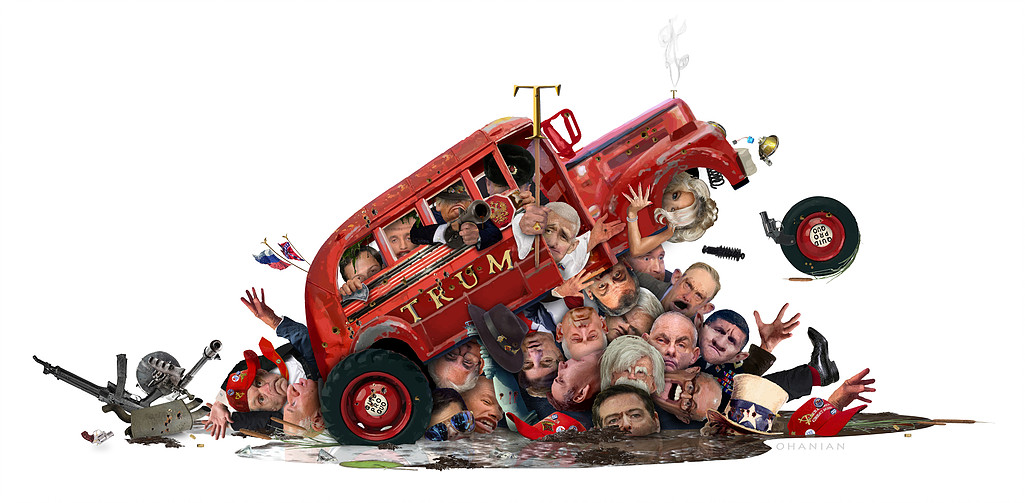
A Sinking Ship-- Trump's-- Drags Down All Boats With It

>


Kansas is a very red state. In fact, the candidate Schumer recruited to run as a putative Democrat, Barbara Bollier is, in fact, a Republican. She served as a Republican in the state House from 2011 to 2017 and has been in the state Senate since 2016. At the very end of 2018, she switched parties, no doubt with Schumer promising her the U.S. Senate nomination. He forced former United States Attorney for Kansas Barry Grissom to drop out of the race and endorse her as soon as Bollier declared a few months later. A new GOP internal poll shows her beating Trump-aligned Republican Congressman Roger Marshall 45-42%.

The last time Kansas elected a Democrat to the Senate was an exceptional circumstance. Before he triggered the Great Depression, Herbert Hoover picked Kansas Senator Charlie Curtis to be his VP. After Hoover and Curtis were inaugurated, the governor, Clyde Reed, appointed ex-Gov. Henry Justin Allen as interim Senator. When Allen ran to complete the rest of Curtis' term 6 months later, the Republican Depression was in full swing and Allen was defeated (as was the GOP gubernatorial candidate). Democrat George McGill was elected and was reelected in 1932, the last time a Kansas Democrat was elected to the U.S. Senate.

Many voters in traditionally super-red areas think Trump is as bad as the Great Depression. He is losing millions of dependable Republican voters across the country-- and dragging Republicans down the toilet with him. In Kansas' case, Trump beat Hillary 671,018 (56.16%) to 427,005 (35.74%). This year, it's likely Biden will do significantly better than Hillary, though not better enough to win the state's 6 electoral votes. Bollier, an actual Republican just pretending to be a Democrat, could very well win the Senate seat. Why, you ask?


Yesterday, writing for the Washington Post, former top Republican political operative, Stuart Stevens wrote that Republicans have lied so much to constituents about Trump as he led the party to ruin that they are seen as his enablers. Many still have their heads up his ass-- although Stevens politely calls what they're doing as genuflecting. "As he turns his own covid-19 diagnosis into a reality TV show, mocking his administration’s own public health guidance, showing the Americans who have suffered that he doesn’t give a whit for their plight," wrote Stevens, "[t]hey know they’re defending the indefensible, and they know if the president were a Democrat, they wouldn’t hesitate to condemn him. With a straight face in Wednesday’s debate, Vice President Pence claimed, 'From the very first day, President Donald Trump has put the health of America first.'" Wednesday Kansas had 1,095 new cases, bringing the state total to 65,010-- 22,315 cases per million Kansans. And there were 17 more deaths reported, bringing the total to 723. Kansans who heard Pence on Wednesday night, knew he was full of shit and knew Trump had made very wrong decision that could me made during the pandemic. But, as Stevens wrote, Republican officials are "so used to this routine that co-signing Trump’s bad behavior is now habit and shooting straight is completely foreign."


Even after the party’s turn away from time-honored Republican principles, I couldn’t have imagined a party that would abandon any pretense of standing for conservative values, decency or common sense. Having spent four years defending their guy at every turn, they’re stuck. In for a penny, in for a pound: Republicans can’t tell the truth about Trump anymore. Even if they wanted to.


Many GOP candidates know they face near-impossible odds this year. Across the nation, every morning there are campaign team calls on which political professionals try to think of ways their bosses might escape impending electoral doom. I’ve been on calls like this more times than I’d care to remember, and I know they will take on an increasingly desperate tone as reality sinks in. In a week or two, it’ll be all gallows humor from here on out as they mask the pain. Even the normal conversations about where campaign staffers might go to unwind after the campaign will be abnormal: Paris? Nope. How about Serbia?

Their 2020 plans were shattered by a combination of incompetence and fate. What was intended to be an election celebrating a booming economy, waged against an opponent who could legitimately be tagged as a socialist, has turned into a defensive battle for Trump and Republicans: Trying to justify dramatic job losses and business failures against the backdrop of more than 210,000 Americans, so far, dying in a badly managed public health crisis. Instead of Sen. Bernie Sanders (I-VT), they drew former vice president Joe Biden, a man so unthreatening that even Trump, the master of nicknames, is reduced to calling him “sleepy”-- a snoozer of a put-down if there ever was one. In recent weeks, Biden’s polling lead has widened. Senate Republicans in once-safe seats are fighting to hang on. Sen. Lindsey O. Graham (R-SC), running in a solid-red state, has been reduced to begging for money on Fox News. Five years ago, he accurately tagged Trump as a “race-baiting, xenophobic, religious bigot.” Now he’s Trump’s semiregular golf patsy.

Instead of covid-19 fading as an election issue, the pandemic has struck the president’s inner circle, a cluster of his family members, favorite White House staffers, his campaign manager, members of his debate prep team and the GOP chair.

...Every day Trump makes it worse: After his first debate with Biden, instead of focusing on jobs and the economy, campaigns had to scramble just to prove that their bosses weren’t fond of a group of thugs founded by the author of How to Piss in Public. After springing himself from a brief hospital stay, Trump’s tweets and videos ham-handedly and disrespectfully implied that those who have fallen to covid-19-- those who didn’t have a president’s access to experimental drugs and round-the-clock care-- are weak. He says he’s calling off coronavirus relief talks with congressional Democrats because he can’t get his way. (Art of the deal, right?) His staged White House return from Walter Reed military hospital created a gold mine for mockery, and I confess it was great fun to pan some of that gold.

Like Americans abroad who can’t speak the language, Republicans are saying the same thing they’ve been saying for at least four years, only louder. In his debate last week with challenger Jaime Harrison, Graham had the gall to babble that “the people running the Democratic Party today are nuts” at the same time that he’s trying to win reelection in a party headed by a man who suggested household disinfectant might cure covid-19.


With the exception of Sen. Mitt Romney (R-UT), no office-holding Republican with a national profile has even tried to establish an identity separate from Trump. With a combination of cowardice and convenience, Republicans went quietly into the night of Trump’s instability, grievances and immorality. Their occasional gestures at restraining the president-- I have very serious concerns. I wish he’d spend less time on Twitter-- are the stuff of late-night comedy. Their words have only served only to highlight their pathos. There could be no better metaphor for their fecklessness than justifying their enabling ways by touting the nomination of Judge Amy Coney Barrett to the Supreme Court. You think a Justice Barrett will save you, Republicans? You couldn’t even get through her Rose Garden ceremony without a coronavirus outbreak.

Republicans should start telling the truth. They should go in front of the cameras and say what the public knows just from living their daily lives: Trump has failed on covid-19. We need a national strategy. Give me a second chance. I was wrong to put my faith in the president. They should take some responsibility. But you can’t really say you’re quitting drinking while ordering another round at the bar.

So why won’t they? Call it the flight, flee or freeze syndrome wired into our DNA. Most politicians call themselves “fighters,” but in truth, almost all of them are starved for approval. These Republicans would cut and run, but where would they go? On the Trump battlefield, there’s no safe zone. So, they freeze, hoping something will magically save them.

The few Republican consultants who still talk to me begin most conversations with: “What a terrible year,” like farmers who’ve been hit by drought. Behind the scenes, that’s the mood. Everyone sees where we’re headed. No one dares challenge their king.
On Wednesday Greg Sargent, also for The Post, wrote that "When you step back and survey the last two years of U.S. politics, one of the biggest story lines that comes into view is this: One after another, a whole string of deeply corrupt schemes that President Trump has hatched to smooth his reelection hopes have crashed and burned. In all these cases, Trump has either blown up the schemes himself or compounded the damage they did to him when they self-destructed. In some cases he did both... When you view these things in one place, the true scale of Trump’s commitment to winning the election through corrupt means becomes a lot more striking. And, since many of them are doing great damage to the country, his sheer destructiveness also comes into much sharper relief."

And now even sports-prognosticators who think they know more about politics than they do-- and who just a few short months ago were arguing among themselves about how the GOP would probably not win enough seats to win back the House majority-- are on the cusp of admitting that the anti-Trump/anti-GOP wave is going to destroy dozens of Republicans' careers. And it's only early October. Yesterday, Cook, Sabato and Silver all seemed to wake up-- somewhat stunned-- to what's happening to the GOP as it crumbles and starts fall apart. By November 4th or 5th they will all have it-- or most of it-- right.


Labels: , , , , ,

Sunday, September 13, 2020

Saving America Starts With Decimating The Republican Party In November

>


Saving America by Nancy Ohanian

If you watch right-wing media (or pay attention to Republican Party fake pollsters like Trafalgar or Rasmussen), you'd think Trump is tightening up the gap between himself and Biden. That isn't what I'm seeing in the legitimate polls. aYesterday a new one, from YouGov, commissioned by Yahoo News, was released showing Biden leads 49-39% among registered voters. "Trump," wrote Yahoo's Andrew Romano, "has fallen further behind Joe Biden following bombshell reports that the president knowingly misled Americans about the dangers of COVID-19 and privately disparaged dead U.S. soldiers as 'suckers' and 'losers.' The results suggest that a week of unrelenting and unflattering revelations about Trump-- from the Atlantic report on his alleged contempt for Americans wounded or killed in war (which appeared on Sept. 3) to Bob Woodward’s recordings of Trump admitting he downplayed the deadliness of COVID-19 (released on Sept. 9)-- has damaged the president’s standing with voters."


An incredible 15% of those who voted for Trump in 2016 say the Woodward news has changed their mind about Trump’s handling of the pandemic and 15% of voters overall said that the revelations from Woodward have made them less likely to vote for Trump in November. Although this is impacting former Trump voters, it is really impacting independents. 8% of 2016 Trump voters say they're voting for Biden this year.

If that holds (and if it is spread more or less evenly among states)-- and it is more likely to grow than diminish-- on election day, Trump will lose the key states he needs to be reelected: Florida, Pennsylvania, Wisconsin, Michigan, Arizona, North Carolina, probably Georgia and Ohio and possibly even Texas.

Late last week Vanity Fair published a transcript of former GOP strategist Stuart Stevens being interviewed by Joe Hagan. It's worth reading the whole transcript. In summarizing it, Hagan wrote that "Stevens described the GOP under Donald Trump as a party of cynics, stooges, racists, and obsequious enablers whose profiles in cowardice bear an uncomfortable resemblance to 1930s Germany. 'When I talk to Republican politicians, I hear Franz von Papen,' he says, referencing the German chancellor who convinced Germans that so-called radical leftists were a far greater threat than Adolf Hitler. 'They all know that Trump is an idiot. They all know that he’s uniquely unqualified to be president. But they convinced themselves that he was a necessity... It is the combination of the anti-intellectualism, the anti-education elements of the Republican Party, and the anti-elite elements of the Republican Party, so-called, that have culminated in this toxic brew that is killing tens of thousands of Americans,' says Stevens, who recently joined the independent Never Trump organization the Lincoln Project. 'I mean, more Americans are going to die because of this combination of political beliefs than major wars. This virus [is] attacking Americans. And Donald Trump is making it a lot worse, and we all know this. But Republicans won’t even stand up to defend America.' Consequently, Stevens calls Trump a 'traitor' to his country. 'I really think he is against America,' he says, blaming the Republican Party for 'a complete collapse of responsibility that they had to defend democracy in America.'"

So not just Trump... the entire Republican Party. Hagan spoke with Stevens about his 71 year old Republican father: "Help me with something here. My dad is a conservative. He voted for Trump. He said he held his nose, he hated Hillary, the common story that you hear. And in your book, you talk about how the party and its media apparatus, Fox News and other like-minded people, have turned it into tribal-like sports where you’re just going to root for your team almost no matter what. There’s a sense of like, even if they see that he’s a horrible guy and that they might have made a colossal error, they’re going to deflect and project all the blame onto the media and the 'radical left.' We’ve seen this time and again. How can we get my dad out of that?"


It’s dangerous for your dad to go outside now. Your dad’s not going to be going to a football game. It’s dangerous for him to go shopping. Donald Trump has made the world more dangerous for your father in a very tangible, real [way]. It didn’t have to be this way. It’s not this way in Canada. If your dad goes across the border to Ottawa, he’s going to be a lot safer. And it’s not genetic. It’s government. And it’s not conservative or liberal. It is the combination of the anti-intellectualism, the anti-education elements of the Republican Party, and the anti-elite elements of the Republican Party, so-called, that have culminated in this toxic brew that is killing tens of thousands of Americans. I mean, more Americans are going to die because of this combination of political beliefs than major wars. This virus [is] attacking Americans. And Donald Trump is making it a lot worse, and we all know this. But Republicans won’t even stand up to defend America.

What drives me crazy about this is you take my dad-- I’m older than you, my dad fought in World War II, South Pacific, 28 island landings, and like hundreds of thousands of guys came back, never really talked about it. My uncle was grievously wounded in Europe, shot seven times, never really recovered. They took this legacy and handed it off to the current group of politicians. And the Republicans have completely squandered that. And it’s a disgrace. Courage isn’t standing up to Donald Trump to defend Americans. Courage is getting out of the boat when the guy in front of you gets shot. And they don’t have the courage to stand up to some fat, ridiculous imbecile from Queens. And it’s shameful. It should be their legacy. They are killing their neighbors to defend Donald Trump. I’m very comfortable calling Trump a traitor because I really think he is against America, what it means to be an American. I don’t think these Republican politicians-- I know a lot of them, I helped elect a lot of them, they’re good people. If you’re stranded on the side of the road with a flat tire, they’d stop and help you in a heartbeat. If they lived next door to you, they’d be a really good neighbor. They’re not mean people. But there’s something here that has been a complete collapse of responsibility that they had to defend democracy in America. And they failed.

...I came across the stats: of Americans 15 and under, the majority are nonwhite. So odds are looking really good they’re going to turn 18 and still be nonwhite. And what does that mean for the Republican Party? It’s a death sentence if the party doesn’t change, and the party has no desire to change.

I think there’s really three parties now in America: there’s two parties in the Democratic Party and then there’s a Conservative Party and the Republican Party. I don’t think the Republican Party is going to be very relevant for a long time. I think we’re at a period when we’re going to be in for center-left government. Probably that center-left government goes too far at some point and some logically coherent, moral, and intellectually defensible center-right opposition will emerge. But it’s not going to happen with these clowns like Josh Hawley and [Ted] Cruz. These are people who have made themselves ridiculous. Nikki Haley praising Charlie Kirk. These are people that faced a moment and the moment defeated them. I can’t tell you who it will be. But you can’t negotiate with Trump.


Labels: , ,

Tuesday, August 18, 2020

Trump Was Right To Fire Brad Parscale... But It Won't Help Him Avoid His Destiny

>


One of the most discussed pieces of reporting over the weekend was Olivia Nuzzi's New York Magazine look inside the chaotic, desperate last-minute Trump 2020 reboot. She goes beyond the reasons why Trump fired his rarely present campaign manager, Jared-puppet Brad Parscale, while noting the " tiny Tulsa rally Parscale had organized-- which followed weeks of massive hype-- preceded a spike in coronavirus infections in the city that, local officials said, was probably born of the event, where the guest list included Herman Cain, who later died... The campaign was in a hole so deep it was actually historic-- a deficit not just bigger, at this point in the race, than any an incumbent had ever overcome, but bigger than any an incumbent had ever even faced."

Nuzzi wrote that "It was July before he 'saw for the first time' that he could be defeated, according to the [senior White House official] official. And he didn’t blame himself. He blamed a cruel world, a crueler media, and the Death Star’s failure to defend him from both. 'They thought they were running one campaign: We’re on cruise control for the president who gave us the greatest economy of all time, and all the messaging would flow from there. Which socialist are we running against? Bop, bop, bop. And everything changed, and they didn’t change,' the senior White House official said. 'The president started to hate the ads. He hated Beijing Biden-- he didn’t come up with that name.' In the West Wing, officials filed away gossip and unflattering data points about the campaign manager as if drafting a dossier. When it was reported that Parscale’s web of companies took in $38 million between Inauguration Day and the spring of the pandemic, according to the Federal Election Commission, the story circulated widely. Though Parscale has declined to make clear what portion of his bills to the campaign amount to his personal salary, the New York Times reported in March that Trump had imposed a salary cap on Parscale of somewhere between $700,000 and $800,000-- enough for him to become in midlife a collector of luxury cars and seaside real estate, or at least a media caricature of one. But it wasn’t only Parscale’s spending on Parscale that worried-- or 'worried'-- some of his colleagues; it was his spending on everything else, too, like the $15,000-a-month payments to Kimberly Guilfoyle, Donald Trump Jr.’s girlfriend, and to Lara Trump, Eric Trump’s wife, both of whom crisscross the country as campaign surrogates.


The courtiers surrounding Trump began wondering aloud about what Parascale was even doing aside from milking the campaign for his own accounts. Nuzzi spoke with one of the country's most prominent #NeverTrumpers, Lincoln Project founder George Conway, who told her that the Orange Menace "wonders who’s truly loyal to him and who’s not and who’s making a buck on him," noting that "triggering Trump’s paranoia" is one way to defeat him. "It doesn’t matter who is the captain of the SS Trump, because Trump is the one who is going to run it into the iceberg in the end. If there’s more chaos, all the better. We try to trigger the chaos in Trump’s DNA."

It started eating away at Trump that Pascale was making so much money off him. Three weeks after Tulsa, he was unceremoniously fired-- replaced by Bill Stepien. Right after Trump fired him, Parscale tweeted a Bible verse: "Bless those who persecute you; bless and do not curse them." No one has seen him since.
Parscale’s value, as some saw it, lay not in what he could do for the campaign but in what he could do for Kushner. “Brad was willing to do whatever Jared said and keep quiet about it. Brad was willing to get yelled at by the president and not say to the president, ‘Well, actually, this was Jared’s decision,’ ” the first senior White House official said. “And Jared got to rule from afar because Brad would do whatever he said. In return, Brad made a fuck-ton of money and got to live by the pool in Florida. It was almost like this weird mutual partnership, whether they knew it or not.”

...In the case of the reelection campaign, what appeared to be a civil war at the highest levels of Trumpworld, with anti-Kushner factions inside and immediately surrounding the West Wing positioned against representatives of his interests at campaign headquarters, and a last-minute last chance for a reboot before November, was more like WrestleMania. The drama was both all-consuming and self-contained. Parscale and Stepien were both seen as Kushner allies, yet the regime change was nevertheless regarded as revealing some aspect of Kushner’s shifting status-- even as he remained functionally in charge the whole time. Kushner’s influence is so total that, even when his proxy is removed, he’s just replaced by yet another proxy. After all, if you’re not a “Kushner guy,” the dismissive term for officials perceived to carry out his will, what kind of guy could you even be?

...But while replacing Parscale with Stepien has the look of a reboot, at the strategy level it does not seem much has changed or is likely to. Asked how the campaign can formulate a coherent message, given what life is like for most people across the country today, senior adviser Jason Miller said, “It’s very direct: President Trump built the greatest economy in the history of the world, and he’s doing it again.”

But what about the polls? “I’d push back on that,” Miller said. “I have much more timely data, and much more accurate data, than what you have access to. And it’s improved over the last four weeks, and over the last two weeks, it definitely improved. We’re headed in the right direction.

...If I just woke you up in the middle of the night and told you a guy who is deeply involved in Bridgegate is now calling himself campaign manager for Donald Trump, you wouldn’t have said, ‘You’re kidding me! I’m shocked. How did that happen?,’ ” Stuart Stevens said with a laugh. You’d have said, Of course.


Stevens is a veteran of Republican presidential campaigns whose latest book, It Was All a Lie, is about his newfound realization-- at 67 years old-- that his life’s work was a mistake. As he sees it, Trump has a “management philosophy” that has guided him from the Trump Organization to the 2016 campaign to the White House and now to the campaign for reelection. “What Trump does is take people who are mediocre talent at best, who know they could never have the position they have if it were not for Trump, and it creates this instant loyalty to Trump. When you look at Trumpworld, it’s all these people who weren’t involved in presidential races, and it wasn’t because they didn’t want to be; it was because nobody would hire them. It’s not like Steve Bannon woke up one day and said, ‘I think I’d like to get involved in campaigns!’ Or Corey Lewandowski, all of these people. It’s how you end up with Brad Parscale. Top professionals won’t work for you.”
Almost all Democrats I know-- basically I know progressive Democrats-- abhor Biden's record. They're going to mostly hold their noses and vote for him-- a vehicle for saving the country from Trump and Trumpism. Not the #NeverTrumpers. They're enthusiastic. Biden's lifelong fiscal conservatism is just what they want in a president. Just ask Susan Molinari. "When Joe Biden makes a commitment, he always sees it through," the narrator says in this new Lincoln Project ad. Does that mean that we're about to vote someone in who is going to kill Social Security and Medicare?


Labels: , , , , , ,

Tuesday, August 04, 2020

No, Not "Both Parties" Fault-- The Blame From The Entire Financial Crisis Millions Of Americans are Facing is Only The Republicans' Fault-- 100%

>


In his interview with Stuart Stevens published yesterday by the New Yorker-- on the occasion of the release of his new book, It Was All a Lie: How the Republican Party Became Donald Trump-- Isaac Chotiner asked the former GOP political operative (and now, Lincoln Project #NeverTrumpers), how he came to see that the Republican Party wasn't polluted by Trump but that the Republican Party was polluted by itself. Stevens now understands that Trump didn't hijack the GOP but that what we have is what the GOP turned itself into. He pointed out that Trump "says he has ninety-five per cent Republican approval, and that’s probably an exaggeration, but let’s say it is eighty-nine per cent or so. You look at what Trump is saying, and the degree to which the Party is comfortable with it, and I don’t know what conclusion to come to other than that Trump very well suits the Republican Party... What appealed to me was a party that believed in personal responsibility, that character counts, and that was strong on Russia and free trade, and strongly pro legal immigration. It’s not just that the Party has drifted away from those principles, like parties do. As far as I can tell, the Party is actively against every one of them. We’re the “character doesn’t count” party. We’re the anti-personal-responsibility party. We’re the pro-Putin party. I think the only conclusion is that a party that said it believed in these things didn’t really believe in them."

Just before that was published published, the Washington Post put out an ominous piece by Erica Werner and Seung Min Kim, Congress flails as coronavirus ravages the nation and the economy stalls. Their point-- everything is a disaster and the Republican-controlled Senate, at Trump's direction, "is doing what it does best: nothing at all."


Two months ago, the House passed a bill that would have helped people get through these extraordinarily tough times. McConnell went on vacation and refused to allow even a debate on the merits. As the virus surged and the economy collapsed McConnell plotted how to make the Democrats look bad. Polling shows that that has backfired, making the GOP even more unpopular and putting more of his caucus in jeopardy for November defeats.


"Let's be clear about what's happening here," progressive Texas Democrat Julie Oliver told me this morning. "The House passed the Democratic relief bill, the HEROES Act, weeks ago-- it would have extended the $600 unemployment insurance that has served as a lifeline for so many of the Texas families we've heard from here in our district who are hurting right now. Roger Williams voted against it. He believes that Texans who are struggling should get 'zero' in relief. Mitch McConnell and Senate Republicans refused to take the bill up for consideration. And that negligence-- while people are losing everything, going hungry, kids and families facing eviction-- is truly corrupt." You can help Julie replace Williams here.
“The Republicans are pushing the American economy into a depression because they are unwilling to do what is necessary to prevent it,” said Sen. Brian Schatz (D-HI). “This is not the fault of ‘Congress’ generally-- this is happening to America because of the Republicans. We want to strike a compromise, but their ideology prevents them from meeting the moment.”

...“Congress has to rise to the crisis. It is too serious,” said Sen. Susan Collins (R-ME), one of at least a half dozen endangered GOP senators whose political fortunes are in the balance. “If we can’t work together in a bipartisan, bicameral way in the midst of a persistent pandemic that is causing such harm to people’s health and their economic stability, then we will have failed the American people.”

Democrats and many Republicans insist it is imperative to act soon to pass another big relief bill. House Speaker Nancy Pelosi (D-CA) called the virus “a freight train that is picking up steam and picking up speed” Friday as she called for Senate passage of the House Democrats’ $3 trillion bill. Talks are ongoing between congressional Democrats and top Trump administration officials, and many people involved think they will manage to produce some kind of agreement in the next couple weeks.


But Republicans are divided between those like Collins who support aggressive new action and a significant minority of GOP lawmakers who think Congress has done its job and should not spend any more money at all to pile on the deficit.

President Trump’s weakening standing in the polls means there is less imperative for reluctant fiscal conservatives to rally around legislation that might help his political fortunes. The president himself has also reduced the sense of urgency for some in his party by embracing unlikely hopes that the economy can heal itself by reopening, or that the virus will disappear on its own.

Senate Majority Leader Mitch McConnell (R-KY) waited months over the late spring and summer to act, saying he wanted to see what impact the programs already approved were having before agreeing to anything more. During that time the virus itself frustrated widespread hopes that the situation might improve and began to surge in states that had reopened too aggressively.

McConnell finally released a $1 trillion bill last Monday as the GOP’s answer to the much larger bill passed by House Democrats in May, but he struggled to get consensus within his party and with the Trump administration, including complaints from members of his own conference about everything from the price tag to a new round of stimulus checks.

Facing a deadline Friday for $600 weekly emergency unemployment benefits to expire for nearly 30 million Americans, Republicans quickly started to pivot to talking about a short-term unemployment insurance fix, rendering their own bill all but irrelevant in a matter of days-- with Trump himself dismissing it as “sort of semi-irrelevant” the day after it was released.

Democrats have consistently rejected the notion of a short-term fix, and in face of the GOP’s disunity they have shown little willingness to compromise on their push for the most generous relief bill possible, with an array of provisions that Republicans reject, such as $1 trillion in new aid for cities and states. Republicans say they do not think Democrats want to pass anything at all because they’d rather have a political issue; Democrats angrily reject that accusation.

After 3-1/2 years of rancor under the Trump administration, there is little trust left between the two parties, and no direct communication at all between Trump and Pelosi.

The result is stasis.


“In order to cut deals and find compromise in this hyperpartisan political environment you have to have at least a small amount of trust in each other,” said Jim Manley, who was a top aide to former Senate Democratic leader Harry M. Reid of Nevada. “The problem right now is that no one trusts their colleagues on the other side of the aisle.”

Congress rarely acts except when up against a deadline, and stopgap spending bills and partial government shutdowns have become almost routine in recent years, as Congress repeatedly offers fresh proof of its own dysfunction. As economically harmful as a government shutdown is, however, it is nothing compared with the coronavirus, which has already killed more than 150,000 Americans while simultaneously clobbering the economy. Gross domestic product dropped 9.5 percent in the second quarter of the year, the Commerce Department said Thursday-- a decline that would have been even worse without the economic aid provided by Congress.

Multiple lawmakers of both parties have said the only really comparable situation is a war. Yet with the two sides so far apart on multiple issues, the prospect of failing to get any deal at all is a real possibility.

“I don’t even want to fathom that, it’s unimaginable that we wouldn’t, given the needs that the country has,” said Sen. Marco Rubio (R-FL). “It would just be so bad if we didn’t that ultimately you would hope that... the fever would break.”

...McConnell coordinates closely with Mnuchin and Meadows, but his posture of remove puts the onus on the Trump administration to sell any deal made with Democrats to GOP members of Congress. Republicans have been unhappy with some of the deals Mnuchin struck with Democrats early on, including the unemployment insurance payments that have now expired. Most Republicans want to extend them, but at a greatly reduced level, while Democrats want to continue the $600 weekly payments at their present level.

The two parties spent much of the past week blaming each other for allowing the payments to expire.

In the first sign of progress after days of stalemate, a meeting at the Capitol Saturday between Pelosi, Schumer, Meadows and Mnuchin yielded guardedly positive comments from all involved-- although a deal did not appear imminent.

Despite the current chaos and uncertainty, Congress may ultimately find its way through to making another deal to help revive the economy and help Americans. But even as the virus rages and the economy teeters, the rancor shows every sign of getting worse before it gets better.

“Our politics is such that there must be significant political pain before hard things can get done,” said Brendan Buck, who was a top adviser to former Republican House speaker Paul D. Ryan. “That’s our forcing mechanism, and the political pain will be starting very soon.”
Goal ThermometerAdam Christensen is running for Congress in north-central Florida, for the seat teabagger Ted Yoho is abandoning. He told me this morning that "The Florida GOP knew exactly what they were doing when they ok’d one of the largest corporate giveaways in history right before a pandemic. They knew what they were doing when they built one of the worst unemployment websites in the country after 2008. They knew what they were doing when they made sure that Florida had one of the lowest unemployment benefit payouts in the country. They knew what they were doing when they muddied the waters with the shut downs, masks, and basic public safety. And my representative, Ted Yoho, knew what he was doing when he voted for the biggest companies in the world 100% of the time he was in Congress. The response to this pandemic and conditions that made it worse were not an accident. The response was purposeful. They had planned and implemented these policies for years. Now all of us are facing the consequences for their actions."

Labels: , , , , , ,

Saturday, June 27, 2020

Maybe It Really Is Time For the South To Rise Again-- But Without The Built-In Racism This Time

>


On Friday the House voted, 232-180 to admit Washington, DC-- which has more people than Wyoming and Vermont-- as a state. Every Republican-- ironically, the party of unadulterated and unashamed racism-- voted no, as did the most Republican of the House Dems, Minnesota Blue Dog Collin Peterson. There were 8 other Democrats who wanted top vote NO-- and in fact did vote with the GOP on their motion to recommit, but who felt their best strategy was to have it both ways, voting with the GOP on the motion and with the Democrats on the bill:
Anthony Brindisi (Blue Dog-NY)
Angie Craig (New Dem-MN)
Joe Cunningham (Blue Dog-SC)
Jared Golden (careerist-ME)
Kendra Horn (Blue Dog-OK)
Conor Lamb (careerist-PA)
Ben McAdams (Blue Dog-UT)
Collin Peterson (Blue Dog-MN)
Xochitl Torres Small (Blue Dog-NM)
McConnell already declared it DOA as far as the Senate is concerned, somehow deciding statehood for Washington is-- wait for it-- "socialist." So his virulent and disgusting racism had nothing to do with it at all. And if McConnell were to be hit by a car tonight and whisked off to his place in Satan's bed, Trump has already said he would veto it, although didn't mention he's the most racist president to ever occupy the White House. The District, by the way, is 49% African-American so, the thinking goes among racists like McConnell and Trump and, generally all the Republicans in Congress... why give them a House seat and two Senate seats?


So I asked myself why is there still so much racism in our country. Why is it still a thing? Inequality politically and economically are bad enough but what about in our hearts? Why?

Stuart Stevens, a Mississippi Republican had something to say about that yesterday at The Bulwark-- at least for part of the problem: My Confederate Past. Before we get to Stevens' reflections, a little news (beyond Faith Hill's call for Mississippi to get a new Confederate-free state flag): there's plan to do just that and that started today, a flag that was adopted in 1894 at the height of the white backlash to Reconstruction.
As of Friday at noon, the plan-- which several sources reiterated was “extremely fluid”-- is for the House of Representatives to begin the legislative process to remove or replace the flag on Saturday morning.

A resolution will be filed that would suspend the rules so that legislators could take up a bill to address the flag. This resolution is expected to be the most difficult part of the process because it requires approval of a two-thirds majority in each chamber (82 of 122 House members, 35 of 52 Senate members). And the resolution must be passed by both chambers before either chamber could actually begin the process of debating the actual bill. [It did pass the House today-- 85 to 35-- and Gov. Reeves announced he will sign the final bill into law if it passes the state Senate too.] UPDATE: Last in the day, the Senate passed it too!

If the two-thirds threshold to suspend the rules is met, a simple majority would be required to pass the actual bill (62 of 122 House members, 27 of 52 Senate members).

Sources close to House leadership say they have-- for now-- the two-thirds majority votes to suspend rules, but they stress the margin is very thin.

On the Senate side, reports are that the leadership is “close”-- within one or two votes-- to having a two-thirds vote to suspend rules. Lt. Gov. Delbert Hosemann said the plan is for the House to move first.

...Many Republican lawmakers have for years opposed changing the flag, particularly without a popular vote on the issue. Some who want the Legislature to change it fear a backlash from constituents.

And  Republican Gov. Tate Reeves-- the de facto head of the state GOP-- opposes the Legislature changing the flag.

But that sentiment appears to be changing among some lawmakers.

Rep. Karl Oliver, R-Winona, in a 2017 social media post said that those who support the removal of Confederate monuments should be “lynched.” In recent weeks, he declined to comment on the flag issue.

But on Thursday, Oliver issued a statement that said: “I am choosing to attempt to unite our state and ask each of you to join me in supporting a flag that creates unity-- now is the time.” Oliver’s statement said the flag issue is growing “more divisive by the day” and “History will record the position I chose.”

A growing list of businesses, cities, counties and other groups have either stopped flying the flag or asked leaders to change it. Religious leaders have spoken out, saying changing the flag is a “moral issue.”  The NCAA, SEC, and Conference USA this month took action to ban post-season play in the state until the flag is changed.


"It’s difficult to explain to a non-Southerner," wrote Stevens, "the role the Confederate flag has played in our lives. I suspect that’s more so for a Mississippian than for someone from any other state as Mississippi is the most Southern of the states. Put it this way: If you have connections to the University of Mississippi-- the most Southern school in the most Southern state-- then your connection to the Confederate flag is what the shamrock is to Notre Dame. I was born in the 1950s to parents who met at Ole Miss. The role Ole Miss football played in my life was basically what the Catholic Church is to the Jesuits. It was both a belief system and the organizing principle of life. Saturdays in the fall were the Holy Days when the Faithful would gather and reinforce our devotion through the shared communion of ritual."
These were not football games but celebrations of the Lost Cause of the Confederacy. Only this time our 11 soldiers on the field of battle more often than not emerged victorious. At halftime the band marched in Confederate battle gray uniforms while Colonel Reb led the cheerleaders in unfolding what was billed as the world’s largest Confederate flag. (Even as a 10-year-old I remember wondering, “How big was the second-largest flag?”) Cheerleaders threw bundles of Confederate flags into the stands. We stood and swayed together singing Dixie, always ending in the stadium-shaking cry, “The South Shall Rise Again.”

It was at halftime in the 1962 Ole Miss-Kentucky game at Jackson’s Memorial Stadium-- walking distance from my home-- that Governor Ross Barnett gave his famous speech calling for states’ rights. We beat Kentucky that afternoon and the next day in Oxford there began the last pitched battle of the Civil War. It took 30,000 troops to force the University of Mississippi to accept a single black student.

Today you’re more likely to get a student riot if a top-ranked black athlete committed to Ole Miss and then switched at the last minute to Alabama.


...Mississippi has the highest percentage of African Americans of any state in the country. I ask myself now why did it take so long for me to realize what it might be like for nearly 40 percent of my state to go to school and work under a flag that represented a cause dedicated to the right to own their ancestors? Why is it that I had written books about traveling through China, Africa, and Europe, fascinated by every cultural quirk I came across, before I looked up at my own state flag and thought about the dehumanizing brutality it represented?

I don’t have any good answers, most likely because there are none. I was given every opportunity in this life, an open door to the world, a chance at the best education in the United States and England, a family that supported my odd passions that I was lucky enough to turn into professions. I had passport stamps from 61 countries with different flags before I began to think about my own state’s flag. It wasn’t that I was actively for the flag . . . but that indifference was just as toxic as active support.

Today many white Mississippians of my generation-- and even more of the younger generation-- are eager to change. Faulkner wrote, “The past is never dead. It’s not even past.” We can’t undo what we didn’t do.

But my regret is mixed with a hope. Hope that perhaps we can take steps-- small and inadequate as they might be-- to face the truth of our Confederate past. And in doing so change the future.

It will never be enough. But I hope today we can take one more step out of the shadows of a bloody past into the brighter sun of a better day.


This morning, the NY Times released a poll by Siena that showed how out of touch Trump-- who reflexively and unceasingly stokes The Lost Cause and American divisiveness over race-- is on sentiments about race seem to be heading. 59% of voters, including 52% of white voters, believe the death of George Floyd at the hands of the police in Minneapolis was "part of a broader pattern of excessive police violence toward African Americans. Black Lives Matter is seen as favorably as the police as an institution is (44% for BLM, 43% for the police). "The numbers add to the mounting evidence that recent protests have significantly shifted public opinion on race, creating potential political allies for a movement that was, within the past decade, dismissed as fringe and divisive. It also highlights how President Trump is increasingly out of touch with a country he is seeking to lead for a second term: While he has shown little sympathy for the protesters and their fight for racial justice, and has continued to use racist language that many have denounced, voters feel favorably toward the protests and their cause."


Labels: , , , , , ,

Monday, April 06, 2020

Trump-- Incompetent And Unfit By Nature

>


How many times have you seen columns called The Worst President Ever? A conservative historian, Max Boot did a good one yesterday, noting that he's been reluctant to label Señor Trumpanzee the worst president in U.S. history. "Some presidents who seemed awful to contemporaries (Harry S. Truman) or simply lackluster (Dwight D. Eisenhower, George H.W. Bush) look much better in retrospect," he wrote. "Others, such as Thomas Jefferson and Woodrow Wilson, don’t look as good as they once did. So I have written, as I did on March 12, that Trump is the worst president in modern times-- not of all time. That left open the possibility that James Buchanan, Andrew Johnson, Franklin Pierce, Warren Harding or some other nonentity would be judged more harshly. But in the past month, we have seen enough to take away the qualifier 'in modern times.' With his catastrophic mishandling of the coronavirus, Trump has established himself as the worst president in U.S. history."

The Trump Regime has managed to screw up the massive $2 trillion bailout bill Congress passed last month. Americans without savings and small businesses are in hot water. Jeff Stein wrote Sunday that "Small-business owners have reported delays in getting approved for loans without which they will close their doors, while others say they have been denied altogether by their lenders and do not understand why. The law’s provision to boost unemployment benefits has become tangled in dated and overwhelmed state bureaucracies, as an unprecedented avalanche of jobless Americans seeks aid." Republicans ideologically hate government. Expecting them to be able to handle an emergency in unrealistic, especially when jobs are filled based on ideology and personal loyalty to the leader-- and never based on competence.

Stein continued that "Officials at the Internal Revenue Service have warned that $1,200 relief checks may not reach many Americans until August or September if they haven’t already given their direct-deposit information to the government. Taxpayers in need of answers from the IRS amid a rapidly changing job market are encountering dysfunctional government websites and unresponsive call centers that have become understaffed as federal workers stay home."

Dan Balz also focused on Trumpist incompetence and dysfunction and their inability to adequaltely respond to the pandemic. He pointed out that Trump "downplayed the coronavirus threat, was slow to move and has delivered mixed messages to the nation. The federal bureaucracy bungled rapid production of tests for the virus. Stockpiles of crucial medical materials were limited and supply lines cumbersome. States and hospitals were plunged into life-and-death competition with one another. When the public looked to government for help, government sometimes looked helpless or frozen or contradictory-- and not for the first time." Republicans, as I said, are incapable of making government work. They hate government and have put all their efforts into... drowning it in a bathtub.

Drown Him In A Bathtub by Chip Proser

The country and its [Republican] leaders were caught off guard when terrorists on hijacked airplanes attacked the homeland on Sept. 11, 2001. The financial crisis of 2008, which turned into a deep recession, forced drastic, unprecedented action by a government struggling to keep pace with the economic wreckage. The devastation from Hurricane Andrew in Florida in 1992 and Hurricane Katrina in New Orleans in 2005 exposed serious gaps in the government’s disaster response and emergency management systems.

“We always wait for the crisis to happen,” said Leon Panetta, who served in government as secretary of defense, director of the CIA, White House chief of staff, director of the Office of Management and Budget and a member of the House. “I know the human failings we’re dealing with, but the responsibility of people elected to these jobs is to make sure we are not caught unawares.”

...Repeated crises have shown that government is rarely, if ever, fully prepared. Nor is government as flexible as it needs to be to respond as quickly or creatively as conditions often demand. Many factors contribute to what appear to be chronic weaknesses that can compound problems and reduce public confidence. Lessons learned after the fact solve past problems without necessarily anticipating future ones.

Leadership is important, and President Trump will have on his record what he did and didn’t do in the early stages of this particular crisis. But the problems go far broader and deeper than what a president does. Lack of planning and preparation contribute, but so too does bureaucratic inertia as well as fear among career officials of taking risks. Turnover in personnel robs government of historical knowledge and expertise. The process of policymaking-on-the-fly is less robust than it once was. Politics, too, gets in the way.

Mike Pence, Coronavirus Czar by Nancy Ohanian


Long ago, this was far less the case, a time when the United States projected competence and confidence around the globe, said Philip Zelikow, a professor at the University of Virginia who served in five administrations and was executive director of the 9/11 Commission.

“America had the reputation of being non-ideological, super pragmatic, problem solvers, par excellence,” he said. “This image of the United States was an earned image, of people seeing America do almost a wondrous series of things... We became known as the can-do country. If you contrast that with the image of the U.S. today, it’s kind of depressing.”

Government officials have worried about the threat of a pandemic like the coronavirus for many years. In the fall of 2005, President George W. Bush tasked Fran Townsend, his homeland security adviser, to develop a national pandemic strategy. What prompted the directive was not an imminent threat to which he had been alerted by advisers; it was because he had read John Barry’s book, The Great Influenza, about the flu pandemic of 1918.

Townsend recalled that when she convened an interagency meeting to launch the project, she met significant resistance from Cabinet officials who said they had far more urgent problems to deal with. Only with prodding and presidential insistence did the pandemic strategy get put together, and it was part of the Bush team’s handoff to the administration of Barack Obama during that transition.

The Obama administration ended up dealing with a series of virus threats, and that experience shaped the transition handoff to the Trump administration three years ago.

On Jan. 13, 2017, Lisa Monaco, who was White House homeland security and counterterrorism adviser in the Obama administration, convened a meeting in the Eisenhower Executive Office Building. The session brought together the members of the outgoing Obama Cabinet with the Cabinet designees in the incoming Trump administration.

Attendees included the outgoing and incoming secretaries of homeland security, Jeh Johnson and John Kelly, who later became White House chief of staff. Tom Bossert, who was to be Monaco’s successor as White House homeland security adviser and who has since left the Trump administration, acted as co-chair.

The session dealt with terrorism and cyber and various other threats, but because the Obama administration had been through H1N1, the Ebola crisis and the Zika virus, Monaco included a discussion of what she regarded as the nightmare scenario: a new strain of flu that was a respiratory illness for which there was no vaccine and that because of globalization and travel patterns would be nearly impossible to contain.

“I don’t want to give an impression that we bestowed the answer key for dealing with such a challenging and unprecedented crisis,” Monaco said. “But the idea was to identify issues that would say these are the kinds of things you need to be planning for and thinking about now.”

What does it mean for the federal government to be prepared? “Oftentimes, the gauge is no mistakes, no criticism, just complete smooth sailing,” Monaco said. “That to me is not the definition of what it means to be prepared.”

She argued that preparation means planning ahead of a crisis, and having structures and organizations that can move quickly and principles that guide decision-making. “I think it’s about trying as best to minimize the chaos, particularly at the beginning,” she said.

Almost by definition, a crisis is something no one has or can prepare for fully. As Zelikow put it, what government is least prepared for is to do things “different from what it did yesterday.” Then the question becomes whether government is agile enough to figure out what to do next. On that measure, the record is not encouraging either.

Joshua Bolten, who served as White House chief of staff in the administration of George W. Bush, said, “It’s especially hard for government to be prepared for the unexpected or the unpredicted. That was certainly true in 9/11. When you think back to 2001, if you had said that, while it looks like there’s enhanced risk of terrorist activity in the United States, I don’t know that you necessarily would have checked on who was enrolling in flight schools.”

It isn’t that government doesn’t do planning. The Pentagon has contingency plans for wars, conflicts and disasters-- “for anything everywhere... for everything,” as Panetta put it. But federal domestic agencies don’t have the same culture as the Pentagon.

“The Pentagon bureaucracy has the resources to do that. There’s a deputy secretary for everything,” said Johnson, who served as general counsel at the Pentagon before going to DHS. “Homeland security is a relatively new concept. The headquarters bureaucracy at DHS is still a work in progress.”

But plans by themselves are not a measure of preparedness. When Stephen Goldsmith, a professor at Harvard’s Kennedy School, was deputy mayor of New York, his portfolio included emergency management. When he would ask about potential disasters, “They’d take out a black three-ring notebook and they’d say, ‘We have a three-ring notebook for that.’ ” That was only partially reassuring, he added, “because the chances of something happening not in a three-ring notebook is really high.”

Goldsmith assesses the situation this way: “I think we’ve gotten relatively good as a country-- local, state and federal government-- at the professional performance of routines. Our ability to accomplish the important routines of government on a daily basis is very high.”

But there are limitations, he said. “One is, are they conducive to imagination? Second, do they value the exercise of discretion throughout the system? And third, are they good at calculating the risk across agencies? What are the trade-offs of closing a country?”

The culture of plans on shelves can carry government officials only so far when disaster strikes. What then becomes more important are the systems in place that allow for quick action, improvisation and the rapid creation of systems to deal with the unexpected.

...Lack of integration-- public health with emergency management with economic assistance-- across the government creates other obstacles. So too does turnover in personnel or vacancies in key positions, which has been a continuing problem particularly in this administration.

“If you do not have people who do not remember the lessons learned and you don’t have people who have navigated these enough to have relationships across the government, you can be hampered,” said Mark Harvey, former senior director for resilience policy at the National Security Council. “You never want to be exchanging business cards at a disaster scene.”


...The Trump administration has been particularly weak in that regard, with scores of long-standing vacancies in critical positions, hostility toward career officials who are vitally important in times like these and with an indifference to the importance of selecting competent political appointees, rather than presidential favorites, that began during the transition and has plagued the government ever since.

Success goes beyond a president’s capacity to engage and move the bureaucracy. A top-down system inhibits quick action when needed. Experts in disaster management suggest that a functional system empowers officials farther down in the government to act without having been ordered to do so. Coordination must be at higher levels of government; response should be at a much lower level.

...Zelikow pointed to an earlier era when the world looked at the United States as being capable of almost anything. He cited the Marshall Plan that helped save Europe after World War II and creation of the Berlin Airlift in 1948 when the Soviet Union shut off ground access to Berlin, which threatened the well-being of residents there. In that case, improvisation quickly turned into a system that eventually forced the Soviets to relent and reopen the city.


...The Obama administration earned generally good marks for the way officials dealt with the Ebola crisis in 2014, consolidating decision-making under one person, Ron Klain, who had previously served as vice presidential chief of staff. He later recommended that he be the last disease-specific czar, that government needed a permanent expertise within the White House.

Improvisation in the midst of a crisis requires one set of skills, both in terms of leadership and the capacity for creative policymaking. “It’s really hard for government to understand every different collateral consequence that will occur until you start to experience it,” said former New Jersey governor Chris Christie, whose state was devastated by Hurricane Sandy in 2012.

...The absence of capacity for real planning could be especially damaging in the context of a threat farther out on the horizon. Tyler Cowen, a professor of economics at George Mason University, looks at what has happened with the coronavirus pandemic to speculate about how the government might deal with threats from climate change.

“In the United States, as you know, we had a solid two months’ warning and did nothing. And even now, in terms of getting testing and masks set up and the like, there are incredible delays,” he said. “So we might finally overcome those problems. But, you know, with climate change, you need a 20-to-30-year ramping up for it to work.”

Cowen said it’s inexplicable why the federal government, given all the warnings and evidence from China of a spreading pandemic, did not move more rapidly.

“You know, Trump was terrible, but you can’t just pin it on him. It’s far more systemic than that. The NBA [which suspended its season on March 11] really gets so much credit. I would put the NBA in charge of fighting climate change at this point.”

“The question for me is, does government retain a certain baseline level of preparedness... and then whether government is nimble and agile enough to take a baseline and put it on steroids when something occurs,” said Janet Napolitano, former secretary of homeland security in the Obama administration.

The performance by the Trump administration and the government as a whole in responding to the coronavirus pandemic will be thoroughly examined. The president’s handling already is a focus of criticism, and his reelection could hinge on how the public assesses his leadership next November. A national commission similar to that which was created after 9/11 could follow with a thorough exploration of what has happened.

Lessons will be learned and changes will be made, as they have after other disasters. Anyone looking for a few simple fixes-- a fuller stockpile of material, more funding for public health, a designated agency to deal with the next new virus-- will quickly find themselves disappointed. Those changes alone, however needed, will not have solved the underlying problems of a governing and political culture that, for all the good they can do when called upon, have limits, especially when officials are caught unawares and forced to act in new and unfamiliar ways.

“I’ve often wondered if democracy writ large is designed to be responsive rather than preemptive,” said Tom Ridge, the nation’s first secretary of the Department of Homeland Security. “One of the lessons perhaps as a result of this is we’ll be a little more inclined to be preemptive. With election cycles every two years, there is not a lot of credence given to people who take a longer view.”
Die For Me by Nancy Ohanian


Instead we get a severely sick narcissist. Yesterday he decided to spend his time on the national stage attacking Democratic Illinois Governor J.B. Pritzker for "allegedly 'complaining all the time' during Sunday's coronavirus White House press briefing, adding that he "hasn't performed well" amid the COVID-19 pandemic. 'There is a governor, I hear him complaining all the time, Pritzker. He is always complaining,' Trump said during Sunday's White House Coronavirus Task Force press briefing. 'I just said, Give me a list of a couple of the things we've done in Illinois. We're building a 2,500-bed hospital in McCormick Place, that's a big convention center in Chicago. We're helping to staff it and probably will end up staffing it because he's not able to do what he's supposed to be able to do as the governor. He has not performed well,' the president added."


Labels: , , , , , ,