Saturday, February 19, 2011

Reminder: There are still two concerts left in the St. Petersburg Quartet's historic Shostakovich-Beethoven cycle in Brooklyn

>
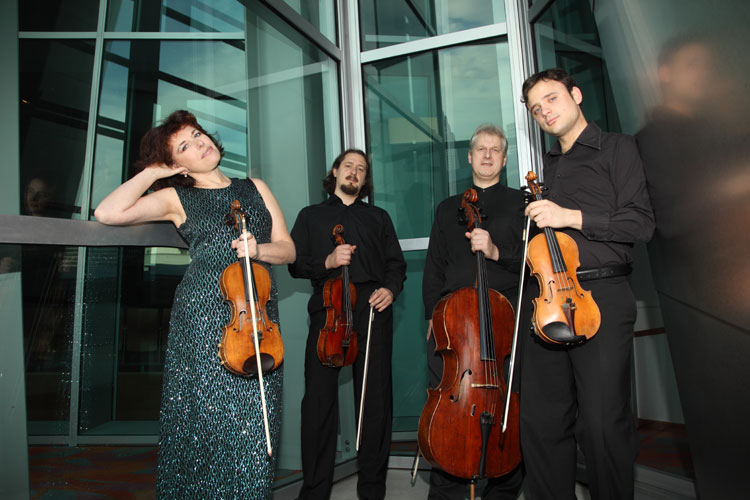
The St. Petersburg Quartet: unflappably poised and probing founding first violinist Alla Aranovskaya, violist Boris Vayner (with the quartet since 2005, and an ear-opener in last night's performance of the Shostakovich 13th Quartet), rock-solid founding cellist Leonid Shukayev, and a shorter-haired version of unreasonably adorable second violinist Evgeny Zvonnikov (with the quartet since 2010). Last night's concert was "one of the great concerts of my (alarmingly long) concertgoing experience."

by Ken

I should have tried harder to squeeze into yesterday's schedule a reminder about the weekend event I previewed last weekend: the second half of the St. Petersburg String Quartet's six-concert series of the complete Shostakovich quartets accompanied by selected mid-to-late Beethoven quartets. Obviously my regular 6pm PT post would have been too late to remind anyone about last night's concert, so I put off any reminder to today. And then, instead of writing this post for the 10am PT slot, I opted instead for more fulminating on the right-wing hooligans now running amok in the nation's statehouses and in the U.S. House of Representatives. Like my fulminating is going to do anything about it!

In the event that my I thereby deprived anyone of the opportunity to get to last night's concert, or of the time to plan to attend tonight's, which features one of the more attractive-looking programs, I apologize, because last night's was one of the great concerts of my (alarmingly long) concertgoing experience. I'm inclined now to take off the hypotheticals and question marks I've been using in describing the St. Petersburg as possibly the foremost string quartet before the public today. Not only do I know of no current quartet that can do what these folks did last night, but I don't know of any quartet of any era that could have surpassed it.

I really enjoyed the two concerts I attended out of the first three, January 21-23. (I missed the Friday night but got to the Saturday night and Sunday afternoon.) But I'm not sure the quartet was necessarily at its very best. For one thing, it was frigidly cold. At Bargemusic, on Brooklyn's East River waterfront at Fulton Ferry Landing, you really are on a real live barge in the East River, with windows on the performers' end opening onto the lower Manhattan skyline. Even though the barge itself seemed gratifyingly well heated, I'm not sure how warm it was at the performers' windowed end, and getting there through the deep freeze can't have been easy on either body or mind. And I can't say that the audience turnout was exactly overwhelming, especially when you consider the stature of these performers. (Is this what happens, even in the supposedly aesthetically sensitive classical-music world, when you don't have a high-powered PR machine behind you? I suspect so.)

Of course it may be that my concentration too was off, but in any case, admirable as all of the performances were, I at least didn't feel totally engaged until the final work on each of the programs I heard: the glorious Shostakovich Third Quartet on Saturday, Beethoven's Op. 59, No. 3 on Sunday. Last night, however, I felt gripped from the opening bars of another of my most-loved quartets, the Shostakovich Sixth (one of the pieces we previewed and heard in its entirety last Sunday), and that concentration and intensity remained unflagging through four exceedingly concentrated and intense works. The St. Petersburg not only got full artistic value for all four but made several of them sound approachable in a way I've never experienced before.

I have to say, for example, that I've never quite been on board with the widespread popularity of the Shostakovich Eighth Quartet, which for a lot of music-lovers has been the one Shostakovich quartet they knew. And it's not because the work seems to me "too easy," as often happens when there's one work out of bunch singled out for popularity. Much as I've respected the piece, with its rather gnarly, contentious quality it has always seemed to me a harder sell than any number of other Shostakovich quartets, like the Third and Sixth, and maybe the First and Second and Ninth. But last night the St. Petersburg set the piece out in a way that made it overwhelmingly gripping and moving for me, and left me eager to go back and listen to it some more.

The same was true of the relatively short 13th Quartet (roughly 20 minutes), which has generally seemed to me a beautiful but unwelcomingly wintry piece. Without flinching at its melancholy depths, the St. Petersburg made the whole piece emotionally gripping, with a generous assist from a secret weapon: current violist Boris Vayner.

The Shostakovich 13th Quartet is dedicated to Vadim Borisovsky, the original violist of the Beethoven Quartet, with which the composer had a close bond -- inexplicably close to me, in that I've never gotten much of a message from the Beethoven Quartet's records over a long period of time. Nevertheless, Shostakovich eventually devoted a quartet to each of the four original members, and not surprisingly there embedded special "prizes" for the dedicatees. The 13th Quartet has some simply haunting viola solos, which must be a dream for the player to play, but they also carry a lot of pressure: not just that they're extremely exposed, but that they require the player to deliver. I certainly had no complaints about Vayner's utterly musical playing in the first two and a half concerts I heard, but in the Shostakovich 13th he floored me. Credit the composer with creating those opportunities, but it's up to the performer to deliver, and did Vayner ever!
From the St. Petersburg's Dec. 2000- Jan. 2001 recording of the Shostakovich 13th Quartet, the final minutes are played by violist Alexei Koptev and cellist Leonid Shukayev with violinists Alla Aranovskaya and Ilya Teplyakov.

I have to say that the St. Petersburg has shown excellent taste in violists. In their Shostakovich recordings we had the pleasure of encountering three violists: Andrei Dogadin, Konstantin Kats, and Alexei Koptev, all first-rate. I'm very curious now to go back to the recording of the 13th Quartet, with Koptev. I suspect it's going to give me more pleasure than ever before, because in the cases of both the Eighth Quartet, a piece I've heard a lot, and the 13th, a piece I've heard a fair amount, last night's performances taught me an enormous amount about how to listen to them. (I just noticed, by the way, that Hyperion has gathered the St. Petersburg Shostakovich quartet cycle, including the Piano Trio and Piano Quintet, which I've described repeatedly as one of the great projects in recording history, and which I labored to collect in single-disc form, in a handy box.)

Coming off the haunting intensity of the St. Petersburg's Shostakovich 13th Quartet, not just violist Vayner but the whole quartet seemed to find i Beethoven's Op. 95 something of a cleansing release. For Beethoven the "little" Op. 95 -- it's conspicuously more compact than the earlier "middle" Beethoven quartets, the three of Op. 59 and the majestic "Harp," Op. 74 -- seems to have been an exercise in "writing small." But Beethoven wasn't much for "thinking small," and those nestled smaller works in all media tend to be not so much shorter as more concentrated and focused than their more expansive brethren. Op. 95 is a protean, constantly evolving piece that evokes none other than Shostakovich; it occurred to me that Shostakovich must have taken it very much to heart. The fast tempos of the outer movements were bracing without being excessive, and in slower motion the St. Petersburg players seemed simply to glow. While loving the Beethoven performance, I kept wondering whether it would have had quite this level of physical energy if it hadn't come right after the Shostakovich 13th.

It will be fascinating tonight to hear the St. Petersburg tackle Beethoven's next quartet, the E-flat major, Op. 127, written after a quartet hiatus of more than a decade and jumping the gap from "middle" to "late" Beethoven. It's a piece I love particularly, for its bold streak of extroversion (from the grand opening, you would never guess that we were in such a string-improbable key as E-flat major, which basically nullifies the vibrant sound of the instruments' open strings). Also on tonight's program is the searingly beautiful 14th Quartet, the other work we previewed last Sunday, and the Tenth Quartet. Tomorrow afternoon we hear three late Shostakovich quartets, Nos. 11, 12, and 15, plus Beethoven's ferociously monumental Grosse Fuge, the original finale of the quartet that followed Op. 127, Op. 130, which even the composer was persuaded was perhaps too much for both performers and listeners. (I always find it fascinating to hear the wildly differnet direction he went in in composing a replacement finale for Op. 130.)

For information about the concerts you can check the Bargemusic website. You can make reservations by e-mail, or just show up before the concert, when all ticket sales are done. Considering the caliber of the music and the performers, not to mention the chance to see them perform in this intimate and informal setting, the asking price is a steal -- and for students ($15) a downright giveaway.


The Adagio of Shostakovich's Tenth Quartet is played here by violinists Neil Gopal and Yuichiro Sakai, violist Curtis Rainey, and cellist Melanie Ellison, at Quartet Program (West) this past July. The Tenth Quartet is on tonight's St. Petersburg Quartet program at Bargemusic.
#

Labels: ,

Sunday, February 13, 2011

Sunday Classics: Sampling the world of Shostakovich's string quartets with Nos. 6 and 14

>


The American Quartet plays the opening movement of Shostakovich's Third Quartet.

by Ken

As I've been mentioning in Friday night's and last night's previews, next weekend the St. Petersburg Quartet, possibly the finest string quartet in the game today, complete's a six-concert series at Brooklyn's Bargemusic with the final three concerts of a series called "Celebrating the Complete Shostakovich and Late Beethoven String Quartets," which will encompass all 15 Shostakovich quartets with a Beethoven quartet included in each program (in the case of the first three programs, which took place last month, the three quartets of Beethoven's Op. 59, the Rasumovsky quartets).

The link is far from far-fetched. Both individually and as a body of work, the Shostakovich quartets do inevitably recall the only comparable body of music. And there's excellent precedent for the link generally. Before conductor Kurt Masur assumed the music directorship of the New York Philharmonic, with his longtime orchestra the Leipzig Gewandhaus Orchestra he put together a Beethoven-Shostakovich festival for which carefully chosen orchestral works were paired (Shostakovich himself was approached for his approval, and was enthusiastic to the point of wanting to participate in the works pairings) for audiences that were initially grudging but became increasingly enthusiastic. The concerts began selling out, and the whole series had to be repeated. This was one of the many things Masur had hoped to do in New York but was told by management, "You can't do that here." The most he was allowed to do was one such program a season, which defeated the whole purpose, both artistically and commercially.

We've focused so far on Shostakovich's Fourth Quartet, a pivotal work in that it was written in the wake of his second denunciation by the Stalin regime, in 1948. One obvious effect was to leave a man of an already nervous disposition convinced, understandably, that he was a door knock away from death. Another relatively obvious effect was that he began composing almost entirely for himself, knowing how poor performance prospects were for the foreseeable future. Perhaps less obvious was a new emphasis on chamber music. He had come relatively late to the string quartet, not composing his first until 1938, when he turned 32, and the Second and Third Quartets didn't follow until 1944 and 1946. Now it seemed the perfect repository for the artistic matter of most personal importance to him, and it would remain that way until his death in 1975.

Even when he resumed composing actively in more public forms, Shostakovich maintained a careful control of the kind of content that went into them. This has led many commentators to claim that publicly he became a stooge of the Soviet regime, but this is because those commentators are morons -- either unequipped with ears or brains or for some reason not using them. Obvious examples: the "patriotic" symphonies, Nos. 11 and 12, which provide musical representations of the revolutions that preceded "the" Russian Revolution, in 1905 and 1911. "Irony" would be the wrong word, but clearly -- if you're listening carefully, more carefully than the composer expected the cultural bureaucracy would be listening -- among the subjects they consider is what sorts of popular attitudes and responses were built into those experiences.

But in the quartet, Shostakovich was limited only by his imagination. By 1956, the year of those Moldavian performances we celebrated of the then-still-banned Fourth Quartet (meanwhile he had composed a Fifth), the regime had relaxed somewhat, and in this partial thaw he composed an almost-sunny work, the Sixth Quartet, which is the first we're going to be hearing today. After that the political situation periodically worsened and improved, and the composer's own health deteriorated sharply, increasing the generally dark outlook of the quartets. Our other quartet today, the 14th (1972-73) is at once a dark and brooding but luminously beautiful piece.

THE ST. PETERSBURG QUARTET AT BARGEMUSIC
Fulton Ferry Landing, Brooklyn

Friday, February 18 • 8 pm
SHOSTAKOVICH: Quartets: No. 6, Op. 101; No. 8, Op. 110; No. 13, Op. 138
BEETHOVEN: Quartet No. 11 in F minor, Op. 95

Saturday, February 19 • 8 pm
SHOSTAKOVICH: Quartets: No. 10, Op. 118; No. 14, Op. 142
BEETHOVEN: Quartet No. 12 in E-flat, Op. 127

Sunday, February 20 • 3 pm
SHOSTAKOVICH: Quartets: No. 11, Op. 122; No. 12, Op. 133; No. 15, Op.144
BEETHOVEN: Grosse Fuge, Op. 133

Note: Listings are of the works included on each program, not the order of performance. Ms. Aranovskaya will tell us about that at the start of each concert.

St. Petersburg Quartet: Alla Aranovskaya and Evgeny Zvonnikov, violins; Boris Vayner, viola; Leonid Shukaev, cello
[Note: First violinist Aranovskaya and cellist Shukaev have been with the quartet since its founding in 1985. The "middle positions" have turned over several times. Violist Vayner joined the quartet in 2005, second violinist Zvonnikov in 2010.]

each concert: $35 ($30 senior, $15 student)

FOR OUR SAMPLING OF THE SHOSTAKOVICH
QUARTETS NOS. 6 AND 14, CLICK HERE.

#

Labels: , ,

Saturday, February 12, 2011

Sunday Classics preview: Remembering an impromptu encore performance of the Shostakovich 4th String Quartet

>

After its aborted earlier attempt at a recording of the 15 Shostakovich string quartets for Sony, the St. Petersburg Quartet began its eventually completed traversal for Hyperion -- one of the great projects in recording history -- in 1999 with this coupling of the Quartets Nos. 4, 6, and 8.

by Ken

We began last night's Shostakovich string quartet preview with the final two and a half minutes of the Fourth Quartet as played by the Emerson Quartet, and I should perhaps have made explicit that this wasn't intended as an endorsement. It so happened that in preparation for these pieces I had just listened to the Emerson's performance of the Fourth Quartet, and while it's certainly not bad, it's like most contemporary quartets' encounters with the Shostakovich 15 -- you get the feeling that the performers are trying each of these pieces on for size, making something of the parts that happen to fit them and muddling through the rest. It happened, though, that those final minutes of the Fourth Quartet fit the Emerson very nicely indeed, and so when I decided to extract just the conclusion of the piece, it seemed natural to go with what I would account a lovely performance . . . of those few minutes. (In a moment we're going to hear another performance of just this bit which I think demonstrates how much is missing even from this "good" bit of Emersonia.)

The ensemble we heard play the whole of the Fourth Quartet was one of the 20th century's supreme string quartets, and for a lot of decades in my view the uncontestedly supreme interpreters of the Shostakovich, the original Borodin Quartet, which is to say from its founding at the Moscow Conservatory in the late 1940 up to the emigration to the U.S. of first violinist Rostislav Dubinsky (and the apparently simultaneous retirement due to ill health of his virtual nemesis in the quartet, second violinist Yaroslav Alexandrov) in 1975. The nearest approach to the Borodin's achievement with the 13 Shostakovich quartets it was able to record before Dubinsky's departure was the Shostakovich Quartet's 1978-88 traversal, at least until the St. Petersburg's in 1999-2003. The performances are very different from the original Borodin's but have in common with that great antecedent the ability to encompass the staggering array of kinds of music that occur in "the 15" and to make them all its own.

As I mentioned last night, we're currently at the midpoint of a unique musical event in New York: a performance of all 15 Shostakovich quartets, with a middle or late Beethoven quartet included on each of the six programs, at Bargemusic, at Brooklyn's Fulton Ferry Landing. Still to come next weekend, February 18-20, are Shostakovich's Nos. 6, 8, and 13 plus Beethoven's Op. 95 on Friday night; Shostakovich's Nos. 10 and 14 plus Beethoven's Op. 127 on Saturday night; and Shostakovich's Nos. 11, 12, and 15 plus Beethoven's Grosse Fuge on Sunday afternoon.

Tomorrow I'll offer some quick images of two of these works, Nos. 6 and 14. For tonight we continue remembering that remarkable night in 1956 when the original Borodin Quartet, assigned to perform at a "Russian music" festival in Modavia, gave two performances of the then-banned-in-Russia No. 4.

Last night I shared Rostislav Dubinsky's recollection of the official performance, including his description of the response of the composer, seated in the front row, to hearing this music, which had been written in 1949 in the wake of his second denunciation by the Stalin regime, in 1948. The piece had had to wait till December 1953, eight months after Stalin's death, for its public premiere, and afterward remained on the government's "forbidden" list.

I can't resist offering once again the haunting final minutes of the Fourth Quartet, this time as performed by the St. Petersburg Quartet -- at least as beautiful as the Emerson's, but with a great many other things happening as well -- along with Dubinsky's description of the conclusion of the "official" performance in Moldavia.


The final pianissimo, like a last sigh, flew off into the hall and returned to us a barely audible echo. We tried to prolong the silence, but the audience interfered. Destroying the fragile world of brief truth, uncertain applause broke out in the hall. We rose slowly, bowed to Shostakovich, and left the stage. The applause died without gaining strength.

After the concert the Borodin Quartet members received thanks for the music from composer Nikolai Peyko, who informed them that "Dmitri Dmitreivich [i.e., Shostakovich] was very moved by your playing," and asked if they might dine together. Naturally they asked if Shostakovich might join them. But Shostakovich had already been invited to a sort of cultural "state dinner" with much of the Moscow contingent, including the minister Schepalin.

FOR MORE ON THAT DINNER IN MOLDAVIA, AND AN
IMPROMPTU ENCORE OF THE 4TH QUARTET, CLICK HERE.

#

Labels: , , ,

Friday, February 11, 2011

Sunday Classics preview: What did it take to get a string quartet banned in Soviet Russia? Meet Shostakovich's 4th

>


The final two and a half minutes of the Shostakovich Fourth Quartet (1949), played by the Emerson Quartet
The final pianissimo, like a last sigh, flew off into the hall and returned to us a barely audible echo. We tried to prolong the silence, but the audience interfered. Destroying the fragile world of brief truth, uncertain applause broke out in the hall. We rose slowly, bowed to Shostakovich, and left the stage. The applause died without gaining strength.
-- Rostislav Dubinsky, first violinist of the original
Borodin Quartet, about a performance of the
Shostakovich Fourth Quartet in Moldavia, 1956

by Ken

The simple answer to the question I've posed in the post heading above is, in the case of Shostakovich's Quartet No. 4, a ringing blanket denunciation of the composer

Next weekend, February 18-20 (Friday and Saturday nights at 8, Sunday afternoon at 3), New Yorkers have access to a musical event of almost impossible-to-overstate importance: the second and concluding round of three concerts by the St. Petersburg String Quartet presenting all 15 of the string quartets of Dmitri Shostakovich, paired with a middle or late Beethoven quartet on each program. The first three concerts took place a couple of weeks ago. It takes a lot to get me to shell out $35 for a concert (it's only $30 for seniors, and $15 for students), and for me to do it twice in one weekend is almost unheard of. At that, I'm kind of sorry I missed the opening concert on the Friday night. What got me schlepping to Brooklyn in particularly frigid January weather, to Bargemusic's barge in the East River at the Fulton Ferry Landing, was the realization that $35 is actually a bargain when you're talking about:

* programs packing this much music of this much quality,

* performed by what may be the finest string quartet before the public today,

* playing in such an intimate space.

We'll be talking more about the remaining programs in tomorrow night's preview and Sunday's main post. Meanwhile, here's the Bargemusic schedule. You can phone or e-mail for reservations, but all actual ticket-buying is done at the door before each concert.

On Sunday we're going to preview two of the Shostakovich quartets still to come in the St. Petersburg series, No. 6 (Friday night the 18th) and No. 14 (Saturday night the 19th). In the previews, perhaps perversely, we're going to concern ourselves with one that's already been played, No. 4. It's still not one of the best-known or -loved of the Shostakovich quartets, but it seems to me a splendidly "typical" specimen of "the 15," written at one of the darkest moments of the composer's life: in the wake of his second full-scale denunciation by the Stalinist regime, in 1948. It wasn't performed publicly until December 1953, eight months after Stalin's death, and even then it was banned from performance for several more years.

In our previews, we're honoring an early performance of the Shostakovich Fourth Quartet, or rather two performances -- one public and formal, the other neither of these things -- on the same night, in the culturally remote Soviet precinct of Moldavia, in 1956.


FOR MORE ON THAT STRANGE NIGHT IN 1956, AND
TO HEAR THE WHOLE FOURTH QUARTET, CLICK HERE.

#

Labels: , ,

Sunday, April 25, 2010

Sunday Classics: The Shostakovich 6th rises from brooding to joyous uplift (with notes on Shostakovich and Schoenberg)

>


Leonard Bernstein tops off his one-of-a-kind performance of the Shostakovich 6th Symphony with the scampering final Presto, with the Vienna Philharmonic in October 1986. (We're going to hear the complete audio recording made at this same series of performances.)

by Ken

We make plans. Sometimes plans blow up.

From our Friday night and Saturday night Guess the Composer(s) quizzes (the answers to which are now posted as updates to the original posts), we're pointed toward the Schoenberg of the monumental and sublime cantata-oratorio Gurre-Lieder and the Shostakovich of the Sixth Symphony.

As the music of our quizzes made clear, both Shostakovich and even (perhaps surprisingly) Schoenberg had a lighter side. Still, that's not, in either case, what made the body of their music tick, although with Shostakovich there was clearly a quality of irony -- I keep searching for the right descriptive term, stronger than satirical or even sardonic; perhaps caustic? -- which remained part of his way of looking at the world well into the darkest period of his later works.
MUSICAL INTERLUDE: SHOSTAKOVICH ON "HUMOR"

The second movement of Shostakovich's great 13th Symphony (1962), built around settings of poems by Yevgeny Yevtushenko, the one that follows the pulverizing opening "Babi Yar" movement (the movement in particular that caused convulsions in the Kremlin), is "Humor":

ii. "Humor" (Allegretto)
Poem by Yevgeny Yevtushenko
English translation by Valeria Vlazinskaya


SOLO
Tsars, kings, emperors,
rulers of the world,
commanded parades,
but humor, but humor -- they could not.
To the palaces of the eminent,
who, well groomed, all day reclined,
came the vagabond Aesop.
and before him all appeared impoverished.
CHORUS
Came the vagabond Aesop,
and before him all appeared impoverished.
SOLO
In homes where a hypocrite left traces
of his puny feet,
all this banality Hadji Nasr-ed-Din
swept aside with his jokes as one would clear a chessboard.
They wanted to buy humor.
CHORUS
Only he cannot be bought!
SOLO
They wanted to kill humor.
CHORUS
But humor thumbed his nose.
SOLO
To battle him is a tough business.
They executed him endlessly.
CHORUS
Humor's severed head
was stuck on a warrior's pike.
SOLO
Just when the buffoons' pipes
would start their tale,
he would brightly cry: "I'm here!"
CHORUS
"I'm here!"
SOLO AND CHORUS
And he would break into a dashing dance.
SOLO
In a threadbare scanty coat,
crestfallen and as if repenting,
caught as a political prisoner,
he would go to his execution.
His appearance displayed disobedience,
ready for his life hereafter,
when suddenly he would slip out of his coat,
waving his hand.
SOLO AND CHORUS
And bye-bye!
SOLO
They hid humor in cells,
but like hell they succeeded.
SOLO AND CHORUS
Iron bars and stone walls
he would pass right through.
SOLO AND CHORUS
Clearing his throat from the cold,
like an ordinary soldier
he marched as a simple ditty
with a rifle for the Winter Palace.
SOLO
He is used to stern glances,
but it does not hurt him.
And humor looks upon himself
at times with humor.
He is everlasting.
CHORUS
Everlasting.
SOLO
He is smart.
CHORUS
Smart.
SOLO
And nimble.
CHORUS
And nimble.
SOLO
He will walk through everything and everybody.
SOLO AND CHORUS
And so, glory to humor!
He is a courageous fellow.


Peter Mikulaš, bass; Czecho-Slovak Symphony Orchestra (Bratislava), Ladislav Slovák, cond. Naxos, recorded Nov. 22-28, 1990

Nikita Storojev, bass; City of Birmingham Symphony Orchestra, Okko Kamu, cond. Chandos, recorded Jan. 9-10, 1987

One other thing Schoenberg (1874-1951) and Shostakovich (1906-1975) had in common, and with every composer of the 20th century who had his wits about him, was the need to cope with the exhaustion of available musical language, which we've talked about a number of times. Some readers react with disbelief or scorn, as if it's all in my imagination, but the composers who've grappled with the problem knew better.

What I can't prove to you, though I've come to believe that it's almost inescapably true, and so have most of the composers who've dealt with this, is that only a certain amount of music can be written within a given framework of musical language. It's a fact, after all, that throughout the history of Western classical music, the musical language has evolved. I don't think it's a matter of randomness or mere fashion. It is, I think, why at least in Western music, the language has been forced to evolve continuously.

It's obviously not that every single piece of music that could be written in that harmonic idiom has been written, but that at a certain point anything more tends to sound tired and imitative. What I continue to find fascinating is that this doesn't in any way invalidate or compromise the music that was already written, which can continue to sound as fresh as it ever was. (Note that this assumes that it did once sound genuinely fresh.)

We've already heard the two biggest pushes toward expanding that available musical language. The first was sounded in a single dramatic stroke by Wagner with that first half-diminshed-seventh chord in the opening phrase of the Prelude to his Tristan und Isolde. To put it mildly, there was a deal of resistance at the time, but the push into chromatic harmony, allowing fuller exploration of the intervals within the musical octave which had been generally looked down on in traditional Western tonal harmony, provided some linguistic elbow room.
MUSICAL INTERLUDE: RETURN TO TRISTAN

WAGNER: Tristan und Isolde: Prelude

Staatskapelle Dresden, Carlos Kleiber, cond. DG, recorded 1980-82

And then, although we didn't discuss it in these terms, along came Debussy with a more limited but still expansive idea: throwing into the mix chords built on intervals that go beyond the octave: 9ths, 11ths, and 13ths, creating the sound we associate with musical Impressionism. Again, it wasn't the grand breakthrough it might once have seemed, but for a while it gave composers some extra harmonic elbow room.
MUSICAL INTERLUDE: RAVEL ORCHESTRATES DEBUSSY

DEBUSSY: Sarabande (orch. Ravel)

San Francisco Symphony Orchestra, Pierre Monteux, cond. RCA/BMG, recorded Apr. 3, 1946

That somehow doesn't seem like much of a bonus, and hardly worth interrupting the main discussion. Don't tell anyone, and we'll slip in something more substantial. We never did get to the three Images for Orchestra, of which, as I mentioned, the middle Image, Ibéria, is one of Debussy's most popular orchestral works in its own right, and is itself in three movements.

DEBUSSY: Ibéria (No. 2 of Images for Orchestra):
i. Par les rues et par les chemins (By the streets and by the byways)
ii. Les Parfums de la nuit (The Perfumes of the Night)
iii. Le Matin d'un jour de fête (Morning of a Festival Day)


Orchestra of the Théâtre National de l'Opéra de Paris, Manuel Rosenthal, cond. Adès, recorded 1957-59

Perhaps this is what Schoenberg saw: that Wagner and Debussy had found enough linguistic wiggle room to keep them going, but by the time they were done, they left little room for anyone else to follow. From a strictly intellectual standpoint, the idea of replacing tonality, where all harmonic relationships are built around a "root" tone, with a system where all 12 tones of the scale are considered equal and all combinations are considered equally valid, has some theoretical plausibility.

The problem comes when you try to listen to music that's composed this way. Very occasionally, a composer (in my experience, his name is Alban Berg) has managed, through sheer force of musical imagination, to produce 12-tone, or "serial," music that really plugs into the human nervous system in much the way that Western classical music had been doing for several centuries.

Of course even after serialism was all but universally abandoned, composers occasionally managed, through some of that "force of musical imagination," to wring a bit more music of substance out of the existing tonal language, as was the case above all for the trio I've dubbed the last three great composers: Stravinsky, Britten, and Shostakovich. (Stravinsky famously had a go with every mode he could think of to give himself some still-exploitable musical language, including even a fling with the serialism he had once ridiculed. He didn't get much more mileage out of it than anyone else.)

I think it's important to understand that Schoenberg himself appreciated the extent of the sacrifice in giving up traditional tonality, at which he himself was a master. We have only to look at that great monument to it, Gurre-Lieder (Songs of Gurre). Which is where my plan for today's post broke down. I thought we could "do" a Shostakovich symphony, notably a little one like the Sixth, as well as Gurre-Lieder in one post. Actually, I had visions of doing not just the Shostakovich Sixth, but the next and last "little" symphony he wrote, the Ninth.

That's craziness, and it's not going to happen. Most of our consideration of Gurre-Lieder is going to have to wait till next week. It's not only an enormous work, but an enormously enveloping one, as full a flowering as German musical Romanticism was capable of. In it Schoenberg created a musico-dramatic world of his own, or rather several worlds, for the work's three very different parts.

For now, let's just add a tease to last night's excerpt: the orchestral interlude that bridges the main body of Part I, which consists of alternating set pieces for the Danish king Waldemar and his lover Tove, and the "Song of the Wood Dove," which culminates the hourlong Part I. Here is the third of Tove's four solos. Anyone who wants to call this the most beautiful music ever written will get no argument from me, and we've got two ravishingly beautiful performances here.

SCHOENBERG: Gurre-Lieder: Part I,
"Nun sag' ich dir zum ersten Mal" (Tove)
Now I say to you for the first time,
"King Volmer, I love you!"
Now I kiss you for the first time
and cast my arms around you.
And if you say, I'd already said it
and even given you my kiss,
then I'll say, "The king is a fool
who thinks of fleeting trash."
And if you say, "I am indeed such a fool,"
then I'll say, "The king is right."
However, if you say, "No, I'm not that,"
then I'll say, "The king is bad."
For I kissed all my roses to death,
the while I thought I thought of you.

Gundula Janowitz (s), Tove; Vienna Symphony Orchestra, Josef Krips, cond. Live performance, 1969

Jessye Norman (s), Tove; Boston Symphony Orchestra, Seiji Ozawa, cond. Philips, recorded live, April 1979

MEANWHILE, BACK AT SHOSTAKOVICH

Last night we began our look at the strange and wonderful Shostakovich Sixth Symphony backwards, starting with the third and final movement. It seemed to me as good a way in as any, though it won't get us out of this weirdly structured piece. The symphony begins with a soulfully intense Largo that lasts typically 17-20 minutes (although we're going to hear a performance that stretches this to 22½!), followed by two quickish movements that combined only sometimes crack 14.

It seems to me clear that in this great Largo we're back in the world of the Bruckner-Mahler adagio.

SHOSTAKOVICH: Symphony No. 6 in B minor, Op. 54:
i. Largo


Berlin Symphony Orchestra, Kurt Sanderling, cond. Berlin Classics, recorded April 1979

I think there's some worthwhile description in this liner note on the Shostakovich Sixth. Unfortunately it reads like the translation it is, not bad of its kind, but still unmistakably a translation, I just didn't have the time or heart to redo it.
In the Shadow of Lenin or of . . . Mahler?

The Sixth Symphony, first performed by the Leningrad Philharmonic under Yevgeny Mravinsky on 5 November 1939, was received with little enthusiasm. The period was harldy conducive to smiles, and this curious score, with its unorthodox formal design, a huge Largo followed by two lively, scherzando movements, disconcerted the critics who had come expecting a new ode to Lenin. This "headless symphony" had to wait almost half a century to be treated on an equal level with its predecessor, the highly spectacular Fifth Symphony in D minor with its Tchaikovskian forcefulness.

The shades of Sibelius and of Mahler hover over this new symphony in B minor. From the former Shostakovich took over the partiality for long, particularly expressive, disincarnate solos for the woodwinds, the use of unstable, evolving harmonies, and a rhythmic pace that endows the symphonic course with a tragic, crepuscular or spectral character.

The Largo, longer than the last two movements together, may be regarded as a symphonic poem, an extensive meditation in the shape of a diptych in which the English horn is given most of the melodic line. This sinuous, inextinguishable melody constantly renews itself in its slow harmonic mutations and its meandering from one soloist to another. The commentary makes use of unusual sonorities created by the sounding of instruments in extreme registers, e.g. the principal melody given to the piccolo accompanied by the double bassoon and a single deep melodic line in the strings. In the same way, a single blow on the gong introduces a radical change of color in the lower strings, while the flutes play skillful arabesques in the top register. The one and only appearance of the celesta launches another change of color in the string parts, which grow somewhat brighter and take up the melodic continuum introduced by the woodwinds.

In contrast, the Allegro is brilliant and exuberant, cast as a pastiche of "classical" humor à la Prokofiev. The reappearance of the original theme in the bass clarinet in opposition to the solo flute playing the inversion of the same theme is full of both humor and virtuosic imaginativeness.

The Presto finale is in the form of a speciously facetious Rondo in B major. The middle episode could be a parody of Rossini's Sonatas for strings, first in the winds (bassoon, flute, piccolo), and then repeated by the solo violin. But the futility of this game engenders a certain uneasiness by its stereotyped character. In the concluding coda there is a sophisticated orchestra of increasingly flimsy melodic material whose jauntiness and vulgarity are comparable to the "recommended" examples provided in this period by Tikhon Khrennikov's orchestrations of "Russian" songs.

--Pierre-E. BARBIER, translated by Derek Yeld

Much of this is useful and unexceptionable, and with it under our belts, this may be a good time to relisten to the first movement and then continue on with the second.

i. Largo

London Philharmonic Orchestra, Sir Adrian Boult, cond. Everest, recorded November 1958

ii. Allegro

Royal Philharmonic Orchestra, Vladimir Ashkenazy, cond. Decca, recorded November 1988

Czecho-Slovak Radio Symphony Orchestra (Bratislava), Ladislav Slovák, cond. Naxos, recorded Dec. 3-12, 1988

Still, I wonder whether we all hear the Shostakovich Sixth the same way M. Barbier does. Let's refresh our memory of the Presto finale, Friday night's bonus work. In particular, the rousing finale, roughly the last three minutes.

iii. Presto

Concertgebouw Orchestra, Bernard Haitink, cond. Decca, recorded December 1983

Our friend M. Barbier thinks the "stereotyped character" of the musical materials here are indicative of something approaching musical parody. And this is a line of thinking I would emphatically endorse with regard to the fake-triumphant climax of the Fifth Symphony, or the brilliantly insipid theme-and-variaitons of the first movement of the Seventh. But I don't get that feeling at all here. What I get is unadulterated joy and celebration, joy and celebration we can only reach by way of the long journey through the symphony's first two and a half movements. Let's listen again to just the finale, before we put the whole piece back together.

iii. Presto

WDR (West German Radio) Symphony Orchestra, Rudolf Barshai, cond. Brilliant Classics, recorded Oct. 17-20, 1995


THE COMPLETE SHOSTAKOVICH SIXTH SYMPHONY

The first thing we have to do is to correct the omission, in all the Shostakovich Sixth excerpts we've heard so far, of any Russian recordings. There really is, or at least historically has been, a difference in weight and tone of native-rendered Shostakovich. It just happens that I don't appear to have any Russian performances of the Sixth on CD, except for the first of our two complete performances, this 1955 mono one by the same conductor and orchestra who, as noted above, gave the symphony its premiere, in 1939.

And then we hear Leonard Bernstein's late recording, coupled with his Vienna remake of the little Ninth Symphony. (A video coupling made at these same performances is available on DVD.) Lenny is the man you would look to to hear the symphony's links to Mahler (he's the conductor of that 22½-minute Largo I promised), and also to savor its sardonic elements.

SHOSTAKOVICH: Symphony No. 6 in B minor, Op. 54:
i. Largo
ii. Allegro
iii. Presto


Leningrad Philharmonic Orchestra, Yevgeny Mravinsky, cond. Praga, recorded live in Prague, May 21, 1955

Vienna Philharmonic, Leonard Bernstein, cond. DG, recorded live, October 1986


SUNDAY CLASSICS POSTS

The current list is here.
#

Labels: , , , ,

Tuesday, September 22, 2009

Sunday Classics follow-up: Is Shostakovich overrated?

>


This is an interesting test. Here we have the first ten minutes of the third-movement Adagio of Shostakovich's Seventh Symphony (in Leonard Bernstein's second recording,with the Chicago Symphony, the full movement runs an unusually long 19:25), one of the most intensely felt pieces of music I know. It's a tortured elegy I would describe as a witness or memorial to victims everywhere -- victims of war, of privation, of oppression. But you get to decide for yourself what you hear, including whether it's anything for Joe Stalin to smile about.

by Ken

In my recent Sunday Classics "sneak peek" at the music of Benjamin Britten, I repeated my previously stated view that in Stravinsky, Shostakovich, and Britten we have our "last three great composers."

As I wrote originally in connection with Stravinsky:
I really want to talk about Stravinsky one of these days, and I plan to get to it really soon. Awhile back I startled Howie by saying that we've already had the last three great composers we're ever going to have--Stravinsky (1882-1971), Dmitri Shostakovich (1906-1975), and Benjamin Britten (1913-1976), all now long since safely dead and buried. This seems so obvious to me now that I forget how stark it may sound to others. But these are the last composers who seem to me, through the sheer force of their imagination, to have transcended the exhaustion of the musical language they inherited, or could scrounge up or invent.

I wish I saw a way around this, but after all these years of creative scavenging, I simply can't imagine where any aspiring composer is going to find a musical language in which to create music that has the power to stimulate and pleasure us in the way we've come to expect from the great achievements of Western classical music. What these last three great composers did was to take the musical language they inherited, which had been pretty well used up in the first half of the 20th century and, through the sheer force of their individuality, and with it produce additional bodies of top-quality work.

I should probably acknowledge here that bundling Stravinsky with these younger colleagues gives me pause, because the music of his that I love is almost all relatively early, and really didn't stretch much more than a decade beyond the "exhaustion" point if we date it at roughly the gaping cultural divide of World War I. While there's much that I admire, or appreciate, or anyway respect in the later Stravinsky, if we're talking about the period from the end of World War I to the immediate post-World War II period, there are any number of composers who produced more music that I love than he did -- names pop to mind like Bela Bartok and Richard Strauss and Sergei Prokofiev and Alban Berg.

Again this is ground I would really like to come back to, to try to make a more coherent and explicit case. For now I just want to deal with a comment added to Sunday's post by reader Frank Wilhoit concerning one of my "last great composers":

I think we may all have overrated Shostakovich somewhat. Now that we live in a totalitarian environment ourselves, his reaction to totalitarianism no longer seems as noble as it once did, but subjective and pitiful. We have now been forced to acknowledge that anything created in a totalitarian environment is axiomatically and absolutely worthless, totally invalidated before it is even conceived.

I began by simply adding a comment-reply, but decided the question of whether Shostakovich is overrated deserved to be pulled out of the comments section -- and this is the one place in the world where I've got the clout to do it.

I kept looking for some indication that this is some sort of ironic statement and not Frank's actual view:

"We have now been forced to acknowledge that anything created in a totalitarian environment is axiomatically and absolutely worthless, totally invalidated before it is even conceived."

Surely there isn't anyone who actually believes this, is there? But my irony detector has come up blank.

"At Babi Yar there is no memorial," begins the Yevtushenko poem that begins Shostakovich's overpowering 13th Symphony (1962), growled by the choral basses in their lower range, punctuated by chimes that in the late Kyril Kondrashin's performances sounded unmistakably like the knell of death. In the course of the time when the Soviet regime was suppressing the piece, this statement became factually untrue; a memorial of sorts was installed. But is the significance of what happened at Babi Yar either remembered or understood? Any more than we will remember what happened at Abu Ghraib and Guantanamo?


The able bass Mikhail Petrenko was a late replacement for this August 2006 Proms performance, in the Royal Albert Hall, of the Shostakovich 13th Symphony by the Mariinsky Theater Chorus and Orchestra under Valery Gergiev. We hear most of the first movement ("Babi Yar"). [Here is an English translation of the Yevtushenko poem.]

For me, Shostakovich's greatness as an artist has nothing to do with some presumed "nobility." It's a product of his availability and sensitivity to the world around him, his insight into the human condition, and the brilliant array of musical resources he brought to bear to transform what he observed and felt into music of ever-increasing resonance. Again, listen to the Adagio of the Seventh Symphony.

The relationship of Soviet citizens to the Soviet regime and the relationship of Soviet artists to both are fascinating and complex subjects, and they are inescapable in the understanding and appreciation of Shostakovich's music. But they don't define or explain that music in any simple way.

For starters, I can't imagine anyone who has lived with the 15 string quartets giving even a second's thought to the notion that Shostakovich is overrated. Under-rated? Perhaps. But overrated? Let's get serious. After Beethoven's quartets, there's nothing remotely comparably in the musical literature. Ironically, these most deeply felt and intimately expressed works may well be the composer's most accessible, because in chamber music he had less need than in more public forms to hide or camouflage his artistic concerns. (We heard another deeply expressive Shostakovich Adagio, that of the Third String Quartet, in the Sunday Classics post on the path from the Borodin Quartet to the Borodin Trio.)

The 15 symphonies are a much more diverse proposition, including as they do so many different kinds of artistic undertakings. Since we've already heard a bit of the Seventh -- a profoundly misunderstood piece, I should warn -- I might direct music lovers to Shostakovich's monumental pair of wartime symphonies, the Seventh and Eighth, which not only are spirit-shaking masterpieces in their own rights but together form a fairly overwhelming super-symphony.

To that we might perhaps add, by way of something completely different, the comparatively minuscule symphony that followed immediately, the irrepressibly impudent Ninth. The Ninth Symphony formed the subject of Leonard Bernstein's Young People's Concert"Humor in Music."


Georg Solti, a surprisingly sympathetic Shostakovich conductor who made a hugely powerful recordingof the gritty Eighth Symphony with the Chicago Symphony, here conducts the jaunty opening movement of the Ninth, with the Bavarian Radio Symphony in 1992.

Marshal Stalin himself is said to have had a personal interest in the Shostakovich Ninth Symphony. He kept a close eye on the composer after Shostakovich's rehabilitation following his first official denunciation by the Stalin regime in 1936. The great leader is said to have been miffed that neither of the monumental wartime symphonies, the Seventh and Eighth, was dedicated to that greatest of Soviet heroes, himself. He was led to believe, we're told, that they would be followed by a comparable mighty work, which would complete a symphonic triptych and be suitable for dedicating to so august a personage. If so, the great man was likely not amused by the actual Ninth Symphony when it was unveiled in November 1945, and he heard what we just heard.

Shostakovich was a pianist, and a whole other side of his personality comes to the fore when he's writing for his instrument. Now in our own living rooms we can not just hear but actually watch the remarkable pianist Tatiana Nikolayevaplay Shostakovich's Op. 87 set of 24 Preludes and Fugues (1950-51), obviously referencing Bach's Well-Tempered Clavier. Here you can hear but not see her play No. 1 in C major. (In this trailer you can see just the Prelude of No. 17 in A flat major.) And when it comes to looking death squarely in the puss, perhaps the only composer who has done so as eloquently as Shostakovich -- I'm thinking particularly of the 14th Symphony (1969) and the 14th and 15th String Quartets (1973 and 1974) -- is Britten, notably in his last opera, Death in Venice (completed in 1973) Third String Quartet (1975, clearly influenced by Shostakovich's final quartets; the two composers had enormous mutual admiration). And I've merely skimmed off a few highlights here, not even mentioning, for example, the two great operas.

Was Shostakovich's world view shaped by the times and society he lived in? Of course. Is that a crucial part of his music? Obviously, and how could there not be interest in hearing a great musical artist's response to all of that? So far it's given me a lifetime's worth of absorption, not to mention the pleasure of a large quantity of beautiful and gripping music.


QUICK HITS: SOME SHOSTAKOVICH CDs (AND DVDs)

For the Shostakovich string quartets, the St. Petersburg Quartet'sboldly reimagined Hyperion cycle is one of the great recorded achievements of the last couple of decades, while the Shostakovich Quartet'smore traditionally conceived but bursting-with-life Melodiya cycle is altogether recommendable. It's a shame that Chandos's well-merited and well-intentioned reissue of the first Borodin Quartetrecordings (before first violinist Rostislav Dubinsky left the quartet and the Soviet Union) of the first 13 quartets doesn't really do justice to the richness and variet of sound of the ensemble as heard on LP, but in their basic commitment these performances remain unsurpasssed.

Rather than get enmeshed in recommendations for the Seventh and Eighth Symphonies, since the pieces do seem to me to have been connected in the composer's mind, let me just suggest the conductor who seems to me to have had the greatest degree of success with both, Neeme Järvi, with the Scottish National Orchestra on Chandos (No. 7and No. 8).And I'm going to suggest Järvi again, this time with the Göteborg Symphony, for the 13th and 14th Symphonies, on the strength of DG's handy two-CD set, which throws in the 15th as well. (I confess, though, that I still don't get the 15th Symphony.)

Leonard Bernstein's affectionate New York Philharmonic recording of the little Ninth Symphony now comes coupledwith a solid performance of what has generally been Shostakovich's most popular symphony and probably most popular work, the Fifth Symphony. You can see as well as hear Lenny's later Ninth, with the Vienna Philharmonic, on a DG DVDcoupled with the Shostakovich Sixth Symphony.

Tatiana Nikolayeva made three audio recordings (that I know of) of the enormous Op. 87 set of 24 Preludes and Fugues for solo piano. But Medici Arts' video recordingseems an obvious recommendation, and a great bargain. (Amazon is selling it for $20, and other merchants offer it for even less.)


SUNDAY CLASSICS POSTS

Here is the updated list.
#

Labels: , , ,

Sunday, September 20, 2009

Sunday Classics: A sneak peek into the sound world of Benjamin Britten

>


At the heart of Britten's haunting opera Peter Grimes are the four Sea Interludes, orchestrally evoking life in a poor Suffolk-coast fishing village. The first, "Dawn," which joins the Prologue and Act I, is played here by the Boston Symphony in Leonard Bernstein's "Final Concert."

by Ken

Way back when (in August 2007, actually), writing briefly about some music of Igor Stravinsky, I caused a flutter of sorts when I described him as "one of the last three great composers":
I really want to talk about Stravinsky one of these days, and I plan to get to it really soon. Awhile back I startled Howie by saying that we've already had the last three great composers we're ever going to have--Stravinsky (1882-1971), Dmitri Shostakovich (1906-1975), and Benjamin Britten (1913-1976), all now long since safely dead and buried. This seems so obvious to me now that I forget how stark it may sound to others. But these are the last composers who seem to me, through the sheer force of their imagination, to have transcended the exhaustion of the musical language they inherited, or could scrounge up or invent.

The proposition still seems to me so simple and uncontroversial that I wonder at the fuss. What bothers me is my failure to deliver on the implied promise there. Since then we have bumped up against Shostakovich but not said much of what I hoped to say about these three composers. And I'm afraid today we aren't going to do a lot more than bump up against Britten. Still, we have to start somewhere.

One problem is that I still haven't figured out how to get control of musical samples. My position is that there's no point in my blithering on if you can't hear the music, which is the important part. As a matter of fact, I've had a Britten piece on the drawing board for two years now, which was to kick off with the first of the Sea Interludes, "Dawn," from the composer's most-performed opera, Peter Grimes, ideally picking up from the Ellen-Grimes duet at the end of the Prologue and continuing into the awakening-village opening of Act I, and then what is for me the emotional core of Britten's War Requiem.


The War Requiem, written for the dedication of the rebuilt Coventry Cathedral (destroyed by German bombs in 1940) in 1962, interspersed poems by the antiwar poet Wilfred Owen (1893-1918), who died in military action a week before the signing of the armistice that ended World War I (his parents are said to have received notification the day the armistice was announced), with the traditional Latin Requiem text. The excerpt I was aiming for was Britten's setting, as part of the Offertorium of the Requiem, of Owen's "Parable of the Old Man and the Young," a retelling of the story of Abram and Isaac, by the tenor and baritone soloists, that veers off track at the end, culminating in one of the more harrowing images I know -- "the old man" Abram slaying not just his son Isaac but "half the seed of Europe, one by one."

THE PARABLE OF THE OLD MAN AND THE YOUNG

So Abram rose, and clave the wood, and went,
And took the fire with him, and a knife.
And as they sojourned, both of them together,
Isaac the first-born spake, and said, My Father,
Behold the preparations, fire and iron,
But where the lamb for this burnt-offering?
Then Abram bound the youth with belts and straps,
And builded parapets the trenches there,
And stretched forth the knife to slay his son.
When lo! an angel called him out of heaven,
Saying, Lay not thy hand upon the lad,
Neither do anything to him. Behold,
A ram, caught in a thicket by its horns;
Offer the Ram of Pride instead of him.
But the old man would not so, but slew his son,
And half the seed of Europe, one by one.


-- Wilfred Owen

Back in 2007 the Britten pickings on YouTube were mighty slender, and I scratched at how to produce my own audio clips, at least, in the process tantalizing Howie with the War Requiem excerpt, for which I couldn't actually find a recording that satisfies me. I'm still not wildly happy with the Bernstein "Final Concert" performance of the "Dawn" Peter Grimes interlude, which seems to me to seriously underplay the whole piece -- and underplaying is something Lenny was rarely accused of. (He had made a better recording of the Grimes interludes with the New York Philharmonic.

Still, the performance is good enough to allow the listener access to the interplay of unexpected tone colors, harmonies, and rhythms with which Britten conjures this musical image of dawn in a fishing village on his beloved Suffolk coast. Like all the Sea Interludes, this is music that's meant to play straight into the imagination, and I've found that even after long acquaintance it becomes more haunting with each hearing.

Strangely, the War Requiem has become one of Britten's more played compositions, and there is now a fair amount of it on YouTube, but I haven't turned up the Offertorium at all, let alone in an acceptable performance. I say it's "strange" that the Requiem is now played so widely, because it has always struck me as one of Britten's less accessible works, except at the most obvious level -- the interplay of the Owen poems and the liturgical text, and their symbolic connection to the occasion for which the piece was written.

(Note to Howie: We'll come back to the War Requiem. I promise. Eventually.)

I have made one happy discovery on YouTube: a lovely performance of Britten's 1942-43 Serenade for Tenor, Horn, and Strings, Op. 31, a setting for this unusual group of performers (inspired by the availability of Britten's life partner, the tenor Peter Pears, and the brilliant young horn player Dennis Brain) of six quite diverse poems, with a Prologue and Epilogue. It's broken into three clips; this middle one encompasses the second, third, and fourth songs, the "Nocturne" (Tennyson's "The Splendor Falls on Castle Walls" from The Princess), "Elegy" (Blake's "The Sick Rose," aka "O Rose, thou art sick," and "Dirge" (the anonymous 15th-century "Lyke-Wake Dirge"):


The "Nocturne," "Elegy," and "Dirge," the second through fourth songs from Britten's Serenade, are performed by tenor John Mark Ainsley, horn soloist Danilo Stagni, and the strings of La Scala's Orchestra filarmonica conducted by Jeffrey Tate. (Part 1 of the Serenade is here; part 3, here.)

Nocturne

The splendor falls on castle walls
And snowy summits old in story;
The long light shakes across the lakes,
And the wild cataract leaps in glory.
Blow, bugle, blow, set the wild echoes flying,
Blow, bugle; answer, echoes, dying, dying, dying.

O, hark, O, hear! how thin and clear,
And thinner, clearer, farther going!
O, sweet and far from cliff and scar
The horns of Elfland faintly blowing!
Blow, let us hear the purple glens replying,
Blow, bugles; answer, echoes, dying, dying, dying.

O love, they die in yon rich sky,
They faint on hill or field or river;
Our echoes roll from soul to soul,
And grow forever and forever.
Blow, bugle, blow, set the wild echoes flying,
And answer, echoes, answer, dying, dying, dying.


-- Alfred Lord Tennyson

Elegy [at 1:23]

O Rose, thou art sick!
The invisible worm
That flies in the night,
In the howling storm,

Has found out thy bed
Of crimson joy:
And his dark secret love
Does thy life destroy.


-- William Blake


Dirge [no clear separation point from the orchestral postlude following "Elegy," but the "Dirge" vocal begins at 6:02]

This ae nighte, this ae nighte,
REFRAIN:—- Every nighte and alle,
Fire and fleet and candle-lighte,
And Christe receive thy saule.

When thou from hence away art past,
-— Every nighte and alle,
To Whinny-muir thou com'st at last;
And Christe receive thy saule.

If ever thou gavest hosen and shoon,
-— Every nighte and alle,
Sit thee down and put them on;
And Christe receive thy saule.

If hosen and shoon thou ne'er gav'st nane
-— Every nighte and alle,
The whinnes sall prick thee to the bare bane;
And Christe receive thy saule.

From Whinny-muir when thou may'st pass,
-- Every nighte and alle,
To Brig o' Dread thou com'st at last;
And Christe receive thy saule.

From Brig o' Dread when thou may'st pass,
—- Every nighte and alle,
To Purgatory fire thou com'st at last;
And Christe receive thy saule.

If ever thou gavest meat or drink,
-— Every nighte and alle,
The fire sall never make thee shrink;
And Christe receive thy saule.

If meat or drink thou ne'er gav'st nane,
—- Every nighte and alle,
The fire will burn thee to the bare bane;
And Christe receive thy saule.

This ae nighte, this ae nighte,
-— Every nighte and alle,
Fire and fleet and candle-lighte,
And Christe receive thy saule.

-- anonymous

I'm not going to say much of anything about the music. Again, I would simply encourage: (a) alertness to the musical setting as well as the texts, and (b) receptivity to both. I think initially you'll find some moments that grab you immediately, and then with repetition other points will begin to act on you, and gradually all will deepen.

Obviously Jon Mark Ainsley is a very different sort of tenor from Peter Pears, and it's kind of a jolt to me, in the "Dirge" (the song I was actually shooting for here) not to hear the truly dirge-appropriate wailing sound Pears produces his upper range. But it's really only when we hear inspired performers quite different from Britten and his circle that we begin to appreciate the true stature of this music. Jeffrey Tate is the good kind of English sensibilty for Britten (I'll come back to this question of nationality briefly), and is well suited to helping the Italian musicians hear this music.

The most obvious case is that of Peter Grimes itself. When Jon Vickers, a singer who could hardly have been more different in voice and personality from Pears, undertook the title role at the Met in 1967, with the collaboration of director Tyrone Guthrie and conductor Colin Davis, a whole previously unheard dimension of the piece opened up. An instructive lesson in the dangerous provincialization of Britten can be learned from what happend when Vickers and Davis took the show back to England. By the time of the Covent Garden video and audio recordings, most of the dimensionality of the Met performances had been flattened to two dimensions, most noticeably in Davis's blandly conventional conducting (it feels like there's an extra hour or two of mediocre music stuffed into the opera), but unfortunately also in Vickers' more mannered, manicured performance.

There was always tension in the relationship between Britten and his countrymen. The composer was unquestionably "English" and "British" to the core, but not in the accepted conventional ways, and they knew it and resented it, especially in the loftier social circles. Was it because he was gay? Yes. Was it because he was a pacifist (he sought and received conscientious objector status during World War II, declaring himself unable to kill or to participate in killing)? Yes. But I think those were symptoms of Britten's "otherness." The more powerfully Britten's musical supremacy emerged, the more you can see the British musical establishment trying to prop up lesser alternatives who might be passed off as Britian's really and truly greatest composer.

Why, it was almost as if Britten was, gasp, pointing a finger of accusation, perhaps rejection, or even ridicule, at all the institutions Britons held sacred! Um, yeah, kinda, d'ya think? Nah, couldn't be.


QUICK HITS

Four Sea Interludes from "Peter Grimes"

If you can't find Britten's own recording of the Sea Interludes from Peter Grimes, try Andrew Davis's,coupled with the composer's ever-popular Young Person's Guide to the Orchestra.

Leonard Bernstein's NY Phil Sea Interludes are available in, of all things, SACD-only format,interestingly coupled with the LB-NYP Holst Planets.

Serenade for Tenor, Horn, and Strings

Peter Pears, Dennis Brain, and the composer recorded the Serenade as early as 1944, with the Boyd Neel Orchestra, and that version has turned up on a Pearl CD, "Benjamin Britten performs Benjamin Britten,"as well as in a valuable four-CD collection of historic Britten recordings -- some conducted by the composer, most not -- in Membran International's Quadromania series. (I paid some ridiculous price like $8 for it at Berkshire Record Outlet, but they don't seem to have it anymore. CD Universe lists it -- at $15.59 for the four-disc set -- but reports it "backordered since 7/28/2009.")

For most listeners, the recording of choice is the gorgeous the gorgeous stereo versionwith Barry Tuckwell filling the gap left by Brain's death in 1957 at the preposterous age of 36. It's coupled with Pears-Britten stereo recordings of the Rimbaud song cycle Les Illuminations (originally written for soprano) and the sequel to the Serenade, the 1958 Nocturne for tenor, assorted instruements, and strings.

War Requiem

There's certainly room for an alternative to the composer's own recording,with the originally scheduled soloists, Galina Vishnevsakaya, Peter Pears, and Dietrich Fischer-Dieskau. But as the recordings continue to pile up, I can't say I've found one that's especially persuasive, or that offers worthy alternatives to Britten's idiosyncratic trio of soloists.


SUNDAY CLASSICS POSTS

The updated list is here.
#

Labels: , , , , , , , ,