Monday, December 02, 2019

Tale Of Two Columns-- One A San Francisco Liberal Who Likes Bloomberg and A New York Conservative Who Likes Bernie

>


When I lived in San Francisco-- in the late '70s and '80s-- Willie Brown was one of the most powerful liberal Democrats in America. Now, at age 85... he's not exactly progressive icon. He's more like an old Republican uncle ranting and raving about the horrors of Socialism!!!!, an example of which was on display as an OpEd on the greatness of Michael Bloomberg in the San Francisco Chronicle over the weekend. And at the same time, a NY Times' in-house conservative, Ross Douthat, penned an impressive moment of honest clarity about the 2020 presidential election, running counter to the Times' editorial herd instinct, The Case For Bernie. Let's get through Brown's bullshit first and then come back to Douthat's enlightened revelations.
Former New York Mayor Michael Bloomberg’s late entry into the Democratic presidential sweepstakes is being dismissed by rival candidates, who call him just another billionaire trying to buy his way into the White House.

And given his self-funded $30 million TV ad kickoff, Bloomberg may well give fellow billionaire Tom Steyer a run for his millions when it comes to campaign spending.


But if you can get past his Mr. Moneybags image, you may be looking at the most plausible general election opponent for President Trump. Bloomberg stands a chance of winning over older Republican voters who are tired of Trump’s antics, which is more than you can say for most of the rest of the Democratic field. And a crossover Republican vote could be key to winning battleground states such as Florida, Ohio and Wisconsin.

I’ve always found the issue of self-financing entertaining. Take money from others, and you’re a sellout. Finance your own campaign, and you’re trying to buy your way into office.

So it came as little surprise when Vermont Sen. Bernie Sanders immediately accused Bloomberg of trying to buy the nomination.

Apparently, Sanders thinks it’s better to have your friends buy the nomination for you, then pay them back by promoting policies that they support.

I doubt Bloomberg will be deterred by the Bernies of the world. To paraphrase John Paul Jones, Bloomberg has not yet begun to spend.

Black Lives Matter types are raising another issue: Bloomberg’s promotion of “stop and frisk” police tactics when he was mayor.

He has apologized for the practice, but the pundits keep saying the random police stops of blacks will cost Bloomberg in the African American community.

Maybe, but the pundits would do well to look at who just endorsed Bloomberg in South Carolina: Stephen Benjamin, the African American mayor of Columbia, S.C., and the former president of the U.S. Conference of Mayors.


I’ve known Bloomberg for years. He is very smart, very charming and very, very opinionated.

And he is not to be underestimated.
Sad! Poor ole Willie, former mentor/paramour for the fatally flawed Kamala Harris, with whom he's now fallen out and, apparently, doesn't see as compelling as the old Republican billionaire pretending to be a Democrat.


Recently, the Trumpists have been pushing out 3 polls showing African-American approval of the racist fake president at over a third. (In 2016 Trump's share of the black vote was 6%.) Is it too much to imagine that today millions of those voters feel taken for granted and that they've become as disillusioned with establishment Democrats as those so-called "deplorables" in the upper midwest who flipped for Trump, punishing the Democrats for their fakery. The political/media establishment-- including for reasons in Douthat’s essay-- refuse to recognize that there is only one ticket to head that off at the pass: B.E.R.N.I.E. And that brings us to The Case For...
The Democratic Party needs a nominee, but right now it has a train wreck instead. The front-runner seems too old for the job and is poised to lose the first two primary season contests. The woman who was supposed to become the front-runner on the basis of her policy chops is sliding in the polls after thoroughly botching her health care strategy. The candidate rising in her place is a 37-year-old mayor of a tiny, not-obviously-thriving city.

Meanwhile several seemingly electable alternatives have failed to catch fire; the party establishment is casting about for other options; and not one but two billionaires are spending millions to try to buy delegates for a brokered convention... which is a not-entirely-unimaginable endgame for the party as it prepares to face down Donald Trump.

The state of the Democratic field reflects the weaknesses of the individual candidates, but it also reflects the heterogenous nature of the Democratic coalition, whose electorate has many more demographic divisions than the mostly white and middle-class and aging G.O.P., and therefore occasionally resembles the 19th-century Hapsburg empire in the challenge it poses to aspiring leaders.

The theory of the Kamala Harris candidacy, whose nosedive was the subject of a withering pre-mortem from three of my colleagues over Thanksgiving, was that she was well suited to accomplish this unification through the elixir of her female/minority/professional class identities-- that she would embody the party’s diversity much as Barack Obama did before her, and subsume the party’s potential tensions under the benevolent stewardship of a multicultural managerialism.

That isn’t happening. But it’s still reasonable for Democratic voters to look for someone who can do a version of what Harris was supposed to do, and build a coalition across the party’s many axes of division.

And there’s an interesting case that the candidate best positioned to do this-- the one whose support is most diverse right now-- is the candidate whom Obama allegedly promised to intervene against if his nomination seemed likely: the resilient Socialist from Vermont, Bernie Sanders.


Like other candidates, Sanders’s support has a demographic core: Just as Elizabeth Warren depends on very liberal professionals and Joe Biden on older minorities and moderates, Bernie depends intensely on the young. But his polling also shows an interesting better-than-you-expect pattern, given stereotypes about his support. He does better-than-you-expect with minorities despite having struggled with them in 2016, with moderate voters and $100K-plus earners despite being famously left-wing, and with young women despite all the BernieBro business.

This pattern explains why, in early-state polling, Sanders shows the most strength in very different environments-- leading Warren everywhere in the latest FiveThirtyEight average, beating Biden in Iowa and challenging him in more-diverse Nevada, matching Pete Buttigieg in New Hampshire and leading him easily in South Carolina and California.

Now, I have stacked the argument slightly, and left out a crucial axis of division where Sanders does worse than you expect: He struggles badly with his fellow Social Security recipients, the over-65. This weakness and Biden’s strength with these same voters are obvious reasons to doubt the case for Bernie as the unifier, Bernie as the eventual nominee.

Especially since Sanders has thus far ignored my advice (I know, the nerve) that he reassure skeptics by telling them that he has a record as a dealmaker, that he can moderate on certain issues, so they can feel safe supporting him even if they aren’t ready for the revolution.

But still: If you are a wavering Democrat concerned about both party unity and ultimate electability, about exciting all the diverse factions of your base while also competing for the disaffected, both the relative breadth of Bernie’s primary coalition and his decent polling among non-voters and Obama-Trump voters are reasons to give him another look.

That decent polling, I suspect, reflects a sense among voters drawn to populism that Bernie is different from not only the more centrist candidates-- latecomers Michael Bloomberg and Deval Patrick especially, but Buttigieg as well-- but also from his fellow left-winger, Warren, who has fully embraced the culture-war breadth of the new progressivism while Sanders remains, fundamentally, an economic-policy monomaniac.

He’s still a social liberal, of course, and he isn’t in the culturally conservative/economic populist quadrant where so many unrepresented voters reside. But for the kind of American who is mostly with the Democrats on economics but wary of progressivism’s zest for culture war, Sanders’s socialism might be strangely reassuring-- as a signal of what he actually cares about, and what battles he might eschew for the sake of his anti-plutocratic goals. (At the very least he’s no more radical on an issue like abortion than a studied moderate like Mayor Pete.)

This is why, despite technically preferring a moderate like Biden or Amy Klobuchar, I keep coming back to the conservative’s case for Bernie-- which rests on the perhaps-wrong but still attractive supposition that he’s the liberal most likely to spend all his time trying to tax the rich and leave cultural conservatives alone.
Goal ThermometerOur friend Skip Kaltenheuser, who called Douthat's column to my attention, also suggested a quick scan of the Times' Picks and Reader Picks comments for Douthat’s essay, noting that it "is damn encouraging for the number of intelligent, aware readers, and for underscoring that Bernie’s message is getting through. Often it’s painful to read comments but these are a pleasure." And, by the way, the thermometer on the right is a way you can contribute to not just Bernie's campaign, but also to the campaigns of progressive congressional candidates who have endorsed him and are running on the same issues that have motivated his own campaign. If Bernie's-- or for that matter, Elizabeth's-- agendas are going to have a chance of passing through Congress and becoming law, items like Medicare-for-All and the Green New Deal, for example, we are going to need far fewer Republicans, Blue Dogs and New Dems in Congress and far more Democrats like Morgan Harper (OH), Mark Gamba (OR), Eva Putzova (AZ), Kim Williams (CA), Kina Collins (IL) and the other men and women you'll see when you click the thermometer.


Labels: , ,

Monday, September 17, 2018

Why Are Evangelical Religious Leaders Helping Trump Remove Jesus From Christianity?

>


Over the weekend the NY Times' in house conservative, Ross Douthat, used his column to opine on Conservatism After Christianity. Funny, I've been thinking a lot about the same topic from another perspective: what happens to evangelical Christianity after the stink of Trumpism becomes apparent even to the suckered carnival tent and snake-oil consuming idiots? "One of the many paradoxes of the Trump era," wrote Douthat, "is that our unusual president couldn’t have been elected, and couldn’t survive politically today, without the support of religious conservatives … but at the same time his ascent was intimately connected to the secularization of conservatism, and his style gives us a taste of what to expect from a post-religious right."

If you follow DWT with any regularity, you've been reading lately a series of posts about a Jesus-oriented evangelical Christianity and a movement called Vote Common Good. They are reaching out directly to evangelicals who are unhappy and confused about Trump-- and pointedly asking them to support Democrats running for Congress as a way of putting a check on Trump's excesses and on the spinelessness of Trump's congressional enablers. Robb Ryerse, a pastor in Arkansas and the VoteCommonGood political director told us that "In Jesus, we see someone who sided with the marginalized and the oppressed. We see someone who spoke truth to people with religious and political power. We see someone who welcomed refugees and immigrants as neighbors. We see someone who offered people the healthcare they needed without blaming them for being poor. We see someone who was really quite progressive. What if we could help others see this same Jesus we do? What if we could convince them to vote, not just the way they always have or for their own self-interests, but for the common good of all people?"

Douthat wrote that "during the Republican primaries, when the most reliable churchgoers tended to prefer Ted Cruz but the more secular part of the party was more Trumpist. But it was obscured in the general election, and since, by the fact that evangelical voters especially rallied to Trump and have generally stood by him. Now, though, a new survey reveals the extent to which a basic religious division still exists within Trump’s Republican Party. The churchgoers who ultimately voted for Trump over Clinton still tend to hold different views than his more secular supporters, and the more religious part of the G.O.P. is still the less Trumpist portion-- meaning less populist on economics, but also less authoritarian and tribal on race and identity... The more often a Trump voter attended church, the less white-identitarian they appeared, the more they expressed favorable views of racial minorities, and the less they agreed with populist arguments on trade and immigration."
[A] quarter of Trump voters who never attend church describe being white as “very important” to their identity; for the most frequent churchgoers voters, it was 9 percent. Among non-churchgoing Trump voters, only 48 percent had warm feelings toward black people, compared to 71 percent of weekly churchgoers; the same sort of pattern held for views of Hispanics, Asians and Jews.

Churchgoing Trump voters were still more culturally conservative than Hillary Clinton voters-- more likely to support the death penalty, more skeptical of immigration-- and their views of Muslims, interestingly, seemed to have been influenced by Trump’s own rhetoric, becoming more hostile between 2016 and 2017.

But in general, churchgoing Republicans look more like the party many elite conservatives wanted to believe existed before Trump came along-- more racially-tolerant, more accepting of multiculturalism and globalization, and also more consistently libertarian on economics. Secularized Trump voters look more like the party as Trump has tried to remake it, blending an inchoate economic populism with strong racial resentments.

Interestingly in the survey the different groups make about the same amount of money, which cuts against strict economic-anxiety explanations for Trumpism. But the churchgoers and nonchurchgoers differ more in social capital: The irreligious are less likely to have college degrees, less likely to be married and more likely to be divorced; they’re also less civically engaged, less satisfied with their neighborhoods and communities, and less trusting and optimistic in general.

This seems to support the argument, advanced by Tim Carney of the Washington Examiner among others, that support for populism correlates with a kind of communal breakdown, in which secularization is one variable among many leaving people feeling isolated and angry, and drawing them to the ersatz solidarity of white identity politics.

Meanwhile frequent church attenders, already a minority within the wider society, are also a minority within the Republican coalition. Relatively few Republicans are explicitly religiously unaffiliated (though that number has been climbing too), but only about a third of Trump’s 2016 voters are in church on a typical Sunday, and almost half attend seldom or not at all.


This suggests a possibility that should worry both Trump’s religious supporters and anyone who finds his style of conservatism racially toxic. Despite their resistance to that toxicity, the churchgoers in this survey did vote for him, making a pragmatic bet that his policies on abortion and religious liberty were worth living with his Caligulan personal life and racial demagoguery. To defend that bet, some historically-inclined believers have cited past cases where Christians accepted bargains with a not-particularly moral leaders-- including the way the early church accepted the patronage of Roman emperors, from Constantine onward, whose personal piety was limited at best.

But the Constantinian bet involved a rising religion allying with a worldly power to accelerate its growth and gains. The bet under Trump involves the reverse sort of situation: A Christian community trying to make the best of its decline, and allying with a leader whose core appeal depends upon and possibly furthers the de-Christianization of conservatism.

Such a bet might be understandable as an act of desperation. But it’s hard to see how it can reverse de-Christianization, and easy to see how it might accelerate it. Which, on the evidence of this survey, is something that secular liberals should fear as well.
Goal ThermometerMany of the progressives working with Vote Common Good and Ted Lieu on this project include candidates DWT readers are very familiar with-- like Randy Bryce (WI), Kara Eastman (NE), Dayna Steele (TX), James Thompson (NE), Katie Porter (CA), J.D. Scholten (IA) and Ammar Campa-Najjar (CA)-- and who are not evangelical Christians but who want to be able to effectively communicate with all their constituents and to represent all their constituents in Congress, including, of course, people of faith. Samir Selmanović, one of the directors of VCG, offers to help Democratic candidates "become more confident talking about religion in a way that is both authentic and persuasive to religious voters, particularly Evangelicals who are ready for your message. Many of them are on the brink of turning their vote to the left in order to follow their conscience, be faithful to their religious experience and story, and cross the line (in the booth or in public) to recover their personal integrity."

Labels: , , , ,

Tuesday, April 17, 2018

Now That Randy Bryce Knocked Ryan Out Of The Race, Creepy Crawly Peter Barca Wants To Run

>


Paul Ryan knows why he retired from Congress-- audit's not about teaching his sons, Charlie and Sam, to shoot bows and arrows. Randy Bryce is why Ryan is retiring from Congress. I've been trying for a decade to find a credible candidate to run against Ryan. The local Democratic elected officials in the district were all afraid... every one of them. Political cowards who were afraid to give up their jobs to run against Paul Ryan. In 1993, when Bill Clinton appointed 22-year incumbent Les Aspin to be Secretary of Defense, Assemblyman Peter Barca ran for the open seat to serve out the rest of Aspin's term. He beat Mark Neumann by 675 votes and in 1994 Neumann was back and beat Barca-- part of the Newt Gingrich wave-- 83,937 to 82,817. Barca had been a disappointment for Democrats, particularly for unions who had to pull teeth to get him to oppose NAFTA. Neumann decided to run for the Senate in 1998-- giving up his House seat (and losing the Senate race to Russ Feingold. Meanwhile, Paul Ryan won the GOP nomination to replace Neumann and he ran against a weak Democrat, Lydia Sottswood and beat her 57-43%. Obama won the district in 2008 but the Republican legislature gerrymandered it-- removing union stronghold Beloit and adding on a piece of blood red Waukesha, one of Wisconsin's most backward right-wing counties [When Obama beat Romney 53-46% statewide, Waukesha went for Romney 161,567 (67%) to 77,617 (32%).]


Meanwhile, this cycle Randy Bryce a plainspoken union and veteran activist, has been steadily climbing in the polls and putting the fear of God into Ryan, who has come to realize he had virtually no path to victory in a district with a third independents... independents who had no interest in even hearing Ryan's messaging any longer. As soon as Ryan announced his retirement, Barca started putting out feelers that he would like to run and whispering-- like the reptile he's always been-- that a centrist like himself was a better fit for the district than a progressive like Bryce. He's been running around Kenosha saying Bryce isn't college educated and won't win. He's a really horrible person who was forced out of his job as Assembly minority leader after he worked with Scott Walker on the unpopular Foxconn deal.

Over the weekend, Ross Douthat, opined in the NY Times about Ryan's unsuitability for a national leadership position. And Douthat is not Paul Krugman; he's a Republican. "The mistake about Paul Ryan," he wrote, "the one that both friends and foes made over the years between his Obama-era ascent and his just-announced departure from the House speakership, was to imagine him as a potential protagonist for our politics, a lead actor in the drama of conservatism, a visionary or a villain poised to put his stamp upon the era."
This Ryan-of-the-imagination existed among conservatives who portrayed his budgetary blueprints as the G.O.P.’s answer to the New Deal, among centrist deficit hawks who looked to him to hash out their pined-for grand bargain, and among liberals for whom Ryan was the most sinister of far-right operators, part fanatic and part huckster-- a Lyle Lanley with Atlas Shrugged in his back pocket, playing everyone for suckers while he marched the country into a libertarian dystopia.


It existed among the donors who wanted him to run for president, the pundits who encouraged Mitt Romney to choose him as a running mate, the big names who pressured him into the speakership. And it existed among anti-Trump conservatives, finally, who looked to Ryan to be the Republican of principle standing athwart Trumpism yelling stop.

But the real Ryan was never suited for these roles. He was miscast as a visionary when he was fundamentally a party man-- a diligent and policy-oriented champion for whatever the institutional G.O.P. appeared to want, a pilot who ultimately let the party choose the vessel’s course. And because the institutional G.O.P. during his years was like a bayou airboat with a fire in its propeller and several alligators wrestling midship, an unhappy end for his career was all-but-foreordained.

This is not to say that he lacked principles. The frequent descriptions of Ryan as a Jack Kemp acolyte-- a supply-side tax cutter and entitlement reformer and free trader who imagined a more immigrant-welcoming and minority-friendly G.O.P.-- were accurate enough; there was no question that the more a policy reflected Ryan’s deepest preferences, the more Kempist it would be.

But even there, he came to those principles at a time when they were ascendant within the party-- in the period between the supply-side ’80s and the late-1990s window when centrist liberals seemed open to entitlement reform. And then as Republicans moved away from them, tacking now more compassionate-conservative, now more libertarian, now more Trumpist, his resistance to the drift was always gentle, eclipsed by his willingness to turn.

Thus the Ryan of the George W. Bush era cast votes for the pillars of compassionate conservatism, No Child Left Behind and Medicare Part D. Then the Ryan of the Tea Party era championed austerity, talking about “makers and takers” and tossing out the Ayn Rand references that persuaded many liberals that he was an ideological fanatic. But that Ryan gave way to Ryan the dutiful running mate, which gave way in turn to the more moderate Ryan of Obama’s second term, who negotiated a budget deal with Democrats and moved toward so-called “reform conservatism” in his policy proposals at a time when that seemed like that might be the party’s future.


Then came the 2016 election, in which Ryan temporarily resisted Trump and then surrendered lest he break the party (which a party man could never do), and after that the Trump administration, in which Ryan has obviously steered Trump toward standard Republican policies-- but has just as obviously been steered as well. Most of Ryan’s past big-picture goals (entitlement reform, free trade, minority outreach) are compromised or gone, and while he attempted Obamacare repeal and achieved a butchered version of corporate tax reform, he’s accepted spending policies that make a mockery of any sort of libertarian or limited-government goal.

If you look at all this and see an obsessive ideologue working tirelessly for Randian ends, I think you’re being daft. But it’s equally daft to see this as the story of a great visionary brought low by Trump. The truth is that Ryan probably could have thrived as a legislator in a variety of dispensations: As a Reaganite if he’d been born early enough; as a Kempian or compassionate conservative if the late-1990s boom had continued; as a bipartisan dealmaker in a world where his base supported compromises (the blueprints he drew up with Democrats like Ron Wyden were usually interesting); as some sort of reform-conservative-inflected figure under a President Rubio or Kasich.


But in a dispensation where the G.O.P. was leaderless, rudderless, yawing between libertarian and populist extremes, he was never the kind of figure who could impose a vision on the party-- nor would he would break with the party when it seemed to go insane.

Instead, he only knew how to work within the system, which because the system had turned into a madhouse meant that his career could only end where it ended this past week: in a record of failure on policy and principle that he chose for himself, believing-- as party men always do-- that there wasn’t any choice.
Randy Bryce has shown himself smart enough to oppose Ryan's bullshit and drive him out of Congress... while Peter Barca championed Ryan's and Walker's Foxxconn con. Sure, Bryce didn't go to college and Barca did... but Barca's a moron and a traitor to working families.

Labels: , , , , , , ,

Tuesday, January 02, 2018

Democratic Party Obsession With Neo-Liberal Deficits Have Been Financing GOP Upward Redistribution

>


Who on God’s earth would have ever expected NY Times in-house conservative Ross Douthat to champion the most cutting edge of Bernie’s economic policies? But in an OpEd over the weekend, Confessions Of A Columnist, that’s exactly where he went! “I want to use this confessional column,” he wrote, “to reach back to the early Obama years, and the arguments I made then that assumed the urgency of deficit reduction, the pressing need for honest liberals to champion major tax increases and for honest conservatives to go all-in for major entitlement reform.” Sounds like he’s been reading Stephanie Kelton! “I was not,” he continued, “the fiercest of deficit hawks, not a hard-money type or an inflation-panicker. But as a non-economist staring at Congressional Budget Office projections and at examples of fiscal crisis from Greece to California, it seemed reasonable to make deficit cutting a near-term priority from 2010 onward, to offset the surge of Great Recession spending with a period of belt-tightening.”
But now I think this reasonable view was wrong. Not completely, in the sense that many of the deficit-reducing policies I supported-- means-testing entitlement programs, eliminating tax breaks for the wealthy and upper middle class-- I still support, because I think the money involved is presently misspent. But I was wrong in the priority that I gave the deficit relative to other issues, wrong to discern a looming “fiscal precipice,” wrong in some of the criticism I leveled at both George W. Bush and Barack Obama for failing to care enough about balancing the nation’s books.

The best time to make deficit reduction a priority is when the inflation rate and the bond market give you some indication that you are headed for a dangerous inflationary spiral. Such indicators were conspicuously absent eight years ago, but many people I talked to (including people in the Obama White House) argued that it was important to reduce deficits pre-emptively, because the spiraling could happen too quickly for policymakers to effectively respond. At that point I believed them; now I think they had overlearned lessons from the 1970s that did not apply in 2010.

Instead, in hindsight the most important economic argument of the early Obama years was between two schools of thought that agreed we should put more money into the economy and only disagreed about how to do it-- the Keynesians who wanted massive government spending and the market monetarists who favored looser monetary policy. Today, both sides of that debate look far better than the strict fiscal and monetary hawks, and the endless arguments about Bowles-Simpson look like an interesting exercise that did not deserve so much swarming attention from politicians and the press.

There are always real limits on what government spending or tax cuts can accomplish and how far they can go. A society only has so much productive capacity, dumb tax cuts can be hoarded and dumb spending used to enrich special interests or subsidize social pathology, and too much spending can eventually induce inflation.

But those limits are not established by an arbitrary deficit target. Instead, a rich and powerful country with a stable government and control over its own currency (which is to say, not a prisoner of the euro) should be willing to live with a loose fiscal policy when wage growth is disappointing and inflation low, and it should debate tax and spending changes on their own terms-- will this money be put to good use?-- rather than pursuing a balanced budget for its own sake.

That low-inflation, slow-growth context prevailed under Obama; to a lesser extent it still prevails today. There will doubtless come a time when deficit scolds make essential arguments, but of late they haven’t--  and when I was one of them, I now believe, I was making a mistake.


I asked Stephanie Kelton for her thoughts on Douhat’s column, if she felt at all vindicated after the non-stop abuse she’s taken from the establishment for her ideas that are only now getting mainstream acceptance. “The bottom line,” she responded, “is that this is not just about being right about austerity. Any economist of the Keynesian variety easily got that right. This is about understanding how the monetary system works. It’s not enough to be right about deficits in a depressed economy. You have to be right for the right reasons. We were. It didn’t have anything to do with ‘bond markets’ allowing the US to run bigger deficits or any of that. Paul Krugman is (rightly) celebrated for leading the charge against austerity and pushing back against the debt scolds during the Great Recession. That was never an unconventional macro view— any mainstream Keynesian argued the same thing. But now he is warning that ‘Deficits Matter Again.’ Douthat’s piece is not coming from the Krugman wing of the Keynesian approach. It’s coming from the MMT wing, which draws more on the insights of Abba Lerner than John Maynard Keynes. And Douthat isn’t alone. Earlier this month, Matt Yglesias wrote a nearly-perfect piece that clearly drew heavily on the MMT arguments (again, no credit was given to those of us who worked tirelessly to get these ideas into the mainstream). The messengers are getting short-changed, but the message is getting out. And that makes me pretty optimistic about what we can accomplish in 2018.”

She then suggested I read Josh Mound’s piece from last July, The Democrats Are Eisenhower Republicans, something Mound has been seeing from an economic perspective, just as I was seeing it from a political perspective.
For the last fifty years, the Right has waged a war on “objective” fiscal analysis in order to further their goal of upward redistribution. Republicans and their conservative allies invoke mainstream studies when they undermine progressive policy ideas, then discard those same analyses when they get in the way of their agenda.

In contrast, Democrats have touted themselves as denizens of the “reality-based community” and “the party of fiscal responsibility,” as Bill Clinton often put it.

The result is that, for decades, the parties have operated according to completely different rules on taxing and spending.

When Republicans put forward unrealistic tax and budget proposals, they waive away projected deficits by improbably claiming that economic growth will cover the massive shortfall. When Democrats are in power, they treat “pay fors” and budget balancing as paramount and CBO analyses as sacrosanct. And whenever a progressive figure like Bernie Sanders steps outside the neoliberal budgetary consensus, elected Democrats and liberal pundits join conservatives to smack down their proposals as “unrealistic.”

The predictable upshot of this policymaking asymmetry is that Democrats have spent the last forty years trimming their sails, inadvertently underwriting the GOP’s next tax cut.

Jimmy Carter’s austerity funded Ronald Reagan’s top-heavy tax cuts. Bill Clinton’s austerity funded George W. Bush’s top-heavy tax cuts. And now, the deficit reduction Obama worked so hard to achieve in the second half of his presidency will likely help fund Donald Trump’s top-heavy tax cuts.

Throughout the 1950s and ’60s, members of the incipient conservative movement bristled at the GOP’s balanced-budget orthodoxy, as embodied by President Dwight Eisenhower. Republicans’ fear of inflation, they argued, drove the GOP to balance the budget at all costs, unwittingly helping Democrats grow the size of government.

Some on the Right-- advancing what would become known as the “starve the beast” strategy-- began insisting that Republicans put all their focus on slashing taxes, rather than balancing the budget. Any deficits that resulted from tax reduction, these conservatives argued, would serve as a check on Democrats’ spending plans.

“I honor the Republicans for putting what they regard as the national interest ahead of partisan considerations. But I believe that they have been shortsighted in judging the national interest,” libertarian economist Milton Friedman wrote in a Newsweek column in 1968. “True fiscal responsibility requires resisting every tax increase and promoting tax decreases at every opportunity. That is the only way to put an effective ceiling on Federal spending.”

Friedman already had many right-wing Republicans on his side. He’d helped GOP presidential nominee Barry Goldwater craft his tax plan in 1964, which called for a 25 percent across-the-board slash in federal personal and corporate income taxes. Goldwater made no promises about balancing the budget, suggesting only that the fantastic growth spurred by his tax cuts would eventually swell tax receipts. This admission, as the New York Times put it, made Democrat Lyndon Johnson “look like the very model of a fiscal conservative” — which was precisely the point, from Friedman and Goldwater’s point of view.

Just four years earlier, in his 1960 book Conscience of a Conservative, Goldwater had argued that “principled” conservatism meant putting “spending cuts . . . before tax cuts.” “If we reduce taxes before firm, principled decisions are made about expenditures,” Goldwater wrote, “we will court deficit spending and the inflationary effects that invariably follow.”

But now, under the guidance of Friedman, Goldwater was courting deficits for a political purpose. The drop in revenue brought about by Goldwater’s sweeping tax cuts would “put steady and effective pressure on Congress to hold down spending,” Friedman wrote.

Even more crucially, the distribution of Goldwater’s tax cuts heavily favored the GOP’s base. “Senator Goldwater’s proposal,” the Christian Science Monitor noted, “would have the effect of giving high-income persons and corporations a relatively bigger tax break than middle-bracket taxpayers.” The GOP nominee promised to go further in his pursuit of upper-income tax cuts, too. Anticipating the modern Republican fixation on the “flat tax,” Goldwater called the progressive income tax “confiscatory” and pledged to scrap it-- “the sooner . . . the better.”

Goldwater’s landslide loss to Johnson in the general election put his fiscal program on hold for some time. But the power vacuum generated by Nixon’s resignation ten years later allowed movement conservatives-- including Ronald Reagan, who’d famously delivered a televised speech on Goldwater’s behalf in 1964-- to assume the leadership of the rudderless Republican Party.

As part of their overhaul of the GOP, Reaganite conservatives would make the Friedman-Goldwater vision of upwardly redistributive tax cuts financed by ballooning deficits (to hamstring future Democratic spending ambitions) the GOP’s primary policy goal.

Perhaps the most influential articulation of the burgeoning Republican consensus on fiscal policy came in the form of a 1976 piece by Wall Street Journal columnist Jude Wanniski.

Only two years prior, Wanniski had been at the Two Continents restaurant in Washington DC, with Gerald Ford’s chief of staff, Donald Rumsfeld, and deputy chief of staff, Dick Cheney, when economist Arthur Laffer drew a curve plotting top marginal tax rates against tax revenue. Laffer argued that past a certain threshold, taxes on the rich were self-defeating because they discouraged work and investment. At that point, he said, trimming top marginal tax rates would stoke economic growth-- generating, counterintuitively, more revenue than before.

It was a contention that echoed Goldwater’s campaign trail claims, and that had roots extending at least as far back as Andrew Mellon, the treasury secretary for Republican presidents Warren Harding, Calvin Coolidge, and Herbert Hoover. In 1978, Wanniski would dub it the “Laffer Curve” and make it the centerpiece of his “supply-side” manifesto, The Way the World Works.

But in 1976, Wanniski was focused on the politics of taxation, not its economic effects. He called his philosophy the “Two-Santa Claus Theory.” “The Democrats, the party of income redistribution, are best suited for the role of Spending Santa Claus,” Wanniski wrote. “The Republicans, traditionally the party of income growth, should be the Santa Claus of Tax Reduction.” The problem, Wanniski held, was that the GOP had been “playing into the hands of the Democrats, who know the first rule of successful politics is Never Shoot Santa Claus.”

In Wanniski’s view, Republicans erred because of their paralyzing fear of budget deficits and inflation. “The political tension in the marketplace of ideas must be between tax reduction and spending increases,” Wanniski argued, “and as long as Republicans have insisted on balanced budgets, their influence as a party has shriveled, and budgets have been imbalanced.” The conclusion was inescapable: “Republicans should concentrate on tax-rate reduction.” Cut, cut, cut-- and limit Democrats’ ability to introduce new spending programs.

…President Jimmy Carter-- despite calling for a higher capital gains tax while running for president in 1976-- was, in many ways, the personification of this new centrist neoliberalism. And many conservative Democrats in Congress were sympathetic to lowering taxes on investment income. The combination of the Republicans’ “Tax Blitz” campaign and a concerted lobbying effort from business groups like the Chamber of Commerce, the National Association of Manufacturers, and the American Council for Capital Formation made the passage of Steiger’s bill a fait accompli.

The conservatives backing the capital gains reduction weren’t shy about its distributional effects. “Who will benefit from my amendment? Taxpayers in the upper bracket would benefit,” Steiger frankly admitted. He wasn’t kidding. The final version of Steiger’s plan, which was signed into law by Carter, gave a four-person family making $20,000-- just above median income-- approximately $100; a taxpayer making over $200,000 saw a tax reduction of more than $25,000.

By the 1980 presidential campaign, Carter had assumed the role of “green eyeshade” fiscal scold and Reagan the role of sunny spendthrift.

In late 1978, Carter had told the nation that the country was facing a “time of national austerity” that would require “difficult and unpleasant” belt-tightening. Throughout the rest of his presidency, Carter made clear that he believed his role as a president in a time of high inflation was to be “fiscally responsible in reducing the Federal deficit.”

He opposed any spending increases or further tax cuts, including indexing federal income tax brackets to inflation-- one of the few tax changes that would’ve disproportionally helped low- and middle-income taxpayers.

Reagan, in contrast, not only pushed a version of the Kemp-Roth rate cuts during his presidential campaign, he also favored indexation. He denied that his tax cuts would cause the deficit to balloon or that additional austerity was needed to fight inflation. Instead, he promised to replace the “eerie, ghostly silence of economic stagnation, unemployment, inflation, and despair” with the “confident roar of American progress and growth and optimism.”

Ironically, the only area in which Carter claimed to support more generous provisions than Reagan was in tax cuts for business. The inversion of the parties’ fiscal roles was complete.

Once in office, Reagan used language nearly identical to Friedman’s to justify tax cuts that would send the deficit spiraling.

“Over the past decades we’ve talked of curtailing government spending so that we can then lower the tax burden. Sometimes we’ve even taken a run at doing that,” Reagan told the nation in a televised address one month after taking office. “But there were always those who told us that taxes couldn’t be cut until spending was reduced. Well, you know, we can lecture our children about extravagance until we run out of voice and breath. Or we can cure their extravagance by simply reducing their allowance.”

When the CBO predicted huge deficits from Reagan’s cuts, the White House reacted just as the GOP is today. “That’s them practicing what they’ve been preaching for the last thirty years,” Reagan groused. “Their figures are phony.” The administration even attempted to oust CBO director Alice Rivlin and replace her with someone more pliable.

Despite the bill’s regressive effects, a majority of Democrats in the House and the Senate voted for Reagan’s Economic Recovery Tax Act of 1981. It was the largest tax cut in post–World War II history, and it exploded the deficit. Yet it did little to spur the growth that supply-siders had promised. As studies by the CBO, the Joint Committee on Taxation, and the Joint Economic Committee all found, Reagan’s cuts made the federal tax system less progressive and worsened income inequality. Between 1980 and 1983, the bottom half saw their after-tax incomes fall while the top 1 percent enjoyed a more than 20 percent increase.

In the end, Carter’s legacy was laying the fiscal groundwork for Reagan’s giveaway to the rich.

The next Democratic president, Bill Clinton, would make the same mistake.

…[I]n typical “supply-side” fashion, the tax windfall for the rich blew a hole in the budget. By this time, the idea that there was no political downside to growing the deficit had become the Republican conventional wisdom. As Vice President Dick Cheney told Treasury Secretary Paul O’Neill, “Reagan proved deficits don’t matter.”

The Bush deficits had the intended effect on Democrats, too.

When Barack Obama took office, the deficit was enormous and the country was entering the deepest recession since the Great Depression. Obama initially pursued a more ambitious agenda than either Carter or Clinton, but both his stimulus package and the Affordable Care Act were scaled back in an effort to avoid sticker shock. And after his health care law passed, Obama shifted into deficit-reduction mode. He appointed a “bipartisan” National Commission on Fiscal Responsibility and Reform that only heightened deficit hysteria, and he worked to strike a deficit-reducing “grand bargain” with John Boehner that would’ve slashed Social Security.

Now, Obama’s fiscal probity is likely to be undone by Trump and the Republicans in Congress.

…[T]he the top-heavy tax cuts contained in the GOP’s ACA repeal bill and Trump’s tax plan would mark yet another “Two Santas” victory for the Republicans.

And this time they’re pulling out all the stops.

The Republican ACA repeal plan is essentially a tax cut for the rich disguised as a health care bill. The richest 1 percent would enjoy a more than 2 percent bump in their after-tax incomes, while few in the 99 percent would see any tax benefits. Translated into dollar terms, the most recent Senate GOP bill would provide a tax cut of a few hundred dollars for most people and a quarter of a million dollars for the top one-tenth of 1 percent. And the price? Tens of millions of people losing their health insurance and the virtual destruction of the Medicaid program.

…Republicans have made clear time and time again that they don’t care about the deficit. And Democrats shouldn’t either. Rather than fixating on the GOP’s shaky math, Democrats should highlight the cruelty of shoveling money to the rich at a time when inequality is soaring and millions languish in poverty.

Fiscal policy is ultimately about distribution, not growth or deficits. Republicans understand this. Unfortunately, Democrats don’t.

Instead of worrying about crafting practical, deficit-neutral proposals, Democrats should be bold and single-mindedly focus on downwardly redistributive taxing and spending. Go for Medicare for All, public child care, green jobs. Propose popular programs, and don’t worry about the cost. If the GOP raises deficit concerns, waive them away by predicting fabulous economic growth, just like Republicans do.

And if, once enacted, the progressive programs do end up increasing the deficit? Let the next Republican president worry about balancing the budget.


Labels: , , , , ,

Wednesday, July 26, 2017

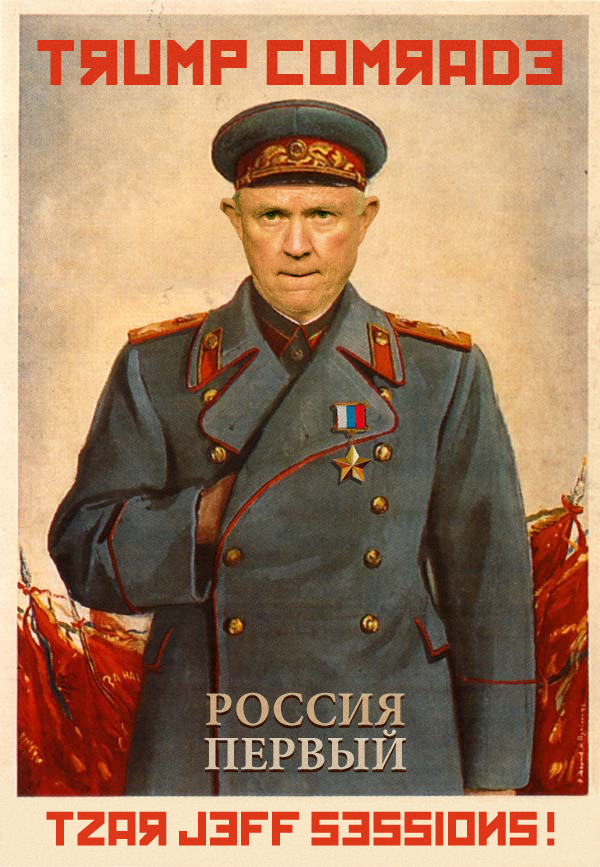
Can You Really Work Up Any Juices To Protest The Firing Of Jefferson Beauregard Sessions?

>

Mike Allen: "Sessions allies tell us he won’t quit, and will have to be fired: This is his life’s work and dream job. (Yesterday, he took on sanctuary cities.) And in Trumptown, you can be down now, but back in favor after you endure a little humiliation. Ask Steve Bannon."

Odd how right-wing Trumpbots are cheering their president on to fire Jeff Sessions, an icon of racism, xenophobia and... well... everything that is at the rotten core of Trumpism. At least just as odd: liberals are bemoaning the fact that Trump is moving towards firing Sessions, despite the fact that there isn't a liberal in America who believes Sessions is fit for the office. Trump has literally turned the world topsy-turvy. One thing that never does change though-- at least not so far-- is the Uriah Heap Speaker of the House's attitude. The Wisconsin enabler gave Trump the green light to go ahead and fire Sessions, even while other Republicans were trying to discourage him. Maybe Trump yelled at him for defending Bob Mueller in a radio interview on Monday, when he told listeners, “Remember, Bob Mueller is a Republican who was appointed by a Republican who served in a Republican administration and stayed on until his term ended. But I don’t think many people are saying Bob Mueller is a person who is a biased partisan. He’s really sort of anything but."

Ryan's such a slimy, confused guy with such an incoherent tattered brand these days. In some ways he must be looking foward to Randy Bryce putting him out of his misery in 2018.


Despite Ryan's jelly-fish posture, some establishment Republicans seethed and some even went public with their concerns about Trump's scheme to replace Sessions and hire someone to fire Mueller and end the Putin-Gate investigation. Mike Simpson (R-ID): "All hell would break loose."
"If he fired Mueller, that would be a problem. It wouldn't pass the smell test," added a second House Republican, who requested anonymity in order to speak candidly. "The American people would demand we do something."

...Sen. Luther Strange, R-Ala., who is chasing Trump's endorsement in the competitive Aug. 15, special Senate election primary, was compelled to take a veiled shot at the president for the humiliating way he has publicly pondered whether to fire Sessions.

"Jeff Sessions is my mentor, a great friend, and a man of the utmost integrity. His example of leadership inspired me to run for public office in Alabama, and continues to merit the admiration of his team at DOJ, his former colleagues in the Senate, and our great state," Strange, who was appointed to fill Sessions' seat on a temporary basis, said in a statement.

"Jeff and President Trump are trying to make America great again," he continued. "And it's a privilege to work along side both to accomplish the Trump agenda for the American people, and we need to stop letting the media distract us from that agenda."

...It's obvious Republicans have no appetite to rebuke the president, fearing a revolt of their own voters at home-- many who side with Trump on the Russia matter-- and anxious for the turbulence it would cause between now and midterm elections 15 months away. But they conceded in interviews that Mueller's dismissal would necessitate action of some sort, although they were unclear on what form it might take.

It could range from stronger verbal denunciations to more aggressive oversight hearings to passage of laws, like a bill that passed Tuesday, that limit Trump's ability to maneuver without congressional approval.

Impeachment proceedings are off the table unless the president commits a crime, GOP insiders said.

"There would have to be a smoking gun," a former Republican congressional aide said. "If he fires Mueller it would be a big deal and there would oversight hearings but it would be similar to Comey. I don't think it would near impeachment. I think there would have to be proof of collusion or breaking the law."

For conservatives, Sessions is an ideological touchstone in an unpredictable administration. He's an immigration hawk who adopted this position long before they were ascendant in the Republican Party, and he's viewed as insurance against Trump drifting left on border security and illegal immigration.

His circle of friends in Congress reaches beyond these circles, however. Many Republicans disagree with his positions on immigration and trade, but always appreciated his professionalism and honesty. In a chaotic White House, Sessions is a dependable ally.

Trump firing the attorney general could cause a breakdown in relations that area already rocky and highly transactional, Republican senators and congressional aides across Capitol Hill told the Washington Examiner in private conversations.

"Jeff's a good friend of mine. He stuck his neck out early for the president, which I have a lot of respect for, and I think that will pay off for him in the long run," Sen. Johnny Isakson, R-Ga., added.
In his NY Times column this morning, A Trump Tower of Absolute Folly, conservative pundit Ross Douthat asserted that "Trump’s campaign against his attorney general, Jeff Sessions, in which he is seemingly attempting to insult and humiliate and tweet-shame Sessions into resignation, is an insanely stupid exercise. It is a multitiered tower of political idiocy, a sublime monument to the moronic, a gaudy, gleaming, Ozymandian folly that leaves many of the president’s prior efforts in its shade... Trump’s war on Sessions is one of the few things short of a recession that could hurt him with his base-- which he needs to hold, since he isn’t doing anything to persuade anyone outside it... This president should not be the president, and the sooner he is not, the better."

Meanwhile a coalition of good government groups such as Citizens for Responsibility and Ethics, Common Cause, Protect Democracy and Public Citizen sent a letter to McConnell and Schumer and the chair and ranking member of the Judiciary Committee, Chuck Grassley and Dianne Feinstein, urging them to delay confirming Christopher Wray as FBI director until Señor Trumpanzee publicly pledges not to fire special counsel Robert Mueller, which is at the heart of his reasons for moving against Sessions.

Nancy Ohanian's Bob Mueller

Dear Senators,

We write to request that the Senate postpone the confirmation of a new Director of the Federal Bureau of Investigations (FBI) until the White House takes concrete steps to insulate the Director and the law enforcement agency he will lead from improper political interference. Recent statements by President Trump indicate that he believes the FBI Director should be politically loyal to him, instead of serving the country and the rule of law. The President’s recent statements further indicate that he is aggressively seeking to undermine, if not eliminate, a specific Department of Justice law enforcement matter-- the Special Counsel’s investigation into Russian interference in our elections. The President’s comments demeaning the Attorney General over his recusal in this matter, as well as his extraordinary reference to him as “beleaguered,” raise deep concerns that the President may be considering a series of personnel changes seeking to terminate the investigation. Under these circumstances, confirming the President’s hand-picked FBI Director-- regardless of that nominee’s individual merits-- would plunge a new Director into an unfair and untenable position, where the stated expectations of the President directly conflict with the Director’s independent law enforcement responsibilities. As such, the Senate should not proceed to confirm a new Director until the President has made specific commitments-- set forth below-- to respect the independence of the Department of Justice, including the FBI Director and the Special Counsel.

The Director of the FBI is an independent position, by its nature as a federal law enforcement leader, its statutory ten year term, and its protection from White House interference under historic policies governing White House communications with law enforcement on specific matters. For over forty years, to prevent even the appearance of political meddling in federal law enforcement, White House policies of Republican and Democratic administrations alike have either forbid, or, vastly minimized any White House contacts with federal law enforcement functions involving specific investigations or prosecutions. These policies, including the current White House policy, designate less than a handful of individuals at the Department of Justice-- excluding the FBI-- which may properly have contact with the White House about any specific investigation or enforcement matter.

Likewise, the decades-long policy of the Department of Justice (DOJ), including the currently operative version, also protects the integrity of particular investigation and enforcement matters by prohibiting communications with the White House about them, other than those involving the Attorney General and Deputy Attorney General. Strict enforcement of these policies restricting White House interference with specific law enforcement matters is especially crucial where the investigation at hand may relate to the President, his family, his campaign, and his closest political advisors.

Currently, the White House has a contacts policy, but as it applies only to DOJ, it is vastly inadequate compared to policies of prior administrations, which applied across the federal government to address other law enforcement functions, as well as specific party matters in procurement, grant-making, and regulatory decisions, among others. Recently, internal White House documents, released through FOIA, disclosed that the White House Counsel’s office plans to issue a more complete and robust White House agency contacts policy, which would be in line with the precedent of prior Administrations, and in keeping with the White House’s commitment months ago. This is a critical moment for the White House to publicly commit to avoiding political interference with law enforcement and other independent government functions. The White House should, as it has promised, issue a thorough and comprehensive policy limiting inappropriate White House contacts about specific matters with officials across the Federal agencies.

Unfortunately, recent comments from the President and the White House, consistent with the White House’s prior actions, suggest that the President does seek the ability to interfere with and impede specific investigations. In particular, the President seems intent on thwarting the special counsel’s investigation regarding Russian interference in the 2016 election. The statements from the White House spokesperson on limiting the scope of the special counsel investigation, as well as news reports of the President’s staff working to investigate the Special Counsel staff in order to discredit them, and by extension, the investigation,6 plainly pose improper White House threats against independent law enforcement functions. In addition, just a few days ago, the President stated in an interview with the New York Times that the “F.B.I. person really reports directly to the president of the United States, which is interesting. You know, which is interesting. And I think we’re going to have a great new F.B.I. director.” Even after the outcry following testimony of the President’s demand for “loyalty” from prior FBI Director James Comey, it appears the President still expects political or personal loyalty to him from the next FBI Director. It also suggests that the President does not respect or abide by the contacts policy of his own White House, or of the Department of Justice.

Before moving to confirm a new Trump-selected FBI Director, the Senate should be assured that President Trump and his White House will respect the independence of the FBI’s law enforcement function from White House interference. In particular, the Senate should ensure the following conditions are met:
1) The White House publicly issues a complete and robust agency contacts policy, as it has said it will.
2)  President Trump commits that he and his White House will abide by the White House’s agency contacts policy.
3)  Consistent with the agency contacts policy and importance of protecting specific law enforcement matters from agency interference, the President commits not to fire or otherwise interfere with Special Counsel Mueller’s investigation.

To approve the nomination of any FBI Director without clarification from the President himself that he will not interfere with ongoing law enforcement matters, would be to thrust that nominee into an impossible position, undermining the head of the FBI before he steps in the door. As the nominee, Christopher Wray, has testified, receiving reassurance from the Department of Justice senior leadership that Special Counsel Mueller is continuing his investigation made Wray “comfortable that I would be able to do my job...” To confirm a Director, with widespread criminal and national security responsibilities, under such a cloud could have lasting harmful consequences for the FBI, the Justice Department, and the nation.

Through the confirmation process, Congress serves its role as a check on the executive pursuant to the constitution. Nothing is more important in upholding our constitutional system and rule of law than the President not be allowed to place himself above the law. In fulfilling Congress’s constitutional role, the Senate should demand these assurances before confirming a new FBI Director.


Labels: , , , , ,

Sunday, May 07, 2017

"A Reasonably Competent Democratic Party"-- Ah There's The Rub

>


Ross Douthat painted a potentially catastrophic picture of what could happen to the House Republicans-- a total wipeout isn't possible because of 135 districts with PVIs between R+10 (there are 16 of them) and R+32 (welcome to the Texas Panhandle) where Señor Trumpanzee won a whopping 79.9%. That's Mac Thornberry's district. But it's not the only one in rural Texas bogged down in the kind of backward mentality that produced results like that. There were 7 congressional districts in Texas that gave Trump over 70% of its votes. And there were 2 in Georgia with over 70% Trump voters. But that ain't nothin'-- AL-04 went for Trump with 80.4%. And KY-05-- the opioid crisis district-- almost hit 80% (79.6%).

But even if every district with R+10 or more is safe-- and I don't know anyone who considers Pete Sessions safe or Devin Nunes very safe anymore-- that leaves over 100 districts held by Republicans that are potentially vulnerable. Douthat, one of the Times' in-house right-wingers, noted that "over the last seven years, the Republican Party has engaged in increasingly elaborate political suicide attempts. The G.O.P. has nominated cranks and erstwhile witches and Todd Akin in winnable Senate races. It has engaged in Somme-esque trench warfare within its own congressional caucus, shut down the government without a strategy for winning anything out of it, and campaigned on a sub-Ayn Randian narrative about the heroic businessman and the mooching 47 percent. And then, after all its prior efforts at seppuku failed, the party nominated Donald Trump for the presidency."
The Republicans were given a gift by Trump’s campaign, a grace they did not merit: the gift of freedom from the trap of dogma, from the pre-existing condition of zombie Reaganism, from an agenda out of touch with the concerns of their actual constituents. Nominating Trump wasn’t as suicidal as it seemed only because he had the political cunning to run against the party’s ideological enforcers, while promising working-class voters not just cultural acknowledgment but material support.

As written, the A.H.C.A. basically takes Trump’s gift to the party and hurls it off the highest possible cliff. It is not just the scale of the likely insurance losses, or how much the rich benefit from repeal relative to everybody else. It’s also the gulf between that reality and what Trump and various Republican leaders explicitly promised-- insisting that their plan would deliver better coverage, lower premiums, and a lot of other things that have since taken a back seat to making room in the budget for more tax cuts.

When President Obama said-- lyingly-- that “if you like your plan, you can keep your plan,” his party ultimately paid for it. A reasonably competent Democratic Party, with something like the A.H.C.A. to run against, should be able to make Republicans pay dearly in their turn.
But, alas, there is no "reasonably competent Democratic Party. Douthat laughs about how the Democrats are fighting internally over "over identity politics versus class politics versus making it all about Trump (and Russia?)" instead of offering a clear vision forward for America's working families. "[T]he central Democratic argument in 2018 and 2020," he suggested, "should be entirely clear: Trump is not a populist but just another pro-plutocracy Republican, and everything his party promised you on health care was a sham." Most Democrats I know are on that page already. But, like I mentioned the other day, I've talked to Democrats-- primarily the DCCC-favored Democrats from the Republican wing of the Democratic Party (Blue Dogs and New Dems) who tell me they don't know anything about healthcare and they want to talk about the kind of Republican issues that pervade Hate Talk Radio in their districts-- like how strongly they pledge allegiance to the Second Amendment.

And Douthat ended on a downer: "When a party repeatedly attempts suicide and somehow staggers bleeding into political victories instead, it is reasonable to doubt the rival party’s ability to capitalize even on the worst of blunders. So two questions loom for the Republicans who voted for this terrible bill. Can the Senate save them from themselves? And if the Senate doesn’t-- can the Democrats?" I doubt the Senate will save them, but I bet the DCCC will innoculate at least 50 winnable seats for the GOP with their Rahm Emanuel version of candidate recruitment: self-funders, Republican-lite candidates, Wall Street suck-ups and repulsive and ignorant identity politics sops. Too bad! Wouldn't you love to see a House with 135 Republican crackpots, primarily from the Old Confederacy, and 300 Democrats. Oh well, let's try to get what we can.
Goal Thermometer

Labels: , ,