Friday, August 21, 2020

Why Do So Many Republicans Back Biden: Aside From Trumpophobia, There's The Shared Value: Austerity

>


All those Republicans backing Biden... they should close out the campaign with a song and dance routine about how much they love Austerity. After all, the whole political class can unite around that-- both parties-- minus a handful of outliers like the Squad and some of the Congressional Progressive Caucus. Biden himself is an Austerity Democrat-- always has been, always will be. In fact, when you look at the Democrats Schumer has handpicked as his team to go up against the Republican austeritarians in November, every single one of them is an Austerity kind of guy (or gal):
Mark Kelly (AZ)
Al Gross (AK)
Hickenlooper (CO)
Jon Ossoff (GA)
Theresa Greenfield (IA)
Barbara Bollier (KS)
Amy McGrath (KY)
Sara Gideon (ME)
Steve Bullock (MT)
Cal Cunningham (NC)
Jamie Harrison (SC)
MJ Heger (TX)
The two anti-Austerity Senate candidates, Marquita Bradshaw in Tennessee and Paula Jean Swearengin in West Virginia are not being supported by Schumer or the DSCC, You can contribute to both or either of their campaigns here.) As in all things Democratic Party-wise, they aren't as bad as the Republicans. Yesterday, the Wall Street Journal reported that "some Republicans are hoping to vote on a cheaper, pared-down version of the aid bill they unveiled last month, although some GOP aides said they saw early signs that it wouldn’t be able to muster a Senate majority. The new proposal, referred to as the skinny bill, is expected to cost about half of the earlier $1 trillion legislation, in an effort to appease GOP senators worried about the price tag of the federal government’s efforts in response to the coronavirus pandemic." Skinny bill? It's an Austerity bill... in the middle of a pandemic and a recession that will likely turn into a Depression.


Here's how the scam works: Republican austeritarians run up gigantic deficits while faking reluctance or giving in to pressure. Then, the country up shit's creek, a Democrat is elected and Democratic austeritarians get busy bringing down the wasteful and corrupt deficit the GOP created. Repeat ad nauseum. This little dance will suit Biden just fine.

Yesterday's Wall Street Journal quoted one of his top manservants, Ted Kaufman: "When we get in, the pantry is going to be bare. When you see what Trump’s done to the deficit… forget about Covid-19, all the deficits that he built with the incredible tax cuts. So we’re going to be limited." Yes, Trump did a terrible job. That's why a nothing like Biden is going to win. But the pantry bare? What the hell is this idiot talking about. The pantry in his home could be bare-- although that seems unlikely-- but the federal government doesn't have a "pantry" to go bare.


Kaufman's statement caused a stir among progressives who've somehow persuaded themselves Biden's spots have miraculously changed color since they announced their support of him. That there is no room for any big federal projects was always built into the Biden cake; Kaufman just spilled the beans to people who don't want to hear it out loud. As I've tried explaining again and again-- Biden will win, the Democrats will take the Senate (with Schumer's Republican-lite menagerie) and Pelosi's meaningless and hopelessly disabled majority in the House will grow. Nothing will be accomplished and Democrats' hopes will be dashed-- like they were in 2010 after 2 years of Obama-- and the Republicans will defeat dozens of worthless Democrats in Congress, while Democratic voters sit on their hands. Get used to it. It's part of having chosen Joe Biden.

Adam Christensen just won his primary in the bid to become the Rep from FL-03 in the Gainesville area. "Would someone please explain to me why it is that whenever billionaires and hedge funds or banks want money we just handed out to them without thinking about the consequences," he asked yesterday. "But anytime that normal people need the basics we the 'pantry is empty'. This Fake Austerity, Corporate Welfare mindset is what has destroyed the Middle Class and Rural America. The American people are done being lied to. They are done being told that if they invest in the biggest companies in the world and bail them out that they will someday get that money back. It’s time we actually invest in people and stop letting those who have stolen our money for 40 years tell us “what is best for America."


Eric Levitz explained how this all works in his New York Magazine column, Biden Has Nothing To Fear But Fear Of Deficits Itself. Unemployment is still a catastrophe, as is the bankruptcy rate in mid-sized and small companies-- and "thanks to the GOP’s obstruction of COVID-19 relief, tens of millions of Americans just saw their monthly incomes slashed by $2,400, while cities and states throughout the country are preparing for mass firings of public workers. The macroeconomic consequences of these developments have yet to fully register. As is, more than 28 million Americans are at high risk of eviction before year’s end, according to a report released by the Aspen Institute earlier this month." So now is a time to pull the austerity rabbit out of the hat? Levitz is as sure of what a bad idea that is as are economist Stephanie Kelton and anyone in Congress who doesn't have their heads up their asses. "At present, the U.S. economy is on a neo-feudal trajectory," he wrote. "Almost all recessions hit the poor harder than the rich. But the COVID-19 crisis has been exceptional in its inequity. The sectors most vulnerable to a pandemic-induced collapse in demand-- such as restaurants and hotels-- are also among those most heavily staffed by low-income workers."


In this context, restoring full employment (and some semblance of shared prosperity) will require a combination of massive fiscal stimulus and progressive redistribution. Biden has given some indications that he understands this. Before the pandemic, the Democratic nominee pledged to spend $1.7 trillion over a decade on a green jobs program; last month, he vowed to spend $2 trillion over four years on climate stimulus. The overall price tag on his economic program is roughly $3.5 trillion according to Bloomberg. And if Congress fails to pass another round of COVID-19 stimulus before next year, that figure would ostensibly be higher (presumably, Biden agrees with House Democrats that the federal government should provide states and cities with nearly $1 trillion in fiscal aid). Encouragingly, Biden’s apparent openness to a robust stimulus program is shared by some self-styled fiscal hawks in Nancy Pelosi’s caucus. In July, the chair of the centrist New Democrat Coalition, Derek Kilmer, told reporters that “getting bogged down in trying to identify offsets is not appropriate in an emergency.” The bulk of Kilmer’s moderate allies voted for the $3.4 trillion Heroes Act in May of this year.

...In 2009, a unified Democratic government declined to provide the economy with the level of stimulus necessary for spurring a rapid recovery in deference to deficit-phobia; specifically, the White House asked for less spending than its own economists believed to be warranted on the merits because it felt that a $1 trillion bill would be politically toxic. As a result, the post-2008 recovery was the slowest and weakest in modern U.S. history. That sluggish rebound had immense human costs as America’s most vulnerable workers-- those with limited education, disabilities, or criminal records-- were effectively locked out of the labor market for a decade. But the toll of inadequate stimulus was also macroeconomic: Since World War II, every time the U.S. economy entered a downturn, it eventually caught back up with its pre-recession growth trajectory-- until 2009. By failing to rapidly re-match workers with jobs, policymakers durably reduced our economy’s productive capacity as discouraged Americans permanently left the labor force and capital fell out of use.

Of course, as we know now, the Democrats’ decision to prioritize national debt minimization above full employment did not actually curb the growth of the national debt. To the contrary, it simply gave Donald Trump and the Republican Party more fiscal space to fill with tax cuts and Pentagon budget increases.

Critically, this historic spending spree has not triggered any of the adverse economic consequences that deficit hawks would have predicted. As the federal deficit soared, inflation and interest rates remained extraordinarily low. America has little trouble finding buyers for its debt or maintaining price stability. And by supplying global investors with the safe assets they demand-- in the form of U.S. debt securities-- America’s fiscal profligacy has arguably helped stabilize the global financial system.

Alas, Kaufman is nevertheless citing Trump’s profligacy as a reason why the party must once again condemn America’s most vulnerable to years of poverty and involuntary unemployment. Separately, the fact that Kaufman emphasizes the Trump tax cuts as a constraint on fiscal space raises questions about the sincerity of Biden’s commitment to repealing the bulk of those tax cuts.

A charitable reader might conclude that Kaufman merely takes a pessimistic view of the politics of deficits and taxation. Which is to say: He believes that Biden will lack the Senate votes to repeal the Trump tax cuts and enact green stimulus. But the metaphor Kaufman deploys, a bare cupboard, suggests that he believes there is an objective constraint on the government’s spending power, not a political one.

And this interpretation is buttressed by the fact that Biden himself has voiced nearly identical sentiments... [and is a] "deficit hawk at heart."

An optimist won’t have that much trouble dismissing these grim portents. After all, most of the moderates in Nancy Pelosi’s caucus voted in May to supply Donald Trump with $3.4 trillion in election-year stimulus (after already supplying with the $2 trillion CARES Act relief package). Is the party really going to be less willing to stimulate the economy during a Democratic president’s honeymoon than it was amid a Republican president’s reelection campaign?

On the other hand, if Democrats do eke out a Senate majority, Chuck Schumer will need the support of some of the most conservative lawmakers in the party to pass legislation. If the Biden administration is ambivalent about its own fiscal agenda, it’s hard to see how it will allay the doubts of Joe Manchin, Kyrsten Sinema, and their ilk. And if Biden’s promised green stimulus ends up amounting to nothing more than a campaign-website decoration, then America will “build back worse” for the second time this century.


Manchin and Sinema? Wait 'til we start having to deal with senators like Hickenlooper, Cunningham, Greenfield and Kelly! Oh... and the GOP-lite Biden administration. THIS Biden, suckers!!


UPDATE: Nate McMurray-- "Forget This Austerity Nonsense"

Goal ThermometerNate is taking on western New York Trump enabler and hereditary multimillionaires Chris Jacobs. This morning, Nate told me that in these vastly unprecedented times, "we have seen over and over Democrats obliterate their agendas by stumbling into GOP minefields of talking points and false choices. Forget this austerity nonsense. It doesn't make economic sense. Not just how we spend, but also how we tax, are indicative of the country's priorities and values. In Washington I will fight tooth and nail to hold the President to an aggressive plan of action on the COVID-19 pandemic, the healthcare crisis, reducing income and wealth inequality, tackling climate change, and strengthening Social Security and Medicare instead of putting them on the chopping block. I'm often asked what the greatest issue facing my district and the country is. It has become clearer and clearer: there are too few with too much economic and political power, and too many with too little. Instead of pontificating about austerity to fix Trump's years of horror, it's time to put the working class first and stop making them subsidize the rich. Fair taxation, combined with national spending that truly reflects the magnitude of the threats we face and the values we share as compassionate Americans, is our path forward. Ted Kaufman should stop worrying about 'empty pantries' in Washington, and worry more about the millions of empty pantries in the homes of struggling, working-class Americans that need a President and Congress ready to act boldly and decisively."


Labels: , , , ,

Monday, August 10, 2020

No One Can Force A Presidential Candidate-- Let Alone A President-- To Read (Or Understand) The U.S. Constitution... Trump's Executive Orders

>


The big news Sunday was Trump's executive orders after he sabotaged the negotiations with Congress for a pandemic relief bill. No doubt, his zombie followers will eat it up. No one else will. Jim Tankersley did an analysis for NY Times readers-- Trump’s Go-It-Alone Stimulus Won’t Do Much to Lift the Recovery. He wrote that Señor Trumpanzee's executive actions "were pitched as a unilateral jolt for an ailing economy. But there is only one group of workers that seems guaranteed to benefit from them, at least right away: lawyers." The orders include an eviction moratorium, a new benefit to supplement unemployment assistance for workers and a temporary delay in payroll taxes-- although if re-elected he's planning to make it permanent, a way to fulfill nearly 9 decades of GOP dreams to end Social Security. "They could," wrote Tankersley, "give renters a break and ease payments for some student loan borrowers. But they are likely to do little to deliver cash any time soon to Americans hit hard by the recession. Even conservative groups have warned that suspending payroll tax collections is unlikely to translate into more money for workers. An executive action seeking to essentially create a new unemployment benefit out of thin air will almost certainly be challenged in court. And as Mr. Trump’s own aides concede, the orders will not provide any aid to small businesses, state and local governments or low- and middle-income workers. If the actions signal the death of a congressional deal to provide that aid, economists warn, the economy will limp toward November without the fiscal support that hastened its recovery after its quick dive into a pandemic-induced recession."
The federal government’s aid to small businesses through the Payroll Protection Program was set to expire on Saturday. Executives, trade groups and business lobbyists had pushed hard for a second round of lending-- along with new programs to get money to the businesses and industries hit hardest in the crisis-- to be included in any congressional stimulus deal. Mr. Trump’s actions do nothing to help those companies.

Low- and middle-income families’ spending power was bolstered in the spring by direct payments of $1,200 per adult that were included in a relief bill Mr. Trump signed into law in March. Lawmakers were pushing for a second round of those checks in a legislative deal. Mr. Trump’s measures will not provide them.

The orders will not provide aid to states and local governments, whose tax revenues have plunged as a direct result of the contraction in economic activity brought on by the virus. Without more money from the federal government, states and local governments will almost certainly have to cut their budgets and lay off workers, increasing the ranks of the unemployed.

Supplemental unemployment benefits of $600 per week, which expired at the end of July, had been supporting consumer spending at a time when about 30 million Americans are unemployed. Mr. Trump’s memo seeking to repurpose other money, including federal disaster aid, to essentially create a $400-a-week bonus payment is likely to be challenged in court and is unlikely to deliver additional cash to laid-off workers any time soon. It, too, raises questions even if it is deemed legal-- for instance, whether states that are already struggling with their budgets will be able to afford the 25 percent contribution that Mr. Trump’s memo says they will need to make toward the new benefit.

...But if negotiations falter now and aid remains scarce for people and businesses, Mr. Trump will be making a political bet: that it is better to tell voters he tried to help the economy than to have actually helped it. Mr. Trump is the president, and he has happily claimed credit for the economy’s performance.

If job growth slows further, and millions of unemployed Americans struggle to make ends meet, he will need to make the case for why the symbolism of acting alone won out over the farther-reaching effects of cutting a deal.


On State of the Union yesterday, Pelosi told Dana Bash that "whether they're legal or not takes time to figure out. I associate my remarks with what the Senator Sasse who says, they're 'unconstitutional slop.' Right now we want to address the needs of the American people. As my constitutional advisers tell me, they're absurdly unconstitutional." In case anyone doesn't understand what Pelosi was saying there, Alan Grayson, a bona fide genius, explained that "The Trump executive orders are not only illegal, but they’re unconstitutional. Anyone who tries to implement them will be facing criminal charges under the Antideficiency Act, 31 USC 1341. And, obviously, this is an impeachable offense, a “high crime” that abuses the power of the office. Trump is a Constitutional pyromaniac. As to the policies in the executive orders, the emperor has no clothes, so he’s trying to steal the Democrats’ clothes. It’s pathetic to watch the orangutan scratch his belly, screetch, and pretend that he gives a damn about anyone else."

Tom Suozzi (D-NY) represents the North Shore of Long Island, from the border of AOC's district in Queens (Whitestone and Beechhurst) straight thru Nassau and into Suffolk as far as Kings Park and the Nissequogue River. The former Nassau County Executive, Suozzi is now a member of the House Ways and Means Committee. Understanding how tax dollars are raised and spent is his field of expertise. And this morning, discussing Trump's clownish executive orders, he told us that "It’s not about the merits of $400 unemployment (of which $100 is paid by the states), or a payroll tax cut (which will decimate Social Security) or any of his executive orders. It is about the fact that it’s ILLEGAL. It is why we have a Congress. The President can’t, other than in limited instances, just do what he wants, especially when it comes to spending money. It’s just more in a long list of gimmicks by a failing president trying to hold on to power."


The Washington Post assigned a team to work on figuring it out-- Jeff Stein, Erica Werner and Renae Merle. They saw it-- as did much of Congress-- through the parameters of Trump's challenge to the constitutional order. "The measures," they wrote, "would attempt to wrest away some of Congress’s most fundamental, constitutionally mandated powers-- tax and spending policy. Trump acknowledged that some of the actions could be challenged in court but indicated he would persevere. Trump bemoaned how Democrats had refused to accept his demands during the recent negotiations but attempted to brush it aside, saying four measures he signed Saturday 'will take care of pretty much this entire situation.' But there were instant questions about whether Trump’s actions were as ironclad as he made them out to be. A leading national expert on unemployment benefits said one of the actions would not increase federal unemployment benefits at all. Instead, the expert said it would instead create a new program that could take “months” to set up. And Trump’s directive to halt evictions primarily calls for federal agencies to 'consider' if they should be stopped. Trump also mischaracterized the legal stature of the measures, referring to them as 'bills.' Congress writes and votes on bills, not the White House. The documents Trump signed on Saturday were a combination of memorandums and an executive order."

McConnell cheered him on, although he didn't explain why Trump's executive actions didn't include a second $1,200/person stimulus check that Congress had already agreed to. As Forbes reported, Trump targeted a payroll tax, reduced unemployment benefits, a bogus eviction moratorium study that won't keep a single family from being evicted and some student loan relief that will do little to help anyone "as his four areas of focus for an executive order. He never mentioned including stimulus checks as part of his executive order plan."


Jack Balkin summed up the unemployment aide program part of Trump's made-for-TV ploy on his must-read blog as Inadequate, Unworkable, and Unlawful. He wrote that Trumpanzee's "effort to relieve the pressure he and Senate Republicans have been feeling over the expiration of enhanced unemployment benefits is a failure on every level. It provides too little in aid. It will miss many families in need. It will expire very soon. It likely cannot be implemented in some states. And it is transparently unlawful."


How many lies can you count? As Alan Grayson put it the day after Trump's nationally televised half hour of gaslighting, "I would advise anyone who is still under the illusion that Trump is fit for office to listen to his speech yesterday. He is a babbling fool and a Constitutional pyromaniac, with a human applause track wired in the room to feed his infinite, insatiable ego."

Jim Himes (D-CT), like every congressional Democrat I've spoken to, is not satisfied with how the GOP is handling this, not even a little. "The so-called executive orders are way too little, way too late," he told me. "Americans are suffering badly and the Republican response has been to 'hit pause,' then to ask for F-35s and full expensing of business lunches, and now to offer weak presidential action. It is time for my Republican colleagues to summon even a fraction of the passion and enthusiasm with which they cut the corporate tax rate from 35% to 21% to actually help the American people in a historic crisis."


Labels: , , , , , , ,

Tuesday, February 11, 2020

Mayo Pete Has Come Out Of The Closet Again!

>


Mayo Pete didn't come out of the closet until he was 33-- in 2015, when he was in electoral politics and there was no doubt he would be outed if he didn't do it himself. Last year, when he wasn't a top candidate, the New York Times' Jeremy Peters wrote the LGBTQ story on Pete. He doesn't talk about the inherent mental illness of hiding in the closet for years and how it turns someone into a compulsive liar. "The closet that Pete Buttigieg built for himself in the late 1990s and 2000s," wrote Peters (who is openly gay himself), "was a lot like the ones that other gay men of his age and ambition hid inside. He dated women, deepened his voice and furtively looked at MySpace and Friendster profiles of guys who had come out-- all while wondering when it might be safe for him to do so too."

By the late 1960s, the stigma attached to being gay-- earlier than that a admission to being an outlaw if not a misfit-- had largely dissipated in many circles and was already starting to break down. When I told my mother-- a blue collar woman who may or may not have graduated from high school-- in the early '70s that I was gay, she asked me if that meant I would be borrowing her wig. Peters claims it was still professionally "unsafe" to admit being gay decades later. There have always been many more cowards-- like Mayo Pete-- than people with courage.

Peters writes that Pete "struggled for a decade after leaving Harvard to overcome the fear that being gay was 'a career death sentence,' as he put it in his memoir." When I ran first Sire and then Reprise Records, I helped many men and women struggling with coming out. Coming out, in my experience, never ruined any of my artists' careers. I know Mayo's type-- untrustworthy, sneaky, self-deceptive... completely unfit to lead. His coming out came almost 40 years after it was "safe" for anyone with a spine.
Many in his generation and in his college class decided to come out as young adults, whether they were confident they would be accepted or not, and had their 20s to navigate being open about their identity-- a process that helped make Americans more aware and accepting of their gay friends, family members and co-workers. Instead, Mr. Buttigieg spent those years trying to reconcile his private life with his aspirations for a high-profile career in public service.

Attitudes toward gay rights changed immensely during that period, though he acknowledges that he was not always able or willing to see what broader social and legal shifts meant for him personally.

...He took a longer journey than his peers did, he has said, because of the inner turmoil he experienced over whether in fact he wanted to be known as the “gay” politician.

...One thing no one seemed to peg him for was someone wrestling with being gay. He was so discreet that many of his friends and classmates said in interviews that they never would have guessed he was hiding anything until he told them. He left the testosterone-fueled campus sex banter to others. Hegel and de Tocqueville were more to his conversational tastes.

“His sexuality didn’t present as a really big thing in his life,” said Joe Flood, a classmate. “I think he always thought about himself politically,” he added, noting that Mr. Buttigieg would become active in the university’s Institute of Politics, an organization at the Kennedy School of Government that hosted big-name politicians like Senator Edward M. Kennedy and Howard Dean during their time in school. “You don’t end up there accidentally,” Mr. Flood said.

When he first ran for mayor in 2011 and won, he was closeted. A local gay rights group did not initially endorse him in that race, opting instead for a candidate with a more established track record on the issues. Mr. Buttigieg endured some awkward moments, like signing a city law banning discrimination based on sexual orientation in 2012. To not think about how the law directly affected him, he acknowledged, “took a little compartmentalization.”
Over the weekend, though, Mayo came out of a different closet-- the Austerity closet of conservatism which many Democrats have seen him oozing out of in the last few months as he tried deciding if he was progressive or reactionary, ultimately connecting the dots between the billionaires and multimillionaires who have been willing to fund him and leaving all pretenses of progressivism behind. He's now a full-on contender, along with Status Quo Joe, Klobuchar and Bloomberg, for the conservative lane in the primary.


NBC News' Sahil Kapur noted over the weekend that Mayo is calling on Democrats "to get more serious about lowering the national debt, portraying himself as the biggest fiscal hawk in the presidential field and taking a shot at chief New Hampshire rival Bernie Sanders for being too spendthrift." Phony Austerity is a hallmark of conservative politics and Mayo is embracing it as fully as he eventually embraced his long-hidden homosexuality.
Asked at a town hall here how important the deficit is to him, Buttigieg said it's "important" and vowed to focus on limiting the debt even though it's "not fashionable in progressive circles."

"I think the time has come for my party to get a lot more comfortable owning this issue, because I see what's happening under this president-- a $1 trillion deficit-- and his allies in Congress do not care. So we have to do something about it," Buttigieg, the former mayor of South Bend, Indiana, said in a packed middle school gym, drawing cheers.

...Buttigieg's remarks are out of step with plenty of progressives who believe Democrats are easily duped by conservatives into focusing on deficit reduction at the expense of their priorities when they control the presidency.

The deficit has risen sharply under President Donald Trump, as it did under his GOP predecessors George W. Bush and Ronald Reagan, all of whom enacted tax cuts and boosted defense spending. It fell under Democrats Barack Obama and Bill Clinton.

But cutting the deficit has not been a focus of the 2020 Democratic field, leaving an opening for Buttigieg to claim that mantle. He echoed fiscal hawks Sunday in arguing that higher deficits strain prospects for investment.

"It's not fashionable in progressive circles to talk too much about the debt, largely because of the irritation to the way it's been used as an excuse against investment. But if we're spending more and more on debt service now, it makes it harder to invest in infrastructure and health and safety net that we need right now," he said. "And also this expansion, which I think of as, by the way, just the 13th inning of the Obama economic expansion. It isn't going to go on forever."

Buttigieg hasn't laid out a plan to significantly lower the national debt, which could require steep tax hikes or cuts in cherished programs like Social Security.

Asked to back up Buttigieg's claim to fiscal responsibility, a campaign aide pointed to a recent study by the Progressive Policy Institute that says the tax revenues Buttigieg has proposed to raise would narrowly exceed his new spending.

Stephanie Kelton, an economics professor at Stony Brook University in New York who is a senior economic adviser to Sanders, fired back at Buttigieg.


The Sanders campaign responded by suggesting Buttigieg was in the pocket of big donors.

“In a blatant effort to appease his billionaire donors, Pete Buttigieg is now parroting the same corporate talking points to justify cuts to Social Security and Medicare that have been used for decades-- cuts that Bernie Sanders has fought to block,” Sanders communications director Mike Casca told NBC News. “This is part of a pattern: Buttigieg used to support Medicare for All, then he raked in huge donations from top pharmaceutical executives, and now suddenly he's against Medicare for All.”
Predictably, scumbag billionaire Steve Rattner, who will do anything and everything he can to derail Bernie, purred that "Finally, a Democratic presidential candidate acknowledges that the deficit/debt is a huge problem that will need to be dealt with."

Is it any wonder that Russian oligarch Leonid Blavatnik-- a big-time Trump financial supporter-- is now helping fund Mayo?

Oops! Wrong oligarch

Labels: , , ,

Tuesday, January 28, 2020

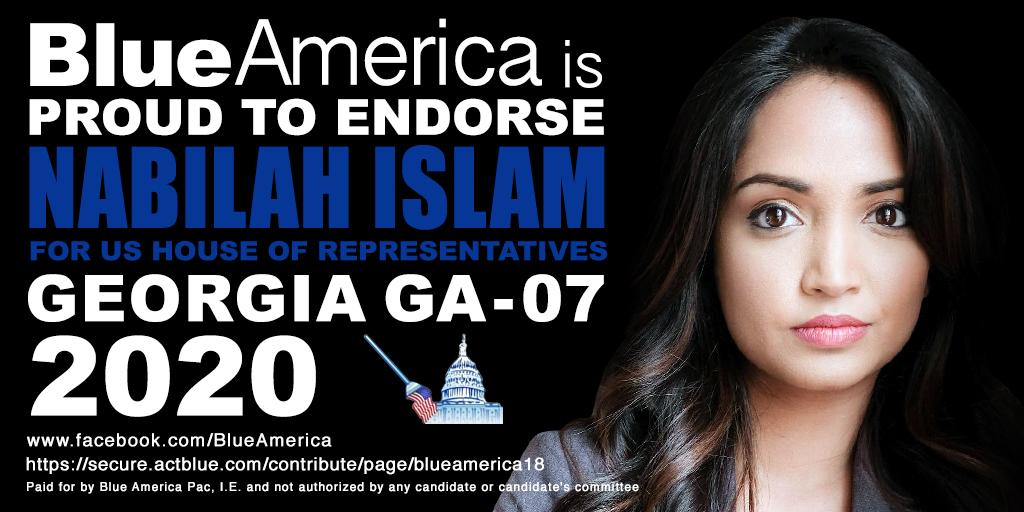
Nabilah Islam For Congress-- Making Georgia Bluer And More Equitable

>


The most recent candidate endorsed by Blue America, Nabilah Islam, sometimes stands out from the crowd because of her name, which for old people, doesn't sound like a name from the Georgia suburbs. Others (men) remark not on her name but on her physical appearance. What people don't realize-- at least not until they get to know her is that Nabilah, despite how she looks and what he name is, is both an All-American girl and a policy wonk. During one of the endorsement interviews, we were discussing her support for Medicare-For-All and the Green New Deal. She mentioned that voters in Gwinnett and Forsyth counties have been asking "how you going to pay for it?" frequently. Fox News is a popular TV station there, even among Democrats. We offered to introduce her to economist Stephanie Kelton, who has been generously giving her time to help progressive candidates grapple with questions like that. Afterwards, I asked Nabilah to write about the experience. This is what she had to say:
My First meeting With Stephanie Kelton
-by Nabilah Islam,
candidate, GA-07

Before the end of the Year, I had the pleasure of connecting with Stephanie Kelton. For those of you who don’t know, Stephanie is an economist, Professor of Public Policy, former Chief Economist on the U.S Senate Budget Committee 2015 minority party staff, and a leading proponent of Modern Monetary Theory.

Modern Monetary Theory is a macroeconomic theory that describes Currency as a public monopoly for the government. The argument is that the government should use fiscal policy to achieve full employment creating new money to fund government purchases.

Stephanie is someone who is extremely generous with her time and has such great knowledge that she freely imparts on any candidates willing to listen. What I came to understand through speaking her is a far better understanding of how Modern Monetary Theory (MMT) works and why it should be applied to the policies that we progressives advocate for.

Understanding MMT is essential advocating for policies like Medicare for All, a Green New Deal, Free Public college, and any other policies that Republicans and centrists' only argument is “hOw ArE wE gOinG tO pAy fOr iT.”

Governments are not people, and their debt should not be treated the same. It is healthy for a Government to have debt, and when inflation actualizes, we issue bonds to reduce circulation. Stephanie also made a great point to me. For every 10 dollars, we invest in our economy as a government, especially in communities that need it, it only strengthens our economy even if that means only 1 dollar is returned.

Republicans already practice MMT at their leisure. When it’s time for War, detention centers, private prisons, or Big Ag, they will write a blank check with their eyes closed. The same goes for centrists when we want to bail out big banks, no problem. But, when it comes down to protecting our most vulnerable, making sure there’s an educated electorate, or protecting our planet, the funds are never there.


Stephanie’s guidance was most helpful in regards to explaining the implementation of a Green New Deal. Yes, it is expensive, but what is the alternative? The reality is the scientific community has dramatically underestimated the severity of the speed of climate change in America and around the world. We must invest in green infrastructure and move to a renewable-based economy. We have to invest in protecting our frontline communities. While doing all of this, we create up to 20 million good-paying union jobs. This is where MMT plays a considerable role. These are not funds that are spent into an abyss. They are direct investments into our economy, our country, and will continue to be circulated. So while deficit spending is a traditionally unpopular idea viewing this through the lens of MMT, it causes stimulation.

I’m very grateful for Stephanie’s time and expertise. I strongly encourage people reading her work and watching her videos whenever possible. The point is MMT is a practice that is already in place, but selectively. It’s time we fix our priorities. This is Public Money, and it is time it is appropriately allocated.
While Nabilah was getting a crash course in MMT, she was also working on an initiative that could change the course of political history-- at least in terms of making it more feasible for working class men and women to be able to run for office.

Almost a decade after the Affordable Care Act was signed into law, 27.5 million Americans still lack health insurance. Nabilah Islam, 30, a progressive political organizer running in the very crowded Democratic primary in Georgia’s 7th Congressional District, is among them. Islam has come up with a unique way to address her situation: She’s asking the Federal Election Commission for help. Many from the working class are hesitant to run-- or can't do it full-time-- because they can't afford to particularly when it comes to health insurance. Calling her Atlanta's own AOC, Helaine Olen covered Nabilah's initiative for the Washington Post last week. "In a letter that will be filed next Monday," wrote Olen, "Islam is petitioning the FEC for an advisory opinion that would permit her to use campaign funds to pay for health insurance. Her short-term goal is medical coverage. But in the long term, this daughter of working-class immigrants from Bangladesh also wants the regulations changed so that more lower- and middle-income people can afford to seek public office. In other words, more people like herself."
“Running for Congress is an expensive endeavor and often cost prohibitive for working Americans,” Islam wrote in her filing. “Running for office while working-- even part-time-- severely limits your ability to campaign effectively. People with financial security are better positioned to campaign full-time while living on their savings.”

One result? Congress is hardly representative of the American public. About 40 percent of members are millionaires, compared with 3 percent of the U.S. population.

This isn’t, as Islam points out, simply because the rich hanker for political positions and power, while their working- and middle-class counterparts do not. It’s because people who lack significant financial resources face structural barriers that make it harder to get in a race and stay in.

Such as how to pay for health insurance.

Islam explained during a telephone interview she initially thought she would hold down a part-time position while competing for the congressional seat. She found that impossible. Running for Congress is a full-time job. She has instead put her student loans into forbearance and canceled her health insurance and is living off savings.

She knows she’s taking a risk: “If something happens to me, I could end up with thousands of dollars in medical bills.” But Islam says she can’t afford to do anything else. The average cost of an individual policy in 2019 was more than $7,000.

True, Islam was paying $120 a month. There was a trade-off involved. In technical terms, Islam says her policy did not comply with the Affordable Care Act. In layman’s terms, that means it wouldn’t have covered such events as the hospital bills if she got hit by a car while canvassing. “Junk,” she called it.

Such as how to pay for health insurance.

Islam explained during a telephone interview she initially thought she would hold down a part-time position while competing for the congressional seat. She found that impossible. Running for Congress is a full-time job. She has instead put her student loans into forbearance and canceled her health insurance and is living off savings.

She knows she’s taking a risk: “If something happens to me, I could end up with thousands of dollars in medical bills.” But Islam says she can’t afford to do anything else. The average cost of an individual policy in 2019 was more than $7,000.

True, Islam was paying $120 a month. There was a trade-off involved. In technical terms, Islam says her policy did not comply with the Affordable Care Act. In layman’s terms, that means it wouldn’t have covered such events as the hospital bills if she got hit by a car while canvassing. “Junk,” she called it.

Monica Klein, the political consultant advising Islam, previously worked with Long Island’s Liuba Grechen Shirley, who successfully petitioned the FEC for permission to use campaign funds to cover her child-care expenses. Klein told me she sees similarities between the two woman’s quests. “Like Liuba, Nabilah isn’t just running for office,” she said. “Liuba and Nabilah are both working to dismantle the conditions that keep Congress overwhelmingly white, wealthy and male.”

But Islam is unlikely to meet with similar quick results. That’s got nothing to do with the merits. President Trump hasn’t bothered to nominate candidates to fill the three openings on the six-member commission, leaving the FEC short of the necessary quorum needed to hold meetings or issue rules.

Goal ThermometerThis is obviously a bigger issue than Islam’s request. As Jeff Hauser, the executive director of the Revolving Door Project, noted, “Without a quorum, campaigns seeking to push-- or shred-- the envelope of legality can do so bolstered by the certainty the FEC cannot open investigations or issue fines.”

But requests for rulings that come in during this period don’t go away. The FEC will consider them when a quorum is restored. Islam’s request could eventually make it easier for other less-than-privileged candidates to run for office. That’s a win, no matter how Islam ultimately performs. “I really believe that we need more people like me, more people with my working-class background who grew up with parents that worked low-wage jobs,” Islam said. “If there are more Nabilahs in Congress, I assure you, things like Medicare-for-all, things like a living wage, $15 an hour, would just be a no-brainer.”


Labels: , , , , ,

Wednesday, September 25, 2019

Bernie Is Right: There Shouldn't Be Any Billionaires

>


Yesterday, as soon as Bernie announced his wealth tax proposal-- something he's been working on long before he ran for president in 2016-- Thomas Kaplan was working to undermine its authenticity for NY Times readers by insinuating he was just trying to one-up Elizabeth Warren. "With the proposal," wrote Kaplan in his second paragraph, "Mr. Sanders is embracing an idea that has been a centerpiece of the campaign of his top progressive rival, Senator Elizabeth Warren. But while Ms. Warren came first, Mr. Sanders is going bigger. His wealth tax would apply to a larger number of households, impose a higher top rate and raise more money."

I spoke with Stephanie Kelton about the plan since I knew she had been working on it as a top economic advisor to Bernie, first in the Senate when he was the ranking member of the Budget Committee and then during the 2016 campaign. She told me that Bernie had her and Steve Wamhoff, his tax expert on the Senate Budget Committee, working "on a wealth tax back in 2015. We did a lot of work on it, had meetings at the Joint Committee on Taxation), made recommendations, etc. It takes a long time to do this kind of thing carefully. The numbers came together with input from two of the country’s leading experts on inequality, Emanuel Saez and Gabriel Zucman. It’s clear that the Sanders proposal is about addressing the kinds of extreme concentrations in wealth that are corrupting our democracy." The folks at Patriotic Millionaires agree. In their celebratory e-mail yesterday, they said they "need each and every one of the 2020 presidential candidates to enunciate the problem clearly and put forth real, substantive solutions to wealth inequality in this country." Morris Pearl, former managing director at Blackrock, Inc., and Chair of the Patriotic Millionaires, wrote that "The wealthiest people in this country haven't been paying their fair share for a long time, and part of that problem is because our tax code only taxes the wealthy based on how much income they choose to take each year. The very rich get money not from earning it each year, but from spending wealth that they have already made. If our tax laws only target one without touching the other, then rich folks like me will continue to find ways to game the system and our inequality crisis will continue to get worse. There are many ways to address wealth inequality, and Senator Sanders's wealth tax proposal this morning is a welcome addition to our national tax debate... We are thrilled to see this proposal and look forward to more dialogue on this critical issue moving forward in the debates."

In a note to his supporters yesterday, Bernie wrote that "Our tax on extreme wealth would only apply to the wealthiest households in America and would cut the wealth of billionaires in half over 15 years-- which would substantially break up the concentration of wealth and power of this small, privileged class."
This is how much more in taxes some of the richest people in America would owe this year:
The Walton family - $14.8 billion
Jeff Bezos - $8.9 billion
Charles Koch - $3.2 billion
Sheldon Adelson - $2.6 billion
Rupert Murdoch - $1.28 billion
Our plan would raise more than $4 trillion over the next decade and anyone with a net worth of less than $32 million would not see their taxes go up under this plan.

Now, I have never understood how someone could have tens and hundreds of billions of dollars and feel the desperate need for even more. I would think that with the amount of money the 0.1 percent of this country has, they might just be able to get by.

But the truth is, for the past several decades there has been a massive transfer of wealth from those who have too little to those who have too much.

And for the sake of our democracy and for working families all over America who are struggling economically, that has got to change.

In my view, a nation cannot survive morally or economically when so few have so much and so many have so little. Millions of people across this country struggle to put bread on the table and are one paycheck away from economic devastation, while the wealthiest people in this country have never had it so good.

It has got to stop.

And when we are in the White House, it will.
Bernie's proposal taxes accumulated wealth, not just income and Kaplan wrote that it "is particularly aggressive in how it would erode the fortunes of billionaires. His tax would cut in half the wealth of the typical billionaire after 15 years, according to two economists who worked with the Sanders campaign on the plan. Mr. Sanders would use the money generated by his wealth tax to fund the housing plan he released last week and a forthcoming plan for universal child care, as well as to help pay for Medicare for all. He quotes Bernie: "Let me be very clear: As president of the United States, I will reduce the outrageous and grotesque and immoral level of income and wealth inequality. What we are trying to do is demand and implement a policy which significantly reduces income and wealth inequality in America by telling the wealthiest families in this country they cannot have so much wealth."
Asked if he thought billionaires should exist in the United States, Mr. Sanders said, “I hope the day comes when they don’t.” He added, “It’s not going to be tomorrow.”

“I don’t think that billionaires should exist,” he said, adding that there would always be rich people and others with less money. “This proposal does not eliminate billionaires, but it eliminates a lot of the wealth that billionaires have, and I think that’s exactly what we should be doing.”

...Mr. Sanders, of Vermont, would create an annual tax that would apply to households with a net worth above $32 million-- about 180,000 households in total, or about the top 0.1 percent, according to the economists who worked on the plan.

He would create a 1 percent tax on net worth above $32 million, with increasing marginal rates topping out at 8 percent on net worth over $10 billion. For single filers, the brackets would be halved, meaning the tax would kick in at $16 million.

By contrast, the wealth tax proposed by Ms. Warren, of Massachusetts, would apply to households with a net worth above $50 million-- an estimated 70,000 households in total.

The structure of her plan is simpler: She would apply a 2 percent tax on net worth from $50 million to $1 billion, and a 3 percent tax on net worth above $1 billion. Unlike the Sanders plan, the tax brackets would be the same for married and single filers.
$32 million to $50 million net worth: 1 percent marginal tax rate
$50 million to $250 million: 2 percent
$250 million to $500 million: 3 percent
$500 million to $1 billion: 4 percent
$1 billion to $2.5 billion: 5 percent
$2.5 billion to $5 billion: 6 percent
$5 billion to $10 billion: 7 percent
Over $10 billion: 8 percent
Elizabeth Warren’s wealth tax proposal
$50 million to $1 billion: 2 percent
Over $1 billion: 3 percent
Note: The brackets shown for the Sanders proposal are for married filers; the brackets would be halved for single filers. The Warren proposal uses the same brackets for married and single filers.


Mr. Sanders’s tax is projected to raise $4.35 trillion over a decade, while Ms. Warren’s is projected to raise $2.6 trillion over the same time period. Those estimates were produced by Emmanuel Saez and Gabriel Zucman, two economists at the University of California, Berkeley, with whom both the Sanders and Warren campaigns consulted as they developed their proposals. (The projection for Ms. Warren’s plan differs slightly from their original estimate of $2.75 trillion earlier this year.)

“The Sanders plan is really pitched at the idea that we don’t want billionaires and decabillionaires to be billionaires and decabillionaires for as long as they currently are,” Mr. Saez said. “It’s going to erode their fortunes much faster than the Warren wealth tax.”

Mr. Sanders included several steps in his plan to enforce the tax, including creating a “national wealth registry,” increasing funding for the Internal Revenue Service and requiring audits of many taxpayers who are subject to the wealth tax, including all billionaires.

Mr. Saez and Mr. Zucman calculated how the Warren and Sanders wealth taxes would have affected the fortunes of the richest Americans had each been in effect since 1982. The fortune of Jeff Bezos, the Amazon founder who Forbes said was worth $160 billion last year, would have been $87 billion under the Warren plan and $43 billion under the Sanders plan.

Over all, the economists found, the cumulative wealth of the top 15 richest Americans in 2018-- amounting to $943 billion-- would have been $434 billion under the Warren plan and $196 billion under the Sanders plan.

Mr. Sanders is hardly a newcomer to the idea of a wealth tax. In a 1997 book, he wrote that it was “time, high time, to establish a tax on wealth similar to those that exist in most European countries.” In 2017, he included a wealth tax on a list of financing options for Medicare for all.
Ask yourself, do you want the 2020 election to be about the pros and cons of runaway economic inequality and how to fix it-- or about whose family is more corrupt, Trump's or Biden's, who lies more, Trump or Biden, who is further alone the path to complete senility, Trump or Biden-- and who is the lesser evil, Trump or Biden? Let's have a real debate about real and fundamental issues.


Labels: , , ,

Wednesday, August 07, 2019

Stephanie Kelton On The Economics of Bernie's Platform

>


Economics isn't easy for many voters to understand. Stephanie Kelton is one of the top economists in the world-- as well as Bernie's chief economic advisor-- and teaches economics at Stony Brook. She's been helping Blue America congressional candidates understand some of the trickier bits of economics behind policy solutions like Medicare-For-All, the Green New Deal, free public college, raising the minimum wage to a living wage, cancelling student loan debt...

In the video above she was interviewed by Bloomberg News yesterday. You may get something out of it; I hope so, because it isn't anything Trump or Status Quo Joe is ever going to comprehend, nor will any of it be reflected in the extremely conservative-- or neo-liberal, to be more precise-- policy agendas. Let me add a few bits and pieces-- four-- from things Kelton has said and written recently:
"The federal government is nothing like a household. In order for households or private businesses to be able to spend, they've got to come up with the money, right? And the federal government doesn't have to behave like a household. In fact, it becomes really destructive for the economy if the government tries to behave like a household. You and I are using the U.S. dollar. States and municipalities-- the state of Kansas or Detroit-- they're also using the U.S. dollar. Private businesses are using the dollar. The federal government of the United States is issuing our currency, and so we have a very different relationship to the currency. That means that in order to spend, the government doesn't have to do what a household or a private business has to do: find the money. The government can simply spend the money into the economy and when it does, the rest of us end up receiving that spending as part of our income."


"The conventional thinking about budget deficits, I think, tends to be that people look at a deficit and they think that it's evidence of overspending. They think it's evidence the government is mismanaging its books. That it's done something wrong. [But] evidence of overspending is inflation. So what is the budget deficit? I like to do this by using an example. I think it helps people. If you think of the government deficit as the difference between what the government spends into the economy and what it taxes back out, then imagine a government that spends $100 into the U.S. economy but it only taxes $90 back out. We label that a government deficit and we record that on the government's books. But what we forget to do, is pay attention to the fact that there's now $10 somewhere in the economy that wouldn't have been there otherwise, that is put there by the government's deficit. In other words, their deficits become our surpluses. So when we talk about the government having all this red ink, we have to remind ourselves that their red ink becomes our black ink, and their deficits are our surpluses."


"People tend to hear deficit and think it's something that we should strive to eliminate, that we shouldn't be running budget deficits. That there's evidence of fiscal irresponsibility. And the truth is the deficit can be too big. Evidence of a deficit that's too big would be inflation. But the deficit can also be too small. It can be too small to support demand in the economy and evidence of a deficit that is too small is unemployment. So, deficits can be too big, but they can also be too small. And the right level of the deficit is the one that gets you a balanced overall economy. The one that allows you to achieve high levels of employment and low inflation."

"We could add $1.5 trillion to the deficit over 10 years, as we just did with tax cuts that go disproportionately to people in the top-income distribution, and we could have done, for instance, student debt cancellation at virtually the same price tag. We could have done massive infrastructure investment, or R&D investment. You can have the same budgetary outcome, but very different economic outcomes, in terms of the potential to boost long-term growth and productivity, impacts on the distribution of income, and so forth. Every economy has its own internal speed limit. You can only absorb so much additional spending at any point in time, given the slack that the economy has at that moment. So can the deficit be too big? Of course! But can it be too small? Yes. And that’s something you rarely hear people say. Or complain about it."

This is a really excellent long-form Bernie interview with Joe Rogan from yesterday. I'm swooning; it's so enlightening and so powerful. Early this morning, 1.7 million people had watched it on YouTube and now over 2.8 million have watched. Take a look; it's really excellent:


Labels: ,

Thursday, July 25, 2019

Why Haven't Democratic Candidates Been Referring To Trump As "Deficit Don?"

>


The "Freedom Caucus" is screaming its collective head off about growing deficits again, threatening to Boehnerize GOP Minority Leader Kevin McCarthy and threatening to kill the budget deal agreed to by Trump, Pelosi, McConnell, Schumer and McCarthy. The "Freedom Caucus" statement: "The House Freedom Caucus has grave concerns about this budget agreement and will oppose it on the House floor. Our country is undeniably headed down a path of fiscal insolvency and rapidly approaching $23 trillion in debt. This is completely unsustainable, and we owe taxpayers and future generations better. We should be working together on a bipartisan basis to cut spending and balance our budget-- or, at bare minimum, holding to the existing spending caps to prevent a significant problem from becoming even worse. All sides should go back to the drawing board and work around the clock, canceling recess if necessary, on a responsible budget agreement that serves American taxpayers better-- not a $323 billion spending frenzy with no serious offsets."

As you can easily see in the graph above. George W Bush left President Obama a humongous budget deficit which Trump worked for 8 years to bring down-- even at the expense of his own agenda for the country. He left Trump with a relatively modest deficit which Trump and the Republican Party are well on schedule to double, wiping out all the efforts of Obama in bringing it down. While bringing the deficit up, Trump has accomplished virtually nothing for the American people-- no infrastructure advances whatsoever, nothing to help in the fields of healthcare, education, or moderating economic inequality.

The new Morning Consult poll asked how important of a priority several issues should be for Congress? One was "reducing the federal budget deficit." Most registered voters think that is important. 46% said it should be a "top priority" and 34% said it should be important but a lower priority. Just 10% said it either was not too important or shouldn't be done at all.

This week, the Washington Post published a piece by Bob Costa and Mike DeBonis, 'We're Like Thelma And Louise': Republicans Shrug At Deficits Under Trump. "In 2011," they wrote, "with the nation still climbing back from the Great Recession, Republicans threatened global markets by refusing to raise the federal debt limit unless President Barack Obama and the Democrats agreed to steep across-the-board spending cuts for years to come. Eight years later-- and $7.7 trillion more in debt-- President Trump and GOP lawmakers have agreed this week to lift the debt ceiling again without a fuss, and with hundreds of billions in new spending on top of it."
The deal marks a significant capitulation to Trump after years of brinkmanship from Republicans claiming the mantle of fiscal responsibility, underscoring the president’s far-reaching hold over his party and a disregard for the budget-cutting and debt reduction that conservatives long claimed as priorities.


John Avlon, reporting for CNN.com, wrote, "It's official: Conservatives only care about deficits when a Democrat is president. Under Donald Trump the deficit is on a path to more than a trillion dollars per year and discretionary government spending is growing faster than it was under Barack Obama, when he was working to stimulate our way out of the Great Recession."
But what was angrily portrayed as generational theft and galloping socialism under President Obama is now accepted with all the outrage of a cow chewing its cud.

Everyone in Washington seems to suddenly accept the economic and political benefits of government spending, as the GOP hopes to keep the stock market goosed past Trump's reelection. While it's great that Washington appears to have avoided another truly stupid, self-inflicted government shutdown, Congress is whistling past the graveyard. That's because deficits are growing while the economy is booming-- up 23% in the first nine months of the fiscal year alone. That's not supposed to happen. And there will be hell to pay when the remorseless math of rapidly falling tax revenue kicks in during the next downturn.

That is very bad news for those of us who will be left to clean up the mess after Donald Trump has left DC. Because there is no way that Democrats are ever going to fall for the inevitable Lucy and the Football moment that will come when conservatives say that it's time to rein in spending.

No less than Rush Limbaugh just admitted the whole thing was a conservative con job, telling a caller: "All this talk about concern for the deficit and the budget has been bogus for as long as it's been around."

That's quite a slap in the face after the Obama-era bipartisan Bowles-Simpson commission tried to implement the warnings of fiscal conservatives with a balanced plan that was rejected by party leaders-- including Senate Majority Leader Mitch McConnell who called for its creation in no less than six floor speeches but then whipped votes against it when the rhetoric threatened to become reality.

In Trump's Washington, deficit hawks are an endangered species. The alleged fiscal principles of the Tea Party have been sold for scrap, leaving only its nativist impulses intact. And there's no obvious way out of the escalating deficits and debt that will compromise our fiscal independence in the next downturn.

During the 2016 campaign, Donald Trump promised to eliminate America's then-$19 trillion-dollar debt in eight years. Anyone who believed that fell for the Don's Con-- after all, this was the self-styled "King of Debt" talking. Under Trump, the national debt just passed $22 trillion for the first time in history.

The danger is that the political benefit of breezy lies seems to have been codified. And it's too much to expect that yet another Democratic president is going to be more fiscally responsible than the Republicans who constantly talk about fiscal discipline and then deliver increased deficits and debt.

It's a story we've seen repeatedly since Ronald Reagan. Bill Clinton was famously the last president to preside over a budget surplus and by 2014 Barack Obama had gotten our deficits to half of what they are today under Donald Trump, despite the Great Recession. Because of the sequestration deal that was just taken off the books in this latest budget deal, Obama presided over a reduction in discretionary government spending of nearly 2% per year in his second term.

During the last Republican presidency of George W. Bush, a group of conservatives bitterly criticized its drift on deficits and debt. Indiana Gov. Mike Pence slammed the "profound loss of credibility on issues of fiscal discipline," saying that "big government conservatism is a failed experiment." Now that he is Vice President, Pence has been not so much muted as neutered on the issue. But no doubt, he'll find a way to blame Democrats when we reap the whirlwind for the actions taken in his administration's name.
Remember, when Trump was a candidate, he promised he would completely end the budget deficit. Now Trump is running the finances of the country as though deficits don't matter, perhaps hearing the first part of a Stephanie Kelton lecture on MMT but nodding off and missing the second part-- the part talking about how deficit-inducing spending needs to be spent (to benefit the general good, something the Trump Regime hasn't done).


Labels: , ,