Friday, January 17, 2020

Republican #NeverTrumpers Make Another Move Against Señor T-- Watch The Videos

>


You won't see the ad up top or the ad below unless you watch the Trumpist Regime propaganda shows,Fox And Friends or Lou Dobbs Tonight, a show with virtually no viewers. The ads, by #NeverTrumpers, Republicans for the Rule of Law, will be broadcast every day next week, while the Trumpanzee Senate impeachment trial is playing out. And they're spend a million dollars on the project to urge Republican senators-- but particularly Lamar Alexander, the dazed and confused Susan Collins, Lisa Murkowski, Mitt Romney and Corey Gardner-- to vote to allow witnesses during the trial, especially John Bolton.

The ads will also be run digitally for two weeks in Arkansas, Arizona, Colorado, Maine, Tennessee and Utah-- and digital bill boards have been purchased in Little Rock, Phoenix, Denver, Augusta (Maine), Nashville and Salt Lake City. This companion ad is already running digitally.

Republicans for the Rule of Law are running quotes calling for a fair trial from prominent conservative office holders on their own website:
• Rep. Justin Amash (I-MI)- "Again, it’s not just about a call, but even the call is a devastating indictment of the president. Trump: We do a lot for Ukraine. Zelenskyy: We are almost ready to buy more Javelins from the United States for defense purposes. Trump: I would like you to do us a favor though."
• Sen. Lisa Murkowski (R-AK)- "If [the President] used undue-- well I don’t know if undue influence is the correct term, but yes, that’s very concerning."
• Gov. Larry Hogan (R-MD)- "I think we do need an inquiry because we have to get to the bottom of it. I’m not ready to say I support impeachment and the removal of the president, but I do think we should have an impeachment inquiry."
• Sen. Rob Portman (R-OH)- "The president should not have raised the Biden issue on that call, period. It’s not appropriate for a president to engage a foreign government in an investigation of a political opponent."
• Rep. Will Hurd (R-TX)- "There is a lot in the whistleblower complaint that is concerning. We need to fully investigate all of the allegations addressed in the letter, and the first step is to talk to the whistleblower."
• Rep.Jim Steineke (R-WI)- "A sitting president asking foreign powers to investigate fellow US citizens and political rivals should not, and cannot be normalized."
• Sen. Mitt Romney (R-UT)- "I did read the transcript. It remains troubling in the extreme. It’s deeply troubling, clearly what we’ve seen from the transcript itself is deeply troubling."
• Sen. Lindsey Graham (R-SC)- "If you could show me that, you know, Trump was actually engaging in a quid pro quo, outside the phone call, that would be very disturbing."
• Rep. Mike Turner (R-OH)- "Concerning that conversation, I want to say to the president, this is not OK. That conversation is not OK. And I think it’s disappointing to the American public when they read the transcript."
• Gov. Phil Scott (R-VT)- "Congress has a solemn responsibility to every American to fulfill its role in our government system of checks and balances."
• Sen. Pat Toomey (R-PA)- "Look, it is not appropriate for any candidate for federal office, certainly, including a sitting president, to ask for assistance from a foreign country."
• Gov. Charlie Baker (R-MA)- "It’s a deeply disturbing situation and circumstance, and I think the proper role and responsibility for Congress at this point is to investigate it and get to the bottom of it."


Would Ronald Reagan Be A #NeverTrumper Today? His Son Says So

In an interview with the Daily Beast Ron Reagan, Jr. said that his father would have seen Trump as a "traitorous president who is betraying his country. The Republican party at this point, for a whole host of reasons to do with Donald Trump, is an entirely illegitimate political party just made up of a bunch of sycophantic traitors mouthing Kremlin propaganda to defend this squalid little man who is occupying the White House... This is shameful stuff in all sorts of ways. This is a dying party. They either have to remake themselves entirely or they will disappear eventually. Within a decade the Republican Party will be a minor fringe group if it continues going this way... My father would-- although he might not use words like this because he was a fairly genteel person-- my father would pinch Trump’s empty head off and shit down his flabby neck... It is perhaps the most dangerous time for our republic in my lifetime, perhaps since the Civil War. If there is a second Trump administration, he’s going to feel liberated to do whatever he wants to do. He’ll try and go for the third, fourth, however long he lasts. He wants to be president for life. It would keep him out of jail, for one thing... Our nation is at a real turning point. Our republic is in danger. Democracy is in danger, and we need to put somebody else in the White House because this man is betraying the country every single day he occupies the Oval Office."


Labels: , ,

Sunday, December 08, 2019

The Democratic Party Should Not Be Nominating Republicans-- Not For Anything

>


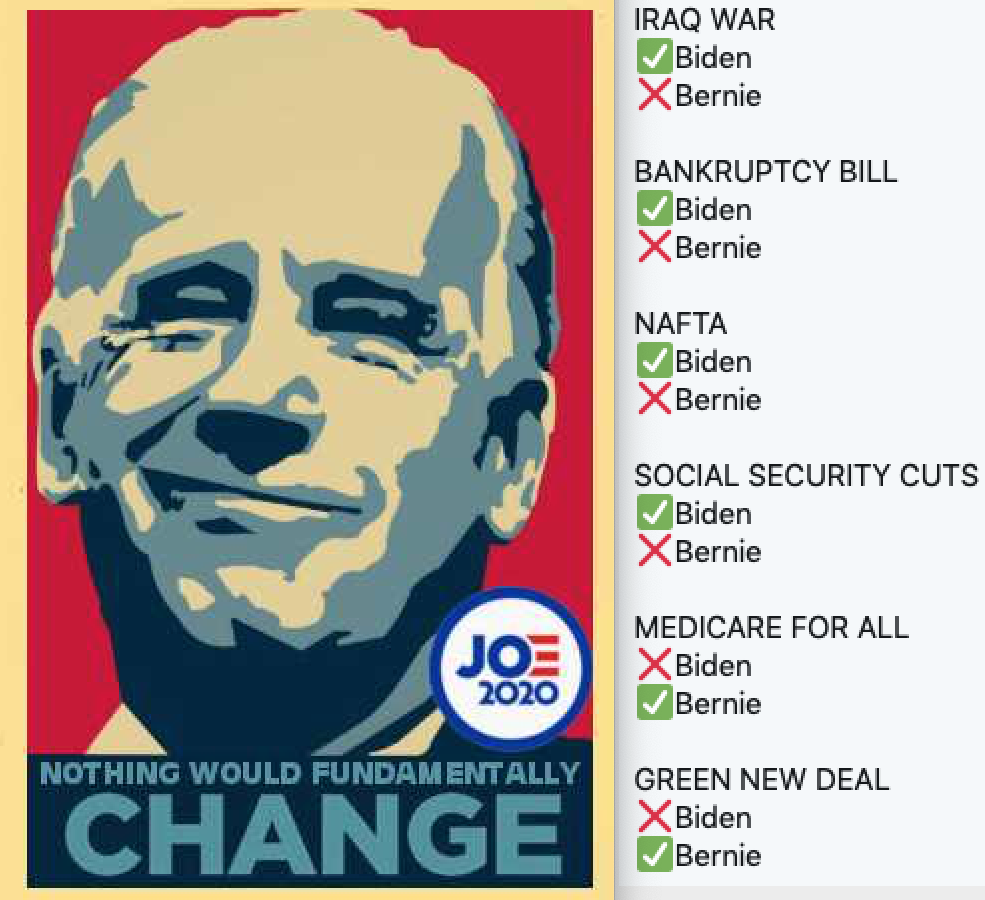
Like Hillary, Biden started off as a Republican. He found himself in a Democratic environment at work-- and he didn't like Nixon-- so he re-registered as a Democrat. But, issue-wise, like Hillary, he's always been a moderate Republican at heart. He wants to run for president as one too-- and if he does, like Hillary, he will probably lose. Status Quo Joe's only real chance would be if voters decide he's the lesser of the two evils. In a post for In These Times last week, Reagan Lives On In Biden, Branko Marcetic reenforced something Georgia progressive Nabilah Islam wrote earlier today: "Growing up in the South, Democrats are indoctrinated early on to believe a specific type is what is electable. That type is usually white and even more often moderate or centrist. The strategy is to play to the middle and hope to get Republicans to vote for you. That’s not a winning strategy. When Republicans go to the voting booth, they vote for the real Republican, not the fake one." Biden, by the way, is on the record saying Delaware was part of the South and would have joined the Confederacy except Maryland was in the way." He spent a considerable part of his time palling around with Southern racists from both parties; he just gravitated to them. They're his people.

Marcetic cautioned Democrats trying to decide who to vote for in 2020 that "Amid warnings of a coming global recession, it’s worth asking what the 2020 presidential aspirants would do during an economic downturn. When it comes to Joe Biden, we may already know. Biden’s formative political years were spent in the shadow of economic crisis. After more than a decade of economic expansion and blissful, carefree consumerism, recession hit in 1973, the same year Biden entered the Senate. Two years later, 2.3 million jobs had disappeared. Americans also had to contend with runaway inflation that reached double digits by 1974. The United States had barely exited that recession when it plunged into another one in the early 1980s, with unemployment climbing past 10% by 1982. During this economically turbulent decade, Biden fended off Republican challenges to his seat by embracing right-wing doctrine--specifically, that restraining federal spending is more important during economic downturns than priming the pump."
This fiscal austerity would become a core conviction of Biden’s and help animate a lifelong belief that compromise and reaching across the aisle are the perennial solution to what ails America.

Biden had always been a somewhat ambivalent New Deal liberal-- fretting about government spending as early as 1975, even as he garnered positive scores from liberal groups for his voting record-- but the recession and his time in the halls of power nudged him in a more conservative direction.

“I must acknowledge that when I first came to the U.S. Senate at age 29, not too long out of college, many economists had been telling me why deficit spending was not all that bad,” he told the Senate in 1981.

“So I was not very convinced of the arguments made by my friends here, who I must acknowledge, were mostly on the Republican side of the aisle.” But, he went on, “as I listened over the years in this body, I became more and more a believer in balanced budgets.”

By the close of the 1970s, Biden began calling himself a fiscal conservative and introduced what he called his “spending control legislation”: a bill requiring all federal programs to be reauthorized every four years or automatically expire. He also voted for a large but unsuccessful tax cut introduced by Sen. William Roth, his Republican counterpart.


Ronald Reagan took office in 1981, pioneering the economic program of generosity to the rich and stinginess to the poor that became known as Reaganomics. Biden was right there with him.

Biden, Reagan and other conservatives pushed the flawed idea that the government is like a household and must take drastic measures to pay off debt to stay solvent. Six months into Reagan’s first term, Biden called the reduction of deficit spending “the single most important” path toward “an economically sound future.”

To curtail government spending, Reagan severely scaled back or eliminated federal programs-- even as he slashed tax rates for the rich. Biden voted for both (including an updated version of Roth’s failed tax cut). When the president proposed a budget freeze in 1983-- to cut the enormous deficits that, ironically, his tax cut helped produce-- Biden one-upped him, working with two Republican senators to propose an even more aggressive budget freeze doing away with scheduled cost-of-living increases for Medicare and Social Security.


This idea is contrary to what economists and experience tell us is the proper course of action in times of economic downturn. Economist Joseph Stiglitz credits Obama’s 2009 big-spending stimulus for ameliorating the recession (criticizing it only for being too small) and criticized austerity politics for undermining it. Meanwhile, countries like the United Kingdom and Greece stand as living monuments to the economic ravages of budget cutting during a recession, something even the International Monetary Fund belatedly acknowledged.

The economy under Reagan did recover-- even as he slashed programs for the poor and vulnerable, he ramped up defense spending, in effect creating an economic stimulus much larger than what would come in the wake of the Great Recession.

Meanwhile, Biden voted three years in a row for a constitutional amendment requiring a balanced budget. When the 2008 financial crisis plunged the world into recession, Republicans again called for cuts to entitlement programs. As ever, Biden stretched out a bipartisan hand. As Obama’s lead negotiator during the “grand bargain” negotiations, Biden-- to his Democratic colleagues’ horror-- capitulated to every one of Republican Sen. Mitch McConnell’s demands, including cuts to Medicare, Social Security and food stamps, and warned in 2013 that, left untouched, deficits “may become a national security issue.”


While that effort collapsed due to Tea Party obstinacy, a President Biden could get one last shot. Following the Reagan playbook, the Trump tax cuts have sent the national debt soaring, and Republicans and conservative groups are now pushing for stringent budget cuts. Biden stands alone among the leading Democratic presidential candidates in his insistence that Democrats can work with McConnell’s GOP. Add a recession into the mix and the temptation to resume what he and Reagan began may be too great. Who says the era of bipartisanship is dead?

Peter Wade, writing yesterday for Rolling Stone, gave another example of Biden's utter unfitness to be the Democratic candidate. During his "No Malarkey" tour of Iowa, the decrepit Status Quo Joe from another era told reporters he's rather share power with Republicans than wild power the way FDR did. I suppose when you have nothing important to do-- and the ego-driven Biden has nothing at all he wants to accomplish other than self-gratification-- you can embrace the kind of dysfunction that plagued the Obama administration. Has he already forgotten how McConnell blocked whatever Obama tried to do-- like the Merrick Garland Supreme Court nomination? Or, as I suspect, was that just find with Biden? Wade reported that "Biden expressed concerns about Republicans possibly getting 'clobbered' in the upcoming election mainly because" of Trump's toxicity. I can't remember ever seeing someone as politically out of touch with the moment as Joe Biden is today.
The candidate said he’s held back on his “ass-kicker” side because he knows the American people want someone who can get things done and work with the other side.

“I mean look, everybody, anybody who knows me in politics including Trump knows they’re not going to be able to screw around with me. Not a joke,” Biden continued. “But that’s not what this is about. I think what the American people want to know is how am I going to make their life better.”

Biden went on to say that he thinks it’s important to have a political balance and the possible lack thereof concerns him. “I’m really worried that no party should have too much power,” Biden said. “You need a countervailing force. You can’t have such a dominant influence that then you start to abuse power. Every party abuses power if they have too much power.”

This warm-and-fuzzy attitude toward divided government is surprising coming from the former President Barack Obama’s VP. During Obama’s first two years, Democrats controlled both houses of Congress and, briefly, had a filibuster-proof majority in the Senate. Despite that, they relentlessly chased Republican moderates, begging to get just one to sign onto a health care plan that included no public option and was modeled after a system implemented by [checks notes] Mitt Romney. All those concessions to the middle gave them exactly zero GOP support.

Instead, they got Republican GOP leadership that decided on Day 1 to block everything Obama did and a tea party movement that claimed Obama was born in Kenya. Democrats lost the House in 2010, and for the final three-quarters of Obama’s presidency, he got damn near nothing of any importance through Congress. And when it was Obama’s turn to pick a Supreme Court justice, Mitch McConnell stole it because he could.

Republicans, meanwhile, used Trump’s first two years in office to ram through absolutely everything they could, including trillions in tax giveaways to corporations and the rich, despite having only the slimmest of Senate majorities.

For Republicans, “sharing power” is only important when Democrats have control-- and Biden should know that better than anyone.
Bernie and Elizabeth have powerful and compelling agendas of things they want to accomplish. Status Quo Joe, much like Trump, just wants to be president. There's virtually nothing he'd do if he were, except some vague, dysfunctional notion of a status quo ante which is at the heart of the rise of Trumpism. I'm sad so many of my countrymen voted for Trump. I'm just as sad that so many of my countrymen are preparing-- a few even eager-- to vote for an utterly worthless sack of crap like Joe Biden.


Labels: , , , , ,

Thursday, August 01, 2019

Hard To Say Who Would Be Most Likely To Kill Medicare In 2021-- Trump Or Biden-- But I'd Guess Biden

>


The Economist's new poll from YouGov could signal choppy waters ahead for the NRCC. Their "Socialism!!!!" campaign is-- of course-- falling flat. Well, wait; it's isn't totally falling flat. The fascist and neo-Nazi base and hate talk radio fanatics and fans of Sean Hannity and Tucker Carlson love it. But that's not moving any dials when independents and conservative Democrats just laugh it off. That's reflected in the new polling that shows a generic congressional Democrat beating a generic congressional Republican by bigger numbers than anyone has seen in quote some time. In fact 48% of respondents say they're planning to vote for a Democrat for Congress next year. Just 37% say they plan to vote for a Republican. Last year 60,572,245 voters backed Democrats and just voted for 50,861,970 Republicans-- and that wasn't 37%; it was considerably more-- 44.8%. The Republicans lost a net of 42 seats (43 if you count the empty seat they got caught stealing in North Carolina). If the 37% holds, the Republicans will lose another 50 or so seats. Just keep screeching "Socialist!!!," boys.

Medicare celebrated it's 54th anniversary on Tuesday. LBJ signed the legislation on July 30, 1965, noting that "No longer will older Americans be denied the healing miracle of modern medicine." 50 years before that reformers tried, unsuccessfully, to pass a national health insurance program through state legislatures. It wasn't until FDR and a Democratic Congress was passing the New Deal that anyone seriously tried again. In fact in 1935, the Social Security bill initially contained a single line authorizing the study of health insurance which completely flipped out the American Medical Association (AMA), which was way more right-wing than it is now and which insisted that any government health insurance plan was an existential threat to financial and clinical autonomy of physicians. Roosevelt himself, worried that the fucking doctors could jeopardize Social Security’s enactment, ordered the line removed from the Social Security Act. In 1945 Truman tried revitalizing the push for universal health insurance but conservatives of both parties, with the backing of the AMA screaming about "socialism," had the clout the kill his hopes.

At that point liberals inside the Truman administration tried getting around the Republicans and Southern Democrats by pushing health insurance strictly for the elderly, who were more likely to need more medical services and were more likely to be uninsured and had much lower incomes, but who always voted.

It was a long building process. But only about half of the elderly had insurance before Medicare was finally enacted. Progressives were successful in capitalizing on the sympathetic reputation of the elderly as a group deserving of government help and in need through no fault of their own-- and as avid voters. The conventional wisdom was that by making Medicare a universal program open to all seniors, with eligibility for benefits earned through working, it would be possible to avoid the stigma conservatives always associate with welfare and any and all government programs that are designed to serve just poor people.

At first, the proposals only included hospital insurance-- and not anything to do with physicians' services, in the hope of shutting the AMA up. The proponents weren't trying to be incrementalists; they had no choice. Even into the late '50s, the AMA and conservative politicians were still screaming "Socialism!!!" and willing to fight to the death against enactment of even a weak version of Medicare. I grew up hating doctors because of this battle and seeing them as class enemies who needed to be fought and beaten. I never trusted any of the fathers of my friends who were doctors when I was a kid.

Early in 1964, Medicare was defeated in the Southern Democrat/Republican-controlled House Ways and Means Committee. Committee Chair Wilbur Mills (D-AR), a dysfunctional drunkard, opposed it. Too bad it was 8 years later that Mills-- drunk as usual-- was in a car accident and an infamous prostitute-- Fanne Foxe-- jumped out of his car and leaped into the Tidal Basin when the police approached. That weekened Mills' power over the committee, which basically controlled all financial matters before Congress.


The 1964 landslide for LBJ gave the Democrats enough votes in Congress so that a GOP/Southern Democrat (Blue Dog). Progressives moved to pass Medicare quickly-- and a far more robust version than the compromise with the conservatives and AMA had forced them into. Insurance for physicians' services were included, a great payback for the AMA for being such dicks for so many decades.

Wilbur Mills, still chairman of the committee, even though barely a Democrat and barely able to function because of his alcoholism, was worried Medicare would be expanded into a broader national health insurance program for all Americans, something like what Bernie is trying to pass and Biden and Trump are trying to stop. Mills added Medicaid into the mix-- giving states payments to finance care for low-income residents-- and thereby derailing calls for any version of Medicare for All at the time.

Medicare has always been seen by its proponents as a beginning, not as a final, perfect objective. When you hear conservative assholes--whether any garden variety Republican or jackasses like Biden, Delaney, Bullock, Tim Ryan or Frackenlooper-- moaning about how great it is and how untouchable it should be... hey, these were the people who would have been arguing not to piss off the king in the 1770s and arguing that the slaves like their lot in the 1850s and 60s. Remember, Medicare’s focus on only insuring the elderly was a political strategy designed to secure the passage of a federal health insurance program that was expected tow keep expanding until all Americans were covered. Robert Ball, one of the Medicare strategists and head of the Social Security Administration from 1962 to 1973: "We all saw insurance for the elderly as a fallback position, which we advocated solely because it seemed to have the best chance politically... we expected Medicare to be the first step toward universal national health insurance, perhaps with ‘Kiddiecare’ as the next step."

Because of a resurgence pf conservative power-- first Reagan and then Bill Clinton-- Medicare did not expand to children and the system was always on the defense as Republicans and Biden-type Democrats constantly threatened cutbacks. Progressives have a chance again-- thanks to general abhorrence of Trump among voters. Electing a Bernie/Elizabeth Warren ticket and more progressives to Congress, means Medicare-For-All sill be the reality Medicare was designed to be from the start. A Biden victory will be the beginning of the end for Medicare as he has always favored cutbacks and given an opportunity to make it part of a "grand bargain," like the one he negotiated with Paul Ryan and MoscowMitch while he was VP.


Labels: , , ,

Wednesday, July 31, 2019

Acting Like Republicans Isn't How You Beat Republicans

>


Conventional wisdom from the corporate media and from #NeverTrump Republicans who saw their party taken over by a carnival barker and 2 bit charlatan, is constant and unwavering: Democrats need to be more like "moderate" conservative Republicans-- you, know, like Jeb Bush, Chris Christie, John Kasich, Marco Rubio... all the clowns the carnival barker and 2 bit charlatan turned to mincemeat. MSNBC, the Washington Post, the New York Times and-- most of all-- the DCCC, DNC and DSCC all agree: the Democratic Party needs to be your father's GOP. And since Bill Clinton was elected they have been pulling it inexorably intuit direction-- the ONE AND ONLY reason Trump is occupying the White House.

John Harris is a former Washington Post reporter and one of the guys who founded Politico so you might reasonably expect to find him expounding exactly that kind of turgid, fear-based centrism. But... his lead-up article for the debates yesterday, took a very different posture: Democrats Are Veering Left, It Just Might Work. He certainly doesn't like it; he terms it "a prevailing Washington media and political class narrative," "going off the rails" and "saddling themselves with unrealistic positions"-- but he does recognize that it may be the formula to beating Trump. "[A]s Democratic contenders gather on the stage again this week," he wrote, "a competing analysis is gaining power: Going a bit off the rails may be an entirely reasonable track to victory." Don't expect Status Quo Joe, let alone Frackenlooper, to start appearing at events dressed as a sans-culotte, but...
“Candidates who look like they are cautious, modulating, have their foot on the brake are missing the moment,” said veteran Democratic pollster Stan Greenberg, who is coming out later this summer with a book on how both parties have been refashioned in the Trump era.

The moment, according to Greenberg’s polling and focus-group work, has left voters of all stripes clamoring for disruption. Cultural and ideological currents in society-- more profound than any given day’s Trump uproars-- are giving progressives a better opportunity than they have had in decades to play offense.

This interpretation is notable for the source. Greenberg first drew wide notice a generation ago, with landmark work about how Ronald Reagan captured many working-class Democrats who believed their party’s liberalism was out of step with their lives. He is a veteran of the 1992 “war room” of Bill Clinton-- who won two elections precisely by practicing a brand of defensive politics that required regular reassurance to voters that his activism didn’t mean he liked big government, disliked free enterprise or was sympathetic to 1960s-style radicalism.

Notable also are Greenberg‘s friends who disagree with him. Perhaps no one has been more outspoken in warning that Democrats might be blowing their chance to beat President Donald Trump by swerving too gratuitously to the left than former Chicago mayor Rahm Emanuel. In the latest of a series of commentaries and interviews, he complained in a Medium post that he was part of group “shaking our heads” after the Miami debates as candidates “succumbed to chasing plaudits on Twitter” with strident positions on health care and immigration which risk offending “swing voters in Wisconsin, Michigan, Pennsylvania and Ohio.”

Emanuel, too, is a veteran of Clinton’s war room and White House, and won four House elections and two mayoral elections with his own version of centrism. When he was in Congress, he lived in a basement apartment of a Capitol Hill town house-- owned by Greenberg and his spouse, Rep. Rosa DeLauro (D-CT).

“The country is so far away from where it was under Bill Clinton,” Greenberg said in an interview. “People are desperate for government to show it can do big things.”

Greenberg’s and Emanuel’s worldviews are more in tension than outright opposition. Both are alert to the danger that Democrats project that they are more interested in identity politics than representing a unified national interest. Even Emanuel, who draws scorn from the left, supports robust expansion of government’s role to improve health care and education.

Where they differ-- in ways that echo with a broader intraparty debate Democrats are confronting-- is on how they calibrate risks.


One thing that hasn’t changed from the Clinton years, Emanuel believes, is that Democrats must loudly make the case of who they are (pragmatists obsessed with concrete improvements in voters’ lives) and implicitly make the case who they are not (smug and impractical ideologues who live in a leftist echo chamber). That’s why he cringed at seeing candidates like Sens. Elizabeth Warren and Bernie Sanders call for the abolition of private health insurance, and even several avowed moderates call for decriminalizing illegal border crossings and providing health insurance for undocumented workers.

Greenberg, by contrast, believes that the urgency voters feel for shaking up the status quo means there’s less risk for candidates and the party in going too far than in not going far enough.

He believes the 2020 election will be decided by a couple big questions which favor Democrats: Do you support or oppose America’s accelerating change toward a more diverse and culturally tolerant society that gives more opportunities to historically excluded groups? Do you believe in the power of government to challenge entrenched financial power, and make average people better off?

His belief that Republicans are placing themselves on the electorally losing side of these questions is the foundation of a forthcoming book, R.I.P G.O.P. It is also why he is generally not joining the bed-wetting of many Democratic operatives over the rhetorical and substantive positioning of many Democrats trying to challenge former Vice President Joe Biden’s frontrunner status (Biden for the most part has avoided these extremes, offering himself as a seasoned incrementalist who can beat Trump).

For one thing, Greenberg said, voters properly see most of the Democratic positioning as about making broad statements of values and ideals-- not millstone-around-the-neck commitments that eliminate their ability to maneuver as general election nominee or president.

What’s more, he said, recent focus groups conducted for the American Federation of Teachers by the Greenberg-linked Democracy Corps suggest that a historically damaging charge-- that Democrats’ plans to expand government amount to “socialism”-- is losing some of its potency.

The focus groups with white working class voters outside metropolitan areas in Maine, Nevada and Wisconsin show that Trump uses partisan insults so promiscuously that his rhetoric may be devalued-- participants didn’t find the socialism allegation compelling.

To be sure, wearing a socialism label from Republicans is not an experiment that most Democrats are ready to run. But if the focus groups are correct it may reflect a broader truth about the cycles of American politics: When the ideological tides are moving in their favor, presidential candidates may not have to worry so much about their language, or pay an especially high cost for laying it on too thick.

Goal ThermometerThe best illustration may come from an earlier swing of the cycle, when Ronald Reagan in 1980 dethroned a half-century of New Deal and Great Society dominance of American politics with a brand of free-market, pro-military conservatism that seemed radical at the time. Reagan, many analysts thought, would be doomed by such provocations as launching his general election campaign in Mississippi with favorable references to “states rights,” doubts about his commitment to Social Security, or disparaging environmental laws by saying trees and the Mt. Saint Helens volcano were causing more pollution than anything man-made. Instead, Reagan was seen as right on big questions about realigning the role of government and won 44 states against incumbent President Jimmy Carter.

Even a Democratic candidate this year who by temperament is among the least inclined to rhetorical bombast, South Bend mayor Pete Buttigieg, recently suggested there’s a lesson in this history-- that successful candidates need to both listen to the electorate and push it beyond present boundaries.

In a recent interview with Democratic operative David Axelrod’s Axe Files podcast, Buttgieg said ideas about cutting tax rates and shrinking government in the 1970s were considered “preposterous” but conservatives were so successful in “tugging” the country toward them that by the 1990s that even many Democrats agreed. “It’s time for us to work a little harder to tug the country back.“

This year, he told Axelrod, Democrats can’t project that they are simply the party “promising a return to normal” before Trump when this version of normal “wasn’t working” for many voters.

Like Greenberg, Buttigieg said the risks of being a disrupter shouldn’t be exaggerated: “I do think it’s OK to get a little bit ahead of where the American people are on an issue if we really do believe it.”
Just a teensy weensy bit ahead, like they taught Mayo Pete at McKinsey. Just a teensy weensy bit... and incrementally. Medicare is 54 years old. As Paul Waldman opined yesterday, conservatives didn't like it 54 years ago any more than they back Medicare-For-All today.


And as long as we're on the subject... A newly-released poll from HuffPo by YouGov shows that "Democrats are increasingly unified on everything from a preference for stricter gun laws to opposition to the Hyde Amendment to a belief in man-made global warming. The change has been especially stark on topics revolving around immigration and race. In the past six years, the percentage of Democrats who said that immigrants strengthen the U.S. rose from 58% to 83%. Between 2011 and 2016, the share of white Democrats saying that “over the past few years, black people have gotten less than they deserve” roughly doubled, from 27% to 55%... What does the American public think? Some of the progressive policies being championed poll a whole lot better than others: taxing the wealthy, for instance, is consistently popular, while ideas like abolishing the death penalty or providing reparations for slavery remain a much harder sell. Framing also matters a great deal: support for Medicare for All looks a lot skimpier when Americans are told the plan wouldn’t provide for people to stay on their current private insurance" (idiotic framing that confuses people and makes them think they are losing something instead of gaining something).
But beyond the political viability of specific policies, there’s also a broader question: whether Democrats’ growing liberalism, or their increasingly visible debate over progressive issues, has actually redefined Americans’ image of the Democratic Party or their perceptions about how well the party’s values align with the mainstream.

So far, a new HuffPost/YouGov poll finds, the answer is no. Views of the Democratic Party, in fact, haven’t really budged in more than four years. The share of Americans calling the Democrats “too extreme,” which stood at 41% in November 2014, now stands at an identical 41%, with only minimal fluctuation in the interim.


Labels: , , , , ,

Monday, July 01, 2019

Neoliberalism Killed 346 People Aboard the Boeing 737 MAX 8

>

What was left of Ethiopian Airlines Flight 302, a Boeing 737 MAX 8 jet, after it crashed to the ground six minutes after takeoff. All 157 people aboard were killed (source)

by Thomas Neuburger

The essence of modern neoliberalism, as encouraged and enabled by both political parties, is the Ayn Randian notion that the greatest amount of freedom in the world should be given to capital — that the giant pool of money should be allowed to flow unrestrained into any country it wishes, seek whatever profit it wishes to seek, then flow out, again unrestrained, leaving in its wake whatever wreck it wishes to walk away from.

The poster child for neoliberal profit-seeking is, of course, NAFTA and its legacy of devastated lives in every country touched by it, but there are more examples than anyone could count. This devastation has been going on for decades, starting in my own memory with Ronald Reagan's permitted transfer of the U.S. semiconductor manufacturing industry to Asia. (Reagan "earned" two million dollars in speaking fees during a fully paid eight-day grand-tour trip to that country within a year of leaving office — clearly "thank you" money for his many gifts to the suddenly swollen wealth of Japan.)

Since the age of greed was kicked off in the 1980s, and because in those years Americans were taught to love their predators (remember breathless praise of shows like Lifestyles of the Rich and Famous), the pursuit of profit by the few at the expense of the lives of the many has only accelerated.

The latest instance of this destructive pursuit is the story of the Boeing 737 MAX 8 jet. There are many parts to the 737 MAX 8 story. This part takes us, once again, to U.S. outsourcing to Asia and $9/hour software engineers in India.

From Bloomberg:
Boeing's 737 Max Software Outsourced to $9-an-Hour Engineers

• Planemaker and suppliers used lower-paid temporary workers
• Engineers feared the practice meant code wasn’t done right

It remains the mystery at the heart of Boeing Co.’s 737 Max crisis: how a company renowned for meticulous design made seemingly basic software mistakes leading to a pair of deadly crashes. Longtime Boeing engineers say the effort was complicated by a push to outsource work to lower-paid contractors.

The Max software -- plagued by issues that could keep the planes grounded months longer after U.S. regulators this week revealed a new flaw -- was developed at a time Boeing was laying off experienced engineers and pressing suppliers to cut costs.

Increasingly, the iconic American planemaker and its subcontractors have relied on temporary workers making as little as $9 an hour to develop and test software, often from countries lacking a deep background in aerospace -- notably India.
According to Mark Rabin, a former Boeing engineer whose work supported the 737 MAX project, the decision to outsource coding to India “was controversial because it was far less efficient than Boeing engineers just writing the code. I took many rounds going back and forth because the code was not done correctly.”

But outsourced U.S. jobs and greatly reduced wage costs were not the only benefits to Boeing from this decision. The company was also rewarded handsomely for it, winning, according to Bloomberg, "several orders for Indian military and commercial aircraft, such as a $22 billion one in January 2017 to supply SpiceJet Ltd. That order included 100 737-Max 8 jets and represented Boeing’s largest order ever from an Indian airline, a coup in a country dominated by Airbus."

Needless to say, in a nation dominated by neoliberal thinking and morality, more than $22 billion in new contracts easily offsets the loss of 346 lives in the two 737 MAX crashes, each of which killed everyone on board.

In a nation that abhors neoliberal morality, on the other hand, one would see trials for manslaughter instead.
 

Labels: , , , , , , , ,

Monday, December 03, 2018

Another Criminal Dies

>

Ronald Reagan and George H.W. Bush in 1985

by Gaius Publius

George H.W. Bush's life is a testament to the notion that public service is a noble, joyous calling. And he did tremendous good along the journey.
     —Former president Barack Obama

Rosalynn and I are deeply saddened by the death of former President George H.W. Bush. His administration was marked by grace, civility, and social conscience.
     —Former president Jimmy Carter

Scouring the Web for comments on the death of George H.W. Bush turns up quite a bit of praise from luminaries as widely disparate as the Dalai Lama, Ellen DeGeneres and CIA director Gina Haspel. Mohammed bin Salman paid a visit to Bush senior and was welcomed warmly, spawning this tweet from the former president:


From lesser lights to greater, from murderers to comedians, the praise continues. 

As usual, the network of those who run the world we merely inhabit have nothing but respect for each other. And why not? They may pick each other off from time to time (both Saddam Hussein and Moamar Khaddafi, were once in high favor), but over the long haul, keeping each member of the ruling circle in a reverential spotlight keeps them all — keeps the circle itself — in reverence as well. Since they operate as a system, the system is honored each time its members, no matter how deadly, are honored as well. And the system sees that the system is always honored.

That's why Bernie Sanders and his new progressive colleagues in the House are so hated. They want to take that system apart. It's why Nancy Pelosi surrendered to the No Labels-financed "Problem Solvers" caucus rather than to those same new progressives and their agenda. The tiny system of people that run the world supports the tiny system of people that run the world, and always will.

For a truer perspective on who those people are and what they do, let's look not to the system's predictable, fawning self-praise, but at less propagandistic comments on the passing of one of its members, former CIA director, former vice president, and former president George H.W. Bush, a man who stood at the center of American power for most of his long adult life.

Again, this is just a sample of those comments on a sample of that life. A true deep dive into his sordid history would take a book.

George H.W. Bush, the CIA and a Case of State-Sponsored Terrorism

To pick just a single incident, this is from the late Robert Parry, writing in 2000 at Consortium News:
In early fall of 1976, after a Chilean government assassin had killed a Chilean dissident and an American woman with a car bomb in Washington, D.C., George H.W. Bush’s CIA leaked a false report clearing Chile’s military dictatorship and pointing the FBI in the wrong direction.

The bogus CIA assessment, spread through Newsweek magazine and other U.S. media outlets, was planted despite CIA’s now admitted awareness at the time that Chile was participating in Operation Condor, a cross-border campaign targeting political dissidents, and the CIA’s own suspicions that the Chilean junta was behind the terrorist bombing in Washington.

In a 21-page report to Congress on Sept. 18, 2000, the CIA officially acknowledged for the first time that the mastermind of the terrorist attack, Chilean intelligence chief Manuel Contreras, was a paid asset of the CIA.

The CIA report was issued almost 24 years to the day after the murders of former Chilean diplomat Orlando Letelier and American co-worker Ronni Moffitt, who died on Sept. 21, 1976, when a remote-controlled bomb ripped apart Letelier’s car as they drove down Massachusetts Avenue, a stately section of Washington known as Embassy Row.
A foreign diplomat and a U.S. citizen are murdered in DC on Embassy Row. The deed is planned by Manuel Contreras, a CIA asset who was also simultaneously intelligence chief for the Pinochet government of Chile. And George H.W. Bush, as head of the CIA, performs the cover-up, going so far as to plant false stories among media assets (sorry, CIA-friendly journalists) in places like Newsweek, and going so far as to mislead the FBI in its own investigation.

This is the man Jimmy Carter praised for "grace, civility, and social conscience." Saying a man complicit in murder is gracious is like saying a mafia don is good to his family and kind to old people and animals. Bill Clinton's praise of Bush, "From the moment I met him ... I was struck by the kindness he showed to Chelsea, by his innate and genuine decency, and by his devotion to Barbara, his children, and their growing brood," strikes just this note.

In the same article the word "assessment" appears, a word so enamored of the anti-Trump forces these days. Parry writes:
[T]he CIA – then under CIA Director George H.W. Bush – leaked for public consumption an assessment clearing the Chilean government’s feared intelligence service, DINA, which was then run by Contreras.
Bush "leaked for public consumption" an "assessment" knowingly filled with lies. The CIA has leaked many lying, secret "assessments" for public consumption; it's what they do. If we weren't so desperate to get rid of Donald Trump — and believe me, security-state people like George H.W. Bush are eagerly on board with that effort — we'd be nervous about what a leaked CIA assessment that immediately cast a shadow on an elected president, within a month of his election no less, might augur.

Does the concept of an American Praetorian Guard concern you? It does me.

George H.W. Bush and the Theft of the 1980 Election

The big enchilada in the George H.W. Bush story is the theft of the 1980 election and its aftermath, the Iran-Contra payoff and cover-up. The bones of the story, the original "October Surprise," go like this.

In 1980, when the Iranian hostage crisis was raging and Reagan and Bush were running against incumbent Jimmy Carter for the Oval Office, former CIA director Bush, future CIA director William Casey and others met at least three times with Iranian officials, including a meeting in Paris on October 19, and struck a deal with the Iranian government to extend the holding of 52 American hostages until after the election, thus denying Carter a diplomatic victory (and by the way, extending the suffering of those hostages).

In exchange, Bush and Casey promised that the Reagan administration would secretly sell arms to Iran through a cutout, Israel. Iran had just become involved in a major war with Iraq at the time and was desperate for arms.

Of course, because the arms sales were secret, the Reagan administration had money on its hands it had not gotten from Congress, and it decided to spend that money propping up the Contras, a brutal right-wing resistance army fighting the socialist (of course) Sandinistas in Nicaragua.

It's the secret support of the Contras (a name taken from the Spanish for counter-revolution), which was expressly forbidden by Congress in 1985 under the third Boland Amendment, that caused the story to unravel. The contra money was found, the Iranian arms sales were found, and the 1980 Reagan-Iran hostage deal was both widely suspected and widely feared.

Why feared? If a U.S. president had committed what many would call treason to gain office, what would the effect on the American people be? Would they ever trust elections — or worse, their leaders — again? Proof of Reagan and Bush's act was potentially destabilizing as, say, proof that elements of the CIA had murdered John Kennedy would have been.

Nixon and Treason

The U.S. had in fact faced this problem before — proof that a candidate had committed treason with a foreign government — when outgoing president Lyndon Johnson uncovered similar deeds ("treason" to use Johnson's word) by Richard Nixon during the 1968 presidential campaign, and declined to act on it, save to tell Senate minority leader Everett Dirksen to tell Richard Nixon to "cut it out," or words to that effect.

Proof of Nixon's treason didn't emerge until 2008, when the tape of the phone call itself was released and the accusation was later confirmed by conservative writer George Will. By then, of course, the whole affair was old news, something from the last generation's history, and could be reliably assumed to be ignored.

So here. Proof of every part of the October Surprise–Iran-Contra story emerged, though proof of the meeting between Bush, Casey and the Iranians in Paris was predictably contravened by a "secret alibi," yet that story is now widely and predictably ignored by all who praise him. 

Robert Parry and the October Surprise

Robert Parry was the primary reporter investigating the October Surprise connection to the breaking Iran-Contra story (emphasis added):
Though there were early rumors about a secret Republican deal with Iran, the October Surprise mystery didn’t gain much traction until the exposure of secret Iran-Contra arms shipments approved by Reagan to Iran in 1985-86. Suddenly, the notion that Reagan and his Vice President George H.W. Bush would lie about covert dealings with Iran didn’t seem so preposterous.

Essentially, the October Surprise question was whether Reagan’s secret contacts with Iran dated back to Campaign 1980, as a growing number of witnesses — from inside the governments of Iran, Israel, France and the United States — were alleging.

However, when Congress finally agreed to look into the October Surprise case in 1991-92, Republicans were determined to circle the wagons around the then-sitting President George H.W. Bush, who was facing a tough reelection fight against Democrat Bill Clinton.

Rather than welcome any truth-seeking, the Republicans and their media allies went on the attack claiming that the October Surprise case was a baseless “conspiracy theory.”
Elites "circling the wagons" to protect elites, even treasonous ones, is the theme of this piece. Eventually, Democrats and the media shied away from the story, leaving Parry essentially alone with his investigation (links in original):
Parry ... received the George Polk Award for National Reporting in 1984 for his work with the Associated Press on Iran-Contra, where he broke the story that the Central Intelligence Agency had provided an assassination manual to the Nicaraguan Contras (Psychological Operations in Guerrilla Warfare). In mid-1985 he wrote the first article on Oliver North's involvement in the affair, and, together with Brian Barger, in late 1985 he broke the CIA and Contras cocaine trafficking in the US scandal, helping to spark Senator John Kerry's interest in investigating Iran-Contra. The Associated Press had refused to publish the drug trafficking story, and only relented when its Spanish-language newswire service accidentally published a translation. Barger and Parry continued to press their investigation of North even as most of the media declined to follow it up, eventually publishing a story in mid-1986, based on 24 sources, which led to a Congressional committee asking questions of North. After North denied the allegations, Barger was pushed out of the Associated Press, and Parry was unable to publish any further follow-ups to the story until after Eugene Hasenfus' plane (Corporate Air Services HPF821) was shot down in Nicaragua in October 1986. After finding out that his boss had been "conferring with [Oliver] North on a regular basis", Parry left AP in 1987 to join Newsweek, which he left in 1990.

In August 1990, PBS' Frontline asked Parry to work on the October Surprise conspiracy theory, leading to Parry making several documentaries for the program, broadcast in 1991 and 1992. He continued to pursue it after a Congressional investigation had concluded the story was untrue, turning his Frontline research into a book published in 1993, and in 1994 he unearthed "a treasure-trove of government documents" supporting the theory, "showing that the [Congressional] task force suppressed incriminating CIA testimony and excluded evidence of big-money links between wealthy Republicans and Carter's Iranian intermediary, Cyrus Hashemi". In 1996, Salon wrote about his work on the theory, saying that "his continuing quest to unearth the facts of the alleged October Surprise has made him persona non grata among those who worship at the altar of conventional wisdom."
But this is not a piece about Robert Parry. It's a piece about George H.W. Bush.

Was George Bush in Paris in October 1980?

Evidence points to the presence of the future vice-president in Paris for the October meeting. Among others, the pilot of the plane that conveyed the participants places him there:
Russbacher [the pilot] states that Bush, while in Paris, met with Hashemi Rafsanjani, the second in command to the Ayatollah and now the president of Iran, and Adnan Khashoggi, a Saudi Arabian businessman who was extremely powerful. Arrangements were apparently made to pay Iran $40 million to delay the release of hostages in order to thwart President Jimmy Carter's re-election bid. The $40 million was the beginning of terms that created the Iran-Contra scandal that is now being reopened by Congress.

Russbacher is concerned for his life, but feels that the other pilots will now come forward in a new Congressional investigation.
From the article, Russbacher was also "a member of the Office of Naval Intelligence and worked with the Central Intelligence Agency." Now note this:
[Russbacher] indicates that there is a growing division within the Central Intelligence Agency. "There is no one higher than the CIA, but there are groups within the company (term used by insiders for the CIA) that are very, very strong. And the group or clique that I belonged to, in my opinion, was probably the strongest but there are other factions that are at war with themselves," Russbacher states."You have these groups that are answerable to no one. Well, they are answerable to one man, on top, and he doesn't seem to care how the problems are resolved, just as long as they are taken care of." The man Russbacher is referring to is President Bush.
The only contrary evidence that Bush was not in Paris on October 19, the date in question, was a "secret alibi witness" whose name wasn't released until 2011, after the witness was safely dead. Secret witnesses, of course, can't be interviewed and their evidence tested by the press. 

In 1992, when the story was raging, Bush publicly and angrily demanded that he be cleared. "Bowing to those pressures ... Rep. Lee Hamilton, D-Indiana, chairman of the House investigative task force, agreed to a curious bargain in which he and a few senior investigators were shown the destination of Bush’s supposed afternoon trip on Oct. 19, 1980, but with the proviso that they never interview anyone who was there or disclose any names. So, without verifying Bush’s alibi, the House task force cleared Bush of going to Paris."

Note the role of a Democrat in covering for Bush.

The "secret alibi witness" was, of course, a Bush family friend who had worked many times with Bush and had in fact been saved by Bush when the Watergate scandal threatened to take him down. More on this part of the story can be found here: "Taking a Bush Secret to the Grave".

So whom do you trust? Ex-CIA chief George H.W. Bush and the witness whose name he worked for decades to keep secret, or the rest of the evidence to the contrary? Elites assert the former in public statements, whatever they privately believe. The rest of us move on with our lives. Thus does the system that rules us retain its power.

Bush's Sins Are Many

Bush's sins are many and great. As head of the CIA in the late 1970s, he "actively supported Operation Condor operations and right-wing military dictatorships in Latin America." This means he was an accomplice to a great many murders. In the 1980 election campaign, he committed treason against the U.S. constitution by treating with an enemy and interfering with the negotiations of the elected president.

As president, he betrayed the trust of Mikhail Gorbachev, promising that after the unification of Germany, NATO would not move "one inch forward." NATO has since moved several inches forward...


...so much so that Trump's questioning of NATO during the 2016 campaign counts as one of his own great sins. War with Russia is the course we're on today, and this is one of the causes, that U.S. leaders have wanted this conflict to continue since the Soviet Union fell. Elites protecting elites.

In 1990, the Bush administration led Saddam Hussein, a U.S. ally, to believe that it wouldn't interfere if Iraq punished Kuwait for "slant-drilling" and other offenses by invading Kuwait. Before the Iraqi invasion, April Glaspie, U.S. ambassador to Iraq, told Saddam Hussein, "We have no opinion on the Arab-Arab conflicts, like your border disagreement with Kuwait." Saddam invaded Kuwait. Then the U.S. invaded Iraq.

The strongest impetus for signing the NAFTA treaty prior to 1992 was George H.W. Bush, after which Bill Clinton campaigned for, and ultimately passed the treaty as well. 

In 1992, outgoing President Bush pardoned those in his inner circle who were convicted of crimes in the Iran-Contra scandal. All this with no mention of the vile Willie Horton campaign ads, or the vile elevation of Clarence Thomas to the U.S. Supreme Court.

For all this he is much honored. And every honor he is accorded as a public figure honors the criminals and murderers who hold power over a globalized establishment. Keep this in mind the next time your own favorite elected says of a similar person, "Too bad he died. He was a good man."

GP
 

Labels: , , , , , , , ,

Friday, November 30, 2018

"We need leaders who tell the truth. This is not now happening" (William D. Ruckelshaus, this August)

>


"William Doyle Ruckelshaus [seen above c2009] served as the first EPA Agency Administrator, from December 1970 to April 1973. During EPA's formative years, he concentrated on developing the new agency's organizational structure; enforcement actions against severely polluted cities and industrial polluters; setting health-based standards for air pollutants and standards for automobile emissions; requiring states to submit new air quality plans; and the banning of the general use of the pesticide DDT."
-- from an Environmental Protection Agency website bio,
"William D. Ruckelshaus: First Term [as EPA administrator]"

"It’s hard to believe that, 45 years later, we may be in store for another damaging attack on the foundations of our democracy. Yet the cynical conduct of this president, his lawyers and a handful of congressional Republicans is frightening to me and should be to every citizen of this country. We are not playing just another Washington political game; there is much more at stake. . . .

"We need leaders who tell the truth. This is not now happening. [Special counsel Robert] Mueller is living up to his superior reputation as a model public servant. His is a search for the truth; we should not complicate his job. Support him, and when he has finished his work, listen to what he has found.

"What Mueller unearths will guide our next steps and will strengthen our trust in our institutions -- including the one we are now using to find the truth. I hope the president at last studies the lessons of a history I lived -- and that he heeds its warning."

-- long-ago Deputy AG William D. Ruckelshaus, in an Aug. 6 WaPo
op-ed,
"Only one other president has ever acted this desperate"

by Ken

My apologies if everybody else has long since read and processed the op-ed published by the Washington Post on August 6, "Only one other president has ever acted this desperate." I've only just read it -- by clicking an (undated) WaPo link that appeared following a new op-ed, "The clownish caricature of Nixon in the White House," the other day by true-red Post columnist Michael Gerson assailing the character and deeds of this monster whom circumstances oblige us to call President Abomination.

What can I say? The news these last couple of years has been so unremittingly grim that I've largely retreated into isolation from it. Still, this doesn't mean I have to go looking for trouble -- reality has a nasty, vindictive way of finding me anyway.

I should note that following the Gerson op-ed there was also a link to an equally forceful anti-President Abomination piece by another committed conservative WaPo columnist, Jennifer Rubin, "If only Republicans weren’t such cowards." Now, there's an awful lot that Michael and Jennifer and I will never agree on, but in these dark and dangerous times they have both amply demonstrated, going back to the 2016 presidential campaign, that -- appearances to the contrary -- there is still such a thing as "principled conservatives." There are others of their kind, but not all that many -- I'm well aware how lonely they're feeling, not least because such voices seem to be heard only in the media, and not all that frequently there. However, in the realm of Republican public officialdom, I'm hard put to think of any such voices I've heard.

Which brings me back to William Ruckelshaus. Just seeing his name attached to the aforementioned WaPo op-ed got my total attention, because there are names you just can't let go of.

I love that little bio of WDR from the archive of the Environmental Protection Agency website, which covers only his first term as EPA adminstrator -- the very first EPA administrator. It's often pointed out, when the abominations of the presidency of Richard M. Nixon are discussed, usually in the context of the subsequent, serially more abominable presidencies of Ronald Reagan and George W. Bush are discussed, that there were redeeming features of the Nixon administration, and usually topping the list is that it was during Nixon's presidency that the EPA was created, and under its first administrator it carved out a mission, a mission that has been ever more fiercely undermined by those successively more abominable Republican administrations.

What's more, as that designation "First Term" reminds us, Ruckelshaus served a second term as EPA administrator, in 1983-85 brought back by a somewhat abashed President Reagan to clean up at least some of the public-relations mess created by his disastrous first EPA administrator, the frightful Anne Burford Gorsuch, a monstrosity who would leave an even viler legacy in the person of her son, eventual Supreme Court Justice Neil Gorsuch (who clearly comes by his monstrousness honestly, possibly the only lick of honesty that can be attributed to him).

IN BETWEEN WDR'S TERMS AS EPA ADMINISTRATOR --

There was another small matter, which the gentleman himself recalled in starkly matter-of-fact terms in that August op-ed. He had already been used by Nixon to try to clean up PR messes, first as acting FBI director and then as deputy attorney general. And then --
In October 1973, Nixon ordered Attorney General Elliot Richardson to fire [Watergate special prosecutor Archibald] Cox. Richardson refused and resigned. As deputy attorney general and next in line, I was ordered by the president to fire Cox; I also refused and resigned. Cox was finally fired by Solicitor General Robert H. Bork. The result is what came to be known as the Saturday Night Massacre.
And there we have it, in a mere handful of words. There are moments in history when individuals are called on to stand up and show what they're made of. On that fateful night in October 1973, in quick succession AG Richardson "refused and resigned" and Deputy AG Ruckelshaus "refused and resigned."

"Neither Richardson nor I saw any justifiable reason for Cox’s dismissal," Ruckelshaus wrote in August.
WDR back in the day (c1970)
When it became clear that Cox would not give up his pursuit of the Oval Office tapes, Nixon took the only action he could to protect himself: He tried to get rid of the man charged with investigating him.

Nixon was desperate. His goal was to shut down the Watergate investigation by ridding himself of Cox. Instead, Nixon got Leon Jaworski, the highly respected former president of the American Bar Association. Nine months later, the Supreme Court handed down a unanimous decision forcing Nixon to release the tapes that proved his guilt. Shortly thereafter, the president resigned.

Not only was that Saturday night the beginning of the end of the Nixon presidency, but it also accelerated the growing wave of political cynicism and distrust in our government we are still living with today. One manifestation of that legacy: a president who will never admit he uttered a falsehood and a Congress too often pursuing only a partisan version of the truth.
Ruckelshaus recalled receiving "hundreds of letters" after he refused and resigned, and those letters "enshrined this thought in my head for the rest of my life": that "Nixon was brought down by his disrespect for the rule of law." Earlier in his piece WDR offered a laconic gloss on the events of October 1973:
A lesson for the president from history: It turned out badly for Nixon. Not only could he not derail the investigation, but also, 10 months later, he was forced to resign the presidency.

"IT TURNED OUT BADLY FOR NIXON"

I love it! It will be interesting to see whether this bit of history repeats itself. In which connection I heartily recommend a Dana Milbank op-ed, "The truth is finally catching up with Trump":
In the beginning, they proffered “alternative facts.” Later, they told us that “truth isn’t truth.”

All along, President Trump and his lieutenants were betting that Jonathan Swift was correct when he wrote more than three centuries ago that “falsehood flies, and the truth comes limping after it.”

But after two long years, the truth is finally catching up with Trump and his winged whoppers.
Note, however, the care with which Dana points out, in the case of each of these "winged whoppers," that, while "Americans no longer need trust the media’s word against Trump’s," because "they can see with their own eyes, if they choose to, that facts are closing in on him from all directions," there's a crucial qualification: that "if they choose to." As more and more commentators are pointing out, this Trump legacy will endure long after he has walked or been booted into the sunset: a codification of Ronald Reagan's debilitating legacy: that "reality" can be whatever you want it to be.

None of which changes my takeaway for the day: that an important part of the reason Nixon's machinations turned out badly for him was that first Elliot Richardson and then William Ruckelshaus, received an illegitimate and unjustifiable order from the president of the United States and did the two things that an honorable person would have to do -- they "refused and resigned."

We might also recall that the third man in the October 1972 DoJ chain of command, the one who without apparent difficulty carried out the boss's execution order, a far-right-wing GOP legal hack name of Robert Bork, was rewarded by the Abominable Reagan first, in 1982, with a seat on the country's second-highest court, the Court of Appeals for the District of Columbia Circuit, and then, in 1987, with nomination to the Supreme Court. True, that nomination failed, with 58 "no" votes in the Senate, as a result of what right-wingers still call "Borking," a supposedly despicable tactic that consisted of simply citing stuff the "victim" has said, written, or done.

It's one of those curious facts of life that right-wing crackpots are deeply, loudly, indignantly, self-righteously offended when you dare to simply citing things they've said or written or done. But this is another story. Today I just want to remember that night in October 1973 when two men understood what they were being ordered to do and instead of doing it, "refused and resigned."
#

Labels: , , , , , , , , , , ,

Wednesday, March 01, 2017

Was Joan Didion foreseeing something like the Trump presidency during her 1970 Gulf Coast swing?

>


"Didion saw her era more clearly than anyone else, which is another way of saying that she was able to see the future. . . . How could the hidebound South, in its perpetual disintegration and defiant decadence, at the same time represent the future? Didion admits the idea seems oxymoronic, but she is onto something. . . .

"An unquestioned premise among those who live in American cities with international airports has been, for more than half a century now, that Enlightenment values would in time become conventional wisdom. . . . Two decades into the new millennium, however, a plurality of the population has clung defiantly to the old way of life."

-- Nathaniel Rich, in "Joan Didion in the Deep South" (NYRB, 3/9)

by Ken

Our story thus far: In summer 1970 Joan Didion took a swing along the Gulf Coast, gathering notes for a piece she never wrote describing how something important for the future of the country was observable in the South. Didion has now published those notes, along with notes she gathered during a trip to San Francisco in 1976 to cover Patty Hearst's trial for Rolling Stone, in book form, as South and West.

The book is almost self-recommending just for the extended look it gives us at the working method of one of the great nonfiction writers of this or any other time. It is, as Nathaniel Rich described it, "in one regard, the most revealing of Didion’s books" a seemingly "far-fetched claim to make about an author who has written about her ancestry, her marriage, her health, and, with painful candor, her grief -- Didion’s readers are, after all, on familiar terms with the personal details of her life."
But the writing itself -- the cool majesty of her prose, written as if from a great, even empyreal distance, elevating personal experience into universal revelation -- has an immaculacy as intimidating as Chelsea porcelain. South and West offers for the first time a glimpse inside the factory walls.
So, Rich writes, while "Didion’s notes . . . surpass in elegance and clarity the finished prose of most other writers," and provide "a fascinating record of this time," he argues that
they are also something more unsettling. Readers today will recognize, with some dismay and even horror, how much is familiar in these long-lost American portraits. Didion saw her era more clearly than anyone else, which is another way of saying that she was able to see the future.
So what did Didion, Californian to the core, see along the Gulf Coast in 1970? In her notes she reports --
a sense which struck me now and then, and which I could not explain coherently, that for some years the South and particularly the Gulf Coast had been for America what people were still saying California was, and what California seemed to me not to be: the future, the secret source of malevolent and benevolent energy, the psychic center.
We've already seen Rich respond, "How could the hidebound South, in its perpetual disintegration and defiant decadence, at the same time represent the future?"
Didion admits the idea seems oxymoronic, but she is onto something. Part of the answer, she suspects, lies in the bluntness with which Southerners confront race, class, and heritage -- “distinctions which the frontier ethic teaches western children to deny and to leave deliberately unmentioned.” "In the South such distinctions are visible, rigid, and the subject of frank conversation."
Rich proceeds, as I noted Friday, to look a bit at the nature of that "frank conversation," that "bluntness with which Southerners confront race, class, and heritage," with those "visible, rigid distinctions," then writes:
This kind of thinking seemed retrograde in the Seventies. From the vantage of New York, California, even New Orleans, it still seems so today. But this southern frame of mind has annexed territory in the last four decades, expanding across the Mason-Dixon Line into the rest of rural America. It has taken root among people -- or at least registered voters -- nostalgic for a more orderly past.
I left off Friday asking, "Do you see where Rich is heading? At this point, the smart thing to do, it seems to me, is to turn the floor over to him.
This kind of thinking seemed retrograde in the Seventies. From the vantage of New York, California, even New Orleans, it still seems so today. But this southern frame of mind has annexed territory in the last four decades, expanding across the Mason-Dixon Line into the rest of rural America. It has taken root among people -- or at least registered voters -- nostalgic for a more orderly past.
What is this "nostalgia for a more orderly past" that has drawn rural America to "this southern frame of mind"? It's a past, Rich suggests,
in which the men concentrated on hunting and fishing and the women on “their cooking, their canning, their ‘prettifying’”; when graft as a way of life was accepted, particularly in politics, and segregation was unquestioned; when a white supremacist running for public office was “a totally explicable phenomenon”; when a wife knew better than to travel through strange territory with a bikini and without a wedding ring [i.e., as Didion herself did during her Gulf tour].
At this point, I remind readers of the connection I set out to make between Didion's '70s discoveries and the mind-blowing changes in American culture represented by sitcoms like The Middle, with its quietly subversive caustic look at traditional "family values," and especially The Real O'Neals, gleefully thumbing its nose at traditionally reflexive, mindless Christian pieties and homophobia. These seem to confirmt the feeling a lot of us have that American society has changed irrevocably on ways that ever so recently would have seemed unimaginable.

As indeed it has -- for many Americans. But not for a significant bloc of Americans. Here's Rich again:
An unquestioned premise among those who live in American cities with international airports has been, for more than half a century now, that Enlightenment values would in time become conventional wisdom. Some fought for this future to come sooner. Others waited patiently. But nobody seemed to believe that it would never arrive. Nobody, certainly, in Los Angeles or the Bay Area, which since Didion’s reporting has only accelerated in its embrace of an ethic in which the past is fluid, meaningless, neutered by technological advancement. In this view the past is relegated to the aesthetic realm, to what Didion describes in “California Notes” as “decorative touches” -- tastefully aged cutlery and window curtains. In this view the past was safely dead and could not return to bloody the land.
"Nobody seemed to believe that it would never arrive," this time when Enlightenment values would become conventional wisdom.
Two decades into the new millennium, however, a plurality of the population has clung defiantly to the old way of life.
I've paused here only for effect, to allow the proposition to sink in. Rich goes right on:
They still believe in the viability of armed revolt. As Didion herself noted nearly fifty years ago, their solidarity is only reinforced by outside disapproval, particularly disapproval by the northern press. They have resisted with mockery, then rage, the collapse of the old identity categories. They have resisted the premise that white skin should not be given special consideration. They have resisted new technology and scientific evidence of global ecological collapse. The force of this resistance has been strong enough to elect a president.
"A writer from the Gulf South," Rich notes, "once wrote that the past is not even past."
Didion goes further, suggesting that the past is also the future. Now that we live in that future, her observations read like a warning unheeded. They suggest that California’s dreamers of the golden dream were just that -- dreamers -- while the “dense obsessiveness” of the South, and all the vindictiveness that comes with it, was the true American condition, the condition to which we will always inevitably return. Joan Didion went to the South to understand something about California and she ended up understanding something about America.

IT ALL GOES BACK TO RONALD REAGAN

The groundwork for what eventually became the Age of Trump, I've argued repeatedly, was laid during the presidency of Ronald Reagan, who told America that it didn't have to be bound by reality if it found the real thing unpleasant -- that it could in fact choose the reality it wished to believe in." In the decades since, the American Right has gone way beyond this. By the time of George W. Bush, they were fully off the truth standard. All that mattered was sounding the lies that Americans wanted to hear, and in crafting those lies he had the masterful assistance of one of America's greatest lie-mongers, Karl Rove.

Nowadays every right-winger is his own Karl Rove, or has one of the dime-a-dozen imitators to call on. Some of us still find it hard to believe that it's really possible to get away with lying of the scope and scale practiced by the creature no esconced in the Oval Office.

And now, merely by managing to deliver a speech in which the Man of Orange didn't appear as a raving psychotic, in many circles his presidency is deemed to have been "rebooted." Not everyone was fooled, though. As John Cassidy begins his newyorker.com response, "Don't Be Fooled. Donald Trump Didn't Pivot":
The instant reviews of President Donald Trump’s speech to Congress on Tuesday night are in, and some of them are raves. Trump had scarcely left the House chamber when Fox News’s Chris Wallace credited him with reinventing the art of giving speeches to joint sessions of Congress. “I feel like, tonight, Donald Trump became the President of the United States,” Wallace opined. His colleague Dana Perino didn’t go quite that far, but she did rate the performance “the best speech he”—Trump—“has ever given.”

To be sure, these were two Fox News analysts speaking, albeit two of the more independent-minded ones. But the praise for Trump’s performance wasn’t confined to the conservative media. Over on CNN—the President’s least favorite “fake news” network—David Axelrod, the former Obama adviser, commented, “If I’m on the Trump team, I’m very, very happy with this speech. . . . There will be an afterglow from this speech. He should get a bump in the polls.”

Eying these Christians offering praise to the lion that is out to devour them, Slate’s Jacob Weisberg remarked on Twitter, “Enemies of the people giving Trump positive reviews for not sounding like a ranting dictator.” It certainly seemed that way. If there was anything fresh about what Trump said to Congress, it was largely stylistic. He didn’t pivot; he merely pirouetted, and then he dug into the same political ground he has already claimed.

About all that happened was that Trump, perhaps feeling saddled by low approval ratings, caved to the normal conventions of political communication. These rules dictate that, on august occasions such as a speech to Congress, Presidents talk politely and try to avoid giving offense. They leaven the heavy fare they are bearing with moments of optimism and humanity, promise the viewers some goodies, and offer up some notes of inclusion. Trump did all these things, and he even deployed some uplifting prose. If his Inauguration speech sounded like it had been written by Steve Bannon suffering from a migraine, Tuesday’s appeared to have been the work of a professional speechwriter.

Rather than starting things off with his dystopian world view, Trump began the speech with a reference to Black History Month, saying, “We are reminded of our nation’s path toward civil rights and the work that still remains to be done.” He condemned the recent wave of anti-Semitic incidents, and he also mentioned the shooting of two Indian immigrants last week, in Kansas, which, hitherto, he had shamefully ignored. His message, he said, was one “of unity and strength.” Channelling Ronald Reagan, he added, “A new chapter of American greatness is now beginning.”

This tone was markedly different from the one Trump had struck as recently as last week, at the cpac conference, and the television pundits swallowed it whole. In substantive terms, however, Trump didn’t give an inch, or even a millimetre. . . .
The president appears to have relearned the rhetoric of happy-sounding goals, things he wouldn't know how to do even if by chance he wanted to do them.
[D]etails of how he would bring about his ambitious goals were lacking. But rhetoric wasn’t. “Crumbling infrastructure will be replaced with new roads, bridges, tunnels, airports, and railways, gleaming across our very, very beautiful land,” he promised. He also pledged “massive tax relief for the middle class,” and much lower corporate taxes, too. He also said, “I am going to bring back millions of jobs,” and that he would work with Congress to create “a better health-care system for all Americans.”

Absent from Trump’s discussion of these issues was any proper explanation of how any of his proposals would be paid for. He did say his trillion-dollar infrastructure plan would be “financed through both public and private capital,” but he didn’t provide any details, and the words “budget deficit” didn’t once cross his lips.

Nor did he mention Russia or climate change or the robust job growth he inherited. His only use of the word “environment” came in reference to the violent crime wave that he falsely claims is sweeping the nation. “We want all Americans to succeed,” he said, “but that can’t happen in an environment of lawless chaos.” . . .
Does anyone believe the American people won't go right on buying Trump bullshit as long as it's couched in this nonpsychotic way?
#

Labels: , , ,