Thursday, February 07, 2019

Are Freshmen Who Swore Off PAC Money Now Soliciting It? Gil Cisneros

>


In his 2018 TV ad (above) "ex"-Republican candidate-- and multimillion dollar lottery winner-- now-Congressman Gil Cisneros said specifically "I won't take corporate PAC money... because leading by example is how we fix Washington." This invitation comes from his DC fundraiser Amy Strathdee, but please notice on the bottom who's paying for it. Also notice that the hosts are sleaze bag lobbyists. Mercado works for the American Petroleum Institute and Duran and Pino work for Walmart and Comcast. I wonder how Democrats in CA-39 will feel about this whole sleazy mess:


And it wasn't just the TV ad. His also did made a big deal about the issue of PACs in the video he made in August, 2017 (below) when first introducing himself to CA-39 voters. "I will not be accepting any campaign PAC contributions into my campaign... As your congressman, I vow, I pledge that I will work to keep corporate money out of politics... I also pledge today that I will not accept any PAC money into our campaign system."


This was a big talking point during both the primary and the general electionfor him. He doesn’t need the corporate money, but we're hearing from reliable sources that his wife won’t let him continue to spend their lottery winnings.

Cisneros sent $12,030,393-- $9,252,762 of which was self-funded-- against Republican Young Kim. (She spent $2,885,746.) After some fishy recounts in the L.A. slice of the district, he managed to win with 51.6% of the vote, the narrowest win of any of the Orange County Dems who flipped seats, even though he was running in the district where Hillary had done best. Although, technically, the money didn't flow through the company PACs, among his top contributors last year were Goldman Sachs, Bain Capital, Lone Pine Capital, Wicklow Capital, Berkshire Partners and Microsoft. His top industry-- by far-- was Wall Street (Securities and Investment).

So far, Cisneros has refused to sign on as a co-sponsor for either Pramila Jayapal's Medicare-For-All bill or for Alexandria Ocasio's Green New Deal. He's going to have a hard time holding onto progressive activists in his district if he continues to resist living up to what voters thought they were supporting last year. And there is no doubt that the NRCC plans to prioritize his district in 2020. We'll see if he also attracts a primary opponent.


Labels: , ,

Tuesday, May 01, 2018

Dirty Money, Dirty Politicians... We Need To Rid The System Of BOTH

>


Since Kirsten Gillibrand first ran for Congress, joined the Blue Dogs, got appointed the the Senate and kept making nice with Wall Street all the way through, she's taken $9,148,338 from the finance sector. Among sitting senators who have not ran for president, only notorious bankster whores Chuck Schumer ($26,775,768), Mitch McConnell ($12,339,704), Rob Portman ($10,861,584) and Pat Toomey ($9,303,550) have solicited and accepted more in bankster bribes than Gillibrand. So far, during the current election cycle Kirsten Gillibrand is #2-- at $1,413,818... and she has a safe coast to reelection in November. (She's raised $16,669,499 to the $507,177 her little known GOP opponent, Chele Farley, finance chair for NYC Republican Party and a former Goldman Sachs bankster, has raised.)

Now that Gillibrand is harboring some delusion that she's running for president, she has sworn off the Wall Street bribes that have taken her so far. In fact she has sworn off all corporate PAC money. So have crooked Democrats Cory Booker and Kamala Harris, both of whom are also hoping to wind up on a 2020 national ticket, as well as Maria Cantwell. (Bernie Sanders and Elizabeth Warren don't taken corporate PAC money-- so wannabes like Gillibrand, Booker and Harris jumped on the bandwagon.) "Many Americans, wrote Said Jilani for The Intercept last week, "have grown increasingly distrustful of big business’s influence in politics since the Supreme Court’s 2010 decision in Citizens United v. Federal Election Commission. In fact, Harris cited that case when explaining her decision not to accept cash from corporate PACs on the Breakfast Club, a New York radio show.
“I think that money has had such an outside influence on politics, and especially with the Supreme Court determining Citizens United, which basically means that big corporations can spend unlimited amounts of money influencing our campaigns, right? We’re all supposed to have an equal vote, but money has now really tipped the balance between an individual having equal power in an election to a corporation,” Harris said. “So I’ve actually made a decision, since I had that conversation, that I’m not going to accept corporate PAC checks. I just, I’m not.”

Swearing off corporate PAC money can be one positive step a lawmaker can take towards reducing the corrupting influence of money on politics. But it’s far from enough.

The reason is that money from PACs – corporate or otherwise-- comprises a relatively insignificant portion of these senators’ campaign contributions, raising the question of whether curtailing donations from corporate PACs will really make a difference. Critics think it doesn’t, noting that the bigger threat of influence comes from wealthy donors who don’t funnel their cash through PACs. But for politicians looking to seize on public discontent with the influence of money on politics, the decision makes for an effective messaging ploy.

Michael J. Malbin, a campaign finance researcher at Rockefeller College of Public Affairs and Policy, pointed out to The Intercept that Harris has received only a small amount of her total campaign funding from PACs. “However, she also received many of her itemized contributions from individuals whose income is derived from their work as corporate executives,” he said.

Benjamin Page, a long-time researcher of political decision-making at Northwestern University, agreed. “Refusing to take corporate PAC money makes a nice symbol, and I suppose we should give it some credit.  But far more money comes from wealthy individuals,” he wrote in an email. “That is much more important, and I believe it tends to corrupt both the Republican and the Democratic party.”

OpenSecrets, a project of the Center for Responsive Politics, tracked and categorized PAC donations between 2013 and 2018. The data reveals that most of the senators who’ve sworn off corporate PAC money received more from large individual donors-- donors giving $200 or more, who can be regular people but also corporate executives and lobbyists-- than from PACs in that time period.
Cory Booker: 10.37 percent of Booker’s campaign funding has come from PACs, 76.40 percent of which is from business PACs. By contrast, 72.12 percent of Booker’s campaign funding is from large individual donors.
Maria Cantwell: Just 0.62 percent of Cantwell’s campaign funding has come from PACs of any kind. In contrast, 73.61 percent of her campaign funding has come from large donors.
Kirsten Gillibrand:  6.95 percent of Gillibrand’s campaign funding has come from PACs. Of this proportion, 65.73 percent is from business PACs. Meanwhile, 62.15 percent of her fundraising has come from large individual donors.
Kamala Harris: 4.89 percent of Harris’s campaign fundraising has been through PACs; 41.07 percent of this total has been from business PACs. By contrast, 64.99 percent of her campaign funding has come from large donors. (Though the OpenSecrets analysis covered a five-year period, in Harris’s case, it only goes back to 2015, when she first ran for U.S. Senate.)
Bernie Sanders: 1.73 percent of Sanders’s funding has come from PACs. Of that, 7.27 percent is from business PACs. 17.70 percent of his funding has come from large individual contributors.
Elizabeth Warren: Just 1.4 percent of Warren’s campaign money has come from PACs. Of that, 12.91 percent is from business PACs. Large individual donors made up 29.72 percent of her campaign funding.
These figures make clear that the senators are giving up relatively little money by swearing off donations from corporate PACs-- it just isn’t a very big portion of their overall campaign funding. Which raises the question: Is it really possible that the system is being corrupted by sums of money this small? If not, then politicians-- and the voters they’re looking to win over-- need to look closer at how big money is corrupting Washington.

University of Massachusetts, Boston professor emeritus Thomas Ferguson is one of America’s leading academics who studies the influence of money in politics; he is the brain behind “the investment theory of party competition,” which says that politicians are essentially driven by donors, their true political base.

He doesn’t think much of senators disavowing corporate PAC money. “It’s an absolutely cheap gesture that means nothing, that’s why they do it,” Ferguson said in an interview. He pointed out that corporations can also run their money through the Democratic Senatorial Campaign Committee, and that these senators haven’t disavowed the comittee’s backing.

A close look at Gillibrand’s and Booker’s top donors makes clear just how little it matters when senators swear off corporate PAC money. Gillibrand’s 11th-largest donor is Morgan Stanley, which did not give a penny of its money to Gillibrand through a PAC. Instead, Morgan Stanley employees donated $40,425 to her campaign committee as individuals. Of the $814,463 that she has received from the securities and investment industry, just $70,500 came from PACs.

Gillibrand was one of the Democratic senators who voted down an amendment that would have broken up Wall Street’s largest banks in May 2010. Jeff Connaughton, an aide to then-Sen. Ted Kaufman, D-Del., who co-wrote the amendment, noted dryly in his book that an Obama administration Treasury official later boasted that if the administration had supported the amendment, it would have passed, but because they didn’t, it didn’t. Speaking about the amendment four years later, Warren noted that it “had bipartisan support, and it might have passed, but it ran into powerful opposition from an alliance between Wall Streeters on Wall Street and Wall Streeters who held powerful government jobs. They teamed up and blocked the move to break up the banks.”

...A better path to limiting the influence of big money is for senators to simply develop a small donor base that supplants large donors of any sort, Ferguson said. “Let them say they won’t take money over, you know, a particular limit-- $500, $750, whatever you like,” he suggested.

Page agreed. “What we really need from candidates is reliance on small donations, if possible, as was done by Bernie Sanders and (to a lesser extent) Barack Obama,” he wrote to us.

In that regard, Warren and Sanders deserve an honorable mention, as they are the only senators in this group of six who got the majority of their campaign funding from small individual contributors since 2013. Nobody else comes close.

It’s easy to imagine lawmakers getting swayed by a pool of donors from a big bank or fracking company who give them $2,000 donations; it’s less easy to imagine that if the politicians build a donor base of people throwing in relatively small amounts, that they’d fall under pernicious influence.

(The Onion had an amusing article on this topic in 2016, with the headline: “Bernie Sanders Clearly In Pocket Of High-Rolling Teacher Who Donated $300 To His Campaign.”)

One of the other big problems with campaign spending is that outside groups that are technically independent--meaning they don’t officially support one candidate over another-- don’t always have to disclose where their money is coming from. For instance, 501(c)(4) groups are nonprofits that are not required to disclose donors at all. While these groups are not allowed to directly endorse a candidate, they are free to spend money on issues, and they often use their funds to run campaign attack ads.

Warren pioneered her own solution to this type of outside spending by working with her Republican opponent in 2012, incumbent Scott Brown, to form to a pact in which both sides agreed that if an outside group ran an ad, whatever candidate could conceivably benefit had to pay a penalty by donating to charity. The pledge reduced the influence of outside groups in the election, but it also had limitations-- for instance, some groups simply shifted their spending to mailers, as the pledge only explicitly applied to broadcasting.

Building a small donor base and developing agreements to keep outside groups out of elections are serious ways for individual politicians to limit the influence of big donors on politics, without changing campaign finance law itself.

Simply curtailing corporate PACs, when they don’t play a very large role in campaigns to begin with, isn’t.
Beto O'Rourke, the Democratic congressman from El Paso, swore off corporate PACs years ago and is now running for the U.S. Senate in Texas. His opponent, Ted Cruz, is one of the biggest recipients of dirty money from corporate PACs in the country-- but O'Rourke has been beating him in contributions anyway. And in the Oklahoma City-centered 5th district, Blue America’s progressive champion Tom Guild has raised the third most money of the 9 candidates, 3 Republican and 6 Democrats running for Congress. Tom’s average contribution is $31 and he refuses PAC contributions and money from the corporate elitists. The two candidates who have raised more money than Tom have both take PAC money and are awash in corporate contributions. One of those candidates is Republican incumbent Steve Russell, and the other is an establishment moderate, no labels Democrat, who is also awash in PAC and corporate money./span>

Labels: , , , , ,

Thursday, March 30, 2017

Ro Khanna And Beto O'Rourke Move To Remove PACs From The Temple Of Democracy

>


According to CleanSlateNow.org, there are only six members of the House who don't take PAC money-- 4 Democrats and 2 Republicans:
Ro Khanna (D-CA)
Beto O'Rourke (D-TX)
Jared Polis (D-CO)
Phil Roe (R-TN)
Francis Rooney (R-FL)
John Sarbanes (D-MD)
The six most corrupt members of the House-- at least in terms of taking the PAC-bribes-- are all notorious corporate whores who have poisoned the political system and should be driven from office-- 5 Republicans and a disgusting excuse for a Democrat:
Kevin McCarthy (R-CA)- $3,249,247.09
Kevin Brady (R-TX)- $3,068,027.73
Pat Tiberi (R-OH)- $2,822,165.00
Bill Shuster (R-PA)- $2,495,129.55
John Shimkus (R-IL)- $2,484,809.71
Steny Hoyer (R-MD)- $2,471,618.21
Ro Khanna, a dedicated progressive who represents the very PAC-friendly the Silicon Valley, started the No PAC Caucus in Congress. So far just Beto O'Rourke, the El Paso congressman challenging Ted Cruz's mega-PAC 2018 reelection bid, and independently wealthy Jared Polis from Boulder have joined the caucus. I've always asserted that the reason ethics laws for members of Congress-- including everything regarding how candidates raise money-- will always be inherently corrupt because they are written specifically for one class of people: members of Congress. They write their own laws to cover their own asses and legalize their own criminal behavior.

Tuesday, though, two members, Ro Khanna and Beto O'Rourke, have come forward will a new bill-- The No PAC Act-- to prohibit members of Congress from taking PAC contributions. It's a truly revolutionary proposal and it transcends partisanship. The bill that seeks to amend the Federal Election Campaign Act of 1971 by prohibiting members of Congress and those running for Congress from accepting contributions from a PAC, other than that of the candidate’s own PAC. It would also prohibit the establishment of leadership PACs.


The villain of the video above is Chicagoland knee-jerk Republican Peter Roskam who's taken $1,564,543.89 from PACs (more than half his campaign haul). Roskam's opponent in this race is Blue America-backed Geoff Petzel who backs what Khanna and O'Rourke are trying to accomplish-- and more: "I support the concept of the No PAC Act," he told us, "but this bill doesn't do enough to stop the influence of big money in our politics. I am a strong supporter of campaign finance reform and believe that no one, including corporations, should be able to contribute more than $200 to a campaign and all funds should run through a candidates committee. The No PAC Act does take an important stand against leadership PACs. Leadership PACs should absolutely be banned. They have no transparency and allow our elected officials to use them for personal gain. We need more transparency and less corporate influence in our politics. Reasonable people can agree that a $200 donation to a political campaign shouldn't influence someones vote, but when people like Peter Roskam use leadership PAC money for ski trips and hundreds of thousands in travel, I think most people will agree that some influence is certainly possible. Peter Roskam's use of leadership PAC money is yet another example of his questionable judgement when using outside money. In the past he was investigated for ethics violations over a trip he took with his family. The trip to Taiwan that cost $25,000 was paid for by a foreign government. His wild spending of leadership PAC money should also raise serious ethics concerns. And to make matters worse, Congressman Roskam voted to dismantle the House Ethics Committee... we need more oversight regarding these questionable uses of funds, not less. Being a Congressman should be about serving the people, not living a celebrity lifestyle."

In the 2016 cycle, PACs contributed more than $474 million to congressional candidates according to the FEC, which accounted for 35% of campaign funds for House Democrats, 39% for House Republicans, 15% for Senate Democrats, and 27% for Senate Republicans.

Khanna told the media that the bill "is an important step in stopping the influence of wealthy special interests in our political system. By limiting who can give to congressional candidates, voters can have a stronger voice in who represents them in Congress." O'Rourke agreed: "We need to get special interest money out of politics. This bill is an important step to do just that," he said.

We asked some of the progressive candidates who are running for congressional seats now. David Gill, who's up against Republican incumbent Rodney Davis-- who has gobbled up $1,806,068.14, an astonishing 69% of his total contributions-- was the first to respond. "As a candidate who supports meaningful campaign finance reform and who only accepts contributions from individuals, I'm fully supportive of the bill introduced by Representatives Khanna and O'Rourke. It will be much easier to finally achieve the single-payer health care system so desperately needed here in America when we eliminate the big money put into our political system by Big Pharma and the insurance industry."

Tom Guild is running against another big PAC-abuser, Republican Steve Russell in Oklahoma City. Russell gets about half his campaign funds from PAC-- $409,554.12 so far. Guild told us he fully supports the bill proposed by Khanna and O'Rourke. "I have never accepted a PAC contribution and have no plans to do so.  Especially in light of Citizens United, we have a great need for campaign finance reform to remove the stench of big corporate money in congressional campaigns. Dependence on big corporate and Wall Street money undermines the one person, one vote principle undergirding our political system. Accepting PAC money is a serious and debilitating problem that crosses party lines. It virtually ensures that only billionaires who can self-finance their campaigns or those who 'play the game' and sell their souls to the devil can successfully mount a congressional campaign. The No PAC Act is a very good step in the right direction. People often say that members of Congress can’t be bought, but can be rented for long periods of time. We need to put a stop to that unfortunate reality. I’m all in on this one! I know voters in CD5-OK are fed up with the corrosive influence of all the PAC money sloshing around the political system and if they vote to send me to Washington in 2018, I'll sign on as a co-sponsor of this bill on their behalf as soon as I get there."

Labels: , , , , , , , , ,

Saturday, October 17, 2015

Is Trump Already Breaking The Law By Not Reporting His SuperPAC Haul To The FEC?

>


The 2016 elections is a little over a year away and candidates have already raised hundreds of millions of dollars. Just in the last 3 months-- and just the candidates for president (so not people running for Congress or for governor or for state legislatures or anything else-- raised around $150,000,000. Most of the candidates from both the completely corrupt Beltway party establishments have raised MOST of their campaign money in the for of legalized bribes. Small donors and yuuuuge donors-- as Trump explained over and over and over-- give for very different reasons. The big donors give big bucks because they want to own the candidates and make sure their own special interests are super-served. Does that sound like bribery to you?

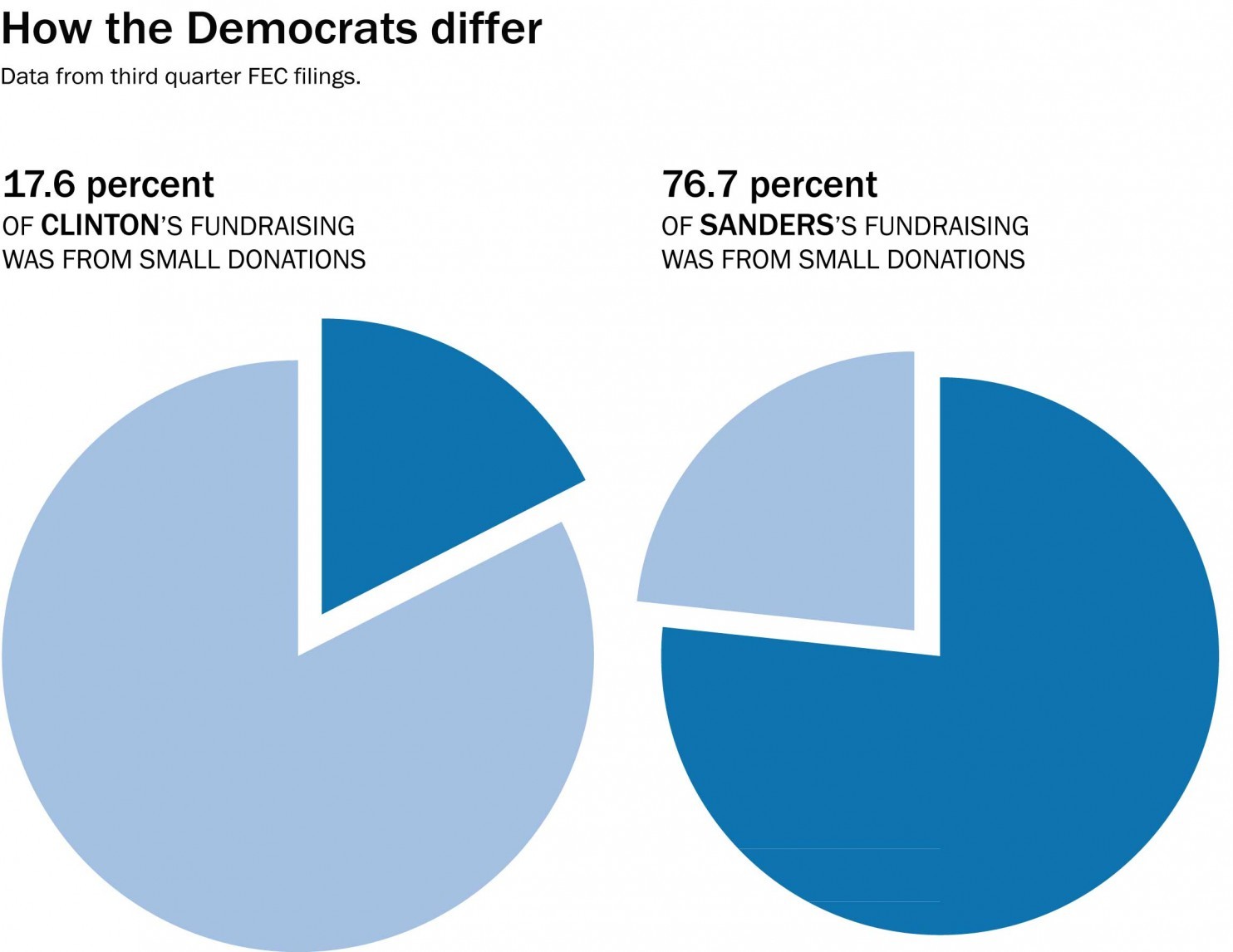
As you can see from the chart above, only 5 candidates-- Bernie (77%), Trump (71%), Carson (60%), Huckabee (59%) and Rand Paul (51%) got over half their campaign funds from small donations of $200 or less. (At Blue America, $200 is a big donation, by the way.) Bernie Sanders raised over $18 million of his $26 million haul this quarter through ActBlue, where the average contribution is in the $3-$40 range. But the two 100% establishment candidates-- the two Wall Street is backing-- both raised relatively little money from normal people. Jeb Bush took in over $13 million and only 7% came from small donors ($877,000). The Democratic Party's version of Jeb, Hillary Clinton, took in even more money (nearly $30 million, the most of any candidate in either party), and only 17.6% came from small donors. This is how that looks on a pie-chart comparing Bernie donors and Hillary donors:


Let's take a look at who the biggest bribers are to the campaigns of the two Establishment candidates. These numbers don't count the immense sums-- in Jeb's case, far more than to his own campaign-- that are coming in to the two candidates' SuperPACs. Jeb's biggest SuperPAC, Right to Rise, scooped up $103,167,846. Hillary's biggest SuperPAC, Priorities USA Action, raised $15,654,458. (Ted Cruz, who I think will be the last man standing in the GOP field has raised far more money through his various SuperPACs-- $38.7 million total-- than through his own campaign committee.)


Sanders is dominating all other candidates among small donors, which could give him a marked advantage as the primary continues. Almost three-quarters of his haul this quarter came from donors giving $200 or less, and the campaign told the Huffington Post that only 270 of his nearly 700,000 donors-- less than half of one percent-- have given the maximum individual contribution of $2,700 for the primary. That means that Sanders can go back to his donor base repeatedly as the race progresses.

Only 17 percent of Clinton’s contributions were from small donors. According to Politico, more than half of her take last quarter was from donors who are now maxed out and can’t give again until the general election gets underway.
Kennedy Elliott took a look at who the megadonors are so far this cycle, with neither the Adelsons nor the Kochs having come in yet with their billion-plus dollars they admit they plan to spend. These are the worst of the plutocrats, sworn enemies of democracy, trying to buy the election.
The Wilks family ($15 million to Ted Cruz)
Robert McNair of Renaissance Technologies ($11 million to Cruz)
Toby Neugebauer ($10 million to Cruz)
Kelcy Warren of Energy Transfer Partners ($6 million to Rick Perry)
Darwin Deason ($5 million to Rick Perry)
Diane Hendricks ($5 million to Scott Walker)
Joe & Marlene Ricketts ($5 million to Walker)
Norman Braiman ($5 million to Marco Rubio)
Fernandez family ($3.1 million to Jeb)
Larry Ellison of Oracle ($3 million to Rubio)
Ronald Cameron of Mountainaire Corp. ($3 million to Huckabee)
Besilu Stables ($2.5 million to Rubio)
Ray & Nancy Hunt ($2 million to Jeb)
Rooney Holdings, Inc ($2 million to Jeb)
Trevor Rees-Jones of Chief Oil & Gas ($2 million to Jeb)
Laura Perlmutter ($2 million to Rubio)
Haim & Cheryl Saban ($2 million to Hillary)
Steven & Alexandra Cohen ($2 million to Chris Christie)
Perenchio family of Chartwell Partners ($1.7 million to Fiorina)
37 other people-- who need to be slapped with a hefty wealth-tax-- gave a million or more, 19 to Jeb and 8 to Hillary... but even losers like Kasich, Jindal and Rand Paul had donors wasting a million dollars each on them.

So what about Mr. Self-Funding billionaire Donald Trump? Not really self-funding yet, at least not much, and nothing like the $100 million he said he was going to spend. More of his empty braggadocio? So far he's spending money his website solicits from the idiots to are looking for something absurd to waste their money on. He put in less than $2 million of his own and spent a little over double that this quarter ($678,000 of it on swag-- hats, t-shirts, piñatas). He seems to be spending a lot of lawyers, consultants, telemarketing and direct-mail firms. event producers, web designers and security services. And of course, on various Trump profit centers "such as the Trump Corporation ($45,000 for rent), Trump Restaurants ($2,185), a Trump Hotel ($1,138), and 'in kind' payments for items from Trump Tower, Trump Payroll Corporation and Donald J. Trump himself." Matea Gold reported in the Washington Post that "Trump’s biggest expenses appear to be the renting out large venues to host elaborate events that attract thousands." AP, on the other hand, reported that "the largest expense-- $723,000-- went to TAG Air, a Trump-owned company that controls his private jet."


MSNBC's Katy Tur reported: "'To be No. 1 in every poll,' he said in a statement Thursday, 'and to have spent the least amount of dollars of any serious candidate is a testament to what I can do for America.' Trump said he initially planned a 'substantially higher' initial budget, but 'good business practices' have kept costs in check. He has previously cited his extensive media attention as another reason not to waste money on ads, telling supporters in Waterloo, Iowa, last week that running TV ads now would make people 'O.D. on Trump.'" Many are anyway.
The filings also reveal new facts about the timeline for Trump’s operation. While the billionaire candidate has been a constant media presence, he has not actually directed any of his own money to the campaign in the past four months. The last time Trump personally funded the campaign was in June, with a $1,081,647 interest-free loan. When he began funding the campaign in April, he allotted a modest $292,650 through two loans, and his only other loan was $430,540 in May.

That’s a contrast to self-funding candidates who have come before, like Mitt Romney, Steve Forbes and Ross Perot, each of whom swiftly invested tens of millions of dollars into their presidential campaigns.

Some Republican operatives say the Trump campaign’s financial picture, revealed in the new filing, begs larger questions about Trump’s intent.

“We don’t know if Donald Trump is willing to open his pocketbook,” says former Romney deputy campaign manager Kate Packer, until he “demonstrates he’s willing to actually spend significant dollars.”

“Just because someone’s rich,” she told NBC, “doesn’t mean they’re completely liquid, and it also doesn’t mean that they’re willing to write a blank check to support their campaign. So we just don’t know.”

But what we do know is that, despite his claims to the contrary-- typical Trumpian lies-- he does have a SuperPAC (the Make America Great Again SuperPAC) and that he is-- or was-- raising money for it. Personal friends and business relations have been pressured into writing big checks. His daughter Ivanka's husband's dad-- Trump crony and campaign finance fraud criminal Charles Kushner-- had a fundraiser for the PAC at his Jersey Shore mansion after he was released from prison and Trump attended. Kushner, a billionaire real estate developer, got the ball rolling with a $100,000 check. But the SuperPAC didn't report to the FEC which is... shady or, at least, irregular. So no one actually knows how much Trump has or has spent because the SuperPAC isn't saying. I don't know how he gets away with it-- or why not one of the mainstream media outlets that reported on him yesterday even bothered to mention there's a key missing report. I guess he'll have them report when he's damn ready. It couldn't be a mistake because we all know he only hires the best and the brightest, right? (By the way, you can contribute to stopping Trump from becoming president here.)


Labels: , , , ,

Saturday, June 13, 2015

OMG, you can go to prison for illegal campaign coordination! Who knew?

>


Hmm, back in February 2011 (the same month that "Hosni Mubarak stepped down from power") Fox Noise couldn't seem to figure out whether Tyler Harber was "President, Wilson Research Strategies" or -- as he was identified in a graphic seconds later -- "VP AND DIRECTOR OF POLITICAL AND PUBLIC AFFAIRS DIVISION AT WRS." The following year Elections and Campaigns magazine would name the Republican consultant a "Rising Star."


"It was something I had seen other people do."
-- Republican political operative Tyler Harber, at his sentencing
hearing yesterday in Federal District Court in Richmond (VA)

by Ken

To be sure, with regard to the charges to which he was pleading guilty yesterday, Tyler did admit to Judge Liam O'Grady: "I did it, it was wrong when I did it, and I knew it was wrong when I did it." But then, clearly the federal prosecutors with whom he had arranged his guilty plea had made it clear that he wasn't going to be allowed to use the ever-popular "Everybody Does It" Defense. Nevertheless, he was apparently allowed to point out that he had seen other people do what he did: breaching the legally mandated firewall between a supposedly independent-of-campaigns super PAC and a political campaign (channeling some of the booty to his sister) and fibbing to the FBI about it. (As we all know, the FBI is free to lie to you in an investigation or interrogation, but you can't lie to the FBI.)

One wonders what Supreme Court Justice "Slow Anthony" Kennedy would make of our Tyler, the latest celebrity warrior in the Republican Campaign to Free America of the Menace of Free and Fair Elections (though for reasons we'll go into not acclaimed as a hero by the official Republicans leading the Campaign to Free America of the Menace of Free and Fair Elections), who was sentenced yesterday to two years in the pokey by Judge O'Grady, Slow Anthony's colleague on the federal bench.

It was, as I recall, that esteemed jurist Slow Anthony who disposed of the challenge to the sanctified form of speech known as "money" by declaring that we have no evidence that it causes corruption of our political system. That was, after all, the only reason a jurist of Slow Anthony's esteemed caliber could imagine for even considering interfering with such a divinely ordained right.

The clincher, as I recall the judicial "reasoning," was that elections are not always won by the candidate who spends the most money. This is a conclusion so stupid that you would have thought it landed him on the "tilt" side of the "Too Stupid to Be Entitled to an Opinion" Rule, except that our judicial system doesn't have such a rule.

For that matter, one wonders what our Tyler would think of Justice Slow Anthony if he was told that the justice doesn't believe in the power of money to corrupt our political system. Surely Tyler would wonder why the mean justice was denying the very basis of his life's work. And I don't think it would help to assure Tyler that not only Justice Slow Anthony but his thug-justice colleagues Scalia, Thomas, Roberts, and Alito have staked not just their careers but their lives as surely, not to mention a lot more successfully, on their faith in the politically corrupting power of money.


ALAS, POOR TYLER, YOU USED TO BE A "RISING STAR"

Once upon a time, way back in 2012, Tyler Harber was an official "Rising Star" in the campaign world:


TYLER HARBER, 29, REPUBLICAN


V.P. and Director of Political Division, Wilson Research Strategies

Tyler Harber seeks to practice politics with military precision. A native of Knoxville, Tennessee, Harber originally wanted to join the armed services. “I was too short and too slow to go into the military,” he jokes. “So I went into politics.”

He studied military tactics in college and believes that the principles of Sun Tzu and Napoleon are well suited for politics. “I see campaigns as being very based in military strategy,” he says. “Successful campaigns are organized similarly.” Harber grew up in a politically active family in Knoxville. His first race was a city council campaign that lost by about 100 votes. He was then hired by an opponent for the run off. That candidate lost by 34 votes.

“Fortunately,” Harber says, “my results have gotten significantly better since then.” When Harber left Tennessee, he landed at Public Opinion Strategies where he worked for Neil Newhouse, one of the best in the business. Harber says he learned at lot there through his work on high profile races like Sen. Lamar Alexander’s 2002 campaign and other races in the South.

Harber left Public Opinion Strategies in 2007 to lead the political division at Wilson Research Strategies. In that role, he has overseen a rapid expansion of the firm. He expects to have between 350 and 400 political clients by the end of the year. Harber has also begun working overseas, most recently providing counsel to former Ukrainian President Viktor Yushchenko.
Whatta guy! Alas, immediately following the above on the website now there's this boldface addendum:
Editorial note: Campaigns and Elections magazine revoked Harber's Rising Star award after he pleaded guilty to coordination of federal campaign contributions in February of 2015.
Oops! "Rising Star" comes crashing back to earth. And apparently he was just too flagrant about it to earn him the solidarity of fellow Republicans working to ensure the corruption of our elections, and the power of money to promote that corruption.


FEBRUARY 2015 WAS NOT A GOOD MONTH FOR TYLER

In the wake of his guilty plea to illegal campaign coordination, fellow Republicans couldn't run away from him fast enough. Virginia local political journalist Betty Bean wrote a piece called "The Rise and Fall of Tyler Harber," in which she told this story:
The last time I heard from Tyler was Nov. 12, 2014, when he sent me an email asking me to come up to D.C. to interview him. He said the Department of Justice was focusing on Republican consultants who were running super PACs:

“I’ve trusted you to write the truth before. Can I pay for you to come up here to meet me once more? One more interview,” he wrote.

“I need an impartial, reasonable, no BS-telling of why I’m going to federal prison for calling Obama a criminal repeatedly on national television. Are you up for a story with as much complexity as the series you wrote about me previously?

“Sooner rather than later. DoJ is pushing hard and I can’t hold them off too much longer. You’ve been the journalist I’ve trusted. Plus this is going to be a national story. I wanted to give you first dibs.

“Let me know. I know this is a very f’d-up request. But in the end of my political career, I’d much prefer that you write my ‘epitaph’ than the Times, Post or any other rag inside the beltway.

“Let me know.

“Best regards, Tyler”

Flabbergasted, I e-mailed him back, asking him to call me. He never responded.
Betty added:
Harber’s situation became brutally clear last week when the news broke that he’d pleaded guilty to illegally coordinating a political campaign with a super PAC he’d created, directing more than $300,000 to the campaign and diverting $138,000 of that to a company run by his mother.

The news brought back a flood of memories. . . .
It may be hard for Tyler to believe, but "calling Obama a criminal repeatedly on national television" doesn't get you indicted. The confusion may be understandable, though, because before Tyler's entanglement with the feds, you would have thought that "illegally coordinating a political campaign with a super PAC" didn't get you indicted either.

Eventually, as we've seen, Tyler seems to have admitted for the record that his legal problems weren't caused by repeatedly calling the president a criminal on national television -- although it's possible that the feds who decided to indict him smiled at the thought that he's that guy. As a matter of fact, as we're going to find out in a moment, Tyler was ratted out to the feds by a fellow Republican.


HOLD ON, ISN'T THIS SUPPOSED TO BE THE FEC'S JOB?

What has generated so much attention ever since Tyler's guilty plea was made known in February is that the Department of Justice was actually indicting someone for playing fast and loose with that mandated separation between super PAC and campaign, especially at a time when Jeb Bush, for one, has been betting that you can be pretty darned flagrant about it and nobody will say "Boo" to  you.

Certainly not the FEC. As the deck on Russ Choma's Mother Jones report on yesterday's sentencing argues: "The Justice Department is stepping in where Federal Election Commission has fallen down on the job." Russ reported:
The Department of Justice scored a victory Friday morning in the fight to rein in the campaign finance Wild West that has come with the rise of super-PACs: A GOP operative in Virginia was sentenced to two years in federal prison for breaking a small, but crucial, campaign finance law in the 2012 election. It's unclear whether this signals a sustained effort by the Justice Department to crack down on campaign finance law violators. But one thing's for sure: it's more than the grid-locked Federal Election Commission has done to enforce the law in this area.

There isn't much that a super PAC can't do under the 2010 Citizens United ruling. These outfits can raise and spend unlimited cash, soliciting funds from individuals and corporations alike. The one thing that can't happen is coordination between a super-PAC and a candidate for elected office. And that's the issue that was at the heart of the Justice Department's case against GOP operative Tyler Harber, once named a "rising star" by Campaigns and Elections magazine (since revoked), who was sentenced to two years in prison for illegal coordination and lying to the FBI.

Since Citizens United, it's been fairly clear that rules against coordination were being short-circuited, if not broken outright. Candidates' political aides have resigned from their campaigns only to resurface at the helm of super PACs supporting that very same candidate; parents and spouses of candidates have created super PACs and pour money in; most significantly, in the run up to 2016, Jeb Bush has merged his campaign with his super PAC, allowing him to raise unlimited amounts of money and hobnob with mega-donors, while hiding behind the excuse that he is not formally a candidate. Campaign finance reformers have cried foul over Bush's use of this loophole, but the reality is no one is likely to do anything about it. The FEC is, for all intents and purposes, putting itself on the bench this election cycle.

But, in lieu of FEC action to curb coordination, the Department of Justice may have sent a powerful message to political operatives across the country with Harber's sentencing today.

In federal court in Richmond, Virginia, Prosecutor Richard Pilger requested that the judge make an example of Harber to send a message to the rest of super PAC world. "The ideal that's really at issue here today is we have a fair campaign finance system," he told the judge, according to the Washington Post.

Harber admitted he was wrong, but the Post reported that he told the judge he didn't break the rules because of greed or power. He said he just got swept away in the post-Citizens United maelstrom of money and boundary-pushing. "I got caught up in what politics has become," he told the judge.

Despite being an up-and-coming operative, Harber was not a particularly powerful one. And he committed his crime while working on behalf of a no-chance congressional candidate who was routed by Democrat Rep. Gerry Connelly. He was no Karl Rove, and he didn't have the backing of a powerful politician or a deep-pocketed donor. In the world of super PACs, Harber was relatively low-hanging fruit.

Harber pleaded guilty to illegal coordination and lying to federal investigators about it, admitting to working as a campaign manager for the candidate and simultaneously playing a secret role in setting up a super PAC that raised $325,000 to run ads on the candidate's behalf. The money came mostly from a New York City real estate developer who had already donated the maximum to the campaign; Harber convinced him to give more to the super PAC, completely erasing any boundary between the campaign and the outside group. On top of that, he diverted more than a third of the super PAC's funds to a firm set up in his mother's name and spent most of that money for personal expenses. Then he threatened someone who confronted him over it and lied to FBI agents who interviewed him about the super PAC's creation.

In other words, he was very easy to prosecute. Even his own party had no love for him (a fellow Republican turned him in). Whether or not the Justice Department can or will take such a hard stance with other super PAC law-breakers—whose infractions may be more subtle—remains to be seen. But, if nothing else, today's sentencing shows that, post-Citizens United, there is still some campaign finance accountability.
Sound the message throughout the land: "There is still some campaign finance accountability." Hey, it's not much, but it's not nothing either, while the FEC slumbers.
#

Labels: , , , , , ,

Sunday, November 02, 2014

The Complete Washingtonization Of Politics

>


This election cycle should serve as a case study in how not to run the DCCC. We've been referring to it as The Steve Israel Effect but, even if Israel is the worst practitioner ever, the DCCC's inability to do its job predated Israel for as long as anyone alive can remember. This goes beyond spending $4,000,000 in a blue-leaning New York City district for a recruit so unattractive that he could lose in a landslide to a Mafia thug with 20 criminal indictments. The story, or a version of it, can be told in any district in the country that Steve Israel stuck his nose into.

As an example, let's look at Friday morning's memo from California Democratic Party vice chair (for Southern California) Eric Bauman, entitled "New Data Indicates Turnout In The Inland Empire Is Dismal This Year." It would never occur to Bauman-- like Israel (in so many ways)-- that dismal candidates make for dismal turnout-- and dismal years. Bauman and Israel pushed Pete Aguilar, a failed bank lobbyist and crony of Jerry Lewis' old Redlands machine pretending to be a Democrat, for a second cycle in a row, helping him to a primary win against a candidate, Eloise Reyes, who would now be wiping the floor with Republican nonentity-- and likely congressman-- Paul Chabot. Instead the DCCC and their House Majority PAC have squandered $1,447,118 on a D+5 solid blue district where the NRCC didn't spend a nickel (although the NRA did spend $4,530).
Vice President Joe Biden is visiting the Indland Empire on Saturday, in an effort to prop up the campaign of Pete Aguilar (D-Redlands), who is running in the open 31st Congressional District against Paul Chabot (R-Rancho Cucamonga), Sources tell InlandPolitics the Aguilar camp is feeling pretty stressed these days, and rightfully so.


Aguilar could easily lose again.
Republicans don't win in D+3 districts, not ever. D+5? Only when someone like Steve Israel is running the DCCC and can get away with recruiting something like Pete Aguilar as the Beltway's favorite candidate. This week, coincidentally, a friend of mine, Moe, dug up a Washington Post OpEd from a reform-minded Democratic congressional candidate, Advise and Resent: Mr. Smith Went to Washington-- and Fled the PACs, which was published on August 25, 1991. It's worth reading and relating to the situation DCCC chairs like Rahm Emanuel and Steve Israel have reinforced and are still reinforcing on House Democrats and candidates who would like to run for Congress.


Even in a quiet year, many believe, we Iowans are being inundated by presidential contenders. Our first-in-the-nation caucus state is seen as a model of democracy. Perhaps it is, yet there is a terrible feeling here that it just doesn't matter anymore. Those who once took pride in raising issues at their neighborhood caucuses, knowing they had a chance of affecting the national agenda, are feeling left out.

This has happened because people believe they're trying to work within an American campaign system that's gone haywire. I'm no political evangelist, but I've made it my business to tell my fellow Iowans just what's happened. More specifically, I tell them about my experience last year as a candidate for the U.S. House of Representatives.

They've found my experience appalling-- exemplifying what many Iowans believe has gone wrong: the dramatic shift from a participatory democracy to a highly centralized and manipulative system. At the risk of sounding naive, I'll confess that I was struck by this realization when I made my quest for the Democratic nomination in Iowa's second congressional district-- a seat vacated by Rep. Tom Tauke, who unsuccessfully challenged Democratic Sen. Tom Harkin.

My instruction was served up by the Democratic Congressional Campaign Committee (DCCC), the group whose purpose it is to maintain a Democratic majority in the House. On March 1 last year, the DCCC put on a workshop for challengers at its Washington headquarters, a couple of blocks from the Capitol. The Republicans were doing the same thing at a different time and place.

I attended the workshop with 70 Democratic candidates from all over the country. We hoped that those in Washington, and particularly in my party, had been awakened to the compelling need for campaign reform. After all, one would have expected scandals like the "Keating Five" situation to have brought on a rush to find a better way. I looked forward to returning to Cedar Rapids filled with ideas, ideals, issues and inspiration.

It didn't happen that way. Instead, we were lectured by members of Congress, PAC representatives, pollsters, consultants and media specialists who told us how the "game" is played. As our tape recorders took down their words of wisdom, we heard political "axioms" like the following:

"Marty Stone, staff member of the DCCC: "Money drives this town."

"Tom King, principal of Fenn and King consultants: "You have to sell yourself in Washington first" (pointing out the primacy of Washington professionals over the people you intend to represent). "Negative politics in a primary campaign produces damaged goods," he added, "but you've got to do what you've got to do."

"Frank Greer of Greer, Margolis, Mitchell: "The game of raising PAC money here in Washington will make the difference. Understand how the game is played. It's crucial to your being one of the few that will win." He continued: "It doesn't matter whether negative campaigning is good or bad; it's a reality."

There was more advice at the workshop: Rep. Peter Hoagland, a Nebraska Democrat, assured us that "Raising campaign money from Washington PACs is much easier than from individuals because it's a business relationship."

I wondered just what kind of business relationship he had in mind. Having been in business for 25 years, I believed such a relationship to be an exchange of money or some other consideration for products or services of value. Marty Stone clarified this concept for us: "These people are paid to give you money," he said, "You have to do certain things, but they want to give you money."

George Gould of the letter-carriers union indirectly explained why so little PAC money goes to challengers-- and how PAC giving has less to do with ideology than with access to power: "I don't give my people's money to those I think are going to lose, so you have to convince me you're going to win."

He didn't mince words about the implied agreement between the PAC and the recipient of the PAC's largesse. Nor did he flinch when he said, "When you take PAC money, you are saying you're their friend."

As a candidate, I refused PAC money-- one of two House candidates in the nation to do so. In part, this was a reflection of the caucus-generated platform of Iowa Democrats-- one that called for an end to the influence of PACs and a limit to the obscene levels of campaign spending. In addition, I had been working for campaign reform since 1980 in the belief that the best way to return the agenda of representative democracy to its citizens is to assure a government beholden only to them and not to Washington-based, special-interest pressure groups.

In light of that, you can imagine my reaction to being lectured at the workshop by Hoagland, who said, "Some of you may be under pressure to repudiate PACs. I strongly suggest you not take the hook. Restrain yourself, don't let zeal for reform influence you. Process challenges just don't work."

There were many candidates present who, like myself, were fighting personal financial odds to take a year or more from their jobs to campaign for Congress. Nevertheless, we were told by Hoagland-- who, incidentally, spent $ 180,000 of his own money on his campaign-- that the "ultimate test of your commitment is how much of your own money you are willing to put into your own campaign. If you aren't willing to use your own money, you ought to think about [doing] something else."

He further urged us to adopt this approach because "It will be a permanent career change, you'll be here as long as you want." He was apparently underscoring a system of campaign funding that has become an overwhelmingly effective incumbent-protection tool. He was also, in my view, advocating the principle that personal wealth is an appropriate qualification for election to office.

The complete Washingtonization of politics had become abundantly clear. It was all right there. Everything you could ever want for a successful election was either right in the room or within walking distance. The second day of the workshop began with a "mating dance" brunch, limited to candidates and PACs. Candidates wore blue name tags and PACs wore red. The occasion was opened by Arkansas Rep. Beryl Anthony, then head of the DCCC, who defined PACs as an acronym for "People Are Concerned." He said that candidates facing those who criticize PACs must "take that issue straight to 'em because PACs represent thousands of little people."

I saw the Phillips Petroleum PAC representative smile with approval. I wondered if he was representative of the "little people" to whom Anthony referred. The congressman went on to tell the PAC people they'd be able to pick winners and find matches in the room that will "make your board of directors proud of you."

Candidates were coached to hire Washington consultants and pollsters with the money they raised from Washington PACs. Hoagland told us we "must hire world-class people and not local [back home] people. That's why you have to raise a lot of money." The letter-carriers' Gould said, "You can't hire local people-- forget it!"

Talk about vertical integration of the campaign industry! Here was a congressman telling us how to get the money and a PAC director giving the specifics, while on the same panel were the consultants, pollsters and media gurus who were ready to spend every dime of it for us. Left out of the equation were the people I sought to represent.

Gould went on to warn candidates of the folly of involving volunteers from home districts, saying we may need them near election day to "walk the streets." Said Gould, "In the first phases they'll be no help. They can't do polling, radio, direct mail or TV." At the moment he spoke, my campaign had scores of volunteers who still believed in a government "of the people," phoning neighbors to talk about the campaign and issues that concerned them. Other volunteers were stuffing and stamping envelopes for a "direct mail" response to those concerns.

I suppose you could say that my reaction was pretty emotional. I stood and implored the candidates and panelists, saying that much of what we'd heard is much of what is wrong with the process of politics, campaigns and government today. I told the gathering that it ought to be the Democrats who lead the effort to end the kind of politics we had been coached that day to execute.

There was an uncomfortable moment of silence after my comments. It was broken when PAC director Gould said, "Well, I guess we don't have to worry about contributing to that campaign!" There was polite laughter and the workshop proceeded.

Later, though, many of the candidates approached me individually to second my chagrin about a system out of control. At one point, there were five of us in the restroom during a break, railing against the seaminess and proposing how we might best change the system. However, most of them already had committed to raising as much PAC money as they could, so they didn't want to express their concern in the presence of PACs and the DCCC. But, before the workshop was over, more than half of the candidates present, one at a time, whispered their affirmation of my remarks and their deep disappointment in the position of those representing our party.

One lasting impression came during a brief discussion I had with a would-be candidate who decided, during those two days, not to run. "This has got to change," he confided. He pointed out the difficulty of bringing such activity to an end. A psychologist by profession, he concluded that the behavior we witnessed was addictive in nature and that he had often seen similar symptoms in his practice. We mused that the habit-forming "politically addictive cocaine-- PAC" fueled all of what we saw here. It is an addiction, he said, that has to be "kicked."

In looking back, I realize how serious Frank Greer was when he said, "The campaigns that get the help are the ones that listen to the DCCC when they say that you have to go after a specific PAC and the like. The candidates that listen will get the help in the last few months of the campaign."

Our campaign was cut from the DCCC mailing list soon after the workshop. The issue papers, congressional calendars, updates on important legislation and all the rest were sent only to my primary opponent, Eric Tabor, who was making his third run for the House. He had been the third highest PAC-funded challenger in the nation during the prior election. On election night, when I called my opponent's office to concede, the person who answered his phone was a paid staff member of the DCCC. In November, Tabor was defeated by Republican Jim Nussel.

Now, the Senate has taken some steps toward campaign reform, and the measure it passed in the spring is before the House. I would like to show members of Congress the petition I have. It was signed by the 13 members of the Daughters of the American Revolution who met on a Tuesday noon in the library in Marion, Iowa. The same response came from the 41 members of the Clinton Kiwanis Club; 27 members at the meeting of UAW Local 1024; the executive committee of the Linn County Farm Bureau; the Lions Club of Lansing; Rotarians in Manchester; a Guttenburg High School government class; a local chapter of the American Business Women's Association; Dubuque Optimists; Teamsters retirees; the Cedar Rapids NAACP; and over 50 other diverse eastern Iowa service clubs, civic groups and the like.

The citizens at these gatherings, including Republicans, Democrats and independents, signed a petition that is a call to action to end the stranglehold that PACs have on democracy, return the agenda of government to its citizens and stop the "arms race" of campaign spending.

You have to wonder if it is possible for House members to hear the voices like those in eastern Iowa and join with the Senate to begin the return to a government of, by and for the people. Or will they adhere to a government of the PACs, by the consultants and for the special interests?

Steve Sovern, formerly a sign manufacturer, is now a law student at the University of Iowa.

Labels: , , , , , , , , , ,

Wednesday, January 15, 2014

Be Careful When You Give Political Contributions-- You May Be Making Some Crooks Very, Very Wealthy

>


Early this morning, Anonymous Operative posted about the corruption inherent in our electoral system. It's no better on either side of the aisle and it has a tendency to keep quality people out of politics so that we wind out with criminal sociopaths like Steve Israel, Debbie Wasserman Schultz, Michael Grimm, John Boehner, Rahm Emanuel, Tom DeLay, Steve Stockman, Eric Cantor and Joe Crowley.

But its key to remember that to Beltway operatives winning or losing isn't always what's uppermost in minds fixed on self-enrichment, This morning Roll Call san a story about how people running PACs and consulting firms have become very very wealthy raising money that purports to be for causes and candidates their targets believe in. They work the same way the DCCC and the NRCC work, separating the suckers from their cash and pocketing a chunk for their allies. "Recently released tax forms," reports Eliza Carney, "shed light on the big salaries that an elite corps of political organizers earned during the 2012 elections-- and those who made the most often boasted the fewest wins."
The new filings show that liberal groups, which in many cases outperformed their conservative counterparts, typically paid their executives less money. Liberal super PAC, nonprofit and labor salaries tend to land in the $250,000 to the (at most) $600,000 range, while many conservative organizers are pulling in at least a half-million, and several make into the millions over an election cycle. Findings from the new IRS 990 forms include:

Steven Law, the president of the American Crossroads super PAC and its tax-exempt affiliate, Crossroads Grassroots Policy Strategies, made $1.1 million during the election cycle. That includes $602,935 from Crossroads GPS in 2011 and $637,562 in 2012. Together the super PAC and the nonprofit spent more than $325 million on the election but had an underwhelming return on investment. According to the Sunlight Foundation, 1.3 percent of the super PAC’s money supported candidates who won and opposed candidates who lost in the general election. The Crossroads GPS return on investment was 14.4 percent.

Stephanie Schriock, the president of EMILY’s List, a political organization that supports female Democrats who back abortion rights, received a $263,194 salary for the entire 2012 cycle, according to Political MoneyLine data derived from FEC reports. The EMILY’s List super PAC Women Vote spent $7.7 million in the 2012 elections and had an 80 percent return on investment, according to the Sunlight Foundation.

U.S. Chamber of Commerce President and CEO Thomas Donohue pulled in $5.5 million in 2012, making him one of the top-paid association executives in the nation that year. For the entire election cycle, Donohue made $10.4 million, according to the chamber’s 990s from 2011 and 2012. Said chamber spokeswoman Blair Latoff Holmes: “Tom Donohue leads the largest, most active and most influential trade organization in the world and our board compensates him accordingly.”

Rebecca Burkett, a little-known campaign consultant from Georgia, made more running Winning Our Future, the super PAC that backed losing GOP presidential nominee and former Speaker Newt Gingrich, than many of the nation’s leading labor union presidents make in a year. Burkett earned more than $500,000 during her tenure as the Gingrich super PAC’s chief organizer, according to Political MoneyLine. By comparison, Mary Kay Henry, president of the Service Employees International Union, which spent $23 million on the election, made $288,303 during the 2012 calendar year.

…The top GOP super PAC backing Mitt Romney, Restore Our Future, listed no salary lines or payroll recipients by name on its FEC public disclosures. This drew fire from watchdogs who complained that the super PAC shared vendors and even consultants with Romney, violating rules that bar coordination between candidates and the outside groups that back them.

At the center of those complaints was GOP fundraiser Steve Roche, who ran a fundraising firm called Podium Capital Group. As the super PAC’s top vendor, that firm was paid $7.3 million by Restore Our Future, according to the CRP. But how much of a cut went to Roche-- whether 2 percent or 12 percent, both within industry standards-- remains unanswered. Roche did not return a message seeking comment.

Moreover, Restore Our Future had no single executive in charge. It was run by a trio of consultants that included GOP election lawyer Charles Spies, its treasurer. His firm, Clark Hill, took in $746,425 from Restore Our Future, data from the CRP show. But Spies said that amount was paid to the firm as a whole, not to him individually.
As if things weren't bad enough, 4 of the worst-- worst as in voting all the time with Republicans against Democratic values-- House Democrats joined the dying Blue Dog Caucus this week. I guess the Wall Street-owned and operated New Dems just wasn't far right enough for Sinema and Barber. All 4 of these make a habit, a very consistent habit, of giving Boehner and Cantor the excuse to call their anti-working family bills "bipartisan." Here they are, from bad to worse, with their ProgressivePunch crucial vote scores for this cycle.
Nick Rahall (WV)- 45.52
Cheri Bustos (IL)- 44.62
Kyrsten Sinema (AZ)- 33.33
Ron Barber (AZ)- 25.20
If you contribute any money to the DCCC, whatever is left after they line the pockets of their consultant cronies, goes to characters like these four.

Now, what about Blue America, the PAC Digby, John Amato and I run. Digby's salary and expenses came to zero dollars; Amato's salary and expenses came to zero dollars; my salary and expenses came to zero dollars. The money contributed-- all of it-- goes to elect our candidates. None of us all at Blue America to profit from it. These are our House candidates so far this cycle and these are our Senate candidates. When you contributor to your favorite candidates, you have the option of also contributing to our PAC. When you do, that is money we use to buy TV, radio and newsprint ads as well as billboards and other means of getting out the word about our candidates.

Labels: , ,