Saturday, February 22, 2020

Are Trump And The GOP Leaving The U.S. Defenseless?

>


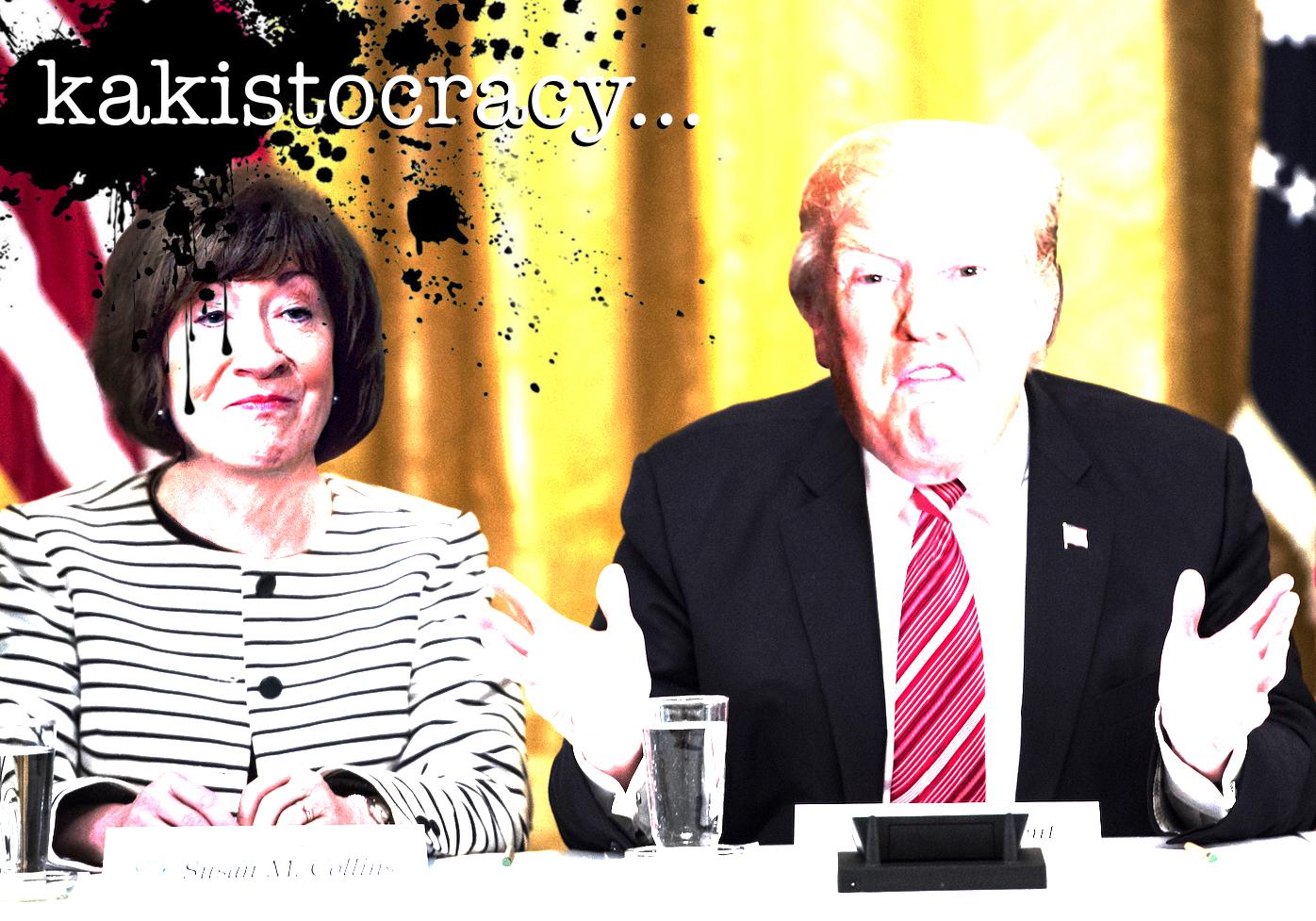
In late October-- and again last week-- Trump had Senate Republicans kill 3 election security bills by Mark Warner (to require campaign officials to report contacts with foreign nationals who are trying to make donations or coordinate with the campaign to the FEC and FBI), Amy Klobuchar (to require campaigns to report "illicit offers" of election assistance from foreign governments or individuals to both the FBI and the FEC and to take steps to ensure that political ads on social media are subject to the same rules as ads on TV and radio) and Ron Wyden (to authorize more funding for the Election Assistance Commission, including language that would ban voting machines from being connected to the internet and being produced in foreign countries). Crackpot Trumpist from a single-party state, Marsha Blackburn (R-TN) blocked each one for McConnell and Trump.

Why would Blackburn and the Senate Republicans insist of keeping the back door to our elections open for our country's enemies? Good question but I think Trump extremists like Blackburn are more about protecting Trump than protecting our country, let alone a concept that is so alien to them like democracy. Trump is gutting the intel capacity of the country-- a big bonus for the support Putin has given, and is still giving, him electorally. And the GOP seems to be revealing in it-- all of them (not just the clinically insane ones like Blackburn).


Utah Congressman Chris Stewart (R) would have been a standard choice for director of national intelligence and Trump was leaning in that direction. But someone showed Trump a video of Stewart calling Trump a fascist and stating flatly that he is our Mussolini. He told a group of students at the Hinckley Institute of Politics that "The world is standing on the edge of a knife and it is a very dangerous time... If some of you are Donald Trump supporters, we see the world differently, because I can't imagine what someone is thinking... Donald Trump does not represent Republican ideals, he is our Mussolini. Donald Trump's approach is-- I am just going to do it."
Trump felt blindsided when he learned belatedly that intelligence officials briefed House lawmakers that Russia is continuing to interfere in U.S. elections-- and that Democrats elicited their view that the Russians favor Trump’s re-election, according to people familiar with the situation.

Trump blamed Joseph Maguire, the acting director of national intelligence, for the episode and the failure to inform him. On Wednesday, the president announced that he was replacing Maguire, a veteran intelligence official, with Ric Grenell, the U.S. ambassador to Germany and a staunch Trump supporter.

The chain of events underscores the continued tensions between Trump and intelligence officials that he and his supporters often depict as part of a “deep state” undermining his presidency.


The classified briefing on Feb. 13 was delivered by Shelby Pierson, the intelligence official charged with monitoring issues related to election security. Among those attending were Intelligence Committee Chairman Adam Schiff, who led the House Democrats who impeached Trump, and the panel’s top Republican, Representative Devin Nunes of California.

In response to questions from Democrats, lawmakers were told that Russia and its president, Vladimir Putin, prefer Trump over his Democratic challengers and is still actively interfering in this year’s election, according to the people. But little information has emerged on any specific or ongoing interference by Russia detailed in the briefing last week.

...Schiff tweeted that “we count on the intelligence community to inform Congress of any threat of foreign interference in our elections.” At the same time, Schiff seemed to hedge on what information, exactly, had been provided to him and other House members. “If reports are true and the President is interfering with that, he is again jeopardizing our efforts to stop foreign meddling,” Schiff said.

Democrats have blasted Trump for replacing Maguire with Grenell, who has little experience in intelligence-gathering or analysis, and several key Republicans have remained silent on the decision.

“By firing Acting DNI Maguire because his staff provided the candid conclusions of the Intelligence Community to Congress regarding Russian meddling in the 2020 Presidential election, the President is not only refusing to defend against foreign interference, he’s inviting it,” House Homeland Security Chairman Bennie Thompson of Mississippi complained in a statement.

On Friday, Maguire’s deputy Andrew Hallman said he was stepping down as the DNI’s principal executive, offering praise for his former boss, who he called a “lifelong patriot and public servant.”
A phrase like "lifelong patriot and public servant" is to Republican of the Trumpist stripe like waving a red flag in front of a bull. John Parkinson reported for ABC News that Trump is trying to reshape the intelligence community-- long the target of his ire-- [but that] his search for a permanent director of national intelligence is proving to be a formidable challenge-- even as he claimed Friday he had 'four great candidates' and called reports Russia is helping his reelection a Democratic 'misinformation campaign.' Although Trump made a point of telling reporters on Air Force One Thursday that he was considering Rep. Doug Collins, one of the president’s leading defenders during the House impeachment inquiry, the Georgia Republican quickly declared Friday that he’s not interested in the nomination. 'This is not a job that’s of interest to me, and it’s not one that I’d accept,' Collins, who is running in a competitive primary for U.S. Senate, said on Fox Business. Trump has had substantial difficulty identifying a confirmable nominee since former DNI Dan Coats resigned Aug. 15, settling instead on two acting directors who did not require Senate confirmation, avoiding tough questions."

People are starting to worry he may add the position to Jared Kushner-in-law's portfolio of 57 positions. Grenell, who has done a miserable job as Ambassador to Germany-- and who is keeping that job as well-- has no experience whatsoever working in Intelligence.
Oregon Democratic Sen. Ron Wyden expressed doubt that Grenell meets the DNI’s basic job requirements for expertise in intelligence-- even if he’s only on the job in an “acting” capacity.

“If there was any doubt that Donald Trump values unquestioning obedience over the safety of the American people, this appointment settles the question,” Wyden said. “Senators who take their oath of office seriously must oppose Trump's practice of dodging Senate confirmation practices to place unqualified individuals into highly sensitive national security posts.”
CNN: "It's happening again. America is blundering into a new Russia election-meddling hall of mirrors that's already doing Moscow's work: tearing fresh political divides and threatening to again tarnish democracy's most sacred moment, a national election. Revelations Thursday about intelligence assessments that Russia has launched a new interference effort to help reelect Donald Trump-- and the President's furious reaction-- mark the return of a recurring nightmare for the country just nine months before the presidential election. Trump was informed that the House Intelligence Committee was told of the Russian intelligence operation last week by Rep. Devin Nunes, his Republican ally from California and was frustrated that Democrats would be able to use the information against him, a source told CNN. A more conventional reaction by the commander-in-chief given his institutional responsibilities might be anger that again a foreign power was trying to manipulate US politics-- however it might affect his own fortunes."


Yesterday, Wired published a piece by Garrett Graff, How Trump Hollowed Out U.S. National Security. "By the end of the day," he began, "almost all of the roles created after 9/11 literally to prevent the next 9/11 will be either vacant or lack permanent appointees. While vacancies and acting officials have become commonplace in this administration, the moves by President Donald Trump this week represent a troubling and potentially profound new danger to the country. There will soon be no Senate-confirmed director of the National Counterterrorism Center, director of national intelligence, principal deputy director of national intelligence, homeland security secretary, deputy homeland security secretary, nor leaders of any of the three main border security and immigration agencies. Across the government, nearly 100,000 federal law enforcement agents, officers, and personnel are working today without permanent agency leaders, from Customs and Border Protection and Immigrations and Customs Enforcement to the Drug Enforcement Administration and the Bureau of Alcohol, Tobacco, Firearms, and Explosives. All the posts, and many more top security jobs, are unfilled or staffed with leaders who have not been confirmed by the Senate. Trump has done an end-around, installing loyalists without subjecting them to legally mandated vetting and approval by Congress."

And the Intelligence agencies are far from the only government departments dealing with national security that Trump has managed to screw up and leave in shambles. Other departments without personnel in crucial positions include the Justice Department, the State Department, the Department of Homeland Security and the Pentagon. Worst president ever? Oh yeah. I don't even want to think about the consequences of a full-blown coronavirus outbreak here, with Trump and his incompetent greed-driven crime family in charge!

In a NY Times report early this morning, Michael Crowley and David Sanger outlined a new role for the NSC-- not advising the president, but defending the illegitimate and insane "president." The head guy, Robert O'Brien, could just as well be a janitor, a job he's probably better suited for anyway. When he "convenes meetings with top National Security Council officials at the White House, he sometimes opens by distributing printouts of Mr. Trump’s latest tweets on the subject at hand. The gesture amounts to an implicit challenge for those present. Their job is to find ways of justifying, enacting or explaining Mr. Trump’s policy, not to advise the president on what it should be. That is the reverse of what the National Security Council was created to do at the Cold War’s dawn-- to inform and advise the president on national security decisions. But under Mr. O’Brien, the White House’s hostage negotiator when Mr. Trump chose him to succeed John R. Bolton in September, that dynamic has often been turned on its head... [D]eveloping policy is not really Mr. O’Brien’s mission. In the fourth year of his presidency and in his fourth national security adviser, Mr. Trump has finally gotten what he wants-- a loyalist who enables his ideas instead of challenging them."
As Mr. O’Brien has whittled down the council he manages, declaring it was all about efficiency, the president has made little effort to disguise his appetite for purging his own government. “DRAIN THE SWAMP!” he tweeted last week, adding: “We want bad people out of our government.”

The same day, Mr. Trump said in a radio interview that he may drastically limit how many national security officials can listen in on his calls with foreign leaders, breaking from decades of White House procedure. “I may end the practice entirely,” he said.

Such commentary “creates the clear impression that this is about retribution, not reform,” said Senator Christopher S. Murphy, a Democratic member of the Foreign Relations Committee.

But Mr. Murphy questioned how much the National Security Council’s structure really matters under a president who often rejects professional advice in making impulsive policy decisions. “It’s not terribly clear what the N.S.C. has been doing for the last three years,” he said. “The N.S.C.’s function now seems to be war-gaming for potential presidential tweets instead of developing policy recommendations for presidential decision-making.”

Mr. Trump is unlikely to mind that. After more than three years in office, he feels more confident than ever in his management of national security, aides say, especially after some of his major decisions-- including the killing of the Iranian commander Maj. Gen. Qassim Suleimani-- failed to elicit the disastrous consequences many experts predicted.

Mr. O’Brien’s willingness to trim the National Security Council, Mr. Gans said, “says something about Trump’s Washington.”

“The national security adviser should have the strongest staff possible,” he continued. “But it seems like Robert O’Brien is focused more on that audience of one-- and making sure that Donald Trump is happy.”
In a Washington Post OpEd today, Admiral William McRaven (retired)-- U.S. special forces commander from 2011 to 2014 (think 2011 SEAL raid that killed bin Laden)--wrote that "As Americans, we should be frightened-- deeply afraid for the future of the nation. When good men and women can’t speak the truth, when facts are inconvenient, when integrity and character no longer matter, when presidential ego and self-preservation are more important than national security-- then there is nothing left to stop the triumph of evil. He was referring to the swampy, proto-fascist Trumpist regime, of course. "Over the course of the past three years, I have watched good men and women, friends of mine, come and go in the Trump administration-- all trying to do something-- all trying to do their best... But, of course, in this administration, good men and women don't last long."


Labels: , ,

Wednesday, September 25, 2019

Midnight Meme Of The Day!

>


by Noah

From the first few days of his administration, when Trump invited the Russian spy chief and his entourage into the Oval Office and handed them top secret Israeli information, it was clear where Trump's allegiances reside. Even before that, he felt that he could ask Russia for his opponent's emails and they would oblige because, well, why wouldn't they help out a friend and business partner? "It's just business." Vladimir Putin said as much in Helsinki which is where, not coincidentally, Trump sided with his buddy Putin over the entire United States intelligence apparatus; after a very private meeting with no American witnesses of course. Hush hush meetings have also been held the heads of other adversaries, too, including the heads of North Korea and China. Never forget that every thing Trump does is transactional. Obviously, things were said and deals were probably at least brought up, or else the usual recordings and/or transcripts would have been made public. There can be only one reason why they haven't and that is that Trump has something very bad, and probably very detrimental to our country, to hide. It's not at all unlike the facts that Trump refuses to show his taxes and blocks his wise guys and made men from testifying before congress, yet people believe Trump when he says a transcript will be provided.

Now, Trump has apparently pressured the government of Ukraine to deliver help in defeating former Vice President Joe Biden. He was allowed to get away similar things by the spineless democrats before, so why wouldn't he be emboldened more than enough to do something similar again? That's how criminal minds and the minds of small children work.

Trump doesn't even have to have offered a quid quo pro in the phone conversation. The quid pro quo of some form of aid hung over the conversation like a giant water balloon of urine just like Trump's offer of removing the sanctions on Russia did. It didn't have to be spoken. That's how mobsters communicate. The media and the lawyers will parse it all of course. That's their role in protecting the vermin of society. In return, the reporters maintain their contacts, ie, place at the table. And the gravy train of advertising money, influence money, out right bribes, etc., just keeps on rolling along. We live in a farce run by briefcase-carrying clowns in suits and ties.

Breaches of national security take all sorts of forms. There's doing nothing about climate change. There's sabotaging the education systems. There's taking money from the military to build a stupid and pointless wall. There's pollution of our water and air for fun and profit, and so much more. So much of this sort of thing has gone on before but never to this nihilistic extent. The current corruption is a Tsunami, irrevocably destroying the legal system that maintains our society and literally smothering us and poisoning us. Soon, everything we have known and every thing that has nurtured this country will be gone with the wind.

Our so-called leaders do nothing. After all, the perpetuation of evil for cash in pocket is their biggest and most prized product. They look at secret meetings between Trump and foreign leaders that will happily hack our voting machines and flip vote counts for Trump the second they can, and they shrug. The republicans do this with a smirk or a laugh. The democrats do it with a frown. It's the Comedy and Tragedy duality of life in Washington. It's so ludicrous now. How ludicrous is it? Just think of this Washington "reasoning" the next time and every damn time another Russia deal, secret get together with North Korea's nutjob dictator (Trump's loveletter penpal), or mysterious phone call to Ukraine or somewhere else happens: Our so-called republican representatives are all for the treachery and treason. That's their brand now and has been for a while. Our so-called Democratic Party representatives in Washington? They don't want to impeach Trump for his illicit actions with foreigners designed to assure him winning re-election because they fear impeaching him might help him win re-election.

Labels: , ,

Friday, June 28, 2019

If There Are No Consequences Commensurate With The Crime Of Treason, Wall Street Executives Will Keep Selling Us Out

>

Russia may have paid to get them in office, but China seems to be getting the most out of it

During Wednesday’s debate, the candidates were all asked to name the biggest single national security threat to the country. Few of them had the self-discipline to name just one, but almost all of then named China. Tim Ryan caught himself about to say China is “whipping” us everywhere, realized that might sound defeatist and changed it in mid-sentence into something that didn’t make any sense— “wiping us everywhere.” Last night, one of the moderators just phrased it as a what-to-do-about-China question.

This week Matt Stoller co-authored a piece for the American Conservative, America’s Monopoly Crisis Hits the Military, about how Wall Street greed has “decimated our defense industrial base and undermined our national security… [T]he destruction of America’s once vibrant military and commercial industrial capacity in many sectors has become the single biggest unacknowledged threat to our national security. Because of public policies focused on finance instead of production, the United States increasingly cannot produce or maintain vital systems upon which our economy, our military, and our allies rely.”
When national security specialists consider preparedness, they usually think in terms of the amount of money spent on the Pentagon. One of President Donald Trump’s key campaign promises was to aggressively raise the military budget, which he, along with Congress, started doing in 2017. The reaction was instant. “I’m heartened that Congress recognizes the sobering effect of budgetary uncertainty on America’s military and on the men and women who provide for our nation’s defense,” then-defense secretary Jim Mattis said. Budgets have gone up every year since.

Higher budgets would seem to make sense. According to the 2018 National Defense Strategy, the United States is shifting away from armed conflicts in the Middle East to “great power” competition with China and Russia, which have technological parity in many areas with the United States. As part of his case for higher budgets, Mattis told Congress that “our military remains capable, but our competitive edge has eroded in every domain of warfare— air, land, sea, space, and cyber.”

In some cases, our competitive edge has not just been eroded, but is at risk of being— or already is— surpassed. The Chinese surge in 5G telecom equipment, which has dual civilian and military uses, is one example. China is making key investments in artificial intelligence, another area of competition. They even seem to be able to mount a rail gun on a naval ship, an important next generation weapons technology that the U.S. Navy has yet to incorporate.


And yet, the U.S. military budget, even at stalled levels, is still larger than the next nine countries’ budgets combined. So there’s a second natural follow-up question: is the defense budget the primary reason our military advantage is slipping away, or is it something deeper?

…[I]t wasn’t one of [our] adversaries that killed our telecommunications capacity, but one of our own institutions, Wall Street, and its pressure on executives to make decisions designed to impress financial markets, rather than for the long-term health of their companies. In 1996, AT&T spun off Bell Labs into a telecom equipment company, Lucent Technologies, to take advantage of investors’ appetite for an independent player selling high-tech telecom gear after Congress deregulated the telecommuncations space. At the time, it was the biggest initial public offering in history, and became the foundation of a relationship with financial markets that led to its eventual collapse.

The focus on stock price at Lucent was systematic. The stock price was posted daily to encourage everyone to focus on the company’s relationship with short-term oriented financial markets. All employees got a small number of “Founder’s Grant Share Options,” with executives offered much larger slugs of stock to solidify the connection. When Richard McGinn became CEO in 1997, he focused on financial markets.

Lucent began to buy up companies. According to two scholars, “The perceived need to compete for acquisitions became a ‘strategic’ justification for keeping stock prices high. This in turn demanded meeting or exceeding quarterly revenue and earnings targets, objectives with which Lucent top executives, led by the hard-driving McGinn, became obsessed.”

Lucent got even more aggressive. McGinn’s subordinate, an executive named Carly Fiorina, juiced returns with a strategy based on lending money to risky startups who would then turn around and buy Lucent equipment. Fiorina collected $65 million in compensation as the stock soared. And then, when the dot-com boom turned to bust, the company, beset by accounting scandals designed to impress shareholders and the financial markets, embarked on massive layoffs. CEO McGinn was among those laid off, but with a $12.5 million severance package—royal compensation for taking one of America’s strategic industrial assets down the road toward total destruction.

In the early 2000s, the telecom equipment market began to recover from the recession. Lucent’s new strategy, as Mottl put it, was to seek “margin” by offshoring production to China, continuing layoffs of American workers and hiring abroad. At first, it was the simpler parts of the telecom equipment, the boxes and assembly, but soon contract manufacturers in China were making virtually all of it. American telecom capacity would never return.

Lucent didn’t recover its former position. Chinese entrants, subsidized heavily by the Chinese state and using Western technology, underpriced Western companies. American policymakers, unconcerned with industrial capacity, allowed Chinese companies to capture market share despite the predatory subsidies and stolen technology. In 2006, French telecom equipment maker Alcatel bought Lucent, signifying the end of American control of Bell Labs. Today, Huawei, with state backing, dominates the market.

The erosion of much of the American industrial and defense industrial base proceeded like Lucent. First, in the 1980s and 1990s, Wall Street financiers focused on short-term profits, market power, and executive pay-outs over core competencies like research and production, often rolling an industry up into a monopoly producer. Then, in the 2000s, they offshored production to the lowest cost producer. This finance-centric approach opened the door to the Chinese government’s ability to strategically pick off industrial capacity by subsidizing its producers. Hand over cash to Wall Street, and China could get the American crown jewels.

The loss of manufacturing capacity has been devastating for American research capacity. “Innovation doesn’t just hover above the Great Plains,” Mottl said. “It is built on steady incremental changes and knowledge learned out of basic manufacturing.” Telecommunications equipment is dual use, meaning it can be used for both commercial and military purposes. The loss of an industrial base in telecom equipment meant that the American national security apparatus lost military capacity.

This loss goes well beyond telecom equipment. Talking to small manufacturers and distributors who operate in the guts of our industrial systems offers a perspective on the danger of this process of financial predation and offshoring. Bill Hickey, who headed his family’s metal distributor, processor, and fabricator, has been watching the collapse for decades. Hickey sells to “everyone who uses steel,” from truck, car, and agricultural equipment manufacturers to stadiums and the military.


Hickey, like many manufacturers, has watched the rise of China with alarm for decades. “Everyone’s upset about the China 2025 plan,” he told the American Conservative, referencing the current Chinese plan causing alarm among national security thinkers in Washington. “Well there was a China 2020 plan, 2016 plan, 2012 plan.” The United States has, for instance, lost much of its fasteners and casting industries, which are key inputs to virtually every industrial product. It has lost much of its capacity in grain oriented flat-rolled electrical steel, a specialized metal required for highly efficient electrical motors. Aluminum that goes into American aircraft carriers now often comes from China.

Hickey told a story of how the United States is even losing its submarine fleet. He had a conversation with an admiral in charge of the U.S. sub fleet at the commissioning of the USS Illinois, a Virginia-class attack submarine, who complained that the United States was retiring three worn-out boats a year, but could only build one and a half in that time. The Trump military budget has boosted funding to build two a year, but the United States no longer has the capacity to do high quality castings to build any more than that. The supply chain that could support such surge production should be in the commercial world, but it has been offshored to China. “You can’t run a really high-end casting business on making three submarines a year,” Hickey said. “You just can’t do it.” This shift happened because Wall Street, or “the LBO (leveraged buy-out) guys” as Hickey put it, bought up manufacturing facilities in the 1990s and moved them to China.

“The middle-class Americans who did the manufacturing work, all that capability, machine tools, knowledge, it just became worthless, driven by the stock price,” he said. “The national ability to produce is a national treasure. If you can’t produce you won’t consume, and you can’t defend yourself.”

The Loss of the Defense Industrial Base

But it’s not just the dual-use commercial manufacturing base that is collapsing. Our policy empowering Wall Street and offshoring has also damaged the more specialized defense base, which directly produces weaponry and equipment for the military.

How pervasive is the loss of such capacity? In September 2018, the Department of Defense released findings of its analysis into its supply chain. The results highlighted how fragile our ability to supply our own military has become.

The report listed dozens of militarily significant items and inputs with only one or two domestic producers, or even none at all. Many production facilities are owned by companies that are financially vulnerable and at high risk of being shut down. Some of the risk comes from limited production capability. Mortar tubes, for example, are made on just one production line, and some Marine aircraft parts are made by just one company— one which recently filed for bankruptcy.

At risk is everything from chaff to flares to high voltage cable, fittings for ships, valves, key inputs for satellites and missiles, and even material for tents. As Americans no longer work in key industrial fields, the engineering and production skills evaporate as the legacy workforce retires.

Even more unsettling is the reliance on foreign, and often adversarial, manufacturing and supplies. The report found that “China is the single or sole supplier for a number of specialty chemicals used in munitions and missiles…. A sudden and catastrophic loss of supply would disrupt DoD missile, satellite, space launch, and other defense manufacturing programs. In many cases, there are no substitutes readily available.” Other examples of foreign reliance included circuit boards, night vision systems, batteries, and space sensors.

The story here is similar. When Wall Street targeted the commercial industrial base in the 1990s, the same financial trends shifted the defense industry. Well before any of the more recent conflicts, financial pressure led to a change in focus for many in the defense industry— from technological engineering to balance sheet engineering. The result is that some of the biggest names in the industry have never created any defense product. Instead of innovating new technology to support our national security, they innovate new ways of creating monopolies to take advantage of it.

…Fleecing the Defense Department is big business. [TransDigm’s] executive chairman W. Nicholas Howley, skewered by Democrats and Republicans alike in a May 2019 House Oversight hearing for making up to 4,000 percent excess profit on some parts and stealing from the American taxpayer, received total compensation of over $64 million in 2013, the fifth most among all CEOs, and over $13 million in 2018, making him one of the most highly compensated CEOs no one has ever heard of. Shortly after May’s hearing, the company agreed to voluntarily return $16 million in overcharges to the Pentagon, but the share price is at near record highs.

L3 Technologies, created in 1997, has taken a different, but also damaging, approach to monopolizing Defense Department contracts. Originally, it sought to become “the Home Depot of the defense industry” by going on an acquisition binge, according to its former CEO Frank Lanza. Today, L3 uses its size, its connections within the government, and its willingness to offer federal employees good-paying jobs at L3, to muscle out competitors and win contracts, even if the competitor has more innovative and better priced products. This practice attracted the ire of two Republican congressmen from North Carolina, Ted Budd and the late Walter Jones, who found in 2017 that L3 succeeds, in part, due to “blatant corruption and obvious disregard of American foreign interest in the name of personal economic profit.”

Like TransDigm, this isn’t L3’s first brush with trouble. It was temporarily suspended from U.S. government contracting for using “extremely sensitive and classified information” from a government system to help its international business interests. It was the subject of a scathing Senate Armed Services Committee investigation for failing to notify the Defense Department that it supplied faulty Chinese counterfeit parts for some of its aircraft displays. And it agreed to pay a $25.6 million settlement to the U.S. government for knowingly providing defective weapon sights for years to soldiers serving in Iraq and Afghanistan.

Yet, also like TransDigm, L3 has thrived despite its troubles. When the company was granted an open-ended contract to update the Air Force’s electronics jamming airplane in 2017, Lieutenant General Arnold Bunch outlined the Air Force’s logic at a House Armed Services Subcommittee meeting. L3, he said, is the only company that can do the job. “They have all the tooling, they have all the existing knowledge, and they have the modeling and all the information to do that work,” he said.

In other words, because L3 has a monopoly, there was no one else to pick. The system— a system designed by the financial industry that rewards monopoly and consolidation at the expense of innovation and national security— essentially made the pick for him. It is no wonder our military capacities are ebbing, despite the large budget outlays— the money isn’t going to defense.

In fact, in some ways, our own defense budgets are being used against us when potential adversaries use Wall Street to take control of our own Pentagon-developed technologies.


There’s no better example than China’s takeover of the rare earth metal industry, which is key to both defense and electronics. The issue has frequently made the front page during the recent trade war, but the seldom-discussed background to our dependence on China for rare earths is that, just like with telecom equipment, the United States used to be the world leader in the industry until the financial sector shipped the whole thing to China.

In the 1970s and 1980s, the Defense Department invested in the development of a technology to use what are known as rare-earth magnets. The investment was so successful that General Motors engineers, using Pentagon grants, succeeded in creating a rare earth magnet that is now essential for nearly every high-tech piece of military equipment in the U.S. inventory, from smart bombs and fighter jets to lasers and communications devices. The benefit of DARPA’s investment wasn’t restricted to the military. The magnets make cell phones and modern commercial electronics possible.

China recognized the value of these magnets early on. Chinese Premier Deng Xiaoping famously said in 1992 that “The Middle East has oil, China has rare earth,” to underscore the importance of a rare earth strategy he adopted for China. Part of that strategy was to take control of the industry by manipulating the motivations of Wall Street.

Two of Xiaoping’s sons-in-law approached investment banker Archibald Cox, Jr. in the mid-1990s to use his hedge fund as a front for their companies to buy the U.S. rare-earth magnet enterprise. They were successful, purchasing and then moving the factory, the Indiana jobs, the patents, and the expertise to China. This was not the only big move, as Cox later moved into a $12 million luxury New York residence. The result is remarkably similar to Huawei: the United States has entirely divested of a technology and market it created and dominated just 30 years ago. China has a near-complete monopoly on rare earth elements, and the U.S. military, according to U.S. government studies, is now 100 percent reliant upon China for the resources to produce its advanced weapon systems.

Wall Street’s outsized control over defense contracting and industry means that every place a foreign adversary can insert itself into American financial institutions, it can insert itself into our defense industry.

At an Armed Services Committee hearing in 2018, Representative Carol Shea-Porter talked about how constant the conflict between financial concentration and patriotism had been in her six years on the committee. She recounted a CEO once telling her, in response to her concern about the outsourcing of defense industry parts, that he “[has] to answer to stockholders.”

Who are these stockholders that CEOs are so compelled to answer to? Oftentimes, China. Jennifer M. Harris, an expert in global markets with experience at the U.S. State Department and the U.S. National Intelligence Council, researched a recent explosion of Chinese strategic investment in American technology companies. She found that China has systematically targeted U.S. greenfield investments, “technology goods (especially semiconductors), R&D networks, and advanced manufacturing.”

The trend accelerated, until the recent flare-up of tensions between the United States and China. “China’s foreign direct investment (FDI) stock in the U.S. increased some 800% between 2009 and 2015,” she wrote. Then, from 2015 to 2017, “Chinese FDI in the U.S. …climbed nearly four-fold, reaching roughly $45.6 billion in 2016, up from just $12.8 billion in 2014.”

This investment runs right through Wall Street, the key lobbying group trying to ratchet down Trump’s tough negotiating posture with the Chinese. Rather than showing concern about the increasing influence of a foreign power in our commerce and industry, Wall Street banks have repeatedly followed Archie Cox down the path of easy returns.

In 2016, J.P. Morgan Chase agreed to pay a $264 million bribery settlement to the U.S. government for creating a program, called “Sons and Daughters,” to gain access to Chinese money by selectively hiring the unqualified offspring of high-ranking Communist Party officials and other Chinese elites. Several other banks are under investigation for similar practices, including Citigroup and Goldman Sachs, who, not coincidentally, hired the son of China’s commerce minister. It appears to have worked out for them. In 2017, Goldman Sachs partnered with the Chinese government’s sovereign wealth fund to invest $5 billion Chinese government dollars in American industry.

In short, China is becoming a significant shareholder in U.S. industries, and is selectively targeting those with strategic implications. Congresswoman Shea-Porter’s discovery that defense industry CEOs aren’t able to worry about national security because they “[have] to answer to shareholders” was disturbing enough. But the fact that it potentially translates as CEOs not being able to worry about national security because they have to answer to the Chinese should elevate the issue to the top of our national security discussion. This nexus of China, Wall Street, and our defense industrial base may be the answer to why our military advantage is ebbing. Even when American ingenuity can thrive, too often the fruits go to the Chinese.

In short, the financial industry, with its emphasis on short-term profit and monopoly, and its willingness to ignore national security for profit, has warped our very ability to defend ourselves.

How Did We Get Here?

Believe it or not, America has been here before. In the 1920s and 1930s, the American defense industrial base was being similarly manipulated by domestic financiers for their own purposes, retarding innovation and damaging the nation’s ability to defend itself. And American military readiness was ebbing in the midst of an increasingly dangerous world full of rising autocracies.

Today it might be artificial intelligence or drones, but in the 1930s the key military technology was the airplane. And as with much digital technology today, while Americans invented the airplane, many of the fruits went elsewhere. The reason was similar to the problem of Wall Street today. The American aerospace industry in the 1930s was undermined by fights among bankers over who got to profit from associated patent rights.

In 1935, Brigadier General William Mitchell told Congress that the United States didn’t have a single plane that could go against a “first-class power.” “It is a disgraceful situation and is due,” he said, “for one thing, to this pool of patents.” The lack of aerospace capacity reflected a broader industrial problem. Monopolists refused to invest in factories to produce enough steel, aluminum, and magnesium for adequate military readiness, for fear of losing control over prices.

New Dealers investigated, and by the time war broke out, the Roosevelt administration was in the midst of a sustained anti-monopoly campaign. The Nazi war machine, like China today, gave added impetus to the problem of monopoly in key technology-heavy industries. In 1941, an assistant attorney general for the antitrust division, Norman Littell, gave a speech to the Indiana State Bar Association about what he called “The German Invasion of American Business.”

The Nazis, he argued, used legal techniques, like patent laws, stock ownership, dummy corporations, and cartel arrangements, to extend their power into the United States. “The distinction between bombing a vital plant out of existence from an airplane and preventing that plant from coming into existence in the first place [through cartel arrangements],” he said, “is largely a difference in the amount of noise involved.”

Nazis used their American subsidiary corporations to spy on U.S. industrial capacity and steal technology, such as walkie-talkies, intertank and ground-air radio communication systems, and shortwave sets developed by the U.S. Army and Navy. They used patents or cartel arrangements to restrict the production of stainless steel, tungsten-carbide, and fuel injection equipment. According to the U.S. military after the war, I.G. Farben, the Nazi chemical monopoly, had influence over American production of “synthetic gas and oils, dyestuffs, explosives, synthetic rubber (‘Buna’), menthol, cellophane, and other products,” and sought to keep the United States “entirely dependent” on Germany for certain types of electrical equipment.

The Nazis took advantage of an industrial system that was, like the current one, organized along short-term objectives. But seeing the danger, New Dealers attacked the power of financiers through direct financing of factories, excess profits taxes, and the breaking of the power of the Rockefeller, Dupont, and Mellon empires through bank regulation and antitrust suits. They separated the makers of airplanes from airlines, a sort of Glass Steagall for aerospace. During the war itself, antitrust chief Thurman Arnold, and those he influenced, sought to end international cartels and loosen patent rules in part because they allowed control over American industry by the Nazis.

After the war, the link between global cartels and national security vulnerabilities was a key driver of American trade and military strategy. America pursued globalization, but with two differences from the form we have today. First, strategists sought to prevent the recurrence of global cartels and monopolies. Second, they sought to become industrially intertwined with allies, not rivals. While multinational corporations stretched across the West, they did not locate production or technology development in Moscow or among strategic rivals, as we do today in China.

Domestically, anti-profiteering institutions and rules protected against corruption, especially important when the defense budget comprised a large chunk of overall American research and development. The Defense Department’s procurement agency— the Defense Logistics Agency— was enormously powerful and oversaw procurement and supply challenges. The Pentagon had the power to force suppliers of sole source products— contractors that had monopolies— to reveal cost information to the government. The financial health of defense contractors mattered, but so did value to the taxpayer, a skilled defense industrial workforce, and the ability to deliver quality products to aid in national defense.


A fragmented base of contractors and subcontractors ensured redundancy and competition, and a powerful federal apparatus with thousands of employees with expertise in pricing and negotiation kept prices reasonable. The Defense Department could even take ownership of specialized tooling rights to create competition in monopolistic markets with specialized spare part needs— which is precisely where TransDigm specializes. This authority and expertise had been carefully cultivated over decades to provide the material necessary to equip American soldiers for World War II, the Korean and Vietnam wars, and the first Gulf war.

In the 1980s, while Ronald Reagan allowed Wall Street free rein elsewhere in the economy, he mostly kept Wall Street from going after the defense base. But scholars began debating whether it made sense to have such a large and expensive negotiating apparatus to deal with contractors, or if a more “cooperative” approach should be taken. Business consultants argued that the Pentagon could save money if it would simply be “a better customer, by being less adversarial and more trusting” of defense contractors.

With the end of the Cold War, these arguments found new resonance. Bill Clinton took the philosophical change that Reagan had pushed on the civilian economy, and moved it into the defense base. In 1993, Defense Department official William Perry gathered CEOs of top defense contractors and told them that they would have to merge into larger entities because of reduced Cold War spending. “Consolidate or evaporate,” he said at what became known as “The Last Supper” in military lore. Former secretary of the Navy John Lehman noted, “industry leaders took the warning to heart.” They reduced the number of prime contractors from 16 to six; subcontractor mergers quadrupled from 1990 to 1998. They also loosened rules on sole source— i.e. monopoly— contracts, and slashed the Defense Logistics Agency, resulting in thousands of employees with deep knowledge of defense contracting leaving the public sector.

Contractors increasingly dictated procurement rules. The Clinton administration approved laws changing procurement, which, as the Los Angeles Times put it, got rid of the government’s traditional goals of ensuring “fair competition and low prices.” They reversed what the New Dealers had done to insulate American military power from financiers.

The administration also pushed Congress to allow foreign imports into American weapons through waivers of the Buy America Act, and demanded procurement officers stop asking for cost data. Mass offshoring took place, and businesses could increase prices radically.

This environment attracted private-equity shops, and swaths of the defense industry shifted their focus from aerospace engineering to balance sheet engineering. From 1993 to 2000, despite dramatic declines in Cold War military spending and declines in the number of workers in the defense industrial base and within the military, defense stocks outperformed the S&P.


Today, the American defense establishment quietly finds itself in the same predicament it did in the 1930s. Despite spending large amounts of money on weapons systems, it often gets substandard equipment. It is dependent for key sources of supply on business arrangements with potentially hostile powers. The problem is so big, so toxic, and so difficult that few lawmakers even want to take it on. But the increasingly obvious danger of Chinese power means we can no longer ignore it.

The Fix

Fortunately, this is fixable. Huawei’s predatory pricing success has shown policymakers all over the world what happens when we don’t protect our vital industrial capacity. Last year, Congress strengthened the Committee on Foreign Investment in the United States, the committee that reviews foreign investment and mergers. The Trump tariffs have begun forcing a long-overdue conversation across the globe about Chinese steel and aluminum overcapacity, and Democrats like Representative Dan Lipinski are focused on reconstituting domestic manufacturing ability.

Within the defense base itself, every example— from TransDigm to L3 to Chinese infiltration of American business— has drawn the attention of members of Congress. Representatives Ted Budd and Paul Cook are Republicans and Representatives Jackie Speier and Ro Khanna are Democrats. They are not alone. Democratic Senator Elizabeth Warren and Representative Tim Ryan have joined Khanna’s demand for a TransDigm investigation.

Moreover, focus on production is bipartisan. One of the most ardent opponents of consolidation in the 1990s is current presidential candidate Bernie Sanders, who in 1996 passed an amendment to block Pentagon subsidies for defense mergers, or what he called “Payoffs for Layoffs.” On the other end of the spectrum, Trump has refocused national security and trade officials on the importance of domestic manufacturing.

Defense officials have also become acutely aware of the problem. In a 2015 briefing at the Pentagon, in response to questions about Lockheed’s acquisition of Sikorsky, then secretary of defense Ash Carter emphasized the importance of not having “excessive consolidation,” including so-called vertical integration, in the defense industry because it is “[not] good for the defense marketplace, and therefore, for the taxpayer and warfighter in the long run.” Carter’s acquisition chief, Frank Kendall, also noted the “significant policy concerns” posed by the “continuing march toward greater consolidation in the defense industry at the prime contractor level” and the effect it has on innovation.

American policymakers in the 1990s lost the ability to recognize the value of production capacity. Today, many of the problems highlighted here are still seen in isolation, perhaps as instances of corruption or reduced capacity. But the problems— diminished innovation, marginal quality, higher prices, less redundancy, dependence on overseas supply chains, a lack of defense industry competition, and reduced investment in research and development— are not independent. They are the result of the financialization of industry and of monopoly. It’s time for a new strategic posture, one that puts a premium not just on spending the right amount on military budgets, but also on ensuring that financial actors don’t capture what we do spend. We must begin once again to recognize that private industrial capacity is a vital national security asset that we can no longer allow Wall Street to pillage. By seeing the problem in its totality, we can attack the power of finance within the commercial and defense base and restore our national security capacity once again.

There are many levers we can use to reorder our national priorities. The Defense Department, along with its new higher budgets, should have more authority to promote competition, break up defense conglomerates, restrict excess defense contractor profits, empower contracting officers to get cost information, and block private equity takeovers of suppliers. Congress could reinstate the authority of the Defense Department to simply take ownership of specialized tooling rights to create competition in monopolistic markets with specialized spare part needs, a power it once had.

In the commercial sector, rebuilding the industrial base will require an aggressive national mobilization strategy. This means aggressive investment by government to rebuild manufacturing capacity, selective tariffs to protect against Chinese or foreign predation, regulation to stop financial predation by Wall Street, and anti-monopoly enforcement to block the exploitation of market power.

Policymakers must recognize that industrial capacity is a public good and short-term actors on Wall Street have become a serious national security vulnerability. While private businesses are essential to our common defense, the public sector must once again structure how we organize our national defense and protect our defense industrial base from predatory finance. For several decades, Wall Street has been organizing not just the financing of defense contractors, but the capabilities of our very defense posture. That experiment has been a failure. It is time to wake up, before it’s too late. 

Pig on the Wing

Labels: , , , ,

Friday, October 19, 2018

Nobody Has Been Better At The Military

>


"President" Pig-Man can't pull his lard ass away from his mastabatory Nazi rallies and cheating at his pathetic golf game. Did you read the transcript of the interview the illegitimate and incompetent fake "president" did the other day with the Associated Press? You should; it will encourage you to help get out the vote in 2 weeks. Let me skip the lies and lame attempt at a cover-up for his crooked Saudi cronies and his bullshit and lies about the midterms, the lies about how he feels about a Democratic takeover of the House, the lies about Stormy Daniels, the lies about hurricanes and Climate Change... and even the bitter lies about the Mueller investigation that half the country prays will land him in prison someday. This bit of classic gaslighting could have been inserted after any question-- and it practically was after every question:
I have the most successful. Nobody has done what I’ve done, and nobody has come close in the first two years of office. And that’s despite the fighting, the Democrats’ obstruction.
Instead, towards the end of the endless bullshit and bragging and utter disgustingness, an AP reporter asked him "On the subject of American soldiers and military overseas, why have you not yet visited a military base in a combat zone like in Iraq and Afghanistan?" And the repulsive pig's anus answered: "Well, I will do that at some point, but I don’t think it’s overly necessary. I’ve been very busy with everything that’s taking place here. We have the greatest economy in the history of our country. I mean, this is the greatest economy we’ve ever had, best unemployment numbers. Many groups are, you know, we’ve never even been close to these numbers. I’m doing a lot of things. I’m doing a lot of things. But it’s something I’d do. And do gladly. Nobody has been better at the military. Hey, I just got them a pay raise. I haven’t had a pay raise in 11 years. I just got them a substantial pay raise. ‘They’ meaning our military people. I just got them new equipment. They have stuff that was so old that the grandfathers used to fly it. I have done more for the military than any president in many, many years."


Labels:

Thursday, April 06, 2017

The Mercers Lose The Seat They Bought On The National Security Council

>


Supposedly it was a "him or me" moment for National Security Advisor H.R. McMaster. After being publicly humiliated when he tried removing doofus Ezra Cohen-Watnick from his staff, only to be overruled by Bannon (and Kushner-in-law) he went to Trump and said the National Security Council needed to be reorganized-- without Bannon on it.

The White House came up with some cock'n'bull story about how Bannon was only appointed so he could "watch" Flynn (who "we all knew Flynn had issues," something they've been vigorously denying for months). They're trying to help Bannon and his sponsors-- the Mercers-- save face by saying it just a "Mission Accomplished" sort of move.

McMaster will now be setting the agenda for NSA meetings with no interference from Bannon. Reporting for Bloomberg, Jennifer Jacobs, also noted that the role of Trump's Homeland Security Adviser, Tom Bossert, was also downgraded. And. as congressional Republicans have been demanding, the national intelligence director, Dan Coats, and the chairman of the Joint Chiefs of Staff, Marine Corps General Joseph Dunford, "are again 'regular attendees' of the NSC’s principals committee."

Peter Frase, writing for Jacobin predicts its Bedtime for Bannon, since he failed at his basic job: mobilizing the adoring masses for Señor Trumpanzee. Fraser believes Bannon is "getting hellaciously dumpstered [as] "things are already spinning out of control and falling apart, in the face of resistance from both mass street protest and the judiciary."
And Donald Trump is known to be a person whose primary loyalty is to Donald J. Trump. To stay in his inner circle, you need to have a “value proposition,” as the sleazy businessmen like to say. That is, something you have to offer, that can increase the revenue of the business.

And what, exactly, is Bannon’s value proposition?

It isn’t any special connection with the conventional Republican political elite. Paul Ryan and the like have always regarded him with something between indifference and contempt. And they’re probably starting to wonder if his agenda is crowding out more traditional conservative priorities, such as starving out grannies, enabling financial fraud, lowering taxes on billionaires, and ensuring that sick people die in the gutter if they aren’t rich.

Bannon also isn’t a gateway to the super-rich donor class. From the perspective of the billionaires, his pipsqueak Seinfeld-residuals-cashing ass barely registers.

What Steve Bannon provides-- or was supposed to provide-- is the mass base, the hordes of frothing Trump supporters, who would pour forth from 4chan and Breitbart.com to give aid and cover to the schemes of the Ayn-Rand-worshiping ideologues and the cynical rich.

The problem is that he isn’t actually delivering this. Hence the half-empty inauguration, followed up with packed Women’s March protests. The definitive image from Trump’s coronation wasn’t hordes of his adoring fans; it was Richard Spencer getting punched in the face. This was an embarrassment so severe, Trump was reduced to harassing the Park Service for more flattering photos. And then we got the executive orders on migrants that presumably were supposed to bring out the grateful masses, but which only succeeded in bringing on a whirlwind of mobilization against Trump.

Trump’s vanity and idiocy are sufficient that it may take him some time to realize this. But once he does, it’s bedtime for Bannon, who will be defenestrated without ceremony. That leaves the rest of the ghouls in this administration and in Congress, who are no less terrifying in their own way. But we’ll have gotten our first win, and hopefully far from the last.
Joe Scarborough had been urging Trump to fire Bannon, while Alex Jones, predictably, went ape-shit on his crackpot radio show when the news leaked out yesterday. Oh yeah-- and 16 organizations collected more than 1.1 million petition signatures urging that theRegime get Bannon of the NSC as well. Win Without War Director Stephen Miles:
Steve Bannon’s removal from the National Security Council will not only make America safer, but it’s also a victory for the hundreds of thousands of Americans who took action and said a white nationalist, warmongering, political operative with no credentials shouldn’t be anywhere near the epicenter of U.S. national security and foreign policy making.

President Trump put politics before our nation’s security by elevating Bannon to this position. Bannon was a key architect of Trump’s illegal Muslim ban and from his perch at the NSC, he would have been able to continue to turn his dangerous ideology-- which includes the belief that the U.S. will soon be engaged in a “brutal and bloody” clash of civilizations-- into reality.

While Bannon should never have been a member of the NSC to begin with, his ongoing presence in the White House endangers the United States and its allies. We, along with the American people, will continue to monitor Bannon and pressure every power center to ensure that he can no longer influence U.S. policy, foreign or domestic.
John Roberts on Fox News-- presumably in TrumpWorld not fake news-- reported that "The president wasn't particularly happy with the way Bannon had been grabbing the limelight and that may have played into all of this too." Flynn's crackpot son-- the one from PizzaGate-- was tweeting again yesterday, bitching that Flynn and Bannon are loyal to Señor Trumpanzee while that damned McMaster won't even say "Radical Islam." What a fruitcake!

By late yesterday, the NY Times was reporting that Trump just hated this:
#PresidentBannon
The Times sees Bannon's power-base falling apart as Kushner-in-law and others blame him for the disaster that the Trump Regime has become. When he was fired from the NSC, "Bannon resisted the move, even threatening at one point to quit if it went forward, according to a White House official who, like others, insisted on anonymity to discuss internal deliberations... Bannon’s myriad enemies, both inside and outside the White House, celebrated what they saw as a defeat for his brand of firebrand politics."By this morning Joe Scarborough was claiming on his show that Bannon said that "if my talents aren't needed here, I can take them somewhere else." Moscow?

Kushner-in-law and Ivanka fret that Bannon brings out Trump's worst qualities


Politico is reporting that the Mercers ordered Bannon not to quit over his loss of several West Wing turf battles, primarily to President Kushner-in-law. These leaks sound like people in the White House are pressuring Bannon to resign. "Bannon's removal from the NSC is symbolic of a broader realignment in the West Wing that has Bannon increasingly marginalized and at odds both with the president and Kushner," according to Politico.
The “big fight is between nationalists and the West Wing Democrats,” said a person familiar with Bannon’s thinking.

“You have these New York interlocutors who are just not political and who want to think that they’re above the way Washington thinks, but if anybody is allied on delivering on things that Trump ran on, it’s Bannon and Reince and the vice president,” said the Republican who has spoken to Bannon recently.

Kushner has also told people that he thinks Mercer as well as her father, the hedge fund billionaire Robert Mercer-- who poured $13 million into a super PAC that supported Ted Cruz’s campaign in the Republican primary, and came around to Trump after he won the nomination-- have taken too much credit for their role in his victory, and has expressed misgivings about their go-it-alone approach to outside spending boosting Trump’s agenda.

“If Bannon leaves the White House, Bekah’s access and influence shrinks dramatically,” said the GOP operative who talks to Mercer.


Labels: , , , , ,

Tuesday, March 28, 2017

A Military Perspective On Border Security And Terrorism-- Learning Lessons From Military Service

>


-by Kevin Lenau,
National Security Advisor to the Tom Wakely for Congress Campaign


As an officer in training for the Marine Corps, I recall many days and nights spent running through the woods, digging fox holes, and sitting in rain and mud, watching a small opening in the trees. At the time, I could barely see how these skills were applicable for the job I was then training for, let alone predict how they could be of use to me in civilian life. Yet, it’s been seven years since my time training in Virginia, and even today I am able to take wisdom I earned then, and apply it today to make the best decisions I can. I only wish I could say the same about the decisions that are being made by our current administration.

Building a wall, the travel ban, and conducting indiscriminate ICE raids are mostly symbolic gestures meant to consolidate political support at home, but from a practical point of view, violate basic military concepts and actually put America in a less secure position. These political gestures of power in fact have very limited benefits for national security, and in actuality have a number of wide-ranging risks. From a basic military perspective, specifically one concerned with antiterrorism goals, these measures are entirely misdirected.

Let’s start with the wall. On its surface, this idea sounds strong and decisive, one meant to directly curtail issues of drug flow and illegal immigration that America has been dealing with for decades. Yet, beyond this visceral symbolism, a basic understanding of security and defense shows us that such a wall will actually have far more negative implications for the American people. In the military, there exists a core tenant in the planning of defensive positions called “defense in depth.” This is the idea of having overlapping tactics that use geography, technology, and human behavior in sync with each other in order to create high level security and safety. Think of using ground radar to detect foot traffic at a border crossing and using UAVs (drones) as a quick response force. Building the proposed wall along the Mexico-U.S. border would drain resources from this proven multi-layered strategy in order to implement an idea with only one layer instead. The opposite of sitting in the rain staring at a specific spot based on intelligence, terrain and strategy.

Further flaws that will create more problems than solutions for the USA include messaging and prioritization. The message being perpetuated is one of hostility and fear, the same type of language used by the Soviets in their explanation for the construction of the Berlin Wall. This is important to note due to the importance of messaging and civil affairs to modern military operations, a lesson which has been learned over the last 50 years of military history. In this case, the best message to send out is that the United States is monitoring the most desolate and dangerous crossing areas, thereby decreasing the number of migrants and smugglers using these most hazardous routes, which would result in overall decreases in these types of illegal activities.

On prioritization, the wall challenges all illegal crossings indiscriminately. While this may sound good at first, what this really means is resources would be evenly spread to stop drug traffickers, terrorists, and migrant workers, all of which clearly do not pose the same level of risk to America. This is an insane idea; no military commander would ever tell their forces to spend equal time and resources across an entire geographical area or population group.

In short, the idea of building a wall is antiquated and outdated. Suggesting a wall as a solution is the equivalent of saying “to fix our transportation system I am building a transcontinental canal, but don't worry-- it will be big and beautiful.” A “Smart Border” using defense in depth principles would be more efficient, flexible, and cost-effective.

Moving on from the wall, next we must discuss the mighty travel ban. Quick, decisive, and powerful, once said “I come in peace. I didn't bring artillery. But I'm pleading with you, with tears in my eyes: If you f*ck with me, I'll kill you all.” The General was known for showing up in combat theatres without body armor on, not because it was the safest thing to do, but because he is well aware of the powerful tools of both messaging and optics.

Mattis, along with his Marines and countless other services members (past and current) know the effects that either good or bad communications and visuals can have. We all know that a full shutdown of our borders to all foreign countries could possibly prevent a terror attack, but the outsized negative impacts, including on the outside perception of America, would cause irrevocable harm to our National Security interests. Military members know that building trust in communities that you work with is indispensable to gather intelligence and to protect our “six” the same is applied to foreign relations.

A military perspective shows us a better way to stop potential terror threats from entering our country. Rather than an all-out ban, which does nothing to actually identify threats to U.S. soil, we should increase wait times for visas to people from countries that are unwilling or unable to share intelligence information with us. From there, we can build our relationships with other countries based on a clear understanding of we require for our security, which would enable the U.S. to engage in bilateral negotiations with countries that are not able to track terrorism within their borders. This type of strategy was recently demonstrated with the laptop ban, targeted, intelligence based, and multi-lateral. In short, we can stop threats abroad before they even try to set foot on our land.

Lastly, when I think about basic military principles the generalized ICE raids make my skin crawl. Such a generalized mission does not allow for proper prioritization and allocation of resources. Resources have not been increased by the legislature, the natural conclusion of which sees resources moving from a targeted approach on violent offenders meaning more violent criminals will be left on the streets. Quite an effective crackdown wouldn’t you say?

A more sensible approach would be for more joint task forces between the DEA and ICE using ICE arrests to weaken cartel influence in the United States. In conjuncture, universal background checks for gun purchases would further increase our ability to find the most dangerous criminals who have managed to make it to America as these checks would immediately criminalize gun ownership by any immigrants without the proper authorization. Seen this way, universal background checks could be a serious check on criminal elements of the undocumented community.

These are just a few alternatives that both the current administration and Congress should be considering. They are evidence based, supported by years of military experience and the data to go along with it. When I was assigned to logistical or support functions in the Marine Corps, I was not absolved of understanding the strategy of the Marines I was supporting. This same principal applies to Congress, which must take responsibility for the strategies imposed by the agencies they are funding. Evidence, logic, holistic strategy, and data can only be ignored for so long before the everyone notices and policies fall apart.

I am not the only Marine who was an anti-terrorism officer, or who sat in the snowy hills of Quantico, freezing, digging holes to learn the basic military principles that are being ignored by our highest leadership. Thus, I know there are many out in our country who are as concerned as I am about the type of thinking being employed by our government. If you’re one of those people, Marine, Soldier, Airman, or Sailor, Military or Civilian, I urge you not to let our country fall under the idea appearing strong rather than actually being strong.


Labels: , , , ,