Thursday, September 10, 2020

Is The U.S. Cursed With An Unending COVID-Crisis-- Or Will We Heal Once Trump Is Gone?

>

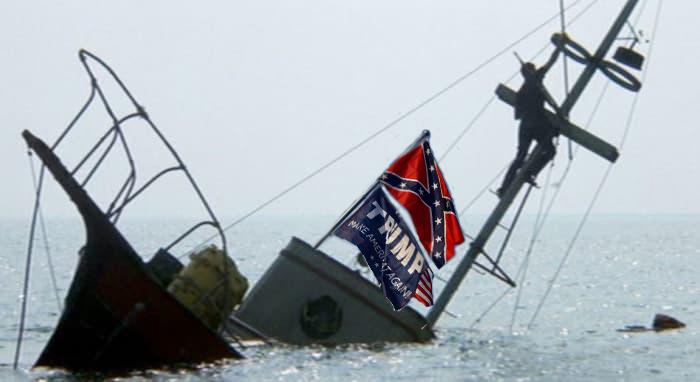
Fargo Revisited by Nancy Ohanian

A few days ago, the number of U.S. cases of COVID cross the 6.5 million mark. This coming weekend the number of deaths in America will cross the 200,000 mark. Yesterday was another horrific day of new cases in some of the states where governors robotically bought into Trump's public lies about the nature of the threat. The number in parenthesis is how many cases there are per million residents of the state.
Ron DeSantis (R-FL) +2,583 (30,484 cases per million residents)
Tate Reeves (R-MS) +517 (29,677 cases per million residents)
Doug Ducey (R-AZ) +461 (28,439 cases per million residents)
Kay Ivey (R-AL) +1,148 (27,648 cases per million residents)
Brian Kemp (R-GA) +1,836 (27,231 cases per million residents)
Bill Lee (R-TN) +1,650 (24,635 cases per million residents)
Greg Abbott (R-TX) +4,096 (23,520 cases per million residents)
Kim Reynolds (R-IA) +977 (22,908 cases per million residents)
Kevin Stitt (R-OK) +771 (16,856 cases per million residents)
Mike Parson (R-MO) +1,519 (16,230 cases per million residents)
Yesterday, writing for The Atlantic, Ed Yong suggested that The U.S. Is Trapped In A Pandemic Spiral which is "enormous because the country presented the SARS-CoV-2 coronavirus with a smorgasbord of vulnerabilities to exploit. But the toll continues to be enormous-- every day, the case count rises by around 40,000 and the death toll by around 800-- because the country has consistently thought about the pandemic in the same unproductive ways. Many Americans trusted intuition to help guide them through this disaster. They grabbed onto whatever solution was most prominent in the moment, and bounced from one (often false) hope to the next. They saw the actions that individual people were taking, and blamed and shamed their neighbors. They lapsed into magical thinking, and believed that the world would return to normal within months. Following these impulses was simpler than navigating a web of solutions, staring down broken systems, and accepting that the pandemic would rage for at least a year."
“The grand challenge now is, how can we adjust our thinking to match the problem before us?” says Lori Peek, a sociologist at the University of Colorado at Boulder who studies disasters. Here, then, are nine errors of intuition that still hamstring the U.S. pandemic response, and a glimpse at the future if they continue unchecked. The time to break free is now. Our pandemic summer is nearly over. Now come fall, the season of preparation, and winter, the season of survival. The U.S. must reset its mindset to accomplish both. Ant death spirals break only when enough workers accidentally blunder away, creating trails that lead the spiraling workers to safety. But humans don’t have to rely on luck; unlike ants, we have a capacity for introspection.

The spiral begins when people forget that controlling the pandemic means doing many things at once. The virus can spread before symptoms appear, and does so most easily through five P’s: people in prolonged, poorly ventilated, protection-free proximity. To stop that spread, this country could use measures that other nations did, to great effect: close nonessential businesses and spaces that allow crowds to congregate indoors; improve ventilation; encourage mask use; test widely to identify contagious people; trace their contacts; help them isolate themselves; and provide a social safety net so that people can protect others without sacrificing their livelihood. None of these other nations did everything, but all did enough things right—and did them simultaneously. By contrast, the U.S. engaged in …
1. A Serial Monogamy of Solutions

Stay-at-home orders dominated March. Masks were fiercely debated in April. Contact tracing took its turn in May. Ventilation is having its moment now. “It’s like we only have attention for only one thing at a time,” says Natalie Dean, a biostatistician at the University of Florida.

As often happens, people sought easy technological fixes for complex societal problems. For months, President Donald Trump touted hydroxychloroquine as a COVID-19 cure, even as rigorous studies showed that it isn’t one. In August, he switched his attention to convalescent plasma-- the liquid fraction of a COVID-19 survivor’s blood that might contain virus-blocking antibodies. There’s still no clear evidence that this century-old approach can treat COVID-19 either, despite grossly misstated claims from FDA Commissioner Stephen Hahn (for which he later apologized). More generally, drugs might save some of the very sickest patients, as dexamethasone does, or shorten a hospital stay, as remdesivir does, but they are unlikely to offer outright cures. “It’s so reassuring to think that a magic-bullet treatment is out there and if we just wait, it’ll come and things will be normal,” Dean says.

Other strategies have merit, but are wrongly dismissed for being imperfect. In July, Carl Bergstrom, an epidemiologist and a sociologist of science at the University of Washington, argued that colleges cannot reopen safely without testing all students upon entry. “The gotcha question I’ve handled most from reporters since is: This school did entry testing, so why did they get an outbreak?” he says. It’s because such testing is necessary for a safe reopening, but not sufficient. “If you do it and screw everything else up, you’ll still have a big outbreak,” Bergstrom adds.

This brief attention span is understandable. Adherents of the scientific method are trained to isolate and change one variable at a time. Academics are walled off into different disciplines that rarely connect. Journalists constantly look for new stories, shifting attention to the next great idea. These factors prime the public to view solutions in isolation, which means imperfections become conflated with uselessness. For example, many critics of masks argued that they provide only partial protection against the virus, that they often don’t fit well, or that people wear them incorrectly. But some protection is clearly better than no protection. As Dylan Morris of Princeton writes, “X won’t stop COVID on its own is not an argument against doing X.” Instead, it’s an argument for doing X along with other measures. Seat belts won’t prevent all fatal car crashes, but cars also come with airbags and crumple zones. “When we layer things, we give ourselves more wiggle room,” Dean says.

Several experts I’ve talked with have been asked: What now? The question assumes that the pandemic lingers because the U.S. simply hasn’t found the right solution yet. In fact, it lingers because the familiar solutions were never fully implemented. Despite claims from the White House, the U.S. is still not testing enough people. It still doesn’t have enough contact tracers. “We have the playbook, but I think there’s a confusion about what we’ve actually tried and what we’ve just talked about doing,” Dean says. A successful response “is never going to be one thing done perfectly. It’ll be a lot of different things done well enough.” That resilience disappears if we create…

2. False Dichotomies

A world of black and white is easier to handle than one awash with grays. But false dichotomies are dangerous. From the start, COVID-19 has been portrayed as a disease that mostly causes mild symptoms in people who quickly recover, and occasionally causes severe illness that leads to hospitalization and death. This two-sided caricature-- severe or mild, sick or recovered-- has erased the thousands of “long-haulers” who have endured months of debilitating symptoms at home with neither recognition nor care.

Meanwhile, as businesses closed and stay-at-home orders rolled out, “we presumed a trade-off between saving lives and saving the economy,” says Danielle Allen, a political scientist at Harvard. “That was foolishness of the most profound degree.” The two goals were actually aligned: Epidemiologists and economists largely agree that the economy cannot rebound while the pandemic is still raging. By treating the two as opposites, state leaders rushed to reopen, leading a barely contained virus to surge anew.

Now, as winter looms and the pandemic continues, another dichotomy has emerged: enter another awful lockdown, or let the virus run free. This choice, too, is false. Public-health measures offer a middle road, and even “lockdowns” need not be as overbearing as they were in spring. A city could close higher-risk venues like bars and nightclubs while opening lower-risk ones like retail stores. There’s a “whole control panel of dials” on offer, but “it’s hard to have that conversation when people think of a light switch,” says Lindsay Wiley, a professor of public-health law at American University. “The term lockdown has done a lot of damage.” It exacerbated the false binary between shutting down and opening up, while offering...


3. The Comfort of Theatricality

Stay-at-home orders saved lives by curtailing COVID-19’s spread, and by giving hospitals some breathing room. But the orders were also meant to buy time for the nation to ramp up its public-health defenses. Instead, the White House treated months of physical distancing as a pandemic-ending strategy in itself. “We squandered that time in terms of scaling up testing and contact tracing, enacting policies to protect workers who get infected on the job, getting protective equipment to people in food-processing plants, finding places for people to isolate, offering paid sick leave … We still don’t have those things,” says Julia Marcus, an infectious-disease epidemiologist at Harvard Medical School and regular Atlantic contributor. The country is now facing the fall with many of the same problems that plagued it through the summer.

Showiness is often mistaken for effectiveness. The coronavirus mostly spreads through air rather than contaminated surfaces, but many businesses are nonetheless trying to scrub and bleach their way toward reopening. My colleague Derek Thompson calls this hygiene theater-- dramatic moves that appear to offer safety without actually doing so. The same charge applies to temperature checks, which can’t detect the many COVID-19 patients who don’t have a fever. It also applies to the porous and inefficient travel bans that Trump and his allies still tout as policy successes. These tactics might do some good-- let’s not conflate imperfect with useless-- but they cause harm when they substitute for stronger measures. Theatricality breeds complacency. And by emphasizing solutions that can be easily seen, it exacerbated the American preference for...

4. Personal Blame Over Systemic Fixes

SARS-CoV-2 spread rapidly among America’s overstuffed prisons and understaffed nursing homes, in communities served by overstretched hospitals and underfunded public-health departments, and among Black, Latino, and Indigenous Americans who had been geographically and financially disconnected from health care by decades of racist policies. Without paid sick leave or a living wage, “essential workers” who earn a low, hourly income could not afford to quarantine themselves when they fell ill-- and especially not if that would jeopardize the jobs to which their health care is tied. “The things I do to stay safe, they don’t have that as an option,” says Whitney Robinson, a social epidemiologist at the University of North Carolina at Chapel Hill.

But tattered social safety nets are less visible than crowded bars. Pushing for universal health care is harder than shaming an unmasked stranger. Fixing systemic problems is more difficult than spewing moralism, and Americans gravitated toward the latter. News outlets illustrated pandemic articles with (often distorted) photos of beaches, even though open-air spaces offer low-risk ways for people to enjoy themselves. Marcus attributes this tendency to America’s puritanical roots, which conflate pleasure with irresponsibility, and which prize shame over support. “The shaming gets codified into bad policy,” she says. Chicago fenced off a beach, and Honolulu closed beaches, parks, and hiking trails, while leaving riskier indoor businesses open.

Moralistic thinking jeopardizes health in two ways. First, people often oppose measures that reduce an individual’s risk-- seat belts, condoms, HPV vaccines-- because such protections might promote risky behavior. During the pandemic, some experts used such reasoning to question the value of masks, while the University of Michigan’s president argued that testing students widely would offer a “false sense of security.” These paternalistic false-assurance arguments are almost always false themselves. “There’s very little evidence for overcompensation to the point where safety measures do harm,” Bergstrom says.

Second, misplaced moralism can provide cover for bad policies. Many colleges started their semester with in-person teaching and inadequate testing, and are predictably dealing with large outbreaks. UNC Chapel Hill lasted just six days before reverting to remote classes. Administrators have chastised students for behaving irresponsibly, while taking no responsibility for setting them up to fail-- a pattern that will likely continue through the fall as college clusters inevitably grow. “If you put 10,000 [students] in a small space, eating, sleeping, and socializing together, there’ll be an explosion of cases,” Robinson says. “I don’t know what [colleges] were expecting.” Perhaps they fell prey to...


5. The Normality Trap

In times of uncertainty and upheaval, “people crave a return to familiar, predictable rhythms,” says Monica Schoch-Spana, a medical anthropologist at the Johns Hopkins Center for Health Security. That pull is especially strong now because the pandemic’s toll is largely invisible. There’s nothing as dramatic as ruined buildings or lapping floodwater to hint that the world has changed. In some circles, returning to normal has been valorized as an act of defiance. That’s a reasonable stance when resisting terrorists, who seek to stoke fear, but a dangerous one when fighting a virus, which doesn’t care.

The powerful desire to re-create an old world can obscure the trade-offs necessary for surviving the new one. Keeping high-risk indoor businesses open, for example, helps the virus spread within a community, which makes reopening schools harder. “If schools are a priority, you have to put them ahead of something. What is that something?” says Bill Hanage, an epidemiologist at Harvard. “In an ideal world, they would be the last to close and the first to open, but in many communities, casinos, bars, and tattoo parlors opened before them.” A world with COVID-19 is fundamentally different from one without it, and the former simply cannot include all the trappings of the latter. Cherished summer rituals like camps and baseball games have already been lost; back-to-school traditions and Thanksgiving now hang in the balance. Change is hard to accept, which predisposes people to...

6. Magical Thinking

Back in April, Trump imagined the pandemic’s quick end: “Maybe this goes away with heat and light,” he said. From the start, he and others wondered if hot, humid weather might curb the spread of COVID-19, as it does other coronavirus diseases. Many experts countered that seasonal effects wouldn’t stop the new virus, which was already spreading in the tropics. But, fueled by shaky science and speculative stories, people widely latched on to seasonality as a possible savior, before the virus proved that it could thrive in the Arizona, Texas, and Florida summer.

This brand of magical thinking, in which some factor naturally defuses the pandemic, has become a convenient excuse for inaction. Recently, some commentators have argued that the pandemic will imminently fizzle out for two reasons. First, 20 to 50 percent of people have defensive T-cells that recognize the new coronavirus, because they were previously exposed to its milder, common-cold-causing cousins. Second, some modeling studies claim that herd immunity-- whereby the virus struggles to find new hosts, because enough people are immune-- could kick in when just 20 percent of the population has been infected.

Neither claim is implausible, but neither should be grounds for complacency. No one yet knows if the “cross-reactive” T-cells actually protect against COVID-19, and even if they do, they’re unlikely to stop people from getting infected. Herd immunity, meanwhile, is not a perfect barrier. Even if the low thresholds are correct, a fast-growing and uncontrolled outbreak will still shoot past them. Pursuing this strategy will mean that, in the winter, many parts of the U.S. may suffer what New York City endured in the spring: thousands of deaths and an untold number of lingering disabilities. That alone should be an argument against...

7. The Complacency of Inexperience

When illness is averted and lives are spared, “nothing happens and all you have is the miracle of a normal, healthy day,” says Howard Koh, a public-health professor at Harvard. “People take that for granted.” Public-health departments are chronically underfunded because the suffering they prevent is invisible. Pandemic preparations are deprioritized in the peaceful years between outbreaks. Even now, many people who have been spared the ravages of COVID-19 argue that the disease wasn’t a big deal, or associate their woes with preventive measures. But the problem is still the disease those measures prevented: The economy is still hurting, mental-health problems are growing, and educational futures have been curtailed, not because of some fearmongering overreaction, but because an uncontrolled pandemic is still afoot.

If anything, the U.S. did not react swiftly or strongly enough. Nations that had previously dealt with emerging viral epidemics, including several in East Asia and sub-Saharan Africa, were quick to take the new coronavirus seriously. By contrast, America’s lack of similar firsthand experience, combined with its sense of exceptionalism, might have contributed to its initial sloppiness. “One of my colleagues went to Rwanda in February, and as soon as he hit the airport, they asked about symptoms, checked his temperature, and took his phone number,” says Abraar Karan, an internist at Brigham and Women’s Hospital and Harvard Medical School. “In the U.S., I flew in July, and walked out of the airport, no questions asked.”

Even when the virus began spreading within the U.S., places that weren’t initially pummeled seemed to forget that viruses spread. “In April, I was seeing COVID patients in the ER every day,” Karan says. “In Texas, I had friends saying, ‘No one believes it here because we have no cases.’ In L.A., fellow physicians said, ‘Are you sure this is worse than the flu? We’re not seeing anything.’” Three months later, Texas and California saw COVID-19 all too closely. The tendency to ignore threats until they directly affect us has consigned the U.S. to...

8. A Reactive Rut

In March, Mike Ryan at the World Health Organization advised, “Be fast, have no regrets … The virus will always get you if you don’t move quickly.” The U.S. failed to heed that warning, and has repeatedly found itself several steps behind the coronavirus. That’s partly because exponential growth is counterintuitive, so “we don’t understand that things look fine until right before they’re very not fine,” says Beth Redbird, a sociologist at Northwestern. It’s also because the coronavirus spreads quickly but is slow to reveal itself: It can take a month for infections to lead to symptoms, for symptoms to warrant tests and hospitalizations, and for enough sick people to produce a noticeable spike. Pandemic data are like the light of distant stars, recording past events instead of present ones. This lag separates actions from their consequences by enough time to break our intuition for cause and effect. Policy makers end up acting only when it’s too late. Predictable surges get falsely cast as unexpected surprises.

This reactive rut also precludes long-term planning. In April, Michael Osterholm, an epidemiologist at the University of Minnesota, told me that “people haven’t understood that [the pandemic] isn’t about the next couple of weeks [but] about the next two years.” Leaders should have taken the long view then. “We should have been thinking about what it would take to ensure schools open in the fall, and prevent the long-term harms of lost children’s development,” Redbird says. Instead, we started working our way through a serial monogamy of solutions, and, like spiraling army ants, marched forward with no sense of the future beyond the next few footsteps.

These errors crop up in all disasters. But the COVID-19 pandemic has special qualities that have exacerbated them. The virus moved quickly enough to upend the status quo in a few months, deepening the allure of the hastily abandoned past. It also moved slowly enough to sweep the U.S. in a patchwork fashion, allowing as-yet-untouched communities to drop their guard. The pandemic grew huge in scope, entangling every aspect of society, and maxing out our capacity to deal with complexity. “People struggle to make rational decisions when they cannot see all the cogs,” says Njoki Mwarumba, an emergency-management professor at the University of Nebraska at Omaha. Full of fear and anxiety, people furiously searched for more information, but because the virus is so new, they instead spiraled into more confusion and uncertainty. And tragically, all of this happened during the presidency of Donald Trump.

Counting Sheep by Nancy Ohanian


Trump embodied and amplified America’s intuition death spiral. Instead of rolling out a detailed, coordinated plan to control the pandemic, he ricocheted from one overhyped cure-all to another, while relying on theatrics such as travel bans. He ignored inequities and systemic failures in favor of blaming China, the WHO, governors, Anthony Fauci, and Barack Obama. He widened the false dichotomy between lockdowns and reopening by regularly tweeting in favor of the latter. He and his allies appealed to magical thinking and steered the U.S. straight into the normality trap by frequently lying that the virus would go away, that the pandemic was ending, that new waves weren’t happening, and that rising case numbers were solely due to increased testing. They have started talking about COVID-19 in the past tense as cases surge in the Midwest.

“It’s like mass gaslighting,” says Martha Lincoln, a medical anthropologist at San Francisco State University. “We were put in a situation where better solutions were closed off but a lot of people had that fact sneak up on them. In the absence of a robust federal response, we’re all left washing our hands and hoping for the best, which makes us more susceptible to magical thinking and individual-level fixes.” And if those fixes never come, “I think people are going to harden into a fatalistic sense that we have to accept whatever the risks are to continue with our everyday lives.”

That might, indeed, be Trump’s next solution. The Washington Post reports that Trump’s new adviser-- the neuroradiologist Scott Atlas-- is pushing a strategy that lets the virus rip through the non-elderly population in a bid to reach herd immunity. This policy was folly for Sweden, which is nowhere near herd immunity, had one of the world’s highest COVID-19 death rates, and has a regretful state epidemiologist. Although the White House has denied that a formal herd-immunity policy exists, the Centers for Disease Control and Prevention recently changed its guidance to say that asymptomatic people “do not necessarily need a test” even after close contact with an infected person. This change makes no sense: People can still spread the virus before showing symptoms. By effectively recommending less testing, as Trump has specifically called for, the nation’s top public-health agency is depriving the U.S. of the data it needs to resist intuitive errors. “When there’s a refusal to take in the big picture, we are stuck,” Mwarumba says.

The pandemic is now in its ninth month. Uncertainties abound as fall and winter loom. In much of the country, colder weather will gradually pack people into indoor spaces, where the coronavirus more readily spreads. Winter also typically heralds the arrival of the flu and other respiratory viruses, and although the Southern Hemisphere enjoyed an unusually mild flu season, that’s “because of the severe precautions they were taking against COVID-19,” says Eleanor Murray, an epidemiologist at Boston University. “It’s not clear to me that our precautions will be successful enough to also prevent the flu.”

Schools are reopening, which will shape the path of the pandemic in still-uncertain ways. Universities are more predictable: Thanks to magical thinking and misplaced moralism, the U.S. already has at least 51,000 confirmed infections in more than 1,000 colleges across every state. These (underestimated) numbers will grow, because only 20 percent of colleges are doing regular testing, while almost half are not testing at all. As more are forced to stop in-person teaching, students will be sent back to their communities with COVID-19 in tow. “I expect this will blow up outbreaks in places that never had outbreaks, or in places that had outbreaks under control,” Murray says. Further spikes will likely occur after Thanksgiving and Christmas, as people who yearn to return to normal (or who think that the country overreacted) travel to see their family. Despite that risk, the CDC recently dropped its recommendation that out-of-state travelers should quarantine themselves for 14 days.

But many of the experts I spoke with thought it unlikely that “we’ll have cities going full New York,” as Bergstrom puts it. Doctors are getting better at treating the disease. States like Massachusetts, New York, and New Jersey have managed to avoid new surges over the summer, showing that local leadership can at least partly compensate for federal laxity. A new generation of cheap, rapid, paper-based tests will hit the market and make it easier to work out who is contagious. And despite the spiral of bad intuitions, many Americans are holding the line: Mask use and support for physical distancing are still high, according to Redbird, who has been tracking pandemic-related attitudes since March. “My feeling is that while things are going to get worse, I’m not sure they’ll be catastrophic, because of situational awareness,” Bill Hanage says.

Meanwhile, Trump seems to be teeing up a vaccine announcement in late October, shortly before the November 3 election. Moncef Slaoui, the scientific head of Operation Warp Speed, told NPR that it’s “extremely unlikely” a vaccine will be ready by then, and many scientists are concerned that the FDA will be pressured into approving a product that hasn’t been adequately tested, as Russia and China already have. Many Americans share this concern. A safe and effective vaccine could finally bring the pandemic under control, but its arrival will also test America’s ability to resist the intuitive errors that have trapped it so far. Vaccination has long been portrayed as the ultimate biomedical silver bullet, separating an era when masks and social distancing mattered from a world where normality has returned. This is yet another false dichotomy. “Everyone’s imagining this moment when all of a sudden, it’s all over, and they can go on vacation,” Natalie Dean says. “But the reality is going to be messier.”

This problem is not unique to COVID-19. It’s more compelling to hope that drug-resistant bacteria can be beaten with viruses than to stem the overuse of antibiotics, to hack the climate than to curb greenhouse-gas emissions, or to invest in a doomed oceanic plastic-catcher than to reduce the production of waste. Throughout its entire history, and more than any other nation, the U.S. has espoused “an almost blind faith in the power of technology as panacea,” writes the historian David Segal. Instead of solving social problems, the U.S. uses techno-fixes to bypass them, plastering the wounds instead of removing the source of injury-- and that’s if people even accept the solution on offer.

A third of Americans already say they would refuse a vaccine, whether because of existing anti-vaccine attitudes or more reasonable concerns about a rushed development process. Those who get the shot are unlikely to be fully protected; the FDA is prepared to approve a vaccine that’s at least 50 percent effective-- a level comparable to current flu shots. An imperfect vaccine will still be useful. The risk is that the government goes all-in on this one theatrical countermeasure, without addressing the systemic problems that made the U.S. so vulnerable, or investing in the testing and tracing strategies that will still be necessary. “We’re still going to need those other things,” Dean says.

Between these reasons and the time needed for manufacturing and distribution, the pandemic is likely to drag on for months after a vaccine is approved. Already, the event is exacting a psychological toll that’s unlike the trauma of a hurricane or fire. “It’s not the type of disaster that Americans specifically are used to dealing with,” says Samantha Montano of Massachusetts Maritime Academy, who studies disasters. “Famines and complex humanitarian crises are closer approximations.” Health experts are burning out. Long-haulers are struggling to find treatments or support. But many Americans are turning away from the pandemic. “People have stopped watching news about it as much, or talking to friends about it,” Redbird says. “I think we’re all exhausted.” Optimistically, this might mean that people are becoming less anxious and more resilient. More worryingly, it could also mean they are becoming inured to tragedy.

The most accurate model to date predicts that the U.S. will head into November with 220,000 confirmed deaths. More than 1,000 health-care workers have died. One in every 1,125 Black Americans has died, along with similarly disproportionate numbers of Indigenous people, Pacific Islanders, and Latinos. And yet, a recent poll found that 57 percent of Republican voters and 33 percent of independents think the number of deaths is acceptable. “In order for us to mobilize around a social problem, we all have to agree that it’s a problem,” Lori Peek says. “It’s shocking that we haven’t, because you really would have thought that with a pandemic it would be easy.” This is the final and perhaps most costly intuitive error...

9. The Habituation of Horror

The U.S. might stop treating the pandemic as the emergency that it is. Daily tragedy might become ambient noise. The desire for normality might render the unthinkable normal. Like poverty and racism, school shootings and police brutality, mass incarceration and sexual harassment, widespread extinctions and changing climate, COVID-19 might become yet another unacceptable thing that America comes to accept.


Labels: ,

Monday, September 07, 2020

We All Have All The Information We Need To Decide Who To Not Vote For In November

>


In a "sermon" a couple of years ago, God Has Nothing to Do With Trump Being President, John Pavlovitz reached out directly to evangelicals to remind them that spiritualizing the Trump presidency is "sinful, blasphemous, lousy evangelism and just plain asinine. The hypocrisy on display is historic: after spending the past 8 years straining to find infinitesimal specks in Barack Obama’s eye that they could condemn as deal breakers-- Evangelicals are now perfectly fine with Trump’s rotted forest of Redwoods. In fact, in the most dizzying display of theological spin doctoring, it is now precisely his ever-growing trail of personal toxic discharge that supposedly proves evidence of God’s hand in it all. So Trump’s multiple marriages, his porn star affairs, his mountain of sexual assault claims, his verbal obscenities, his disregard for rule of law, his compulsive lying, his clear racism, his unrelenting attacks on marginalized communities (things these Christians would have figuratively and almost literally crucified Obama for) are now unmistakable signs that God is using this President. This is nonsense of Biblical proportions; to try and draw some line between Jesus of Nazareth and Donald of New York, is about as farcical as you can get without actually spontaneously combusting from the cognitive dissonance... We really should stop pretending God is responsible for this fast food dumpster fire, when it’s clear whose hand is in it all. This reality is the rotten fruit of misogyny, racism, Nationalism, fear, xenophobia, and bigotry-- all released by people who want God to consent to it all so they don’t have to deal with their own culpability or face their own repentance."

Fast forward to... tomorrow. Michael Cohen's book will be officially out and available... a longer and more detailed and less religiously-oriented version of Pavlovitz's 2018 sermon: Disloyal: A Memoir. I have a feeling this may be the most talked about-- if not read-- book out of the dozens of Trump exposés by people once close to him that have come out in the last 4 years. Cohen makes the case that Trump is a criminal, a mentally ill sex psycho and an obsessed racist.

Washington Post reporters Ashley Parker and Rosalind Helderman got their hands on an advance copy and wrote up a preview over the weekend, noting that Cohen "Trump’s longtime lawyer and personal fixer... alleges in a new book that Trump made 'overt and covert attempts to get Russia to interfere in the 2016 election.' ... Cohen lays out an alarming portrait of the constellation of characters orbiting around Trump, likening the arrangement to the mafia and calling himself 'one of Trump’s bad guys.' He describes the president, meanwhile, as 'a cheat, a liar, a fraud, a bully, a racist, a predator, a con man.' The memoir also describes episodes of Trump’s alleged racism and his 'hatred and contempt' of his predecessor, Barack Obama, the nation’s only African American president." I hate the way Parker and Helderman use the world "alleged" to describe characteristics that have been proven beyond any reasonable double over and over and over for decades and decades and decades.
On Russia, Cohen writes that the cause behind Trump’s admiration of Russian President Vladimir Putin is simpler than many of his critics assume. Above all, he writes, Trump loves money-- and he wrongly identified Putin as “the richest man in the world by a multiple.”

Trump loved Putin, Cohen wrote, because the Russian leader had the ability “to take over an entire nation and run it like it was his personal company-- like the Trump Organization, in fact.”

Cohen also reveals new alleged details about the convoluted effort behind a National Enquirer report smearing Sen. Ted Cruz (R-TX). Cohen says that Trump signed off on the baseless report to damage Cruz, one of his rivals in the 2016 Republican primary.

“It’s not real, right?” Trump allegedly asked after being shown a photograph, which the magazine would claim depicted Cruz’s father with Lee Harvey Oswald shortly before Oswald killed President John F. Kennedy in 1963.

“Looks real to me!” Cohen responded, according to the book, prompting Trump to laugh as he demanded that the story be run on the tabloid’s front page.


“To say it would be a low blow would be an insult to low blows; can you think of another politician, ever, who would stoop this low?” Cohen writes.

...According to Cohen, Trump’s sycophantic praise of the Russian leader during the 2016 campaign began as a way to suck up and ensure access to the oligarch’s money after he lost the election. But he claims Trump came to understand that Putin’s hatred of Democratic nominee Hillary Clinton, dating to her support for the 2011 protest movement in Russia, could also help Trump amass more power in the United States.

“What appeared to be collusion was really a confluence of shared interests in harming Hillary Clinton in any way possible, up to and including interfering in the American election-- a subject that caused Trump precisely zero unease,” Cohen writes.

Cohen’s book, however, does not reveal much in the way of new details surrounding the investigations by former special counsel Robert S. Mueller III and others into Russian interference in the 2016 election.

...Cohen asserts that another reason that Trump consistently praised Putin was to fulfill his long-held desire to slap his name on a proposed Trump Tower project in Moscow.

Cohen says the Trump Tower plans called for a 120-story building in Red Square, including 30 floors devoted to a five-star hotel with an Ivanka Trump-branded spa and Trump restaurants, and 230 high-end condominiums for Russian oligarchs and leaders.

The plan, Cohen adds, was to give the penthouse apartment to the Russian president for free, in part “as a way to suck up to Putin.”

“The whole idea of patriotism and treason became irrelevant in his mind,” Cohen writes. “Trump was using the campaign to make money for himself: of course he was.”

Trump would later publicly insist that he had no business dealings with Russia. But Cohen writes extensively of his own efforts beginning in the fall of 2015-- several months after Trump had declared his candidacy-- to make the Moscow project a reality.

The project fell to Cohen, he writes, because Trump’s children all disliked Felix Sater, the colorful Russian American developer who served as the Trump Organization’s liaison with Russians interested in the project.


Nevertheless, Cohen says the whole family was aware of the project, even as candidate Trump publicly said he had no ties to Russia. Ivanka Trump, the president’s daughter, who is now a senior White House adviser, even selected the proposed tower’s high-end finishes, Cohen writes.

Ivanka and her lawyers have previously described her involvement in the Russia project as minimal, noting that she never visited the prospective site.

Cohen also describes in detail the partnership between Trump and David Pecker, the chief executive of National Enquirer parent company American Media and a longtime Trump friend, which included Pecker allegedly sharing the Cruz attack with Trump ahead of publication.

While many of Trump’s critics would obsess over the possibility of Russian interference, Cohen writes, it was a purposeful “disinformation campaign” run by American citizens such as Pecker that was “by far the more insidious and dangerous development of the last cycle-- and the most threatening for 2020.”

Cohen notes that the grocery-store tabloid targeted each of Trump’s 2016 primary opponents in turn. He includes a document in the book, for instance, purporting to lay out the magazine’s plan to take down Sen. Marco Rubio (R-FL). [I hope it was all about Rubio's period as a gay prostitute.]

The National Enquirer came through for Trump again later in 2016, agreeing to pay former Playboy playmate Karen McDougal, who claimed she had an affair with Trump, for her life story and then never running the story. Trump agreed to repay Pecker for the $150,000 fee but never did, Cohen writes.

In the case of Daniels, Cohen writes that after Trump agreed to pay her $130,000 for her silence, he strategized with Trump Organization Chief Financial Officer Allen Weisselberg on how she could be paid without attracting notice.

Weisselberg suggested finding a Trump friend to put up the money, in the guise of paying for a membership to a Trump golf course or the club Mar-a-Lago, according to the book. When Cohen countered that perhaps Weisselberg should lay out the money himself, “Weisselberg went white as a sheet-- like he’d seen a ghost,” he writes.

Ultimately, Cohen made the hush payment himself, taking out a personal home equity loan to come up with the cash, all the while assuming Trump would probably fail to repay him as agreed.

“Stuck with the tab for Trump’s sex romp in a hotel room in Utah a decade ago,” Cohen writes. “This was the job I loved?”

Ultimately, however, Trump did repay Cohen-- agreeing to reimburse him in $35,000 monthly installments after he had entered the White House as president, hiding the payments as fees for legal services and naming Cohen his personal attorney. Cohen asserts that Trump would get a tax break and legal services along with the money-- meaning he would actually come out financially ahead for paying off the adult-film star.

The Trump Organization did not immediately respond for comment Saturday.

In 2018, Cohen pleaded guilty to lying to Congress about the Trump Moscow project, as well as to violating campaign finance laws by paying Daniels to remain silent. Cohen told the court that he had been directed to make the payment to Daniels-- and later reimbursed for the money-- by Trump. He also pleaded guilty to tax evasion and lying to a financial institution, crimes that were unrelated to his work for Trump.

He was sentenced to three years in prison, which he had been serving at a federal facility in Otisville, N.Y., until he was allowed to leave prison and serve his sentence at home because of the coronavirus pandemic. Before he entered prison, he delivered dramatic public testimony to Congress, in which he apologized for his past lies and called Trump a “racist,” “a con man” and “a cheat.” Republicans mocked his self-professed turn to honesty, noting that he had previously defended Trump with similar gusto.

Beyond Russia’s role in the 2016 elections and the Daniels payment, Cohen seeds the rest of his book with snippets of gossip from his time in Trump’s orbit-- some of it new, some of it well-known and much of it familiar.

He describes Trump insulting and dismissing some of his children, including Donald Trump Jr., his eldest son, and Tiffany, his youngest daughter.


Cohen writes that during the 2016 campaign, Trump was dismissive of minorities, describing them as “not my people.” “I will never get the Hispanic vote,” Cohen recounts Trump claiming. “Like the blacks, they’re too stupid to vote for Trump.”

Cohen describes Trump’s obsessive hatred of Obama, including claiming that the only reason the former president got into Columbia University and Harvard Law School was because of “fucking affirmative action.” He also recounts Trump’s “low opinion of all black folks.” claiming that Trump once said while ranting about Obama, “Tell me one country run by a black person that isn’t a shithole. They are all complete fucking toilets.”

After South African President Nelson Mandela died in 2013, Trump said he did not think Mandela “was a real leader-- not the kind he respected,” Cohen writes.

Instead, Cohen writes that Trump praised the country’s apartheid-era White rule, saying: “Mandela fucked the whole country up. Now it’s a shithole. Fuck Mandela. He was no leader.”

Cohen writes that before winning the presidency, Trump held a meeting at Trump Tower with prominent evangelical leaders, where they laid their hands on him in prayer. Afterward, Trump allegedly said: “Can you believe that bullshit? Can you believe people believe that bullshit?”


“The cosmic joke was that Trump convinced a vast swathe of working-class white folks in the Midwest that he cared about their well-being,” Cohen writes. “The truth was that he couldn’t care less.”

Cohen also depicts Trump as being crude toward women, including inadvertently commenting on Cohen’s then-15-year-old daughter as she finished up a tennis lesson: “Look at that piece of ass,” Trump said, according to Cohen. “I would love some of that.”

Cohen details a tawdry 2013 visit to a Las Vegas club, the Act, with Trump and Aras and Emin Agalarov-- a Russian father-and-son oligarch duo. Cohen asserts that the group watched a debauched strip show that included one performer who simulated urinating on another performer, who pretended to drink it.

Trump’s reaction to the show, Cohen writes, was “disbelief and delight.”

Cohen’s book ends with something of a plea-- though one that requires the reader to trust Cohen’s account of his time in the Trump orbit.

“You now have all the information you need to decide for yourself in November,” Cohen concludes.


Labels: , , , , , , ,

Sunday, September 06, 2020

Trump Campaign Faces Reality And Gives Up On Arizona

>

2020's kiss of death in Arizona

Arizona has been a deep red state for a long time. The only statewide Democrat-- Kyrsten Simena, elected in 2018-- isn't a Democrat by any other standard except that she has a "D" next to her name. By any metric, she's the worst Democrat in the Senate, with a more Republican voting record than Doug Jones (AL) and Joe Manchin (WV), who represent far redder states. But Arizona is plenty red. Aside from the governor, Doug Ducey, being a full-bore Trumpist, the GOP controls both Houses of the state legislature. In presidential elections, Arizona was a strongly Democratic state when it was clear that the Democratic Party stood for the working class. Roosevelt won all 4 times he ran, Alf Landon scoring just 26.9% against him in 1936. Arizona stuck with the Democrats in 1948 (Truman) and then flipped entirely, especially after the Democrats tried enlarging their tent so much that they became unable to define themselves in a way that appealed to the working class. Eisenhower, Nixon Goldwater, Ford, Reagan, both Bushs (both times), McCain, Romney and Trump all won. The only Republican to lose was Dole in 1996 when Ross Perot drew 8% of the vote and Bill Clinton won with 46.5% against Dole's 44.3%.

Trump's win in 2016 was 1,252,401 (48.1%) 1,161,167 to (44.6%), a little wobbly, but he won 11 of the state's 15 counties, including massive Maricopa County, where Trump took 49.1% of the vote to Hillary's 45.7%. This cycle, everyone agrees that Arizona is a top swing state. The Real Clear Politics polling average-- which includes fake Republican polls from GOP operation Trafalgar Group-- shows Biden ahead by 5 points. The most recent Arizona poll show Biden at 49% and Trump at 39% among registered voters (including leaners).

The Fox poll indicates why Arizonans are giving up on Trump. The issue he does worst on against Biden is one very much on the mind of Arizonans: the pandemic. When asked who would do a better job on the coronavirus only 36% of Arizona voters pick Trump. High-growth Arizona is the 14th most populated state, but has the 7th most cases of COVID-19. Yesterday, Arizona reported 835 new cases, bringing the state total to 205,516, or 28,235 cases per million Arizonans. How bad is that? Louisiana, Florida and Mississippi are worse, but every other state has done better. Why? Trump, Ducey and the Republican controlled legislature made it clear from the beginning they will deal with the pandemic through extreme right ideology rather than through science of public health. As a result 5,207 Arizonans are dead so far-- the 8th worst COVID death rate in the country... and rising far more rapidly than 5 of the states above it.


How are the Republicans confronting this threat to 11 crucial electoral votes that Trump cannot afford to lose? On Friday, Jim Small, writing for the Arizona Mirror, reported that the Trump campaign is going off the airwaves the day after tomorrow and may not resume television advertising until early voting begins in early October. Trump had already stopped advertising in the blue-leaning Tucson area two weeks ago! Now he's going dark in the rest of the state as well.
On Thursday, records filed with the Federal Communications Commission by Phoenix-area television stations showed that the Trump campaign cancelled all of its ads between Sept. 8 and Sept. 14. The air time totaled approximately $580,000 in the Phoenix media market, which includes most of the state except for the areas surrounding Tucson and Yuma.

A campaign spokeswoman confirmed Trump was suddenly going dark in a state where he has consistently trailed Democratic challenger Joe Biden in the polls-- a state that has only voted for a Democratic presidential candidate once since 1948.

“With a permanent presence in the state since 2016, Arizonans have heard from the Trump campaign for years and know about the wins President Trump’s America First agenda has delivered for them in just one term,” said Samantha Zager.

A Trump campaign source who was not authorized to speak on the record said that the campaign’s advertising strategy is following the early voting map. Because Arizona early voting doesn’t begin until Oct. 7, the source indicated advertising here was being halted.
This is bad enough for Trump, but it is also a disaster for the GOP incumbent, Martha McSally, who has attached herself to him at the hip. McSally's reelect numbers are worse than Trump's and she doesn't have the resources her Democratic opponent Mark Kelly does. Kelly has spent $24,516,845 to McSally's $19,947,472 after having raised $45,735,788 to her $30,018,096. He has around double what she does to spend between now and election day. McConnell and his allies have spent around $7 million trying to help McSally but Schumer and his allies have spent around $10 million on behalf of Kelly. That same Fox News poll that shows Biden leading Trump 49-39%, has Kelly up over McSally 56-39%, a seemingly insurmountable lead that has continued to grow,

Most observers see McSally as a dead man walking. The same may well be true of the Republican majorities in the state legislature. Democrats need just two seats in the House and three seats in the Senate to flip the state legislature entirely. Democrats have 4 state Senate candidates and 6 state House candidates-- including popular Flagstaff mayor Coral Evans-- with reasonable chances to flip their districts from red to blue. Coconino County supervisor Art Babbott is also seeking a state House seat, running as an independent.


Labels: , , , ,

Saturday, August 29, 2020

Trump's Wrong Decisions Are Bringing On A Depression

>


Trump claims he inherited a lousy economy from Obama and made it the best economy in the world. That's a double lie-- Trump inherited a very decent economy from Obama and it kept improving until Trump tried skewering it further for the rich at the expense of the working poor-- and by the time Trump made every wrong decision about confronting the pandemic, a recession was baked into the cake. Will voters understand this? Probably enough of them will.

I guess you know there are two economies right now-- one for the labor force that's in a deep recession, likely a depression, and one the management class and people living on passive income-- wealthier people-- that just keeps growing, thanks to the Fed pumping money into the financial markets and to their unlimited ability to print money. Yesterday Wall Street soared again-- up xx points. No one ever mentions that only 5 stocks on the S&P 500 are doing all the work and the other 495 stocks are all down by an average of 3%. (Pam and Russ Martens at Wall Street on Parade added another unsettling aspect yesterday: An Unprecedented 1,640 CEOs Departed in 2019; Now Execs Are Dumping Stock at Highest Pace Since 2006. "The number of CEOs that did not leave on their own accord last year was 101 out of the 1,640," they reported. "According to the study, 15 CEOs left over allegations of professional misconduct; 20 left amid a scandal, 'typically under investigations for financial wrongdoing or other legal issues'; 24 saw their positions terminated; 39 left due to a merger or acquisition; 3 left due to bankruptcy... When an outsized number of CEOs decide to cash out their stock options, grab their golden parachutes, and flee their corner offices-- something smells. On top of that fishy smell comes a report from TrimTabs Investment Research that corporate insiders have reaped more than $50 billion in stock sales since May, putting insider selling on a pace not seen since 2006-- two years before the stock market and economic crash of 2008.)

A blunter instrument for measuring the economy are unemployment and eviction statistics, Yesterday the Department of Labor reported that another million American workers filed for first-time unemployment benefits last week. There are now around 27 million Americans getting some kind of jobless assistance. With the GOP blocking the $600 supplemental claim for unemployed workers, the economy is going to soon start feeling billions dollars light-- unless more workers are forced back into COVID-unsafe jobs, which is exactly what the GOP is hoping for by denying the benefits.


The Aspen Institute reported earlier in the month on the COVID-19 Eviction Crisis, which has between 30 and 40 million American renters at risk of eviction. A team of reporters wrote that the U.S. "may be facing the most severe housing crisis in its history. According to the latest analysis of weekly US Census data, as federal, state, and local protections and resources expire and in the absence of robust and swift intervention, an estimated 30–40 million people in America could be at risk of eviction in the next several months. Many property owners, who lack the credit or financial ability to cover rental payment arrears, will struggle to pay their mortgages and property taxes and maintain properties. The COVID-19 housing crisis has sharply increased the risk of foreclosure and bankruptcy, especially among small property owners; long-term harm to renter families and individuals; disruption of the affordable housing market; and destabilization of communities across the United States."


This chart shows eviction risk by state. Risks are lowest in Vermont and highest in states filled with morons who keep voting for politicians who bring them hardships, fools living in deep red Mississippi, Louisiana, South Carolina, Oklahoma and Tennessee.
Significant loss of rental income during the COVID-19 pandemic creates financial peril and hardship for renters, small property owners, and communities. Without rental income, many landlords may struggle to pay mortgages and risk foreclosure and bankruptcy. The National Consumer Law Center predicts that 3 million homeowners, or roughly 5%, will have significantly delinquent mortgages by early 2021. Currently, 44% of single-family rentals have a mortgage or some similar debt. Sixty-five percent of properties with 2 to 4 units and 61% of properties with 5 to 19 units have a mortgage. Foreclosure can lead to a lack of maintenance, urban blight, reduced property values for neighboring properties, and erosion of neighborhood safety and stability. Without rental income to pay property tax, communities lose resources for public services, city and state governments, schools, and infrastructure, and can expend significant resources managing or disposing of properties acquired through tax foreclosure.

The impact of an eviction on families and individuals is even greater. Following eviction, a person’s likelihood of experiencing homelessness increases, mental and physical health are diminished, and the probability of obtaining employment declines. Eviction is linked to numerous poor health outcomes, including depression, suicide, and anxiety, among others. Eviction is also linked with respiratory disease, which could increase the risk of complications if COVID-19 is contracted, as well as mortality risk during COVID-19. Eviction makes it more expensive and more difficult for tenants who have been evicted to rent safe and decent housing, apply for credit, borrow money, or purchase a home. Instability, like eviction, is particularly damaging to children, who suffer in ways that impact their educational development and well-being for years.

The public costs of eviction are far-reaching. Individuals experiencing displacement due to eviction are more likely to need emergency shelter and re-housing, use in-patient and emergency medical services, require child welfare services, and experience the criminal legal system, among other harms.

The eviction crisis and its devastating outcomes are entirely preventable. Policy interventions at the national, state, and local levels could avoid many of the devastating costs outlined above... [W]ithout federal financial assistance, any intervention will be a stopgap at best and may fail to prevent the eviction crisis and its collateral harm.

The most comprehensive policy proposals include a nationwide moratorium on evictions and at least $100 billion in emergency rental assistance. Combining this assistance with an extension of federally enhanced unemployment insurance for displaced workers would provide additional relief for renters. Responses like these could neutralize the eviction risk outlined in this report, eliminating the public and private costs of mass evictions that result from the pandemic. More importantly, they could prevent millions of people in America from experiencing unfathomable hardship in the months and years ahead. These solutions have passed the US House of Representatives two times, and have companion legislation in the Senate.

Similarly, studies have shown a civil right to counsel in eviction cases can deliver significant benefits for tenants and landlords. While exact figures vary by jurisdiction, tenants with counsel experience improved housing stability-- often by remaining in their home, but alternatively by obtaining additional time to relocate, avoiding a formal eviction on their record, and accessing emergency rental assistance or subsidized housing.  Representation also leads to lower default rates and more fairly negotiated resolutions with landlords that limit disruption from displacement and ensure the rights of all parties are exercised. Other policies, such as eviction record sealing and restrictions that preclude property owners from basing tenant eligibility on eviction records, can prevent the longer-term harm that comes from eviction.

Given the incredibly high cost of evictions to renters, landlords, and communities, a wide range of policy interventions would provide significant cost avoidance for state and local government across the US.


Writing for Bloomberg News yesterday, Noah Buhayar, asked half a dozen key questions about evictions and attempted to answer them as the country hurtles towards an eviction crisis of historic proportions.

1- How many people could face eviction?

He comes up with 30 million, citing that same Aspen report but acknowledges it could be more like 40 million. Absent significant federal help that the GOP is absolutely unwilling to provide, the country "is heading for a massive wave of housing displacement and insecurity. More people will double up with family or end up homeless."

2. Will this all happen at once?

He doesn't think so and wrote that "It may take a few months for evictions to ramp up... The federal moratorium expired on July 24, and landlords had 30 days to notify tenants if they wanted to evict them, meaning Aug. 24 was the earliest date at which the floodgates could open. As of the end of July, 30 states lacked state-level protections against eviction during the pandemic. But even in states where there are bans, they do little to clear people’s debts. Many now owe so much in back rent that they won’t be able to catch up, pushing landlords to evict them when restrictions lift.

3. What's bring done to avert this?

Trump's lame and pointless attempt to show he cares earlier this month "didn’t authorize any specific action. Real relief would have to come from Congress, and that means money-- lots of it. House Democrats have passed a plan that would provide $100 billion in rental assistance and ban evictions" but Republicans are eager to show the working class they are the party of cruelty and refuse to be anything at all.

4- Why would a landlord evict someone at a time of high unemployment?

"Landlords," he reminded his readers, "need to collect rent to cover their expenses, including mortgage payments and property taxes. Many also pay for utilities. Keeping non-paying tenants around can incur operating costs without generating any revenue. Property owners also worry that letting a renter live in a unit for free or reduced rent could encourage other tenants in a building to withhold some of their payments. Landlords may also be betting that they can fill empty units. Going into the pandemic, there was a severe shortage of affordable rental housing across the U.S. that was driving up rents faster than incomes. Vacancy rates were at decades-long lows.

5- Who gets hurt?

As usual, Blacks and Latinos much more than white people.

6- Is this a U.S.-only problem?

It isn't but most governments are handling it much better than Trump. Big surprise!

An aside: according to Nielsen's ratings, 14.1 million people watched Trump's lies-filled screed Thursday night, quite a few less than the 17.5 million who had watched Biden's the week before. Trump's 3 biggest markets were West Palm Beach, Memphis and Nashville. Biden's had been New York City, San Francisco and West Palm. (More people watched Biden than Trump in West Palm.)
Wrapped In His Flag And Carrying A Cross... by Nancy Ohanian

Labels: , , ,

Sunday, August 16, 2020

Midnight Meme Of The Day!

>


by Noah

Sunday Thoughts:
From golden showers in a sex club in Vegas, to tax fraud, to deals with corrupt officials from the former Soviet Union, to catch and kill conspiracies to silence Trump's clandestine lovers, I wasn't just a witness to the president's rise, I was an active and eager participant.
I'll assume that all of you have read the complete foreward to Disloyal, the upcoming book from former Trump attorney/fixer Michael Cohen from which the above quote comes. I can't wait to see who gets the movie rights to the book. Just the forward itself would make for a fine, very fine, trailer!

Since Trump's Christonut supporters back their mental case no matter what, I will also assume that they will not only shrug as always but continue to embrace him right down to his attitudes towards people, our country, and the world. They applaud and endorse everything he does so I can't wait to see them all wearing their Trump Golden Showers hats. Far be it for me to be judgmental, but would it surprise you if they've been to that same Vegas sex club? Maybe the unzipped Jerry Falwell, Jr. and his unzipped gal pal go there too? How long before Golden Showers are their #1 Christian blessed sacrament?


Labels: , , ,