Saturday, November 14, 2020

Will McConnell Have to Die Before Biden Is Going To Be Able To Govern?

>


The Washington Post headline of Mike DeBonis' story this morning reads Biden’s agenda may rest on centrist Republicans-- and the return of a bygone Senate era, but maybe a shorter version would be more accurate: "Biden's centrist agenda may rest on centrists."

When I was growing up, my grandfather, a Russian socialist who had been converted by FDR and was, by the '50s, getting very fed up with the Democratic Party, pointed out to me that though Congress was "controlled" by the Democrats, real power was in the hands of a trans-partisan coalition of anti-progressive reactionaries (many of whom were virulent southern Democratic racists who hadn't yet migrated to their new political home).

DeBonis' piece looks forward to another era of centrism in Congress with just such a coalition-- albeit without the racists and, he wrote, "if anyone can manage it, senators and operatives from both parties say, it’s Biden-- who spent 36 years in the Senate and will enter the White House as the most accomplished legislator to hold the presidency since at least Lyndon B. Johnson." Unless you're on an empty stomach, don't examine what Biden accomplished while he was in the Senate from 1973 to 2008. It ain't pretty.

Goal ThermometerUnless the Democrats Jon Ossoff and Raphael Warnock win both Georgia Senate seats-- almost unimaginable-- Team Biden will be sharing power with Mitch "Grim Reaper" McConnell. "At stake," wrote DeBonis, "is not only Biden’s policy agenda but the process of filling his Cabinet and other agency posts, as well as the increasingly partisan business of judicial nominations. How Biden navigates the political currents of the Senate could determine such essential matters as the federal government’s fiscal outlook or filling a possible Supreme Court vacancy."

If you want to contribute to Warnock and/or Ossoff, you can do so by clicking on the Senate thermometer on the right.
The scenarios tend to have Biden wooing a small number of Republicans with a reputation for bipartisanship-- centered on Sens. Susan Collins of Maine and Lisa Murkowski of Alaska-- as he seeks to build a governing coalition in a closely divided Congress. Both Republicans offered encouraging words in the days following Biden’s victory.

“Joe Biden knows exactly how to deal with this body. He’s worked within it. He has done some strong and important bipartisan deals with no less than Mitch McConnell,” Murkowski said in an interview Thursday. “If you truly have a view that what we’re going to try to do is be constructive rather than just throw grenades at one another, you can build anything.”

Biden phoned Collins-- who handily won her own reelection race despite tens of millions of dollars of Democratic spending-- shortly after Election Day, and she hailed her “very good relationship” with the president-elect in comments to reporters this week.

“As I would of any president, I want him to be successful,” she said Tuesday.

Weighing against the happy talk is recent history in the Senate, where groups of moderate senators have joined over the past decade to try to solve intractable issues such as illegal immigration, gun violence and a spiraling national debt with scant success.

A group that met in Collins’s office amid a government shutdown in early 2018, for instance, tried to forge a path to an immigration deal that never materialized. Bipartisan talks on modest gun control measures led by Sen. Joe Manchin III (D-WV) and Sen. Patrick J. Toomey (R-PA) have gone nowhere. Compromises struck by bipartisan “gangs” to preserve the rights of Senate minorities have been obliterated.

To many Democrats-- who vividly remember McConnell’s efforts to block President Barack Obama’s legislative priorities as both minority and majority leader-- there is simply no hope of progress as long as he sets the Senate agenda.

“We saw that horror film play out in the Obama years, and we don’t want to see it again,” Sen. Jeff Merkley (D-OR) said. “Unless there’s a group secretly meeting within the Republican caucus that says, ‘We really want to see the Senate work as a legislative body again,’ then my hopes are dim if Leader McConnell’s in charge.”

Ronald A. Klain, Biden’s choice for White House chief of staff, said in an MSNBC interview Thursday that Biden had yet to speak to McConnell post-election but noted the two men have known each other for decades, with a track record of cutting deals.

Klain expressed measured optimism that they “will have a working relationship when the time comes,” even though McConnell has yet to publicly acknowledge Biden’s win a week after the Associated Press and multiple news organizations called the race for him.

“They obviously need no introduction to one another,” he said, adding that Biden would “use all the tools that he has, his prodigious tools of persuasion, his ability to reach out to people on all aspects of our party and in both parties, to rally the voters and to do everything he can to move this country forward.”
I wonder how soon Biden will acquiesce to the GOP killing off what's left of the New Deal for some flashy temporary gains. And how loudly Schumer, Pelosi and Hoyer will cheer.

On the other hand, maybe the system is so broken that Biden-- pretty broken himself at 77 (78 in 6 days)-- won't make any headway with McConnell at all. As DeBonis noted "the power of personal relationships has drastically receded in the 11 years since Biden left the Senate, and his former colleagues warn that he will be battling fierce institutional obstacles. Former senator Kent Conrad (D-ND), who served 22 years with Biden, said the days of bottom-up lawmaking driven by committees and bipartisan coalitions of senators are 'largely gone. The ability of the majority leader to set the agenda is incredibly important. It gives him extraordinary leverage. And that, more than anything else, probably will dictate what the Biden legislative agenda is going to be,' Conrad said."

Democrats hope that by winning both Georgia Senate seats-- a steep climb, to put it mildly-- 50-50 tie votes will be broken by Kamala. But that assumes that virulent anti-progressives who frequently cross the aisle, like Joe Manchin (WV), Kyrsten Sinema (AZ), Angus King (I-ME), and Mark Warner (VA) will vote with the Democrats. And then there are the two right-wing Democratic freshmen, Frackenlooper (CO) and Mark Kelly (AZ). Good luck with that crew. Sinema, for example, voted with the GOP against progressive roll calls 55% of the time since being elected. And when she was in the House, she was the most GOP-voting Blue Dog in Congress, absolutely revelling in her role as an asshole.
Should Biden become the first president since George H.W. Bush to enter office without the Senate under his party’s control, the mere task of confirming a Cabinet threatens to become a partisan minefield, handing Republicans effective veto power over his administration’s staffing.

A clutch of GOP senators already signaled that they are likely to vote to confirm Biden’s nominees, but under certain conditions. Collins said she would have reservations if a nominee is “not qualified or is way outside the ideological mainstream or is unethical,” while Sen. Mitt Romney (R-UT)-- who has shown a willingness to cross party lines on some issues-- said he would confirm Biden’s nominees “barring some extreme individual or someone not qualified for the job.”

While McConnell might be unlikely to orchestrate a blockade of Biden’s Cabinet nominees, he is also unlikely to countenance any legislative deals the new president may seek to strike with two or three members of his conference. With a 60-vote threshold for major legislation all but certain to remain in place, any legislative negotiation will have to include a larger group of Republicans.

In one vivid illustration of his aversion to legislation that divides his ranks, McConnell refused for months to schedule a vote on a bipartisan criminal justice reform bill until Trump publicly pushed him. It ultimately passed 87 to 12.

Josh Huder, a congressional scholar and senior fellow with Georgetown University’s Government Affairs Institute, said it “seems improbable at best” that governing from the center would succeed in a hyperpartisan era.

“In the last decade and a half of divided control of Congress, we’ve seen historic gridlock-- the kind of stalemate where you can’t pass a budget or appropriations bills, much less touch on some of the most high-profile, high-stakes political battles that we have,” he said.

Even those senators most likely to cooperate with Democrats are warning their cooperation will only go so far. Murkowski, who is up for reelection in 2022 and whose state depends on oil and gas jobs, warned, “If there are issues that work against my state’s economy, we’re going to fight them tooth and nail”-- a dismal indicator for climate-change legislation.

Romney said Biden would be “making a mistake to think that the people of America chose a left-oriented policy agenda” given the mixed election results. “The country remains a center-right nation, and I will continue to fight for conservative principles that I think comport with not only my philosophy but that of the nation as a whole,” he said.

Labels: , , , ,

Monday, October 12, 2020

If McConnell Thwarts Trump's Plans For A Pandemic Relief Package, Trump Can Thwart McConnell's Reelection Plans

>


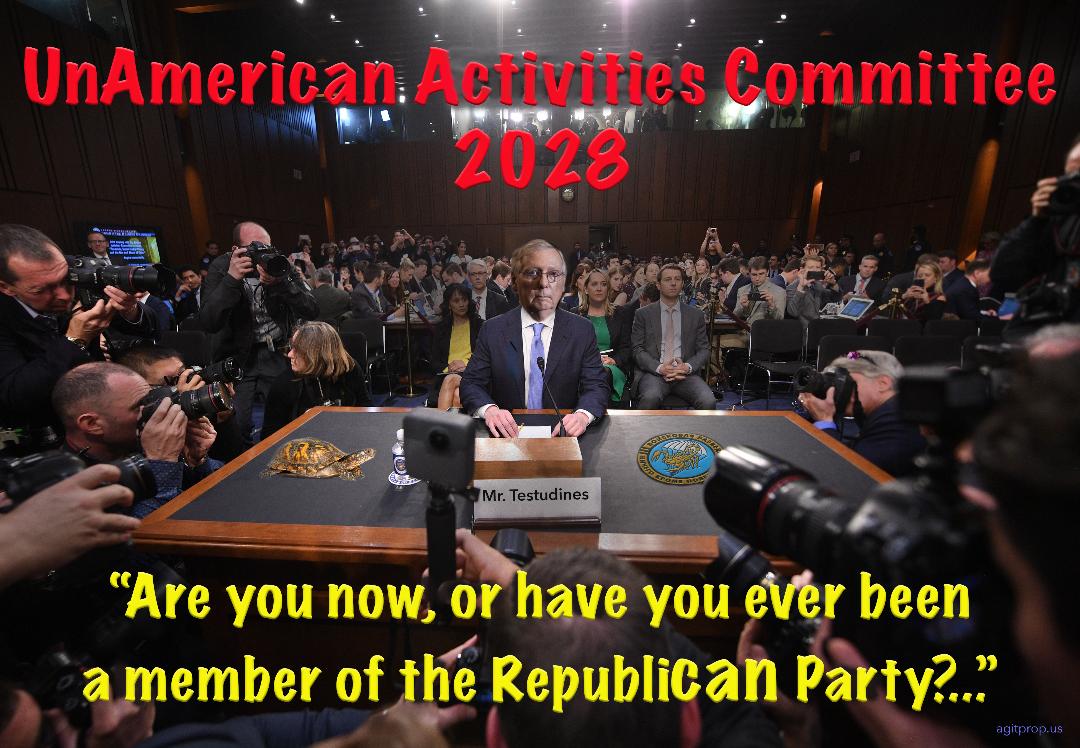
2028 by Chip Proser

In her Sunday NY Times column, Maureen Dowd decided it was time to dunk McConnell into the Potomac, pointing out that he appears to have ditched Donald. It's not too late for Trump to cut a spot for Kentucky television endorsing Amy McGrath. She seems to be saying more nice things about Trump these days than McConnell is. And all Trump would have to do is give a signal to voters in backward bastions of Trumpism, hellholes like Jackson, Casey, Monroe, Leslie, Carlisle, Green, Whitley, Bell, Rockcastle, Harlan, Pike, Adair, Knox, Lewis, Allen, Laurel, Butler, Russell, Owsley, Martin, Clinton, McCreary, Crittenden, Lee, Cumberland, Johnson, Pulaski, Clay... all counties where Trump got more than 80% of the vote and is far more popular than McConnell. That would shake up the zeitgeist!


Maybe Trump is angry that McConnell implied he had cooties, but, as Dowd wrote, "McConnell did more than physically distance himself from Trump. He politically distanced himself as well, throwing cold water on the president’s whiplash-inducing reversal on a stimulus bill. After torpedoing negotiations in a tweet on Tuesday because he thought the Democrats wanted too much, the steroid-pumped president did a triple axel and tweeted to Congress to 'Go Big! I would like to see a bigger stimulus package, frankly, than either Democrats or Republicans are offering,' he told Rush Limbaugh in a manic two-hour call on Friday (during which he dropped the F bomb about Iran). I’m going the exact opposite now.' Clearly, McConnell does not want to invest whatever capital he has left in reviving Trump when the guy seems doomed. Why bring up an issue that really divides his Republican members weeks before an election that might be a wipeout-- with the Senate in the balance?"
McConnell is all about winning. He knows a loser when he sees one.

As Alex Conant, a Republican strategist, told The Times Trumpworld is at a dangerous pass: “The knives come out, the donors flee and the candidate throws embarrassing Hail Marys.”

Proving once more that there’s no bottom to how low he’ll go, McConnell explained to reporters in Kentucky that he wasn’t ready to push a stimulus deal because “the situation is kind of murky, and I think the murkiness is a result of the proximity to the election and everybody kind of trying to elbow for political advantage.”

So it’s fine to elbow for political advantage and push to replace R.B.G. with an arch conservative who would threaten health care and abortion rights in proximity to the election. But a bill that would help millions of suffering Americans as the economy goes down the tubes? Nah. That’s too murky.
As for helping the public-- and the economy-- through this phase of the pandemic... McConnell feels he's politically bullet-proof and doesn't care what Trump, the Democrats or anyone else has to say about it. He actually appears to be behaving more irrationally than Trump for a change.

Politico reporters Jake Sherman and Burgess Everett wrote that "a significant and important chunk of Senate Republicans hate everything about the package that Mnuchin is negotiating with Pelosi... Republicans aren’t taking issue with a policy or two, they’re taking issue with the entire package, the number, the scope and the policies. There doesn’t appear to be a middle ground here." The two reporters were blunt in their assessment: If Pelosi and Mnuchin come up with something, McConnell will give it-- and Trump-- the same treatment he's been giving everything that comes out of the House: "at this juncture, it has absolutely no chance of even getting brought up" in the Senate!

On CNN’s State of the Union, drug-addled Trump economic adviser Larry Kudlow said he doesn't "think it’s dead at all. I spoke to Secretary Mnuchin last evening. Look, don’t forget-- Republicans in the Senate put up their own bill a few weeks ago and got 53 votes, I think it was… I think if an agreement can be reached they will go along with it."
Earth To Larry!: That bill was $300 billion and was a very heavy lift for GOP leadership. This bill is six times that. That was also a very different time in the life of this virus, Republicans say.

Ya Can't Make It Up! As Republicans freak out about the high price tag, Kudlow says Republicans are willing to go higher than their current offer!!! “He may. He may. Secretary Mnuchin is up to $1.8 trillion. So, the bid and the offer is narrowing somewhat between the two sides. President Trump actually has always said-- I mean, I have heard him say it in the Oval-- as far as the key elements are concerned, the checks, the unemployment assistance, the small business assistance-- we have got to help airlines out-- he would go further. He’s always said that. He knows that we need as much power for economic recovery as possible. It’s not just recovery in three weeks. It’s recovery to the end of the year and beyond in a possible second term. So, I think Secretary Mnuchin, who is a very good negotiator, will be carrying the president’s message.”
By the end of the day, Mnuchin and Meadows (basically, Trump) were calling on Congress to pass a relief bill using leftover funds from the paycheck protection program as negotiations on a more comprehensive package continue. They sent a letter to Pelosi and McConnell demanding that Congress "immediately vote on a bill" that would enable the use of unused Paycheck Protection Program funds while working toward a bigger package. "The all or nothing approach is an unacceptable response to the American people," they wrote.

Labels: , , ,

Tuesday, September 22, 2020

Will Schumer And The Senate Democrats Go To The Wall To Stop An Illegitimate SCOTUS Appointment?

>


AOC: "We need to make sure that we mobilize on an unprecedented scale to ensure that this vacancy is reserved to the next president, and we must use every tool at our disposal."

Early yesterday, Alisyn Camerota hosted Jeffrey Toobin on CNN's New Day and I guarantee you, establishment Democrats did not like what they heard. She spoke with him about what the congressional Democrats can do if Trump and his enablers ramrod through an extreme-right Supreme Court justice. "Democrats are great about talking big," said Toobin, clearly referring to Chuck Schumer, "but we’ll see if he has the-- if he and the other Democrats have the guts to do anything. If they retake control of the Senate, will they really add the two seats on the Supreme Court? ... Because they’re weak and they’re wimps and they’re afraid. We think about Bush v. Gore and, which David [Boies] argued. In 2016, Al Gore said no street protests. This is just a legal process, while David saw in Tallahassee and Washington the Republican forces massing against them, literally on the streets. There is a difference to how Democrats and Republicans go about these fights, and we’ll see if Democrats learn anything from Republicans here. Yes, it’s interesting that Chuck Schumer said nothing is off the table, but that’s not a commitment to do anything."

The Democrats are not without weapons in this battle, just without leadership that  has the heart and the guts to wield them. Schumer should tell McConnell in no uncertain terms that if the Democrats win back the Senate in November, he will propose legislation to make Puerto Rico and the District of Columbia states, something the GOP dreads. It would probably pass but even if it doesn't, Marco Rubio, Rick Scott and Pat Toomey will put their reelections in jeopardy by voting against Puerto Rican statehood. Then there's the much discussed concept of going back to 9 judges (1837), although I have a tip for Schumer, In 1863, Congress passed a law establishing a Supreme Court with 10 justices. He should threaten 10 and then compromise on 9. It wasn't until 1869 that the 7-judge court was established.

Writing last week for the New Yorker Toobin himself reported on a less-discussed threat conservatives would find unpalatable. He wrote that Demand Justice, founded by Christopher Kang, who helped run judicial selection for Obama, and Brian Fallon, a former Schumer aide, "argue that the next President should not nominate any judicial candidates who come out of the world of corporate law. As Kang and Fallon, two insiders to the process, point out, even in Democratic administrations, there is a recurring pattern among nominees to the federal bench: 'A typical nominee might have an Ivy League degree and clerkships with one or more respected federal judges,' they write, in a new article in The Atlantic. 'But perhaps no qualification is more prevalent than prior work at a major private-sector firm, representing the interests of large corporations.' As they note, roughly sixty per cent of federal appellate judges come from corporate firms."

It would be hard to imagine Schumer backing anything like that-- not to mention Biden, but if it's part of an informal, off-the-record package of threats to throw at McConnell...

Toobin claims that "The moment is especially ripe for this proposal. The story of the Roberts Court is its embrace of corporate power. The court has consistently ruled against labor unions and for big-dollar campaign contributors, polluters, and other wealthy interests. Justices Neil Gorsuch and Brett Kavanaugh, Trump’s appointees to the court, have embraced this agenda and appear likely to push the Court even more dramatically in this direction. Both showed a particular interest in limiting regulations during their time as circuit-court judges. Sheldon Whitehouse, a senator from Rhode Island, has been one of the few Democratic politicians to focus on this issue of corporate power in the courts; he’s even written a book about it. By 2021, it will be especially important to establish some sort of counterweight to this trend, because Trump will have made so many appointments, and because of the possibility of Supreme Court vacancies... Kang and Fallon write, 'There are plenty enough highly qualified individuals with other backgrounds-- civil-rights litigators, public defenders, and legal-aid lawyers-- that the next president can afford to make identifying new kinds of candidates a priority.'"

On Friday, the New Yorker published an essay by Jane Mayer, suggesting that McConnell cares more about keeping the GOP Senate majority than about putting another rightist on the Court. McConnell, she wrote, is as immune to shame as The Donald is. Norman Ornstein told her that "McConnell will do anything that serves his interests. We know that."

A former Trump White House official told her that "McConnell’s been telling our donors that when R.B.G. meets her reward, even if it’s October, we’re getting our judge. He’s saying it’s our October surprise."
But now that the moment is here, the calculation isn’t quite so simple. On Friday night, McConnell released a statement vowing that a Trump nominee “will receive a vote on the floor of the United States Senate.” While McConnell’s obstruction of Obama’s nominee, Merrick Garland, made him the bane of liberals, he has regarded it with pride as the single “most important decision I’ve made in my political career.” He and many others believe it handed Trump his victory by motivating the politically powerful evangelical bloc to vote for Trump, despite their doubts about him, because he promised to fill the Court vacancy with a social conservative. It’s entirely possible that the same scenario will play out again this November, with Trump and McConnell offering another enticing gift to evangelicals.

But McConnell is also what Ornstein calls “a ruthless pragmatist,” whose No. 1 goal has always been to remain Majority Leader of the Senate. He’s made the conservative makeover of the federal court system his pet project, but if he faces a choice between another right-wing Justice or keeping his control of the Senate, no one who knows him well thinks he’d hesitate for a moment to do whatever is necessary to stay in power. In fact, back in the summer of 2016, when it looked like Trump would lose to Hillary Clinton, far from being distressed at his party’s dim prospects, McConnell was savoring the probability of being the single most powerful Republican in the country, according to a confidant who spoke with him then.

The problem for McConnell now is that it may be impossible for him to both confirm a new Justice and hold on to his personal power as Majority Leader. A power grab for the Court that is too brutish may provoke so much outrage among Democrats and independents that it could undermine Republican Senate candidates in November. As he knows better than anyone, polls show that Republican hopes of holding the Senate are very much in doubt. If Joe Biden is elected, enabling a Democratic Vice-President to cast the deciding vote in the Senate, Democrats need only to pick up three seats to win a majority. And, at the moment, according to recent polls, Democratic challengers stand good chances against Republican incumbents in Maine, Arizona, and Colorado. Democrats also have shots at capturing seats in South Carolina and Iowa. [She's leaving out North Carolina, Montana, Alaska and Georgia.]

No one knows for sure how the politics of the Ginsburg seat will play out in close Senate races. But the issue likely puts some of the most endangered Republican candidates in very tough spots. In Maine, for instance, Susan Collins can’t afford to either alienate the Trump base by voting against a conservative Court pick or to alienate moderate Republican women, who don’t want a radically right-wing judiciary. Late on Saturday afternoon, Collins contradicted McConnell’s line, saying in a statement, “In fairness to the American people, who will either be re-electing the president or selecting a new one, the decision on a lifetime appointment to the Supreme Court should be made by the president who is elected on November 3rd.” Hours before the news of Ginsburg’s death on Friday, Lisa Murkowski, an independent-minded Republican senator from Alaska, said that she thought it was too late for a confirmation vote, telling a public-radio interviewer that “I would not vote to confirm a Supreme Court nominee.”

Given those complications, Ornstein predicts, McConnell may “use some elements of delay.” McConnell conspicuously laid out no timetable when promising a Senate vote for Trump’s nominee. Ornstein speculates that he may hold off on a vote until after the election to provide cover for his members but, meanwhile, obtain private pledges of support from them. It would mean he’d have the votes to ram a confirmation through the Senate during the lame-duck period after the election, regardless of who has won the White House.

Senate watchers suggest that the first thing that McConnell probably did after learning of Ginsburg’s death was to call every member of his caucus, in order to make an assessment about whether it would help or hurt his members to force a Supreme Court confirmation vote. On Friday night, he also issued a thinly veiled warning to his caucus members to shut up, or, as he put it, “be cautious and keep your powder dry.” According to the Washington Post, which obtained a copy of the McConnell letter, he warned, “For those of you who are unsure how to answer, or for those inclined to oppose giving a nominee a vote... this is not the time to prematurely lock yourselves into a position you may later regret.”

Keeping the Republican senators in line was also among the top concerns McConnell had when Antonin Scalia unexpectedly died, in February, 2016. McConnell immediately coördinated with Leonard Leo, then the executive vice-president of the powerful conservative legal group the Federalist Society, to plot a path forward that would avoid what Leo reportedly called “a cacophony of voices.” To keep control, they came up with a plan. Although eleven months remained in the President’s second term, McConnell immediately announced he would block a vote for any Obama nominee because it was an election year, and so he argued, “the American people should have a voice in the selection of their next Supreme Court Justice. Therefore, this vacancy should not be filled until we have a new President.” The speciousness was breathtaking. Since the nation’s founding, the Senate had confirmed seventeen Supreme Court nominees in election years. Moreover, the “American people” had made a choice-- they had elected Obama. But, despite declaring themselves as conservatives who respect precedent, McConnell, in consultation with Leo, simply invented a new rule to cover their radical defiance of past precedents and accepted norms.

Facing the same kind of unconstrained power play by McConnell again, the Democrats have few procedural weapons at their disposal other than taking radical measures themselves. For more leverage, Brian Fallon, the executive director of Demand Justice, a liberal group, says that if McConnell forces a confirmation vote before the election, Democrats need to threaten to expand the size of the Supreme Court if they win control of the White House and Senate in November. He believes there may be support for this even from unlikely moderate Democrats, if McConnell tries to strong-arm a vote. Senator Tim Kaine, of Virginia, who is ordinarily a mainstream Democrat, has said he could support enlarging the court as a tactic, if the Republicans force a confirmation vote. The Democratic senator Ed Markey, of Massachusetts, and Congressman Jerry Nadler, of New York, have also embraced the idea. Fallon also suggested that if a Trump nominee has yet to be confirmed after the election, and if Biden wins the White House, he, as President-elect, should name his own nominee, creating a scenario in which there are two nominees backed by opposing parties simultaneously duelling for confirmation. The Democratic members of the Senate, he argues, should decline to attend any courtesy calls, or confirmation hearings meanwhile, for any lame-duck Trump nominee.

ACB by Chip Proser
David Cole, the national legal director for the American Civil Liberties Union, also called on Democrats to fight rather than fold. He told me, “I think we should demand that the Senate respects her dying wish,” referring to a statement from Ginsburg released after her death by her granddaughter Clara Spera, which said, “My most fervent wish is that I will not be replaced until a new President is installed.” He argued that although what the Senate did to Garland “was wrong, if they have a shred of consistency, they should hold off until after the Inauguration. And if not, progressives should take to the streets.”

Ornstein foresees the potential for a historic political rupture if Trump, who lost the popular vote in 2016, and McConnell successfully seize a Supreme Court seat for a second time. “If McConnell gets away with this again, this will be a Court like none we have ever seen in our lifetime. We will be back to the pre-New Deal era,” Ornstein said, referring to one of the most conservative courts in the last century. He predicted, “If McConnell does this, it’s not just an act of hypocrisy, it’s one of the most dangerous breaches we’ve seen in our lifetime. There will be consequences. I think there would almost be revolution in this country.”

Labels: , , , , , ,

Monday, September 21, 2020

A Man Is Only As Good As His Word? So How Do Closet Cases, Like Lindsey Graham Survive In Electoral Politics?

>


I'm gay. When I realized it, I was living in Amsterdam. I went to a psychologist and told him. He looked at me oddly and said, basically, "So? You need me to give you the addresses of gay bars?" Then I flew to the U.S., for my first visit back home in 4 years, to tell my mother. Her response was to tell me I couldn't borrow her wigs. Years later my first corporate job was working for a gay man. My sexuality never held back my career and I rose to be president of the parent company. I'm glad I never went down the closet road. People in closets live a life reflexively and usually increasingly dishonest. They lie about who they are, what they are and, eventually, about everything and start living a life where serial dishonestly becomes the essence of being, more so than any semblance of honesty. It's the slipperiest of slopes to start down and so, so tragic for so many people.

It's the slope poor Lindsey Graham felt he had to go down if he was going to be a successful politician in South Carolina. And, his life has been one gigantic lie, both professionally and personally. "Everyone knows" and even colleagues and acquaintances who find him likable, simpatico and amusing, all tend to pity him. And now it may be catching up with him politically, as an unlikely Democratic opponent has him locked in a what should be an easy reelection campaign but is basically tied and too close to call.

On Saturday, Washington Post reporters Sean Sullivan and Seung Min Kim wrote that 4 and a half years ago Lindsey "sat across a conference table from his colleagues and issued them a dare. 'I want you to use my words against me,' said Graham, a South Carolina Republican with a flair for drama. Pointing with his index finger, Graham continued: 'If there’s a Republican president in 2016 and a vacancy occurs in the last year of the first term, you can say Lindsey Graham said let’s let the next president, whoever it might be, make that nomination.' On Saturday, Graham was singing a different tune, pledging support for President Trump in 'any effort to move forward regarding the recent vacancy created by the passing of Justice Ginsburg.' The stark turnabout from 2016 marked the latest chapter in Graham’s dramatic reinvention of himself during the Trump presidency, morphing from an old-school Senate institutionalist and bipartisan dealmaker into a stalwart soldier for the president’s agenda."

Democrats and other opponents of The Donald very much would like to take Graham up on his offer-- to hold his words against him. I don't know how effective this Lincoln Project ad will be with South Carolina voters, but I suspect someone will figure out exactly how to hold his words against him in a way that will cause him no end of political pain. After all, no one likes a liar... well, except for Republicans who apparently love liars:


"Graham," our Post duo reminded us, "is chairman of the powerful Senate Judiciary Committee charged with processing Supreme Court nominees, and he is in the midst of a competitive reelection campaign that could factor closely into the fight for control of the upper chamber. His comments Saturday, coming after less-decisive statements in the hours after Justice Ruth Bader Ginsburg’s death Friday, amounted to the latest indication of how Republican leaders are rallying quickly around a strategy of seeking to fill her seat this year. That prospect has stoked widespread outrage among Senate Democrats, who are calling Republicans hypocrites for the move after blocking President Barack Obama’s Supreme Court nominee in 2016 because they said the president chosen by voters that fall should make the pick.
“There’s no doubt everything will be sort of on the table if we’re thrown into a world where you can’t trust somebody’s word and precedents get changed at will to fit your priorities of the moment,” Sen. Chris Murphy (D-CT) said in response to Graham’s decision to align behind Trump and go back on what he said in 2016.

During Saturday’s call, Senate Minority Leader Charles E. Schumer (D-NY) used similar language, saying that if Senate Republicans move forward with whoever Trump nominates, “nothing is off the table for next year” should Democrats win control of the chamber. That appeared to be a reference to structural changes to the court proposed by liberal activists such as expanding the number of justices-- a proposal that has sparked some disagreements among Democrats.


Republican leaders appeared determined to press ahead swiftly to fill the court vacancy with a conservative jurist. Senate Majority Leader Mitch McConnell (R-KY) promised Trump during a Friday phone call that his nominee would get a vote in the Senate, according to people familiar with their conversation who, like others, spoke on the condition of anonymity to discuss the private conversation.

Trump told McConnell he liked Judge Amy Coney Barrett of the U.S. Court of Appeals for the 7th Circuit and Barbara Lagoa of the 11th Circuit, according to two people briefed on the discussion.

“We were put in this position of power and importance to make decisions for the people who so proudly elected us, the most important of which has long been considered to be the selection of United States Supreme Court Justices,” Trump wrote on Twitter Saturday. “We have this obligation, without delay!”

...Less clear is how rank-and-file Republican senators will respond, with many in tough reelection races in states where Trump is not popular. Republicans hold a 53-to-47 majority in the Senate, meaning they can afford to lose no more than three members in a confirmation vote, should the entire Democratic caucus unite against Trump's nominee.

They have already lost one.

“I do not believe that the Senate should vote on the nominee prior to the election,” Sen. Susan Collins (R-Maine), who is in a tough reelection fight, said in a statement. “In fairness to the American people, who will either be re-electing the President or selecting a new one, the decision on a lifetime appointment to the Supreme Court should be made by the President who is elected on November 3rd.”

Collins’s reservations contrasted sharply with the comments from Graham, who is seeking a fourth term in the Senate. The contest has been tougher than many expected in a ruby-red state Trump won easily in 2016, with recent polls showing Democrat Jaime Harrison in close competition with Graham.

Now Graham will be at the center of what will likely be one of the most contentious confirmation battles in history, affording him an opportunity to demonstrate his loyalty to Trump. But some Democrats say his position could help amplify the arguments against his reelection.

“A lot of folks miss the Lindsey of old-- and that’s why this race is so competitive,” said Steve Benjamin, the Democratic mayor of Columbia, S.C. “When it comes time to do what’s right and maybe not popular,” Benjamin said, “it can be difficult for some.”

Harrison, one of his party's fast-rising African American stars, sounded similar notes. “My grandpa always said that a man is only as good as his word. Senator Graham, you have proven your word is worthless,” he wrote on Twitter.
Writing for The Atlantic, Edward-Isaac Dovere offered a glimpse into what Republican senators are saying in private and off the record. "Whispering Republicans," as he termed them, talk about how they hate The Donald and then back him in public-- to the media and, of course, with their votes. The GOP is absolutely one of the country's two spineless, jellyfish parties. "The secretly apostate Republican senators," wrote Dovere, "have two choices: They can support a president they think is a threat to American democracy while also violating Senate Majority Leader Mitch McConnell’s invented 2016 rule about not confirming justices in an election year, or they can oppose Trump, enraging both him and their progressively cultish base while giving up what might be their last chance to secure a conservative majority for a generation."

Notice The Donald's Chamber of Commerce retweet from Sunday morning, signally he's ready for war with Alaska senior Senator Lisa Murkowski, who is not up for reelection in November and is not up for giving Trump a third Supreme Court pick.


For McConnell, this is principle versus power, and the golden rule is “Whoever has the gold makes the rules.” And it’s happening as the next generation of ambitious Republicans looks to a future in which Trumpism remains a dominant force within the party no matter what happens in November.

Don’t expect many Republicans-- even those who want to stick it to Trump-- to be direct with their commitments. “If they try to shove something through, I think you’re going to see some of these Republicans who hate Trump fall on the horrible sword of ‘This country is dangerously divided right now; the hypocrisy is horrible; if we do something like this, it will tear the country apart,’” says Joe Walsh, the former Republican representative from Illinois, who briefly ran a primary campaign against Trump that went nowhere earlier this year. Based on conversations he’s had, Walsh estimates that, of the current Republican senators, “if you put a gun to their head privately, I would say more than 40 of the 53 would like to see him lose.”

Walsh insists that Republicans didn’t want this vacancy-- not now. “This is political death for the Republicans,” he told me.

This is not the time for Republicans to insist that they haven’t “seen the latest tweet.” This is where they either will or will not give Trump the boost that he needs weeks before the election. Now, more than ever, they are either with him or against him. “This,” Senator Amy Klobuchar of Minnesota, a Democrat, said on CNN last night, “is my colleagues’ moment of reckoning.”

...Senator Joni Ernst, in a tight reelection race in Iowa, said in July that she would support a nomination process if an opening occurred. But that puts her at odds with her fellow Iowa senator, Chuck Grassley, who said in August that he couldn’t support a confirmation in an election year if he was going to be consistent with the position he took in 2016. He stood then with McConnell’s adamant refusal to give Merrick Garland a hearing after Antonin Scalia’s sudden death in 2016, though Garland was nominated nine months before Election Day. Of course, the question becomes whether Grassley will hold to his position now that the question is no longer theoretical.

...Late yesterday, I asked a former Republican House member what an anti-Trump Republican senator would do when facing a choice that sounds more out of a novel than anything Goethe might have come up with if he’d ever wandered around Capitol Hill.

“The Republican senator,” said the person, who requested anonymity to speak directly about old colleagues, “will do what they must in the name of self-preservation.”

“Guess what?” the former House member said of Graham. “He’s going to do it. You know he is. He’s up for reelection in South Carolina. He needs his base. He’ll flip on this.”

McConnell, in his Rube Goldberg–machine statement explaining why Trump’s nominee will get a vote on the floor of the Senate but Obama’s didn’t, left the door open to having a vote in a potential lame-duck session after the election.

Maybe it’ll all come down to Senator Mitt Romney, who is publicly offended by pretty much everything Trump stands for but whose spokesperson shot down rumors last night that he would oppose a confirmation before the election. Or maybe, if Mark Kelly wins his Senate race in Arizona, it will all hinge on a legal dispute over whether he would get to immediately be sworn into the seat because his opponent was appointed to it. Or maybe by then we’ll be in a country where the November 3 votes are taking weeks to count, rioters and militias are out on the streets, and, as in 2000, the election will head to the Supreme Court, which now is without a tiebreaker vote.

In 2016, from the minute he learned of Scalia’s death, Obama knew that Republicans would try to prevent him from appointing a justice and flipping the balance to a 5–4 liberal majority. He nominated Garland anyway and threw himself into the fight, daring the GOP senators to oppose a middle-of-the-road, accomplished judge whom so many had voted for in his confirmation to a lower court. Working the phones for a few senators he dreamed might buck McConnell, he pleaded with them: Don’t do this.

I remember speaking with one of the Republican senators struggling with breaking the process then. The senator, though torn, ultimately did not say anything publicly, and didn’t invite Garland in for a meeting.

Last night, Obama closed his statement mourning Ginsburg with, “As votes are already being cast in this election, Republican senators are now called to apply that standard.” Don’t hold a confirmation hearing, he said. Always an institutionalist with his eye toward history, Obama was admitting that the process breakers had won.

Now the question is, what else will Trump, the ultimate process breaker, win?


David Frum offered up 4 reasons to doubt McConnell’s power. He asked himself 4 questions:
Does McConnell really command a Senate majority?

The polls do not favor Susan Collins, Cory Gardner, or Thom Tillis--senators from Maine, Colorado, and North Carolina up for reelection this cycle. Yet these competitors may not be ready to attend their own funerals. They may regard voting against McConnell's Court grab as a heaven-sent chance to prove their independence from an unpopular president-- and to thereby save their own seats... (Martha McSally of Arizona, however, is likely a safe vote for McConnell. The deadest of the Senate's dead ducks surely must be focused on retaining national Republican support for her post-Senate career. Mitt Romney of Utah is a more open question: His strong sense of fairness will push him against confirmation; his consistent support for conservative judges will pull him in favor.)

Does McConnell really have a nominee to advance?

Any last-minute Trump nominee will face a gantlet of opposition in the Senate, a firestorm of opposition in the country, and probably a lifetime of suspicion from the majority of the country.

Can McConnell and Trump find an appointee willing to risk all that for the chance-- but not the guarantee-- of a Supreme Court seat? Specifically, can they find a woman willing to do it? The optics of replacing Ginsburg with a man may be too ugly even for the Trump administration. And if they can find a woman, can they find a woman sufficiently moderate-seeming to provide cover to anxious senators? The task may prove harder than immediately assumed.

Will Trump balk?

Until now, judicial-nomination fights have mobilized Republicans and conservatives more than Democrats and liberals. The fight McConnell proposes may upset that pattern. Trump's hopes for reelection depend on suppressing votes and discouraging participation. The last thing he needs is a highly dramatic battle that could mobilize Democrats in states including Arizona and North Carolina-- even Georgia and Texas.

The smart play for Trump is to postpone the nomination to reduce the risk of Democratic mobilization, and to warn Republicans of the risks should he lose. Trump’s people do not usually execute the smart play. They are often the victims of the hyper-ideological media they consume, which deceive them about what actually is the smart play. This time, though, they may just be desperate enough to break long-standing pattern and try something different.

Will the conservative legal establishment play ball?

The judicial status quo enormously favors conservatives. Even should Democrats win big in November, it will take many years for them to catch up to the huge Republican lead in judicial appointments. By then, who knows, the GOP may have retaken the Senate, and of course it may well find a way to hold on in 2020.

But a last-minute overreach by McConnell could seem so illegitimate to Democrats as to justify radical countermoves should they win in November: increasing the number of appellate judges and Supreme Court justices; conceivably even opening impeachment hearings against Justice Brett Kavanaugh.

McConnell may want the win badly enough to dismiss those risks. But many conservative-leaning lawyers in the country may be more cautious. And their voices will get a hearing in a contentious nomination fight-- not only by the national media, but by some of the less Trump-y Republican senators. This could be enough to slow down a process that has no time to spare.

Mitch McConnell has gotten his way so often that it’s hard to imagine he might ever lose. But the political balance of power is shifting this fall, and for once, McConnell may be on the wrong side of a power dynamic.


Labels: , , , , , , , , , , ,

Sunday, September 16, 2018

Midnight Meme Of The Day!

>


by Noah

Happy Sunday, everybody. Do you like things you find difficult to unsee? Yes, the emperor has no clothes, not even a funny oversized tie. Here we have a realistic artistic expression of Mitch the Treason Turtle carrying his master, smiling and laughing all the way; smiling and laughing at all of us. The burden is heavy but he gladly carries Putin's president, servilely carrying him wherever he wants to go.

Labels: , ,

Friday, June 15, 2018

Will Trump Be Able To Save McConnell From Kentucky Voters In 2 Years?

>


Pelosi is one of the least liked politicians in America-- two caveats though: 1- her own constituents love her and showed it at the polls 2 weeks ago when 172,399 voters turned out-- more than any other district in California-- and gave her an overwhelming win against 6 challengers and 2- she's far more popular than Mitch McConnell, the most disliked elected official in America.

McConnell's seat isn't up this November. It's up in 2020-- when Señor Trumpanzee is on the top of the ticket. If Pete Session in a gerrymandered Dallas district can loose his seat, as looks likely-- McConnell can too. This morning Alex Isenstadt too a look at what to expect in just under 2 and a half years.

In 2014 McConnell beat Alison Lundergan Grimes, a moderate who didn't offer much of a progressive message to contrast herself to McConnell, 806,787 (56.2%) to 584,698 (40.7%) Two years later Kentucky voters looked at an even worse status quo candidate, Hillary Clinton and Trump eviscerated her, 1,202,971 (62.5%) to 628,854 (32.7%), winning all 120 counties minus two. It was Trump's 5th strongest state. Trump is still far more popular in Kentucky than McConnell and McConnell has stuck as closely to Trump as he could and is certainly one of Trump's top congressional enablers. On Monday, McConnell and his top advisors met to plot out a strategy.
At a time when anti-establishment sentiment is roiling the party, the 76-year-old McConnell, who this week became the longest-serving Senate Republican leader in history, has a target on his back and is taking no chances.

Polling has shown the leader’s approval ratings lagging in his home state, and there is the ongoing threat of a primary challenge.

“You have to start laying the groundwork really early,” said Billy Piper, a former McConnell chief of staff who remains an outside adviser. “He lives by the motto you can start too late, but you can never start too early. And that probably gets more true with each passing cycle.”

...McConnell, who since his first Senate election in 1984 has established a reputation as a sharp-elbowed campaigner, is regarded as a political titan in Kentucky. Yet his path to another term won’t necessarily be smooth.

The leader’s poll numbers are weak. A Western Kentucky University survey conducted in April found McConnell’s approval rating at just 30 percent in the state, the same figure recorded in a December Mason-Dixon poll of Kentucky voters.

...[A] few names are circulating, including sports radio show host Matt Jones, retired Marine corps fighter pilot and 2018 congressional hopeful Amy McGrath, and state Attorney General Andy Beshear, son of ex-Gov. Steve Beshear.

Reached by phone Wednesday evening, Jones, a liberal who has used his popular show to target McConnell, said he expects to decide on a run by the middle of next year. Jones said he‘s confident he could make a persuasive case to voters that McConnell’s time is up, but added that he fully understood how hard it would be to take him out.

...“Anyone who will run against him will be put through a blender,” said Scott Jennings, a longtime McConnell confidant, “the likes of which they’ve never experienced.”
Tying himself to Trump like a barnacle is probably McConnell's best strategy-- at least for now. In fact, yesterday, McConnell called for an end to the Mueller investigation, Trump's top priority. He said that "it’s time for special counsel Robert Mueller to conclude the federal probe into Russian meddling in the 2016 election and possible collusion with Moscow by President Trump... 'What I think about the Mueller investigation is, they ought to wrap it up. It’s gone on seemingly forever and I don’t know how much more they think they can find out..'" Did you ever wonder why McConnell derailed the effort to pass legislation to protect Mueller from Trump?


Labels: , , ,