Saturday, November 14, 2020

Will McConnell Have to Die Before Biden Is Going To Be Able To Govern?

>


The Washington Post headline of Mike DeBonis' story this morning reads Biden’s agenda may rest on centrist Republicans-- and the return of a bygone Senate era, but maybe a shorter version would be more accurate: "Biden's centrist agenda may rest on centrists."

When I was growing up, my grandfather, a Russian socialist who had been converted by FDR and was, by the '50s, getting very fed up with the Democratic Party, pointed out to me that though Congress was "controlled" by the Democrats, real power was in the hands of a trans-partisan coalition of anti-progressive reactionaries (many of whom were virulent southern Democratic racists who hadn't yet migrated to their new political home).

DeBonis' piece looks forward to another era of centrism in Congress with just such a coalition-- albeit without the racists and, he wrote, "if anyone can manage it, senators and operatives from both parties say, it’s Biden-- who spent 36 years in the Senate and will enter the White House as the most accomplished legislator to hold the presidency since at least Lyndon B. Johnson." Unless you're on an empty stomach, don't examine what Biden accomplished while he was in the Senate from 1973 to 2008. It ain't pretty.

Goal ThermometerUnless the Democrats Jon Ossoff and Raphael Warnock win both Georgia Senate seats-- almost unimaginable-- Team Biden will be sharing power with Mitch "Grim Reaper" McConnell. "At stake," wrote DeBonis, "is not only Biden’s policy agenda but the process of filling his Cabinet and other agency posts, as well as the increasingly partisan business of judicial nominations. How Biden navigates the political currents of the Senate could determine such essential matters as the federal government’s fiscal outlook or filling a possible Supreme Court vacancy."

If you want to contribute to Warnock and/or Ossoff, you can do so by clicking on the Senate thermometer on the right.
The scenarios tend to have Biden wooing a small number of Republicans with a reputation for bipartisanship-- centered on Sens. Susan Collins of Maine and Lisa Murkowski of Alaska-- as he seeks to build a governing coalition in a closely divided Congress. Both Republicans offered encouraging words in the days following Biden’s victory.

“Joe Biden knows exactly how to deal with this body. He’s worked within it. He has done some strong and important bipartisan deals with no less than Mitch McConnell,” Murkowski said in an interview Thursday. “If you truly have a view that what we’re going to try to do is be constructive rather than just throw grenades at one another, you can build anything.”

Biden phoned Collins-- who handily won her own reelection race despite tens of millions of dollars of Democratic spending-- shortly after Election Day, and she hailed her “very good relationship” with the president-elect in comments to reporters this week.

“As I would of any president, I want him to be successful,” she said Tuesday.

Weighing against the happy talk is recent history in the Senate, where groups of moderate senators have joined over the past decade to try to solve intractable issues such as illegal immigration, gun violence and a spiraling national debt with scant success.

A group that met in Collins’s office amid a government shutdown in early 2018, for instance, tried to forge a path to an immigration deal that never materialized. Bipartisan talks on modest gun control measures led by Sen. Joe Manchin III (D-WV) and Sen. Patrick J. Toomey (R-PA) have gone nowhere. Compromises struck by bipartisan “gangs” to preserve the rights of Senate minorities have been obliterated.

To many Democrats-- who vividly remember McConnell’s efforts to block President Barack Obama’s legislative priorities as both minority and majority leader-- there is simply no hope of progress as long as he sets the Senate agenda.

“We saw that horror film play out in the Obama years, and we don’t want to see it again,” Sen. Jeff Merkley (D-OR) said. “Unless there’s a group secretly meeting within the Republican caucus that says, ‘We really want to see the Senate work as a legislative body again,’ then my hopes are dim if Leader McConnell’s in charge.”

Ronald A. Klain, Biden’s choice for White House chief of staff, said in an MSNBC interview Thursday that Biden had yet to speak to McConnell post-election but noted the two men have known each other for decades, with a track record of cutting deals.

Klain expressed measured optimism that they “will have a working relationship when the time comes,” even though McConnell has yet to publicly acknowledge Biden’s win a week after the Associated Press and multiple news organizations called the race for him.

“They obviously need no introduction to one another,” he said, adding that Biden would “use all the tools that he has, his prodigious tools of persuasion, his ability to reach out to people on all aspects of our party and in both parties, to rally the voters and to do everything he can to move this country forward.”
I wonder how soon Biden will acquiesce to the GOP killing off what's left of the New Deal for some flashy temporary gains. And how loudly Schumer, Pelosi and Hoyer will cheer.

On the other hand, maybe the system is so broken that Biden-- pretty broken himself at 77 (78 in 6 days)-- won't make any headway with McConnell at all. As DeBonis noted "the power of personal relationships has drastically receded in the 11 years since Biden left the Senate, and his former colleagues warn that he will be battling fierce institutional obstacles. Former senator Kent Conrad (D-ND), who served 22 years with Biden, said the days of bottom-up lawmaking driven by committees and bipartisan coalitions of senators are 'largely gone. The ability of the majority leader to set the agenda is incredibly important. It gives him extraordinary leverage. And that, more than anything else, probably will dictate what the Biden legislative agenda is going to be,' Conrad said."

Democrats hope that by winning both Georgia Senate seats-- a steep climb, to put it mildly-- 50-50 tie votes will be broken by Kamala. But that assumes that virulent anti-progressives who frequently cross the aisle, like Joe Manchin (WV), Kyrsten Sinema (AZ), Angus King (I-ME), and Mark Warner (VA) will vote with the Democrats. And then there are the two right-wing Democratic freshmen, Frackenlooper (CO) and Mark Kelly (AZ). Good luck with that crew. Sinema, for example, voted with the GOP against progressive roll calls 55% of the time since being elected. And when she was in the House, she was the most GOP-voting Blue Dog in Congress, absolutely revelling in her role as an asshole.
Should Biden become the first president since George H.W. Bush to enter office without the Senate under his party’s control, the mere task of confirming a Cabinet threatens to become a partisan minefield, handing Republicans effective veto power over his administration’s staffing.

A clutch of GOP senators already signaled that they are likely to vote to confirm Biden’s nominees, but under certain conditions. Collins said she would have reservations if a nominee is “not qualified or is way outside the ideological mainstream or is unethical,” while Sen. Mitt Romney (R-UT)-- who has shown a willingness to cross party lines on some issues-- said he would confirm Biden’s nominees “barring some extreme individual or someone not qualified for the job.”

While McConnell might be unlikely to orchestrate a blockade of Biden’s Cabinet nominees, he is also unlikely to countenance any legislative deals the new president may seek to strike with two or three members of his conference. With a 60-vote threshold for major legislation all but certain to remain in place, any legislative negotiation will have to include a larger group of Republicans.

In one vivid illustration of his aversion to legislation that divides his ranks, McConnell refused for months to schedule a vote on a bipartisan criminal justice reform bill until Trump publicly pushed him. It ultimately passed 87 to 12.

Josh Huder, a congressional scholar and senior fellow with Georgetown University’s Government Affairs Institute, said it “seems improbable at best” that governing from the center would succeed in a hyperpartisan era.

“In the last decade and a half of divided control of Congress, we’ve seen historic gridlock-- the kind of stalemate where you can’t pass a budget or appropriations bills, much less touch on some of the most high-profile, high-stakes political battles that we have,” he said.

Even those senators most likely to cooperate with Democrats are warning their cooperation will only go so far. Murkowski, who is up for reelection in 2022 and whose state depends on oil and gas jobs, warned, “If there are issues that work against my state’s economy, we’re going to fight them tooth and nail”-- a dismal indicator for climate-change legislation.

Romney said Biden would be “making a mistake to think that the people of America chose a left-oriented policy agenda” given the mixed election results. “The country remains a center-right nation, and I will continue to fight for conservative principles that I think comport with not only my philosophy but that of the nation as a whole,” he said.

Labels: , , , ,

Wednesday, October 30, 2019

Het Meisje Met Het Rode Haar-- The Girl With The Red Hair-- plus Newt Gingrich And Kyrsten Sinema

>


This morning when I woke up I found an email from my old friend Toon in Amsterdam. He had heard about the fires ravaging L.A. and he wanted to make sure I was ok. Then he started going on about how Trump and Boris Johnson are ruining the world. That led him in two directions-- were Bernie and Elizabeth too old to get the job done-- I assured him they weren't and that either could-- and then he started writing about how during World War II, "A lot of Dutchmen were completely indifferent about German occupation. A lot of Dutchmen were completely pro or opportunistic." There were not many like our friend (RIP) Hilda van Norden or Hannie Schaft. Hannie Schaft? I didn't know the name. So I took a few moments off from the impeachment news and looked her up. There were dozens of YouTubes... all in Dutch, like one above.

Jannetje Johanna Schaft (Hannie's actual name) was born in 1920. Twenty-four years later, she was arrested at a Nazi checkpoint in Haarlem, her hometown, tortured for a month and shot by Dutch Nazis 3 weeks before the end of the war. 7 months later she was reburied in a state funeral. Queen Whilhelmina called Schaft "the symbol of the Resistance."

As the impeachment trap closes on Trump, will he try a coup? Who's to stop him? If he does, who will be our own Hannie Schaft? You?

Hannie was in law school in 1943 when the Germans occupied the country. University students were required to sign a declaration of allegiance to the occupation authorities. Like 80% of students, Schaft refused to sign and was expelled. Would you sign?

After leaving school and Amsterdam and moving back in with her parents, she joined the Council of Resistance. Eventually she became an assassin and began carrying out attacks on Germans and on Dutch collaborators. She learned to speak German fluently and became involved with German soldiers. She was recognizable by her red hair and wound up on the Nazis "most wanted" list. Eventually, she died her hair black. She was identified by her red roots after she was arrested.

Hannie Schaft, murdered by Dutch Nazis, symbol of The Resistance


I also found an e-mail from Newt Gingrich this morning. "Friend," he wrote, "If you refuse to fight for President Trump... then don't read this email. But don't come complaining to me when anti-Trump socialist fanatics take over!
Sorry to be so blunt, but Democrats have decided to impeach President Trump and we have an urgent deadline to stop them: We're rallying as many Loyal American Patriots as we can for the next 24 hours -- and we've activated 5x-matching for you.

You've already received emails from Steve Scalise, Liz Cheney, Darin LaHood, Drew Ferguson and others...

They ALL want you to know this is the most important request we have EVER made of you. If we fall short now, we will ALL suffer the consequences.

Stand with President Trump, who has been FALSELY accused!


Hannie was offered an opportunity to be a courier when she joined the resistance to the fascists. She wanted the job of killing fascists. At what point is shooting someone like Newt Gingrich the right thing to do? Now? Never? Not 'til they've overthrown democracy entirely? Oh... and speaking of collaborators, as opposed to full on fascists like Newt, Politico ran a piece by Burgess Everett yesterday on putative Democrat Kyrsten Sinema, the mentally impaired and deranged freak from Arizona who Schumer decided to make a senator last year. That she, in Everett's words, "hobnobs with Republicans at least as much as she does with her own caucus," is hardly the problem. She started as a socialist, became a Green, then a liberal Democrat, then a conservative Democrat, then the chair of the House Blue Dogs and will soon enough join the GOP and go further right than Marsha Blackburn. "Sinema," wrote Everett, "doesn’t really fit in with her fellow Senate Democrats. Don’t even ask her whether she watches the Democratic presidential debates." She's more into physical fitness-- a regular fräulein of the Nationalsozialistischer Reichsbund für Leibesübungen. Her voting record isn't, as Everett claims, "on par with West Virginia Sen. Joe Manchin’s." It's worse. Sinema's ProgressivePunch lifetime crucial vote score is much closer to Susan Collins' than to Manchin's:
Joe Manchin (D-WV)- 52.45
Doug Jones (D-AL)- 45.21
Kyrsten Sinema (Freak-AZ)- 34.18
Susan Collins (R-ME)- 24.97
Rand Paul (R-KY)- 13.76
Sinema's support for the fascists that Trump nominated-- like Attorney General William Barr-- "and her lack of zeal for impeachment are part of a political profile drawing blowback from progressives and cheers from the GOP. Yet Sinema is also setting herself up to be a pivotal vote the next time the Democrats are in power. And her radical breed of centrism could be a headache for the party. Take the liberal drive to bust down age-old Senate rules in order to pass Medicare for All or a Green New Deal. Sinema not only opposes getting rid of the 60-vote filibuster threshold for legislation, she wants to restore the supermajority requirement for presidential nominees that has been weakened by both parties." Exactly what Schumer wanted when he selected her as Arizona's senator.
“They will not get my vote on [nuking the filibuster],” Sinema said in her office, outfitted with shiny leather and translucent chairs and boasting a vivid shade of purple that pops from the walls. “In fact, whether I’m in the majority or the minority I would always vote to reinstate the protections for the minority… It is the right thing for the country.

Senate allies


Sinema isn’t actively trying to reshape the party. Though she captured a state that Democrats would love to seize in the 2020 campaign, she’s utterly uninterested in using her perch as senator to do cable TV hits, speak to the Capitol Hill press corps or offer general guidance to Democrats ahead of a crucial election cycle.

Yet her record speaks for itself. She voted for Barr and Interior Secretary David Bernhardt and opposed attempts to roll back the Trump administration’s coal deregulation regime earlier this month.

It’s an approach that has the potential to revive the Senate’s moribund middle but has left her something of a mystery to her Democratic colleagues, even fellow moderates.

“Haven’t had a lot of interaction with her. She’s kind of doing her own thing,” said Sen. Jon Tester (D-MT), a centrist senator with a more liberal voting record than Sinema’s.

Unlike any of her colleagues, she snubbed sitting Sen. Ed Markey and endorsed Rep. Joe Kennedy, an old House colleague and close friend, in the hotly contested Massachusetts Democratic Senate primary. That earned a rejoinder from Manchin: “I would never do that … made no sense to me at all.”


And she is criticizing senators in both parties for “highly partisan” statements on impeachment and is declining to endorse the House impeachment inquiry: “That’s not my job, that’s not my role.”

For all her distance from the establishment, Sinema also seems to have come to an understanding with Schumer, whom she [fake-]opposed as Democratic leader during her 2018 campaign.

Like every member of the caucus, she gets random calls from Schumer frequently enough that she can easily break into a raspy New York accent while doing a brief impression of the minority leader: “‘Sinema! What’s new?’”

But when push comes to shove on important votes, she has a warning for party honchos: Leave her alone.

“Everyone knows that I am very independent-minded,” she said. “And that it’s not super useful to try and convince me otherwise.”

Sinema isn’t especially close with either Trump or Majority Leader Mitch McConnell (neither has her phone number, she said), but she doesn’t light into them the way most Democrats do. She’s working with McConnell to whip votes for repealing Obamacare’s medical device tax and said the president “certainly” knows who she is.

And observers watching her on the Senate floor during a vote would be forgiven for thinking she’s a Republican, considering her chats with GOP senators like Majority Whip John Thune of South Dakota, Tom Cotton of Arkansas and Kevin Cramer of North Dakota.

She spends at least as much time on the Republican side of the chamber as the Democratic half and lists Sen. Ted Cruz of Texas as an ally atop the Commerce Committee’s Aviation and Space subcommittee. Cruz returned the favor by declining to lump the Arizona Democrat in with what he sees as an increasingly socialist Democratic Party.

“I said to her one time: Why aren’t you a Republican? … she said: ‘I just couldn’t be,’” Cramer recounted.

Cramer and Sinema came into the House together in 2013, and then arrived in the Senate this year. They are close friends but couldn’t be more different. In fact, there are few like Sinema, the youngest Democrat at 43 who’s trying to figure out how to teach a spin class in the archaic Senate gym and boasts a sense of style that stands out in the tradition-bound Senate.

“I’m sort of a prude and she’s very exotic,” Cramer explained of their contrasting demeanor. “She was very hard on President Obama. So she’s quite feisty.”

There’s one Republican who’s still at arm’s length from Sinema: Martha McSally, whom Sinema defeated in 2018 but was then quickly appointed to fill the seat of the late Sen. John McCain. McSally said that the two “left it all out there on the field during the campaign” and Sinema said their staffs work together.

But after a race in which McSally accused Sinema of saying “It’s OK to commit treason,” and Sinema said McSally was spreading "smears," there’s been no real attempt to put the past behind them.

“There hasn’t been that conversation,” Sinema said flatly.

Sinema isn’t out for revenge, either. She’s currently uncommitted in McSally’s campaign against Democrat Mark Kelly and has no plans to weigh in. She said her constituents “don’t care” about endorsements.

That neutral stance might buy her goodwill with her Republican colleagues, who are in the majority, after all. But it’s another reminder that her moderate stance doesn’t play well with all Democrats. The state Democratic Party put off a censure vote against her this year, but could revive it next year.

Rep. Raúl Grijalva, a progressive Democrat from Arizona, said Democrats were “a little thrown back” by her vote for Barr and warned her not to forget her state’s increasingly young, diverse voting population as she navigates the tricky politics of being from a swing state.

“She runs her own thing. It worked for her getting elected. In terms of effectiveness, we’ll see,” Grijalva said. “I would be more concerned about not reflecting where the demographics in Arizona are going. And they’re going Democratic and they’re going more progressive.”

Sinema is unmoved and might even see a censure as a badge of honor after McCain received one from the state GOP. Sinema won’t fight the effort and won’t change her positions. And if the censure resolution comes back up next year? “I don’t know. Also, don’t care.”

Sinema’s attempt to be above the political fray is central to her identity and her goal of building relationships with as many colleagues as possible.

Party leaders’ whip counts? Not her problem. Using her platform as senator to regularly promote her views to a national audience? Not interested. Skipping caucus lunches almost everyone else attends? She’ll be there when it matters for Arizona.

And missing votes on the EPA chief for an Ironman race?

“Ironman’s pretty badass. It’s awesome,” she responded when asked if she got any criticism for skipping town for New Zealand just two months into her term.

Less awesome, in her view, is the 2020 Democratic presidential primary. And with her party fixated on beating both McSally and Trump in Arizona, Sinema’s endorsement or even guidance for candidates about how to win there could be key.

But that’s not something she’s interested in, either. She even said it’s “premature” to commit to supporting her own party’s nominee at this point and indicated it could be months before she tunes into a debate.

“Eventually it would be wonderful to have a candidate that shares the values of the majority of Americans,” Sinema said cryptically. “Let’s winnow the field below like, 20 or something, and then maybe it gets easier. Like, when it’s enough for two basketball teams, it’s too much.”
When Kevin Cramer distanced himself from her by saying "I’m sort of a prude and she’s very exotic," he meant she's a lascivious, licentious bisexual. One of her former colleagues in the House, a happily married man who told me she tried seducing him several times, finds her "the strangest member of Congress... a duck out of water... It makes as much sense that she's in the Senate as it does that Trump is in the White House."

Orlando progressive Democrat Alan Grayson also used to serve with Sinema in the House. Yesterday, during a discussion of the Politico article, he told me that "There are a lot of observers who see 'unprincipled' and think 'independent,' or they see 'betrayal' and they think 'moderate.'  No matter how long such 'independent moderates' are in office, the only thing they can ever look back on is being elected. They can’t answer the question, 'what have you done for The People?'"

She used to serve on the same board as I did-- before she was elected to Congress. After a short time I realized she was insane and soon after I realized she was dangerously insane. I always made sure to sit outside of her line of vision... just in case she was carrying a pistol in her handbag and decided to go postal. I'm not joking.


Labels: , , , , , , ,

Thursday, April 25, 2019

When Will Kyrsten Sinema Make It Official And Formally Join The GOP?

>

Does she look like she could be a mass murderer?

There are plenty of reasons to oppose Kyrsten Sinema-- like all the reasons that made Chuck Schumer pick her to be the U.S. Senator for Arizona. Her corruption is stupendous, mimicking his own. Her voting record was once the most Republican of any Democrat's in the House and is now the most Republican of any Democrat's in the Senate. For example, the last vote the Senate took before leaving for spring break was April 11 on whether or not to confirm oil lobbyists David Bernhardt as Secretary of the Interior. Even some of the Senate's most egregious corporate whores-- like Michael Bennet and Tom Carper-- felt compelled to vote NO. But not Sinema.

Since arriving in the Senate in January, she's been struggling with West Virginia conservative Joe Manchin for the title of "Worst Voting Record." They go back and forth. Her "F" is 52.38%; his is 47.62%. Her career-long Trump adhesion score is 58.4%, imperceptibly "better" than Machin's. Factoring in the partisan-lean of states, though, her Trump score is not just worse than Manchin's but worse than that of 41 current Republicans!

Yesterday, Alex Henderson asked, rhetorically, if she's the Joe Manchin of the West. I'll explain why she's far worse in a moment. I don't think Henderson knows much about her although he did mention that "Arizona Republicans and Tea Party activists in Arizona have described Sinema as 'far left,' but her record doesn’t bear that out by any means. No, not by any means at all. He list 4 positions she's taken since January:
She opposes Medicare-For-All
She voted to confirm William Barr as Attorney General
She voted against the Green New Deal
She sides with corporate donors against New Neutrality
That doesn't even scratch the surface of why Schumer should be driven from office for having given her the Arizona Senate seat.

When I first met her, she was still serving in the Arizona state legislature. We served on a board together and I noticed there was something wrong with her. I couldn't quite put my finger on it at the time but when we had to pick seats at the big table for the board meetings, I always tried to pick a seat that wasn't in her direct eye range... in case she pulled a gun out of her purse and started randomly shooting up the room. Yeah, I sensed CRAZY from the first time I met her. And she got crazier with time.

There were always House Republicans voting more progressively than Sinema


She's had a bizarre political devolution from full on anarcho-socialist to Green to Democrat to Blue Dog to... well, for her the obvious next step would be Republican, except she's aggressively bisexual-- aggressively in terms of telling everyone she meets over and over, not necessarily trying to hook up with people-- and Republicans like people that kind of stuff kept on the down low. And she's also pro-women, which Republicans tend to frown on.

She asked me for a Blue America endorsement when she ran for Congress. The vetting process painted a very, very, very different picture of her than the one she had tried to present. She said she was a champion of immigrants' rights in the state legislature. Immigrants rights activists in Arizona I asked, told me said she's an untrustworthy backstabber. Many of her colleagues in the legislature agreed-- and not just on that issue. She received the worst vetting outcomes of any candidate in the history of Blue America. It pained me to tell her we couldn't endorse her but the picture that was painted turned out to be totally accurate.

She's also a compulsive liar on a Trumpian scale. And is notorious for selling her votes to corporate special interests. She had a pattern while on the House Financial Services Committee of voting with the Republicans against reform, probably atrributable to the massive contributions from Wall Street she was gobbling up. Of everyone running for the Senate last cycle-- including sitting senators-- she took the most Finance Sector sewer money ($2,882,605.) Since first being elected to Congress, she's taken $4,600,708, more than any other Senate freshman, of either party, by far.

She takes money from sleazy interest groups most Democrats keep at arm's length, from Payday Lenders ($82,000) and charter schools ($63,496) to Big Tobacco ($34,300). But mostly she takes from the banksters.


Labels: ,

Monday, March 11, 2019

Who Is The Worst Democrat In Congress-- And The Best Republican?

>

Seriously-- would YOU shake hands with Trump without a glove on?

Arizona Blue Dog Kyrsten Sinema is no longer the worst Democrat in the House. Thanks to Chuck Schumer's always screwed-up recruiting agenda, she's now the worst Democrat in the Senate. Actually her crucial vote score (38.46%) is tied with Jo Manchin, so... to be fair, she's tied for worst. But that leaves the important slot in the House open.

Who's the worst Democrat-- at least so far-- in the House? Well, according to ProgressivePunch-- and their explanation of how they arrive at their scores is here-- there is a 3-way tied between 3 especially reactionary Blue Dog freshmen: Joe Cunningham (SC), Ben McAdams (UT) and Jeff Van Drew (NJ). Each scores a 30.0%. Two Republicans-- Justin Amash (MI) and Brian Fitzpatrick (PA)-- are voting more progressively than they are. There's a simple case for breaking the tie and declaring Van Drew the winner (the loser). Cunningham's district has a PVI of R+10 and Trump beat Hillary there 53.5% to 40.4%. McAdam's districts even worse-- R+13 and Hillary only managed to win 32.4%. Van Drew's district, on the other had, isn't deep red, but a normal swing district. The PVI is R+1, the least red of the 5 New Jersey swing districts occupied by Democrats. Obama lost both times he ran in McAdam's district and in Cunningham's district, but Obama won both times in Van Drew's district-- and with slightly over 53% both times. Trump beat Hillary 50.6% to 46.0%, a much less drastic loss than in McAdam's and Cunningham's districts.

In other words, NJ-02 is a place that will vote for someone with a progressive message. Van Drew is going in the opposite direction-- pure GOP-lite. He even votes with Republicans other silly game-playing procedural roll calls meant to do nothing but embarrass Democrats. Van Drew-- a dentist but absolutely not a brain surgeon-- is one of the only freshmen still falling for it.

Late last week, the editorial board of the South Jersey Times took a look at his voting record so far, noting what a kiss up he is to Trump.
The media in New Jersey made a big deal about the lengths to which U.S. Rep. Jeff Van Drew, the freshman South Jersey Democrat, went to make sure that he was seen shaking hands with President Donald Trump at last month’s State of the Union address.

It looked at times as if Van Drew had aced a course in Advanced Photobombing 101. NJTV reported that Van Drew tugged at the president’s coat sleeves three times until he got Trump’s attention.

“I shook his hand going in and coming out,” Van Drew told columnist Paul Mulshine later. “The president of the United States occupies the highest office in the land. It’s traditional to greet him.”


One can argue that a president who seems to disrespect everyone else doesn’t command respect from opposite-party members of Congress. But to Van Drew, who represents the 2nd District, a hand-clasp with Trump is the ultimate symbol of bipartisanship.

Last week, Van Drew noted that he’d been named co-chair of the National Security Task Force of the Blue Dog Coalition, a group of conservative Democrats named for their historic origins as a response to “yellow-dog Democrats” who would vote the party line even if its candidate was a yellow dog.

Although another newly elected New Jersey House Democrat, Mikie Sherill of the 11th District, has also joined the Blue Dogs, she hasn’t embraced the designation the way Van Drew has.

Broadly, Van Drew has refused to take any of numerous opportunities to attack Trump’s call for a greatly extended border wall. Congress’ failure to provide the president with $5.7 billion for the wall prompted the recent, but unsuccessful, Trump-engineered government shutdown. Further, Van Drew’s statement about his Blue Dog leadership states that he’s “looking forward to proactively engage on issues that promote a strong and smart national security for the United States.”
Van Drew was the same kind of fake Democrat in the New Jersey state Senate before the DCCC recruited him to run for the open NJ-02 seat. In the legislature, he was considered the worst Democrat, always the one most likely to betray the party and back the GOP. That he was, was the whole reason the DCCC recruited him. Those are always the kinds of Democrats the DC establishment tries to bring into Congress. It's so self-defeating and self-loathing. (It was the same with Schumer's design to recruit Sinema.)

Justin Amash is an odd duck. He's a popular Grand Rapids libertarian who tends to vote with the GOP less than any of his GOP colleagues. Until he passed away last month, Walter Jones (R-NC) sometimes beat Amash voting more progressively and these days, super-vulnerable swing district Pennsylvanian Brian Fitzpatrick sometimes votes more progressively. But, generally speaking... well, let's put it like this: if I could trade Van Drew for any Republican, it would be Amash... hands down.


In 2012, the Democrats once ran some shithead, Steve Pestka, against him from the right! An anti-Choice homophobic piece of crap "Democrat"... and I enjoyed watching Amash wipe the floor with him. Yesterday, CNN dubbed Amash the loneliest Republican in Congress, after an interview with Jake Tapper. Haley Byrd wrote that Amash's "firm libertarian stances on foreign policy, surveillance and federal spending put him in an awkward position with many in his own party. And two years into Donald Trump's presidency, Amash appears lonelier than ever. His closest allies-- conservatives who routinely sparred with the GOP establishment in the past-- have coalesced behind Trump even as his political and legal woes have mounted, with Republican lawmakers now marching in lock-step behind the President even on issues they historically haven't supported, like shutting down the government. But that's not Amash's style."

Some have suggested Amash run for president in 2020 as a Libertarian. He told Tapper he "would never rule anything out" but it's not on his radar. I don't see him doing anything like that. He's important in Congress and he knows it.
The divide was clearer than ever during a February oversight hearing with former Trump attorney Michael Cohen. While most Republicans on the panel stuck to Ohio Rep. Jim Jordan's strategy of attacking Cohen's character and playing defense for the President, Amash asked sharp questions designed to draw out information.

..."From the time the President was elected, I was urging them to remain independent and to be willing to push back against the President where they thought he was wrong," said Amash. "They've decided to stick with the President time and again, even where they disagree with him privately."

Amash was the sole member of the caucus to vote against Trump's use of emergency powers to seize funds for his long-desired wall along the southern border, even though the Freedom Caucus was known for lambasting President Barack Obama's executive maneuvering to get around Congress.

"In some sense you've delegitimized objections to the President," Amash said of his peers. "You've built up such credibility for him that you just can't challenge him anymore."

Asked if he'd thought about leaving the Freedom Caucus in recent months, the congressman admitted he has been "disenchanted" enough to consider it at times. But he said having close partners to work with on issues he cares about has kept him from calling it quits.

Still, the relationship has evolved.

Leading up to the 2018 election, Amash started to feel like the group wasn't going to turn around. Since then, he hasn't been attending all of the meetings like he used to, going only "infrequently," he told CNN.

"I came to a meeting and really gave them a dramatic speech about what my concerns were and what we needed to do as a group and how we were losing sight of our purpose and our principles," Amash recalled. "And that was sort of it."

Tension built as Amash regularly argued for the group to return to a focus on opening up the legislative process. In recent years, it has become harder and harder for rank-and-file members to have a say in lawmaking. Leaders in both parties opt for a top-down approach, rejecting the idea of allowing a robust amendments process. When the Senate was debating the GOP health care bill, only a small handful of senators actually knew what would be included in the bill-- even up until the final hours before the vote. And the House recently experienced its most closed session in history under now-retired House Speaker Paul Ryan.

The question of whether to prioritize process or policy has plagued the Freedom Caucus since its inception, and divisions have only heightened in the Trump age. It hasn't helped that Amash has lost key allies like Raul Labrador, the Idaho lawmaker who left Congress last year to run unsuccessfully for governor of his state, and Mark Sanford, who lost his South Carolina primary to a more Trump-friendly opponent in 2018.

Yet Amash reiterated his Freedom Caucus colleagues remain some of his closest friends in Congress.

"They are good, kind people," he said. "I may have my disagreements with some of the current approach, but I'd still take them over pretty much anyone in Congress."

And members who differ with Amash's stance say he still brings a helpful perspective.

"Justin, like all of us, is just looking for a way to be the most effective and efficient he can be," Arizona Rep. Andy Biggs said. "When we're debating, he engages in debate and offers a ton of valuable comments and I think that's invaluable for all of us."

Amash has the rhetorical style of someone who really enjoys arguing for the sake of arguing but also benefits from fiercely believing what he says. He also has a wry sense of humor.

Soon after inauguration day in early 2017, Trump signed a travel ban targeting six majority Muslim countries. Amash-- whose mother is a Syrian immigrant and whose father came to America as a Palestinian refugee in 1956-- opposed the executive order. In the immediate aftermath of the ban, protestors flocked to airports, where travelers were stranded.

At the height of the outcry, Amash excused his lateness to a Freedom Caucus meeting one night with a joke at the administration's expense, according to one attendee who told CNN about the incident at the time. "Hey guys. Sorry I'm late," he said. "The travel ban got me held up at the airport-- they're screening all the Syrians."

Half of the room was amused by the quip. The other half-- not so much. It was memorable enough that a lawmaker who also attended the meeting still recalled the episode more than two years later.

To his closest friends in Congress, Amash's ability to call out his own side is part of his charm.

"Justin Amash is probably one of the most, if not the most consistent and honorable members of Congress that I met in the eight years I was there," Labrador, the former Idaho representative, said. "He always outlined what he believes in, why he believes in the things that he does and why he makes the decisions that he makes."

It's not clear what's next for Amash, whether another term in the House or something new. He admits he's thought about everything from breaking away from the GOP to launching a presidential bid.

"I never stop thinking about these sorts of things," he told CNN. "It's not because I have any immediate plans or anything like that, but I never stop thinking about those things because there is a big problem with the current two-party system we have, and someone has to shake it up."

"Now, is it possible for anyone to shake it up and make a difference?" he added. "I don't know."

Labels: , , , , ,

Saturday, March 02, 2019

Lamar Alexander (R-TN) Could Pass The Resolution Of Disapprove-- Unless Kyrsten Sinema Moves To Save Trump

>


Kyrsten Sinema (AZ), the furthest right Democrat in the Senate, has, according to ProgressivePunch, been voting far less progressively than any other Democrat in the Senate and less progressively than Kentucky and Louisiana Republicans Rand Paul and John Kennedy! He crucial vote score is exactly the same as Susan Collins' (R-ME), Mike Lee's (R-UT) and Ted Cruz's (R-TX). She tends to never disappoint Trump. But say for a moment that when McTurtle brings up the Resolution of Disapproval, she can somehow be forced to vote for it with the Democrats. In that case, only 4 Republicans will be needed to pass it. At this point, that looks like it's in the bag. Susan Collins, Lisa Murkowski (R-AK) and Thom Tillis (R-NC) have all said they are yes votes.

Any number of Republicans may provide that 4th vote but by the end of the week Politico was reporting that Lamar Alexander, the Tennessee Republican who is retiring next year, i willing o cast the deciding vote if he can't get Trump to back down and withdraw the phony state of emergency. Burgess Everett reported on Thursday that he's one of the senior Republicans offering Trump a choice: Withdraw your national emergency declaration at the border or face a potential rebellion from the GOP.
In a much-anticipated floor speech, the retiring senator declined to state whether he will become the deciding vote to block the president’s maneuver. But he signaled broad opposition to the emergency declaration and sought to convince Trump that he has other ways to collect $5.7 billion for the border wall-- the precise amount of money he demanded during the government shutdown fight.

“He’s got sufficient funding without a national emergency, he can build a wall and avoid a dangerous precedent,” Alexander told reporters afterward, referring to billions from a drug forfeiture fund and anti-drug smuggling money at the Defense Department. “That would change the voting situation if he we were to agree to do that.”

...[Trump] told Sean Hannity that Republicans who oppose him “put themselves at great jeopardy” and said it’s “very dangerous” to vote against border security. Some GOP senators shrugged off that sentiment.

“I always do what I think is the right thing to do,” said Sen. Johnny Isakson (R-GA), who is undecided. “As long as I’m satisfied with myself, that’s the person I’m going to satisfy.”

Republicans spent all week debating how to deal with the political headache of seeing a president from their party use some of the same unilateral tactics they panned under President Barack Obama.


After introducing her own resolution of disapproval directly on the Senate floor Thursday, Collins said her “Republican colleagues are very uneasy about the precedent.”

“I don’t think emergencies are a good way to run the government. And the president needs permission from Congress to get money,” said Sen. Rand Paul (R-KY) on Thursday. Despite those words, he hasn’t made a “final decision” on his vote.

...Despite his clear opposition to Trump’s national emergency declaration, Alexander deemed the looming vote on disapproval a hypothetical, since Trump could withdraw it or the House-passed resolution could be amended. Under current law, the House measure will come up by mid-March, and Alexander left little doubt that he’s just one of a large bloc of Republicans who could defy the president.

Trump’s national emergency declaration for border wall funding is “unnecessary, unwise and inconsistent with the Constitution,” Alexander told reporters. “And many Republican senators who can speak for themselves share that view.”

“We’ve never had a case where the president has asked for money, been refused the money by Congress, then used the national emergency powers to spend it anyway,” he added. “To me that’s a dangerous precedent.”

Collusion by Nancy Ohanian

Labels: , , , ,

Wednesday, October 31, 2018

Could You "Choke It Down" And Vote For Kyrsten Sinema? Let's Look At New Jersey

>

Hugin & Menendez-- living proof of why primaries are so important

Sinema (AZ) is the worst Democrat in the House-- the one that is most supportive of Trump and most opposed to a progressive agenda. She's the chair of the Blue Dog Cause; she's grotesquely corrupt-- soliciting money from Wall Street from her perch on the House Financial Services Committee (bribes amounting to $2,167,231 this cycle)-- and she's a crackpot who could easily do anything from abandoning the Democratic Party to sneaking a gun into the chamber and shooting a colleague who angered her. You have to take my word for it; I've known her for years; she is not just putridly conservative; she is c-r-a-z-y. Schumer selected her as the Democratic candidate for the open (Flake) Arizona Senate seat not despite all that, but because of it.

But the Democrats need that seat to take back the Senate. There's a good chance she'll win-- 538 gives her a 64.7% chance to beat Martha McSally-- even though the Democrats lose the Senate and then they're stuck with a right-wing sociopath who will constantly vote with the GOP and constantly work to water down all progressive proposals.


So... do Arizona Democrats hold their nose and vote for her? Choke it down? That's what the Newark Star Ledger says to do in their "endorsement of Robert Menendez, an ethics-free unconnected criminal. The brand new poll from Emerson shows Menendez leading-- despite a 53% unfavorable rating (and just a 34% favorable rating). His favorables are lower than Trump's 36% in the state but Trump's unfavorables (57%) in probably what's keeping Menendez alive.


The Star-Ledger editorial board calls the choice "the most depressing choice for New Jersey voters in a generation, with two awful candidates whose most convincing argument is that the other guy is unfit to serve... both candidates are slippery characters, even by Washington standards." But the editors want you to vote anyway.
Before he was caught in 2015, Sen. Robert Menendez broke Senate rules by routinely accepting expensive gifts, including private jets to luxury resorts abroad. He kept those gifts secret, breaking another rule. He then used his office to promote the personal and business interests of the man who paid the bills. All that was the unanimous conclusion of the Senate ethics committee, including all its Democrats.

It's a miracle that Menendez escaped criminal conviction, and an act of profound narcissism that he stayed in the race despite this baggage, putting a Democratic seat at risk while Donald Trump sits in the White House.

The Republican challenger, Bob Hugin, is no better. He's using the closing weeks of his campaign to spread the most vicious lie of this election season in New Jersey-- the suggestion that Menendez patronized child prostitutes in the Dominican Republic.

Hugin estimates that he earned up to $200 million at Celgene, a pharmaceutical firm known for its vigorous fight to keep cheaper generics off the market so it could repeatedly hike the cost of its expensive cancer drugs.

It gets worse. Celgene paid $280 million to settle a whistleblower lawsuit charging that the firm deliberately deceived doctors by concealing potentially fatal side effects of its cancer drugs. If that shocking accusations is false, then why did Celgene pay such an enormous sum without a fight?

The suit also charged that Celgene under Hugin defrauded Medicare. If that's also untrue, then why did Celgene direct more than $250 million of that settlement to the federal government? Hugin has no credible answer to those questions.

Which candidate is worse when it comes to personal ethics? Ask a philosopher, because to us it seems neither man can claim much advantage.

And when you get past ethics, the central issue in this race is Donald Trump. The question is which candidate can best fight Trump's toxic policies, his grotesque appeals to racial and ethnic tribalism, and his corrosive attacks on the pillars of our democracy, starting with the rule of law.

That makes this an easy decision: Menendez is the better choice, by far. He has our endorsement... Our hope is that voters remember that Trump is on the ballot, that they choke down their reluctance and vote for Menendez. He's no gem, but he's better than Hugin.
Better candidate?!? Nonsense. Clearly he's the less horrible-- or at least the least likely of the two to enable Trump. Menendez is not fit to serve in public office. But that's the big tent Democratic Party which runs on one basic premise: "we suck but they suck more. Our candidate is the lesser evil." The Star-Ledger is correct to point out that "It's a disgrace that Democratic leaders like Sen. Cory Booker and Gov. Phil Murphy rallied to support Menendez early on, when a stronger candidate could have beaten him in a primary. This race is a rated as a tossup now, in a year when a generic Democrat could win in a walk." With the exception of Andy Kim, who appears to be a genuinely good candidate and is running against Trumpist Tom MacArthur, every Democratic congressional challenger in New Jersey this cycle is simply the lesser evil. Jeff Van Drew, going right to the bottom of the shitpile, is probably going to accrue and even worse voting record than Sinema has! These are all nothing but lesser evils:
NJ-02- Jeff Van Drew (Blue Dog)
NJ-07- Tom Malinowski (New Dem)
NJ-11- Mikie Sherrill (Blue Dog)
So... most New Jersey voters can forget about making America a great place when they go to the polls next week. But if they hold their noses and vote for this pile of human garbage that the DCCC has selected, they might be able to make our country less horrible than the United States of Trumpanzee. Wouldn't it be great if the Democratic Party was awesome and more than just a career protection operation for a bunch of corrupt politicians and a selection machine for lesser or two evils candidates? Can Bernie clean out our very own stinking Augean Stables?

Labels: , , , , , ,

Sunday, September 30, 2018

Sure Vote For Sinema, But Do So With Eyes Wide Open

>


An old friend just reached out to me and asked me if it was ok to contribute through the DSCC because he wanted to help Beto and Kyrsten O'Rourke. My advice was to contribute directly to Beto here because giving anything to the DSCC means helping them line the pockets of corrupt, inept consultants and because they don't like Beto anyway. As for Sinema... you can imagine-- or if you can't, take a gander at some of these. If you live in Arizona, hold your nose and vote for her if you must, but as I told my friend, if you have Senate money to contribute, it would be wiser to spend it helping Tammy Baldwin defend her seat from relentless attack from the GOP, who are aiming to defeat her in a state Trump won.


As for Sinema... you know what? I'm not going to repeat myself about her record and her insanity. Instead, let's look at her penchant for lying that has been exposed as journalists looked more closely at her fabricated heroic biography. When she first told it to me, long before she was first elected to Congress, I realized she was a liar and an insane person. Josh Voorhees covered the bio-lies for Slate last week, The Details of Kyrsten Sinema’s Homeless Story That Matter—and the Ones That Don’t.

I guess Schumer didn't vet her when he handed her the party nomination. Meanwhile Arizona voters are trying to decide how seriously to take serial embellishment in light of an exposé by the NY Times that included her parents' divorce case court records that contradict her decades of bullshit. First of all, was she really homeless living in an abandoned gas station with no electricity or water? Here's her latest iteration of the carefully woven deception she's been telling voters for over a decade and "continues to offer it up on the stump and in interviews. It’s all the more compelling because of how well it lines up with her political argument. A former progressive flamethrower who has recast herself as a Blue Dog Democrat, Sinema offers voters a modern retelling of the myth of the self-made American man or woman, designed to thread the needle in a red state: Pull on those bootstraps, by all means, but they can pull you up only so far. 'See, my parents taught me if you work really hard you can make it,' Sinema said in that ad, which mentioned her family’s reliance on food stamps and the Pell Grant she used to go to college. 'I worked really hard-- but I still needed a little help.'"


The problem now, though, is that her recollection of time spent without electricity doesn’t line up with what the New York Times found when it dug a little deeper. The paper discovered that during her mother’s divorce proceedings, she and Sinema’s stepfather told a judge that they were paying monthly bills for electricity, phone, and gas. Sinema was unable to explain to the paper why her parents would have an electricity bill at a time she says they didn’t have electricity. “Oh gosh, I don’t have an answer for that,” Sinema said. “That’s not something a little kid would hear about from her parents.”

As the paper notes, Sinema’s taken a tough line on truthfulness in the past, writing in her 2009 book, for example, that it’s “wrong to tell half-truths and be sneaky about the truth-- no doubt about it.” And this also isn’t the first time questions have come up about Sinema’s childhood living conditions. Speaking to the Washington Post for a profile published last month, her step-aunt took issue with Sinema’s description of the structure in which her family lived, which was owned by her stepfather’s parents, who lived nearby. “I realize this tugs at people’s heartstrings and that was what she was going for, but, you know, it’s not the truth,” said Susie Fleming, who said she believed the structure-- which she called a remodeled country store-- had at least some utilities when Sinema lived there as a child.

Republicans, naturally, were quick to tout the Times report:


In many ways, this is familiar territory. Sinema is far from the first politician to run on her biography, and when you do that, the details of your biography become fair game. But as a candidate’s lived experience-- as someone of a certain gender, race, sexual orientation, socio-economic status, etc., or any combination thereof-- grows in importance, particularly on the left, it’s a good bet that we’ll see more of this type of litigation of those lived experiences. In 2008, one popular question was how black is “black enough?” In 2018 in Arizona, it’s how homeless is homeless enough?

It’s telling, though, that so far the GOP attacks against Sinema have been either overly specific (“in direct contradiction to court documents,”) or overly broad (“exaggerating her story of growing up ‘homeless’ ”). Despite what those scare-quotes suggest, Sinema has been clear from the beginning that she wasn’t living on the streets.

Given how frequently she has mentioned a specific lack of utilities like water and electricity, it’s fair to question whether that was the case. And if she did intentionally embellish the details, that matters. But it’s also worth remembering what’s not up for debate: Sinema and her family spent years living in conditions far more dire than your typical future senator did, and through hard work and some government aid, she was able to find remarkable success. She was the valedictorian of her high school at 16, and earned a prestigious scholarship to Brigham Young University, where she graduated in just two years. Whether her parents had electricity is relevant to that story, yes, but voters can decide for themselves whether it changes the moral of it.
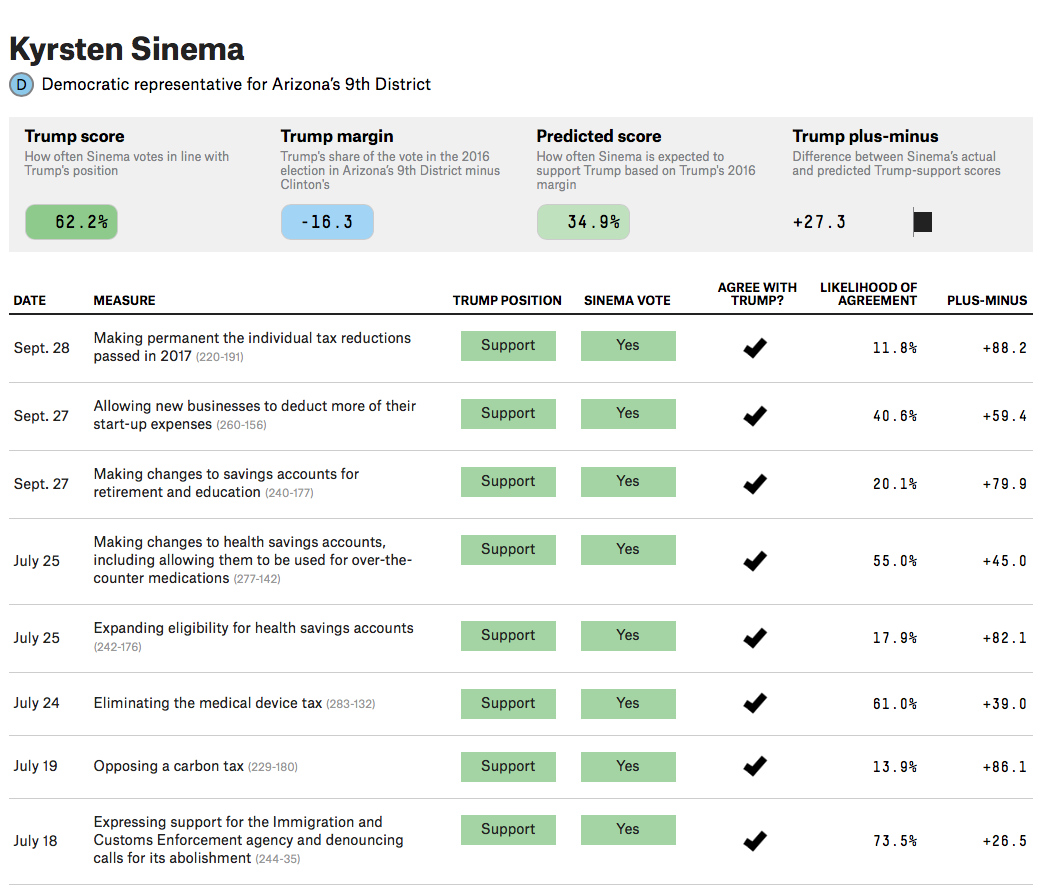
And this is quite the Trump adhesion score for a so-called Democrat-- even for a damned Blue Dog!


Labels: , ,

Friday, September 28, 2018

Recruiting Republican-Lite Candidates For Senate-- Good Idea? Bad Idea?

>

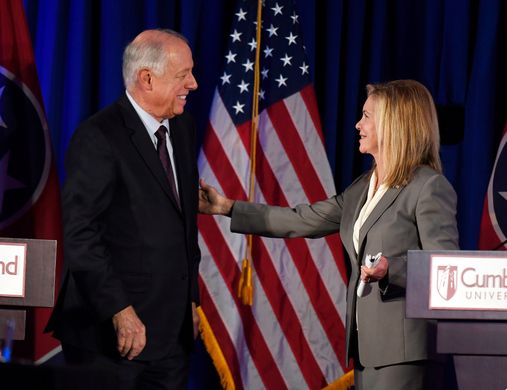
Bredesen is like a moderate Republican; Blackburn is a neo-fascist

Schumer decided to try to win back the Senate by going the Republican-lite route. He hand-picked the single worst Democrat in Congress, Blue Dog chair Kyrsten Sinema, to run for the open Arizona seat, former Tennessee 2-term Governor Phil Bredesen, also a conservative, to run for the open seat there, and in Nevada chose Jacky Rosen, a multimillionaire but unproven right-of-center congresswoman with no accomplishments to her name, whose only chance to win is via a big anti-red wave. Recent polling shows Sinema and Bredesen consistency-- if narrowly-- ahead while Rosen lags incumbent Senator Dean Heller, also narrowly. Still, the FiveThirtyEight forecaster shows her slightly ahead (and Bredesen slightly behind):


One strategy the Democrats seem to have agreed on in Arizona and Tennessee is for Sinema and Bredesen to show their independence by vowing that they won't support Schumer for Senate leader, a silly proposition, but one that makes a point in red states. Neither is going to vote for McConnell and there is no Democratic alternative. Schumer doesn't need their votes. He may have even suggested the ploy-- and he certainly agreed to it.
Tennessee Democrat Phil Bredesen said at a debate Tuesday that if he is elected to the Senate, he would not back Minority Leader Chuck Schumer to continue as Democrats' leader.

Bredesen made the announcement during the opening statements of his first debate with the Republican nominee, Rep. Marsha Blackburn. Bredesen said Washington had become "hyperpartisan" and blamed current leadership in both parties.

"You've heard a lot recently of this campaign about me, about these crazy ideas about if somehow I'm elected and go to Washington, suddenly I'm going to turn my back on a whole lifetime of thinking for myself and being independent and suddenly become some kind of a political lackey," Bredesen said. "That's not going to happen for a bunch of reasons. One of them is that I think a lot of the problem in Washington is with the leadership that we have there now. Whether it be [Speaker Paul] Ryan or [Minority Leader Nancy] Pelosi or [Majority Leader Mitch] McConnell or Schumer, they're not doing the job.

"We need to get new leadership. I can tell you right now that if I'm elected, and when I'm elected and go to Washington, I am not going to be voting for Chuck Schumer," Bredesen said.

It's the latest effort Bredesen has made to show independence from national Democrats while running in solid-red Tennessee, which President Donald Trump carried by 26 percentage points in 2016. Bredesen has also played down his party's chances of winning the Senate majority in the fall, to try to keep crossover voters in his camp.

But the former governor's pledge to vote against Schumer is his largest break from the Democratic Party thus far. Rep. Kyrsten Sinema of Arizona is the only other Democratic battleground Senate candidate who has pledged to vote against the party's leader.

The pledge is functionally useless-- unlike in the House, where the speaker is chosen by a majority of the chamber in a floor vote, Senate party leaders are chosen by a majority in a private caucus vote. While there might be enough Democratic House candidates to deny Pelosi the 218 votes she needs to become speaker again, there is virtually no chance of Schumer being dethroned by the Democratic Caucus after the election.

Blackburn brushed off Bredesen's vow to vote against Schumer, repeatedly attacking the Democrat as "bought and paid for" by the Senate minority leader. Majority Forward, a nonprofit organization aligned with Schumer, has spent more than $3.5 million on ads in the Tennessee race so far, according to the Federal Election Commission. The group has even more ads reserved for this fall.

"We know he will vote with Chuck Schumer because his vote is already bought and paid for, his campaign is bought and paid for by Chuck Schumer," Blackburn said.

"I do think we all know that Phil had a choice. He could have run as a Republican or independent. Probably didn't want to do that. He's running as a Democrat so he will be with Chuck Schumer if he were to go to Washington," she continued.
Back in July, Politico first reported that Sinema said she isn't going to vote for Schumer and about how deferential she is towards Trump. "I am not going to vote for him," she said matter of factly when asked about Schumer by a reporter, who reported that "Schumer privately backed her for the seat even before she’d announced, helping clear the field."
Her opposition to Schumer is just one example of how the three-term House member is carving out a center-left [they actually mean center-right but the reporter is too dull-witted to know it] Senate campaign in the Republican state, hoping it’s enough to inoculate herself from the national party’s baggage and land Democrats their first Arizona Senate seat in 30 years.

She is notably more deferential to Trump than most Democrats are. “He has challenges,” she responded when asked whether Trump is a good president. “Transitioning from a CEO position to a presidency is probably a difficult challenge.”

...Sinema is continuing her campaign against national Democrats, which started with her opposing Nancy Pelosi as the House Democratic leader.

“The Democratic leadership has failed Democrats across the country,” Sinema said. “I am unafraid to say what I believe about what I think our party needs to do and I think our party needs to grow and change.”

Sinema aligned herself early on with the centrist wing in the House Democratic Caucus, becoming a close ally of Minority Whip Steny Hoyer (D-MD), Pelosi’s No. 2 and longtime rival. She also forged close relationships with conservatives such as Reps. Tom Graves of Georgia and Trey Gowdy of South Carolina over a shared love of fitness.

...Sinema is a polarizing figure among House Democrats. Some members privately question whether her evolution from flame-throwing liberal to Blue Dog centrist is genuine or self-serving. And there’s no love lost between Sinema and Pelosi allies.

...At times, Sinema sounds more like a Republican than a moderate Democrat, a sharp contrast from Rep. Jacky Rosen of Nevada, another Senate candidate carving a far more liberal path [total Politico nonsense] against GOP incumbent Sen. Dean Heller.

Sinema gushes praise for Trump when it comes to veterans issues. Both of Sinema’s brothers are veterans, and that’s been a primary focus of her congressional career.

“President Trump has signed every single piece of veterans legislation we’ve sent him, including some bills that we couldn’t get to President Obama,” she said.

And Sinema defends her voting record on immigration, including support of controversial Republican proposals that most other House Democrats opposed. She voted for Kate’s Law last year, for example, which increases penalties for undocumented immigrants who are deported and try to re-enter the country.

“My leadership in that area,” Sinema said, “is about holding bad guys accountable and making sure that we have good security on the border.”
You know how worried everyone is now that some of the senators from the Republican wing of the Democratic Party may vote to confirm Kavanaugh-- particularly Manchin, Donnelly and Heitkamp? Sinema, Bredesen and Rosen will be worse for the Senate Democrats to deal with on a wide range of issues-- especially Sinema. It wouldn't surprise me in the least if she eventually jumps the fence and joins the Republican Party. She doesn't believe in anything at all but her own career and I'd say-- after spending far more time with her than I ever should have-- that she's clinically insane.

Labels: , , , , , ,