
Trump's Proposal Was Radical-- AOC And Elizabeth Warren Are Reformers
>


His latest, AOC Thinks Concentrated Wealth Is Incompatible With Democracy. So Did Our Founders, shows he still has a poetic heart. He's become a reliable defender of Alexandria Ocasio every time the forces of the extreme right mass against her and her program. When Hannity spewed out his creed about how "general economic equality is not a precondition for the American dream, but rather, an insurmountable obstacle to it," as a way of trying to rouse his viewers against Ocasio's tax ideas, Levitz noted that "after popularizing the idea of a 70 percent top marginal tax rate earlier this month, the freshman congresswoman recently suggested that the mere existence of billionaires was both immoral, and a threat to American democracy."
What Ocasio said (in an interview with Ta-Nehisi Coates on Martin Luther King Day) was that she doesn't "think that a system that allows billionaires to exist when there are parts of Alabama where people are still getting ringworm because they don’t have access to public health is wrong.” The day day Ocasio approvingly quoted an op-ed by the economists Gabriel Zucman and Emmanuel Saez, which argued that the purpose of high taxes on the wealthy wasn’t merely to generate revenue, but rather, to safeguard "democracy against oligarchy." Recall, these are the two who have been advising Elizabeth Warren on the matter of her wealth tax proposal.
Hannity’s not buying it. The Fox News host informed his audience Wednesday that Ocasio-Cortez had “called the American dream immoral,” and that she wants to “empower the government to confiscate” said dream. “Better hide your nice things,” Hannity advised his audience (whom he ostensibly believes to be composed primarily of billionaires), “because here come the excess police.”
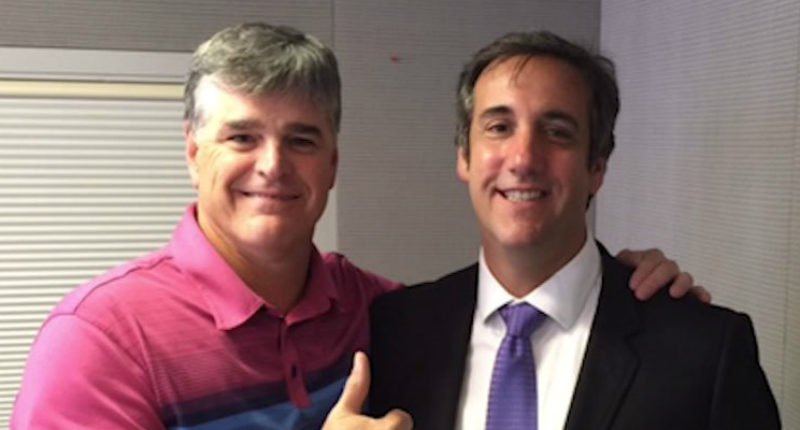
Hannity and his attorney
Hannity was hardly alone in deriding AOC’s antipathy for billionaires as fundamentally un-American. But in reality, there’s nothing foreign or communistic about the idea that concentrated wealth is incompatible with democracy, or all-too compatible with mass poverty. Republicans might call such notions radical. But many of our republic’s founders would have called them common sense.
Compare AOC’s first argument-- that the simultaneous existence of billionaires and poverty is immoral, and thus justifies steeply progressive taxation-- with Thomas Jefferson’s reflections in 1785. During a visit to the French countryside, Jefferson found himself scandalized by “the condition of the labouring poor.” In a letter to James Madison, Jefferson wrote that the extremity of European inequality was not only morally suspect, but economically inefficient. Aristocrats had grown so wealthy, they were happy to leave their lands uncultivated, even as masses of idle workers were eager to improve it. Thus, these proto-billionaires undermined both the peasants’ ability to transcend mere subsistence, and their society’s capacity to develop economically:
[T]he solitude of my walk led me into a train of reflections on that unequal division of property which occasions the numberless instances of wretchedness which I had observed in this country and is to be observed all over Europe. The property of this country is absolutely concentered in a very few hands…I asked myself what could be the reason that so many should be permitted to beg who are willing to work, in a country where there is a very considerable proportion of uncultivated lands? These lands are kept idle mostly for the aske of game. It should seem then that it must be because of the enormous wealth of the proprietors which places them above attention to the increase of their revenues by permitting these lands to be laboured.Here is how Jefferson proposes to address the obscene coexistence of concentrated wealth and underemployed workers:
I am conscious that an equal division of property is impracticable. But the consequences of this enormous inequality producing so much misery to the bulk of mankind, legislators cannot invent too many devices for subdividing property, only taking care to let their subdivisions go hand in hand with the natural affections of the human mind. The descent of property of every kind therefore to all the children, or to all the brothers and sisters, or other relations in equal degree is a politic measure, and a practicable one. Another means of silently lessening the inequality of property is to exempt all from taxation below a certain point, and to tax the higher portions of property in geometrical progression as they rise. Whenever there is in any country, uncultivated lands and unemployed poor, it is clear that the laws of property have been so far extended as to violate natural right…It is too soon yet in our country to say that every man who cannot find employment but who can find uncultivated land, shall be at liberty to cultivate it, paying a moderate rent. But it is not too soon to provide by every possible means that as few as possible shall be without a little portion of land. The small landholders are the most precious part of a state. [Emphasis Levitz's.]If Ocasio-Cortez’s views are un-American, then surely these words from our third president’s are, as well.
...[AOC is] channeling one deeply rooted strain of American thought on economic morality. And while that strain might have been marginal among the leaders of the American Revolution, it was pervasive among its foot soldiers (there’s a reason the leading propagandist of the war effort, Thomas Paine, was one of the earliest champions of an American welfare state).
Regardless, Ocasio-Cortez’s second argument against the existence of billionaires-- that concentrated wealth is incompatible with genuine democracy-- was something close to conventional wisdom among the founders (including those who opposed democracy).
America’s first political theorists took these truths to be self-evident: that a person could not exercise political liberty if he did not possess a modicum of economic autonomy, and that disparities in wealth inevitably produced disparities of political power.
The notion that political freedom has a material basis did not originate with Karl Marx and the creed of Communism; it was a core idea of the 17th-century British political theorist James Harrington, and his formulation of classical republicanism. A man who does not own the means of his own reproduction can never exercise political freedom, Harrington argued, because “the man that cannot live upon his own must be servant.” Likewise, the man of immense wealth-- whose fortune consigns great masses of men to servitude-- is inevitably a kind of tyrant. After all, “where there is inequality of estates, there must be inequality of power, and where there is inequality of power, there can be no commonwealth.”
These premises deeply informed the American founders’ conception of republican liberty. The Jeffersonian ideal of a yeoman’s republic derived from the conviction that only independent landowners were politically free-- and only a (very) rough equality in the distribution of land could preserve such freedom. Even a consummate elitist like Alexander Hamilton couldn’t help but echo Harringtonian thinking, writing in the Federalist Papers, “A power over man’s subsistence amounts to a power over his will.”
...Thus, Ocasio-Cortez’s belief in the moral necessity of mass democracy (and women’s suffrage, and the abolition of slavery) would have struck many a Founding Father as radical. But her insistence that true democracy is incompatible with America’s present distribution of property-- in which the richest 0.1 percent of Americans command as much wealth as the poorest 90 percent-- would have struck Jefferson & Co. as tautological. And a large body of political science research suggests that their shared intuition is correct.
All of which is to say: If the right to self-government is an inextricable component of the American dream, then it isn’t AOC who regards that dream as immoral-- it’s Sean Hannity, and every other multimillionaire who believes that legislators should not invent “many devices for subdividing property.”


Because the government controls how many dollars are out in the economy, Kelton and MMT said Congress and the president shouldn’t worry about balancing the money coming in through taxes with the money going out to fund government programs.
For those of you screaming “Inflation! Inflation! Inflaaation!” at the idea of the government creating fresh money every time it needs to pay the bills, calm down. The MMT economists know about Weimar, Germany, too. If Congress stops worrying about balancing the budget, Kelton said the government could spend too much money into the economy with ambitious programs and end up causing inflation.
That’s where tax policy comes in. Kelton said taxes can act as a “release valve” for inflation.
To wrap your brain around this concept, picture a bathroom sink. Think of the government and its ability to create more money whenever it needs to as the faucet and that bucket area of the sink where the water goes as the economy.
The government controls how much money, or water, is flowing into the economy. It spends money into the economy by building interstates or paying farm subsidies or funding programs.
“And so as those dollars reach the economy, they begin to fill up that bucket, and what you want to do is be very mindful about how full that bucket is getting or you're going to get an inflation problem,” Kelton said.
Inflation is where the sink overflows. If that happens, Kelton said there are two ways to fix it: “You can slow the flow of dollars coming into that bucket. That means the government then has to start slowing it's rate of spending, or you can open up the drain and let some of those dollars out of the economy. And that's what we do when we collect taxes.”
Let's back up for a second and think how this stuff works. Chairman Jay Powell and the gang at the Federal Reserve are the people thinking about the economy's big picture and keeping that water level right.
The Fed uses monetary policy-- interest rates-- to keep that sink we were talking about from getting too empty or too full. The MMT folks want Congress to be doing that using fiscal policy-- government spending and taxing decisions.
Randall Wray, a senior scholar at the Levy Economics Institute at Bard College and one of the developers of MMT, said he thinks the Fed should stop focusing on inflation.
“If you ask what I think ideal monetary policy would be, what the Fed really should do is stabilize interest rates at a low level," he said.
The catch, of course, with telling the Fed to just keep interest rates low and controlling inflation with fiscal policy is the political reality in Washington.
“The making of fiscal policy, it’s never neat and tidy. It’s not efficient,” said Sarah Binder, senior fellow at the Brookings Institution and a political science professor at George Washington University. “The political constraints on members makes it harder to use fiscal policy and to use tax policy,” she said.
Running the federal government the way the MMT economists would if they were in charge would require Democrats and Republicans to change the way they think about fiscal policy and monetary policy.
Labels: Alexandria Ocasio, Bartiromo, economic inequality, Eric Levitz, founding fathers, Kai Ryssdal, MMT, Sean Hannity, Stephanie Kelton, Thomas Jefferson, wealth tax
posted by DownWithTyranny @ 9:00 AM
5 comments
|
Reddit


