Monday, August 10, 2020

No One Can Force A Presidential Candidate-- Let Alone A President-- To Read (Or Understand) The U.S. Constitution... Trump's Executive Orders

>


The big news Sunday was Trump's executive orders after he sabotaged the negotiations with Congress for a pandemic relief bill. No doubt, his zombie followers will eat it up. No one else will. Jim Tankersley did an analysis for NY Times readers-- Trump’s Go-It-Alone Stimulus Won’t Do Much to Lift the Recovery. He wrote that Señor Trumpanzee's executive actions "were pitched as a unilateral jolt for an ailing economy. But there is only one group of workers that seems guaranteed to benefit from them, at least right away: lawyers." The orders include an eviction moratorium, a new benefit to supplement unemployment assistance for workers and a temporary delay in payroll taxes-- although if re-elected he's planning to make it permanent, a way to fulfill nearly 9 decades of GOP dreams to end Social Security. "They could," wrote Tankersley, "give renters a break and ease payments for some student loan borrowers. But they are likely to do little to deliver cash any time soon to Americans hit hard by the recession. Even conservative groups have warned that suspending payroll tax collections is unlikely to translate into more money for workers. An executive action seeking to essentially create a new unemployment benefit out of thin air will almost certainly be challenged in court. And as Mr. Trump’s own aides concede, the orders will not provide any aid to small businesses, state and local governments or low- and middle-income workers. If the actions signal the death of a congressional deal to provide that aid, economists warn, the economy will limp toward November without the fiscal support that hastened its recovery after its quick dive into a pandemic-induced recession."
The federal government’s aid to small businesses through the Payroll Protection Program was set to expire on Saturday. Executives, trade groups and business lobbyists had pushed hard for a second round of lending-- along with new programs to get money to the businesses and industries hit hardest in the crisis-- to be included in any congressional stimulus deal. Mr. Trump’s actions do nothing to help those companies.

Low- and middle-income families’ spending power was bolstered in the spring by direct payments of $1,200 per adult that were included in a relief bill Mr. Trump signed into law in March. Lawmakers were pushing for a second round of those checks in a legislative deal. Mr. Trump’s measures will not provide them.

The orders will not provide aid to states and local governments, whose tax revenues have plunged as a direct result of the contraction in economic activity brought on by the virus. Without more money from the federal government, states and local governments will almost certainly have to cut their budgets and lay off workers, increasing the ranks of the unemployed.

Supplemental unemployment benefits of $600 per week, which expired at the end of July, had been supporting consumer spending at a time when about 30 million Americans are unemployed. Mr. Trump’s memo seeking to repurpose other money, including federal disaster aid, to essentially create a $400-a-week bonus payment is likely to be challenged in court and is unlikely to deliver additional cash to laid-off workers any time soon. It, too, raises questions even if it is deemed legal-- for instance, whether states that are already struggling with their budgets will be able to afford the 25 percent contribution that Mr. Trump’s memo says they will need to make toward the new benefit.

...But if negotiations falter now and aid remains scarce for people and businesses, Mr. Trump will be making a political bet: that it is better to tell voters he tried to help the economy than to have actually helped it. Mr. Trump is the president, and he has happily claimed credit for the economy’s performance.

If job growth slows further, and millions of unemployed Americans struggle to make ends meet, he will need to make the case for why the symbolism of acting alone won out over the farther-reaching effects of cutting a deal.


On State of the Union yesterday, Pelosi told Dana Bash that "whether they're legal or not takes time to figure out. I associate my remarks with what the Senator Sasse who says, they're 'unconstitutional slop.' Right now we want to address the needs of the American people. As my constitutional advisers tell me, they're absurdly unconstitutional." In case anyone doesn't understand what Pelosi was saying there, Alan Grayson, a bona fide genius, explained that "The Trump executive orders are not only illegal, but they’re unconstitutional. Anyone who tries to implement them will be facing criminal charges under the Antideficiency Act, 31 USC 1341. And, obviously, this is an impeachable offense, a “high crime” that abuses the power of the office. Trump is a Constitutional pyromaniac. As to the policies in the executive orders, the emperor has no clothes, so he’s trying to steal the Democrats’ clothes. It’s pathetic to watch the orangutan scratch his belly, screetch, and pretend that he gives a damn about anyone else."

Tom Suozzi (D-NY) represents the North Shore of Long Island, from the border of AOC's district in Queens (Whitestone and Beechhurst) straight thru Nassau and into Suffolk as far as Kings Park and the Nissequogue River. The former Nassau County Executive, Suozzi is now a member of the House Ways and Means Committee. Understanding how tax dollars are raised and spent is his field of expertise. And this morning, discussing Trump's clownish executive orders, he told us that "It’s not about the merits of $400 unemployment (of which $100 is paid by the states), or a payroll tax cut (which will decimate Social Security) or any of his executive orders. It is about the fact that it’s ILLEGAL. It is why we have a Congress. The President can’t, other than in limited instances, just do what he wants, especially when it comes to spending money. It’s just more in a long list of gimmicks by a failing president trying to hold on to power."


The Washington Post assigned a team to work on figuring it out-- Jeff Stein, Erica Werner and Renae Merle. They saw it-- as did much of Congress-- through the parameters of Trump's challenge to the constitutional order. "The measures," they wrote, "would attempt to wrest away some of Congress’s most fundamental, constitutionally mandated powers-- tax and spending policy. Trump acknowledged that some of the actions could be challenged in court but indicated he would persevere. Trump bemoaned how Democrats had refused to accept his demands during the recent negotiations but attempted to brush it aside, saying four measures he signed Saturday 'will take care of pretty much this entire situation.' But there were instant questions about whether Trump’s actions were as ironclad as he made them out to be. A leading national expert on unemployment benefits said one of the actions would not increase federal unemployment benefits at all. Instead, the expert said it would instead create a new program that could take “months” to set up. And Trump’s directive to halt evictions primarily calls for federal agencies to 'consider' if they should be stopped. Trump also mischaracterized the legal stature of the measures, referring to them as 'bills.' Congress writes and votes on bills, not the White House. The documents Trump signed on Saturday were a combination of memorandums and an executive order."

McConnell cheered him on, although he didn't explain why Trump's executive actions didn't include a second $1,200/person stimulus check that Congress had already agreed to. As Forbes reported, Trump targeted a payroll tax, reduced unemployment benefits, a bogus eviction moratorium study that won't keep a single family from being evicted and some student loan relief that will do little to help anyone "as his four areas of focus for an executive order. He never mentioned including stimulus checks as part of his executive order plan."


Jack Balkin summed up the unemployment aide program part of Trump's made-for-TV ploy on his must-read blog as Inadequate, Unworkable, and Unlawful. He wrote that Trumpanzee's "effort to relieve the pressure he and Senate Republicans have been feeling over the expiration of enhanced unemployment benefits is a failure on every level. It provides too little in aid. It will miss many families in need. It will expire very soon. It likely cannot be implemented in some states. And it is transparently unlawful."


How many lies can you count? As Alan Grayson put it the day after Trump's nationally televised half hour of gaslighting, "I would advise anyone who is still under the illusion that Trump is fit for office to listen to his speech yesterday. He is a babbling fool and a Constitutional pyromaniac, with a human applause track wired in the room to feed his infinite, insatiable ego."

Jim Himes (D-CT), like every congressional Democrat I've spoken to, is not satisfied with how the GOP is handling this, not even a little. "The so-called executive orders are way too little, way too late," he told me. "Americans are suffering badly and the Republican response has been to 'hit pause,' then to ask for F-35s and full expensing of business lunches, and now to offer weak presidential action. It is time for my Republican colleagues to summon even a fraction of the passion and enthusiasm with which they cut the corporate tax rate from 35% to 21% to actually help the American people in a historic crisis."


Labels: , , , , , , ,

Tuesday, January 28, 2020

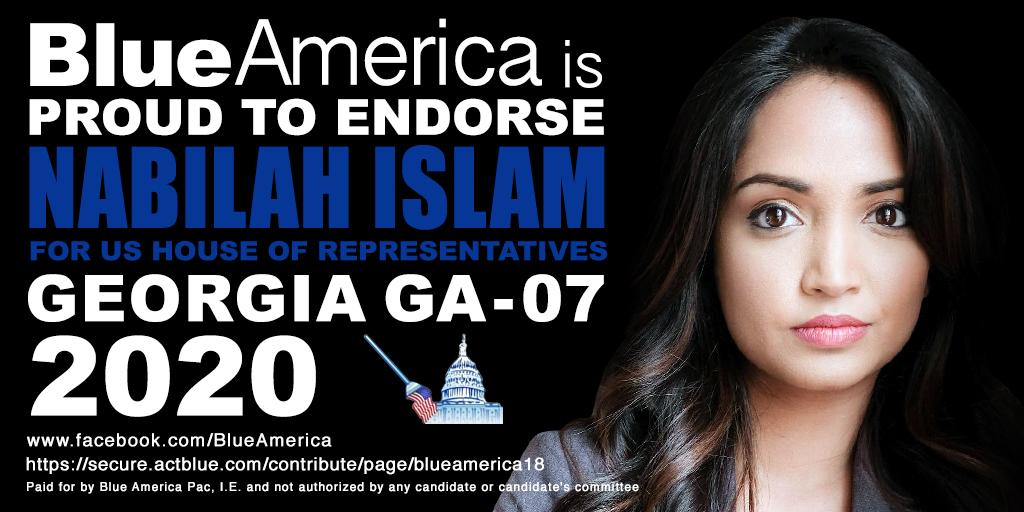
Nabilah Islam For Congress-- Making Georgia Bluer And More Equitable

>


The most recent candidate endorsed by Blue America, Nabilah Islam, sometimes stands out from the crowd because of her name, which for old people, doesn't sound like a name from the Georgia suburbs. Others (men) remark not on her name but on her physical appearance. What people don't realize-- at least not until they get to know her is that Nabilah, despite how she looks and what he name is, is both an All-American girl and a policy wonk. During one of the endorsement interviews, we were discussing her support for Medicare-For-All and the Green New Deal. She mentioned that voters in Gwinnett and Forsyth counties have been asking "how you going to pay for it?" frequently. Fox News is a popular TV station there, even among Democrats. We offered to introduce her to economist Stephanie Kelton, who has been generously giving her time to help progressive candidates grapple with questions like that. Afterwards, I asked Nabilah to write about the experience. This is what she had to say:
My First meeting With Stephanie Kelton
-by Nabilah Islam,
candidate, GA-07

Before the end of the Year, I had the pleasure of connecting with Stephanie Kelton. For those of you who don’t know, Stephanie is an economist, Professor of Public Policy, former Chief Economist on the U.S Senate Budget Committee 2015 minority party staff, and a leading proponent of Modern Monetary Theory.

Modern Monetary Theory is a macroeconomic theory that describes Currency as a public monopoly for the government. The argument is that the government should use fiscal policy to achieve full employment creating new money to fund government purchases.

Stephanie is someone who is extremely generous with her time and has such great knowledge that she freely imparts on any candidates willing to listen. What I came to understand through speaking her is a far better understanding of how Modern Monetary Theory (MMT) works and why it should be applied to the policies that we progressives advocate for.

Understanding MMT is essential advocating for policies like Medicare for All, a Green New Deal, Free Public college, and any other policies that Republicans and centrists' only argument is “hOw ArE wE gOinG tO pAy fOr iT.”

Governments are not people, and their debt should not be treated the same. It is healthy for a Government to have debt, and when inflation actualizes, we issue bonds to reduce circulation. Stephanie also made a great point to me. For every 10 dollars, we invest in our economy as a government, especially in communities that need it, it only strengthens our economy even if that means only 1 dollar is returned.

Republicans already practice MMT at their leisure. When it’s time for War, detention centers, private prisons, or Big Ag, they will write a blank check with their eyes closed. The same goes for centrists when we want to bail out big banks, no problem. But, when it comes down to protecting our most vulnerable, making sure there’s an educated electorate, or protecting our planet, the funds are never there.


Stephanie’s guidance was most helpful in regards to explaining the implementation of a Green New Deal. Yes, it is expensive, but what is the alternative? The reality is the scientific community has dramatically underestimated the severity of the speed of climate change in America and around the world. We must invest in green infrastructure and move to a renewable-based economy. We have to invest in protecting our frontline communities. While doing all of this, we create up to 20 million good-paying union jobs. This is where MMT plays a considerable role. These are not funds that are spent into an abyss. They are direct investments into our economy, our country, and will continue to be circulated. So while deficit spending is a traditionally unpopular idea viewing this through the lens of MMT, it causes stimulation.

I’m very grateful for Stephanie’s time and expertise. I strongly encourage people reading her work and watching her videos whenever possible. The point is MMT is a practice that is already in place, but selectively. It’s time we fix our priorities. This is Public Money, and it is time it is appropriately allocated.
While Nabilah was getting a crash course in MMT, she was also working on an initiative that could change the course of political history-- at least in terms of making it more feasible for working class men and women to be able to run for office.

Almost a decade after the Affordable Care Act was signed into law, 27.5 million Americans still lack health insurance. Nabilah Islam, 30, a progressive political organizer running in the very crowded Democratic primary in Georgia’s 7th Congressional District, is among them. Islam has come up with a unique way to address her situation: She’s asking the Federal Election Commission for help. Many from the working class are hesitant to run-- or can't do it full-time-- because they can't afford to particularly when it comes to health insurance. Calling her Atlanta's own AOC, Helaine Olen covered Nabilah's initiative for the Washington Post last week. "In a letter that will be filed next Monday," wrote Olen, "Islam is petitioning the FEC for an advisory opinion that would permit her to use campaign funds to pay for health insurance. Her short-term goal is medical coverage. But in the long term, this daughter of working-class immigrants from Bangladesh also wants the regulations changed so that more lower- and middle-income people can afford to seek public office. In other words, more people like herself."
“Running for Congress is an expensive endeavor and often cost prohibitive for working Americans,” Islam wrote in her filing. “Running for office while working-- even part-time-- severely limits your ability to campaign effectively. People with financial security are better positioned to campaign full-time while living on their savings.”

One result? Congress is hardly representative of the American public. About 40 percent of members are millionaires, compared with 3 percent of the U.S. population.

This isn’t, as Islam points out, simply because the rich hanker for political positions and power, while their working- and middle-class counterparts do not. It’s because people who lack significant financial resources face structural barriers that make it harder to get in a race and stay in.

Such as how to pay for health insurance.

Islam explained during a telephone interview she initially thought she would hold down a part-time position while competing for the congressional seat. She found that impossible. Running for Congress is a full-time job. She has instead put her student loans into forbearance and canceled her health insurance and is living off savings.

She knows she’s taking a risk: “If something happens to me, I could end up with thousands of dollars in medical bills.” But Islam says she can’t afford to do anything else. The average cost of an individual policy in 2019 was more than $7,000.

True, Islam was paying $120 a month. There was a trade-off involved. In technical terms, Islam says her policy did not comply with the Affordable Care Act. In layman’s terms, that means it wouldn’t have covered such events as the hospital bills if she got hit by a car while canvassing. “Junk,” she called it.

Such as how to pay for health insurance.

Islam explained during a telephone interview she initially thought she would hold down a part-time position while competing for the congressional seat. She found that impossible. Running for Congress is a full-time job. She has instead put her student loans into forbearance and canceled her health insurance and is living off savings.

She knows she’s taking a risk: “If something happens to me, I could end up with thousands of dollars in medical bills.” But Islam says she can’t afford to do anything else. The average cost of an individual policy in 2019 was more than $7,000.

True, Islam was paying $120 a month. There was a trade-off involved. In technical terms, Islam says her policy did not comply with the Affordable Care Act. In layman’s terms, that means it wouldn’t have covered such events as the hospital bills if she got hit by a car while canvassing. “Junk,” she called it.

Monica Klein, the political consultant advising Islam, previously worked with Long Island’s Liuba Grechen Shirley, who successfully petitioned the FEC for permission to use campaign funds to cover her child-care expenses. Klein told me she sees similarities between the two woman’s quests. “Like Liuba, Nabilah isn’t just running for office,” she said. “Liuba and Nabilah are both working to dismantle the conditions that keep Congress overwhelmingly white, wealthy and male.”

But Islam is unlikely to meet with similar quick results. That’s got nothing to do with the merits. President Trump hasn’t bothered to nominate candidates to fill the three openings on the six-member commission, leaving the FEC short of the necessary quorum needed to hold meetings or issue rules.

Goal ThermometerThis is obviously a bigger issue than Islam’s request. As Jeff Hauser, the executive director of the Revolving Door Project, noted, “Without a quorum, campaigns seeking to push-- or shred-- the envelope of legality can do so bolstered by the certainty the FEC cannot open investigations or issue fines.”

But requests for rulings that come in during this period don’t go away. The FEC will consider them when a quorum is restored. Islam’s request could eventually make it easier for other less-than-privileged candidates to run for office. That’s a win, no matter how Islam ultimately performs. “I really believe that we need more people like me, more people with my working-class background who grew up with parents that worked low-wage jobs,” Islam said. “If there are more Nabilahs in Congress, I assure you, things like Medicare-for-all, things like a living wage, $15 an hour, would just be a no-brainer.”


Labels: , , , , ,

Sunday, September 15, 2019

Progressive African-American Pastors Identify How Establishment Democratic Economics Have Devastated Their Communities

>


On Friday Dr. Delman Coates, senior pastor of Mt. Ennon Baptist Church in Clinton, Maryland wrote a post for Sojourners on the economic issues facing African-American voters struggling with a decision about who to back in the Democratic primary. Dr. Coates has a good solid grounding in Modern Monetary Theory (MMT) and in how the Democratic establishment hasn't done nearly as much as it could have for African-Americans who make up much of the base of their party. "As African-American faith leaders committed to the social justice tradition of the Black Church," he wrote on behalf of 22 woke pastors, "we would like to raise our voices to point out that it is not lost on us that Larry Summers and the establishment economists have done immense damage to the communities we serve, as well as to the broader American public, via their influence on economic policymaking. We recognize in the new school of economic thought, called Modern Monetary Theory (MMT), a credible, highly impressive, and genuinely public-spirited alternative to the disastrous economic stewardship offered by the old guard. MMT also offers a powerful theoretical defense of the Federal Job Guarantee, a proposal that was pioneered by America’s first black economist, Sadie Alexander, and a centerpiece of the activism of civil rights icon, Coretta Scott King."
As for the establishment economists, we have not forgotten that it was, in large part, their economic stewardship that ultimately brought us decades of stagnant wages, mass incarceration, deteriorating public schools, sky high levels of student debt, the worst health care system in the “developed” world, a housing affordability crisis, the Great Recession, the rise of Trump, and perpetual delay of action to tackle the climate crisis. The communities we serve are among the hardest hit by each of the items on this laundry list of national emergencies. It is time for a changing of the guard, and we urge our fellow citizens and community advocacy organizations to join us in calling on our elected representatives to educate themselves in the new economic thinking that has the potential to enable us to right our ship before it is too late.

In 1992, President Bill Clinton was elected with a mandate for progressive reform, the centerpiece of which was his proposed middle-class tax cut. Upon taking office, however, he promptly capitulated to the admonitions of what is now the old guard, Rubin Wing of the Democratic Party, of which Summers was and remains a key player. The bond vigilantes, they said, would not tolerate the implementation of Clinton’s democratic mandate. If Clinton proceeded with his agenda, these bond traders would dump treasury debt en masse, driving up our federal government’s borrowing costs. The only responsible thing to do, it was argued, was to capitulate to the bond market and undertake an aggressive policy of deficit reduction. By the end of his administration, Clinton boasted a budget surplus, having abandoned his original agenda and mandate, largely aligning Democratic Party economic policymaking with the “small government” economic agenda of the Republican Party. Along the way, Summers and the Rubinites, with the enthusiastic cooperation of the Republican Party, oversaw the deregulation of Wall Street and derivatives markets, setting the stage for the subprime bubble and collapse we would later see culminate in 2008. This harmful superstition of prioritizing the balancing of our federal budget maintains its grip on the Democratic Party to this day in the form of the “Paygo” provision in the House rules package.

What Summers and the Rubinites failed to mention to President Clinton was that the interest rates on treasuries are, in fact, entirely subject to the control of our federal government, via the Federal Reserve, as was demonstrated clearly during World War II. By failing to alert President Clinton to the full extent of our public power, they ceded veto power over our democracy to financial markets at a time when it was entirely unnecessary. Then, after leaving on the table public spending capacity that could have been used to attend to public priorities, they oversaw, via the deregulation of finance, an expansion of private credit creation that ultimately led to an unprecedented destruction of black wealth in the foreclosure crisis.

With federal spending considered off-limits, the financial sector becomes the only game in town for financing the development of our communities. By failing to use the full extent of our capacity for responsible public spending, we needlessly leave the American people as sitting ducks for an often-predatory Wall Street. This must change.

At the core of MMT is a recognition of the importance of integrating an accurate understanding of money creation into our economic thinking. While the old guard dismisses money creation as an unserious recipe for hyperinflation, the challengers show us that money creation is in fact ubiquitous. It takes place in our federal spending, the financial sector’s credit creation, and even our government’s issuance of treasuries, which are properly understood as a form of money. Contrary to mischaracterizations by opponents like Summers, MMT argues not that we can create money indefinitely without an impact on inflation, but that inflation, rather than tax revenue or interest rates, should be viewed as the actual constraint on public spending. This may seem like a minor adjustment, but the implications are profound.

Over the past 20 years, our federal government has done about $15 trillion worth of deficit spending, which is properly understood as money creation through public spending, in excess of tax receipts. Yet the Federal Reserve has typically undershot its inflation target over this period. This means that had we constrained ourselves to a balanced budget approach, we would have left at least $15 trillion in public spending capacity on the table. How much more public spending capacity, that could be deployed on behalf of our most deeply held and brutally neglected public priorities, do we leave on the table by following the old guard’s advice?

In the meantime, we leave most of the deficit spending to the Republicans, to be spent on tax cuts and wars, while the Democratic Party presents itself as the party of seriousness and responsibility, lamentably handcuffed in their ability to deliver what the public wants. Our public priorities go unattended to, with for-profit substitutes for basic public services stepping in to fill the void. The financial sector creates and allocates what are, in essence, public funds with little public accountability, while Washington selectively frets about how to pay for things. In the absence of more robust public spending to attend to our public priorities, we turn to the financial sector to help us muddle through, and our household debt mounts. Our increasing dependence upon these private-sector substitutes for basic public services is sold to us as a matter of dignity and self-reliance.

We say, “no more.” The notion that dignity and self-reliance are to be found only in the private sector has proven to be an insidious trap. What could be more dignified than exercising our democratic power on our own public behalf? We must learn to see our government as a tool of empowerment for our communities, and demand it be deployed accordingly. It is high time that the public exercise the full extent of its capacity for responsible money creation on behalf of public priorities, from full employment, to universal health care, to education, and affordable housing. “No more” to leaving our public priorities unattended to while predatory, for-profit substitutes fill in the void. “No more” to leaving the power and responsibility of creating our money to an unaccountable financial sector.

The old guard economists have long provided the Democrats with the false alibi for their failure to serve the public to which they are accountable: the idea that using our public power of money creation to attend to public priorities is somehow “irresponsible.” It is time we see this alibi for the irresponsibility and economic malpractice that it is. With the danger of another four years of Trump and the failure to address the climate crisis looming, there is no time to defer to the inertia of sticking with the familiar. We stand with the Modern Monetary Theory academics in their siege of the ivory tower, and we call on all who care about our common future to do the same.

Labels:

Wednesday, March 13, 2019

Democrats Can Pile On About What A Nightmare Trump's Budget Is-- But Can't Come Up With One Of Their Own?

>


If the budget is a statement of values, the Democrats' presumed inability to unite behind one, speaks volumes about a party whose tent is too big to be functional. Trump's DOA budget will never get a vote but his intention of a high increase for the Pentagon and paying for his vanity wall by cutting Social Security, Medicare and Medicaid is all anyone needs to know about his values and his party's values. Trump's obscene $4.7 trillion budget would cut $845 billion from Medicare-- didn't he say he was the only Republican who would never cut that?-- $241 billion from Medicaid and slash Social Security by $25 billion over 10 years-- not to mention drastic cuts to food stamps and a $207 billion cut to student loans including the outright elimination of the Public Service Loan Forgiveness program. Democrats will have a field day demonizing his budget-- and rightly so. But what about their own?

Yesterday Sarah Ferris and Heather Caygle, reporting for Politico, wrote that though the Democrats have finally gained back control of the House "they’re likely to skip one of their most fundamental responsibilities: passing a budget. Eager to steer clear of another public intraparty battle, House Democrats are expected to avoid a vote on a budget this year."
House Democrats are still drafting a budget, which would offer their first chance as a new majority to formally outline their broader agenda. But the resolution-- which is purely a political messaging document and is not signed into law-- would also stoke major ideological clashes within the caucus over “Medicare for All,” the “Green New Deal” and defense spending.

“We’re still proceeding as if we’re going to do one, but we’re also considering other options because we don’t know if we can get 218 votes for anything,” House Budget Chairman John Yarmuth (D-KY) said in an interview Monday.

Indeed, in a worst-case scenario for Speaker Nancy Pelosi and her party, the budget could be an embarrassing flop on the House floor.

Most Democrats say publicly they want a chance to vote on their party’s fiscal blueprint after eight years of rejecting GOP budgets.

Privately, however, lawmakers and aides say that a budget is unlikely to come for a final vote. It’s an acknowledgment of the divisions within the caucus even on key principles, and a sign of how difficult it will be to craft actual legislation in the months to come.

Democratic leaders have made no formal decision, though Yarmuth met Monday with Pelosi and other top Democratic leaders, including House Appropriations Chairwoman Nita Lowey (D-NY), as they discussed skipping a floor vote. That meeting comes after Yarmuth has spent weeks huddling with dozens of committee and caucus leaders as he strives to bring it to the floor despite the daunting odds.

Several senior Democratic aides said it makes little political sense to spend weeks perfecting a messaging document when there are other items with far greater partywide appeal on their to-do list, like an upcoming vote to address the gender pay gap.

That’s particularly true, they added, after the caucus’ factions openly warred last week over how to handle Rep. Ilhan Omar’s comments criticizing pro-Israel advocates.

“I hope we can work through a budget process, but it will not be easy, and I get the idea that it may be impossible to arrive at consensus on that document,” said Rep. David Cicilline (D-RI), chairman of the Democratic Policy and Communications Committee.

“It’s ultimately a political decision whether to bring a budget to the floor,” Rep. Gerry Connolly (D-VA) added. “And so a pragmatic decision often gets made: Where do you want to put your political capital?”

Yarmuth said his budget won’t include some of the most iconic ideas championed by progressives, like Medicare for All or the Green New Deal, which have been panned by moderates.

But he acknowledged in a separate interview last week that the decision could cost him votes from the party’s progressives: “The complicating factor is that there are members who probably would have a hard time voting for a budget that didn’t in some way anticipate the Green New Deal. Same thing with Medicare for All.”

House Democrats still plan to release their budget draft this month, which will be their counteroffer to the newly unveiled White House budget. Unlike spending bills to fund the government, Congress doesn’t need to pass a budget on the floor. The House and Senate rarely find agreement during divided government.


With a tricky electoral map for Republicans in 2020, Senate Majority Leader Mitch McConnell is unlikely to put his members through a budget vote on the floor, though his budget chairman, Mike Enzi (R-WY), has said he plans to draft one.

But failing to pass a budget would be an embarrassment for Democratic leaders, who hammered Republicans when they were in power for consistently struggling to unite over a party blueprint-- and failing to put one on the floor at all last year. House Republicans skipped a floor vote amid an ugly intraparty fight over how deeply to cut assistance programs for the poor.

It also wouldn’t be the first time Pelosi punted; her previous majority skipped a budget in 2010, even when Democrats controlled both chambers.

Still, Democrats had been expected to pass a budget this year after their decisive win in November, with their members eager to define their political brand and show progress to their base after two years in a GOP-controlled Washington.

This year’s historic freshman class, however, heightens the challenges for Democratic budget writers. Forty-three of the party’s new members come from previously Republican-held districts, and GOP operatives are watching closely for controversial votes.

Even with the rise of progressive lawmakers like high-profile freshman Reps. Alexandria Ocasio-Cortez of New York and Rashida Tlaib of Michigan, there are more Democrats in the centrist Blue Dog and New Democrat coalitions than in the Congressional Progressive Caucus.

Every major caucus and committee is in talks with Yarmuth and other top Democrats to craft this year’s blueprint. And every corner of the caucus will need to back the budget, because Democrats can afford to lose few votes on the floor.

Some moderates [Note: when Politico uses the term "moderate" to describe the far right of the Democratic Party, they are doing so help make the Republican-lite policies that wing espouses seem attractive to the casual reader] say they have little interest in squabbling over the fine print of a budget this year. Instead, they say Democrats should focus on the looming threat of another budget sequester, which would impose billions of dollars in cuts if Congress can’t reach a deal this fall.

“What matters is the numbers. A lot of the budget resolution ends up being sort of a messaging document, which I think most people here have less interest in,” said Rep. Derek Kilmer (New Dem-WA), co-chair of the New Democrat Coalition. “My hope is that we can thread that needle in a careful way.”


Rep. Kurt Schrader (Blue Dog-OR), a co-chair of the Blue Dog Coalition, said his group has only occasionally voted to support Democratic budgets on the floor in the past. This year, the group has worked behind the scenes to push for a budget proposal that wouldn’t add to the deficit, along with other demands, but hasn’t committed to supporting it.

“Maybe there’s an opportunity to have a paid-for budget that makes sense and we can get behind,” Schrader told reporters when asked about the budget’s prospects.

A deficit-neutral proposal, however, would force Democrats to make tough sacrifices when writing the budget. The outcome could anger defense hawks who want to see massive Pentagon budgets or progressives who want bigger investments in education and anti-poverty programs.

“The job he has to do, I wouldn’t want to do it,” Rep. Tom O’Halleran (Blue Dog-AZ), another co-chair of the Blue Dog Coalition, said of Yarmuth. “The American people expect us to do a budget, that’s our job. It’s one of the core responsibilities of Congress, especially the House.”

Democrats say they fear drafting a budget resolution would harden battle lines among the various factions, particularly defense hawks and doves as they’re forced to settle on a total dollar amount for the Pentagon.

“Obviously, we would love to be able to have a Democratic Caucus unity budget, but it’s going to be a line to walk to get there,” Rep. Pramila Jayapal, co-chair of the Congressional Progressive Caucus, said in an interview. One of their group’s key requests involves more accountability for Pentagon spending.
Yesterday, in an e-mail, Bernie told his supporters that "It was not long ago that the idea of Medicare for All was dismissed and ridiculed by the corporate media and political establishment of this country. Too radical, they said. Fringe. Crazy. Pie in the sky. Well, they are not saying that anymore. Because today, not only do a strong majority of Americans believe health care should be a right in this country, but it is also a mainstream Democratic Party position... How can we call this a civilized society when some Americans have access to the best medical care in the world and others are unable to walk into a doctor’s office because they lack money? How can we tolerate a situation where the children or parents of the rich get the medical attention they need in order to stay alive, while members of working-class families, who lack health insurance, have to die or needlessly suffer or go hopelessly into debt to get the care they need?"

I hope he asks Pelosi and the reactionary Blue Dogs and New Dems she's coddling. And particularly Blue Dog Cheri Bustos, the DCCC Chair who is busy recruiting more Blue Dogs and more New Dems to further pollute the Democratic Party's values and turn it into another neo-liberal institution owned and operated by the plutocracy.


In the context of a battle over fundamental economic theory, William K. Black noted on Monday that "polls showing enormous public support for the key progressive initiatives terrify the neoliberals. Sanders’ 2016 policy initiatives have transformed the Democratic Party candidates’ policy proposals for 2020. Imitation is the sincerest form of flattery. Warren’s policy proposals are having a similar effect. Polls show broad support for the Green New Deal, Medicare for All, a jobs guaranty program, a tax system that would reverse the current race to plutocracy, a campaign to reduce gun slaughter and massacres, the restoration of the rule of law (including antitrust laws) to business (particularly banking and Silicon Valley), and a meaningful minimum wage."
The massive, coordinated assault on Modern Monetary Theory (MMT) scholars by the most elite forces of orthodoxy represents a watershed moment in economics, but we must not lose sight that the real attack is actually on progressives, particularly the newly elected progressive members of Congress plus Elizabeth Warren, and Bernie Sanders. Even that statement is incomplete, for it is the combination of the rise of these progressive elected officials, the 2020 presidential election (and nomination battle), and the exceptional embrace of progressive policies by the general public and Democratic Party candidates for the presidential nomination that prompted the coordinated and personalized assault of overwhelmingly neoliberal economists on MMT scholars. This first column in a series provides an overview of why the progressives’ embrace of MMT spurred the terrified assault on MMT by orthodox economists.

...The emerging progressive policy core enjoys far stronger public support than do the neoliberal policies of the self-described Democratic Party ‘moderates.’ That professed ‘moderation,’ has become code for extreme opposition to the policies that the public overwhelmingly supports. The progressive policy core is centrist in terms of the electorate’s preferences. The progressive policy core is not “socialist,” “extreme,” or “left.”

The Democratic Party “moderates,” on two key economic issues, their embrace of austerity and willingness to cut the safety net, are to the right of Republican conservatives. Republicans only pretend to embrace austerity when there is a Democratic president. The New Democrats, Blue Dogs, and “Problem Solver” Democrats actually believe in inflicting self-destructive austerity and cuts to the safety net regardless of the President’s party. Neoliberal Democrats’ big club to bash progressive policies is the typically mythical catastrophic effects of federal budget deficits. MMT scholarship disarms neoliberals, removing the legitimacy of their deficit hysteria ‘club’ in the vast bulk of circumstances where federal deficits do not cause significant shortages of real resources.

Fox News, President Trump, and neoliberal economists mounted a desperate attack on the progressive policy core precisely because the public overwhelmingly supports it. Their attack makes three claims. First, the policy core represents bad economics. Second, the policy core represents ‘socialism.’ Third, even if the policies are desirable, the world cannot afford to adopt them. These three points form the all-encompassing neoliberal meme that the government cannot and should not act to protect the public. They think the government should serve and fund the plutocrats, kleptocrats, and the “chicken hawks’” massive military expenditures and wars.  Neoliberals try desperately to convince the public to adopt their ideology that democratic government is fundamentally illegitimate while the reality of a rigged kleptocracy represents the fiction of ‘capitalism.’
Since the Blue Dog Eva Putzova is competing with for the AZ-01 seat, Tom O'Halleran, is a member of the Budget Committee who is so very fond of austerity-- and since he quoted above-- I asked Eva where she comes down on these budgetary questions. She told us she supports "the request of the Congressional Progressive Caucus to include more accountability for Pentagon spending that would include a rigorous audit. Money that is wasted in defense spending can be reallocated to needed investments in veteran care, healthcare, green energy, education, and other areas without harming our national security. In fact, if we are serious about national security and defense we turn our attention to the real vulnerabilities of our communities: electrical grid, clean water supply, and digital security."

The virulent attacks by conservatives against the progressive agenda are not swaying candidates like Mike Siegel in Texas. In fact-- just the opposite. Last night he told us that "The 2020 election will be the moment when Americans can decide, once and for all, that we want universal healthcare. The public sentiment is there. It is up to candidates and elected officials to honor the will of the people. Here in Central and Gulf Coast Texas, we have at least four national battleground Congressional districts for the 2020 election, in TX-10, TX-21, TX-22, and TX-31, and several more contested races. In TX-10, I will be running strong on Medicare for All, not only because it is the right thing to do, not only because this legislation will save thousands upon thousands of lives, but also because we must draw a line in the sand for every Democratic candidate, and push every candidate to support universal healthcare. We only have these opportunities once every 20 or 40 years, to reform the national healthcare system. If we don't push for Medicare for All now, we might lose our chance for a generation or more. The people are counting us to show a little courage; to resist the moneyed interests; and to fight for their health and lives."


Labels: , , , , , ,

Sunday, March 03, 2019

Stephanie Kelton vs Krugman And Trump

>


I spent the summer between graduating from James Madison High School (Brooklyn) and beginning my freshman year at Stony Brook University working in my first political campaign. It was 1965 and William Ryan, the first member of Congress to oppose the War in Vietnam, was running for mayor against a corrupt status quo Democrat, Abe Beame. Beame beat him and was subsequently beaten by liberal Republican John Lindsay in November. While working for the campaign, I met Bob Lekachman who was also going to be at Stony Brook for the first time-- although he was going in a chairman of the Economic Department. Lakachman, best known for his Economics 101 text book, always espoused a philosophy that sought to promote social justice simultaneously with economic growth, which is why-- along with the fact that he identified as a socialist-- I decided to take an economics course that he was teaching. I liked his teaching but... I wasn't crazy about economics.

I graduated in 1969-- the year, I later found out-- Stephanie Kelton was born. She was Chief Economist for the Democratic on the Budget Committee and then Bernie's economic advisor for his 2016 campaign and then... Professor of Public Policy and Economics at Stony Brook and head of Stony Brook's Center for the Study of Inequality and Social Justice. I rarely regret anything but I missed her by 40 years! She's been helping the Blue America-endorsed candidates understand and answer the "How do you pay for it?" questions about Medicare for All, Free public universities, the Green New Deal, etc, so I've gotten to know her a little. I noticed that Paul Krugman had challenged her on Modern Monetary Theory. Friday she responded to him in her Bloomberg News column. "There is a doctrine among mainstream economists," she wrote, "holding that: (1) government deficits push interest rates higher and (2) rising interest rates crowd out private investment. The government can take more of the economy’s financial resources, but only at the expense of lost private investment. This means that running budget deficits has at least some downside. Paul Krugman is a believer in this doctrine. I’m not, and he’s asked me to explain why. He is responding to a column I wrote critiquing his view of modern monetary theory." She responded to his 4 questions, one by one. I'm only including the short answers, for the full explanations, you just hit the link for her column:
Krugman: "Are MMTers claiming, as Kelton seems to, that there is only one deficit level consistent with full employment, that there is no ability to substitute monetary for fiscal policy? Are they claiming that expansionary fiscal policy actually reduces interest rates? Yes or no answers, please, with explanations of how you got these answers and why the straightforward framework I laid out above is wrong.

Kelton: #1: Is there only one right deficit level? Answer: No. The right deficit depends on private behavior, which changes. MMT would set public spending always to the level required to achieve full employment, and then accept whatever deficit may result.

#2: Is there no ability to substitute monetary for fiscal policy? Answer: Little to none. In a slump, cutting interest rates is weak tea against depressed expectations of profits. In a boom, raising interest rates does little to quell new activity, and higher rates could even support the expansion via the interest income channel.

#3: Does expansionary fiscal policy reduce interest rates? Answer: Yes. Pumping money into the economy increases bank reserves and reduces banks' bids for federal funds. Any banker will tell you this.

#4: Does MMT accept Krugman’s “straightforward framework”? No.

Stephanie Kelton explains Modern Monetary Theory from CNBC.


Yesterday, Jordan Malter at CNBC interviewed her about how Modern Monetary Theory helps define the 2020 election.
Jordan Malter, CNBC: You wrote an article in the New York Times. It was titled, "How we think about the deficit is mostly wrong." What's the conventional thinking and why is it wrong?

Stephanie Kelton: So the conventional thinking about budget deficits, I think, tends to be that people look at a deficit and they think that it's evidence of overspending. They think it's evidence the government is mismanaging its books. That it's done something wrong. [But] evidence of overspending is inflation.

So what is the budget deficit? I like to do this by using an example. I think it helps people. If you think of the government deficit as the difference between what the government spends into the economy and what it taxes back out, then imagine a government that spends $100 into the U.S. economy but it only taxes $90 back out. We label that a government deficit and we record that on the government's books. But what we forget to do, is pay attention to the fact that there's now $10 somewhere in the economy that wouldn't have been there otherwise, that is put there by the government's deficit. In other words, their deficits become our surpluses. So when we talk about the government having all this red ink, we have to remind ourselves that their red ink becomes our black ink, and their deficits are our surpluses.

Malter: So, do deficits and aggregate debt matter at all? At some point can a country have too much debt?

Kelton: So the deficit definitely matters. It's just that it matters in ways that we're not normally taught to understand. Normally, I think people tend to hear deficit and think it's something that we should strive to eliminate, that we shouldn't be running budget deficits. That they're evidence of fiscal irresponsibility. And the truth is the deficit can be too big. Evidence of a deficit that's too big would be inflation.

But the deficit can also be too small. It can be too small to support demand in the economy and evidence of a deficit that is too small is unemployment. So, deficits can be too big, but they can also be too small. And the right level of the deficit is the one that gets you a balanced overall economy. The one that allows you to achieve high levels of employment and low inflation.

Malter: Where does growth play into this? You're saying high unemployment means that the deficit might be too small. Is low growth also a sign of the deficit being too small?

Kelton: Well, it depends because you've got to balance the potential benefits from higher growth against the risks of higher inflation. And so you may see a slow-growing economy that has close to full employment and inflation at about 2 percent. The question is then: Should you expand fiscal policy? Should you run bigger budget deficits in order to boost growth? So what is the objective? What is the proper policy goal? I think the right policy goal is to maintain a balanced economy where you're at full employment and you're guarding against an acceleration in inflation risk. Economists tend to understand that the kinds of things that you can do to boost longer-term growth are investments in things like education, infrastructure, R&D. Those are the sorts of things that tend to accelerate productivity growth so that longer-term real GDP growth can be higher. So there are ways in which the government can make investments today-- that increase deficits today-- that produce higher growth tomorrow and build in the extra capacity to absorb those higher deficits.

Malter: I want to talk a little bit more about the policy proposals a little bit later but before that, Modern Monetary Theory-- MMT-- can you explain that?

Kelton: MMT starts with a really simple observation and that is that the U.S. dollar is a simple public monopoly. In other words, the United States currency comes from the United States government. It can't come from anywhere else. And therefore, it can never run out of money. It cannot face a solvency problem, bills coming due that it can't afford to pay. It never has to worry about finding the money in order to be able to spend. It doesn't need to go and raise taxes or borrow money before it is able to spend.

So what that means is that the federal government is nothing like a household. In order for households or private businesses to be able to spend, they've got to come up with the money, right? And the federal government doesn't have to behave like a household. In fact, it becomes really destructive for the economy if the government tries to behave like a household. You and I are using the U.S. dollar. States and municipalities-- the state of Kansas or Detroit-- they're also using the U.S. dollar. Private businesses are using the dollar. The federal government of the United States is issuing our currency, and so we have a very different relationship to the currency. That means that in order to spend, the government doesn't have to do what a household or a private business has to do: find the money. The government can simply spend the money into the economy and when it does, the rest of us end up receiving that spending as part of our income.

Malter: How much is too much? The CBO estimates that if things remain unchanged, the debt will be 152 percent of GDP in 2048. That will be the highest in the nation's history. Is that too much?

Kelton: Let's remember what the national debt is. The national debt is nothing more than a historical record of all of the dollars that the government spent into the economy and didn't tax back that are currently being held in the form of safe U.S. Treasurys. That's what the national debt is. So the question about whether the debt is too big or too small (or whether it might get too big at some point in the future) is really a question about whether that's too many safe assets for people to hold 10, 20, 50 years from now.

If you think about what happened after World War II, when the U.S. national debt went in excess of 100 percent, close to 125 percent of GDP. If we were talking about it the way we talk about it today as burdening future generations as posing a grave national security risk, we would have to scratch our heads and say, wait a minute. Do we think that our grandparents burdened the next generation with all of those bonds that were sold during World War II to win the war, build the strongest middle class, produce the longest period of peacetime prosperity, the golden age of capitalism, all of that followed in the wake of fighting World War II, increasing deficits, massively increasing the size of the national debt. And of course the next generation inherits those bonds. They don't become burdens to the next generation. They become their assets.

So it's impossible really to put a number, nobody can. How much debt is too much debt? If you look at Japan today you see a country where the debt-to-GDP ratio is something like 240 percent. Well above, orders of magnitude above, where the U.S. is today or even where the U.S. is forecast to be in the future. And so, the question is how is Japan able to sustain a debt of that size? Wouldn't it have an inflation problem? Wouldn't it lead to rising interest rates? Wouldn't this be destructive in some way? And the answer to all of those questions, as Japan has demonstrated now for years is simply: No. Japan's debt is close to 240 percent of GDP-- almost a quadrillion, that's a very big number, yen. Long-term interest rates are very close to zero, there's no inflation problem. And so despite the size of the debt there are no negative consequences as a result and I think Japan teaches us a really important lesson.

Really, the only potential risk with the national debt increasing over time is inflation and to the extent that you don't believe the U.S. has a long-term inflation problem you shouldn't believe that the U.S. is facing a long-term debt problem.

Malter: Isn't it a valid concern that printing more money to pay for spending, especially when we're not in a recession, will result in inflation and destroy the spending power of regular people.

Kelton: If Congress got together and wrote a budget and decided they were going to put trillions of additional dollars into something like infrastructure investment, noting that our national infrastructure is approaching kind of Third World standards, and they said let's put several trillion dollars in and not offset any of that new spending. They just said, "Let's spend $3 trillion more into the U.S. economy." Would that be problematic? The answer is almost certainly yes, because we have an economy that has approached full employment (I don't believe we're there).

But the question is always: How much capacity does the economy have to absorb any new spending without prices beginning to rise?

So look, the Republicans passed the tax cuts and we now know that that added about $1.9 trillion to deficits over the next 10 years. There were people at the time who said, "The U.S. economy cannot take $1.9 trillion in fiscal stimulus. We're at full employment, if we do this it's going to create all kinds of problems. Interest rates will spike, inflation will accelerate, growth will slow." None of those things happened and the answer to the question why is because the economy had the capacity to absorb it.

Malter: From my understanding, one way to fight inflation (if we do get to that point of inflation) under MMT, is to raise taxes. So my question there is: Isn't it the wrong time to raise taxes when people are having trouble paying for basic goods? And is that even politically feasible? It seems like it would be easier to have the Fed raise rates or something like that?

Kelton: So the best defense against inflation is a good offense, and what MMT does is to try to be I think kind of hypersensitive to the risks of inflation. I don't see any other macro school of thought pay as careful attention as we do to the inflation risk question. And so what we would say is: Look, if you are Congress and if you are considering a new spending bill, instead of thinking about the ways in which that new spending will add to the deficit or add to the debt, you should be thinking about the ways in which that new spending has the risk of accelerating inflation. And then avoid doing that.

So instead of going to the Congressional Budget Office and saying, "Would you take a look at this piece of legislation and give us feedback? We'd like to know what this bill will do to the debt and the deficit over time." Instead, go to the Congressional Budget Office or other government agencies and say, "We're considering passing this trillion-dollar investment in infrastructure. This is our bill would you look at it? And we plan to do this spending over the course of the next five years. Tell us if that would create problems in the real economy. Evaluate the inflation risk and come back to us and give us some feedback." And if that feedback comes back and they say five years is too fast, we don't have enough slack in the U.S. economy you should spread it over seven or 10, that's the kind of responsible budgeting that I think that I would like to see Congress begin to move toward.

So there is always the risk of inflation with any additional spending once you get close to full employment. Not just from government, but if the rest of the world increase their appetite suddenly for the goods and services that we produce here in the U.S. and we're already at full employment, then foreign demand carries inflation risk. If consumers got very optimistic, if we had a housing bubble and people were leveraging up using the equity in their homes to finance new spending, that spending would carry inflation risk. So there's always the risk of inflation if you spend too much. What MMT tries to do is to maintain the level of spending in the aggregate at the level that is just compatible with full employment and price stability.

The question about what to do if inflation becomes a problem is a different one. And I think the first thing you have to do is say: "What is driving the inflation? What's the source of the inflationary pressure?" Because to think that the inflation that is going to be become important at some future date is likely to be the result of an overheating economy of too much aggregate spending is really hard to believe.

I mean, the U.S. economy hasn't experienced what we might call Demand-Pull Inflation for almost a century. The types of inflation episodes that have been important in the U.S. have almost always come on the cost side, what we call Cost-Push Inflation. They come about because of things like oil price shocks. You might see increases in headline inflation rates because the housing component or health care. Energy is the more likely. These tend to be the more important drivers of inflation.

And so when you think about how to fight inflation, I think the first question is to understand what the source of the inflationary pressure is and then to move forward with a policy tool that you think is going to help you get at that inflation. If you've got inflation resulting from energy price increases it's probably not going to do much to have the Fed raise interest rates or even to have Congress raise taxes. You've got to do something else that's going to work. I reject the idea that MMT is about using taxes to fight inflation. That's a mischaracterization of pretty much everything we've written, but people say it all the time.

Malter: From your perspective what is it OK to spend on versus what do you think is sort of a waste of deficit spending?

Kelton: So it's a great thing to think about: How close are we to having an economy that is already using its resources so fully that if the government were to try to come in, or if any additional spending were to happen, that we would see an acceleration of inflation to levels that we find intolerable.

So are there things the government could safely spend money on today even though we may have an economy that's very close to approaching full employment? And I think the answer is yes, because there are things the government can spend money on today that actually create more room in the economy to produce more, so that we can absorb that additional spending. The kinds of investments that would allow you to do that would be things like infrastructure investment, like R&D. Things that lead to breakthroughs, technological innovation that allow the economy to be more productive, that raise productivity. Education is another good example.

Malter: There's a lot of chatter about debt and deficits but I feel like there's not a lot of action. So in some ways haven't politicians already taken your advice and they've just kept cutting taxes and kept spending?

Kelton: I think that in a sense the Republican tax cuts have given us a really good lesson in MMT. The risks are always on the inflation side. And so again many economists were warning that the tax cuts would be risky and irresponsible and have all kinds of negative effects, according to traditional modeling and traditional approaches. And now the evidence is in, and once again we have engaged in deficit spending without any of the fallout the textbooks and the conventional narratives have warned about, so I think it's a pretty good lesson in MMT.


Stephanie Kelton on Trump and 2020 from CNBC.


Malter: With regard to our president, he has coined himself "The King of Debt" before and you mentioned how personal debt and business debt is very different for government debt. So is it OK to be the "King of Debt" when you're the president of the United States?

Kelton: At some point [Trump] said, you know after initially worrying about the national debt as a candidate, he talked about the need to possibly renegotiate the debt, negotiate with our creditors and there was a lot of backlash against those comments. And I think he had a really important conversation with someone and then he changed his narrative. He came out and he said, "Let me tell you, you don't have to negotiate with your creditors OK? I hate to tell you but we print the money OK? I hate to tell you there's never going to be a default." So, I think the king of debt figured out that there's a difference between taking on debt to finance casinos and real estate in your personal capacity or in your capacity as a business, and taking on and selling Treasurys and having a national debt and being able to afford to make every payment on time in perpetuity.

Malter: What was it like advising Bernie Sanders back in the 2016 election?

Kelton: Well he knew what he wanted to do. He already had an agenda laid out before the two of us even met for the first time. He had a 12-point agenda that became sort of the bedrock for his presidential run. And so I was useful to him where I could be, but the big policy ideas had taken shape really before I got involved.

Malter: Are you working with any of the 2020 candidates on the Democratic side currently.

Kelton: Yes.

Malter: And you'll just leave it at that?

Kelton: I better, because if they don't go public then I don't go public.

Malter: If not Bernie in 2020 who do you think is in a position to sort of make the best stand with regard to some of these big Democratic proposals?

Kelton: I just look at the field, you know, the people who have entered so far, and I see Democrats kind of swinging for the fences. I think you're seeing more ambitious policy proposals this time than, you know, you would have seen probably if the way hadn't been paved for this kind of thing in 2016. So there are a lot of people: Sen. Booker's got a big proposal for doing something called "baby bonds." Sen. Harris is talking about very big tax cuts for the middle class. Sen. Warren's talking about a green new deal. Sen. Sanders has talked about a job guarantee. So there's just all kinds of big stuff out there and I think there's just going to potentially be a lot of excitement in the Democratic Party around some of these big ideas.

Labels: , ,