Saturday, May 04, 2019

Who Has A Higher IQ-- Señor T Or Status Quo Joe? Who Cares? Maxine Waters Is Smarter Than Both Of Them Combined

>


Back in March, when Biden prematurely let the cat out of the bag that he would soon begin his 7th run for the presidency, Trump made fun of him on twitter. "Joe Biden got tongue tied over the weekend when he was unable to properly deliver a very simple line about his decision to run for President. Get used to it, another low I.Q. individual!" And here I thought that Trumpian epithet was reserved for Maxine Waters!

I guess I'd rather see Trump and Biden argue with each other about which one is dumber than actually get into a boxing ring together. Recall when Joe "Handsy" Biden defended the honor of women by boasting he'd like to "beat the hell" out of Trump behind a high school building? Trump responded in kind-- like the braggart-bully and moron he is:


Trump's not the only moron we're dealing with in the toilet of political discourse, though. Biden tried running for president six times before. In 1987 he wanted to talk about how high his IQ is-- and wound up lying about how he had graduated in the "top half of my class"... before someone explained to him that #76 out of 85 is not the top half. He does seem a little touchy about that whole brain power thing though. Watch this video and think about how horrifying and ugly a Trump v Biden campaign is going to look. Nothing could help Trump more than an opponent like Joe Biden:


There's no doubt that even if Trump is "a low-IQ individual"-- as he betrays in his endless protectionism-- he is also cunning and unscrupulous. Would Biden be a match for him? 30 years ago, E.J. Dionne was reporting on Biden's club-footed, ill-fated presidential campaign of that cycle:
Senator Joseph R. Biden Jr. issued a formal statement today acknowledging that he had misstated several facts about his past last April in a campaign appearance in New Hampshire.

But the Delaware Democrat insisted today, as he had Sunday night in an interview with the New York Times, that some of the disputed statements were true and that his misstatements were the product of a faulty memory and the fact that he lost his temper.

Mr. Biden, whose Presidential campaign has been shaken by news reports about his unattributed use of speeches from other politicians and a plagiarism incident while he was in law school, said in The Times interview that he was "frustrated" and "angry as hell" over the reports.

Mr. Biden was going through his political agony even as he presided over hearings tonight on the confirmation of Judge Robert H. Bork to the Supreme Court. Exhausted top aides found their attention constantly torn between the crucial hearings and their principal's political future.

Intends to Stay in Race

Late tonight, for example, Mr. Biden called a meeting of his senior staff to discuss the effects of the recent developments on his campaign. But senior aides said they did not know if it would even take place as the Bork hearings dragged into the night. Although a high-level aide denied that Mr. Biden was contemplating withdrawing from the race, several Washington politicians here said they believed he was considering this possibility.

On Sunday night, Mr. Biden said emphatically that he intended to remain a candidate for the Democratic Presidential nomination. "I think if I can get by the next week, I can pull out of this if I can just get my story across," he said.

Most of Mr. Biden's statement was in response to a report in this week's issue of Newsweek magazine on a tape recording made by the C-SPAN network of an appearance by Mr. Biden at a home in Claremont, N.H., on April 3. It was a typical coffee-klatch style appearance before a small group. The network regularly records and broadcasts such events as part of its coverage of the Presidential campaign.

The tape, which was made available by C-SPAN in response to a reporter's request, showed a testy exchange in response to a question about his law school record from a man identified only as "Frank." Mr. Biden looked at his questioner and said: "I think I have a much higher I.Q. than you do."

He then went on to say that he "went to law school on a full academic scholarship-- the only one in my class to have a full academic scholarship," Mr. Biden said. He also said that he "ended up in the top half" of his class and won a prize in an international moot court competition. In college, Mr. Biden said in the appearance, he was "the outstanding student in the political science department" and "graduated with three degrees from college."

Comments on Assertions

In his statement today, Mr. Biden, who attended the Syracuse College of Law and graduated 76th in a class of 85, acknowledged: "I did not graduate in the top half of my class at law school and my recollection of this was inacurate."

As for receiving three degrees, Mr. Biden said: "I graduated from the University of Delaware with a double major in history and political science. My reference to degrees at the Claremont event was intended to refer to these majors-- I said 'three' and should have said 'two.'" Mr. Biden received a single B.A. in history and political science.

"With regard to my being the outstanding student in the political science department," the statement went on. "My name was put up for that award by David Ingersoll, who is still at the University of Delaware."

In the Sunday interview, Mr. Biden said of his claim that he went to school on full academic scholarship: "My recollection is-- and I'd have to confirm this-- but I don't recall paying any money to go to law school." Newsweek said Mr. Biden had gone to Syracuse "on half scholarship based on financial need." Says He Also Received Grant

In his statement today, Mr. Biden did not directly dispute this, but said he received a scholarship from the Syracuse University College of Law "based in part on academics" as well as a grant from the Higher Education Scholarship Fund of the state of Delaware. He said the law school "arranged for my first year's room and board by placing me as an assistant resident adviser in the undergraduate school."


As for the moot court competition, Mr. Biden said he had won such a competition, with a partner, in Kingston, Ontario, on Dec. 12, 1967.

Mr. Biden acknowledged that in the testy exchange in New Hampshire, he had lost his temper. "I exaggerate when I'm angry," Mr. Biden said, "but I've never gone around telling people things that aren't true about me." Mr. Biden's questioner had made the query in a mild tone, but provoked an explosive response from Mr. Biden.

'Legitimate Questions of Press'

As for the continued, minute probing of his past, Mr. Biden told The Times: "I guess every single word I've ever said is going to be dissected now."

In his statement today Mr. Biden acknowledged that inevitability, saying:

"However trivial, I certainly believe these are legitimate questions of press inquiry. And I will be as responsive to these and other inquiries as I possibly can."

Mr. Biden's campaign staff met this weekend in Wilmington, Del., in an effort to come up with a strategy in face of the building controversy. A senior adviser to the Biden campaign dismissed speculatrion that he would withdraw from the contest. "Of course he's going to stay in," the adviser said, dismissing the recent reports on Mr. Biden as "random press frenzy."

The adviser said the latest troubles might "free" Mr. Biden to "get into being himself" and to campaign as an aggressive "populist, anti-Establishment" candidate and a defender of the interests of the American middle class.
That, apparently, was a bridge too far for a corporate shill who has helped the banksters crush the legitimate aspirations of working families for his entire political career. Instead, he dropped out and went back to the Senate to compete-- often successfully-- for the title of "The Senate's Worst Democrat." And, by the way, if you thought Hillary-- who's obviously a lot smarter than Trump and Biden-- was a bad candidate for the Democrats in 2016... you ain't seen nothing yet.

Labels: , , ,

Thursday, December 27, 2018

Midnight Meme Of The Day!

>


by Noah

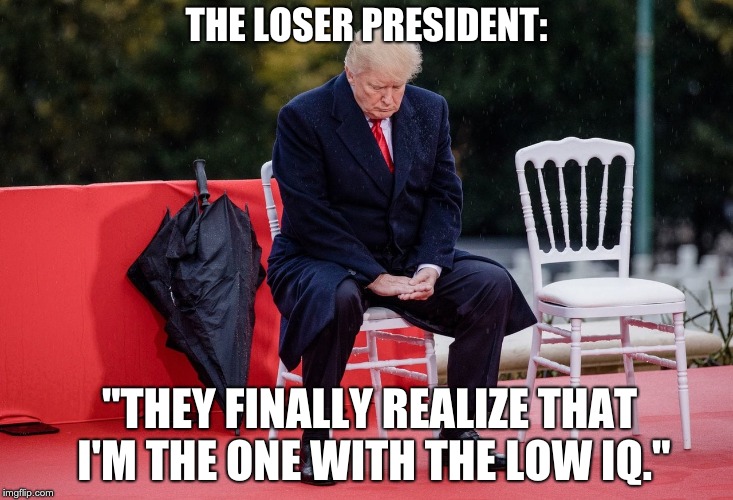
#4 in the series: The Loser President.

I've been thinking of the second verse of Simon & Garfunkel's Fakin' It lately. Having seen so many complete bozos in suits in my years in the corporate world, the song often came to mind. I couldn't see them walking through the corridors without imagining them singing the song to themselves. Of course, they never actually were. Their egos and insecurities overwhelmed their chances of attaining or even wanting any true self-awareness.

The song as a whole isn't a perfect match for Trump but it's very, very close. It's the second verse that really brings the song home, no matter who is singing it, and it's the second verse (below) that just seems to apply these days.
I'm such a dubious soul,
And a walk in the garden
Wears me down.
Tangled in the fallen vines,
Pickin' up the punch lines,
I've just been fakin' it,
Not really makin' it.

Labels: , , ,

Friday, December 07, 2018

Trump May Be Sly And Manipulative, But He's Still, In His Own Words, "Dumb As A Rock" And "Lazy"

>


Remember last year when Trump challenged Rex Tillerson to an IQ duel? At the time, Tillerson, still Secretary of State, let slip the well-known fact that Trump is-- literally-- "a moron." Trump took offense, said he'd like to compare their IQs, and eventually fired Tillerson and replaced him with a less intelligent and more servile man, Mike Pompeo. Trump, likely the lowest IQ individual to ever occupy the White House, is still offended by Tillerson.

Last night Tillerson spoke at a fundraiser for the MD Anderson Cancer Center in Houston, telling the crowd that when he was Secretary of State Trump would often ask him to break the law. "So often, the president would say here's what I want to do and here's how I want to do it and I would have to say to him, 'Mr. President, I understand what you want to do but you can't do it that way. It violates the law.' I'd say here's what we can do. We can go back to Congress and get this law changed. And if that's what you want to do, there's nothing wrong with that. I told him I'm ready to go up there and fight the fight, if that's what you want to do."

Tillerson also said that there's no question Russia interfered in the 2016 election to help elect Trump and that they wanted Trump in the Oval Office "to undermine our confidence and undermine the world's confidence in us." Trump may be a fool but he understands the implications of that statement.

Tillerson virtually admitted that he was as surprised as anyone that American voters were stupid enough to fall for Trump's low grade con game. "I will be honest with you," he told the audience, "it troubles me that the American people seem to want to know so little about issues that they are satisfied with a 128 characters. I don't want that to come across as a criticism of him. It's really a concern that I have about us as Americans and us as a society and us as citizens."


Trump took it as a criticism and lashed out like a vicious animal today (above), safely ensconced at his twitter station (below).


Labels: ,

Wednesday, October 11, 2017

Trump Has The Lowest IQ Of Any President From The 20th Century On-- Tillerson Isn't As Cunning, But He's Way Smarter

>


During the 2016 Republican primary, many of us got used to hearing Trump using the vocabulary of a third-grader. As Jack Shafer pointed out, Señor Trumpanzee "isn’t a simpleton, he just talks like one" resisting "multisyllabic words and complex, writerly sentence constructions when speaking extemporaneously in a debate, at a news conference or in an interview. He prefers to link short, blocky words into other short, blocky words to create short, blocky sentences that he then stacks into short, blocky paragraphs."
Flattening the English language whenever he speaks without a script, Trump relies heavily on words such as “very” and “great,” and the pronouns “we” and “I,” which is his favorite word. As any news observer can observe, he lives to diminish his foes by calling them “losers,” “total losers,” “haters,” “dumb,” “idiots,” “morons,” “stupid,” “dummy” and “ disgusting.” He can’t open his mouth without bragging about getting the Clintons to attend his wedding, about how smart he is, the excellence of his real estate projects, the brilliance of his TV show, his generous donations to other political campaigns and so on. In a freakish way, Trump resembles that of Muhammad Ali at his prime-- except the champ was always kidding (even when he was right) while Trump seems to believe his claims (and often is wrong). Or perhaps he is afflicted with binary vision disorder, which renders all within his eyeshot either great or rotten.

It’s obvious that Trump’s verbal deficit, as grating as it may be on the ears of the educated class, has not caused him much political pain. The media has noted the opposite: Trump’s overreliance on sports and war metaphors in his public utterances, his reductionist, one-dimensional policy prescriptions-- including nuanced geopolitical arguments such as get tough with China and Mexico, which are killing us!-- inspire trust in many rather than distrust. Trump’s rejection of “convoluted nuance” and “politically correct norms,” mark him as authentic in certain corners and advance his cred as a plainspoken guardian of the American way. By not conforming to the standard oratorical style, he distinguishes himself from the pompous politician. Less is more when you’re speaking Trumpspeak.
He warned his readers not to interpret the cagey and manipulative Trump's low Flesch-Kincaid grade-level scores "as a marker of low intelligence. Trump’s professional history indicates a skill at dealing and deceiving, inspiring and selling, and such attributes would likely qualify as a type of intelligence."

He usually tries claiming-- without ever allowing the release of his academic records-- that he has a 156 IQ. No experts in the field think he has an IQ even approaching 156. Gary Denton estimates something in the 120s and reminds his readers that Trumpanzee "was a graduate of the University of Pennsylvania, not Wharton. He took some undergraduate classes at Wharton. He does not have an MBA from Wharton. He has a BA from UP. He did not graduate with honors from UP, it would have been noted in the graduation ceremony. He had transferred into UP after two years at Fordham University after meeting with a friendly admissions officer who knew his rich family."


In any case, Trump is very conscious of the mediocrity of his IQ and has been publicly hysterical about it decades. As CNN pointed out yesterday, he's been challenging people to IQ tests for many years-- although he's never once actually agreed to do one. They found 22 instances with just a few minutes of light research on Twitter. He once claimed "We have by far the highest IQ of any Cabinet ever assembled!" He couldn't have been talking about Rick Perry or Betsy DeVos but now he claims he wasn't talking about Rex Tillerson either, who he challenged to an IQ face off after T-Rex said aloud what everyone in Trump's orbit already know: the emperor is a fucking moron. So far Tillerson has ignored his imbecile boss' challenge, we;; aware that Trump would never submit himself to it.

Unfortunately for Señor T, The Hill reached out to Mensa, "an international society whose only qualification for membership is a score in the top 2 percent of the general population on a standardized intelligence test." Obviously Trump isn't qualified to be a member but Mensa's communications director, Charles Brown, said they would be happy to host an IQ competition between Trump and Tillerson. "American Mensa would be happy to hold a testing session for President Trump and Secretary Tillerson."
When asked if any American president or Cabinet member has ever taken a Mensa admissions test before, Brown pointed out that while the group can confirm membership, it doesn’t release who’s actually taken the brain-busting exam.

“But it’s important to note that our admissions test is not the sole way to qualify for Mensa-- there are hundreds of other prior-evidence tests that can qualify a member,” Brown said. “And the early success of many presidents no doubt exposed them to those types of qualifying avenues.”

Naming former President Clinton’s experience as a Rhodes Scholar, Jimmy Carter’s work as a nuclear engineer and George H.W. Bush’s time as a military pilot, Brown told us, “Each could have encountered standardized academic tests (LSAT, GMAT, Miller Analogies), where qualifying scores would have propelled them into Mensa.”

Again, nothing in Trump's life has qualified him to be a member-- and his 120 IQ isn't going to get him in. The Independent reported that IQ experts say Trump would lose an IQ battle with Rex Tillerson. Joel Schneider, a Temple University professor who studies the assessment of intelligence said he'd bet on Tillerson, although he thinks Señor T would actually be considered "bright" compared to the general population (though not, he stipulated, compared to past presidents).
Trump’s more obvious public gaffes-- mispronouncing the Turkish President's name, or telling an audience in Israel he "just got back from the Middle East"-- don’t stem from a low intelligence, Mr Schneider said. Instead, they come his “lack of intellectual curiosity.”

“His bad moves generally come from his narcissism, and his arrogance, and his extreme centeredness,” he said. “He doesn't seem to know very much, because all he cares about is himself. And he knows a great deal about himself.”

Jack Naglieri, a psychological research professor who also develops intelligence tests, has a different theory. He believes Mr Trump is lacking in “executive function”-- the process of strategising, evaluating, decision making, and impulse control.

According to Mr Naglieri, strong executive function is a “hallmark of intelligence," and makes for a more modern, reliable indicator than notoriously imprecise IQ tests.

“It's very, very clear that Trump lacks this critical executive function,” Mr Naglieri said, pointing to the President’s outbursts, impulsivity, and apparent lack of empathy and insight.

“The tweeting is an obvious impulse control problem,” Mr Naglieri said.

As for who would win in a battle of the wits, the researcher is “absolutely” on team Tillerson.

“Tillerson is clearly a person who has impulse control, who thinks things through,” he said. “...He's not blurting out, he's not impulsive, he's not flying off the handle. He's not telegraphing his anger like Trump does.”

“I'd put my money on Tillerson any day,” he added.

And these academics aren't the only ones betting against Señor Trumpanzee. As you can see in their little betting odds sheet just above, the European oddsmakers at BetOnline.ag see Tillerson as the odds on favorite to win that matchup. Maybe Trump shouldn't have been bellowing to the Pentagon about a 10-fold increase in the U.S. nuclear arsenal, which is apparently what impelled Secretary Tillerson to explain to everyone within earshot that the orange-hued baboon that he works for is a "fucking moron" in the first place.

Labels: , ,

Friday, March 20, 2015

We want to keep Ian Welsh slaving away at his computer, don't we?

>


"I am fundraising to determine how much I’ll write this year.  If you value my writing, and want more of it, please consider donating."
-- Ian Welsh, during his just-about-done
ianwelsh.net fund-raising drive

by Ken

It's time (actually, almost past time) to show Ian Welsh how much we value his blog-writing.

Apologies for my bad timing -- I should have gotten to this a couple of weeks ago, and in this case timeliness would have been a boon. Because while I'm sure Ian Welsh isn't going to turn away contributions that come in after he's rung the gong on this year's fund-raising effort, his calculation of how much he can afford to write for ianwelsh.net over the next three months will be based, as it has been since last year's fund-raiser, on the tallies for the period.

Partly I suppose my dilatoriness had something to do with me getting around to kick in my paltry offering, since I can hardly ask you to give to something I wouldn't. But now I've done my piece, such as it is, and I want to make sure you don't forget -- or make the acquaintance of if you haven't already -- one of the most original and thought-provoking observers and commentators I can put you in touch with, not to mention one of the most readable.

I'm often less confident than Ian about the solutions to problems he takes to be axiomatic, but I have a pretty strong feeling that we haven't much shot at useful answers if we don't figure out the right questions, and I almost always feel that Ian brings us closer. And the range of subjects he covers is not only impressive and stimulating but helpful as a reminder of the interconnectedness of, well, things.

Consider just the start of his post today, "Serfdom Is Better Than What the West Is Heading For":
One of the things that we forget about Feudalism is that serfs had rights: economic rights.  They had the right to farm common land, they had the right to take wood from common forests, they had the right to live where they had lived before.

This is not to say that they were free, they certainly were not.  But they were not slaves; they had access to, as it were, capital: what they needed to grow their own food, shelter themselves and clothe themselves.

We have an overly grim view of the Middle Ages, but, in various periods and various places, serfs, let alone freeholders, lived quite well.  Much of what we associate as the worst of the Middle Ages actually happened either in the Dark Ages or in the Renaissance.  For example, torture really takes off in the Renaissance, because as Stirling Newberry has pointed out, torture chambers and so on take a lot of iron and they didn’t have it to waste in the Middle Ages. . . .
How's that for (a) an unexpected reconceiving of seemingly familiar notions and (b) a lesson in connectedness?

Or there was a post not long ago that found Ian pondering "The Dangers of Intelligence Without Creativity or Judgment," which took off from this:
Divide intelligence into three parts, (yes, you can divide other ways):

1) processing power and pattern recognition (measured pretty well by IQ)

2) Creativity

3) Judgment

A lot of people only have the first, they are very smart ordinary people, they will get to the same solution a modestly bright person would, just a heck of a lot faster. The folks who put up their hands first in class, whose self-worth is based around #1.
And came to rest with the conclusion:
Learning how to think is, in many ways, more important than raw processing power. . . . [T]oo much power and too little judgment will get you killed, and too much processing power and no creativity will just get you where everyone else would have gone, but faster. Better hope that’s the best place to go.
Or there was a post called "When Keynesian Stimulus Works," which began:
It has become fashionable in many circles to denigrate Keynes and Keynesianism because unconventional monetary policy hasn’t worked.

I’m not going to mince words, people who make that argument are idiots.  Unconventional monetary policy is not Keynesian stimulus.

Keynesian stimulus is about widespread demand: giving money to rich people is not Keynesian stimulus.  The government spends, or even just gives money to people to increase their spending.

Unconventional monetary policy is not Keynesian stimulus.

Further, Keynesian stimulus only works where there aren’t supply bottlenecks. If you were to do (actual) Keynesian stimulus today it wouldn’t work, because oil would rocket past $150/barrel and the economy would immediately collapse.

Keynes did not concentrate on this issue because it wasn’t a problem in his time period . . . .

I COULD GO ON AND ON

But you can do this for yourself. I would encourage you to visit the ianwelsh.net site and browse the "Recent Articles" list, or stroll through the current batch of posts and then keep going back. Depending on your mood and inclinations of the moment ,you'll pluck out different posts that cry out, "Read me!" And the chances are overwhelmingly good that you'll come away with something new to think about, or a new way to think about something you've already thought quite a lot about.

Timed to last year's fund-raising drive, I wrote a February post titled "As you think about kicking in to Ian Welsh, just remember that 'Dumb Davy' Brooks gets paid NYT $$$ to write that, er, stuff." I don't mind going out with that thought.


UPDATE -- Fund-raiser lands Ian in the five-times-a-week writing zone; plus, he does count later contributions

As of March 23, Ian reports the following resutls:
Fundraiser Finished: Five Articles a Week, Average, Reached

2015 MARCH 23

by Ian Welsh

We raised $5,246.64 in one time donations and $539 in recurring donations (recurring includes people who already had a subscription). That puts us solidly in the five articles a week, average, bracket. I’ll start up that schedule as of April 1st. If I get seriously ill and can’t do it for a week or some such, I’ll extend the duration.

THANK YOU very much, everyone who donated.  This will make a large difference.

I do keep track of donations after the fundraiser and it does affect how much I write, so if you didn’t give and still want to, rest assured it isn’t wasted. [Emphasis added -- Ed.]

Again, my thanks.


Note again that Ian does take into account in his calculations donations that come in after the fund-raiser, so don't think that the lateness of my pass-along lets you off the hook. (Yeah, you thought you could work that angle, right?)
#

Labels: , , , ,

Saturday, December 13, 2014

Lack Of Intelligence Doesn't Hurt Conservative Candidates With Conservative Voters

>


"You don't have to pass an IQ test to be in the Senate, though," giggled conservative Arkansas Senator Mark Pryor on the big screen. He was unseated by an undistinguished right-wing extremist, Tom Cotton, 476,309 (56.5%) to 332,669 (39.5%). I don't know how much his remarks to Bill Maher played into his defeat. I don't know how much Arkansas voters care about IQ test results or intelligence in their elected officials at all for that matter. And this week, a neighboring state's governor, Rick Perry, was playing up on that sentiment in his "I'm back and I'm different this time" plea for support in his quest for the 2016 GOP presidential nomination. Perry's polling support hovers around 2% among GOP voters-- better than Rick Santorum, tied with Bobby Jindal.

But Perry's handlers are telling big donors he's kicked his drug addiction problems and he's telling interviewers his awkward, stumbling nature and low IQ don't matter in a Republican primary. He says "life experience is more important than book smarts in a president." Book smarts, though, isn't what IQ measures. IQ measures human intelligence and conservatives, by nature, are extremely distrustful of any such thing. General intelligence refers to the ability to reason deductively or inductively, think abstractly, use analogies, synthesize information, and apply it to new domains. We'll get to that in a minute. Back to Perry first.
"Running for the presidency's not an IQ test. It is a test of an individual's resolve. It's a test of an individual's philosophy. It's a test of an individual's life's experiences," Perry said in an interview at the Governor's Mansion, which he's leaving as his term ends. "And I think Americans are really ready for a leader that will give them a great hope about the future."

Perry said he probably has less "margin for error" after he famously couldn't remember one of the federal agencies he said he'd ax during a November 2011 Republican debate. But "I think, over the course of the last two years, people realize that what they saw in 2011 is certainly not the person they're looking at at 2013, 2014, 2015," he said.

Perry also said he'd have no problem convincing Republicans that he can win in 2016, saying potential backers "are pouring in here to sit down with us, to talk to us."

"The policy individuals that have said 'listen, we want to come help you become even better prepared as we go forward' is already the answer to that," he said.
A few years ago Professor Satoshi Kanazawa of the London School of Economics published a piece, Why Liberals And Atheists Are More Intelligent, in the Social Psychology Quarterly that turned political conservatives off to intelligence permanently. His study found that higher intelligence directly correlates with liberal political ideology. "General intelligence, the ability to think and reason, endowed our ancestors with advantages in solving evolutionarily novel problems for which they did not have innate solutions," says Kanazawa. "As a result, more intelligent people are more likely to recognize and understand such novel entities and situations than less intelligent people, and some of these entities and situations are preferences, values, and lifestyles." He argues that humans are evolutionarily designed to be conservative, caring mostly about their family and friends, and being liberal, caring about an indefinite number of genetically unrelated strangers they never meet or interact with, is evolutionarily novel. So more intelligent children may be more likely to grow up to be liberals. Here's how Time covered the report back in 2010, noting that Kanazawa is a libertarian and non-partisan.
The notion that liberals are smarter than conservatives is familiar to anyone who has spent time on a college campus. The College Democrats are said to be ugly, smug and intellectual; the College Republicans, pretty, belligerent and dumb. There's enough truth in both stereotypes that the vast majority of college students opt not to join either club.

...What's new in Kanazawa's paper is a provocative theory about why intelligence might correlate with liberalism. He argues that smarter people are more willing to espouse "evolutionarily novel" values-- that is, values that did not exist in our ancestral environment, including weird ideas about, say, helping genetically unrelated strangers (liberalism, as Kanazawa defines it), which never would have occurred to us back when we had to hunt to feed our own clan and our only real technology was fire.

Kanazawa offers this view of how such novel values sprang up in our ancestors: Imagine you are a caveman (if it helps, you are wearing a loincloth and have never shaved). Lightning strikes a tree near your cave, and fire threatens. What do you do? Natural selection would have favored the smart specimen who could quickly conceive answers to such a problem (or other rare catastrophes like sudden drought or flood), even if-- or maybe especially if-- those answers were unusual ones that few others in your tribe could generate. So, the theory goes, genes for intelligence got wrapped up with genes for unnatural thinking.

It's an elegant theory, but based on Kanazawa's own evidence, I'm not sure he's right. In his paper, Kanazawa begins by noting, accurately, that psychologists don't have a good understanding of why people embrace the values they do. Many kids share their parents' values, but at the same time many adolescents define themselves in opposition to what their parents believe. We know that most people firm up their values when they are in their 20s, but some people experience conversions to new religions, new political parties, new artistic tastes and even new cuisines after middle age. As Kanazawa notes, this multiplicity of views-- a multiplicity you find within both cultures and individuals-- is one reason economists have largely abandoned the study of values with a single Latin phrase, De gustibus non est disputandum: there's no accounting for taste.

Kanazawa doesn't disagree, but he believes scientists can account for whether people like new tastes or old, radical tastes or Establishment ones. He points out that there's a strong correlation between liberalism and openness to new kinds of experiences. But openness to new experience isn't necessarily intelligent (cocaine is fun; accidental cocaine overdose is not).

So are liberals smarter? Kanazawa quotes from two surveys that support the hypothesis that liberals are more intelligent. One is the National Longitudinal Study of Adolescent Health, which is often called Add Health. The other is the General Social Survey (GSS). The Add Health study shows that the mean IQ of adolescents who identify themselves as "very liberal" is 106, compared with a mean IQ of 95 for those calling themselves "very conservative." The Add Health study is huge-- more than 20,000 kids-- and this difference is highly statistically significant.

No, that isn't Michele Bachmann above. Still Perry... celebrating. Hard to fathom though, that in the middle of the fight to keep the government open/deregulate Wall Street, the White House not only hosted a Christmas Party, but invited dangerous right-wing radicals to it. I hope they all got thoroughly patted down. Even Michele Bachmann, who is being allowed to walk away from a serious criminal investigation in return for her retirement from Congress, was permitted to attend.

Why would she even bother? She wanted to tell President Obama, in person, to nuke Iran, which has over 77 million inhabitants, more than the population of Iraq and Afghanistan combined. Throw in Libya and Qatar and we're still not there yet. First she promised her family she wouldn't make a spectacle out of herself when it was time to pose with the president for photos. But as soon as they had left the stage, that special Bachmann derangement gene kicked in.
“I turned to the president and I said, something to the effect of, ‘Mr. President, you need to bomb the Iranian nuclear facilities, because if you don’t, Iran will have a nuclear weapon on your watch and the course of world history will change,’” she told the Washington Free Beacon.

“And he got his condescending smile on his face and laughed at me and said, ‘Well Michele, it’s just not that easy.’ And I said to him, ‘No, Mr. President, you’re the president, it will happen on your watch, and you’ll have to answer to the world for this.’ And that was it and then I left. Merry Christmas,” she said with a laugh.

...Bachmann now plans to travel across the country, giving speeches and writing op-eds ahead of what she called a “consequential” election in 2016. Presumptive Democratic nominee Hillary Clinton will simply continue Obama’s widely criticized domestic and foreign policies, Bachmann said. Republicans for their part need to ensure that they do not nominate a candidate who is “changing their stripes just for an election.”

“If we get a very bold conservative who has a strong identification of where they want to take the country, both economically and in terms of national security, we do have a chance to have a major course correction for America in the future,” she said.

Labels: , , , ,

Sunday, June 30, 2013

Digital Dementia-- Is It For Real?

>


Roland's my closest friend. I call his cell phone at least once a day. But I have no idea what his number is. I press a button on my cell and his phone is automatically "dialed." If I lost my phone, I wouldn't be able to contact him. Oh, wait, I could. All I would have to do is go to my computer and type in the first 3 or 4 letters of his screen name and his e-mail address would come up. If I was at another computer, though, I wouldn't be able to e-mail him either. I only know the first 3 or 4 letters of his rather complicated screen name. Everything comes up kind of automatically online. It's so convenient... but I remember nothing. I hope it's making room in my brain to remember more important things. I refuse to get GPS for my car-- even though the crooked Toyota dealer made me pay for it anyway-- because I don't want to forget how to get from place to place.

Doctors in South Korea are talking about this as digital dementia... but they're diagnosing it as an epidemic among teenagers, not people my age.
South Korea is one of the most digitally connected nations in the world and the problem of internet addiction among both adults and children was recognised as far back as the late 1990s.

That is now developing into the early onset of digital dementia-- a term coined in South Korea-- meaning a deterioration in cognitive abilities that is more commonly seen in people who have suffered a head injury or psychiatric illness.

"Over-use of smartphones and game devices hampers the balanced development of the brain," Byun Gi-won, a doctor at the Balance Brain Centre in Seoul, told the JoongAng Daily newspaper.

"Heavy users are likely to develop the left side of their brains, leaving the right side untapped or underdeveloped," he said.

The right side of the brain is linked with concentration and its failure to develop will affect attention and memory span, which could in as many as 15 per cent of cases lead to the early onset of dementia.

Sufferers are also reported to suffer emotional underdevelopment, with children more at risk than adults because their brains are still growing.

The situation appears to be worsening, doctors report, with the percentage of people aged between 10 and 19 who use their smartphones for more than seven hours every day leaping to 18.4 per cent, an increase of seven per cent from last year.

More than 67 per cent of South Koreans have a smartphone, the highest in the world, with that figure standing at more than 64 per cent in teenagers, up from 21.4 per cent in 2011, according to the Ministry of Science, ICT and Future Planning.

Dr Manfred Spitzer, a German neuroscientist, published a book titled Digital Dementia in 2012 that warned parents and teachers of the dangers of allowing children to spend too much time on a laptop, mobile phone or other electronic devices.

Dr Spitzer warned that the deficits in brain development are irreversible and called for digital media to be banned from German classrooms before children become "addicted."
Spitzer is a psychiatrist at Ulm University and, to put it mildly, he's no fan of the Internet. "Avoid digital media... they truly do make us fat, dumb, aggressive, lonely, sick and unhappy." He compares teaching children to use online media to serving them beer, and providing computers in elementary schools to heroin dealers getting their users hooked. Not everyone agrees. In fact, children are performing significantly better on IQ tests now than in previous generations. The astonishing upward trend in IQ levels is known as the "Flynn effect," named after American political scientist James Flynn, who published a new book last year, Are We Getting Smarter? Rising IQ in the Twenty-First Century, in which he seeks to elucidate this phenomenon. Flynn's findings refute the claims of those who warn that humanity is getting dumber. We're "amusing ourselves to death," American media theorist and critic Neil Postman argued in a 1985 book of the same name. Postman blamed television for a decline in cognitive skills. Since then, however, the average IQ in the US has risen by nearly 10 points.
Spitzer says the term "digital dementia" originated with Korean scientists. More likely, though, it simply comes from a survey one web portal conducted five years ago among its users, who indicated among other things that they were hardly able to remember telephone numbers anymore.

Additionally, Spitzer previously made many of the same claims verbatim in his 2005 book Vorsicht Bildschirm! (Caution, Screen!) Since then, the average German IQ has risen by about 2 points.

Around 1900, there was a similar fashion for hysterical warnings of "nervous disorders" and the weakening of the brain supposedly triggered by technological advances. It was in this environment that a Parisian researcher developed the first intelligence test in 1905.

Then, exactly 100 years ago, Hamburg-based psychologist William Stern invented the "intelligence quotient," or IQ. In the fall of 1917, with Europe at war, Stern received an assignment to select 1,000 out of 20,000 Hamburg children for advanced lessons at school. The researcher chose not to rely on IQ scores but, rather, to conduct intensive observation of the students in the classroom-- he knew the limits of his own tests.

The informative value of IQ tests has been debated ever since their invention. Stanford psychologist Lewis Terman, for example, followed a group of 1,500 gifted children over several decades. The majority of them did not grow up to be new Einsteins, but rather led entirely normal lives and did not even perform above average in their professional lives. It turns out that self-confidence and perserverance, as well as the way a person is raised, have just as important an effect as IQ does.
The fact that people are scoring progressively better on IQ tests, Flynn says, doesn't represent better cognitive skills so much as it expresses a modern, scientifically influenced way of thinking that can better take hypothetical and abstract situations into account. "In pre-modern societies, people thought in a more practical and concrete way," the researcher explains. In his book, he provides an anecdote to illustrate this point. As a child, he writes, he once asked his father: "But what if your skin turned black?" He just answered: "That is the dumbest thing you have ever said-- who has ever heard of anyone's skin turning black?"

This is the only way to explain the fact that the average IQ in Kenya is just 72-- but is increasing by an enormous one point per year. "If I conduct an IQ test and ask a shepherd, 'What connects a lion and a lamb?' he might say, 'The lion eats the lamb,'" Flynn says. "The correct answer on the test, though, is: 'Both are mammals.'"

Thinking is "plastic" and adapts to the environment, Flynn adds. From generation to generation, children find it easier to organize symbols, create categories and think abstractly.

Flynn thus calls for "sociological imagination" when it comes to interpreting data on human intelligence. In many countries, for example, girls have caught up with boys in IQ tests-- an effect of being treated equally. And African-Americans score worse than white Americans only when they grew up under difficult circumstances. For example, no difference was found among the children of black US soldiers living in Germany.

In the 1990s, it seemed like the Flynn effect was gradually coming to a standstill, prompting questions about whether a maximum level had perhaps been reached. But, to his amazement, Flynn is now discovering that the trend has started up again.

One thing stands out, though: While young test subjects are particularly good at solving visual and logical tasks quickly, their vocabulary is increasing only minimally-- unlike that of their parents.

"Linguistically, the generations are growing apart," Flynn states. "Young people can still understand their parents, but they can no longer mimic their style of speech. That was different in the past." One possible reason for the change is that today's young people read and write many short messages on Facebook and on their cell phones, but they rarely immerse themselves in books anymore.

Flynn says this is a pity-- but no reason to panic. What some have taken for "digital dementia," he explains, is ultimately just children and young people adapting to a world that is faster-paced and strongly influenced by digital media.

For personal reasons, Flynn is far more concerned about an entirely different phenomenon: Everyone's IQ test scores start to slip with advancing age-- and the more intelligent they are to begin with, the faster their results drop. The only thing that can apparently counteract this trend is exercising the brain-- including with the help of modern media.

Last week, a working group under Osvaldo Almeida, an Australian professor of geriatric psychiatry at the University of Western Australia, in Perth, released the results of a long-term study of over 5,500 seniors. The finding: Study participants who used computers had over 30 percent less risk of developing dementia.


SCHEDULE NOTE: SUNDAY CLASSICS

Today's Sunday Classics post, "In The Flying Dutchman Wagner shows there's more than one way to get from Act I to Act II and from Act II to Act III," follows at 5pm ET/2pm PT. If I can get it up earlier on the stand-alone Sunday Classics blog, I will. -- Ken
#

Labels: ,