Sunday, January 08, 2017

Interfering In Other Countries' Domestic Politics-- What Monsters Do That?

>


One of the excuses many of the Trump-Putin useful idiots give for dismissing Putin’s hacking of the U.S. elections is that governments do it all the time— especially the U.S. Well, they are certainly right about governments doing it all the time, but that doesn’t make Putin’s coup against America any more palatable than, say, the U.S.-British coup against Iran in 1953. Glen Yeadon's book, Nazi Hydra In America includes a chapter about how the CIA recruited a whole lot of Nazis after the World War II to work for it in various capacities, including that of helping overthrow governments that were deemed unfriendly to American corporate power. The CIA was busy all over Europe, of course (as were the Russians) but both countries’ spy agencies were super-involved in Iran as well.
Kermit Roosevelt, grandson of Teddy Roosevelt was the CIA's agent in Iran that installed the Shah and overthrew Mossadegh. The plans issued by Mossadegh for nationalizing the oil fields precipitated his removal. The reader should understand that Mossadegh had been elected to office. Once the Shah was in power he was persuaded to name Fazlollah Zaledi as Prime Minister. During WWII Zaledi was imprisoned for collaborating with the Nazis. Once firmly in control Iran completed a contract with an international consortium of oil companies. One member of that consortium was Standard Oil of New Jersey, a client of Sullivan and Cromwell. Jack Anderson reported that the Rockefeller family had helped arranged the coup that brought the Shah to power. Anderson had listed a number of ways the Shah demonstrated his appreciation. The CIA also provided training for the dreaded Savak or secret police of Iran.

...The result over the next two decades was the Shah enriched himself at the expense of his fellow countrymen using the brutal Savak to maintain control. Of course he remained a loyal ally of the US and corporate America such as Standard Oil of New Jersey got pricing breaks... The reader can now see the pattern, first the legally elected leader purposes reforms or maybe leaning to the left in a move that threatens corporate America. He is then dispelled and replaced with a hard right leader favorable to US [corporate] interests. The new leader enriches himself at the expense of his fellow countrymen and becomes an ally of the US. He maintains power through brutality and outright murder with a police force trained by the US. This then is the model that the US has followed since WWII, often times in the 1950s ex Nazis were employed as agents. The US press should be considered a co-conspirator in that they cover up the bloodshed by ignoring the killing as they did in Nicaragua. It is a model that has been repeated time after time in all corners of the globe from the end of WWII to the present time. Noam Chomsky terms the resulting state as subfascist. The resulting brutality and looting of the country by a group of elitists proceeds as it did in Germany under the Nazis.


The U.S. has interfered in the domestic politics of every country in Latin America, catastrophically in most, such as Brazil, Chile, Cuba, Ecuador, Venezuela, Guatemala, Haiti, the Dominican Republic, Bolivia, Uruguay, El Salvador, Panama, Nicaragua, Honduras… And the U.S. has a long sordid history interfering in the domestic politics of counties like Greece, Italy, Vietnam, Laos, Cambodia, Hungary, Ukraine, Congo, Indonesia, Australia, Angola, Afghanistan, Libya, Iraq… Did you know U.S., British, French, Japanese, Canadian, Czech and Greek troops invaded Russia in 1918? American troops occupied Vladivostok and Arkhangelsk. In fact, Russians aren’t completely paranoid to think the West has been interfering in their politics for over a century.

This past summer I visited Russia for the first time and one of my favorite lesser-known attractions was the Museum of Political History in St. Petersburg— great way to go through Russia’s rich history. I spent tike in a room devoted to Rasputin and just this week, the London Times ran a piece which seems pretty definitive about who— one of their agents— assassinated the monk and why. On January 7 Ben Macintyre wrote “Today The Times publishes a world exclusive — exactly a century late. On January 2, 1917, Robert Wilton, The Times correspondent in Petrograd, sent an urgent telegraph to head office with the news that Grigori Rasputin, the infamous ‘mad monk’ who had enraged members of the royal court by his intimacy with the tsarina, had been murdered four days earlier, and his bullet-riddled corpse thrown into the icy Neva River. Wilton’s detailed report did not appear in the newspaper. The Times decided to hold it back for reasons of diplomacy and good taste — and perhaps because the Foreign Office ‘hinted’ that it should do so.”
“Rasputin was shot in a room in the basement of the palace of Prince Yusupov,” wrote Wilton, whose words appear in newsprint here for the first time.

“Prince Yusupov did the shooting. Conjointly with other young Princes of the Blood . . . they had decided some time ago to ‘remove’ Rasputin because they regarded him as the cause of a dangerous scandal affecting the interests of the dynasty.”

But what Wilton did not report (and may not have known) was whether MI6 was involved in the death of Rasputin.

Was Prince Felix Yusupov, an Oxford-educated aristocrat married to the tsar’s niece, aided in the assassination by British intelligence in order to keep Russia fighting in the First World War?

Was the fatal bullet fired by an MI6 officer?

These questions will never be answered, and the mystery of Rasputin’s death will never be completely solved, until and unless MI6 opens up its files. A Siberian mystic, Rasputin insinuated himself into the Russian royal family, exercising particular influence over Tsarina Alexandra, to the fury of other family members — notably the hot-headed, flamboyant, cross-dressing and fabulously wealthy Prince Yusupov, the only member of Oxford’s Bullingdon Club to admit murder.

Alexandra was German by birth, and it was rumoured that she and Rasputin led a faction intent on making peace with Germany and pulling Russia out of the war. Britain, desperate to keep its Russian ally fighting, had the motive to want Rasputin dead.

The authorised history of MI6 is silent on the subject of British involvement in the killing, but there is no doubt that Samuel Hoare, the MI6 station chief in Russia, believed that Rasputin was sabotaging the war effort.

Hoare told the MI6 chief Mansfield Smith-Cumming, the original “C,” that if Rasputin were to be liquidated “the country would be freed from the sinister influence that was . . . endangering the success of its armies.”

A key suspect in the murder is Lieutenant Oswald Rayner, a 28-year-old MI6 officer and close friend of Prince Yusupov from their time at Oxford. Tsar Nicholas II told the British ambassador that he suspected “a young Englishman who had been a college friend of Prince Felix Yusupov, of having been concerned in Rasputin’s murder”. Rayner’s chauffeur later confirmed that the two men had met several times at the Yusupov palace in the weeks leading up to the murder on December 30.

The post-mortem examination carried out by the professor Dmitrii Kosorotov indicated that Rasputin had been shot three times, with different weapons.

The forensic evidence suggests that the final shot to Rasputin’s head could only have come from a revolver firing a lead, non-jacketed bullet at close range, most likely a British .455 Webley — the gun favoured by Rayner.

A letter from a second MI6 officer, Stephen Alley, also points to direct British participation in the murder plot: “Although matters have not gone entirely to plan, our objective has clearly been achieved. Reaction to the demise of Dark Forces [an obvious allusion to Rasputin] has been well received by all, although a few awkward questions have already been asked about wider involvement. Rayner is attending to loose ends . . .”

Back in England, Rayner reportedly confided to family members that he had been present at the murder, and retained a bullet he said he had acquired at the scene. After the war, he helped Yusupov to write a graphic, self-serving and largely fictional account of the assassination, named his son after the prince, and died in 1961 after burning all his papers.

Lies, half-truths and uncertainties have long lingered around the murder of Rasputin, as reluctant to die as the monk himself, who allegedly survived both poisoning and shooting, and may even have been half-alive when he was dumped in the frozen river.

But the mystery surrounding Britain’s role in his death is the most enduring, and the most important factor, since it underpins a century of Russian mistrust of Britain.

If Rayner was involved, he may have been acting in a personal capacity, or as a British agent, or both. He may not have been involved at all, with the allegations against him just being the result of Russian propaganda and anti-British feeling.


I doubt Putin cares about a 28 year old British spy shooting Rasputin in 1917. He’s probably more interested that many Russians believe the CIA somehow persuaded Gorbachev and/or Yeltsin to sell out the Soviet Union. And he’s not thrilled about NATO’s policy of encirclement or about how the West overthrew his ally in Ukraine and replaced him with their own puppet. Does this make it “right” that Putin got even by installing Trump as president of the U.S.? Of course not— but it makes it easier to understand some of the chit-chat about it.

Labels: , , , , , , ,

Sunday, December 11, 2011

Guatemala, Reagan, Newt Gingrich And The Reactionary Mind

>


It's always very sad to be writing about Guatemala-- sad and, as an American, shameful. What we've done to the people of that country is beyond conceivable and probably damns every single one of us to a special collective circle of hell. Last summer, in the context of our heroic unleashing of the hounds of hell on Libya, we looked at Glen Yeadon's observations of the bloody U.S. intervention in Guatemala in 1953
In 1953 the CIA also intervened in Guatemala, and regarded the action as a success. For what reasons they regarded the operation as success can be only guess at for what followed was a bloody civil war that lasted 36 years. Once again this intervention fits the model perfectly. The legally elected government of Arbenz was reform minded. The center piece of his reforms was land reform. In an overwhelmingly rural nation only 2.2% of the population owned 70% of the land. Prior to the 1944 revolution and ousting of the dictatorship of Ubico, the army was used to rope farm labors together for delivery to low-land farms where they were kept as debt slaves. The expropriation of large uncultivated tracts of land to landless peasants, improvement in the rights of unions and other social reforms were hurting the bottom line of United Fruit. Arbenz even constructed a port on the Atlantic to compete against the port controlled by United Fruit, likewise a public hydro-electric plant was constructed for the same reasons.

The position of United Fruit inside Guatemala was essentially one of a country within a country. United Fruit owned the country's telephone and telegraph systems, administered the country's only Atlantic port, monopolized banana exports and a subsidiary owned the rail system. In the US United Fruit had close ties to the Dulles brothers, various state department officials, congressmen and the US Ambassador to the UN. The former CIA Director, Walter Bedell Smith was seeking an executive position with United Fruit at the same time he was planing the Guatemala coup. He later was named to the board of directors of United Fruit.

The first plan to oust Arbenz was given by Truman as a response to Guatemala receiving arms from Czechoslovakia and the implied communism threat but was canceled. After the election of Eisenhower the plan was put into effect. The Guatemala coup also provides and ideal example of how the CIA manipulates the American opinion. After first being tried in Guatemala this technique has been employed throughout South America. It involves the CIA planting an article in the foreign press the article is then picked up by the news wires and newspapers in other countries. Besides the obvious multiplier effect upon the potential audience it has the appearance of an independent world opinion. Incidentally it was the same tactic that Bush tried to use against Clinton in the 1992 election.

The immediate after effects of the coup was draconian, within four months 72,000 was labeled as communist, many who were tortured and murdered. It is known that the U.S. Ambassador John Peurifoy had a long list of names of leaders that the successor government was to assassinate. Agrarian reform was stopped and the land already expropriated was given back to United Fruit. Union leaders turned up dead. Three quarters of the population was disenfranchised by barring illiterates from the polls and all political parties, unions and peasant organizations were outlawed...

The blood bath and carnage that followed for the next 36 years can only be described as horrific A genocidal war was carried on against the native Indians. Murders, kidnappings and disappearances became widespread and everyday occurrences as right wing death squads roamed the countryside. The report on Guatemala as a first step to reconciliation states that the army is blamed for over 200,000 deaths and disappearances. Below are some extracts from that report:
"Of the 42,000 deaths investigated in the report, the army was found to be responsible for 93 percent. Three percent were the work of the leftist Guatemalan National Revolutionary Unity, and 4 percent were unresolved. The report found that 29,000 of the investigated deaths involved summary executions.

Most of the victims were civilians and Mayan Indians... [T]he government of the United States, through various agencies including the CIA, provided direct and indirect support for some state operations."

It was "clearly genocide and a planned strategy against the civilian population," said Christian Tomuschat, a German citizen who heads the three-member commission. "Government forces... blindly pursued the anti-communist fight, without respecting any legal principle or even the most elemental ethical or religious values."

In 626 massacres, the report found that government forces "completely exterminated Mayan communities, destroyed their dwellings, livestock and crops." The guerrillas were blamed for 32 such massacres, the report said."

Guatemala also provides us with the first example of the right wing death squads that have became so much a part of South American politics. Those death squads and the dictators that employ them are products of the CIA-Military intelligence system of the US. They lead directly to the School of the Americas at Fort Benning, Georgia.

In reading Corey Robin's new book, The Reactionary Mind I came across a review he wrote for the London Review of Books in 2004 of Greg Granlin's Colonial Massacre: Latin America in the Cold War. How could any serious examination of the reactionary mind-- particularly the American reactionary mind-- not deal with the enormity of what was visited (by reactionary minds) on the Mayan native people of Guatemala, the ones whose ancestors had managed to escape being slaughtered in previous centuries by Spanish imperialists? And whose reactionary mind-- albeit an extraordinarily weak one-- would be better to start with than Ronald Reagan's?
On 5 December 1982, Ronald Reagan met the Guatemalan president, Efraín Ríos Montt, in Honduras. It was a useful meeting for Reagan. ‘Well, I learned a lot,’ he told reporters on Air Force One. ‘You’d be surprised. They’re all individual countries.’ It was also a useful meeting for Ríos Montt. Reagan declared him ‘a man of great personal integrity... totally dedicated to democracy’, and claimed that the Guatemalan strongman was getting ‘a bum rap’ from human rights organisations for his military’s campaign against leftist guerrillas. The next day, one of Guatemala’s elite platoons entered a jungle village called Las Dos Erres and killed 162 of its inhabitants, 67 of them children. Soldiers grabbed babies and toddlers by their legs, swung them in the air, and smashed their heads against a wall. Older children and adults were forced to kneel at the edge of a well, where a single blow from a sledgehammer sent them plummeting below. The platoon then raped a selection of women and girls it had saved for last, pummelling their stomachs in order to force the pregnant among them to miscarry. They tossed the women into the well and filled it with dirt, burying an unlucky few alive. The only traces of the bodies later visitors would find were blood on the walls and placentas and umbilical cords on the ground.

Amid the hagiography surrounding Reagan’s death in June, it was probably too much to expect the media to mention his meeting with Ríos Montt. After all, it wasn’t Reykjavik. But Reykjavik’s shadow-- or that cast by Reagan speaking in front of the Berlin Wall-- does not entirely explain the silence about this encounter between presidents. While it’s tempting to ascribe the omission to American amnesia, a more likely cause is the deep misconception about the Cold War under which most Americans labour. To the casual observer, the Cold War was a struggle between the United States and the Soviet Union, fought and won through stylish jousting at Berlin, antiseptic arguments over nuclear stockpiles, and the savvy brinkmanship of American leaders. Latin America seldom figures in popular or even academic discussion of the Cold War, and to the extent that it does, it is Cuba, Chile and Nicaragua rather than Guatemala that earn most of the attention.

But, as Greg Grandin shows in The Last Colonial Massacre, Latin America was as much a battleground of the Cold War as Europe, and Guatemala was its front line. In 1954, the US fought its first major contest against Communism in the Western hemisphere when it overthrew Guatemala’s democratically elected president, Jacobo Arbenz, who had worked closely with the country’s small but influential Communist Party. That coup sent a young Argentinian doctor fleeing to Mexico, where he met Fidel Castro. Five years later, Che Guevara declared that 1954 had taught him the impossibility of peaceful, electoral reform and promised his followers that ‘Cuba will not be Guatemala.’ In 1966, Guatemala was again the pacesetter, this time pioneering the ‘disappearances’ that would come to define the dirty wars of Argentina, Uruguay, Chile and Brazil. In a lightning strike, US-trained security officials captured some thirty leftists, tortured and executed them, and then dropped most of their corpses into the Pacific. Explaining the operation in a classified memo, the CIA wrote: ‘The execution of these persons will not be announced and the Guatemalan government will deny that they were ever taken into custody.’ With the 1996 signing of a peace accord between the Guatemalan military and leftist guerrillas, the Latin American Cold War finally came to an end-- in the same place it had begun-- making Guatemala’s the longest and most lethal of the hemisphere’s civil wars. Some 200,000 men, women and children were dead, virtually all at the hands of the military: more than were killed in Argentina, Uruguay, Chile, Brazil, Nicaragua and El Salvador combined, and roughly the same number as were killed in the Balkans. Because the victims were primarily Mayan Indians, Guatemala today has the only military in Latin America deemed by a UN-sponsored truth commission to have committed acts of genocide.

I know, I know, I know... it's a downer. Yecchhh, yecchhh, yecchhh... mass slaughter of civilians; feh! And speaking of "feh," I do want to point out that Newt Gingrich has promised to appoint John Bolton Secretary of State. (Or is it worse that Romney picked Bork as his chief judicial advisor?)


And one more thing from Corey Robin about what this whole reactionary mind actually wrought for us-- us being Americans... American taxpayers... we, us... you and me. What we defeated in Guatemala and Latin America wasn't "Communism." It was, in Robin's words, "the defeat of a continental social democracy which would allow citizens to exercise a greater share of power-– and to receive a greater share of its benefits-– than historically had been their due... [and] the defeat of that still elusive dream of men and women freeing themselves, thanks to their own reason and willed effort, from the bonds of tradition and oppression." Remember what we saw about the end of serfdom in Russia last week? The U.S. fought hard to preserve that in Guatemala into very recent times.
[I]n Latin America, Grandin shows, it was the left who took up the Enlightenment’s banner, leaving the United States and its allies carrying the black bag of the counter-Enlightenment. More than foisting on the United States the unwanted burden of liberal hypocrisy, the Cold War inspired it to embrace some of the most reactionary ideals and revanchist characters of the 20th century.

According to Grandin, the Latin American left brought liberalism and progress to a land awash in feudalism. Well into the 20th century, he shows, Guatemala’s coffee planters presided over a regime of forced labour that was every bit as medieval as tsarist Russia. Using vagrancy laws and the lure of easy credit, the planters amassed vast estates and a workforce of peasants who essentially belonged to them. Reading like an excerpt from Gogol’s Dead Souls, one advertisement from 1922 announced the sale of ‘5000 acres and many mozos colonos who will travel to work on other plantations’. (Mozos colonos were indebted labourers.) While unionised workers elsewhere were itemising what their employers could and could not ask of them, Guatemala’s peasants were forced to provide a variety of compulsory services, including sex. Two planters in the Alta Verapaz region, cousins from Boston, used their Indian cooks and corn grinders to sire more than a dozen children. ‘They fucked anything that moved,’ a neighbouring planter observed. Though plantations were mini-states-– with private jails, stockades and whipping posts-– planters also depended on the army, judges, mayors and local constables to force workers to submit to their will. Public officials routinely rounded up independent or runaway peasants, shipping them off to plantations or forcing them to build roads. One mayor had local vagrants paint his house. As much as anything Grandin cites, it is this view of political power as a form of private property which confirms his observation that by 1944 ‘only five Latin America countries-– Mexico, Uruguay, Chile, Costa Rica and Colombia-– could nominally call themselves democracies.’

Labels: , ,

Monday, August 29, 2011

Hit Men, Jackels... Has Our Turn Come?

>


I just finished reading Glen Yeadon's fantastic book, The Nazi Hydra In America I've been quoting at such great length for the last couple months. Towards the end is the story of the CIA assassination of Jaime Roldós, Ecuador's first democratically elected president in modern times. A few days ago we posted a story about Ecuador and the Galápagos Islands and immediately readers started asking me why we left out any mention of the assassination. Well, that's a travel blog; this is the political blog. And, to be honest, like most Americans, I just didn't know that the CIA had murdered the president of Ecuador in 1981. Our media doesn't exactly harp on that sort of thing.

Roldós was elected on a populist platform and pissed off the corporations that determine U.S. policies in Latin America by insisting that his countrymen be treated as human beings. He decreed a 40 hour workweek, doubled the minimum wage to $160/month and rallied other countries in the region to a policy embracing human rights, which, predictably, drove American conservatives into a frenzy of bloodlust. Roldós rejected an invitation to Reagan's inauguration (January, 1981) and 4 months later he had a plane crash. The CIA assassinated the President of Panama, Omar Torrijos, a few months later (another plane crash).

John Perkins, in his epic 2004 book, Confessions of An Economic Hit Man, explained that the CIA murdered both Torrijos and Roldós, but not just because of a human rights declaration. A CIA asset planted a bomb in a tape recorder in Roldós' plane because he was in the middle of reorganizing the country's oil policies, a big no-no in a very high stakes world where there's no fooling around tolerated.

From Yeadon we learned that in Latin America "legally elected governments leaning to the left or announcing reforms that threatened corporate America were branded as communist and soon overthrown by covert support of hard-right rebellions. Invariably the new regime was a brutal right-wing dictatorship that murdered thousands to suppress dissent. The United States soon recognized the new regime and offered support for its military and police, all in the name of combating communism and supporting freedom."

But that isn't all The U.S. offered. Remember, the leadership of the OSS and the CIA came almost entirely from Wall Street reactionaries and fascists, with connections to plutocrats and corporations that financed the rise of Hitler and the building of the Nazi war machine. It hasn't mattered who we elected president. The CIA, the national security state, had an agenda that was all about the bottom line of American corporations. Yeadon:
The record of CIA interventions leaves a bloody trail across the globe. The pattern is always the same: a popular government is legally elected and starts reforms that threaten the interests of multinational American corporations. Economic or military inducements are tried. If they fail, then the CIA begins covert methods to oust the government. These operations ended in a bloody coup in Chile and a brutal guerrilla war in the Contra revolution in Nicaragua, only two of many tactics used after all other means fail.

John Perkins in Confessions of an Economic Hit Man describes how multinational American corporations and the World Bank act as extended arms of the CIA. Perkins, who was employed by the American consulting firm, MAIN, lays out a model of deliberate economic sabotage of countries, conducted by the CIA, the IMF and the World Bank. The first step is to coerce a country to sign a plan for economic development, which may include construction of a dam, airport, factory or other infrastructure. The plan is deliberately oversized in such way that there is no hope the country can never repay the loan.

The country is deliberately misled by overly optimistic forecasts of the success and need for such projects. A few corrupt local politicians and rich families receive some funds to grease the way for the project. Once the economic forecasts fall short, the country slides into default on the loan. The World Bank then forces the country to accept austerity measures, which require the government to privatize property at fire sale prices, or grant other economic concessions to American corporations.

So what happens when Austerity gets shoved down peoples' throats by the ruling elites. You remember the riots in Greece and England recently. You ain't seen nothing yet. Capitalism is falling apart and we can expect some very turbulent weather ahead-- and the U.S. isn't immune the way it was in 1848 when revolutions swept across Europe.
A key aspect of this sudden mass awareness is in response to high unemployment and the deeply unpopular measures that politicians are forcing upon working people, both byproducts of the Great Recession. Politicians are blaming "the markets" for demanding austerity measures, but "markets" are simply places where wealthy people invest their money. To guarantee a profitable return on their money these investors demand that labor laws be squashed and social programs be eliminated, all over the world.

Spain, for example, is one of many countries having austerity measures forced down their throats. Reuters reports:

"Analysts see the shaking up of the country's inflexible labor laws [laws that protect workers] and the easing of hiring and firing [so older, activist, or slower workers can be fired] as vital to restoring the country's competitiveness. The labor reforms are crucial. They will help to restore growth [profits] in the long term. Growth is the only way out of these adverse fiscal trends,' said Luigi Speranza, analyst at BNP Paribas." [May 27, 2010]

To summarize, creating new laws that enable Spanish corporations to work their workers harder will be better for profits.

Greece faces a similar austerity plan, according to The Guardian UK:

"Tax increases, spending cuts and wage reductions and a sweeping privatisation programme have led to violent protests in Greece, with many arguing that the International Monetary Fund and European Union have demanded too high a price for their financial support." [August 2, 2011]

In the United States, these policies find expression in the attack against public-sector unions and the targeting of Social Security, Medicare and Medicaid for cuts, while mass unemployment is allowed to act as a very efficient way to lower wages for all workers.

Politicians have made it clear that economic growth, especially corporate profits, will increase in response to these anti-worker policies. They are only partially right. Corporate profits in fact have been on the rise, but the austerity measures have been responsible for the depressed economies throughout Europe and the US. When workers' wages are lowered and social programs are decimated, working people and the poor are left with little money for any purchases other than the bare necessities. Without consumer demand for their products, corporations curtail operations even more. This global dynamic has been decades in the making, with the recession having finally forced the issue into the forefront.

The Reagan and Thatcher administrations were the first Western representatives during the post-World War II era of this now dominant trend, which aimed at pushing back the social programs and wages won by the labor movements. Their policies were in response to the lower corporate growth rates that began in the 1970s and continue to this day. Now, all of Europe is suffering because banks and corporations demand a more profit-friendly business environment: universal health care and education programs are in jeopardy, plus wages and other benefits are under attack.

For the wealthy and corporations this is a life-and-death struggle. The Great Recession has already bankrupted the banks and corporations who were not fit enough to survive under a crumbling market economy. The existing companies are thus forced to squeeze more work for less pay out of their workers, since labor is the most flexible cost of any business. Pushing labor costs down - and by extension cutting social programs - is thus the priority of the corporations and their paid-for politicians across the globe, since the global economy is tightly connected and they all play by the vicious rules of the market. In fact, the intensity with which the corporate elite is pursuing these policies is a reflection of their negative outlook for the global economy.

This constitutes a new era in global capitalism, one that mimics the market economy of past generations. The 2008 recession was not a temporary phenomenon, but the ushering in of a new period in which the corporate elite attempt to restructure social relations, meaning that past assumptions regarding wages and social programs must be destroyed, as a new, more profitable equilibrium is sought between the corporate elite and working people.

Implied in this nation-by-nation restructuring is a restriction of democracy, since these anti-worker policies negatively affect the vast majority of the population. The riots in London are an expression of this, as are the mass demonstrations throughout Europe as well as the Middle East. In the United States, democracy is circumvented via the so-called Super Congress, whose duty it is to cut Medicare, Medicaid and Social Security. Austerity programs throughout Europe are being implemented against the wishes of the general working populations.

Also included in this attack on working people is the corporate elite's doubled efforts to divert the working-class anger toward fake populist movements-- like the Tea Party in the US-- or against minorities, such as Muslims and immigrants in the US.

This will require that working people stay focused on who exactly is attacking them, while focusing on measures that can serve as alternatives to what the corporate elite are forcefully implementing.

The most immediate and important demand of working people must be taxing the rich and corporations, since social programs need to be funded and expanded and a massive jobs program with a strong green component is desperately overdue. It's not by coincidence that taxing the rich is rarely used in austerity plans; and when, on rare occasions, the rich are taxed, it's at low levels with high publicity, so the angry public will think the illusion of "shared sacrifice" is a reality.

For example, in the US, President Obama is again calling to end the Bush tax cuts for the rich (after allowing them to continue less than a year ago). It is doubtful that the Bush tax cuts will be ended, but if they were, it would be insufficient. Working people must demand that taxes on the rich be raised to at least pre-Reagan levels (70 percent), while President Eisenhower levels would be best (90 percent). Over the decades, the tax burden has shifted dramatically, causing wealth to accumulate into the bank accounts of the top 1 percent of the population, the same people who are now demanding that social programs be destroyed so that their investments are secured and their corporate profits remain high.

Since illusions of an economic recovery have now been shattered, it's up to working people to demand that their labor unions and community groups unite to tax the rich and corporations in order to finance a massive jobs program. Fortunately, the AFL-CIO is organizing actions for the first week of October to demand jobs and oppose cuts to Social Security, Medicare and Medicaid. Many within the labor movement are calling for massive demonstrations across the country for October 1. It will take these types of actions to unite working people to fight for a positive solution to the economic crisis.

I hope you watched, or will watch, the interview with John Perkins above. It will help explain why we're being sucked into an Austerity Regime here in America and Europe. Watch this one afterwards:

Labels: , , ,

Tuesday, August 23, 2011

Let's Hope The CIA Doesn't Have A Libyan Augusto Pinochet Waiting In The Wings

>


If you're getting sick of me harping on CIA atrocities (like in Iran and Guatemala) and comparing them to what's going down in Libya... just skip right over this admittedly disturbing post and go back to reading about what a psychopath Rick Perry is.

I'm getting sick of reading all the self-congratulatory tweets and posts about how we took out the dictator in Libya. You can leave me out of that "we," if you don't mind. When "we" were making the world safe from godless Communism in southeast Asia, I decided to leave the country rather than be part of that murderous "we." Sorry, but I'm not convinced-- at least not yet-- that this is that much different. Big country stomping on little country to get it's way-- and, in this case, its oil. Let's talk about Chile and what the U.S. did down there to protect "us." By now everyone knows how the arch war-criminals Nixon and Kissinger engineered the overthrow and execution of the President of Chile and the transformation of that country's robust democracy into a horrifying fascist dictatorship. But it didn't start with Nixon and Kissinger. Presidents and Secretaries of State come and go... the CIA and a foreign policy establishment is forever-- or has been since a fascist takeover in the late 1940s and early 1950s. Turning to Glen Yeadon's Nazi Hydra in America for some background...
The CIA began covert operations in Chile following the 1958 presidential election, in which Allende came within 3 percent of winning. The next presidential election was scheduled in 1964, and Washington was determined that an avowed socialist like Allende not win.

In 1961, the Kennedy administration set up an electoral committee composed of more than 100 top-level officials from the State Department, the CIA and the White House. A parallel committee was set up in the U.S. embassy in Chile. Committee operatives laid the groundwork for the election by establishing relationships with key political figures. After channeling funds to right-wing groups, the committee decided to back a centrist, Eduardo Frei of the Christian Democratic Party. The CIA underwrote more than half of the party's expenses in the 1964 election, spending an estimated $20 million. The amount is about equal to the money spent by John F. Kennedy ($9.7 million) and Richard Nixon ($10.1 million) together in the 1964 election. The CIA took the Chilean election seriously.

The CIA spent the money on a scare campaign, with images of Russian tanks and Cuban firing squads, with extra attention on women and religion because, traditionally, women in Chile are more religious. The CIA produced massive volumes of propaganda to fill the airwaves and the press. Besides buying the press piecemeal, the agency subsidized wire services, magazines and right-wing newspapers from 1953-70.

One of the assets the CIA employed in the 1964 election was Roger Vekemans, a Belgian Jesuit who founded a network of social action organizations. Vekemans admits to receiving $5 million from the CIA, as well as a like amount of aid. The results of the 1964 election were gratifying for the CIA. Frei won the election with a commanding margin of victory. The continued operations of the CIA network kept Allende and the socialists at bay throughout the 1960s. However, no amount of propaganda can cover the lack of needed reforms and social progress.

By 1970 Allende's popularity was high and his chances in the upcoming presidential election were good. His rising popularity did not go unnoticed by the Nixon White House, which increased anti-Allende spending by $300,000. The CIA continued to use its networks in Chile against Allende. Despite all efforts by the CIA and the Nixon White House, Allende won the Sept. 4 election.

On October 24, the Chilean Congress was due to confirm the winner, assuring Allende of the presidential office. This left the Nixon White House and the CIA with seven weeks to prevent him from taking office. Nixon met with Kissinger, CIA Director Richard Helms and Attorney General John Mitchell. The Committee of 40 received authorized funds to bribe Chilean congressmen to vote against Allende, but soon abandoned the effort as unfeasible. The Nixon administration concentrated on fermenting a military coup, which would cancel the congressional vote. The White House also made it clear that an assassination was not unwelcome.

The CIA and the Nixon administration launched a new propaganda campaign to impress on the military the danger of Allende taking office. Privately, military officers were threatened with a cut in aid if Allende were seated. During this seven-week period the CIA produced more than 700 articles, broadcasts and editorials in Europe and Latin America. Journalists in the pay of the CIA from at least 10 countries traveled to Chile for on-the-spot coverage. The propaganda came with the usual communist scare tactics-- fabricated stories that Allende would nationalize everything down to the small shops. The campaign was so intense that it affected the Chilean economy negatively, inducing a financial panic...

Meanwhile, the CIA was consulting actively with several military officers receptive to a coup. It was difficult due to apolitical attitudes and support for the constitution. The prime obstacle to a military coup was the Commander and Chief of the Chilean Army, Rene Schneider, who insisted on following the constitution. The coup attempt was a direct result of a plea for action by Donald Kendall, chairman of PepsiCo, in two phone calls to the company's former lawyer, President Richard Nixon.

With time running out before Allende was seated, the CIA distributed sterilized machine guns and ammunition to some of the conspirators on the morning of October 22. That same day, Schneider was mortally wounded in an attempted kidnapping. The CIA station in Santiago cabled headquarters that Schneider had been killed with CIA weapons. The assassination did not result in a coup; instead, military officers rallied around the flag and the constitution. Two days later, Allende was seated as president. The Nixon administration responded by cutting aid to Chile, including loans from the Export-Import Bank and the Inter-American Development Bank... In addition, holding what amounted to a veto, the United States denied all loans to Chile from the World Bank during 1971-73. The following U.S. banks [almost all fascist run outfits that had been ardent Hitler supporters very recently] canceled credit to Chile: Chase Manhattan, Chemical, First National City, Manufacturers Hanover and Morgan Guaranty. The CIA provided financial support to prolong strikes, and caused panic buying to further compound shortages. The CIA and the Nixon administration were determined to bring about a complete economic collapse and widespread public unrest to defeat the Allende government and prove socialism cannot work in the Western Hemisphere...

Large U.S. corporations also helped destabilize Chile in support of a coup to remove Allende. International Telephone and Telegraph (ITT) offered $1 million to Secretary of State Henry Kissinger. Officials denied the offer was accepted. However, former U.S. Ambassador to Chile Edward Korry has stated in recent interviews the offer was made by former CIA Director John McCone. McCone was a member of ITT's board at the time. The Nixon White House was well aware at the time that ITT was illegally channeling money to the Republican Party. Korry also stated that Anaconda Copper and other multinationals, under the aegis of David Rockefeller's Business Group for Latin America, gave $350,000 to the CIA to bribe members of Congress.

...On Sept 11. 1973. Allende's Administration ended in a violent coup. Allende was killed after an assault on the presidential palace, where he and a group of dedicated followers made a last stand. Within twelve hours, most of the people with Allende who had survived the military assault were executed.

...The Nixon administration immediately recognized the new regime and granted it $24 million in credit for wheat previously denied the Allende government. The resulting fascist regime of Augusto Pinochet was brutally repressive. Only 19 days after the coup, a briefing paper for Kissinger showed the death toll was 1,500, including 320 summarily executed. By mid-November, U.S. intelligence estimated 13,500 people had been arrested. Others were executed, disappeared or tortured, including two Americans killed in the mass executions at the national stadium... An estimated 50,000 died at the hands of Pinochet.

But the right wingers and the CIA hail Pinochet's rule of Chile as an economic miracle. For once in power he installed the boys from Chicago, a group of Chileans educated in economics at the University of Chicago. It may have been an economic miracle for the American corporations but it certainly wasn't for the average Chilean worker. As the Boys from Chicago promptly set about dismantling all social programs and destroying unions. The statistics of this so-called economic miracle are indeed bleak, as the GNP per capita fell from 1972 to 1982 by 6.4 percent. Presently Pinochet faces charges of murder in Spain if England will extradite him. But once again we see the model repeated, a legally elected reform minded government is overthrown to be replaced by a brutal right wing dictator, corporate America gets rich at the expense of the native population. In just Guatemala and Chile the body count from the CIA and their puppet regimes total over a quarter million... Does the reader have anymore questions over the fascist nature of our foreign policy as executed by the CIA?

And about that Libyan oil, which has NOTHING-- DO YOU HEAR ME? N.O.T.H.I.N.G.-- to do with the overthrown of the Qaddafi regime in the glorious name of democracy, the New York Times had a few salient facts that slipped through yesterday.
The fighting is not yet over in Tripoli, but the scramble to secure access to Libya’s oil wealth has already begun.

...Western nations-- especially the NATO countries that provided crucial air support to the rebels-- want to make sure their companies are in prime position to pump the Libyan crude.

...Colonel Qaddafi proved to be a problematic partner for international oil companies, frequently raising fees and taxes and making other demands. A new government with close ties to NATO may be an easier partner for Western nations to deal with. Some experts say that given a free hand, oil companies could find considerably more oil in Libya than they were able to locate under the restrictions placed by the Qaddafi government.

But, of course... to the victors, the spoils. Like everywhere in all ages. “We don’t have a problem with Western countries like Italians, French and U.K. companies,” Abdeljalil Mayouf, a spokesman for the Libyan rebel oil company Agoco, was quoted by Reuters as saying. “But we may have some political issues with Russia, China and Brazil.”

Labels: , , , ,

Monday, August 22, 2011

How We Ever Gonna Know What Happened In Libya? From Our TVs?

>


Many cute tweets about the fall of the House of Qaddafi over the weekend. That was one of the cutest. But the toppling on Qaddafi wasn't Democratic policy or Republican policy. It was American policy. Unraveling what that means exactly is to face some harsh realities about our own country. Sunday-- and this really was just a coincidence-- we posted about the CIA overthrowing the legitimate, popular, elected government of Iran in 1953 and how that set up a model for violent international operations for decades. In those days the U.S. was always overthrowing good guys-- national heroes who were trying to make life better for their people, Mohammed Mosaddegh in Iran, Jacobo Árbenz, president of Guatemala, the year after the "success" in Iran, Patrice Lumumba, President of the Congo in 1961, Salvador Allende, president of Chile, a decade later. In the interim the CIA took a hand in government changes in less dramatic, less violent ways all over the world, including Greece, Italy, Japan, Australia, England, Congo... Let me quote from Glen Yeadon's book, Nazi Hydra in America:
At the end of the Second World War the US had the chance to grab the brass ring of liberty and present it to the world as a gift. Instead lead by a small cabal of Wall Street sharks and rich industrialists we were plunged into a cesspool of repression and became the spawning grounds for the fourth Reich. From earlier chapters it was shown that fascism was the end product of a capitalistic society that government failures are started by midlevel officials And finally for any revolution to be successful it requires the control over the 3Ms: the military, the media and money. This chapter has established the relationship between the CIA and money in the form of a revolving door between Wall Street and the CIA and the manipulation of the free press by the CIA as well as its close ties to Nazi war criminals. In short the CIA is a danger to the future liberty of not only US citizens but to the world. Its an agency that has served its purposes and needs to be broken into a thousand pieces and scattered to the winds as JFK threaten to do after his reelection.

What does this have to do with Libya, clearly a popular uprising against a terrible dictator? Or so it appears on our TVs. Is Qaddafi's oppression of his people-- the ostensible reason for U.S. and NATO intervention-- as bad, even nearly as bad, as what our good friend King Hamid is doing to his people in Bahrain? The brutal repression in Syria by Assad makes Qaddafi look almost benevolent.

Half a year ago, the CIA was no longer plotting to remove Qaddafi. They were on the ground removing Qaddafi. In March the NY Times, always, always, always an integral part of all U.S. imperialistic moves anywhere in the world, was reporting that the CIA had "inserted clandestine operatives into Libya to gather intelligence for military airstrikes and to contact and vet the beleaguered rebels battling Col. Muammar el-Qaddafi’s forces, according to American officials."
While President Obama has insisted that no American military ground troops participate in the Libyan campaign, small groups of C.I.A. operatives have been working in Libya for several weeks as part of a shadow force of Westerners that the Obama administration hopes can help bleed Colonel Qaddafi’s military, the officials said.

In addition to the C.I.A. presence, composed of an unknown number of Americans who had worked at the spy agency’s station in Tripoli and others who arrived more recently, current and former British officials said that dozens of British special forces and MI6 intelligence officers are working inside Libya. The British operatives have been directing airstrikes from British jets and gathering intelligence about the whereabouts of Libyan government tank columns, artillery pieces and missile installations, the officials said.

American officials hope that similar information gathered by American intelligence officers-- including the location of Colonel Qaddafi’s munitions depots and the clusters of government troops inside towns-- might help weaken Libya’s military enough to encourage defections within its ranks.

In addition, the American spies are meeting with rebels to try to fill in gaps in understanding who their leaders are and the allegiances of the groups opposed to Colonel Qaddafi, said United States government officials, speaking on the condition of anonymity because of the classified nature of the activities.  American officials cautioned, though, that the Western operatives were not directing the actions of rebel forces.

A C.I.A. spokesman declined to comment.

Lotta oil in Libya. Just a coincidence, I'm sure, as the U.S. continues its unending crusade to bring democracy to every part of the world, other than Florida or Waukesha County, Wisconsin. Libya's popular uprising has every hallmark of a CIA operation. Expect bodies. If you want to find the conventional wisdom here, just put on your TV... any channel, and you'll hear how Americans are being conditioned to look at what just happened in Libya. Instead let's turn to Steve Clemons at The Atlantic: "Like Qaddafi, Saddam Hussein was also a horrendous thug whose arbitrary and brutal rule resulted in the deaths of vast numbers of his own citizens..." But Clemons didn't reprocess a CIA press handout. He says he gets "the euphoria that is sweeping amongst those who had a hand in toppling a 42-year old regime" but he definitely buys into what David Cameron is trying to sell as "a Libyan-led and Libyan-owned process with broad international support."

Image change

The fall of Moammer Qaddafi -- whose bizarre antics ranging from rambling nonsense speeches he'd give at the UN General Assembly to his proposal to "abolish Switzerland" to his personal-digs at other Arab leaders-- could easily excite anyone who spent any time studying this tormenting figure.

...I was skeptical of the Libyan intervention by the US and the rest-- but the Tuesday night when President Obama authorized action, I expressed cautious support, understanding that the humanitarian costs of letting the siege of Benghazi unfold outweighed other factors.  The US military raised concerns about managing a limited conflict where the authorization for action might lead to a long drawn-out stalemate with Qaddafi, who eventually might be able to dig himself a back door of support with nations like Russia, China, Brazil and India. 

The Pentagon's counsel in this case was important-- because the scenario the military sketched out could have come to pass-- and the impact on America's credibility would have been negative. 

As it turns out, the combination of intelligence support provided by the US, the technical and financial and logistics support provided behind the scenes by Qatar and the UAE, the military interventions by French and British forces, and more helped give the Libyan rebels an opportunity to regroup after early setbacks and push Qaddafi's forces back steadily and firmly to the battle inside Tripoli that we saw last night.  A key part of the success were the Berbers organizing their village militias west of Tripoli and pushing towards Qaddafi from one direction while the Benghazi-based rebels pushed from the other-- putting Tripoli in a vise.

Barack Obama's gamble in providing limited support for a conflict, in which other countries played lead roles, now seems like a winning move.  It's hard to replicate the conditions of Libya in other cases because Qaddafi had a habit of making unnecessary enemies-- most importantly in the Arab League, whose vote in favor of imposing a No Fly Zone over Libya was the trigger that led to everything else that has been possible.

...What Obama's intervention accomplished was giving Libyans an opportunity to own the outcome.  Obama kept the US military footprint relatively small-- occasionally getting involved in unhelpful Western posturing that took the cameras off the Libyan rebels and putting them on the West-- but on the whole, Obama kept his game to one of trying to tilt the odds, not guarantee outcomes.

This is the same kind of approach that the international community needs to take as Libya takes its next steps.  Give support, technical counsel and advice if asked, but be respectful of the process that is now going to have to evolve inside Libya to include many players and groups that have been excluded from power for decades.

That means being there if needed-- but as Cameron implied, not making Libya's next steps about us-- but rather making sure that the leaders of the next government control their own reigns.

Sounds far-fetched in light of the post-World War II history of U.S./CIA intervention in other countries. You don't rememeber? A few random thoughts-- again via Yeadon-- about our neighborly agenda in Guatemala... if you can take it:
In 1953 the CIA also intervened in Guatemala, and regarded the action as a success. For what reasons they regarded the operation as success can be only guess at for what followed was a bloody civil war that lasted 36 years. Once again this intervention fits the model perfectly. The legally elected government of Arbenz was reform minded. The center piece of his reforms was land reform. In an overwhelmingly rural nation only 2.2% of the population owned 70% of the land. Prior to the 1944 revolution and ousting of the dictatorship of Ubico, the army was used to rope farm labors together for delivery to low-land farms where they were kept as debt slaves. The expropriation of large uncultivated tracts of land to landless peasants, improvement in the rights of unions and other social reforms were hurting the bottom line of United Fruit. Arbenz even constructed a port on the Atlantic to compete against the port controlled by United Fruit, likewise a public hydro-electric plant was constructed for the same reasons.

The position of United Fruit inside Guatemala was essentially one of a country within a country. United Fruit owned the country's telephone and telegraph systems, administered the country's only Atlantic port, monopolized banana exports and a subsidiary owned the rail system. In the US United Fruit had close ties to the Dulles brothers, various state department officials, congressmen and the US Ambassador to the UN. The former CIA Director, Wlater Bedell Smith was seeking an executive position with United Fruit at the same time he was planing the Guatemala coup. He later was named to the board of directors of United Fruit.

The first plan to oust Arbenz was given by Truman as a response to Guatemala receiving arms from Czechoslovakia and the implied communism threat but was canceled. After the election of Eisenhower the plan was put into effect. The Guatemala coup also provides and ideal example of how the CIA manipulates the American opinion. After first being tried in Guatemala this technique has been employed throughout South America. It involves the CIA planting an article in the foreign press the article is then picked up by the news wires and newspapers in other countries. Besides the obvious multiplier effect upon the potential audience it has the appearance of an independent world opinion. Incidentally it was the same tactic that Bush tried to use against Clinton in the 1992 election.

The immediate after effects of the coup was draconian, within four months 72,000 was labeled as communist, many who were tortured and murdered. It is known that the U.S. Ambassador John Peurifoy had a long list of names of leaders that the successor government was to assassinate. Agrarian reform was stopped and the land already expropriated was given back to United Fruit. Union leaders turned up dead. Three quarters of the population was disenfranchised by barring illiterates from the polls and all political parties, unions and peasant organizations were outlawed...

The blood bath and carnage that followed for the next 36 years can only be described as horrific A genocidal war was carried on against the native Indians. Murders, kidnappings and disappearances became widespread and everyday occurrences as right wing death squads roamed the countryside. The report on Guatemala as a first step to reconciliation states that the army is blamed for over 200,000 deaths and disappearances. Below are some extracts from that report:
"Of the 42,000 deaths investigated in the report, the army was found to be responsible for 93 percent. Three percent were the work of the leftist Guatemalan National Revolutionary Unity, and 4 percent were unresolved. The report found that 29,000 of the investigated deaths involved summary executions.

Most of the victims were civilians and Mayan Indians... [T]he government of the United States, through various agencies including the CIA, provided direct and indirect support for some state operations."

It was "clearly genocide and a planned strategy against the civilian population," said Christian Tomuschat, a German citizen who heads the three-member commission. "Government forces... blindly pursued the anti-communist fight, without respecting any legal principle or even the most elemental ethical or religious values."

In 626 massacres, the report found that government forces "completely exterminated Mayan communities, destroyed their dwellings, livestock and crops." The guerrillas were blamed for 32 such massacres, the report said."

Guatemala also provides us with the first example of the right wing death squads that have became so much a part of South American politics. Those death squads and the dictators that employ them are products of the CIA-Military intelligence system of the US. They lead directly to the School of the Americas at Fort Benning, Georgia.

So grubby compared to President Obama soaring, idealism last night:
Tonight, the momentum against the Qadhafi regime has reached a tipping point. Tripoli is slipping from the grasp of a tyrant. The Qadhafi regime is showing signs of collapsing. The people of Libya are showing that the universal pursuit of dignity and freedom is far stronger than the iron fist of a dictator.

The surest way for the bloodshed to end is simple: Moammar Qadhafi and his regime need to recognize that their rule has come to an end. Qadhafi needs to acknowledge the reality that he no longer controls Libya. He needs to relinquish power once and for all. Meanwhile, the United States has recognized the Transitional National Council as the legitimate governing authority in Libya. At this pivotal and historic time, the TNC should continue to demonstrate the leadership that is necessary to steer the country through a transition by respecting the rights of the people of Libya, avoiding civilian casualties, protecting the institutions of the Libyan state, and pursuing a transition to democracy that is just and inclusive for all of the people of Libya. A season of conflict must lead to one of peace.

The future of Libya is now in the hands of the Libyan people. Going forward, the United States will continue to stay in close coordination with the TNC. We will continue to insist that the basic rights of the Libyan people are respected. And we will continue to work with our allies and partners in the international community to protect the people of Libya, and to support a peaceful transition to democracy.

McCain and Lindsey Graham-- where was Lieberman?-- released this statement yesterday: "Americans can be proud of the role our country has played in helping to defeat Qaddafi, but we regret that this success was so long in coming due to the failure of the United States to employ the full weight of our airpower." I'm sure either would have preferred nukes, of course. Dennis Kucinich had a very different perspective last week.
In March of this year, the US, France, Britain and their North Atlantic Treaty Organisation (NATO) allies launched military operations in Libya under the guise of a "humanitarian intervention." US diplomats and world leaders carelessly voiced unsubstantiated claims of an impending massacre in Benghazi. You hear no such appeals to humanity while NATO, in the name of the rebels (whoever they are), prepares to lay siege to Tripoli, a city of nearly 2 million people.

Libyan rebels are now advancing on the capital city of Tripoli with the aid of NATO strikes; this is sure to result in a real bloodbath, as opposed to the one that was conjured in Benghazi this past winter. NATO is assisting rebels who are blocking food, water and medical supplies from coming into the capital city, and is stopping those who need advanced medical care from travelling to Tunisia to access it. NATO is bombing power stations, creating blackouts, and using Apache helicopters to attack Libyan police checkpoints to clear roads for rebels to advance.

Regardless of whether Muammar Gaddafi is ousted in coming days, the war against Libya has seen countless violations of United Nations security council resolutions (UNSCRs) by NATO and UN member states. The funnelling of weapons (now being air-dropped) to Libyan rebels was, from the beginning of the conflict, in clear violation of UNSCR 1970. The use of military force on behalf of the rebels, in an attempt to impose regime change, has undermined international law and damaged the credibility of the United Nations. Countless innocent civilians have been killed, and NATO air strikes continue to place many at great risk.

So much for the humanitarian-inspired UNSCR 1973 as a means to protect civilians. The people of Libya cannot take another month of such humanitarian intervention.

The leading donor nations of NATO-- the US, France and Great Britain-- have been free to prosecute war under the cloak of this faceless, bureaucratic, alphabet security agency, now multinational war machine, which can violate UN resolutions and kill innocent civilians with impunity. War crimes trials are only for losers. The prospective conquerors, the western powers and their rebel proxies, will then expect to be able to assert control over Libya's vast oil and natural gas reserves.

The US share of the war against Libya has probably exceeded the $1bn mark. This extraordinary amount of money for an intervention that Americans were told would last "days not weeks" could only be explained by looking at the war as an investment, and at control over Libya's wealth as an opportunity to make a return on that investment. Cynical? Then tell me why else we are at war in Libya.

The victors write the history:

Labels: , , , ,

Sunday, August 21, 2011

Is It Hard For You To Imagine Why Iran Might Not Trust America? It Shouldn't Be

>


I passed by a TV last week that had on some MSNBC show with their in-house Nazi Pat Buchanan pontificating about what a wonderful world it would be if Hillary Clinton was president instead of Obama. It was a discussion between him and Tweety and I wasn't paying attention at all until they started talking about how Hillary would have been so wonderful and macho and would have attacked Iran by now. I wish I had taped it.

I visited Iran twice. The first time was in the summer of 1969 when I drove there from London in a VW van. I loved the place-- and discovered pomegranate juice for the first time. It was 16 years after the CIA overthrew it's first-- a model as it turned out-- civilian government, toppling the enormously popular Mohammed Mosaddegh in favor of an illegitimate "royal" family, and 10 years before the Iranian people were finally able to throw off the yoke of the CIA and the "royal" predators.

Many Americans were upset yesterday by the harsh sentences given the two U.S. hikers who strayed into Iranian territory a few years ago, Shane Bauer and Joshua Fattal. And, no doubt warming Buchanan's fascist heart, Hillary's spokesperson demanded they be released. CNN and other U.S. government propaganda sources say they were just carefree lovers of travel wandering around the lovely mountains and borderlands between eastern Iraq and western Iran, immersing themselves in other cultures. Iran says they are spies. Why all the mistrust? After all, it wasn't that many years ago that Iran was our bestest buddy in the whole Mideast, aside from Israel-- and those two were practically married too. I've been reading Glen Yeadon's book, Nazi Hydra In America and there's a chapter about how the CIA recruited a whole lot of Nazis after the way to work for it in various capacities, including that of helping overthrow governments that were deemed unfriendly to American corporate power. Iran was the first.
Kermit Roosevelt, grandson of Teddy Roosevelt was the CIA's agent in Iran that installed the Shah and overthrew Mossadegh. The plans issued by Mossadegh for nationalizing the oil fields precipitated his removal. The reader should understand that Mossadegh had been elected to office. Once the Shah was in power he was persuaded to name Fazlollah Zaledi as Prime Minister. During WWII Zaledi was imprisoned for collaborating with the Nazis. Once firmly in control Iran completed a contract with an international consortium of oil companies. One member of that consortium was Standard Oil of New Jersey, a client of Sullivan and Cromwell. Jack Anderson reported that the Rockefeller family had helped arranged the coup that brought the Shah to power. Anderson had listed a number of ways the Shah demonstrated his appreciation. The CIA also provided training for the dreaded Savak or secret police of Iran.

...The result over the next two decades was the Shah enriched himself at the expense of his fellow countrymen using the brutal Savak to maintain control. Of course he remained a loyal ally of the US and corporate America such as Standard Oil of New Jersey got pricing breaks... The reader can now see the pattern, first the legally elected leader purposes reforms or maybe leaning to the left in a move that threatens corporate America. He is then dispelled and replaced with a hard right leader favorable to US [corporate] interests. The new leader enriches himself at the expense of his fellow countrymen and becomes an ally of the US. He maintains power through brutality and outright murder with a police force trained by the US. This then is the model that the US has followed since WWII, often times in the 1950s ex Nazis were employed as agents. The US press should be considered a co-conspirator in that they cover up the bloodshed by ignoring the killing as they did in Nicaragua. It is a model that has been repeated time after time in all corners of the globe from the end of WWII to the present time. Noam Chomsky terms the resulting state as subfascist. The resulting brutality and looting of the country by a group of elitists proceeds as it did in Germany under the Nazis.

Everyone knows what karma means, right? This clip is worth taking a look at:

Labels: , ,

Monday, August 15, 2011

Would The CIA Harm Us... American Civilians? Operation Midnight Climax

>


A few days ago I let loose with a provocative and kind of random tweet based on something I was reading about the post World War II American national security state in Glen Yeadon's book Nazi Hydra In America. I sometimes forget not everyone has read that book. So this little tweet dialogue ensued:


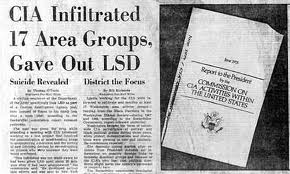
Operation Midnight Climax was part of a CIA mind-control research program after the U.S. started importing hundreds of Nazi "scientists who had been experimenting on human beings in concentration camps. According to Wikipedia, this project "consisted of a web of CIA-run safehouses in San Francisco, Marin, and New York. It was established in order to study the effects of LSD on unconsenting individuals. Prostitutes on the CIA payroll were instructed to lure clients back to the safehouses, where they were surreptitiously plied with a wide range of substances, including LSD, and monitored behind one-way glass. Several significant operational techniques were developed in this theater, including extensive research into sexual blackmail, surveillance technology, and the possible use of mind-altering drugs in field operations.

... News of the story began to leak following a landmark story by New York Times reporter Seymour Hersh on illegal CIA domestic surveillance. This report triggered Senate Subcommittee hearings which investigated MKULTRA, and brought Operation Midnight Climax to light.

I found an old report from 1977 in Time, slightly minimizing the magnitude of what the U.S. government was doing. Let's take a look at some of what Yeadon had to say that inspired my little tweet:
Just as the immigration of Nazis and war criminals into the US involved the use of several projects of which Paperclip is the most widely known such is the case of MK-Ultra. There were 149 sub projects under MK-Ultra. The use of drugs for truth serum and for mind control were conducted under a bewildering list of Project or Operations.

...Army documents suggest there is a contingency plan to use BZ [aka, Buzz or Quinuclidinyl benzilate] as a domestic civilian riot control method. STP, PCP and hundreds of other drugs were tested for use in mind control and as incapacitating agents.

Most research involved LSD. The Army tested LSD on approximately 1,500 military personnel in the mid-1960s. Soldiers were not the only guinea pigs used by the CIA. The list of expendables: war prisoners, prostitutes, sexual psychopaths, prison inmates, certain war objectors, mentally retarded people, the elderly, terminally ill patients, schizophrenics, drug addicts, foreigners, and, of course, any other man, woman or child who fit the need.

...Besides being illegal, such testing [Operation Midnight Climax] without subjects' informed consent is a violation of the Nuremberg code, a set of ethical principles regarding experiments with human subjects and other medical research, which guided the Nuremberg Tribunal.

No idea if the Brits recently used-- or even have-- any of these mind control drugs. No doubt a pissed off right-wing prime minister-- who had to interrupt his Tuscan vacation and hurry home-- wouldn't hesitate for a moment to use them. And now he isn't hesitating to kick arrested suspects' families out of their homes. His coalition partners, the Liberal-Democrats are starting to get a little nervous that they're hooked up with an increasingly dangerous sociopath and that their party could well be headed for extinction. The party's business secretary, looking to the underlying causes of the anti-Austerity riots that shook Britain last week, wants to impose a wealth, or mansion, tax, in the form of a capital gains tax, on properties valued at over £1 million. Their Conservative partners, like the Republicans here, will never go for it. In fact they are committed to lowering taxes on the rich which ramping up the Austerity regime that is convulsing the country. Does this sound familiar?
Speaking on BBC Radio 4, [Chancellor of the Exchequer George] Osborne said there was "not much point" in having a tax that raised scant funds but that served to drive businesses out of Britain.

Osborne said: "I've said with the 50p rate I don't see that as a lasting tax rate for Britain because it's very uncompetitive internationally, and people frankly can move. What is it actually raising? It's only been in operation for a year, this tax, put in place by the last government."

Another Lib-Dem MP, Simon Hughes, who represents a district in South London, Old Southwark, hit hard by rioting last week, penned a column for The Guardian Sunday, Profits must no longer go to the few at the top. It probably wasn't very well-received by anyone at or near the top, particularly not David Cameron. Hughes called for "a fundamental shift in the politics of the last 30 Conservative and Labour years which have sacrificed people's jobs and security in the name of efficiency, and then seen the profits go only to the few at the top."
We must now focus on the redistribution of wealth. But this will not succeed by means of greater hand-outs. Financial benefits must seek to engage people positively. The redistribution of hope and opportunity means the redistribution as well as the creation of work. Co-operative and mutual businesses and social enterprise should be prioritised. The private sector, like the public sector, should not be allowed to get away with obscene pay ratios and bonuses. All employers should be required to consider how they can increase employment and training, by themselves or with others.

Where communities are unable to provide work the government must be prepared to intervene.

A responsible economy is necessary for a responsible society. Building local, regional and national economies which provide the opportunity for all to participate in for fair reward will build much stronger communities. This will counter the appeal of the gangs and the get-rich-quick merchants. Other people and activity must now capture the energies and abilities of a generation that has greater potential than any we have had before.

The Austerity the Republicans are demanding-- and to which Obama seems to be giving in to without any fight at all-- is what's infecting Britain and Greece and dozens of other countries on the verge of explosions. I just don't want to see anyone get hurt with all those experimental drugs.

Labels: , , ,

Friday, August 12, 2011

Plutocracy Has No Place In America-- But It Is Now Our Effective Form Of Government

>


For all the fascination with Hitler and Nazis and World War II on the History Channel and History International, Americans are reticent to engage in a serious discussion of what fascism is and how dangerous to the American way of life it still is. Many Americans don't understand that fascism isn't just about exterminating Jews or about TV war-pornography. I'm going to forego mentioning fascism in this post, although I'll be quoting from Glen Yeadon's book Nazi Hydra In America, and instead talk about plutocracy, which wikipedia defines like this:
Plutocracy is rule by the wealthy, or power provided by wealth. The combination of both plutocracy and oligarchy is called plutarchy... [A]ccording to Kevin Phillips, author and political strategist to U.S. President Richard Nixon, the United States is a plutocracy in which there is a "fusion of money and government."

The wealthy minority exerts influence over the political arena via many methods. Most western democracies permit partisan organizations to raise funds for politicians, and political parties frequently accept significant donations from various individuals (either directly or through corporations or advocacy groups)... Many corporations and business interest groups pay lobbyists to maintain constant contact with elected officials, and press them for favorable legislation. Owners of mass media outlets, and the advertisement buyers which financially support them can shape public perception of political issues by controlling the information available to the population and the manner in which it is presented.

At the end of World War II, it was clear that America had defeated the forces of plutocracy on the battlefields. But they were already plotting to destroy democracy and find a different host to infect for their next great battle to take over the world. By the end of 1944 it was obvious the U.S. was going to defeat the Germans and the Japanese. Their legions of supporters among the American plutocrats were frantic to minimize the damage and save as many of their allies (and investments) as possible. Roosevelt was old and sick (and dying) but he held out against Republicans who wanted a soft peace with Germany and a war against the Soviets-- which was the German and plutocratic goal. When the OSS, precursor to the CIA asked FDR for permission to recruit Nazis and bring them to America, FDR refused. Here's what he told Bill Donovan, head of the OSS, on December 1, 1944:
"I do not believe that we should offer any guarantees of protection in post-hostilities periods to Germans who are working for your organization. I think that carrying out of any such guarantees would be difficult and probably we widely misunderstood both in this country and aboard. We may expect that the number of Germans who are anxious to save their skins and property will rapidly increase. Among them may be some who should properly be tried for war crimes or at least arrested for active participation in Nazi activities. Even with the necessary controls you mention I am not prepared to authorize the giving of guarantees."

Nor did he. Right after he died, though, Truman relented a bit-- with strict guidelines... that were stealthily, systematically-- and gleefully-- ignored. But once the GOP retook the White House, and the Dulles Brothers, those pillars of American plutocracy, grabbed the levers of power, the floodgates opened-- and they opened wide. Almost a dozen programs, starting with Project Overcast and then Paperclip, were used to bring tens of thousands of Germans and brutal far right quislings, primarily from Eastern Europe, into the U.S. It was a determined, if semi-secret, wave of right-wing immigration specifically meant by anti-Semites like the Dulles Brothers, to counter the influence of Jews and "leftists" in America. War criminals of every stripe, including mass murderers were resettled in America under the auspices of the Dulles Brothers and, later, Richard Nixon. Did these immigrants make a contribution, as other waves of immigrants have? Well, they certainly made a contribution to Republican Party fortunes in states where they settled-- and being able to continue their work in biological and psychological warfare here brought America Lyme Disease, West Nile Virus, and drug, chemical and radiation tests on unsuspecting Americans... and, a major goal of the international plutocrats-- the Cold War and the rise of plutocracy here in America (see, especially, Wisconsin, Ohio, Florida, Michigan, the House of Representatives, Mitt Romney's presidential campaign...).

Yesterday Sam Stein reported on what appear to be an anomaly, a teensy weensy little flip flop by Republican Senate Majority Leader-- and plutocracy fanatic-- Mitch McConnell. Miss McConnell, like Mitt Romney, was for raising taxes on the rich before he was so hysterically against it that he would rather see the country go down the drain. In a 1990 campaign ad, Miss lisped, "Unlike some folks around here, I think everyone should pay their fair share, including the rich." The ad was produced by Roger Ailes, like the Dulles Brothers in their day, a pillar of Plutocracy in ours.
The 1990 campaign ad still stands out for what it says about the political mood of the country-- specifically the mood in economically depressed areas that usually vote Republican. McConnell is known for being one of Congress' more astute political minds. The fact that he once espoused tax code fairness in the heat of a tight election shows that even people from Kentucky, at one point, applauded lawmakers for asking the wealthy to further subsidize the social safety net for the middle class and poor.

"What has been amazing, watching his career, is it doesn't bother him a bit to say whatever he needs to say to get re-elected. Mitch would just say whatever he needed to say," said Jim Cunningham, a long time Democratic operative who managed the campaign of McConnell's 1990 challenger, Harvey Sloane.

In Kentucky, "there was a time when... you could poll people on taxes and they believed that if you needed to raise their taxes, especially to take care of education, you should do it," Cunningham said. "Over the years it seems like folks pay less and less attention. At the same time that the Republican Party in our state has helped them buy into this notion that we don't need to tax the rich because they are the ones who create the jobs."

This week Jeff Merkley (D-OR) and 22 other senators called on Miss McConnell to put job creation first, rather than the deranged rush towards Austerity that is ripping apart the social fabric of England, Greece and a dozen other countries right now.
“For families across the country, the biggest economic problem is high unemployment,” wrote the senators. “As you know, the lack of jobs and anemic growth rate of the economy are not only enormous problems in their own right, causing great pain for millions of Americans, they are a major component of our deficit. Indeed, the loss of revenue resulting from the recession accounts for nearly $4 trillion of the projected deficits over the next 10 years.

“It is therefore appropriate and important that the JSC explicitly embrace job creation as a part of its mission,” they continued. “Targeted investments in economic growth and job creation can complement and even enhance long-term deficit reduction efforts and should be a priority that the JSC embraces.

“Let us be very clear: our fiscal challenge is directly linked to the jobs crisis and we cannot solve the former without tackling the latter.”

maybe if these 23 senators followed former Labor Secretary Robert Reich, they would have sent a copy of their letter to President Obama as well, who really ought to present a bold plan to create jobs if he would like to jumpstart the economy. Reich:
Americans are deeply confused about why the economy is so bad-- and their President isn’t telling them. In fact, the White House apparently has decided to join with Republicans and blame it on the long-term budget deficit.

Before I turn to the President, though, let’s be clear: The lousy economy is due to insufficient demand. Consumers-- who are 70 percent of the economy-- can’t and won’t buy because they’re running out of cash. They can’t borrow against homes that are worth a third less than they were five years ago, and most consumers are bad credit risks anyway because they’re losing their jobs and their wages are dropping.  They also have to start saving for the kids’ college or for retirement, which will cut their spending even more.

Without enough consumers, businesses won’t hire enough people and pay them enough to reverse the vicious cycle. So we’re dead in the water. Even the stock market has caught on to the truth.

Which means government has to step in to boost the economy-- as it has every time the economy has fallen into recession over the last eight downturns. Include the massive spending on World War II that lifted us out of the Great Recession, and it’s nine. The Fed can help, but it can’t do it alone. And it’s least helpful after a huge asset bubble has burst because the financial system won’t channel low interest rates where they’re most needed-- to small businesses and average consumers.

This time we tried one stimulus that was way too small relative to the size of the falloff in demand that started in 2008-- especially given that states and locales cut their spending by almost as much as the federal government increased it.

So we need another-- a bold jobs plan.
 
Which gets me to the President. Even though the President’s two former top economic advisors (Larry Summers and Christy Roemer) have called for a major fiscal boost to the economy, the President has remained mum. Why?

I’m told White House political operatives are against a bold jobs plan. They believe the only jobs plan that could get through Congress would be so watered down as to have almost no impact by Election Day. They also worry the public wouldn’t understand how more government spending in the near term can be consistent with long-term deficit reduction. And they fear Republicans would use any such initiative to further bash Obama as a big spender.

So rather than fight for a bold jobs plan, the White House has apparently decided it’s politically wiser to continue fighting about the deficit. The idea is to keep the public focused on the deficit drama-- to convince them their current economic woes have something to do with it, decry Washington’s paralysis over fixing it, and then claim victory over whatever outcome emerges from the process recently negotiated to fix it. They hope all this will distract the public’s attention from the President’s failure to do anything about continuing high unemployment and economic anemia.

Labels: , , , ,