Friday, June 22, 2012

Tammy Baldwin And Fair Trade

>


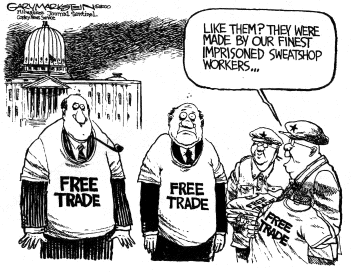
In her new-- first, in fact-- television ad, Rep. Tammy Baldwin, a fair trade (as opposed to "free" trade) advocate has been reported to have gone after China. But that isn't really the point of her ad. True, China helped finance, the Republican takeover of Congress in 2010-- and especially helped the China-advocate who beat Russ Feingold, Ron Johnson. But what's behind Tammy's ad makes a much more important point about the corporate trade agreements conservatives support that are devastating the American middle class. She's always had a lot to say about well-paying jobs. It explains, in part, why's she's one of only three people running for the Senate being supported by Blue America this year. Last night she told me that "Protecting the future of Wisconsin's middle class goes hand-in-hand with protecting our American manufacturing. If we're going to honor the tradition of 'Made in Wisconsin' we need to be sure that there's a level playing field on which our companies compete in the global market. Things need to be fair-- fair trade means ending the practice of Chinese paper goods flooding the market with subsidized products. That's not a partisan issue, it's an American issue."

In the ad she says, "In Wisconsin we lead the entire nation in paper industry jobs. But China, they lead the world in cheating. And it's costing us jobs in Wisconsin. So I brought Democrats and Republicans together to put sanctions on China now and punish them for making billions breaking trade rules. When the rules are fair, Wisconsin workers come out ahead." There's a lot behind those 5 short sentences.

Wisconsin has been the #1 paper-making state for more than most Americans have been alive and Wisconsin has more jobs-- over 53,000-- in the paper industry than any other state. Tammy's Senate opponents are all "free" traders and, like Ron Johnson, are very much pro-China and have studiously avoided confronting the issue about how illegal Chinese subsidies are devastating Wisconsin's paper industry and making it impossible for the state to compete fairly. Half the paper industry jobs have vanished-- well, not vanished... they're in China now. and in return, John Boehner is Speaker of the House. Great deal for China!

Tammy, on the other hand, teamed up with a home-state Republican to pass bipartisan legislation to take on China's unfair trade practices, her CHEATS Act, which would allow the U.S. to impose countervailing duties on Chinese imports that are heavily subsidized by the Chinese government. In addition, Congress passed (370-39) bi-partisan legislation in March sponsored by Tammy to restore expiring trade sanctions designed to protect Wisconsin paper mills and a select group of other American manufacturers hard hit by cheap Chinese imports ("dumping"). And this month she introduced the PAGE Act (Purchasing American Generates Employment) to promote the U.S. (and Wisconsin) paper industry. The "Buy American" legislation that would require that any paper products purchased by the federal government must be grown, reprocessed, reused or produced in the U.S.

In his new book, The Fifteen Biggest Lies About The Economy, Joshua Holland waits 'til the very end to deal with the trade issue. Chapter 15 is called "There's Nothing Free About Free Trade." I want to share a little bit of it with you. Part of his thesis is that "free trade" is basically a corporate power grab-- and it's been a corporate power grab that has supporters on both sides of the aisle. Tammy isn'y among them.
It’s tempting to focus only on the economic impacts of trade deals such as NAFTA, but it’s just as important to dig deeper into the antidemocratic nature of the “free trade” orthodoxy pushed by Big Business. All too often, progressives tie themselves up in knots discussing trade because they argue the issue on corporate America’s terms, instead of going to the root of the matter: “free trade” isn’t free, and it often has nothing to do with what most people would consider “trade.”

If the central question we’re asking is “Free trade or protectionism?” the debate is already lost. That’s how the corporate globalizers have presented it and that’s how the media-- which clearly have a horse in the race-- report it. And that’s why the so-called free traders have been able to keep the upper hand.

Here’s the truth about “free trade” agreements. When you talk about trade policy, you’re really talking about the enormous influence of corporate power over democratic governance. Senator Sherrod Brown (D-OH), the gutsy leader of the fair-trade caucus, explained the close connection during the lead-up to the vote on the Central American Free Trade Agreement (CAFTA) in 2005. “Our political system is now up for the highest bidder,” Brown told me at the time. “Energy bills are written by oil companies and environmental bills are written by the chemical companies.”

Similarly, this trade agreement-- CAFTA-- but other trade agreements, too, have been written by a select few for a select few-- and that select few is typically the drug industry, the insurance and financial institutions, and the energy companies, and the largest multinational corporations. It’s the same old song, whether it’s international or it’s domestic.

In his book The Myths of Free Trade, Brown described thousands of corporate jets stacked up over D.C. as the vote neared, carrying industry execs eager to descend on the city to lobby for the agreement. Trade policy is clearly an insider’s game.

In their book Whose Trade Organization, Lori Wallach and Patrick Woodall found that among the hundreds of “experts” who sat on the advisory boards that hammered out the thousands of pages of WTO and NAFTA rules, there were only a handful of representatives of labor. The rest were multinational execs and various lawyers, lobbyists, and sundry industry experts. There was almost zero input from human rights groups, environmentalists, or the rest of society. It’s not only that the treaties we’ve signed are flawed, but the process by which they’re created makes it all but impossible that they would benefit working people or protect our commons. These are simply not corporate America’s priorities (nor those of its counterparts in Japan or the EU).

...Pressuring countries to adhere to the economic policies of the “Washington Consensus,” whether they’re popular or not, is job number one for the bi multinationals, because a majority of governments on the planet today are, to varying degrees, democratic. And democracy is a huge challenge to many of the big multinationals’ interests. Workers’ movements, environmentalists, pesky public interest groups, and, above all, voters exert various degrees of influence on those elected representatives.

Trade treaties constrain legislatures to remain true to the prevailing orthodoxy. Most folks don’t know this, but when state lawmakers draw up new legislation, they often drop a line to the office of the U.S. Trade Representative to make sure their bills comply with our trade commitments.

Other countries acting on behalf of their biggest corporations can challenge laws that aren’t “WTO legal.” These aren’t about widgets being shipped from here to there; the range of what falls under the catchall “free trade” is astounding. A few of the more notorious decisions include:
A Massachusetts law preventing state and local governments from doing business with the brutal dictatorship in Burma was overturned by domestic courts after a WTO challenge. An EU policy that gave preferential tariffs to small banana
exporters in Europe’s former colonies was successfully challenged by the United States after lobbying by the Chiquita banana company.

Venezuela, backed by Brazil, successfully challenged provisions of the United States’ Clean Air Act that kept fuels with higher
levels of pollutants out of the market.

The WTO has an enforceable arbitration process, but it isn’t always necessary to lodge a formal grievance. Because the vast majority of challenges to various domestic laws have been upheld, merely the threat of bringing a case is usually enough to make governments rethink their legislation. This is common when it comes to health, environmental, and food safety laws. In the first ten years of WTO arbitration panels’ operation, all but two such challenges brought before them prevailed.

In NAFTA and in regional deals such as CAFTA and the proposed Free Trade Area of the Americas (FTAA), the business community managed to get what it had tried and failed to achieve in the WTO: the ability of multinationals to cut out the middle man and sue governments directly for the loss of profits resulting from a regulation or a law they consider too “burdensome.” Under those rules, “signatory governments are required to provide extensive rights and privileges to foreign investors,” who are then “empowered to privately enforce these new rights by demanding cash payment from governments” that don’t give them what they want, according to a report by Public Citizen.

The cases are decided behind closed doors in “private tribunals operating outside the nations’ domestic court system”:
The track record of cases demonstrate[s] an array of attacks on public policies and normal governmental activity at all levels of government-- federal, state and local. Even though these NAFTA cases implicate commonplace public policies, the investor-state system is a closed and unaccountable one. Citizens whose policies are being attacked have no avenue of meaningful participation and neither do the state and local officials they elected to represent them. [Domestic] court decisions can be challenged and jury decisions undermined, yet no judge or jury has standing to participate in the private NAFTA tribunals.

These rules shift significant amounts of risk from investors to governments. At the same time, they sharply limit what governments can ask for in return.

The common response to this critique is pretty straightforward: most of the parties to international trade deals such as the WTO are democratic states. Their legislators are elected by the people, and when they enter into a treaty, they’re doing it on behalf of those who put them in office. Hence, democracy is safe, even if democratic governments don’t always have the freedom-- the “policy space”-- to advance their constituents’ interests.

But we have to remember those private jets stacked up over Washington during the run-up to the vote on CAFTA. That trade deal faced stiff public resistance-- one poll taken in the weeks before Congress voted found that three out of four Americans opposed trade agreements that resulted in job losses at home, even if they resulted in cheaper goods and services. And cheaper goods were a central selling point for the deal.

As the vote neared, it looked as if George Bush might have become the first president to fail to get a trade agreement through Congress in forty years. But all of the lobbying might of various business groups came to bear on members of Congress. As the Washington Post reported, “A prominent business leader recently laid it on the line: Business groups are prepared to cut off campaign contributions to House members who oppose the pact. ‘If you [lawmakers] are going to vote against it, it’s going to cost you,’ Thomas J. Donohue, president and CEO of the U.S. Chamber of Commerce, warned recently during a meeting on Capitol Hill.” Several years later, months before the 2008 presidential elections, Donahue would announce a $60 million war chest dedicated to punishing those whom the Los Angeles Times described as “candidates who target business interests with their rhetoric or policy proposals, including congressional and state-level candidates.” “We plan to build a grassroots business organization so strong that when it bites you in the butt, you bleed,” Donohue said.

On the eve of the vote, the Bush administration started to cut deals with members of its own party who were resisting the pact. The Los Angeles Times reported, “For more than an hour, lawmakers milled about the House floor and gazed at the electronic scoreboard displaying the vote tally, which showed CAFTA several votes short of the mark.” Nancy Pelosi, then the House minority leader, told the Times, “Right there in front of us, for the world to see, they were twisting arms, making deals, changing votes.” Finally, when the count reached 217 to 215, the vote was gaveled to a close, and the deal had scraped through by a hair.

Yet if the pressure on lawmakers here in the United States was great, it paled in comparison with that brought to bear on leaders of smaller, poorer states such as Costa Rica. Lori Wallach, the director of Public Citizen, noted that “The U.S. ambassador to Costa Rica, Mark Langdale, was slammed with a rare formal denunciation before Costa Rica’s Supreme Electoral Tribunal in August after he waged a lengthy campaign to influence the vote on CAFTA. As part of that [campaign], Langdale employed misleading threats and suggested there would be economic reprisals if CAFTA were rejected.” The Bush administration repeatedly threatened to remove Costa Rica’s trade preferences-- which waived some duties on products it exports to the United States-- if the Costa Rican people rejected CAFTA in a referendum.

This kind of geopolitical arm-twisting is par for the course in venues like the WTO. In 2001, immediately after the attacks of 9/11, U.S. trade representative Robert Zoellick made the case that advancing the Anglo-U.S. model of corporate “free” trade was key to winning the “War on Terror.” At the time, author Naomi Klein wrote, “Zoellick explained that ‘by promoting the WTO’s agenda, these 142 nations can counter the revulsive destructionism of terrorism.’ Open markets, he said, are ‘an antidote’ to the terrorists’ ‘violent rejectionism.’”

The United States has become infamous among trade observers for using that kind of rhetorical “linkage” to advance its agenda, but it’s far from unique in that regard. These kinds of power plays are especially evident in negotiations between wealthy states and the developing world, so-called North-South negotiations.

As Aileen Kwa, who analyzed the back-room deals in which trade agreements are formed in great detail, wrote, “In comparison to the United States, the EU is usually more sophisticated in the rhetoric it adopts... it promotes its agenda at the WTO as being ‘in the interests of developing countries.’ This is ironic since developing countries’ assessment[s] of their own interests are the complete opposite.”

The highly developed states use economic blackmail-- threatening poorer countries’ trade preferences and foreign aid accounts-- and blatantly undemocratic methods to overcome the developing world’s concerns about these deals and get them to sign on the bottom line.

In their seminal book Behind the Scenes at the WTO, Kwa and coauthor Fatoumata Jawara cast a bright light on the murky world of international trade negotiations. “Any country whose political system operated as the WTO... [does]-- where... rules were routinely ignored, and people or interested groups routinely used bribery and blackmail to achieve their political ends-- would not only be rightly condemned by the international community as undemocratic and corrupt, it would also face a real and constant threat of revolution,” they wrote.

Crucial meetings are held behind closed doors, excluding participants with critical interests at stake, with no formal record of the discussion. When delegates are, in principle, entitled to attend meetings, they are not informed when or where they are to be held. Meetings are held without translation into the languages of many participants, to discuss documents which are only available in English, and which have been issued only hours before, or even at the meeting itself. Those most familiar with issues (Ambassadors) are sometimes discouraged or prevented from speaking in discussions about them at Ministeria meetings. “Consultations” with Members on key decisions are held one-to-one, in private, with no written record, and the interpretation left to an individual who has a stake in the outcome. Protestations that inconvenient views have been ignored in this process fall on deaf ears. Chairs of committees and facilitators are selected by a small clique, and often have an interest in the issues for which the committee is responsible. The established principle of decision-making by consensus is routinely overridden, and the views of decision-makers are “interpreted” rather than a formal vote being taken... Rules are ignored when they are inconvenient, and a blind eye is turned to blackmail and inducements. The list is endless.

A free-market transaction, remember, has to be free of coercion. All parties have to have access to the same information. By these standards alone, “free trade” is anything but.

Let me leave you with this one last thought: let's make sure Tammy is elected in November, instead of some corporate whore eager to carry out the bidding of Big Business, no matter how many American jobs get shipped overseas. You can help Tammy here.

Labels: , , , , , , ,

Monday, November 15, 2010

Will The Teabaggers Work With Progressives To Derail A Toxic Obama-Boehner Free Trade Push?

>


Yesterday Frank Rich had everybody asking Who Will Stand Up To The Superrich? Looking at who financed Obama's electoral campaign, who runs his treasury department and economic team and who he appointed to be his first chief of staff, we can be sure who won't stand up to the superrich. And now that the superrich just bought the House of Representatives, anyone who thinks the Senate is about to make an historic u-turn and start standing up for regular working families has got to be delusional. The Supreme Court has been a wholly owned subsidiary of the superrich for decades. And that leaves...
America’s ever-widening income inequality was not an inevitable by-product of the modern megacorporation, or of globalization, or of the advent of the new tech-driven economy, or of a growing education gap. (Yes, the very rich often have fancy degrees, but so do those in many income levels below them.) Inequality is instead the result of specific policies, including tax policies, championed by Washington Democrats and Republicans alike as they conducted a bidding war for high-rolling donors in election after election.

...The G.O.P.’s arguments for extending the Bush tax cuts to this crowd, usually wrapped in laughably hypocritical whining about “class warfare,” are easily batted down. The most constant refrain is that small-business owners who file in this bracket would be hit so hard they could no longer hire new employees. But the Tax Policy Center found in 2008, when checking out similar campaign claims by “Joe the Plumber,” that only 2 percent of all Americans reporting small-business income, regardless of tax bracket, would see tax increases if Obama fulfilled his pledge to let the Bush tax cuts lapse for the top earners. The economist Dean Baker calculated that the yearly tax increase at the lower end of that bracket, for those with earnings between $200,000 and $500,000, would amount to $700-- which “isn’t enough to hire anyone.”

Those in the higher reaches aren’t investing in creating new jobs even now, when the full Bush tax cuts remain in effect, so why would extending them change that equation? American companies seem intent on sitting on trillions in cash until the economy reboots. Meanwhile, the nonpartisan Congressional Budget Office ranks the extension of any Bush tax cuts, let alone those to the wealthiest Americans, as the least effective of 11 possible policy options for increasing employment.

Nor are the superrich helping to further the traditional American business culture that inspires and encourages those with big ideas and drive to believe they can climb to the top. Robert Frank, the writer who chronicled the superrich in the book “Richistan,” recently analyzed the new Forbes list of the 400 richest Americans for The Wall Street Journal and found a “hardening of the plutocracy” and scant mobility. Only 16 of the 400 were newcomers-- as opposed to an average of 40 to 50 in recent years-- and they tended to be in industries like coal, natural gas, chemicals and casinos rather than forward-looking businesses involving the Green Economy, tech or biotechnology. This is “not exactly the formula for America’s vaunted entrepreneurial wealth machine,” Frank wrote.

As “Winner-Take-All Politics” documents, America has been busy “building a bridge to the 19th century”-- that is, to a new Gilded Age. To dislodge the country from this stagnant rut will require all kinds of effort from Americans in and out of politics. That includes some patriotic selflessness from those at the very top who still might emulate Warren Buffett and the few others in the Forbes 400 who dare say publicly that it’s not in America’s best interests to stack the tax and regulatory decks in their favor.

Many of the countless tasks that need to be addressed to start rebuilding an equitable America are formidable, but surely few, if any, are easier than eliminating a tax break that was destined to expire anyway and that most Americans want to see expire. Two years ago, Obama campaigned on this issue far more strenuously than he did on, say, reforming health care. Now he and what remains of his Congressional caucus are poised to retreat from even this clear-cut battle. You know things are grim when you start wishing that the president might summon his inner Linda McMahon.

Late last summer when polling showed Boehner that there's was virtually nothing that the Democrats could do that would keep him out of the Speaker's chair, he introduced himself to the American public with a speech at the City Club of Cleveland in which he said, basically, that it'd time to get back to the policies promulgated under the Bush White House/Republican Congress. Most of it was all the right-wing claptrap about lowering taxes on the rich but this is what Boehner had to say about what the right calls "free" trade:
We’ve also recently heard a lot of talk in Washington about the manufacturing sector, but no action. Congress has yet to act on pending free trade agreements with Colombia, Panama, and South Korea. 

These agreements would level the playing field for American workers, farmers, and businesses and pave the way for creating hundreds of thousands of new jobs here at home. 

Passing these free-trade agreements was a critical plank of the jobs plan that House Republican Whip Eric Cantor and I presented to President Obama last December.

Congress should approve these free trade agreements immediately.

It's the place where the conservative majority in the House and the conservative Democrat in the White House-- all of whom have had the political careers financed by the same sources-- find common ground. Remember, when Democrats prevented George H.W. Bush from ramming through the disastrous and hated NAFTA, it was Clinton-- and a particularly brutal, driven and very corporatist White House henchman, Rahm Emanuel-- who managed to get it passed, working with Tom DeLay and the corporately-owned Republican leadership.
Emanuel and DeLay had their hands full to pass the hated NAFTA legislation and there are plenty of legendary stories about nuts being cracked and congressmen being forced to sell out their own constituents. One, Robin Hayes (R-NC), actually broke down and wept like a little girl when DeLay told him he had to vote to destroy what was left of the Piedmont's once-booming textile industry. In the end, on that fateful day in November, 1993, 234 voted aye and only 200, overwhelmingly Democrats, of course, voted nay. Many of the corporate shills who cast their votes against American workers are still in public office-- or otherwise engaged in politics, like Tea Party organizer Dick Armey, and perpetual presidential candidate Newt Gingrich.

Let me do a quick, where are they now on some of the folks who refused to stick up for American workers when push (from DeLay) came to shove (from Emanuel)-- people who are now in the process of reorganizing the House, who back these deadly, job-destroying "free" trade policies and who cynically pay lip service to the deluded teabaggers who helped them into power. Along with Emanuel, Clinton, DeLay, Armey and Gingrich, these were the people who forced through NAFTA and a trade policy based on de-industrialization and outsourcing:

-Spencer Bachus (R-AL), who has taken more Wall Street bribes, $4,450,324, than any other currently serving Members of the House other than career criminals Charlie Rangel ($4,826,590) and Eric Cantor ($4,458,585), slated to be chairman of the Financial Services Committee
-Joe Barton (R-Big Oil)
-John Boehner (R-OH), whose life story is all about how he went from a sweeper of bar floors (his parents') to a multimillionaire, simply by learning how to fellate the rich and powerful
-Ken Calvert (R-CA)
-Dave Camp (R-MI)
-Jim Cooper (Blue Dog-TN), one that got away... for now
-David Dreier (R-CA)
-Wally Herger (R-CA)
-Peter King (R-NY)
-Jerry Lewis (R-CA)
-Buck McKeon (R-CA)
-Dan Rohrabacher (R-CA)
-John Sensenbrenner (R-WI)
-Fred Upton (R-MI)
-Bill Young (R-FL)

132 Republicans voted for NAFTA and only 43 opposed it. 156 Democrats (+ independent Bernie Sanders) voted against NAFTA but 102 crossed the aisle to vote with the Republicans... and Clinton. A few days ago a NY Times OpEd by Robert E. Lighthizer, a former deputy trade representative in the Reagan administration, explores the question of whether we will have to look to the teabaggers to save us from an Obama-Boehner "Free" Trade Axis.
Despite his failure to conclude a trade deal with South Korea this week, President Obama has put free trade at the top of his agenda. That’s in part because the White House and the newly empowered Republican leadership see it as one of the few places where they can work together.

But those expectations could be upset by an unexpected force: the Tea Party. Strangely, for a movement named after an 18th-century protest against import levies, Tea Partyers are largely skeptical about free trade’s benefits-- according to a recent poll by NBC and the Wall Street Journal, 61 percent of Tea Party sympathizers believe it has hurt the United States.

The movement has already forced the Republicans to alter their agenda in several policy areas. Should the same thing happen with free trade, America’s stance toward open markets and globalization could shift drastically.

At first glance, the Tea Party’s position may seem contradictory: its small-government, pro-business views usually go hand in hand with free trade. But if you consider the dominant themes underlying its agenda, it makes sense that the movement would be wary about free-trade policies. For starters, Tea Partyers are frustrated with Washington, and that includes its failure to make free trade work for America. Our trade deficit in manufactured goods was about $4.3 trillion during the last decade, and the country lost some 5.6 million manufacturing jobs.

And while the Tea Party supports market outcomes, its members appear to believe that the rest of the world is stacking the free-trade deck against us. They have a point: most policymakers agree that the Chinese currency is grossly and deliberately undervalued, that China fails to respect intellectual property rights and that it uses government subsidies to protect its own manufacturing base. Meanwhile, the movement says, the United States does virtually nothing in response.

The Republican establishment will argue that its trade agenda is consistent with Tea Party ideals, that its goal is to get government out of the way and allow American companies to thrive in competitive markets.

But Tea Partyers will ask, what good does it do to reduce the role of our government if foreign governments are free to rig the rules, attack American industries and take American jobs? As a result, the otherwise pro-market Tea Party may find its economic program far more at home with a nationalist trade policy that confronts foreign abuses and fights for American companies.

...Trade is an issue where Tea Party concerns about “elites” thwarting the will of the voters will resonate.

In this case, the elites include both Democrats and Republicans. You would need a high-powered microscope to tell the difference between Bill Clinton and George W. Bush on the subject of trade. Even during this slow economic recovery, Mr. Obama is pushing for a new market-opening round of talks at the World Trade Organization.

Among Republicans, not one major elected figure expresses the skepticism toward free trade held by over three-fifths of Tea Partyers. In the face of soaring trade deficits and talk of American decline, the Tea Party may ask whether this is yet another area where the establishment has simply gotten it wrong.

In short, the apparent contradiction between the Tea Party’s fiscal conservatism and its skepticism about free trade may not be a contradiction at all. If the Tea Party continues to influence the Republican agenda, it may not only spell bad news for the South Korea free trade agreement-- it could also mean a fundamental reorientation of our country’s attitude toward trade and globalization.

Nancy Pelosi supported Clinton and crossed the aisle to vote with Gingrich, DeLay, Armey, Boehner and the rest of the "free" trade crowd on NAFTA. That vote was the subject of the ad Blue America ran in OH-8 against Boehner:


Unlike Boehner and virtually all of his Republican colleagues, Pelosi didn't make that mistake again. In fact when the House passed CAFTA on July 28, 2005 by a 217-215 vote, Pelosi led the opposition to it. 187 Democrats voted against it (along with 27 Republicans), while 202 Republicans and 15 Democrats voted in favor. Who forced CAFTA through? The same crew of Wall Street/Big Business shills who enshrined outsourcing and de-industrialization: Tom DeLay (R-TX), John Boehner (R-OH), Eric Cantor (R-VA), Roy Blunt (R-MO), Paul Ryan (R-WI), David Dreier (R-CA), Buck McKeon (R-CA), Spencer Bachus (R-AL), Steve & Peter King (R-IA &NY), Jeb Hensarling (R-TX), Charlie Bass (R-NH), Mike Pence (R-IN), John Boozman (R-AR)... along with sold-out conservative Democrats like Melissa Bean, Jim Cooper, Jim Matheson, Ike Skelton and William Jefferson.

And which Republicans joined Pelosi and the Democratic caucus in opposing this outrageous, job-destroying legislation? Some are among Congress' most conservative members: Virginia Foxx and Patrick McHenry, both of North Carolina, Scott Garrett (R-NJ), Tom Tancredo (R-CO), Bobby Jindal (R-LA), Connie Mack (R-FL) and Rand Paul (R-TX).

I suspect that the Tea Party movement will dry up and wither away now, especially if it takes any serious stands against the behind-the-curtain financiers who made it viable and put it into the national consciousness. The GOP is, after all, a very top-down party and the teabaggers, whether they knew it or not, had a role to play. Boehner may have to do a little juggling but when the Tea Party Patriots published the personal phone numbers of the new Republican freshmen last week, urging supporters to call and urge them to not buy into GOP Establishment nostrums (like "free" trade), they almost immediately had to follow up with a post calling off the dogs and asking teabaggers to not call the freshmen. I hope you won't either... unless you think it's really, really important:

AL-02 Martha Roby - (334) 315-1925 - martharoby@gmail.com
AL-05 Mo Brooks - (256) 652-3833 - mbrooks@leo-law.com
AR-01 Rick Crawford - (870) 919-0305 - erc@meetrickcrawford.com
AR-02 Tim Griffin - (501) 837-5190 - griffinjag@comcast.net
AR-03 Steve Womack - (479) 936-0234 - womackforcongress@gmail.com
AZ-01 Paul Gosar - (928) 853-6225 - paul@drgosar.com
AZ-03 Benjamin Quayle - (602) 616-6837 - bquayle@tynwaldcapital.com
AZ-05 Dave Schweikert - (602) 619-3330 - dave@david10.com
AZ-08 Jesse Kelly - (520) 907-5388 - kellyforcongress@live.com
CA-11 David Harmer - (925) 998-3458 - harmerdavidj@gmail.com
CA-19 Jeff Denham - (831) 595-6785 - jeff_denham@yahoo.com
CA-20 Andy Vidak - andy@vidakforcongress.com
CO-03 Scott Tipton - (970) 560-2631 - scottrtipton@yahoo.com
CO-04 Cory Gardner - (970) 597-0123 - cory@corygardner.net
FL-02 Steve Southerland - (850) 258-9082 - steve@southerlandforcongress.com
FL-05 Richard Nugent - (352) 428-0924 - Richard_Nugent1@msn.com
FL-08 Daniel Webster - (407) 947-5376 - senator_webster@yahoo.com
FL-12 Dennis Ross - (863) 255-1048 - Dross71803@aol.com
FL-22 Allen West - (954) 288-6934 - gowest@allenwestforcongress.com
FL-24 Sandy Adams - (321) 303-9214 - sadams4flhr33@aol.com
FL-25 David Rivera - (786) 258-2222 - Rivera2004@comcast.net
GA-07 Rob Woodall - (770) 366-4245 - rob@robwoodall.com
GA-08 Austin Scott - (229) 392-6992 - austin@scottforga.com
GA-09 Tom Graves - (770) 548-2288 - sovision@aol.com
ID-01 Raul Labrador - (208) 965-1622 - labrador4idaho@gmail.com
IL-08 Joe Walsh (847) 849-9508 - info@walshforcongress.com
IL-10 Bob Dold (847) 251-3653 - bob@bobdold.com
IL-11 Adam Kinzinger - (309) 287-6938 - aknznger@AOL.com
IL-14 Randy Hultgren - (630) 347-1136 - randy@hultgrenforcongress.com
IL-17 Bobby Schilling - (309) 428-9046 - bobbyschilling@gmail.com
IN-03 Marlin Stutzman - (260) 336-0809 - marlin@marlinstutzman.com
IN-04 Todd Rokita - (317) 414-5071 - trokita@hotmail.com
IN-08 Larry Bucshon - (812) 604-5812 - larrybucshon@gmail.com
IN-09 Todd Young - (812) 320-3736 - toddyoung@toddyoungforcongress.com
KS-01 Tim Huelskamp (620) 646-5413 - huelskampforcongress@rurallink.net
KS-03 Kevin Yoder - (913) 526-1990 - kyoder@kc.rr.com
KS-04 Michael Pompeo - (316) 393-6830 - mpompeo@sentryinternational.net
KY-06 Andy Barr - (859) 619-7381 - andy@andybarr.org
LA-03 Jeff Landry - (337) 380-1382 - jlandry@gjtbs.com
MD-01 Andy Harris - (443) 791-0691 - dr.andy.harris@gmail.com
MI-01 Dan Benishek - (906) 396-5839 - benishekforcongress@gmail.com
MI-02 Bill Huizenga - (616) 405-9216 - huizengaforhouse@charter.net
MI-03 Justin Amash - (616) 881-3390 - justin@justinamash.com
MI-07 Tim Walberg - (517) 673-0507 - congressmanwalberg@gmail.com
MN-08 Chip Cravaack - (651) 395-0785 - chip@votechip.org
MO-04 Vicky Hartzler - (816) 392-1582 - vicky79@me.com
MO-07 Billy Long - (417) 839-0061 - auctnr1@aol.com
MS-01 Alan Nunnelee - (662) 213-3571 - alan@senatornunnelee.com
MS-04 Steven Palazzo - (228) 596-8297 - spalazzo@palazzocpa.com
NC-02 Renee Ellmers - renee@reneeforcongress.com
ND-AL Rick Berg - (701) 866-9077 - Berg@bergforcongress.com
NH-01 Frank Guinta - (603) 860-0474 - frankguinta@yahoo.com
NH-02 Charlie Bass - (603) 547-0570 - cfbass@comcast.net
NJ-03 Jon Runyan - (856) 466-3009 - runyanjon69@comcast.net
NM-02 Steve Pearce - (575) 202-9251 - stevehr3746@verizon.net
NV-03 Joe Heck - (702) 885-2626 - joe@heck4nevada.com
NY-13 Michael Grimm - (917) 885-6022 - mggbusiness@aol.com
NY-19 Nan Hayworth - (914) 584-5324 - nan@nanhayworth.com
NY-20 Chris Gibson - (518) 821-7807 - cpandmjgibson@aol.com
NY-24 Richard Hanna - (315) 794-9602 - rlhanna@roadrunner.com
NY-25 Ann Marie Buerkle - (315) 415-4233 - AnnMBuerkle@gmail.com
NY-29 Tom Reed - (607) 765-0487 - tjwreed@yahoo.com
OH-01 Steve Chabot - (513) 235-0150 - Stevechabot11@gmail.com
OH-06 Bill Johnson - (330) 261-2059 - bill.johnson@zoominternet.net
OH-15 Steve Stivers - (614) 581-5559 - stivers.steve@gmail.com
OH-16 Jim Renacci - (330) 336-7956 - jrenacci@sprynet.com
OH-18 Bob Gibbs - (330) 763-1224 - bob@bobgibbs.org
OK-05 James Lankford - (405) 990-9042 - James@jameslankford.com
PA-03 Mike Kelly - (724) 712-6312 - Mikekelly@zoominternet.net
PA-07 Pat Meehan - (215) 850-6352 - pmeehan@conradobrien.com
PA-08 Mike Fitzpatrick - (215) 514-0470 - mfitzpatrick@begleycarlin.com
PA-10 Tom Marino - (570) 772-3192 - realamon@aol.com
PA-11 Lou Barletta - (570) 578-0026 - loubarletta@gmail.com
SC-01 Tim Scott - (843) 343-4990 - tim@votetimscott.com
SC-03 Jeff Duncan - (864) 923-3188 - jeffduncan22@gmail.com
SC-04 Trey Gowdy - (864) 809-0917 - treygowdy@charter.net
SC-05 Mick Mulvaney - (803) 246-1001 - mickmulvaney@mac.com
SD-AL Kristi Noem - (605) 881-2526 - racota@dailypost.com
TN-03 Chuck Fleischmann - (423) 413-3767 - chuck@chuckforcongress.com
TN-04 Scott Desjarlais - (423) 280-1122 - tndesjarlais@charter.net
TN-06 Diane Black - (615) 397-9033 - diane.davidblack@comcast.net
TN-08 Steve Fincher - (731) 676-3555 - Fieldsofgrace5@yahoo.com
TX-17 Bill Flores - (281) 352-2476 - bflores@floresforcongress.org
TX-23 Quico Canseco - (210) 216-8169 - fquico@yahoo.com
TX-27 R. Blake Farenthold - (361) 533-3393
VA-02 Scott Rigell - (757) 619-8276 - esrigell@scottrigell.com
VA-05 Robert Hurt - (434) 489-7995 - robert@roberthurt.org
VA-09 Morgan Griffith - (540) 353-8287 - hmg1993@aol.com
VA-11 Keith Fimian - (703) 989-3782 - keith@fimian2010.com
WA-02 John Koster - (425) 308-9609 - repkoster@hotmail.com
WA-03 Jaime Herrera - (360) 609-0435 - jaimelherrera@hotmail.com
WA-09 Dick Muri - (253) 439-9797 - dick@dickmuri.com
WI-07 Sean Duffy - (715) 491-2345 - sean@seanpduffy.com
WI-08 Reid Ribble - (920) 378-7343 - RRibble@ribblegroup.com
WV-01 David McKinley - (304) 639-1188 - dmckinley@mckinleyassoc.com

And, no, Ben Qualye's number is not good for ordering online porno.

Labels: , , , , ,

Thursday, September 09, 2010

Boehner May Look Like A Dried Up Old Catcher's Mitt, But President Obama Used Him As A Punching Bag Yesterday

>


President Obama was back in Ohio yesterday, pushing back against Republican obstructionism. And he had a good reason for picking Ohio. Early in his Senate term GOP trade policies came up for a vote in the form of CAFTA. Obama, as we explained yesterday, voted against that legislation-- so did then-Congressmen Ted Strickland and Sherrod Brown. In fact every Ohio Democrat voted against a bill that was clearly designed to decimate the whole idea of a high wage/high standard of living society by shipping good manufacturing jobs to slave-wage countries. The impact on Ohio has been especially devastating. Other Ohio Democrats fighting these unfair corporate trade policies then and now: Marcy Kaptur, Dennis Kucinich, Tim Ryan.

Leading the way on passing this destructive Republican bill-- and every piece of bad trade legislation that's come up in the last two decades-- was Wall Street whore John Boehner. Every Republican in the House except Bob Ney followed his lead and among the ones asking hard-pressed Ohio voters to return them to office in November are, aside from the orange drunk golfer, Steve Chabot, Steve LaTourette, Pat Tiberi, and Mike Turner. On top of that, another of the bad trade policy architects, former Congressman Rob Portman (Mean Jean Schmidt's predecessor) didn't vote on CAFTA because he left Congress exactly two months before the final vote... to serve as Bush's Trade Representative and implement all the policies of shipping Ohio's manufacturing base off shore. He's now running for the U.S. Senate!

The picture President Obama painted in Cleveland yesterday wasn't especially kind to these Ohio Republicans:
I ran for President because for much of the last decade, a very specific governing philosophy had reigned about how America should work: 
 
Cut taxes, especially for millionaires and billionaires. Cut regulations for special interests. Cut trade deals even if they didn’t benefit our workers. Cut back on investments in our people and our future-- in education and clean energy; in research and technology. The idea was that if we had blind faith in the market; if we let corporations play by their own rules; if we left everyone else to fend for themselves, America would grow and prosper. 
 
For a time, this idea gave us the illusion of prosperity. We saw financial firms and CEOs take in record profits and record bonuses. We saw a housing boom that led to new homeowners and new jobs in construction. Consumers bought more condos and bigger cars and better televisions. 
 
But while all this was happening, the broader economy was becoming weaker. Job growth between 2000 and 2008 was slower than it had been in any economic expansion since World War II-- even slower than it’s been over the past year. The wages and incomes of middle-class families kept falling while the cost of everything from tuition to health care kept rising. Folks were forced to put more debt on their credit cards and borrow against homes that many couldn’t afford in the first place. Meanwhile, a failure to pay for two wars and two tax cuts for the wealthy helped turn a record surplus into a record deficit. 
 
I ran for President because I believed that this kind of economy was unsustainable-- for the middle-class and for our nation’s future. I ran because I had a different idea about how America was built-- an idea rooted in my own family’s story.
 
...[M]uch has happened since that election. The flawed policies and economic weaknesses of the previous decade culminated in the worst recession of our lifetimes. My hope was that the crisis would cause everyone, Democrats and Republicans, to pull together and tackle our problems in a practical way. But as we all know, things didn’t work out that way. 
 
Some Republican leaders figured it was smart politics to sit on the sidelines and let Democrats solve the mess. Others believed on principle that government shouldn’t meddle in the markets, even when the markets were broken. But with the nation losing nearly 800,000 jobs the month I was sworn in, my most urgent task was to stop a financial meltdown and prevent this recession from becoming a second depression. 
 
We’ve done that. The economy is growing again. The financial markets have stabilized. The private sector has created jobs for the last eight months in a row. And there are roughly three million Americans who are working today because of the economic plan we put in place.
 
But the truth is, progress has been painfully slow. Millions of jobs were lost before our policies even had a chance to take effect-- a hole so deep that even though we’ve added jobs again, millions of Americans remain unemployed. Hundreds of thousands of families have lost their homes; millions more can barely pay the bills or make the mortgage. The middle-class is still treading water, while those aspiring to reach the middle class are doing everything they can to keep from drowning. 
 
Meanwhile, some of the very steps that were necessary to save the economy-- like temporarily supporting the banks and the auto industry-- fed the perception that Washington is still ignoring the middle class in favor of special interests.
 
And so people are frustrated and angry and anxious about the future. I understand that. I also understand that in a political campaign, the easiest thing for the other side to do is ride this fear and anger all the way to Election Day.    
 
That’s what’s happening right now. A few weeks ago, the Republican leader of the House came here to Cleveland and offered his party’s answer to our economic challenges. Now, it would be one thing if he admitted his party’s mistakes during the eight years they were in power, and was offering a credible new approach to solving our country’s problems.
 
But that’s not what happened. There were no new policies from Mr. Boehner. There were no new ideas. There was just the same philosophy we already tried for the last decade-- the same philosophy that led to this mess in the first place: cut more taxes for millionaires and cut more rules for corporations. Instead of coming together like past generations did to build a better country for our children and grandchildren, their argument is that we should let insurance companies go back to denying care to folks who are sick, and let credit card companies go back to raising rates without any reason. Instead of setting our sights higher, they’re asking us to settle for a status quo of stagnant growth, eroding competitiveness, and a shrinking middle class.   
 
...I have a different vision for the future. I’ve never believed that government has all the answers to our problems. I’ve never believed that government’s role is to create jobs or prosperity. I believe it’s the drive and ingenuity of our entrepreneurs, the skill and dedication of our workers, that has made us the wealthiest nation on Earth. I believe it’s the private sector that must be the main engine of our recovery. 
 
I believe government should be lean, it should be efficient, and it should leave people free to make the choices they think are best for themselves and their families, so long as those choices don’t hurt others. 
 
But in the words of the first Republican President, Abraham Lincoln, I also believe that government should do for the people what they cannot do better for themselves. 
 
That means making long-term investments in this country’s future that individuals and corporations cannot make on their own: investments in education and clean energy; in basic research, technology, and infrastructure
 
That means making sure corporations live up to their responsibilities to treat consumers fairly and play by the same rules as everyone else; to look out for their workers and create jobs here at home.
 
And that means providing a hand up for middle-class families-- so that if they work hard and meet their responsibilities, they can afford to raise their children, send them to college, see a doctor when they get sick, and retire with dignity and respect. 
 
That’s what we Democrats believe in-- a vibrant free market, but one that works for everybody.  That’s our vision for a stronger economy and a growing middle-class. And that’s the difference between what we and the Republicans in Congress are offering the American people right now.

Let me give you a few specific examples of our different approaches. This week, I proposed some additional steps to grow the economy and help businesses spur hiring. One of the keys to job creation is to encourage companies to invest more in the United States. But for years, our tax code has actually given billions of dollars in tax breaks that encourage companies to create jobs and profits in other countries. 
 
I want to change that. Instead of tax loopholes that incentivize investment in overseas jobs, I’m proposing a more generous, permanent extension of the tax credit that goes to companies for all the research and innovation they do right here in America. And I’m proposing that all American businesses should be allowed to write off all the investment they do in 2011. This will help small businesses upgrade their plants and equipment, and will encourage large corporations to get off the sidelines and start putting their profits to work in places like Cleveland and Toledo and Dayton. 
 
To most of you, this is just common sense. But not to Mr. Boehner and his allies. For years, Republicans have fought to keep these corporate loopholes open. In fact, when Mr. Boehner was here in Cleveland he attacked us for closing a few of these loopholes-- and using the money to help states like Ohio keep hundreds of thousands of teachers and cops and firefighters on the job. He dismissed these jobs-- teaching our kids, patrolling our streets, rushing into burning buildings-- as quote “government jobs”-- jobs that I guess he thought just weren’t worth saving. 
 
I couldn’t disagree more. I think teachers and police officers and firefighters are part of what keep America strong. And I think if we’re going to give tax breaks to companies, they should go to companies that create jobs in America-- not those that create jobs overseas. That’s one difference between the Republican vision and the Democratic vision. And that’s what this election is all about. 
 
Let me give you another example. We want to put more Americans back to work rebuilding America-- our roads, railways, and runways. When the housing sector collapsed and the recession hit, one in every four jobs lost were in the construction industry. That’s partly why our economic plan has invested in badly needed infrastructure projects over the last nineteen months-- not just roads and bridges, but high-speed railroads and expanded broadband access. Altogether, these are projects that have led to thousands of good, private sector jobs, especially for those in the trades.
 
Mr. Boehner and the Republicans in Congress said no to these projects. Fought them tooth and nail. Though I should say that didn’t stop a lot of them from showing up at the ribbon-cutting ceremonies and trying to take credit. That’s always a sight to see.

Goal ThermometerNow, there are still thousands of miles of roads, railways, and runways left to repair and improve.  And engineers, economists, governors and mayors of every political stripe believe that if we want to compete, we need to rebuild this vital infrastructure. There’s no reason Europe or China should have the fastest trains or the most modern airports-- we want to put people to work building them right here in America. So this week, I’ve proposed a six year infrastructure plan that would start putting Americans to work right away. But despite the fact that this has traditionally been an issue with bipartisan support, Mr. Boehner has so far said no to infrastructure. That’s bad for America-- and that too is what this election is about. 
 
I’ll give you one final example of the differences between us and the Republicans, and that’s on the issue of tax cuts. Under the tax plan passed by the last administration, taxes are scheduled to go up substantially next year. Now, I believe we ought to make the tax cuts for the middle class permanent. These families are the ones who saw their wages and incomes flatline over the last decade – and they deserve a break. And because they are more likely to spend on basic necessities, this will strengthen the economy as a whole.
 
But the Republican leader of the House doesn’t want to stop there. Make no mistake: he and his party believe we should also give a permanent tax cut to the wealthiest two percent of Americans.  With all the other budgetary pressures we have-- with all the Republicans’ talk about wanting to shrink the deficit-- they would have us borrow $700 billion over the next ten years to give a tax cut of about $100,000 to folks who are already millionaires. These are among the only folks who saw their incomes rise when Republicans were in charge. And these are folks who are less likely to spend the money, which is why economists don’t think tax breaks for the wealthy would do much to boost the economy.
 
So let me be clear to Mr. Boehner and everyone else: we should not hold middle class tax cuts hostage any longer. We are ready, this week, to give tax cuts to every American making $250,000 or less. For any income over this amount, the tax rates would go back to what they were under President Clinton. This isn’t to punish folks who are better off – it’s because we can’t afford the $700 billion price tag. And for those who claim that this is bad for growth and bad for small businesses, let me remind you that with those tax rates in place, this country created 22 million jobs, raised incomes, and had the largest surplus in history. 
 
In fact, if the Republican leadership in Congress really wants to help small businesses, they’ll stop using legislative maneuvers to block an up-or-down vote on a small business jobs bill that’s before the Senate right now. This is a bill that would do two things: cut taxes for small businesses and make loans more available for small businesses. It is fully paid for, and it was written by Democrats and Republicans. And yet, the other party continues to block this jobs bill-- a delay that small business owners have said is actually leading them to put off hiring.
 
Look, I recognize that most of the Republicans in Congress have said no to just about every policy I’ve proposed since taking office. And on some issues, I realize it’s because there are genuine philosophical differences. But on issues like this one, the only reason they’re holding this up is politics, pure and simple. They’re making the same calculation they made just before the inauguration: if I fail, they win. Well, they might think this will get them where they need to go in November, but it won’t get our country where it needs to go in the long run.
 
Meanwhile, take a look at some of the salient points about Boehner's budget gimmicks Jen Psaki made on the White House blog yesterday.
It is disturbing but unfortunately not surprising that an entire political party would rally together to hold tax relief for middle class families hostage as leverage to push through tax cuts for the very richest Americans-- people who don’t need them and haven’t even asked for them. But that is apparently what exactly what Republican Minority Leader John Boehner is trying to do.

Even as the Republican Party has tried to shed its dismal record on fiscal discipline, they have been consistent and unwavering in their attempts to borrow more than $700 billion to support permanent tax cuts for millionaires and billionaires. But giving an average $100,000 tax break to those making over $1,000,000 a year when we can’t afford them and they don’t need them is not sound economic policy.

The latest trick from Republican Minority Leader John Boehner says a lot about Republican priorities and strategy-- and seems like an obvious recognition of just how irresponsible their position is. 

In an interview this morning he issued a half-hearted call for a two year extension of these tax cuts for the wealthiest Americans. This is nothing more than a throwback to Bush-era budget gimmicks that helped get us into the fiscal mess we're in today, an attempt to mask the true budget-busting cost of the Republican agenda. If there was any doubt about that, it was eliminated when immediately after the interview he issued a press release making clear the Party’s continuing desire to borrow more than $700 billion to make these tax cuts permanent (“House Republicans will continue to fight to permanently stop job-killing tax hikes.”)

But President Obama isn't running against John Boehner and can't defeat him. The DCCC is trying to use him as a whipping boy but is doing absolutely nothing to help the ONLY Democrat who can defeat Boehner in November, Justin Coussoule. See that thermometer above? You can click it to donate to Justin's campaign efforts directly and/or to contribute to Blue America's TV campaign against Boehner and on behalf of Justin. John Boehner isn't a theory; he's a clear and present danger to our country and our families. The DCCC is too cowardly to take him on; Justin, a former Army captain and West Point grad, isn't. If you can, please help him. Like in the case of Donna Edwards and Alan Grayson, DC Democrats aren't going to lift a finger; it's up to us.

Labels: , , , , ,

Wednesday, September 08, 2010

What Republicans Don't Want Voters To Know About Jobs, Jobs, Jobs

>


When Bush pushed CAFTA through Congress, it was a very close win for the GOP's Big Business allies. The final vote was 217-215. Although 187 Democrats voted against it-- only 15 joining the Republicans in favor-- Boehner, Blunt, Cantor, Ryan delivered for their corporate masters once again. For the last month Boehner has been running around the country like a bright orange chicken without a head squawking, "Where are the jobs, Mr. President?"

It's an ironic question coming from one of the engineers responsible for passing trade policies that have systematically decimated the basis of America's manufacturing base. Boehner and his cronies-- their wallets fat with gargantuan payoffs from outsourcers-- have voted for every single bad trade bill that has ever promised to ship American jobs overseas. For Boehner to publicly ask where the jobs are is a slap in the face to every American worker and an insult to the intelligence of every Ohio voter. In the Senate, Obama looked at the exact same CAFTA bill Boehner and the Republicans did. Then-Senator Obama voted against it. Several conservative Senate Republicans voted NO as well (John Thune, Lindsey Graham, David Vitter, Mike Enzi, Richard Shelby...) but voting to send American jobs to slave wage economies: Jim DeMint, Richard Burr, Mike DeWine, Chuck Grassley, Blanche Lincoln, John McCain, Ben Nelson and, of course Miss McConnell. All the Democrats voted against it with the exception of a small handful of corporate whores who habitually vote with the GOP against working families.

But let's go back to the House for a moment, where every member has to face the voters in November. Why are Ohio voters thinking of reelecting John Boehner, who has screwed them on WTO, screwed them on CAFTA, screwed them on NAFTA and has the temerity to be boosting plans for more unbalanced trade legislation with a handful of more low-wage countries. I know he wants to destroy the standard of living of American workers and make them into serfs but who does he think will be buying American goods and services to keep our consumer-driven economy afloat if there are no decent jobs? Not everyone can be a caddy or bartender!

Instead of asking Justin Coussoule for another quote about Boehner's record on jobs and how it has devastated businesses and the economy from Butler County up through Darke, Miami and Mercer, we took a look at a perfectly framed ad by Rob Miller, the former marine running against Joe "You Lie" Wilson. Although South Carolina Senator Lindsey Graham warned that CAFTA would be disastrous for South Carolina's textile industry and small businesses (and voted NO), at the last minute Wilson was persuaded by Boehner's slick blandishments and voted YES, along with Gresham Barrett and Bob Inglis, both of whom have been disposed of by tea party activists. Miller's TV ad should leave Wilson reeling:


We caught up with Rob this morning and asked him if Wilson, just one Member of Congress, really hurt South Carolina with his vote. We knew the answer but we wanted to see how Rob would put it. He put it well:
When Joe Wilson went to Congress in December 2001, South Carolina’s unemployment rate was 5.7 percent. Today, 10.8 percent of South Carolinians are without jobs, including 112,500 people who have lost their manufacturing jobs.

Manufacturing was the backbone of South Carolina’s economy, until unfair trade deals like CAFTA went into effect. CAFTA sent thousands of our jobs overseas, and people all across the state knew that would happen before the first vote was cast.

But that didn’t stop Joe Wilson. Joe Wilson voted for CAFTA and broke his promise to protect South Carolina’s workers, sending their jobs to Central America. The real insult is that Joe Wilson cast the deciding vote for CAFTA. If Wilson voted “No” CAFTA would not have passed.

It was that simple, and Joe Wilson didn’t have the courage to do what’s right. South Carolina towns are dying-- people are struggling to put food on the table-- and it all comes down to Joe Wilson turning his back on South Carolina’s workers by voting “Yes” for CAFTA.

I hope lots of Democrats watch Rob's ad. Similar ones would be especially effective against Roy Blunt (R-MO), Mike Castle (R-DE), Mark Kirk (R-IL), and John Boozman (R-AR) four particularly corrupt Wall Street darlings who are all trying to upgrade from the House to the Senate. It may also be useful for Democrats in New Hampshire, Pennsylvania and New Mexico to keep in mind as Charlie Bass, Mike Fitzpatrick and Steve Pearce try to slip back into office without letting voters know they were major players in the battles to pass CAFTA and similarly toxic trade bills.

Labels: , , , ,

Friday, March 26, 2010

The Pornography Of American Trade Policy And The Bipartisan Destruction Of The Middle Class

>

You already know one of these assholes; the other is more dangerous

Trade policy is about the unsexiest thing anyone can talk about... right? The other day I was arguing with a very wonky Democratic official and even he-- though eager for a boost for his congressional campaign-- started yawning in my face when I tried equating Bill Clinton's trade policies with the economic well-being of our country. And he's from a city whose working families have been absolutely pulverized by the job-destroying Republican trade policies that Bush I failed to get through Congress but that Clinton-- with the strong arm, thuggish tactics of henchman Rahm Emanuel-- managed to push through for them, a majority of Democrats voting "no." Among those supporting President Clinton's closely contested bill were notorious Clinton haters like Newt Gingrich (R-GA), Tom DeLay (R-TX), Jerry Lewis (R-CA), Pete Hoekstra (R-MI), John Boehner (R-OH), Wally Herger (R-CA), Frank Wolf (R-VA), Duke Cunningham (R-CA), Ken Calvert (R-CA), Bill Young (R-FL), Mike Castle (R-DE), Fred Upton (R-MI), Jim Cooper (Blue Dog-TN), Dave Dreier (R-CA), Dana Rohrabacher (R-CA), Buck McKeon (R-CA), John Kasich (R-OH) and Rob Portman (R-OH).

If you're from Ohio, a state whose economy is nearly prostate from trade policy caused job losses, you may have noted the last two names on the list, the favored Republican nominees for governor and senator this year. In fact, that very last name, Rob Portman, graduated from pushing crappy trade policies in Congress to actually devising and implementing them in his post-Congressional career as a lobbyist and Bush's Trade Representative. Friday was the anniversary of Portman's ill-starred appointment as Trade Rep and the occasion was marked by working people in Ohio with the sorrow it merits.
Cincinnati AFL-CIO Executive Secretary-Treasurer Doug Sizemore said Bush chose Portman for a reason and that his record in the House show he “betrayed Ohio workers time and time again.”

“Portman voted repeatedly to fast-track international trade agreements and also voted against helping workers who lost their jobs due to outsourcing,” Sizemore said. “Portman also supported NAFTA (North American Free Trade Agreement) and still thinks it created jobs. I can tell you there are 50,000 Ohio workers who would disagree with him on that.

“This anniversary is important because as we weather this recession, we can’t forget how we got here,” he said. “Portman’s job killing trade policies were a recipe for disaster five years ago, and they are not the way out of this crisis ... and we can’t afford to have him represent our voice in the Senate.”

Ohio Conference on Fair Trade Director Karen Hanson blasted Portman and said the number regarding trade and loss of jobs speaks for his work.

“it’s unthinkable for Portman to receive anything but failing marks for his record as Bush’s U.S. trade representative,” Hanson said.

She claimed 17,000 Ohio workers had their jobs shipped overseas on his watch and the U.S. trade deficit rose nearly 6.5 percent “slowing economic growth and impeding job creation.” She also claimed the trade imbalance with China eclipsed $200 billion for the first time in U.S. history.

“These are just statistical numbers and they don’t begin to reveal all the collateral damage to Ohio families and communities by this decimation of our manufacturing base in this state,” Hanson said. “Ohio workers, businesses and middle class families deserve better than Portman’s agenda in Washington.”

Joe Logan, director of Agricultural Programs for the Ohio Environmental Council and agricultural co-chair for the Coalition for a Prosperous America, criticized Portman for his policies affecting agriculture.

He cited wheat exports declined to 20 percent of the global export market in 2009 from 45.7 percent in 1980, with corn declining to 10.6 percent from 19.6 percent and soybeans dropping to 30 percent from 60 percent during the same period.

“Traditionally the U.S. agriculture has been a very robust net exporter of agricultural commodities and agricultural products,” Logan said. “Exports and trade continues to be a very important to the agricultural economy here in Ohio and across the country.

“We have gone from being a very robust net exporter of food to a near-break-even point,” Logan said. “We are on the cusp of being a net food importer for the first time since 1959.”

As it happens, today (another Friday) is also a big day for Portman's prospective Democratic opponent, Ohio Secretary of State Jennifer Brunner (more on her progressive stance on trade policy below). To celebrate a remarkable grassroots victory against the state party machine this week (she defeated her primary opponent Lt. Gov. Lee Fisher's surreptitious request for a eleventh-hour state party endorsement with the help of supporters who sent more than 57,000 email messages to members of the state party's executive committee), she is conducting an all-day money bomb today at VictoryForCourage.com. Stop by and help her out with a contribution to help give her get-out-the-vote operations a boost. Her people-powered campaign is built on small-dollar contributions from progressives across Ohio and the nation, and with the tremendous support she is building she is fending off the big-dollar contributions and massive campaign spending of her corporatist Democrat rival.

Portman's campaign called the anniversary a "distraction," although they did note that his presumed opponent, Lee Fisher, has a record that is just as bad as Portman's. I can't say that Fisher is that bad but... well, Clinton was an improvement over Bush I. Just don't tell that to the millions of American workers who's jobs were lost because of the bipartisan corporate trade policies both pursued. Then again, that might be why the one Ohio Senate candidate who does not support these catastrophic trade policies, Secretary of State Jennifer Brunner, is climbing the polls and why the other two stagnate.

In fact "Trade" is the #2 issue mentioned on Jennifer's campaign website, right after "Jobs." Her way of looking at Trade policy rejects the catastrophic approach that Reagan, both Bushes and Clinton took:
"Free trade" resulting from U.S. trade agreements such as NAFTA and CAFTA has resulted in huge trade deficits for the U.S., hurting our middle class workers who have lost jobs to outsourcing while corporations have scoured the world for the cheapest labor in countries with the fewest health, safety and environmental regulations. These agreements have enabled foreign countries to ship what their low-wage workers produce to the United States while blocking many U.S. products from entering their countries, all while we have bound ourselves to decisions of the World Trade Organization that hinder a fair trade balance.

Agreements for "free trade" should be re-examined and where warranted replaced with intelligent trade pacts that prevent foreign predatory practices such as: 1) demanding patented or trade secret protected technology in order to operate in that country or 2) abiding by foreign Value Added Tax (VAT) agreements that unjustifiably subsidize foreign exports to us, but simultaneously penalize our exports to those countries. At the same time, it must be profitable to manufacture in America.

The tax structure for industries vital to strategic American interests, such as steel, transportation and cement should be revisited. Out-of-control trade deficits place foreign companies in a position to purchase our best companies, such as in industries like publishing, autos, movies, steel, electronics and clothing, impacting national security and living standards in the United States.

We must take great care that we maintain ownership of vital strategic American interests. We must take great care not to drain our long term wealth as a nation for short term interests.

Talking with her about trade policy and reading what she's written about it reminded me of the brilliant way it was explained by Thom Hartmann in The Threshold. After explaining how Reagan's quest to improve the profitability of transnational corporations, like his former employers at GE, reversed the steady gains the American middle class had been making since the Great Republican Depression half a century before, Hartmann lit into more contemporary history:
George H.W. Bush, initially decrying Reagan's economic worldview as "voodoo economics," embraced it, as did Bill Clinton, who really kicked the door down on tariffs and "protectionism" by signing the United States up for the full GATT, the creation of the World Trade Organization (WTO), and the North American Free Trade Agreement (NAFTA), all benefiting the transnational corporations that had come to dominate political contributions for both the Republican and Democratic parties by the 1980s. Their campaign contributions, in turn, benefited the 537 elected members of the House, Senate, and the executive branch of government (president and vice president).

For the first time in its history, our country's smaller and medium-size industries stood essentially naked and defenseless against those of other fully developed nations, most of which were still holding in place tariffs, R&D supports, and intense support of the commons infrastructure, including free higher education and free health care. While today both China and India have import tariffs that run as high as 20 to 30 percent on manufactured goods (to protect their domestic industries and markets), we've dropped our tariffs from a 1973 average of 12 percent to today's average of around 2 percent.

The result was just what Alexander Hamilton feared: the rapid unraveling of the American middle class as the nation bled its industrial base into the gutter of cheap-labor countries.

As wealth dramatically increases in the top 1 percent of America and the middle class shrinks, the working poor become even poorer. Between the election of George W. Bush and 2007, the four hundred richest individuals in America (virtually all associated with transnational corporations) saw their wealth increase from $1.0 trillion to $1.6 trillion-- an increase of $600 billion. During the same time the real income of the average wage earner fell by between $2,000 and $4,000... The growing gap between the haves and the have-nots has, in the past, brought civilization to a threshold of cultural, economic, and political change-- and often that's violent, painful, or even democracy-ending.

And, no, the GOP and Fox News hadn't yet launched the teabagger movement when Hartmann wrote those words.

Labels: , , , , ,

Friday, October 24, 2008

Keith Olbermann Has A New Worst Person: Robin Hayes (R-NC)

>

Robin Hayes can't ever seem to get his stories straight

Olbermann is never kind to extremist lunatics. It's taken him a while but he's finally gotten around to Robin "Weepy" Hayes, a kind of feudal type who represents a sprawling district that stretches from Charlotte to Fayetteville (NC-08). Apparently he had either just lost control of himself or he was trying to compete with Michele Bachmann for the GOP crazee du jour, when he introduced John McCain to an audience in North Carolina by saying "Liberals hate real Americans that work and accomplish and believe in God." Forgetting that we're in a different kind of media age, where things are easy recorded and checked, he flatly denied saying it.

The next day witnesses came forward to say they heard him. He denied it some more. Then someone released a recording and he was caught like a rat. He first claimed he didn't remember saying it and then claimed he didn't mean to say it and later claimed he never really denied it-- and blamed the whole thing on... liberal bloggers. The funny thing is, North Carolina voters have even better reasons to get rid of Robin Hayes than just his erratic grappling with Truth and Reality.

If any member of Congress personifies a willingness to sell out his constituents' economic interests for the sake of special interests, it is Robin Hayes. Few districts anywhere have been as hard hit by unfair trade policies as NC-08. And yet Hayes was the deciding vote-- twice-- on trade agreements his party was pushing that he himself said he knew was bad for North Carolina! Once he actually voted NO and then, weeping like a little girl, changed his vote to YES when Tom Delay threatened him on the floor of the House.

Hayes' opponent, Larry Kissell, is one of the best candidates running for Congress anywhere. A laid off mill worker, Larry became a social studies teacher and later came within 325 votes of ousting Hayes from Congress in 2006. This year polls say he will complete the job. Blue America has endorsed him and I'm very nervous about this race because Hayes and his corporate allies are flooding the district with negative campaign ads-- and Larry's pretty much out of money. According to Open Secrets, on September 30 Hayes still had $1,113,272 left to spend and Larry was down to $250,134. The most recent polling shows Larry at 49% and Hayes at 41% but the NRCC is blasting away with $882,000 in television smears.

Larry deserves our support-- and not just because Hayes has been such an egregious rubber stamp for the entire Bush agenda. Larry is a committed progressive who will stand up to special interests across the board-- the kind represented by Bush Republicans and the kind, just as venal, represented by corrupt Democrats like Rahm Emanuel. Emanuel, the Tom Delay doppelganger in the Democratic caucus, favors the exact same unfair trade policies that Bush and Delay were pushing. I'd LOVE to see the little twerp try to persuade Larry Kissell to change his vote and support that kind of crap! This is what Larry told me when I asked him about Hayes' latest episode:
Unfortunately this dishonesty that my opponent has continued to show this week is part of a pattern of deceit that goes all the way back to his betrayal of our district and his last minute vote switches on fast track authority for Bush and CAFTA.

There are two ways to help Larry win this seat now. One is by donating directly to his campaign via ActBlue. Even $5 and $10 donations help. The other is to place your own ad buy in the Charlotte cable market through SaysMe.tv. Just pick which ad you want to run, which network you want to run it on and what time of the day. An ad on MSNBC in the late afternoon, for example, costs $60, while a late night ad on MTV or the SciFi channel costs $31; ESPN 2 charges $60 for a spot late night or early morning. It's fun. Meanwhile, watch Keith giving Hayes his due:

Labels: , , , ,

Wednesday, July 23, 2008

Republican Wing Of The Democratic Party

>

More Democrats? No, BETTER Democrats

In politics, no one is perfect (except Donna Edwards... though Tammy Baldwin and Linda Sánchez come close enough). Still, there are patterns that develop over time, patterns that show the frightening consistency of Democrats who always vote with the Republicans on substantive matters. We've been referring to them as "the Republican wing of the Democratic Party." Who joins? Well... no one running as a Democrat-- not even Jim Marshall or John Barrow would ever admit they're part of the Republican wing of the Democratic Party (RwotDP). Even while Barrow was accepting money from a vicious anti-union political action committee and Republican front group 2 weeks ago-- which he said he was honored to be endorsed by-- BIPAC, he was still trying to persuade Georgia Democratic primary voters that he is Barack Obama's long-lost fraternal twin. Watch him move to a more... nuanced position as the general election approaches: "Barack who????"

Let's forget about Republicans for a while, since every single one of them is even worse than the worst Blue Dog or DLC Democrat, and see if we can find any patterns by examining some of the most crucial votes that have shaped today's political landscape. I want to start with the NAFTA vote on November 17, 1993, during which Bill Clinton dispatched a thuggish White House operative to cajole, beg, bribe and... when necessary, break arms and legs to get enough Democrats to cross the aisle and vote with the Republicans on one of the most damaging trade bills ever conceived.

The majority of Democrats, 156, voted against it (as did 43 Republicans). But joining the 132 pro-NAFTA Republicans were 102 Democrats. Clinton's most grotesque operative, a then barely known Rahm Emanuel,  had just earned himself a rotten borough for his efforts and was soon after given a congressional seat in a Chicago district previously slated for extinction.

I know that some of these Democrats now realize they made a grievous error-- and have atoned by voting against similar bills and by fighting long and hard for Democratic principles since then. One of my neighbors, Xavier Becerra, fits into that category. So do Congressman Ed Markey and then congressmen/now senators Dick Durbin, Ben Cardin, Maria Cantwell, and Ron Wyden. However,  there are some Democrats who voted for NAFTA who have continued-- even after the disastrous effects of NAFTA became apparent-- to vote with the GOP on trade policy and on other key issues adversely effecting their constituents' well-being. That's what we mean by the RwotDP. These are Democratic members who voted for NAFTA who are still in Congress and still voting with the Republicans way more frequently than they should:

Jim Cooper (D-TN)*
Norm Dicks (D-WA)
Chet Edwards (D-TX)
Bart Gordon (D-TN)*
Steny Hoyer (D-MD)
Solomon Ortiz (D-TX)
John Tanner (D-TN)*

Fast forward a dozen years to July 28, 2005. Congress had already seen all the evidence of NAFTA's horrible impact on American working families. And the Bush Regime was pushing CAFTA. This time only 27 Republicans abandoned their party's right wing orthodoxy and opposed this bill. And instead of 102 Democrats, only 15 voted for CAFTA. Still, it passed-- by two votes, 217-215. These are the 15 Democrats, even with all the evidence in on NAFTA, who voted for CAFTA:

Melissa Bean (D-IL)*
Jim Cooper (D-TN)*
Henry Cuellar (D-TX)
Norm Dicks (D-WA)
Ruben Hinojosa (D-TX)
William Jefferson (D-LA)
Jim Matheson (D-UT)*
Gregory Meeks (D-NY)
Dennis Moore (D-KS)*
Jim Moran (D-VA)
Solomon Ortiz (D-TX)
Ike Skelton (D-MO)
Vic Snyder (D-AR)
John Tanner (D-TN)*
Edophous Towns (D-NY)

Even some of the Democrats' worst corporate hacks, like Hoyer and Emanuel, had migrated back to the Democratic position on trade. Even before they brought up CAFTA, the Bush Regime was pushing it's attack on Iraq. On October 10, 2002 the House voted on the Authorization For the Use of Force Against Iraq, a bill that cost then-Minority Leader Dick Gephardt, who conspired with Bush against the American people and against his own caucus, his job. Only 6 of 223 Republicans voted against Bush while 126 (61%) of 208 Democrats voted against the disastrous resolution.

Many Democrats crossed the aisle that day, to their eternal shame. Many, though by no means all, of the Jewish congressmen abandoned their progressive allies to vote the Likud-AIPAC line. But many of the Democrats who voted Republican that day are the same old regular suspects who are mainstays of the RwotDP and who keep abandoning Democratic values and principles whenever push comes to shove:

Shelley Berkley (NV)
Howard Berman (CA)
Marion Berry (AR)*
Sanford Bishop (GA)*
Leonard Boswell (IA)*
Rick Boucher (VA)
Allen Boyd (FL)*
Norm Dicks (WA)
Chet Edwards (TX)
Eliot Engel (NY)
Bob Etheridge (NC)
Bart Gordon (TN)*
Gene Green (TX)
Jane Harman (CA)*
Baron Hill (IN)*
Tim Holden (PA)*
Steny Hoyer (MD)
William Jefferson (LA)
Ron Kind (WI)
Nick Lampson (TX)*
Jim Matheson (UT)*
Mike McIntyre (NC)*
Dennis Moore (KS)*
Collin Peterson (MN)*
Mike Ross (AR)*
Adam Schiff (CA)*
Ike Skelton (MO)
Adam Smith (WA)
John Tanner (TN)*
Ellen Tauscher (CA)
Gene Taylor (MS)*

Let's compare that list of traitors to the 80 Democrats who crossed the aisle June 19 to make sure Bush could keep the Iraq War going. If these treacherous "Democrats," led by Hoyer and Emanuel, would have stuck with the majority of Democrats, led by the hapless Pelosi, Bush would be outlining his plan for bringing the troops home safely now. Many of these members are new in Congress, but see how many names were on the previous list of war authorizers (hint, their names are bolded) :

Jason Altmire (PA)
Brian Baird (WA)
John Barrow (GA)*
Melissa Bean (IL)*
Shelly Berkley (NV)
Howard Berman (CA)
Marion Berry (CA)*
Sanford Bishop (GA)*
Dan Boren (OK)*
Rick Boucher (VA)
Allen Boyd (FL)*
Nancy Boyda (KS)
Chris Carney (PA)*
Don Cazayoux (LA)
Travis Childers (MS)
Jim Cooper (TN)*
Jim Costa (CA)*
Henry Cuellar (TX)
Norm Dicks (WA)
Joe Donnelly (IN)*
Chet Edwards (TX)
Brad Ellsworth (IN)*
Rahm Emanuel (IL)
Bob Etheridge (NC)
Bill Foster (IL)
Gabby Giffords (AZ)*
Kirsten Gillbrand (NY)*
Charlie Gonzalez (TX)
Bart Gordon (TN)*
Gene Green (TX)
Baron Hill (IN)*
Ruben Hinojosa (TX)
Tim Holden (PA)*
Steny Hoyer (MD)
Ron Kind (WI)
Nick Lampson (TX)*
Dan Lipinski (IL)
Tim Mahoney (FL)*
Jim Marshall (GA)*
Jim Matheson (UT)*
Mike McIntyre (NC)*
Charlie Melancon (LA)*
Harry Mitchell (AZ)
Dennis Moore (KS)*
Collin Peterson (MN)*
Mike Ross (AR)*
Dutch Ruppersberger (MD)
John Salazar (CO)*
David Scott (GA)*
Heath Shuler (NC)*
Ike Skelton (MO)
Zach Space (OH)*
John Tanner (TN)*
Gene Taylor (MS)*

The FISA vote, allowing for warrantless wiretaps and retroactive immunity also saw Hoyer and Emanuel lead a minority-- a very large minority-- of Democrats across the aisle to pass unconscionable legislation demanded by the Bush Regime and huge corporate donors. It passed 293-129 but would have failed if not for the Hoyer-Emanuel coalition of bought off Democrats. This list is a little different because it only includes Democrats who voted for this FISA bill plus the war funding bill:

Jason Altmire (PA)
Brian Baird (WA)
John Barrow (GA)*
Melissa Bean (IL)*
Shelley Berkley (NV)
Howard Berman (CA)
Marion Berry (AR)*
Sanford Bishop (GA)*
Dan Boren (OK)*
Leonard Boswell (IA)*
Rick Boucher (VA)
Allen Boyd (FL)*
Nancy Boyda (KS)
Corrine Brown (FL)
Chris Carney (PA)*
Don Cazayoux (LA)
Ben Chandler (KY)
Travis Childers (MS)
Jim Clyburn (SC)
Jim Cooper (TN)*
Jim Costa (CA)*
Bud Cramer (AL)*
Henry Cuellar (TX)
Artur Davis (AL)
Norman Dicks (WA)
Joe Donnelly (IN)*
Chet Edwards (TX)
Brad Ellsworth (IN)*
Rahm Emanuel (IL)
Eliot Engel (NY)
Bob Etheridge (NC)
Gabby Giffords (AZ)*
Kirsten Gillibrand (NY)*
Bart Gordon (TN)*
Gene Green (TX)
Stephanie Herseth Sandlin (SD)*
Ruben Hinojosa (TX)
Tim Holden (PA)*
Steny Hoyer (MD)
Paul Kanjorski (PA)
Dale Kildee (MI)
Ron Kind (WI)
Nick Lampson (TX)*
Dan Lipinski (IL)
Tim Mahoney (FL)*
Jim Marshall (GA)*
Jim Matheson (UT)*
Charlie Melancon (LA)*
Harry Mitchell (AZ)
Jack Murtha (PA)
Solomon Ortiz (TX)
Collin Peterson (MN)*
Earl Pomeroy (ND)*
Silvestre Reyes (TX)
Ruben Rodriguez (TX)
Mike Ross (AR)*
Dutch Ruppersberger (MD)
John Salazar (CO)*
David Scott (GA)*
Joe Sestak (PA)
Heath Shuler (NC)*
Ike Skelton (MO)
Vic Snyder (AR)
Zach Space (OH)*
John Spratt (SC)
John Tanner (TN)*
Gene Taylor (MS)*
Mark Udall (CO)
Charlie Wilson (OH)*

And those little asterisks (*) some people have and others don't? The asterisks are members who have publicly admitted to being Blue Dogs. It is suspected that there are some members who have asked their membership to stay hush-hush.

When you talk to professional Inside the Beltway Democrats they will try to persuade you that all that's bad in the world flows from the fact that there are Republicans. Just elect more Democrats, they say, and everything will be hunky dory. The record shows otherwise. Without these Democrats above there would be no war in Iraq, no FISA bill, no job-killing trade legislation. That's why Blue America is all about BETTER Democrats, not "more Democrats."

Labels: , , , , ,