Saturday, December 07, 2019

Ron DeSantis, Like Many Republican Officials, Doesn't Seem To Understand What Democracy Means

>


The Voting Rights Restoration for Felons Initiative (Amendment 4 to the Florida constitution) passed overwhelmingly on November 6, 2018, 5,148,926 (64.55%) to 2,828,339 (35.45%). The amendment was sponsored by a wide coalition including the ACLU, the Christian Coalition and the Koch Brothers' Freedom Partners. It was generally supported by Democrats, independents and moderate Republicans. Far right and extremist Republicans like Ron DeSantis opposed it. DeSantis, an anti-democracy Trumpist was on the ballot the same day. DeSantis had a close call that day, somehow narrowly triumphing over Democrat Andrew Gillum, 4,076,186 (49.6%) to 4,043,723 (49.2%). There are several ways to look at these numbers. You may note that that while Amendment 4 won by 2,320,587 votes and over 29 points, DeSantis only win by 32,463 votes and less than half a point. You could also point out that Bill Nelson lost his senate reelection campaign that day with 4,089,472 votes, 13,236 more votes than DeSantis got. Just over 23,000 voters who cast their ballots for Republican Rick Scott-- who did not oppose Amendment 4-- to replace Nelson, refused to vote for DeSantis.

DeSantis, a notorious racist who would like nothing better than to reinstate Jim Crow in Florida, has been working to undermine Amendment 4-- and the expressed will of the Florida electorate-- ever since taking office. Yesterday, Tampa Bay Times reporter Dara Kam discussed how he's still doing so., noting that "A federal judge on Tuesday excoriated lawyers representing Gov. Ron DeSantis’ administration, accusing the state of trying to 'run out the clock' to keep felons from voting in next year’s elections." No beating around the bush there.

Yesterday, I discussed this development with Alan Grayson, one of the foremost proponents of Amendment 4. He pointed out that "If there is one thing that the GOP is consistent about, it’s about preventing voting, whenever, wherever and however it can. A very strange approach for a political party in a democracy, but there it is."


Republicans fear that Florida's 29 electoral votes are at stake if Amendment 4 stands


The acrimony between U.S. District Judge Robert Hinkle and the state’s attorneys came during a hearing in a legal battle over a constitutional amendment designed to restore voting rights to felons who have completed terms of their sentences.

The controversy is centered on whether felons have to pay legal financial obligations, such as restitution, fines and fees, to be able to vote. The Republican-dominated Legislature approved a law this spring that required payment of such obligations, drawing a legal challenge from civil-rights and voting-rights groups.

Hinkle ruled in October that it is unconstitutional to deny the right to vote to felons who are “genuinely unable” to pay financial obligations. In a preliminary injunction, Hinkle said state officials need to come up with an administrative process in which felons could try to prove that they are unable to pay financial obligations and should be able to vote.

The state appealed Hinkle’s ruling to the 11th U.S. Circuit Court of Appeals.

In a subsequent motion asking Hinkle to put the case on hold amid the appeal, lawyers for DeSantis and Secretary of State Laurel Lee argued that a decision upholding the federal judge’s ruling could render the entire constitutional amendment void because of a lack of “severability.” Under the legal concept of severability, an unconstitutional portion of a law can be eliminated while the rest of the law remains intact. The state maintains that if any part of the felons’ rights amendment is struck down, the entire amendment is void.

Only the Florida Supreme Court can decide whether Hinkle’s ruling would change the amendment so much that Floridians would not have supported the proposal, the state’s lawyers argued in the motion filed Nov. 18. The Florida justices are poised to issue an advisory opinion requested by DeSantis on whether the amendment requires payment of legal financial obligations.

“It is unlikely that Florida voters would have permitted felons to recapture their voting rights without fully repaying their debt to society,” the state’s lawyers wrote in the federal court motion.

But Hinkle, who repeatedly raised his voice while questioning the state’s lawyers, grew increasingly incensed as he spent two hours Tuesday attempting to ascertain whether the papers filed on the governor’s behalf accurately reflected a statement issued by DeSantis’ office in response to the judge’s October ruling.

In the statement, DeSantis spokeswoman Helen Ferré wrote that Hinkle’s decision affirmed the governor’s position that convicted felons be held responsible for paying restitution, fees and fines while also recognizing “the need to provide an avenue for individuals unable to pay back their debts as a result of true financial hardship.”

The discrepancy between the court filings and Ferré’s statement prompted Hinkle to ask, “Is it the governor’s position that Amendment 4 is a complete nullity,” even if a person is unable to pay legal financial obligations.

“I want to be sure that you don’t just bury it in your papers, that you say it here in public,” the judge asked Nicholas Primrose, deputy general counsel for DeSantis.

Primrose said “what voters thought” they were voting on is a “question that has to be addressed.”

The “indigency exception” created by Hinkle in his ruling would “broaden” what some voters believed they passed, he argued.

But Hinkle wasn’t satisfied, asking Primrose to answer whether it was a nullity or not.

“I’m not sure I can accurately express the governor’s position,” Primrose said, reiterating that the “very critical question of severability” needs to be addressed.

“I’m not accustomed to people coming and saying, ‘Here’s a critical question but I’m not going to tell you my position on it,’” Hinkle responded.

Hinkle pressed Lee’s lawyer, Mohammad Jazil, on the same issue.

“Our fear is that... the severability analysis... would suggest that Amendment 4 cannot be severed,” Jazil began.

But Hinkle interrupted him.

“I really don’t want the lawyers’ analysis,” the judge said. “This is a question that the secretary is going to have to take a position and the governor’s going to have to take a position.”

Jazil said the state disagrees with Hinkle’s interpretation requiring an exemption for felons who cannot pay their legal financial obligations. Because the state does not believe the amendment can be severed, it would be void if Hinkle’s ruling is upheld, Jazil said.

“That, we believe, is an absurd outcome,” he added.

The judge continued to tangle with Primrose and Jazil until the state’s lawyers finally conceded the court filings reflected their bosses’ positions.

“We stand by our papers,” Jazil said.

Primrose said DeSantis had approved everything that had been filed on his behalf, and that the amendment would be null if Hinkle’s analysis of the amendment was correct.

“We don’t believe your analysis is correct,” which is why the state appealed, he added.

Hinkle scolded the state on other matters, as well.

Chiding the state for failing to move forward with a process to allow felons who can’t afford to pay their financial obligations to register to vote, Hinkle asked the state what the “irreparable harm” would be in proceeding with the process while the appeal plays out.

Primrose said the state did not want to begin the process until the appellate court had ruled because of the amount of work involved.


“The possibility of tens of thousands or hundreds of thousands of individuals” registering to vote create a heavy workload for state and local elections officials, Primrose argued. And, if the state wins the appeal, those people would have to be removed from the voting rolls, he said.

“So the irreparable harm’s the administrative burden,” Hinkle asked.

“Yes, your honor,” Primrose said.

Hinkle appeared troubled that the time it will take before the appellate court rules will interfere with people’s ability to register to vote in time for the March presidential primary elections.

Leah Aden, a lawyer who represents the NAACP Legal Defense Fund, told Hinkle the state is “going mute” and leaving voter-registration groups “at a loss for what to do.”

It’s “chilling people” because “the state is unwilling to say” what the process is, Aden argued.

Hinkle said the court system determines whether defendants are indigent before their cases are resolved.

The state could establish that defendants who were deemed indigent at the time of their last felony conviction are currently unable to pay their court-ordered fees and fines and allow them to register and vote, Hinkle suggested.

Primrose said “there’s a lot of disagreement” between the plaintiffs and the state on a process to move forward, drawing another rebuke from Hinkle.

“If you really want to comply with the Constitution and let everyone who’s eligible to vote vote, pretty easy,” the judge said. “You put in place a constitutional system, it won’t matter if they (plaintiffs) like it or not. What you can’t do is to run out the clock so that people who are eligible to vote don’t get to vote in the March primary or, more importantly, in the presidential election.”

Labels: , , , ,

Thursday, March 30, 2017

Crossing the U.S. Border with Electronic Devices

>

(Source; click to enlarge)

by Gaius Publius

It used to be that when most people crossed the U.S. border, their electronic devices — computers, smartphones, tablets — were not routinely searched. This is no longer the case. As Murtaza Hussain notes at The Intercept, searches are up sharply, from 5,000 in 2015 ... to 5,000 in just last February alone.

It's not just ICE agents whose jobs are "fun" again, it's the men and women at the U.S. Border Protection service too.
Lawsuit Seeks Transparency as Searches of Cellphones and Laptops Skyrocket at Borders

A lawsuit filed today by the Knight First Amendment Institute, a public interest legal organization based at Columbia University, seeks to shed light on invasive searches of laptops and cellphones by Customs and Border Protection officers at U.S. border crossings.

Documents filed in the case note that these searches have risen precipitously over the past two years, from a total of 5,000 searches in 2015 to 25,000 in 2016, and rising to 5,000 in the month of February 2017 alone. Among other questions, the lawsuit seeks to compel the federal government to provide more information about these searches, including how many of those searched have been U.S. citizens, the number of searches by port of entry, and the number of searches by the country of origin of the travelers.
The obvious problem — that pesky Fourth Amendment aside — is, as the author puts it, "the wealth of personal data often held on such devices." Seizure and search of these devices puts that highly personal treasure trove in the hands of the Trump-led, even-more-muscular government and its agents, to do with as they will. (And don't discount the possibility that Trojan horse software could be implanted. Not that our government would do that, mind you — that would be wrong — but still.)

Of course, the border agents can't order you to surrender your devices and unlock codes — not exactly — though intimidation and coercion is in their repertoire. How long, for example, are you willing to put your life on hold while you defy them and they wait you out ... at the airport, with a flight to catch or a job to get to?

Hussain again:
A number of recent cases in the media have revealed instances of U.S. citizens and others being compelled by CBP agents to unlock their devices for search. In some instances, people have claimed to have been physically coerced into complying, including one American citizen who said that CBP agents grabbed him by the neck in order to take his cellphone out of his possession.
With that in mind, I thought I'd offer a few suggestions, as a partial answer to questions I'm seeing more and more, asked by people who have reason to believe they may be on the "outs" with the brave new world in Washington and its agenda.

How to Safeguard Your Data From Searches at the Border

The first set of suggestions comes from the New York Times. Brian Chen, the author of the piece, gives a nice introduction to the problems encountered by those who cross the U.S. border, closing with the admonition, Do not lie about your passwords. That would not only be wrong, it would be punishable.

That said, here are his suggestions. Note that many of them hinge on not crossing the border with your data to begin with — or not crossing the border with your passwords, even in your head. Chen:
Consider a cheap device

The best way to prevent your information from being searched is to travel with a device that never had any of your data in the first place.

It’s a wise idea to invest in a so-called travel device, a cheap smartphone or computer that you use only abroad ... So leave your fancy equipment — along with your photo album, Facebook, Snapchat and Twitter apps — at home.

Which devices to buy? The Wirecutter, the product recommendations site owned by The New York Times, published a guide on budget Android phones, including the $100 Moto G4 Play that comes unlocked so that it can work with foreign SIM cards. For cheap computers, consider a $550 Acer laptop or a $430 Dell Chromebook.
When it comes to phones, you could even forego a local phone and, as an East London friend suggests, buy a cheap smartphone or even a "dumbphone" at your destination. Then load a pay-as-you-go SIM card into it and use it exclusively. You could even abandon it before leaving if you're feeling really bold. (Remember when travelers didn't feel incomplete if they didn't have a phone in their pocket? That could be you.)

If you want it back, I'm sure a friend would be glad to mail it to you after you leave — or you could simply mail it to yourself before you depart.

Three more small pieces of advice before one major one:
Disable fingerprint readers

...[In] the United States, law enforcement agencies have successfully used warrants to compel people to unlock their cellphones with a fingerprint. But because of your right to remain silent, it would be tough (though not impossible) for the federal government to force you to share your passcode. So disabling your fingerprint sensor when traveling is generally a safer move. ...

Encrypt your devices

Whether you are using a burner device or your own, always make sure to lock down the system with encryption, which scrambles your data so it becomes indecipherable without the right key.

Desktop apps like BitLocker or Apple’s FileVault let you encrypt your hard drive, requiring a passphrase to decrypt your files. To avoid surrendering this passphrase, you could jot it down and hand it to a friend and contact that person for the passphrase after crossing the border. [emphasis added]

Back up to the cloud, then wipe before you cross

...[To have access to your data while abroad] back up your data to a cloud service and then wipe, or erase, all the data from your device before arriving at the border, Mr. Zdziarski said. After passing through customs, you could then restore your information from the online backup.
I want to focus on the comment above about your passphrase for a moment. You can't surrender your passphrase (a more complex form of password) if you don't know it. So, when you encrypt your device, use a complex passphrase that you (1) don't memorize, and (2) give to someone not traveling with you.

If You Don't Know Your Passwords, You Can't Surrender Them

Which leads to the final piece of advice, a major one:
Don’t memorize your passwords

The best way to protect your passwords is to not know them. When resisting a data frisk, it is easier to say you didn’t memorize your password as opposed to refusing to provide it to border agents, Mr. Grossman said.

“If you don’t know them it’s hard to compel you to give them over if you don’t know how,” he said. “Even if somebody put a gun to my head, I don’t know it.”

Password management apps like 1Password and LastPass can automatically create strong, lengthy passwords for all your online accounts and keep them stored in a vault that is accessible with one master password.

However, Mr. Grossman said you are better off traveling without your password management software loaded on your devices so that you won’t be asked to hand over the master password to your vault. You could store a copy of the password vault on a cloud service like Dropbox and get access to your vault of passwords when you reach your travel destination, he said.

An alternative to using a password-managing app is to write your passwords down and leave them with someone you trust. After getting through customs, contact that person and ask him or her to read off your passwords.
What's really needed, of course, is for someone who can put her life on hold — and who has a great lawyer prepared to defend her — to challenge these searches and seizures in court. Some lawyers I spoke to don't think they're legal — though note the strong objections to that opinion here.

Suggestions from the CIA

The other suggestions I want to offer come from the CIA. This isn't related to carrying electronic devices per se, but to how to comport yourself during screenings. WikiLeaks has leaked internal documents from the CIA that advise its own agents how to behave when they cross the border. After all, if you're a spy with a cover story, you don't want it blown by some border cop who pulls you out of line for a random secondary check and spots your nervousness.

Those documents are here:


Happy traveling.

GP
  

Labels: , , , , , ,

Tuesday, July 14, 2015

The "Augean Stables" — How Corruption Has Amended the Constitution

>

Hercules starting to clean a 1,000-cattle stable that hadn't been emptied in 30 years. Like the U.S. government, says Gary Hart. (Hercules quickly gives up on the shovel.)

by Gaius Publius

Not something you don't already know if you're a regular reader of these pages, but it's becoming more and more mainstream to deliver a radical* analysis of government in the U.S. That's why I found the following so interesting — the source is former U.S. Senator and former presidential candidate Gary Hart. And believe me, this is a radical analysis.

But first, two definitions. The Augean Stables is a reference to the Fifth Labor of Hercules, one of the Twelve (click to read the context). The task was to clean the king's stables, which housed 1,000 cattle and which hadn't been cleaned in 30 years, the life of the man who owned it. Cleaned of what? Surely you know:
The fifth Labour of Heracles (Hercules in Latin) was to clean the Augean (/ɔːˈən/) stables. Eurystheus [the king assigning the tasks to Hercules] intended this assignment both as humiliating (rather than impressive, like the previous labours) and as impossible, since the livestock were divinely healthy (immortal) and therefore produced an enormous quantity of dung (ἡ ὄνθος). These stables had not been cleaned in over 30 years, and over 1,000 cattle lived there. However, Heracles succeeded by rerouting the rivers Alpheus and Peneus to wash out the filth.
The second definition — corruption. Most think of corruption as an outcome that's perverted for the sake of money. Hart, correctly, says, Not so:
From Plato and Aristotle forward, corruption was meant to describe actions and decisions that put a narrow, special, or personal interest ahead of the interest of the public or commonwealth. Corruption did not have to stoop to money under the table, vote buying, or even renting out the Lincoln bedroom. In the governing of a republic, corruption was self-interest placed above the interest of all—the public interest.
Corruption is "self-interest placed above the interest of all," or in some cases, one's legal or contractual obligation. Thus, for example, some college football referees and refereeing groups are obviously corrupt. When Conference A plays Conference B using Conference B's referees, and year after year the bad calls go Conference B's way, especially with the game on the line, the referees are corrupt.

Are they betraying their obligation for money? No, likely not. Are they betraying their obligation in order to satisfy animus against Conference A, or to make sure the "home teams" win? That's an obvious explanation, and by this definition (and mine), that's corrupt.

Or take another situation. By this definition, the Supreme Court since at least 2000 and likely before has acted corruptly, if the definition is "self-interest placed above the interest of all." No legal analysis of Bush v. Gore passes the "upholds the interest of all" test — the Republicans on the Court simply put a Republican (the home team candidate) in the White House because they could. Nor do the major decisions around money and corporate rights, like Citizens United or even Buckley v. Valeo, the 1976 Burger Court decision that lifted restrictions on campaign contributions, and its follow-up, First National Bank of Boston vs. Bellotti, whose majority opinion was authored by Lewis Powell, of the infamous Powell memo.

By this definition — perverting an outcome to benefit a group in which one has a personal interest — the Supreme Court acted corruptly in the cases above. Likely corrupt in Buckley, Citizens United, and First National Bank of Boston. Certainly corrupt in Bush v. Gore, where Republican justices favored a Republican candidate for president over a Democratic one on no defensible grounds. They weren't metaphorically "corrupt," with the quotes. They were corrupt by definition.

Gary Hart on the Systemic Corruption of the U.S. Government

Hart's piece is an interesting Time magazine essay, and also a long section from his new book, The Republic of Conscience (I don't support Amazon, so no Amazon link). I don't want to quote a ton of it, since its main argument is likely familiar to you. But he makes a systemic point in a way that seems original; that is, he puts pieces together to make a bigger whole than most of us were aware of. For example, it's likely that the "army of lobbyists" we all hate aren't a perversion of government — they are government.

A few notable sections (all emphasis mine):
Gary Hart: America’s Founding Principles Are in Danger of Corruption

Welcome to the age of vanity politics and campaigns-for-hire. What would our founders make of this nightmare?

Four qualities have distinguished republican government from ancient Athens forward: the sovereignty of the people; a sense of the common good; government dedicated to the commonwealth; and resistance to corruption. Measured against the standards established for republics from ancient times, the American Republic is massively corrupt.

From Plato and Aristotle forward, corruption was meant to describe actions and decisions that put a narrow, special, or personal interest ahead of the interest of the public or commonwealth. Corruption did not have to stoop to money under the table, vote buying, or even renting out the Lincoln bedroom. In the governing of a republic, corruption was self-interest placed above the interest of all—the public interest.

By that standard, can anyone seriously doubt that our republic, our government, is corrupt? There have been Teapot Domes and financial scandals of one kind or another throughout our nation’s history. There has never been a time, however, when the government of the United States was so perversely and systematically dedicated to special interests, earmarks, side deals, log-rolling, vote-trading, and sweetheart deals of one kind or another.

What brought us to this? A sinister system combining staggering campaign costs, political contributions, political action committees, special interest payments for access, and, most of all, the rise of the lobbying class.

Worst of all, the army of lobbyists that started relatively small in the mid-twentieth century has now grown to big battalions of law firms and lobbying firms of the right, left, and an amalgam of both. And that gargantuan, if not reptilian, industry now takes on board former members of the House and the Senate and their personal and committee staffs. And they are all getting fabulously rich.
Gargantuan numbers of lobbyists with gargantuan amounts of money. There's a point where corruption of government on that scale systemically changes government itself.

The "Big Three" Lobbying Conglomerates Are a "Fourth Branch of Government"

For Hart, the movement of office-holders and their staffs between lobbying firms and government is not a "revolving door" to government; that revolving door is government. Hart makes his point by looking at the lobbying firm WPP, the largest of three giant lobbying conglomerates. WPP isn't just a lobbying firm, it's an international conglomerate of firms that wields enormous power and wealth.

Consider — WPP has been eating up lobbying firms the way Macy's, Inc. eats department stores or Darden eats restaurant chains. At some point, you simply own the business you're in, and the size of your operation changes the nature of the game itself.

Hart on how lobbying at this scale changes our government:
[T]he largest [lobbying "predator" (his term)] by far is WPP (originally called Wire and Plastic Products; is there a metaphor here?), which has its headquarters in London and more than 150,000 employees in 2,500 offices spread around 107 countries. It, together with one or two conglomerating competitors, represents a fourth branch of government, vacuuming up former senators and House members and their spouses and families, key committee staff, former senior administration officials of both parties and several administrations, and ambassadors, diplomats, and retired senior military officers.

WPP has swallowed giant public relations, advertising, and lobbying outfits such as Hill & Knowlton and BursonMarsteller, along with dozens of smaller members of the highly lucrative special interest and influence-manipulation world. Close behind WPP is the Orwellian-named Omnicom Group and another converger vaguely called the Interpublic Group of Companies. According to Mr. Edsall, WPP had billings last year of $72.3 billion, larger than the budgets of quite a number of countries.

With a budget so astronomical, think how much good WPP can do in the campaign finance arena, especially since the Citizens United decision. The possibilities are almost limitless. Why pay for a senator or congresswoman here or there when you can buy an entire committee? Think of the banks that can be bailed out, the range of elaborate weapons systems that can be sold to the government, the protection from congressional scrutiny that can be paid for, the economic policies that can be manipulated.

The lobbying business is no longer about votes up or down on particular measures that may emerge in Congress or policies made in the White House. It is about setting agendas, deciding what should and should not be brought up for hearings and legislation. We have gone way beyond mere vote buying now. The converging Influence World represents nothing less than an unofficial but enormously powerful fourth branch of government.

To whom is this branch of government accountable? Who sets the agenda for its rising army of influence marketers? How easy will it be to not only go from office to a lucrative lobbying job but, more important, from lucrative lobbying job to holding office?
When one lobbying firm has billings of nearly $75 billion, you can "buy committees," not just individual votes; and you can "set agendas" rather than just pass laws.

Now consider that "revolving door" again. Is that a door out of government and back into it, or is it a door into another branch of government, one where policy decisions also get made?

Does an International Lobbying Firm Serve One Nation's Interest or Many?

And a final question: If the lobbying firm is international, with international clients and governmental "targets," are its interests "American" in any way? If not, how compromised are those who take its money?
Where are its [WPP's] loyalties if it is manipulating and influencing governments around the world? Other than as a trough of money of gigantic proportions, how does it view the government of the United States?
Why would not WPP act to modify the laws of one country to serve the interests of clients in another? And I'll ask again, are those who take its money compromised by the international goals of these mega-firms?

"Purchasing" Candidates and Office-Holders — Even Former Senators Are Saying It

Just as "corruption" is not a metaphor when it comes to decisions like Bush v. Gore, "buying" and "sponsoring" candidates and office-holders — the way soap is bought and race cars are sponsored — is not a metaphor, at least according to Hart:
The advent of legalized corruption launched by the Supreme Court empowers the superrich to fund their own presidential and congressional campaigns as pet projects, to foster pet policies, and to represent pet political enclaves. You have a billion, or even several hundred million, then purchase a candidate from the endless reserve bench of minor politicians and make him or her a star, a mouthpiece for any cause or purpose however questionable, and that candidate will mouth your script in endless political debates and through as many television spots as you are willing to pay for. All legal now. ...

The five prevailing Supreme Court justices, holding that a legal entity called a corporation has First Amendment rights of free speech, might at least have required the bought-and-paid-for candidates to wear sponsor labels on their suits as stock-car drivers do. Though, for the time being, sponsored candidates will not be openly promoted by Exxon-Mobil or the Stardust Resort and Casino but by phony “committees for good government” smokescreens.
I think he's literally correct. In the old days, it didn't take much money to wholly own a back-bench Congress person from coal country, say, and one coal company, if big enough, could do it. But the major office-holders had to be funded by competing interests. Now you can tag several  presidential candidates, at least on the Republican side, with the single name of their "benefactor."

For example:
  • Marco Rubio — Sponsored by Norman Braman & (he hopes) Sheldon Adelson
  • Scott Walker — Sponsored by the Koch Brothers
  • Ted Cruz — Sponsored by hedge fund billionaire Robert Mercer
  • Rick Santorum — Sponsored by Foster Friess
  • Rand Paul — Sponsored by [this slot available]
And so on. Joe Biden's been called the "Senator from MBNA," and Chuck Schumer the "Senator from Wall Street." Seems right. In cases of such complete "sponsorship" I agree that wearing of badges should be required. Partial sponsorship could be handled like NASCAR jackets:


But this treats a serious problem too lightly. Remember, I said this was a radical analysis. In fact, by this practice we're actually amending the Constitution — not the one as written; the one as practiced.

The Other Way to Amend the Constitution

All constitutions and all systems of laws are amended in two ways, by formal agreement (legal process) and by informal agreement. In England, the second ways is in fact the primary way their "constitution" is amended.

In the U.S., if both parties enforce a law in the same way, even though that way deviates from the way the law is written, the law is amended until forced back to its original form in practice. Thus:

▪ We have, by bipartisan agreement, revoked the Fourth Amendment. Neither party enforces it, so it's gone. Do you think you'll see it enforced in your lifetime? It's possible. Is that likely, do you think, without another radical change?

▪ We have changed the "rule of law" to add a "circle of immunity" amendment. It started with Nixon — the circle of "who cannot be prosecuted" included one person, the president. That was granted him by Gerald Ford's pardon with no objection from Congress and confirmed by Obama's refusal to indict Bush II for violating laws against torture. (Can you see Obama being indicted by anyone for extrajudicial murder, assassination really, of Americans, some mere propagandists and some completely innocent?)

Under Reagan–Bush I that circle expanded to include their top cabinet officers, like Defense Secretary Casper Weinberger. Under Bush II–Obama it includes all money-center bankers and former senators (and outright crooks) like Jon Corzine.

▪ Regarding that parenthetical comment about Obama and his drone kills above, we've now amended the trial-by-jury section of the Sixth Amendment to allow executive assassination, death by executive fiat. It just awaits a Republican president to confirm it by following suit, but Congress has already approved.

And so on. Now we can add one more:

▪ The mega-lobbying firms, with their combined more-than-$100 billion annual budget, are a fourth branch of government. Policy is set in these firms and passed to Congress and the executive branch to "discuss." Once discussed and passed, those who passed these policies then return to the firms to set more policy — and receive what's often the biggest payoff of their lifetime.

Was TPP drafted first in these mega-firms before being negotiated between nations? There aren't many other ways to convene 600 lobbyists (pdf).

Cleaning the Augean Stables

Back to Hart's essay and where we started, with the Augean Stables. The way out of this mess, if Greek myth is any indicator, is not incremental. You can't shovel your way out. Remember, that's a 1,000-cattle stable, and in our case a literal army of lobbyists. With a mere shovel, we'd be buried to our necks before the fourth toss of filth out the window.

How did Hercules clean his stable? He diverted a river and ran the whole mess out to sea in one pass. There's a word for that equivalent in government life — radical change, and it comes in several forms.

I recommend the peaceful kind, like backing this guy for president. Click to support; you can adjust the split at the link.

* Did you know that "radical" means "going to the root or source"?

Radically yours,

GP

Labels: , , , , , , , , , , ,

Tuesday, August 06, 2013

Anonymous Republican Senator Preventing A Vote To Protect E-mail Privacy

>


Ken and I-- along with Ruth Bader Ginsburg, Bernie Sanders and Chuck Schumer-- went to James Madison High School in Brooklyn. Maybe that's why the 5 of us are all committed to the 4th Amendment to the Constitution, a crucial part of the Bill of Rights. It was Madison, who was later elected president, who wrote and proposed the simple one-sentence amendment:
The right of the people to be secure in their persons, houses, papers, and effects, against unreasonable searches and seizures, shall not be violated, and no Warrants shall issue, but upon probable cause, supported by Oath or affirmation, and particularly describing the place to be searched, and the persons or things to be seized.
Madison wrote it so that even a moron Tory-- his day's version of the Republicans and teabaggers-- could understand it. Alas, he didn't count on how low our elected officials have sunk in intellect and how far they have strayed from the principles of democracy. America's ruling elites-- on both sides of the aisle-- seem determined to discard certain constitutional niceties like the 4th Amendment. Authoritarians, particularly in the GOP, seem unable or unwilling to understand the importance of the Bill of Rights in general and the 4th Amendment in particular.
An anonymous Republican senator has delayed a vote on legislation that would require police to obtain a warrant before accessing emails and other online messages.

Senate Judiciary Committee Chairman Patrick Leahy (D-Vt.) pushed for a vote on the bill before Congress left for its August recess. He secured unanimous support from Democrats, but at least one Republican objected to the bill, according to a Democratic Senate aide.

Leahy had hoped to fast-track the bill to passage with unanimous support, but the opposition means a vote will be delayed until at least September.

A Leahy aide said the senator will continue to work with Republicans to address their concerns. The Senate could pass the legislation without unanimous support, but it would take up valuable floor time to override a filibuster.

It is unclear which Republican or Republicans objected to the bill, S. 607.

Sen. Chuck Grassley (R-Iowa), the ranking Republican on the Judiciary Committee, has expressed concern about how the bill would affect civil regulatory investigations, but Beth Levine, a Grassley spokeswoman, said he was not the one to place a hold on the bill.

Privacy concerns have moved to the front burner on Capitol Hill in the weeks since revelations about the National Security Agency's surveillance programs.

Leahy's bill would not affect the NSA programs, but it would curb the ability of local and federal law enforcement officials to access private online messages.

Under the Electronic Communications Privacy Act (ECPA) of 1986, police only need a subpoena, issued without a judge's approval, to force Internet companies to turn over emails that have been opened, or that are more than 180 days old.

When lawmakers passed ECPA more than 25 years ago, they failed to anticipate that email providers would offer massive online storage. They assumed that if a person hadn't downloaded and deleted an email within six months, it could be considered abandoned and wouldn't require strict privacy protections.

Leahy and privacy advocates argue that ECPA is woefully out of date and that police should need a warrant, based on probable cause and approved by a judge, to read a person's emails.

Privacy advocates argue that the Fourth Amendment already requires a warrant for email searches, but the courts have traditionally ruled that people have limited privacy rights over information they share with third parties. A federal appeals court endorsed a warrant requirement for email searches in 2010, but the Supreme Court has yet to settle the issue.

Leahy's bill has the strong support of Internet companies like Google, Facebook, Yahoo and Microsoft, who argue that the current law erodes trust in online services.

"Users expect, as they should, that the documents they store online have the same Fourth Amendment protections as they do when the government wants to enter the home to seize documents stored in a desk drawer," Richard Salgado, a Google official, said at a House hearing earlier this year.

The Senate Judiciary Committee approved Leahy's bill in April, and a bipartisan group of House lawmakers are working on companion legislation.

But Grassley and some other lawmakers are concerned that the warrant requirement could hinder civil regulatory investigations. Warrants are only available in criminal cases.
Lindsey Graham, currently galavanting around Egypt preaching his and McCain's bizarre version of democracy in the midst of a military coup, is thought by several observers to be the anonymous source of the hold. One committee staffer asked, bitterly, "Isn't that how closet cases like Graham work? Isn't everything hidden from public view and steeped in mistrust and bad faith?"

Labels: , , ,

Tuesday, July 30, 2013

Best Predictor Of How Congressmembers Voted On The Amendment To End NSA Spying: Legalistic Bribes From Defense Industry

>


David Kravets put the vote on the Amash-Conyers amendment to end warrantless domestic spying into a sensible perspective for Wired Last week: Lawmakers Who Upheld NSA Phone Spying Received Double the Defense Industry Cash. And, appropriately enough, the photo in his piece-- Congress' most corrupt Military Industrial Complex shill, Buck McKeon (R-CA).
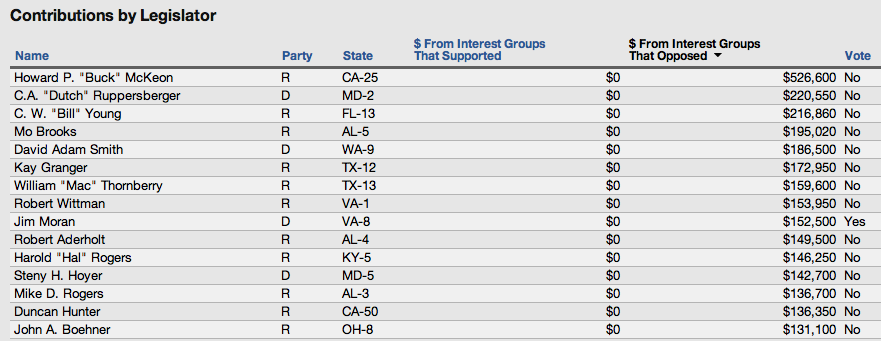
The numbers tell the story-- in votes and dollars. On Wednesday, the House voted 217 to 205 not to rein in the NSA’s phone-spying dragnet. It turns out that those 217 “no” voters received twice as much campaign financing from the defense and intelligence industry as the 205 “yes” voters.

That’s the upshot of a new analysis by MapLight, a Berkeley-based non-profit that performed the inquiry at Wired’s request. The investigation shows that defense cash was a better predictor of a member’s vote on the Amash amendment than party affiliation. House members who voted to continue the massive phone-call-metadata spy program, on average, raked in 122 percent more money from defense contractors than those who voted to dismantle it.

Overall, political action committees and employees from defense and intelligence firms such as Lockheed Martin, Boeing, United Technologies, Honeywell International, and others ponied up $12.97 million in donations for a two-year period ending December 31, 2012, according to the analysis, which MapLight performed with financing data from OpenSecrets. Lawmakers who voted to continue the NSA dragnet-surveillance program averaged $41,635 from the pot, whereas House members who voted to repeal authority averaged $18,765.


worth clicking on to see how much these crooks take in bribery


Of the top 10 money getters, only one House member-- Rep. Jim Moran (D-Virginia)-- voted to end the program.

“How can we trust legislators to vote in the public interest when they are dependent on industry campaign funding to get elected? Our broken money and politics system forces lawmakers into a conflict of interest between lawmakers’ voters and their donors,” said Daniel G. Newman, MapLight’s president and co-founder.

The Guardian newspaper disclosed the phone-metadata spying last month with documents leaked by former NSA contractor Edward Snowden.

The House voted 205-217 Wednesday and defeated an amendment to the roughly $600 billion Department of Defense Appropriations Act of 2014 that would have ended authority for the once-secret spy program the White House insisted was necessary to protect national security.

The amendment  was proposed by Rep. Justin Amash (R-Michigan), who received a fraction of the money from the defense industry compared to top earners. For example, Amash got $1,400-- ranking him in the bottom 50 for the two-year period. On the flip side, Rep. Howard McKeon (R-California) scored $526,600 to lead the House in defense contributions. He voted against Amash. Of the 26 House members who voted and did not receive any defense financing, 16 voted for the Amash amendment.


House Speaker John Boehner (R-Ohio) voted against the measure. He ranked 15th in defense earnings with a $131,000 take. House Minority Leader Nancy Pelosi (D-California) also voted against Amash. Pelosi took in $47,000 from defense firms over the two-year period.
Rolling in all this illicit cash, apparently McKeon doesn't realize that when he says something "insensitive" in Alabama people back in Santa Clarita, Simi Valley and the Antelope Valley find out about it too. This week he was advocating for more job cuts at an "off-the-record" meeting with community and business leaders in Huntsville with one of his junior Armed Services Committee shills, Mo Brooks.
In responding to a follow-up question, McKeon said the practice of furloughs gambles that the most valued employees will remain at 80 percent of their regular salary rather than pursuing another job.

"In my time in business, I always found that if you had to make cuts, you were better off making them than putting them off as long as you could because they are going to come," he said. "When they take a 20 percent cut and they think it's just going to be for a few months, they can maybe they can get by.

"If they see it's going to be 10 years, they are going to be gone anyway. You're going to lose the best people because they're going to go somewhere else. They just won't stay. Eventually, you end up with it costing you even more."
McKeon was indeed in business. He ran a huge 55-store western dress-up chain of stores, Howard & Phil's, his parents built and left him. He bankrupted it through severe mismanagement. So whenever McKeon starts a sentence with "In my time in business," it's time to clutch your wallet tightly.

Last year, Dr. Lee Rogers, an ACLU member and staunch supporter of constitutionally mandated privacy rights, came closer to beating McKeon than anyone in Buck's sordid career. He had no support from the Beltway Democrats last year but this year the DCCC has pledged to help. If you'd like to help as well, you can do it at the Blue America ActBlue page. We asked Rogers how he sees McKeon's role in the NSA controversy.
"I believe the NSA's actions violate the Fourth Amendment, which establishes the protection of persons, houses, papers, and effects against unreasonable searches and seizures without a warrant, and that the warrant shall only be issued when there is probable cause. Collection of mass data on American citizens does not meet that standard and I would have voted to limit the extent of NSA data collection to non-citizens or in cases where a warrant was issued for a specific person."

"But I believe we need to go even a step further. I support making electronic communication between persons just as protected as the US Mail. It is a federal crime to open or destroy mail not directed to you. Email is the modern way of personal communication. Private email conversations occur between lawyers and clients, doctors and patients, banks and customers, journalists and sources, and between family and friends. I want to make sure those private conversations are kept private. If the government has a reason to suspect you are a terrorist or otherwise engaged in criminal activity, it can obtain a warrant. If not, it shouldn't be engaged in mass interception and analysis of our communications."

Labels: , , , , ,

Friday, March 22, 2013

Drones And Privacy-- Do Libertarians Still Back Buck McKeon? What About Ed Markey?

>

Buck McKeon is riding the weapons manufacturers' drone expansion agenda to immense personal wealth

We started sounding the alarm about drone privacy issues as soon as we realized that the founder and chairman of the House Drone Caucus, Buck McKeon, was taking massive legalistic bribes-- hundreds of thousands of dollars-- from the drone manufacturers, more than any other Member of Congress. They don't give him that kind of money because they like the cut of his jib. He's expected to always be there for their special interests and to push their agenda relentlessly. He hasn't disappointed them and managed to push through legislation that enables licenses for 30,000 or more domestic drones, most of which will be used to spy on American citizens. The DCCC is starting to come around to the idea of targeting the now vulnerable McKeon in 2014 and, hopefully, Lee Rogers will defeat him the next time they face each other.

Meanwhile, though, Massachusetts Congressman Ed Markey, chairman of the bipartisan Congressional Privacy Caucus, is trying to deal with the ramifications of McKeon's treachery against the Constitution and the American people. Yesterday he introduced a bill, The Drone Aircraft Privacy and Transparency Act (DAPTA), that would establish safeguards to protect the privacy of individuals from expanded use of McKeon's drones. Markey:
“As drones increasingly fill our skies, Americans must be afforded a level of privacy and protection from these aerial technologies. My drone privacy bill provides transparency on the domestic use of drone aircraft and adds privacy protections that ensure this technology cannot be used to endlessly watch Americans. I look forward to working with my Congressional colleagues on this bi-partisan issue to ensure that strong personal privacy protections and public transparency measures are put in place now, before this technology is literally hovering over our heads.”
Congressman Markey introduced similar legislation in 2012 which Boehner was able to kill by sending it to Fred Upton's notorious Committee of Corporate Shillery (House Energy and Commerce), where it died without a hearing or vote. “Drone surveillance poses a real threat to privacy and civil liberties in the United States. Congressman Markey's bill adds much-needed transparency to the drone authorization process and mandates important restrictions that will help to protect Americans from unwarranted drone use," said Jennifer Lynch, Electronic Frontier Foundation. Similarly the National Association of Criminal Defense Lawyers are also supportive of the Markey bill, issuing a press release that supports his efforts based on the need to safeguard the Fourth Amendment in the digital age. "This bill leaves the door open for law enforcement use of aerial drones while upholding the right of Americans to be free from unreasonable searches and seizures. Striking the proper balance between law enforcement interests and privacy interests, this bill is the first step in the right direction towards transparency and accountability in future drone use.”

There is no accompanying legislation in the Senate-- at least not yet. Markey is running for the open seat John Kerry gave up to become Secretary of Defense-- and Kerry has endorsed him (as has Massachusetts' other U.S. Senator, Elizabeth Warren. No doubt he will introduce the same bill in that body as soon as he's elected. Perhaps he and Rand Paul, who also purports to oppose McKeon's drone expansion, could co-sponsor it. If you'd like to help make sure Markey gets to the Senate (instead of a conservative corporate shill), you can do so on the Blue America Senate page.

Labels: , , ,

Sunday, March 03, 2013

For Los Angeles, Domestic Surveillance Drones Are Already A Reality

>


R. Rex Parris is the mayor of Lancaster in the Antelope Valley, a reactionary crony of Buck McKeon's, and is best known as "the guy who tried to ban dogs known to be favored by gangs, proposed restrictions on landlords who want to rent to tenants with Section 8 federal housing vouchers, helped fund a program to bus homeless people out of town and shut down a local motel to prevent the notorious Mongols motorcycle club from meeting in Lancaster... and kicking aside roadblocks for developers wanting to do business in town... [C]ritics say Parris, who was elected [in 2008], is an arrogant bully and an unstoppable control freak. 'King Rex' they call him, or 'T. Rex.' Scott Pelka, 52, a self-described archenemy of Parris and long-time Lancaster resident, said the mayor has created a 'dictatorship' in which challenges to his authority are simply not tolerated."

Buck McKeon, founder and chairman of the congressional drone caucus, notorious for taking more bribes from drone manufacturers than anyone else in Congress-- and for directing drone company political contributions towards other congressmen-- doesn't simply "tolerate," T Rex, he encouraged him to build his own private drone-like force in the Antelope Valley to help the manufacturers sell their products to municipalities nationwwide. At a time when Russia and China have decided to build their own drone capacities, this Brave New World is already getting out of hand domestically. Fourth Amendment? Who cares? Not T Rex and not Buck McKeon.

The FAA hasn't authorized unmanned drones in U.S. skies yet, but at the behest of the drone manufacturers, McKeon and T Rex figured a way around it-- a manned Eye in the Sky controlled from the ground with an iPad! The Antelope Valley, which voted against McKeon in November and supported his Democratic opponent, Lee Rogers, has become the national testing ground for using drone technology for spying on American citizens.
Despite the security measures the city said it would take to keep the video footage accessible only to the sheriff’s office, the American Civil Liberties Union (ACLU) of Southern California had a number of unanswered questions about the program.

Peter Bibring, senior staff attorney for the ACLU of Southern California, said privacy issues remain a “huge concern” and the organization sent a public records request on Monday, Nov. 7, to Lancaster and Los Angeles County for the details behind the aerial surveillance program.

“People who have done nothing wrong shouldn’t have the details of everything they do in their yards and homes open to video surveillance from the skies,” Bibring said. “This kind of sophisticated aerial technology poses a significant risk to the privacy of the residents of Lancaster, and it’s also unclear why it’s a better crime-fighting tool than less invasive and less expensive options the police already use.”

Bibring went on to say that while the California Public Records Act exempts law enforcement investigation materials from disclosure if the program’s video footage is random daily surveillance. It’s unclear whether such random footage will also be exempt from public records requests.

“The fact that [the video footage] is going directly to law enforcement doesn’t necessarily mean it can’t be shared with other agencies,” Bibring added. “The program raises all sorts of questions.”


Parris disagreed with Bibring’s assessment of the situation. Parris said the public can’t request data from the city if the city doesn’t have any access to the data. So in this case-- since the Lancaster Sheriff’s Station will control the data-- there shouldn’t be any California Public Records Act issues when it comes to the availability of the video footage.

Additionally the Lancaster mayor maintained that while the video is surveillance data, it will be treated as evidential and, therefore, protected.

“City personnel and non-parties to a criminal case do not have any rights or privileges for accessing the data transmitted by LEAPS to the Sheriff’s archives,” Parris explained.


Brandon Zavala is Chairman of Community Outreach for the Democratic Club of the High Desert, someone who's paid a great deal of attention to McKeon and T Rex's drone program. Yesterday he told me that "the City of Lancaster has taken it upon itself to monitor each and every citizen with its, 'Eye-in-the-Sky' program. A Los Angeles Sheriff’s deputy is able to direct the flight pattern of the plane which has a fully-functional camera attached to it; the officer can move the camera at his/her discretion at unsuspecting members of the public. The Mayor of Lancaster, R. Rex Parris, thinks he owns the city, and the citizens of Lancaster are unaware that their mayor spies on them for what he calls, 'their safety.' The 'Eye-in-the-Sky' has never solved a crime according to the deputies I have spoken to personally, and it costs the city $90,000 a month to buzz over our heads. Money that could be spent on real officers, on after-school programs for children and economic development in a city devastated by the economic recession. Mayor R. Rex Parris has tried selling the 'Eye-in-the-Sky' to other cities and sheriff’s department throughout the state of California and quite frankly, I am tired of my California skies being treated as a show room for a millionaire mayor with too much time on his hands."

Labels: , , ,

Saturday, February 09, 2013

Drones And You

>


I'm not sure how much I agree with it but I completely respect the work people are doing in questioning the rights of the Executive Branch to use drones to kill American citizens without trials. Maybe the Executive should have a hearing to strip the accused of their citizenship before murdering them. My problem with drone policy, though, is different, the "collateral damage" abroad and the shredding of Constitutional protections domestically.

As someone who has spent years in places, like Pakistan, Afghanistan and Mali, where U.S. drones are reigning terror and death down on the heads of innocent civilians-- including women and children-- the "collateral damage" in these drone strikes is neither remote nor abstract. To me the policy seems dangerously psychotic. Brave New Films has done incredible work on the subject. Please watch their video up top; I wish every Member of Congress would... or every voter. Here's the Executive Summary of their report:
In the United States, the dominant narrative about the use of drones in Pakistan is of a surgically precise and effective tool that makes the US safer by enabling “targeted killing” of terrorists, with minimal downsides or collateral impacts.

This narrative is false.

Following nine months of intensive research-- including two investigations in Pakistan, more than 130 interviews with victims, witnesses, and experts, and review of thousands of pages of documentation and media reporting-- this report presents evidence of the damaging and counterproductive effects of current US drone strike policies. Based on extensive interviews with Pakistanis living in the regions directly affected, as well as humanitarian and medical workers, this report provides new and firsthand testimony about the negative impacts US policies are having on the civilians living under drones.

Real threats to US security and to Pakistani civilians exist in the Pakistani border areas now targeted by drones. It is crucial that the US be able to protect itself from terrorist threats, and that the great harm caused by terrorists to Pakistani civilians be addressed. However, in light of significant evidence of harmful impacts to Pakistani civilians and to US interests, current policies to address terrorism through targeted killings and drone strikes must be carefully re-evaluated.

It is essential that public debate about US policies take the negative effects of current policies into account.

First, while civilian casualties are rarely acknowledged by the US government, there is significant evidence that US drone strikes have injured and killed civilians. In public statements, the US states that there have been “no” or “single digit” civilian casualties.” It is difficult to obtain data on strike casualties because of US efforts to shield the drone program from democratic accountability, compounded by the obstacles to independent investigation of strikes in North Waziristan. The best currently available public aggregate data on drone strikes are provided by The Bureau of Investigative Journalism (TBIJ), an independent journalist organization. TBIJ reports that from June 2004 through mid-September 2012, available data indicate that drone strikes killed 2,562-3,325 people in Pakistan, of whom 474-881 were civilians, including 176 children. TBIJ reports that these strikes also injured an additional 1,228-1,362 individuals. Where media accounts do report civilian casualties, rarely is any information provided about the victims or the communities they leave behind. This report includes the harrowing narratives of many survivors, witnesses, and family members who provided evidence of civilian injuries and deaths in drone strikes to our research team. It also presents detailed accounts of three separate strikes, for which there is evidence of civilian deaths and injuries, including a March 2011 strike on a meeting of tribal elders that killed some 40 individuals.

Second, US drone strike policies cause considerable and under-accounted-for harm to the daily lives of ordinary civilians, beyond death and physical injury. Drones hover twenty-four hours a day over communities in northwest Pakistan, striking homes, vehicles, and public spaces without warning. Their presence terrorizes men, women, and children, giving rise to anxiety and psychological trauma among civilian communities. Those living under drones have to face the constant worry that a deadly strike may be fired at any moment, and the knowledge that they are powerless to protect themselves. These fears have affected behavior. The US practice of striking one area multiple times, and evidence that it has killed rescuers, makes both community members and humanitarian workers afraid or unwilling to assist injured victims. Some community members shy away from gathering in groups, including important tribal dispute-resolution bodies, out of fear that they may attract the attention of drone operators. Some parents choose to keep their children home, and children injured or traumatized by strikes have dropped out of school. Waziris told our researchers that the strikes have undermined cultural and religious practices related to burial, and made family members afraid to attend funerals. In addition, families who lost loved ones or their homes in drone strikes now struggle to support themselves.

Third, publicly available evidence that the strikes have made the US safer overall is ambiguous at best. The strikes have certainly killed alleged combatants and disrupted armed actor networks. However, serious concerns about the efficacy and counter-productive nature of drone strikes have been raised. The number of “high-level” targets killed as a percentage of total casualties is extremely low-- estimated at just 2%. Furthermore, evidence suggests that US strikes have facilitated recruitment to violent non-state armed groups, and motivated further violent attacks. As the New York Times has reported, “drones have replaced Guantánamo as the recruiting tool of choice for militants.” Drone strikes have also soured many Pakistanis on cooperation with the US and undermined US-Pakistani relations. One major study shows that 74% of Pakistanis now consider the US an enemy.

Fourth, current US targeted killings and drone strike practices undermine respect for the rule of law and international legal protections and may set dangerous precedents. This report casts doubt on the legality of strikes on individuals or groups not linked to the terrorist attacks of September 11, 2011, and who do not pose imminent threats to the US. The US government’s failure to ensure basic transparency and accountability in its targeted killing policies, to provide necessary details about its targeted killing program, or adequately to set out the legal factors involved in decisions to strike hinders necessary democratic debate about a key aspect of US foreign and national security policy. US practices may also facilitate recourse to lethal force around the globe by establishing dangerous precedents for other governments. As drone manufacturers and officials successfully reduce export control barriers, and as more countries develop lethal drone technologies, these risks increase.

In light of these concerns, this report recommends that the US conduct a fundamental re-evaluation of current targeted killing practices, taking into account all available evidence, the concerns of various stakeholders, and the short and long-term costs and benefits. A significant rethinking of current US targeted killing and drone strike policies is long overdue. US policy-makers, and the American public, cannot continue to ignore evidence of the civilian harm and counter-productive impacts of US targeted killings and drone strikes in Pakistan.

This report also supports and reiterates the calls consistently made by rights groups and others for legality, accountability, and transparency in US drone strike policies:

• The US should fulfill its international obligations with respect to accountability and transparency, and ensure proper democratic debate about key policies. The US should:

• Release the US Department of Justice memoranda outlining the legal basis for US targeted killing in Pakistan;

• Make public critical information concerning US drone strike policies, including as previously and repeatedly requested by various groups and officials: the targeting criteria for so-called “signature” strikes; the mechanisms in place to ensure that targeting complies with international law; which laws are being applied; the nature of investigations into civilian death and injury; and mechanisms in place to track, analyze and publicly recognize civilian casualties;

• Ensure independent investigations into drone strike deaths, consistent with the call made by Ben Emmerson, UN Special Rapporteur on the promotion and protection of human rights and fundamental freedoms while countering terrorism in August 2012;

• In conjunction with robust investigations and, where appropriate, prosecutions, establish compensation programs for civilians harmed by US strikes in Pakistan.

• The US should fulfill its international humanitarian and human rights law obligations with respect to the use of force, including by not using lethal force against individuals who are not members of armed groups with whom the US is in an armed conflict, or otherwise against individuals not posing an imminent threat to life. This includes not double-striking targets as first responders arrive.

• Journalists and media outlets should cease the common practice of referring simply to “militant” deaths, without further explanation. All reporting of government accounts of “militant” deaths should include acknowledgment that the US government counts all adult males killed by strikes as “militants,” absent exonerating evidence. Media accounts relying on anonymous government sources should also highlight the fact of their single-source information and of the past record of false government reports.
Population-wise, Pakistan is the 6th biggest country in the world with 182,173,000 people. Compared to the U.S. or Europe it's very backward in many ways. But it is nuclear-armed. The regime in charge right now-- which has questionable legitimacy-- is surreptitiously on board with the U.S. drone policy. The people of Pakistan aren't-- not even a little. And the regime won't last forever. In fact, the regime is probably going to be around only a very short time. The hatred for America being engendered by this drone policy is very serious and it isn't being taken seriously by Congress. We'll get to that in a moment. Even a clown-- and war criminal-- like former Congressman Allen West recognizes the danger... at least now that he's no longer in Congress.

Now, as for the domestic problems with drones. As we warned all through the 2012 election cycle, House Armed Services Committee chairman Buck McKeon, a crooked little shit from Santa Clarita, CA, with a nose for graft and corruption, founded and chairs the Congressional Unmanned Systems Caucus, AKA, the Drone Caucus. Busy creating a post-congressional career for himself, while helping to funnel millions of dollars in Military-Industrial Complex legalistic bribes into GOP coffers, McKeon is perfectly willing to trample of sacred American constitutional rights for the sake of his buddies at the drone manufacturing companies. He wrote and passed legislation that will fill American skies with tens of thousands of spy drones over the next decade. Yes, American skies, not just Pakistani, Afghani, Yemeni and Somalian skies. So what, you ask? This week Thom Hartmann tackled that question well:
Imagine you’re being stalked from the sky. Every time you go in or out of any building, it’s recorded. Everybody you talk with. Everyplace you drive or take public transportation. Your sky-stalker can see through your windows, read your lips, and, using infrared cameras, can even see if you’ve lit a cigarette-- of any type.

Shouldn’t this be illegal?

...Police helicopters, police trucks that can use infrared to see inside your house, and GPS units cops can attach to you car. In every case there’s a legitimate police use for these technologies, as well as an incredible potential for abuse.

The Fourth Amendment, part of the Bill of Rights that Jefferson demanded Madison put into the Constitution as the price of getting Virginia’s ratification, is one sentence long. It says:
“The right of the people to be secure in their persons, houses, papers, and effects, against unreasonable searches and seizures, shall not be violated, and no Warrants shall issue, but upon probable cause, supported by Oath or affirmation, and particularly describing the place to be searched, and the persons or things to be seized.”
In other words, they can’t spy on you-- on you, personally-- unless they have enough proof to bring before a judge that you’re up to something that’s probably illegal.

In the case of the police helicopters, trucks, GPS units, and phone taps, to some extent both state governments, Congress, and the Supreme Court have brought their use into at least a marginal compliance with the Fourth Amendment.

Not so with drones. At least yet.

And that’s why the City of Charlottesville, Virginia-- a stone’s throw from Thomas Jefferson’s home-- did a beautiful thing this week in passing a resolution calling for a ban, for the moment, on drones in their skies.

The Rutherford Institute proposed the first draft of what ultimately became the resolution that was promoted by the Charlottesville Center for Peace and Justice. It included language that said:
“WHEREAS, the federal government and the Commonwealth of Virginia have thus far failed to provide reasonable legal restrictions on the use of drones within the United States; and

“WHEREAS, police departments throughout the country have begun implementing drone technology absent any guidance or guidelines from law makers…” there should be at two-year moratorium on using information obtained from them, or on weaponizing them.
As David Swanson notes in his blog on the CCPJ site, “without proper safeguards, these drones, some of which are deceptively small and capable of videotaping the facial expressions of people on the ground from hundreds of feet in the air, will usher in a new age of surveillance in American society. Not even those indoors, in the privacy of their homes, will be safe from these aerial spies, which can be equipped with technology capable of peering through walls.”

And that doesn’t even include the capability of these police drones to be weapon-equipped, from bullets to nerve gas. Or their ability to be hacked, or their data streams to be hijacked by malicious corporations, weird stalkers, or foreign governments.
What about your city council? Your state legislature? Congress is too corrupted by Military Industrial Complex cash. But would your local officials pass resolutions like the one Charlottesville did? Ask them... especially if they're running for office-- which they basically always are. It seems to be working in Seattle, where Mayor Mike McGinn ordered the police department to abandon its plan to use drones after residents and privacy advocates protested.


Buck McKeon-- riding drones all the way to the bank

Labels: , , , , , ,