Friday, December 02, 2016

Sanders: "United Technologies Took Trump Hostage and Won"

>

"You think you're so clever and classless and free..."
(so many versions, so little time)

by Gaius Publius

This matters, both the Carrier settlement itself (how it was achieved) and the Sanders pushback against it. Let's start with Sanders, then go to the settlement. Sanders writes (my bolded emphasis):
Bernie Sanders: Carrier just showed corporations how to beat Donald Trump

We need a president who can stand up to big corporations, not fold to their demands.

Today, about 1,000 Carrier workers and their families should be rejoicing. But the rest of our nation’s workers should be very nervous.

President-elect Donald Trump will reportedly announce a deal with United Technologies, the corporation that owns Carrier, that keeps less than 1,000 of the 2100 jobs in America that were previously scheduled to be transferred to Mexico. Let’s be clear: It is not good enough to save some of these jobs. Trump made a promise that he would save all of these jobs, and we cannot rest until an ironclad contract is signed to ensure that all of these workers are able to continue working in Indiana without having their pay or benefits slashed.

In exchange for allowing United Technologies to continue to offshore more than 1,000 jobs, Trump will reportedly give the company tax and regulatory favors that the corporation has sought. Just a short few months ago, Trump was pledging to force United Technologies to “pay a damn tax.” He was insisting on very steep tariffs for companies like Carrier that left the United States and wanted to sell their foreign-made products back in the United States. Instead of a damn tax, the company will be rewarded with a damn tax cut. Wow! How’s that for standing up to corporate greed? How’s that for punishing corporations that shut down in the United States and move abroad?

In essence, United Technologies took Trump hostage and won. And that should send a shock wave of fear through all workers across the country.
Or, as Politico succinctly put it, "Carrier tariff now Carrier tax cut?" Trump went toe-to-toe with United Technology, and lost.

Trump As Enabler of Offshoring

This is a 180 degree reversal and he's not even in office yet. But Sanders is exactly right:
Trump has endangered the jobs of workers who were previously safe in the United States. Why? Because he has signaled to every corporation in America that they can threaten to offshore jobs in exchange for business-friendly tax benefits and incentives. Even corporations that weren’t thinking of offshoring jobs will most probably be re-evaluating their stance this morning. And who would pay for the high cost for tax cuts that go to the richest businessmen in America? The working class of America.
Sanders closes: "I will soon be introducing the Outsourcing Prevention Ac [details here]t, which will address exactly that. If Donald Trump won’t stand up for America’s working class, we must."

Some working class hero Trump turned out to be. I guess we're still peasants after all.

The "Deal"

A little more detail on the so-called "deal." They say "1000 jobs" were saved, but of those only 800 were originally at risk. Plus, 1300 jobs will still move to Mexico.

From The Hill:
The company that owns Carrier will receive $7 million worth of tax breaks over 10 years from Indiana to keep 1,000 jobs in the state, the Wall Street Journal reported Thursday.

Carrier confirmed the news Thursday in a statement, writing that the deal is contingent upon factors including employment, job retention and capital investment.

The company this week reached a deal with President-elect Donald Trump and Vice President-elect Mike Pence to keep the jobs in the state, after announcing earlier this year it would shut down a plant in Indianapolis and move manufacturing to Mexico. ...

The deal would cover 800 workers from the Indianapolis furnace plant and an additional 300 research and headquarters positions that weren't planned to go to Mexico, according to the Journal.

But 600 jobs will still move from Indianapolis to Mexico.

Carrier also still plans to close a second plant in Huntington, Ind., shifting another 700 jobs to Mexico.
More detail via the WSJ (subscripton required): 
Carrier has previously said it expected to save about $65 million a year by shutting the plant and shifting its operations to Monterrey, in the state of Nuevo León, where wages average about $11 a day, plus benefits. The average wage of the Indiana jobs that will be retained is $30 an hour, according to a document reviewed by the Journal.
In case that didn't sink in, Indian-to-Mexico wages shift $30 per hour to $11 per day. That's why we can't have nice jobs, or at least decent paying ones. How much of that savings, do you think, would have ended up in the executive suite, via stock buybacks, sweetened salaries and bonuses, and "golden parachutes"? Answer, as much as possible.

Plus $7 million in tax breaks. Unless some of it is federal, all will come out of the pockets of cash-strapped Indiana and its (largely Trump-voting) tax-payers.

Why This Is Important

First, Bernie Sanders is right — Trump sold out his voters in Indiana. Second, Sanders is saying this out loud and getting lots of attention for it, which means the sound of Sanders analysis is likely playing in Trump's ears right now, and hopefully in the ears of his Sanders-tempted supporters as well.

Which ought to put Trump on the defensive and keep real systemic solutions to corporate America's outsourcing addiction alive. Remember, the problem that got Trump elected isn't going away until cash-strapped citizens — not corporations — get relief they can see, feel and spend. Under Trump, that's not going to happen.

Which means, there's hope after all.

"Working Class Hero"

Trump may not be a working class hero, but Sanders is, and so was John Lennon. Here's the original version. Enjoy:


Fun with music theory: One of the things that makes this song so interesting, so not a "four-square" song, is its phrase length. Each phrase — each line in the verse or chorus — occupies seven measures of music, not eight. It's why you feel off-balance as you listen, like the lines end too soon or restart too quickly. Count if you like; each measure is three beats long, so they're easy to identify. Be sure to stop at seven and restart at one. Very good song-writing from a master at it.

GP
 

Labels: , , , , , , , , ,

Sunday, November 16, 2014

How does the "strict father" model of society work when Strict Dad is, say, a Point-Haired Boss or a Donny "The Mine Unsafety King" Blankenship?

>

DILBERT     by Scott Adams


by Ken

This weekend I've been wandering around issues of work and the employer-employee relationship, first Friday night, "Let's celebrate that great champion of the American working man, mining mogul Donny "Safety Is for Suckers" Blankenship," about the news that four years after the Upper Branch Mine disaster Donny B has finally been indicted for allowing the mine to be so dangerously unsafe; then last night, "Work sucks (pass it on)," about how work for most of us, you know, sucks. Tonight I want to make a trilogy of it, pulling those previous posts together.

I honestly wonder what goes through the mind of someone like Donny B, known (per Rolling Stone) as the "Dark Lord" of Coal Country, a man who knows perfectly well that the mines he's sending miners into are death traps, when he thinks about the lives that are in his hands. And surely he has to think about it, at least in some fashion, doesn't he? But he can't think of them as human persons who knowingly subject themselves to life-threatening conditions in order to be able to put food on their family's tables, can he? He must have to think of them as some kind of automaton, a unit of inventory, easily replaceable with other readily available units.

I have to conclude from Donny B's history of proudly ignoring his groaning stockpile of safety violations, even under the real-world conditions of exceedingly loose mine-safety oversight, that he's either indifferent to or openly contemptuous the whole notion of mine-safety regulation. Then I wonder whether his views on the subject might change if he spent, say, a month doing regular shifts in one of his mines. Actually, I like better still the suggestion of a commenter on my Friday night post: "The sentence Blankenship SHOULD get would be to spend the rest of his life tearing coal out of the ground in the very conditions he deems suitable for employment."


REMEMBER GEORGE LAKOFF'S "STRICT FATHER MODEL"?

As I've mentioned, I've been playing with my copy of Prof. George Lakoff's All New Don't Think of an Elephant!, and as you probably recall, one of the professor's basic tenets as a cognitive scientist is that we humans don't really hear words and "facts," we take in impressions of language which our brain takes in -- or doesn't -- according to the way they fit into ideas and understandings already etched into our brains. He argues further that that the conservative mindset is attuned to what he calls the "strict father model." I just wanted to review a tiny bit of his description of the "strict father model" that dominates in the brains of conservatives.

In fact, since the original Don't Think of an Elephant! was written, conservative friends of the professor's have clued him in that yes, there is indeed such a thing as the strict-father model, but he hadn't really nailed it. Now he thinks he has, thanks to a terrific tip: Go to the preachings of right-wing psycho-pervert "Dr." James Dobson -- you remember, the founder of Focus on the Family. "Dr." Dobbsy gets the whole schmeer, starting with the strict father's need to apply discipline to wayward kiddies, and he doesn't mean just metaphorical discipline, and including the inseparable link between religion and patriarchal control. (He's not totally slap-happy, though, our "Dr." Dobbsy. He tells us in The New Dare to Discipline, Professor Lakoff tells us, on page 65, "There is no excuse for spanking babies younger than fifteen or eighteen months of age.")

We're not going to get into this tonight, but let me say that the new explanation of the strict-father model seems to me much stronger and clearer. Let me also stress that the professor isn't saying the strict father model is right. In fact, he argues that it's not only demonstrably wrong in important ways but also immoral in important ways. Still, he considers it desperately important that we have some sense of what conservatives are hearing when they hear. Because he wants us to accept that while yes, conservatives do lie, in general what they understand and say isn't a matter of lying, or stupidity, or lack of thought, but what they honestly believe. He thinks if we have any shot at making contact with the less fervently committed holders of this mental model, it is essential that we accord their beliefs this degree of respect, no matter how strongly we may disagree with those beliefs.

So let's listen to listen to just a bit of Professor Lakoff's description of the strict-father model, after he has laid out most of the particulars. Here he is talking about "the conservative view of the moral hierarchy":
As we have seen, the rich and those who can take care of themselves are considered more moral than the poor and those who need help. But moral superiority on a wider scope is central to conservative thought. The idea is that those who are more moral should rule. How do you decide who is more moral? Well, in a well-ordered world (ordered by God), the moral have come out on top. Here is the hierarchy: God above man; man above nature; adults above children; Western culture above non-Western culture; our country above other countries. These are general conservative values. But the hierarchy goes on, and it explains the oppressive views of more radical conservatives: men above women, Christians above non-Christians, whites above nonwhites, straights above gays.

HOLD THAT THOUGHT AS WE GO BACK TO WORK SUCKING

In last night's post, I quoted The Frisky's Megan Reynolds, in the first column in a weekly series devoted to work issues:
Newsflash. Work is terrible. It’s something that we all have to do, but no one particularly wants to do it. It’s a cruel trick in which you have to go to a place and do things that you would never normally do, for a nominal amount of money that is usually too little, and for a select few, just right. Sometimes, you win the life lottery and the thing that you do for 40 hours a week in a nondescript office building somewhere in the city you live in is not a soul-crushing exercise in managing disappointments. Sometimes, you’re lucky enough to really, truly, love what you do. If you are one of these people, I’m very happy for you. Please close this tab and go to that special members-only club that exists for people who have found true career satisfaction. Let me know what it’s like in there.
Which brings us back to today's Dilbert, with Dilbert's rant on the Pointy-Headed Boss, and also to that right-wing strict-father model. What happens when Strict Dad is the Pointy-Haired Boss, or a titan of capitalist morality like Donny "Safety Is for Suckers" Blankenship? Isn't their dominating financial success proof of their dominant morality?

I admit that I'm already a tad skeptical about having to take seriously anyone's beliefs just 'cause it's what the person believes. Isn't this just an expanded version of what I think of as the Costanza Exception as applied to lying -- you recall George's explanation to Jerry Seinfeld, in need of crash tips on lying: "Remember, it's not a lie if you believe it." Start applying this to mental cases through history, and it sounds as if people like, oh, Adolf Hitler and Al Capone get points for sincerely believing whatever sociopathology they had in their heads.

Or maybe I'm wrong about those sweethearts, the right-wing strict-father modelists. After all, once that 18-month moratorium on infant corporal punishment expires and sick fucks vigilant dads like Dr. James Dobson get to start beating the crap out of the kiddies, don't they learn what it means to be moral? (Oh, I think they learn something, all right, but not necessarily what it means to be moral.)
#

Labels: , , , ,

Saturday, November 15, 2014

Work sucks (pass it on)

>


"Sometimes, you win the life lottery and the thing that you do for 40 hours a week in a nondescript office building somewhere in the city you live in is not a soul-crushing exercise in managing disappointments. Sometimes, you're lucky enough to really, truly, love what you do. If you are one of these people, I'm very happy for you. . . ."

by Ken

As I mentioned last night, I was putting off a post on the lines of "Work sucks" in order to deal ("Let's celebrate that great champion of the American working man, mining mogul Donny "Safety Is for Suckers" Blankenship") with Nobody's Favorite Employer, finally indicted Massey Energy head honcho Donny Blankenship, who is accused of contributing generously, via his consistent record of thumbing his nose at mine safety considerations (including voluminous citations for violations), to the April 2010 Upper Branch Mine disaster, which took the lives of 29 of his employees.

You have to wonder what goes through the mind of someone like Donny B, known (per Rolling Stone) as the "Dark Lord" of Coal Country, when he thinks of the miners whose lives are in his hands. Surely he does think of them, at least in some fashion, but it can't be as human persons subjecting themselves to inhuman conditions for the sake of putting food on their family's tables, can it? It has to be as some kind of automaton, easily replaceable with other readily available units. My wonder is whether his views on mine safety issues might change if he spent, say, a month doing regular shifts in one of his mines.

(Actually, I like better still the suggestion of a commenter on last night's post: "The sentence Blankenship SHOULD get would be to spend the rest of his life tearing coal out of the ground in the very conditions he deems suitable for employment.")

What I had in mind was a hangover from the debut Monday of a column devoted to work issues on on "The Frisky" called "Make It Work." Author Megan Reynolds got the venture off to a frothy start:
Newsflash. Work is terrible. It’s something that we all have to do, but no one particularly wants to do it. It’s a cruel trick in which you have to go to a place and do things that you would never normally do, for a nominal amount of money that is usually too little, and for a select few, just right. Sometimes, you win the life lottery and the thing that you do for 40 hours a week in a nondescript office building somewhere in the city you live in is not a soul-crushing exercise in managing disappointments. Sometimes, you’re lucky enough to really, truly, love what you do. If you are one of these people, I’m very happy for you. Please close this tab and go to that special members-only club that exists for people who have found true career satisfaction. Let me know what it’s like in there.
Like Megan I've known or at least heard about people who truly love what they do to make a living, and like Megan I'm happy for them. Okay, I hate them, but that doesn't mean I'm not happy for them. Actually, I haven't really personally known all that many of them, so the problem hasn't come up all that much.

For the debut column Megan looked an extreme version of the problem faced by most of us ("career dissatisfaction is as natural as breathing"): "How to Tell if You're in the Wrong Job." She ventures that "there’s a fine line that separates general career dissatisfaction and actually being in the wrong career," and tells us she has "worked a lot of the wrong jobs" but has "finally found something that's kind of right." Hence, she says, "I know what I'm talking about."

She proceeds to throw out "some signs that you might be doing the wrong job." I don't want to steal her thunder, and will encourage you to go onsite for proper explanations of her four "signs":
1. You don’t feel like you’re very good at your job.
2. The thought of advancing in your field makes you want to die, a little.
3. You’re actually never happy at work. Ever.
4. You actually aren’t ever motivated to just sit down and, you know, work.
This last sign is interesting. After describing this particular state of occupational desolation, Megan says:
[I]f you’re truly, and actually dissatisfied with your job or the direction your career has taken to this point, the idea of sitting down and doing even the simplest, least painful task that is in your work repertoire is impossible to fathom. I like to believe that all human beings WANT to work in some way, because work makes you feel useful, and feeling useful makes you feel like a functioning member of society. If you can’t even be driven to try to perform these very basic tasks, here’s what you need to do: Take a “mental health day,” and sit in your empty home. Take a shower, make some coffee, and find a fresh Sharpie and a legal pad. Make a list of all the things you want out of your career. Shut off the horrible, screaming voice in your head that’s telling you that you’re just having a bad day. Respect yourself enough to make the list honestly. Stick the list up on a wall, Carrie Mathison-style, and step back. If there’s nothing on that list that matches what you’re currently doing, guess what? It’s time to make a change.
And Megan promises "more on that in a future column." I don't know whether that's going to be the subject of column no. 2, on Monday, but in any case it seems worth checking out.
#

Labels:

Friday, November 14, 2014

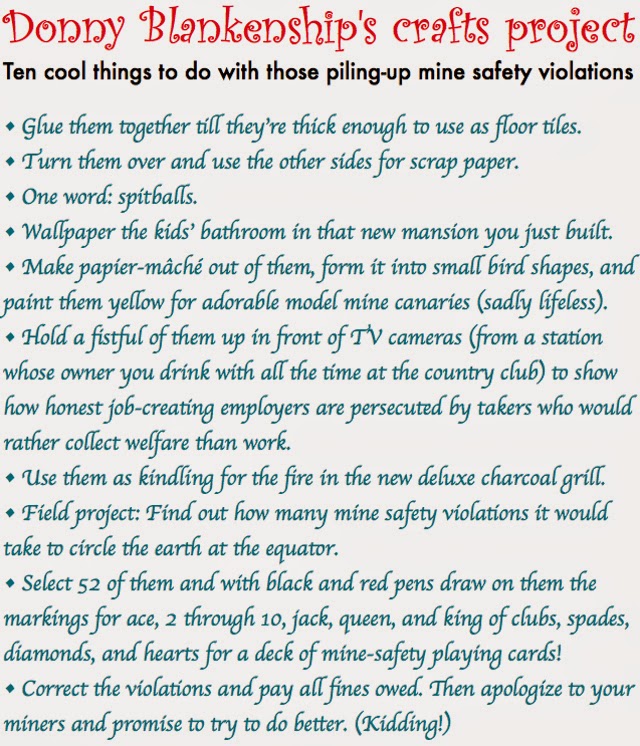
Let's celebrate that great champion of the American working man, mining mogul Donny "Safety Is for Suckers" Blankenship

>


Donny, aka the "Dark Lord" of Coal Country, shares his insights with the Senate Appropriations Committee at a 2010 hearing on efforts to prevent mine disasters.

by Ken

I had a post slotted in for tonight to be called "Work sucks!" or something of the sort, but I thought we should put that off to take time to honor that great friend of workers everywhere, mining mogul Donny "Safety Last" Blankenship, chief executive of West Virginia's Massey Energy.

Howie has already covered the story of how, a mere four years after the fact, Donny is being indicted for his indispensable contribution, through gross disregard of mine-safety laws and an exhaustive collection of ignored mine safety violations, to the Upper Big Branch Mine disaster that took the lives of 29 of his employees in April 2010. (My favorite headline: Rolling Stone's "Don Blankenship, Coal Country's 'Dark Lord,' Indicted.")

Well, better late than never.

Now it's easy to criticize, but there are two sides to every story, and when I heard the story of Donny's indictment on the radio this morning, I also heard his lawyer insisting that his client is innocent and is being "persecuted." Isn't that always the way with America's rich and powerful (and politically hot-wired)? What do they get in return for their making and shaking and baking of our economy but persecution? I guess they're just such easy targets for persecution, our rich and powerful (and politically hot-wired).

It remains to be seen how long it will take to adjudicate Donny's case, and how much time -- if any -- he'll do. Meanwhile, I thought the least we could do was to celebrate this great American with --


[Click to enlarge.]

Whatta guy!
#


Labels: ,

Tuesday, October 21, 2014

As Dilbert's Pointy-Haired Boss returns from vacation, we look back at the temporary boss's management style

>

Does this boss need a vacation?

Wednesday

DILBERT     by Scott Adams

[Click to enlarge]

by Ken

As all Dilbert fans know, today is the big day: Dilbert's Pointy-Haired Boss returned from vacation. So I thought this would be a good time to look back through this tumultuous week, in which the PHB deputized an unexpected fill-in. I've taken the liberty of placing the Sunday strip where it would seem to belong in the sequence.

Thursday -- "A soulless creature of questionable intelligence"

DILBERT     by Scott Adams

[Click to enlarge]

Sunday -- "Robots will never be intelligent like humans"

DILBERT     by Scott Adams


Friday -- Temporary Robot Boss 1:
"I have come to micromanage you"

DILBERT     by Scott Adams

[Click to enlarge]

Saturday -- Temporary Robot Boss 2:
Machine vs. Man er, Wally

DILBERT     by Scott Adams

[Click to enlarge]

Monday -- Temporary Robot Boss 3:
A consultation with consultant Catbert

DILBERT     by Scott Adams

[Click to enlarge]

Tuesday -- He's ba-a-a-ack!

DILBERT     by Scott Adams

[Click to enlarge]
#

Labels: ,

Sunday, March 23, 2014

Food for thought (almost literally) in the funnies

>


I like to think my grasp of the technology has advanced to the point where if you click on this lovely strip by Ruben Bolling to enlarge it, you'll actually be able to read it.

by Ken

If I groped hard enough I could find a connection between the offerings above and below. But the truth is that I've had the one above for a few days, since I received it as a pass-along, and knew I wanted to pass it along in turn. So far there doesn't seem to be any action on my proposal that if Paul Ryan insists on continuing to speak in public, he be required to wear a dunce cap, or at least a clown wig. And a clown nose, I think. A nice big red bulb of a honker would suit him, I think.

Then as to today's Dilbert, which offers us literally -- or along a zigzaggy line running somewhere between the metaphorical and the literal -- food for thought, well, what can I say except that Wally, a fellow who has raised slacking to if not quite an art form, then at least to a lifestyle, is one of my cultural heroes? By the end, I feel myself in need of a shot of something strong.

I remain persuaded that if someone could just show Wally a good reason for it, he would be only too happy to buckle down and do, you know, a day's work. In the meantime . . . .

DILBERT by Scott Adams


#

Labels: , ,

Monday, July 01, 2013

There's an America where workers are paying more and more of their modest wages just to GET those wages

>

"Natalie Gunshannon, 27, with her daughter, Anie Popish, 7, said she had to use a card because her employers would not deposit her pay directly into her account." (NYT caption)

Krystal McLemore, 22, makes $7.65 an hour at a Taco Bell in St. Louis. She said she was told to sign up for a payroll card. (Taco Bell says it "offers direct deposit and a voluntary option of payroll cards as an added convenience" for employees.)

But she grew tired of being charged $1.75, in addition to the A.T.M.'s fees, to withdraw cash. After a tip from a co-worker, Ms. McLemore realized she could reduce her charges if she took out all her wages once a month. Now, supplied with one of the most modern banking products, Ms. McLemore has a decidedly old-fashioned way of handling her pay: it is stacked in a shoe box in her closet in $10s and $20s.

"It costs too much to get my money," she said.
by Ken

This really sucks. From this report today by the NY Times's Jessica Silver-Greenberg and Stephanie Clifford:
A growing number of American workers are confronting a frustrating predicament on payday: to get their wages, they must first pay a fee.

For these largely hourly workers, paper paychecks and even direct deposit have been replaced by prepaid cards issued by their employers. Employees can use these cards, which work like debit cards, at an A.T.M. to withdraw their pay.

But in the overwhelming majority of cases, using the card involves a fee. And those fees can quickly add up: one provider, for example, charges $1.75 to make a withdrawal from most A.T.M.’s, $2.95 for a paper statement and $6 to replace a card. Some users even have to pay $7 inactivity fees for not using their cards.

These fees can take such a big bite out of paychecks that some employees end up making less than the minimum wage once the charges are taken into account, according to interviews with consumer lawyers, employees, and state and federal regulators.
And they offer some cases in point, like that of 21-year-old Milwaukee McDonald's employee Devote Yates, who "says he spends $40 to $50 a month on fees associated with his JPMorgan Chase payroll card," and says, "It’s pretty bad. There’s a fee for literally everything you do."

Now it's not exactly a new phenomenon to make employees pay to get paid. For ages check-cashing stores have stayed in business servicing workers who don't have the luxury of a bank account to deposit checks into. But now having a bank account no longer guarantees that you can access your pay without paying.
Many employees say they have no choice but to use the cards: some companies no longer offer common payroll options like ordinary checks or direct deposit.

At companies where there is a choice, it is often more in theory than in practice, according to interviews with employees, state regulators and consumer advocates. Employees say they are often automatically enrolled in the payroll card programs and confronted with a pile of paperwork if they want to opt out.

"We hear virtually every week from employees who never knew there were other options, and employers certainly don’t disabuse workers of that idea," said Deyanira Del Rio, an associate director of the Neighborhood Economic Development Advocacy Project, which works with community groups in New York.
As you could surely have imagined, the use of these cards didn't come about for the convenience of workers. It saves companies money, and that's all that matters.
Taco Bell, Walgreen and Wal-Mart are among the dozens of well-known companies that offer prepaid cards to their workers; the cards are particularly popular with retailers and restaurants. And they are quickly gaining momentum. In 2012, $34 billion was loaded onto 4.6 million active payroll cards, according to the research firm Aite Group. Aite said it expected that to reach $68.9 billion and 10.8 million cards by 2017.

Companies and card issuers, which include Bank of America, Wells Fargo and Citigroup, say the cards are cheaper and more efficient than checks -- a calculator on Visa’s Web site estimates that a company with 500 workers could save $21,000 a year by switching from checks to payroll cards. On its Web site, Citigroup trumpets how the cards "guarantee pay on time to all employees."
According to Chuck Harris, president of NetSpend, based in Austin, described as "the largest issuer of payroll cards": "We built a product that an employer can fairly represent to their employees as having real benefits to them." Yeah, right, Chuck. That's what it's all about: "real benefits" to the employees.

It gets worse.
Sometimes, though, the incentives for employers to steer workers toward the cards are more explicit. In the case of the New York City Housing Authority, it stands to receive a dollar for every employee it signs up to Citibank’s payroll cards, according to a contract reviewed by The New York Times. (Sheila Stainback, a spokeswoman for the agency, noted that it had an annual budget of $3 billion and that roughly 430 employees had signed up for the card.)
Some of those interviewed fell back on the hoary check-cashing services, pointing out that for workers without bank accounts, the fees associated with the payroll cards are less than those. And "this population -- people who tend to use few, if any, bank services -- is swelling."
About 10 million households in the United States do not use a bank at all, up from nine million four years ago, according to estimates from the Federal Deposit Insurance Corporation. And 24 million households that do have a bank account still use expensive financial services like prepaid cards, the agency said.

For banks that are looking to recoup billions of dollars in lost income from a spate of recent limits on debit and credit card fees, issuing payroll cards can be lucrative -- the products were largely untouched by recent financial regulations. As a result, some of the nation’s largest banks are expanding into the business, banking analysts say.
All to provide financial services to those who have fallen through the banking net. Philanthropists! Or maybe not.
The lack of regulation in the payroll card market, while alluring for some of the issuers, can potentially leave cardholders swimming in fees. Take the example of inactivity fees that penalize customers for infrequently using their cards. The Federal Reserve has banned such fees for credit and debit cards, but no protections exist on prepaid cards. Cards used by more than two dozen major retailers have inactivity fees of $7 or more, according to a review of agreements.

Some employees can also be hit with $25 overdraft fees, called "balance protection," on some of the prepaid cards. Under the Dodd-Frank financial overhaul law, banks with more than $10 billion in assets are barred from levying overdraft fees on customers’ checking accounts.

Many fees are virtually impossible to dodge, some employees say. A Victoria’s Secret employee, Bintou Kamara, for example, said it cost her $1.50 just to transfer money from her Citi payroll card to her checking account.

"I just make such little money that it seems like a lot to pay just to get access to it," said Ms. Kamara, 23, who works as a sales clerk in New York.

Naoki Fujita, a policy associate at Retail Action Project, an advocacy group for retail workers, said, "These are people who can least afford to fork over huge fees."
It turns out that having a checking account can make life harder, not easier.
For Natalie Gunshannon, 27, another McDonald’s worker, the owners of the franchise that she worked for in Dallas, Pa., she says, refused to deposit her pay directly into her checking account at a local credit union, which lets its customers use its A.T.M.’s free. Instead, Ms. Gunshannon said, she was forced to use a payroll card issued by JPMorgan Chase. She has since quit her job at the drive-through window and is suing the franchise owners.

"I know I deserve to get fairly paid for my work," she said.

The franchise owners, Albert and Carol Mueller, said in a statement that they comply with all employment, pay and work laws, and try to provide a positive experience for employees. McDonald’s itself, noting that it is not named in the suit, says it lets franchisees determine employment and pay policies.
There's a lot more to the report, but I think you get the drift. Employers save money, employees get screwed, and the banks and other financial-services companies producing these financial products make out like bandits.

It's a shame we don't have any prominent politicians willing to talk about something like, I don't know, "The Two Americas," one of which would be the America that doesn't know or care what it's like to be in the low-wage America where your economic status forces you to suffer this further lowering of your wages.
#

Labels: , ,

Saturday, December 18, 2010

In case you're not feeling bad enough about your crappy, totally unimportant job . . .

>

Some days it's a doggie-dog world here in the workforce.

by Ken

You could say it's my own fault for trying to fill out the stupid survey. Goodness knows how many of them I seem to fill out online, where eventually, usually, the surveyors want to know just who the heck I think I am in this doggie-dog world (I think it was in a Dilbert newsletter, probably among the "True Tales of Induhviduals," that I read about somebody overhearing an induhvidual announcing that "it's a doggie-dog world"; it's stuck with me), and rather than just ask you for your occupation, the way the IRS does on your 1040, they break it down for you. I'm used to the employment world being broken down into an exceedingly curious set of career possibilities, and also used to not finding any choice that seems to come anywhere near my particular mode of wage slavery. But this one . . . this one shot the heck out of a day that already wasn't suffused with uplift.

I only got involved with it because it was for readers of The New Yorker, and I thought for once I might feel "with it," since usually these magazine surveys want to know which of the articles in a recent issue you read and how much you liked them, and while usually, even with the magazines I actually claim to read, what I see is mostly a list of articles I now remember thinking I might want to read when I have a moment, lately I've been doing a better job with my New Yorkers. I thought it might make me feel a little more like somebody if I actually had opinions to share.

So I clicked on the link to take the survey, and quickly regretted it. I actually copied the question that blew the whistle on my day. Here it is:
Which of the following best describes your job title?
◊ Chairman of the Board
◊ Board Member
◊ President/CEO
◊ Managing Director/COO
◊ Senior Vice President/Executive Vice President
◊ Vice President
◊ Controller/Treasurer/CFO
◊ Owner/Partner
◊ General Manager
◊ Information Systems/CIO
◊ Group/Division Director
◊ Department Manager/Supervisor
◊ Consultant
◊ Professional (i.e. accountant, doctor, lawyer, teacher)
◊ Technical Staff (i.e. MIS, IT)
◊ Sales Representative
◊ Clerical/Support Staff
◊ Government/Public Official
◊ Other (please specify):
Am I nuts, or is this a distinctly weird set of "job titles"?

Think about it. If you're not in the first 12 categories, which is to say "Chairman of the Board" through "Department Manager/Supervisor," and you're a salaried employee, which is to say not a "Consultant" or "Professional," then the only functions the surveyors can think of, or at least acknowledge, are "Technical Staff," "Sales Representative," or "Clerical/Support Staff" -- assuming of course that you're not a "Government/Public Official." By the time I had worked my options down to "Clerical/Support Staff" and "Other (please specify)," I knew it was time to click the hell away.

By the way, how many people in those first 12 categories would you expect to be completing this idiotic survey?

Anyway, I never did find out what the foks at the magazine wanted to know about my experience as a reader. But then, I'm not at all sure now that they care about my experience as a reader. I'm not entirely sure now that I'm eligible to be a New Yorker reader.

Of course it's possible that the surveyors were acting on their own, and not on the wishes of the client, in this case presumably the New Yorker circulation and/or marketing people. Nevertheless, I can't shake the thought that people at the magazine, possibly including the editors, think that this is who they're putting the damned rag out for. (Just let Mr. Remnick see how quickly I'll be returning his calls now.)

I'm sure I'm making too much of this. Besides, if I had simply claimed to be, say, an "Information Systems/CIO" (that's not worded quite right, is it?), who would have known? And I could have gotten on with my day.

Such as it was.

And come to think of it, I don't remember getting a Dilbert newsletter in quite a while. Do you suppose they've heard about my scheme to try to pass myself off as a CIO?
#

Labels: ,

Wednesday, June 04, 2008

Wanna hear a pretty good joke? It happens we've ripped one off for you -- plus some thoughts on work and why the U.S. economy is in the toilet

>


Morris and his wife Esther went to the state fair every year, and every year Morris would say, “Esther, I’d like to ride in that helicopter.”

Esther always replied, “I know Morris, but that helicopter ride is fifty dollars, and fifty dollars is fifty dollars.”

One year Esther and Morris went to the fair, and Morris said, “Esther, I’m 85 years old. If I don’t ride that helicopter, I might never get another chance.”

To this, Esther replied, “Morris that helicopter ride is fifty dollars, and fifty dollars is fifty dollars.”

The pilot overheard the couple and said, “Folks I’ll make you a deal. I’ll take the both of you for a ride. If you can stay quiet for the entire ride and don’t say a word I won’t charge you a penny! But if you say one word it’s fifty dollars.”

Morris and Esther agreed, and up they went. The pilot did all kinds of fancy maneuvers, but not a word was heard. He did his daredevil tricks over and over again, but still not a word.

When they landed, the pilot turned to Morris and said, “By golly, I did everything I could to get you to yell out, but you didn’t. I’m impressed!”

Morris replied, “Well, to tell you the truth, I almost said something when Esther fell out, but you know, fifty dollars is fifty dollars!”


--"Joke of the Month" from the Noble Desktop Enewsletter Number 93 (June 3, 2008)

Can you really rip off a joke? Don't jokes just exist, like sunshine and rainfall? Well, I suppose the people who write jokes for a living would take a different view of the matter.

Anyway, if it will ease your precious conscience, the person who sent in this joke, one Pattie Steib, has already gotten a Noble Desktop T-shirt, and all she did was send it in! Who knows who Pattie ripped it off from?

I get the Noble Enewsletter because my company once paid for me -- well, not just me, but everybody who's involved in the production of our magazines -- to take a course there, and I was so impressed with the instructor that I took advantage of the opportunity to provide online feedback, which got me put on the Enewsletter mailing list. I'm sure you too get put on all sorts of e-mailing lists that you'd desperately like to get taken off of. However, I always look at the Noble newsletter, if for no other reason than that each issue includes a list of free (yes, free!) seminars being offered through the month. All you have to do is register, a simple online procedure.

Now, the free seminars are only two hours, and unlike the regular classes (in a wide range of subjects in print and Web production), which are "hands on," with everyone at a computer, the seminars are in lecture format. But they cram a lot of material into those two hours, and all the instructors I've encountered are really great. Often you find yourself in the presence of the person who wrote the company's workbook for the software he's teaching. (They produce their own manuals, not to mention instructional DVDs.) I've been to a handful of them, and always feel like I come away a better person, or anyway a slightly smarter one, or . . . hey, it's free, and you feel as if you're learning something.

We were all sent down to Noble, in SoHo, when we made the big switchover from QuarkXPress to Adobe InDesign as our publishing softwared -- an increasingly common switch, I'm told. We were grouped, logically enough, by department (art, editorial, production), but in the end for many if not most of us the training was next to worthless, because the people in our company who sent us really had so little idea what we actually do. I'm sure the Noble people would have happily tailored the course to our needs, but our masters didn't know enough about our needs to clue them in. In fact, some of the things that we in my particular little editorial group really needed to know, the instructor had been expressly instructed not to teach us.

So we just got a sort of generic overview of the software, and the instructor provided whatever help he could. Since he knew both Quark and InDesign cold, for those of us who were used to editing in Quark, he could point out features that were similar or different in InDesign, as well as answer questions, except of course for the ones he had been told not to answer.

It kind of makes you proud to draw a paycheck, knowing that while your company may not know what you need to learn, it cares enough to cordon off stuff that you're not allowed to learn. When it came to making the actual transition, this all helped about as much as you might expect. There were some pretty chaotic, stressful months during which we gradually figured out what the hell we were doing, and so our masters never really did have to trouble their heads over what exactly it is we do and who does it. Somehow it all gets done, which exhausts their interest in the matter.

Most of the fellow working stiffs I know at other companies seem to work in very much this same way. Somehow it all gets done. It's not a pleasant way to work, because it means for one thing that since nobody at the command level really knows how anything gets done, there isn't much chance of being rewarded for doing it well, or for that matter being punished for doing it badly.

When those fellow working stiffs of mine are inclined to grouse about it, I sometimes tell them about my mother's philosophy of work. It used to drive me crazy, back when I was, shall we say, newer to the workplace than I am now. I must have done my share of complaining about how unfulfilling my work was. This got no sympathy from my mother, who didn't understand where all of us young people were getting the idea that work was supposed to be something you enjoy. She would explain as patiently as she could that work is what you do because you have to. Enjoyment didn't come into it, and as for fulfillment -- well, you don't want to know.

Of course this was a long time ago, and as Oscar Hammerstein's King of Siam [that's Yul Brynner at right] put it, "World have changed a lot." Back then, I suspect that the people who managed those workers, doing their jobs because they knew they had to, knew exactly what every one of them was supposed to be doing, and how to do it. Very likely the manager had risen through the ranks and had done most of those jobs him or herself.

Of course that was also before books on management philosophy and techniques became a publishing subculture. Since those days, computers and all sorts of other technology have caused worker productivity to shoot through the roof. But we don't seem actually to produce much of anything, do we? And the economy isn't growing, so we've got to divide up the same old pie, with the people at the top of the economic ladder reclaiming their rightful overwhelming share.

This always used to be explained by how much "risk" high-level executives took. We worker drones came in and did our thing and in return got regular paychecks, including benefits! Whereas our high-flying bosses succeeded or failed on their derring-do and guts and cunning. This was all before golden parachutes, and chief execs failing serially, often upward.

My mother is slipping away now, probably in her final months. I don't think I ever told her that I'd come to see the wisdom of her understanding of the work process. These last few years one of the most urgent reasons why I had to hold on to my job was to make sure that she was taken care of, something that she at least earned. Otherwise I look around my little corner of the U.S. economy, and the concept of "earning" doesn't really come into play much.
#

Labels: , ,