"When fascism comes to America, it will be wrapped in the flag and carrying the cross."
-- Sinclair Lewis
Saturday, November 07, 2020
Partisan Realignment-- Is The Working Class Up For Grabs?
>
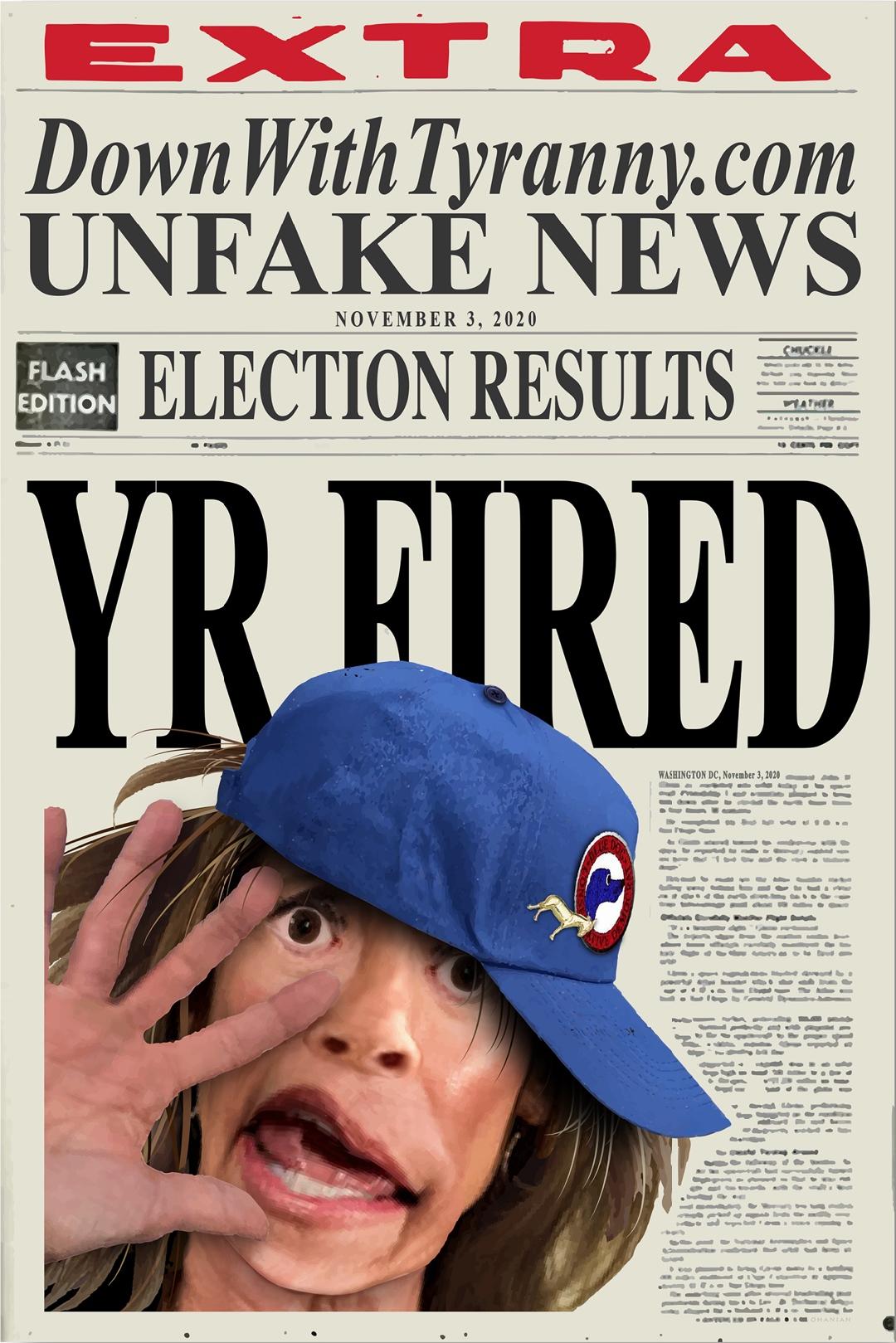
Cheri Bustos-- Worst DCCC Chair since her mentor Rahm by Nancy Ohanian
Blue Dog/New Dem Cheri Bustos, DCCC chair, who represents a northwest Illinois congressional district gerrymandered by the Democratic Party-controlled state legislature to elect Democrats, finally eked out a victory on Friday morning. She beat little-known Republican Esther Joy King 153, 947 (51.9%) to 142,621 (48.1%). Bustos spent $4,573,839 to King's $1,634,304. Pelosi's House Majority SuperPAC just in $1,044,002 to save Bustos in the last days of her meaningless campaign. It's tragic for the Democratic Party that she didn't lose; it would have taught them a lesson they badly need.
George HW Bush tried hard but failed to pass Reagan's NAFTA for their wealthy Republican donors. There were just too many Democrats in Congress standing up for the working class back then. When Bill Clinton defeated Bush in 1992 one of the very first things he did was to assign one of his campaign thugs, Rahm Emanuel, to force reluctant Democrats in Congress to join the Republicans to pass the bill. Members were bribed, threatened and blackmailed and it finally passed November 17, 1993, 234–200, 102 Democrats joining 132 Republicans in the House and, 3 days later, 27 Democrats (including Biden-- though certainly not Wellstone) joining 34 Republicans in the Senate in favor of ratification. What cluster fuck-- but most of the Democrats depending on working class votes and union support voted no despite Clinton and Emanuel. (And, yes, of course Pelosi and Hoyer voted for the bill.) It would be a lot easier for the Democrats to pass something like that now, although it would be more difficult to get enough Republicans behind it.
Yeah, there's been a reversal of support since then-- starting then-- for the working class, as Clinton made a play for Wall Street and corporate donors and acceded to the strings attached-- with the cooperation of congressional Democratic leadership. Don't expect any reversal of that trend with Biden in the White House. The Democrats who lost their seats on Tuesday-- or who are struggling to hang on-- were all Blue Dogs and New Dems from the Republican wing of the party, none of whom could be called a friend of the working class-- anti-progressive chumps like Joe Cunningham (Blue Dog-SC), Max Rose (Blue Dog-NY), Xochitl Torres Small (Blue Dog-NM), Kendra Horn (Blue Dog-OK), Debbie Mucarsel-Powell (New Dem-FL), Abby Finkenauer (IA), Susan Wild (New Dem-PA), Gil Cisneros (New Dem-CA), Anthony Brindisi (Blue Dog-NY), Collin Peterson (Blue Dog-MN), Angie Craig (New Dem-MN), Abigail Spanberger (Blue Dog-VA), Harley Rouda (New Dem-CA)... That's a big glaring problem-- an existential one, no less-- that neither Nancy Pelosi nor Chuck Schumer understands, let alone addresses.
Yesterday Matt Taibbi asked which party is the real working class party now? What an about-face that a question like that could even be taken seriously, which, of course, it must be. "Trump lost the election," he wrote, "because of his handling of the pandemic, the top issue for 41% of voters, who chose Biden by a nearly 3-1 margin. But among people whose top concern was the economy-- 28% of the electorate-- Trump won an incredible 80% of the vote... Democrats’ conspicuous refusal to address economic inequality and other class issues in a meaningful way created an opening."
Now, Trump is likely to leave the White House, but he created a coalition that some Republicans already understand would deliver massively in a non-pandemic situation. As Missouri Republican Josh Hawley put it the night of the election, “We are a working-class party now. That’s the future.”
What happens from here is a race to see which political party can make the obvious dumb move faster. Will the Democrats, emboldened by the false high of a Biden victory, blow off the clear need to revamp their economic messaging before 2022, when they risk losing both houses of Congress?
Or will the Republican opposition give away the Trump coalition just as fast, by choosing Mitch McConnell’s donor list over Hawley’s insight?
The Pandemic Is Powerful Enough To Swing An Election-- But How Will It Impact Partisan Realignment?
>
"... And I Won't Lose One Voter" by Nancy Ohanian
Many people wonder if, aside from Herman Cain (RIP), Trump rallies have been killing off his followers? And now we know. In a report from USA Today late Friday night, Erin Mansfield, Josh Salman and Dinah Pulver wrote that coronavirus cases surged in the wake of President Super Spreader's visits. New cases in the U.S. are spiking like crazy. Friday there were a record-setting 81,210 new cases-- many in rural, Trump-worshipping areas. And deaths are way back up again-- especially in Texas, Florida and Tennessee. Over 20,000 cases per million in any locale is considered an out of control pandemic. There are now 18 states with over 30,000 cases per million and two-- North and South Dakota-- with over 40,000 cases per million. There are no places on earth-- other than postage stamp sized quasi-countries like Qatar and Aruba-- that are worse COVID hellholes than the Trumpistani states of North nd South Dakota.
Mansfield, Salman and Pulver reported that as Trump "jetted across the country holding campaign rallies during the past two months, he didn’t just defy state orders and federal health guidelines. He left a trail of coronavirus outbreaks in his wake. The president has participated in nearly three dozen rallies since mid-August, all but two at airport hangars. A USA Today analysis shows COVID-19 cases grew at a faster rate than before after at least five of those rallies in the following counties: Blue Earth, Minnesota; Lackawanna, Pennsylvania; Marathon, Wisconsin; Dauphin, Pennsylvania; and Beltrami, Minnesota. Together, those counties saw 1,500 more new cases in the two weeks following Trump’s rallies than the two weeks before-- 9,647 cases, up from 8,069." Now, those three states are COVID-disaster areas. Friday's new cases (and the number of cases per million residents):
• Minnesota +1,711 (23,027 cases per million residents)-- 13 new deaths on Friday • Wisconsin +4,378 (32,714 cases per million residents)-- 42 new deaths on Friday • Pennsylvania +2,258 (15,283 cases per million residents)-- 34 new deaths on Friday
"Although there’s no way to determine definitively if cases originated at Trump’s rallies," the trio of reporters wrote, "public health experts say the gatherings fly in the face of all recommendations to curb the spread of the coronavirus.
The earliest post-rally spikes occurred even as the nation’s overall case counts were in decline from a peak in mid-July. When U.S. cases started climbing in mid-September, Trump did not alter his campaign schedule but continued holding an average of four rallies a week.
He stopped first in Minnesota, where Blue Earth County’s coronavirus growth rate was 15% before Trump’s rally, but grew to 25% afterward. Three days later, he was in Lackawanna County, Pennsylvania, where the coronavirus growth rate jumped from less than 3% before his visit to more than 7% afterward.
Even in states where cases were already rising, the spikes in at least four counties that hosted Trump rallies far surpassed their state’s overall growth rates.
In two counties, it was more than double: Marathon County’s case count surged by 67% after Trump’s visit compared to Wisconsin’s overall growth rate of 29% during the same time. In Beltrami County, Minnesota, it swelled by 35% compared to the state’s 14%.
...[E]xperts all agreed that holding large rallies during a pandemic interferes with efforts to contain the virus and can make things worse. This is why officials in at least five states, including two with Republican governors, voiced concerns or issued warnings in advance of the president’s rallies.
“I would ask the president, for once, to put the health of his constituents ahead of his own political fortunes,” Pennsylvania Gov. Tom Wolf, a Democrat, said on Sept. 25. Trump has held three rallies in the state since then.
Campaign events where people gather together cheering and screaming can carry the virus far through the crowd, said Shelley Payne, director of the LaMontagne Center for Infectious Diseases at the University of Texas. Then those infected will take the virus back to their families, friends and coworkers-- fanning an outbreak in the community.
“This is true of any respiratory virus; when you’re near people in close contact, you’re going to spread the virus,” Payne said. “And rallies are particularly problematic.”
Campaign rallies fall within a category the Centers for Disease Control and Prevention labels “highest risk” for the potential to spread the virus that already has claimed the lives of more than 222,000 Americans.
...Political experts say the guideline-defying events are part of a strategy by the Trump administration to downplay the seriousness of the virus ahead of the election. It has divided the nation over wearing masks and taking the necessary precautions to contain the virus.
“It’s a trade-off between doing what’s right for public health or what benefits re-election,” said Todd Belt, professor and director of the Political Management Program at The George Washington University. “And over and over, the greater concern for this White House is re-election.”
From conservative Christians with tucked shirts and dress shoes to bikers with long beards and leather, hundreds of Trump supporters waved flags, held signs and donned the red caps as they descended on the small town of Bemidji, located in Beltrami County, Minnesota.
Despite the 250-person limit for gatherings in the state, throngs stood shoulder-to-shoulder as they waited in long lines, cheering on the commander in chief and greeting others as if the global pandemic did not exist. A mix of locals and those who traveled hundreds of miles, the scene at the September rally has played out in small towns across America where Trump has a stronghold.
Charter buses packed full, merchandise vendors lining the streets and counter protests nearby, the spectacles have marked Trump’s campaigns and presidency.
But many of these towns don’t typically draw these types of crowds-- and the aftermath is now evident in their COVID-19 cases.
Between mid-August and mid-October, Trump has visited small and mid-sized communities in major swing states with county populations ranging from 47,000 to 310,000.
They also have largely been in conservative communities that in many cases have resisted mask-wearing and social distancing efforts.
...The campaign includes a disclaimer on rally ticket requests stating that guests “assume all risks related to exposure to COVID-19.”
...Following Trump’s COVID-19 infection, 57% or registered voters say they are very or somewhat confident in Biden to handle the public health impact of the coronavirus, while 40% express that level of confidence in Trump, according to the Pew Research Center. Biden held a narrower lead on his support over the outbreak in June.
Trump isn't holding these rallies in deep red states that he considers "in the bag"-- like West Virginia, Idaho, Alabama, Mississippi, North Dakota, Arkansas, Wyoming and Tennessee. No, he's holding them in swing states where he thinks he needs to motivate his base to turn out on election day. Let's go back to the three states where he should be charged with negligent homicide and look at the polling average in each:
• Minnesota- Trump down by 6.0 points • Wisconsin- Trump down by 4.6 points • Pennsylvania- Trump down by 5.1 points
And that brings us to Nicholas Lemann's much-discussed essay in Friday's New Yorker, The Republican Identity Crisis After Trump. Lemann explores if, post-Trump, "economic insecurity and inequality [are] powerful enough to blow apart the boundaries of conventional politics... An ambitious Republican can’t ignore Trumpism. Nor can an ambitious Democrat: the Democratic Party has also failed to address the deep economic discontent in this country. But is it possible to address it without opening a Pandora’s box of virulent rage and racism?"
The Republican Party has long had a significant nativist, isolationist element. In the Party’s collective memory, this faction was kept in check by “fusionism,” a grand entente between this element and the Party’s business establishment. The best-known promoter of fusionism is the late William F. Buckley, Jr., the theatrically patrician founder of National Review and an all-around conservative celebrity. Buckley tried to keep anti-Semites and conspiracy theorists out of the conservative movement, but he was not a standard Chamber of Commerce Republican. His first book attacked liberal universities, his second defended Joseph McCarthy, and in 1957, when Dwight Eisenhower was sending federal troops to integrate Little Rock Central High School, he wrote an article titled “WHY THE SOUTH MUST PREVAIL.” Buckley helped define American conservatism as a movement that supported free-market economics and internationalism and welcomed serious intellectuals, including former Communists such as James Burnham, Frank Meyer, and Whittaker Chambers.
Fusionism brought these views together into what seemed for a long time, at least from the outside, to be a relatively workable political coalition. Philip Zelikow, a veteran Republican foreign-policy official and one of hundreds of prominent members of the Party who vigorously opposed Trump in 2016, said, “World War II, followed by nearly World War III, brought the United States into an unprecedented world role. And a vocal minority didn’t accept it. They don’t like foreigners. They think they’re playing us for suckers. There were a lot of Pearl Harbor and Yalta conspiracy theories that we’ve forgotten about. This group concentrates overwhelmingly in the Republican Party.” For a long time, it was kept in check. Now, in Zelikow’s view, it has grown in prominence and become less deferential to the business wing of the Republican establishment, and is “close to being the most influential element in the Party.”
...In American politics, white nativism and racism tend to rise in conjunction with economic distress. Quite often, liberal economic reforms have been achieved at the price of compromises with politicians who were anything but liberal on race. The greatest triumph of liberalism in American history, the New Deal, entailed a bargain with the segregationist South in which the Jim Crow system remained firmly in place. In the twenty-first century, rising economic discontent among working-class whites has often caused them to lash out at people from other groups. Albert Mohler, the president of the Southern Baptist Theological Seminary, in Louisville, and a leader of the religious wing of the conservative movement, told me, “There’s an anxiety. A world is being demolished before your eyes. It’s an instinct that things aren’t going as they should. The world is coming apart. Somebody has to say no.”
Trump’s Republican opponents in 2016, who had been living in a world created by the Republican donor class, didn’t see that the Republican coalition had been shattered. After Obama defeated Mitt Romney in the 2012 election, Reince Priebus, then the head of the Republican National Committee (who later followed the familiar trajectory from Never Trumper to Trump enabler to Trump exile), commissioned an inquiry to find out what had gone wrong. The resulting report, known in Republican circles as “the autopsy,” noted a significant decline in the Latino vote for Republican Presidential candidates since the George W. Bush high-water mark, in 2004, and urgently called on the Party to reaffirm its identity as pro-market, government-skeptical, and ethnically and culturally inclusive. Romney would have carried Colorado, New Mexico, and Nevada if he had replicated Bush’s share of the Latino vote. The Republican establishment, and most of the 2016 Republican Presidential field, accepted the autopsy as revealed truth.
This left an opening for Trump to ignore a series of supposedly inviolable Republican bromides. He didn’t talk about the need for limited government or for balancing the federal budget. He didn’t talk about the United States as the guarantor of freedom worldwide. He didn’t extoll free trade. He didn’t court the Koch brothers. He did not sign the no-new-tax pledge that the conservative organizer Grover Norquist has been imposing on Republican Presidential aspirants for decades. A new book, Never Trump, by two political scientists, Robert Saldin and Steven Teles, asserts that Trump was opposed by more officials in his own Party (the Never Trumpers of their title) than any Presidential nominee in recent American history. Nonetheless, he got more votes in the Republican primary than any Presidential candidate ever has. Newt Gingrich, the former House Speaker, who in the nineties laid some of the groundwork for Trump’s rise by establishing hot-blooded attack as the dominant Republican leadership style, told me, “He won because he’s a dramatically better politician than anybody believed. A substantial part of the country felt demeaned. Talked down to.” Gingrich, who was among the first prominent Republican politicians to endorse Trump, has written two glowing books about the “great comeback” that the President’s agenda represents.
...Trump’s key insight in 2016 was that the Republican establishment could be ignored, and his primary campaign pitched only to the Republican base, which no longer believed in the free-market gospel, if it ever had. There would be no penalty for violating any ironclad rule of traditional Republicanism. Mike Murphy, a veteran Republican consultant who was affiliated with Jeb Bush in 2016, said, “Trump was a perfect grievance candidate, at a time when Republican voters wanted to blow up the system. I did Arnold Schwarzenegger-- he was what Hollywood people call a ‘pre-awareness title.’ People thought Trump was all over the place on Republican-base issues like guns and abortion, and that would do him in. But he hit this note of resentment. He was ‘politically incorrect’-- critical of Obama in crude terms. There was definitely a racial subtext.” He went on, “He was very George Wallace. And then there was the strongman thing: Juan Perón in an orange fright wig. He spoke to a fifty-two-year-old shoe salesman in a dying mall in Parma, Ohio. He has those voters in his head.” Charles Kesler, a conservative political scientist and the editor of the Claremont Review of Books, one of a small number of Trump-sympathetic intellectual journals, said much the same thing: “It’s a confession of the disrepair of the Republican Party that he won that race. He shouldn’t have won that race. It revealed the inner hollowness of the Party.”
Nobody pretends that President Trump pores over detailed policy briefs. By all accounts from reporters and from Administration defectors, what you see (tweets, rallies, enmities, palace intrigue) is what you get. Even though Republicans controlled the House of Representatives, the Senate, and the White House for two years, Trump failed to achieve his most loudly voiced campaign promises from 2016, such as building that big, beautiful wall and making Mexico pay for it, getting Congress to repeal the Affordable Care Act, and undertaking a major infrastructure-building program. He is running for a second term without having produced any formal platform. What he did accomplish is a surprisingly conventional Republican program: substantial tax cuts, a vast rollback of federal regulations, large increases in military spending, and the elevation to the federal bench of more than two hundred judges with lifetime tenure, including, most likely, three avowedly conservative Supreme Court Justices.
Trump signed into law a cut in the corporate tax rate from thirty-five per cent to twenty-one per cent-- far lower than what Reagan was able to get. Glenn Hubbard said, “Jeb would have given you the tax cut. I know because I wrote it. Trump just doubled it.” In 2017, Julius Krein, an up-and-coming conservative intellectual and a former Trump supporter, founded a magazine called American Affairs. He told me, regarding Trump’s economic accomplishments, “Laugh if you want, but he ran on an ambitious agenda, which ran counter to the entire consensus. And in office he did almost nothing for anyone aligned with the 2016 campaign. The donors are driving the bus.” Trump’s racially charged rhetoric has remained constant from his first campaign through his time in office, but, in policy, foreign affairs is the one area where the Trump of the campaign and the Trump of the White House are truly aligned. His hostility toward alliances and treaties has led him to withdraw from the Paris climate accord and the Iran nuclear deal. He has enacted punitive restrictions on immigration. He constantly attacks NATO and other international organizations.
The best explanation I’ve heard for the difference between Trump as a candidate and Trump as the President goes back to fusionism. Governing requires filling thousands of jobs at the highest levels of the federal government with people who know what they’re doing, and also having shovel-ready policies in dozens of specific areas. Trump and most of his closest aides had no government experience and no developed policies. Reagan was elected sixteen years after Barry Goldwater’s forty-four-state defeat, in 1964. The conservative movement had used that time to develop a governing infrastructure. As Reagan took office, the Heritage Foundation (established in 1973) released the thousand-page Mandate for Leadership, which included hundreds of detailed suggestions for conservative policies that Reagan could enact.
There was no manual like that detailing the program Trump ran on, and no economic-policy experts ready to enact it. “This was a case where the dog caught the car,” Oren Cass, a young conservative activist and thinker who dislikes both Trump and the Republican establishment, told me. Trump’s motley crew included people like Stephen Bannon, Corey Lewandowski, and Paul Manafort, who hadn’t previously worked in government, or even had leading roles in prominent Republican campaigns. Stuart Stevens, Romney’s senior strategist in 2012 and a Never Trumper, told me, “These are evil people. They don’t have a sense of right and wrong. The people Trump attracts—these are damaged people. These are weird, damaged people. They are using Trump to work out their personal issues.”
Yet the establishment’s governing machinery was still running apace, so there were plenty of appointees and policies available from congressional staffs, think tanks, and lobbying organizations—all funded by the Republican donor class. The establishment is set up to supply the Presidential officials who supervise the career civil servants (also known by Trumpists as “the deep state”) in federal agencies. A few distinctively Trump appointees-- Stephen Miller, on immigration, and Jared Kushner, on the Middle East-- pushed through policies that no traditional Republican would have put into place. Otherwise, appointees without previous connections to Trump but with deep connections to the Party’s libertarian wing have put in place an enhanced version of the standard Republican program.
The result has been an odd mix of traditional Republican policies and Trumpian rhetorical flourishes. It’s hard to tell whether Trump believed in what his Administration was doing or if he was merely focussed on how to square it with his personal branding strategy. Cliff Sims, a White House aide who left in 2018, is the author of Team of Vipers, arguably the most revealing of the half-dozen tell-all Administration memoirs. In the book, Sims describes a scene from 2017, in which Trump is on the phone with Paul Ryan and Kevin Brady, the Republican members of Congress who were primarily responsible for the tax-cut plan. Trump says, “I think I’ve got a great name for this bill-- it’s going to be really cool. We need to call it ‘The Cut Cut Cut Act,’ because this is a tax cut. When people hear the name, that’s what we want people to know.” (The bill became law under the name Tax Cuts and Jobs Act.)
It’s also hard to tell whether Trump is truly an economic nationalist or merely a crony capitalist. He railed against TikTok, a Chinese-owned company, demanding that it sell its U.S. division, but then approved a deal that would permit Chinese control to continue and would also benefit two American companies, Walmart and Oracle, the latter of which has a major Trump contributor as a top executive. The Administration’s misadventures in Ukraine appear to have involved attempts to get the head of Naftogaz, the national gas company there, replaced by someone who would agree to import liquefied natural gas from the United States. Whatever is really going on, it’s clear that Trump in office is far less economically populist than he claimed to be while he was campaigning for his first term.
...As Trump has outsourced economic policy to the establishment, he has outsourced social policy to the evangelicals. Years before he launched his Presidential campaign, some instinct led him to create an alliance with the religious wing of the Republican Party. Nearly twenty years ago, he formed a public relationship with Paula White, a popular televangelist who preaches the "prosperity Gospel," and who has said that she guided Trump toward active Christianity. Since at least 2011, Trump has been appearing at the American Conservative Union's annual Conservative Political Action Conference, a large gathering of activists from the Party base. In 2016 and 2017, Trump released lists of potential Supreme Court Justices, all of them demonstrably acceptable to both wings of the Republican Party, the evangelicals and the libertarians, and then made appointments only from those lists. (He released a second-term list this year.) He selected Mike Pence, an evangelical Christian who had strong support from the Koch brothers and from other major Republican donors, as his Vice-President. As President, Trump has issued a number of executive orders that evangelicals approve of, such as one that rescinded a provision of the Affordable Care Act which required health-care providers to offer birth control. "He actually did what he said he'd do," Albert Mohler told me. "It's the oddest thing."
...Trump is far too bizarre to be precisely replicable as a model for the generic Republican of the future. That raises the question of where the Republican Party will go after he leaves office. The jockeying for the 2024 Republican nomination is already well under way. Did Trump's ascension represent a significant change in the Party's orientation, and, if so, will the change be temporary or lasting?
Among the Republicans I spoke to, some of whom will vote for Trump and some of whom won't, there are three competing predictions about the future of the Party over the coming years. Let's call them the Remnant, Restoration, and Reversal scenarios.
Most of the 2016 Republican Presidential candidates accepted the post-2012-autopsy argument that the Party, with its overwhelming lack of appeal to nonwhite voters, was in a demographic death spiral. Trump ran a campaign that seemed designed to appeal only to whites-- indeed, only to whites who didn't like nonwhites. That worked well in the Republican primaries, and well enough in the general election for Trump to eke out a victory that would have been impossible without the Electoral College system. He also did slightly better with minority voters than Romney had, though minority turnout was significantly lower than it had been in the two elections when Barack Obama was the Democratic nominee.
Could somebody else use the Trump playbook to win a Presidential election? Those who believe in the Remnant scenario think so. It would require extremely high motivation among Trump's base-- mainly exurban or rural, actively religious, and not highly educated-- along with a strong appeal to affluent whites, continued modest inroads with minority voters, and a low turnout among Democrats. If a politician were able to tap into the deep antipathy toward élites in the Trump heartland, he could compensate, at least in part, for the demographic decline of white voters. In the years between the elections of 1996 and 2016, the Democratic Party lost its voting majority in about a thousand of the three thousand counties in the United States-- none in major population centers. Trump carried eighty-four per cent of the counties.
...The Remnant strategy entails relentless attacks. It rests on the idea of an outpowered cohort of traditional Americans who see themselves as courageously defending their values. The obvious candidate to carry out a high Trumpist strategy in 2024 would be Donald Trump, Jr., who is an active speaker in Trump-admiring circles and in the past two years has published two books that excoriate liberals. Several other potential Republican candidates, most notably Senators Tom Cotton, of Arkansas, and Josh Hawley, of Missouri, have demonstrated that they see Trump's success as instructive. Between them, Cotton and Hawley have two degrees from Harvard, one from Yale, and one from Stanford, but both have been steadily propounding populist and nationalist themes. The forty-year-old Hawley, who is only two years into his first term and is the youngest member of the Senate, is a relentless Twitter user, frequently targeting China, Silicon Valley, and liberals who are hostile to religion. Like Trump in 2016, he almost never argues for less government, and often calls for programs to help working people. In the summer of 2019, he gave a speech at the National Conservatism Conference denouncing "a powerful upper class and their cosmopolitan priorities" which, he implied, had gained control of both parties. There is also Tucker Carlson, of Fox News, who, like Trump in 2016, has no political experience and a large television audience. He offers up ferocious attacks on élites almost nightly. Charles Kesler told me that, no matter who wins, the Claremont Institute, which publishes the Claremont Review of Books, is going to start a Washington branch after the election, to devise Trumpian policies: socially conservative, economically nationalist.
Under the Restoration scenario, if Trump loses, Republicans, as if waking from a bad dream, could recapture their essential identity for the past hundred years as the party of business. They could revive a Reagan-like optimistic rhetoric of freedom and enterprise; resume an internationalist, alliance-oriented foreign policy; and embrace, at least notionally, diversity and immigration. One veteran Republican campaigner with Restorationist leanings says that, if Trump wins,"it'll blow up the Republican Party. In the 2022 election, we'll have an epic disaster-- a wipeout of epic proportions" Instead of Trumpism, "economic growth with an emphasis on character, and treating the Democrats as opponents and not as the enemy, is a way forward for the Party." Many Never Trumpers would feel comfortable again in a Restorationist Republican Party. Restoration could entail a conventionally positioned Presidential candidate, such as Mike Pence or Mike Pompeo, the Secretary of State, if it's possible for them to shake off their close association with Trump. But the most discussed Restorationist candidate is Nikki Haley, the former governor of South Carolina and a former U.N. ambassador. Haley is the child of immigrants from India (one a professor at Voorhees College, a historically Black college, the other a schoolteacher who started a successful business selling clothing and accessories from around the world) and the sister of a military veteran. She achieved the rare feat of serving in the Trump Administration without either going full Trumpist or falling out with the President. She left, evidently on good terms with Trump, shortly after it emerged that she had accepted rides on private planes from businessmen in South Carolina. She was given a starring role at Trump's renomination convention, this past August.
...The Reversal scenario, though perhaps the least plausible, is the most threatening to the Democratic Party. The parties would essentially switch the roles they have had for the past century: the Republicans would replace the Democrats as the party of the people, the one with a greater emphasis on progressive economic policies for ordinary families. Some Reversalists have praised Elizabeth Warren; criticizing Wall Street and free trade is pretty much a membership requirement. Michael Podhorzer, who works at the A.F.L.-C.I.O., sent me a chart he had made that showed the vote in congressional districts, ranked by median income, from 1960 to today. For most of that time, districts in the bottom forty per cent of income were far more likely to vote Democratic. But by 2010 the lines had crossed-- perhaps because of the financial crisis and the Great Recession, perhaps because of the Presidency of Barack Obama-- and today poorer districts are far more likely to vote Republican and richer districts are far more likely to vote Democratic. The ten richest congressional districts in the country, and forty-four of the richest fifty, are represented by Democrats. The French economist Thomas Piketty has produced a chart showing that for highly educated voters, who were once mainly Republican, the lines started crossing back in 1968. In 2016, Trump carried non-college-educated whites by thirty-six points, and Hillary Clinton carried college-educated whites by seventeen points. Could Republicans become the working-class party, and Democrats the party of the prosperous? That would bode well for Republicans because, especially in a time of rising inequality, there aren't enough prosperous people to make up a reliable voting majority.
The Democratic Party appears confident that it has the abiding loyalty of minority voters at all income and education levels, and that it dominates the metropolitan areas where a growing majority of Americans live. The coming majority-minority, decreasingly rural country will be naturally Democratic over the long term. But there are holes in this argument. Because minorities are younger than whites and are also less likely to be U.S. citizens, the electorate could remain white-majority for decades. Richard Alba, a sociologist who has written a book called The Great Demographic Illusion, which challenges the idea of a rapidly arriving majority-minority America, estimates that in 2060, which is as far into the future as the Census Bureau projects, the electorate will still be fifty-five per cent white. (It was seventy-three per cent white in 2018). And minority voters-- especially Latinos, who will be the largest group of minority voters in the 2020 election-- may not remain as loyally Democratic as they have been in recent elections, especially if the Republican Party has a leader who doesn't race-bait. Black and Latino Democratic voters are substantially less likely to identify as liberal than white Democratic voters are. They are also more likely to be actively religious, and to pursue Republican-leaning careers such as military service and law enforcement.
...The Reversalists believe that the Democrats' embrace of market economics, and their establishment of a powerful business wing of the Democratic Party, especially in Silicon Valley and on Wall Street, during the Clinton and Obama Administrations, has left them vulnerable to an attack from a new, socially conservative and economically liberal strain of Republicanism. Reversalists oppose the Republican donor class. Several have abandoned donor-funded libertarian and neoconservative think tanks like Cato and the American Enterprise Institute, disillusioned with the Party's indifference to the concerns of middle-class and working-class voters. Oren Cass, one of the leading Reversalists, has founded an organization called American Compass, which is trying to formulate policies that would appeal to members of the base of both parties. "What we're talking about is actual conservatism," he told me. "What we have called 'conservatism' just outsourced economic policy thinking away from conservatives to a small niche group of libertarians." Culturally, Reversalists present themselves as champions of provincialism, faith, and work, but they aim to promote these things through unusually interventionist (at least for Republicans, and for centrist Democrats since the nineties) economic policies. Steven Hayward, who calls himself a reluctant Trump supporter, said, "It's amazing to me the number of conservatives who are talking about, essentially, Walter Mondale's industrial policy from 1984. The right and the left suddenly agree. Reagan was very popular with younger voters. Younger people then had come of age seeing government failure. Now young people have come of age seeing market failure."
...Many Democrats will surely see this vision of the future of the Republican Party as fanciful. Isn't the Party controlled by ferociously right-wing billionaires? Aren't Republican-base voters irredeemable white supremacists who have been bamboozled by Fox News and televangelists? But the Democrats' coalition is no less unnatural than the Republicans'. A political system with only two parties produces parties with internal contradictions. The five most valuable corporations in America are all West Coast tech companies-- enemy territory, in today's Republican rhetoric. The head of the country's biggest bank, Jamie Dimon, of JPMorgan Chase, is a Democrat and a Trump critic. There was a stir in Republican circles in 2018, when a conservative journalist eavesdropped, on an Amtrak train, on a long phone conversation that Representative Jerry Nadler, of the Upper West Side, was having. Nadler complained that Democrats were attracting voters who were like the old Rockefeller Republicans-- liberal on social issues, conservative on economics. That's who lives in a lot of the wealthy older suburbs-- formerly Republican areas that are now Democratic. And the Democrats' minority voters differ enough on measures such as income, education, ideology, and religion that some of them could potentially be tempted to join a Republican Party that wasn't headed by Trump.
Trump has already changed the Republican Party. Its most hawkish element-- hawkish in the Iraq War sense-- has gone underground, if it still exists. The same goes for publicly stated Republican skepticism about Social Security and Medicare. One must be hostile to China, and skeptical, to some degree, of free trade. Especially since the arrival of the pandemic, it's hard to find a true libertarian in the Party-- at least among those who have to run for office. In the future, according to Donald Critchlow, a historian of conservatism who teaches at Arizona State University, "the advantage would go to a candidate who is Trump without the Trump caricature. An old-fashioned Chamber of Commerce candidate would not do well. We're in a new situation, in both parties. Everything's up for grabs." A senior Republican staffer who has Reversalist sympathies says, "Trump isn't good at a twenty-first-century policy agenda," but that work can go on without him. "If he loses, we'll have a massive argument in the Republican Party. Some will say, "He's a black swan." To me, the lesson is: he correctly diagnosed what was going on. Let's apply that to conservative economic policy. To me, what's up for grabs is the working-class vote. Not just working-class white-- working-class. Does what the President tapped into have to be racial? Can it be about what neoliberalism has done to the country?"
Trump's genius is to command attention, including the attention of people who dislike him. That makes it tempting to think that, when he's gone, everything he stands for will go with him. It probably won't; elements of Trumpism will likely be with us for a long time. Which elements, taking what form, in the possession of which party? Such questions will be just as pressing after Trump as they are now.
The Great Depression was electorally equated with the Republican Party for at least 20 years and the mishandling of the coronavirus pandemic is going to make Trump's Republican Party this generation's Herbert Hoover's Republican Party. So... Lemann is a really smart guy, but his frame may be cockeyed here.
Which Party Is Going To Have to Rebuild After The Trump Debacle?
>
Cone Of Shame by Nancy Ohanian
If someone was to start an essay with "I was a Republican for most of my adult life," there's a good chance I would stop reading. How much of a moron or bigot would someone have to be to have been a Republican for most of their adult life? I wasn't even an adult when I figured out that even a horribly flawed Democratic Party in practice wasn't as bad as the Republican Party in aspiration (and practice). But the title of the new Tom Nichols essay for The Atlantic-- This Republican Party Is Not Worth Saving-- I wouldn't have heard his compelling arguments from why defeating Trump is just the beginning of a process that needs to go much deeper. "No one should ever get a second chance," he wrote, "to destroy the Constitution." And he wasn't just talking about Mitch McConnell and the band of unspeakably anti-patriotic political hacks that make up the congressional Republican Party. Nichols, basically addressing conservatives and Republicans, began by acknowledging that he understands "the attachment to that GOP, even among those who have sworn to defeat Donald Trump, but the time for sentimentality is over. That party is long gone. Today the Republicans are the party of 'American carnage' and Russian collusion, of scams, plots, and weapons-grade contempt for the rule of law. The only decent, sensible, and conservative position is to vote against this Republican Party at every level, and bring the sad final days of a once-great political institution to an end. Then build the party back up again-- from scratch. I’m not advocating for voting against the GOP merely to punish Republicans for Trump’s existence in their party. Rather, conservatives must finally accept that at this point Trump and the Republican Party are indistinguishable. Trump and his circle have gutted the old GOP and stuffed its empty husk with the Trump family’s paranoia and corruption." This Facebook ad was made specifically for Liam O'Mara's campaign to replace Crooked Ken Calvert in Riverside County. But it sums up, elegantly, Nichols' entire argument for why the GOP-- not just Trump-- needs to go away. In fact, it goes deeper and beyond Nichols' argument. Take a look:
Nicholas wrote that "the transformation of the GOP into a cult of personality is so complete that the Republicans didn’t even bother presenting a platform at their own convention. Like a group of ciphers at a meeting of SPECTRE, they nodded at whatever Number One told them to do, each of them fearing an extended pinkie finger pressing the button that would electrocute them into political oblivion. Some Republicans, even while they grant that Trump is a sociopath and an idiot-- and how unsettling that so many of them will stipulate to that-- are willing to continue voting for Republican candidates because the GOP is nominally pro-life or because the administration’s judicial appointments show that the people around the president are doing what conservatives should want done. But Trump’s few conservative achievements are meaningless when compared with his war on American democracy, a rampage that few Republicans have lifted a finger to stop. Trump and Attorney General Bill Barr have turned the constitutional order and the rule of law into a joke. If you’re Roger Stone or Michael Flynn, the White House will arrange pardons, commutations, or even the outright betrayal of the Justice Department’s own lawyers. Felony convictions are for the little people. The Constitution is just busywork for chumps." I guess it's still too hard for him to understand why Republicans are now and have always been-- at least in our lifetimes-- unfit to be allowed to get behind the wheel. My biggest worry is that Republicans like Nichols are infiltrating and polluting the DNA of the Democratic Party and making it over into a Reaganite party where Democrats like Biden and Manchin and Schumer and Gottheimer will be perfectly comfortable, but where there will be no place for progressives or for anyone who understands the solidarity of the New Deal. Yesterday, in fact, Liam O'Mara, the same independent-minded progressive running for the Riverside County congressional seat, wrote that "Given the very real impact on ordinary people of rising costs and stagnant wages, this country needs to turn around. It elected Barack Obama because he spun a tale about hope and change that resonated with a country in the grip of recession. There was a historic opportunity in those first two years to realign the economy to favour growth for all, not just the one per cent. Alas, Obama failed completely to rise to the challenge of the day, preferring to bail out the people who caused the problem, not those who suffered its effects. At the end of the day, exactly the same people and ideas were left in charge. This is how we got Trump. And people really thought Biden was their best shot against him? For some reason, 'It's the economy, stupid!' remains one of the hardest lessons for this party to learn. If Democrats really want to win nationally, not just against Trump but consistently, and regain ground in the swing states, we must get back to our New Deal roots and tear up the nonsensical DLC crap that's driven the party since the 1970s. And a new batch of policy-driven challengers across the state and country give me hope that we're gaining ground at the grassroots at least. The Squad is already set to double this year, and there are a lot of great challengers running in red districts as well as the safely blue seats."
"GOP representatives in the people’s house." continued Nichols, "sneer at concepts such as oversight and the separation of powers. Rather than demand accountability from the executive branch on COVID-19, on the Hatch Act, on the Postal Service-- on anything, really-- they either repose in sullen silence or they take up the lance for the president and overwhelm committee hearings with Trumpian word salad. Meanwhile, senators who swore to be 'impartial' jurors refused to hear actual evidence during an impeachment trial. They confirmed a rogue’s gallery of incompetent henchmen and cronies to important positions. They continue to downplay Russian attacks on the U.S. political system and are now outfoxed by the likes of John Ratcliffe, the director of national intelligence, a nonentity who has ruled that none of them, Republican or Democrat, should be allowed to ask any pesky questions about election security in person."
“But Gorsuch,” Republicans chirp when pressed about their party’s demise, as if Neil Gorsuch and Brett Kavanaugh will saddle up and save us when elected Republicans refuse to stop Trump from finally turning the FBI into his private police force or Barr from using the Department of Homeland Security as the White House’s own Belarusian interior ministry. (Kavanaugh, who warned during his confirmation hearings that “what goes around comes around,” might be exactly the justice to put his stamp on such moves.) Conservatives must also let go of fantasies about saving the “good” Republicans, a list that is virtually nonexistent. (You can’t count Mitt Romney more than once.) The occasional furrowed brow-- a specialty of the feckless Susan Collins of Maine-- is not enough. The few, like Romney, who have dared grasp at moments of sanity have been pilloried by Trump and other Republicans. In any case, Romney is chained to the GOP caucus, a crew that includes the jabbering Louie Gohmert and calculating Elise Stefanik in the House, and the sniveling Ted Cruz and amoral Mitch McConnell in the Senate. Would-be Madisonians among the Republicans warn that no party should have untrammeled access to the levers of power-- and especially not the Democrats. Yes, they say, we understand that Trump must go, but if Joe Biden is allowed to run the executive branch without a Republican Senate, America will become a one-party state that sooner or later will fall under the boot of the dreaded Representative Alexandria Ocasio-Cortez. This faux constitutionalism is naked hypocrisy: I do not recall, during my days in the GOP, anyone on the right ever pleading that Americans should leave at least a few Democrats in office so that we Republicans would not go crazy and start force-feeding Ayn Rand or Friedrich Hayek to impressionable schoolchildren.
Nichols-- the lifelong Republican-- will never understand AOC or Liam O'Mara nor what they represent. When he asks "if the Republicans suffer a full-spectrum defeat in 2020, what comes next?," he is thinking about something that doesn't exist-- never existed and never will exist: "sensible conservatives-- who believe in limited government and the prudent, constitutional stewardship of national power and resources." He looks forward to them feeling "safe to run for national office as Republicans again. Those at the local level who were bullied into silence by their state organizations might be able to come out of hiding and challenge the people who led them to disaster." But what he's describing in the Big Tent neoliberal Democratic Party of Joe Biden. "Reconstructing the GOP-- or any center-right party that might one day replace it-- will take a long time, and the process will be painful." So why not just infiltrate the Democratic Party and kick out the progressives and make them go through the long, painful process of rebuilding? That's my fear and I see it already happening. I see Nichols' fear as well: "The remaining opportunists in the GOP will try to avert any kind of reform by making a last-ditch lunge to the right to fill the vacuum left by Trump’s culture warring and race-baiting. In the short term, the party might become smaller and more extreme, even as it loses seats. So be it. The hardening of the GOP into a toxic conglomeration of hucksters, quislings, racists, theocrats, and cultists is already happening. The party gladly accepted support from white supremacists and the Russian secret services, and now welcomes QAnon kooks into its caucus. Conservatives must learn that the only way out of 'the wilderness' is first to vanquish those who led them there. No person should ever get a second chance to destroy the Constitution. Trump has brought the United States to the brink of civil catastrophe, and the Republican Party has protected him from the consequences of all his immoral and illegal actions more ably than even Fred Trump did. Conservatives need to put the current Republican Party out of its-- and our-- misery." How about a pitch for progressives in the Democratic Party now? This thermometer on the right will take you to a page with 17 progressives who won their primaries and now have to face off against conservatives in November. I've talked with each of these men and women. Some-- like Kara Eastman, Nat McMurray, Mike Siegel, J.D. Scholten-- I've gotten to know over years, not just over the phone, but over the dinner table and on the frontlines of the battle between progressivism and neoliberalism. Some I'm just getting to know but feel confident enough to recommend them. I doubt there are many DWT readers with the capacity to max out to each of the candidates on the page... but that has never been what Blue America is about. Our average contribution is around $45. We've raised between $6 and $7 million for progressive candidates and we've seen former candidates we've backed-- like Alan Grayson, Donna Edwards, Elizabeth Warren, Bernie, AOC, Rashida Tlaib, Ted Lieu, Pramila Jayapal, Jamie Raskin, Matt Cartwright, Katie Porter... changing the national conversation and changing the way Americans look at politics, one painful step at a time. Many of our former candidates I see as in the middle of their journeys and I have every expectation that men and women like Randy Bryce, Mark Gamba, Hector Oseguera, McKayla Wilkes, Kaniela Ing, Robert Emmons, Tom Winter, Eva Putzova, Shaniyat Chowdhury, Robin Wilt, Morgan Harper, Keeda Haynes, Nabilah Islam, Tomas Ramos are part of America's future. Meanwhile. it will only set you back $17 to give each of the candidates one dollar-- or maybe you like what Liam O'Mara had to say above and you want to give him that whole $17. Or perhaps you live in Texas and want to split the contribution equally between Mike Siegal and Julie Oliver, or maybe you live in New York and want to give a boost to Mondaire Jones, Nate McMurray and Jamaal Bowman. Start by clicking the thermometer and give what you can to whomever you want. (And, hey, there's no better feedback for us at Blue America as we decide where to spend our last minute ad money.)
One thing is certain. If voters don't end Republican political dominance everywhere and at every level it exists, it won;'t be the rebuilding of parties that matter; it will be the rebuilding of our entire world and society. Nothing will survey the Climate Change that the GOP is still denying ostrich-like. Yesterday, Patagonia sent this out to all their customers and it really doesn't matter which party you identify with or if you're "non-political." It really is now or never.
The Republicans Can't Blame Trump For What They've Become-- Nor For What's About To Happen To Them
>
Murder/Suicide by Nancy Ohanian
Yesterday, The Hill reported that, in private, House Republicans see the tsunami coming for them and they are panic-stricken. Everything is working against them and there is "a growing sense of doom... House Republicans face numerous, almost insurmountable obstacles: a cash shortfall against the Democratic Congressional Campaign Committee, 27 retiring lawmakers and a Republican National Committee that is more focused on reelecting President Trump and protecting the Senate GOP majority. 'If the election were today, we would lose the House, the Senate and the White House,' said one Republican source. Several GOP lawmakers are warning that the party faces a landslide defeat on Election Day if Trump doesn’t start landing punches on former Vice President Joe Biden, who has a strong lead in the polls both nationally and in key battleground states. 'This is the problem: [Trump] continues to allow it to be a referendum on himself; you can’t do that in a competitive race,' one GOP lawmaker said." Well... that turns out to be only partially true. It is a referendum on the Republican Party and on conservative governance. A new poll by David Binder Research of rural voters in Iowa, Michigan, Minnesota and Wisconsin for Focus on Rural America shows Trump-- and the GOP-- up shit's creek without a paddle. Trump is even losing in Iowa, where Republicans claim he is solid.
And rural voters disapprove of Trump by large numbers and think Biden will do a better job than he has on issues that are specifically important to rural and small town voters. If those numbers represent rural voters in other parts of the country, this is going to be the biggest GOP ass-whooping since America decided Herbert Hoover didn't deserve a second term. In fact, these voters "give Biden the most significant advantage on understanding the values of rural America, and improving access to health care in rural areas. Majorities also believe that Biden would be better than Trump at supporting farmers and stabilizing markets for agriculture commodities, and being relatable to rural Americans."
My own calculations see between 2 and 3 dozen Republican House seats flipping blue-- with a possibility of Trump doing something between now and November than will increase those numbers significantly. And writing for The Atlantic yesterday, Norm Ornstein explained how the GOP has been so radically changed-- a change that culminated with the rise of Trump-- that he barely recognizes it. He wrote that over time "Nothing has been more striking or significant than the transformation of the Republican Party, from a moderately conservative party to a very conservative party to something else entirely."
One sign of this change? A five-term Republican congressman from Colorado, elected in the Tea Party wave in 2010 and now a Trump loyalist, was recently defeated in a primary by a candidate who runs Shooters Grill, where servers are encouraged to carry firearms, and who has indulged the QAnon conspiracy theories and who is now endorsed, not repudiated, by the National Republican Congressional Committee. Another? The current buzz surrounding Tucker Carlson as the party’s hope in 2024-- even as he takes sudden leave from his show to go fishing, after one of his writers was tied to racist and misogynistic posts on an internet message board.
Few of the dozens of Republicans in high office I have known and admired over five decades-- in a party not my own and holding views that, in many cases, I did not share-- would be represented in the Republican Party of today. While some of my friends and mentors were and are moderates, others were proud conservatives, who genuinely believed in fiscal discipline but also valued government, albeit in a limited form. But the radical and unconservative idea that all government should be disdained, that tax cuts that blow up the debt are just fine, would be anathema to them. And the idea that the Republican Party would be a force for ethnic and anti-immigrant animus and racial division would appall them-- including my late friend Jack Kemp. The Republicans I knew best and worked most closely with were almost uniformly for civil rights-- they represented the party of Everett Dirksen and William McCullough, who were instrumental in passage of the Civil Rights Act in 1964 and the Voting Rights Act in 1965. The individuals I knew, admired, and worked with were not the entirety of the Republican Party, even then. Plenty of lawmakers and others were quite content to exploit racism. They sought out the votes of segregationist former Southern Democrats, such as Strom Thurmond, to refill their party’s diminishing moderate ranks in the Northeast and the Midwest, and on the West Coast. Beginning with Barry Goldwater’s 1964 candidacy and Richard Nixon’s 1968 “law and order” campaign, some Republican politicians ran for office using rhetoric that, at best, cynically inflamed racial divisions. But even as I opposed many of the initiatives and campaign tactics of that Republican Party, I appreciated its efforts to solve problems and work within the governing institutions. The party of Nixon, with all its pathologies, created the Environmental Protection Agency, proposed a health-care-reform plan as sweeping as the later Affordable Care Act, and considered offering Americans a guaranteed annual income on a par with Andrew Yang’s universal basic income. The party of Reagan, which tried to cut Medicare, Medicaid, and Social Security, and which slashed taxes in 1981, precipitating ballooning deficits, also cut deals with Democratic Representative Henry Waxman to bolster Medicare and Medicaid; championed bipartisan Social Security reform in 1983; and supported tax increases in 1982, 1983, 1985, and 1986 to offset the earlier cuts and reduce the deficits. The party responsible for Iran-Contra is also the party that championed democracy and moved in concert with Democrats to create the National Endowment for Democracy, the United States Institute of Peace, the National Democratic Institute, and the International Republican Institute.
...The Republican Party’s slide away from those values preceded Donald Trump, providing the conditions for his rise. In recent years, the GOP has thrown away its guiding values and embraced its darkest instincts. It has blown up long-standing norms in the Senate, creating divisions that outstrip anything I have seen before; done nothing about rank corruption in the White House and the Cabinet; accepted the politicization of the Justice Department and lies from the attorney general; avoided any meaningful oversight of misconduct; and failed to curb attacks on the independence of inspectors general. The GOP now distinguishes itself by inaction. It has stood and watched as this administration separated children from their parents at the border, mistreated asylum seekers, botched its response to a hurricane in Puerto Rico, attacked science, and opened new avenues for toxic materials in our air and water. It said and did nothing about Russian interference in the 2016 elections, and is actively blocking efforts to combat a recurrence in 2020. It has refused to pass a new Voting Rights Act after the Supreme Court decision in Shelby County v. Holder eviscerated the legislation, which, reflecting the GOP of the past, had passed the House unanimously. It has refused to deal in any fashion with urgent problems such as climate change, immigration, global competition, hunger, and poverty. It confirmed nominees who lied to the Senate, who inflated résumés, and who failed to meet minimum qualifications for the job. It confirmed judges who were unanimously rated unqualified by the American Bar Association. The party jammed through a tax cut at a time of low unemployment and low economic growth, making a mockery of modern economics and leaving little flexibility to deal with the economic consequences of the coronavirus pandemic. It slashed the budget of the Centers for Disease Control and Prevention, delivering an 80 percent cut to global-health programs designed to fight pandemics, and leaving the agency without the resources necessary to battle COVID-19. It has said almost nothing about the pitiful and reckless responses of the president to the pandemic, which has resulted in tens of thousands of deaths that should never have occurred. And now it is silent as we learn that Russia offered bounties to the Taliban to kill American soldiers, while the president said and did nothing.
...Plenty of the Republicans I dealt with in the past were fierce partisans, including Dole and John Rhodes. But when pushed, they put country first-- that was the basis on which they could forge bonds across the aisle. I had strong relationships in years past with a number of Republicans currently in the Senate. But none of them have, in recent years, behaved in a fashion that would meet the values of the party of Domenici, Steiger, or Dole. The country obviously needs a major change in its politics, a purging of the status quo. It faces challenges both societal and structural that go beyond Trump and the two parties. The United States must recover from the pandemic and rebuild its economy, while confronting head-on the issue of racism. But we cannot long operate as a democracy without two problem-solving parties that aim to compete for genuine majorities in the country. The Democratic Party is far from a paragon of virtue here; in politics, there are no angels. It faces its own deep challenges ahead. But America’s crisis of governance has been driven by a party that my colleague Tom Mann and I, long before Trump, described as an insurgent outlier in American politics. “It is ideologically extreme,” we wrote in 2012; “scornful of compromise; unmoved by conventional understanding of facts, evidence and science; and dismissive of the legitimacy of its political opposition.” I was reminded of that description recently by the comments of the Republican pollster Alex Castellanos. “Mask-wearing has become a totem, a secular religious symbol,” Castellanos told the Washington Post. “Christians wear crosses, Muslims wear a hijab, and members of the Church of Secular Science bow to the Gods of Data by wearing a mask as their symbol, demonstrating that they are the elite; smarter, more rational, and morally superior to everyone else.” A reshaped GOP would be very conservative, but not radical. It would believe in limited government, but a government run by professionals, respecting data and science, and operating efficiently and fairly. It would believe in genuine fiscal discipline. It would try to apply free-market approaches to solving difficult problems, such as climate change. It would believe in the integrity of institutions and insist that those in office adhere to high ethical standards. It would respect the sanctity of alliances and the fundamental values of decency and equal treatment. It would work to broaden its base across racial and ethnic lines, not use division and voter suppression to cling to power. Sadly, even if Donald Trump is defeated in November, there is no sign that such a party will return anytime soon. But restoring the Republican Party to its traditional values is absolutely essential to preserve the core of our system of governance.
Well... he's wrong about there being no sign that such a party will return anytime soon. In case anyone didn't notice, Ornstein just described the post-Bill Clinton Democratic Party-- the one so many Republicans seem to be very, very comfortable with these days. I predict that the Biden administration will be more like the Republican Party Ornstein just described than the Trump-Pence regime.
The Self-Destruction Of The Republican Party, Puts The Democrats At A Crossroad
>
The least racist person anywhere by Nancy Ohanian
Last May Trump performed at one of his hate rallies in one of the most vile neo-fascist areas of America, the Florida Panhandle (AKA, "Little Alabama"). He was stoking hatred and bigotry is a place he had no need to be. Panama City Beach is east of Panama City-- in Bay County-- drawing residents from Florida's first and second congressional districts. Trump beat Hillary in Bay County 71.2% to 24.9%. Trump beat her in the first district 67.5% to 28.2% and bear her in the second district 66.2% to 30.6%. They were his top two performing districts in Florida, not just Republican, thorough fascist. Matt Gaetz represents FL-01. At his hate rally he excited the audience with a question and answer: "How do you stop these people? You can’t." He was referring to immigrants. One of his adoring fans screamed, "Shoot them." Trump smiled benignly as thousands of repulsive fascist supporters cheered wildly. And then, Saturday, we had El Paso. Remember RedHat = HatRed. Yesterday Yasmeen Abutaleb, reporting for the Washington Post, wrote about what's inside the Trump-inspired manifesto posted by the Trumpist mass murdrerer. "It railed against a 'Hispanic invasion' and laid out a plan to divide the United States into territories based on race... It begins by praising the manifesto of the gunman who killed 51 Muslims at two mosques in New Zealand earlier this year. That document cited a white supremacist theory known as 'The Great Replacement,' which postulates that a secret group of elites is working to destroy the white race by replacing them with immigrants and refugees. 'This attack is a response to the Hispanic invasion of Texas,' the manifesto says." Trumpism were sprinkled throughout the 2,300 word manifesto, which she notes is "a jumble of positions and ideologies."
Under “political reasons,” the manifesto lambastes both Democrats and Republicans, suggesting the United States will soon become a one-party state run by Democrats because of the growing Hispanic population, the death of the baby-boom generation and the “anti-immigrant rhetoric of the right.” The author postulates that the growing Hispanic population in Texas will soon make it a solidly Democratic state, which he argues would all but assure repeated Democratic presidential victories. “The Democrat party will own America and they know it. They have already begun the transition by pandering heavily to the Hispanic voting bloc in the 1st Democratic Debate,” the manifesto says. The document repeatedly rails against corporations, which the author says have taken over the government. The author criticizes Republicans for favoring corporations, but argues that “at least with Republicans, the process of mass immigration and citizenship can be greatly reduced.” The author also expresses fear over the impact automation will have on job opportunities and argues that immigrants should not be allowed to continue coming into the country as long as job opportunities are scarce. He argues that while immigrants often take menial jobs that Americans are unwilling to perform, their children seek better opportunities and often receive college degrees that allow them to obtain high-skill positions. The document again blames corporations for advocating for work visas for skilled workers and says they rely on immigrants to fill low-skilled positions. In a jumbled rant, the document rails against corporations for destroying the environment by over-harvesting resources. The manifesto chastises the government for being unwilling to confront environmental issues and most Americans for being unwilling to change their lifestyles to be more environmentally friendly. It argues that the United States therefore needs fewer people consuming resources. The author wrote that he planned to mainly rely on an AK-47 as his weapon for the shooting, noting that it overheats after about 100 rounds and that he would need a heat-resistant glove. The manifesto notes that many migrants return to their home countries to reunite with family, arguing that “the Hispanic population is willing to return to their home countries if given the right incentive. An incentive that myself and many other patriotic Americans will provide.” The author writes that such terrorist attacks will “remove the threat of the Hispanic voting bloc.” In the “personal reasons and thoughts” section, the author writes that he has spent his life preparing for a future that does not exist, though does not specify what that future would be. He ends on an anti-immigrant screed, worrying that Hispanics will take over the Texas government and says the Founding Fathers have given him the rights-- presumably referring to the right to bear arms-- to save the country from destruction. “Our European comrades don’t have the gun rights needed to repel the millions of invaders that plaque [sic] their country. They have no choice but to sit by and watch their countries burn,” the manifesto says. Finally, the manifesto ends by decrying interracial couples and proposes separating the United States into territories based on race. The author points to white supremacist theories that “stronger and/or more appealing cultures overtake weaker and/or undesirable ones.” The author expresses fear that he will be captured, rather than die during the shooting, because that would mean he would receive the death penalty and his family would despise him. And he stresses that he has maintained his white supremacist ideology for many years, predating President Trump and his 2016 campaign, which he says did not influence his reasons for carrying out the attack. “This is just the beginning of the fight for America and Europe,” the author writes.
I went to the crossroad, fell down on my knees
I went to the crossroad, fell down on my knees
Asked the Lord above "have mercy, now save poor Bob, if you please"
Ooh, standin' at the crossroad, tried to flag a ride
Ooh-ee, I tried to flag a ride
Didn't nobody seem to know me, babe, everybody pass me by
Standin' at the crossroad, baby, risin' sun goin' down
Standin' at the crossroad, baby, eee-eee, risin' sun goin' down
I believe to my soul, now, poor Bob is sinkin' down
You can run, you can run, tell my friend Willie Brown
You can run, you can run, tell my friend Willie Brown
That I got the crossroad blues this mornin', Lord, babe, I'm sinkin' down
And I went to the crossroad, mama, I looked east and west
I went to the crossroad, baby, I looked East and West
Lord, I didn't have no sweet woman, ooh well, babe, in my distress
About a month ago, Joshua Zeitz, author of Building the Great Society: Inside Lyndon Johnson's White House, writing for Politico put the dilemma of the NeverTrumpers into some historical perspective. For years, before the Civil War broke out, there was a mass migration among northern Democrats away from "the political organization that had long formed the backbone of their civic identity. Yet they came over the course of a decade to believe that the Jacksonian Democratic Party had degenerated into something thoroughly autocratic and corrupt. It had fallen so deeply in the thrall of the Slave Power that it posed an existential threat to American democracy. Placing the sanctity of the nation above the narrow bonds of party, these Democrats joined in common cause with former Whig antagonists [the newly-formed Republican Party] in the epic struggle to save the United States from its own darker instincts. Today, a small but influential cadre of Republican elected officials, strategists and policy experts faces a similar choice. Heirs of Ronald Reagan, they have grown to believe that their party has also degenerated into something ugly and undemocratic-- hostile to science and fact, rooted in an angry spirit of racial and ethnic nationalism, enamored of foreign strongmen and hostile to American institutions, and so fundamentally estranged from the nation’s founding values that it poses an existential threat to American democracy. During the presidential campaign of 2016, and for the better part of the past two years, these Never Trumpers could plausibly speak of extracting their party from the grip of white nationalism and angry populism. Now, with midterm elections approaching-- with broad majorities of the GOP electorate firmly in the president’s thrall and the Republican Congress all but fully acquiescent to the White House-- such talk is fanciful... [T]oday’s Never Trumpers face a stark choice: passively acquiesce to the further ascent of Trumpism, or switch parties and play a vital part in stopping it."
In the course of defecting to the new Republican Party, many former Democrats came to look back with disgust on the ways by which Southern Democrats had enforced rigid, doctrinaire support for slavery for decades. Starting in the 1830s, when Congress instituted a “gag rule” barring debate or discussion of the peculiar institution, the Democratic majority blithely tramped over the First Amendment rights of white Northern congressmen in the defense of chattel slavery. A onetime Democrat from Ohio-- and future Republican congressman-- put the matter in sharper relief when he complained that “we have submitted to slavery long enough, and must not stand it any longer… I am done catching negroes for the South.” Hannibal Hamlin, a Democratic senator from Maine, lamented that “the old Dem. party is now the party of slavery. It has no other issue, in fact, and this is the standard on which [it] measures every thing and every man.” Hamlin soon switched parties and served as vice president in Abraham Lincoln’s first term. It’s unclear whether the politicians were leading their constituents, or vice versa. The congressional district in Pennsylvania that antislavery Democrat David Wilmot and his Democrat-turned-Republican successor, Galusha Grow, represented had delivered a plurality of 2,500 votes to Democratic presidential candidate Franklin Pierce in 1852. Four years later, Republican nominee John C. Fremont won the district with 70 percent of the vote and a plurality of 9,000. (Grow would go on to serve as House speaker.) Throughout most of the North and Midwest, Democrats were reduced to minority status overnight. ...Ex-Democrats in the 1850s and 1860s didn’t have to become Whigs. They were able to join a new political party-- albeit one dominated by former Whigs. The shrewdest of today’s Never Trump Republicans realize that they face only one clean choice, and it is, of course, more jarring: Become Democrats or, like the prominent GOP strategist Steve Schmidt, become independents and support Democrats... Never Trumpers will find it a bitter pill to swallow.
Zeitz offers them-- in the name of "history"-- some consolation, promising the Never Trumpers control of the more conservative, less progressive Democratic Party that the ex-Republicans are all over MSNBC and on the editorial pages of the New York Times propagandizing for, as they push, push, push for Biden or-- if he proven too implausible-- Mayo Pete or Kamala "Mnuchin" Harris. Never Trumpers and Democrats can find common cause, wrote Zeitz, filled with disdain for the activist progressive roots of the FDR "wing" of the Democratic Party, in love with the Republican wing. Of the Democrats, he wrote, it "is more center than left. It’s the only American political party that has seriously attempted to develop market-based policies to expand health care access (the Affordable Care Act), address climate change (cap and trade) or upgrade the nation’s deficient infrastructure (an infrastructure bank). He celebrates half measures like RomneyCare/ObamaCare and buries his head in cap and trade as Miami and Fort Meyers sink under the waves. "If Never Trumpers are truly alarmed by Democrats’ recent embrace of single-payer health care and universal community college, they should become Democrats and develop market-based solutions to big, systemic problems. That would also require that Democratic voters understand their role in forging a new majority: They must pitch a larger tent and accommodate a broader range of ideas and perspectives. Some of them might be forced to make sacrifices like Lincoln’s and step aside in favor of former Republicans where circumstances demand it." Zeitz may be hopeful, but that doesn't make him correct. Reed Galen offers another historical analysis. In the first half of the 19th century, the two major parties in the U.S. were the Democrats and the Whigs. The Republicans broken from the Whigs in 1854, basically to stop the spread of slavery. Six years later, they elected a president, Abraham Lincoln. "While slavery served as the lever around which the Whigs would spin into oblivion," write Galen, "it was their moral failure regarding so odious an institution to so many Americans that ultimately killed them off. Like the Whigs of old, Donald Trump’s GOP is staring at a similar fate should it continue on this path. Many evangelical Christians, seeing themselves as arbiters of moral righteousness, tout the president as the tonic to so many of the country’s problems. The reality is, however, that the party’s outward failures are distinctly grounded in a lack of moral compass, ugly politics and nonexistent policy; for which the electoral consequences have only just begun."
Between 1854 and today, the GOP has completed an about face. Founded as the party of equality for all races, its leader and new spiritual guide now intentionally stokes resentment as a matter of politics, policy and habit. Trump’s reasoning? An abiding fear that his overwhelmingly white, male base will desert him. We’re a long way from Abraham Lincoln and Ulysses S. Grant. In last year’s midterm elections, many suburban congressional districts, long the bastion of Republicanism, saw Democrats elected for the first time in decades. Given these voters’ unwillingness to vote for Hillary Clinton in 2016, they took their revenge on Republicans generally, and Trump specifically, in 2018. Based on their feelings about Trump’s language and behavior, many Republicans and conservative independents are turning away from the party. As Jonathan Martin noted earlier this week, Orange County, Calif., once the heart and soul of Reagan Republicanism, saw its GOP voter registration advantage sink from 124,000 to only 1,000 in the course of three years. The Republican Party in California is now third in line, registration-wise, behind Democrats and voters who claim “No Party Preference.” The GOP’s decade-long war on Obamacare, and its inability to provide a credible substitute, battered and bruised the party last year. Today, health care, and the economic fallout from health crises, consistently top voters’ concerns in public surveys. Republicans are out of step with the electorate, with nothing to say and no one to say it. The images and stories coming out of our border with Mexico cause many middle-class and suburban Americans to blanch. Despite our nation’s troubles, these voters still see America as exceptional, as humane and as an exemplar to the rest of the world. Keeping men in cages for weeks on end and taking children from their parents is beyond the pale for moderates, independents and many otherwise conservative voters. In politics, as in life, demographics are destiny. In the 2016 election, Trump lost voters 18-29 and 30-44 by 19 percentage points and 10 percentage points, respectively. As MSNBC’s Steve Kornacki noted on Jon Ward’s podcast, The Long Game, one look at public polling shows there is a massive chasm between voters under/over 45 years of age. Regarding how they see the world, their personal priorities, what they believe to be the most pressing issues facing the country, the GOP is out of step with a large and growing cohort. On the other hand, the older voters that Republicans have long relied on-- white, more conservative, more working class-- will represent a plurality of registered voters and their impact will drop accordingly. This argument and warning to Republicans is not new. In the wake of Mitt Romney’s 2012 loss, the “Growth and Opportunity Project” was commissioned by party leaders to determine a direction forward. Their belief? Without a credible position on issues such as immigration and without the ability to draw in minority and younger voters, the way of the Whigs was their likely destination. While those GOP leaders misread the Republican electorate of 2016, looking back they understood the arc of American politics. What the country needs now is a new collection of political pioneers, willing to find their Ripon moment. The opportunity for new entrants and new energy is there. Harnessing the energy, attention and passion of millennials and Generation X to chart our course forward is completely possible and absolutely necessary.
The catastrophe for America would be for the Republican wing of the Democratic Party-- the Blue Dogs New Dems and corrupt careerists like Pelosi and Hoyer and their leadership team-- to be allowed to let the NeverTrumpers woo the Democratic Party into leaving the progressive instincts of the party on the side of the road in return for temporary, self-serving and expedient political dominance. For progressives, this is the time to continue the fight against conservatism, whether that conservatism is led by Trump, Biden, Romney, Mayo Pete or any random MSNBC talking head who was stupid enough to lose his or her own party to a two bit con man in a fancy suit and a long red tie.