Friday, November 07, 2014

Wait... Why Didn't Voters Vote?

>


Many of the Democrats who lost their seats-- or nearly lost their seats-- Tuesday had nothing to offer voters, which helps explain why voters stayed away. DCCC Chair Steve Israel had a purposeful "mystery meat" strategy for his collection of lousy candidates-- almost all of whom lost. That excuse for a strategy calls for candidates to say nothing controversial that might make someone (like a Republican) not want to vote for them. Of course, by offering nothing, you not only don't get Republicans to vote for Democrats, you discourage Democrats to even both. So they didn't turn out. That's why consummate centrist Mark Warner came within a few thousand votes of losing his seat to a ridiculous party hack who didn't even bother airing any TV commercials in October and never thought he had a serious chance to win. Democratic voters were just plain not inspired by Warner's insipid, contentless, mealy-mouthed, doctrinaire centrism. Populist and progressive candidates like Jeff Merkley, Al Franken and Brian Schatz won with sizable majorities in their states because they had records of standing up-- unabashedly so-- for working families... and they ran on those records.

working families didn't find much reason to vote
Other than John Rockefeller, who is retiring in January, Mark Warner is the richest member of the Senate, with a net worth of $95.13 million. He's not exactly a raging populist. Merkley and Schatz are blue color guys. We need more like them in the Senate-- a lot more... and a lot fewer multimillionaires. Yesterday Jeffrey Sachs won the day with his HuffPo piece, Understanding and Overcoming America's Plutocracy. Mark Warner should read it before he tries to persuade the Clintons to let him be Hillary's VP nominee. When Sachs explained that what unites the billionaire financiers of the two parties is greater than what divides them, he could have just as well been talking about the super-rich members of Congress on both sides of the aisle. "The much-discussed left-right polarization is not polarization at all," he wrote. "The political system is actually relatively united and working very effectively for the richest of the rich."
There has never been a better time for the top 1%. The stock market is soaring, profits are high, interest rates are near zero, and taxes are low. The main countervailing forces-- unions, antitrust authorities, and financial regulators-- have been clobbered.

Think of it this way. If government were turned over to the CEOs of ExxonMobil, Goldman Sachs, Bechtel, and Health Corporation of America, they would have very little to change of current policies, which already cater to the four mega-lobbies: Big Oil, Wall Street, defense contractors, and medical care giants. This week's election swing to the Republicans will likely give these lobbies the few added perks that they seek: lower corporate and personal tax rates, stronger management powers vis-à-vis labor, and even weaker environmental and financial regulation.

The richest of the rich pay for the political system-- putting in billions of dollars in campaign and lobbying funds-- and garner trillions of dollars of benefits in return. Those are benefits for the corporate sector-- financial bailouts, cheap loans, tax breaks, lucrative federal contracts, and a blind eye to environmental damages -- not for society as a whole. The rich reap their outsized incomes and wealth in large part by imposing costs on the rest of society.

...The evidence is overwhelming that politicians vote the interests of their donors, not of society at large. This has now been demonstrated rigorously by many researchers, most notably Princeton Professor Martin Gilens. Whether the Republicans or Democrats are in office, the results are little different. The interests at the top of the income distribution will prevail.

Why does the actual vote count for so little? People vote for individuals, not directly for policies. They may elect a politician running on a platform for change, but the politician once elected will then vote for the positions of the big campaign donors. The political outcomes are therefore oriented toward great wealth rather than to mainstream public opinion, the point that Gilens and others have been finding in their detailed research. (See also the study by Page, Bartels, and Seawright).

It's not easy for the politicians to shun the campaign funds even if they want to. Money works in election campaigns. It pays for attack ads that flood the media, and it pays for elaborate and sophisticated get-out-the-vote efforts that target households at the micro level to manipulate who does and does not go to the polls. Campaigning without big money is like unilateral disarmament. It's noble; it works once in a while; and it is extremely risky. On the other hand, taking big campaign money is a Faustian bargain: you may win power but lose your political soul.

Yes, yes, yes, of course there are modest differences between the parties, and there is a wonderful, truly progressive wing of the Democratic Party organized in the Congressional Progressive Caucus, but it's marginalized and in the minority of the party. So many Democrats have their hand in the fossil-fuel cookie jar of Big Oil and Big Coal that the Obama administration couldn't get even the Democrats, much less the Republicans, to line up for climate-change action during the first year of the administration. And how do Wall Street money managers keep their tax privileges despite the public glare? Their success in lobbying is due at least as much to Democratic Party Senators beholden to Wall Street as it is to Republican Senators.

Is there a way out? Yes, but it's a very tough path. Plutocracy has a way of spreading like an epidemic until democracy itself is abandoned. History shows the wreckage of democracies killed from within. And yet America has rallied in the past to push democratic reforms, notably in the Progressive Era from 1890-1914, the New Deal from 1933-1940, and the Great Society from 1961-1969.

All of these transformative successes required grass-roots activism, public protests and demonstrations, and eventually bold leaders, indeed drawn from the rich but with their hearts with the people: Teddy Roosevelt, Franklin Roosevelt, and John F. Kennedy. Yet in all of those cases, the mass public led and the great leaders followed the cause. This is our time and responsibility to help save democracy. The Occupy Movement and the 400,000 New Yorkers who marched for climate-change control in September are pointing the way.
Working class voters can smell that Jeff Merkely is part of that-- and that Mark Warner is not... and not even close. 


UPDATE: Republicans Are Laughing At Israel And The Beltway Democratic Leaders

Looks like mealy-mouthism didn't work for the pathetic Republican wing of the Democratic Party (aka, the self-proclaimed centrists like DCCC chair Steve Israel, DSCC chair Michael Bennet and DNC chair Debbie Wasserman Schultz. They should all be fired and made to sit in the corner and keep their traps shut. Israel, with his mystery meat "strategy" of keeping candidates from talking about a progressive Democratic economic vision-- which he abhors-- was the biggest failure of all. Republican strategists can't stop laughing.
Republican operatives still relishing their Senate election victory offered some unlikely criticism of their Democratic opponents’ campaigns Thursday.

“They sidelined the president,” Rob Collins, the Executive Director of the National Republican Senatorial Committee (NRSC) told reporters at a backslapping post-election briefing. Instead, Collins argued, Democrats shouldn’t have been scared off by Republican attempts to tie Obama to their candidates.

Collins said NRSC polling had long identified the economy as the issues voters cared about most, and one where Democrats stood to gain. “We felt that that was their best message and they sidelined their best messenger,” he said. Collins added that in many states, Democratic candidates had positive stories to tell. “In Colorado, unemployment is 5.1 percent and they never talked about it,” he added.

“They were so focused on independents that they forgot they had a base,” Collins said of Democratic Senate candidates. “They left their base behind. They became Republican-lite.”

...“I can’t remember a Democrat who spent any kind of money in a significant way talking about the economy,” he added. “If I had a choice between talking about the number one issue we saw in every single poll, and talking about a single issue, I would be talking about the number one issue.”
A friend of mine, a white southern Democrat and a local elected official told me that the career-oriented Beltway Democratic elite are losing the middle class. "Too much narrow issues and not broad economic statements," said of the campaign Steve Israel and Michael Bennet (and Nancy Pelosi and Harry Reid) put together. "The middle class is scared; they're afraid. How many of us wake up every day and even though we have jobs, wonder if you got fired, how would you make ends meet? Wages in general don't allow cushions to anyone. A medical problem can bankrupt you. People with children feel this fear every day... not enough solid broad economic platforms to the people that are going to vote."

Labels: , , , , , , ,

Tuesday, August 19, 2014

All Is Not Lost For Sean Eldridge… He Has A 1% Chance To Win

>

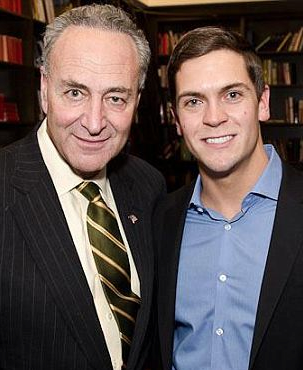
Chuck and Sean-- haimish?

Monday the New York State AFL-CIO rolled out its congressional endorsements, It endorsed all the Democrats-- almost. Steve Israel's DCCC failed to recruit candidates against Chris Collins (in Kathy Hochul's old suburban Buffalo district), Richard Hanna in the swing district he took from Michael Acuri in 2010, and, of course, against Israel's crony Peter King on Long Island. The AFL-CIO ignored Democrats Pat Maher in the Long Island district, ignored Jim O'Connell's race against Collins and actually endorsed Hanna where no Democrat or WFP candidate is even running. The AFL-CIO did endorse every other Democratic challenger in the state-- except multimillionaire Sean Eldridge, who's running against the House's only real moderate Republican, Chris Gibson (NY-19). So, endorsements for vile corporatists Kathleen Rice (NY-04) and Domenic Recchia (NY-11), for Aaron Woolf (NY-21) and Martha Robertson (NY-23) but nothing for Eldridge. Looks like AFL-CIO endorsements-- unlike DCCC backing-- aren't for sale.

It could have been worse. The New York State United Teachers (NYSUT), which refused to endorse Andrew Cuomo, not only didn't endorse Eldridge… they endorsed Gibson! And on top of that, the latest polling shows Eldridge-- in a 50/50 D+1 district-- unable to even break 30%. Worse yet, the Environmental Defense Fund’s Action PAC today launched a $230,000 ad buy in favor of Gibson:


As of the June 30 FEC reporting deadline Gibson had raised $2,261,120 and had $1,910,550 in cash on hand. Eldridge had raised $3,069,179 and had $2,106,220 on hand. But $1,340,000 came right out of Eldridge's personal bank account and most of the rest came from his wealthy friends in Manhattan, where he lives. The U.S. Chamber of Commerce has already spent $350,000 bolstering Gibson and the DCCC's response? $9,136 (mostly in the form of bagels and lox Fed-Exed to Eldridge staffers weekly by Steve Israel).

The irony of all this, is that left to his own devises, Eldridge probably isn't a bad candidate. He may be too young and self-entitled but I hear he's got some progressive instincts. The problem is that in an effort to cement backing from the DCCC and Blue Dog Steve Israel, he's repressed those progressive instincts and come out like a tepid centrist. Multimillionaire tepid centrists may give Israel a woody but that isn't what inspires Democratic voters-- ergo the 29% support even after spending all that money (although, admittedly most of it was wasted on really horrible consultants the DCCC pushed on poor Sean like Jeffrey Pollock at the Global Strategy Group and the maker of insipid SKDKnickerbocker ads, Andrew Shipley). And to add insult to injury, even after Eldridge twisted himself into a pretzel to fit into Israel's mystery meat loser model, the DCCC support for him… doesn't go beyond the bagels and cream cheese.

The DCCC didn't even include Eldridge on their Red-to-Blue list until Eldridge threatened that he and his husband would stop financing Democrats and when Israel announced which districts the DCCC would be investing all those tens of millions of dollars they trick the Democratic grassroots to give them, NY-19 was not on the list. Israel is willing to throw away millions on absurd races in Michigan and Arkansas-- and is pumping money into NY races to help Recchia, Woolf and Robertson (all in tougher districts than Eldridge's) while studiously ignoring NY-19. Their House Majority PAC has taken the same stance: No money for NY-19.

Advice to Eldridge: forget Steve Israel and his failed Blue Dog stratagems. Think about how Elizabeth Warren displaced Republican Scott Brown in Massachusetts, how Alan Grayson beat GOP incumbent Ric Keller (in an R+3 district) and how Matt Cartwright beat Hoyer/Israel-backed Blue Dog Tim Holden last cycle in a Pennsylvania not very far from where you are. Hint: none of them bought into the mystery meat/GOP-light precepts of the Beltway Democrats that are wrecking your campaign. Candidates shall not live on bagels alone.

Eldridge's consultant-heavy campaign can do a lot better than this tepid, uninspiring, cookie-cutter, DCCC-grade crap he released yesterday, an ad that will neither inspire Democrats to go to the polls nor change the mind of a single independent or Republican-- just a total waste of money for everyone but the consultants who are getting rich while leading Eldridge down the garden path:


Labels: , , , , , ,

Tuesday, July 01, 2014

Bagels And Cream Cheese And A Million Of His Own Dollars Won't Win Sean Eldridge A Seat In Congress

>

Chris, Nancy, Sean

Poor Sean Eldridge! Well, not really… he's very rich. He married Chris Hughes, the former Harvard roommate of Mark Zuckerberg and the ultimate example of being in the right place at the right time. When he left Facebook he became started MyBarackObama.com and was lauded as The Kid Who Made Obama President; How Facebook Cofounder Chris Hughes Unleashed Barack's Base-- and Changed Politics and Marketing Forever. How do you top that? He married Sean and they started hunting for some congressional seat Sean could run in (skipping last cycle and picking NY-19 this time; bad timing)-- and he bought the New Republic, once an esteemed progressive magazine. He gives a fortune to the DCCC and other Democratic Party committees and his net worth is estimated to be between $800 million and a billion.

Sean was political director of Freedom to Marry. And somehow he turned himself into a DCCC "mystery meat" candidate. Friends have told me he has a progressive heart (or a progressive soul; I can't remember). But he adheres strictly to Steve Israel's diktat that his candidates keep their opinions to themselves. Other than gay marriage, no one knows what Sean stands for and no one has any solid reason to bother voting for him other than he's better than Chris Gibson, the Republican incumbent (who happens to be the least right-wing Republican in Congress). Gibson, in fact, regularly votes more progressively than around 10-12 Democrats, half of them being financed by the DCCC. Here are tProgressivePunch crucial vote scores for the current session of Democrats the DCCC has on financial life-support and who all vote more conservatively than Gibson:
Chris Gibson (R-NY) 39.69
Sean Patrick Maloney (New Dem-NY) 39.18
Collin Peterson (Blue Dog-MN) 36.6
Kyrsten Sinema (Blue Dog-AZ) 33.87
Pete Gallego (Blue Dog-TX) 32.46
Ron Barber (Blue Dog-AZ) 29.03
John Barrow (Blue Dog-GA) 26.29
Sean Patrick Maloney… he's the Wall Street-oriented schnook who does his call time from a hedge fund office and who grabbed poor Sean's first choice for a district, the one right next door to NY-19-- and closer to where Sean and Hughes live in Soho. Gibson actually votes better than Maloney. Is there any reason to think Sean would be any better? Any worse? Who knows? That's what buying mystery meat entails.

So why "poor Sean?" Things aren't unfolding that well for him. DCCC Chairman Steve Israel, eager to keep Hughes' money flowing, has played him for a fool, not even giving him a coveted Red-to-Blue slot until Sean went bonkers on him. "Israel doesn't help at all," one heartbroken staffer told me. "All he does for this campaign is ship us bagels and cream cheese every week. We'd all rather have local donuts. He can shove his crappy bagels up his ass with the cream cheese." Apparently he isn't the only staffer who doesn't see things going well. Despite reporting $2,448,887 (of which $965,000 was self-funded) to Gibson's $1,799,331, the pundits still see this as a race Sean has little chance to win. Obama took the D+1 district in 2008 with 53% and in 2012 with 52% but Cook rates it a "Lean GOP" with a Gibson +4 and Rothenberg called it "Tilt GOP" with a Gibson +2. So, last Friday Sean fired Michael Reid, his campaign manager.

I haven't even been able to get Sean to return a phone call to tell me where he stands on Chained CPI or the Keystone XL pipeline so I'm not going to even try to find out why he fired Reid, who was successful last cycle winning a tough race for Lois Frankel against Adam Hasner in Florida. What I do know is that poor Sean is interviewing candidates who have just lost other races around the country. One of the campaign managers was so dreadful that everyone else involved with the campaign blamed him for the loss and when I asked the candidate if there was any chance he had been a plant from the opponent, the reply was that he was a plant from the DCCC, even worse. If Sean calls me back to talk issues, if he asks nicely I'll tell him which candidate he's interviewing is that one and which candidate is a drunken incompetent.

Labels: , , , ,

Wednesday, May 07, 2014

Will The DCCC Lose Another Blue District In Central California? Meet Amanda Renteria

>

Amanda Renteria

A few months ago, an old friend was raving to me about a woman he had worked with at the Treasury Department, Amanda Renteria. She's running for the Central Valley seat currently occupied by mainstream conservative Republican David Valadao. CA-21 stretches from just south and west of Fresno, down through Hanford and Delano to Bakersfield, which it shares with Kevin McCarthy's 23rd CD. McCarthy's deep red district has a PVI of R+16 and Romney beat Obama there 62-36%. Valadao has a more problematic district with a D+2 PVI. It's one of the bluest districts in the country with a Republican incumbent, thanks, almost completely to legendary DCCC incompetence. While Obama was beating Romney with a convincing 55-44% win, the DCCC had managed to botch the primary and wind up with a fatally flawed candidate, John Hernandez, who lost to Valadao 55,130 (59%) to 38,402 (41%). Although Hernandez managed to scrape a victory in Kern County (Bakersfield), he lost in the 3 other counties-- Fresno, Kings and Tulare-- by very wide margins. Valadao crushed him in Kings County 70-30%, sealing the election.

In reporting on the launch of the Latino Voter Project this week, the New York Times took a little look at the Renteria race against Valadao this cycle. Despite my friend's rave reviews of Renteria, we haven't gotten into the race, primarily because she was coming off as just another Steve Israel "mystery meat" candidate who didn't seem to be offering any compelling reason for voters to replace their incumbent with a first-time candidate. Her typical DCCC no-content website offers a nice biographical sketch-- and no issue positions. The Times piece, alas, doesn't fill in any of the blanks. Like the website, the sadly hackish and utterly superficial reporting (and by a veteran reporter no less!) is mostly about Renteria's inspiring life story.
“Ya es tiempo-- you have a voice,” Amanda Renteria, a Democratic candidate for Congress, declared one recent Saturday morning at a park in this little city southeast of Fresno. There was no need to translate the Spanish. The park was festooned with “Amanda Renteria para el Congreso” signs.

As she told her local-girl-makes-good story-- daughter of onetime migrant fruit pickers, degrees from Stanford and Harvard, a job in Washington as a senator’s chief of staff-- men in ranchero hats smiled with pride. Women choked back tears. Candidates like her, they said, do not come around often in places like this.

“We have been waiting, waiting,” said Diana Rodriquez, a retired teacher whose parents also worked the fields here in the agriculturally rich Central Valley, in a largely Hispanic congressional district. “We helped Obama win the election, and they still see us to be passed over. This is going to help the overall national cause-- respect for our community.”

But if Ms. Renteria represents the hopes of her party and her people, she also reflects Latino Democrats’ deep angst. Seven out of 10 Hispanic voters supported President Obama in 2012, but Latinos-- the nation’s most rapidly growing minority-- are greatly underrepresented in public office.

“I have been troubled by a lack of Latino bench for the future,” said Bill Richardson, the Democratic former governor of New Mexico. He said Democrats take Latinos for granted, and have not been “as aggressive as Republicans in attracting and encouraging Latino candidates.”

On Monday, Cinco de Mayo, a new nonpartisan organization, the Latino Victory Project, will announce an effort to promote Hispanic political engagement, in part by grooming Latino candidates; its political arm will endorse eight-- all Democrats, including Ms. Renteria.

...Democrats insist they are investing, in candidates like Leticia Van de Putte and Lucy Flores, running for lieutenant governorships in Texas and Nevada, along with Ms. Renteria. Ms. Renteria, 39, was the first Latina Senate chief of staff, to Senator Debbie Stabenow, Democrat of Michigan. She moved to Sanger in August with her husband and two young sons, in a bid to unseat Representative David Valadao, a well-liked Republican of Portuguese descent.

“I feel like I’ve spent a lot of my life being one of the few,” Ms. Renteria said. “I see it as my responsibility to bridge two different worlds.”

The race is a priority for Democrats in what could be a bleak year. Democratic donors and groups like Emily’s List have flocked to Ms. Renteria, helping her raise $630,000 so far, though Mr. Valadao has twice that.

Now, Ms. Renteria will get a boost from the Latino Victory Project’s political action committee, which intends to run television ads and a get-out-the-vote effort in key districts.

Co-founded by two top Obama fund-raisers-- Henry R. Muñoz III, the finance chairman of the Democratic National Committee, and Eva Longoria, the actress-- the project will “use our numbers, our votes and our dollars” to create “the next generation of leadership,” Mr. Muñoz said.

Its PAC is open to backing Republicans, as long as they support immigration reform, and is looking far beyond 2014.

Here in Sanger, though, Ms. Renteria’s race for Congress illustrates the challenges. In 2012, Democrats ran a weak candidate, bungling an opportunity to win this politically diverse district, one of the poorest in the nation, where Democrats outregister Republicans by 14 percentage points and Hispanics make up 55 percent of the voting age population. Ms. Renteria’s challenge now is to get them to the polls.

The cultural dynamics are complex. Mr. Valadao, 37, who calls Ms. Renteria “an outsider from Washington,” has deep roots in the conservative community of Hanford, where his parents, who emigrated from the Azores, founded their family farm. Despite his Spanish-sounding surname (he also speaks the language), the race typifies the region’s class divide, said Darry Sragow, a longtime Democratic strategist in California.

“There’s always been a real class dichotomy between the Latino farm workers and the farmers,” Mr. Sragow said. “We’re talking Steinbeck, a very deep divide.”

Grow Elect, a group dedicated to electing Hispanic Republicans in California, has embraced Mr. Valadao. “We’re starting at the grass-roots level,” said its president, Ruben Barrales, “because you can’t depend on superstars.”

Immigration is, not surprisingly, a pressing issue, along with jobs. Mr. Valadao is among the handful of Republican House members who favor a path to citizenship for undocumented immigrants, though Ms. Renteria accuses him of not pushing his party leaders to act.

The congressman says he believes his conservative politics on social issues like abortion and also on taxes, appeal to Hispanic voters, especially small-business owners who “work really hard for their money” and “don’t want to see a bunch of government guys regulating them.”

But analysts say the race will be close, and Ms. Renteria is working her way into Latino circles. At a Mexican-American dinner dance in Hanford, Mr. Valadao’s hometown, she ran into the parents of a Stanford classmate, and was invited by a local woman for a midnight meal of menudo, a traditional Mexican soup.

Earlier in the day in Sanger, the city’s former mayor, José Villarreal, introduced her. He said he had “a lot of questions” when she moved to town, but was won over. “She is a daughter of the Valley,” he told the crowd. “She is one of us.”
Renteria can win this race by taking strong progressive stands and drawing a powerful distinction between herself and the conservative Valadao. But the DCCC and their incompetent consultants tell her not to and she won't and she will lose. Pity.


Labels: , , ,

FL-02-- A Teabagger vs A Mystery Meat Blue Dog

>

2 Grahams

Exactly a month over a year ago, a friend of mine suggested I get to know Bob Graham's daughter, Gwen, just as she was announcing that she would run for the Tallahassee-based House seat (FL-02) occupied by undertaker and teabagger Steve Southerland. That first encounter with another quintessential Steve Israel "mystery meat" recruit didn't go well.

I caught up with her at a supermarket checkout line a few hours after she announced her candidacy and spoke to her further while she was driving southwest towards Panama City. Well spoken and idealistic she didn't want to go beyond generalities she had down by rote, like “I want to be a different type of representative to find a common ground with Democrats and Republicans." When I asked her about specifics like the Chained CPI and marriage equality she abruptly told me her campaign manager said it was time for her to take another call. I knew right then and there she would be Steve Israel's favorite candidate ever-- even before she was recruited by the Blue Dogs, which came soon after.

Like another conservative-leaning Democrat, Michelle Nunn, next door in Georgia, Graham's top asset is her father's name. But there's even more conservatives like than just the name ID. Remember, as you read this, "moderate" is what they call "conservative" in this kind of reporting.
Graham and Nunn are going beyond the typical advantages of name ID and fundraising connections. They explicitly hold up their fathers as examples of what kind of elected officials they would be: old-style moderate Southerners, the kind rendered largely extinct on Capitol Hill.

“I often hear from people that they miss the days in which they felt like they had someone who was a statesman and reached across the aisle,” Michelle Nunn told The Associated Press at a campaign stop in Shellman, Georgia. “I’m both lucky to have that connection and to have my own experiences that demonstrate my capacity to lead in that way.”

Graham, who is following her father’s campaign tradition of spending days working alongside constituents, said, “I want to put aside the bickering. It should be public service, not politics.”

The approach offers Democrats a ray of hope in a midterm congressional election that could continue the party’s slide in the South, where President Barack Obama and national figures such as U.S. House Democratic leader Nancy Pelosi of California are broadly unpopular.

Republicans aim to unseat Democratic senators in Arkansas, Louisiana and North Carolina on their way to reclaiming a Senate majority. Voter defections and racial polarization are already pronounced in the U.S. House, where U.S. Rep. John Barrow of Georgia is the sole white Democrat from the Deep South states that stretch from South Carolina to Louisiana.

Graham, 51, wants to oust U.S. Rep. Steve Southerland, who won Florida’s 2nd District in Republicans’ 2010 midterm House sweep. Nunn, 47, is trying to succeed retiring U.S. Sen. Saxby Chambliss, R-Ga.

...Nunn and Graham call themselves independent voices, promise to tackle national debt and say Obama’s health care overhaul needs improvement. Graham goes further, saying Obama should have pursued incremental changes instead of a sweeping law.

Graham was the chief labor negotiator for the Leon County School District. Nunn spent 25 years running not-for-profit volunteer organizations, culminating as CEO of former President George H.W. Bush’s Points of Light Foundation.

Nunn mentioned Bush, a Republican, in one television spot; her father appears in another. “My dad has been reminding me throughout the campaign that he never passed any legislation that didn’t have bipartisan support,” she told AP.

For Graham, the lessons come from spending work days with voters, something her father once did. She’s worked the cash register in a food truck, hung drywall at a construction site, chased chickens and trimmed goat hoofs on a boutique farm. In one town, she wore a bulletproof vest for a day-in-the-life of a police officer.

“To be able to spend real time with people … gives you a connection that I think sadly is missing in Washington today,” Graham said, noting that the work days made her father “a better leader.”

Bob Graham championed traditional liberal causes such as public education and environmental protection but cracked down on drug crimes and revived capital punishment, earning nicknames like “Bloody Bob” and “Governor Death.” In his last Senate race in 1998, he carried 63 of Florida’s 67 counties.

...The electoral dynamics in both campaigns explain Democrats’ strategy in emphasizing that centrism.

The Florida Panhandle is Republican territory, but the 2nd Congressional District, which includes heavily Democratic Leon County, gave Obama 46.5 percent and 47.1 percent in his two presidential victories. Southerland won by a comfortable-but-competitive 5 percentage points in 2012.

In Georgia, Republicans hold every statewide executive office, and Democrats haven’t won a U.S. Senate race since 1996, when Max Cleland captured Sam Nunn’s seat, only to lose to Chambliss in 2002. Yet Chambliss needed a general election runoff to win in 2008, and Obama notched 47 percent and 45.5 percent statewide.

While hoping to maximize support from black voters and urban whites, Graham and Nunn look to convert just enough white voters outside the cities, closing the gap with old “Reagan Democrats” who could just as easily be called “Bob Graham Republicans” or “Sam Nunn Republicans.”

Gary Harrell, a surveying engineer near Albany, Ga., fits the bill.

Harrell said he hasn’t voted for Democrats at the federal level since Sam Nunn and Bill Clinton. Now he’s backing Nunn’s daughter. “I’m just really struggling with this administration,” he said of Obama, “but not necessarily all Democrats-- and I was a huge fan of her father.”
Did I miss something or did the AP leave out every single issue a normal reporter would ask a candidate for political office? After reading it you can probably surmise where Graham would be on various issues-- and you might be right or you might be wrong. The Democrats advising her want it that way. They do not back Democratic positions themselves and do not want to defend them and just hope 51% of the voters won't notice and will just vote for their pathetic mystery meat candidate because of who her father was. Sick!


Labels: , , , ,

Tuesday, April 08, 2014

Politico's Alex Isenstadt Gets Slammed In The Face By DCCC Mystery Meat

>


Poor Sean Eldridge is getting blamed for Steve Israel's "Mystery Meat Strategy." He and his husband, Chris Hughes, have contributed so much money to Steve Israel's corrupt enterprise that, surely, he deserves better. First Israel downgraded him to a mere "Emerging Race," a bad signal to institutional donors, and now he's left Sean to rot in the hands of the high-priced, cynical and incompetent consultants who will rob him blind and leave him with… at best, a lesson learned.

When the Democrats sift through the ashes of their fake campaign to take back the House in November, I bet no one will bring up the cornerstone of Steve Israel's absurd "strategy," his "mystery meat" tactics. Israel has ordered his unbelievably bad roster of fifth rate candidates to keep their mouths shut about issues and to avoid serious reporters who might ask them substantive questions. Last month we saw Israel's horrible recruit to run against Rodney Davis in IL-13, Ann Callis, lose all the newspaper endorsements in the area by refusing to sit down for an interview with any of them. This is becoming standard operating procedure for the Steve Israel zombies. Real candidates seek out the media and push their issues and positions, trying to win over voters. Steve Israel manufactured shills hide from the media, put up asinine websites with no issues and behave the way poor Sean behaved towards Alex Isenstadt. Watch the video up top.

Back to IL-13 for a moment, where Republican Rodney Davis is probably now a lock for reelection, the Israel candidate won her primary but not before the Chicago Tribune and the State Journal-Register exposed the DCCC strategy:
When political candidates agree to sit with the State Journal-Register's editorial board ahead of an election and explain where they stand on issues important to voters, it's a unique opportunity for them to do just that-- explain where they stand.

When political candidates agree to sit with The State Journal-Register's editorial board ahead of an election and explain where they stand on issues important to voters, it's a unique opportunity for them to do just that-- explain where they stand.
The Chicago Tribune was even more explicit about Callis'-- and the mystery meat strategy's-- shortcomings. As part of their endorsement of her Democratic opponent, George Gollin, they said that "in the Democratic primary… Sen. Dick Durbin's chosen candidate is carefully insulated from anyone who might ask her a tough question. Former Madison County chief judge Ann Callis sticks to safe talking points, occasionally name-checking Durbin. Her answers to our survey are carefully scripted, heavy on promises to protect seniors and middle-class families without explaining what she'd actually do. She would not agree to be interviewed by the Tribune." The conservative-leaning newspaper went on to say "Our pick is George Gollin… We disagree with many of his positions, but at least we know where he stands."


What reporters haven't figured out yet is that the Callis and Eldridge silliness is a national phenomenon. Take CA-31 as another example, the solid blue Inland Empire district Israel botched in 2012, allowing far right Arkansas neo-Confederate multimillionaire, Gary Miller, to sneak into office. Israel doubled down this year by recruiting the same out-of-touch, corrupt, lame-brained candidate who lost in 2012, Pete Aguilar. Before I knew that Aguilar was out-of-touch, corrupt, and lame-brained, I called his office to ask him about his campaign, since there was nothing useful on his website. He wouldn't come to the phone but the guy who answered very politely said he would try helping answer my questions. Except he didn't know any answers to any questions-- even the most basic, non-invasive, uncontroversial ones. I figured he was an intern when he told me the DCCC hadn't told them what their positions are supposed to be yet but that they expected them to within a week and that they would call me back. I was somewhat flabbergasted that even an intern would be so lame as to admit that and made a note to myself to mention it to Aguilar when he called back. He never did of course… and the intern turned out to be-- unless there are two Boris' in this pathetic campaign-- Boris Medzhibovsky, the imported DCCC campaign manager. No reporter has been able to get Aguilar, who is frequently… high, to speak about the huge blunder he made in backing Chained CPI, a very conservative position that steals benefits from the Social Security cost of living adjustment and isn't popular in hard-pressed San Bernardino County, especially not among Democratic voters Aguilar needs to impress. Maybe Alex Isenstadt should try interviewing Pete too!

Standing in sharp contrast to the tongue-tied loser candidates Israel has assembled, are the candidates listed by Alternet today-- Key Progressive Politicians To Watch In the 2014 Elections. Every single one of them, though they may have to battle moron consultants trained in mystery-meatism by the DCCC, has taken on a leadership role in his or her community about the tough issues that distinguish a progressive from a conservative. These are not "ex"-Blue Dog Steve Israel's dreadful array of Blue Dogs and New Dems… these are candidates eager to seek out the media and make the case for a progressive agenda. You can find the best of the best House candidates here and the best of the best Senate candidates here. The DCCC isn't helping these men and women win in November, just like they never helped Alan Grayson, Donna Edwards, Raul Grijalva, Matt Cartwright or any good progressives who needed it. So… it's up to us.

UPDATE: Isenstadt Strikes Back

Earlier today Isenstadt posted his report, Chasing Sean Eldridge. It's another is a series of devastating reports about an ambitious, fabulously wealthy, completely unprepared 27 year old outsider thirsting for political power.
Wealthy people who run for public office typically stick to the same basic blueprint: Plow millions of their personal fortunes into the campaign. Hire big-name consultants. Flood the TV airwaves with ads.

Sean Eldridge is making all of that look quaint. The 27-year-old husband of Facebook co-founder Chris Hughes has turned his congressional campaign for New York’s 19th District into a multimillion-dollar start-up-- a gambit that veteran election watchers say is as unique as it is brazen.

It has unfolded in rapid-fire sequence. After Eldridge decided he wanted to run for office, he and Hughes in 2011 bought the first of two luxurious homes in the Hudson Valley region. Soon after, Eldridge set up a venture capital firm, Hudson River Ventures, that has provided millions in loans and equity lines to local companies. And now the first-time candidate, who’s running his first business, is touting the jobs he’s created in the blue-collar district.

“I know firsthand what it takes to support small businesses and create good jobs,” reads one pamphlet his campaign is plastering throughout the area.

Like no other 2014 candidate, Eldridge is testing the limits of dollars and cents to secure a seat in the House of Representatives. The Democrat is tapping Hughes’s vast wealth-- estimated at $700 million-- to build an elaborate campaign apparatus in a district where he remains a stranger to many. In addition to his firm’s investments, Eldridge has spent more than $700,000 on his campaign, and that figure is sure to rise exponentially because he’s promised to match each contribution he receives, dollar for dollar.

His efforts are all the more striking in contrast with incumbent GOP Rep. Chris Gibson, a 49-year-old decorated war veteran and former college professor who lives in the same middle-class neighborhood where he grew up. Gibson’s financial disclosure report filed with the House lists a savings account of $100,000 to $250,000, and the Center for Responsive Politics ranks his personal wealth in the bottom fifth of House members.

Gibson does little to hide his disdain for Eldridge, whom he calls a “young man with virtually no experience.” The district, encompassing a vast swath of the northern Hudson Valley and Catskills, is one of the most evenly divided in the country. Gibson won there in 2010 on the strength of the Republican wave and secured reelection in 2012 even as President Barack Obama carried the district by 6 percentage points.

“This is about him and his political aspirations, and I think that’s going to be a problem for him. He married well, he married into money,” Gibson said of Eldridge. “But there are some things money can’t buy.”

It’s difficult to size up the person behind the polished image Eldridge and his campaign are projecting to voters. He’s been running for more than half a year but remains mostly an enigma.

Congressional challengers typically seek maximum media exposure; Eldridge allows few chance encounters with the media. His campaign frequently posts pictures on his Facebook page of the candidate out and about in the district, but local reporters say they’re usually not made aware of his public schedule ahead of time. He declined to be interviewed by Politico, and the door to his campaign headquarters in Kingston was locked on a recent visit. No one answered a call on an intercom.

A spokesman provided a statement from Eldridge that said, “Chris and I have been very fortunate in our lives, and we’ve benefited from those who took a chance on us. The Hudson Valley is our home, and we’re proud to be investing in entrepreneurship in our community.”

Even people who have spent time with the candidate aren’t sure what to make of him.

A few weeks after his September campaign launch, Eldridge sat for an interview with Alan Chartock, an influential liberal radio host in upstate New York. They talked for almost 30 minutes, discussing Eldridge’s views on the federal shutdown, environmental policy and money in politics.

“If you look at what we’ve seen in Washington recently, with more of this brinkmanship, more of the games and party politics that are really hurting our economy and hurting middle-class families and not helping anyone. I’m frustrated. I know we can be doing better than how we’re doing now,” Eldridge said in the interview.

Chartock came away without any real sense of the candidate.

Eldridge sounded like “what a young person thinks a politician should sound like,” the radio host said in an interview. “He’s right on all the issues, but what I think people are looking for is a person. He’s extremely bright, has all the assets that you need to run. But it’s cookie cutter.”

Eldridge employs a team of prominent political consultants-- including media firm SKDKnickerbocker, polling outfit Global Strategy Group and veteran party operative Anne Lewis — who carefully tend to his image. Through the end of last year, he paid the three entities a total of $241,000, campaign records show.

…For a while, Eldridge had his eye on another congressional seat. In 2011, he and Hughes, who had been living together in a SoHo loft, purchased a $5 million estate in Garrison, N.Y, positioning Eldridge to run in the neighboring 18th District. But in November 2012 that district’s Republican congresswoman, Nan Hayworth, lost reelection to a Democrat. So Eldridge looked north to the 19th District, where Gibson had just won a second term.

In Jan. 2013, the couple paid $1.9 million in cash for a 3,000-square-foot home in Shokan, N.Y., an area just outside Woodstock in Gibson’s district. “Sleek and sexy with walls of glass to showcase the awe-inspiring views of the Catskill Mountains, Ashokan Reservoir, and beyond,” the buyers were promised.

The home is shielded from public view; a “Private Property” sign warns passersby. Eldridge’s advisers won’t say how much time he spends in the Shokan house as opposed to the couple’s other two residences.

...Eldridge’s team denies that the venture capital firm and campaign are coordinated. But the overlap is undeniable.

Michael Oates, a New York businessman and CEO of the firm, is Eldridge’s campaign treasurer. SKDKnickerbocker is working for Eldridge’s campaign and doing public relations work for the investment group at the same time. Some press releases for Hudson River Ventures lavish Eldridge with praise.

Several campaign finance experts said the use of a venture capital firm to advance a political campaign was a novel tactic. They say it wouldn’t be illegal unless Eldridge was using campaign dollars to fund Hudson River Ventures, which aides say he isn’t doing.

“Candidates who employ people in the districts they’re running in enjoy some advantages. What’s so unusual about this situation is that he’s being so transparent about it,” said campaign finance expert Paul Herrnson, executive director of the University of Connecticut’s Roper Center for Public Opinion Research.

Some locals have been turned off by Eldridge’s sudden arrival on the scene. They suspect he’s using his fortune as a substitute for the hard, tedious work of running for Congress.

As the Democratic mayor of Kingston, the district’s largest city, Shayne Gallo said he expected to hear from Eldridge shortly after he moved into the district. Instead, last June, he received an email from an Eldridge staffer, asking for an endorsement. Gallo didn’t respond to the message.

“I was extremely surprised, and I was offended,” he said. “I would think it would be prudent … if not politically polite and respectful, to reach out to those who’ve gone through this process and who are local yokels and who are stakeholders in the community you hope to represent.”

“Considering that someone isn’t from the area, wasn’t born or raised in the district, doesn’t have an established record in public or private service, nor any notable achievements in our local or regional economy … I’m very perplexed by that,” the mayor said.

Gallo said the Eldridge campaign had recently reached out to him and that a meeting between him and the candidate would be taking place soon.

Others say they’re simply puzzled by what Eldridge is doing.

…Eldridge, for his part, is pitching himself as a middle-of-the-road Democrat. In interviews with local reporters, he’s come out in favor of comprehensive immigration reform while stressing the need for secure borders. He backs Second Amendment rights, but with stricter background checks.

And in an irony his GOP adversaries have seized on, Eldridge has made campaign-finance reform a central plank of his bid, decrying what he calls the corrupting influence of corporate money in politics.

“We will certainly do what we need to do to be competitive and win next year,” Eldridge said in a 2013 radio interview. “But at the same time, when I am in Congress I will be a loud and consistent advocate for campaign-finance reform.”

He repeated that position-- and, in his detractors’ view, betrayed his obliviousness-- last week when the Supreme Court struck down aggregate caps on campaign contributions. Eldridge blasted the ruling as “a disappointing step backwards for our democracy.

“Right now the voices of everyday New Yorkers are being drowned out by the big money and corporate interests in our politics,” he said in a statement. “And today’s ruling only makes that problem worse.”

Labels: , , , , , ,

Monday, March 24, 2014

Ventura County Voters Are Sick And Tired Of Corrupt Careerist And Extremist Tony Strickland… So He's Moving

>


The Steve Israel "Mystery Meat strategy" precludes DCCC recruitment for many state legislators. Israel doesn't want candidates with voting records, and especially not candidates with records of leadership on cutting edge issues. Actvist, effective progressive legislators like Patrick Hope (VA), Pat Murphy (IA), Daylin Leach (PA), Ted Lieu (CA)-- hated by Israel bankster buddies for his consumer protection legislation-- are not going to be found on any early DCCC programs. All 4 are running on their records and emphasizing their accomplishments as legislative leaders, the exact opposite of the "Mystery Meat strategy" that has seen newspaper editorial boards push back against Israel's ridiculously secretive recruits.

On the other side of the political spectrum, Republicans are also grappling with the whole voting records dilemma. Because of the effectiveness of the Tea Party and the raging Republican civil war, it is much harder for Republican candidates to hide extremist and obstructionist records, primarily because its increasingly difficult to win GOP primaries without a proven record of extremism and obstructionism. Let's take the hotly contested 3-way race in CA-25 for example. Although the DCCC has finally-- grudgingly-- added progressive Lee Rogers to one of their bogus lists, they have not lifted a finger, or proffered a nickel, to help Rogers overcome the two Republican extremists in the race, Steve Knight and Tony Strickland. Strickland is Buck McKeon's handpicked successor and Knight, the most extreme right legislator in Sacramento, was chosen by local Republicans horrified by the thought of Strickland, an especially corrupt carpetbagger. Both have extensive voting records-- voting records that are out of sync with the moderate suburban district.

Last year, I wrote that Knight's voting record would be ultra-conservative if he represented a backward district in Alabama or Mississippi. In suburban L.A., it's just bizarre and a throwback to another century. Widely considered a shill for the NRA and an automaton for the most extreme right-wing proposals that ever come up in Sacramento, Knight was one of only 11 senators who voted against increasing the minimum wage and, despite representing a district with a huge Hispanic population, he was one of only 8 senators who voted against drivers licenses for undocumented immigrants. When the Governor decided to expand Medicaid in line with the Affordable Care Act, only 7 die-hard right-wingers opposed it, Knight being one of them. He was also one of only 8 senators to fully back unregulated fracking in earthquake zones in California. He is vehemently anti-Choice and anti-gay and voted against every piece of legislation promoting equality that has ever come before him. For example, last May he was one of only 9 senators to vote against a bipartisan bill that prohibits tax-exempt status for organizations that discriminate against the LGBT community and he also one one of only seven sociopaths who opposed an anti-bullying bill that passed the Senate with huge bipartisan support. One legislator told me that Knight isn't a bad guy on a personal level but that he's "an inflexible ideologue… probably the single least effective member of the state legislature… Sure, Strickland is no prize but Knight makes even him look almost good!"

But how "almost good" does even Knight make Strickland actually look? A few years ago, long before this race, Joan Trossman Bien took a deep dive into the wreck that Tony Strickland already was for the Ventura County Reporter, Meet the Stricklands. "Tony and Audra Strickland," she writes, "became well-known in Ventura County in 1998. That’s when then-newcomer Tony was elected to the state Assembly representing the 37th District." The two of them are the quintessential careerist politicos, running for office after office and have since become "a permanent fixture on Ventura County’s political landscape," interesting, since he's now trying to run in a Los Angeles County district.
The Stricklands are no strangers to controversy, coming under public scrutiny in recent years by the LA Times and the state Fair Political Practices Commission (FPPC) for their creation and funding of separate political committees, as well as their unusual practice of paying each other as consultants from contributions to their various individual campaigns for public office.

In fact, on March 30 of this year, the FPPC fined Tony Strickland $3,000 for violating state law in 2008 with a mass mailer attack on then-opponent Hannah-Beth Jackson that failed to disclose that it came from his campaign. Tony’s campaign said it was a mistake. However, the FPPC concluded that Strickland is an experienced politician, and failure to disclose the source of the mailer was “at worst intentional and at best negligent.”

…Tony was born in 1970 at Fort Ord when his father was in the Army. He received his bachelor’s degree in political science from Whittier College in Orange County then became a legislative aide to another Republican career politician, state Sen. Tom McClintock of Granite Bay.

Audra also received her BA in political science, only at UC Irvine. And she, too, became a legislative aide to a number of conservative state lawmakers. Not surprisingly, Tony and Audra met at a state Republican Convention in Orange County, and they were married at the Nixon Library in Yorba Linda in 1998. Audra spent one year teaching history at a private Christian school. Now married 12 years, when asked by a reporter what her best relationship advice would be, Audra replied, “Ensuring that God is part of our marriage.”

Tony is currently raising money in the form of campaign contributions through one of his many campaign committees, Strickland Senate 2012, Re-Elect Tony. This committee had total cash on hand, as of March 17, of more than $115,600. Tony also has another active committee called Strickland for Controller 2010. As of the same date, records showed the committee was holding more than $24,000.

Tony had other open committees when he started these two committees. Strickland for Controller was activated for his failed 2006 campaign. This committee was not closed until March 17, 2010, and listed nearly 3,000 contributions.

Strickland for Senate, which was opened to collect contributions for his 2008 Senate campaign, is still active and lists nearly 2,000 contributions. All of the open committees can continue to accept contributions even after the election in order to pay the net debt. If there is a surplus, it can be carried over to another committee that has been created for the next election.

Incumbent District 2 County Supervisor Linda Parks said she is confused. “[Tony] has the controller campaign committee, he’s got the Re-Elect Tony Strickland 2012,” Parks said. “Those are two separate offices. How can he run for both?”

Hannah-Beth Jackson, who lost the state Senate race to Tony in 2008, is now a political consultant. Jackson said that she is concerned about distractions from his present Senate office. “It’s very disappointing that someone would spend millions of dollars to win a senate seat and not even care enough about his constituents to fulfill his commitment to the people of the district who desperately need representation,” Jackson said.

With Audra terming out of the Assembly this year, she initially decided to run for secretary of state, opening a campaign committee called Strickland for Secretary of State 2010, Audra. Then she changed her mind and decided to run for Ventura County Treasurer-Tax Collector and opened a campaign committee called Strickland for Treasurer-Tax Collector 2010. Shortly after Audra announced she was running for treasurer, the Ventura County Board of Supervisors voted 4-1 to mandate certain minimum professional requirements for that office, such as being a certified public accountant or having a college degree in business. Audra did not meet the new standards for the office and was forced to abandoned the campaign.

Then the Ventura County Republican Central Committee announced that if Audra decided to run for county supervisor, they would endorse her candidacy. The seat in Audra’s district, the 4th District, is up for election although it is occupied by Peter Foy, another right-wing conservative. Instead of challenging the incumbent Foy, Audra chose to pursue the Supervisor office for the 2nd District, the seat occupied by incumbent Linda Parks. In order to qualify for the office, a candidate is required to register to vote from a residence within the district no less than 30 days before the filing deadline. Audra rented an apartment in the district and announced her candidacy on Feb. 5. And Audra opened yet another campaign committee called Strickland for Supervisor.

“I think if Audra Strickland is elected she will undo many of the good things we’ve accomplished at the County,” Parks said. “I think Sacramento is broken as a result of divisive politics. Her inability to reach across the aisle and work with her fellow legislators typifies the gridlock in Sacramento that has caused a budget crisis of unprecedented proportions.

The failure of leadership, the partisan nature of her tenure and the special interests that fund her are all unacceptable qualifications for the job of county supervisor.”

Businessman and photographer Larry Janss has deep generational roots in Thousand Oaks and voiced his own concerns over Audra’s candidacy. “Audra is just looking for a job,” he said. “She blows into town, her only line being that she’s serving the people of the area from her experience in the Assembly as a tax-cutter and hard-nosed pro-business Republican. Her voting record in Sacramento doesn’t show anything that she has done of any consequence.”

…Tony is running for state controller, a position with enormous financial responsibilities. According to the secretary of state job description, “The State Controller supervises the fiscal affairs of the state, suggests plans for improvement and management of public revenues, keeps all accounts in which the state is interested, and keeps a separate account for each specific appropriation, showing at all times the balance of the appropriation. The State Controller supervises the state’s fiscal concerns and all claims against it. The State Controller directs the collections of all monies due the state.” The controller oversees a $131 billion state budget and $300 billion in pension funds.

However, Tony and Audra Strickland have fines and violations on financial affairs, both political and personal. Here are some of them.

In October 2003, Sacramento County placed a lien on the Stricklands’ property in Sacramento as a result of delinquent utility charges in the amount of $95.95. In April 2004, a second lien was placed on their property by Sacramento County, also for delinquent utility charges in the amount of $103.88.

In 2004, the Stricklands were three months late in paying their second installment of property taxes for one of their homes in Moorpark. They paid a penalty of $126.86.

In December 1999, Tony Strickland was sued by the secretary of state over failure to report $116,140 in late contributions, a violation of the Political Reform Act of 1974. It resulted in a fine of $6,000.

State Senator Tony Strickland is paid $112,490. Assemblywoman Audra Strickland earns $114,602. Each is eligible for an additional $35,000 a year in tax-free per diem payments along with state-paid vehicle allowance, gasoline and car insurance.

On April 13, 2006, the Los Angeles Times reported that beginning in 2001, Tony Strickland’s anti-tax nonprofit organization California Club For Growth, and Audra Strickland’s consulting firm Golden State Strategies, which was co-owned by their close friend and chief of staff Joel Angeles, had paid each other more than $138,000. The name of Golden State Strategies was changed to 20/20 Innovation, Inc. in 2006. The Stricklands say that Audra sold her interest in Golden State Strategies to Angeles in December 2002. Tony said that Ventura County prosecutors had looked into the payments to each other’s firms and found “no criminal activity.” Tony also said that they had served as paid consultants to each other’s campaigns, adding that it was common for politicians to hire relatives to work on campaigns.

In response, Robert Stern, president of the Center for Governmental Studies in Los Angeles commented that he had “never seen both spouses being paid to work on each other’s campaigns.”

Soon after being fined by the FPPC, Tony put his weight behind SB 739, which bans spouses from being hired and paid for services rendered by their spouse/candidate for a political campaign, precisely what the Stricklands admitted to having practiced for five years, claiming the practice was legal in 2006.  In a press release heralding the importance of the bill, Tony said, “We (politicians) just don’t have a lot of trust, so we need to do whatever we can here in the Legislature to build it back.”

…Both Stricklands have been exposed to Sacramento Republican politics for the past several years. The current collapse of the state’s entire financial foundation has happened during that time.  Ever since the state Constitution was amended to require a two-thirds vote in order to raise taxes, the minority has had control of the budget through its power to prevent a budget from passing. This year, as in numerous previous years, the state is once again hovering on the brink of insolvency.

Yet in a recent press release, Tony opined on the real root of the fiscal disaster. “There’s a reason why we have an ongoing budget problem, and it’s because people are fleeing the state because they’re being over-taxed.”

Cal-Access on the secretary of state’s Web site allows you to view all of the candidates’ reported campaign contributions, donations to others, and expenditures. Major donors, political action committees, political parties and ballot measures are also there. This is where voters can get a much more accurate reading on where special interests are spending their money. It is also a window into the competency and transparency of any one candidate. Warning: Careful inspection of these records is only for the stout-hearted. Sorting through the 14 different campaign committees that the Stricklands have used at various times requires great patience and focus. But the effort can be rewarding.
Political consultant Skelton was posed a hypothetical question about a voter contributing $100 to candidate X and the expectation that the money will be used to pay for that candidate’s campaign.

“Well, that’s a rather naïve assumption, isn’t it?” Skelton said. “When people contribute money, they can expect the candidate to use it to further their political interests. And if that’s contributing to other candidates as a way of building an electoral base, particularly institutions where people are contributing to incumbents who don’t really have a contested race on the horizon. A lot of the time, people want to contribute to an incumbent even though they know the incumbent may be running for some other office and may transfer the money. But they don’t want to get involved in the other race for whatever reason, but the fact that they are contributing to the incumbent’s committee for the office they currently hold gives them plausible deniability.” The contributors can claim they could not have foreseen that the candidate would use the contribution for a different purpose.

Some of the campaign contribution rules are quite complicated. Back in 2000, there was another committee for Tony called Strickland Leadership Fund. According to public records, on October 16, 2000, $25,000 was placed in the Strickland Leadership Fund and was contributed by his Strickland For Assembly fund. A note accompanied this entry: “This check was intended for Assembly was inadvertently dep (sic) in Leadership.”  Still confused on which committee gets which checks, on June 18, 2001, Strickland For Assembly contributed $500 to Strickland Leadership Fund with this note: “Not a contribution. Check deposited in wrong account.” (Secretary of State Web site, Cal-Access, Committees, Strickland Leadership Fund)

According to MAPLight.org, 79 percent of all campaign funds raised by California lawmakers between January 2007 and March 2010 were from out of their districts. That means almost four out of every five dollars did not come from the legislators’ direct constituents.

The same organization revealed the top industries that have contributed to the Stricklands from March 18, 2008, to March 17, 2010.

For Tony, the top five industries were: 1) real estate developers and subdividers, 2) property and casualty insurance, 3) securities, commodities and investments, 4) Native American tribes and governing units, and 5) attorneys and law firms.

For Audra, the top five industries were: 1) property and casualty insurance, 2) accident and health insurance, 3) Native American tribes and governing units, 4) landscaping and excavation services, and 5) real estate developers and subdividers.

“Audra Strickland is notorious for the special interest money she gets from casinos, tobacco, oil and developers,” Parks said. “It is a large amount of money and the sources are unsavory. I hope that voters will see that her smear campaign against me is coming from Exxon, Chevron, Sempra, Pechanga  the building industry, and other special interests. We don’t need that kind of Sacramento politics in Ventura County.”
That kind of dirty right-wing money is now being expertly deployed against Lee Rogers in the Stricklands' latest adopted district. Over the weekend, in the L.A. Daily News, Steve Knight pointed out what everyone in CA-25 knows about his fellow-Republican: "Tony has been running for a couple of seats. That would be my question to him. I was born and raised here and I will not run in another district to be a congressman. We’re doing this to help our community. This is my home, where my family and friends live, where I have lived for the great majority of my life. It is my community and I would hope that anyone who runs would want to help their community."

Steve Israel has no interest in helping a progressive like Rogers win this seat and, at least so far, hasn't spent any DCCC money to help him fight back against Strickland's smear campaign. Do you want to help? You can contribute directly to Lee Rogers' campaign here-- and you can chip in to the Blue America PAC where we have some plans to make sure L.A. County voters know what Ventura County voters already know about Tony Strickland. Here's what Strickland had to say about L.A. when he was still running in Ventura County. I bet he won't be running this ad again:


Labels: , , ,

Saturday, March 15, 2014

Will Steve Israel Manage To Doom Democratic Hopes In IL-13 With Another Of His Mystery Meat Candidates?

>


Tuesday is primary day in Illinois and progressive George Gollin's insurgent campaign in IL-13 won two big endorsements yesterday. Early in the morning the biggest local paper, the Champaign News-Gazette came in for him, following the lead of the other two most read newspapers in the district, the Chicago Tribune and Springfield's State Journal-Register. Each of them has included negative comments about Steve Israel's putrid "mystery meat" candidate, Ann Callis, and the DCCC's strategy of all platitudes all the time, while avoiding real issues that voters might be interested in. A couple of hours later, Orlando Congressman Alan Grayson also endorsed Gollin and urged his supporters to contribute to Gollin's grassroots campaign. First, the News-Gazette:
Democratic leaders like U.S. Sen. Richard Durbin believe-- correctly-- that they missed a great chance in 2012 to pick up a U.S. House seat from the state's 13th Congressional District.

Determined to correct that mistake this year, they've painted a bulls-eye on the back of Republican Rep. Rodney Davis and focused all their efforts on defeating the first-term incumbent. Davis, who barely eked out a win over Democrat David Gill, is certainly vulnerable. But the key for Democrats to defeat him is to find the right challenger.

Just as they did in 2012, party leaders have focused on an individual they believe can win, retired Madison County judge Ann Callis, and anointed her as their choice. But just as they did in 2012, they failed to clear the field of party challengers.

In 2012, Gill defeated the establishment's choice in the primary election. This year, two local Democrats, University of Illinois physics Professor Gollin and university policy analyst David Green, hope to knock off Callis in the March 18 Democratic primary.

Of the three Democratic candidates, Gollin is best suited to represent his party in the fall election. A physicist by profession, he has the intelligence to understand complex issues. Now a politician by choice, Gollin has shown that he's both comfortable on the platform and willing to clearly articulate his positions on the issues. Although he's certainly more liberal than the politically divided 13th District, it would be our expectation that Gollin would pursue practical solutions to serious problems rather than fall back on liberal orthodoxy. After all, he condemns what he calls the political orthodoxy of tea party conservatives.

Our enthusiasm for Gollin is heightened by our disappointment in Callis. Gollin has enough respect for the voters to state his positions in a clear and informed manner. She uses her intelligence to shape vague responses to important questions. While he has been forthcoming, she has been willfully nonresponsive.

It's not enough for Callis to fall back on her resume and promise that she'll determine her congressional votes the way she formed her judicial opinions-- by examining all aspects of the issue and then deciding. That's just a dodge, not even a particularly clever one. It's hard to imagine that even Callis' most enthusiastic supporters get excited listening to her non-answers.

Having said all that, it's our clear expectation that Callis would follow the lead of her Democratic patron, Durbin, and be a reliably liberal vote if she is elected. She just won't say; her campaign strategy is to say as little as possible for as long as possible to avoid alienating various groups of voters.

As for the third candidate in the race-- Democrat Green-- he's been entertaining to watch. Like the libertarian candidate in the three-way GOP House primary, Green offers a rigidly ideological point of view that is highly critical of both foreign and domestic policy under Democrats and Republicans. While that extreme left-wing point of view makes him interesting to hear and watch, Green would be hopelessly ineffective as both a party nominee and a member of the U.S. House.
Grayson's endorsement was premised on other priorities-- first and foremost Gollin's expertise. In his endorsement letter of the Illinois particle physicist, Grayson mentioned that Congress is severely lacking in experts about issues they have to legislate on.
I serve on the House Science and Technology Committee. It is bleak, really bleak. A few months ago, one of our Members on the Committee said that evolution is "a lie straight from the pit of hell." Most of the Members are climate change deniers. I keep encouraging them to transfer from the House Science Committee to the House Religion Committee, and follow their true calling. (There is no House Religion Committee, but their eyes light up anyway, when I tell them that.)


I need George Gollin's help on the Science Committee, and in Congress. So we should help him get there.


Here's another really good thing about George Gollin-- he's a liberal Democrat, and he's not afraid to say so. In fact, that's exactly what his TV ad says-- that he's a proud progressive Democrat. For that reason alone, he deserves our support. A progressive who is proud to be a progressive-- how refreshing! I hope that this catches on.


By the way, there is another good progressive in this three-way primary, named David Green. I respect Green's stands on the issues, but I don't think that he has a chance to win. Gollin does.


George Gollin is in a tough primary race on Tuesday. It looks like he'll come in ahead of David Green, but his real opponent is a Democrat-in-name-only, the choice of the local political machine, who appears to suffer from issuephobia. She's a lawyer. Maybe Congress always will be crawling with witless lawyers and businessman, like vermin. But if someone like George Gollin can win, then maybe not. Maybe there is hope.
The Establishment Dems, as they always do, have worked hard to confuse voters of all persuasions into thinking that Callis believes whatever they believe. They even have some sensible liberals thinking she's a liberal-- the same way they did last year for Democratic candidates like Kyrsten Sinema, Patrick Murphy, Brad Schneider, Cheri Bustos, and Sean Patrick Maloney, all of whom have voted more frequently to support Boehner and Cantor on crucial issues than progressives. If Callis is elected, there is every reason to believe she'll be another one just like those. If Gollin is elected, something very different is likely to unfold. Last night he told me that "My vision is a more just, more fair America, where EVERYONE has the opportunity to participate and benefit. I am at a loss to tell you Ms. Callis’ vision, because-- as all three endorsements point out-- she hasn’t really presented anything besides cliches and anecdotes."

You can contribute to Gollin's Get Out The Vote effort here on ActBlue.

Labels: , , , ,