Sunday, February 02, 2020

Artificial Intelligence Predicts Big Bernie Win Tomorrow-- With Far-Reaching Effects On Biden's Electability Argument

>


When computers mimic the human mind by showing an ability to "learn" and then use that learning to solve problems... that's AI-- Artificial Intelligence. Today it goes beyond human speech recognition, military war-game simulations and autonomously operating cars and tracks to... predicting who's going to win the Iowa caucuses tomorrow. You don't need AI for that you say? You can check the Real Clear Politics polling average (which shows Bernie ahead with 23.8%, compared to Status Quo Joe's 20.2%, Mayo Pete's 15.8% and everyone else below the 15% needed to win any delegates). Or you can check the latest trustworthy polls, like Emerson's (which shows Bernie with 30%, Biden with 21% and no one else over 15%) or the Civiqs poll with Iowa State University (which shows Bernie leading with 24%, followed by Elizabeth with 19%, Mayo with 17% and Status Quo Joe hanging on with his fingernails at 15%).

Or go ask Polly. Polly? Polly is an AI tool powered by Advanced Symbolics Inc., itself an artificial intelligence-driven market research company. Polly, the first AI in the world able to predict human behavior up to the minute-- everything from buying decisions to voting intentions-- is predicting a win for Bernie tomorrow. "She uses publicly available online information," explains ASI, "to create representative samples of any population or target audience. Without asking any direct questions, Polly tracks and interprets how people in the sample feel toward a topic along with their intentions.
When looking at the forecast numbers, the story isn’t between Sanders and Biden (although polls have shown them neck-to-neck for the past few days), but with the shift in momentum for Warren. Polly sees Warren cracking 15% of the vote, which is significantly higher than the 13-14 percent polls have been showing. These votes come at the expense of Biden, who will drop to 20% for the first time since the Democratic Debate on January 15.  Heading into New Hampshire, this will appear momentum shifting from Biden to Warren.

Young voters will be responsible for Sanders’s win in Iowa. 24% of voters under 25 are supportive of Sanders. Biden strongly resonates with older voters, especially 65 and over. Polly is seeing that younger voters will turn out at higher than historic levels, swinging the election to Sanders, countering the strong voter turnout among retirees.

Looking beyond the two front runners, Polly sees Buttigieg holding steady in 3rd place with 17% of the vote, followed by Warren with 15%, and then Klobuchar with 8% of the vote. The race between Warren and Klobuchar, the two leading female candidates, is interesting. Women are more likely to support Klobuchar then men (9% of women voting for Klobuchar compared to 7% of men), while Warren has more endeared herself to the male constituent (16% of men will vote for Warren, compared to 14% of women). This is consistent with Warren’s debate showing, where she held her ground as a strong female candidate while not offending men.
This is what Polly predicts for tomorrow among all people who attend the Democratic caucuses:
Bernie- 21.47%
Status Quo Joe- 19.98%
Mayo- 16.82%
Elizabeth- 15.44%
Klobuchar- 8.36%
Yang- 3.24%
Steyer- 3.09%
Tulsi- 1.88%
Bloomberg- 0.58%
I would also note that among caucus attendees with no party (independents), Bernie's lead goes way up (although he also leads among Democrats alone 20% to 18% over Biden). The Bernie landslide among independents is something Democrats concerned about electability should be paying close attention to, since independents decide election is states Trump won that Bernie is targeting for November, namely Ohio, Michigan, Pennsylvania, Wisconsin, North Carolina, Georgia, Iowa, Arizona, Florida and Alaska, as well as electoral college voting congressional districts NE-02 and ME-02. It should be worrying to see how badly Elizabeth Warren, Amy Klobuchar and Status Quo Joe perform among independent voters. This is each candidate's projected performance among only independent Iowa voters likely to participate in the Democratic caucuses tomorrow:
Bernie- 34% (+13)
Status Quo Joe- 14% (-6)
Klobuchar- 10% (-2)
Elizabeth- 5% (-10)
Mayo- 9% (-8)
Yang- 7% (+4)
Steyer- 3% (same)
Tulsi- 5% (+3)
Bloomberg- 3% (+2)
I also want to mention one more metric Polly measured-- support for each candidate by gender. Bernie wins among males, beating Biden 26 to 14% and wins among females, beating Biden 21 to 20%. So who is against Bernie-- these corporations funding the Republican wing of the Democratic Party's (Third Way) vicious attacks against him with over a million dollars worth of TV advertising smears in Iowa:

Good target for progressives: CVS


Speaking of which, there are Democratic Party sore losers... like Hillary Clinton, once a Republican Party operative in Illinois who then moved to Massachusetts where she rose in the GOP ranks and spent her teens and twenties as a hard-core Republican. And she's still that kind of person. What kind of person? Have you ever met a Republican? I have. And I've met Hillary Clinton-- several times-- and she's the same kind of creep, which is why I just could not bring myself to vote for her in 2016. And why her repugnant attacks on Bernie come as no surprise to me whatsoever. (And, yes, that said, she was still a better candidate than Joe Biden!)


Get involved-- no matter where you live, no matter who you are. Let's not stick ourselves with another lesser of two evils candidate the DNC thrusts on us as "inevitable," the way they did in 2016. There's a great candidate running, great in the way Franklin Roosevelt was great. I hope I see another great president-- the first in my lifetime-- and I hope this guy does too. Don't feel sad... feel inspired.


Labels: , , , , , , ,

Sunday, December 22, 2019

Trump Always Appeals To Our Darkest Angels, Never Our Better Angels... And Independent Voters In Arizona Are Repulsed

>


Just before midnight on Friday night, the Washington Post published a piece by Ashley Parker about the American president that would have shocked and astounded any time traveler from back at any point in American history. It was about Trump's vicious, ugly mean streak. she wrote that over the past dozen days or so, the disgusting orange blob "has spewed forth an advent calendar’s worth of cruelty-- new barbs popping out almost daily, like so many tiny bitter chocolates-- underscoring the instinctual nastiness that is central to his brand and casting doubt on claims from his aides that Trump is merely a counterpuncher. In addition to taunting John Dingell as his widow prepared for her first holiday season without her husband of 38 years, Trump also ridiculed everyone from climate activist Greta Thunberg to House Speaker Nancy Pelosi (D-CA) and House Intelligence Chairman Adam B. Schiff (D-CA)."
Others in his orbit exhibited similar callousness this week. Sarah Sanders, the former White House press secretary, came under near-universal condemnation Thursday night after sending a tweet that mocked former vice president Joe Biden’s stutter, after he brought it up during a Democratic primary debate. She later deleted, and apologized for, her tweet.

“Trump is the worst within us, and he markets that worst as admirable,” said Stuart Stevens, a Republican operative and frequent Trump critic who was a senior adviser on Mitt Romney’s 2012 presidential campaign. “He appeals to our darkest angels, not our better angels.”
And that sentiment was at the crux of the powerful and compelling editorial in Christianity Today, Trump Should Be Removed From Office, by Mark Galli, the evangelical magazine's editor-in-chief. He wrote that Trump "has dumbed down the idea of morality in his administration. He has hired and fired a number of people who are now convicted criminals. He himself has admitted to immoral actions in business and his relationship with women, about which he remains proud. His Twitter feed alone-- with its habitual string of mischaracterizations, lies, and slanders-- is a near perfect example of a human being who is morally lost and confused... Unsavory dealings and immoral acts by the President and those close to him have rendered this administration morally unable to lead."

Trump, of course, immediately went on the attack against the magazine. Parker's story pointed out that "by definition Trump is almost always punching down. His targets of derision are not only less powerful than a U.S. president, but many are among the weakest and most vulnerable members of society. He has mocked and attacked, among others, immigrants, minorities, women and a reporter with a physical disability. 'A dead guy or a widow or somebody who has a physical handicap or the wives of a candidate-- the idea that he’s a counterpuncher or a tough guy has been a farce from the start,' said Tim Miller, a Republican operative and frequent Trump critic, who was a senior adviser on Jeb Bush’s 2016 presidential campaign. Stevens said the president embodies the 'classic abusing spouse trope,' blaming the other person for his own behavior. 'The essence of counterpunching is never having to take personal responsibility,' he said."
The president’s behavior also seems to grant permission to some of his supporters to act in similar fashion. At the Michigan rally, whenever Trump mentioned Pelosi, a man clad in a Santa outfit would shout, “Nancy Pelosi is a ho, ho, ho!”

And when the president attacked Dingell, there were surprised gasps, yes, but there were also the attendees who processed that Trump had just attacked a dead congressman from their home state-- and then cheered and whistled anyway.

In many ways, Trump’s casual viciousness is now an inextricable part of his brand, the attribute that many supporters love and that his critics hate.

An August 2016 Post-ABC News poll found that 57 percent of Americans said Trump “goes too far in criticizing other people and groups,” while 42 percent said he “tells it like it is regardless of whether or not it’s politically correct.” That same poll found 79 percent saying Trump does not show enough respect for people he disagrees with, and 58 percent said this is a “major problem.”

A more recent Pew Research survey this spring found similar concerns with Trump’s language. Seventy-six percent said Trump’s comments often or sometimes make them feel concerned, 70 percent said confused, 69 percent embarrassed and 67 percent exhausted.


There is no getting around it: "Trump’s mercilessness has emerged as core to his ethos." So how will it be manifested in the 2020 election cycle? Well, my guess is that the number of Republicans who will leave their team and vote for a Democrat-- even for a corporate conservative Democrat like Status Quo Joe, Mayo Pete or Bloomberg-- is small, probably no bigger than the number of deranged Democrats who find Trump's "ethos" appealing and decide to move in his direction. I expect there may be some disillusioned, old skool Republicans who stay home or abstain from voting for president-- but not in truly significant numbers. The serpent' s tongue had always been seductive and Trump has been very successful in reaching, as he put it himself, the poorly educated.


But where Trump is likely to destroy his own reelection chances-- and the chances of congressional Republicans-- is among independent voters. Take Arizona-- a red state. Arizona has voted Republican in every presidential election since 1952 with the exception of the 3-way race in 1996 when Clinton narrowly slipped in with 46.52% to Bob Dole's 44.29% and Ross Perot's 7.98%. In 2016, Trump struggled, only beating Hillary 1,252,401 (48.08%) to 1,161,167 (44.58%). Next year Arizona will be a major battleground state. Since inauguration day, Trump's job approval has crashed by an astounding 24 points and now stands in negative territory. 46% of Arizonans approval or Trump and 50% disapprove. The movement is not especially among Republicans or Democrats; it's among independent voters. They're sick of him. And his net disapproval among Independent voters is already into the double digits (minus 13).

On Saturday morning, Mike Noble, chief of research for OH Predictive Insights in Phoenix, wrote that independents will determine who wins in Arizona next November. Noble suggests that "GOP officeholders may need to start looking for second careers soon."

Keep in mind that there isn't a lot of ideological distance between Republican Senator Martha McSally and her opponent, ex-Republican Mark Kelly. She's a mainstream conservative-- with a Trump albatross around her neck-- and he's a mainstream conservative with a "D" next to his name. He's likely to beat her in November and go on to be one of the worst Democrats in the Senate, frequently voting with the GOP exactly the way Kyrsten Sinema, another Arizona conservative with a "D" next to her name, does.

Noble points out that Arizona "is one of the closest and most expensive U.S. Senate races in the country," although I don't believe it is as close as he does. Kelly's got this one. Kelly has raked in $13,887,759 so far-- to McSally's $8,354,274. He's already outspending her-- by around three-quarters of a million dollars-- and his campaign war chest overpowers hers but around $4 million.
Polling in February 2019 in a head-to-head matchup between Kelly and McSally showed 46 percent of Arizona likely voters support McSally and 44 percent support Kelly. The latest polling as of December 2019 found that Kelly has a slight edge, although the race is currently a statistical dead heat, with Kelly at 47 percent support and McSally with 44 percent support, with 9 percent still undecided.

...In the Trump era, Arizona is no longer a reliably red state. But November 3, 2020 could show whether impeachment is a bridge too far for Arizona’s middle-of-the-road voters.


Labels: , , , ,

Sunday, November 17, 2019

Independent Voters Are Going To Elect The Next President-- And They Prefer Bernie, Not Trump And Not Biden

>


Ipsos did a new national poll for Reuters. I just want to focus on respondents who described themselves as independents (12%) rather than Democrats (43%) or Republicans (37%). It is worth noting, however, that while 70% of Democrats and 74% of Republicans say they are completely certain they will vote in 2020, just 48% of independents said they would and, in fact, 18% of independents said they are certain they will not vote. This is how detached self-described independents are from American politics: they are far less familiar with leading politicians than either Democrats or Republicans. For example, while just 1% of Democrats and 2% of Republicans say they haven't heard anything about Biden, 7% of independents say they haven't. 13% of them haven't heard about Elizabeth Warren. 4% haven't heard about Bernie. 29% haven't heard about Mayo Pete (although neither have 16% of Dems nor 21% of Republicans). 15% of independents (and 9% of Dems and 8% of Republicans) haven't heard anything about Bloomberg.

So who do these independents like least among the possible next presidents? These percentages represent "very unfavorable," "somewhat unfavorable" and "lean towards unfavorable" responses.
Trump- 71%
Bloomberg- 65% (43% of Dems also have a negative impression of him)
Elizabeth- 58%
Mayo- 56%
Biden- 51%
Bernie- 50%
Just looking at "very favorable," independents rank Trump and Bernie 10% each, Biden 8%, Mayo 7%, Elizabeth 4% and Bloomberg 3%. Asked who they would vote for in a Democratic caucus or primary, Bernie came out on top among independent voters-- and by a lot:
No one- 31%
Undecided- 19%
Bernie- 14%
Elizabeth- 7%
Biden- 6%
Mayo- 5%
Yang-5%
Tulsi- 4%
Booker- 4%
Bloomberg- 3%
Mayo- 3%
When polled on which candidate is best on a series of issues, Bernie came out on top for immigration (14% to Biden in second place at 8%), healthcare (21% to Elizabeth in second place at 14% and Biden down at 10%), the environment (15% to Biden in second place at 9%), and the economy (16% to Biden in second place at 11%).

Asked who was offering a new and different voice among Democrats, independents also picked Bernie:
Bernie- 17%
Mayo- 14%
Elizabeth- 11%
Biden- 8%
Mayo- 5%
Booker- 5%
Kamala- 4%
There'll be a few Republicans-- maybe even more than a few-- who vote for whichever Democrat is nominated, but most Republicans are going to vote for Trump. And there may well be as many Democrats (racists, xenophobes, the rich, greedy people) who vote for Trump as Republicans who don't. Let's call it a wash and say all the Republicans will vote for Trump and all the Democrats will vote for whomever the Democrats nominate. That leaves it up to independents. In 2016, independent voters swung towards Trump. This cycle they appear to hate him and are prepared to vote against him. And if Democrats want to win in 2020-- the best way to do that is to nominate the candidate who independent voters like most: Bernie.


Labels: , ,

Friday, November 01, 2019

Will Independent Voters Determine Which Party Controls The Senate Starting In 2021?

>


No matter what the result of the impeachment battle is, next year, Republicans and Democrats are going to do what Republicans and Democrats do-- Republicans voters are going to vote for Republican candidates and Democrats are going to vote for Democratic candidates. In states with overwhelming numbers of Republican voters or Democratic voters, we already know the results of the elections. Take Wyoming, a state with an R+25 PVI, the reddest state in the country. Democrats don't get elected there without some kind of politically seismic event. There are 263,337 registered voters. This is how they identified themselves:
Republicans: 176,307 (66.95%)
Democrats: 46,979 (17.84%)
Unaffiliated: 36,688 (13.93%)
There is no incentive for Wyoming Republicans to move away from a base strategy. They don't need independent voters-- let along Democratic voters. That's how we wind up with extremists like Liz Cheney (who represents an at-large district, same as a senator).

Among the states where voters register by party-- and many don't-- these are the ones with the huge independent voters that swing and determine elections:
Alaska
Independents- 55.25%
Republicans- 25.77%
Democrats- 13.82%
Massachusetts
Independents- 54.05%
Democrats- 34.03%
Republicans- 10.68%
Rhode Island
Independents- 48.4%
Democrats- 39.4%
Republicans- 11.8%
New Hampshire
Independents- 41.55%
Republicans- 30.62%
Democrats- 27.81%
Connecticut
Independents- 41.26%
Democrats- 36.60%
Republicans- 20.76%
New Jersey
Independents- 40.99%
Democrats- 36.87%
Republicans- 21.47%
Colorado
Independents- 38.36%
Democrats- 30.25%
Republicans- 29.49%
Iowa
Independents- 36.05%
Republicans- 31.90%
Democrats- 31.33%
Maine
Independents- 34.95%
Democrats- 32.97%
Republicans- 27.37%
So that makes 4 red hot Senate races that will be determined by independent voters next year: Colorado (Gardner), Maine (Collins), Iowa (Ernst) and Alaska (Sullivan). If the Democratic candidates in these 4 states are successful in tying the Republican incumbents to Trump, they should each win, flipping the Senate and banishing Moscow Mitch from the chamber's leadership role.


Labels: ,

Wednesday, October 16, 2019

Maine GOP Senator Collins Never Much Cared For Trump-- And His Toxicity Is About To End Her Career

>


Republicans in states or districts that are so red that they don't need independent voters to win, have no problem continuing to support Trump. At least in theory, the states where Republicans can win without significant independent support are these half dozen red hellholes (with their PVIs):
Wyoming- R+25
Utah- R+20 (except even Republicans there hate Trump)
Oklahoma- R+20
West Virginia- R+19
Idaho- R+19
North Dakota- R+17
And these are the dozen reddest House districts in the country-- where Republicans can win without independent voters and where even an anti-red mega-tsunami will leave Republicans in power-- along with their incumbents:
TX-13- R+33 (Mac Thornberry)
TX-11- R+32 (Michael Conaway)
KY-05- R+31 (Hal Rogers)
GA-09- R+31 (Doug Collins)
AL-04- R+30 (Ron Aderholt)
TX-08- R+28 (Kevin Brady)
TX-04- R+28 (John Ratcliffe)
TN-01- R+28 (Phil Roe)
TX-19- R+27 (Jodey Arrington)
OK-03- R+27 (Frank Lucas)
NE-03- R+27 (Adrian Smith)
GA-14- R+27 (Tom Graves)
The problem for Republican senators and Congress members in this cycle is that lots of states with senators up for reelection and lots of House districts have incumbents (or empty seats) where no one wins without significant support from independent voters.) These are the half dozen states were independents will make the most difference this cycle:
Maine- D+3 (Susan Collins-R)
Colorado- D+1 (Cory Gardner-R)
Michigan- D+1 (Gary Peters-D)
Iowa- R+3 (Joni Ernst-R)
North Carolina- R+3 (Thom Tillis-R)
Arizona- R+5 (Martha McSally-R)
The only safe incumbent this cycle is the one Democrat in one of these swing states, Gary Peters (MI). The rest are all vulnerable. Trump's turn-out-the-base strategy has turned off independent voters to the point where his approval with them in in the toilet, deep in the toilet. If the election were held today, a significant majority of independent voters would go to the polls determined to fuck him up, which means voting against him and voting against other candidates in his party.

The impeachment issue puts these vulnerable Republicans in an awkward position. As the PPP survey of Maine voters showed yesterday, the Republican incumbent-- Susan Collins-- is screwed no matter what she does. If she supports Trump, independents will abandon her. If she votes to impeach Trump, the GOP base will abandon her. Cory Gardner, Joni Ernst, Thom Tillis and Matha McSally face similar dilemmas, even if not as pronounced. In Maine 37% of voters self-identify as Democrats, 32% as Independents and 31% as Republicans.


PPP’s newest Maine poll finds that Susan Collins is in trouble for reelection…and that she’s likely to find herself in more trouble no matter what side of impeachment she comes down on.

Collins is unpopular, with only 35% of voters approving of the job she’s doing to 50% who disapprove. She trails a generic Democrat for reelection 44-41. That represents a big drop for Collins compared to a poll we did last September when she led a generic Democrat by 6 points at 44-38. At that time she only trailed 64-21 among Clinton voters but in the wake of her vote on Brett Kavanaugh and the general hardening of partisan lines she’s lost a lot of her crossover support and now trails 76-12 with Clinton voters.

53% of Mainers support impeaching Donald Trump with 44% opposed. When we ask voters who they would choose if Collins opposed impeachment, her 76-12 deficit among Clinton voters grows even further to 83-8 and she goes from a 3 point deficit against a generic Democratic opponent for reelection to a 7 point deficit at 47-40.

And yet she continues to support his entire crackpot agenda

Collins faces defeat from a different angle if she supports impeachment though. Her numbers are already a little bit soft with Republican primary voters with 53% saying they generally support her for the nomination again to 38% who say they would prefer someone else. We also tested Collins against some specific possible opponents in a primary- she trails Paul LePage 63-29 and Shawn Moody 45-36 but does lead Derek Levasseur who already entered and exited the race this year 55-10.

Things get a lot worse for Collins within the primary electorate if she supports impeachment though. Trump still has an 80% approval rating with GOP voters in the state- much higher than Collins’ 59% approval- and only 14% of primary voters support impeachment to 83% who are opposed to it. When we ask voters about the Republican primary if Collins supports impeachment there’s a 35 point net shift from supporting Collins by 15 points at 53/38 to opposing Collins by 20 points, with just 35% still wanting to nominate Collins if she supports impeachment to 55% who prefer someone else. There’s also a 32 point shift in a hypothetical match with Levasseur from her 45 point initial advantage at 55-10 to just a 13 point advantage at 37-24. And presumably supporting impeaching Trump might bring a more serious primary challenger than Levasseur out of the woodwork.

Collins has been remarkably resilient over the years but the issue of impeachment seems to have the potential to cause her to lose in the general election if she chooses one path and to lose in the primary election if she chooses the other path, leaving her with no good options.

Maine was one of the closer states in the country in 2016, with Hillary Clinton winning it by less than 3 points. It doesn’t look likely to be as competitive this time around. Only 42% of voters approve of the job Trump is doing to 54% who disapprove. He trails Joe Biden by 12 points (54-42), Elizabeth Warren and Bernie Sanders each by 10 points (53-43), Pete Buttigieg by 9 points (52-43), and Kamala Harris by 6 points (50-44).

Labels: , , , , ,

Sunday, September 29, 2019

As Trump Becomes Increasingly Toxic Among Independent Voters, GOP Incumbents Will Feel The Pressure To Separate Themselves From Trump

>

Mark Amodei (R-NV) desperately wants to change the backdrop

Lately, Eli Stokols has been doing some excellent reporting for the virtually moribund L.A. Times. I hope it's enough to save the paper from oblivion. It looks like nothing will save the GOP from oblivion, though-- at least not in the short term. In his latest, Stokol, noted that "Although Republican support in Congress appears solid, that firewall could falter if damaging new revelations emerge or if lawmakers find public support crumbling back in their districts. Congress went on recess Friday for two weeks and some lawmakers planned to hold town halls to gauge constituents’ views on impeachment." Republicans whose districts have large independent voting blocs will find it hard to stick with Trump. House members where Republicans can't win without significant support from independent voters are already under increasing pressure. A few examples of incumbents who have decided to run for reelection but who could easily be dragged down by Trump:
John Katko (NY)
Brian Fitzpatrick (PA)
Don Bacon (NE)
Rodney Davis (IL)
Mario Diaz-Balart (FL)
Jaime Herrera Beutler (WA)
Steve Chabot (OH)
Fred Upton (MI)
Michael Turner (OH)
Mark Amodei (NV)
Cathy McMorris Rodgers (WA)
Michael McCaul (TX)
Scott Perry (PA)
Dan Crenshaw (TX)
Chip Roy (TX)
Ann Wagner (MO)
Bryan Steil (WI)
Peter King (NY)
Ross Spano (FL)
George Holding (NC)
Troy Balderson (OH)
Jim Hegedorn (MN)
Brian Mast (FL)
Denver Riggleman (VA)
Ted Budd (NC)
John Carter (TX)
Ron Wittman (VA)
David Joyce (OH)
Vern Buchanan (FL)
Elise Stefanik (NY)
Chris Smith (NJ)
Lee Zeldin (NY)
That's 32 districts held by Republicans-- and not counting districts where incumbents have already announced that they're bailing-- where there are too many independent voters for Republicans to win if the revelations about Trump's criminal and treasonous activities stay in the headlines and on TV and radio. The Mooch explained to Stokols why it will continue to fester: "The superficial support for this guy is wearing thin." Let me give you a good example of what's happening outside of DC. A recent poll in NE-02-- Omaha and surrounding communities-- puts progressive challenger Kara Eastman up against Trump Republican Don Bacon and it shows the extent to which Trump's standing is hurting Trump enablers among independents. Donald J. Trump is underwater in NE-02 46-53%, and Donald J. Bacon is losing to Kara among independents 45-53%. Neither a Democrat nor a Republican is ever going to win this district without independent support; that's just the way it is.

And a top Capitol staffer for a Republican senator told Stokol that "At this point, [Trump] could be caught walking out of a Federal Reserve bank with two giant sacks of money in his hands and no Republican would vote to impeach him for grand larceny. Our voters want two things from their congressmen: [dumping] on the media and blindly defending the president. That’s what being a Republican has come to." And that's the kind of thing independent voters absolutely detest and why the GOP is going to suffer massive losses in Congress next year.

Already one conservative Republican member, Mark Amodei, who represents Reno, Carson City and the Tahoe area-- where Democrats and independents from Northern California have been flocking-- has gone on the record as favoring an official impeachment hearing. He's the first, and so far only, Republican to do so-- and he's the last federal Republican elected official in Nevada. His district's R+7 PVI is completely out of date. Trump beat Hillary there but Trump only garnered 52.0%. Washoe County is where almost all Amodei's voters live. Last year, in the Senate race, a less-than-mediocre, completely worthless Democrat, Jacky Rosen, ousted Republican incumbent Dean Heller and won Washoe County 49.8% to 46.2%. Democrat Steve Sisolak beat better-known Republican Adam Laxalt for the governorship by winning Washoe 48.7% to 46.4% and although Amodei himself won Washoe, the county only performed as an R+2 for him. A couple of points slippage and he's toast. Last year his Democratic opponent, Clint Koble, didn't get as much as a nod or a nickel from the DCCC and raised only $152,389 compared to Amodei's $1,207,363. Koble is running again this cycle and his overly cautious approach is unlikely to help him oust Amodei... something only Trump could do. But Amodei is quite aware that it actually is something Trump could do.

Montana state Rep. Tom Winter ran and won a race in the western part of his state, right up against Idaho, that voted 11 points for Trump. Nearly half of the voters there identify as Independent. "When you actually talk to the people that are suspicious of both parties they’re clearly unhappy with what’s been going on these last three years," Tom, who's running for Congress, told us today. "Folks have been dealing with the effects of our broken politics for quite some time. They thought they were voting to shake up a system that wasn’t working for them. Now they just want to be able to wake up and not see the world on fire. And it wouldn’t hurt to tell them how you’re going to lower their healthcare costs too."

Labels: , , , , , , ,

Tuesday, January 08, 2019

Is Lesser Of Two Evils Politics All We Can Hope For-- Or Will A Bernie v Trump 2020 Election Break The Cycle?

>


Both parties suck and one of the themes of DWT for the past decade has been that the Democrats are simply the lesser of two evils-- sometimes not even that. The 2018 elections were not a "blue wave." Few people were excited about what the Democrats were offering. 2018 was simply an anti-Trump wave or an anti-red wave. Self-identified Democratic voters tended to vote for Democratic candidates and self-indetified Republican voters tended to vote for Republican candidates. There were some Democrats who voted for the GOP-- fewer than usual-- and there were some Republicans that voted for Democratic voters-- more than usual-- but that did not equate to the Democrats flipping 43 Republican-held seats. What did was that independent voters went in far greater numbers to Democrats than they did to Republicans.

In deep red districts with few independents, Republican incumbents and candidates had no problem at all. Quite the contrary, in fact. Let's look at the incumbents in the reddest districts in the country, 18 of them with R+25 or above PVIs. We're comparing Trump's vote in 2016 with the 2018 GOP congressional vote:
Mac Thornberry- TX-13 (R+33): 79.9% vs 81.5%
Michael Conaway- TX-11 (R+32): 77.8% vs 80.1%
Doug Collins- GA-09 (R+31): 77.8% vs 79.5%
Hal Rogers- KY-05 (R+31): 79.6% vs 78.9%
Rob Aderholt- AL-04 (R+30): 80.4% vs 79.9%
Phil Roe- TN-01 (R+28): 76.7% vs 77.1%
John Ratcliffe- TX-04 (R+28): 75.4% vs 75.7%
Kevin Brady- TX-08 (R+28): 72.7% vs 73.4%
Tom Graves- GA-14 (R+27): 75.0% vs 76.5%
Adrian Smith- NE-03 (R+27): 74.9% vs 76.7%
Frank Lucas- OK-03 (R+27): 73.6% vs 73.9%
Jody Arrington- TX-19 (R+27): 72.5% vs 75.2%
Gary Palmer- AL-06 (R+26): 70.8% vs 69.2%
Brian Babin- TX-36 (R+26): 72.0% vs 72.6%
Rob Bishop- UT-01 (R+26): 49.7% vs 61.6%
Louie Gohmert- TX-01 (R+25): 72.2% vs 72.3%
John Curts- UT-03 (R+25): 47.2% vs 67.5%
Liz Cheney- WY-al (R+25): 70.1% vs 63.7%
No blue waves/anti-red waves in any of these mostly rural, backward places where religionist bigotry reigns supreme and where minds completeley taken over by Hate Talk Radio and white evangelicalism define the hive. In fact, in 14 of the 18 districts the 2018 wins for the congressional candidates were greater than the Trump margin in 2016 and only one district saw a significant decline in 2018-- Wyoming's at-large district where a controversial candidate ran, goosing Democratic and independent turnout.


Monday morning a new Gallup release indicated that more and more Americans are registering as independents rather than as Democrats or Republicans. Look at that chart just above. What is shows is that "significantly more U.S. adults continued to identify as political independents (42%) in 2018 than as either Democrats (30%) or Republicans (26%). At least four in 10 Americans have been political independents in seven of the past eight years... [S]ince 2011, the percentage of independents has exceeded the percentage identifying with the Democratic Party by 11 points on average, and the percentage identifying as Republicans by 14 points... The recent rise in independent identification has come at the expense of both parties about equally. Compared with 30 years ago, when 33% of Americans identified as independents, the percentage of Republicans has fallen five points and the percentage of Democrats has fallen six points."
Since 1991, Gallup has consistently asked independents whether they lean toward either of the two major political parties. Most independents do express a party leaning when probed, and when those leanings are taken into account, 47% of Americans on average in 2018 were Democratic identifiers or Democratic-leaning independents, and 41% were Republicans or Republican-leaning independents.

The Democrats' six-point edge on this measure of party affiliation is in line with their five-point advantages in both 2016 and 2017.

Democrats have led on this combined party ID measure in most years since 1991, with Republicans outnumbering Democrats only in that first year, when George H.W. Bush had especially high job approval ratings after the Gulf War.

The Democratic lead has been as large as 12 points. This occurred in 2008, the year Barack Obama was elected president to replace George W. Bush, who had approval ratings in the high 20s or low 30s. By 2010, Republicans had essentially drawn even with Democrats after the passage of the Obamacare health legislation, but the Democrats have regained and maintained a consistent edge since then.

...The contraction of the party bases has occurred about equally among both parties and has allowed the Democratic Party to maintain its usual advantage over the Republican Party in terms of its share of the adult population. As such, Republicans' ability to remain competitive in national elections continues to depend on having higher turnout among its supporters, something it was able to do in the 2010 and 2014 midterm election years but not in 2018.


A policy-heavy 2020 Bernie presidential campaign versus Trump's psychotic rambling and increasingly preposterous lying would frame a perfect break with the whole lesser-of-two evils direction of American politics. But so could the developing theme of Alexandria Ocasio-Cortez vs a hapless, Trump-owned Kevin McCarthy. That's already begun and AOC is just kicking McCarthy's ass from Washington all the way back to Bakersfield. Let's keep watching. It's a lot more thrilling-- not to mention stimulating-- than yawning through largely meaningless McCarthy and Steny Hoyer matches!


Labels: , , ,

Friday, November 02, 2018

Which Party Will Turn Out Its Base? And What Will Independents Do?

>

You know what this baby Nazi grew up to be, right?

I feel like a tape: Republicans generally vote for Republicans and Democrats generally vote for Republicans. That's why, in so many districts-- including ALL the battleground districts-- independents decide the outcome. And you know who independents do not like? Right-- Trump. Glen Borger is a top GOP pollster and he sees it the same way I do:


Trump may be too dense to understand that, but, believe me, there are operatives around him who do-- and who read and grok what Amy Walter wrote for Cook yesterday about the end of the cycle's added uncertainty and chaos spurred by Señor Trumpanzee in the waning hours of the campaign. "Every midterm is about the sitting president," she wrote, "even ones who are more traditional and less unorthodox than the one currently sitting at 1600 Pennsylvania Avenue. The better a president’s approval ratings, the better his party does in the midterms. The weaker his ratings, the more losses his party suffers. This president has always wanted the election to be about him. And, in these final hours he's made sure to put the focus back on himself. He's ramped up the rhetoric on illegal immigration, ordered the military to the southern border and floated the idea about doing away with birthright citizenship with an executive order. But, what's also been true about this president, is that the less he's front and center, the better his job approval rating." Republicans up for reelection and party strategists are flipping out because he's thrusting his biggest weaknesses-- his temperament, his racism, his mendacity, his over-heated rhetoric and undisciplined tweeting-- into everyone face and Walter reported that GOP strategists have told her that they're "seeing slippage in Trump’s approval rating similar to the drop we saw this week in Gallup’s tracker (Trump dropped from 44 percent to 40 percent). This is why many of them are more worried about big losses in the House than they were just a week or ten days ago."
What creates wave elections is usually a big differential in turn-out. One party turns out. The other stays home. And, as such, the winning party picks up seats that they would never have been able to capture at a time of ‘normal’ turnout.

This year is different. Democratic enthusiasm is sky high. But, Republicans are energized too. The so-called ‘enthusiasm gap’ in the NBC/Wall Street Journal poll went from Democrats +12 for most of 2018 to a smaller D+4 lead in October.

...Of course, intent to vote and actually voting are two different things. Just because Trump has retained the loyalty of his base doesn’t mean that they are also committed to showing up to vote. The most recent NBC/Wall Street Journal poll found Democrats more intensely negative about Trump (79 percent) than Republicans are intensely positive (65 percent).

For Democrats, the question is whether their least reliable mid-term voters-- young voters and voters of color-- show up. The early vote suggests they will, but many Democrats who are tracking this on the ground remain skeptical.

Intensity can also be measured by who has the most financial fire-power. On this score, Democrats are also dominating. A Republican source showed me the amount of money spent since July 1 on advertising in the most competitive 75+ House races. Democratic candidates have outspent GOP candidates almost 2-1 ($163M to $88M). And, the GOP outside groups haven’t been able to fill in the gaps. The three biggest GOP outside group funders-- the Paul Ryan affiliated Congressional Leadership Fund, the NRCC independent expenditure (IE) and Trump SuperPAC, America First, have spent a combined $174.5M. But, the three biggest Democratic groups: the DCCC IE, House Majority PAC and the Michael Bloomberg SuperPAC Independence USA are not far behind at $156.6M.

Polarization Means Independents More Important Than Ever

The most recent polling suggests that Republicans haven’t ‘solved’ their independent voter problem. The Marist/PBS poll showed Democrats leading among independents on the generic ballot by 10 points. The NBC/Wall Street Journal poll shows Democrats leading the generic by 14 points. This is in line with the last three midterm wave elections (2006, 2010, and 2014), in which the winning party carried independents by 12 to 19 points.

How are the two parties trying to woo these independents in the closing days of the campaign? For Republicans, their message is focused almost exclusively on three things: Nancy Pelosi, taxes and ‘government-run/socialized health care.” Why? Among independent voters (according to the NBC/Wall Street Journal survey), Nancy Pelosi is 13 points more unpopular (-33) than Trump (-20).

For Democrats, it’s all about health care (the second most important issue to these voters in the NBC/Wall Street Journal poll) and the GOP incumbent’s attachment to ‘special interests” (‘changing how things work in Washington is another top issue for these voters). We are also seeing a number of closing ads from candidates that feature their commitment to solving problems (i.e., I’m not going to be a part of the partisan food fight in DC). It also serves as a contrast to the divisive language the president is using in these final days.


The racist, xenophobic, inflammatory new Trump ad isn't going to help with independents-- nor with mainstream conservatives. CNN termed it "the most racially charged national political ad in 30 years... the most extreme step yet in the most inflammatory closing argument of any campaign in recent memory." Opposite of "moderate" in every way. White nationalism isn't working for him either, at least not with independents or many mainstream Republicans. The NY Times reported Monday that "If the 2016 election hinged in large part on a rightward shift among working-class whites who deserted Democrats in the presidential race, Tuesday’s House election may turn on an equally significant and opposite force: a generational break with Republicanism among educated, wealthier whites-- especially women-- who generally like the party’s pro-business policies but recoil from strident, divisive language on race and gender. Rather than seeking to coax voters like these back into the Republican coalition, Mr. Trump appears to have all but written them off, spending the final days of the campaign delivering a scorching message about preoccupations like birthright citizenship and a migrant 'invasion' from Mexico that these voters see through as alarmist." That kind of stuff is part of what got Bolger flipping out yesterday.

Writing for the Washington Post, Glen Balz and Scott Clement reported on a new Schar School poll of likely voters in 69 battleground congressional districts. The poll found 50% of likely voters in those districts (combined; they don't break them down by district, wasting time instead writing about their murdered colleague, Khashoggi who will not determine a single vote anywhere) support the Democrats and 46% support the Democrat. Keep in mind that only 6 of the 69 seats are currently in Democratic hands, meaning that 63 Republican seats were being polled-- and the Democratic candidate was still leading in the aggregate.


Turnout remains a critical factor in next Tuesday’s balloting, and given past patterns, Democratic turnout is at greater risk of falling short of what the candidates in competitive races might need to win. The party’s current level of support in the poll of battleground districts is fueled by a 21-point advantage among voters under age 40, a 21-point advantage among independents who lean toward neither party and a 40-point advantage among nonwhite voters.

These groups have turned out at low rates in recent midterm elections. In 2014, 36 percent of eligible African Americans voted, along with 21 percent of Hispanics and 16 percent of people under age 30, according to the United States Elections Project. At the same time, 41 percent of whites cast ballots. And while some voters in these groups express heightened enthusiasm this year, it is unclear how much the electorate’s makeup will shift from previous years. Overall, voters who did not turn out in the 2014 midterms favor Democrats by 55 percent to 42 percent, while those who did vote split 49 percent to 48 percent in Republicans’ favor.


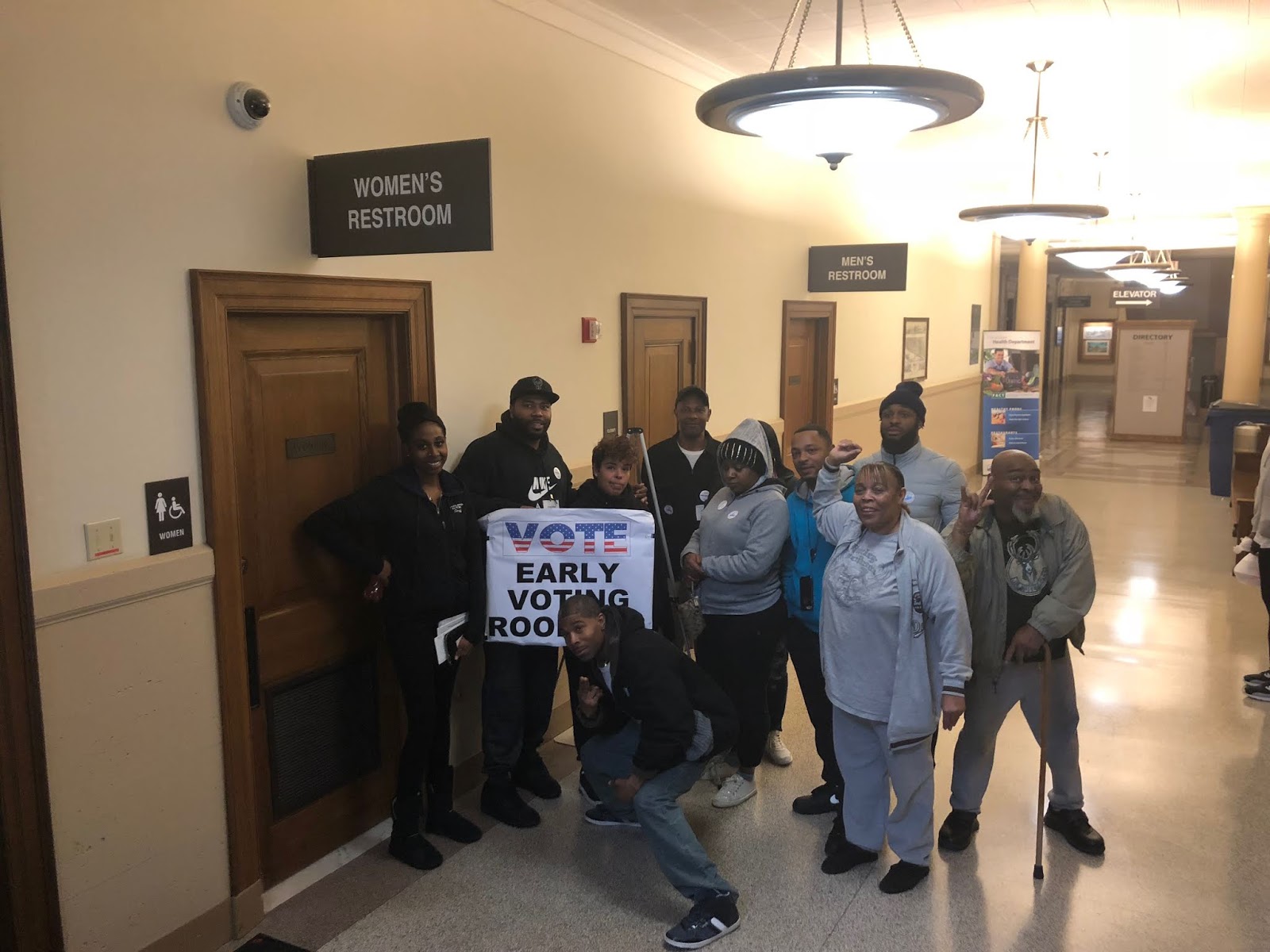
I'm not including this photo (above) of these people because they are early voters-- although each one of them did vote early-- but because they are bus drivers who have been bringing their neighbors to the early voting location in Racine all week. One of the top Wisconsin Democratic operatives told me today that early voting in Racine is higher than it was in the 2016 presidential election and "probably higher than it has ever been. Our voters flooded into early voting places all week giving incredible head starts to Tony [Evers], Tammy [Baldwin] and Randy [Bryce] and to our down-ballot candidates... I've never seen anything like this before-- no one has-- and I've been doing this longer than most of these people have been alive."

We're hearing that Democratic turnout in WI-01 blue bastions-- Kenosha and Janesville particularly-- are even higher than they are in Racine. There were immense lines to get into city clerk's offices to vote-- some wrapping around buildings, as it did in Racine. I've been hearing identical reports from Austin, Texas and from Atlanta, Georgia, where Democrats-- particularly the ones the media says are unlikely to vote (millennials and people of color)-- are charged up and prepared to wait on long lines as if at the end of the line they could smack Trump across his sneering face.


Labels: , , ,

Tuesday, September 25, 2018

Republicans Not Even Campaigning For Independent Voters Anymore-- For Them, It's All About Their Crackpot Base Now

>

GOP base strategy works with hardcore Republican voters, but not with normal people

This morning when Trump tried bragging about his magnificence, the UN General Assembly burst out in sustained, audible laughter. No, Señor T, you're not in Kansas anymore. (Ironically, even Kansas may not be Kansas anymore.)

Ugly monkey: "In less than two years, my administration has accomplished more than almost any administration in the history of our country."

World Leaders: laughter.

Ugly monkey: "It's so true."

World Leaders: more laughter.

Ugly monkey: "I didn't expect that reaction, but that's okay," smirking as though waiting for someone to feed him a banana-- or hand him a submachine gun.


Republican Party strategists have come to realize that appealing to independent voters this year is a rabbit hole for their candidates and they are now doubling down on getting out their own base and virtually ceding the independents-- as much as a third of the vote in many places-- to the Democrats. Our election coverage here at DWT has centered on independents ability to decide the midterms. GOP strategy is to now run such vile negative advertising as to just discourage independents from voting, not to get them to vote for Republican candidates.

At Axios Monday morning, Caitlin Owens outlined a Republican strategy to save hardcore red districts and basically abandon all swing districts. "With the midterm elections fast approaching and Democrats riding a clear advantage on health care, many Republicans are nevertheless doubling down on largely unpopular ideas like repealing the Affordable Care Act and cutting Medicare," she wrote."This strategy may seem counterintuitive on its face. However, it likely reveals that the party has all but abandoned independent voters this year and instead is focused on turning out its base. Republican leaders have recently become more public about the likelihood of trying again on ACA repeal, whereas a few months ago it was largely a private assumption among the party.
Vice President Mike Pence told reporters in Wisconsin that if the GOP candidate wins the Senate seat there, the effort will be revived, per The Hill. “We made an effort to fully repeal and replace ObamaCare and we'll continue, with Leah Vukmir in the Senate, we'll continue to go back to that," he said.
“We need to win this election and then get more seats next year" before trying again, GOP Whip Steve Scalise told the AP.
Is that a good idea in Wisconsin, a state where independents decide elections? It may be a good strategy for Mississippi but there isn't a single poll-- including partisan Republican polls that no one takes seriously-- that shows Vukmir with a pathway to victory. FiveThirtyEight gives her a 1 in 40 chance to beat progressive Democratic incumbent Tammy Baldwin (in a state Trump won-- albeit narrowly and with Kremlin help-- in 2016.


As Owens explained, "ACA repeal only resonates well with one group of voters: registered Republicans. 'It’s all about the base, because as far as I can tell, they’ve lost the independents, there’s no one left to woo,' said conservative economist Doug Holtz-Eakin, a former campaign aide to John McCain. 'The Republicans face a very odd problem…when you ask actually registered voters what they want to do with the future of the ACA, no one wants to repeal and replace it except the Republicans, which the majority do,' said Robert Blendon of Harvard's School of Public Health. 'If you are looking at the aggregate, you can't imagine why you’d even mention it. But if you’re trying to encourage your own voters… then they're trying to say that we would come back and try to do something,' Blendon added."

Worse yet for the GOP's election hopes among normal voters, the Trump Regime is now talking about cuts to Social Security and Medicare again. Owens reminds us that Trumpanzee's top economic advisor, drug addict and crackpot TV personality Larry Kudlow, "recently said that the administration will probably look at entitlement cuts next year." She brought up 3 very vulnerable Republican incumbents-- in districts with huge numbers of independent voters-- who are going along with Kudlow and Trump are likely to lose their seats because of it. John Faso, for example, was keeping his seat in play. It is now starting to trend, ever so slightly, towards Anthony Delgado. Faso is making noises that will make independents (and seniors) see him as a threat to Social Security and Medicare. Fine for the GOP base-- but NY-19 is not some backward rural district in Oklahoma or Alabama. The PVI is supposedly a deceptive R+2 but Obama won it both times he ran and it was only Hillary's lousy campaign and flaws as a candidate that gave Trump his win there (50.8% to 44.0%).


Peter Roskam is another one the need to rein in spending on entitlement programs like Medicare and Social Security. That's a bad idea in Chicagoland. IL-06 gave Obama a win over McCain, Romney a win over Obama and Hillary a 7 point win over Trump (50.2% to 43.2%). The PVI is also a deceptive R+2. The Democratic candidate, Sean Casten, isn't especially strong but it's a neck-and-neck race that Roskam's to lose by talking about cutting Social Security and Medicare.


Very similar story in Texas' 7th district (Houston), where the Democrats nominated a weak candidate, Lizzie Fletcher, but where Hillary narrowly edged Trump (48.5% to 47.1%). Incumbent John Culberson is a poor campaigner. Fletcher has outraised him, $2,312,615 to $2,007,183 and he will be committing political suicide if he embraces-- as he appears to be doing-- an all base strategy. Fletcher isn't capable of winning this race; Culberson is very capable of losing it.


Again, Owens explained the risk to Republicans like Culberson: Although the bet is that the GOP base is concerned with deficits, "as soon as the other side switches to 'you're going to cut back Medicare and Social Security,' you're on the wrong side," Blendon said. "The highest turnout rates are among people above 60." Like clockwork, the DNC blasted out an email criticizing Kudlow's comments, saying that he "admitted that Republicans will try to cut vital programs relied upon by millions of working families."

Labels: , , , , , , , , , , ,