Wednesday, February 05, 2020

Who's To Blame When Parties Get Out Of Hand? Is Republican Virtue Dead And Buried?

>


"Who's to blame when situations degenerate?" That what's the B-52s wanted to know in 1979, sometime between the adoption of the U.S. Constitution and the Trump "acquittal" yesterday. Adam White, a resident scholar at the right-wing American Enterprise Institute and member of the Federalist Society, teaches at George Mason University's Antonin Scalia Law School. Yesterday at dawn, The Atlantic published an historical essay, A Republic, If We Can Keep It, he wrote as Trump was preparing for his acquittal and his State of the Union address. And while many might not find White's essay as incisive as the B-52's song, it is worth reading... after listening to the song. He begins by tying the end of the Trumpanzee impeachment trial to a little known-- other than by law students-- factoid about Founding Father John Jay, a governor of New York and the first Chief Justice of the United States.
In the days leading up to the Senate’s impeachment trial, some people hoped that Chief Justice John Roberts, presiding over the trial, would use his position to send a strong message to the senators on what the Constitution requires of them. He had, in fact, already sent such a message, just weeks earlier, on what the Constitution requires of all Americans. On December 31, in a letter accompanying his annual report on the work of the federal courts, Roberts called on federal judges-- and everyone else-- to invest themselves in the preservation of constitutional democracy.

“Each generation,” he wrote, “has an obligation to pass on to the next, not only a fully functioning government responsive to the needs of the people, but the tools to understand and improve it.” For Roberts, this requires civic education-- and something more fundamental than that, too.

He illustrated his point with a founding-era episode involving the nation’s first chief justice, John Jay. After Jay committed to joining Alexander Hamilton and James Madison in writing essays in defense of the proposed constitution, Jay was seriously wounded by a mob of New Yorkers who had been whipped into a frenzy by rumors of grave robberies. Jay’s wounds derailed his involvement in our nation’s greatest work of political philosophy, The Federalist Papers. “It is sadly ironic,” Roberts wrote, “that John Jay’s efforts to educate his fellow citizens about the Framers’ plan of government fell victim to a rock thrown by a rioter motivated by a rumor.”

The connection between Jay’s day and ours is clear: “In our age,” Roberts wrote, “when social media can instantly spread rumor and false information on a grand scale,” there is even greater danger that political passions can turn us against one another, or against constitutional government itself. He emphasized judges’ particular role as “a key source of national unity and stability,” but his deeper point was that those values are needed among more than just judges.

His letter invoked Jay, Hamilton, Madison, and John Marshall, but his ideas called to mind another Founding Father: Benjamin Franklin, who, on leaving the constitutional convention of 1787, supposedly told a curious passerby that the Framers had produced “a republic, if you can keep it.”

What does it take to “keep a republic”? Nearly two and a half centuries into this experiment in self-governance, Americans tend to think that they keep their republic by relying on constitutional structure: separated powers, federalism, checks and balances. But constitutional structure, like any structure, does not maintain itself. Each generation has to maintain its institutions and repair any damage that its predecessors inflicted or allowed. This task begins with civic education, so that Americans know how their government works, and thus what to expect from their constitutional institutions.

Yet civic education alone, though necessary, is not sufficient. For civic education to take root and produce its desired fruit, the people themselves must have certain qualities of self-restraint, goodwill, and moderation. Because those virtues are necessary for the functioning of a constitutional republic, they are often called civic virtue, or republican virtue. This is not morality writ large, but something more limited and practical. As the late Irving Kristol argued in an essay 45 years ago, republican virtue is fundamentally the virtue of public-spiritedness as the Founding Fathers knew it:
It means curbing one’s passions and moderating one’s opinions in order to achieve a large consensus that will ensure domestic tranquility. We think of public-spiritedness as a form of self-expression, an exercise in self-righteousness. The Founders thought of it as a form of self-control, an exercise in self-government.
Kristol further described this in terms of “probity, truthfulness, self-reliance, diligence, prudence, and a disinterested concern for the welfare of the republic.” A cofounder of the policy journal the Public Interest, he understood that in a republic there is such a thing as the public interest apart from-- and perhaps at odds with-- one’s own personal interests, and thus it requires citizens to restrain themselves in the slow, deliberative workings of constitutional and civic institutions, and even in their interactions with one another, as Roberts emphasized in his letter.

...These are themes that the Constitution’s framers knew well. Madison, for example, understood how much of his constitutional vision depended on republican virtue, and he wrote about it. But those writings have been overshadowed by his more famous quotes, on the need for constitutional structure to guard against mankind’s vices. “If men were angels,” he observed in “Federalist No. 51,” “no government would be necessary.” For people who aren’t angels, republican government relies on constitutional checks and balances, which redirect certain vices toward the public benefit: “Ambition must be made to counteract ambition,” he argued, and liberty is safer when one ambitious branch of government counteracts another.

But to say that constitutional government does not need people to be angels is not to say that constitutional government requires no virtue at all. Madison himself warned against assuming otherwise. In “Federalist No. 55,” facing critics’ predictions of corruption in Congress, he observed that while “there is a degree of depravity in mankind which requires a certain degree of circumspection and distrust,” there are also “other qualities in human nature which justify a certain portion of esteem and confidence.” But then, setting optimism aside, he warned:
Republican government presupposes the existence of these qualities in a higher degree than any other form. Were the pictures which have been drawn by the political jealousy of some among us faithful likenesses of the human character, the inference would be, that there is not sufficient virtue among men for self-government; and that nothing less than the chains of despotism can restrain them from destroying and devouring one another.
This was blunt. Madison knew that the Constitution could not be sustained if the country did not first sustain certain virtues of self-restraint among those who administer the government, and among the people who choose them.

...The necessity of virtue and self-restraint comes through even more clearly with regard to the presidency. The Constitution contains express provisions for presidential self-restraint: The president swears an oath to “faithfully execute the Office of President of the United States,” and he bears a constitutional duty to “take Care that the laws be faithfully executed.” By these vows the president is bound to enforce not just the statutes that he likes but also the inherited statutes that he dislikes, so long as the statute is constitutional.

Defenders of presidential power-- recently Attorney General William Barr, in his address to the Federalist Society-- often quote Hamilton’s discussion, in “Federalist No. 70,” of the Constitution’s need for “energy in the executive.” But advocates for presidential energy should focus on both the president’s powers and on the president’s duties, and the ends to which presidential power is supposed to be directed. Hamilton championed energy in the executive not for its own sake but for “the steady administration of the laws” and “the security of liberty against the enterprises and assaults of ambition, of faction, and of anarchy.” Rooted in the right republican virtues, a president’s energy reinforces our constitutional system; unmoored from those virtues, a president’s energy destabilizes it-- or worse.

Hamilton made these points even more bluntly elsewhere. In “Federalist No. 68,” he argued for choosing the president through an electoral college, rather than by parliamentary election or direct democracy, in order to maximize the odds of electing presidents with “the requisite qualifications”-- not men with “talents for low intrigue, and the little arts of popularity,” but “characters pre-eminent for ability and virtue.”
Oops! Time to try something else, perhaps?


Perhaps Hamilton’s subtlest argument for republican virtue in the presidency is found in his famous essay on the judiciary, “Federalist No. 78.” Here, in his discussion of the judicial branch’s relative weakness, Hamilton observed that the courts “must ultimately depend upon the aid of the executive arm even for the efficacy of its judgments.” That is, the Constitution gives presidents at least some legitimate authority not to enforce judicial decisions with which they disagree, if only when necessary for presidents to carry out their constitutional duty to “take Care that the Laws be faithfully executed.” But Hamilton’s balance of judicial and presidential power is sustainable only if presidents restrain themselves from disregarding judicial decisions whenever they feel like it; presidents’ power can coexist with the Constitution’s judicial power and independence only if they use their non-enforcement power sparingly, if at all.

The executive branch’s need for republican virtue is not limited to the president alone. It extends throughout the administration that he oversees. In “Federalist No. 76,” remarking on the Senate’s role in the appointment of officers, Hamilton observed that to give the president unfettered powers of appointment would free him to staff his administration not from merit in the public interest but “from family connection, from personal attachment, or from a view to popularity.”

Constitutional government, by contrast, requires an administration staffed by the nation’s best servants, not by a president’s favorite friends. The steady administration of the laws requires an executive branch filled with officers who follow the president’s lawful orders but not before providing the constructive feedback that the president needs. Or, as Hamilton put it, constitutional administration requires officers who offer more than just the “pliancy to render them the obsequious instruments of [the president’s] pleasure.” Instead, constitutional administration depends on officers with both courage and fortitude, but also with the moderation and self-restraint necessary to follow lawful presidential orders with which they personally disagree.

Finally, the Constitution needs republican virtue not just in the three branches of government but also in the people whom the government serves and is accountable to. Long before Roberts wrote his year-end letter, Hamilton and Madison filled The Federalist Papers with warnings about “passions” that inflame public opinion and prevent reasoned deliberation. Hamilton introduced this theme at the very outset, in “Federalist No. 1,” presenting the Constitution’s ratification debates as an opportunity to see “whether societies of men are really capable or not of establishing good government from reflection and choice,” and to decide the debates not as a competition of narrow interests but with a view to “patriotism, to heighten the solicitude which all considerate and good men must feel for the event.”

Madison emphasized it, too. Recognizing that the public will always be impassioned by politics, he observed in “Federalist No. 49” that the process and structure of our federal government will help to transform the public’s passions into a less impassioned public reason, so the public’s “reason, alone” would “control and regulate the government,” while the government would control the people’s passions. But this approach presumes that an impassioned public is willing to be controlled. If the public persists in its impassioned state, it will eventually have the opportunity to overcome whatever limits the government tries to put on the impassioned majority. Only with the virtues of self-restraint urged by Madison and Hamilton in their time, Irving Kristol four decades ago, and Roberts and Gorsuch today, can the country avoid the national self-immolation that the Founding Fathers feared.

The justices can do much to advance these themes in public, by writing or speaking about them and by modeling them in their own work: in the way they conduct themselves at oral argument, and in the tone and style of their judicial opinions. But on this, as in all things, judges can do only so much to save the country from itself. For the country to relearn republican virtue will require heroic efforts by parents, teachers, clergy, coaches, and statesmen. Benjamin Franklin did not promise “a republic, if your judges can keep it.” He promised something far more challenging: “a republic, if you can keep it.”

Labels: , , ,

Sunday, January 27, 2019

Trump's Proposal Was Radical-- AOC And Elizabeth Warren Are Reformers

>


I wish that crazy Trump would just settle down and go spend his days playing golf again so AOC could get Congress working on a sensible agenda. You know who's work I'm really enjoying? Eric Levitz at New York Magazine. Once a poetry lecturer at Johns Hopkins, this guy has been writing excellent essays on the nexus of where politics meets the world of finance. And this pinned tweet is pretty awesome too, don't you think?


His latest, AOC Thinks Concentrated Wealth Is Incompatible With Democracy. So Did Our Founders, shows he still has a poetic heart. He's become a reliable defender of Alexandria Ocasio every time the forces of the extreme right mass against her and her program. When Hannity spewed out his creed about how "general economic equality is not a precondition for the American dream, but rather, an insurmountable obstacle to it," as a way of trying to rouse his viewers against Ocasio's tax ideas, Levitz noted that "after popularizing the idea of a 70 percent top marginal tax rate earlier this month, the freshman congresswoman recently suggested that the mere existence of billionaires was both immoral, and a threat to American democracy."

What Ocasio said (in an interview with Ta-Nehisi Coates on Martin Luther King Day) was that she doesn't "think that a system that allows billionaires to exist when there are parts of Alabama where people are still getting ringworm because they don’t have access to public health is wrong.” The day day Ocasio approvingly quoted an op-ed by the economists Gabriel Zucman and Emmanuel Saez, which argued that the purpose of high taxes on the wealthy wasn’t merely to generate revenue, but rather, to safeguard "democracy against oligarchy." Recall, these are the two who have been advising Elizabeth Warren on the matter of her wealth tax proposal.
Hannity’s not buying it. The Fox News host informed his audience Wednesday that Ocasio-Cortez had “called the American dream immoral,” and that she wants to “empower the government to confiscate” said dream. “Better hide your nice things,” Hannity advised his audience (whom he ostensibly believes to be composed primarily of billionaires), “because here come the excess police.”


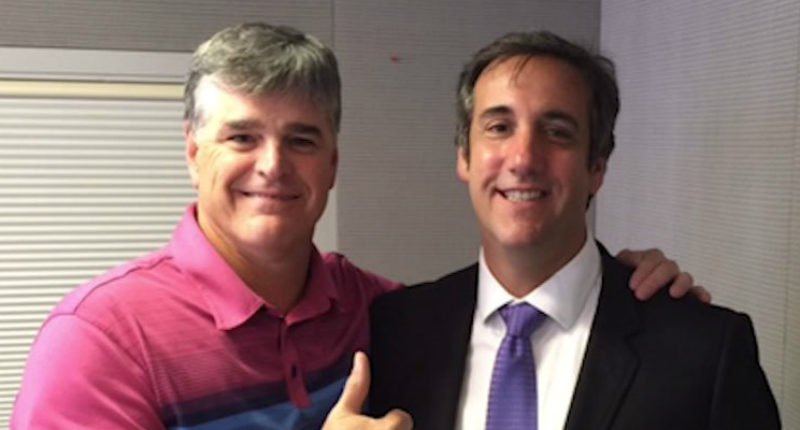
Hannity and his attorney


Hannity was hardly alone in deriding AOC’s antipathy for billionaires as fundamentally un-American. But in reality, there’s nothing foreign or communistic about the idea that concentrated wealth is incompatible with democracy, or all-too compatible with mass poverty. Republicans might call such notions radical. But many of our republic’s founders would have called them common sense.

Compare AOC’s first argument-- that the simultaneous existence of billionaires and poverty is immoral, and thus justifies steeply progressive taxation-- with Thomas Jefferson’s reflections in 1785. During a visit to the French countryside, Jefferson found himself scandalized by “the condition of the labouring poor.” In a letter to James Madison, Jefferson wrote that the extremity of European inequality was not only morally suspect, but economically inefficient. Aristocrats had grown so wealthy, they were happy to leave their lands uncultivated, even as masses of idle workers were eager to improve it. Thus, these proto-billionaires undermined both the peasants’ ability to transcend mere subsistence, and their society’s capacity to develop economically:
[T]he solitude of my walk led me into a train of reflections on that unequal division of property which occasions the numberless instances of wretchedness which I had observed in this country and is to be observed all over Europe. The property of this country is absolutely concentered in a very few hands…I asked myself what could be the reason that so many should be permitted to beg who are willing to work, in a country where there is a very considerable proportion of uncultivated lands? These lands are kept idle mostly for the aske of game. It should seem then that it must be because of the enormous wealth of the proprietors which places them above attention to the increase of their revenues by permitting these lands to be laboured.
Here is how Jefferson proposes to address the obscene coexistence of concentrated wealth and underemployed workers:
I am conscious that an equal division of property is impracticable. But the consequences of this enormous inequality producing so much misery to the bulk of mankind, legislators cannot invent too many devices for subdividing property, only taking care to let their subdivisions go hand in hand with the natural affections of the human mind. The descent of property of every kind therefore to all the children, or to all the brothers and sisters, or other relations in equal degree is a politic measure, and a practicable one. Another means of silently lessening the inequality of property is to exempt all from taxation below a certain point, and to tax the higher portions of property in geometrical progression as they rise. Whenever there is in any country, uncultivated lands and unemployed poor, it is clear that the laws of property have been so far extended as to violate natural right…It is too soon yet in our country to say that every man who cannot find employment but who can find uncultivated land, shall be at liberty to cultivate it, paying a moderate rent. But it is not too soon to provide by every possible means that as few as possible shall be without a little portion of land. The small landholders are the most precious part of a state. [Emphasis Levitz's.]
If Ocasio-Cortez’s views are un-American, then surely these words from our third president’s are, as well.

...[AOC is] channeling one deeply rooted strain of American thought on economic morality. And while that strain might have been marginal among the leaders of the American Revolution, it was pervasive among its foot soldiers (there’s a reason the leading propagandist of the war effort, Thomas Paine, was one of the earliest champions of an American welfare state).

Regardless, Ocasio-Cortez’s second argument against the existence of billionaires-- that concentrated wealth is incompatible with genuine democracy-- was something close to conventional wisdom among the founders (including those who opposed democracy).

America’s first political theorists took these truths to be self-evident: that a person could not exercise political liberty if he did not possess a modicum of economic autonomy, and that disparities in wealth inevitably produced disparities of political power.


The notion that political freedom has a material basis did not originate with Karl Marx and the creed of Communism; it was a core idea of the 17th-century British political theorist James Harrington, and his formulation of classical republicanism. A man who does not own the means of his own reproduction can never exercise political freedom, Harrington argued, because “the man that cannot live upon his own must be servant.” Likewise, the man of immense wealth-- whose fortune consigns great masses of men to servitude-- is inevitably a kind of tyrant. After all, “where there is inequality of estates, there must be inequality of power, and where there is inequality of power, there can be no commonwealth.”

These premises deeply informed the American founders’ conception of republican liberty. The Jeffersonian ideal of a yeoman’s republic derived from the conviction that only independent landowners were politically free-- and only a (very) rough equality in the distribution of land could preserve such freedom. Even a consummate elitist like Alexander Hamilton couldn’t help but echo Harringtonian thinking, writing in the Federalist Papers, “A power over man’s subsistence amounts to a power over his will.”

...Thus, Ocasio-Cortez’s belief in the moral necessity of mass democracy (and women’s suffrage, and the abolition of slavery) would have struck many a Founding Father as radical. But her insistence that true democracy is incompatible with America’s present distribution of property-- in which the richest 0.1 percent of Americans command as much wealth as the poorest 90 percent-- would have struck Jefferson & Co. as tautological. And a large body of political science research suggests that their shared intuition is correct.

All of which is to say: If the right to self-government is an inextricable component of the American dream, then it isn’t AOC who regards that dream as immoral-- it’s Sean Hannity, and every other multimillionaire who believes that legislators should not invent “many devices for subdividing property.”
Yesterday Stephanie Kelton reminded me that Warren's wealth tax proposal went from the 2% she proposed for wealth over $50 million to 3% on wealth over a billion dollars. Trump's proposal called for real confiscation-- 14.25%. AOC and Warren are just sensible reformers. Kelton was on NPR's Marketplace Thursday. She told Kai Ryssdal that "If you control your own currency and you have bills that are coming due, it means you can always afford to pay the bills on time. You can never go broke, you can never be forced into bankruptcy. You're nothing like a household. Ryssdal tried explaining what he took away from his talk with her and what MMT is all about.
Because the government controls how many dollars are out in the economy, Kelton and MMT said Congress and the president shouldn’t worry about balancing the money coming in through taxes with the money going out to fund government programs.

For those of you screaming “Inflation! Inflation! Inflaaation!” at the idea of the government creating fresh money every time it needs to pay the bills, calm down. The MMT economists know about Weimar, Germany, too. If Congress stops worrying about balancing the budget, Kelton said the government could spend too much money into the economy with ambitious programs and end up causing inflation.

That’s where tax policy comes in. Kelton said taxes can act as a “release valve” for inflation.

To wrap your brain around this concept, picture a bathroom sink. Think of the government and its ability to create more money whenever it needs to as the faucet and that bucket area of the sink where the water goes as the economy.

The government controls how much money, or water, is flowing into the economy. It spends money into the economy by building interstates or paying farm subsidies or funding programs.

“And so as those dollars reach the economy, they begin to fill up that bucket, and what you want to do is be very mindful about how full that bucket is getting or you're going to get an inflation problem,” Kelton said.

Inflation is where the sink overflows. If that happens, Kelton said there are two ways to fix it: “You can slow the flow of dollars coming into that bucket. That means the government then has to start slowing it's rate of spending, or you can open up the drain and let some of those dollars out of the economy. And that's what we do when we collect taxes.”

Let's back up for a second and think how this stuff works. Chairman Jay Powell and the gang at the Federal Reserve are the people thinking about the economy's big picture and keeping that water level right.

The Fed uses monetary policy-- interest rates-- to keep that sink we were talking about from getting too empty or too full. The MMT folks want Congress to be doing that using fiscal policy-- government spending and taxing decisions.

Randall Wray, a senior scholar at the Levy Economics Institute at Bard College and one of the developers of MMT, said he thinks the Fed should stop focusing on inflation.

“If you ask what I think ideal monetary policy would be, what the Fed really should do is stabilize interest rates at a low level," he said.

The catch, of course, with telling the Fed to just keep interest rates low and controlling inflation with fiscal policy is the political reality in Washington.

“The making of fiscal policy, it’s never neat and tidy. It’s not efficient,” said Sarah Binder, senior fellow at the Brookings Institution and a political science professor at George Washington University. “The political constraints on members makes it harder to use fiscal policy and to use tax policy,” she said.

Running the federal government the way the MMT economists would if they were in charge would require Democrats and Republicans to change the way they think about fiscal policy and monetary policy.


Labels: , , , , , , , , , ,

Friday, July 06, 2018

No, The Founding Fathers Weren't "Ordinary Men," Not In The Way Scott Walker Means It

>


Trump's knowledge of American history is as thorough as his knowledge of everything other than grifting. That's why so many morons love him so much; they see themselves in him. I guess there's nothing we can do about that. Even when Max Boot speculated in his Post column yesterday that "If Trump announced he were going to spit-roast immigrant kids and eat them on national TV (apologies to Jonathan Swift), most Republicans probably would approve of that too," he was right on target. Anyone-- including Boot-- who thinks there is anything Robert Mueller could find that will that will shatter his hold on the affections of his moron followers is just whistling Dixie. "Imagine," wrote Boot, "what would happen if special counsel Robert S. Mueller III finds clear evidence of criminality or if Trump’s trade wars tank the economy... if it does, it might-- just might-- shake the 88 percent GOP support that Trump currently enjoys. That, in turn, could open the way for a credible primary challenge... To use one of Boot's own metaphor sources, Wrong 'Em Boyo.


Remember when the idiot talked about what a great future he saw for Frederick Douglass? That's his knowledge of history. I don't want to say that the whole party don't know much about history... but... scholar's they don't tend to be these days. Another genius, Wisconsin Governor Scott Walker, getting his voters ready for some unconstitutional activities, has been a big proponent of spreading the idea that the founding fathers were "ordinary people."

Well, is some ways Scott Walker was correct. Here's half a dozen:
each one had a nose from which he breathed
each one ate food through a mouth
each one got tired and slept
each one had feet to walk with
each one was born of a mother
each one was, in Walker's own words, a patriot who risked his life for the freedoms we hold dear today
There are reasons their collective endeavor-- the founding of our country including the war for independence and then the Constitution-- has held up, had something to do with just how extraordinary these men were. PolitiFact Wisconsin though, decided that instead of contradicting Walker, they would give him and other Republicans a little history lesson about who the Founding Fathers' fathers were.
After consulting several scholars and other sources, we found that-- with some exceptions-- central figures in the nation’s founding generally came from privileged backgrounds, attended college at a time when very few people did and, by 1776, were prominent and wealthy.

"They weren't ordinary," said Brown University emeritus history professor Gordon Wood, author of Creation of the American Republic, Revolutionary Characters: What Made the Founders Different and other books. "They were the elite of the day, involved in highest levels of the society."

Paul Finkelman, a scholar-in-residence at the National Constitution Center in Philadelphia, was among the historians who agreed with that assessment. But noting that Benjamin Franklin’s formal education ended when he was 10, Finkelman added, "the notion that some of the founding fathers were self-made is true."

While there is no set group of founding fathers, lists of the major ones usually include the following six, as listed by the National Archives’ Founders Online.

Here’s a look at their early years, as well as where they were by 1776:
John Adams

Adams was born into a "comfortable, but not wealthy, Massachusetts farming family," according to the University of Virginia’s Miller Center, which specializes in political history. His father earned a living as a farmer and shoemaker. His early education was strong enough that he entered Harvard College at the age of 15.

Adams became the lawyer with the largest number of clients in highly competitive Boston, said University of West Georgia history professor emeritus John Ferling, the author of 11 books on the American Revolution and its leaders.

In the Continental Congress-- the body of delegates who represented the people of the colony-states that later became the United States of America-- he was the leader of the faction pushing for independence in 1776. He later became vice president and then the nation’s second president.

Benjamin Franklin

Franklin was the son of a man who made soap and candles, which Encyclopedia Britannica terms "one of the lowliest of the artisan crafts" at the time. Franklin learned to read very early and had one year in grammar school and another under a private teacher, but his formal education ended at age 10. At 12, he was apprenticed to one of his brothers as a printer and "taught himself to write effectively." He founded a weekly newspaper at age 16.

Franklin, Finkelman told us, "is the classic self-made American." He eventually became wealthy enough that, at age 42, he became "perhaps the first American we know of to retire," Finkelman said. He was a significant property owner, owned a successful publishing business and was an internationally known scientist. Franklin was a slave owner when he helped draft the Declaration of Independence, but became one of the early abolitionists when, at 81, he was at the Constitutional Convention in 1787, Finkelman said.

Alexander Hamilton

Hamilton was born in the British West Indies, the illegitimate son of a "poor itinerant Scottish merchant of aristocratic descent and an English-French Huguenot mother who was a planter's daughter," according to the National Archives. He received a "basic education" and became an apprentice clerk in a mercantile establishment. The proprietor and others recognized Hamilton’s "ambition and superior intelligence" and raised money to further his education, which included time at what became Columbia University in New York.

Finkelman said that after Hamilton joined the Army, he quickly became George Washington’s aide-de-camp with rank of lieutenant colonel. Hamilton wrote pamphlets and newspaper essays favoring independence in 1774 and 1775. In 1789, he became the nation’s first secretary of the treasury. In 1804, he was mortally wounded in a duel with a political rival, Aaron Burr.

James Madison

Madison’s father inherited and married into substantial wealth, according to the Miller Center. Madison was a "sickly child" who also suffered from psychosomatic, or stress-induced, seizures, similar to epileptic fits, "that plagued him on and off throughout his youth." But by the time he entered what became Princeton University, Madison had mastered Greek and Latin under the direction of private tutors.

Ferling noted that Madison was a leading figure in the Continental Congress and the Constitutional Convention, served as the leader in the First House of Representatives and drafted the Bill of Rights. According to Finkelman, Madison owned at least 100 slaves, inherited wealth and land from his father, and married into wealthy family. He was president from 1809 to 1817.

Thomas Jefferson

Jefferson was born on a slave plantation in central Virginia, according to Monticello.org. His father was a planter and surveyor, and his mother was the daughter of a well-known Virginia family. When Jefferson was 14, his father died and he inherited about 3,000 acres of land and about 30 slaves. Jefferson went to the College of William and Mary, then studied and practiced law.

Jefferson was the primary author of the Declaration of Independence. According to Finkelman, he owned two major plantations and 150 to 200 slaves which, by modern standards, means he was a billionaire. Jefferson followed Washington and Adams as the third president.

George Washington

Washington was a member of Virginia’s gentry, born on his father’s plantation, according to MountVernon.org. Augustine Washington was a leading planter in the area and also served as a justice of the county court.

After Augustine died, when George was 11, "the income from what remained was just sufficient to maintain Mary Washington and her children" and George "undoubtedly helped his mother manage" the plantation where they lived. His formal education ended at age 15, before that of many gentlemen’s sons.

Washington trained as a surveyor before entering the military. Virginia’s governor appointed Washington, at age 22, to command the colony’s army in the French and Indian War, Ferling said. Washington went on to become a wealthy farmer and businessman before being appointed commander of the Continental army in 1775. Finkelman said by this time, Washington owned thousands of acres of land and hundreds of slaves. He served two terms as president.
PolitiFact added that the Founding Fathers "were all far from ordinary in terms of income, wealth, education, and social standing." But, to be fair, I don't think that's what Walker meant. Walker is an ordinary man, a profoundly flawed one. My guess is that he was trying to get across to Wisconsin voters that the Founding Fathers were also flawed-- ordinary like him in that way-- and could make mistakes that had to be corrected. And it is true that there are grievous historical errors in the Constitution, for example, errors that had to be corrected, something foreseen by the Founding Fathers, who included an amendment process, which gave us the Bill of Right, eventually abolished slavery, gave women legal equality, pohibited the denial of the right to vote based on race and then based on gender.

Constitutional Amendments generally gave more rights to people. Conservatives, Republicans, people like Scott Walker and Señor Trumpanzee aren't looking to expand rights; they look to narrow them and take them away.

Labels: , , , , , ,