Monday, August 17, 2020

Figuring Out Who To Vote For Down-Ballot-- Let's Look at PA-01, Bucks County

>


The New Dems don't just endorse anyone who asks them for an endorsement and they don't sell endorsements as part of a protection racket the way certain other caucuses do. They vet their candidates very carefully and if they detect any fiscal progressive streak-- BOOM!-- it's over. The New Dems are the dominant part of Congress' Republican wing of the Democratic Party. They're not as bad as Republicans but they are corporately financed and tend to vote with Republicans on economic issues. In other words-- if 2 gays want to get married, it doesn't bother them any more than a woman getting an abortion does, when when it comes to making the rich pay their fair share of taxes or regulating the banksters... that's where we have a little problem. Actually, a big problem-- of the 10 Democrats with the worst voting records in Congress, 8 of them-- all Blue Dogs Collin Peterson (MN) and Jared Golden (ME)-- are New Dems. Most of them are also Blue Dogs. Almost every Blue Dog has joined the New Dems-- makes it easier to access Wall Street bribes.

There are currently 104 New Dems in the House, making it the biggest Democratic caucus in the House. Of the 104 New Dems, only 21 do not have "F"-graded voting records-- an even dozen with "D" scores (like Debbie Wasserman Schultz, Greg Schiff, Darren Soto and Juan Vargas), 5 with "C" scores, although that includes Eliot Engel who was recently dispatched by his constituents and replaced by a Democrat with real progressive values, Jamaal Bowman, and 3 with B scores and just one with an A, Lori Trahan (who is also a member of the Progressive Caucus).

When I was looking for information about Christina Finello, the hand-picked DCCC/EMILY's List candidate for the Bucks County congressional district (PA-01), I went to her website first and saw her proudly displaying the New Dems endorsement meme. She's one of the 27 candidates conservative and amenable to corruption enough to make the grade. But there was no AFL-CIO endorsement; which went to the pro-union Republican incumbent Brian Fitzpatrick.

She's running in Pennsylvania's penultimate swing district with a PVI of R+1, but with a record of having voted for Obama both times he ran and even having given a 2 point win to Hillary over Trump-- 49.1% to 47.1%. The so-called "Blue Wave"-- and an attempt to buy the seat by a wealthy Democrat who put an obscene and offensive $12,756,892 of his own money in-- didn't take out Fitzpatrick in 2018, when he beat Scott Wallace 169,053 (51.3%) to 160,745 (48.7%). Bucks County (90% of the district) performed very strongly for Fitzpatrick, while voting even more strongly for progressive Democratic gubernatorial candidate Tom Wolf (58.5%) and for Democratic Senate incumbent Bob Casey (56.2%), both of whom were running against crackpot Trumpists.

As of the June 30 FEC reporting deadline, Fitzpatrick had raised $2,741,797, spent $1,029,695 and had $1,828,737 cash on hand. Finello raised $501,826, spent $205,703 and had $296,123 cash on hand. There hasn't been a lot of outside spending yet, but I expect there will be, for both candidates. Looks bad for the New Dem, Finello. Maybe. Why maybe? Trump. Trump may pull all down-ballot Republicans down with him. Finello is just a nothing careerist candidate with nothing to offer but she's in the right place at the right time. 92,308 Democrats voted in the primary, 71,571 of them for Finello. And just 75,895 Republicans voted on the same day-- and just 48,017 of them for Fitzpatrick. Fighting the Trump anti-red headwinds, it's going to be very hard for Fitzpatrick to stave off a defeat, although he'll easily beat Finello in a 2022 rematch when the Democrats have spent 2 years accomplishing nothing important to anyone, primarily because of status quo candidates like Finello (and Biden) getting swept into office.

Fitzpatrick's lifetime ProgressivePunch crucial vote score in 27.35. Only one Republican, Thomas Massie-- and by less than one percentage point-- has voted more frequently for progressive legislation. In fact, Fitzpatrick is basically tied with Utah Blue Dog Ben McAdams and has a more progressive voting record than two Blue Dog/New Dems, the detestable Anthony Brindisi (NY) and Joe Cunningham (SC). Fitzpatrick uses his score to insist he's a "moderate" and "independent," his biggest selling points back home. Will voters hear his pleas over the Trump din though? Last week, Philadelphia Inquirer reporters Andrew Seidman and Chris Brennan asked if Fitzpatrick really is a moderate, which isn't how either party paints him. The right wing of the GOP dismisses him as a RINO and Democrats desperately try to tie him to the despised Trump. Fitzpatrick has a tightrope because if he is seen as too close to Trump he will lose independent voters who are the ones who decide elections in Bucks County. But if he's too unsupportive of Trump, he'll hemorrhage the Republicans who are devoted to Trump and Trumpism.

Seidman and Brennan wrote that "Democrats narrowly outnumber Republicans in the district, a solidly middle-class swath of suburbia that includes part of Montgomery County. And heated debate over whether a Fitzpatrick deserves the moderate tag is familiar ground for local voters, dating back to when his late brother, Mike Fitzpatrick, represented the district. Whether Brian Fitzpatrick survives what’s likely to be a challenging reelection campaign while Trump continues to repel suburban voters will offer clues about if and how Republicans can hold on to power in the suburbs.
“Anybody that claims I’m not a moderate and not an independent thinker is living on another planet,” Fitzpatrick said in an interview Thursday, touting his involvement with the bipartisan Problem Solvers Caucus.

Rick Bloomingdale, president of the Pennsylvania AFL-CIO, said the success of moderate politicians in the region dates back to the late 1970s. Pete Kostmayer, a Democrat, served seven terms in the House, followed for six terms by Republican Jim Greenwood. They weren’t ideological warriors. The district didn’t expect-- or want-- them to be. The same could be said for the men who followed: Mike Fitzpatrick and Democrat Patrick Murphy.

The AFL-CIO this month endorsed Fitzpatrick, the only Republican the labor group backed for U.S. House in Pennsylvania and just one of eight GOP endorsements out of 189 overall. Bloomingdale cited Fitzpatrick’s support for unionized federal employees’ rights, dredging jobs on the Delaware River, and protections for union organizing.

All that made it “pretty easy to endorse” Fitzpatrick, Bloomingdale said. To do otherwise would be the act of a “fair-weather friend,” he said.

Fitzpatrick’s moderate bona fides have been a source of frustration among progressive groups eager to retake a seat held by Republicans for a decade. Fitzpatrick withstood the 2018 Democratic wave that washed out Republicans in the Philadelphia suburbs.

In an interview, Finello rattled off positions taken by Fitzpatrick that she said show he’s no moderate, starting with his support for Trump’s 2017 tax cuts-- which disproportionately benefited wealthy Americans and swelled the federal budget deficit.

She condemned Fitzpatrick for voting against the Heroes Act, a second coronavirus economic relief package the House passed in May. The Republican-controlled Senate didn’t advance the bill, and negotiations between the White House and congressional Democrats have gone nowhere.

Finello said Fitzpatrick’s vote means he opposed oversight of federal aid to make sure it “went to struggling small businesses rather than corporations.” The bill also included money for state and local governments, continuing supplemental unemployment benefits, and extending moratoriums on evictions and foreclosures.

“We’re talking right now in August, the fourth straight month where roughly a third of Americans have missed a housing payment, voting against things people need,” she said.

Fitzpatrick noted that 14 Democrats voted against the bill. He said he supports more funding for state and local governments, the Postal Service, small businesses, and unemployment benefits. But he opposed a provision in the bill that aimed to reduce the prison population to fight the spread of the virus.

He also opposes Trump’s call for a payroll tax cut, saying it would “jeopardize Social Security and Medicare.” And on a day when Trump openly admitted that by withholding funding for the Postal Service, it would be unable to handle an anticipated surge of mail voting, Fitzpatrick said the USPS should be “fully funded.”

And Fitzpatrick noted that he backed “major policy initiatives” advanced by Democrats after they retook the House, including Democratic priorities like strengthening protections for voting rights, closing the gender pay gap, and expanding antidiscrimination protections for LGBTQ people.

“That’s union rights, environmental rights, gun safety, LGBT rights,” Fitzpatrick said. “These are major, major initiatives.”

In June, he was one of just three Republicans who voted for the police reform measure passed by the House after the police killing of George Floyd in Minneapolis.

It all adds up to a record the Lugar Center and Georgetown University’s McCourt School of Public Policy rank as the most bipartisan of any member of the House. The center’s index is based on “how often a member of Congress introduces bills that succeed in attracting cosponsors from members of the other party, and how often they in turn cosponsor a bill introduced from across the aisle.”

Fitzpatrick has voted with Trump 64% of the time on legislation on which the president has a clear position, according to the website FiveThirtyEight. Just two House Republicans have voted with Trump less frequently, according to the analysis.

Democrats counter that Fitzpatrick, a former FBI agent, has failed to deliver on a defining issue: standing up to Trump.

“You can’t deny the fact he’s been complicit with Donald Trump on his most important initiatives, and has been silent as a lamb when his own FBI directors have been attacked, when our military leaders have been attacked by this president,” said Murphy, who unseated Mike Fitzpatrick in 2006 but lost the seat back to him in 2010. (Mike Fitzpatrick died in January.)

Murphy, asked if he thought there were any moderate Republicans in Congress, pointed to Sen. Mitt Romney of Utah, the only one who voted to convict Trump at his impeachment trial.

“Where was he on that vote?” Murphy said of Fitzpatrick.

Fitzpatrick said he will wait until the election to decide whether to vote for Trump or presumptive Democratic nominee Joe Biden.

The debate over Fitzpatrick’s independence is something of a redux of his 2018 campaign against Democrat Scott Wallace.

Progressives were incensed then when Everytown for Gun Safety, the antigun violence group cofounded by Mike Bloomberg, endorsed Fitzpatrick. Everytown cited Fitzpatrick’s vote against a bill backed by the National Rifle Association that would require states to recognize concealed carry permits from other states-- but progressives questioned his commitment to the issue.

The Bucks County branch of Moms Demand Action, an arm of Everytown, dissolved in protest.

Ali Glickman, of Solebury Township, cofounded Orange Wave for Gun Safety along with other former Moms Demand Action volunteers. She said that Fitzpatrick is no moderate, and that regardless, voting for Republicans won’t help on issues like gun violence. The only way to advance the cause is to elect Democrats like Finello, she said.

“If we don’t have the majority, it doesn’t really matter, period,” Glickman said.

While Finello’s campaign frequently mocks Fitzpatrick’s claims of independence, Finello said she doesn’t focus on labels.

“I’m focusing on what people are talking about right at this moment,” she said. “People are concerned right now about how they’re going to pay their rent when they’ve lost their job. They’re worried about what’s happening when they have to send their kids back to school.”


That ad didn't work-- at least not enough to flip the district-- in 2018, but that's basically the campaign again this cycle. It's all a matter of how skilled Fitzpatrick is in walking his tightrope-- distancing himself from Trump, but not so much as to offend Trump supporters enough to watch them decide to skip the vote-- or vote for the Libertarian on the ballot in November..

Still, Finello may win. If she does, her voting record will be slightly better than Fitzpatrick's. She's not for Medicare-for-All and She doesn't back a Green New Deal. Her website issues page is basically DCCC pablum-- sounds good/means nothing. Is she better than Fitzpatrick? Yes, a bit. Can she hold the seat in a bad wave year for Dems? No way. Incumbents like her always lose the seats. This is the kind of thing-- made by Republicans-- that will sweep Finello into Congress:


Labels: , , , , , , , , ,

Friday, July 10, 2020

Cook: Trump Is Dragging Down Republican Candidates With Him

>


Cook is usually a lagging indicator. They do not move on a dime. If they move a race from "leans Republican" to "toss up," it probably means you should expect a big loss for the GOP. Yesterday, Amy Walter, one of their top prognosticators, used the word "tsunami." It's July; I would interpret that to mean Cook foresees a mass GOP drowning in November-- an actual; threat to to basic well-being of the party's existence. This isn't just about swing states and swing districts-- you can start anticipating painful Republican losses in "solid red" states like Alaska, Texas, Arizona, Georgia and Montana. And that isn't just about electoral votes but about Republicans up for reelection-- or running for-- congressional and state and county legislative seats as well. "This election," wrote Walter, "is looking more like a Democratic tsunami than simply a Blue wave. President Trump, mired in some of the lowest job approval ratings of his presidency, is trailing Biden by significant margins in key battleground states like Pennsylvania (8 points), Michigan (9 points), and Wisconsin (9 points). He’s even running behind Biden in his firewall states of Florida and North Carolina."

She doesn't understand the difference between a Blue wave and an anti-red wave. There's no enthusiasm for Biden or the crappy party he "leads." All the enthusiasm is for stuffing Trump down a toilet and flushing. But the Beltway insiders will never understand that and will continue babbling like chimps about "a Blue wave." Fine, who cares; it ends up with the same results anyway.


Cook changed some of their electoral college predictions "to reflect this reality." All have moved towards the Democrats and all are laughably behind reality. Their best predictions are always the day after the election anyway. They move Wisconsin, Pennsylvania, and Nebraska’s 2nd district from toss up to lean Democrat. And Maine, which for whatever insane reason, was in the lean Democrat column moved to likely Democrat. Cook is so funny. They also moved Maine's 2nd district from likely Republican to just lean Republican. And she wrote that "Georgia has joined Arizona, North Carolina and Florida in the Toss Up column, although, at this point, Biden would be slightly favored to win at least Arizona and Florida."

Even Republican strategists she spoke with understand that Trump has now reached "a permanent loss of trust and faith of the majority of voters. In talking with strategists on both sides this last week, it’s also clear that Trump is dragging Republican congressional candidates with him as well. Plugged in strategists on both sides tell us that Trump is running behind in districts he easily carried in 2016. As one GOP strategist told us this week, 'I’d be surprised if any House GOP challenger is able to outperform Trump-- they are tied to him.' Meanwhile, Democratic Senate candidates-- even those in second and third-tier races-- are pulling in eye-popping second-quarter fundraising totals."


I spoke to a handful of candidates running strong in prohibitively red districts. Iowa progressive, J.D. Scholten, pointed out that his right-wing Trumpist opponent, Randy Feenstra "ran his primary campaign on the theme that he's best positioned to 'deliver' for Trump. But Trump's policies have systematically ravaged Iowa's farmers and rural communities in everything from the disastrous trade war to abuses of the Renewable Fuel Standard to corporate bailouts. Iowans don't need nor want another career politician who's beholden to corporate interests and afraid to stand up to power. We understand why folks voted for Trump-- they were looking for change and solutions, but unfortunately, that's not what we got. Our campaign is gaining traction with Trump voters, Republicans, and voters across the political spectrum because we're fighting for them: farmers, workers, and rural communities."

Goal ThermometerGeorgia progressive Lisa Ring told me that through her experiences she's concluded that the most dangerous thing we can do is assume we can predict political outcomes. "Every action," she said, "has the potential of harming or propelling a campaign but the ever-changing nature of politics renders an important development, insignificant within hours. In general, the failures of the Trump administration should be harmful to every legislator or candidate who remains loyal to it. However, it is what Democrats choose to do with the failings of the GOP that will make a difference. Or not.

"Simply pointing out that Rep. Buddy Carter is a Trump lackey who has followed his every direction in order to gain Trump’s official endorsement, is not enough," she continued. "Instead, I must remind the people of my district that Carter and Trump worked hand in hand to destroy the middle class, working class, and disadvantaged, by taking away whatever healthcare they had, letting small businesses fail, allowing our infrastructure to crumble, protections to be rolled back, and failing the millions of unemployed, as well as the millions of infected Americans who were provided no assistance and no leadership during a pandemic that is not even close to being over. 2016 and beyond, should have taught us not to rely on polls or predictors, but rather to continue to focus on the issues, and reach voters one on one. These times are unprecedented and we cannot sit back and analyze with numbers, beliefs that defy all reason. Instead let us hit the streets(virtually, if it must be) and connect truthfully to people who need answers and solutions to the very real problems they face daily."

Texan Julie Oliver shared something that has changed in a pretty big way since the 2018 campaign. "What we’ve seen over the last two election cycles is a growing number of 'independent' voters in TX-25. Some folks share that they’re former Republicans who have lost their party and will never vote for another Trumpublican, like Rep. Roger Williams, again. Sometimes we encounter these newly independent voters when we are phone-banking, or in the pre-pandemic world when we were able to canvass, but what we are seeing in this election cycle that really didn’t happen in the midterms is that many former Republicans reach out to our campaign unsolicited."

Yesterday, Astead Herndon wrote specifically about the Trumpist base in Georgia and Arizona being nonplussed about the GOP establishment Senate candidates. "Many Republican candidates face a perplexing electoral landscape this year, given that Mr. Trump’s conduct has endeared him to the party’s most conservative groups, but has soured some suburban moderates and seniors who are vital parts of any swing state coalition. These candidates are walking a tightrope, made more difficult by a voter base that doesn’t just want to elect Republicans, but rather loyal foot soldiers who take on Mr. Trump’s political and cultural enemies. It is the long-term political war over how Trumpism is best expressed-- not the short-term battle over Mr. Trump himself-- and how a party that has been driven by early-morning tweets for four years will seek to survive the next 40."
In the run-up to the 2018 midterm elections, a record number of House Republicans chose not to seek re-election rather than face conflict with the conservative base, and even a favorable Senate map saw Republicans lose in states like Arizona and Nevada.

With Mr. Trump on the ballot this year, it will be even harder for candidates to paper over the differences, and the uneasy relationship between the party’s most right-wing voters and the statewide Republicans like Ms. Loeffler and Ms. McSally who rely on their votes is bursting into the open.

Governors in both Arizona and Georgia are currently confronting this political challenge, after opening up their states’s economies at the urging of the president and those in the media who support him, only to face pressure to reverse course after coronavirus cases surged.

Polling also shows that Ms. Loeffler and Ms. McSally are underdogs in their respective races, facing an energized Democratic electorate in addition to their inner-party wrangling.

...A recent survey of Arizona voters from the New York Times and Siena College found Ms. McSally trailing her Democratic opponent, the former astronaut and U.S. Navy Captain Mark Kelly, by nine percentage points.

In a recent Fox News poll of the Arizona race, just 73 percent of Republicans supported Ms. McSally, while 88 percent of Democrats supported Mr. Kelly.

“They don’t buy her as a bona fide very conservative Republican,” said Chuck Coughlin, a longtime Republican political consultant in Arizona.

The candidates’ struggles speak to how real divisions among Republicans have been obscured by Mr. Trump’s victory in 2016, and could erupt again should he lose in November.

...Several Republicans in Arizona and Georgia said in interviews that the problem is not with Ms. Loeffler’s or Ms. McSally’s messages, but whether the base is buying the candidates as authentic.  As a sign of their shared troubles among Republicans, some of the most negative publicity for both senators in the past year has come courtesy of Fox News, the cable outlet that is often sympathetic to the president.

...“The electorate has changed a lot,” Mr. Coughlin said, adding that the current Republican Party has “moved away from that narrative that people were originally attracted to. And in my view, has become one that’s reactive to the identity politics of the left.”

Labels: , , , , , , , , , , ,

Wednesday, July 08, 2020

If The Democrats Win State Legislatures, Will They Gerrymander States The Way Republicans Do? Or Will They End Gerrymandering?

>

And it all depends on...

Sure, the GOP stole the racism issue from Democrats long ago and there is no longer any doubt which is the party of bigotry and hatred. But no one supposed to talk about it outlaid the way Trump does. And he's making other Republicans nervous-- not that minorities aren't going to vote for them-- they're not-- but that educated white people who don't like overt racism won't. Yesterday a team of NBC News reporters, Geoff Bennett, Peter Alexander and Carol E. Lee, looked into how this racism and divisiveness are playing itself out now.

They wrote that "Trump allies are telling him that he has a better argument to make and to focus on his accomplishments in office and offer sharp criticism of his opponent, former Vice President Joe Biden. But Trump is 'going with his gut' and 'relying on instinct.' "Instead of touting wins, Trump has opted to zero in on the national debate about race and side with supporters who view themselves as victims unfairly cast as racists in the renewed national discussion about discrimination targeting minorities."
Trump has heard from some political allies encouraging him to embrace a divisive tone likely to further inflame civic unrest seen across the country over the past month and deliver political wins by rallying his supporters.

But other aides have pushed him to temper his rhetoric.

A second White House official said Trump is making a mistake by stoking racial divisions and continuing to revive the kind of grievances he also aired in 2016, when he stoked racial animosity targeting immigrants. This official says the president’s attack lines no longer have the same resonance as they did four years ago.

...[Trump] believes divisive rhetoric helped him win the White House, and could do so again. And two officials said he is largely eschewing the political advice to shift his message because he blames the coronavirus pandemic and his campaign's strategy-- and not his own approach-- for his polling plunge.

As a result, he’s tapping more deeply into the perceived anger and resentment of his white supporters.

The president, for instance, has gone from obliquely describing an effort to take down Confederate statues as an assault on “our heritage” during his campaign rally in Oklahoma last month to defending the Confederate flag and attacking NASCAR’s only Black full-time driver Monday on Twitter.

Some of the president’s allies worry he is out of step with public sentiment during this moment of national reckoning over racial justice, even if they agree he has a case to make that demonizing historical figures like George Washington goes too far.

The president “senses victimization that a lot of Americans feel” in scenarios where they’re deemed racist if they don’t denounce the Confederate flag, one of the officials said.
Yeah... like nearly the whole Mississippi state legislature and Republican governor, who just finally shit-canned the Confederate battle flag from their own state flag. The Democrats aren't going to win Mississippi-- or Wyoming for that matter. But other than that... the sky's the limit.

Goal ThermometerAnd the DLCC-- a less toxic version of the DCCC and DSCC but for state legislatures-- is aiming high and allowing themselves to dream about keeping the GOP from gerrymandering key swing states in 2021. And they thank Trump for what is looking more and more like an anti-red tsunami. Natasha Korecki and Christopher Cadelago reported that "they’re imagining a rout that extends all the way down the ballot... From Pennsylvania to Texas to Minnesota, cash-flush Democrats are working to win back legislative chambers needed to take control of drawing congressional maps-- or at least guarantee a seat at the table. If they succeed, it would correct an Obama-era down-ballot shellacking that handed Republicans House control and resulted in the loss of more than 900 Democratic legislative seats. The devastating results for Democrats in 2010-- part of a multi-million dollar effort by Republicans and Karl Rove to zero in on winning governor’s offices and battleground statehouses-- gave the GOP total control in 19 states and allowed them to draw 213 congressional districts." The 2020 Blue America state legislative thermometer above, is for carefully vetted progressives running for legislative seats. The thermometer below is for just the state of Florida and-- again-- just progressives, not run of the mill Democrats or crooked careerists.
The new maps were a disaster for Democrats and spawned a bevy of groups and fundraising efforts intent on preventing a repeat in 2020. Most notably, Obama and former Attorney General Eric Holder created the National Democratic Redistricting Committee, a centralized redistricting hub on the Democratic side “to make sure that what the Republicans did last time was not possible again,” said John Bisognano, the NDRC’s executive director. “We weren’t going to get caught off guard again.”

Goal ThermometerBut the opportunity in November is even more profound, Democrats say. It represents not only a once-every-20-years occurrence when reapportionment falls in a presidential year, but perhaps a once in a lifetime opportunity when an incumbent president appears so weak.

Joe Biden has long said he thinks it’s part of the job as the presumptive nominee to bolster down-ballot races. His campaign is coordinating with local campaigns in battleground states, where building out infrastructure and organization can help drive Democratic control at lower levels of government.

If Trump’s dismal polling extends into the fall, Democrats say it's even more likely Biden’s campaign will contest territory once unfriendly to the party.

“We are a campaign aggressively looking to expand the map as we move forward,” said senior adviser Anita Dunn. Naming Texas and Georgia as “expansion targets,” she added, “Right now, we’re not ruling anything out.”

Simon Rosenberg, who worked as a senior consultant for the Democratic Congressional Campaign Committee in 2018, when the party swamped Republicans en route to the House majority, said the environment is just as ripe this year.

“The rationale for going big is clear: it can help flip the Senate, create a more powerful mandate for governing, and lock in wins for the coming reapportionment,” he said. “From a governing and party perspective, there will be a powerful case for going big, and trying to get to 400-plus Electoral College votes.”

Republicans say Democrats should curb their enthusiasm. The GOP is pursuing its own state legislative fundraising efforts to stave off Democrats. In Texas, Rove has returned to serve as treasurer of Leading Texas Forward PAC, aimed at maintaining a Republican state House. They also paint Democrats as hypocritical, saying the party complained about gerrymandering by Republicans only to take part in it themselves in blue states, like Illinois.

Former Wisconsin Republican Gov. Scott Walker, the financial chair of the National Republican Redistricting Trust, dismissed talk of a Democratic rout.

"They were making similar predictions in 2016 while Hillary Clinton ignored Wisconsin after our primary and tried to run up the score in other states," he said.

Adam Kincaid, the group's executive director and a veteran of the GOP's 2010 redistricting efforts, said it won’t be easy for Democrats to flip legislative chambers in states where they came up short four years ago. “If the Biden campaign is talking about winning in Texas and Arizona and Georgia," he said, "they need to go back and read the clips from four years ago."

Some Republicans, however, acknowledge the party faces a genuine threat in longtime conservative bastions like Texas.

“The switch was flipped on in the November 2018 midterm elections. It was, 'Oh boy, this is real, we better get our act together,” said Brendan Steinhauser, a Republican strategist in Texas. “But I’m also not sure the party has figured it out.”

...National groups are eyeing Texas not only because Biden is polling close to Trump, but because Democrats need to gain control of at least one chamber of the state legislature to have a say in the state’s congressional map.

Texas stands to gain a handful of new congressional seats after the Census. In 2018, Democrats flipped two state Senate seats and 12 in the state House. The nine state House seats Democrats are eyeing to flip the chamber were all carried by former Rep. Beto O’Rourke when he ran for Senate two years ago.

In an interview, O’Rourke said years of litigation over the state’s maps-- and claims those maps have diluted the power of voters of color-- are motivating Democratic voters.

“Folks are talking about this and they get that if we have a Democratic majority, not only can we help decide what those new congressional districts look like, we can help to redraw existing state House, state Senate, U.S. Congress districts to include instead of exclude Black and brown voters in this state,” O’Rourke said.

O’Rourke is among the higher-profile Democrats working to direct resources and attention to obscure statehouse races in states like Texas and North Carolina.

So, too, is Virginia State Delegate Danica Roem, who in 2017 was the first openly transgender person to be elected to a U.S. statehouse. Roem said she’s held Zoom calls to help raise money for candidates or state parties in places like North Carolina and Texas.

In some areas, Democrats don’t need to win outright to advance their cause. In Kansas, they’re aiming to break the GOP’s statehouse supermajority so Democratic Gov. Laura Kelly can wield her veto power over congressional maps. To do that, they need to flip one seat in the state House and two in the state Senate.

Democrats are zeroing in on races in states with independent redistricting commissions that have come under fire from Republicans. They include Michigan, where Republican lawmakers have tried to take control of funding for the redistricting commission, and Arizona, where legislators have tried to split a legislative district that is the only majority Native American one in the state.

North Carolina is important for another reason. Despite having a Democratic governor, state rules prevent him from vetoing maps crafted by the majority GOP legislature.

Several factors make Democrats believe this time will be different. They’ve already made important strides to thwart Republican map-making in 2021, including winning the governorships in Wisconsin and Michigan and reelecting Pennsylvania Gov. Tom Wolf. They also forced the redrawing of some old maps that put them in better position in places like North Carolina, and are encouraged by recent turnout in primaries in Wisconsin and Georgia during the coronavirus pandemic.

At the same time, with so much attention focused on the presidential election and control of the Senate, many Democrats still worry that down-ballot races will get short shrift.

“The question is... given the extraordinary and appropriate emphasis on the presidential race and the extraordinary emphasis on winning back the Senate, are we going to miss the third leg of this stool, which is losing control of the states and having this extreme congressional and legislative gerrymandering for another decade,” asked Tom Steyer, the billionaire climate activist who ran for president and has spent hundreds of millions to elect Democrats.

Steyer said he’s encouraged by the grass-roots activity on the ground. Yet taken together, he’s still concerned about the broader “Republican playbook”-- which he said includes redistricting, voter suppression and preventing vote-by mail expansion-- if Democrats don’t remain vigilant.

Dave Abrams, deputy executive director of the Republican State Leadership Committee, predicted that Democrats are “going to fail again" at the state level despite their renewed efforts. He said voters would "definitively reject the liberals’ new radical agenda that dismantles our nation and replaces it with a lawless society.”

But Texas House Democratic Caucus Chair Chris Turner, who lost his state seat to remapping in 2010 and was later reelected, said that recent polls showing Trump and Biden virtually tied in Texas suggests the president is slipping in the suburbs. That alone, he said, is plenty of incentive for national Democrats to play in the Lone Star state.

“We’re very bullish about 2020,” he said, pointing to the party's gains in Texas in the 2018 midterms. “It’s a complete train wreck of an environment for the Republican Party right now.”
My guess that the Democrats 7 most realistic shots at flipping chambers are the Minnesota state Senate, the Pennsylvania House, the Iowa House, the Michigan House, both the North Carolina chambers, the Arizona House and, if things really rock for the Democrats, the West Virginia, Texas and Kentucky Houses.


Labels: , , , , ,

Thursday, June 11, 2020

Republican Concern About Another Ass-Whooping By The Voters Grows

>


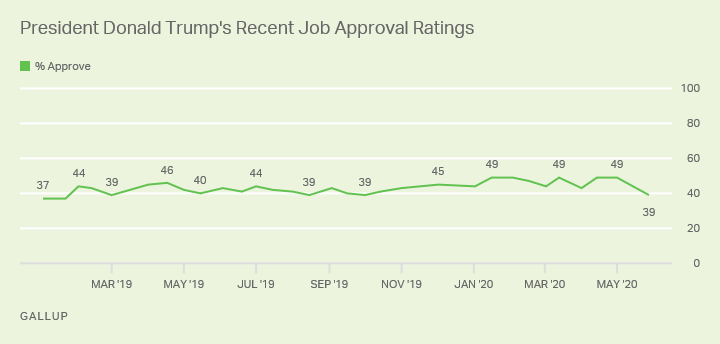
Yesterday, Gallup released a new poll that shows Trump's job approval cratering, down to 39% for the week ending June 4. "His current level of approval," they wrote, "would make another term as president unlikely, given the historical relationship between job approval ratings and incumbent reelection. With five months to go before Election Day, there is still time for those ratings to improve and get back near the 50% level associated with incumbent reelection in the past, but also time for them to get worse and give the president even longer odds of winning a second term."


Just as Gallup was releasing their bad news for Trump, Politico released the latest in-depth Morning Consult survey, which also looks disastrous for an incumbent president. Among registered voters, 39% approve of Trump, while 58% disapprove (47% of them strongly.) Furthermore no one likes the members of two of Trump's key demographics. Only 4% have a favorable opinion of neo-Nazis (81% have an unfavorable view) and just 5% like the most important component of the Trump coalition-- white supremicists-- while 84% have an unfavorable opinion. And compared to other high-profile politicians, Trump looks like a loser. These are the net approval ratings
Mitch McConnell- minus 25%
Señor Trumpanzee- minus 18%
Republicans in Congress- minus 18%
Nancy Pelosi- 36% (52%) minus 16%
Kevin McCarthy- minus 15%
Chuck Schumer- 26% (40%) minus 14%
Mike Pence- 40% (46%) minus 6%
Democrats in Congress- minus 6%
Elizabeth Warren- minus 1
Joe Biden- 46-46% (neutral)
This has hurt the notoriously thin-skinned and ratings obsessed Señor T's feelings. So he's suing CNN. He had an attorney for his campaign serve them with a cease and desist order, demanding they retract (and apologize for) a poll with results very much like the two from Gallup and Morning Consult. The CNN poll shows Trump with a 38% approval rating and shows Biden beating him 55-41%. CNN laughed at his cease and desist letter, delighted with the publicity.

Republicans in Congress-- especially those up for reelection-- don't find it laughable. Two Washington Post stories in recent days says it all: What Keeps Senate Republicans From Ditching Trump? and Republicans Fear Trump's Weakened Standing Jeopardizes The Party In November. In the latter piece, Bob Costa and Phil Rucker wrote that "there is no sign yet of a mass exodus from the runaway Trump train. If anything, most elected Republicans see themselves as prisoners onboard, calculating that jumping off would lead to almost certain defeat. Conversations at the highest ranks of the party have reached what one veteran operative called the 'acceptance phase of grieving,' where 'there is an understanding that he’s president until at least November, and there is not much we can do about it.' … Strategists over the past week have suggested myriad ways embattled incumbents could tiptoe around Trump’s rolling controversies, as opposed to embracing them."

House districts tend to be more polarized than most entire states are and House incumbents are generally thereby rendered safer. But in another huge anti-red wave year, Republicans who are usually unconcerned about what voters think, are nervous now. I asked Mike Siegel, who nearly beat McCaul in 2018 and is back to finish the job, why McCaul should be worried. "When Joe Biden is polling close to even in Texas," he said, "that signals doom down the GOP ballot. For years office holders like McCaul relied on the 'straight ticket'-- an option in Texas where voters could press one button to select one party in every partisan race. In this way, the gubernatorial and presidential candidates meant everything, and if you were luckily enough to win the nomination in the right district with a decent candidate at the top of the ticket, you rode in without much effort. Now, in 2020, we no longer have straight ticket voting (the GOP legislature repealed it, in a move they may regret), and Republicans like McCaul are faced with the twin challenges of building name ID while avoiding the albatross of Trump. It’s an impossible quest in TX-10. McCaul is already sounding the alarm, telling his donors this is a 'toss up' race. The cavalry is not coming-- he hasn’t kissed up sufficiently to the White House, so Trump won’t help, but he’s simultaneously too right wing and Trump-compromised (family separation, impeachment, COVID-19) to earn moderate support. It’s a perfect storm and we are ready to take advantage."

Goal ThermometerAudrey Denney had similar thoughts about her race in rural northeast California, where Oregon, Nevada and California all meet up. She told me that Trump enabler Doug LaMalfa "is actually running a campaign for the first time in his 18 years of holding elected office. He’s feeling the pressure and we’re feeling good!"

After Tuesday confirmed that Cathy Kunkel is the Democratic nominee in West Virginia's least red congressional district she told me that "With Trump's approval down in West Virginia, Alex Mooney may be forced to actually run on his record, instead of relying on the down-ballot effect high Republican turnout for Trump. And his record is not a good one: voting to take away healthcare from tens of thousands of West Virginians in his district by supporting repeal of the Affordable Care Act, voting in favor of tax cuts for the wealthy, and voting against the Families First Coronavirus Relief Act.


Labels: , , , , , ,

Tuesday, June 02, 2020

For The Working Class, The Democratic Party Is Still A Bit Better Than The GOP

>


In 2018, the DCCC successfully perpetrated the myth of the Blue Wave. That kind of p.r. is part of their job. The problem is, they believed it. And the results reinforced that mightily. There were 41 seats that flipped from red to blue. In 2016, the House Dems hadn't done badly. Even with an apparent Trump victory, they had managed to flip 6 seats and they increased their national congressional vote margin by 2.5%. In 2018, though, House Democratic candidates won 60,572,245 (53.4%) to 50,861,970 (44.8), as the GOP share of the vote plummeted 4.3%. The Dems increased their swing by 5.4%. That's a wave. But a Blue Wave? I've never thought so.

The DCCC recruited a huge pile of worthless garbage candidates with nothing to offer other than not being Republicans-- even if some of them actually were Republicans who were trying to rebrand themselves as Democrats (like Harley Rouda and Gil Cisneros in Orange County). Voters were ready to punish Trump for his first two years of excruciatingly bad governance. But he wasn't on the ballot... and they took stout on GOP congressional incumbents and on Republicans candidates. Dozens of Republicans sensed what was headed their way and retired before the election, including incumbents whose seats were ready to flip (and, in fact, did flip: Ed Royce (CA), Darrell Issa (CA), Ileana Ros-Lehtinen (FL), Lynn Jenkins (KS), Dave Trott (MI), Frank LoBiondo (NJ), Rodney Frelinghuysen (NJ), Steve Pearce (NM), Ryan Costello (PA), Pat Meehan (PA), Charlie Dent (PA), Bill Shuster (PA), and Dave Reichert (WA).

Then 30 Republican incumbents lost their reelection runs including notable Republicans Pete Sessions (TX, former head of the NRCC), Dana Rohrabacher (CA & Moscow), Dave Brat (VA), Barbara Comstock (VA), John Culberson (TX), Erik Paulsen (MN), Rod Blum (IA), Pete Roskam (IL), Mike Coffman (CO) and Steve Knight (CA). None of them had good opponents. In fact, almost no red to blue flips were by good Democrats. Those flips were anti-Republican flips... anti-Trump voters. There was a wave alright... but it was an anti-red wave, not a blue wave.

Yesterday, writing for the Washington Post, Mike DeBonis surveyed the lay of the land in terms of the upcoming House elections and concluded 2020 isn't going to be a good year for the GOP. He has no idea how bad it's going to be though, as anti-red wave II is gathering strength. The seat the NRCC wants to point to to frame the election is CA-25, the L.A./Ventura County seat the Steve Knight lost to weird New Dem Katie Hill in 2018 and was just won by a Republican in a special election. Hill had been forced to resign in a twisted and lurid sex scandal and the DCCC immediately recruited the worst possible candidate to replace her-- another worthless conservative, barely a Democrat, who was meant to remind voters of... Katie Hill, who most voters wanted to forget about. She was as unfit for office as Hill had been-- and the voters knew it and, despite it being a blue district with a Democratic registration advantage, the Republican won. DeBonis wrote that "When Republican Mike Garcia won a Southern California special election in May-- reclaiming a district Democrats had flipped only 18 months prior-- he gave the House GOP its most encouraging piece of political news since President Trump was sworn into office. The good news might end there. While Trump, Minority Leader Kevin McCarthy (R-CA) and other GOP leaders have heralded Garcia’s May 12 win as proof that they can win the House majority this year, many other indicators suggest that it will be exceedingly difficult to unwind Democrats’ 17-seat majority come November."

Yeah... and someone should explain to DeBonis that the GOP is more likely to lose 17 seats than to pick up a net of even one! That will be in his October column about the elections though. Now, it's just the Inside the Beltway metrics... "Vulnerable Democratic incumbents have massively outraised their Republican challengers, national GOP groups have yet to show the ability to make up the fundraising gap, and in several key districts, some of the party’s most coveted recruits have opted not to run. Public opinion polls, meanwhile, indicate a Democratic advantage on the congressional ballot in line with what the party enjoyed in 2018, ahead of their sweeping national gains." He is happy to admit this is all Inside-the-Beltway palaver: "Multiple nonpartisan forecasters, in fact, have worsened their outlook for House Republicans in recent weeks, arguing that those structural disadvantages, plus national political head winds for Republicans, will limit GOP House gains-- and potentially allow for further Democratic pickups." I question the use of the word "sincerely" by Gonzales below:
“Republicans sincerely believe that 2018 was a high-water mark for Democrats, that it is just not possible that Democrats can improve on their 2018 performance, and I don’t know that that’s true,” said Nathan L. Gonzales, editor and publisher of Inside Elections, who recently declared the California result an “outlier” and predicted that the November election would leave the House “close to the status quo” with no more than five seats changing hands between parties.

GOP leaders see the math differently. Garcia’s win, they argue, shows that Republicans can be competitive in the suburban battlegrounds where Democrats built their majority two years ago-- on top of the 30 Democratic-held districts where Trump won in 2016.

“If we can win in the Los Angeles suburbs, we can win anywhere and everywhere we need to win in the fall,” said Rep. Tom Emmer (R-MN), chairman of the National Republican Congressional Committee (NRCC), citing 43 Democratic seats with a heavier GOP tilt than Garcia’s.
Democrats didn't turn out for the special election. Among other things, Latinos, who make up a big part of the Democratic coalition in CA-25, were confused because the Republican was named Garcia and the Democrat was named Smith. And in the third of the district that lies in the Antelope Valley, she was disliked anyway for her support of putting homeless people in her Assembly district on a bus with a one way ticket to... the Antelope Valley. So they abstained. As horrible as Smith is-- and she's about as bad as a DCCC recruitment can be-- she'll probably win in November in the anti-GOP wave that catches Garcia.
Democrats and nonpartisan analysts are quick to quibble with that arithmetic-- starting with the size of the mountain Republicans have to climb. While the gap is now 17 seats, the margin is certain to be wider. A court-ordered mid-cycle redistricting in North Carolina created two additional safe Democratic seats in that state, and the retirement of GOP Rep. Will Hurd has opened a prime Democratic pickup opportunity in South Texas.

Meanwhile, Democrats are eyeing potential gains elsewhere, including suburban districts outside Dallas and Houston where GOP incumbents are retiring, as well as near-misses from 2018 in central Illinois, southern Minnesota and suburban Atlanta.

That means Republicans may have to flip three or more Democratic seats before they even begin to cut into the current majority, and they face serious head winds in doing so. The most easily quantifiable obstacle is money: More than two dozen Democrats have raised more than $2.5 million each, easily lapping their Republican challengers in all but a few cases.

Data compiled by the Cook Political Report’s David Wasserman found that, as of March, in the 55 top races targeted by the NRCC, the median Democratic incumbent had raised more than six times what the median leading Republican challenger had raised. And that was before the coronavirus pandemic upended political fundraising, making it more difficult for those behind to catch up. Wasserman declared the GOP’s path to the majority as “slim to non-existent” earlier this month.

Outside Republican groups such as the NRCC and the Congressional Leadership Fund are likely to raise tens of millions of dollars to supplement individual campaigns, but those groups have also been trailing their counterparts at the Democratic Congressional Campaign Committee (DCCC) and the House Majority PAC.

Republicans have heavily touted star recruits in several districts-- starting with Garcia, a former Navy fighter pilot, son of immigrants and first-time political candidate who skillfully positioned himself as a fresh alternative to his Democratic opponent, state lawmaker Christy Smith. Wesley Hunt, an African American former Army officer, is challenging freshman Rep. Lizzie Fletcher in Texas, and Michelle Steel, a Korean American county official, is running against Rep. Harley Rouda in Orange County, Calif.

“A record number of women running, a record number of minority candidates, 240-some military veterans-- these are people with great résumés, and the vast majority of them don’t have voting records,” Emmer said. “It’s basically the Democrats’ 2018 playbook that we’re using.”

But some of those diversity gains have been offset by setbacks elsewhere. Democrats were delighted when GOP voters nominated Jim Oberweis, a conservative former state senator, over two women to face Rep. Lauren Underwood in an exurban Chicago district Trump won by four points. And just this month, party officials moved to distance themselves from Ted Howze, the Republican facing Rep. Josh Harder in a competitive central California district, after Politico reported on racially offensive Internet postings made under Howze’s name [by Howze].

And on Tuesday, forecasters are closely watching the outcome of the GOP primary in Iowa’s 4th District, where Rep. Steve King is facing a strong intraparty challenge after making racially offensive comments, prompting Republicans to strip him of his committee assignments. A King win, forecasters agree, would leave the seat vulnerable to Democrat J.D. Scholten, who came within three points of beating King in 2018.

Meanwhile, Republicans are likely to go into November with less-than-ideal candidates in several other races. In New York’s 19th Congressional District, which Trump won by seven points in 2016, no credible GOP candidate has emerged to challenge freshman Rep. Antonio Delgado (D). In Michigan, top potential Republican candidates failed to challenge Reps. Elissa Slotkin, who has raised $3.7 million to defend a district Trump previously won by seven points, and Haley Stevens, who has raised $2.5 million in a district Trump won by four.

The difficulties for Republicans have been on display in Utah’s 4th Congressional District, centered on Salt Lake City, where Trump won by seven points in 2016. It leaped to the top of GOP target lists after Democrat Ben McAdams beat GOP Rep. Mia Love in 2018. The NRCC initially backed popular state Sen. Dan Hemmert, who quickly raised more than $400,000. But Hemmert backed out weeks later, citing the demands of a high-profile campaign.

“It’s not the right time. I don’t know what to say,” he told the Salt Lake Tribune in December.

McAdams, meanwhile, has raised $2.8 million for his reelection campaign and had $2.2 million left to spend as of early April. The best-funded Republican candidate, state Rep. Kim Coleman, had about $115,000 in the bank at the same point.

Meanwhile, it’s unclear if potential GOP attacks against McAdams-- highlighting his vote for Trump’s impeachment or tying him to far-left Democratic figures-- will even resonate in a post-pandemic political environment. McAdams, who recently emerged from a bout with the coronavirus, said Thursday he was focused on helping his constituents and not getting caught up in partisan politicking.

“One thing I have going for me is that I work harder than anybody else in the race, and I think a lot of people who were looking at the race knew that it was going to be hard to outwork me,” he said Thursday.

While there is anecdotal evidence that presidential-year turnout will improve for Republicans with Trump on the ticket, there is little sign that public opinion about control of Congress has shifted since 2018. Democrats won the national House vote in 2018 by about eight points; a Monmouth poll released this month gave them a 10-point lead nationally, and other recent “generic ballot” polls have been in a similar range.

Hopes of outsize GOP gains largely rest on Trump’s ability to keep the pandemic at bay and recover his political standing in the coming months, giving him the ability to drag underfunded candidates across the finish line on Nov. 3.

“President Trump won most of the seats that are on the battlefield now-- all he has to do is win them again,” said Rep. Steve Stivers (R-OH), a former NRCC chairman. “And so I don’t know if he’ll match his performance from 2016, but if he does, we win the majority.”

But Rep. Cheri Bustos (D-IL), chairwoman of the DCCC, expressed complete confidence in an interview Wednesday, calling Garcia’s win “not a sign of anything” and predicting that Smith would best Garcia in the higher-turnout November election.

Bustos pointed to her party’s fundraising advantage, GOP recruiting woes and a proven Democratic message on health care-- “I’d much rather be the party of health care than the party of drinking bleach,” she said, referring to Trump’s recent musings about injecting disinfectant-- as underpinning that confidence.

“It’s literally failure and failure after failure for them, whether it’s the money, the messaging or the mobilization,” Bustos said. “By every measurement, I feel really good six months out.”
Cheri & Rahm
Cheri Bustos feels good-- all those shit candidates she's recruited seem just like her and the other worthless, hated neo-liberals who have turned the Democratic party into a sewer that only exists because it's slightly less odious and toxic than the Republican Party. When I first met Ari Rabin-Have he was working for Harry Reid, although he soon migrated towards Bernie. Over the weekend he wrote a piece for Jacobin, Coronavirus’s Devastation Has Been Made Far Worse by Years of Democrats’ Neoliberal Policies, which should help anyone understand why the Cheri Bustos/Pelosi/Hoyer wing of the party is leading the Democrats down the road to disaster. [Prediction in January, 2023, there will be a Republican Speaker of the House again.] "Coronavirus," he wrote, "isn’t only exposing Donald Trump’s incompetence. The crisis is laying bare the consequences of the neoliberal economic agenda corporate Democrats have been pushing for decades." He explained how "Instead of examining the very real pain felt by workers in our economy over decades... the upper echelons of Democratic Party economic policymaking... hide behind broad macro numbers and use them to avoid confronting the economic hardship caused by the very systems they helped create."
Manufacturing workers watched as their jobs were outsourced in the aftermath of NAFTA and other bad trade treaties, while leaders in the Democratic Party either ignored their plight, claimed we were trading low-wage jobs for higher-wage ones, or falsely promoted the promise of programs like the Trade Adjustment Assistance which never lived up to the hype.

Factories closed, communities were gutted, and good jobs were nowhere to be found. Yet the economic thought leaders in the Democratic Party continued to paint rosy economic scenarios... A certain set of Democratic policymakers and strategists would like to pretend that the only thing exposed by the COVID-19 pandemic is the utter incompetence of Donald Trump. What they would like to ignore is that the crisis we are in has laid bare the consequences of the neoliberal economic agenda [Jason] Furman and his ideological allies have been pushing for decades.

They fought mercilessly in 2019 for a health care system where insurance coverage was tied to employment. In the 1990s they scaled back welfare programs. They pushed policies that tied educational advancement to personal debt and an international trade system whose supply chain is over-reliant on foreign manufacturing, in particular in China.

Each of these steps were taken under the advisement of wonderfully written economic studies claiming broad economic benefits for the country. In truth the opposite occurred, and the economic pain of the current crisis has been magnified because of them.

Earlier this month, the Biden campaign was promoting the notion of an “FDR-size presidency” under the rationale that the Democratic nominee needs to meet this moment. For centrist policymakers this was the threat they thought had been defeated in the primary.

Furman, on the other hand, wrote an op-ed in the Wall Street Journal in early March making his case for a “big coronavirus stimulus.” Big to Furman amounted to a laughably small $350 billion program.

Furman is not worried that Trump’s campaign will successfully be able to sell an economic miracle. Instead he and other centrist policymakers’ greater fear is that the economic conditions of the Great Depression would steer the Biden campaign and administration toward bolder economic policies. While thus far there is little evidence of this, even deploying progressive rhetoric is too much for the centrist establishment.

Furman’s former boss, Obama White House chief of staff Rahm Emanuel, who has been privately advising the Biden campaign, explained this to David Axelrod on his podcast this week. “The moment may call for it, and I’m a big believer in never allowing a crisis to go to waste, but the whole primary was a couple people in our party talking about a revolution and a couple people in our party talking more reform than revolution,” he said. “And what Biden is now saying is, ‘Well, the post-COVID world requires a revolution,’ and I’m surprised, because he did not win on the revolution model. He won on the reform model.”

Emanuel continued, “I’m not sure revolution is going to be reassuring to Southfield, Michigan; Bloomfield, Michigan; the suburbs out of Milwaukee; the suburbs in Phoenix.”

Axelrod replied that Biden’s policies should be “packaged as pragmatic answers to the crisis.”

Cheri & Debbie
The notion that people who are out of work, without health care and not knowing how they are going to put food on the table, are not seeking help but instead political pragmatism is ludicrous. It is yet another example of centrists ignoring economic pain because they fundamentally support a politics where “nothing will fundamentally change.” This is what they were promised by Joe Biden’s campaign. But if they acknowledge that the economic fallout from the coronavirus could lead to a second Great Depression, then the logical policy response is a second New Deal, and that promise would be broken.

Instead Furman suggests a Democratic response fundamentally based on accepting a false reality. He knows that Donald Trump will campaign saying he has built the greatest economy in American history. Regardless of data, the president was always going to make that claim, and Fox News and his other propaganda organs would dutifully tout that party line.

That is how fearful the centrist establishment is of progressive policy change. They would rather ignore the real pain of working people and cower to the phony economic posturing of Donald Trump than confront corporate power.

Labels: , , , , , , , , ,

Friday, May 01, 2020

Most Professional Political Prognasticators Said The Senate Was Out Of Reach For The Democrats But They're BeginningTo Admit They Were Wrong

>


2020 will be another big anti-red wave. The media isn't talking about it yet-- they're a lagging indicator-- but they will, and when they do, they will demonstrate how clueless they are by dubbing it a "blue wave," which it certainly won't be.

The video above was made by The Lincoln Project, a cabal of #NeverTrump Republicans-- George Conway, Jennifer Horn, Steve Schmidt, John Weaver, Rick Wilson, Mike Madrid, etc. In their mission statement they wrote that their goal is defeating Trump and Trumpism at the ballot box. "We do not undertake this task lightly nor from ideological preference. Our many policy differences with national Democrats remain. However, the priority for all patriotic Americans must be a shared fidelity to the Constitution and a commitment to defeat those candidates who have abandoned their constitutional oaths, regardless of party. Electing Democrats who support the Constitution over Republicans who do not is a worthy effort." Perfect for Justin Amash? Uh... no. they happily endorsed conservative, Status Quo Joe while spending money attacking Trump:


And now, as you can see in the video up top, they are also attacking vulnerable Republican senators, in this case Susan Collins (ME), Thom Tillis (NC), Cory Gardner (CO) and Martha McSally (AZ), the 4 of whom are the key to putting Chuck Schumer in charge of the Senate instead of Moscow Mitch. That's a big move for a bunch of life-long Republicans, more than just standing up to Trump. But it isn't #NeverTrumpers that are going to make the difference in the Senate and House races; it's millions of independent voters and the size of the Democratic turnout-- even with an incredibly bad Democratic candidate at the top of the ticket and mostly mediocre (at best) Democratic candidates in down ballot races. 2020 will be a referendum on Trump and his enablers in the Republican Party. The GOP risks more than Trump falling off the COVID-cliff; they risk him dragging the rest of the party over with him-- senators, Congress members, governors, state legislators... As Ben White wrote for Politico on Tuesday, "Republicans are trying to pull off a high-wire act over the next three months: Reopen the economy enough to get most jobless Americans back to work and off the public dole, while resisting another giant stimulus package. If they fail, they’ll face a coronavirus cliff-- an even deeper collapse in spending and sky-high unemployment in the months before Election Day. That could both damage President Donald Trump’s reelection prospects and put the party’s Senate majority at serious risk."

Goal ThermometerYesterday, Kyle Kondik's report for Sabato's Crystal Ball looked cautiously-- cautiously being the operative word for the always-a-month-behind Sabato operation-- beyond the Core Four highlighted in the Lincoln Project ad. "[T]he map may be expanding," ventured Kondik. "Democrats’ best bet among the other targets probably is Montana, but we still see a small Republican edge there." They moved Alaska Republican Dan Sullivan, who hasn't filed to run yet and probably won't, from Safe to Likely in his race against Dr. Al Gross, an Independent running as a Democrat. And they did the same with Lindsey Graham in South Carolina, which is just silly and pointless.

Since Alabama Democrat Doug Jones isn't likely to be reelected, the Democrats have to win Arizona, Maine, North Carolina and Colorado and the vice presidency, to send McConnell packing.
The best Democratic target right now outside the core four is Montana, in our view. Its emergence as a Senate battleground represents the best argument, for Democrats, that they are truly expanding the Senate map beyond the core four.

Gov. Steve Bullock’s (D-MT) late entry into the race last month prevented first-term Sen. Steve Daines (R-MT) from coasting to reelection: We were prepared to move the race to Safe Republican prior to Bullock’s entry; we now list it as Leans Republican.

Based on what we can piece together, the race seems like it’s neck and neck at the moment. But does that actually make it a Toss-up? We are not quite there yet.
They should be there-- and will be by June-- because that's what it is. The only current public polling available-- PPP's March 19 survey-- showed Governor Steve Bullock exactly tied with Senate incumbent and Trump enabler Steve Daines, 47-47%. Cook and Inside Elections, like Sabato, rate the race "leans Republican." In 2018 Democrat Jon Tester-- who isn't as popular as Bullock-- beat Republican Matt Rosendale 253,876 (50.3%) to 235,963 (46.8%).


Kondik uses history to suggest Bullock will lose: "[I]t is very rare for an incumbent senator to lose reelection while that senator’s party is winning the state for president. There are only four examples of that happening in the last seven presidential election cycles, and there were confounding circumstances in three of those four races. Donald Trump would really have to crater in order to lose Montana, which he carried by 20 points in 2016." Like I said, by June Kondik will change his rating to "Toss-up."

Trump did well against Hillary in 2016-- 274,120 (56.5%) to 174,521 (36.0%), but she was an exceptionally bad candidate for the state and didn't campaign there. Since the inauguration, the Morning Consult Trump Tracker has seen Trump's job approval rating collapse by a mammoth 18 points and his lead now (Feb 20, pre-pandemic) is 52% approve, 46% disapprove, a 6 point net approval. Expect that to head underwater in their next report. (In November it was underwater, 48% approve, 49% disapprove.)

An even worse rating for Sabato is their leans Republican for Joni Ernst. The 5-way Democratic primary is still month away. Michael Franken is probably the best shot the Democrats have to take the seat but Schumer recruited the worst shot, conservative nothing Theresa Greenfield, Ernst's best shot to hold on. Trump won the state 798,923 (51.8%) to 650,790 (42.2%) in 2016 but a better number to look at would be 4 Iowa congressional district races in 2018, after voters had already decided they hate Trump. (The Morning Consult Tracker showed Trump underwater already in February. His net approve numbers had gone down 14 points since he was inaugurated and now stand at 46% approving and 51% disapproving, negative 5.) In 2018 extremely mediocre congressional candidates defeated 2 GOP incumbents. Statewide, so combining all 4 district results, 665,676 voters chose the Democrats and 612,338 chose the Republicans, a catastrophic GOP result, likely to be as bad or worse in November for Ernst. Ernst's approval rating has followed Trump's down the toilet, the latest poll showing her down 10 points since last year.


Both Senate seats are open in Georgia, a special election where the bitterness among appointed, crooked Senator Kelly Loeffler (R-GA) and extremist sociopath Rep. Doug Collins (R-GA) is further poisoning the well for Republicans. Rev. Raphael Warnock has a good shot there. The other seat, held by David Purdue (R), is up in the air because of a murky primary. Former Columbus mayor Theresa Tomlinson would be the best bet to beat Purdue but the establishment prefers a centrist order-taker, either "ex"-Republican Sarah Riggs Amico or careerist looser Jon Ossoff. As of the March 31 FEC deadline, Tomlinson had spent $1,631,918, to Ossoff's $1,533,898 and Amico's $1,074,393. The primary is on May 19.

Other states Democrats have slight chances to win away from Republicans-- if and only if the wave is big enough-- are Alaska, Kansas, Kentucky and West Virginia. The Blue America 2020 Senate page can be accessed by clicking on the thermometer above.


Labels: , , , ,