Wednesday, August 22, 2018

Wells Fargo-- The Anti-Medical Marijuana Bank-- Strikes Again

>


There was some excellent news out of Florida, where the primaries are next Tuesday. The progressive in the race, Tallahassee mayor Andrew Gillum, is surging into first place. A new poll shows him with 33% while his two closest rivals, conservatives Gwen Graham and Philip Levine are each down to 22% and the other progressive in the race, Jeff Greene, is languishing at 10%. Gillum's message is finally resonating and Democratic voters are realizing he isn't just another garden variety lesser-of-two evils Democrat. He's touring the entire state and just did raucous overflow rallies with Bernie Sanders in Tampa (above) and Orlando, giving Florida voters a chance to see what dynamic, bold progressive leadership looks like.

But not all the new was. Right at the time Elizabeth Warren was delivering her sweeping anti-corruption proposal, I learned about another Wells Fargo outrage. Wells Fargo has long been one of the most corrupt banks in America, making a business of ripping off their customers. No one should be banking with them but Nikki Fried, Democratic candidate for agriculture commissioner was. Was. No more. Wells Fargo told her to take her business elsewhere because of her advocacy and interaction with the medical marijuana industry. Medical marijuana is legal in Florida, despite GOP efforts to defy the will of Florida voters.
“They told me my account was being flagged because of my political platform,” Fried said during a news conference at the Capitol. She lists greater access to medical marijuana as one of the main issues of her campaign.

Many large banks have refused to do business with the burgeoning industry of legal marijuana. While some states have legalized it for medical or recreational purposes, it remains illegal under federal law to grow, sell or possess marijuana.

“It is Wells Fargo's policy not to knowingly bank or provide services to marijuana businesses or for activities related to those businesses, based on federal laws under which the sale and use of marijuana is illegal even if state laws differ,” Wells Fargo spokesman Michael Gray wrote in an emailed statement in which he did not answer a series of questions sent to the bank about the matter. “We continually review our banking relationships to ensure we adhere to strict regulatory and risk guidelines.”

Fried says Wells Fargo took it a step too far when it asked her end the banking relationship.

“I’m a candidate. I have a right to be heard,” Fried said. “I am not touching the plant, I am not selling the plant, I’m not producing the plant. I’m simply advocating for the expansion of medical marijuana.”

Fried provided emails, starting on July 11, from Wells Fargo employees asking if she would be receiving donations from the medical marijuana industry.

“Can you confirm the types of transactions expected for this customer and if any of the transactions will include funds received from lobbyists from the medical marijuana industry in any capacity?” Antoinette Infante, Wells Fargo senior relationship manager, wrote to Fried campaign treasurer Gloria Maggiolo.

After Fried campaign officials confirmed they would receive funds from the industry, and that Fried herself was a former lobbyist for the industry, the bank called on Aug. 3 to say the account would need to be closed. An Aug. 14 letter followed, giving the campaign 30 days to end the account.

The Fried campaign switched its funds to BB&T Bank. A political committee supporting Fried, Florida Consumers First, also switched its funds to BB&T.

As of Aug. 10, Fried’s campaign has received at least $7,500 from medical marijuana industry executives and employees, including $3,000 from Jake Bergmann, CEO of Surterra Wellness, one of the companies licensed by the state to sell marijuana for medical uses. Florida Consumers First has received $50,000, including $35,000 from Bergmann.

Fried said she hasn’t heard of any other candidate in the country having their bank suspend their account over medical marijuana industry donations. Since the race for Florida agriculture commissioner isn’t a high-profile race nationally, she suspects someone alerted the bank to the issue, but wouldn’t speculate who it was.

Labels: , , , ,

Saturday, December 09, 2017

Did Wells Fargo Rip You Off? Mick Mulvaney, Trump's Pick To Head The CFPB, Says "Too Bad"

>

3 crooks: Wells Fargo CEO Tim Sloan flanked by Trumpanzee & Mulvaney

There was a bit of a stir over Wells Fargo yesterday morning, Trump's exceedingly and sour joke of a CFPB director, Mick Mulvaney, started it. A little background: "In September 2016, Wells Fargo admitted that its cutthroat culture and hyperrealistic sales goals led employees to open some 2 million fake bank and credit-card accounts in customers’ names without said customers’ permission, a number the bank has now adjusted to roughly 3.5 million. In July, it admitted to charging 800,000 people for auto-insurance they didn’t need, which may have resulted in 20,000 wrongful repossessions. In August, it agreed to pay $108 million to settle allegations that it charged military veterans hidden fees to refinance their mortgages. And last month, it announced that its foreign-exchange business was under 'new management' around the same time bankers in its forex operation were revealed to have overcharged hundreds of clients. In short, Wells is the Usain Bolt of ripping off customers. As such, it has also become a prime example of the very real need for the Consumer Financial Protection Bureau. But now that the guy in charge of the agency is the same one who once co-sponsored legislation to abolish it, the bank can potentially rest much easier."
Back in October, Wells said it would issue refunds to approximately 100,000 homebuyers who were wrongly charged fees to lock in fixed-rate loans between between September 2013 and February 2017, and in November, the C.F.P.B. set settlement terms that were approved by Obama-era appointee Richard Cordray. According to Reuters, that proposal “envisions a Wells Fargo payout of tens of millions of dollars.” Though the conclusions of Mulvaney’s review are still unclear, the fact that he once called the bureau a “sick, sad joke” likely does not bode well for Wells customers hoping to receive payouts.

Mulvaney’s installation at the C.F.P.B. is part of movement by Team Trump to ease up on Wall Street and the banking industry, which they believe has been treated just so, so unfairly. On the campaign trail, Trump told voters, “I know Wall Street. I know the people on Wall Street. . . Wall Street has caused tremendous problems for us. I’m not going to let Wall Street get away with murder.” But as the New York Times recently noted, Treasury Department officials are working to help firms to avoid being hit with the dreaded “too big to fail” tag, which results in strong oversight.

...Last week, Mulvaney said that he would “try and limit as much as we can what the C.F.P.B. does to sort of interfere with capitalism and with the financial services market.” That may not be great news for those Wells Fargo has made a cottage industry of ripping off, but for the San Fransisco bank, it’s Christmas come early!
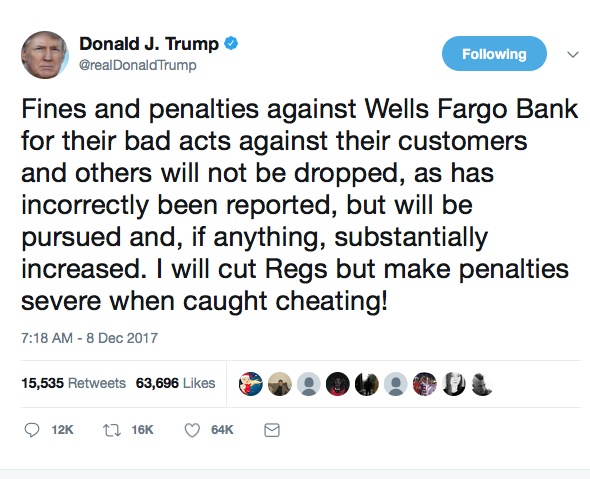
That started a stir and Trumpanzee himself jumped into the fray with this early morning tweet sure to piss off Mulvaney:


Meanwhile, the Trump Regime had a clear vision of what they had in mind in replacing Rich Cordray at the CFPB with Mulvaney. Allied Progress put out some valuable research this week showing how the Regime is already turning an organization built around protecting consumers into one that Mulvaney is leading towards harming consumers while helping banksters, predatory lenders and Wall Street special interests.
Mulvaney is Going to Pair Independent Government Regulators at the CFPB with Political Staff – A Move Experts Say Threatens the Independence of ALL Financial Regulators: Mulvaney said “he plans to start hiring political staffers, and to pair them with the career officials who currently head various CFPB divisions.” But “Congress designed the CFPB to be an independent agency in the mold of the Federal Deposit Insurance Corp., the Office of the Comptroller of the Currency and the Federal Reserve Board. Those agencies typically have far fewer political appointees than other parts of the executive branch.” As one expert put it, “Mulvaney’s plans ‘should send shivers down the spine’ of anyone who supports independent financial regulation.” [Kevin Wack, “Mulvaney’s plan to embed political staffers in CFPB sparks backlash,” American Banker, 12/5/17.]
Mulvaney Could Shelve a CFPB Investigation into a Giant Spanish Bank (Santander) for Overcharging Auto Loan Customers-- a Longtime Mulvaney Staffer Lobbies for the Bank: The CFPB has been investigating Santander “for overcharging auto loan customers. Given the tenor of recent conversations inside the bureau, agency lawyers suspect the investigation could be shelved under Mr. Mulvaney, according to four people with knowledge of the case who requested anonymity to discuss an investigation.” In 2017, longtime Mulvaney staffer Natalee Binkholder “left Mulvaney’s office to work as a top lobbyist for Santander” where she has actively worked against CFPB rules. [Jessica Silver-Greenberg and Stacy Cowley, “Consumer Bureau’s New Leader Steers a Sudden Reversal,” New York Times, 12/5/17; David Sirota, “Trump Conflict Of Interest: CFPB Pick Mulvaney Linked To Lobbyist For Bank Facing Possible CFPB Sanctions,” International Business Times, 11/26/17.]
Mulvaney is Going Easy on an Ohio-Company Which Misled More Than 100,000 Mortgage Customers and Faced an $8 Million Penalty: A federal judge agreed with the CFPB that Ohio-based Nationwide Biweekly Administration “misled more than 100,000 mortgage customers” and ordered the company to pay “$8 million in penalties.” Seeking to collect the penalty so that harmed consumers could be compensated, the CFPB sought to force the company to post a bond while proceedings in the case concluded. “Barely 48 hours later,” under Mulvaney, the CFPB reversed course. [Jessica Silver-Greenberg and Stacy Cowley, “Consumer Bureau’s New Leader Steers a Sudden Reversal,” the New York Times, 12/5/17.]
Mulvaney is Freezing CFPB Data Collection Which is Used to Protect Consumers from Discrimination and Other Industry Misconduct: Mulvaney froze the CFPB’s collection of consumer data, ostensibly “due to cybersecurity concerns.” The Government Accountability Office (GAO) had previously concluded that “the CFPB has taken steps to ‘protect and secure’ the data it collects,” including by “‘anonymizing’ the material involving identifiable individuals.” Data collection helps the CFPB “identify discrimination and other industry misconduct, and can serve as a basis for writing rules.” A CFPB official said that data is “‘essential for effective financial regulation'” and “‘allows regulators to see how markets are functioning and monitor the impact of rules.'” [Yuka Hayashi, “New CFPB Chief Curbs Data Collection, Citing Cybersecurity Worries,” the Wall Street Journal, 12/04/17; Benjamin Goad, “GAO: Nothing unusual in CFPB data collection,” The Hill, 09/22/14; Trey Garrison, “CFPB: Data collection practices within the norm for regulators,” HousingWire, 09/23/14]
Mulvaney Froze Payments to Victims of Financial Crime (But Reversed Himself Following Intense Public Outcry): When Mulvaney took charge of the CFPB, he said “he would suspend all payments from the [civil penalties] fund for at least 30 days, until he had a chance to find out ‘what that fund is all about.'” The move “drew a rebuke from two Senate Democrats, who sent a letter calling the move ‘inexplicable.'” The public outcry was so intense that Mulvaney reversed his freeze on “payments to victims of financial crime” after only eight days. [Stacy Cowley, “Consumer Bureau Lifts Freeze on Payments to Crime Victims,” the New York Times, 12/04/17]
Mulvaney is Dropping an Investigation into a Company Accused of Preying on Detained Immigrants: Under Mulvaney, the CFPB suspended “its investigation and request for a civil investigation demand (CID) of Nexus Services,” “a Virginia-based firm that handles immigration bonds.” The company was under investigation for preying on detained immigrants. [“CFPB reverses course, suspends CID investigation,” RESPA News,12/04/17; Michael E. Miller, “Company accused of preying on detained immigrants is under investigation,” Washington Post, 10/20/17.]
Mulvaney may be Freezing Enforcement Actions Against Predatory Financial Institutions: While Mulvaney has said that the bureau will continue to meet its legal and statutory deadlines,” he has said he is “reviewing the various lawsuits CFPB is party to” and has already “requested delays in two cases where immediate action was required.” [Andrew Restuccia, “Mulvaney imposes temporary hiring, regulations freeze on CFPB,” PoliticoPro, 11/27/17; Victoria Guida, “Mulvaney: No plans to fire CFPB rival Leandra English,” PoliticoPro, 12/4/17; Sylvan Lane, “Mulvaney says he won’t fire consumer bureau deputy director who sued him,” The Hill, 12/04/17.]
Mulvaney is Freezing the Hiring of Additional Personnel Who Would Help Hold Financial Bad Actors Accountable: On November 27, his first day at the CFPB, Mick Mulvaney “implemented a temporary freeze on hiring and new regulations.” He said that the freezes “will last for 30 days.” [Andrew Restuccia, “Mulvaney imposes temporary hiring, regulations freeze on CFPB,” PoliticoPro, 11/27/17.]

Labels: , , ,

Wednesday, October 04, 2017

What's The Matter With New Jersey?

>


Elizabeth Warren is from Oklahoma and got politically active when she had already moved to Massachusetts. Watch the video of her speaking to Wells Fargo’s chief executive Timothy Sloan at the Senate Banking Committee yesterday. She's my idea of a great senator. "At best," she told the immensely powerful and corrupt bankster, "you were incompetent, and at worst, you were complicit. Either way, you should be fired." Can New Jersey politics produce a political leader like Elizabeth Warren? Unfortunately, no. So... what's the matter with New Jersey?

The simple answer is... simple: corrupt political bosses at the heads of powerful machines. A better question is why do voters allow themselves to be trapped in this kind of pernicious system. Richard Moser tried answering at Counterpunch this week: New Jersey Is A One-Party State. He doesn't go into any history pre-Christie though. "When it comes down to what really matters-- power and money-- New Jersey is run by machine politics and the insiders know how to wheel and deal," he wrote. "Power in the Garden State is managed by a shifting alliance of political machines, ready to cut deals, share power and scratch each others back.  At least that is how its been since Chris Christie came to rule the roost." Think about this: Christie was endorsed by 60 Democratic Party officials including major machine bosses like Union City scumbag, Sen. Brian Stack, boss of the Hudson County Democratic Machine, and Essex County scumbag Joe DiVincenzo, each considered among the most corrupt men in contemporary American politics.
In one of the best pieces of investigative reporting ever written on New Jersey politics Alec MacGillis states:
Christie owes his rise to some of the most toxic forces in his state-- powerful bosses who ensure that his vow to clean up New Jersey will never come to pass. He has allowed them to escape scrutiny, rewarded them for their support, and punished their enemies. All along, even as it looked like Christie was attacking the machine, he was really just mastering it.
MacGillis continues to describe the gears and wheels:
In most of the United States, the big political machines have been broken, or reduced to wheezing versions of their former selves. In New Jersey, though, they’ve endured like nowhere else. The state has retained its excessively local distribution of power-- 566 municipalities, 21 counties, and innumerable commissions and authorities, all of them generous repositories of contracts and jobs. The place still has bona fide bosses—perhaps not as colorful as the old ones, but about as powerful. The bosses drum up campaign cash from people and firms seeking public jobs and contracts, and direct it to candidates, who take care of the bosses and the contributors-- a self-perpetuating cycle…
The relationship between Democratic machine bosses and Christie was so cozy that in the 2013 gubernatorial race the Democratic Party failed to support its own candidate, Barbara Buono.

  In her concession speech Buono thanked her supporters who:
“withstood the onslaught of Betrayal from our own party… The Democratic political bosses, some elected, some not made a deal with this governor….They did not do it for the State they did it out of a desire to help themselves.”
[One of the best and most inspiring political leaders in New Jersey then moved to the West Coast.]

The machines effectively deprive the voters of New Jersey of a free, fair and competitive election.

This time around it’s Christie that “kicks sand” in the face of the Republican candidate even thought his very own Lt. Governor. Guadagno is way down in the polls and millions short.

After Christie’s gross absenteeism during his vain run for the Presidency, Bridgegate, Beachgate,  plundering of the treasury with record giveaways to favored corporations, the protection and rescue of Exxon and the unprecedented low approval ratings to show for it, there is nothing Christie can or will do to help.

Referring to his miserable poll ratings Christie said, “Poll numbers matter when you’re running for something….And I don’t care.” He used New Jersey for his personal gain and trashed the Republican Party, but no worries, now its the Democrats turn.

The big money knows the game and former Christie donors have switched to supporting Murphy.

A Republican politician, Chris Brown, is quoted in PoliticoNewJersey as saying:
I can only speak for myself and say that I believe there has been an unholy alliance between Governor Christie and Senator Sweeney, which I don’t believe is in the best interest of the people I represent in Atlantic County or this state….”
Where are the lesser of two evils in New Jersey?

When it came time to attack workers they were one big happy family.

As reported in The Nation
[W]hen Christie launched an aggressive assault on the pensions and health-care benefits of state employees in 2011, he did so with the support of Norcross, DiVincenzo, and other Democratic bosses, whose allies in the Assembly joined the Republican governor to give him the margin he needed to pass the changes despite massive protests outside the State House by the NJEA, the CWA, and other unions.In June of that year, Wisniewski appeared on MSNBC’s Rachel Maddow Show, where he joined her in bemoaning the state of the Democratic Party and added, in regard to the pension-“reform” fiasco: “We fought real hard, but unfortunately there were some Democrats who chose to side with the Republicans on this bill.”
Some Democrats? Just the most powerful Democrats in the state.


Watch this revealing video of Joseph DiVincenzo, Democratic machine boss of Essex county endorse Chris Christie of Governor.  DiVincenzo took the opportunity to champion Christie’s attacks against workers.  DiVincenzo then accurately praises Shelia Oliver, now Democratic candidate for Lt. Governor, for moving the Christie agenda when Oliver was Speaker of the New Jersey General Assembly.

Joe DiVincenzo is Shelia Oliver’s political mentor and boss on her day job. Machine much?

New Jersey’s supreme Democratic boss is also a long-term ally of Christie. George Norcross and his brothers Phil and Donald have built their careers on the city of Camden. After 30 years of such leadership the people of Camden are desperately poor and plagued by all the problems extreme poverty includes. Read this scathing critique of Norcorss’s recent attempt to develop Camden.

George Norcross lives a life of luxury greasing Christie’s wheels and hanging out at Trump’s Mar-a-Lago where he can easily toss the $200,000 a year membership fee to rub shoulders with the rich and powerful. Camden gets poverty, crime, violence and silence. Norcross gets caviar, cash and Trump’s company.

The machine bosses decided their narrow interest was far more important than giving the people of New Jersey a real choice. And so we got Chris Christie delivered on a platter by the Democrats themselves. Now its the Democrat’s turn.

And if you think there is no payoff, then tell me why the cash-strapped state government approved a $86 million tax break for an insurance company run by-- you guessed it-- New Jersey’s most powerful Democrat, George Norcross.

Any complaints from supposed Republican Chris Christie for lining the pockets of the leading Democrat? None. One hand washes the other and the people of New Jersey get the shaft.  And the shaft is coming.

According to the Mercatus Center at George Mason University, New Jersey is ranked 50th, among US states for its fiscal health. Will Murphy repeat Corzine by making fine sounding promises followed by austerity?

There is only one reason that New Jersey-- one of the riches states in the richest country in the history of the world-- has budget problems and that, in the end, is the machine.

And Phil “Goldman-Sachs” Murphy has signaled his acceptance and alliance with the machine by appointing tried and true team player Shelia Oliver as his running mate.

Murphy does not have to run hard. The fix is in and he is way ahead on money and polls. Why have a ground game when the real game is to marry New Jersey’s old-school machine with the most greedy, ruthless players on Wall Street and on Trump’s cabinet: Goldman Sachs.

Machine meets machine, falls in love and we live unhappily ever after.

But, what is broken in Jersey can be fixed in Jersey if we have the courage and vision to restore competition, democracy and basic honestly to politics. This election we are lucky to have a real alternative with the Green Party candidates for governor Seth-Kaper Dale and Lisa Durden.

It’s time to stop voting for the bosses unless we want to be political prisoners for the rest of our lives.

Labels: , , , ,

Friday, August 04, 2017

Paul Ryan's And Trumpy-the-Clown's Vision For America Is Very Dark And Horrifyingly Kafka-esque

>


You may well have woken up yesterday to Señor Trumpanzee's tweet (below), taking-- or at least sharing-- the "credit" with congressional Republicans obsessed with destroying the consumer protections the Democrats made some terminative steps towards implementing-- despite obstruction from the corrupt Blue Dogs and even more corrupt New Dems from the Republican wing of the Democratic Party-- while they were in power. House Republicans-- led by Wall Street whores Paul Ryan ($10,328,395), Jeb Hensarling ($7,746,848), Ed Royce ($7,281,557), Pat Tiberi ($6,594,495), Kevin McCarthy ($6,528,867), Peter Roskam ($4,548,803), Steve Stivers ($4,512,937) and Patrick McHenry ($4,396,186)-- have been furiously chipping away at Dodd Frank protections. So how does this manifest itself in the real world and what does it do to real people?


Republicans-- along with their Blue Dog and New Dem allies like Joe Crowley ($6,477,659), Steny Hoyer ($6,073,548), Carolyn Maloney ($5,751,077), Jim Himes ($5,749,252) and Kyrsten Sinema ($2,015,020)-- literally want to make it easier for their bankster campaign donors, the people who finance their careers, to rip off their customers with impunity. An exaggeration? Not at all. Have you heard about the new class action law suits-- which the GOP wants to ban-- accusing Wells Fargo of racketeering and fraud involving over half a million customers of the bank they were stealing from? That's very precisely what Paul Ryan's "free market" Ayn Randian vision looks like in the real world. Wells Fargo-- caught red-handed-- now admits having charged hundreds of thousands of customers doing business with them for car loans for insurance they did not ask for or need, causing nightmares in the lives of countless Americans who have been left on the side of the road by conservatives as prey for the banksters.

After the NY Times exposed the scam, Wells Fargo begged for mercy late last week and promising to refund about $80 million to over half a million customers they were caught stealing from-- including at least 20,000 people whose vehicles were illegally repossessed. Last night I heard a personalized version of the scandal on NPR's All Things Considered.


Who Snatched My Car? Wells Fargo Did

Wells Fargo is back in the spotlight for another scandal. This time, for signing up 490,000 auto-loan customers for insurance they didn't need.

This comes less than a year after the bank generated a massive public outcry for opening millions of unwanted accounts for customers.

Customers who already had car insurance say they had no idea they were being charged for this insurance from Wells Fargo. And the bank acknowledges that tens of thousands of people wound up in default, which affected people's credit scores, and thousands had their cars repossessed.

One of them was Michael Feifer.

One morning in February, he was heading off to his job in Maryland at a company that builds guitars. He walked to the spot where he'd parked his car, but it wasn't there.

"I called the police," he says. "I was livid. I thought somebody stole my car."

Somebody had improperly made off with Feifer's car. But it wasn't a car thief. It was Wells Fargo bank. The police informed him of this when he called them. "That's when I found out it was repossessed," he says.

Feifer says he had no idea why the bank would repo his car. He says his payments were automatically taken out of his checking account.

"I've never missed a payment," he says. "My insurance was current."

So he called Wells Fargo and found out the bank had put another insurance policy on his car. Lenders do this when a borrower doesn't have insurance. Wells Fargo calls it collateral protection insurance, or CPI.

And there's nothing wrong with that, but Wells Fargo imposed this insurance on nearly a half-million people who already had insurance. The bank outlined the scope of the problems and its efforts to resolve them in a statement.

Right after Feifer's car got repo'd, Wells Fargo told him he was marked as delinquent for not paying this insurance-- which he didn't want or need or even know about. "They said, well, you owe $1,500," he says.

..."I showed up at that bank with my bank statements showing all the payments I made for my vehicle and my proof of insurance showing that I've never had a lapse in my insurance," he says. "The people at the bank were like, 'Well, you shouldn't owe anything because it's not your fault.' They were just as confused as I was."

Feifer says the branch employees were trying to be helpful. They called up the Wells Fargo department for him that deals with car repossessions to find out what was going on. They kept getting put on hold.

"We were probably on hold for a total of 2 1/2 hours while I was in there," Feifer says. "I literally spent the whole day" at the branch. He says the employees were getting frustrated too. "They're like, 'This is ridiculous. You shouldn't be on hold for this long.'"

What Feifer didn't know was that Wells Fargo had already been doing an internal investigation into complaints from lots of customers for the same insurance mix-up.

Feifer was eventually told to call back several days later. Then he was told there was no record of his prior calls from the branch. He said the person he spoke to on the phone wouldn't let him talk to a supervisor. "She was rude to me, talking over me. I felt like she wasn't willing to hear anything I had to say," Feifer says. He says the Wells Fargo representative just kept telling him he had to pay the money.

Meanwhile, Feifer was told that the clock was ticking and his car would be auctioned off two weeks from the day it was repossessed. So, after much haggling with the bank, he paid about $600 to get his car back.

Feifer said he figured this was just some freak mistake. But when he heard this insurance issue affected hundreds of thousands of customers, "I was blown away," he says. "I wasn't alone in it and I felt like they're preying on everybody, taking people's money. I felt like they're crooks."
Roland Tellis, a lawyer for the plaintiffs, doesn't want to let Wells Fargo off the hook with their attempt to pay the $80 million. "Wells Fargo has long lost the right to decide what is best for its customers... Refunds don't address the fraud or inflated premiums, the delinquency charges, and the late fees. It will be up to a jury or court to decide the appropriate remedy." And that's where Ryan and the House Republicans come in. They're trying the abolish these kinds of class law suits and doing everything they can to make it more difficult for the public-- their own constituents-- to protect themselves from this kind of predatory behavior. Traditionally, Democrats have stood up against this kind of crap-- it was FDR, for example, who popularized the term "banksters"-- but certainly since the Clinton presidency and the rise of the New Dems, the role of Democrats in this equation had become less clear, more murky. In his interview last week with David Sirota, for Thomas Franks explained why "the Democratic Party is in deep trouble... The Democrats very gradually, but definitely, abandoning the interests of working-class voters, identifying themselves instead with a more affluent group, with the affluent white-collar professionals. It starts in the 1970s with the Democrats removing organized labor from its structural position in the Democratic party, and then it goes up through Bill Clinton getting NAFTA done, the free trade deals that the Democrats have ... By the way, in my opinion, free trade or the trade agreements, I should say, was probably the issue that if there was one issue that really did Hillary in, I think that's what it was: the trade deals under the Clinton administration, Obama sort of dropping the ball on labor's various issues, doing these incredible favors for Wall Street while he blew off the concerns of union. The ultimate evidence is what's happening with inequality. It gets worse and worse and worse every year. It's very easy to show how the Democrats have forgotten about organized labor, but what is really striking is the passion that they show for the knowledge industries, which includes Wall Street, Silicon Valley, big pharma, that sort of thing."


The Democratic party [used to be] this sworn enemy of Wall Street. Franklin Roosevelt broke up all of these banks, the Glass Steagall Act, put all these banks out of business, and set up the Securities and Exchange Commission to regulate these guys, all of these regulatory measures. That's the Democratic heritage. That's the legacy of the New Deal. Up until the days of Clinton, that's really who the Democratic Party was. They had a very populist tone, and they would never identify themselves with Wall Street.

Barack Obama comes in, and I was one of these people who thought that he represented a turn back in the other direction and that he would be, very shortly would be, getting tough with Wall Street. He had all the bailouts were underway. He had total authority over these guys, and he didn't do it. Instead, he appointed all these various Clinton people to come in and manage the bailout situation.
And now we have a pipsqueak from New Mexico, as head of the DCCC, aiming to make it worse by recruiting and financing Blue Dogs and New Dems to further take over the Democratic Party. UGLY! South Bay congressman Ro Khanna has increasingly become one of the strongest and most powerful populist voices on economic issues for progressive Democrats. Last night he reminded us that "Democrats need to have a substantive platform for the middle class, not just a rhetorical one. This means standing up for labor unions. It means standing up for class action lawsuits. It means standing up for basic consumer protections and against economic concentration. We don't need fancy consultants to come up with a message. We need to stand on the side of people against powerful economic interests and be true to our roots."

Katie Porter, a respected academic who has written extensively about consumer protection and is now running against a Republican rubber stamp who opposes it-- Mimi Walters-- with Elizabeth Warren's backing, told us that "Whether we're talking about increases in outrageous banking fees, the latest Wells Fargo product scam or the fraud that occurred in the housing market ahead of the 2008 collapse, all of it has one thing in common-- Wall Street banks engaged in systemic fraud against consumers and knew Washington would let them get away with it. I witnessed this phenomenon firsthand in my own work as a consumer advocate. These banks planned and accounted for the profits they would reap from predatory actions against consumers. Companies like Well Fargo built their business model around cheating consumers! But while Washington made some headway fighting abuses after the 2008 crisis by creating the CFPB and passing Dodd-Frank (against intense opposition from the industry and pro-Wall Street politicians), Trump and members of Congress in both parties once again are trying to make it even easier for Wall Street to break the law and reap major profits from defrauding working families. Those are completely backwards and reckless priorities, and fighting those attempts is one of the biggest reasons why I'm running."

The other progressive Democrat hoping to win the CA-45 congressional district is Kia Hamadanchy, a young attorney who worked on the staff on Banking Committee ranking member Sherrod Brown. This issue is in his wheelhouse as well and yesterday he told us that "Time and time again institutions like Wells Fargo have demonstrated that as soon as people let up or stop paying attention that they will not hesitate to take advantage of their customers and bleed them dry. One of the things we learned in the aftermath of the financial crisis was how much of the business model at many of these institutions was premised on the ability to rip off consumers. It's no surprise that they're pushing for Members of Congress '"if men were angels, no government would be necessary.' What we know is that the best predictor of future behavior is past behavior and what that tells us that its certainly not angels who are running these institutions and that they are in need of constant and relentless oversight."

  Maxine Waters and Dan Kildee, the ranking and vice ranking Financial Services Committee Democrats, asked the crooked Republican chairman, Hensarling, to call Wells Fargo’s top executives, CEO Timothy Sloan and Chairman Stephen Sanger, for a hearing "about ongoing violations of consumer rights, any lessons learned from the egregious behavior of the bank’s fraudulent opening of millions of unauthorized accounts, and what concrete steps are being taken to address all of the problems that have come to light." Last year Wells Fargo gave Hensarling a nice fat $10,000 bribe. Other crooked members of the House Financial Services Committee who accepted substantial bribes from Wells Fargo last year while they were investigating Wells Fargo's crimes were:
Ann Wagner (R-MO)- $18,600
French Hill (R-AR)- $15,250
Vice Chair Patrick McHenry R-NC)- $15,100
• Keith Rothfus (R-PA)- $14,800
Ed Royce (R-CA)- $12,500
Frank Lucas (R-OK)- $10,000
John Delaney (New Dem-MD)- $9,500
Tom Emmer (R-MN)- $9,150
Robert Pittenger (R-NC)- $8,500
Sean Duffy (R-WI)- $7,500
Blaine Luetkemeyer (R-MO)- $7,500
Carolyn Maloney (New Dem-NY)- $7,750
Denny Heck (New Dem-WA)- $7,000
Steve Stivers (R-OH)- $7,000
Randy Hultgren (R-IL)- $7,000
Jim Himes (New Dem-CT)- $6,500
Bill Huizenga (R-MI)- $6,500
Kyrsten Sinema (Blue Dog-AZ)- $6,100
Mia Love (R-UT)- $6,091
Andy Barr (R-KY)- $6,000
Dennis Ross (R-FL)- $6,000
When crooked New Dems and Blue Dogs from the Republican wing of the Democratic Party are taking bribes from the same sources that pay off the crooked Republicans... well, that leads to a very special kind of bipartisanship. doesn't it. And Lujan and Pelosi want to recruit more of this garbage for the Democratic congressional caucus.

Labels: , , , , , , , , , , ,

Thursday, October 13, 2016

NBC Planned to Use Trump Audio to Influence Debate & Election

>

 Billy Bush, Donald Trump and Days of our Lives actress Arianne Zucker. Zucker was apparently the subject of all the crude remarks. That bus Bush is standing next to? He's now under it (source; click to enlarge).

by Gaius Publius

Not long ago, Howie alluded to the timing of the release of the Mark Foley pageboy information as engineered to influence that election. His discussion of Foley is here, in the first few paragraphs. Howie didn't exactly make a parallel to the Trump Tape release, but the implication was there, as I read it.

More recently, Chris Hayes, in a side comment after one of his Trump Tape segments, also brought up the timing of the Mark Foley scandal, but without connecting the dots to the current Trump scandal. Nevertheless, he may well have been very covertly alluding to this coming revelation — that NBC in fact did engineer the timing to alter an electoral outcome. After all, MSNBC's parent is NBC, NBC is at the heart of the story, and Hayes is in position to hear things. If that was Hayes' intention, we'll likely never know, but I was struck by the lack of any explicit connection to the content of that segment, and the presence of this implicit connection.

Now, it seems, TMZ has a source that does connects the dots between the Trump videotape release and its electoral timing. Bottom line: NBC knew about the Trump "pussy" tape (the audio version) as early as last August — learned about it, in fact, from Billy Bush himself — and had intended to time its release for maximum influence on both the election and the Second Presidential Debate.

Here's their story:
NBC Planned to Use Trump Audio to Influence Debate, Election

NBC execs had a plan to time the release of the Donald Trump audio to have maximum impact on both the 2nd presidential debate and the general election ... sources connected with the network tell TMZ.

Multiple sources connected with NBC tell us ... top network execs knew about the video long before they publicly said they did, but wanted to hold it because it was too early in the election. The sources say many NBC execs have open disdain for Trump and their plan was to roll out the tape 48 hours before the debate so it would dominate the news cycle leading up to the face-off.

As we reported, Billy Bush was bragging about the tape -- in front of NBC execs at the Rio Olympics -- in early August. NBC says it's only known about the tape for a little more than a week.

We're told the plan was to edit the tape to keep the focus on Trump and not Billy. "Access Hollywood"[,] we're told[,] was not going to air the portion where Trump and Billy got off the bus and Billy goaded Trump and the soap star to hug. Our sources say the tape was going to be "sanitized" to protect Billy as much as possible.
The article goes on to describe how Hurricane Matthew threw off the NBC plan to release the tape, audio only, before the debate — that is, before Sunday. People at the network who wanted to see it out earlier than that, according to this report, leaked it then to the Washington Post, which went with the story. After the Post story came out, Access Hollywood released their version, unsanitized audio and video, and the rest is history.

(That's why, by the way, the Access Hollywood version looked "wrong," with audio recorded onboard the bus overlaid on shots of the bus from the outside, arriving at its destination. Access Hollywood appears to have combined their video footage with NBC's leaked audio footage, the audio that was recorded on the bus only.)

Clearly, if any or all of this is true, the press has laid a very heavy thumb indeed on the scales of this election. Is this a democracy yet? I'm having trouble figuring that out.

Billy Bush Caught in the Crosshairs

One casualty of this affair, other than Trump, is Billy Bush, who's recently been suspended. Of course, that makes NBC look good, suspending the co-miscreant, but, again according to the report, that wasn't the plan at the start. Recall above that Bush is reportedly the one who revealed the tape's existence to NBC execs in the first place, and the plan was to "sanitize" it to harm only Trump and protect Billy Bush.

Didn't work out that way. Once the Post and then Access Hollywood got the story, the die was cast for Bush. He ended up under the bus he rode in on:
As one source put it, "NBC really screwed Billy. They had no problem with him on the tape 'till it got leaked." The source goes on to say there was never a peep about disciplining Billy until the full tape got leaked.
Let me help you read that correctly. NBC was fine with every slimy thing Billy Bush did and said on that tape, until it became known. Then they had to pretend they weren't, and Bush paid the price.

The Billy Bush that NBC is perfectly OK with

This has all the shape of the Wells Fargo scandal writ small. In the bank's case, thousands of employees were driven by executives to commit fraud, then fired to protect those who gave the orders to do it. Here, a daytime TV beta male sucks up to an alpha male in the unseemliest of ways, offers to let his execs use the tape of him doing it to trash the alpha male, then loses his own job when execs blow the timing of the release.

Nevertheless, writ small, Bush made a far bigger splash with his downfall than any of the Wells Fargo employees did with theirs.

Unseemly sells, I guess. Your national "news" media at work.

GP
 

Labels: , , , , , , , ,

Tuesday, October 04, 2016

Why No Wells Fargo Executive Will Be Prosecuted

>

Cartoon by Steve Sack ©2016, The Minneapolis Star Tribune (source)

by Gaius Publius

A follow-up to this recent piece — "A Clinton Speech to Millennials That Will Work" — in which my hoped-for Hillary Clinton says, among other things, that she will start a criminal investigation of Well Fargo executives for criminal fraud. In that (sadly, fictional) speech she cites several recent Justice Department investigations of banking heavyweights that found criminal behavior, yet produced no indictments.

That information came from this piece by Jesse Singal in New York Magazine, and in particular an interview with Notre Dame law professor Jimmy Gurulé.

The relevant section (my emphasis):
If you took a cursory glance at the agreement that has been struck between the CFPB and Wells Fargo, you might find reason to be optimistic about the possibility of a full-blown criminal investigation by the feds. While the document does grant immunity to the bank itself for any of the crimes that have been uncovered up to this point, it specifically mentions that other than that, nothing in the agreement prevents other government agencies from continuing the investigation — meaning the DoJ is still free to go after individuals. (A CPFB spokesperson said the agency doesn’t comment on possible referrals to the DoJ, and the DoJ declined to comment. I have an email out to the DoJ itself, and will update this post if the agency responds.)

But Jimmy Gurulé, a law professor at Notre Dame who specializes in money laundering and terrorist financing, and who has closely followed federal responses to malfeasance on the part of big banks, said he’s quite skeptical. In a phone call, he rattled off many recent instances of banks engaging in massive criminal activity, and coming away only with monetary punishments.

To take just a handful of them: In 2012, Standard Chartered was found to have violated the U.S.’s economics sanctions by moving hundreds of billions of dollars for Iran, and settled for $330 million. In 2012, federal investigators found that HSBC had, as the Times put it, “transferred billions of dollars for nations under United States sanctions, enabled Mexican drug cartels to launder tainted money through the American financial system, and worked closely with Saudi Arabian banks linked to terrorist organizations.” HSBC paid $1.92 billion. Then there was Barclays in 2010 — a fine of $298 million for illegal dealings with Cuba, Iran, Libya, Sudan, and Myanmar (before reluctantly approving the settlement, the judge in that case called it a “sweetheart deal”). Also, Credit Suisse in 2009: it settled for $536 million in connection with similar charges.

In many of these cases, the banks entered into what are called deferred prosecution agreements, with the DoJ effectively saying, “We have what we need to issue indictments right now, but if you make certain reforms, and pay a fine, we’ll table and eventually drop the charges.” Each scandal is different, but they share one commonality, other than the massive sums of money involved: “In all those cases I’ve listed, not one single individual spent a single day in jail for the criminal activity that justified those monetary penalties,” said Gurulé. And as he pointed out, full-blown investigations have benefits beyond simple punishment and deterrence: Authorities with subpoena powers can uncover important details about exactly who played the biggest roles in orchestrating and perpetuating a pattern of illegal activity, helping regulators and others prevent repeat acts in the future.
This explains in detail that bankers are never held accountable. As to why they're not held accountable:
The question of why the feds basically never target individuals in these cases is complicated. It would seem like an easy political, moral, and social-norm win: Punish the individuals who committed huge financial crimes, making it clear that such conduct is unacceptable and can’t be paid for with cash alone. But as one former government official who had been involved in money-laundering cases told me in 2012, sometimes building a strong case against individuals can be difficult given how big and complicated banks are, and sometimes, even when there is evidence, that evidence points not to the C-suite suits, but middle-manager types. It may be, he explained, that at the start of an investigation, there’s an appetite among investigators for convictions, but that a few months or a year in, the government realizes that its most favorable bang-for-the-buck outcome is the announcement of a rich-seeming deferred prosecution deal.
The explanation above is certainly reasonable-sounding, but it misses two points.

First, putting even middle managers in jail (or at least, before the court) sends a message that "next time, you may be next." The threat of actual jail, even in Club Fed facilities, is greater by several orders of magnitude than the threat of an executive having to pay a fine in the institution's name, not his own, with stockholder money. At this point, any banker in jail is a major step up from no banker in jail. You have to start somewhere, assuming you intend to start at all.

Second, it misses the cultural corruption of the Department of Justice, in which its top people often came from "white shoes law firms" that regularly represent clients the Justice Department may contemplate jailing. Then, when those top officials are finished working for the DOJ, they often return to those firms. Why would they want to jail their past and future clients?

Eric Holder's Revolving Door

A prime example is Eric Holder, our most recent ex-Attorney General. Lee Fang at The Intercept:
Eric Holder Returns as Hero to Law Firm That Lobbies for Big Banks

After failing to criminally prosecute any of the financial firms responsible for the market collapse in 2008, former Attorney General Eric Holder is returning to Covington & Burling, a corporate law firm known for serving Wall Street clients.

The move completes one of the more troubling trips through the revolving door for a cabinet secretary. Holder worked at Covington from 2001 right up to being sworn in as attorney general in Feburary 2009. And Covington literally kept an office empty for him, awaiting his return.

The Covington & Burling client list has included four of the largest banks, including Bank of America, Citigroup, JPMorgan Chase and Wells Fargo. Lobbying records show that Wells Fargo is still a client of Covington. Covington recently represented Citigroup over a civil lawsuit relating to the bank’s role in Libor manipulation.

Covington was also deeply involved with a company known as MERS, which was later responsible for falsifying mortgage documents on an industrial scale. “Court records show that Covington, in the late 1990s, provided legal opinion letters needed to create MERS on behalf of Fannie Mae, Freddie Mac, Bank of America, JPMorgan Chase and several other large banks,” according to an investigation by Reuters.

The Department of Justice under Holder not only failed to pursue criminal prosecutions of the banks responsible for the mortage meltdown, but in fact de-prioritized investigations of mortgage fraud, making it the “lowest-ranked criminal threat,” according to an inspector general report.
It has to be asked at this point — who was Eric Holder's client while he was at the Justice Department? Perhaps the Occam's Razor answer is ... Eric Holder.

Could Lack of Wall Street Prosecutions Put Trump in the White House?

This leads both me and Professor Gurulé to be both certain there will be no Wells Fargo criminal prosecutions, and certain that this is a dangerous pattern for the country to be following.
“It’s very troubling for me,” said Gurulé. “I’ve been harping on this issue for at least the last four or five years — that at the end of the day, no one individual is held accountable.” At this point, he said, the country seems to be mired in a “double standard of justice” when it comes to crimes committed by banks. ... “That strikes me as wrong, and it really undermines the public’s confidence in the criminal justice system.”
Which takes us back to my earlier piece on Clinton and the way to win the support of millennials. This is the danger — that this kind of insider self-dealing might well help cost Clinton the presidency, might well help put Donald Trump, a man being used, among many things, as a "human Molotov cocktail" thrown at the entire corrupt system, into the White House.

At that point, the country could really come apart, and not just electorally. How might the country come apart under a President Trump? I'll leave you to think that through, but once down that speculative road, you may find the ways become pretty clear.

GP
  

Labels: , , , , , , , , , ,

Friday, September 30, 2016

Wells Fargo Must Be Broken Up-- Too Big AND Too Much Failure

>


I spent yesterday morning watching-- and tweeting about-- the House Financial Services Committee "examination" of Wells Fargo's crooked CEO John Stumpf. Exasperating! Without an Elizabeth Warren or an Alan Grayson, these kinds of hearings don't shed much light on anything. Keith Ellison, Maxine Waters and Gwen Moore made some excellent points but, over all, there was never any chance anything of substance would take place since nearly all the members of this cesspool of a committee take immense bribes from the Financial Sector. During the hearing-- and this was announced by Ranking Member Waters-- Jesse Hamilton and Tom Schoenberg from Bloomberg reported that the Department of Justice and the the Office of the Comptroller of the Currency, are finally getting tough on Wells Fargo. While the anti-regulation Republicans who dominate the bankster-friendly committee were trying to make a case for fewer regulations-- one of the dumbest of the freaks on the committee, New Hampshire teabagger Frank Guinta, tried floating a a crackpot conspiracy theory about Stumpf conspiring with the CFPB-- the Department of Justice revealed that Wells Fargo had been very illegally ripping off military families.

Federal prosecutors and the bank’s regulator, the Office of the Comptroller of the Currency, are planning to punish the San Francisco-based lender for alleged violations of the Servicemembers Civil Relief Act, said the people, who asked not to be named because the investigation isn’t public. A penalty of as much as $20 million is expected from the OCC, one of the people said. That’s an unusually large fine for abuse of this law, which in most cases requires that firms obtain court orders before seizing vehicles from soldiers, sailors, airmen and Marines who are delinquent on their loans.

These enforcement actions against the bank follow a $185 million settlement in which employees of the firm opened more than two million accounts that customers may not have been aware of with the aim of meeting internal sales targets. The matter has sparked weeks of sharp criticism, congressional hearings and the forfeit of tens of millions in bonuses for top executives.

...Shielding soldiers from financial stress has been a priority for lawmakers, and the Justice Department has recently stepped up enforcement actions against banks for taking assets illegally. Banco Santander SA’s U.S. unit agreed to pay $9 million last year over allegations that it improperly confiscated more than 1,000 vehicles from military members, the largest settlement ever obtained in a case involving repossessions of automobiles with delinquent loans.

Wells Fargo-- which was the world’s most valuable bank before the account scandal hurt its stock price-- has branches on eight U.S. military bases, include Fort Bliss in Texas, Georgia’s Fort Benning, Fort Dix in New Jersey and Hill Air Force Base in Utah. On its website, the bank says it has “a history of making banking easier for our servicemen and servicewomen.”

The bank has previously been accused of not adhering to the military lending law, which Congress approved decades ago to protect soldiers from legal hassles while they’re on active duty. Wells Fargo agreed to pay $28 million along with four other mortgage servicers that were fined for improper home foreclosures, according to a statement issued by the Justice Department last year. It didn’t admit or deny the allegations.
By the end of the hearing, Ranking Member Maxine Waters had come to the conclusion that Wells Fargo is too big to manage effectively and has to be broken up. I suspect that most of the Democrats-- though probably few of the corrupt New Dems on the committee like Himes and Delaney-- agree. Here's how she kicked off the serious (non-Republican) part of the hearing:


Before Hensarling convened his committee yesterday, David Cay Johnston published a post at HuffPo calling for bankster imprisonment. I agree with him, and I feel members of Congress like Jeb Henslarling, Sean Duffy, Bruce Poliquin, Frank Guinta, Roger Williams, Robert Pittinger, Ann Wagner, et al deserve a life behind bars even more than the banksters. They, after all, swore an oath and are supposed to be working for the public good. Johnston's point was that "our government continues to look the other way as many top bankers thumb their noses at fraud laws. There is a term," he wrote, "for the criminality that infects our biggest banks and damages the economy, and there is a solution to this problem. But there is also an obstacle. The term is “control fraud.” That’s when executives use their control of a corporation to run frauds because they make much more money that way."
President Obama has explained away his failure to prosecute Wall Street crooks by saying what they did was wrong, but not illegal. Eric Holder, when he was attorney general, lied again and again, saying that many prosecutions were underway even though an inspector general’s report showed he knew that was not so.

We need a government that will prosecute corrupt bankers without fear or favor-- and the top candidate at the moment should be Stumpf, who wants us to believe that low-level bank workers were the problem, not top executives.

No one can seriously believe that the 5,300 low-level employees Wells Fargo fired were rogues. They did what top management didn’t just order, but hounded them to do for years, as E. Scott Reckard reported in the Los Angeles Times in 2013. His exposé cited the daily dread experienced by Wells Fargo branch manager Rita Murillo each time her phone rang:

Regional bosses required hourly conferences on her Florida branch's progress toward daily quotas for opening accounts and selling customers extras, such as overdraft protection. Employees who lagged behind had to stay late and work weekends to meet goals, Murillo said.

American Banker’s Kate Berry described a “cutthroat sales culture,” with 20 different Wells Fargo management reports tracking cross-sales, even as no one in upper management was held accountable for the frauds then committed by low-level employees told to do the impossible or lose their jobs.

Wells Fargo, [former bank regulator and now Professor William K.] Black told me last week, is “a clear example of control fraud. It was the defining policy of Wells Fargo. Indeed, it was the defining policy of Norwest before it acquired Wells Fargo.”

...Wells Fargo illustrates what I have long written about: a major breakdown of ethics at the top of American society, especially in accounting and law. A good illustration of this is what N. Gregory Mankiw, the Harvard economics professor who was President George W Bush’s top economic advisor, says about bankers who loot the banks they control.

Mankiw says we should expect bankers to be thieves. Seriously. Here is what he told a 1993 Brookings Institution conference on the S&L scandals and all the prosecutions resulting from Black’s diligence: "Given the incentives that regulators set up, it would be irrational for operators of the savings and loans not to loot."

Black derides this as “Mankiw morality,” and says government is failing in its duty to enforce the laws against corrupt bankers.

Mankiw is not alone in looking at everything and anything but crime and lack of punishment. Consider how Priyank Gandhi, an assistant professor of finance at the University of Notre Dame, described the issues right after the Senate hearings in a commentary for CNBC:
If the [Wells Fargo] fraud is not more widespread than it currently appears, and if further investigation does not reveal any new material facts, I would think that in time, pessimism about the bank will peak, the share price will stabilize (or dare I say even rebound), and there will be no serious repercussions or consequences from the scandal.
The focus should not be on the stock price, but on integrity.

For more than a quarter of a century the news has been filled with tales of top bankers who abused their positions of trust to cheat, lie and steal, including all the mortgage securities fraud that sank the economy in 2008.

Congress created the Financial Crisis Inquiry Commission to find out how the 2008 economic collapsed happened. The commission laid it all out in detail in a report that no one has ever shown contains a single error. It is a story of corrupt bankers, dishonest brokers and liars everywhere-- as well as sightless sheriffs who saw the evidence of criminality and did nothing.

Congress threw the report into the trash. It did nothing to enforce the law, only to enact new rules that bankers continue to flout.

Labels: , , , ,

Thursday, September 29, 2016

Today's House Financial Services Committee Meeting Will Demonstrate Why Not All Democrats Measure Up

>

Sleaze bag Sean Duffy is chair of the Financial Services' Subcommittee on Oversight & Investigations-- Wells Fargo singled him out for this year's biggest bribe. Wonder why!

Today the most corrupted corner of Congress, the House Financial Services Committee, gets to "question" crooked Wells Fargo CEO John Stumpf, who Elizabeth Warren made mince-meat out of last week. Don't expect too many serious holding feet to the fire moments today. Members request getting onto the House Financial Services Committee primarily to be in position to be on the receiving end of the most gigantic flow of bribes in the history of Congress. Since 1990 the Financial Sector has doled out $2,375,923,205 in bribes to members of Congress and candidates for Congress. That's 2.3 BILLION dollars in flat-out bribes. And that's not because banksters are civic-minded! The surest way to get on that gravy train is to get on the House Financial Services Committee. Is it any wonder there is so little oversight of Wall Street predators?


The OpenSecrets chart above-- which only covers 2015-16-- shows the 25 Members of the House who have solicited and taken the most in bribery from the banksters. Shockingly-- or, alas, maybe not-- 13 of the most corrupt are members of the committee that's supposed to be keeping the banksters from ripping off the country, 10 typically crooked Republicans and the 3 most corrupt New Dems in Washington: Patrick Murphy (FL), Kirsten Sinema (AZ) and Jim Himes (CT). Some in Washington joke that when the House Financial Services Committee meets there's quorum for a meeting of the Wall Street owned and operated New Dems, the Republican wing of the Democratic Party.

Thanks to Warren's very public grilling-- flambé-ing?-- of Stumpf last week, on Tuesday Wells Fargo's board of directors announced that they are clawing back $41 million in stock options from the crooked CEO and $19 million from the retired bankster who was directly responsible for the scandal, Carrie Tolstedt. Neither gets a bonus this year and Tolstedt gets no golden parachute severance package. The board also hired a law firm to do an independent investigation. The Labor Department has also launched an investigation of its own. What about the SEC and the Justice Department. What are they waiting for? Sworn affidavits of guilt from Stumpf, Tolstedt and the other top brass at Wells Fargo who ordered the theft of millions of dollars from the bank's customers to boost their annual bonuses?

But who at tomorrow's hearings can we expect any serious oversight from? Certainly not from one of the biggest crooks on the committee of all, Sean Duffy, the head of the Subcommittee on Oversight and Investigations. Duffy took more in bribes from Wells Fargo this cycle than any other member of the committee-- $15,000 this year alone! His Democratic opponent this year back in Wisconsin's 7th CD, Mary Hoeft, issued a statement to residents of northwest Wisconsin saying that "Sean Duffy, chair of a congressional banking oversight subcommittee, accepted more than $400,000 in political contributions from bankers to use against me in this campaign. At the very least, Sean should have acknowledged the ethical dilemma he faced when accepting money from the bankers he oversees. That doesn't appear to be the case. He is doubling down on his efforts to cripple the Consumer's Financial Protection Bureau, the very agency designed by Elizabeth Warren and others to make sure Big Banks are never able to bring our economy to its knees again--an economy where 7 million Americans lost their homes to bankruptcy." (You can contribute to Mary's campaign to replace Duffy here.)


Will Murphy even show up?
All the Republicans on the committee are Wall Street stooges-- every.single.one.of. them! They will be defending Wall Street with all their might today-- pushing Wall Street's #1 agenda item of destroying the CFPB-- while pretending to be as stern with Strumpf as they sometimes make believe they are with Drumpf. The chairman of the House Financial Services Committee, a notorious criminal from Texas named Jeb Hensarling, has taken more in Wall Street bribes than anyone else currently serving in the House other than Speaker Ryan ($7,202,670 for Hensarling and $8,237,251 for the Beltway media's esteemed Speaker). Other members of the Committee you can be sure will either be licking Strumpf's posterior today or laying low are Ed Royce (R-CA- $6,601,798), Jim Himes (New Dem-CT- $5,374,477), Scott Garrett (R-NJ- $4,874,049), Peter Roskam (R-IL- $4,028,343), Steve Stivers (R-OH- $4,026,487), Vice-Chair Patrick McHenry (R-NC- $3,760,861), Patrick Murphy (New Dem-FL- $3,536,090), and Randy Neugebauer (R-TX-$3,466,470). Other shameless Wall Street hatchet men on the committee include Peter King (R-NY- $2,672,724), Blaine Luetkemeyer (R-MO- $2,275,065), and Frank Lucas (R-OK- $2,066,077).

So who might be worth listening to at the hearings today? Maxine Waters (CA), the ranking Democrat on the committee will probably scorch Wells Fargo and I'd hope that Mike Capuano (MA) and Keith Ellison (MN) get some time. There aren't any other members in that fetid cesspool worth listening to.

Labels: , , ,